
AutoML-Based Prediction of Unconfined Compressive Strength of Stabilized Soils: A Multi-Dataset Evaluation on Worldwide Experimental Data

 , , ,
, , ,  , and
, and 
Highlights
- The FLAML AutoML framework achieved the most accurate Unconfined Compressive Strength (UCS) predictions (highest average PI score of 0.7848).
- AutoML frameworks demonstrated strong predictive capability for UCS, with performance influenced by dataset size, feature complexity, and optimization strategy.
- The results offer practical guidance for selecting AutoML frameworks based on dataset characteristics, thereby enabling accessible data-driven geotechnical modeling.
- By reducing laboratory workload and experimental time, AutoML frameworks can accelerate data-driven decision-making in the context of soil stabilization projects.
Abstract
1. Introduction
1.1. Research Background
1.2. Research Motivation
1.3. Research Gap
1.4. Objectives and Significance of the Study
2. Material and Methods
2.1. Datasets Description
- Soil and mix composition characteristics: soil type (S), moisture content (Mc), wet density (We), sampling depth (D), and amount of cement (Ac).
- Specimen geometry and physical properties after mixing: specimen diameter (Di), specimen length (L), specimen area (A), specimen volume (V), specimen mass (M), and specimen density (De).
- Curing conditions: curing condition (Cc), curing period (Cp, expressed in days), and type of cement (T).
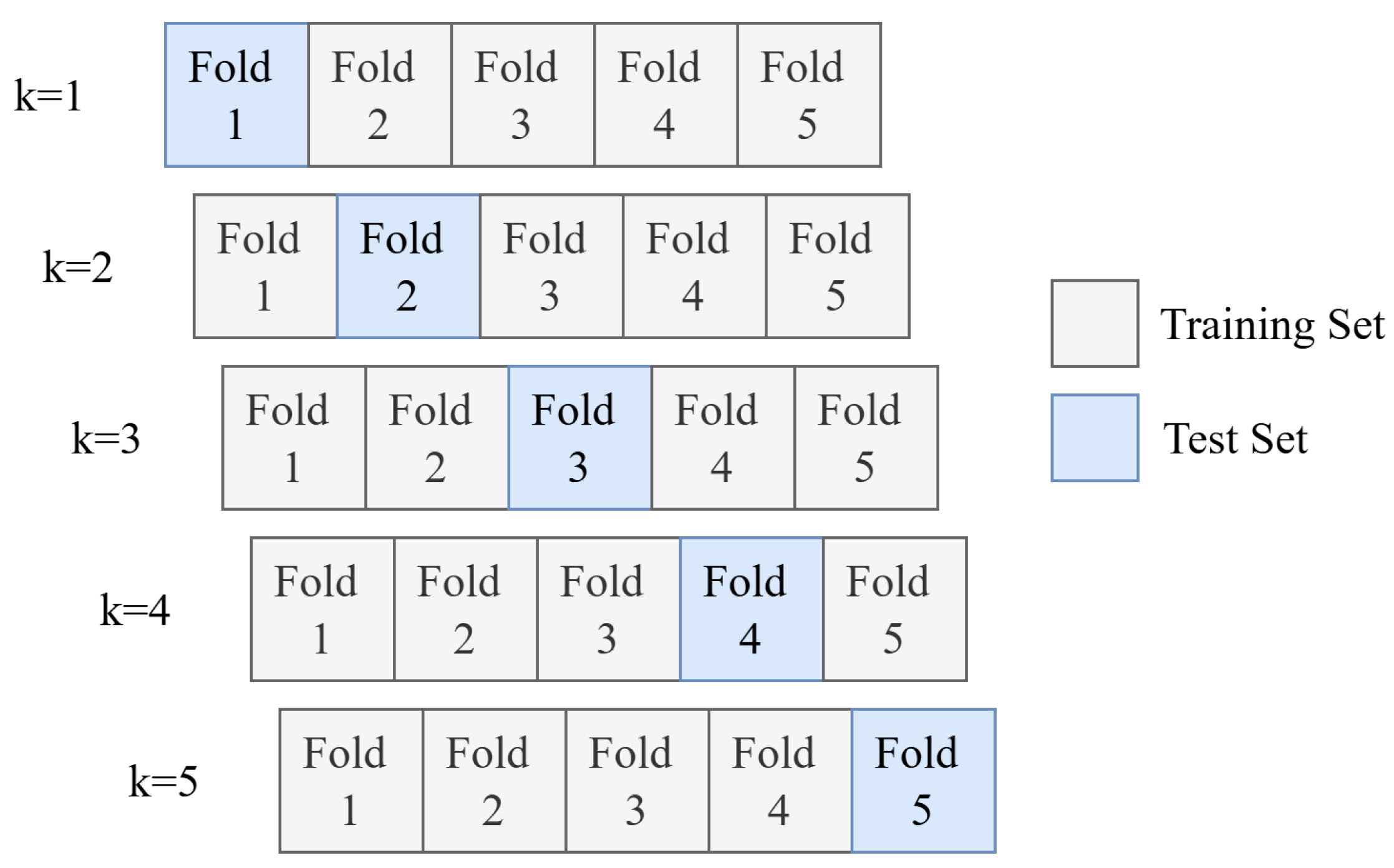
2.2. Cross-Validation (CV)
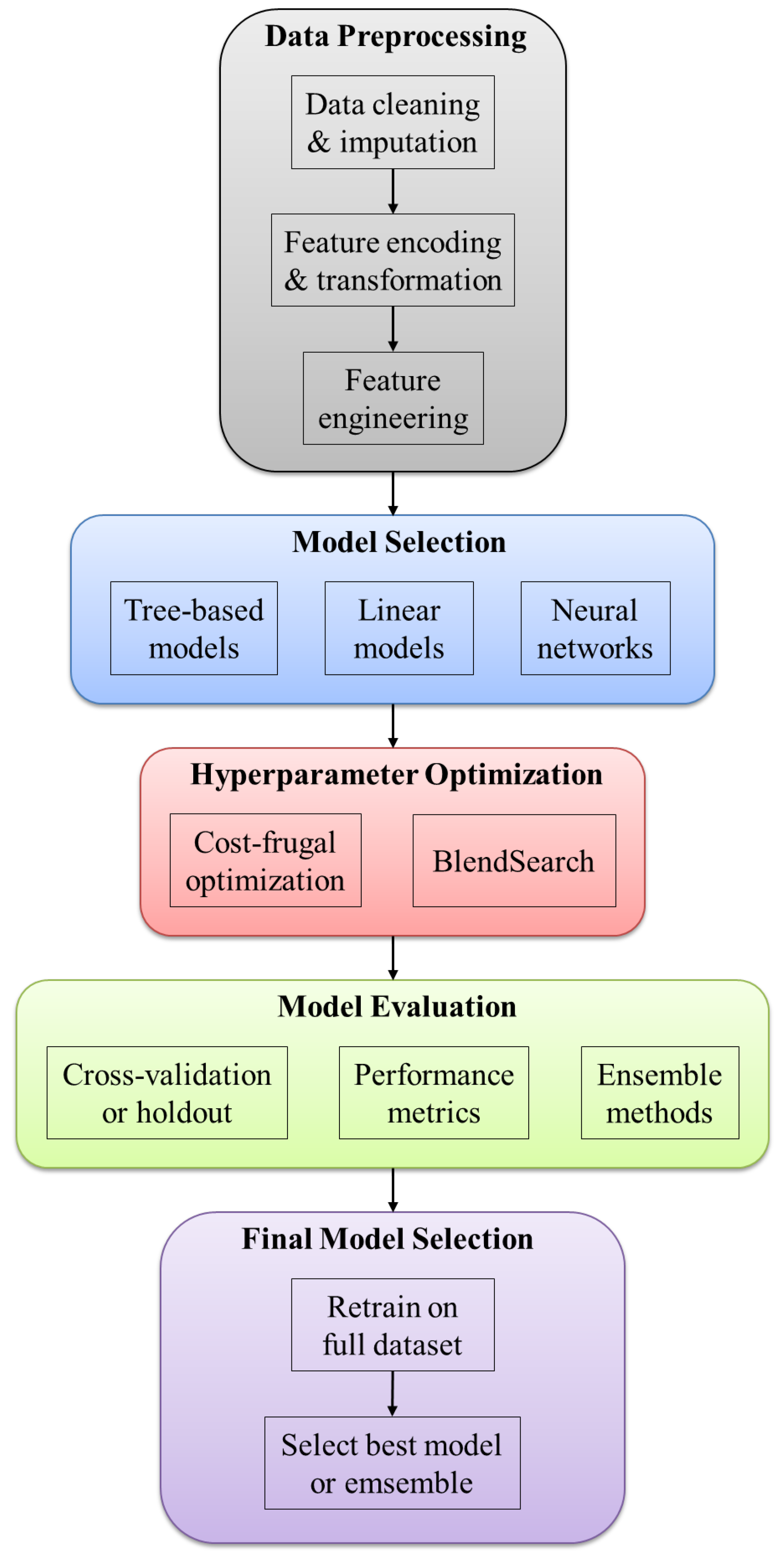
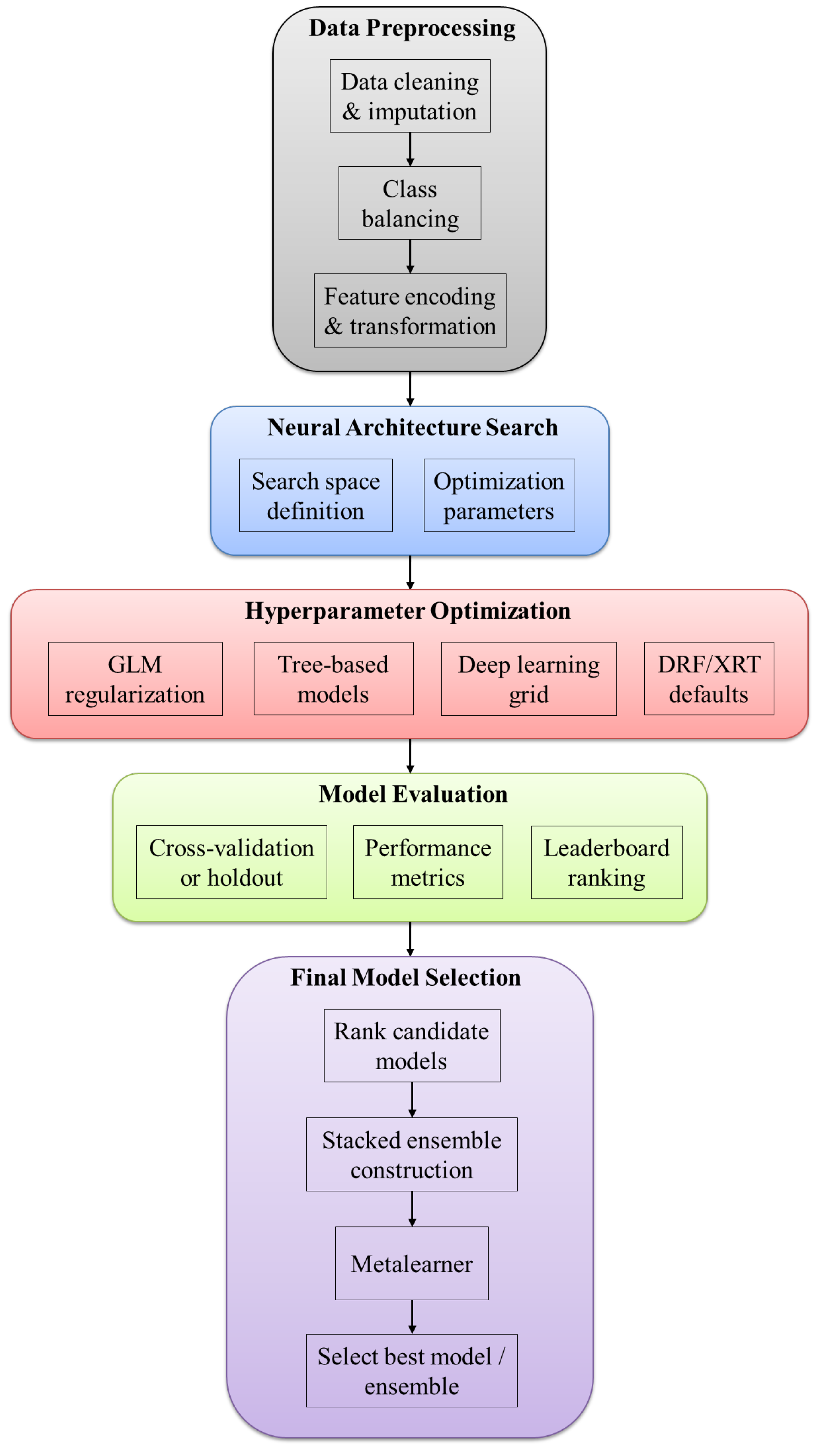
2.3. Automated Machine Learning (AutoML)
2.3.1. Auto-Keras
2.3.2. AutoGluon
2.3.3. Fast Lightweight AutoML (FLAML)
2.3.4. H2O
2.3.5. Tree-Based Pipeline Optimization Tool (TPOT)
2.3.6. Imputation Strategies Across AutoML Frameworks
2.3.7. AutoML Framework Parameters
2.4. Model Development and Validation Procedures
2.5. Performance Metrics
2.6. Feature Importance
3. Computational Experiments
3.1. Computational Settings
3.2. Comparison of AutoML Frameworks
3.3. Comparative Performance Indexes
3.4. Comparison with Previous Studies
3.5. Interpretation of the Findings
3.6. Feature Importance Analysis
3.7. Strengths and Limitations
4. Concluding Remarks
Author Contributions
Funding
Data Availability Statement
Conflicts of Interest
Correction Statement
Appendix A. Exploratory Data Analysis

| Variable | Name | Mean | Std | Min | 25% | 50% | 75% | Max |
|---|---|---|---|---|---|---|---|---|
| LL | Liquid Limit (%) | 45.2 | 13.8 | 19.8 | 37.0 | 43.0 | 52.1 | 76.0 |
| PL | Plasticity Limit (%) | 21.2 | 7.0 | 0.0 | 18.0 | 21.1 | 25.6 | 33.5 |
| PI | Plasticity Index (%) | 22.1 | 13.0 | 0.0 | 14.5 | 20.5 | 28.0 | 53.5 |
| Clay | Clay content (%) | 37.6 | 17.2 | 0.0 | 29.0 | 38.5 | 46.4 | 75.0 |
| Silt | Silt content (%) | 41.1 | 19.3 | 5.0 | 30.1 | 37.0 | 57.3 | 81.0 |
| Sand | Sand content (%) | 16.3 | 15.9 | 0.0 | 1.7 | 11.7 | 29.5 | 65.0 |
| OC | Organic content (%) | 1.0 | 1.5 | 0.0 | 0.0 | 0.2 | 1.6 | 4.8 |
| Lime | Lime content (%) | 5.9 | 4.1 | 0.0 | 2.0 | 6.0 | 10.0 | 14.0 |
| UCS | Unconfined Comp. Strength (MPa) | 0.7 | 0.6 | 0.0 | 0.2 | 0.7 | 1.1 | 2.3 |
| Variable | Name | Mean | Std | Min | 25% | 50% | 75% | Max |
|---|---|---|---|---|---|---|---|---|
| LL | Liquid Limit (%) | 40.1 | 18.2 | 18.9 | 24.6 | 42.4 | 51.0 | 87.1 |
| PL | Plasticity Limit (%) | 19.6 | 8.4 | 0.0 | 16.4 | 20.0 | 26.0 | 34.5 |
| PI | Plasticity Index (%) | 18.3 | 15.9 | 0.0 | 5.0 | 21.9 | 30.0 | 52.6 |
| Clay | Clay content (%) | 33.7 | 24.9 | 0.0 | 15.0 | 38.5 | 47.8 | 82.0 |
| Silt | Silt content (%) | 29.4 | 25.0 | 1.6 | 13.8 | 22.3 | 30.0 | 81.1 |
| Sand | Sand content (%) | 27.3 | 26.3 | 0.0 | 5.5 | 23.9 | 31.5 | 94.4 |
| OC | Organic content (%) | 0.2 | 0.3 | 0.0 | 0.0 | 0.2 | 0.2 | 1.5 |
| Cement | Cement content (%) | 5.9 | 4.7 | 0.0 | 2.0 | 6.0 | 10.0 | 16.0 |
| UCS | Unconfined Comp. Strength (MPa) | 1.8 | 1.5 | 0.0 | 0.7 | 1.6 | 2.5 | 7.1 |
| Variable | Name | Mean | Std | Min | 25% | 50% | 75% | Max |
|---|---|---|---|---|---|---|---|---|
| D | Sampling depth (m) | 2.9 | 1.0 | 2.0 | 2.0 | 2.0 | 4.0 | 4.0 |
| We | Wet density (g/cm3) | 1.8 | 0.1 | 1.7 | 1.7 | 1.9 | 1.9 | 1.9 |
| Cc | Curing condition | 1.5 | 0.5 | 1.0 | 1.0 | 2.0 | 2.0 | 2.0 |
| Cp | Curing period (days) | 17.7 | 10.6 | 7.0 | 7.0 | 28.0 | 28.0 | 28.0 |
| S | Soil type | 1.6 | 0.7 | 1.0 | 1.0 | 1.0 | 2.0 | 3.0 |
| Mc | Moisture content (%) | 1.8 | 0.1 | 1.7 | 1.7 | 1.9 | 1.9 | 2.0 |
| T | Type of cement | 2.1 | 0.8 | 1.0 | 1.0 | 2.0 | 3.0 | 3.0 |
| Ac | Amount of cement (kg/cm3) | 154.0 | 40.6 | 100.0 | 100.0 | 150.0 | 200.0 | 200.0 |
| Di | Specimen diameter (cm) | 5.0 | 0.0 | 4.9 | 5.0 | 5.0 | 5.0 | 5.0 |
| A | Specimen area (cm2) | 19.5 | 0.2 | 18.9 | 19.3 | 19.6 | 19.6 | 19.7 |
| V | Specimen volume (cm3) | 194.8 | 2.0 | 188.6 | 193.4 | 196.4 | 196.4 | 197.4 |
| M | Specimen mass (g) | 337.2 | 35.8 | 255.6 | 311.2 | 343.0 | 376.1 | 385.8 |
| De | Specimen density (g/cm3) | 1.7 | 0.2 | 1.4 | 1.6 | 1.8 | 1.9 | 2.0 |
| UCS | Unconfined Comp. Strength (MPa) | 2.0 | 1.2 | 0.3 | 1.1 | 1.7 | 2.6 | 5.1 |
| Variable | Name | Mean | Std | Min | 25% | 50% | 75% | Max |
|---|---|---|---|---|---|---|---|---|
| C | Clay content (%) | 69.4 | 18.7 | 46.0 | 50.0 | 73.0 | 86.0 | 100.0 |
| PondAsh | Pond ash content (%) | 21.5 | 18.7 | 0.0 | 0.0 | 25.0 | 40.0 | 50.0 |
| RiceHusk | Rice husk ash content (%) | 7.1 | 7.5 | 0.0 | 0.0 | 5.0 | 15.0 | 20.0 |
| Cement | Cement content (%) | 2.0 | 1.6 | 0.0 | 0.0 | 2.0 | 4.0 | 4.0 |
| Curing | Curing period (days) | 16.3 | 8.8 | 7.0 | 7.0 | 14.0 | 28.0 | 28.0 |
| UCS | Unconfined Comp. Strength (kPa) | 258.7 | 80.7 | 118.0 | 186.3 | 265.0 | 311.5 | 512.0 |
| Variable | Name | Mean | Std | Min | 25% | 50% | 75% | Max |
|---|---|---|---|---|---|---|---|---|
| LL | Liquid Limit (%) | 63.8 | 32.3 | 37.7 | 37.7 | 38.0 | 82.2 | 116.0 |
| PI | Plasticity Index (%) | 38.8 | 30.7 | 14.1 | 14.1 | 14.1 | 56.5 | 88.5 |
| S | GGBS content (%) | 15.9 | 12.9 | 0.0 | 4.0 | 16.0 | 20.0 | 50.0 |
| FA | Fly ash content (%) | 2.1 | 4.7 | 0.0 | 0.0 | 0.0 | 0.0 | 20.0 |
| M | Molar concentration | 12.4 | 2.7 | 4.0 | 12.0 | 12.0 | 14.5 | 15.0 |
| A/B | Alkali to binder ratio | 0.6 | 0.1 | 0.5 | 0.5 | 0.6 | 0.6 | 0.9 |
| Na/Al | Na/Al ratio | 1.2 | 0.4 | 0.2 | 0.9 | 1.2 | 1.5 | 2.0 |
| Si/Al | Si/Al ratio | 1.7 | 0.4 | 1.5 | 1.5 | 1.5 | 1.9 | 2.5 |
| UCS | Unconfined Comp. Strength (MPa) | 5.8 | 6.5 | 0.0 | 0.1 | 2.9 | 10.9 | 24.3 |
| Variable | Name | Mean | Std | Min | 25% | 50% | 75% | Max |
|---|---|---|---|---|---|---|---|---|
| Soil | Soil content (%) | 93.7 | 4.7 | 70.0 | 94.0 | 94.0 | 95.0 | 100.0 |
| Cement | Cement content (%) | 3.8 | 4.3 | 0.0 | 0.0 | 4.0 | 6.0 | 30.0 |
| Lime | Lime content (%) | 2.6 | 4.1 | 0.0 | 0.0 | 2.0 | 4.0 | 30.0 |
| LL | Liquid Limit (%) | 39.5 | 16.7 | 18.0 | 29.0 | 35.0 | 45.0 | 102.0 |
| PL | Plasticity Limit (%) | 22.7 | 9.4 | 12.0 | 17.0 | 20.0 | 26.0 | 58.2 |
| PI | Plasticity Index (%) | 16.8 | 12.7 | 0.0 | 7.0 | 15.5 | 21.0 | 70.0 |
| USCS | Unified Soil Classification System | 1.9 | 1.4 | 0.0 | 1.0 | 1.0 | 4.0 | 4.0 |
| MDD | Maximum dry density (MN/m3) (*) | 1.8 | 0.2 | 1.2 | 1.6 | 1.8 | 2.0 | 2.2 |
| OMC | Optimum moisture | |||||||
| content (%) | 14.0 | 7.3 | 5.4 | 8.8 | 11.2 | 16.3 | 36.8 | |
| UCS | Unconfined Comp. | |||||||
| Strength (MPa) (*) | 2.3 | 1.2 | 0.1 | 1.7 | 2.3 | 3.0 | 5.4 |
| Variable | Name | Mean | Std | Min | 25% | 50% | 75% | Max |
|---|---|---|---|---|---|---|---|---|
| ST | Soil type | 0.5 | 0.5 | 0.0 | 0.0 | 0.0 | 1.0 | 1.0 |
| DUW | Dry unit weight (kN/m3) | 13.5 | 1.9 | 11.0 | 12.0 | 14.0 | 15.0 | 17.0 |
| CT | Curing time (days) | 31.3 | 22.0 | 0.0 | 7.0 | 28.0 | 60.0 | 60.0 |
| C | Cement content (%) | 2.3 | 0.9 | 0.0 | 1.9 | 2.5 | 3.1 | 3.8 |
| L | Lime content (%) | 4.7 | 1.7 | 0.0 | 3.8 | 5.0 | 6.3 | 7.5 |
| RHA | Rice husk ash content (%) | 1.9 | 1.2 | 0.0 | 1.3 | 1.9 | 3.1 | 3.8 |
| UCS | Unconfined Comp. Strength (kPa) | 432.9 | 430.9 | 25.0 | 138.0 | 285.0 | 539.0 | 2099.0 |
| Variable | Name | Mean | Std | Min | 25% | 50% | 75% | Max |
|---|---|---|---|---|---|---|---|---|
| n | Porosity (%) | 2.8 | 4.1 | 0.1 | 0.3 | 0.5 | 3.8 | 16.8 |
| SHR | Schmidt hammer number | 44.4 | 11.5 | 25.5 | 33.5 | 46.0 | 53.0 | 67.1 |
| Vp | P-wave velocity (km/s) | 5.4 | 1.0 | 2.7 | 4.9 | 5.5 | 6.0 | 7.9 |
| Is(50) | Point load index (MPa) | 4.3 | 2.5 | 0.9 | 2.8 | 3.4 | 5.4 | 14.1 |
| UCS | Unconfined Comp. Strength (MPa) | 96.0 | 51.1 | 12.0 | 41.6 | 99.5 | 136.7 | 215.2 |
| Variable | Name | Mean | Std | Min | 25% | 50% | 75% | Max |
|---|---|---|---|---|---|---|---|---|
| d50 | Median grain size (mm) | 0.4 | 0.3 | 0.1 | 0.2 | 0.3 | 0.5 | 1.6 |
| Cu | Coefficient of uniformity | 1.8 | 1.1 | 1.2 | 1.4 | 1.4 | 1.6 | 6.2 |
| e0 | Initial void ratio | 0.6 | 0.1 | 0.4 | 0.6 | 0.7 | 0.7 | 1.0 |
| OD600 | Optical density (OD600) | 2.0 | 1.2 | 0.3 | 1.0 | 1.8 | 3.0 | 4.5 |
| Mu | Urea conc. (mol/L) | 0.7 | 0.3 | 0.1 | 0.5 | 1.0 | 1.0 | 1.5 |
| MCa | Calcium conc. (mol/L) | 0.7 | 0.3 | 0.1 | 0.5 | 1.0 | 1.0 | 1.5 |
| FCa | Calcium carbonate content (%) | 8.8 | 6.5 | 1.5 | 4.2 | 6.5 | 11.7 | 29.5 |
| UCS | Unconfined Comp. Strength (MPa) | 1.8 | 2.0 | 0.1 | 0.5 | 1.2 | 2.3 | 14.2 |
| Variable | Name | Mean | Std | Min | 25% | 50% | 75% | Max |
|---|---|---|---|---|---|---|---|---|
| Cc | Cement proportion (kg/m3) | 0.2 | 0.1 | 0.1 | 0.1 | 0.2 | 0.2 | 0.3 |
| Cw | Water content (kg/m3) | 0.7 | 0.1 | 0.5 | 0.6 | 0.7 | 0.8 | 0.9 |
| Tc | Curing period (days) | 40.2 | 28.4 | 7.0 | 14.0 | 35.0 | 60.0 | 90.0 |
| Tp | Peak bond strength (kPa) | 954.1 | 1173.7 | 3.0 | 95.5 | 419.3 | 1524.0 | 5363.1 |
| Tt | Residual bond strength (kPa) | 179.5 | 225.3 | 0.3 | 18.7 | 74.6 | 276.4 | 1109.6 |
| UCS | Unconfined Comp. Strength (MPa) (*) | 2.1 | 2.2 | 0.0 | 0.4 | 1.3 | 3.2 | 10.3 |
Appendix B. Dunn’s Test Results
| Metric | Significant Pairwise Differences (p < 0.05) |
|---|---|
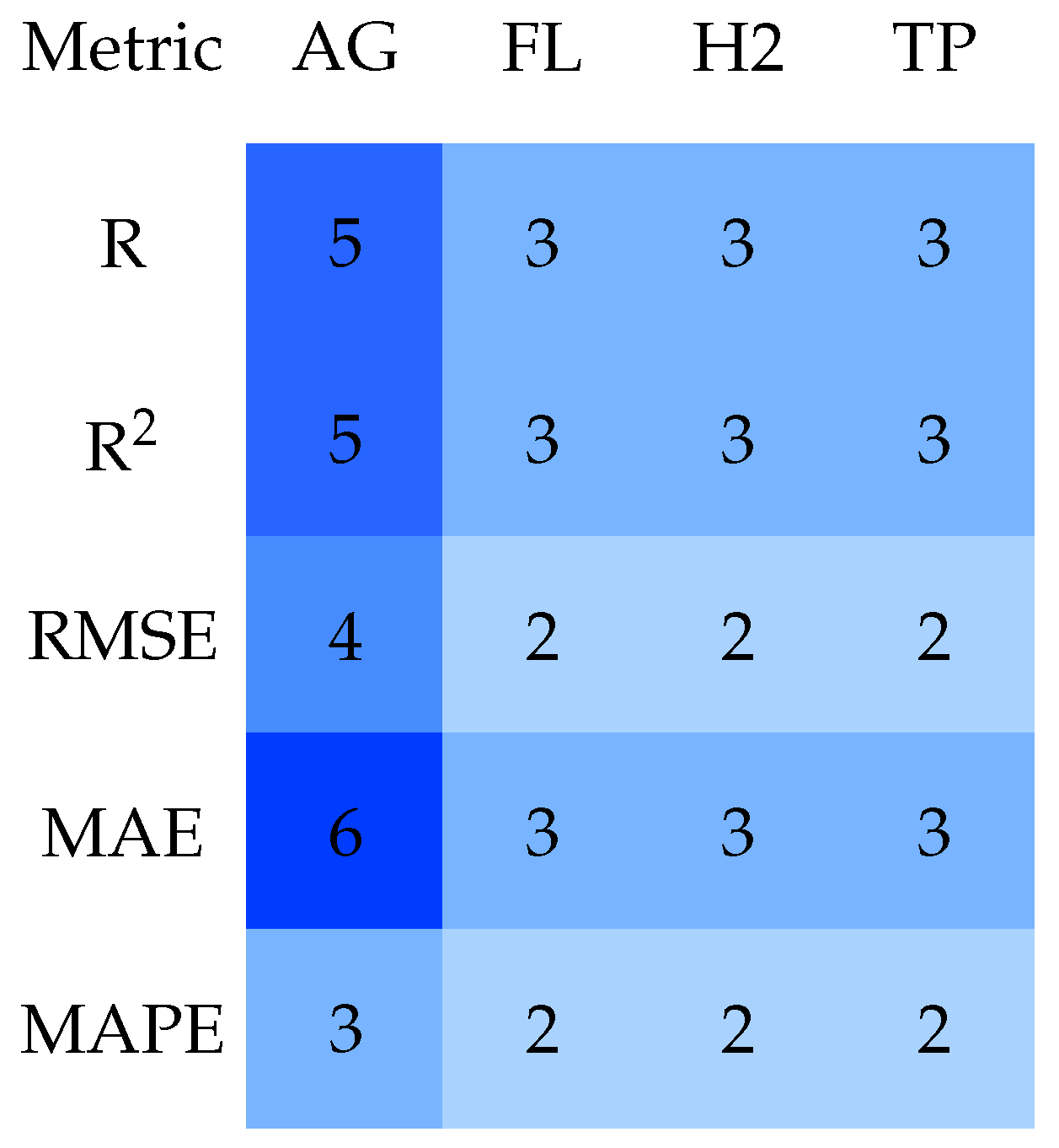
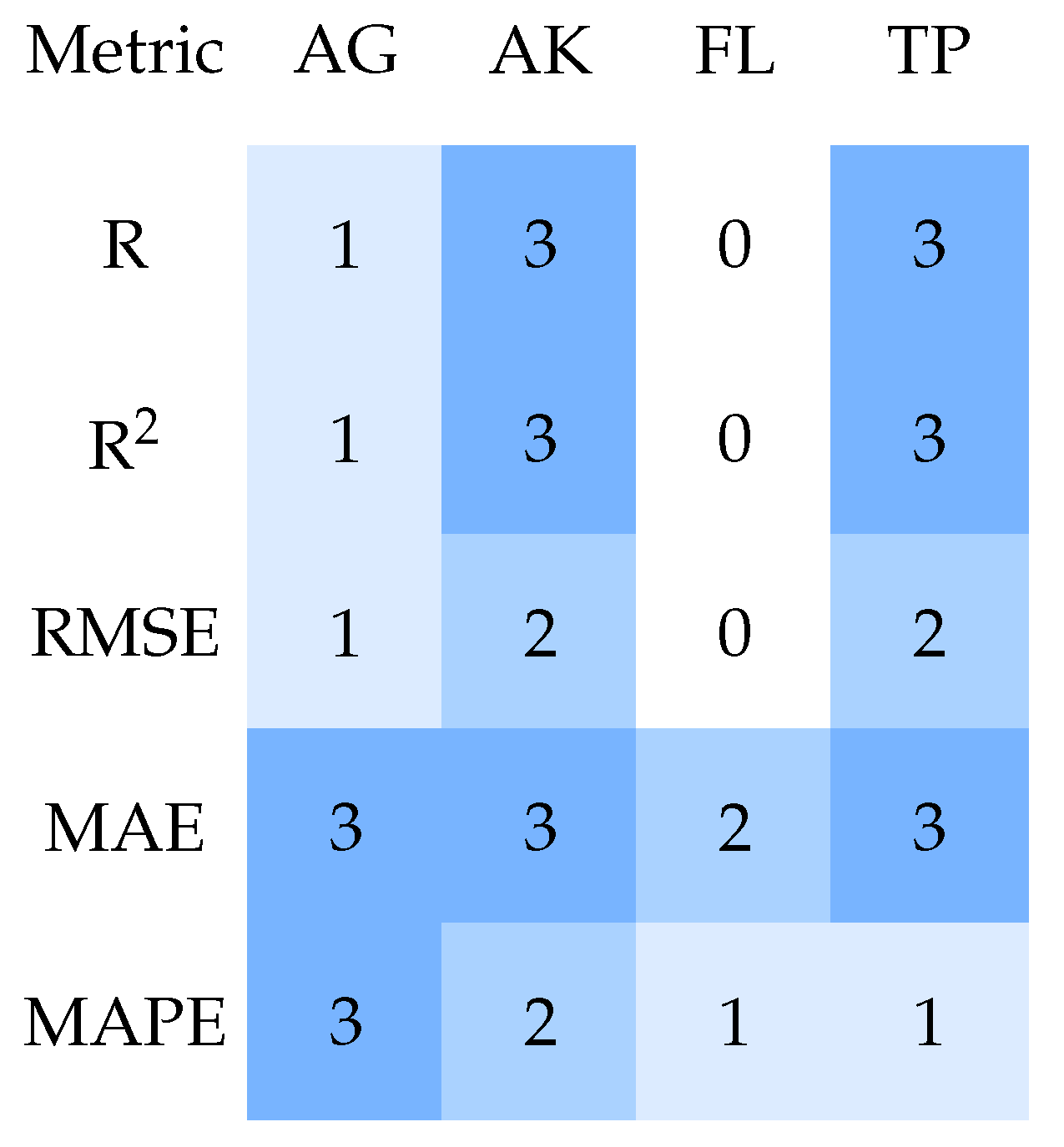
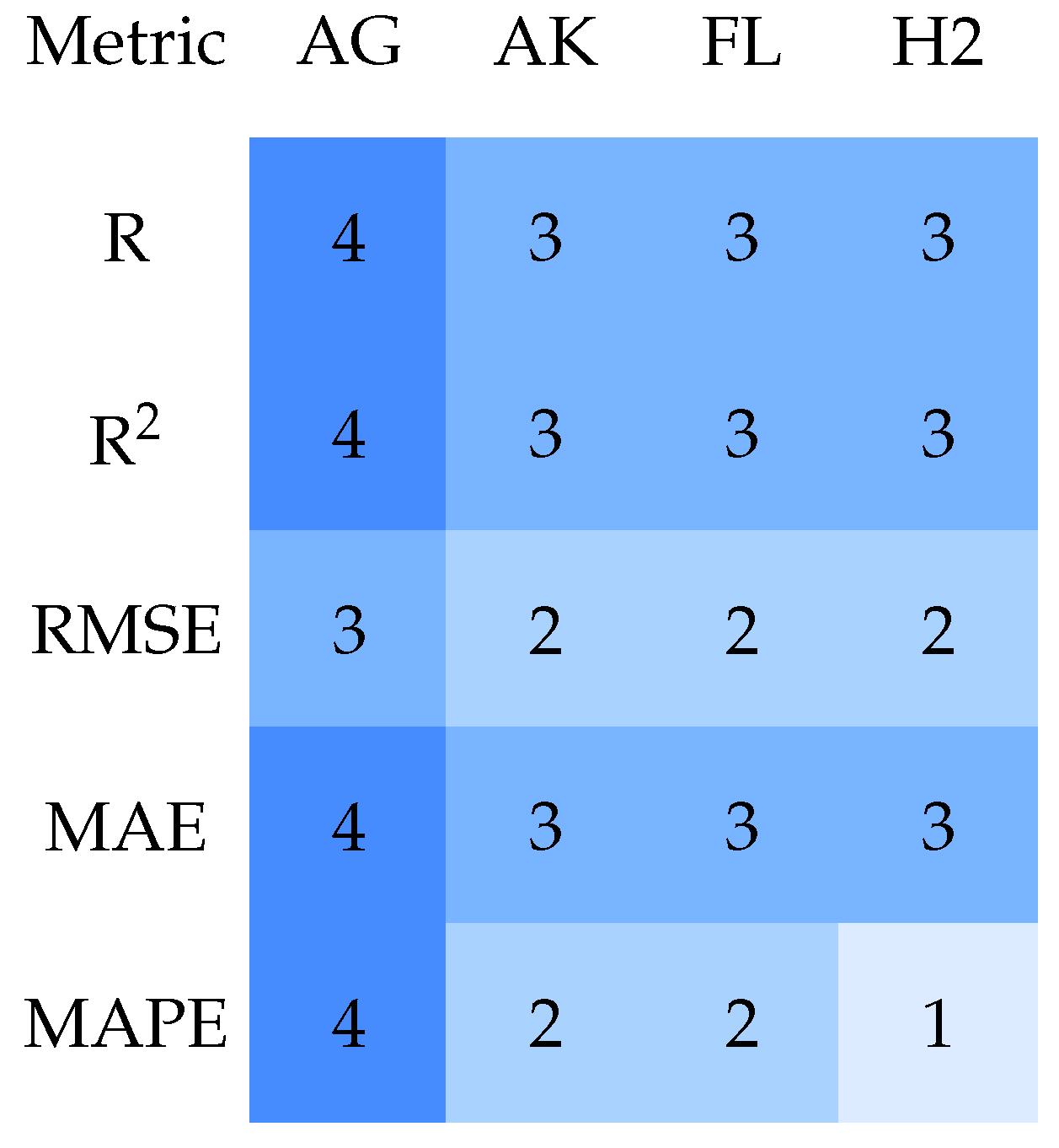
| R | D2: AG < AK, AG < TP, AK < FL, AK < H2O |
| D4: AG < AK, AG < FL, AG < H2O, AG < TP, AK < FL, AK < H2O, AK < TP | |
| D6: AG < AK, AK < FL, AK < H2O, AK < TP | |
| D7: AG < AK, AK < FL | |
| D8: FL < TP, H2O < TP | |
| D9: AG < TP | |
| D10: AG < AK, AG < TP, AK < TP, FL < TP, H2O < TP | |
| R2 | D2: AG < AK, AG < TP, AK < FL, AK < H2O |
| D4: AG < AK, AG < FL, AG < H2O, AG < TP, AK < FL, AK < H2O, AK < TP | |
| D6: AG < AK, AK < FL, AK < H2O, AK < TP | |
| D7: AG < AK, AK < FL | |
| D8: FL < TP, H2O < TP | |
| D9: AG < TP | |
| D10: AG < AK, AG < TP, AK < TP, FL < TP, H2O < TP | |
| RMSE | D2: AG < AK, AG < TP, AK < FL, AK < H2O |
| D4: AG < AK, AG < H2O, AG < TP, AK < FL, AK < H2O, AK < TP | |
| D6: AG < AK, AK < FL, AK < H2O, AK < TP | |
| D8: FL < TP, H2O < TP | |
| D9: AG < TP | |
| D10: AG < AK, AK < TP, FL < TP, H2O < TP | |
| MAE | D2: AG < AK, AG < TP, AK < FL, AK < H2O |
| D4: AG < AK, AG < H2O, AG < TP, AK < FL, AK < H2O, AK < TP | |
| D5: AG < AK, AG < FL, AK < H2O, FL < H2O | |
| D6: AG < AK, AK < FL, AK < H2O, AK < TP | |
| D7: AG < AK, AK < FL, AK < H2O | |
| D8: FL < TP, H2O < TP | |
| D9: AG < TP, FL < H2O, FL < TP | |
| D10: AG < AK, AG < H2O, AK < FL, AK < TP, FL < TP, H2O < TP | |
| MAPE | D4: AG < AK, AG < H2O, AG < TP, AK < FL, AK < H2O, AK < TP |
| D5: AG < AK, AG < FL, AG < TP, AK < H2O, FL < H2O, H2O < TP | |
| D7: AG < AK, AK < FL, AK < H2O | |
| D8: H2O < TP | |
| D9: AG < H2O, AG < TP, FL < TP | |
| D10: AG < AK, AG < H2O, AG < TP, AK < FL, FL < H2O |
Appendix C. Normality and Homogeneity Tests
| Model | Metric | Shapiro–Wilk (p) | Levene (p) | Assumptions |
|---|---|---|---|---|
| AutoGluon | MAE | 0.114 | 0.011 | Violated |
| AutoKeras | MAE | 0.458 | 0.011 | Violated |
| FLAML | MAE | 0.406 | 0.011 | Violated |
| H2O | MAE | 0.027 | 0.011 | Violated |
| TPOT | MAE | 0.003 | 0.011 | Violated |
| AutoGluon | MAPE | 0.015 | 0.206 | Violated |
| AutoKeras | MAPE | 0.152 | 0.206 | OK |
| FLAML | MAPE | 0.013 | 0.206 | Violated |
| H2O | MAPE | 0.174 | 0.206 | OK |
| TPOT | MAPE | 0.003 | 0.206 | Violated |
| AutoGluon | R | 0.033 | 0.222 | Violated |
| AutoKeras | R | 0.378 | 0.222 | OK |
| FLAML | R | 0.000 | 0.222 | Violated |
| H2O | R | 0.085 | 0.222 | OK |
| TPOT | R | 0.573 | 0.222 | OK |
| AutoGluon | R2 | 0.196 | 0.012 | Violated |
| AutoKeras | R2 | 0.902 | 0.012 | Violated |
| FLAML | R2 | 0.001 | 0.012 | Violated |
| H2O | R2 | 0.037 | 0.012 | Violated |
| TPOT | R2 | 0.534 | 0.012 | Violated |
| AutoGluon | RMSE | 0.050 | 0.489 | OK |
| AutoKeras | RMSE | 0.386 | 0.489 | OK |
| FLAML | RMSE | 0.022 | 0.489 | Violated |
| H2O | RMSE | 0.167 | 0.489 | OK |
| TPOT | RMSE | 0.359 | 0.489 | OK |
| Model | Metric | Shapiro–Wilk (p) | Levene (p) | Assumptions |
|---|---|---|---|---|
| AutoGluon | MAE | 0.001 | 0.000 | Violated |
| AutoKeras | MAE | 0.743 | 0.000 | Violated |
| FLAML | MAE | 0.178 | 0.000 | Violated |
| H2O | MAE | 0.001 | 0.000 | Violated |
| TPOT | MAE | 0.587 | 0.000 | Violated |
| AutoGluon | MAPE | 0.000 | 0.004 | Violated |
| AutoKeras | MAPE | 0.157 | 0.004 | Violated |
| FLAML | MAPE | 0.000 | 0.004 | Violated |
| H2O | MAPE | 0.000 | 0.004 | Violated |
| TPOT | MAPE | 0.032 | 0.004 | Violated |
| AutoGluon | R | 0.003 | 0.017 | Violated |
| AutoKeras | R | 0.002 | 0.017 | Violated |
| FLAML | R | 0.002 | 0.017 | Violated |
| H2O | R | 0.000 | 0.017 | Violated |
| TPOT | R | 0.002 | 0.017 | Violated |
| AutoGluon | R2 | 0.001 | 0.060 | Violated |
| AutoKeras | R2 | 0.000 | 0.060 | Violated |
| FLAML | R2 | 0.004 | 0.060 | Violated |
| H2O | R2 | 0.000 | 0.060 | Violated |
| TPOT | R2 | 0.000 | 0.060 | Violated |
| AutoGluon | RMSE | 0.094 | 0.006 | Violated |
| AutoKeras | RMSE | 0.371 | 0.006 | Violated |
| FLAML | RMSE | 0.831 | 0.006 | Violated |
| H2O | RMSE | 0.003 | 0.006 | Violated |
| TPOT | RMSE | 0.435 | 0.006 | Violated |
| Model | Metric | Shapiro–Wilk (p) | Levene (p) | Assumptions |
|---|---|---|---|---|
| AutoGluon | MAE | 0.122 | 0.000 | Violated |
| AutoKeras | MAE | 0.803 | 0.000 | Violated |
| FLAML | MAE | 0.936 | 0.000 | Violated |
| H2O | MAE | 0.820 | 0.000 | Violated |
| TPOT | MAE | 0.262 | 0.000 | Violated |
| AutoGluon | MAPE | 0.006 | 0.000 | Violated |
| AutoKeras | MAPE | 0.243 | 0.000 | Violated |
| FLAML | MAPE | 0.563 | 0.000 | Violated |
| H2O | MAPE | 0.210 | 0.000 | Violated |
| TPOT | MAPE | 0.518 | 0.000 | Violated |
| AutoGluon | R | 0.000 | 0.000 | Violated |
| AutoKeras | R | 0.105 | 0.000 | Violated |
| FLAML | R | 0.683 | 0.000 | Violated |
| H2O | R | 0.001 | 0.000 | Violated |
| TPOT | R | 0.010 | 0.000 | Violated |
| AutoGluon | R2 | 0.000 | 0.000 | Violated |
| AutoKeras | R2 | 0.159 | 0.000 | Violated |
| FLAML | R2 | 0.529 | 0.000 | Violated |
| H2O | R2 | 0.001 | 0.000 | Violated |
| TPOT | R2 | 0.000 | 0.000 | Violated |
| AutoGluon | RMSE | 0.023 | 0.000 | Violated |
| AutoKeras | RMSE | 0.721 | 0.000 | Violated |
| FLAML | RMSE | 0.879 | 0.000 | Violated |
| H2O | RMSE | 0.269 | 0.000 | Violated |
| TPOT | RMSE | 0.001 | 0.000 | Violated |
| Model | Metric | Shapiro–Wilk (p) | Levene (p) | Assumptions |
|---|---|---|---|---|
| AutoGluon | MAE | 0.039 | 0.000 | Violated |
| AutoKeras | MAE | 0.818 | 0.000 | Violated |
| FLAML | MAE | 0.000 | 0.000 | Violated |
| H2O | MAE | 0.001 | 0.000 | Violated |
| TPOT | MAE | 0.025 | 0.000 | Violated |
| AutoGluon | MAPE | 0.017 | 0.000 | Violated |
| AutoKeras | MAPE | 0.220 | 0.000 | Violated |
| FLAML | MAPE | 0.000 | 0.000 | Violated |
| H2O | MAPE | 0.030 | 0.000 | Violated |
| TPOT | MAPE | 0.009 | 0.000 | Violated |
| AutoGluon | R | 0.051 | 0.000 | Violated |
| AutoKeras | R | 0.939 | 0.000 | Violated |
| FLAML | R | 0.000 | 0.000 | Violated |
| H2O | R | 0.000 | 0.000 | Violated |
| TPOT | R | 0.000 | 0.000 | Violated |
| AutoGluon | R2 | 0.001 | 0.000 | Violated |
| AutoKeras | R2 | 0.208 | 0.000 | Violated |
| FLAML | R2 | 0.000 | 0.000 | Violated |
| H2O | R2 | 0.000 | 0.000 | Violated |
| TPOT | R2 | 0.001 | 0.000 | Violated |
| AutoGluon | RMSE | 0.011 | 0.000 | Violated |
| AutoKeras | RMSE | 0.673 | 0.000 | Violated |
| FLAML | RMSE | 0.000 | 0.000 | Violated |
| H2O | RMSE | 0.015 | 0.000 | Violated |
| TPOT | RMSE | 0.004 | 0.000 | Violated |
| Model | Metric | Shapiro–Wilk (p) | Levene (p) | Assumptions |
|---|---|---|---|---|
| AutoGluon | MAE | 0.260 | 0.103 | OK |
| AutoKeras | MAE | 0.879 | 0.103 | OK |
| FLAML | MAE | 0.523 | 0.103 | OK |
| H2O | MAE | 0.887 | 0.103 | OK |
| TPOT | MAE | 0.629 | 0.103 | OK |
| AutoGluon | MAPE | 0.000 | 0.000 | Violated |
| AutoKeras | MAPE | 0.100 | 0.000 | Violated |
| FLAML | MAPE | 0.000 | 0.000 | Violated |
| H2O | MAPE | 0.003 | 0.000 | Violated |
| TPOT | MAPE | 0.000 | 0.000 | Violated |
| AutoGluon | R | 0.000 | 0.051 | Violated |
| AutoKeras | R | 0.151 | 0.051 | OK |
| FLAML | R | 0.012 | 0.051 | Violated |
| H2O | R | 0.003 | 0.051 | Violated |
| TPOT | R | 0.014 | 0.051 | Violated |
| AutoGluon | R2 | 0.002 | 0.123 | Violated |
| AutoKeras | R2 | 0.044 | 0.123 | Violated |
| FLAML | R2 | 0.003 | 0.123 | Violated |
| H2O | R2 | 0.005 | 0.123 | Violated |
| TPOT | R2 | 0.048 | 0.123 | Violated |
| AutoGluon | RMSE | 0.412 | 0.640 | OK |
| AutoKeras | RMSE | 0.694 | 0.640 | OK |
| FLAML | RMSE | 0.179 | 0.640 | OK |
| H2O | RMSE | 0.490 | 0.640 | OK |
| TPOT | RMSE | 0.653 | 0.640 | OK |
| Model | Metric | Shapiro–Wilk (p) | Levene (p) | Assumptions |
|---|---|---|---|---|
| AutoGluon | MAE | 0.286 | 0.000 | Violated |
| AutoKeras | MAE | 0.321 | 0.000 | Violated |
| FLAML | MAE | 0.920 | 0.000 | Violated |
| H2O | MAE | 0.081 | 0.000 | Violated |
| TPOT | MAE | 0.019 | 0.000 | Violated |
| AutoGluon | MAPE | 0.663 | 0.247 | OK |
| AutoKeras | MAPE | 0.373 | 0.247 | OK |
| FLAML | MAPE | 0.374 | 0.247 | OK |
| H2O | MAPE | 0.080 | 0.247 | OK |
| TPOT | MAPE | 0.000 | 0.247 | Violated |
| AutoGluon | R | 0.870 | 0.000 | Violated |
| AutoKeras | R | 0.094 | 0.000 | Violated |
| FLAML | R | 0.397 | 0.000 | Violated |
| H2O | R | 0.780 | 0.000 | Violated |
| TPOT | R | 0.339 | 0.000 | Violated |
| AutoGluon | R2 | 0.696 | 0.000 | Violated |
| AutoKeras | R2 | 0.216 | 0.000 | Violated |
| FLAML | R2 | 0.368 | 0.000 | Violated |
| H2O | R2 | 0.832 | 0.000 | Violated |
| TPOT | R2 | 0.233 | 0.000 | Violated |
| AutoGluon | RMSE | 0.941 | 0.024 | Violated |
| AutoKeras | RMSE | 0.473 | 0.024 | Violated |
| FLAML | RMSE | 0.945 | 0.024 | Violated |
| H2O | RMSE | 0.300 | 0.024 | Violated |
| TPOT | RMSE | 0.190 | 0.024 | Violated |
| Model | Metric | Shapiro–Wilk (p) | Levene (p) | Assumptions |
|---|---|---|---|---|
| AutoGluon | MAE | 0.766 | 0.000 | Violated |
| AutoKeras | MAE | 0.203 | 0.000 | Violated |
| FLAML | MAE | 0.007 | 0.000 | Violated |
| H2O | MAE | 0.000 | 0.000 | Violated |
| TPOT | MAE | 0.266 | 0.000 | Violated |
| AutoGluon | MAPE | 0.050 | 0.000 | Violated |
| AutoKeras | MAPE | 0.001 | 0.000 | Violated |
| FLAML | MAPE | 0.346 | 0.000 | Violated |
| H2O | MAPE | 0.000 | 0.000 | Violated |
| TPOT | MAPE | 0.088 | 0.000 | Violated |
| AutoGluon | R | 0.000 | 0.000 | Violated |
| AutoKeras | R | 0.206 | 0.000 | Violated |
| FLAML | R | 0.001 | 0.000 | Violated |
| H2O | R | 0.000 | 0.000 | Violated |
| TPOT | R | 0.000 | 0.000 | Violated |
| AutoGluon | R2 | 0.006 | 0.001 | Violated |
| AutoKeras | R2 | 0.174 | 0.001 | Violated |
| FLAML | R2 | 0.001 | 0.001 | Violated |
| H2O | R2 | 0.000 | 0.001 | Violated |
| TPOT | R2 | 0.001 | 0.001 | Violated |
| AutoGluon | RMSE | 0.606 | 0.000 | Violated |
| AutoKeras | RMSE | 0.171 | 0.000 | Violated |
| FLAML | RMSE | 0.064 | 0.000 | Violated |
| H2O | RMSE | 0.000 | 0.000 | Violated |
| TPOT | RMSE | 0.241 | 0.000 | Violated |
| Model | Metric | Shapiro–Wilk (p) | Levene (p) | Assumptions |
|---|---|---|---|---|
| AutoGluon | MAE | 0.271 | 0.000 | Violated |
| AutoKeras | MAE | 0.624 | 0.000 | Violated |
| FLAML | MAE | 0.543 | 0.000 | Violated |
| H2O | MAE | 0.024 | 0.000 | Violated |
| TPOT | MAE | 0.451 | 0.000 | Violated |
| AutoGluon | MAPE | 0.609 | 0.001 | Violated |
| AutoKeras | MAPE | 0.290 | 0.001 | Violated |
| FLAML | MAPE | 0.634 | 0.001 | Violated |
| H2O | MAPE | 0.004 | 0.001 | Violated |
| TPOT | MAPE | 0.513 | 0.001 | Violated |
| AutoGluon | R | 0.177 | 0.032 | Violated |
| AutoKeras | R | 0.884 | 0.032 | Violated |
| FLAML | R | 0.012 | 0.032 | Violated |
| H2O | R | 0.000 | 0.032 | Violated |
| TPOT | R | 0.231 | 0.032 | Violated |
| AutoGluon | R2 | 0.119 | 0.001 | Violated |
| AutoKeras | R2 | 0.918 | 0.001 | Violated |
| FLAML | R2 | 0.013 | 0.001 | Violated |
| H2O | R2 | 0.000 | 0.001 | Violated |
| TPOT | R2 | 0.276 | 0.001 | Violated |
| AutoGluon | RMSE | 0.618 | 0.000 | Violated |
| AutoKeras | RMSE | 0.972 | 0.000 | Violated |
| FLAML | RMSE | 0.308 | 0.000 | Violated |
| H2O | RMSE | 0.061 | 0.000 | Violated |
| TPOT | RMSE | 0.644 | 0.000 | Violated |
| Model | Metric | Shapiro–Wilk (p) | Levene (p) | Assumptions |
|---|---|---|---|---|
| AutoGluon | MAE | 0.480 | 0.046 | Violated |
| AutoKeras | MAE | 0.143 | 0.046 | Violated |
| FLAML | MAE | 0.397 | 0.046 | Violated |
| H2O | MAE | 0.000 | 0.046 | Violated |
| TPOT | MAE | 0.768 | 0.046 | Violated |
| AutoGluon | MAPE | 0.078 | 0.006 | Violated |
| AutoKeras | MAPE | 0.047 | 0.006 | Violated |
| FLAML | MAPE | 0.217 | 0.006 | Violated |
| H2O | MAPE | 0.000 | 0.006 | Violated |
| TPOT | MAPE | 0.003 | 0.006 | Violated |
| AutoGluon | R | 0.188 | 0.113 | OK |
| AutoKeras | R | 0.019 | 0.113 | Violated |
| FLAML | R | 0.509 | 0.113 | OK |
| H2O | R | 0.000 | 0.113 | Violated |
| TPOT | R | 0.010 | 0.113 | Violated |
| AutoGluon | R2 | 0.007 | 0.103 | Violated |
| AutoKeras | R2 | 0.004 | 0.103 | Violated |
| FLAML | R2 | 0.017 | 0.103 | Violated |
| H2O | R2 | 0.001 | 0.103 | Violated |
| TPOT | R2 | 0.013 | 0.103 | Violated |
| AutoGluon | RMSE | 0.000 | 0.573 | Violated |
| AutoKeras | RMSE | 0.215 | 0.573 | OK |
| FLAML | RMSE | 0.000 | 0.573 | Violated |
| H2O | RMSE | 0.008 | 0.573 | Violated |
| TPOT | RMSE | 0.027 | 0.573 | Violated |
| Model | Metric | Shapiro–Wilk (p) | Levene (p) | Assumptions |
|---|---|---|---|---|
| AutoGluon | MAE | 0.359 | 0.000 | Violated |
| AutoKeras | MAE | 0.726 | 0.000 | Violated |
| FLAML | MAE | 0.015 | 0.000 | Violated |
| H2O | MAE | 0.000 | 0.000 | Violated |
| TPOT | MAE | 0.423 | 0.000 | Violated |
| AutoGluon | MAPE | 0.065 | 0.000 | Violated |
| AutoKeras | MAPE | 0.108 | 0.000 | Violated |
| FLAML | MAPE | 0.001 | 0.000 | Violated |
| H2O | MAPE | 0.000 | 0.000 | Violated |
| TPOT | MAPE | 0.000 | 0.000 | Violated |
| AutoGluon | R | 0.051 | 0.000 | Violated |
| AutoKeras | R | 0.024 | 0.000 | Violated |
| FLAML | R | 0.979 | 0.000 | Violated |
| H2O | R | 0.000 | 0.000 | Violated |
| TPOT | R | 0.290 | 0.000 | Violated |
| AutoGluon | R2 | 0.007 | 0.000 | Violated |
| AutoKeras | R2 | 0.656 | 0.000 | Violated |
| FLAML | R2 | 0.591 | 0.000 | Violated |
| H2O | R2 | 0.000 | 0.000 | Violated |
| TPOT | R2 | 0.655 | 0.000 | Violated |
| AutoGluon | RMSE | 0.016 | 0.000 | Violated |
| AutoKeras | RMSE | 0.622 | 0.000 | Violated |
| FLAML | RMSE | 0.026 | 0.000 | Violated |
| H2O | RMSE | 0.000 | 0.000 | Violated |
| TPOT | RMSE | 0.371 | 0.000 | Violated |
References
- Sheshde, E.A.; Cheshomi, A. New method for estimating unconfined compressive strength (UCS) using small rock samples. J. Pet. Sci. Eng. 2015, 133, 367–375. [Google Scholar] [CrossRef]
- Kormu, S.; Sorsa, A.; Amena, S. Correlation of unconfined compressive strength (UCS) with compaction characteristics of soils in Burayu Town. Adv. Mater. Sci. Eng. 2022, 2022, 1548272. [Google Scholar] [CrossRef]
- Tran, V.Q.; Nguyen, L.Q. Using machine learning technique for designing reinforced lightweight soil. J. Intell. Fuzzy Syst. 2022, 43, 1633–1650. [Google Scholar] [CrossRef]
- Consoli, N.C.; Leon, H.B.; da Silva Carretta, M.; Daronco, J.V.L.; Lourenço, D.E. The effects of curing time and temperature on stiffness, strength and durability of sand-environment friendly binder blends. Soils Found. 2019, 59, 1428–1439. [Google Scholar] [CrossRef]
- Zhang, Y.; Jiang, S.; Quan, D.; Fang, K.; Wang, B.; Ma, Z. Properties of Sustainable Earth Construction Materials: A State-of-the-Art Review. Sustainability 2024, 16, 670. [Google Scholar] [CrossRef]
- Eyo, E.; Abbey, S. Machine learning regression and classification algorithms utilised for strength prediction of OPC/by-product materials improved soils. Constr. Build. Mater. 2021, 284, 122817. [Google Scholar] [CrossRef]
- Behak, L. Soil Stabilization with Rice Husk Ash. In Rice; Amanullah, K., Fahad, S., Eds.; IntechOpen: Rijeka, Croatia, 2017; Chapter 3. [Google Scholar] [CrossRef]
- Soleimani, S.; Rajaei, S.; Jiao, P.; Sabz, A.; Soheilinia, S. New prediction models for unconfined compressive strength of geopolymer stabilized soil using multi-gen genetic programming. Measurement 2018, 113, 99–107. [Google Scholar] [CrossRef]
- Gajurel, A.; Mukherjee, P.S.; Chittoori, B. Estimating Optimal Additive Content for Soil Stabilization Using Machine Learning Methods. In Proceedings of the 8th International Conference on Case Histories in Geotechnical Engineering: Geotechnical Materials, Modeling, and Testing, Geo-Congress 2019, Philadelphia, PA, USA, 24–27 March 2019; pp. 662–672. [Google Scholar] [CrossRef]
- Saad, A.H.; Nahazanan, H.; Yusuf, B.; Toha, S.F.; Alnuaim, A.; El-Mouchi, A.; Elseknidy, M.; Mohammed, A.A. A Systematic Review of Machine Learning Techniques and Applications in Soil Improvement Using Green Materials. Sustainability 2023, 15, 9738. [Google Scholar] [CrossRef]
- Khatti, J.; Grover, K.S. A Scientometrics Review of Soil Properties Prediction Using Soft Computing Approaches. Arch. Comput. Methods Eng. 2023, 31, 1519–1553. [Google Scholar] [CrossRef]
- Zhang, G.; Chen, C.; Sun, J.; Li, K.; Xiao, F.; Wang, Y.; Chen, M.; Huang, J.; Wang, X. Mixture optimisation for cement-soil mixtures with embedded GFRP tendons. J. Mater. Res. Technol. 2022, 18, 611–628. [Google Scholar] [CrossRef]
- Mohanty, S.; Roy, N.; Singh, S.P.; Sihag, P. Estimating the strength of stabilized dispersive soil with cement clinker and fly ash. Geotech. Geol. Eng. 2019, 37, 2915–2926. [Google Scholar] [CrossRef]
- Zhang, G.; Ding, Z.; Wang, Y.; Fu, G.; Wang, Y.; Xie, C.; Zhang, Y.; Zhao, X.; Lu, X.; Wang, X. Performance prediction of cement stabilized soil incorporating solid waste and propylene fiber. Materials 2022, 15, 4250. [Google Scholar] [CrossRef] [PubMed]
- Chen, H.; Zhang, L. A machine learning-based method for predicting end-bearing capacity of rock-socketed shafts. Rock Mech. Rock Eng. 2022, 55, 1743–1757. [Google Scholar] [CrossRef]
- Kayadelen, C.; Altay, G.; Önal, Y. Numerical simulation and novel methodology on resilient modulus for traffic loading on road embankment. Int. J. Pavement Eng. 2021, 23, 3212–3221. [Google Scholar] [CrossRef]
- Ly, H.B.; Phaim, B.T. Soil unconfined compressive strength prediction using random forest (RF) machine learning model. Open Constr. Build. Technol. J. 2020, 14, 278–285. [Google Scholar] [CrossRef]
- Van Giap, L.; Pham, T.A.; Vu, H.L. Application of random forest model to determine unconfined compressive strength of the soil-cement mixture. In Proceedings of the CIGOS 2021, Ha Long, Vietnam, 28–29 October 2021. [Google Scholar] [CrossRef]
- Suman, S.; Mahamaya, M.; Das, S.K. Prediction of maximum dry density and unconfined compressive strength of cement stabilised soil using artificial intelligence techniques. Int. J. Geosynth. Ground Eng. 2016, 2, 11. [Google Scholar] [CrossRef]
- Tinoco, J.; Alberto, A.; Oliveira, P.J.V.; Lemos, L.; Correia, A.G. Data-driven approach to predict unconfined compressive strength of laboratory soil stabilized with cementitious binders. In Proceedings of the 17th European Conference on Soil Mechanics and Geotechnical Engineering, ECSMGE 2019, Reykjavik, Iceland, 1–6 September 2019. [Google Scholar]
- Tinoco, J.; Alberto, A.; da Venda, P.; Gomes Correia, A.; Lemos, L. A novel approach based on soft computing techniques for unconfined compressive strength prediction of soil cement mixtures. Neural Comput. Appl. 2020, 32, 8985–8991. [Google Scholar] [CrossRef]
- Jalal, F.E.; Xu, Y.; Iqbal, M.; Javed, M.F.; Jamhiri, B. Predictive modeling of swell strength of expansive soils using artificial intelligence approaches: ANN, ANFIS and GEP. J. Environ. Manag. 2021, 289, 112420. [Google Scholar] [CrossRef]
- Pham, V.N.; Oh, E.; Ong, D.E. Effects of binder types and other significant variables on the unconfined compressive strength of chemical-stabilized clayey soil using gene-expression programming. Neural Comput. Appl. 2022, 34, 9103–9121. [Google Scholar] [CrossRef]
- Tran, V.Q. Selection of single machine learning model for designing compressive strength of stabilized soil containing lime, cement and bitumen. J. Intell. Fuzzy Syst. 2023, 45, 239–256. [Google Scholar] [CrossRef]
- Guo, P.; Meng, W.; Xu, M.; Li, V.C.; Bao, Y. Predicting mechanical properties of high-performance fiber-reinforced cementitious composites by integrating micromechanics and machine learning. Materials 2021, 14, 3143. [Google Scholar] [CrossRef] [PubMed]
- Tao, H.; Habib, M.; Aljarah, I.; Faris, H.; Afan, H.A.; Yaseen, Z.M. An intelligent evolutionary extreme gradient boosting algorithm development for modeling scour depths under submerged weir. Inform. Sci. 2021, 570, 172–184. [Google Scholar] [CrossRef]
- Ding, X.; Amiri, M.; Hasanipanah, M. Enhancing shear strength predictions of rocks using a hierarchical ensemble model. Sci. Rep. 2024, 14, 20268. [Google Scholar] [CrossRef] [PubMed]
- Malik, A.; Saggi, M.K.; Rehman, S.; Sajjad, H.; Inyurt, S.; Bhatia, A.S.; Farooque, A.A.; Oudah, A.Y.; Yaseen, Z.M. Deep learning versus gradient boosting machine for pan evaporation prediction. Eng. Appl. Comput. Fluid Mech. 2022, 16, 570–587. [Google Scholar] [CrossRef]
- Faridmehr, I.; Shariq, M.; Plevris, V.; Aalimahmoody, N. Novel hybrid informational model for predicting the creep and shrinkage deflection of reinforced concrete beams containing GGBFS. Neural Comput. Appl. 2022, 34, 13107–13123. [Google Scholar] [CrossRef]
- Tao, H.; Awadh, S.M.; Salih, S.Q.; Shafik, S.S.; Yaseen, Z.M. Integration of extreme gradient boosting feature selection approach with machine learning models: Application of weather relative humidity prediction. Neural Comput. Appl. 2022, 34, 515–533. [Google Scholar] [CrossRef]
- Ghanizadeh, A.R.; Heidarabadizadeh, N.; Bayat, M.; Khalifeh, V. Modeling of unconfined compressive strength and Young’s modulus of lime and cement stabilized clayey subgrade soil using evolutionary polynomial regression (EPR). Int. J. Min. Geo-Eng. 2022, 56, 257–269. [Google Scholar]
- Tran, V.Q. Hybrid gradient boosting with meta-heuristic algorithms prediction of unconfined compressive strength of stabilized soil based on initial soil properties, mix design and effective compaction. J. Clean. Prod. 2022, 355, 131683. [Google Scholar] [CrossRef]
- Dehghanbanadaki, A. Intelligent modelling and design of soft soil improved with floating column-like elements as a road subgrade. Transp. Geotech. 2021, 26, 100428. [Google Scholar] [CrossRef]
- Wang, J.; Xing, Y.; Cheng, L.; Qin, F.; Ma, T. The prediction of mechanical properties of cement soil based on PSO-SVM. In Proceedings of the 2010 International Conference on Computational Intelligence and Software Engineering, CiSE 2010, Wuhan, China, 10–12 December 2010. [Google Scholar]
- Shamshirband, S.; Tavakkoli, A.; Roy, C.B.; Motamedi, S.; Song, K.I.; Hashim, R.; Islam, S.M. Hybrid intelligent model for approximating unconfined compressive strength of cement-based bricks with odd-valued array of peat content (0–29%). Powder Technol. 2015, 284, 560–570. [Google Scholar] [CrossRef]
- Zhang, G.; Chen, C.; Li, K.; Xiao, F.; Sun, J.; Wang, Y.; Wang, X. Multi-objective optimisation design for GFRP tendon reinforced cemented soil. Constr. Build. Mater. 2022, 320, 126297. [Google Scholar] [CrossRef]
- He, P.; Di, H.; He, C.; Zhang, X.; Liu, C.; Zhou, S. Spatio-temporal graph convolutional networks with multi-source fusion for predicting excavation deformation. Adv. Eng. Inform. 2025, 68, 103722. [Google Scholar] [CrossRef]
- He, P.; Guo, H.; Di, H.; Guan, Z. Application of soil parameter back analysis method based on MLAPSO in staged excavation deformation prediction. Expert Syst. Appl. 2025, 259, 129244. [Google Scholar] [CrossRef]
- Le, H.A.; Nguyen, T.A.; Nguyen, D.D.; Prakash, I. Prediction of soil unconfined compressive strength using artificial neural network model. Vietnam J. Earth Sci. 2020, 42, 255–264. [Google Scholar] [CrossRef]
- Ngo, A.Q.; Nguyen, L.Q.; Tran, V.Q. Developing interpretable machine learning Shapley additive explanations model for unconfined compressive strength of cohesive soils stabilized with geopolymer. PLoS ONE 2023, 18, e0286950. [Google Scholar] [CrossRef]
- Das, S.K.; Samui, P.; Sabat, A.K. Application of artificial intelligence to maximum dry density and unconfined compressive strength of cement stabilized soil. Geotech. Geol. Eng. 2011, 29, 329–342. [Google Scholar] [CrossRef]
- Güllü, H.; Fedakar, H.İ. On the prediction of unconfined compressive strength of silty soil stabilized with bottom ash, jute and steel fibers via artificial intelligence. Geomech. Eng. 2017, 12, 441–464. [Google Scholar] [CrossRef]
- Tinoco, J.; Correia, A.A.S.; da Venda, P. Soil–cement mixtures reinforced with fibers: A data-driven approach for mechanical properties prediction. Appl. Sci. 2021, 11, 8099. [Google Scholar] [CrossRef]
- Tiwari, N.; Satyam, N. Coupling effect of pond ash and polypropylene fiber on strength and durability of expansive soil subgrades: An integrated experimental and machine learning approach. J. Rock Mech. Geotech. Eng. 2021, 13, 1101–1112. [Google Scholar] [CrossRef]
- Yao, H.; Xu, Z.; Hou, Y.; Dong, Q.; Liu, P.; Ye, Z.; Pei, X.; Oeser, M.; Wang, L.; Wang, D. Advanced industrial informatics towards smart, safe and sustainable roads: A state of the art. J. Traffic Transp. Eng. (Engl. Ed.) 2023, 10, 143–158. [Google Scholar] [CrossRef]
- Ouf, M.S. Towards sustainability: Artificial intelligent based approach for soil stabilization using various pozzolans. WIT Trans. Ecol. Environ. 2012, 162, 253–262. [Google Scholar]
- Oda, K. Method for objectively determining design strength with artificial neural network. In Proceedings of the 16th Asian Regional Conference on Soil Mechanics and Geotechnical Engineering, ARC 2019, Taipei, Taiwan, 14–18 October 2019. [Google Scholar]
- Onyelowe, K.C.; Iqbal, M.; Jalal, F.E.; Onyia, M.E.; Onuoha, I.C. Application of 3-algorithm ANN programming to predict the strength performance of hydrated-lime activated rice husk ash treated soil. Multiscale Multidiscip. Model. Exp. Des. 2021, 4, 259–274. [Google Scholar] [CrossRef]
- Yang, X.; Guan, J.; Ding, L.; You, Z.; Lee, V.C.; Hasan, M.R.M.; Cheng, X. Research and applications of artificial neural network in pavement engineering: A state-of-the-art review. J. Traffic Transp. Eng. (Engl. Ed.) 2021, 8, 1000–1021. [Google Scholar] [CrossRef]
- Hoang, H.G.; Nguyen, T.A. An artificial intelligence approach to predict the resilient modulus of subgrade pavement or unbound material. In Proceedings of the CIGOS 2021, Ha Long, Vietnam, 28–29 October 2021. [Google Scholar] [CrossRef]
- Sezer, A.; Sezer, G.İ.; Mardani-Aghabaglou, A.; Altun, S. Prediction of mechanical and penetrability properties of cement-stabilized clay exposed to sulfate attack by use of soft computing methods. Neural Comput. Appl. 2020, 32, 16707–16722. [Google Scholar] [CrossRef]
- MolaAbasi, H.; Shooshpasha, I. Prediction of zeolite-cement-sand unconfined compressive strength using polynomial neural network. Eur. Phys. J. Plus 2016, 131, 108. [Google Scholar] [CrossRef]
- Rezazadeh Eidgahee, D.; Rafiean, A.H.; Haddad, A. A novel formulation for the compressive strength of IBP-based geopolymer stabilized clayey soils using ANN and GMDH-NN approaches. Iran J. Sci. Technol.-Trans. Civ. Eng. 2020, 44, 219–229. [Google Scholar]
- Sihag, P.; Suthar, M.; Mohanty, S. Estimation of UCS-FT of dispersive soil stabilized with fly ash, cement clinker and GGBS by artificial intelligence. Iran J. Sci. Technol.-Trans. Civ. Eng. 2021, 45, 901–912. [Google Scholar] [CrossRef]
- Dehghanbanadaki, A.; Sotoudeh, M.A.; Golpazir, I.; Keshtkarbanaeemoghadam, A.; Ilbeigi, M. Prediction of geotechnical properties of treated fibrous peat by artificial neural networks. Bull. Eng. Geol. Environ. 2019, 78, 1345–1358. [Google Scholar] [CrossRef]
- Javdanian, H.; Lee, S. Evaluating unconfined compressive strength of cohesive soils stabilized with geopolymer: A computational intelligence approach. Eng. Comput. 2019, 35, 191–199. [Google Scholar] [CrossRef]
- Kardani, N.; Zhou, A.; Shen, S.L.; Nazem, M. Estimating unconfined compressive strength of unsaturated cemented soils using alternative evolutionary approaches. Transp. Geotech. 2021, 29, 100591. [Google Scholar] [CrossRef]
- Gajurel, A.; Chittoori, B.; Mukherjee, P.S.; Sadegh, M. Machine learning methods to map stabilizer effectiveness based on common soil properties. Transp. Geotech. 2021, 27, 100506. [Google Scholar] [CrossRef]
- Iravanian, A.; Kassem, Y.; Gökçekuş, H. Stress–strain behavior of modified expansive clay soil: Experimental measurements and prediction models. Environ. Earth Sci. 2022, 81, 107. [Google Scholar] [CrossRef]
- Taffese, W.Z.; Abegaz, K.A. Prediction of compaction and strength properties of amended soil using machine learning. Buildings 2022, 12, 613. [Google Scholar] [CrossRef]
- Mojtahedi, S.F.F.; Ahmadihosseini, A.; Sadeghi, H. An artificial intelligence based data-driven method for forecasting unconfined compressive strength of cement stabilized soil by deep mixing technique. Geotech. Geol. Eng. 2023, 41, 491–514. [Google Scholar]
- Zhang, C.; Zhu, Z.; Liu, F.; Yang, Y.; Wan, Y.; Huo, W.; Yang, L. Efficient machine learning method for evaluating compressive strength of cement stabilized soft soil. Constr. Build. Mater. 2023, 392, 131887. [Google Scholar] [CrossRef]
- Choobbasti, A.J.; Kutanaei, S.S. Microstructure characteristics of cement-stabilized sandy soil using nanosilica. J. Rock Mech. Geotech. Eng. 2017, 9, 981–988. [Google Scholar] [CrossRef]
- Kang, X.; Ge, L.; Kang, G.C.; Mathews, C. Laboratory investigation of the strength, stiffness, and thermal conductivity of fly ash and lime kiln dust stabilised clay subgrade materials. Road Mater. Pavement Des. 2015, 16, 928–945. [Google Scholar] [CrossRef]
- Association, N.L. Technical Brief: Mixture Design and Testing Procedures for Lime Stabilized Soil; Technical Report; National Lime Association: Arlington, VA, USA, 2006. [Google Scholar]
- Association, P.C. Soil Cement Laboratory Handbook; Technical Report; Portland Cement Association: Washington, DC, USA, 1992. [Google Scholar]
- U.S. Army. Soil Stabilization for Pavements; Technical Report TM 5-882-14/AFM 32-1019; U.S. Army: Arlington, VA, USA, 1994. [Google Scholar]
- Sahin, E.K.; Demir, S. Greedy-AutoML: A novel greedy-based stacking ensemble learning framework for assessing soil liquefaction potential. Eng. Appl. Artif. Intell. 2023, 119, 105732. [Google Scholar] [CrossRef]
- Hutter, F.; Kotthoff, L.; Vanschoren, J. Automated Machine Learning: Methods, Systems, Challenges; Springer: Cham, Switzerland, 2019. [Google Scholar] [CrossRef]
- Al Alamin, M.A.; Uddin, G. How far are we with automated machine learning? characterization and challenges of AutoML toolkits. Empir. Softw. Eng. 2024, 29, 91. [Google Scholar] [CrossRef]
- Goliatt, L.; Marhoon, H.A.; Yaseen, Z.M.; Heddam, S.; Zand, A.W.A.; Halder, B.; Tan, M.L.; Sa’adi, Z.; Ahmadianfar, I.; Elsayed, S. An evolutionary optimized automated machine learning approach to soil unconfined compressive strength prediction for sustainable transportation infrastructure. Transp. Geotech. 2025, 52, 101550. [Google Scholar] [CrossRef]
- Wang, L. Automated machine learning techniques for estimating the unconfined compressive strength of soil stabilization. Int. J. Interact. Des. Manuf. (IJIDeM) 2025, 19, 6347–6359. [Google Scholar] [CrossRef]
- Ngo, T.Q.; Nguyen, L.Q.; Tran, V.Q. Novel hybrid machine learning models including support vector machine with meta-heuristic algorithms in predicting unconfined compressive strength of organic soils stabilised with cement and lime. Int. J. Pavement Eng. 2023, 24, 3191–3205. [Google Scholar] [CrossRef]
- Onyelowe, K.C.; Moghal, A.A.B.; Ebid, A.; Rehman, A.U.; Hanandeh, S.; Priyan, V. Estimating the strength of soil stabilized with cement and lime at optimal compaction using ensemble-based multiple machine learning. Sci. Rep. 2024, 14, 17400. [Google Scholar] [CrossRef]
- Teodoru, I.B.; Voinea, M.M.; Ene, A.D.; Mihai, G.O.; Dumitrescu, A.M.; Radu, D.G.; Chivu, A.P.; Radulescu, I.M. Prediction of Unconfined Compressive Strength in Cement-Treated Soils: A Machine Learning Approach. Appl. Sci. 2025, 15, 7022. [Google Scholar] [CrossRef]
- Yao, Q.; Lu, Y.; Yang, J.; Zhao, M. Hybrid XGB model for predicting unconfined compressive strength of solid waste-cement-stabilized cohesive soil. Constr. Build. Mater. 2024, 449, 138242. [Google Scholar] [CrossRef]
- ASTM D2487-06; Standard Practice for Classification of Soils for Engineering Purposes (Unified Soil Classification System). ASTM International: West Conshohocken, PA, USA, 2006. [CrossRef]
- Ngo, H.T.T.; Pham, T.A.; Vu, H.L.T.; Giap, L.V. Application of Artificial Intelligence to Determined Unconfined Compressive Strength of Cement-Stabilized Soil in Vietnam. Appl. Sci. 2021, 11, 1949. [Google Scholar] [CrossRef]
- Priyadarshee, A.; Chandra, S.; Gupta, D.; Kumar, V. Neural Models for Unconfined Compressive Strength of Kaolin clay mixed with pond ash, rice husk ash and cement. J. Soft Comput. Civ. Eng. 2020, 4, 85–102. [Google Scholar]
- Mozumder, R.A.; Laskar, A.I. Prediction of unconfined compressive strength of geopolymer stabilized clayey soil using Artificial Neural Network. Comput. Geotech. 2015, 69, 291–300. [Google Scholar] [CrossRef]
- Taffese, W.Z.; Abegaz, K.A. Artificial Intelligence for Prediction of Physical and Mechanical Properties of Stabilized Soil for Affordable Housing. Appl. Sci. 2021, 11, 7503. [Google Scholar] [CrossRef]
- Tabarsa, A.; Latifi, N.; Osouli, A.; Bagheri, Y. Unconfined compressive strength prediction of soils stabilized using artificial neural networks and support vector machines. Front. Struct. Civ. Eng. 2021, 15, 520–536. [Google Scholar] [CrossRef]
- Mahmoodzadeh, A.; Mohammadi, M.; Hashim Ibrahim, H.; Nariman Abdulhamid, S.; Ghafoor Salim, S.; Farid Hama Ali, H.; Kamal Majeed, M. Artificial intelligence forecasting models of uniaxial compressive strength. Transp. Geotech. 2021, 27, 100499. [Google Scholar] [CrossRef]
- Wang, H.L.; Yin, Z.Y. Unconfined compressive strength of bio-cemented sand: State-of-the-art review and MEP-MC-based model development. J. Clean. Prod. 2021, 315, 128205. [Google Scholar] [CrossRef]
- van Paassen, L.A.; Ghose, R.; van der Linden, T.J.M.; van der Star, W.R.L.; van Loosdrecht, M.C.M. Quantifying Biomediated Ground Improvement by Ureolysis: Large-Scale Biogrout Experiment. J. Geotech. Geoenviron. Eng. 2010, 136, 1721–1728. [Google Scholar] [CrossRef]
- Cheng, L.; Cord-Ruwisch, R.; Shahin, M.A. Cementation of sand soil by microbially induced calcite precipitation at various degrees of saturation. Can. Geotech. J. 2013, 50, 81–90. [Google Scholar] [CrossRef]
- Cheng, L.; Shahin, M.; Cord-Ruwisch, R. Bio-cementation of sandy soil using microbially induced carbonate precipitation for marine environments. Géotechnique 2014, 64, 1010–1013. [Google Scholar] [CrossRef]
- Cheng, L.; Shahin, M.A.; Mujah, D. Influence of Key Environmental Conditions on Microbially Induced Cementation for Soil Stabilization. J. Geotech. Geoenviron. Eng. 2017, 143, 04016083. [Google Scholar] [CrossRef]
- Zhao, Q.; Li, L.; Li, C.; Li, M.; Amini, F.; Zhang, H. Factors Affecting Improvement of Engineering Properties of MICP-Treated Soil Catalyzed by Bacteria and Urease. J. Mater. Civ. Eng. 2014, 26, 04014094. [Google Scholar] [CrossRef]
- Mahawish, A.; Bouazza, A.; Gates, W.P. Effect of particle size distribution on the bio-cementation of coarse aggregates. Acta Geotech. 2018, 13, 1019–1025. [Google Scholar] [CrossRef]
- Mahawish, A.; Bouazza, A.; Gates, W.P. Unconfined Compressive Strength and Visualization of the Microstructure of Coarse Sand Subjected to Different Biocementation Levels. J. Geotech. Geoenviron. Eng. 2019, 145, 04019033. [Google Scholar] [CrossRef]
- Mujah, D.; Cheng, L.; Shahin, M.A. Microstructural and Geomechanical Study on Biocemented Sand for Optimization of MICP Process. J. Mater. Civ. Eng. 2019, 31, 04019025. [Google Scholar] [CrossRef]
- Wen, K.; Li, Y.; Liu, S.; Bu, C.; Li, L. Development of an Improved Immersing Method to Enhance Microbial Induced Calcite Precipitation Treated Sandy Soil through Multiple Treatments in Low Cementation Media Concentration. Geotech. Geol. Eng. 2019, 37, 1015–1027. [Google Scholar] [CrossRef]
- Xiao, Y.; He, X.; Evans, T.M.; Stuedlein, A.W.; Liu, H. Unconfined Compressive and Splitting Tensile Strength of Basalt Fiber–Reinforced Biocemented Sand. J. Geotech. Geoenviron. Eng. 2019, 145, 04019048. [Google Scholar] [CrossRef]
- Nafisi, A.; Mocelin, D.; Montoya, B.M.; Underwood, S. Tensile strength of sands treated with microbially induced carbonate precipitation. Can. Geotech. J. 2020, 57, 1611–1616. [Google Scholar] [CrossRef]
- Wang, Y.; Soga, K.; Dejong, J.T.; Kabla, A.J. A microfluidic chip and its use in characterising the particle-scale behaviour of microbial-induced calcium carbonate precipitation (MICP). Géotechnique 2019, 69, 1086–1094. [Google Scholar] [CrossRef]
- James, G.; Witten, D.; Hastie, T.; Tibshirani, R. An Introduction to Statistical Learning: With Applications in R, 2nd ed.; Springer: New York, NY, USA, 2021; p. 607. [Google Scholar] [CrossRef]
- Eldeeb, H.; Maher, M.; Elshawi, R.; Sakr, S. AutoMLBench: A comprehensive experimental evaluation of automated machine learning frameworks. Expert Syst. Appl. 2024, 243, 122877. [Google Scholar] [CrossRef]
- He, X.; Zhao, K.; Chu, X. AutoML: A survey of the state-of-the-art. Knowl.-Based Syst. 2021, 212, 106622. [Google Scholar] [CrossRef]
- Baratchi, M.; Wang, C.; Limmer, S.; van Rijn, J.N.; Hoos, H.H.; Bäck, T.; Olhofer, M. Automated machine learning: Past, present and future. Artif. Intell. Rev. 2024, 57, 122. [Google Scholar] [CrossRef]
- Vakhrushev, A.; Ryzhkov, A.; Savchenko, M.; Simakov, D.; Damdinov, R.; Tuzhilin, A. LightAutoML: AutoML solution for a large financial services ecosystem. arXiv 2021, arXiv:2109.01528. [Google Scholar]
- Zhang, H.; Ji, J.; Liu, Z.; Lu, H.; Qian, C.; Wei, C.; Chen, S.; Lu, W.; Wang, C.; Xu, H.; et al. Artificial intelligence for the diagnosis of clinically significant prostate cancer based on multimodal data: A multicenter study. BMC Med. 2023, 21, 270. [Google Scholar] [CrossRef]
- Bodini, M.; Rivolta, M.W.; Sassi, R. Classification of ECG Signals with Different Lead Systems Using AutoML. In Proceedings of the 2021 Computing in Cardiology (CinC), Brno, Czech Republic, 12–15 September 2021; Volume 48, pp. 1–4. [Google Scholar] [CrossRef]
- Palacios Salinas, N.R.; Baratchi, M.; van Rijn, J.N.; Vollrath, A. Automated machine learning for satellite data: Integrating remote sensing pre-trained models into AutoML systems. In Proceedings of the Joint European Conference on Machine Learning and Knowledge Discovery in Databases, Bilbao, Spain, 13–17 September 2021; Springer: Cham, Switzerland, 2021; pp. 447–462. [Google Scholar]
- Chauhan, K.; Jani, S.; Thakkar, D.; Dave, R.; Bhatia, J.; Tanwar, S.; Obaidat, M.S. Automated Machine Learning: The New Wave of Machine Learning. In Proceedings of the 2020 2nd International Conference on Innovative Mechanisms for Industry Applications (ICIMIA), Bangalore, India, 5–7 March 2020; pp. 205–212. [Google Scholar]
- Alsharef, A.; Aggarwal, K.; Sonia; Kumar, M.; Mishra, A. Review of ML and AutoML Solutions to Forecast Time-Series Data. Arch. Comput. Methods Eng. 2022, 29, 5297–5311. [Google Scholar] [CrossRef]
- Bodini, M. Daily Streamflow Forecasting Using AutoML and Remote-Sensing-Estimated Rainfall Datasets in the Amazon Biomes. Signals 2024, 5, 659–689. [Google Scholar] [CrossRef]
- Campos, D.; Ervilha, R.; da Silva Macêdo, B.; Bodini, M.; Saporetti, C.M.; Goliatt, L. Automated machine learning for bio-oil yield prediction from lignocellulosic biomass pyrolysis. Fuel 2026, 405, 136480. [Google Scholar] [CrossRef]
- Campos, D.; da Silva Macêdo, B.; Al-Khafaji, Z.; Bozkurt, M.A.; Kayral, İ.E.; Gontijo, T.S.; Bodini, M.; Saporetti, C.M.; Goliatt, L. Assessment of AutoML frameworks for predicting compressive and flexural strength of recycled aggregate concrete. Mater. Today Sustain. 2025, 31, 101200. [Google Scholar] [CrossRef]
- Jin, H.; Chollet, F.; Song, Q.; Hu, X. Autokeras: An automl library for deep learning. J. Mach. Learn. Res. 2023, 24, 1–6. [Google Scholar]
- Jin, H.; Song, Q.; Hu, X. Auto-keras: An efficient neural architecture search system. In Proceedings of the 25th ACM SIGKDD International Conference on Knowledge Discovery & Data Mining, Anchorage, AK, USA, 4–8 August 2019; pp. 1946–1956. [Google Scholar]
- Erickson, N.; Mueller, J.; Shirkov, A.; Zhang, H.; Larroy, P.; Li, M.; Smola, A. Autogluon-tabular: Robust and accurate automl for structured data. arXiv 2020, arXiv:2003.06505. [Google Scholar]
- Wang, C.; Wu, Q.; Weimer, M.; Zhu, E. FLAML: A Fast and Lightweight AutoML Library. Proc. Mach. Learn. Syst. 2021, 3, 434–447. [Google Scholar]
- LeDell, E.; Poirier, S. H2O AutoML: Scalable Automatic Machine Learning. In Proceedings of the 7th ICML Workshop on Automated Machine Learning (AutoML), Online, 17–18 July 2020. [Google Scholar]
- Olson, R.S.; Moore, J.H. TPOT: A tree-based pipeline optimization tool for automating machine learning. In Proceedings of the Workshop on Automatic Machine Learning, PMLR, New York, NY, USA, 24 June 2016; pp. 66–74. [Google Scholar]
- Nguyen, T.T.; Ahn, Y.; Lee, S.; Lim, B.T.H.; Oo, B.L. Managing and predicting embodied carbon emissions for ready-mix concrete products using model-agnostic meta-learning technique. J. Build. Eng. 2025, 111, 113554. [Google Scholar] [CrossRef]
- Breiman, L. Random forests. Mach. Learn. 2001, 45, 5–32. [Google Scholar] [CrossRef]
- Fisher, A.; Rudin, C.; Dominici, F. All models are wrong, but many are useful: Learning a variable’s importance by studying an entire class of prediction models simultaneously. J. Mach. Learn. Res. 2019, 20, 1–81. [Google Scholar]
- Nguyen, H.A.T.; Pham, D.H.; Ahn, Y.; Oo, B.L.; Lim, B.T.H. Machine learning and sustainable geopolymer materials: A systematic review. Mater. Today Sustain. 2025, 30, 101095. [Google Scholar] [CrossRef]
- Oo, B.L.; Nguyen, A.T.; Ahn, Y.; Lim, B.T.H. Predicting the number of bidders in construction competitive bidding using explainable machine learning models. Constr. Innov. Inf. Process Manag. 2025, 25, 158–188. [Google Scholar] [CrossRef]
- Neutatz, F.; Chen, B.; Alkhatib, Y.; Ye, J.; Abedjan, Z. Data Cleaning and AutoML: Would an Optimizer Choose to Clean? Datenbank-Spektrum 2022, 22, 121–130. [Google Scholar] [CrossRef]
- Paterakis, G.; Fafalios, S.; Charonyktakis, P.; Christophides, V.; Tsamardinos, I. Do We Really Need Imputation in AutoML Predictive Modeling? ACM Trans. Knowl. Discov. Data 2024, 18, 147. [Google Scholar] [CrossRef]
- Gijsbers, P.; Bueno, M.L.P.; Coors, S.; LeDell, E.; Poirier, S.; Thomas, J.; Bischl, B.; Vanschoren, J. AMLB: An AutoML Benchmark. J. Mach. Learn. Res. 2024, 25, 1–65. [Google Scholar]
- Neutatz, F.; Lindauer, M.; Abedjan, Z. AutoML in heavily constrained applications. VLDB J. 2023, 33, 957–979. [Google Scholar] [CrossRef]
- Echternacht, H.; Campos, L.; de Martinho, A.D.; Souza, D.P.M.d.; de Santis, R.B.; Gontijo, T.S.; Bodini, M.; Gorgoglione, A.; Saporetti, C.M.; Goliatt, L. Convolutional neural networks with transfer learning for natural river flow prediction in ungauged basins. Sci. Rep. 2025, 15, 23873. [Google Scholar] [CrossRef]
- Li, Q.; Wang, Z.; Shangguan, W.; Li, L.; Yao, Y.; Yu, F. Improved daily SMAP satellite soil moisture prediction over China using deep learning model with transfer learning. J. Hydrol. 2021, 600, 126698. [Google Scholar] [CrossRef]


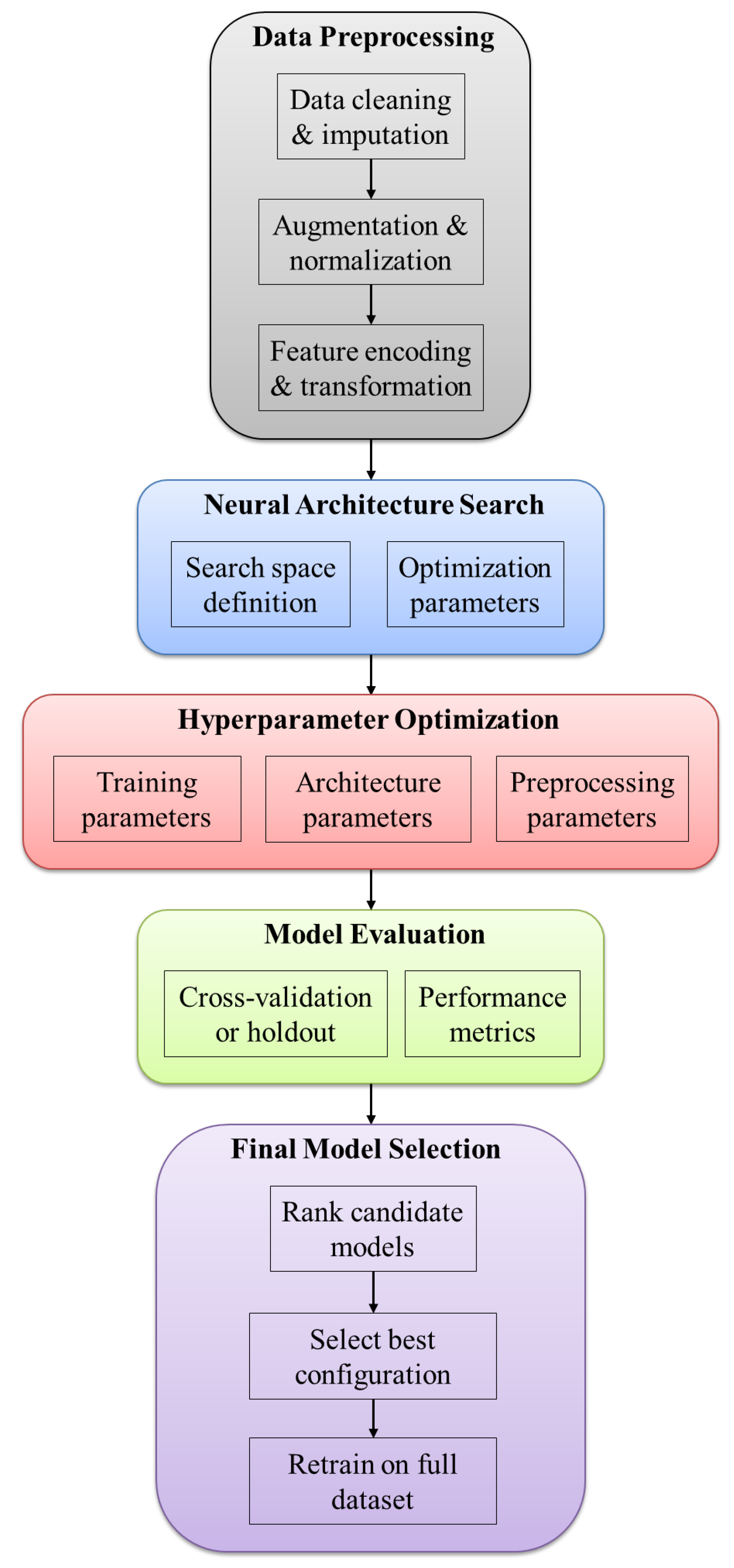
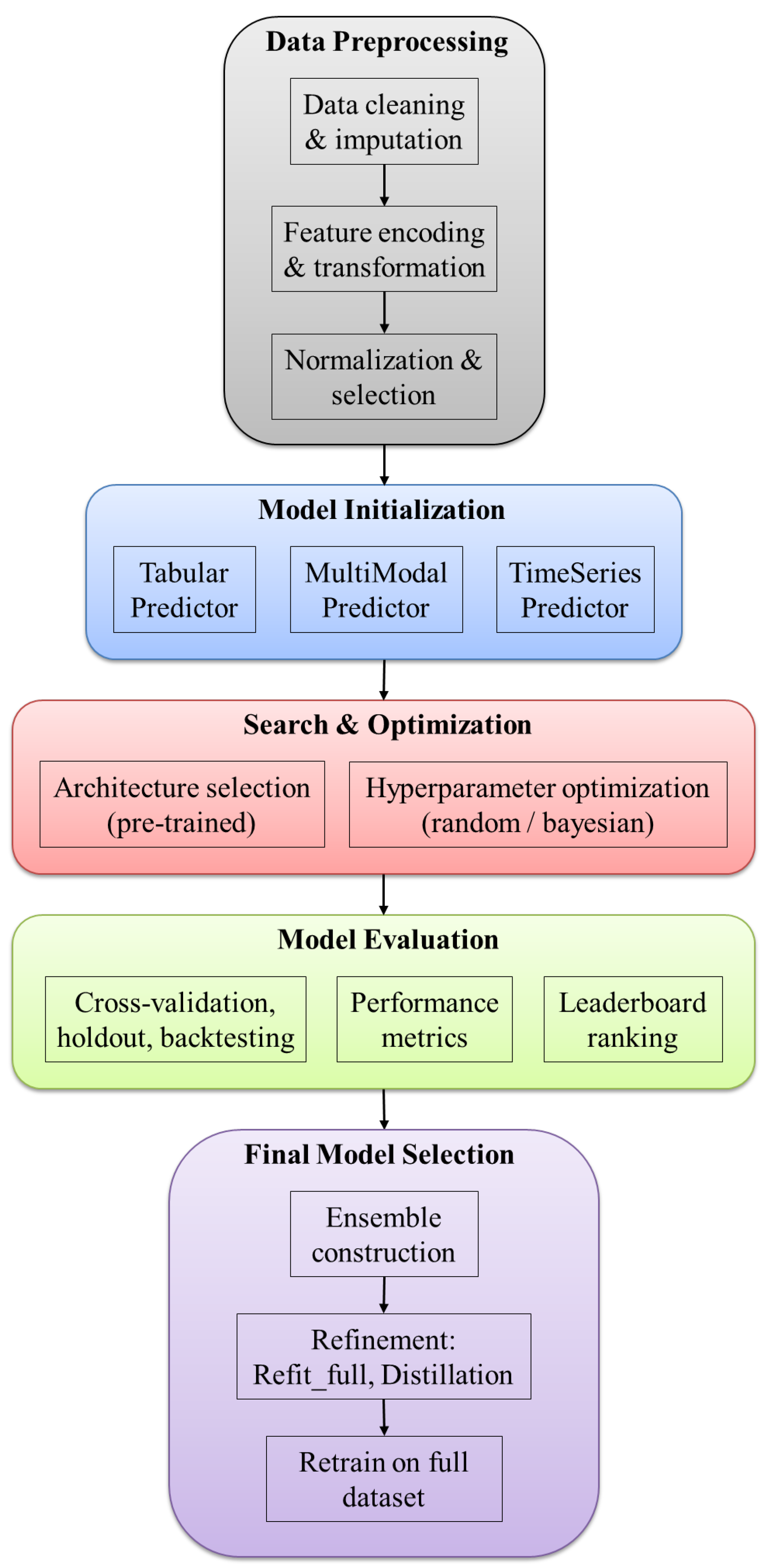


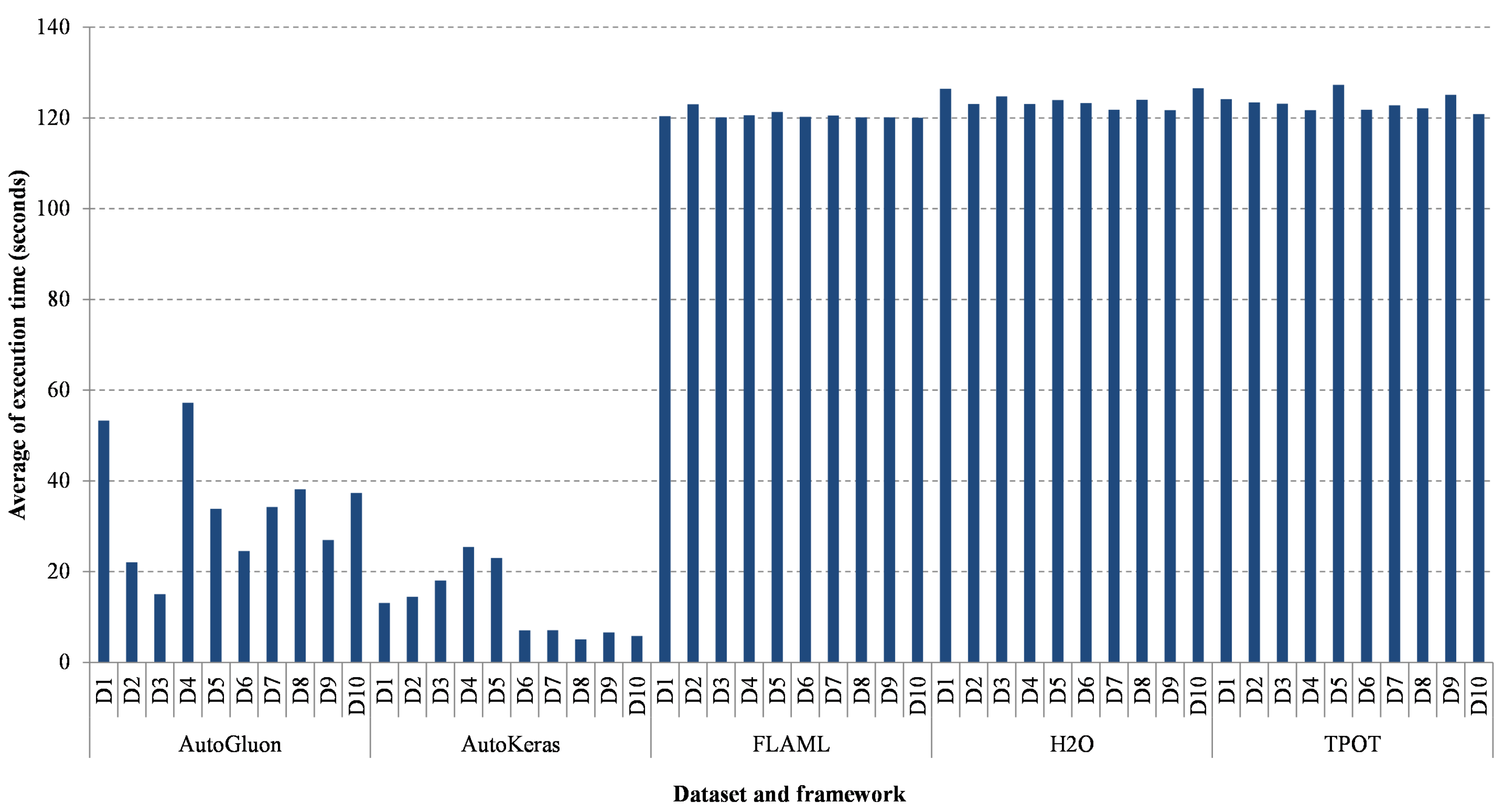
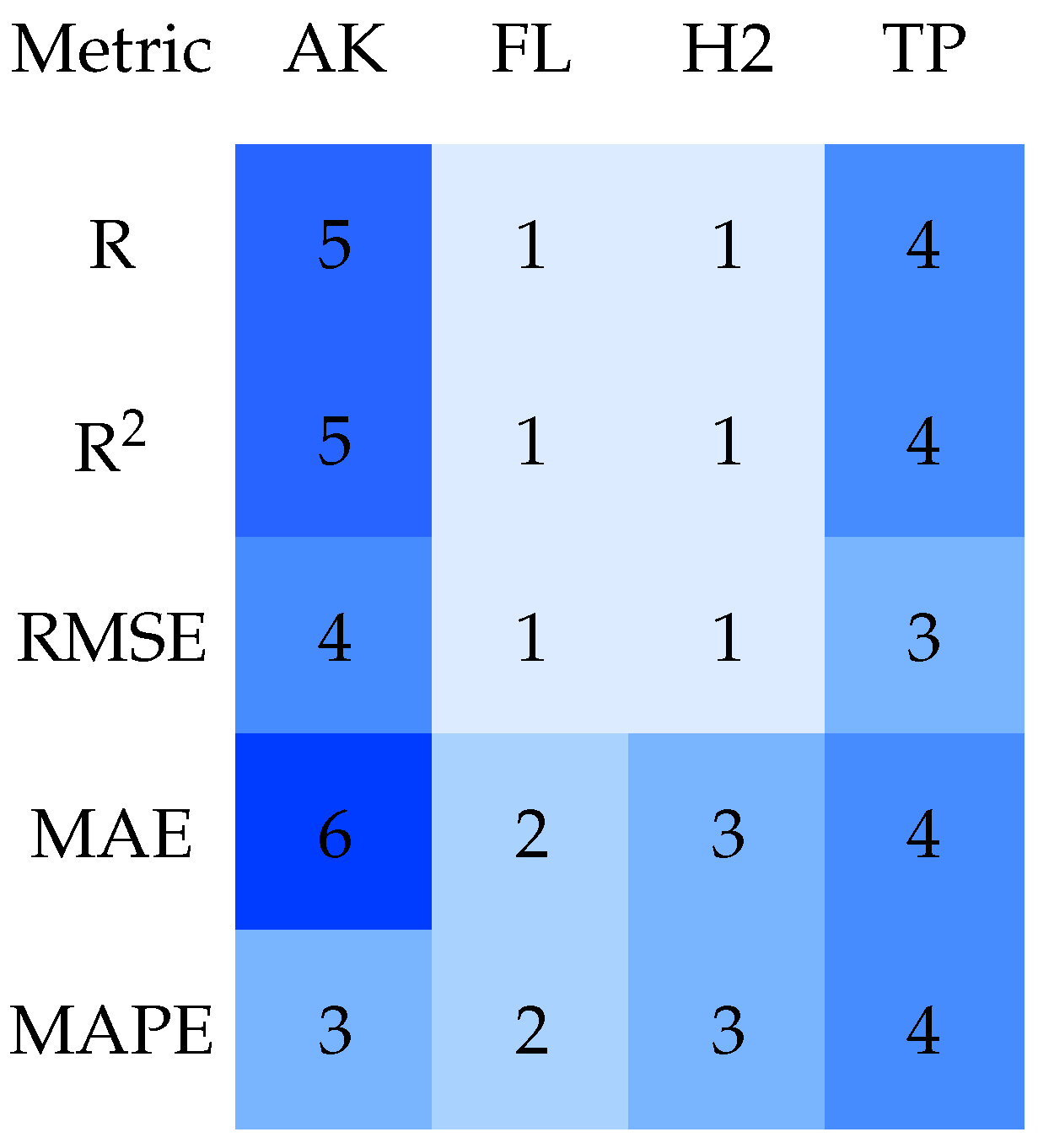


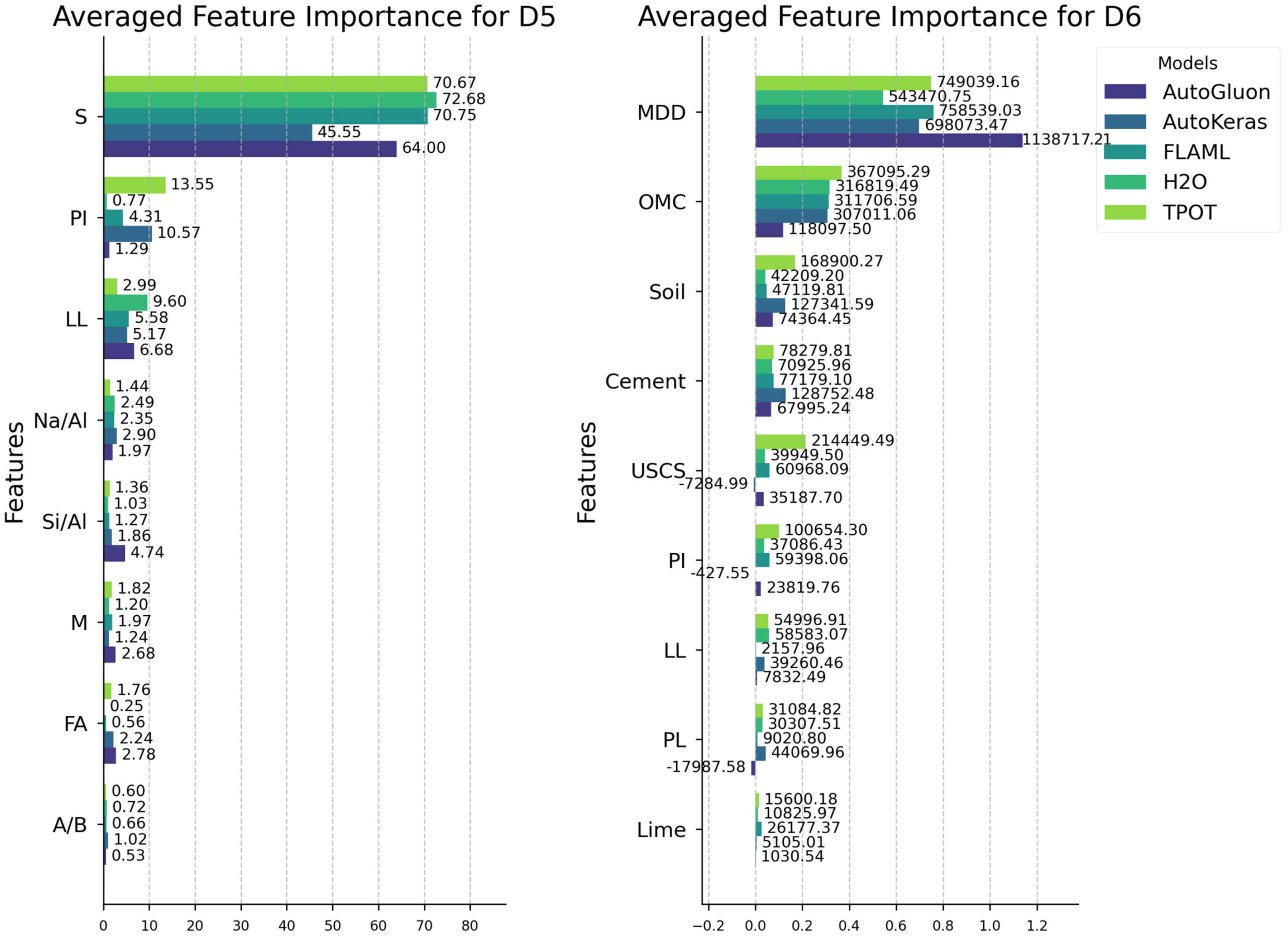
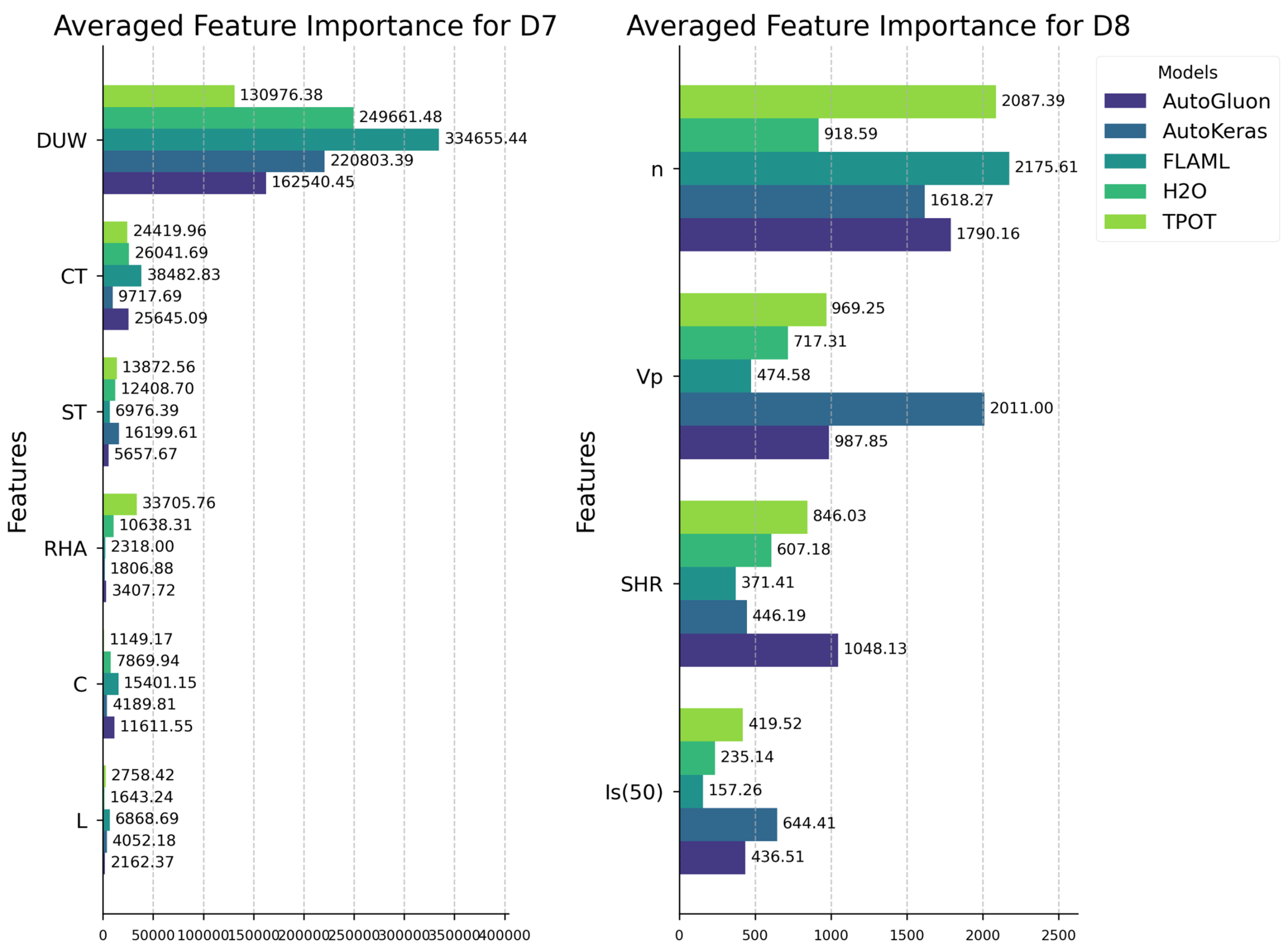

| Study | Data Preprocessing | Feature Selection | Model Selection | Hyperparameter Tuning | Evaluation | Workflow Type |
|---|---|---|---|---|---|---|
| Ngo et al. (2023) [73] | Manual normalization | Manual correlation check | SVM-based model predefined | Meta-heuristic (PSO/GA) | Manual with regression metrics | Semi-automated |
| Kardani et al. (2021) [57] | Manual preprocessing | Not applied | Predefined regression models | Evolutionary algorithm | Manual performance analysis | Semi-automated |
| Onyelowe et al. (2024) [74] | Standardized inputs | Statistical filtering (RFE) | Ensemble model comparison | Grid/Random search | Manual cross-validation | Semi-automated |
| Teodoru et al. (2025) [75] | Automated scaling and cleaning | Recursive feature elimination | Model comparison via Auto-sklearn | Bayesian optimization (Optuna) | Automated | Partially automated |
| Yao et al. (2024) [76] | Manual preprocessing | Importance ranking via SHAP | Hybrid XGB architecture | Hybrid optimization (XGB-based) | Manual evaluation | Semi-automated |
| This paper | Fully automated preprocessing (encoding, scaling, imputation) | Automated feature selection (embedded and filter-based) | Automated model search (multiple AutoML frameworks) | Automated tuning (Bayesian + meta-heuristics) | Automated performance evaluation and reporting | End-to-end AutoML |
| Dataset and Reference | No. Samples | No. Variables | Soil/Rock Type * | Stabilizer | Country |
|---|---|---|---|---|---|
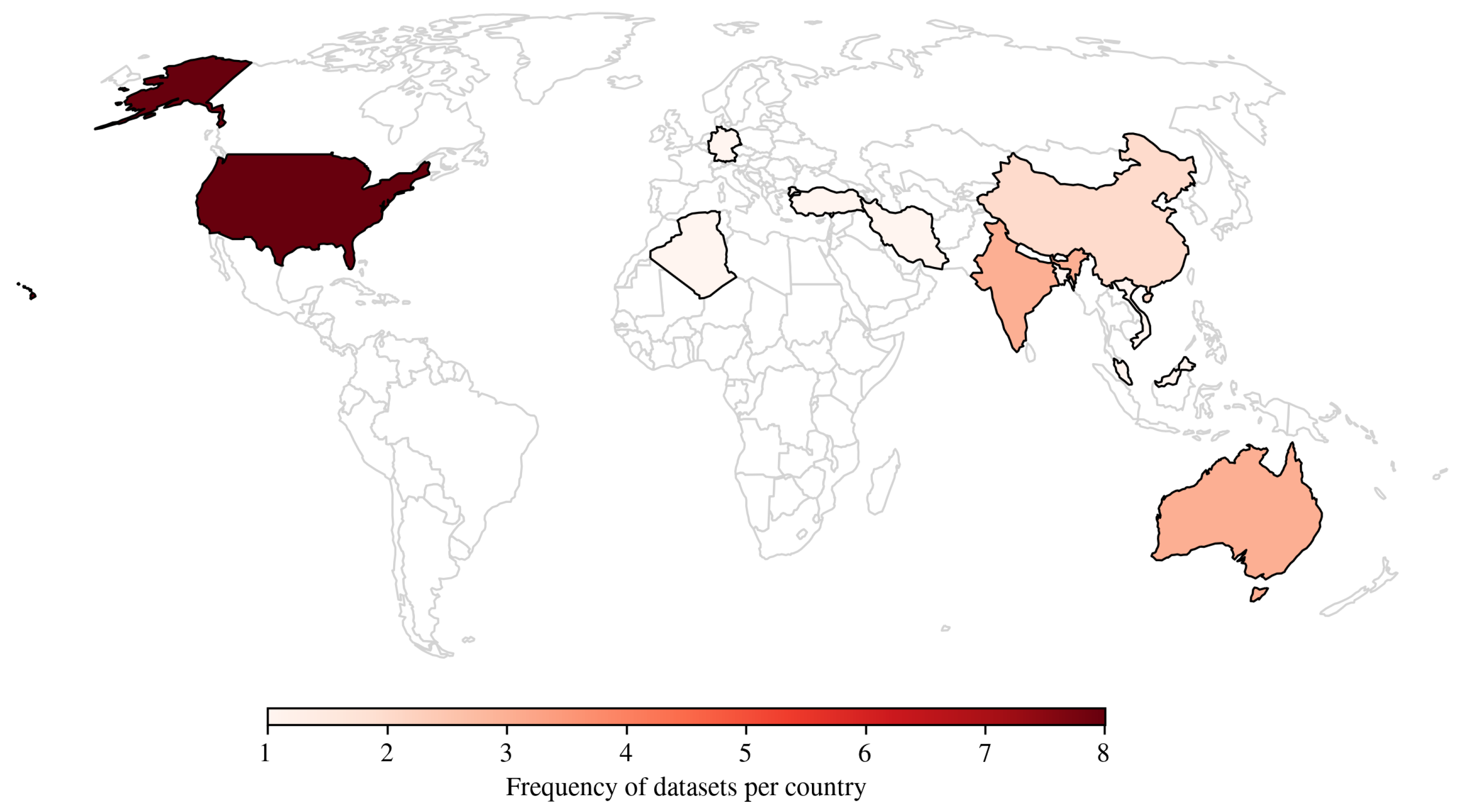
| D1 [58] | 179 | 7 | Various 1 | Lime | USA |
| D2 [58] | 60 | 7 | Various 2 | Cement | USA |
| D3 [78] | 216 | 14 | Various 3 | Cement | Vietnam |
| D4 [79] | 129 | 5 | CL | Various 4 | India 5 |
| D5 [80] | 283 | 8 | CH and CL | Geopolymer | India |
| D6 [81] | 408 | 9 | Various 6 | Various 7 | Various 8 |
| D7 [82] | 137 | 6 | SM and MH | CLR 9 | Malaysia |
| D8 [83] | 170 | 4 | Various 10 | – 11 | Iran |
| D9 [84] | 351 | 7 | Sands | MICP 12 | Various 13 |
| D10 [12] | 150 | 3 | CH | Various 14 | China |
| Group Symbol | Group Name |
|---|---|
| GW | Well-graded gravels |
| GP | Poorly graded gravels |
| GM | Silty gravels |
| GC | Clayey gravels |
| SW | Well-graded sands |
| SP | Poorly graded sands |
| SM | Silty sands |
| SC | Clayey sands |
| ML | Low-plasticity silts |
| CL | Low-plasticity clays |
| OL | Organic soils with low compressibility |
| MH | High-plasticity silts |
| CH | High-plasticity clays |
| OH | Organic soils with high compressibility |
| PT | Highly organic soils (Peat) |
| Framework | Release Date | Optimization Technique | ML Toolbox | Meta-Learning | Post-Processing |
|---|---|---|---|---|---|
| AutoKeras [110,111] | 2019 | Bayesian Optimization | Keras, TensorFlow | No | Yes |
| AutoGluon [112] | 2020 | Ensemble-Based Search | MXNet, PyTorch 2.4.0 | Yes | Yes |
| FLAML [113] | 2021 | Cost-Aware Search | flaml | No | No |
| H2O [114] | 2020 | Random and Ensemble-Based | h2o | Yes | Yes |
| TPOT [115] | 2016 | Genetic Programming | scikit-learn | No | Yes |
| Framework | Parameter | Value |
|---|---|---|
| AutoGluon | label | target |
| verbosity | False | |
| time_limit | 120 s | |
| AutoKeras | max_trials | 50 |
| epochs | 100 | |
| column_names | feature_names | |
| loss | mean_absolute_error | |
| FLAML | time_budget | 120 s |
| metric | MAE | |
| task | regression | |
| estimator_list | [lgbm, rf, xgboost, extra_tree, xgb_limitdepth, catboost, kneighbor] | |
| verbose | False | |
| n_jobs | 2 | |
| H2O | nthreads | 2 |
| max_runtime_secs | 120 s | |
| sort_metric | RMSE | |
| TPOT | max_time_mins | 2 (120 s) |
| generations | 20 | |
| population_size | 20 | |
| cv | 5 | |
| verbosity | False | |
| n_jobs | 2 |
| Metric Acronym | Expression |
|---|---|
| MAE | |
| MAPE | |
| RMSE | |
| R | |
| R2 | |
| SMAPE |
| Library | Version |
|---|---|
| AutoGluon | 0.7.0 |
| AutoKeras | 1.0.20 |
| Cython | 3.1.3 |
| FLAML | 1.2.4 |
| H2O | 3.44.0.3 |
| Jinja2 | 3.1.6 |
| Joblib | 1.5.1 |
| Keras-Tuner | 1.4.7 |
| Matplotlib | 3.9.4 |
| NumPy | 1.23.5 |
| Openpyxl | 3.1.2 |
| Pandas | 1.5.3 |
| Permetrics | 2.0.0 |
| Scikit-Learn | 1.2.2 |
| Scipy | 1.11.4 |
| Seaborn | 0.12.2 |
| Skillmetrics | 1.1.8 |
| TPOT | 0.12.1 |
| Tensorflow | 2.9.3 |
| Dataset | Model/Framework | R | R2 | RMSE | MAE | MAPE (%) | SMAPE (%) |
|---|---|---|---|---|---|---|---|
| D1 | AutoGluon | 0.904 (0.037) | 0.819 (0.066) | 0.234 (0.055) MPa | 0.163 (0.034) MPa | 128.371 (139.790) | 47.462 (6.699) |
| AutoKeras | 0.902 (0.042) | 0.816 (0.073) | 0.234 (0.048) MPa | 0.152 (0.027) MPa | 92.089 (109.954) | 47.301 (7.186) | |
| FLAML | 0.912 (0.056) | 0.835 (0.098) | 0.217 (0.063) MPa | 0.146 (0.031) MPa | 137.759 (177.942) | 47.485 (6.680) | |
| H2O | 0.928 (0.031) | 0.863 (0.057) | 0.202 (0.043) MPa | 0.140 (0.026) MPa | 94.955 (110.567) | 45.990 (6.242) | |
| TPOT | 0.894 (0.043) | 0.801 (0.076) | 0.243 (0.050) MPa | 0.169 (0.030) MPa | 149.595 (186.377) | 48.707 (7.180) | |
| Ref. [58] | SVR | - | 0.75 | 0.50 MPa | 0.44 MPa | - | - |
| Goliatt et al. [71] | XGB | 0.964 | 0.928 | 0.148 MPa | 0.101 MPa | - | - |
| D2 | AutoGluon | 0.752 (0.161) | 0.525 (0.323) | 0.875 (0.257) MPa | 0.617 (0.201) MPa | 42.235 (14.832) | 60.526 (14.097) |
| AutoKeras | 0.867 (0.146) | 0.744 (0.261) | 0.584 (0.184) MPa | 0.403 (0.120) MPa | 32.049 (13.506) | 55.515 (13.795) | |
| FLAML | 0.778 (0.152) | 0.579 (0.276) | 0.820 (0.203) MPa | 0.582 (0.158) MPa | 40.229 (14.214) | 61.195 (12.662) | |
| H2O | 0.713 (0.259) | 0.462 (0.471) | 0.895 (0.407) MPa | 0.674 (0.344) MPa | 43.297 (18.931) | 62.467 (16.609) | |
| TPOT | 0.815 (0.180) | 0.696 (0.242) | 0.676 (0.188) MPa | 0.489 (0.126) MPa | 35.099 (12.928) | 56.329 (14.001) | |
| Ref. [58] | MLR | - | 0.82 | 0.53 MPa | 0.45 MPa | - | - |
| Goliatt et al. [71] | XGB | 0.910 | 0.826 | 0.596 MPa | 0.390 MPa | - | - |
| D3 | AutoGluon | 0.901 (0.051) | 0.814 (0.086) | 0.489 (0.115) MPa | 0.376 (0.084) MPa | 25.594 (7.692) | 22.026 (4.751) |
| AutoKeras | 0.889 (0.057) | 0.763 (0.192) | 0.538 (0.191) MPa | 0.375 (0.101) MPa | 21.883 (4.757) | 20.949 (4.266) | |
| FLAML | 0.908 (0.030) | 0.825 (0.054) | 0.475 (0.066) MPa | 0.367 (0.047) MPa | 24.596 (4.581) | 22.403 (3.178) | |
| H2O | 0.915 (0.038) | 0.839 (0.067) | 0.452 (0.063) MPa | 0.347 (0.048) MPa | 23.585 (4.219) | 21.632 (3.908) | |
| TPOT | 0.898 (0.064) | 0.810 (0.106) | 0.484 (0.122) MPa | 0.366 (0.073) MPa | 24.747 (5.713) | 22.424 (4.400) | |
| Ref. [78] | ANN | 0.925 | - | 0.419 MPa | 0.292 MPa | - | - |
| Goliatt et al. [71] | XGB | 0.940 | 0.882 | 0.410 MPa | 0.312 MPa | - | - |
| D4 | AutoGluon | 0.967 (0.018) | 0.936 (0.034) | 19.316 (6.020) kPa | 14.137 (3.778) kPa | 5.747 (1.565) | 5.622 (1.467) |
| AutoKeras | 0.685 (0.176) | 0.456 (0.259) | 55.800 (12.711) kPa | 43.646 (10.590) kPa | 17.903 (4.246) | 17.540 (4.231) | |
| FLAML | 0.980 (0.014) | 0.961 (0.028) | 14.758 (5.116) kPa | 11.042 (3.477) kPa | 4.597 (1.613) | 4.509 (1.436) | |
| H2O | 0.984 (0.008) | 0.968 (0.016) | 13.593 (3.364) kPa | 10.119 (2.307) kPa | 4.100 (0.934) | 4.063 (0.899) | |
| TPOT | 0.977 (0.016) | 0.955 (0.031) | 15.575 (5.661) kPa | 11.666 (4.100) kPa | 4.759 (1.726) | 4.696 (1.600) | |
| Ref. [79] | ANN | 0.986 | 0.971 | 7.165 kPa | - | - | - |
| Goliatt et al. [71] | XGB | 0.994 | 0.987 | 7.005 kPa | 6.527 kPa | - | - |
| D5 | AutoGluon | 0.981 (0.007) | 0.963 (0.014) | 1.233 (0.228) MPa | 0.809 (0.130) MPa | 182.095 (68.100) | 61.839 (8.822) |
| AutoKeras | 0.984 (0.007) | 0.968 (0.013) | 1.140 (0.205) MPa | 0.697 (0.124) MPa | 79.015 (52.257) | 42.226 (7.983) | |
| FLAML | 0.984 (0.006) | 0.969 (0.011) | 1.132 (0.198) MPa | 0.703 (0.107) MPa | 119.320 (58.293) | 46.122 (7.937) | |
| H2O | 0.982 (0.007) | 0.965 (0.015) | 1.193 (0.231) MPa | 0.810 (0.144) MPa | 209.786 (80.903) | 67.646 (9.120) | |
| TPOT | 0.979 (0.008) | 0.959 (0.017) | 1.293 (0.242) MPa | 0.829 (0.168) MPa | 155.239 (89.615) | 54.911 (12.886) | |
| Ref. [80] | ANN | 0.982 | - | 1225 MPa | - | 83.4 | - |
| Goliatt et al. [71] | XGB | 0.989 | 0.979 | 0.939 MPa | 0.593 MPa | - | - |
| D6 | AutoGluon | 0.778 (0.053) | 0.608 (0.081) | 721.829 (92.884) kPa | 534.059 (64.614) kPa | 64.332 (19.530) | 32.002 (4.738) |
| AutoKeras | 0.685 (0.107) | 0.430 (0.302) | 855.464 (181.128) kPa | 635.403 (107.515) kPa | 59.773 (22.157) | 36.542 (5.661) | |
| FLAML | 0.787 (0.062) | 0.623 (0.096) | 704.867 (101.052) kPa | 502.085 (76.596) kPa | 52.765 (14.022) | 30.633 (3.849) | |
| H2O | 0.797 (0.051) | 0.638 (0.080) | 692.648 (91.517) kPa | 496.498 (66.359) kPa | 58.102 (17.830) | 29.828 (3.768) | |
| TPOT | 0.780 (0.048) | 0.611 (0.075) | 720.204 (91.464) kPa | 522.665 (74.257) kPa | 56.909 (23.060) | 31.091 (4.182) | |
| Ref. [81] | BRT | - | 0.69 | 649.73 kPa | 472.33 kPa | - | - |
| Goliatt et al. [71] | XGB | 0.851 | 0.723 | 609.347 kPa | 423.656 kPa | - | - |
| D7 | AutoGluon | 0.979 (0.011) | 0.958 (0.021) | 85.115 (25.128) kPa | 50.835 (11.381) kPa | 14.191 (2.241) | 12.958 (1.758) |
| AutoKeras | 0.967 (0.019) | 0.935 (0.036) | 103.715 (36.951) kPa | 65.280 (18.708) kPa | 20.141 (8.482) | 16.655 (3.460) | |
| FLAML | 0.980 (0.012) | 0.960 (0.024) | 80.079 (23.704) kPa | 50.364 (13.255) kPa | 13.789 (2.689) | 12.980 (2.678) | |
| H2O | 0.969 (0.046) | 0.940 (0.082) | 93.932 (64.250) kPa | 59.752 (39.038) kPa | 19.262 (20.820) | 16.997 (12.781) | |
| TPOT | 0.969 (0.018) | 0.940 (0.035) | 99.597 (32.389) kPa | 65.090 (18.787) kPa | 20.110 (6.402) | 18.476 (5.393) | |
| Ref. [82] | SVR | 0.997 | - | - | - | 4.606 | - |
| D8 | AutoGluon | 0.953 (0.019) | 0.908 (0.036) | 15.200 (3.265) MPa | 10.428 (2.146) MPa | 14.894 (3.236) | 13.403 (2.452) |
| AutoKeras | 0.950 (0.028) | 0.902 (0.052) | 15.282 (4.153) MPa | 11.458 (3.587) MPa | 14.614 (4.092) | 14.196 (4.598) | |
| FLAML | 0.943 (0.023) | 0.890 (0.043) | 16.671 (2.978) MPa | 11.721 (1.933) MPa | 15.474 (2.968) | 14.164 (2.309) | |
| H2O | 0.929 (0.059) | 0.866 (0.104) | 17.549 (6.856) MPa | 13.087 (5.566) MPa | 18.876 (8.460) | 17.524 (7.304) | |
| TPOT | 0.946 (0.021) | 0.896 (0.039) | 16.208 (3.219) MPa | 11.659 (2.386) MPa | 16.433 (3.760) | 14.735 (2.893) | |
| Ref. [83] | GPR | - | 0.996 | 0.522 MPa | 0.04 MPa | 0.032 | - |
| D9 | AutoGluon | 0.939 (0.021) | 0.883 (0.039) | 0.636 (0.167) MPa | 0.375 (0.063) MPa | 30.460 (4.790) | 27.275 (3.682) |
| AutoKeras | 0.936 (0.026) | 0.877 (0.048) | 0.632 (0.091) MPa | 0.374 (0.047) MPa | 33.285 (8.954) | 27.540 (4.124) | |
| FLAML | 0.943 (0.022) | 0.890 (0.040) | 0.610 (0.155) MPa | 0.344 (0.054) MPa | 30.458 (5.510) | 24.668 (2.544) | |
| H2O | 0.928 (0.039) | 0.862 (0.071) | 0.677 (0.203) MPa | 0.415 (0.120) MPa | 38.987 (17.640) | 33.859 (8.999) | |
| TPOT | 0.924 (0.029) | 0.854 (0.052) | 0.705 (0.166) MPa | 0.441 (0.080) MPa | 41.195 (11.662) | 33.542 (6.280) | |
| Ref. [84] | MEP | - | 0.857 | 0.652 MPa | 0.415 MPa | - | - |
| D10 | AutoGluon | 0.986 (0.005) | 0.971 (0.010) | 364.036 (95.065) kPa | 220.969 (40.940) kPa | 26.285 (10.078) | 21.866 (6.624) |
| AutoKeras | 0.977 (0.011) | 0.954 (0.021) | 451.564 (93.672) kPa | 299.045 (52.739) kPa | 36.417 (21.320) | 27.425 (7.661) | |
| FLAML | 0.984 (0.004) | 0.968 (0.007) | 380.999 (65.827) kPa | 237.462 (37.877) kPa | 21.450 (4.962) | 18.943 (3.074) | |
| H2O | 0.930 (0.144) | 0.884 (0.205) | 599.435 (519.115) kPa | 415.813 (385.779) kPa | 102.564 (152.366) | 39.324 (22.689) | |
| TPOT | 0.992 (0.003) | 0.984 (0.005) | 270.799 (65.340) kPa | 180.965 (35.406) kPa | 27.138 (12.898) | 24.543 (6.145) | |
| Ref. [12] | RF | 0.932 | - | 841.40 kPa | 591.64 kPa | 76.5 | - |
| Dataset | Reference | Model |
|---|---|---|
| D1 | [58] | Support Vector Regression (SVR) |
| D2 | [58] | Multiple Linear Regression (MLR) |
| D3 | [78] | Artificial Neural Network (ANN) |
| D4 | [79] | Artificial Neural Network (ANN) |
| D5 | [80] | Artificial Neural Network (ANN) |
| D6 | [81] | Bagging Regression Tree (BRT) |
| D7 | [82] | Support Vector Regression (SVR) |
| D8 | [83] | Gaussian Process Regression (GPR) |
| D9 | [84] | Multi-Expression Programming (MEP) |
| D10 | [12] | Random Forest (RF) |
| Metric | D1 | D2 | D3 | D4 | D5 | D6 | D7 | D8 | D9 | D10 |
|---|---|---|---|---|---|---|---|---|---|---|
| R | Yes | Yes | No | Yes | Yes | Yes | Yes | No | Yes | Yes |
| R2 | Yes | Yes | No | Yes | Yes | Yes | Yes | No | Yes | Yes |
| RMSE | Yes | Yes | No | Yes | Yes | Yes | Yes | No | No | Yes |
| MAE | Yes | Yes | No | Yes | Yes | Yes | Yes | No | Yes | Yes |
| MAPE | No | Yes | No | Yes | Yes | No | Yes | No | Yes | Yes |
| Dataset | AutoGluon | AutoKeras | FLAML | H2O | TPOT |
|---|---|---|---|---|---|
| D1 | 0.486 (±0.148) | 0.498 (±0.136) | 0.536 (±0.182) | 0.581 (±0.121) | 0.451 (±0.146) |
| D2 | 0.610 (±0.082) | 0.706 (±0.072) | 0.625 (±0.076) | 0.578 (±0.184) | 0.676 (±0.067) |
| D3 | 0.797 (±0.111) | 0.787 (±0.156) | 0.808 (±0.062) | 0.829 (±0.064) | 0.801 (±0.106) |
| D4 | 0.892 (±0.049) | 0.413 (±0.197) | 0.931 (±0.046) | 0.944 (±0.028) | 0.923 (±0.054) |
| D5 | 0.667 (±0.143) | 0.748 (±0.134) | 0.748 (±0.117) | 0.685 (±0.151) | 0.625 (±0.173) |
| D6 | 0.764 (±0.069) | 0.676 (±0.150) | 0.802 (±0.074) | 0.800 (±0.076) | 0.780 (±0.079) |
| D7 | 0.894 (±0.049) | 0.831 (±0.079) | 0.897 (±0.056) | 0.847 (±0.208) | 0.833 (±0.088) |
| D8 | 0.788 (±0.089) | 0.792 (±0.112) | 0.741 (±0.092) | 0.687 (±0.243) | 0.746 (±0.100) |
| D9 | 0.786 (±0.093) | 0.778 (±0.082) | 0.810 (±0.091) | 0.716 (±0.199) | 0.684 (±0.128) |
| D10 | 0.954 (±0.017) | 0.927 (±0.022) | 0.950 (±0.013) | 0.850 (±0.223) | 0.972 (±0.014) |
| Dataset | Top-Performing Framework | PI (Average Value) |
|---|---|---|
| D1 | H2O | 0.581 |
| D2 | AutoKeras | 0.706 |
| D3 | H2O | 0.829 |
| D4 | H2O | 0.944 |
| D5 | FLAML | 0.748 |
| D6 | FLAML | 0.802 |
| D7 | FLAML | 0.897 |
| D8 | AutoKeras | 0.792 |
| D9 | FLAML | 0.810 |
| D10 | TPOT | 0.972 |
| Model/Framework | R | R2 | RMSE | MAE | MAPE | Score |
|---|---|---|---|---|---|---|
| AutoGluon | 0 | 0 | 0 | 0 | 0 | 0 |
| AutoKeras | 0 | 1 | 0 | 1 | 1 | 3 |
| FLAML | 1 | 1 | 2 | 1 | 1 | 6 |
| H2O | 0 | 1 | 2 | 1 | 0 | 4 |
| TPOT | 1 | 0 | 1 | 1 | 0 | 3 |
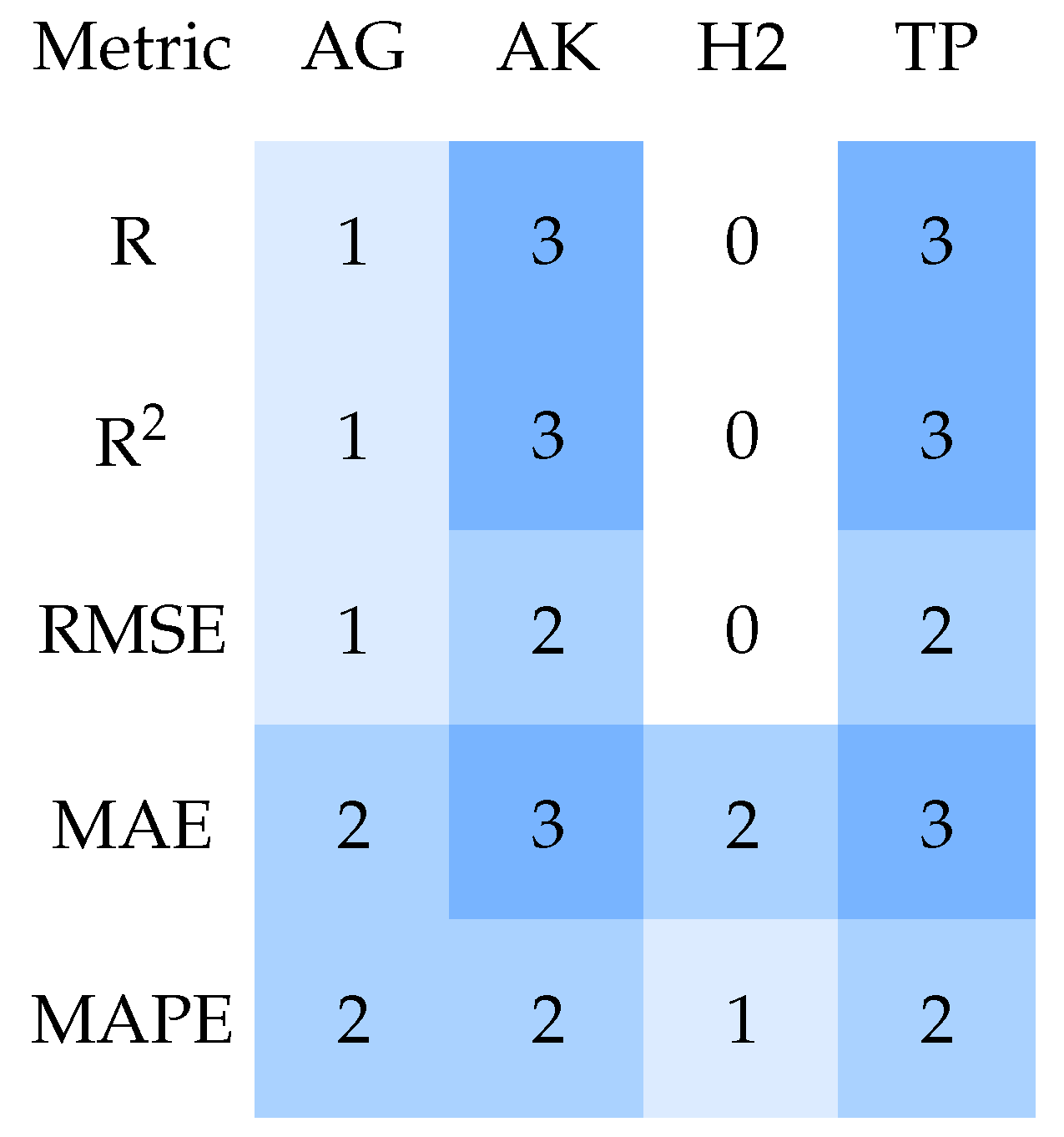
| AutoML | 2 | 3 | 5 | 4 | 2 | 16 |
| Ref. | 3 | 3 | 4 | 3 | 2 | 15 |
Disclaimer/Publisher’s Note: The statements, opinions and data contained in all publications are solely those of the individual author(s) and contributor(s) and not of MDPI and/or the editor(s). MDPI and/or the editor(s) disclaim responsibility for any injury to people or property resulting from any ideas, methods, instructions or products referred to in the content. |
© 2025 by the authors. Licensee MDPI, Basel, Switzerland. This article is an open access article distributed under the terms and conditions of the Creative Commons Attribution (CC BY) license (https://creativecommons.org/licenses/by/4.0/).
Share and Cite
Oliveira, R.M.; Campos, D.; Bicalho, K.V.; Macêdo, B.d.S.; Bodini, M.; Saporetti, C.M.; Goliatt, L. AutoML-Based Prediction of Unconfined Compressive Strength of Stabilized Soils: A Multi-Dataset Evaluation on Worldwide Experimental Data. Forecasting 2025, 7, 80. https://doi.org/10.3390/forecast7040080
Oliveira RM, Campos D, Bicalho KV, Macêdo BdS, Bodini M, Saporetti CM, Goliatt L. AutoML-Based Prediction of Unconfined Compressive Strength of Stabilized Soils: A Multi-Dataset Evaluation on Worldwide Experimental Data. Forecasting. 2025; 7(4):80. https://doi.org/10.3390/forecast7040080
Chicago/Turabian StyleOliveira, Romulo Murucci, Deivid Campos, Katia Vanessa Bicalho, Bruno da S. Macêdo, Matteo Bodini, Camila Martins Saporetti, and Leonardo Goliatt. 2025. "AutoML-Based Prediction of Unconfined Compressive Strength of Stabilized Soils: A Multi-Dataset Evaluation on Worldwide Experimental Data" Forecasting 7, no. 4: 80. https://doi.org/10.3390/forecast7040080
APA StyleOliveira, R. M., Campos, D., Bicalho, K. V., Macêdo, B. d. S., Bodini, M., Saporetti, C. M., & Goliatt, L. (2025). AutoML-Based Prediction of Unconfined Compressive Strength of Stabilized Soils: A Multi-Dataset Evaluation on Worldwide Experimental Data. Forecasting, 7(4), 80. https://doi.org/10.3390/forecast7040080