- Article

Endocannabinoid System Modulates Glial Responses and Motoneuron Preservation After Spinal Cord Ventral Root Axotomy
- Caroline Machado Tomazelli,
- Alexandre Leite Rodrigues de Oliveira and
- Luciana Politti Cartarozzi
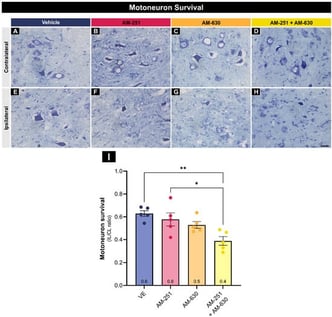
Background/Objectives: Injuries to spinal ventral roots induce complex retrograde reactions that compromise motoneuron survival, synaptic organization, and glial responses, ultimately limiting the potential for regeneration. The endocannabinoid system (ECS) has emerged as a crucial modulator of neuroprotective processes, primarily through the activation of CB1 and CB2. However, the individual and combined contributions of these receptors to post-injury spinal responses remain poorly understood. Here, we examined the effects of selective blockade of CB1 and CB2 receptors in a murine model of ventral root crush (VRC). Methods: Female C57BL/6JUnib mice received daily intraperitoneal injections of the CB1 antagonist AM-251 and/or the CB2 antagonist AM-630 (1 mg/kg) for 14 days post-lesion. At 28 days after injury, spinal cords were analyzed for motoneuron survival (Nissl staining), glial responses (immunohistochemistry for GFAP and Iba-1), and synaptic coverage (immunohistochemistry for synaptophysin). Results: Selective blockade of CB2 receptors led to a marked reduction in motoneuron survival, enhanced microglial activation-associated morphology (morphological classification and Sholl analysis), and decreased synaptic coverage. CB1 blockade produced milder, context-dependent effects. Dual blockade exacerbated all outcomes, indicating complementary CB1/CB2 functions in the spinal microenvironment. Conclusions: Under the conditions tested, CB2 signaling is necessary for motoneuron preservation, limiting microglial activation-associated morphology, and maintaining synaptic coverage after VRC. The knowledge of specific actions of CB1 and CB2 provides mechanistic insight into the neuroprotective potential of endocannabinoid signaling and reinforces its therapeutic relevance for motoneuron preservation and functional recovery after axotomy.
24 January 2026