

You are currently viewing a new version of our website. To view the old version click .

Fire, Volume 3, Issue 1

March 2020 - 7 articles

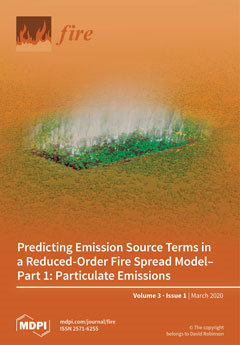
Cover Story: Shown is a QUIC-Fire simulated smoke plume from a pine-forest wildfire. A simple, computationally-efficient surrogate model was created for predicting particulate emission factors for reduced-order simulations. Leveraging a database of detailed simulations, the surrogate model translates particle-formation phenomena to simple correlations connecting fire characteristics (flame length, gas velocities, and local oxygen concentrations) to local emission factors as well as estimate emitted particle size distributions. Emitted particles are subsequently transported and dispersed using QUIC-Plume, a plume trajectory model, with QUIC-Fire velocity fields.View this paper.
  • Issues are regarded as officially published after their release is announced to the table of contents alert mailing list .
  • You may sign up for email alerts to receive table of contents of newly released issues.
  • PDF is the official format for papers published in both, html and pdf forms. To view the papers in pdf format, click on the "PDF Full-text" link, and use the free Adobe Reader to open them.

Articles (7)

  • Article
  • Open Access
41 Citations
5,755 Views
21 Pages

10 March 2020

Within the realms of both wildland and prescribed fire, an understanding of how fire severity and forest structure interact is critical for improving fuels treatment effectiveness, quantifying the ramifications of wildfires, and improving fire behavi...

  • Article
  • Open Access
2 Citations
4,371 Views
20 Pages

Fire-Environment Analysis: An Example of Army Garrison Camp Williams, Utah

  • Scott M. Frost,
  • Martin E. Alexander,
  • R. Justin DeRose and
  • Michael J. Jenkins

9 March 2020

The planning of fuel treatments for ecological or societal purposes requires an in-depth understanding of the conditions associated with the occurrence of free-burning fire behavior for the area of concern. Detailed fire-environment analysis for Army...

  • Article
  • Open Access
15 Citations
3,824 Views
19 Pages

26 February 2020

This study examines 95 lightning-initiated wildfires and 1170 lightning flashes in the western United States between May and October 2017 to characterize lightning and precipitation rates and totals near the time of ignition. Eighty-nine percent of t...

  • Article
  • Open Access
5 Citations
3,908 Views
15 Pages

Predicting Emission Source Terms in a Reduced-Order Fire Spread Model—Part 1: Particulate Emissions

  • Alexander J. Josephson,
  • Troy M. Holland,
  • Sara Brambilla,
  • Michael J. Brown and
  • Rodman R. Linn

25 February 2020

A simple, easy-to-evaluate, surrogate model was developed for predicting the particle emission source term in wildfire simulations. In creating this model, we conceptualized wildfire as a series of flamelets, and using this concept of flamelets, we d...

  • Article
  • Open Access
8 Citations
4,408 Views
18 Pages

24 December 2019

Land treatments in wildland–urban interface (WUI) areas are highly visible and subject to public scrutiny and possible opposition. This study examines a contested vegetation treatment—Forsythe II—in a WUI area of the Arapaho-Rooseve...

  • Technical Note
  • Open Access
17 Citations
5,807 Views
17 Pages

Frequency of Dynamic Fire Behaviours in Australian Forest Environments

  • Alexander I. Filkov,
  • Thomas J. Duff and
  • Trent D. Penman

18 December 2019

Wildfires can result in significant social, environmental and economic losses. Fires in which dynamic fire behaviours (DFBs) occur contribute disproportionately to damage statistics. Little quantitative data on the frequency at which DFBs occur exist...

Get Alerted

Add your email address to receive forthcoming issues of this journal.

XFacebookLinkedIn
Fire - ISSN 2571-6255