You are currently viewing a new version of our website. To view the old version click .

Quaternary, Volume 1, Issue 3

December 2018 - 14 articles

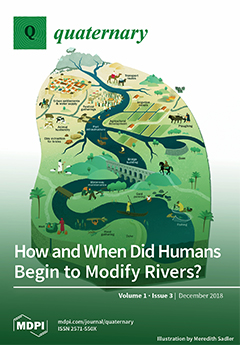
Cover Story: Rivers are central to landscape change and the Anthropocene because many human activities focused along waterways. The use of fire and gathering of plants and aquatic resources probably had little effect on rivers until crop cultivation intensified about 15,000 years ago in the Near East. Many plants and animals were domesticated worldwide after 10,700 years ago, leading locally within a millennium to organized agriculture with widespread legacy sediments, the first dams and irrigation, and mud-brick manufacture. Extensive irrigation systems and riverine settlements after about 6,500 years ago led to dams, urban water supplies, expanded groundwater use, river fleets, and alluvial mining, with major river engineering under the Chinese and Roman empires. Recent industrial effects have radically altered rivers worldwide. View this paper.
  • Issues are regarded as officially published after their release is announced to the table of contents alert mailing list .
  • You may sign up for email alerts to receive table of contents of newly released issues.
  • PDF is the official format for papers published in both, html and pdf forms. To view the papers in pdf format, click on the "PDF Full-text" link, and use the free Adobe Reader to open them.

Articles (14)

  • Article
  • Open Access
14 Citations
4,625 Views
25 Pages

ESR Dating Ungulate Teeth and Molluscs from the Paleolithic Site Marathousa 1, Megalopolis Basin, Greece

  • Bonnie A. B. Blackwell,
  • Neeraj Sakhrani,
  • Impreet K. Singh,
  • Kalyani K. Gopalkrishna,
  • Vangelis Tourloukis,
  • Eleni Panagopoulou,
  • Panagiotis Karkanas,
  • Joel I. B. Blickstein,
  • Anne R. Skinner and
  • Jonathan A. Florentin
  • + 1 author

15 October 2018

At 37°24′ N 22°8′ E, the Megalopolis Basin lies in the central Peloponnese Peninsula, southwestern Greece. In the Megalopolis Basin at ~350 m amsl, the Paleolithic site, Marathousa 1, sits within a palustrine/lacustrine clastic pa...

  • Feature Paper
  • Article
  • Open Access
52 Citations
21,297 Views
37 Pages

4 October 2018

Rivers are central to debate about the Anthropocene because many human activities from antiquity focused on channels and floodplains. A literature compilation for the onset of human modification of rivers identifies six stages that represent key inno...

  • Article
  • Open Access
19 Citations
7,118 Views
47 Pages

27 September 2018

Coulet des Roches is a natural karst trap in Southern France. Its infilling dates back to the end of the Pleniglacial (Last Glacial Maximum, LGM) and the end of the Tardiglacial (Last Glacial, LG). Three mustelid species have been identified in this...

  • Article
  • Open Access
25 Citations
4,876 Views
19 Pages

Identifying Past Remains of Morphologically Similar Vole Species Using Molar Shapes

  • Nicolas Navarro,
  • Sophie Montuire,
  • Rémi Laffont,
  • Emilie Steimetz,
  • Catalina Onofrei and
  • Aurélien Royer

27 September 2018

Accurate species identification in fossil remains is a complex task but is a key component for developing good inferences on many, if not all, fundamental questions in macroecology and macroevolution. In the Quaternary, arvicolines are very abundant...

of 2

Get Alerted

Add your email address to receive forthcoming issues of this journal.

XFacebookLinkedIn
Quaternary - ISSN 2571-550X