


Highlights
What are the main findings?
- A lightweight UAV detection model NCDet-YOLO is proposed, achieving 1.55 M parameters and 65.04% mAP50–95 while maintaining real-time edge inference performance.
- A closed-loop UAV perception, tracking, distance estimation, and net-capture framework is developed, enabling target-state assessment and actuator triggering in low-altitude scenarios.
What are the implications of the main findings?
- The proposed lightweight detection architecture demonstrates feasibility for deployment on resource-constrained edge platforms in UAV monitoring tasks.
- The integrated net-capture linkage mechanism provides a practical framework for non-destructive UAV interception with multi-condition trigger confirmation.
Abstract
The growing frequency of unauthorized UAV activities has increased the demand for real-time perception and rapid response on resource-constrained edge devices. This study proposes an edge-deployable UAV detection and net-capture system based on Net-Capture Detection YOLO (NCDet-YOLO). Developed from YOLOv8n, NCDet-YOLO incorporates C2f_Faster, SPD_Conv, EMA, and a lightweight three-scale detection head, with CrossKD used to compensate for accuracy loss caused by structural compression. The dataset contains 6615 images and was divided into 5292 training and 1323 validation images. The self-collected data include DJI Phantom 4 and DJI Inspire 2 UAVs observed at approximately 4–30 m under different daytime backgrounds. NCDet-YOLO achieves an mAP50–95 of 0.6504 with 1.55 M parameters and 4.1 GFLOPs. On a Jetson Orin NX Super under the 15 W power mode, it achieves 31.53 FPS, representing a 31.67% increase over YOLOv8n. The detector is further integrated with target alignment, distance determination, trigger control, and net-capture execution. In 10 real-platform trials, 8 captures were successful, corresponding to an 80.0% success rate, with one false-trigger event and an end-to-end latency from target detection to net-capture firing of approximately 400 ms.
1. Introduction
In recent years, consumer-grade and industrial-grade unmanned aerial vehicles (UAVs) have been rapidly popularized, and low-altitude flight activities have been widely applied in aerial photography and mapping, agricultural plant protection, power line inspection, logistics transportation, and emergency rescue [1,2,3]. While UAVs improve operational efficiency and expand application scenarios, they also introduce low-altitude security risks, such as airspace interference, privacy leakage, and public safety threats. In particular, in airports, major event venues, critical facilities, and urban sensitive areas, unauthorized low-altitude UAVs may affect normal order and security protection. Therefore, the timely, accurate, and reliable detection and disposal of low-altitude UAV targets has become an important issue in the field of low-altitude security protection [4,5,6].
UAV surveillance can be performed using radar, radio-frequency sensing, acoustic sensing, and visual imaging. Among these modalities, vision-based methods offer relatively low costs, rich target and scene information, flexible deployment, and easy integration with deep-learning algorithms, leading to their widespread use in UAV detection tasks [4,5,6,7]. In low-altitude security applications, visual information supports not only target discovery and identification but also optical tracking, airborne net capture, interception guidance, and low-altitude situational awareness [7]. With the continued development of deep-learning-based object detection, YOLO-based methods have been widely applied to UAV vision tasks because they offer a favorable balance between detection accuracy and real-time performance [8,9,10,11,12,13,14,15,16].
In low-altitude UAV disposal scenarios, visual detection models are typically deployed on airborne platforms or edge devices. These models must continuously provide target position, confidence score, and scale information to support subsequent tracking, distance determination, and execution control. Because such platforms are constrained by limited computing resources and power budgets, parameter count, computational cost, and inference latency directly affect the responsiveness of the overall system [17,18,19,20]. Therefore, reducing model complexity while maintaining detection performance and improving edge-deployment efficiency has become an important research objective in UAV visual detection.
To meet these requirements, previous studies have reduced model size and computational demand by employing lightweight network architectures, efficient feature-fusion modules, and compact detection heads [21,22,23,24,25]. However, model lightweighting often results in some performance degradation. Attention mechanisms, feature-enhancement modules, and knowledge-distillation methods have therefore been introduced to improve feature representation and recover the accuracy lost because of lightweight structural design [26,27,28,29]. Achieving a suitable balance among model complexity, detection performance, and edge inference efficiency remains an important issue in the design of visual UAV detectors. However, most existing studies mainly focus on detector-level performance, while the integration of lightweight detection with subsequent UAV interception and execution processes remains relatively limited.
Object detection alone cannot fully satisfy the requirements of low-altitude UAV disposal. Existing studies have demonstrated the feasibility of vision-guided UAV interception and net-capture systems [30,31,32,33]. In practical low-altitude protection scenarios, a system must not only recognize the target but also perform target tracking, relative-position assessment, distance determination, capture-condition confirmation, and actuator coordination during continuous observation. However, the execution platform is itself moving during a UAV net-capture task. A system that depends only on single-frame detection or one decision condition is vulnerable to transient false detections, target jitter, distance uncertainty, platform-state variations, and execution delays. These factors may cause unstable target tracking, incorrect capture-timing decisions, or net-capture failure. Therefore, establishing a closed-loop linkage process covering target detection, tracking and alignment, distance determination, capture-condition confirmation, and net-capture execution is important for practical low-altitude UAV net-capture applications.
Existing studies on lightweight UAV detection mainly focus on improving detector efficiency and accuracy [9,10,11,12,13,14,15,16], whereas vision-guided UAV interception studies emphasize target tracking, guidance, and capture execution [30,31,32,33]. However, relatively few studies jointly consider lightweight detector design, edge-device deployment, target alignment, distance determination, trigger-condition judgment, and physical net-capture execution within a unified closed-loop system. In addition to the lightweight detector design, this work emphasizes the system-level integration and real-platform validation of edge deployment, target alignment, distance determination, trigger-condition judgment, and physical net-capture execution.
To address the above issues, this paper proposes an edge-deployable lightweight UAV detection and net-capture linkage system based on NCDet-YOLO. The system uses a lightweight visual detection model as its core, adopts the Jetson Orin NX Super as the edge computing platform, and integrates the DJI M300 flight platform, the PSDK control interface [34], and the ESP32 execution control module to achieve closed-loop coordination among target detection, tracking and alignment, distance determination, capture-condition confirmation, and net-capture execution. Experimental validation on a real platform demonstrates the feasibility of integrating lightweight UAV perception, real-time edge inference, target-state assessment, and physical net-capture execution within a closed-loop system. The main contributions of this study are as follows:
- A lightweight UAV detection model, NCDet-YOLO, is developed for edge deployment. Based on YOLOv8n, C2f_Faster, SPD_Conv, EMA, and a lightweight Small Head are incorporated at different stages according to their respective functions, reducing model complexity while retaining the P3, P4, and P5 multi-scale prediction structure for edge-based UAV detection.
- CrossKD is introduced during training to compensate for part of the detection-performance loss caused by structural compression. Since knowledge distillation is used only during training, the deployed model retains its lightweight inference architecture without additional inference complexity.
- A UAV detection and net-capture linkage system is constructed using the Jetson Orin NX Super and DJI M300 PSDK. Target confidence, image position, temporal stability, distance constraints, and platform status are jointly evaluated to coordinate target detection, tracking and alignment, capture-condition judgment, and physical net-capture execution. This system-level integration and real-platform validation further distinguish the proposed work from studies focusing primarily on detector-level optimization.
The remainder of this paper is organized as follows: Section 2 describes the NCDet-YOLO architecture, the CrossKD training strategy, the UAV net-capture method, and the dataset and experimental setup. Section 3 presents the comparative experiments, ablation experiments, edge-deployment evaluation, visualization results, and real-platform net-capture experiments. Section 4 discusses the main findings, performance–complexity trade-offs, and limitations of the current study. Finally, Section 5 summarizes the conclusions and outlines directions for future work.
2. Methodology
2.1. NCDet-YOLO Model
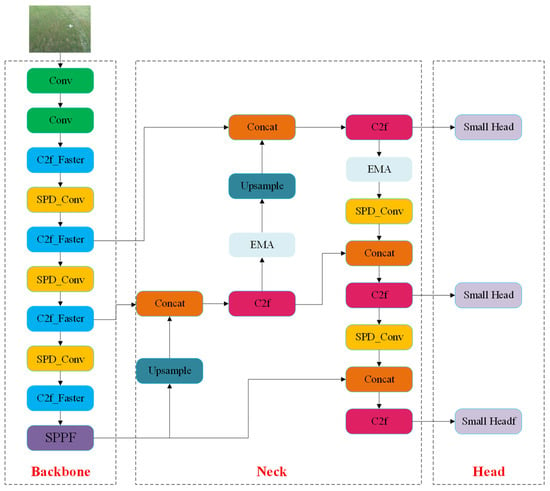
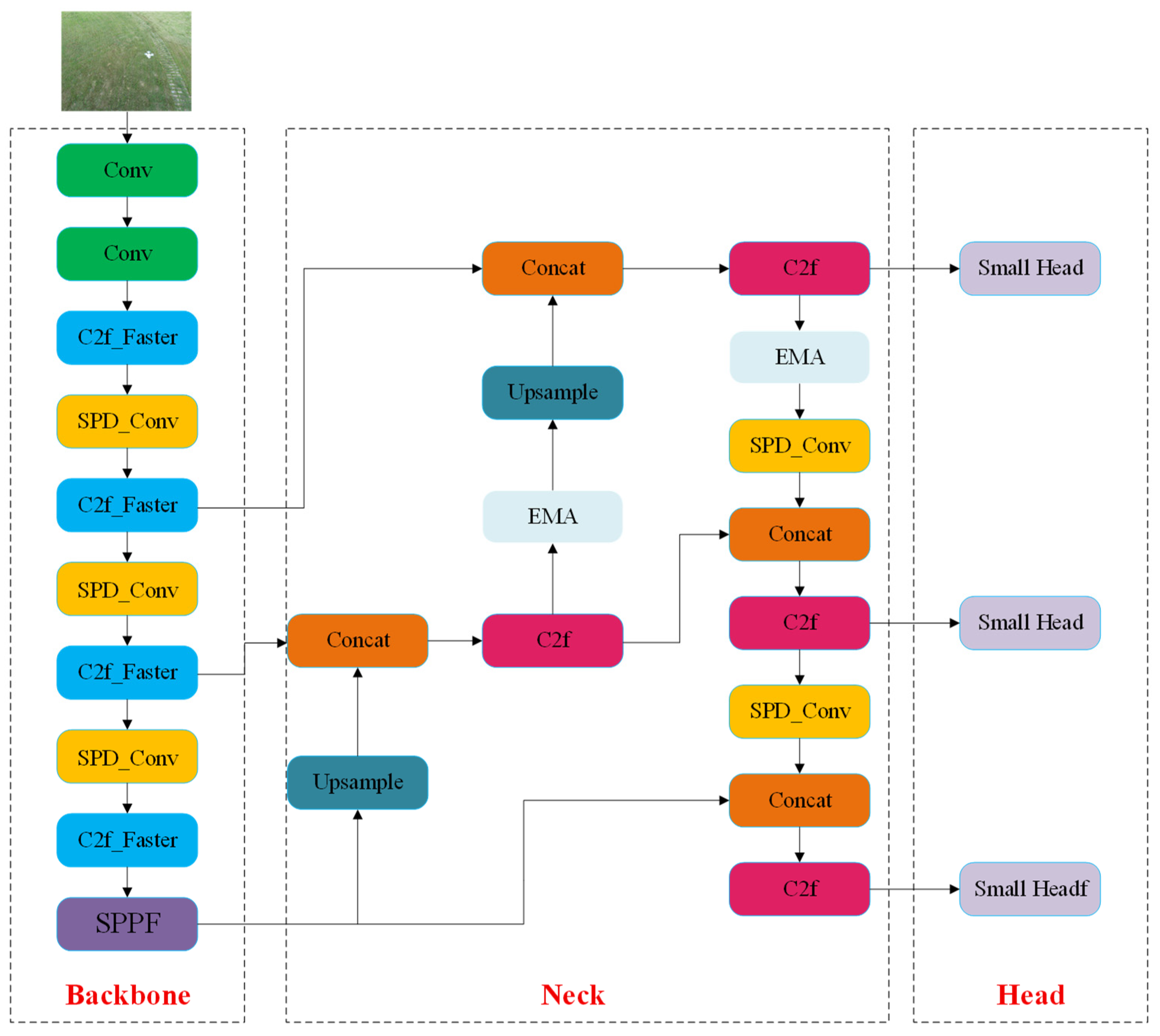
NCDet-YOLO is developed from YOLOv8n and retains its three-stage organization, comprising a Backbone, a Neck, and a Head, as illustrated in Figure 1. The locations of the introduced modules are determined according to their respective functions in the detection pipeline. Within the Backbone, C2f_Faster is used to simplify feature extraction and reduce computational cost, while SPD_Conv is employed at selected downsampling locations to retain spatial cues during resolution reduction [35,36]. In the Neck, EMA is applied after multi-scale feature fusion to enhance target-related responses in the fused features [26]. At the prediction stage, a lightweight Small Head retains the P3, P4, and P5 detection scales while reducing the computational burden of the classification and regression branches. This stage-wise redesign decreases the computational burden of the detector while preserving the overall YOLOv8 detection pipeline, making the resulting model more suitable for execution on resource-constrained edge devices.
Figure 1.
NCDet-YOLO network architecture.
2.1.1. C2f_Faster Module
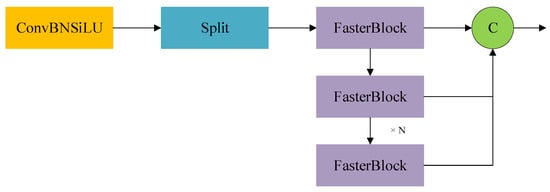
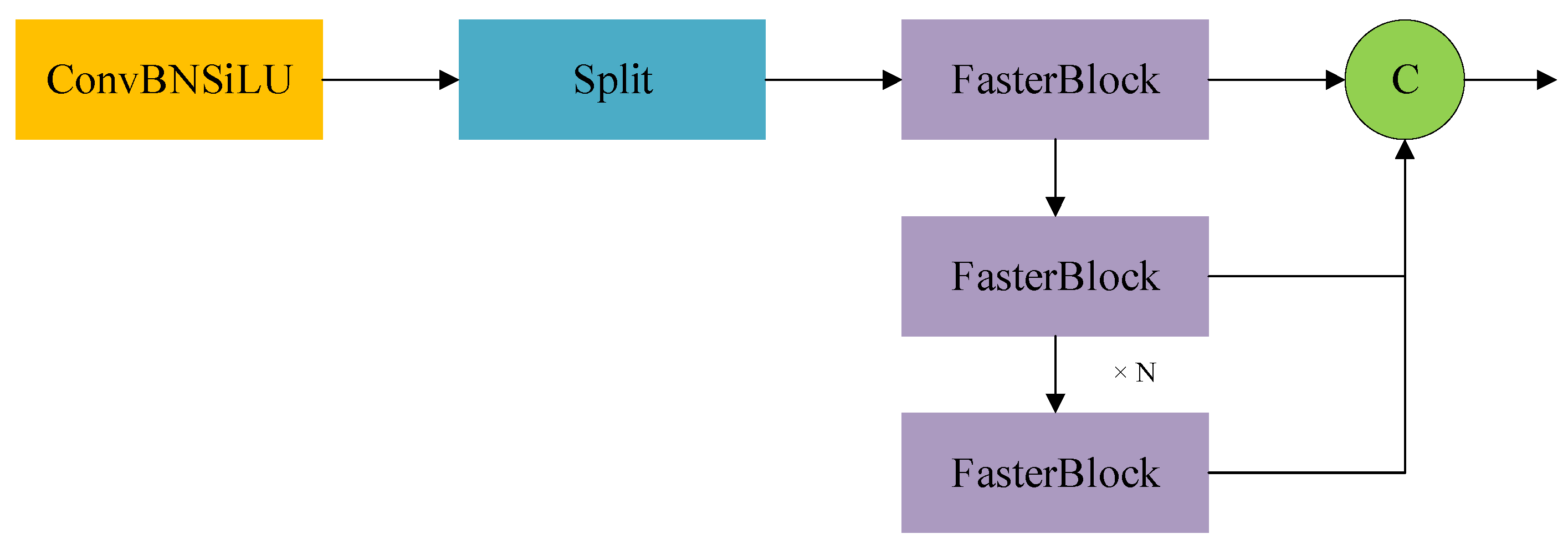
C2f is an important feature extraction unit in YOLOv8n. It enhances gradient flow and feature reuse through feature branches and cross-layer connections; however, the convolution operations inside the module still introduce a certain computational cost. To further reduce model complexity, this study replaces part of the original C2f structures with the C2f_Faster module, whose structure is shown in Figure 2.
Figure 2.
The C2f_Faster module.
C2f_Faster modifies the original C2f processing path by restricting spatial convolution to a subset of feature channels. As shown in Figure 2, the input tensor is first projected by ConvBNSiLU and then divided into two paths through the Split operation. One path is retained for subsequent aggregation, whereas the other is processed by a sequence of FasterBlocks to extract local features. The bypass feature, the processed feature, and the intermediate outputs are finally concatenated to form the module output. Each FasterBlock follows the partial-convolution principle of FasterNet, applying spatial convolution only to selected channels rather than to the entire feature tensor [35]. Relative to the original C2f module, this design preserves the multi-branch feature-reuse mechanism while requiring fewer parameters and less computation, thereby improving its suitability for real-time inference on edge devices.
2.1.2. SPD_Conv Module
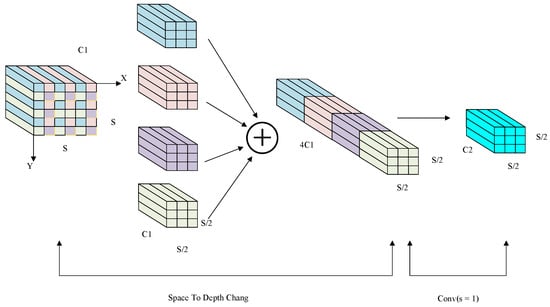
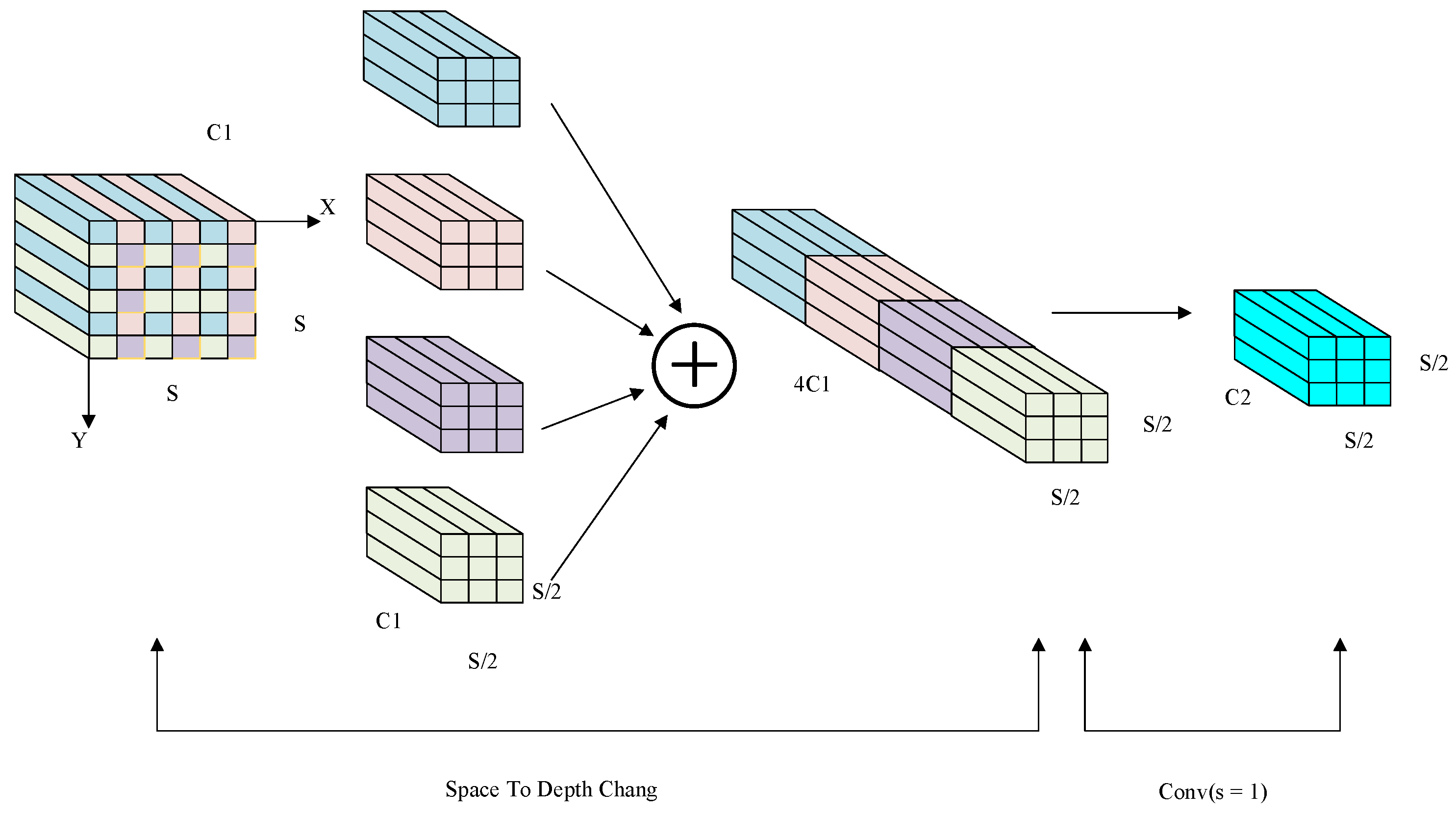
Downsampling is commonly employed in object detection networks to shrink feature maps and expand the receptive field. However, conventional approaches based on strided convolution or pooling may discard fine-grained spatial information. In low-altitude UAV detection, the apparent target scale varies with the observation distance and platform motion. Excessive loss of spatial details during resolution reduction may weaken target representation and reduce detection stability. To address this issue, SPD_Conv is introduced to replace selected conventional downsampling operations, as illustrated in Figure 3.
Figure 3.
The SPD_Conv module.
SPD_Conv rearranges information from adjacent spatial regions into the channel dimension through a Space-to-Depth operation and then uses convolution for feature fusion [36]. Compared with direct downsampling using strided convolution, this approach preserves more local spatial details while reducing the feature map resolution, thereby improving the representation of scale-varying and distant UAV targets. Meanwhile, the module has a relatively simple structure and is suitable for integration into lightweight detection networks to improve the model’s detection adaptability in edge deployment scenarios.
2.1.3. EMA Attention Module
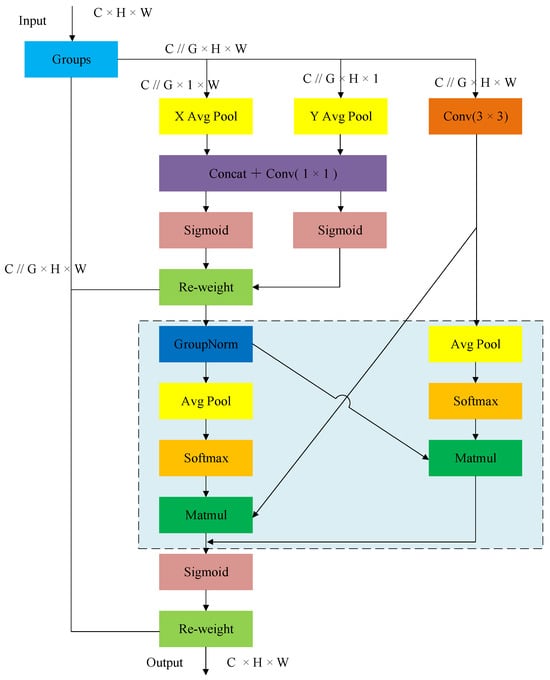
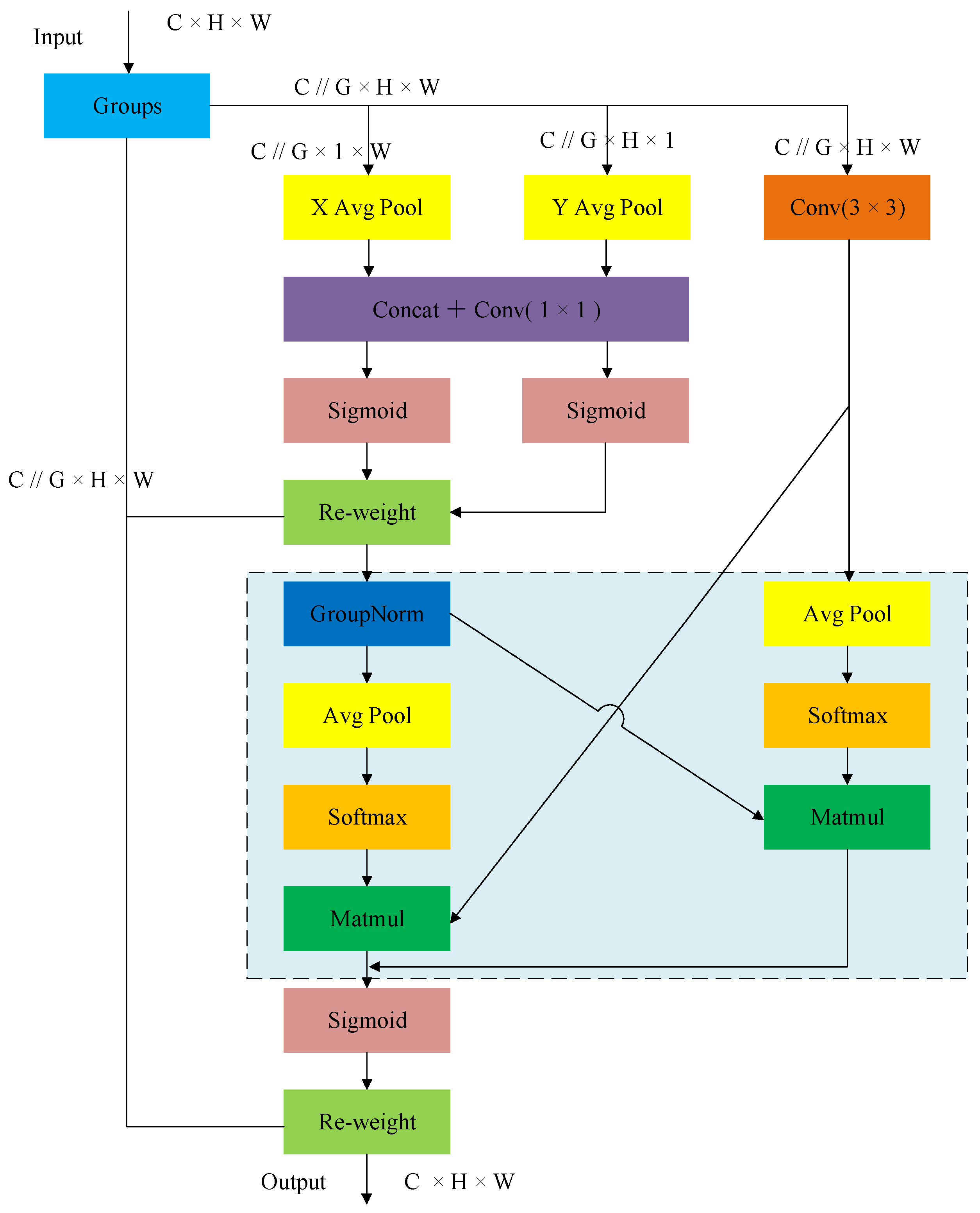
To enhance the feature representation capability of the lightweight model for UAV target regions, the EMA attention module is introduced at the feature fusion stage, as shown in Figure 4. EMA processes feature maps in groups and combines multi-scale spatial information to establish correlations among different regions, thereby strengthening the feature representation of UAV targets [26].
Figure 4.
The EMA attention module.
Compared with some complex attention mechanisms, EMA introduces lower additional computational overhead and is suitable for integration into lightweight detection networks. In this study, EMA is embedded into the C2f module after multi-scale feature fusion, enabling the model to further enhance the feature representation capability of target regions while fusing semantic information from different levels, thereby improving the stability of the lightweight model in low-altitude UAV detection tasks.
2.1.4. Small Head Module
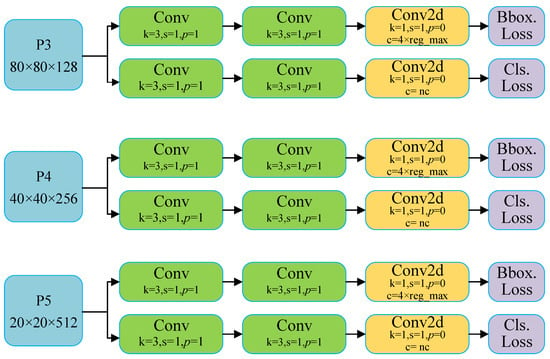
The detection head performs target classification and bounding-box regression, and its channel width and convolutional workload directly influence inference speed. Since the UAV detection task considered in this study contains only a small number of categories and must operate with limited edge-computing resources, a lightweight Small Head is adopted. The channels of the original YOLOv8n detection head are compressed to reduce the computational burden of the prediction stage.
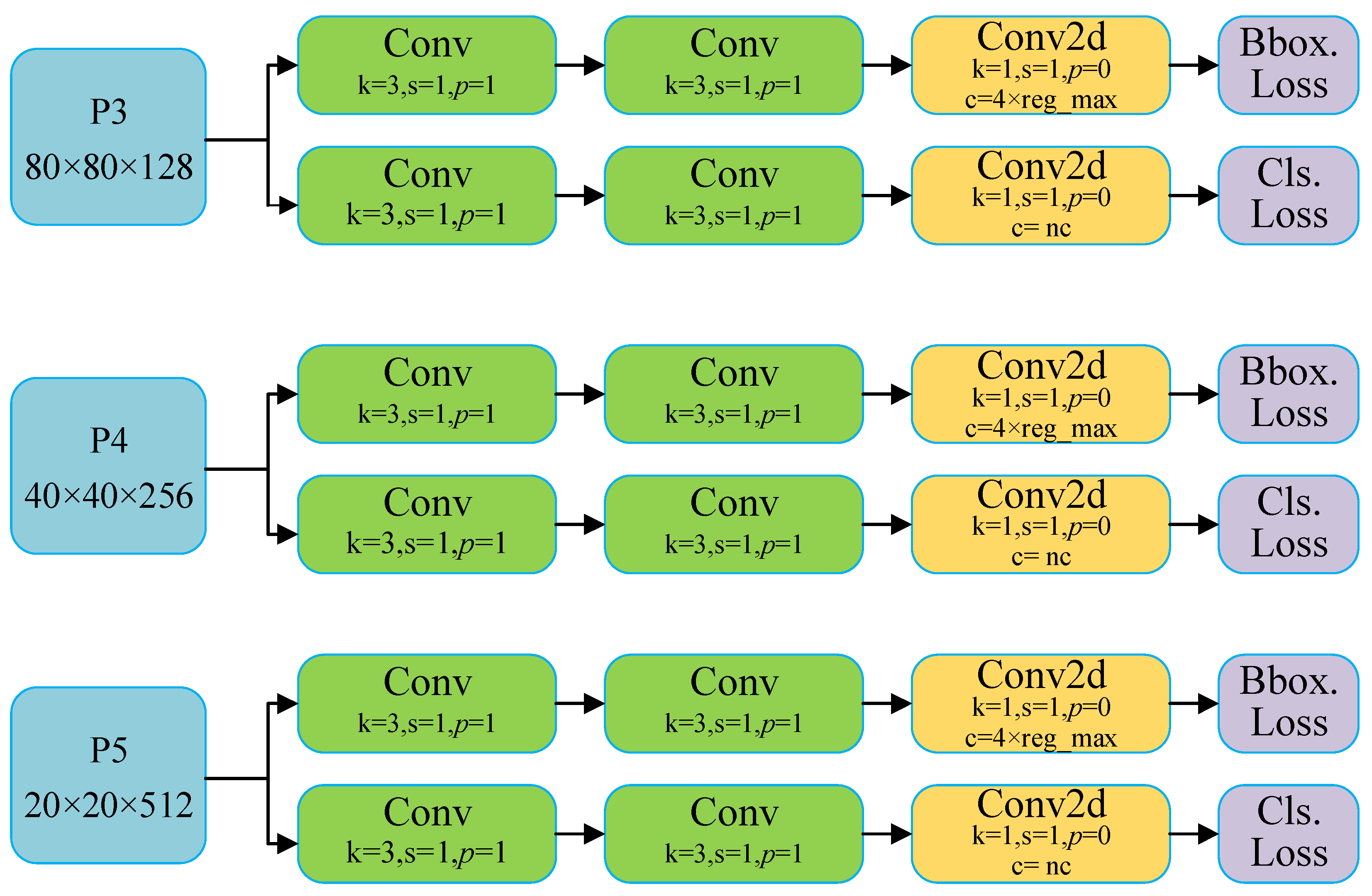
As illustrated in Figure 5, Small Head retains the three detection scales, P3, P4, and P5, while setting the channel widths of the corresponding branches to 128, 256, and 512. The channel widths were selected based on comparative experiments with different head configurations, considering the trade-off between detection performance and model complexity. This configuration reduces redundant convolutional operations in the classification and regression branches, thereby improving inference efficiency on edge platforms such as Jetson while still satisfying the requirements of UAV localization and classification. Together with C2f_Faster, SPD_Conv, and EMA, the Small Head forms the proposed lightweight UAV detector, NCDet-YOLO.
Figure 5.
Channel-compression structure of the Small Head module.
2.1.5. CrossKD Knowledge Distillation
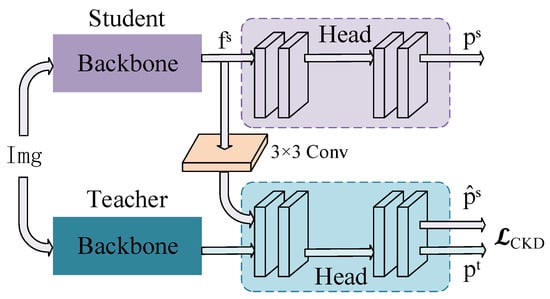
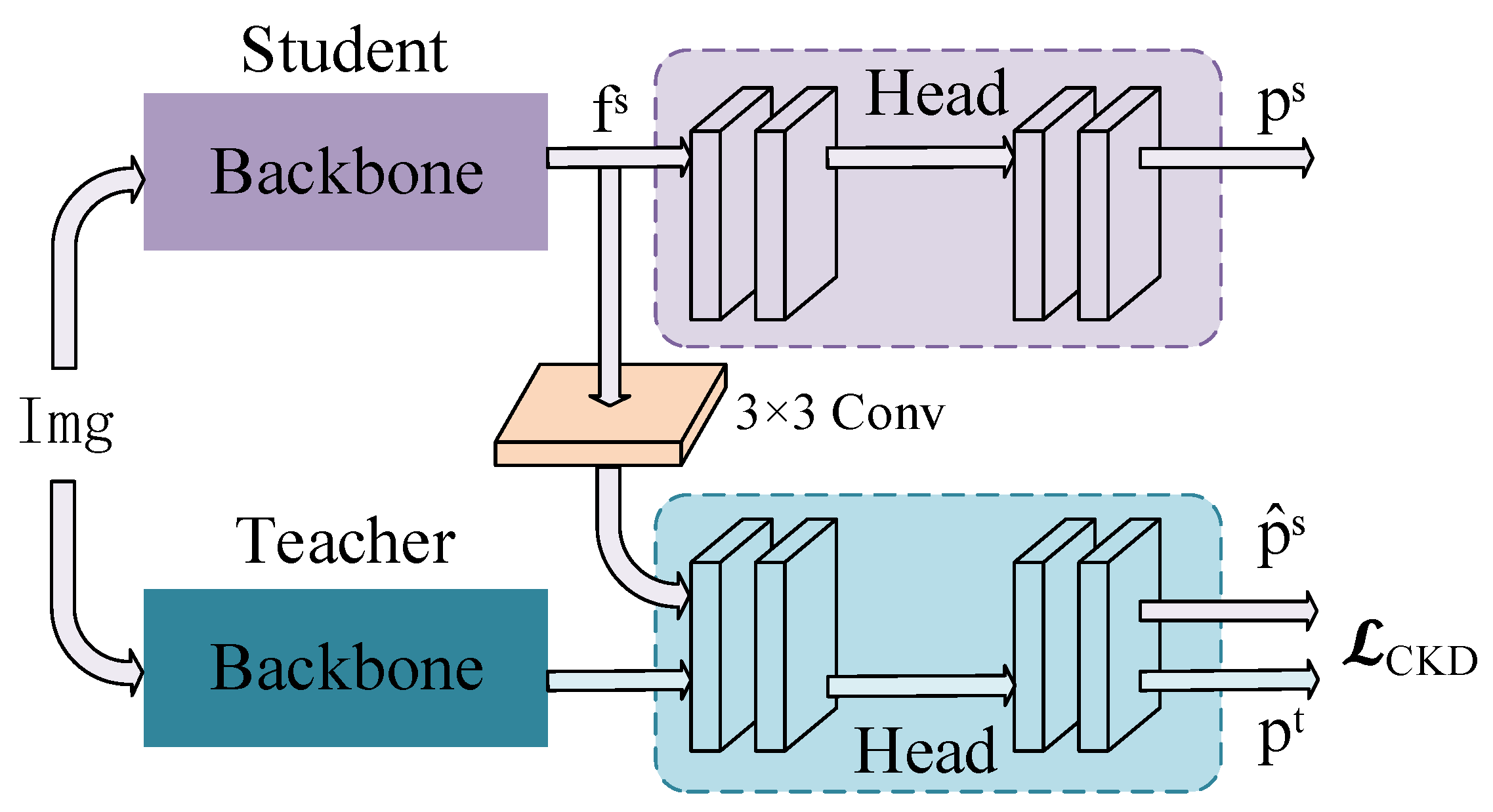
Reducing the size of a detection network lowers its parameter count and computational demand, but this may also limit its ability to represent discriminative target features. To alleviate this degradation, CrossKD is introduced during the training of NCDet-YOLO [29]. YOLOv8s, which provides stronger detection performance, is employed as the teacher network, whereas the proposed lightweight NCDet-YOLO acts as the student network.
As shown in Figure 6, CrossKD establishes a cross-head knowledge-transfer path between the teacher and student models. The teacher network generates prediction responses as distillation targets, while the student network extracts intermediate features . These student features are passed through channel-adjustment convolutions and then forwarded through the teacher detection head to generate the cross-head predictions . The distillation loss is calculated between and , rather than directly between the student prediction and the teacher prediction. During training, the teacher parameters remain fixed, while the student model is optimized using the detection loss and the CrossKD loss.
Figure 6.
Cross-head knowledge distillation process of NCDet-YOLO.
The CrossKD loss consists of classification and regression distillation losses:
where and denote the classification logits of the cross-head prediction and teacher prediction, respectively, and and denote their decoded bounding boxes. The classification and regression distillation weights are set to 0.4 and 0.75, respectively, with and . The distillation weight was determined through comparative experiments. Among the tested settings, achieved the best validation performance and was therefore adopted.
By adopting this distillation strategy, the student model obtains detection knowledge from the teacher model without modifying its inference architecture. Therefore, the number of parameters and computational cost remain unchanged during deployment. Experimental results show that CrossKD optimization improves the mAP50–95 of NCDet-YOLO to 0.65038, effectively compensating for the accuracy loss caused by the lightweight design.
2.2. UAV Net-Capture Method
2.2.1. Net-Capture Algorithm Workflow
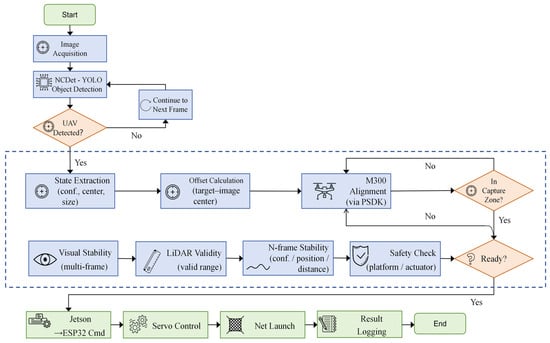
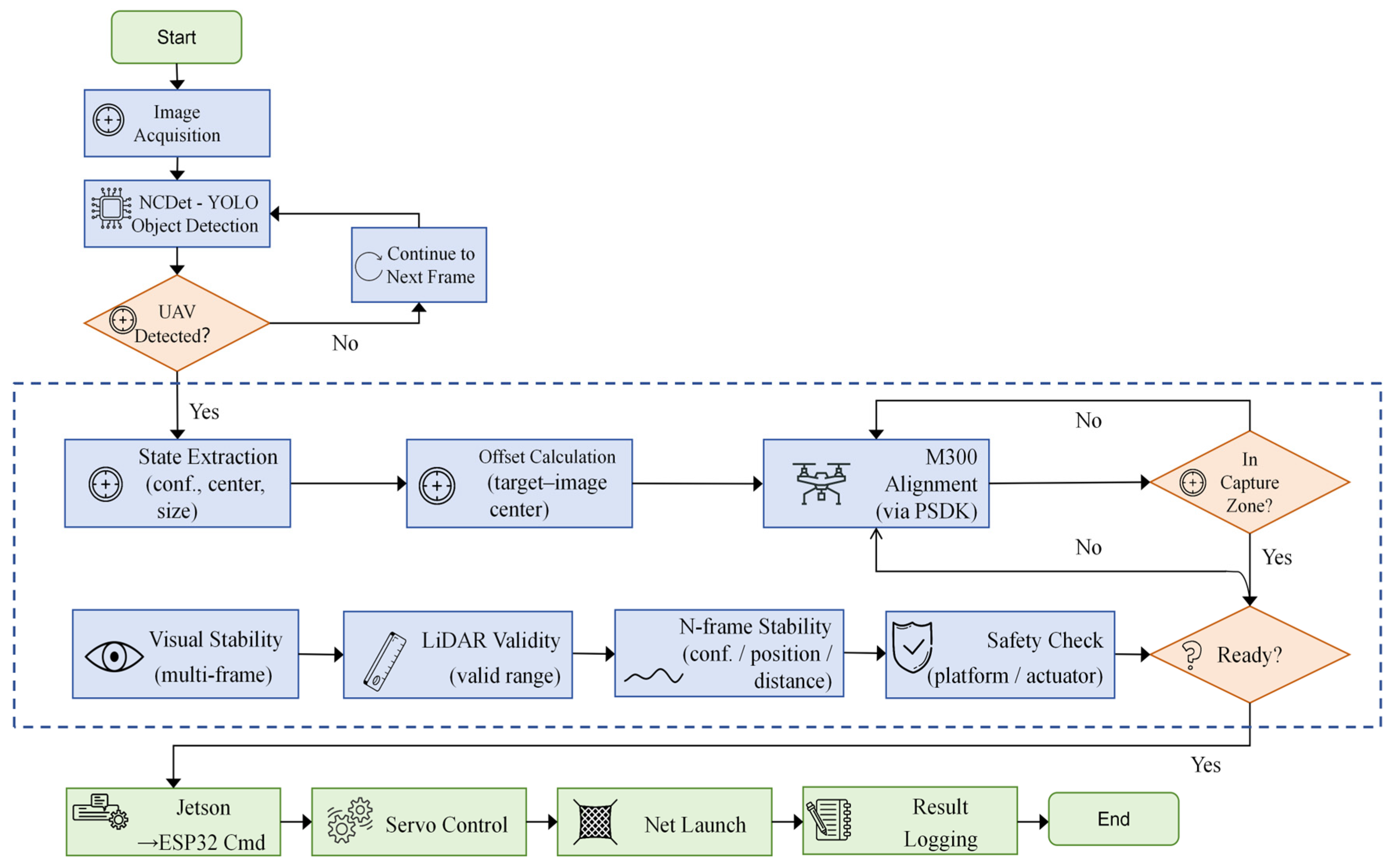
To achieve reliable coordination between UAV detection results and the net-capture actuator, this study designs a system workflow for the UAV net-capture task, as shown in Figure 7. The workflow takes the target detection results output by NCDet-YOLO as the perception input and realizes continuous control from target detection to net-capture execution through target state extraction, tracking and alignment, distance determination, and capture condition judgment.
Figure 7.
UAV net-capture workflow.
After the task starts, the monocular camera continuously captures images, and the Jetson Orin NX Super performs target detection on each frame. When a UAV target is detected, the system extracts state information such as the center coordinates of the bounding box, confidence score, and target scale, and then performs tracking and alignment according to the target position deviation. Subsequently, the system determines whether the target satisfies the capture conditions by combining laser ranging, monocular vision estimation, continuous-frame stability, and platform state information. If the conditions are satisfied, the Jetson sends a net-capture execution command to the ESP32, which controls the servo to drive the net-capture mechanism to complete the action. If the conditions are not satisfied, the system continues image acquisition, target detection, and state updating.
To further explain the implementation of the key stages in the system workflow, the following sections introduce four aspects: target detection and state extraction, tracking and capture alignment, distance estimation, and capture judgment and net-capture execution.
2.2.2. Target Detection and State Extraction
In the target perception stage, the system uses NCDet-YOLO deployed on the Jetson Orin NX Super to perform real-time inference on monocular camera images and output the category, confidence score, and bounding box position of the UAV target. Since the detection task in this study contains only a single UAV target category, the detection results are mainly used to determine whether a target exists and to further extract target position, scale, and stability information, which provide inputs for subsequent tracking and alignment, distance determination, and net-capture triggering.
Let the coordinates of the upper-left and lower-right corners of the bounding box be and , respectively. The target center coordinates, width, height, and area can then be expressed as
Let the image center coordinates be , and let the image width and height be and , respectively. The normalized deviation of the target relative to the image center can be expressed as
where and denote the horizontal and vertical deviations of the target, respectively. The system uses the target confidence score, center deviation, bounding box scale, and continuous-frame detection status as target state variables for subsequent closed-loop linkage judgment.
2.2.3. Tracking and Capture Alignment
In the UAV net-capture task, detecting the target alone cannot directly trigger the actuator. The target must also gradually enter the effective operating region of the net-capture mechanism. Therefore, the system performs tracking and alignment control according to the target center deviation, so that the target is maintained as close as possible to the image center.
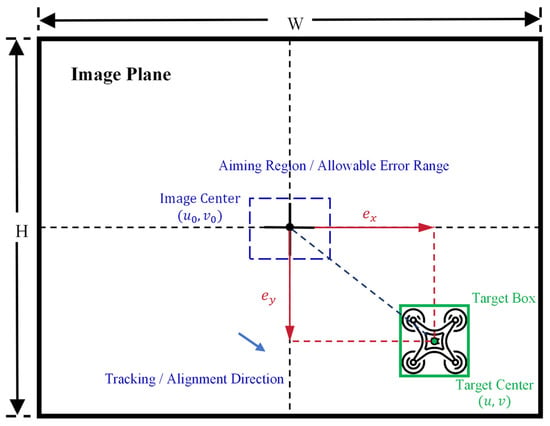
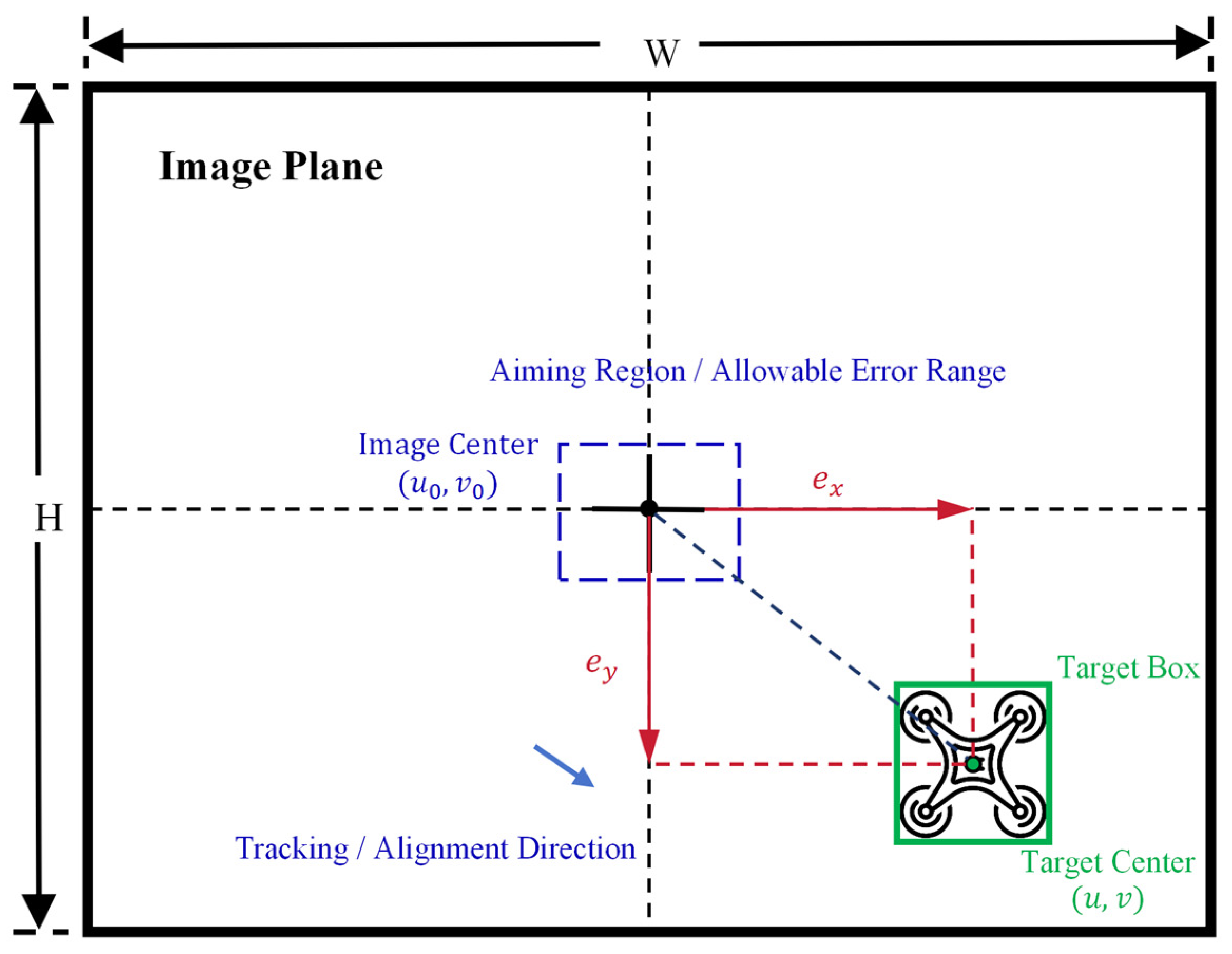
As shown in Figure 8, the system uses the image center as the reference point for net-capture alignment and determines the relative position of the target according to the horizontal and vertical deviations between the target center and the image center. The normalized deviations defined above are used as the control inputs, with their signs determining the corresponding adjustment directions. The horizontal deviation is mainly used for lateral adjustment of the platform, while the vertical deviation is used to assist forward and backward adjustment. Changes in the bounding box scale and the ranging results are used to assist height adjustment and distance-state determination. During target following and alignment, the system maintains a target distance of approximately 7 m.
Figure 8.
Target tracking and capture alignment.
No dedicated temporal tracking algorithm is employed; instead, NCDet-YOLO performs frame-by-frame detection and continuously updates the target position and alignment command using the current bounding box. To suppress frequent platform adjustments caused by small localization fluctuations, a normalized deviation dead zone of 0.03 is applied. When the deviation lies within the dead zone, the corresponding correction is suppressed; otherwise, alignment adjustment is continued. The commanded velocity of the capture UAV is limited to a maximum of 2 m/s. This frame-by-frame strategy avoids the additional computational overhead of a separate tracking module on the onboard edge platform. The current field validation was limited to stationary and low-speed moving targets, with the speed of the moving targets maintained below approximately 1 m/s. Therefore, the stability of the frame-by-frame tracking approach for rapidly moving UAVs was not independently evaluated in the present study.
2.2.4. Distance Estimation
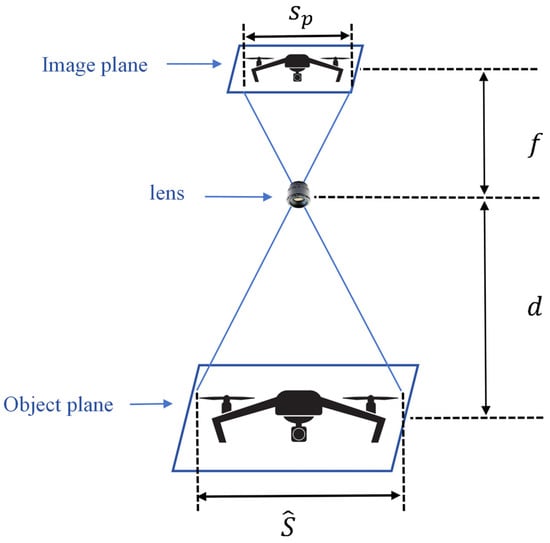
Distance determination is an important step before net-capture execution and is used to determine whether the target has entered the effective operating range of the net-capture mechanism. Traditional monocular ranging usually requires the actual size of the target to be known. However, in practical low-altitude scenarios, the UAV type, attitude, and observation angle may vary. If a fixed target size is used for estimation, relatively large errors may occur [37,38]. Therefore, this study adopts a distance determination method that primarily relies on laser ranging and uses monocular vision estimation as a supplement. When the laser ranging result is valid, the system preferentially uses the laser-measured distance as the basis for net-capture triggering. When the laser ranging result is temporarily invalid or abnormal, the system combines the monocular vision estimation result with the historical distance variation trend to assist in judging the target approach state. The principle of monocular vision ranging is shown in Figure 9.
Figure 9.
Principle of monocular vision ranging.
The monocular ranging result is derived from the geometry of similar triangles. Let denote the equivalent physical size of the target, denote its corresponding pixel scale in the detection box, and denote the focal length of the camera. The target distance is then calculated as follows:
where denotes the target distance estimated by monocular vision. In the current implementation, the initial reference value of is set to 0.40 m. Once a valid laser-ranging measurement is obtained, the laser-measured distance and the corresponding target pixel scale are used to calibrate based on Equation (8), thereby reducing the dependence of monocular ranging on a predefined physical size for a specific UAV model. No explicit compensation for variations in UAV attitude or viewing angle is applied, so changes in the projected target size may affect the monocular estimate. Because laser ranging is preferentially used and the net-capture mechanism operates over an effective range of approximately 4–10 m, the system does not rely on a single exact monocular distance estimate for capture-distance judgment. A laser measurement is considered valid when a valid return is received and the measured distance lies within the nominal operating range of the sensor. When the laser and monocular estimates are inconsistent, the valid laser result is preferentially adopted, while monocular ranging is used as a fallback when laser-ranging data are unavailable. In actual capture execution, net capture is triggered only when the target distance remains within the 5–8 m range and the other triggering conditions are satisfied.
2.2.5. Multi-Condition Net-Capture Judgment and Execution
Net-capture execution is a terminal disposal action. If it is triggered when the target is not aligned, the distance is abnormal, or the platform state is unstable, misoperation or capture failure may occur [30,31,32,33]. Therefore, before execution, this study adopts a multi-condition continuous confirmation mechanism to jointly evaluate the net-capture triggering conditions and execution safety status. The main judgment conditions before net-capture execution are shown in Table 1.
Table 1.
Net-capture triggering conditions and safety confirmation mechanism.
When the detection confidence exceeds 0.70, the normalized target-center deviation is within 0.07, the target distance is within the 5–8 m capture range, and both the platform and actuator are in an executable state, the system continuously confirms these conditions for five consecutive frames. Only after all conditions remain satisfied does the Jetson Orin NX Super send a net-capture execution command to the ESP32, which then controls the servo to drive the net-capture mechanism. If any condition is not satisfied, net capture is not triggered and the system continues target detection, alignment, and distance determination. This continuous-confirmation mechanism reduces the influence of low-confidence detections and transient target-state fluctuations on net-capture triggering.
2.3. Dataset and Experimental Setup
2.3.1. Dataset
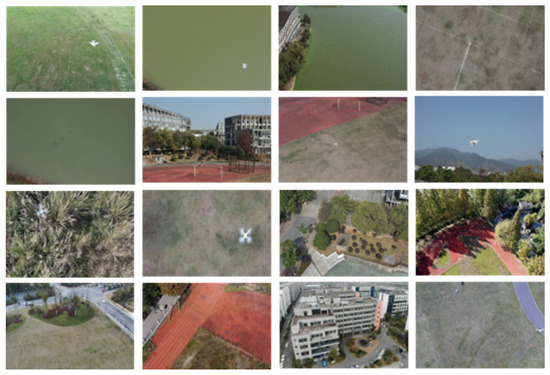
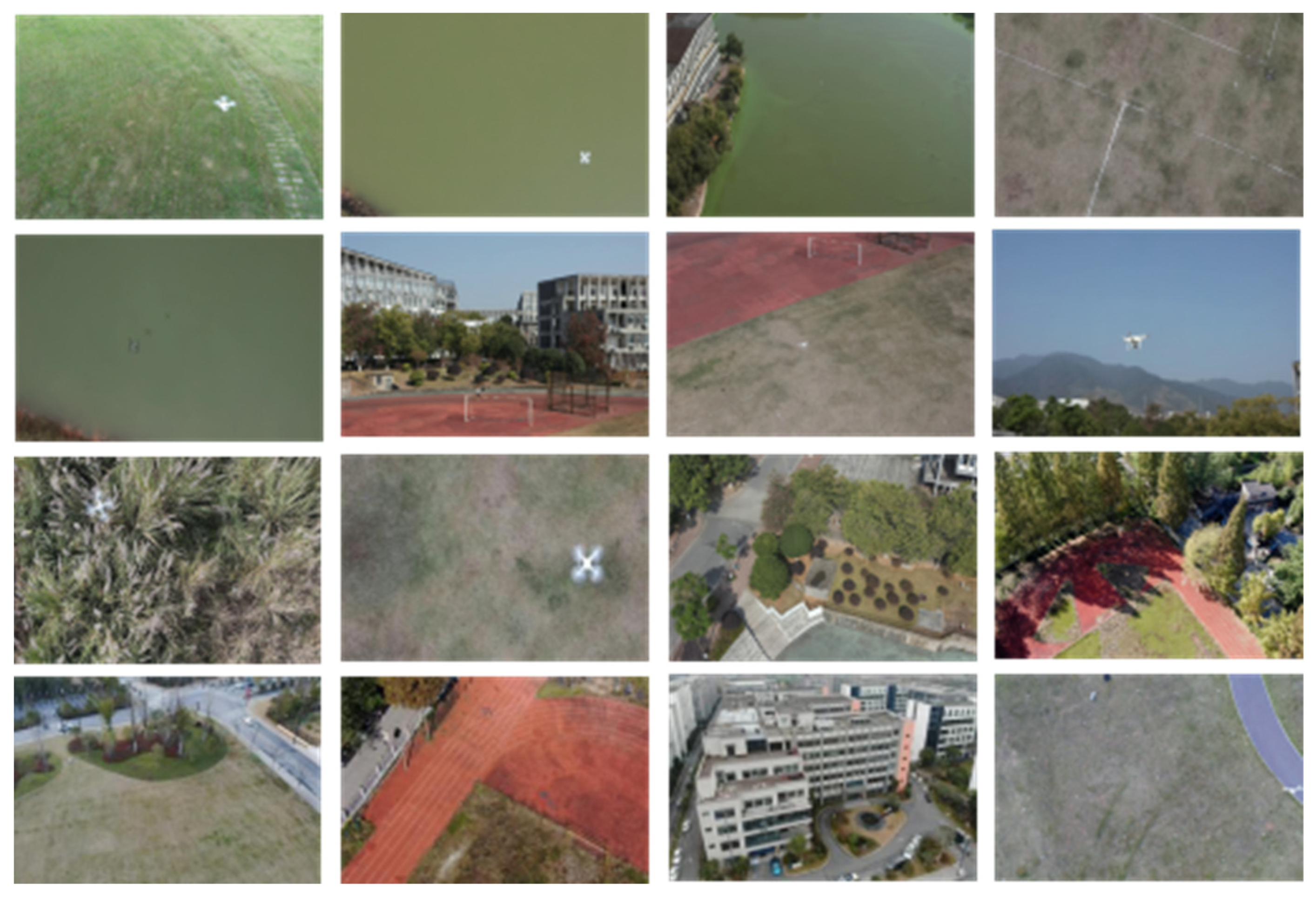
The dataset assembled for this study consists of three parts: 3524 self-collected images, 2500 images selected from the Det-Fly dataset [39], and 591 target-free negative images, resulting in a total of 6615 images. Therefore, the 6615 images represent the final experimental dataset constructed for this study rather than the complete Det-Fly dataset. The self-collected images were extracted from 13 videos involving DJI Phantom 4 and DJI Inspire 2 UAVs, with target distances of approximately 4–30 m under different daytime backgrounds and motion states. The selected Det-Fly images were included to increase the diversity of target poses, scales, and observation conditions, while the negative samples were used to improve discrimination in target-free scenes. Only one object category, UAV, is defined. All images are annotated in YOLO format. Table 2 summarizes the dataset composition, and representative samples are shown in Figure 10.
Table 2.
Composition of the dataset.
Figure 10.
Representative samples of the dataset.
The complete dataset was divided at the image level into training and validation sets at a ratio of 8:2, resulting in 5292 training images and 1323 validation images. Interval frame sampling and near-duplicate removal were applied during data preparation to reduce redundancy among consecutive video frames.
2.3.2. Experimental Environment and Parameter Settings
To ensure the fairness of the experimental comparison and the reliability of the result analysis, all detection models were trained and validated using the same dataset partition, input resolution, and evaluation metrics. The model training environment is presented in Table 3, and the main training parameters are listed in Table 4. Precision, Recall, mAP50, and mAP50–95 were adopted as the model evaluation metrics. Model complexity was represented by the parameter count and GFLOPs, while edge-deployment performance was evaluated using the ONNX model size, single-frame inference latency, and FPS.
Table 3.
Experimental environment configuration.
Table 4.
Training parameter settings.
The input resolution of 640 × 640 was adopted to balance detection performance and computational cost. The batch size was set to 16 considering GPU memory consumption and training stability. A total of 300 epochs was used to ensure sufficient model convergence, and SGD with an initial learning rate of 0.01 was adopted for optimization. The models were initialized using pretrained weights, and the early-stopping patience was set to 100 epochs. During training, HSV color augmentation, image translation, scaling, horizontal flipping, and Mosaic augmentation were applied, with Mosaic disabled during the final 30 epochs. The random seed was fixed at 0 for all experiments.
2.3.3. Edge Deployment and Net-Capture Experimental Platform
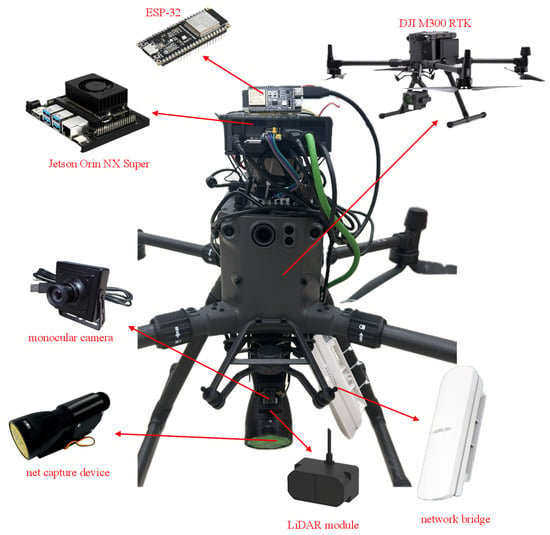
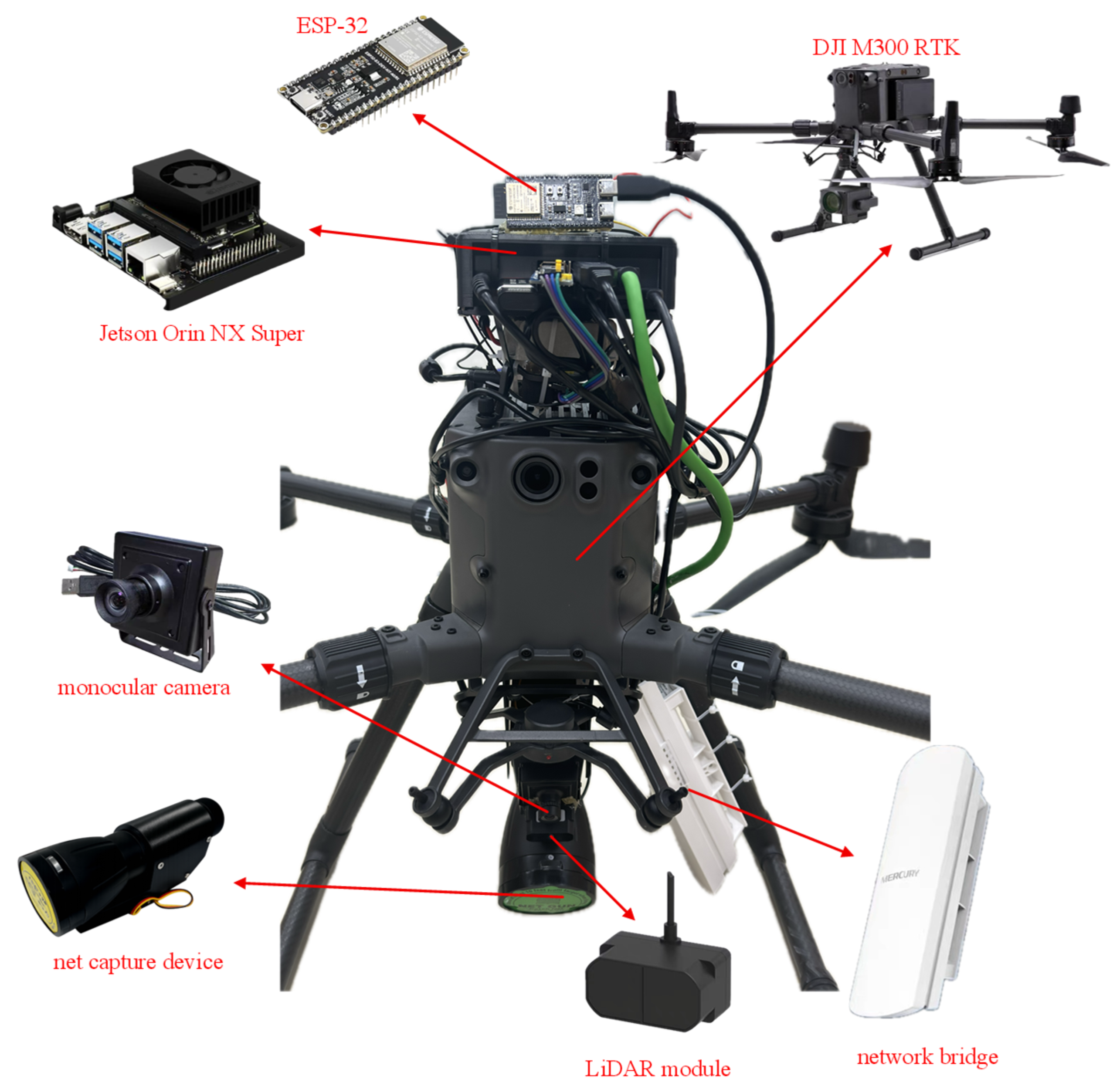
The edge deployment experiment uses the Jetson Orin NX Super as the inference platform to test the real-time operating performance of NCDet-YOLO on the edge device. The net-capture experimental platform consists of the DJI M300 flight platform, a monocular camera, a laser ranging module, the Jetson Orin NX Super, an ESP32 control module, and a net-capture mechanism. The overall hardware configuration is shown in Figure 11.
Figure 11.
Hardware platform for edge deployment and net capture.
The monocular camera is used to capture images of UAV targets. The Jetson Orin NX Super is responsible for image processing, target detection, state judgment, and control command generation. The laser ranging module is used to assist in target distance determination. The DJI M300 serves as the flight platform and provides motion control and platform state information. The ESP32 is used to receive net-capture execution commands and drive the servo to complete the net-capture action. This experimental platform is used to verify the application feasibility of the proposed model in real-time edge detection and net-capture execution tasks.
3. Results
This section presents the experimental results of NCDet-YOLO and the UAV net-capture linkage system based on the dataset and experimental setup described in Section 2.3. The evaluation focuses on model comparison, ablation analysis of network components and knowledge distillation, edge-deployment performance, and net-capture linkage performance. The experiments are conducted to assess the detection and lightweight performance of NCDet-YOLO and to verify whether the model can provide sufficient real-time inference capability for the UAV net-capture system after deployment on the Jetson Orin NX Super.
3.1. Comparative Experiments
To verify the detection performance and lightweight effect of the proposed model, YOLOv5n, YOLOv8n, YOLOv10n, YOLO11n, and YOLOv8s were selected as comparison models. Among them, YOLOv5n, YOLOv8n, YOLOv10n, and YOLO11n are lightweight detection models, while YOLOv8s is included as a higher-capacity reference model for detection-performance comparison. All models were trained and validated on the same dataset and with the same input size, and the results are shown in Table 5.
Table 5.
Performance comparison of mainstream detection models.
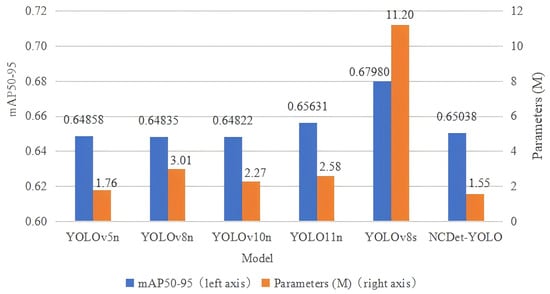
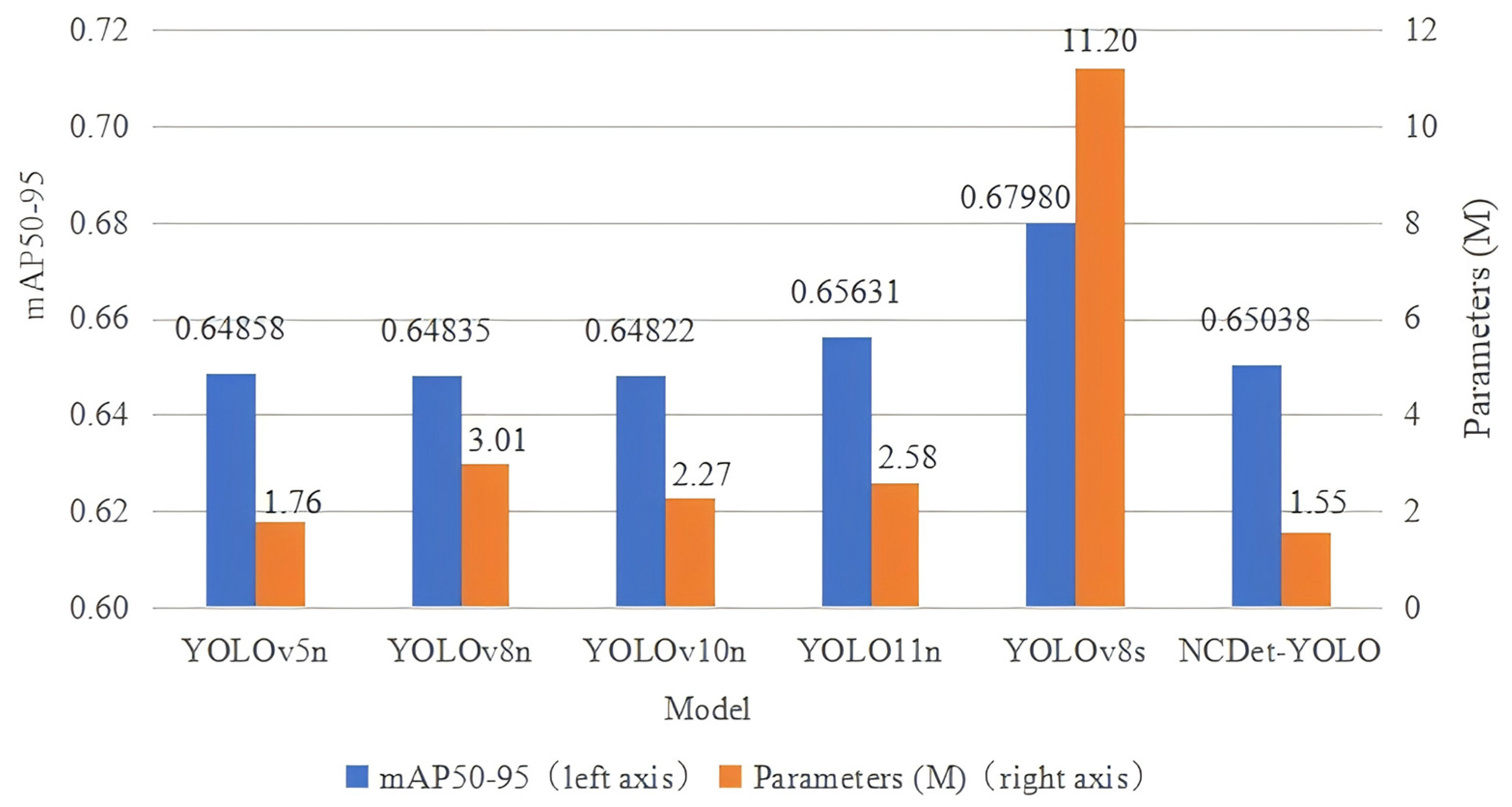
As indicated in Table 5, YOLOv8s achieves the highest mAP50–95 of 0.67980, but its larger model size and computational cost limit its suitability for resource-constrained edge deployment. Compared with YOLOv8n, NCDet-YOLO reduces the parameter count from 3.011 M to 1.550 M and GFLOPs from 8.1 to 4.1, while maintaining a comparable mAP50–95 of 0.65038 versus 0.64835. Precision increases from 0.95180 to 0.97940, whereas Recall decreases from 0.84405 to 0.79839, indicating a trade-off between the two metrics. Overall, NCDet-YOLO substantially reduces model complexity while preserving comparable detection performance. Figure 12 further compares the evaluated models in terms of mAP50–95 and parameter count.
Figure 12.
mAP50–95–parameter comparison of different detection models.
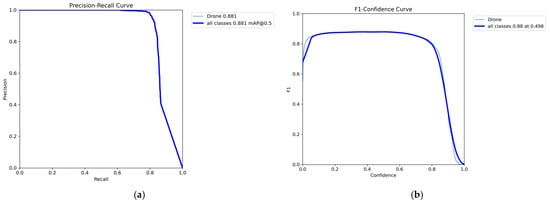
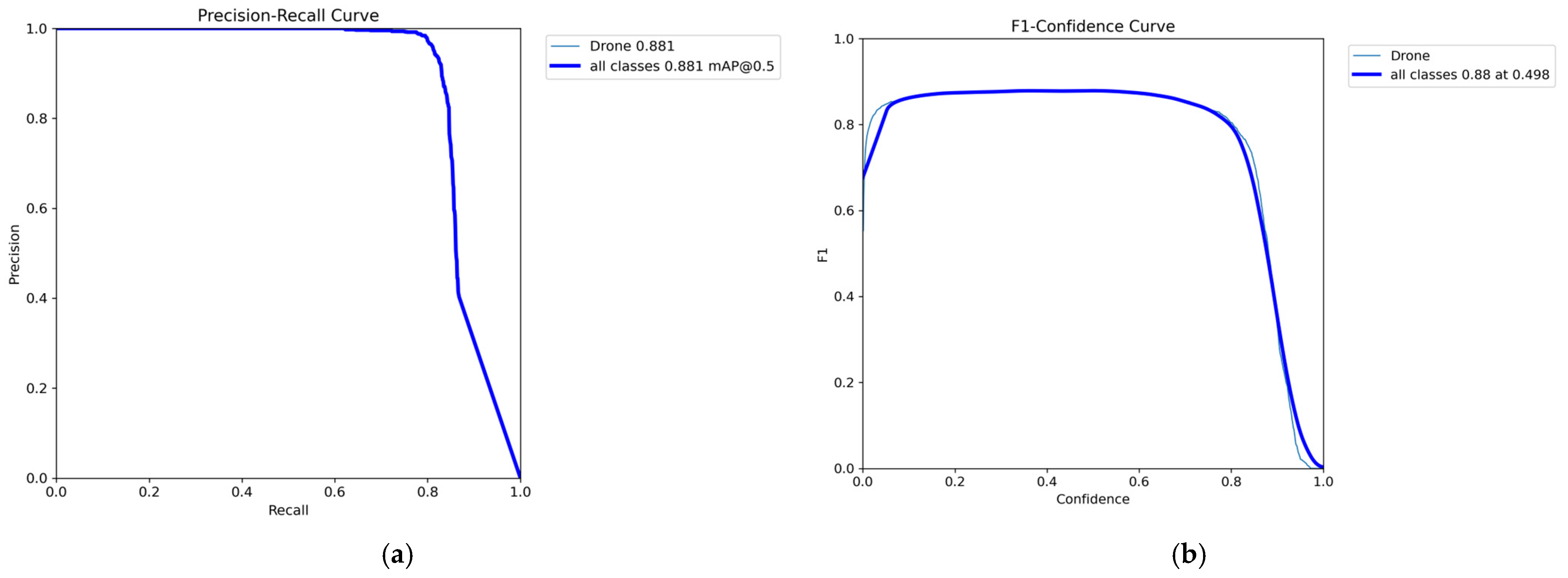
To further analyze the Precision–Recall trade-off, Figure 13 presents the precision–recall and F1–confidence curves of NCDet-YOLO. The PR curve shows that the model maintains high precision over a broad recall range, while the F1–confidence curve illustrates the balance between Precision and Recall under different confidence thresholds. These curves complement the point metrics reported in Table 5 and provide a more complete evaluation of the detector performance. In addition to the PR/F1 analysis, size-wise evaluation was conducted according to the bounding-box area. The AP50–95 values for small, medium, and large targets were 0.29335, 0.60738, and 0.81253, respectively, with 280, 543, and 417 validation instances in the corresponding groups. Small, medium, and large targets were defined using bounding-box areas of <322, , and ≥962 pixels, respectively. The results indicate that the detection performance varies across different target scales.
Figure 13.
Precision–recall and F1–confidence curves of NCDet-YOLO. (a) Precision–recall curve. (b) F1–confidence curve.
3.2. Ablation Experiments
To systematically evaluate the contribution of each component, both independent and progressive ablation experiments were conducted using YOLOv8n as the baseline. C2f_Faster, SPD_Conv, EMA, and the lightweight detection head were independently evaluated to examine their isolated effects, while the progressive configurations were used to analyze their combined contributions. CrossKD was further introduced based on Ours-Base. The corresponding results are presented in Table 6.
Table 6.
Ablation results of model structure and knowledge distillation.
As shown in Table 6, the individual structural modifications exhibit different trade-offs between detection performance and model complexity rather than uniformly improving all detection metrics. In particular, the lightweight detection head provides a substantial reduction in model complexity, while EMA alone does not improve mAP50–95 over the baseline. However, the progressive ablation results show that introducing EMA after C2f_Faster and SPD_Conv increases mAP50–95 from 0.62935 to 0.63669, indicating that its contribution is more evident in the combined architecture. After all lightweight structural modifications are incorporated, Ours-Base achieves 1.55010 M parameters with an mAP50–95 of 0.62781. The results demonstrate different accuracy–complexity trade-offs and complementary effects among the proposed modules.
After CrossKD is introduced into Ours-Base, the parameter count remains unchanged at 1.55010 M, while Precision increases from 0.96331 to 0.97940, mAP50 increases from 0.86679 to 0.88015, and mAP50–95 increases from 0.62781 to 0.65038. This indicates that CrossKD effectively compensates for the accuracy loss associated with the lightweight structural modifications without increasing the model parameter count.
3.3. Edge Deployment Performance Analysis
To evaluate the real-time deployment performance of the proposed model, all compared models were exported to ONNX format and tested on the Jetson Orin NX Super configured in the 15 W power mode. ONNX Runtime with the CUDAExecutionProvider was used as the inference backend, and FP32 precision was adopted for model inference. The input resolution was set to 640 × 640 with a batch size of 1. Before measurement, 50 warm-up runs were performed, followed by 300 timed inference runs for each model. The reported inference latency corresponds to the complete model prediction process, including image preprocessing, ONNX inference, and post-processing. FPS was calculated as 1000 divided by the average single-frame inference latency in milliseconds. The actual device power consumption was obtained from the VDD_IN readings reported by tegrastats. The deployment results are summarized in Table 7.
Table 7.
Deployment performance on the Jetson Orin NX Super under the 15 W power mode.
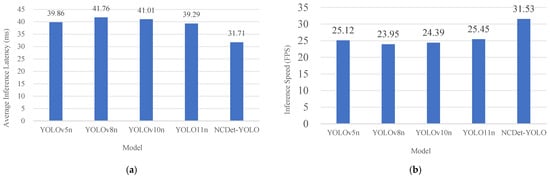
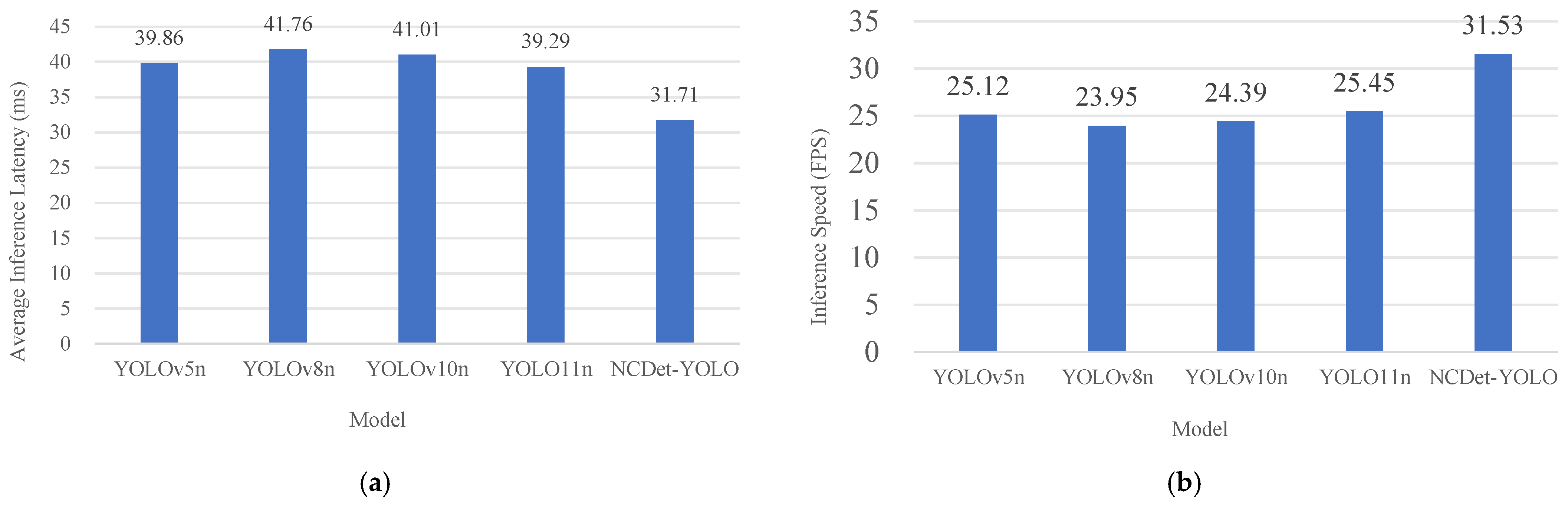
As shown in Table 7, NCDet-YOLO has an ONNX model size of 6.14 MB, an average inference latency of 31.71 ms, an inference speed of 31.53 FPS, and a measured power consumption of 9.65 W. Compared with YOLOv8n, NCDet-YOLO reduces the ONNX model size from 11.70 MB to 6.14 MB and the inference latency from 41.76 ms to 31.71 ms, while increasing FPS from 23.95 to 31.53. The measured power consumption of NCDet-YOLO is also slightly lower than that of YOLOv8n under the same 15 W power mode. Overall, these results indicate that NCDet-YOLO provides a favorable balance among model size, inference latency, processing speed, and power consumption on the evaluated edge platform. Figure 14a further compares the average inference latency of the evaluated models, while Figure 14b presents their inference speed in terms of FPS.
Figure 14.
Inference performance test on the Jetson Orin NX Super under 15 W mode. (a) Average inference latency. (b) Inference speed.
The experimental results show that NCDet-YOLO achieves lower inference latency and a higher inference frame rate while maintaining a small model size, meeting the requirements of the UAV net-capture linkage system for real-time visual detection on edge devices.
3.4. Visualization Results
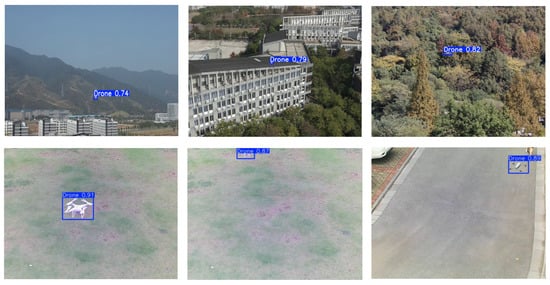
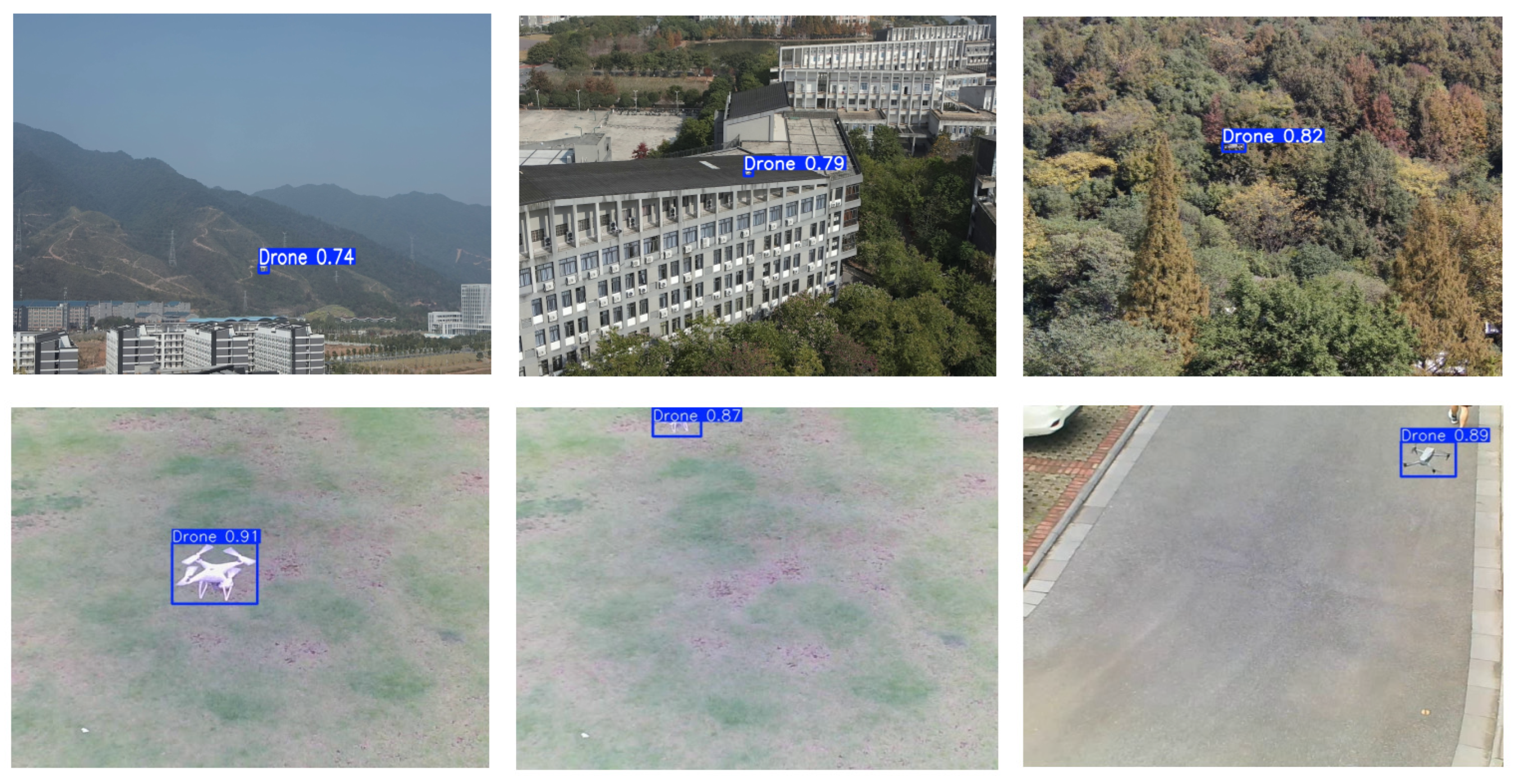
To intuitively demonstrate the detection performance of NCDet-YOLO under different low-altitude observation scenarios and in the actual net-capture testing environment, representative typical samples were selected for visualization analysis, as shown in Figure 15. The experimental scenarios cover various low-altitude observation conditions, including sky, buildings, trees, ground backgrounds, and the actual net-capture testing environment.
Figure 15.
UAV detection results in multiple scenarios and field tests.
The visualization results show that NCDet-YOLO successfully detects UAV targets in the illustrated scenarios and under different scale conditions. These qualitative results support its use as the visual perception input for subsequent target alignment, distance determination, and net-capture linkage under the evaluated conditions.
3.5. Net-Capture Experiment
To evaluate the linkage between the detection model and the net-capture actuator, real-platform experiments were conducted in an outdoor low-altitude environment. During the experiments, the Jetson Orin NX Super ran NCDet-YOLO for real-time UAV detection and determined whether the target entered a capturable state by combining target position, distance information, continuous-frame stability, and platform status. Both stationary and low-speed moving targets were tested, with the target speed kept below approximately 1 m/s during the moving trials. During target tracking and alignment, the capture UAV maintained a target distance of approximately 7 m, while net-capture execution was performed within the 5–8 m capture range.
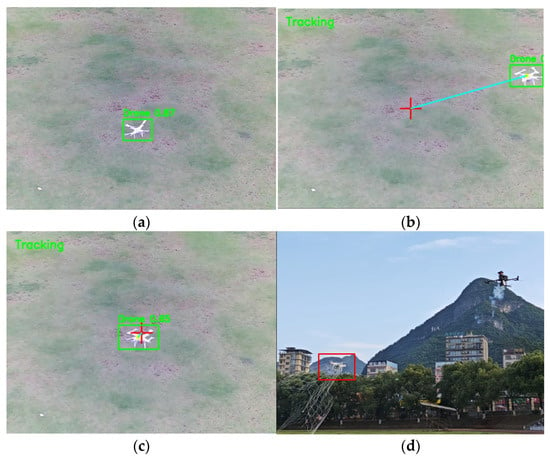
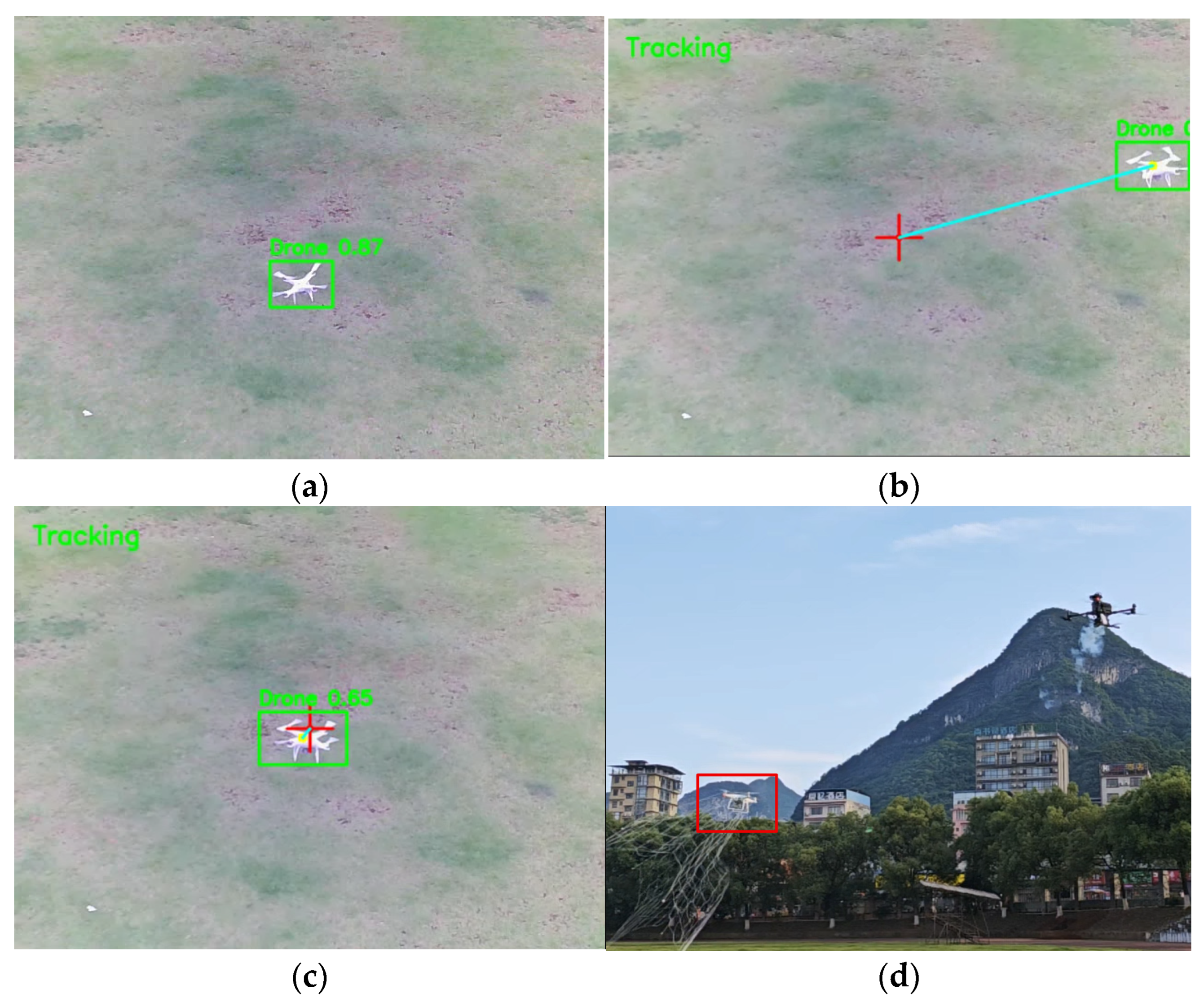
Figure 16 illustrates the complete experimental process, including target detection, tracking and alignment, capture-condition confirmation, and net-capture execution. Figure 16a shows the target detection result, Figure 16b shows the tracking and alignment process, Figure 16c shows the state in which the capture conditions are satisfied, and Figure 16d shows the net-capture execution process. Once the multi-condition continuous confirmation requirements are satisfied, the Jetson sends an execution command to the ESP32 through the control link, and the ESP32 drives the servo to activate the net-capture mechanism.
Figure 16.
Experimental process of UAV net-capture linkage. (a) Target detection. (b) Target tracking and alignment. (c) Capture conditions satisfied. (d) Net-capture mechanism execution.
A total of 10 real-platform net-capture trials were conducted under the evaluated field conditions, including both stationary and low-speed moving targets. Eight trials resulted in successful capture, corresponding to a capture success rate of 80.00%. Analysis of the two unsuccessful trials showed that one failure was caused by jamming of the net-capture mechanism during release, whereas the other involved a false trigger caused by transient PWM signal fluctuation resulting from unstable contact in the execution control link. Based on the experimental videos and execution logs, the measured end-to-end latency from target detection to net-capture firing was approximately 400 ms. These results demonstrate the feasibility of the closed-loop process from target detection, tracking and alignment, and distance determination to net-capture execution under the evaluated conditions. The observed failure cases also indicate that the mechanical reliability of the net-capture mechanism and the stability of the execution control link are important factors affecting overall system performance.
4. Discussion
The experimental results indicate a clear trade-off between model complexity and detection performance during the lightweight design of NCDet-YOLO. Compared with the original YOLOv8n, the structural modifications reduced the parameter count and computational cost, while the mAP50–95 decreased from 0.64835 to 0.62781. After introducing CrossKD, the mAP50–95 increased to 0.65038, indicating that knowledge distillation effectively compensated for the accuracy loss associated with lightweight structural modification. Compared with YOLOv8n, NCDet-YOLO increased Precision from 0.95180 to 0.97940, whereas Recall decreased from 0.84405 to 0.79839, reflecting a trade-off between Precision and Recall rather than a uniform improvement in all detection metrics.
The deployment results further demonstrate the effect of model lightweighting at the system level. On the Jetson Orin NX Super under the 15 W power mode, NCDet-YOLO achieved 31.53 FPS with an average latency of 31.71 ms and a measured power consumption of 9.65 W. In addition, 8 of the 10 real-platform net-capture trials resulted in successful capture, corresponding to a success rate of 80.0%. One false-trigger event was observed, and the measured end-to-end latency from target detection to net-capture firing was approximately 400 ms. These results provide quantitative evidence for the feasibility of integrating lightweight visual detection with the net-capture execution process under the tested conditions.
Several limitations remain in the present study. First, the dataset was partitioned at the image level rather than at the video or sequence level; therefore, potential correlations between the training and validation sets cannot be fully excluded. Second, the reported detector results were obtained from a single training run using a fixed random seed of 0, without formal multi-seed repeated-training analysis. Accordingly, the observed numerical differences should be interpreted within the adopted experimental setting rather than as statistically significant differences. In addition, the experiments considered only a single detection category, namely UAVs, and the number of real-platform net-capture trials and the range of evaluated field scenarios were limited. The system has not yet been systematically evaluated under more challenging conditions, such as distant or partially occluded targets, adverse weather, rapid platform motion, laser-ranging failure, and multiple UAV targets. Future work will expand the dataset and field experiments, evaluate system robustness under more diverse conditions, and further investigate the reliability and safety of the net-capture system.
5. Conclusions
This study developed an edge-oriented system that combined lightweight UAV detection with coordinated net capture. NCDet-YOLO served as the core detector, while the Jetson Orin NX Super, DJI M300, PSDK control interface, and ESP32-based execution module jointly supported target detection, tracking and alignment, distance determination, and net-capture actuation in a closed-loop process. On the validation set, NCDet-YOLO achieved an mAP50–95 of 0.65038 with 1.55010 M parameters and 4.1 GFLOPs. When deployed on the Jetson Orin NX Super under the 15 W power mode, the model achieved 31.53 FPS. In the field experiments, 8 of 10 net-capture trials resulted in successful capture, corresponding to a success rate of 80.0%. These results demonstrated the feasibility of integrating lightweight edge detection with coordinated net-capture execution under the evaluated conditions. The present study was limited to a single UAV category and a limited number of field net-capture trials. Future work will further evaluate the system under more challenging conditions, including distant or partially occluded targets, adverse weather, rapid platform motion, laser-ranging failure, and multiple UAV targets, while expanding the quantitative assessment of net-capture reliability and safety.
Author Contributions
Conceptualization, J.Y., K.L. and J.L.; methodology, J.Y.; software, J.Y. and X.W.; validation, J.Y., J.H. and R.Y.; formal analysis, J.Y.; investigation, J.Y., J.H. and R.Y.; resources, K.L., J.L., N.X. and M.L.; data curation, J.Y. and X.W.; writing—original draft preparation, J.Y.; writing—review and editing, K.L., J.L., N.X. and M.L.; visualization, J.Y. and X.W.; supervision, K.L. and J.L.; project administration, K.L. and J.L.; funding acquisition, K.L. All authors have read and agreed to the published version of the manuscript.
Funding
This work was supported by the Guangxi Science and Technology Department Project (GuikeAB24010281, GuikeZG2503980017) and the Innovation Project of Guangxi Graduate Education (YCSW2026394).
Data Availability Statement
The Det-Fly data used in this study were selected from the publicly available dataset available at https://doi.org/10.1109/LRA.2021.3056381 (accessed on 20 October 2025). The self-collected UAV images and target-free negative samples are available from the corresponding author upon reasonable request. These author-generated data are not publicly available at present because further privacy review and anonymization of the image content are required before public release.
Conflicts of Interest
The authors declare no conflicts of interest.
References
- Shakhatreh, H.; Sawalmeh, A.H.; Al-Fuqaha, A.; Dou, Z.; Almaita, E.; Khalil, I.; Othman, N.S.; Khreishah, A.; Guizani, M. Unmanned Aerial Vehicles: A Survey on Civil Applications and Key Research Challenges. IEEE Access 2019, 7, 48572–48634. [Google Scholar] [CrossRef] [Scilit]
- Tsouros, D.C.; Bibi, S.; Sarigiannidis, P.G. A Review on UAV-Based Applications for Precision Agriculture. Information 2019, 10, 349. [Google Scholar] [CrossRef] [Scilit]
- Surmann, H.; Leinweber, A.; Senkowski, G.; Meine, J.; Slomma, D. UAVs and Neural Networks for Search and Rescue Missions. arXiv 2023, arXiv:2310.05512. [Google Scholar]
- Seidaliyeva, U.; Ilipbayeva, L.; Beisenbi, M.; Taissariyeva, K.; Smailov, N.; Matson, E.T. Advances and Challenges in Drone Detection and Classification Techniques: A State-of-the-Art Review. Sensors 2024, 24, 125. [Google Scholar] [CrossRef] [Scilit] [PubMed]
- Khawaja, W.A.G.; Ezuma, M.; Semkin, V.; Erden, F.; Ozdemir, O.; Guvenc, I. A Survey on Detection, Classification, and Tracking of Aerial Threats Using Radar and Communications Systems. arXiv 2024, arXiv:2402.05909. [Google Scholar]
- Dong, Y.; Wu, F.; Zhang, S.; Chen, G.; Hu, Y.; Yano, M.; Sun, J.; Huang, S.; Liu, F.; Dai, Q.; et al. Securing the Skies: A Comprehensive Survey on Anti-UAV Methods, Benchmarking, and Future Directions. arXiv 2025, arXiv:2504.11967. [Google Scholar]
- Isaac-Medina, B.K.S.; Poyser, M.; Organisciak, D.; Willcocks, C.G.; Breckon, T.P.; Shum, H.P.H. Unmanned Aerial Vehicle Visual Detection and Tracking Using Deep Neural Networks: A Performance Benchmark. arXiv 2021, arXiv:2103.13933. [Google Scholar]
- Zhai, X.; Huang, Z.; Li, T.; Liu, H.; Wang, S. YOLO-Drone: An Optimized YOLOv8 Network for Tiny UAV Object Detection. Electronics 2023, 12, 3664. [Google Scholar] [CrossRef] [Scilit]
- Jiang, P.; Yang, X.; Wan, Y.; Zeng, T.; Nie, M.; Liu, Z. DRBD-YOLOv8: A Lightweight and Efficient Anti-UAV Detection Model. Sensors 2024, 24, 7148. [Google Scholar] [CrossRef] [Scilit] [PubMed]
- Yue, M.; Wang, Y.; Zhang, H.; Liu, X. Lightweight and Efficient Tiny-Object Detection Based on Improved YOLOv8n for UAV Aerial Images. Drones 2024, 8, 276. [Google Scholar] [CrossRef] [Scilit]
- Feng, Y.; Zhang, J.; Liu, H.; Wang, X. An Efficient and Accurate UAV Detection Method Based on Improved YOLOv5s. Appl. Sci. 2024, 14, 6398. [Google Scholar] [CrossRef] [Scilit]
- Yang, H.; Liang, B.; Feng, S.; Wang, J. Lightweight UAV Detection Method Based on IASL-YOLO. Drones 2025, 9, 325. [Google Scholar] [CrossRef] [Scilit]
- Wang, H.; Dang, Z.; Cui, M.; Shi, H.; Qu, Y.; Ye, H.; Zhao, J.; Wu, D. ADG-YOLO: A Lightweight and Efficient Framework for Real-Time UAV Target Detection and Ranging. Drones 2025, 9, 707. [Google Scholar] [CrossRef] [Scilit]
- Zheng, C.; Liu, L.; Fu, Q.; Yang, Q.; Zhang, D.; Yang, H. YOLO-DD: A Lightweight Framework for UAV Detection in Complex Environments via Boundary-Aware Fusion. EURASIP J. Adv. Signal Process. 2025, 2025, 44. [Google Scholar] [CrossRef] [Scilit]
- Han, Y.; Wang, C.; Luo, H.; Wang, H.; Chen, Z.; Xia, Y.; Yun, L. LRDS-YOLO Enhances Small Object Detection in UAV Aerial Images with a Lightweight and Efficient Design. Sci. Rep. 2025, 15, 22627. [Google Scholar] [CrossRef] [Scilit] [PubMed]
- Guo, Y.; He, Y.; Zhang, H.; Ma, J. YOLO-CAM: A Lightweight UAV Object Detector with Enhanced Small-Object Detection Capability. Remote Sens. 2025, 17, 3575. [Google Scholar] [CrossRef] [Scilit]
- NVIDIA. NVIDIA TensorRT Developer Guide. NVIDIA Developer Documentation, 2024. Available online: https://docs.nvidia.com/deeplearning/tensorrt/ (accessed on 4 June 2026).
- Microsoft. ONNX Runtime: Cross-Platform, High Performance ML Inferencing and Training Accelerator. Available online: https://onnxruntime.ai/ (accessed on 4 June 2026).
- NVIDIA. Jetson Orin NX Series System-on-Module Data Sheet. NVIDIA Technical Documentation, 2024. Available online: https://developer.nvidia.com/embedded/jetson-modules (accessed on 4 June 2026).
- DJI. DJI Payload SDK Development Documentation. DJI Developer Documentation, 2024. Available online: https://developer.dji.com/payload-sdk/ (accessed on 4 June 2026).
- Wang, C.-Y.; Yeh, I.-H.; Liao, H.-Y.M. YOLOv9: Learning What You Want to Learn Using Programmable Gradient Information. In Proceedings of the European Conference on Computer Vision, Milan, Italy, 29 September–4 October 2024. [Google Scholar]
- Wang, A.; Chen, H.; Liu, L.; Chen, K.; Lin, Z.; Han, J.; Ding, G. YOLOv10: Real-Time End-to-End Object Detection. arXiv 2024, arXiv:2405.14458. [Google Scholar]
- Zhao, Y.; Lv, W.; Xu, S.; Wei, J.; Wang, G.; Dang, Q.; Liu, Y.; Chen, J. DETRs Beat YOLOs on Real-Time Object Detection. In Proceedings of the IEEE/CVF Conference on Computer Vision and Pattern Recognition, Seattle, WA, USA, 17–21 June 2024; pp. 16965–16974. [Google Scholar]
- Wan, Z.; Lan, Y.; Xu, Z.; Shang, K.; Zhang, F. DAU-YOLO: A Lightweight and Effective Method for Small Object Detection in UAV Aerial Images. Remote Sens. 2025, 17, 1768. [Google Scholar] [CrossRef] [Scilit]
- Liang, S.; Feng, X.; Xie, M.; Li, G. Lightweight YOLO-SR: A Method for Small Object Detection in UAV Aerial Images. Appl. Sci. 2025, 15, 13063. [Google Scholar] [CrossRef] [Scilit]
- Ouyang, D.; He, S.; Zhang, G.; Luo, M.; Guo, H.; Zhan, J.; Huang, Z. Efficient Multi-Scale Attention Module with Cross-Spatial Learning. In Proceedings of the IEEE International Conference on Acoustics, Speech and Signal Processing, Rhodes Island, Greece, 4–10 June 2023; pp. 1–5. [Google Scholar] [CrossRef] [Scilit]
- Hou, Q.; Zhou, D.; Feng, J. Coordinate Attention for Efficient Mobile Network Design. In Proceedings of the IEEE/CVF Conference on Computer Vision and Pattern Recognition, Nashville, TN, USA, 20–25 June 2021; pp. 13713–13722. [Google Scholar]
- Yang, Z.; Li, Z.; Jiang, X.; Gong, Y.; Yuan, Z.; Zhao, D.; Yuan, C. Focal and Global Knowledge Distillation for Detectors. In Proceedings of the IEEE/CVF Conference on Computer Vision and Pattern Recognition, New Orleans, LA, USA, 18–24 June 2022; pp. 4643–4652. [Google Scholar]
- Wang, J.; Chen, Y.; Zheng, Z.; Li, X.; Cheng, M.-M.; Hou, Q. CrossKD: Cross-Head Knowledge Distillation for Object Detection. In Proceedings of the IEEE/CVF Conference on Computer Vision and Pattern Recognition, Seattle, WA, USA, 17–21 June 2024; pp. 16165–16174. [Google Scholar] [CrossRef] [Scilit]
- Zhang, T.; Lu, R.; Yang, X.; Xie, X.; Fan, J.; Tang, B. UAV Hunter: A Net-Capturing UAV System with Improved Detection and Tracking Methods for Anti-UAV Defense. Drones 2024, 8, 573. [Google Scholar] [CrossRef] [Scilit]
- Lee, Z.W.; Lim, S.Y.; Kim, H.J. Air-to-Air Micro Air Vehicle Interceptor with an Embedded Intercepting Mechanism and Vision-Based Detector. Aerosp. Sci. Technol. 2018, 77, 643–653. [Google Scholar] [CrossRef] [Scilit]
- Ning, Z.; Zhang, Y.; Lin, X.; Zhao, S. A Real-to-Sim-to-Real Approach for Vision-Based Autonomous MAV-Catching-MAV. Unmanned Syst. 2024, 12, 787–798. [Google Scholar] [CrossRef] [Scilit]
- Zheng, C.; Mi, Y.; Guo, H.; Chen, H.; Zhao, S. Vision-Based Cooperative MAV-Capturing-MAV. arXiv 2025, arXiv:2503.06412. [Google Scholar]
- Yang, R.; Xie, N.; Li, Q.; Liao, K.; Lang, J.; Ghazali, K.H.B. Design and Implementation of a Real-Time Visual Tracking System for UAVs Based on PSDK. Sensors 2026, 26, 2145. [Google Scholar] [CrossRef] [Scilit] [PubMed]
- Chen, J.; Kao, S.-H.; He, H.; Zhuo, W.; Wen, S.; Lee, C.-H.; Chan, S.-H.G. Run, Don’t Walk: Chasing Higher FLOPS for Faster Neural Networks. In Proceedings of the IEEE/CVF Conference on Computer Vision and Pattern Recognition, Vancouver, BC, Canada, 17–24 June 2023; pp. 12021–12031. [Google Scholar] [CrossRef] [Scilit]
- Sunkara, R.; Luo, T. No More Strided Convolutions or Pooling: A New CNN Building Block for Low-Resolution Images and Small Objects. In Proceedings of the European Conference on Machine Learning and Principles and Practice of Knowledge Discovery in Databases, Grenoble, France, 19–23 September 2022; pp. 443–459. [Google Scholar] [CrossRef] [Scilit]
- Hartley, R.; Zisserman, A. Multiple View Geometry in Computer Vision, 2nd ed.; Cambridge University Press: Cambridge, UK, 2004. [Google Scholar]
- Xue, L.; Xu, L.; Wang, D.; Luo, Z. Monocular Vision Ranging and Camera Focal Length Calibration. Math. Probl. Eng. 2021, 2021, 9979111. [Google Scholar] [CrossRef] [Scilit]
- Zheng, Y.; Chen, Z.; Lv, D.; Li, Z.; Lan, Z.; Zhao, S. Air-to-Air Visual Detection of Micro-UAVs: An Experimental Evaluation of Deep Learning. IEEE Robot. Autom. Lett. 2021, 6, 1020–1027. [Google Scholar] [CrossRef] [Scilit]

Disclaimer/Publisher’s Note: The statements, opinions and data contained in all publications are solely those of the individual author(s) and contributor(s) and not of MDPI and/or the editor(s). MDPI and/or the editor(s) disclaim responsibility for any injury to people or property resulting from any ideas, methods, instructions or products referred to in the content. |
© 2026 by the authors. Licensee MDPI, Basel, Switzerland. This article is an open access article distributed under the terms and conditions of the Creative Commons Attribution (CC BY) license.