


Within the CleanTech project, combined technologies are addressed in order to maximize the impact on process efficiency and environmental issues. In this paper, phytoremediation of soil with potential salt contamination [1,2] combined with the production of biomass for 2nd generation biofuels is the path used to fulfill the project’s objectives. For this purpose, several plant species able to produce biomass for biofuels were tested using soil sampled from salt-affected land. Plant species were selected based on the potential to obtain low-lignin biomass for bioethanol synthesis.
For the laboratory study the seeds, provided by certified providers, were tested for direct germination in commercial peat (as reference) and soils with different initial salinity. In this paper, the results obtained using seeds of Limonium sp. are considered. Thermogravimetric (TGA) characterization of obtained biomass was performed in order to have a complete image of bio-components content and behavior.
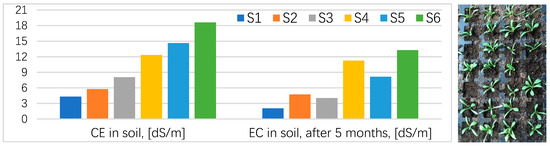
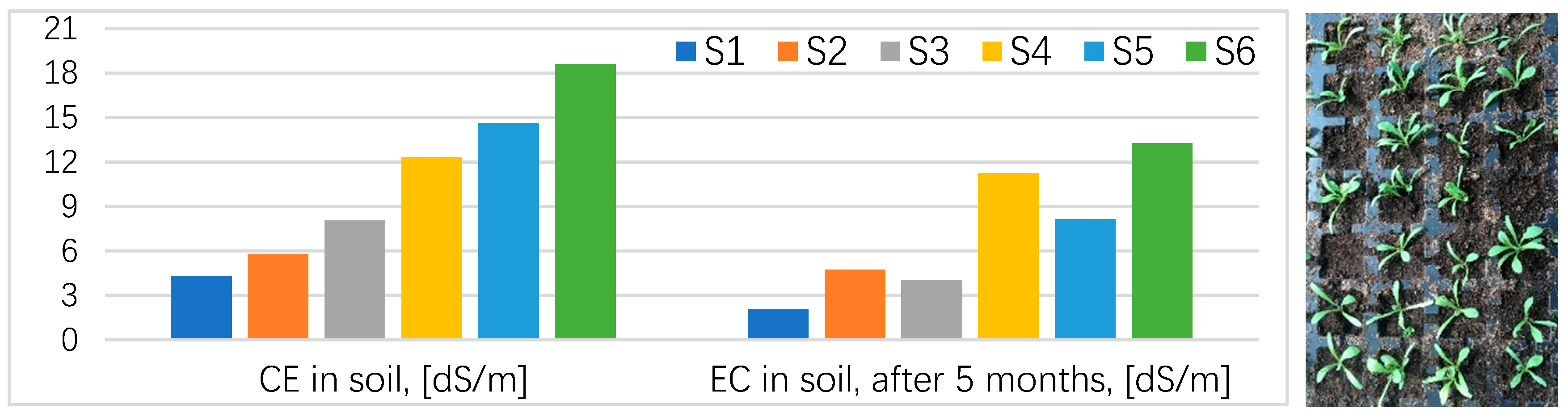
Limonium sp. seeded on soil samples with different salinity (expressed in electrical conductivity, dS/m) did not germinate. Seedlings obtained from germinated seeds in commercial peat have shown good adaptability in different soil structures and salinity levels. Soil electrical conductivity (EC) before and after experimental tests are presented in Figure 1.
Figure 1.
EC of tested soils before and after phytoremediation.
Limonium sp. has shown good salt removal capacity. The TGA analyses show that the salts tend to be deposited mainly in roots.
Acknowledgments
This work was supported by the Romanian competitiveness operational program through the knowledge transfer project CleanTech—POC - P40_308, SMIS: 105958 (http://cleantech.pub.ro/).
References
- Farzi, A.; Borghei, S.M.; Vossoughi, M. The use of halophytic plants for salt phytoremediation in constructed wetlands. Int. J. Phytoremediation 2017, 197, 643–650. [Google Scholar] [CrossRef] [Scilit]
- Gerhardt, K.E.; MacNeill, G.J.; Gerwing, P.D.; Greenberg, B.M. Phytoremediation of Salt-Impacted Soils and Use of Plant Growth-Promoting Rhizobacteria (PGPR) to Enhance Phytoremediation. In Phytoremediation; Ansari, A., Gill, S., Gill, R.R., Lanza, G., Newman, L., Eds.; Springer: Cham, Switzerland, 2017; Volume 5, pp. 19–51. [Google Scholar]
© 2019 by the authors. Licensee MDPI, Basel, Switzerland. This article is an open access article distributed under the terms and conditions of the Creative Commons Attribution (CC BY) license (https://creativecommons.org/licenses/by/4.0/).