


Transparent hydrophobic or super-hydrophobic thin films prepared on plastic substrates have attracted attention in recent years because they can be suited to optical applications such as lenses, mobile phones, touch panels, and waveguides [1].
The aim of this work was to realize transparent coatings based on modified silica materials by the acid-catalyzed sol-gel process at room temperature, and then depositing them onto plastic substrates. Silane precursors having different hydrophobic functional groups (methyl, vinyl, octyl, hexadecyl), as silica sources were employed in order to investigate the potential effect of the alkyl groups in the properties of the obtained thin films.
Different alkoxysilanes (methyltriethoxysilane (MTES), vinyltrimethoxysilane (VTMES), octyltriethoxysilane (OTES), hexadecyltrimethoxysilane (HDTMES) were used as modifier agents. Infrared absorption spectra of the sol-gel silica films were obtained using a FTIR-ATR spectrophotometer. The transmittance and diffuse reflectance of the prepared coatings were measured by a UV-visible spectrometer. The static contact angle between water and coating surface was measured by Contact Angle Tensiometer. The surface topography was investigated through AFM analysis.
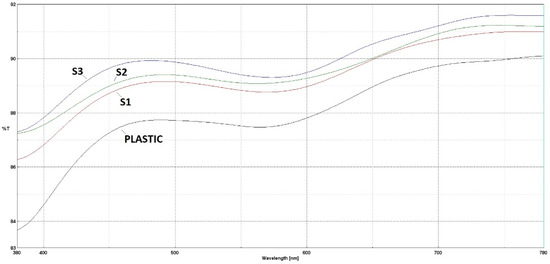
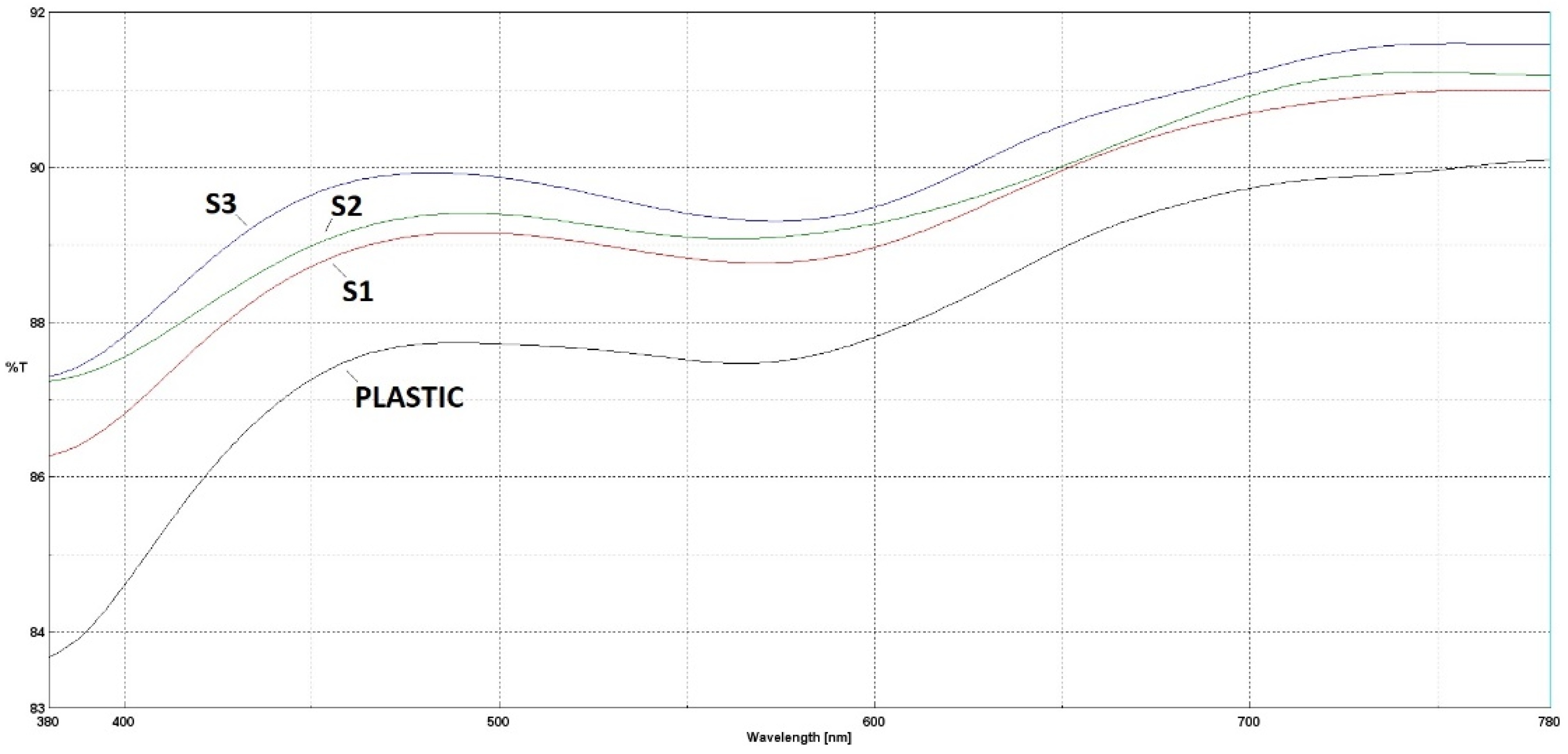
FTIR spectra of obtained materials shows the absorption bands at ~1020 cm-1 correspond to the stretching vibrations of Si-O-Si bonds. The UV-visible spectra of all prepared coatings reveal that these coatings were highly transparent (Figure 1). These sol-gel single-layered, antireflection coatings showed a reduction in the reflectance compared with un-coated plastic surface. The wettability of thin modified silica layers on the plastic substrate varies as a function of the hydrophobic functional groups belonging to the silane precursors.
Figure 1.
Transmittance spectra of coatings covered with sol-gel silica materials modified with silane precursors: S1 (MTES+OTES), S2 (MTES+VTMES), S3 (MTES+HDTMES).
Transparent coatings with anti-reflective and hydrophobic properties were prepared by acid-catalyzed sol-gel process, using silane precursors with long alkyl chains. Plastic substrates coated with the antireflective coating films may be used in solar photovoltaic applications.
Acknowledgments
The work on this paper was supported by the INCDCP ICECHIM Bucharest 2019-2022 Core Program PN. 19.23–Chem-Ergent, Project No.19.23.03.04., and by a grant of the Romanian Ministry of Research and Innovation, PCCDI–UEFISCDI, project number PN-III-P1-1.2-PCCDI-2017-0428, within PNCDI III (no.40PCCDI, PC4-FOTOMAH)
References
- Chang, C.C.; Lin, Z.M.; Huang, S.H.; Cheng, L.P. Preparation of Highly Transparent 13F-Modified Nano-Silica/Polymer Hydrophobic Hard Coatings on Plastic Substrates. J. Appl. Sci. Eng. 2015, 18, 387–394. [Google Scholar]
© 2019 by the authors. Licensee MDPI, Basel, Switzerland. This article is an open access article distributed under the terms and conditions of the Creative Commons Attribution (CC BY) license (https://creativecommons.org/licenses/by/4.0/).