




Next Issue
Volume 11, April
Previous Issue
Volume 11, February


Trop. Med. Infect. Dis., Volume 11, Issue 3 (March 2026) – 23 articles
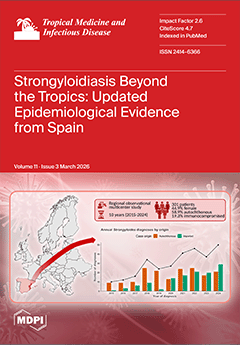
Cover Story (view full-size image): Strongyloidiasis is regarded as a tropical disease; however, localized endemic foci have been historically described in Spain. This multicenter regional case series study includes 301 patients diagnosed with strongyloidiasis from 2015 to 2024. Most cases were autochthonous and asymptomatic, with eosinophilia observed in under half of the sample. Symptoms were mostly cutaneous and gastrointestinal, and severe infection was rare. Imported cases originated predominantly from Latin America, with an increased contribution in overall diagnoses over time, whereas trends by sex and immune status were not significant. Stool-based methods demonstrated a low diagnostic yield. These findings document the sustained detection of cases beyond historically recognized foci with an increasing proportion of imported diagnoses in a non-tropical setting. View this paper 
  • Issues are regarded as officially published after their release is announced to the table of contents alert mailing list.
  • You may sign up for e-mail alerts to receive table of contents of newly released issues.
  • PDF is the official format for papers published in both, html and pdf forms. To view the papers in pdf format, click on the "PDF Full-text" link, and use the free Adobe Reader to open them.
Order results
Result details
Section
Select all
Export citation of selected articles as:
14 pages, 535 KB  
Article
Brucellosis Seroprevalence, Analysis of Risk Factors, and Comparison of Test Methods Used in Diagnosis in a Tertiary Hospital in Kahramanmaraş
by Özlem Kirişci and Zerife Orhan
Trop. Med. Infect. Dis. 2026, 11(3), 85; https://doi.org/10.3390/tropicalmed11030085 - 21 Mar 2026
Viewed by 657
Abstract
(1) Brucellosis is a zoonotic infection that remains a significant public health concern in endemic regions. This study aimed to determine the seroprevalence of brucellosis in a tertiary care hospital, analyze associated risk factors, and evaluate the diagnostic performance of commonly used serological [...] Read more.
(1) Brucellosis is a zoonotic infection that remains a significant public health concern in endemic regions. This study aimed to determine the seroprevalence of brucellosis in a tertiary care hospital, analyze associated risk factors, and evaluate the diagnostic performance of commonly used serological tests. (2) The study was based on the serological test results of 24,545 samples collected between 2020 and 2023. Rose Bengal, standard tube agglutination, and Brucellacapt tests were used for the diagnosis of brucellosis. Data were analyzed according to age, sex, clinical department, and seasonal distribution using SPSS version 25.0. (3) Overall, 367 cases (1.5%) tested positive. When the 367 seropositive cases were evaluated by year, the annual distribution showed a declining trend, decreasing from 2.5% in 2020 to 1.2% in 2023. Among the positive cases, 57.8% were female, and 36% were aged between 41 and 64 years. The infectious diseases department had the highest positivity rate (37.1%). Brucellacapt showed the highest positivity rate (90.2%), followed by Rose Bengal (76.2%). The highest monthly positivity rate was observed in October (11.4%), and seasonally in autumn (31.3%). (4) The Brucellacapt test has demonstrated high sensitivity and serves as a valuable supplementary diagnostic tool in the evaluation of brucellosis. However, its low specificity underscores the necessity for careful interpretation of positive results and supports its use in conjunction with other serological tests to enhance diagnostic accuracy. Considering seasonal and departmental variations, a combined testing approach may improve overall diagnostic accuracy. Full article
Show Figures

Figure 1

16 pages, 386 KB  
Article
Evaluating Treatment and Safety Outcomes of a Shorter Regimen for Drug-Resistant TB in Nigeria: An Implementation Research Study
by Victor Babawale, Clement Adesigbin, Corinne S. Merle, Vanessa Veronese, Fatimata Bintou Sall, Benjamin Seydou Sombie, Eunice Nnaisa Jiya-Chitumu, Chizaram Onyeaghala, Adegboyega Moses Oyefabi, Rotimi Samuel Owolabi, Osman Eltaye, Olusoji Ige, Ogiri Sam, Obioma Akaniro, Adebola Lawanson, Victor Ombeka and Muse Fadeyi
Trop. Med. Infect. Dis. 2026, 11(3), 84; https://doi.org/10.3390/tropicalmed11030084 - 21 Mar 2026
Viewed by 803
Abstract
The introduction of significantly shorter, all-oral regimens has significantly shifted the management of drug-resistant tuberculosis (DR-TB) towards a more tolerable and patient-centred therapeutic approach that aims to enhance treatment adherence, clinical outcomes, and quality of life among patients. Nigeria has gradually adopted this [...] Read more.
The introduction of significantly shorter, all-oral regimens has significantly shifted the management of drug-resistant tuberculosis (DR-TB) towards a more tolerable and patient-centred therapeutic approach that aims to enhance treatment adherence, clinical outcomes, and quality of life among patients. Nigeria has gradually adopted this all-oral, shorter regimen, but the impact of this regimen in programmatic settings has not yet been studied. In 2022, a longitudinal, two-armed cohort study was conducted to explore the effectiveness, safety, and feasibility of the all-oral shorter regimen in the programmatic management of RR/MDR-TB in Nigeria. Consenting and eligible RR/MDR-TB patients receiving the all-oral regimen (intervention group) in four states were consecutively enrolled and compared to those receiving the standard of care (SOC). Treatment effectiveness, proportion, and 95% confidence intervals of favourable and unfavourable outcomes were measured at the end of treatment and during follow-up (six and 12 months post-treatment). In total 383 Participants were followed monthly throughout the 9–12-month treatment phase and then reassessed at 6 and 12 months after treatment completion, giving a total possible observation period of up to 24 months (185 received the intervention and 198 the standard of care). At the end of follow-up, there was a higher but non-significant proportion of favourable outcomes among the intervention vs. SOC group (80% vs. 69.7%); a higher proportion of favourable outcomes was also noted at the end of treatment among intervention participants (81.1 vs. 76.8%). Around one third of patients reported at least one serious adverse event (SAE), with no significant differences between arms, and none were deemed related to the use of medication. Intervention participants reported greater improvements in health-related quality of life between baseline and four months compared to those receiving the SOC. These findings support the programmatic use of all-oral shorter treatment for RR/MDR-TB as a regimen that is effective, tolerable, safe, and associated with enhanced health-related quality of life for patients in Nigeria. Full article
(This article belongs to the Special Issue Tuberculosis Control in Africa and Asia)
Show Figures

Figure 1

12 pages, 1018 KB  
Article
Programmatic Results of Integrating Systematic TB Screening Across Diverse Outpatient Health System Entry Points in the Democratic Republic of the Congo
by Romain Kibadi Lungoy, Jean Ngoy Kitenge, Nuccia Saleri, Stephane Mbuyi Tshikunga, Papy Pululu, Emmanuelle Papot, Corinne Simone Merle, Anna Scardigli and Jean Pierre Malemba Tshibuyi
Trop. Med. Infect. Dis. 2026, 11(3), 83; https://doi.org/10.3390/tropicalmed11030083 - 17 Mar 2026
Viewed by 566
Abstract
The Democratic Republic of the Congo faces a high tuberculosis (TB) burden. In 2022, 61% of an estimated 402,000 TB cases were reported (World Health Organization Global tuberculosis report). To enhance case detection, the national TB program (NTP) introduced a program quality and [...] Read more.
The Democratic Republic of the Congo faces a high tuberculosis (TB) burden. In 2022, 61% of an estimated 402,000 TB cases were reported (World Health Organization Global tuberculosis report). To enhance case detection, the national TB program (NTP) introduced a program quality and efficiency approach (PQE), integrating systematic TB screening into outpatient departments (OPDs). Observational data of the PQE on the TB care cascade (from screening to treatment) across 70 sites in Kinshasa that initiated PQE during the first quarter of 2023 are presented. Data were collected monthly and validated during supervision visits, and disaggregated by sex, healthcare facility type (public, private, or faith-based), facility level (primary or secondary), and OPD within each facility. In 2024, 639,464 individuals were consulted in various OPDs in the participating facilities, 57% of which were female. The median number needed to screen (NNS) was 22.1, with an interquartile range of [9.5–104.3]. There was a significantly lower NNS observed in general practice and human immunodeficiency virus departments. Throughout the TB care cascade, women were less likely than men to be screened, tested, or treated. These findings, to be interpreted within the context of Kinshasa pilot facilities, provide insights to the NTP for developing PQE implementation research aimed at understanding the reasons for these discrepancies and informing NTP scale-up at the national level. Full article
(This article belongs to the Special Issue Tuberculosis Control in Africa and Asia)
Show Figures

Figure 1

17 pages, 4045 KB  
Article
Global Temporal Trends and Projections of Acute Hepatitis E Epidemiology for Adults 65 Years and Older from 1990 to 2021: Global Burden of Disease 2021 Based Study
by Shuangshuang Ma, Qingling Wang, Junjie Lin and Yufeng Gao
Trop. Med. Infect. Dis. 2026, 11(3), 82; https://doi.org/10.3390/tropicalmed11030082 - 17 Mar 2026
Viewed by 746
Abstract
Background: Acute hepatitis E (AHE) poses escalating risks to older adults (≥65 years), compounded by immunosenescence and comorbidities. Using Global Burden of Disease (GBD) 2021 data, this study analyzes global AHE burden, trends, and projections in aging populations. Methods: Age-standardized rates (ASIR, ASMR, [...] Read more.
Background: Acute hepatitis E (AHE) poses escalating risks to older adults (≥65 years), compounded by immunosenescence and comorbidities. Using Global Burden of Disease (GBD) 2021 data, this study analyzes global AHE burden, trends, and projections in aging populations. Methods: Age-standardized rates (ASIR, ASMR, ASDR) for AHE in adults ≥ 65 years were extracted from GBD 2021 across 204 countries (1990–2021). Frontier analysis assessed gaps between observed burdens and sociodemographic index (SDI)-based theoretical minima. Age-period-cohort (APC) modeling evaluated age/period/cohort effects. Bayesian (BAPC), NORDPRED, and ARIMA models projected trends to 2050. Results: Global ASIR increased by 1.5% annually (1990–2021), with ASMR and DALYs declining significantly. Middle SDI regions showed the steepest ASIR rise (net drift: 0.064%/year), while high SDI areas had volatile trends. Age effects peaked in ≥95-year-olds. Frontier analysis revealed persistent ASIR-SDI gaps, particularly in low-middle SDI regions. Projections indicate a ASIR rise by 2050 (113.04/100,000), contrasting with declining ASMR (0.056/100,000) and ASDR (1.31/100,000) and the NORDPRED, ARIMA, and EAPC models exhibit analogous global predictive trends. Conclusions: Diverging trends of rising incidence and falling mortality highlight unmet prevention needs. High-burden regions require SDI-stratified strategies, prioritizing vaccination programs (e.g., HEV 239), zoonotic transmission control, and enhanced surveillance. The Sustainable Development Goals (SDGs) envision hepatitis elimination by 2030 (Target 3.3). However, our analysis projects ongoing AHE burden in aging populations through 2050, indicating the need for post-2030 policy adaptations. Full article
(This article belongs to the Special Issue Viral Hepatitis and Other Microbial Threats in Tropical Medicine)
Show Figures

Figure 1

21 pages, 733 KB  
Systematic Review
Thyroid Tuberculosis Abscess: A Systematic Review of Diagnostic Pathways and Management Strategies
by Pranav Shivashankar, Praween Senanayake, Thomas Stephen Ledger and Nicholas Ngui
Trop. Med. Infect. Dis. 2026, 11(3), 81; https://doi.org/10.3390/tropicalmed11030081 - 15 Mar 2026
Viewed by 678
Abstract
Background: Thyroid tuberculosis abscesses (TTA) are rare manifestations of extrapulmonary tuberculosis, with the available literature consisting almost exclusively of individual case reports and small observational series. This systematic review aimed to evaluate current management strategies and associated clinical outcomes for TTA. Methods: Reports [...] Read more.
Background: Thyroid tuberculosis abscesses (TTA) are rare manifestations of extrapulmonary tuberculosis, with the available literature consisting almost exclusively of individual case reports and small observational series. This systematic review aimed to evaluate current management strategies and associated clinical outcomes for TTA. Methods: Reports describing confirmed TTA, specified treatment regimens and clinical outcomes were systematically identified and synthesised from PubMed, Embase, Web of Science and Google Scholar from the period 1990 to 2025. Studies with suspected but unconfirmed cases were excluded. Risk of bias was assessed using the Joanna Briggs Institute tool. A total of 22 studies comprising 33 patients were included. Results: Significant diagnostic delays were seen. When diagnosis was established, standard four-drug anti-tubercular therapy (ATT) for at least 6 months emerged as the predominant first-line treatment. Surgical or percutaneous drainage procedures were typically reserved for large abscesses, treatment failure, acute suppurative presentations or suspected malignancy. Across published cases, lesion resolution and preservation of euthyroid function were reported in 92% of patients. However, the absence of comparative studies and the reliance on highly selected case material limit definitive conclusions and raise concerns about publication bias. Conclusions: TTA is a rare entity, with established treatment success with ATT, with surgery reserved for selected cases. Higher-quality comparative data are required to inform optimal management strategies. Full article
(This article belongs to the Section Infectious Diseases)
Show Figures

Figure 1

20 pages, 3796 KB  
Article
Cytokine-Driven Immune Phenotypes at Delivery as Indicators of Malaria Infection Among Primigravidae in Burkina Faso: An Exploratory Analysis
by Ousmane Traore, Toussaint Rouamba, Serge Henri Zango, Hermann Sorgho, Innocent Valea, Maminata Traore-Coulibaly, Henk D. F. H. Schallig and Halidou Tinto
Trop. Med. Infect. Dis. 2026, 11(3), 80; https://doi.org/10.3390/tropicalmed11030080 - 12 Mar 2026
Viewed by 953
Abstract
In malaria-endemic regions, women remain vulnerable to Plasmodium falciparum infection at the time of delivery. However, the immunological mechanisms underlying infection-associated inflammation in primigravid women remain poorly characterized. This exploratory study investigated cytokine-based immune profiles reflecting malaria infection status at delivery. We assessed [...] Read more.
In malaria-endemic regions, women remain vulnerable to Plasmodium falciparum infection at the time of delivery. However, the immunological mechanisms underlying infection-associated inflammation in primigravid women remain poorly characterized. This exploratory study investigated cytokine-based immune profiles reflecting malaria infection status at delivery. We assessed 33 primigravid women from Nanoro, Burkina Faso (mean age 19 years; range 18–20.5) at childbirth. Antibody responses to P. falciparum antigens (PfCSP, PfAMA-1, and EBA-175) and plasma levels of cytokines (IL-4, IL-10, IL-6, TNF-α, and IFN-γ) were quantified using enzyme immunoassays. Multivariate analyses, including principal component analysis (PCA) and hierarchical clustering, identified three distinct immune profiles: (1) a low-inflammatory cluster with reduced IL-6 and TNF-α, (2) a TNF-α–dominant cluster, and (3) a highly pro-inflammatory cluster with elevated IL-6 and TNF-α. Cluster stability was supported by bootstrap analysis (AU ≥ 92%). All women in the most inflammatory cluster were P. falciparum–positive at delivery (Fisher’s exact test, p = 0.04; exploratory association). These cytokine-driven profiles reflect biologically distinct inflammatory states associated with concurrent infection at delivery rather than predictive immune predispositions. The findings underscore the potential of cytokine profiling as a hypothesis-generating tool to guide future longitudinal studies on immune regulation and the postpartum period. Full article
Show Figures

Figure 1

40 pages, 760 KB  
Article
The Climate–Migration–Health Nexus: A Multisectoral Framework for Action, with Case Insights from MENA
by Davide T. Mosca and Michela Martini
Trop. Med. Infect. Dis. 2026, 11(3), 79; https://doi.org/10.3390/tropicalmed11030079 - 11 Mar 2026
Viewed by 929
Abstract
The convergence of climate change, migration, and health represents a critical global challenge, with the Middle East and North Africa (MENA) region illustrating acute vulnerabilities while offering insight relevant beyond the region. Increasing exposure to extreme heat, droughts, and floods drives displacement, constrained [...] Read more.
The convergence of climate change, migration, and health represents a critical global challenge, with the Middle East and North Africa (MENA) region illustrating acute vulnerabilities while offering insight relevant beyond the region. Increasing exposure to extreme heat, droughts, and floods drives displacement, constrained mobility, and adaptive migration, placing additional pressure on already stretched health systems. This paper proposes an integrated Nexus Action Framework for Climate Change, Migration, and Health (NAF-CMH) to address these interlinked dynamics and move beyond fragmented, sector-specific responses. The framework conceptualizes human mobility both as a potential resilience strategy and as a determinant of health, encompassing climate-affected migrants, displaced populations, and those experiencing involuntary immobility across diverse pathways and settings. It promotes systematic integration of health considerations into climate adaptation and migration governance and situates these interventions within the broader agenda of climate-resilient health systems. Drawing on a non-systematic narrative review of peer-reviewed and grey literature, complemented by the authors’ expertise, the paper identifies seven interrelated pillars for coordinated policy and operational action. While grounded in MENA-specific vulnerabilities, the framework is flexible and adaptable to other regions facing climate-driven mobility challenges. By providing an operational architecture for multisector collaboration, the NAF-CMH supports policymakers, public health authorities, and migration actors in strengthening resilience, reducing vulnerability and safeguarding health amid accelerating climate impacts and evolving mobility patterns. Full article
(This article belongs to the Special Issue Contemporary Migrant Health, 3rd Edition)
Show Figures

Figure 1

18 pages, 1524 KB  
Article
A 3D Organotypic Human Bronchial Model Reveals Persistent Infection and Modulated Inflammatory Response when Exposed to Brucella abortus
by Iván Mathias Alonso Paiva, Florencia Muñoz González, Cecilia Rotondaro, Magali Bialer, Paula Arias, Arlinet Kierbel, Mariana C. Ferrero and Pablo C. Baldi
Trop. Med. Infect. Dis. 2026, 11(3), 78; https://doi.org/10.3390/tropicalmed11030078 - 10 Mar 2026
Viewed by 683
Abstract
Brucella infection is frequently acquired by inhalation, but the pathogen disseminates systemically from the lungs. However, little is known about the interaction of Brucella spp. with the airways. Using a 3D air-exposed organotypic human bronchial tissue model (polarized 16HBE14o- bronchial epithelial cells grown [...] Read more.
Brucella infection is frequently acquired by inhalation, but the pathogen disseminates systemically from the lungs. However, little is known about the interaction of Brucella spp. with the airways. Using a 3D air-exposed organotypic human bronchial tissue model (polarized 16HBE14o- bronchial epithelial cells grown over a collagen matrix containing MRC-5 lung fibroblasts), we analyzed Brucella abortus replication, translocation and cytokine responses over prolonged post-infection times. Apically inoculated B. abortus invaded, replicated and persisted during the whole follow-up (16 days) within the bronchial tissue without inducing cytotoxicity. Viable bacteria were also detected in the conditioned medium (CM) since day five post-infection, indicating release from the basolateral side. In parallel experiments, no invasion or bacterial release was detected for Escherichia coli. The levels of IL-6, IL-8 and MCP-1 were increased in CM from Brucella-infected 3D cultures and in monocultures of polarized bronchial epithelial cells or lung fibroblasts. Collagenase/gelatinase activity was increased in 3D cultures and MRC-5 monocultures. Infection transference from bronchial cells to lung fibroblasts was documented using monocultures. An immune cross-talk was detected, as cytokine levels were increased in fibroblasts stimulated with bronchial CM, and vice versa. These results suggest that the bronchial mucosa can sustain B. abortus persistence, replication and dissemination, and that it induces a proinflammatory response to which both epithelial cells and fibroblasts contribute. Full article
(This article belongs to the Special Issue Advances in Brucella Infections)
Show Figures

Figure 1

16 pages, 1333 KB  
Systematic Review
Expanded Dengue and the Digestive System: A Systematic Review and Meta-Analysis
by Daniel Peñaherrera-Vásquez, Alison Reina, Gabriela Zambrano-Sánchez, Maria Fernanda García-Aguilera, German Fierro, Silvia Jessica Guarderas-Muñoz, Josue Rivadeneira and Luis Fuenmayor-González
Trop. Med. Infect. Dis. 2026, 11(3), 77; https://doi.org/10.3390/tropicalmed11030077 - 7 Mar 2026
Viewed by 1129
Abstract
Background Expanded dengue syndrome represents a severe and atypical spectrum of dengue virus infection characterized by multisystem involvement beyond classic manifestations. While mild gastrointestinal symptoms are common in classic dengue, expanded dengue syndrome may present with clinically significant digestive organ involvement, including hepatitis, [...] Read more.
Background Expanded dengue syndrome represents a severe and atypical spectrum of dengue virus infection characterized by multisystem involvement beyond classic manifestations. While mild gastrointestinal symptoms are common in classic dengue, expanded dengue syndrome may present with clinically significant digestive organ involvement, including hepatitis, fulminant hepatic failure, pancreatitis, and acute acalculous cholecystitis. These manifestations often resemble primary gastrointestinal diseases, leading to diagnostic delays and inappropriate management. Despite increasing recognition, the true frequency of digestive system involvement remains poorly defined due to heterogeneous reporting and limited quantitative evidence. Methodology/Principal Findings A systematic review and meta-analysis was conducted in accordance with the Preferred Reporting Items for Systematic Reviews and Meta-Analyses guidelines and registered in the International Prospective Register of Systematic Reviews (PROSPERO; CRD420251270772). MEDLINE, Scopus, Web of Science, Embase, CENTRAL, Scielo, and BIREME were searched from inception to December 10, 2025. Primary studies reporting laboratory-confirmed dengue infection with atypical digestive system involvement and sufficient quantitative data were included. Seven studies comprising 1774 participants met eligibility criteria. Random-effects meta-analyses were performed to estimate pooled frequencies of gastrointestinal manifestations. The pooled frequency of hepatic involvement was 7% (95% confidence interval: 0–21), including fulminant hepatic failure (3%) and hepatitis (33%), with substantial heterogeneity. Acute pancreatitis occurred in 3% (95% confidence interval: 0–11) of cases. Acute acalculous cholecystitis was the most frequent manifestation, with a pooled frequency of 21% (95% confidence interval: 3–48). All included studies were classified as low risk of bias. Full article
(This article belongs to the Section Vector-Borne Diseases)
Show Figures

Figure 1

16 pages, 1520 KB  
Article
Strongyloidiasis Beyond the Tropics: Updated Epidemiological Evidence from a Historically Endemic Region in Spain
by Andrea de Castro-Oliver, Pedro Guevara-Hernández, Javier Guillem, Miquel Moret-Paredes, Alicia Marco-Gabarre, Alicia Lucas-Camps, Celia Prades-Sirvent, David Ruiz-Raga, Ana Ventura Esteve, Maria Amparo Perea Ribis, Marina Llopis Sanchis, Esther Izquierdo García, Hamlet Ghukasyan, María Pallás Cervera, Carmen Visconti Martín, Ana Isabel López Amorós, Angie Gómez Uranga, Sara Vela-Bernal, Ana Isabel de Gracia-Leon, Andreu Belmonte-Domingo, Carolina Pinto-Pla, Ana Ferrer-Ribera, Anaïs Corma-Gómez, María José Galindo, María Rosa Oltra-Sempere, Blanca Belizón, María José Forner, David Navarro, Isabel Corrales and Carlos Bea-Serranoadd Show full author list remove Hide full author list
Trop. Med. Infect. Dis. 2026, 11(3), 76; https://doi.org/10.3390/tropicalmed11030076 - 6 Mar 2026
Viewed by 944
Abstract
Strongyloidiasis is traditionally regarded as a tropical disease; however, in the Valencian Community (Spain), it has historically been linked to localized endemic foci considered of declining relevance. This was a multicenter regional case series study across three hospitals including patients ≥16 years with [...] Read more.
Strongyloidiasis is traditionally regarded as a tropical disease; however, in the Valencian Community (Spain), it has historically been linked to localized endemic foci considered of declining relevance. This was a multicenter regional case series study across three hospitals including patients ≥16 years with strongyloidiasis defined by positive serology and/or parasitological confirmation diagnosed from 2015 to 2024. A total of 301 patients were included (median age 53 years (quartile 1–quartile 3, 40–72); 135 (44.9%) female). Most cases were autochthonous (176/299, 58.9%), while 123/299 (41.1%) occurred in migrants, predominantly from Latin America. Symptoms were present in 165/296 (55.7%), most frequently cutaneous (68/296, 23.0%) and gastrointestinal (62/296, 20.9%). Eosinophilia (>500 cells/µL) was observed in 144/298 (48.3%) and severe infection (hyperinfection syndrome) in 7/294 (2.4%). Annual diagnoses increased over time, with a significant temporal trend by case origin (p < 0.001), reflecting an increasing contribution of imported infections, whereas trends by sex (p = 0.068) and immune status (p = 0.926) were not significant. Stool-based methods demonstrated a low diagnostic yield (microscopy 7/157, 4.5%; culture 21/136, 15.4%; rtPCR 2/27, 7.4%). These findings document the sustained detection of cases classified as autochthonous beyond historically recognized foci and an increasing proportion of imported diagnoses in a temperate European setting. Full article
Show Figures

Figure 1

12 pages, 657 KB  
Article
Trends in Tuberculosis Incidence and Treatment Outcomes in Kazakhstan: A Decade of Observational Data
by Galymzhan Ryskulov, Malik Adenov, Maira Zhaparkulova, Alibek Bissembayev, Gulnar Rakhimbekova, Dariga Tanabayeva, Shynar Tanabayeva, Ildar Fakhradiyev and Marat Shoranov
Trop. Med. Infect. Dis. 2026, 11(3), 75; https://doi.org/10.3390/tropicalmed11030075 - 6 Mar 2026
Viewed by 833
Abstract
Background: Tuberculosis (TB) remains a major public health concern globally, despite sustained declines in incidence in many countries. Kazakhstan has implemented long-term national TB control strategies; however, comprehensive nationwide analyses integrating temporal trends, demographic patterns, and treatment outcomes over the past decade [...] Read more.
Background: Tuberculosis (TB) remains a major public health concern globally, despite sustained declines in incidence in many countries. Kazakhstan has implemented long-term national TB control strategies; however, comprehensive nationwide analyses integrating temporal trends, demographic patterns, and treatment outcomes over the past decade remain limited. Methods: A nationwide retrospective registry-based analysis of programmatic TB treatment episodes was conducted using anonymized data from the national tuberculosis registry of the Ministry of Health of Kazakhstan. All registered TB cases from 1 January 2014 to 31 December 2023 were included. Treatment outcome was analyzed as the final end-of-episode programmatic status (favorable vs. unfavorable). Because the anonymized extract did not contain complete patient-level dates required to derive person-time (treatment initiation and event dates), time-to-event models were not applied; instead, factors associated with unfavorable end-of-treatment outcomes were assessed using multivariable logistic regression and reported as adjusted odds ratios (aORs) with 95% CIs. Unfavorable treatment outcomes were defined as death, treatment failure, loss to follow-up, and not evaluated or not recorded outcome, according to the national TB program outcome definitions. Results: A total of 93,985 TB cases were analyzed. The number of registered cases declined from 16,391 in 2014 to 6548 in 2023, corresponding to a cumulative reduction of 60.1% and an AAPC of −9.7% per year. TB incidence decreased in both sexes, although rates remained consistently higher among men. Over time, the peak incidence shifted toward older age groups, particularly among men. The proportion of new cases increased to 80.1% by 2023, while relapses and treatment failures declined. In multivariable analysis, unfavorable treatment outcomes were independently associated with male sex (aOR 1.25), older age, relapse, treatment after interruption, prior treatment failure, smear-positive disease (aOR 1.60), combined pulmonary and extrapulmonary involvement, and disseminated TB (ICD-10 A19). The risk of unfavorable outcomes increased during 2020–2021 and declined in 2022–2023. Conclusions: Kazakhstan has achieved a substantial and sustained reduction in TB incidence over the past decade. Nevertheless, marked demographic and clinical disparities persist, particularly among men, older patients, smear-positive cases, and individuals with prior or interrupted treatment. Targeted interventions focused on these high-risk groups may further improve treatment outcomes and support continued progress toward TB control. Full article
(This article belongs to the Special Issue New Perspectives in Tuberculosis Prevention and Control)
Show Figures

Figure 1

2 pages, 148 KB  
Correction
Correction: Del Moral Trinidad et al. Spatial Epidemiological Approach to Tuberculosis Treatment Outcomes in a Tertiary-Level Hospital: A Retrospective Analysis. Trop. Med. Infect. Dis. 2026, 11, 57
by Luis Eduardo Del Moral Trinidad, Gilberto Silva Bañuelos, Esteban Gonzalez-Diaz and Melva Guadalupe Herrera Godina
Trop. Med. Infect. Dis. 2026, 11(3), 74; https://doi.org/10.3390/tropicalmed11030074 - 6 Mar 2026
Viewed by 352
Abstract
In the published publication [...] Full article
19 pages, 7373 KB  
Article
District-Level Dengue Early Warning Prediction System in Bangladesh Using Hybrid Explainable AI and Bayesian Deep Learning
by Md. Abu Bokkor Shiddik, Farzana Zannat Toshi, Sadia Yesmin and Md. Siddikur Rahman
Trop. Med. Infect. Dis. 2026, 11(3), 73; https://doi.org/10.3390/tropicalmed11030073 - 5 Mar 2026
Viewed by 1445
Abstract
Dengue is a mosquito-borne viral disease which is predominantly endemic in tropical and subtropical countries. In Bangladesh, 321,179 dengue cases were reported in 2023, followed by 101,214 cases in 2024, which highlights a severe and ongoing public health challenge. Dengue transmission risks are [...] Read more.
Dengue is a mosquito-borne viral disease which is predominantly endemic in tropical and subtropical countries. In Bangladesh, 321,179 dengue cases were reported in 2023, followed by 101,214 cases in 2024, which highlights a severe and ongoing public health challenge. Dengue transmission risks are shaped by climatic variability, rapid urbanization, socio-economic vulnerability, and healthcare strain. But existing dengue surveillance models remain limited in their ability to capture district-level disparities in Bangladesh. This study aimed to develop a district-level dengue early warning system that integrates climatic, socio-demographic, economic, healthcare, and environmental determinants to generate accurate and interpretable predictions. We examined dengue cases across all 64 districts in Bangladesh from 2017 to 2024, integrating Directorate General of Health Services (DGHS) case records with climate, socio-demographic, economic, and healthcare indicators. Machine learning and deep learning approaches, including Multi-Layer Perceptron (MLP) and Convolutional Long Short-Term Memory (ConvLSTM), were combined with SHAP (Shapley Additive Explanations)-based explainable artificial intelligence. We also used Bayesian spatio-temporal models to capture spatial clustering, temporal dependence, and the lagged transmission effects of dengue. Dengue outbreaks peaked in September 2023, with Dhaka recording 113,233 cases. DENV-4 (Dengue Virus type 4) emerged in 2022, accounting for 27% of infections in 2023. Climate was the strongest predictor of dengue transmission (humidity SHAP = 0.314; minimum temperature SHAP = 0.146; rainfall RR = 1.303). Poverty (SHAP = 0.193) and healthcare capacity (nursing/midwifery density SHAP = 0.073) mostly contributed to dengue prediction. The MLP model achieved the best yearly performance (accuracy = 0.93; ROC-AUC = 0.99), ConvLSTM was the best model in monthly prediction (recall = 0.88; ROC-AUC = 0.81), and Bayesian BYM2_RW2 with lagged effects improved predictive fit (DIC = 3671.055). Our integrated framework delivers transparent, interpretable predictions and district-level early warnings, supporting adaptive dengue outbreak preparedness and resource allocation in Bangladesh. Full article
(This article belongs to the Special Issue Urban Vector-Borne Pathogens in Tropical Cities Under Climate Change)
Show Figures

Figure 1

20 pages, 1050 KB  
Review
Economic Evaluation of Multi-Objective Schistosomiasis Control Through Systemic Causality: Theoretical Advances and Governance Implications
by Menghua Yu, Xinyue Liu, Na Shi, Jiaqi Su, Lefei Han, Jian He, Yaoqian Wang, Suying Guo, Wangping Deng, Chao Lv, Lijuan Zhang, Bo Fu, Hanhui Hu, Jing Xu, Xiao-Nong Zhou and Xiaoxi Zhang
Trop. Med. Infect. Dis. 2026, 11(3), 72; https://doi.org/10.3390/tropicalmed11030072 - 5 Mar 2026
Viewed by 651
Abstract
Schistosomiasis elimination is increasingly constrained less by the technical efficacy of single interventions than by systemic dynamics in coupled human–animal–environment settings, including nonlinear feedback, spatial heterogeneity, and cross-sectoral govern frictions. We conducted a systematic methodological review (search date: 1 January 2026) across PubMed, [...] Read more.
Schistosomiasis elimination is increasingly constrained less by the technical efficacy of single interventions than by systemic dynamics in coupled human–animal–environment settings, including nonlinear feedback, spatial heterogeneity, and cross-sectoral govern frictions. We conducted a systematic methodological review (search date: 1 January 2026) across PubMed, Web of Science, Scopus, EconLit, and CNKI to identify studies that (i) addressed schistosomiasis control, (ii) used explicit system-based, causal, or network-oriented analytical structures, and (iii) incorporated economic evaluation with multi-domain outcomes. We synthesized modeling architectures, economic methods, and approaches to trade-offs and uncertainty, and applied an evidence-informed systemic causality framework to assess decision-analytic adequacy. The literature grouped into three related strands: transmission and system dynamics models that capture feedback processes and rebound risks; economic evaluations dominated by cost-effectiveness analyses; and cross-sectoral or surveillance-oriented decision models optimizing implementation under resource constraints. Across strands, elimination-stage investments such as surveillance, environmental management, and coordination exhibit strong externalities and quasi-public-good properties that are systematically undervalued in single-sector, single-metric frameworks. We argue that decision-relevant evaluation should be reframed as a multi-objective resource allocation problem that integrates systemic modeling with economic valuation, explicitly addresses uncertainty, and applies multi-criteria decision analysis to support long-horizon, cross-sectoral decision-making. Full article
(This article belongs to the Section Neglected and Emerging Tropical Diseases)
Show Figures

Figure 1

11 pages, 1614 KB  
Article
Evaluation of Pediatric Patients Diagnosed with Cutaneous Leishmaniasis: A Single-Center Experience
by Melis Deniz, İsa An, Kerim Parlak and Hasan Tezer
Trop. Med. Infect. Dis. 2026, 11(3), 71; https://doi.org/10.3390/tropicalmed11030071 - 5 Mar 2026
Viewed by 531
Abstract
Objective: We aimed to describe the clinical features and treatment outcomes of pediatric patients with leishmaniasis. Methods: This retrospective study included pediatric patients (>1 month–18 years) diagnosed with leishmaniasis at Şanlıurfa Training and Research Hospital between January 2022 and January 2024, identified from [...] Read more.
Objective: We aimed to describe the clinical features and treatment outcomes of pediatric patients with leishmaniasis. Methods: This retrospective study included pediatric patients (>1 month–18 years) diagnosed with leishmaniasis at Şanlıurfa Training and Research Hospital between January 2022 and January 2024, identified from electronic medical records. Results: Among patients with cutaneous leishmaniasis, fifty pediatric patients were evaluated. Plaques (n = 34, 68%) and ulcerative lesions (n = 8, 16%) were the most common lesion types, with the face and neck being the most frequently affected sites (n = 34, 68%). The number of previously used antibiotics was statistically significantly higher in the multiple-lesion group compared to the single-lesion group (p = 0.022). Conclusions: Clinicians should consider cutaneous leishmaniasis in children with plaque or ulcerative skin lesions and a history of travel to an endemic area. Early detection and timely treatment can prevent long-term damage and cosmetic issues, leading to improved patient outcomes. Full article
(This article belongs to the Special Issue Emerging Vector-Borne Diseases and Public Health Challenges)
Show Figures

Figure 1

12 pages, 1280 KB  
Article
Seroprevalence Patterns Suggestive of Postnatal Trypanosoma cruzi Acquisition in a Low-Infestation Area of Eastern Bolivia
by Beatriz Amparo Rodríguez-Olguin, Daniel F. Lozano Beltrán, Isabel Mariscal Sejas and Brandon N. Mercado-Saavedra
Trop. Med. Infect. Dis. 2026, 11(3), 70; https://doi.org/10.3390/tropicalmed11030070 - 5 Mar 2026
Viewed by 598
Abstract
Chagas disease remains a major public health concern in Latin America, with Bolivia reporting one of the highest burdens of infection. While congenital transmission has become the predominant route of new infections in several countries, vector-borne transmission persists in rural and peri-urban regions. [...] Read more.
Chagas disease remains a major public health concern in Latin America, with Bolivia reporting one of the highest burdens of infection. While congenital transmission has become the predominant route of new infections in several countries, vector-borne transmission persists in rural and peri-urban regions. Postrervalle, in the department of Santa Cruz, is officially classified as a low-infestation area; however, updated community-level data remain limited. We conducted a cross-sectional study in July 2023 involving 58 mothers and 104 of their children in Postrervalle. Participants underwent serological screening with three diagnostic assays, and epidemiological data were collected via structured maternal questionnaires. Logistic regression models were used to assess associations between child Trypanosoma cruzi seropositivity and maternal or household exposures during pregnancy. Seroprevalence was 15.5% among mothers and 3.8% among children. Notably, all seropositive children were born to mothers who tested seronegative, suggesting non-congenital transmission. In multivariable analysis, living in houses with mud walls during pregnancy was strongly associated with child seropositivity (adjusted OR = 38.566), while older child age also increased the odds of infection. Other maternal exposure variables showed elevated but imprecise associations. Despite its classification as a low-infestation area, Postrervalle shows serological patterns consistent with postnatal acquisition linked to domestic structural conditions that facilitate triatomine colonization. These findings overall highlight the need for integrated serological and entomological surveillance to better characterize and prevent Chagas transmission in rural communities. Full article
Show Figures

Figure 1

16 pages, 1355 KB  
Article
Retrospective Molecular Detection and Characterization of Pathogenic Leptospira in the Philippines
by Joanna Ina G. Manalo, Adeliza Mae L. Realingo, Lei Lanna M. Dancel, Timothy John R. Dizon, Amalea Dulcene Nicolasora, Kristine Alvarado-Dela Cruz, Desiree D. Argana, Arjay Niño A. Digman, Emarld Julian G. Medina, Celine Bernice A. Roxas, Rubelia A. Baterna and Julieta Z. Dungca
Trop. Med. Infect. Dis. 2026, 11(3), 69; https://doi.org/10.3390/tropicalmed11030069 - 4 Mar 2026
Viewed by 1417
Abstract
Leptospirosis remains a public health concern in the Philippines. Conventional diagnostic methods, including the microscopic agglutination test (MAT) and qPCR, are routinely used for outbreak response and surveillance. However, these methods often yield discordant results due to cross-reactivity, limited sensitivity, or lack of [...] Read more.
Leptospirosis remains a public health concern in the Philippines. Conventional diagnostic methods, including the microscopic agglutination test (MAT) and qPCR, are routinely used for outbreak response and surveillance. However, these methods often yield discordant results due to cross-reactivity, limited sensitivity, or lack of species-level resolution. To address these diagnostic gaps, this study optimized the Boonsilp 16S rRNA PCR assay and applied Sanger sequencing for accurate species identification of Leptospira in 92 archived DNA samples collected between 2018 and 2020. The sensitivity and specificity of the optimized assay were compared with those of MAT and qPCR. Species-level identification was confirmed via sequencing, and a phylogenetic tree was constructed. Among the 92 samples, 46 (50.0%) tested positive by qPCR, 39 (42.4%) by MAT, and 67 (72.8%) by at least one of the two methods. The optimized Boonsilp assay detected Leptospira in 23 samples (25.0%), of which 22 were also qPCR positive. Twenty-one samples were confirmed as L. interrogans, one as L. borgpetersenii, and one as an unclassified Leptospira species. One sample undetected by both MAT and qPCR tested positive using the optimized assay. Compared to the composite reference, the Boonsilp assay showed 32.8% sensitivity and 96.0% specificity. Phylogenetic analysis revealed multiple L. interrogans strains, including those closely related to reference sequences of Copenhageni, Manilae, and Canicola. While the optimized Boonsilp PCR assay demonstrates diagnostic value as an adjunct molecular tool to qPCR and MAT supporting species-level identification during outbreak surveillance, this warrants further validation in freshly isolated DNA samples. Full article
(This article belongs to the Special Issue Leptospirosis and One Health)
Show Figures

Figure 1

11 pages, 3430 KB  
Article
Mutations in the NS5 RdRp Domain of Zika and Dengue Viruses: Insights into Molecular Patterns in Inland Midwestern Brazil
by José Henrique Francisco Roma, Rachel Cruz Alves, Bruno Moreira Carneiro, Renata Dezengrini Slhessarenko, Juliana Helena Chavez-Pavoni and Mariângela Ribeiro Resende
Trop. Med. Infect. Dis. 2026, 11(3), 68; https://doi.org/10.3390/tropicalmed11030068 - 3 Mar 2026
Viewed by 667
Abstract
In countries where Dengue virus is endemic, the occurrence of outbreaks and epidemic events is strongly associated with viral genomic evolution. In addition, the introduction of a new agent, such as Zika virus, in a naive population and its concomitant circulation may increase [...] Read more.
In countries where Dengue virus is endemic, the occurrence of outbreaks and epidemic events is strongly associated with viral genomic evolution. In addition, the introduction of a new agent, such as Zika virus, in a naive population and its concomitant circulation may increase mutations and virulence. This study aimed to characterize the molecular patterns and circulation of Zika and Dengue viruses inland of midwestern Brazil. Samples from reported cases of zika and dengue fever were subjected to molecular and phylogenetic analyses. Partial genomes of these viruses were recovered and characterized from six samples. Phylogenetic analysis revealed that the Zika virus clustered within the American strain of Asian/American lineage and Dengue virus grouped within the Brazilian lineage (BR04) of serotype 2 from the Asian/American genotype. Amino acid substitutions, and consequently nonsynonymous mutations, were identified in the RdRp domain of the NS5 protein coding region in the recovered genomes from both viruses. These findings highlight the importance of molecular epidemiological surveillance, especially in endemic regions with cocirculation and substantial epidemic risk. Ongoing monitoring efforts are crucial to better understand viral evolution and its potential impact on future outbreaks and epidemic dynamics. Full article
(This article belongs to the Special Issue Zoonotic Viruses and Global Health Impact)
Show Figures

Figure 1

20 pages, 4172 KB  
Case Report
Odontogenic Brain Abscess in a Hereditary Haemorrhagic Telangiectasia (HHT) Patient: Case Report with a Comprehensive Literature Review
by Pontus Westerström, Joanna Malgorzata Bivand, Øyvind Kommedal, Birgitta Ehrnström, Joakim Stray Andreassen and Jan Egil Afset
Trop. Med. Infect. Dis. 2026, 11(3), 67; https://doi.org/10.3390/tropicalmed11030067 - 2 Mar 2026
Viewed by 972
Abstract
Background: Recent diagnostic methods have enabled the detection of often culture-negative pathogens, including anaerobic bacteria from the oral cavity. Characterising the microbial diversity and co-occurrence of bacteria in such infections is important for understanding the molecular pathophysiology in odontogenic brain abscesses. Case presentation: [...] Read more.
Background: Recent diagnostic methods have enabled the detection of often culture-negative pathogens, including anaerobic bacteria from the oral cavity. Characterising the microbial diversity and co-occurrence of bacteria in such infections is important for understanding the molecular pathophysiology in odontogenic brain abscesses. Case presentation: We describe a case of polymicrobial odontogenic brain abscess in a 59-year-old man of Vietnamese ethnicity with a documented increased risk of brain abscess due to Hereditary Haemorrhagic Telangiectasia (HHT). The microbiological diagnostic work-up included conventional culture, matrix-assisted laser desorption ionization-time of flight mass spectrometry (MALDI-TOF MS), targeted 16S rDNA analysis using three broad-range group-specific PCR (polymerase chain reaction) assays and next-generation sequencing (NGS). A literature review was conducted, including database searches for each identified microorganism. Twelve anaerobic bacterial species were detected, among which Treponema medium, Capnocytophaga HMT-323 and Candidatus Saccharibacteria oral taxon 488 have not previously been reported in brain abscesses. In addition, we identified the extremely rare pathogens Arachnia propionica and Capnocytophaga ochracea. Conclusion: This is the first report of Ca. Saccharibacteria oral taxon 488 in a clinical sample and the first detection of any species from this phylum in a brain abscess, co-detected with A. propionica, consistent with its obligate epibiotic lifestyle. Our findings broaden the known microbial diversity associated with odontogenic brain abscesses and underscore the value of 16S rDNA NGS in characterising polymicrobial infections, particularly when fastidious or uncultivable organisms are involved. Full article
(This article belongs to the Section Infectious Diseases)
Show Figures

Figure 1

12 pages, 597 KB  
Communication
Locally Acquired Dengue in Townsville, Australia, 2024–2025: An Outbreak Report in a Non-Endemic Region with wMel Wolbachia-Infected Aedes aegypti
by Kyra Thompson, Scott Lyons, Katherine Malone, Jesse Fryk, Alyssa Pyke and Kate Murton
Trop. Med. Infect. Dis. 2026, 11(3), 66; https://doi.org/10.3390/tropicalmed11030066 - 26 Feb 2026
Viewed by 1452
Abstract
During the 2024/2025 wet season, Townsville had its first sustained autochthonous outbreak of dengue disease caused by dengue virus type 2 (DENV-2), the second locally transmitted outbreak of dengue since 2014 following the introduction of wMel strain Wolbachia-infected mosquitoes, a control [...] Read more.
During the 2024/2025 wet season, Townsville had its first sustained autochthonous outbreak of dengue disease caused by dengue virus type 2 (DENV-2), the second locally transmitted outbreak of dengue since 2014 following the introduction of wMel strain Wolbachia-infected mosquitoes, a control strategy for dengue virus (DENV) and other Aedes-transmitted arboviruses. In comparison to two recorded locally acquired cases of dengue in 2020, the 2024/2025 outbreak resulted in sixteen cases in two inner-city suburbs of Townsville during the wet season associated with higher-than-average rainfall. This second dengue outbreak since 2014 highlights that Townsville and other north Queensland communities where Wolbachia mosquito programs have been deployed remain vulnerable to DENV incursions and local disease outbreaks despite the apparent high coverage of Wolbachia-infected mosquitoes. Whilst these control strategies have likely contributed to a reduction in the number and frequency of autochthonous DENV outbreaks in north Queensland, ongoing maintenance and monitoring of Wolbachia-infected mosquito coverage is necessary, together with timely review and improvement in dengue awareness and prevention health promotion activities in the community. Full article
Show Figures

Figure 1

12 pages, 256 KB  
Article
Subclinical Cardiac Disturbances After Rickettsia spp. Infection in an Endemic Region of Mexico
by Jeanny Fernanda Chapuz-Magaña, Nina Mendez-Dominguez, Karla Dzul-Rosado, Edgar Villarreal-Jimenez, Amonario Olivera-Mar, Vida Merry Salazar-Tostado and Miguel Santaularia-Tomas
Trop. Med. Infect. Dis. 2026, 11(3), 65; https://doi.org/10.3390/tropicalmed11030065 - 26 Feb 2026
Viewed by 678
Abstract
Background: Rickettsial diseases are endemic in southeastern Mexico, yet their potential subclinical cardiac effects remain poorly understood. Although severe spotted fever and typhus group infections may cause myocarditis and arrhythmias, limited evidence exists regarding cardiac alterations in individuals previously diagnosed with rickettsiosis who [...] Read more.
Background: Rickettsial diseases are endemic in southeastern Mexico, yet their potential subclinical cardiac effects remain poorly understood. Although severe spotted fever and typhus group infections may cause myocarditis and arrhythmias, limited evidence exists regarding cardiac alterations in individuals previously diagnosed with rickettsiosis who later show Rickettsia spp. IgG seropositivity. Methods: This follow-up observational study was conducted at a tertiary referral hospital in the Yucatan Peninsula. From an initial cohort of 390 patients evaluated for suspected rickettsial disease, 284 were confirmed as IgG-positive during follow-up. Among them, 18 adults who were asymptomatic for acute rickettsiosis at reassessment, but reported mild or nonspecific cardiac symptoms, underwent standardized cardiological evaluation. Procedures included a 12-lead electrocardiogram (ECG), transthoracic echocardiography, and 24 h Holter monitoring. All studies were reviewed independently by two blinded cardiologists with senior adjudication. Results: Global systolic function was preserved in all participants. However, subclinical abnormalities were identified, including right ventricular dilation in 16.7%, clinically relevant QTc prolongation in 22.2%, sinus pauses in 11.1%, reduced heart rate variability in 11.1%, atrial flutter in one patient, and complete left bundle branch block in one patient. QTc prolongation was detected exclusively through Holter monitoring. Conclusions: Adults previously diagnosed with rickettsiosis may exhibit subclinical cardiac involvement despite apparent recovery. Holter monitoring appears more sensitive than ECG for identifying electrical disturbances, warranting larger prospective studies. Full article
(This article belongs to the Special Issue Epidemiology and Public Health in Tropical Regions of Central America)
18 pages, 1778 KB  
Article
Addressing Knowledge, Attitudes and Practices Toward Dengue Fever, Vector Control, and Vaccine Acceptance Among the General Population in Singapore
by Alicia X. Y. Ang, Po Ying Chia and Penny Oh
Trop. Med. Infect. Dis. 2026, 11(3), 64; https://doi.org/10.3390/tropicalmed11030064 - 26 Feb 2026
Viewed by 869
Abstract
Dengue remains a public health concern in Singapore, with endemic transmission and recurring outbreaks. This study presents results from a Singapore-focused subgroup of the Growth and Emerging Markets Knowledge, Attitudes, and Practices (GEMKAP) cross-sectional survey, which assessed public Knowledge, Attitudes, and Practices (KAP) [...] Read more.
Dengue remains a public health concern in Singapore, with endemic transmission and recurring outbreaks. This study presents results from a Singapore-focused subgroup of the Growth and Emerging Markets Knowledge, Attitudes, and Practices (GEMKAP) cross-sectional survey, which assessed public Knowledge, Attitudes, and Practices (KAP) levels related to dengue and prevention. A total of 400 adult respondents from Singapore participated in an online survey conducted between September and October 2022. Overall KAP scores were 48% (Knowledge), 61% (Attitudes), and 36% (Practices). Awareness of dengue transmission was widespread (96% identified mosquitoes as the vector and 97% recognised stagnant water breeding), while fewer respondents recognised the availability of a dengue vaccine (23%) or the absence of a medicinal cure (38%). Trust in the government’s dengue control efforts was high, though respondents practised an average of 5.1 out of 10 recommended prevention measures. Of the respondents, 25% had a high willingness to vaccinate against dengue. Multivariate analysis revealed that positive vaccine perceptions, past dengue experience, automatic motivation, and social opportunity were associated with willingness to vaccinate. Respondents supported a multi-pronged dengue management approach combining education, vector control, and vaccination. Future efforts should integrate behaviour change strategies, enhance multi-stakeholder collaboration, and empower communities to ensure sustainable impact. Full article
(This article belongs to the Section Vector-Borne Diseases)
Show Figures

Figure 1

10 pages, 533 KB  
Article
Community Knowledge, Risk Perception and Health-Seeking Behaviour Toward Rabies in Ghana: One Health Implications
by Prince Kyere Dwaah, Nana Yaa Awua-Boateng, Sylvia Afriyie Squire, Ernest Osei, David Kando, Rogermilla Enam Dunu, Daniel Nartey, Helen Djang-Fordjour and Patience Edze
Trop. Med. Infect. Dis. 2026, 11(3), 63; https://doi.org/10.3390/tropicalmed11030063 - 26 Feb 2026
Viewed by 709
Abstract
Rabies remains a zoonotic public health problem in Ghana despite the availability of effective preventive measures, including mass dog vaccination and timely post-exposure prophylaxis (PEP). We conducted a community-based cross-sectional mixed-methods study between June and December 2025 to assess rabies-related knowledge, risk perception, [...] Read more.
Rabies remains a zoonotic public health problem in Ghana despite the availability of effective preventive measures, including mass dog vaccination and timely post-exposure prophylaxis (PEP). We conducted a community-based cross-sectional mixed-methods study between June and December 2025 to assess rabies-related knowledge, risk perception, health-seeking behaviour following dog bites, and dog vaccination practices within a One Health framework. Structured face-to-face interviews were conducted with 450 adults from selected urban and rural communities in the Greater Accra, Ashanti, and Bono East regions, supplemented by focus group discussions. Quantitative data were analysed using descriptive statistics, chi-square tests, and multivariable logistic regression. Overall, 68% of respondents had heard of rabies; however, detailed knowledge of transmission and prevention was limited, with 189 (42.0%) correctly identifying dogs as the main source of transmission. Following suspected exposure, 162 (36.0%) reported using home remedies or traditional treatments. Dog vaccination coverage was 31.1%, below the level required to interrupt transmission. Educational level, place of residence, and prior dog-bite exposure were significantly associated with rabies knowledge, health-seeking behaviour, and vaccination practices (p < 0.05). This study provides updated evidence on community rabies knowledge, risk perception, and preventive practices, highlighting behavioural and structural gaps that may hinder effective control in Ghana. Full article
(This article belongs to the Special Issue Rabies—Global Challenges, Societal Perspectives, and Case Studies)
Show Figures

Graphical abstract

Previous Issue
Next Issue
Back to TopTop
