
Economic Evaluation of Multi-Objective Schistosomiasis Control Through Systemic Causality: Theoretical Advances and Governance Implications

 , , , , ,
  ,
,  and
and 
Abstract
1. Introduction
2. Materials and Methods
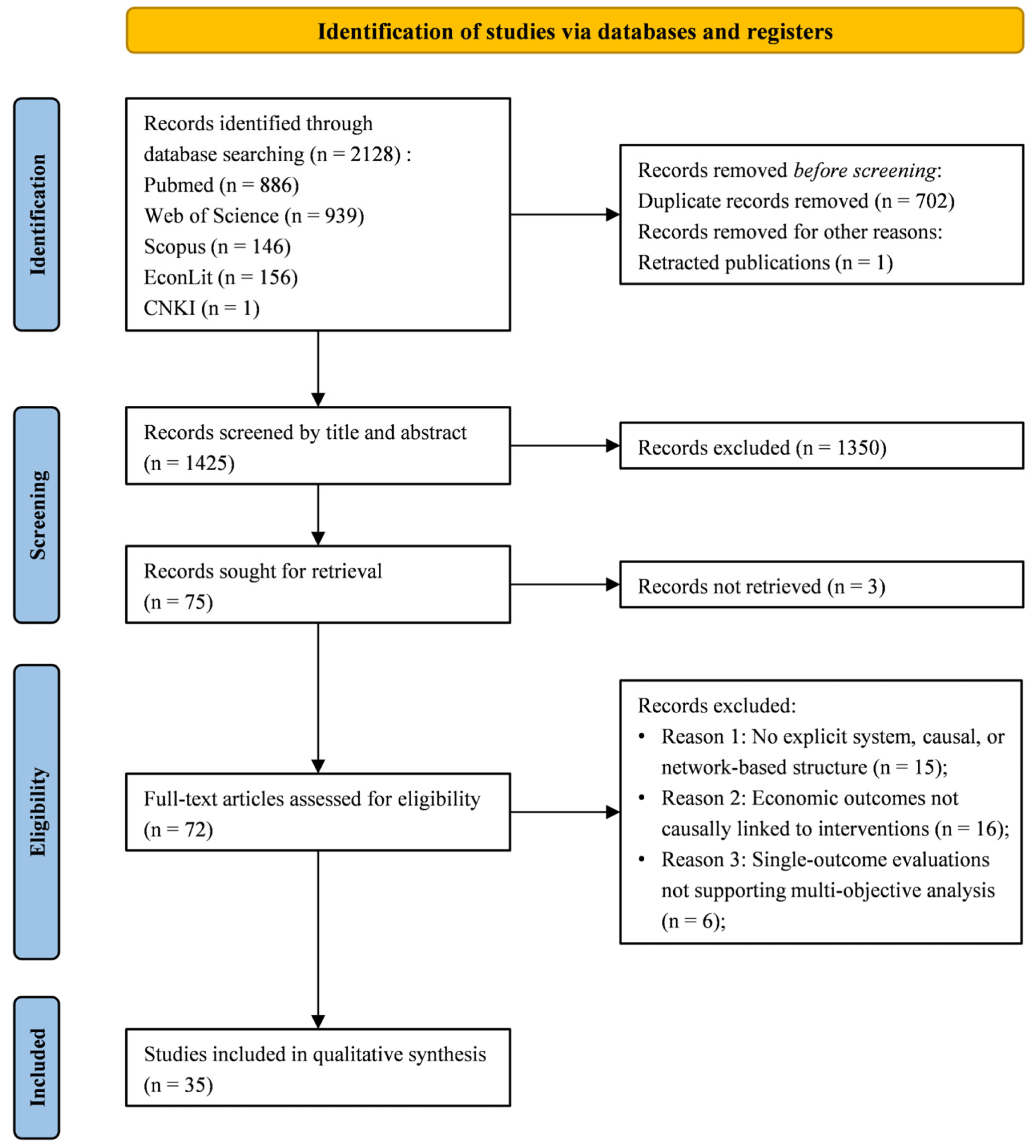
2.1. Literature Search Strategy
2.2. Study Selection Criteria
- (1)
- Focused on schistosomiasis control or prevention;
- (2)
- Incorporated an explicit system-based, causal, or network-oriented analytical structure to represent relationships among epidemiological, ecological, or intervention components;
- (3)
- Included an economic evaluation component, such as cost-effectiveness, cost–benefit, or related economic impact assessment;
- (4)
- Reported outcomes relevant to multiple objectives, including health, ecological, economic, or governance-related dimensions.
- (1)
- Addressed schistosomiasis but lacked any economic evaluation;
- (2)
- Relied solely on linear or descriptive statistical analyses without an explicit system or causal structure;
- (3)
- Evaluated only a single outcome without consideration of broader system interactions;
- (4)
- Were editorials, commentaries, conference abstracts, or policy briefs without original analytical content.
2.3. Screening Process and Data Synthesis
2.4. Data Extraction and Analytical Framework
- (1)
- System or causal modeling approach;
- (2)
- Representation of epidemiological–ecological interactions;
- (3)
- Type and scope of economic evaluation;
- (4)
- Treatment of multiple objectives and trade-offs.
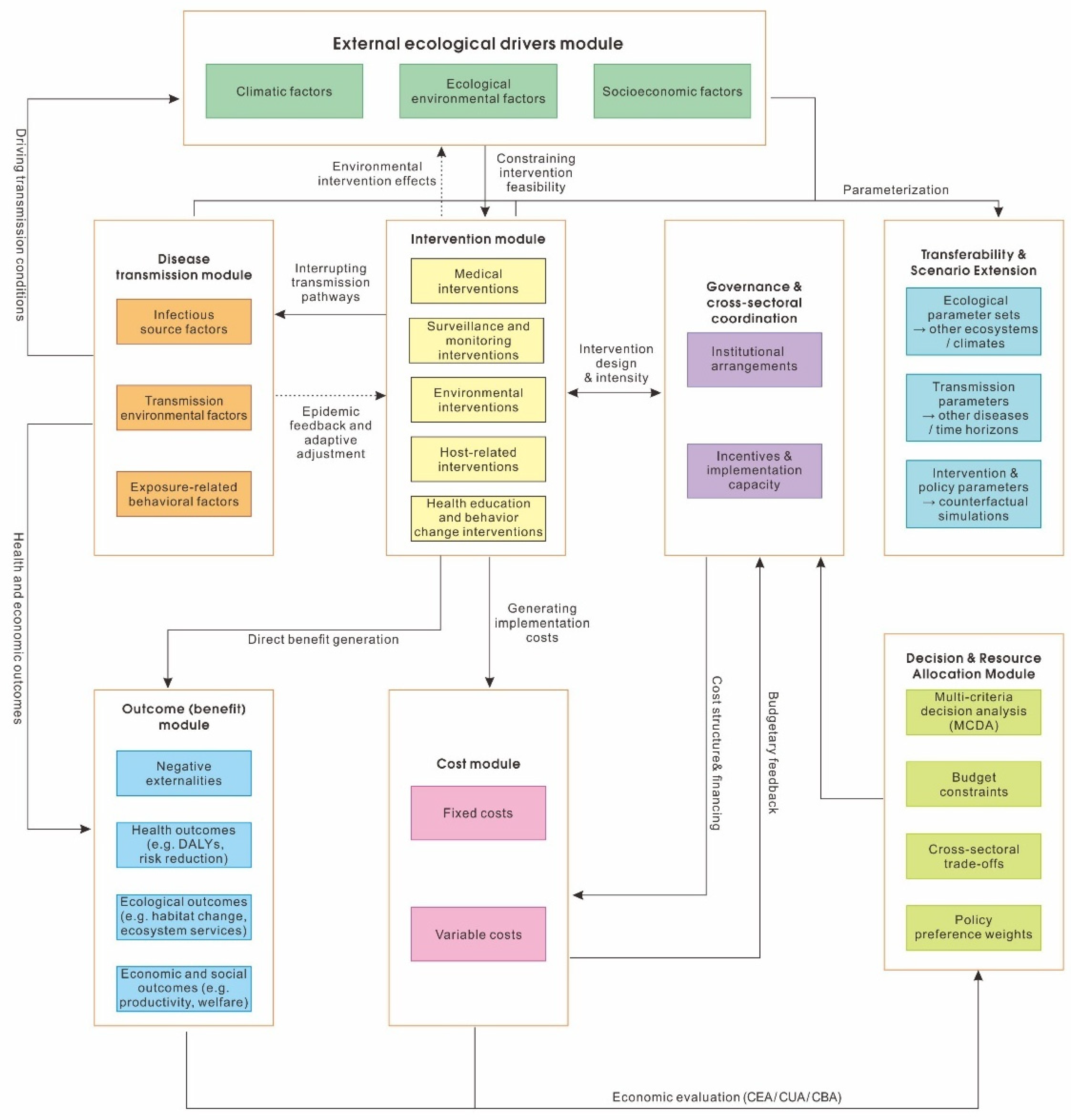
3. A Systemic Theoretical Framework for Schistosomiasis Control
3.1. Environmentally Mediated Transmission and the Systemic Production of Risk
3.2. Nonlinear Dynamics and Hidden Structure in Low-Transmission Settings
3.3. Cross-Sectoral Governance Constraints as Endogenous Determinants
3.4. Dynamics, Uncertainty, and the Role of Systemic Causal Networks (SCNs)
3.5. Synthesis and the Economic Decision Problem Implied by Systemic Causality
4. The Economic Logic of Multi-Objective Schistosomiasis Control
4.1. Reconstructing the Economic Problem Under Elimination-Oriented Objectives
4.2. Externalities and Public-Good Characteristics of Elimination-Stage Investments
4.3. Multi-Actor Strategic Interaction and the Economic Institutionalization of One Health
4.4. From Single-Metric Efficiency to Structured Social Choice
5. Transferability and Implementation Challenges
5.1. Transferability as Mechanism Reconfigurability Under Scenario Uncertainty
5.2. Evidence Boundaries and Structural Tensions in Multi-Objective Evaluation
6. Conclusions
Supplementary Materials
Author Contributions
Funding
Institutional Review Board Statement
Informed Consent Statement
Data Availability Statement
Acknowledgments
Conflicts of Interest
References
- Léger, E.; Borlase, A.; Fall, C.B.; Diouf, N.D.; Diop, S.D.; Yasenev, L.; Catalano, S.; Thiam, C.T.; Ndiaye, A.; Emery, A.; et al. Prevalence and distribution of schistosomiasis in human, livestock, and snail populations in northern Senegal: A One Health epidemiological study of a multi-host system. Lancet Planet. Health 2020, 4, e330–e342. [Google Scholar] [CrossRef]
- Starkloff, N.C.; Angelo, T.; Mahalila, M.P.; Charles, J.; Kinung’hi, S.; Civitello, D.J. Spatio-temporal variability in transmission risk of human schistosomes and animal trematodes in a seasonally desiccating East African landscape. Proc. R. Soc. B Biol. Sci. 2024, 291, 20231766. [Google Scholar] [CrossRef]
- Ayob, N.; Burger, R.P.; Belelie, M.D.; Nkosi, N.C.; Havenga, H.; de Necker, L.; Cilliers, D.P. Modelling the historical distribution of schistosomiasis-transmitting snails in South Africa using ecological niche models. PLoS ONE 2023, 18, e0295149. [Google Scholar] [CrossRef]
- Tabo, Z.; Kalinda, C.; Breuer, L.; Albrecht, C. Exploring the interplay between climate change and schistosomiasis transmission dynamics. Infect. Dis. Model. 2024, 9, 158–176. [Google Scholar] [CrossRef] [PubMed]
- Zhang, X.; Zimmerman, A.; Zhang, Y.; Ogbuoji, O.; Tang, S. Rapid growth of private hospitals in China: Emerging challenges and opportunities to health sector management. Lancet Reg. Health West. Pac. 2024, 44, 100991. [Google Scholar] [CrossRef]
- Trippler, L.; Hattendorf, J.; Ali, S.M.; Ame, S.M.; Juma, S.; Kabole, F.; Knopp, S. Novel tools and strategies for breaking schistosomiasis transmission: Study protocol for an intervention study. BMC Infect. Dis. 2021, 21, 1024. [Google Scholar] [CrossRef] [PubMed]
- Grimes, J.E.; Croll, D.; Harrison, W.E.; Utzinger, J.; Freeman, M.C.; Templeton, M.R. The roles of water, sanitation and hygiene in reducing schistosomiasis: A review. Parasites Vectors 2015, 8, 156. [Google Scholar] [CrossRef]
- Kamara, T.; Byamukama, M.; Karuhanga, M. Modelling the Role of Treatment, Public Health Education, and Chemical Control Strategies on Transmission Dynamics of Schistosomiasis. J. Math. 2022, 2022, 2094979. [Google Scholar] [CrossRef]
- Malizia, V.; de Vlas, S.J.; Roes, K.C.B.; Giardina, F. Revisiting the impact of Schistosoma mansoni regulating mechanisms on transmission dynamics using SchiSTOP, a novel modelling framework. PLoS Negl. Trop. Dis. 2024, 18, e0012464. [Google Scholar] [CrossRef]
- Sule, M.N.; El Lahham, I.; Munkombwe, M.N.; Nasike, P.; Gouvras, A.; Rollinson, D.; Mbaziira, R.; Kanshio, C.; De Leo, G.A. Schistosomiasis and water resources development in Africa: A scoping review and multi-case evaluation of associated snail control. PLoS Negl. Trop. Dis. 2025, 19, e0013180. [Google Scholar] [CrossRef]
- Adediran, M.B.; Adesida, A.; Ezekiel, O.O.; Irabor, P.C.; Babalola, B.M.; Oyeyemi, O.T. From treatment to prevention: Reimagining schistosomiasis control through WASH and environmental management. Pathog. Glob. Health 2025, 1–17. [Google Scholar] [CrossRef]
- Okesanya, O.J.; Eshun, G.; Ukoaka, B.M.; Manirambona, E.; Olabode, O.N.; Adesola, R.O.; Okon, I.I.; Jamil, S.; Singh, A.; Lucero-Prisno, D.E., III; et al. Water, sanitation, and hygiene (WASH) practices in Africa: Exploring the effects on public health and sustainable development plans. Trop. Med. Health 2024, 52, 68. [Google Scholar] [CrossRef] [PubMed]
- Chen, X.-F.; Li, Q.; Bergquist, R.; Zheng, J.-X.; Guo, S.-Y.; Lan, Q.-F.; He, Z.-Z.; Zhang, L.-J.; Cao, C.-L.; Xu, J.; et al. Estimation and prediction on the economic burden of schistosomiasis in 25 endemic countries. Infect. Dis. Poverty 2025, 14, 49. [Google Scholar] [CrossRef]
- Rinaldo, D.; Perez-Saez, J.; Vounatsou, P.; Utzinger, J.; Arcand, J.-L. The economic impact of schistosomiasis. Infect. Dis. Poverty 2021, 10, 134. [Google Scholar] [CrossRef]
- Uzoegbo, S.C.; Jackson, L.J.; Bloch, S.C.M. A systematic review and quality appraisal of the economic evaluations of schistosomiasis interventions. PLoS Negl. Trop. Dis. 2022, 16, e0010822. [Google Scholar] [CrossRef]
- Turner, H.C.; Stolk, W.A.; Solomon, A.W.; King, J.D.; Montresor, A.; Molyneux, D.H.; Toor, J. Are current preventive chemotherapy strategies for controlling and eliminating neglected tropical diseases cost-effective? BMJ Glob. Health 2021, 6, e005456. [Google Scholar] [CrossRef]
- Guo, S.; Li, L.; Zhang, L.-J.; Li, Y.; Li, S.; Xu, J. From the One Health Perspective: Schistosomiasis Japonica and Flooding. Pathogens 2021, 10, 1538. [Google Scholar] [CrossRef]
- Zhang, X.X.; Guo, X.K.; Zhou, X.N. One Health: A key element in the WHO Pandemic Agreement. Lancet 2025, 405, 2197–2198. [Google Scholar] [CrossRef]
- Hong, Z.; Li, L.; Zhang, L.-J.; Wang, Q.; Xu, J.; Li, S.; Zhou, X. Elimination of Schistosomiasis Japonica in China: From the One Health Perspective. China CDC Wkly. 2022, 4, 130–134. [Google Scholar] [CrossRef]
- Joo, H.; Maskery, B.A.; Alpern, J.D.; Weinberg, M.; Stauffer, W.M. Cost-effectiveness of treatment strategies for populations from strongyloidiasis high-risk areas globally who will initiate corticosteroid treatment in the USA. J. Travel Med. 2023, 31, 9. [Google Scholar] [CrossRef]
- Lo, N.C.; Coulibaly, J.T.; Bendavid, E.; N’Goran, E.K.; Utzinger, J.; Keiser, J.; Bogoch, I.I.; Andrews, J.R. Evaluation of a Urine Pooling Strategy for the Rapid and Cost-Efficient Prevalence Classification of Schistosomiasis. PLoS Neglected Trop. Dis. 2016, 10, e0004894. [Google Scholar] [CrossRef] [PubMed]
- Coffeng, L.E.; Levecke, B.; Hattendorf, J.; Walker, M.; Denwood, M.J. Survey Design to Monitor Drug Efficacy for the Control of Soil-Transmitted Helminthiasis and Schistosomiasis. Clin. Infect. Dis. 2021, 72, S195–S202. [Google Scholar] [CrossRef]
- Nakagawa, J.; Ehrenberg, J.P.; Nealon, J.; Fürst, T.; Aratchige, P.; Gonzales, G.; Chanthavisouk, C.; Hernandez, L.M.; Fengthong, T.; Utzinger, J.; et al. Towards effective prevention and control of helminth neglected tropical diseases in the Western Pacific Region through multi-disease and multi-sectoral interventions. Acta Trop. 2015, 141, 407–418. [Google Scholar] [CrossRef] [PubMed]
- King, C.H.; Yoon, N.; Wang, X.; Lo, N.C.; Alsallaq, R.; Ndeffo-Mbah, M.; Li, E.; Gurarie, D. Application of Schistosomiasis Consortium for Operational Research and Evaluation Study Findings to Refine Predictive Modeling of Schistosoma mansoni and Schistosoma haematobium Control in Sub-Saharan Africa. Am. J. Trop. Med. Hyg. 2020, 103, 97–104. [Google Scholar] [CrossRef]
- Trinos, J.; Ng-Nguyen, D.; Coffeng, L.E.; Dyer, C.E.F.; Clarke, N.; Traub, R.; Halton, K.; Wiseman, V.; Watts, C.; Nery, S.V. Cost and cost-effectiveness analysis of mass drug administration compared to school-based targeted preventive chemotherapy for hookworm control in Dak Lak province, Vietnam. Lancet Reg. Health West. Pac. 2023, 41, 100913. [Google Scholar] [CrossRef]
- Lund, A.; Sam, M.; Sy, A.B.; Sow, O.; Ali, S.; Sokolow, S.; Merrell, S.B.; Bruce, J.; Jouanard, N.; Senghor, S.; et al. Unavoidable Risks: Local Perspectives on Water Contact Behavior and Implications for Schistosomiasis Control in an Agricultural Region of Northern Senegal. Am. J. Trop. Med. Hyg. 2019, 101, 837–847. [Google Scholar] [CrossRef]
- Garchitorena, A.; Sokolow, S.H.; Roche, B.; Ngonghala, C.N.; Jocque, M.; Lund, A.; Barry, M.; Mordecai, E.A.; Daily, G.C.; Jones, J.H.; et al. Disease ecology, health and the environment: A framework to account for ecological and socio-economic drivers in the control of neglected tropical diseases. Philos. Trans. R. Soc. B Biol. Sci. 2017, 372, 20160128. [Google Scholar] [CrossRef]
- Du, H.; Zahn, M.; Loo, S.; Alleman, T.; Truelove, S.; Patenaude, B.; Gardner, L.; Papageorge, N.; Hill, A. Improving policy design and epidemic response using integrated models of economic choice and disease dynamics with behavioral feedback. PLoS Comput. Biol. 2025, 21, e1013549. [Google Scholar] [CrossRef]
- Lessani, M.; Li, Z.; Jing, F.; Qiao, S.; Zhang, J.; Olatosi, B.; Li, X. Human mobility and the infectious disease transmission: A systematic review. Geo-Spat. Inf. Sci. 2023, 27, 1824–1851. [Google Scholar] [CrossRef]
- Zhang, X.X.; Jin, Y.Z.; Lu, Y.H.; Huang, L.L.; Wu, C.X.; Lv, S.; Chen, Z.; Xiang, H.; Zhou, X.N. Infectious disease control: From health security strengthening to health systems improvement at global level. Glob. Health Res. Policy 2023, 8, 38. [Google Scholar] [CrossRef]
- Tabo, Z.; Wangalwa, R.; Rwibutso, M.; Breuer, L.; Albrecht, C. Future climate and demographic changes will almost double the risk of schistosomiasis transmission in the Lake Victoria Basin. One Health 2025, 21, 101148. [Google Scholar] [CrossRef]
- Asare, K.K.; Mohammed, M.-D.W.; Aboagye, Y.O.; Arndts, K.; Ritter, M. Impact of Climate Change on Schistosomiasis Transmission and Distribution—Scoping Review. Int. J. Environ. Res. Public Health 2025, 22, 812. [Google Scholar] [CrossRef]
- Wen-Yan, F.; Ling, W.; Xin, W.; Feng-Ning, H. Grey relational analysis of environment interference factors and control measures on endemic status of schistosomiasis in Poyang Lake Eco-economic Region. Zhongguo Xue Xi Chong Bing Fang Zhi Za Zhi 2016, 28, 635–643. [Google Scholar] [CrossRef]
- Wang, X.; Gurarie, D. Mathematical Models of Schistosomiasis Transmission, Morbidity and Control with Applications to Endemic Communities in Coastal Kenya; Case Western Reserve University School of Graduate Studies/OhioLINK: Cleveland, OH, USA, 2012. [Google Scholar]
- Truscott, J.E.; Turner, H.C.; Farrell, S.H.; Anderson, R.M. Soil-Transmitted Helminths: Mathematical Models of Transmission, the Impact of Mass Drug Administration and Transmission Elimination Criteria. In Advances in Parasitology, Vol 94: Mathematical Models for Neglected Tropical Diseases: Essential Tools for Control and Elimination, Pt B; Basanez, M.G., Anderson, R.M., Eds.; Elsevier Academic Press Inc.: San Diego, CA, USA, 2016; Volume 94, pp. 133–198. [Google Scholar]
- Meckawy, R.; Stuckler, D.; Mehta, A.; Al-Ahdal, T.; Doebbeling, B. Effectiveness of early warning systems in the detection of infectious diseases outbreaks: A systematic review. BMC Public Health 2022, 22, 2216. [Google Scholar] [CrossRef]
- Michael, E.; Madon, S. Socio-ecological dynamics and challenges to the governance of Neglected Tropical Disease control. Infect. Dis. Poverty 2017, 6, 35. [Google Scholar] [CrossRef]
- Zhang, Q.Y.; Zhang, Y.Y.; Liu, J.S.; Li, X.C.; Zhu, Z.L.; Feng, X.Y.; Han, L.F.; Zhu, C.D.; Tun, H.M.; Zong, L.; et al. Integrating One Health governance in China: Assessing structural implementation and operational entry points. One Health 2025, 21, 101209. [Google Scholar] [CrossRef]
- Li, X.; Zhang, Y.; Zhang, Q.; Liu, J.; Zhu, Z.; Feng, X.; Han, L.; Zhang, X. Strategy and mechanism of One Health governance: Case study of China. Sci. One Health 2025, 4, 100098. [Google Scholar] [CrossRef]
- Williams, G.M.; Sleigh, A.C.; Li, Y.S.; Feng, Z.; Davis, G.M.; Chen, H.G.; Ross, A.G.P.; Bergquist, R.; McManus, D.P. Mathematical modelling of schistosomiasis japonica: Comparison of control strategies in the People’s Republic of China. Acta Trop. 2002, 82, 253–262. [Google Scholar] [CrossRef]
- Mekete, K.; Ower, A.; Dunn, J.; Sime, H.; Tadesse, G.; Abate, E.; Nigussu, N.; Seife, F.; McNaughton, E.; Anderson, R.M.; et al. The Geshiyaro Project: A study protocol for developing a scalable model of interventions for moving towards the interruption of the transmission of soil-transmitted helminths and schistosome infections in the Wolaita zone of Ethiopia. Parasites Vectors 2019, 12, 503. [Google Scholar] [CrossRef] [PubMed]
- Mbah, M.L.N.; Poolman, E.M.; Atkins, K.E.; Orenstein, E.W.; Meyers, L.A.; Townsend, J.P.; Galvani, A.P. Potential Cost-Effectiveness of Schistosomiasis Treatment for Reducing HIV Transmission in Africa—The Case of Zimbabwean Women. PLoS Negl. Trop. Dis. 2013, 7, e2346. [Google Scholar] [CrossRef]
- Minnery, M.; Okoyo, C.; Morgan, G.; Wang, A.; Johnson, O.; Fronterre, C.; Montresor, A.; Campbell, S.J.; Mwandawiro, C.; Diggle, P. Cost-effectiveness of comparative survey designs for helminth control programs: Post-hoc cost analysis and modelling of the Kenyan national school-based deworming program. PLoS Negl. Trop. Dis. 2024, 18, e0011583. [Google Scholar] [CrossRef]
- Araujo Navas, A.L.; Soares Magalhães, R.J.; Osei, F.; Fornillos, R.J.C.; Leonardo, L.R.; Stein, A. Modelling local areas of exposure to Schistosoma japonicum in a limited survey data environment. Parasites Vectors 2018, 11, 465. [Google Scholar] [CrossRef]
- Xu, J.F.; Xu, J.; Li, S.Z.; Jia, T.W.; Huang, X.B.; Zhang, H.M.; Chen, M.; Yang, G.J.; Gao, S.J.; Wang, Q.Y.; et al. Transmission risks of schistosomiasis japonica: Extraction from back-propagation artificial neural network and logistic regression model. PLoS Negl. Trop. Dis. 2013, 7, e2123. [Google Scholar] [CrossRef]
- Lopez, S.; Majid, S.; Syed, R.; Rychtar, J.; Taylor, D. Mathematical model of voluntary vaccination against schistosomiasis. PeerJ 2024, 12, e16869. [Google Scholar] [CrossRef]
- Agbata, E.N.; Morton, R.L.; Bisoffi, Z.; Bottieau, E.; Greenaway, C.; Biggs, B.A.; Montero, N.; Tran, A.; Rowbotham, N.; Arevalo-Rodriguez, I.; et al. Effectiveness of Screening and Treatment Approaches for Schistosomiasis and Strongyloidiasis in Newly-Arrived Migrants from Endemic Countries in the EU/EEA: A Systematic Review. Int. J. Environ. Res. Public Health 2018, 16, 11. [Google Scholar] [CrossRef]
- Welch, V.A.; Ghogomu, E.; Hossain, A.; Awasthi, S.; Bhutta, Z.A.; Cumberbatch, C.; Fletcher, R.; McGowan, J.; Krishnaratne, S.; Kristjansson, E.; et al. Mass deworming to improve developmental health and wellbeing of children in low-income and middle-income countries: A systematic review and network meta-analysis. Lancet Glob. Health 2017, 5, e40–e50. [Google Scholar] [CrossRef]
- Meginnis, K.; Hanley, N.; Mujumbusi, L.; Pickering, L.; Lamberton, P.H.L. Using choice modelling to identify popular and affordable alternative interventions for schistosomiasis in Uganda. Environ. Dev. Econ. 2022, 27, 578–600. [Google Scholar] [CrossRef]
- Allan, F.; Ame, S.M.; Tian-Bi, Y.N.T.; Hofkin, B.V.; Webster, B.L.; Diakité, N.R.; N’Goran, E.K.; Kabole, F.; Khamis, I.S.; Gouvras, A.N.; et al. Snail-Related Contributions from the Schistosomiasis Consortium for Operational Research and Evaluation Program Including Xenomonitoring, Focal Mollusciciding, Biological Control, and Modeling. Am. J. Trop. Med. Hyg. 2020, 103, 66–79. [Google Scholar] [CrossRef]
- Li, X.C.; Zhang, Y.Y.; Zhang, Q.Y.; Liu, J.S.; Ran, J.J.; Han, L.F.; Zhang, X.X. Global burden of viral infectious diseases of poverty based on Global Burden of Diseases Study 2021. Infect. Dis. Poverty 2024, 13, 71. [Google Scholar] [CrossRef]
- Collyer, B.S.; Turner, H.C.; Hollingsworth, T.D.; Keeling, M.J. Vaccination or mass drug administration against schistosomiasis: A hypothetical cost-effectiveness modelling comparison. Parasites Vectors 2019, 12, 499. [Google Scholar] [CrossRef]
- Zammarchi, L.; Botta, A.; Tilli, M.; Gobbi, F.; Bartoloni, A.; Boccalini, S. Presumptive treatment or serological screening for schistosomiasis in migrants from Sub-Saharan Africa could save both lives and money for the Italian National Health System: Results of an economic evaluation. J. Travel Med. 2023, 30, taac140. [Google Scholar] [CrossRef]
- Lo, N.C.; Gurarie, D.; Yoon, N.; Coulibaly, J.T.; Bendavid, E.; Andrews, J.R.; King, C.H. Impact and cost-effectiveness of snail control to achieve disease control targets for schistosomiasis. Proc. Natl. Acad. Sci. USA 2018, 115, E584–E591. [Google Scholar] [CrossRef]
- Adeyemo, P.; Léger, E.; Hollenberg, E.; Diouf, N.; Sène, M.; Webster, J.P.; Häsler, B. Estimating the financial impact of livestock schistosomiasis on traditional subsistence and transhumance farmers keeping cattle, sheep and goats in northern Senegal. Parasites Vectors 2022, 15, 101. [Google Scholar] [CrossRef]
- Cha, S.; Elhag, M.S.; Lee, Y.H.; Cho, D.S.; Ismail, H.; Hong, S.T. Epidemiological findings and policy implications from the nationwide schistosomiasis and intestinal helminthiasis survey in Sudan. Parasites Vectors 2019, 12, 429. [Google Scholar] [CrossRef] [PubMed]
- Janoušková, E.; Clark, J.; Kajero, O.; Alonso, S.; Lamberton, P.H.L.; Betson, M.; Prada, J.M. Public Health Policy Pillars for the Sustainable Elimination of Zoonotic Schistosomiasis. Front. Trop. Dis. 2022, 3, 826501. [Google Scholar] [CrossRef]
- Zhang, X.X.; Liu, J.S.; Han, L.F.; Simm, G.; Guo, X.K.; Zhou, X.N. One Health: New evaluation framework launched. Nature 2022, 604, 625. [Google Scholar] [CrossRef]
- Zhang, X.X.; Liu, J.S.; Han, L.F.; Xia, S.; Li, S.Z.; Li, O.Y.; Kassegne, K.; Li, M.; Yin, K.; Hu, Q.Q.; et al. Towards a global One Health index: A potential assessment tool for One Health performance. Infect. Dis. Poverty 2022, 11, 57. [Google Scholar] [CrossRef] [PubMed]
- Zhang, Q.; Liu, J.; Han, L.; Li, X.; Zhang, C.; Guo, Z.; Chao, A.; Wang, C.; Wan, E.; Chen, F.; et al. How far has the globe gone in achieving One Health? Current evidence and policy implications based on global One Health index. Sci. One Health 2024, 3, 100064. [Google Scholar] [CrossRef]
- Zhang, X.X.; Li, X.C.; Zhang, Q.Y.; Liu, J.S.; Han, L.F.; Lederman, Z.; Schurer, J.M.; Poeta, P.; Rahman, M.T.; Li, S.Z.; et al. Tackling global health security by building an academic community for One Health action. Infect. Dis. Poverty 2023, 12, 70. [Google Scholar] [CrossRef]
- Spear, R.C.; Hubbard, A.; Liang, S.; Seto, E. Disease transmission models for public health decision making: Toward an approach for designing intervention strategies for Schistosomiasis japonica. Environ. Health Perspect. 2002, 110, 907–915. [Google Scholar] [CrossRef]
- Li, Q.; Zheng, J.X.; Jia, T.W.; Feng, X.Y.; Lv, C.; Zhang, L.J.; Yang, G.J.; Xu, J.; Zhou, X.N. Optimized strategy for schistosomiasis elimination: Results from marginal benefit modeling. Parasites Vectors 2023, 16, 419. [Google Scholar] [CrossRef] [PubMed]
- Turner, H.C.; Truscott, J.E.; Bettis, A.A.; Farrell, S.H.; Deol, A.K.; Whitton, J.M.; Fleming, F.M.; Anderson, R.M. Evaluating the variation in the projected benefit of community-wide mass treatment for schistosomiasis: Implications for future economic evaluations. Parasites Vectors 2017, 10, 213. [Google Scholar] [CrossRef] [PubMed]
- Trinos, D.; Caesar, J.P. Cost, Effectiveness, and Cost-Effectiveness of Preventive Chemotherapy for Control of Soil-Transmitted Helminths in Vietnam and the Philippines; University of New South Wales (UNSW): Sydney, Australia, 2023. [Google Scholar]
- Intergovernmental Panel on Climate Change. Framing, Context, and Methods. In Climate Change 2021—The Physical Science Basis: Working Group I Contribution to the Sixth Assessment Report of the Intergovernmental Panel on Climate Change; Cambridge University Press: Cambridge, UK, 2023; pp. 147–286. [Google Scholar] [CrossRef]
- Li, X.C.; Qian, H.R.; Zhang, Y.Y.; Zhang, Q.Y.; Liu, J.S.; Lai, H.Y.; Zheng, W.G.; Sun, J.; Fu, B.; Zhou, X.N.; et al. Optimal decision-making in relieving global high temperature-related disease burden by data-driven simulation. Infect. Dis. Model. 2024, 9, 618–633. [Google Scholar] [CrossRef] [PubMed]
- Liu, J.S.; Li, X.C.; Zhang, Q.Y.; Han, L.F.; Xia, S.; Kassegne, K.; Zhu, Y.Z.; Yin, K.; Hu, Q.Q.; Xiu, L.S.; et al. China’s application of the One Health approach in addressing public health threats at the human-animal-environment interface: Advances and challenges. One Health 2023, 17, 100607. [Google Scholar] [CrossRef]
- Sun, Z.; Zhou, H.; Chen, F.; Lu, S.; Liang, H.; Wan, E.; Tao, Z.; Zhao, H.; Zhou, X.; Yang, F.; et al. Understanding the China-Tanzania Malaria Control Project: Lessons learned from a multi-stakeholder qualitative study. Front. Public Health 2023, 11, 1229675. [Google Scholar] [CrossRef]
- Lamberti, O.; Terris-Prestholt, F.; Bustinduy, A.L.; Bozzani, F. A health decision analytical model to evaluate the cost-effectiveness of female genital schistosomiasis screening strategies: The female genital schistosomiasis SCREEN framework. Trop. Med. Int. Health 2024, 29, 859–868. [Google Scholar] [CrossRef]
- Manca, F.; Ciminata, G.; Grieve, E.; Reboud, J.; Cooper, J.; McIntosh, E. Cost-effectiveness of sentinel screening of endemic diseases alongside malaria diagnosis: A case study in schistosomiasis. PLoS Negl. Trop. Dis. 2024, 18, e0012339. [Google Scholar] [CrossRef]
- Coffeng, L.E.; Graham, M.; Browning, R.; Kura, K.; Diggle, P.J.; Denwood, M.; Medley, G.F.; Anderson, R.M.; de Vlas, S.J. Improving the Cost-efficiency of Preventive Chemotherapy: Impact of New Diagnostics on Stopping Decisions for Control of Schistosomiasis. Clin. Infect. Dis. 2024, 78, S153–S159. [Google Scholar] [CrossRef]
- Chevalier, J.M.; Grantz, K.H.; Girdwood, S.; Kepha, S.; Ramos, T.; Nichols, B.E.; Khan, S.; Hingel, S. The impact and cost of a new rapid diagnostic test for school-based prevalence mapping and monitoring and evaluation surveys of schistosomiasis: A modelling study. PLoS Negl. Trop. Dis. 2025, 19, e0013071. [Google Scholar] [CrossRef]
- Zhang, X.; Zimmerman, A.; Lai, H.; Zhang, Y.; Tang, Z.; Tang, S.; Ogbuoji, O. Differential effect of China’s Zero Markup Drug Policy on provider-induced demand in secondary and tertiary hospitals. Front. Public Health 2024, 12, 1229722. [Google Scholar] [CrossRef]
- Zhang, X.X.; Lederman, Z.; Han, L.F.; Schurer, J.M.; Xiao, L.H.; Zhang, Z.B.; Chen, Q.L.; Pfeiffer, D.; Ward, M.P.; Sripa, B.; et al. Towards an actionable One Health approach. Infect. Dis. Poverty 2024, 13, 28. [Google Scholar] [CrossRef]
- Page, M.J.; McKenzie, J.E.; Bossuyt, P.M.; Boutron, I.; Hoffmann, T.C.; Mulrow, C.D.; Shamseer, L.; Tetzlaff, J.M.; Akl, E.A.; Brennan, S.E.; et al. The PRISMA 2020 statement: An updated guideline for reporting systematic reviews. BMJ 2021, 372, n71. [Google Scholar] [CrossRef]



| Core Scientific Hypothesis | Key System Characteristics | Corresponding Analytical Framework | Methodological Rationale |
|---|---|---|---|
| Transmission risk is jointly determined by interacting social and ecological factors | Nonlinearity, multiple feedback loops, and path dependence | Systemic causal networks (SCNs) | Economic evaluation requires explicit representation of multi-factor coupling and causal structure; single-risk-factor or linear models are structurally insufficient for valuing system-level interventions |
| Human activities continuously reshape ecological interfaces and transmission topology | Spatial connectivity, interface amplification effects, and cross-regional diffusion | SCNs with explicit spatial structure | Costs and benefits propagate along ecological and mobility networks; administrative units or averaged indicators fail to capture residual transmission pathways relevant for economic valuation |
| Compounded environmental stressors generate intrinsic system instability | Threshold effects, regime shifts, and metastable states | System dynamics (SD) modeling | Intertemporal economic trade-offs depend on long-term system evolution, feedback-driven dynamics, and nonlinear state transitions that must be explicitly modeled |
| System-level interventions generate costs and benefits distributed unevenly across sectors and time | Externalities, intertemporal trade-offs, and public-good characteristics | Embedded cost-effectiveness, cost–utility, and cost–benefit analysis within SCN/SD models | Economic evaluation must be embedded along causal pathways and time horizons to capture delayed, indirect, and cross-sectoral costs and benefits, rather than appended ex post |
| Cross-sectoral coordination failures amplify implementation frictions at the system level | Misaligned objective functions, cost–benefit asymmetry, and governance feedback loops | SCNs with endogenous governance and coordination nodes | Coordination variables must be endogenized as economic determinants; otherwise, the social value of system-level and preventive investments is systematically underestimated |
| Coordination mechanisms shape the long-term robustness and cost-effectiveness of elimination strategies | Cross-sectoral spillovers and limited internalization of long-term benefits | Integrated SCN-SD frameworks with governance feedback loops | Comparative evaluation of long-term economic performance under alternative coordination structures is required to assess sustainability and robustness |
| Elimination-oriented decision-making requires explicit trade-offs among multiple, partially incommensurable objectives | Multi-dimensional outcomes, preference heterogeneity, and decision-making under uncertainty | Multi-criteria decision analysis (MCDA) integrated with SCN/SD outputs | No single efficiency metric can capture joint health, ecological, economic, and governance outcomes; MCDA operationalizes welfare trade-offs when full monetization is infeasible |
| Elimination settings are characterized by pervasive uncertainty | Data sparsity, contextual heterogeneity, and incomplete evidence | Bayesian causal and hierarchical models | Economic decision-making must be based on probability distributions and explicit uncertainty characterization rather than point estimates |
Disclaimer/Publisher’s Note: The statements, opinions and data contained in all publications are solely those of the individual author(s) and contributor(s) and not of MDPI and/or the editor(s). MDPI and/or the editor(s) disclaim responsibility for any injury to people or property resulting from any ideas, methods, instructions or products referred to in the content. |
© 2026 by the authors. Licensee MDPI, Basel, Switzerland. This article is an open access article distributed under the terms and conditions of the Creative Commons Attribution (CC BY) license.
Share and Cite
Yu, M.; Liu, X.; Shi, N.; Su, J.; Han, L.; He, J.; Wang, Y.; Guo, S.; Deng, W.; Lv, C.; et al. Economic Evaluation of Multi-Objective Schistosomiasis Control Through Systemic Causality: Theoretical Advances and Governance Implications. Trop. Med. Infect. Dis. 2026, 11, 72. https://doi.org/10.3390/tropicalmed11030072
Yu M, Liu X, Shi N, Su J, Han L, He J, Wang Y, Guo S, Deng W, Lv C, et al. Economic Evaluation of Multi-Objective Schistosomiasis Control Through Systemic Causality: Theoretical Advances and Governance Implications. Tropical Medicine and Infectious Disease. 2026; 11(3):72. https://doi.org/10.3390/tropicalmed11030072
Chicago/Turabian StyleYu, Menghua, Xinyue Liu, Na Shi, Jiaqi Su, Lefei Han, Jian He, Yaoqian Wang, Suying Guo, Wangping Deng, Chao Lv, and et al. 2026. "Economic Evaluation of Multi-Objective Schistosomiasis Control Through Systemic Causality: Theoretical Advances and Governance Implications" Tropical Medicine and Infectious Disease 11, no. 3: 72. https://doi.org/10.3390/tropicalmed11030072
APA StyleYu, M., Liu, X., Shi, N., Su, J., Han, L., He, J., Wang, Y., Guo, S., Deng, W., Lv, C., Zhang, L., Fu, B., Hu, H., Xu, J., Zhou, X.-N., & Zhang, X. (2026). Economic Evaluation of Multi-Objective Schistosomiasis Control Through Systemic Causality: Theoretical Advances and Governance Implications. Tropical Medicine and Infectious Disease, 11(3), 72. https://doi.org/10.3390/tropicalmed11030072