


Abstract
Physical activity (PA) and sedentary behavior (SB) have emerged as modifiable factors in chronic kidney disease (CKD) patients undergoing hemodialysis (HD). The aim was to evaluate the association between PA, SB, quality of life, and mortality in patients with CKD undergoing HD. This prospective study included 167 patients who were assessed in 2023 and followed until September 2024. The long version of the IPAQ was used to assess PA and SB, and the Kidney Disease Quality of Life Short Form (KDQOL-SF 1.3) was used to evaluate health-related QoL. Survival was estimated using Kaplan–Meier curves, and a parsimonious Cox proportional hazards model. During the follow-up period, 15 patients (9.0%) died. Longer daily sitting time was independently associated with a higher mortality hazard (HR: 1.197; 95% CI: 1.026–1.396; p = 0.022), as was older age (HR: 1.055; 95% CI: 1.009–1.103; p = 0.019). MVPA was not significantly associated with mortality (HR: 1.217; 95% CI: 0.997–1.486; p = 0.054). The Active/Low SB profile showed the highest baseline QoL [median: 74.0 (IQR: 64.5–84.0)], whereas the Inactive/High SB profile showed the lowest QoL [median: 66.0 (IQR: 54.0–76.0)] and the highest mortality proportion (14.6%). However, mortality differences across the combined PA and SB profiles were not statistically significant and should be interpreted as exploratory. Baseline QoL differed significantly across profiles (p = 0.021). These findings identify prolonged sitting time as the main modifiable behavioral factor independently associated with all-cause mortality in patients undergoing HD, whereas MVPA was not independently associated with mortality. In contrast, physical activity and combined PA/SB profiles were more clearly related to health-related QoL, with the Active/Low SB profile showing the most favorable KDQOL-SF™ 1.3 scores. Therefore, reducing prolonged sedentary time may be particularly relevant to survival risk, while promoting appropriately tailored physical activity may contribute to better health-related QoL in this population.
1. Introduction
CKD is a major global public health problem, affecting millions of people and being associated with high rates of morbidity and mortality [1,2,3]. Among patients with advanced stages of CKD, those undergoing HD frequently experience multiple clinical and functional complications, including chronic fatigue, loss of muscle strength, cardiovascular dysfunction, and a decline in health-related quality of life (QoL) [4,5,6].
Recent studies have highlighted the role of lifestyle, particularly PA and SB, as modifiable factors with the potential to influence health-related QoL and survival in these patients [7,8,9]. Although the literature shows that regular levels of PA are associated with better health-related QoL and a lower risk of hospitalization and mortality in patients undergoing HD [2,10,11], a concerning trend of low PA levels and prolonged periods of SB has been observed in this population [12,13].
Furthermore, SB, characterized by activities performed while sitting, reclining, or lying down with low energy expenditure (<1.5 METs) [14], has emerged as an independent risk factor for adverse health outcomes, even in the presence of moderate levels of PA [15]. However, few longitudinal studies have jointly examined the effects of PA and SB on health-related QoL and mortality in patients with CKD undergoing HD, particularly in Latin American settings [5,7,16].
Based on this context, the present study aimed to identify the association between sedentary behavior, physical activity, quality of life, and mortality risk in a cohort of adults with chronic kidney disease undergoing hemodialysis, followed throughout 2023 and 2024.
2. Materials and Methods
2.1. Study Design and Participants
This study corresponds to a single-center prospective cohort composed of patients recruited between May 2023 and September 2024 at the nephrology unit of Hospital Santa Casa de Maringá (Brazil), with a diagnosis of CKD and undergoing HD.
All patients who were undergoing HD during the baseline recruitment period and who were aged 18 years or older, of both genders, had been receiving HD for one month or longer, and were clinically stable at the time of data collection were included. Patients with a severe clinical condition, defined as an acute decompensated clinical state, need for intensive care, or unstable vital signs according to the medical assessment recorded in the medical chart, were excluded. Individuals with psychiatric or cognitive disorders that prevented them from answering the questionnaires, as well as those with insufficient information to complete the baseline assessment, or a diagnosis of active infection requiring hospital isolation, were also excluded. Kidney transplantation occurring after study entry was not considered an exclusion criterion; these participants were censored at the time of transplantation in the survival analyses.
2.2. Ethical Considerations
All participants who agreed to participate signed an informed consent form. The study protocol was approved by the Research Ethics Committee of Hospital Santa Casa de Maringá (HSCM) and the Research Ethics Committee of the State University of Maringá (COPEP/UEM) under approval number 6.004.620 (CAAE: 67206523.6.0000.0104). The study was conducted in accordance with the principles of the Declaration of Helsinki and its subsequent amendments [17].
2.3. Study Variables
The exposure variables were PA and SB, and the exposed population consisted of patients undergoing HD treatment. The outcome variables were all-cause mortality, overall survival time, and health-related QoL.
Patient data were collected at baseline and after 12 months. For each patient, sociodemographic information was obtained, including age (in years), gender, area of residence, educational level, income, living with a spouse, occupation, smoking status, and alcohol consumption. In addition, the participants’ medical records were reviewed to obtain clinical data, including treatment duration, hemodialysis-related information, and medical history, including the presence of comorbidities.
The Brazilian version of the KDQOL-SF™ 1.3 was used to assess health-related QoL in patients with CKD undergoing HD [18,19]. The KDQOL-SF™ 1.3 consists of 80 questions, of which 79 were administered to patients undergoing HD (one question refers to the type of dialysis: HD or peritoneal dialysis). These 79 questions included 35 items generating four physical health scales (physical functioning, 10 items; role limitations due to physical health, four items; pain, two items; and general health, five items) and four mental health scales (emotional well-being, five items; role limitations due to emotional problems, three items; social functioning, two items; and energy/fatigue, four items); 42 kidney disease-targeted items generating 10 scales (symptom/problem list, 12 items; effects of kidney disease, eight items; burden of kidney disease, four items; work status, two items; cognitive function, three items; quality of social interaction, three items; sexual function, two items; sleep, four items; social support, two items; and dialysis staff encouragement, two items); one patient satisfaction item; and one overall health rating item. Item scores were aggregated without weighting and linearly transformed to a 0–100 scale, where higher scores indicate better QoL status.
Participants self-reported their PA level using the long version of the International Physical Activity Questionnaire (IPAQ), as it is the standard from which the short version was developed and is also a valid and reliable instrument for use in Brazil [20,21].
The IPAQ measures PA across four domains: work, household, transportation, and leisure. The PA indicator is expressed continuously as MET-minutes/week and classified as Total PA, Vigorous PA, Moderate PA, or Walking. The cutoff point for physical inactivity was defined as an energy expenditure of less than 600 MET-minutes/week of moderate-to-vigorous physical activity (MVPA) [22].
SB was determined based on the patient’s self-reported time spent in activities involving sitting, reclining, or lying down during leisure or work, using two questions from the sitting time domain to identify how many hours per day, during weekdays and weekends, an individual remained in these positions. This variable was calculated by summing SB during weekdays and weekends. The sum of these values was then divided by seven (corresponding to the days of the week), resulting in the average hours/day of SB, using a cutoff point of ≥6.5 h/day to define high SB [23].
2.4. Follow-Up and Event Definition
Each participant was assessed at baseline (2023) and participants remaining under observation were reassessed during follow-up in 2024 when follow-up data were available. Prospective follow-up time was defined as the interval between the baseline assessment in 2023 and the date of death or the last available observation, through 30 September 2024. This prospective follow-up period was distinguished from time on hemodialysis (dialysis vintage), which was calculated from the date of HD initiation to the corresponding assessment date. Mortality data were confirmed through hospital records and the health system database. Death from any cause was considered the event; participants who remained alive, underwent kidney transplantation, or were lost to follow-up were censored at their last available observation. For deaths for which only the month and year were available, the 15th day of the corresponding month was assigned for the primary analysis, and sensitivity analyses using the first and last day of the month were performed to assess the robustness of the estimates.
2.5. Statistical Analysis
2.5.1. Descriptive Analysis
Statistical analysis was performed using IBM SPSS Statistics, version 24. The normality of the distribution of continuous variables was assessed using the Kolmogorov–Smirnov test.
Descriptive statistics were calculated for variables assessed at baseline (2023) and follow-up (2024), which were summarized separately. Categorical variables were expressed as absolute frequencies and percentages, whereas continuous variables were described as the mean and standard deviation (SD) and median and interquartile range (IQR), as appropriate. Baseline and follow-up descriptive values were not interpreted as paired longitudinal changes.
2.5.2. Cox Regression Models
Cox regression models were applied to evaluate the association between MVPA, sitting time, age, quality of life, BMI, and Kt/V and the hazard of all-cause mortality. MVPA was rescaled and expressed per 1000 MET-min/week, sitting time per 1 h/day, age per 1-year increase, KDQOL-SF™ 1.3 per 10-point increase, BMI per 1 kg/m2, and Kt/V per 0.1-unit increase. Hazard ratios (HRs) were calculated along with their respective 95% confidence intervals (95% CIs).
Time since hemodialysis initiation was used as the underlying time scale for the Cox regression analyses. Because participants had already initiated hemodialysis before entering the study, delayed entry (left truncation) was applied at the date of the baseline assessment in 2023. Death from any cause was considered the event, whereas participants who remained alive, underwent kidney transplantation, or were lost to follow-up were censored at their last available observation.
Univariable Cox regression models were first fitted separately for MVPA, sitting time, age, KDQOL-SF™ 1.3, BMI, and Kt/V. Given the limited number of deaths observed during follow-up (n = 15), a parsimonious multivariable model was used to reduce the risk of overfitting. The final model included MVPA, sitting time, and age and was stratified by gender.
Model fit and discrimination were evaluated using the Akaike information criterion (AIC), Harrell’s C-statistic, and the global likelihood-ratio test. The proportional hazards assumption was verified for the Cox regression models.
Physical Activity–Sedentary Behavior Profile Analysis
A combined categorical variable was created to analyze the joint patterns of PA and SB. Patients were classified into four profiles:
- Active and Low Sedentary Behavior (protective profile);
- Active and High Sedentary Behavior;
- Inactive and Low Sedentary Behavior;
- Inactive and High Sedentary Behavior (highest-risk profile).
Participants were classified as active when MVPA was ≥600 MET-min/week and inactive when MVPA was <600 MET-min/week. High sedentary behavior was defined as sitting time ≥ 6.5 h/day.
The association of these profiles with mortality was evaluated using Cox regression analysis, with the Active/Low SB profile as the reference category, and their relationship with QoL was examined using the Kruskal–Wallis test followed by Holm-adjusted pairwise comparisons when appropriate.
2.5.3. Survival Analysis
Patient survival was estimated using Kaplan–Meier curves, considering death from any cause as the event and censoring patients who were alive, had undergone kidney transplantation, or were lost to follow-up before 30 September 2024. For the Kaplan–Meier analysis, survival time corresponded specifically to the prospective follow-up period from the baseline assessment in 2023 to death or the last available observation in 2024, rather than to the total time since initiation of hemodialysis. The curves were stratified according to the four combined PA and SB profiles. Comparisons between survival curves were performed using the log-rank test.
A p-value < 0.05 was considered statistically significant. All analyses were two-tailed.
The authors did not use generative artificial intelligence (GenAI) to write this manuscript.
3. Results
3.1. Characteristics of Patients Undergoing Hemodialysis
A total of 167 patients undergoing hemodialysis were evaluated at baseline in 2023, and 113 participants were reassessed during follow-up in 2024. At baseline, the mean age was 53.8 ± 16.2 years, mean BMI was 26.2 ± 5.5 kg/m2, and mean Kt/V was 1.50 ± 0.35. Participants had a mean of 8.9 ± 4.7 years of education. Physical activity showed considerable variability across domains. Household physical activity represented the largest contribution to energy expenditure, with a mean of 1265.7 ± 1941.0 MET-min/week, whereas occupational, transportation, and leisure-time physical activity showed median values of 0 MET-min/week. Median MVPA was 840.0 MET-min/week (IQR: 0.0–2400.0). Mean sitting time was 5.9 ± 3.7 h/day and mean screen time was 4.2 ± 3.3 h/day. Health-related quality of life, assessed using the KDQOL-SF™ 1.3, had a mean score of 69.0 ± 15.3 points. The median time on hemodialysis at baseline was 25.5 months (IQR: 8.5–54.9).
Among participants reassessed in 2024, median MVPA was 720.0 MET-min/week (IQR: 20.0–1800.0), mean sitting time was 5.4 ± 3.7 h/day, mean screen time was 4.2 ± 3.1 h/day, and mean KDQOL-SF™ 1.3 score was 69.5 ± 14.7 points. Median time on hemodialysis at follow-up was 39.2 months (IQR: 21.2–66.9). Baseline and follow-up characteristics are presented separately in Table 1.
Table 1.
Sociodemographic, clinical, and lifestyle characteristics of patients undergoing hemodialysis at baseline (2023) and follow-up (2024).
3.2. Mortality: Associations with Physical Activity, Sedentary Behavior, Quality of Life, and Clinical Factors
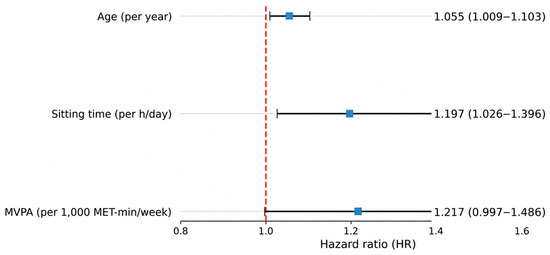
Table 2 shows the associations between physical activity, sedentary behavior, quality of life, clinical factors, and all-cause mortality. In univariable Cox regression analyses, age was significantly associated with mortality, whereas MVPA, sitting time, quality of life, BMI, and Kt/V did not reach statistical significance. In the parsimonious multivariable Cox model, stratified by gender and including MVPA, sitting time, and age, longer daily sitting time was independently associated with a higher mortality hazard (HR = 1.197, 95% CI: 1.026–1.396, p = 0.022), corresponding to an approximately 19.7% higher hazard for each additional hour of sitting per day. Age was also independently associated with mortality (HR = 1.055 per year, 95% CI: 1.009–1.103, p = 0.019), whereas MVPA did not reach statistical significance (HR = 1.217 per 1000 MET-min/week, 95% CI: 0.997–1.486, p = 0.054). The final model showed acceptable discrimination (Harrell’s C = 0.745) and was statistically significant overall (likelihood-ratio p = 0.006). Quality of life, BMI, and Kt/V were evaluated in univariable analyses but were not included in the final multivariable model to limit overparameterization given the small number of deaths.
Table 2.
Cox regression models for all-cause mortality: associations with physical activity, sedentary behavior, quality of life, and clinical factors in patients undergoing hemodialysis.
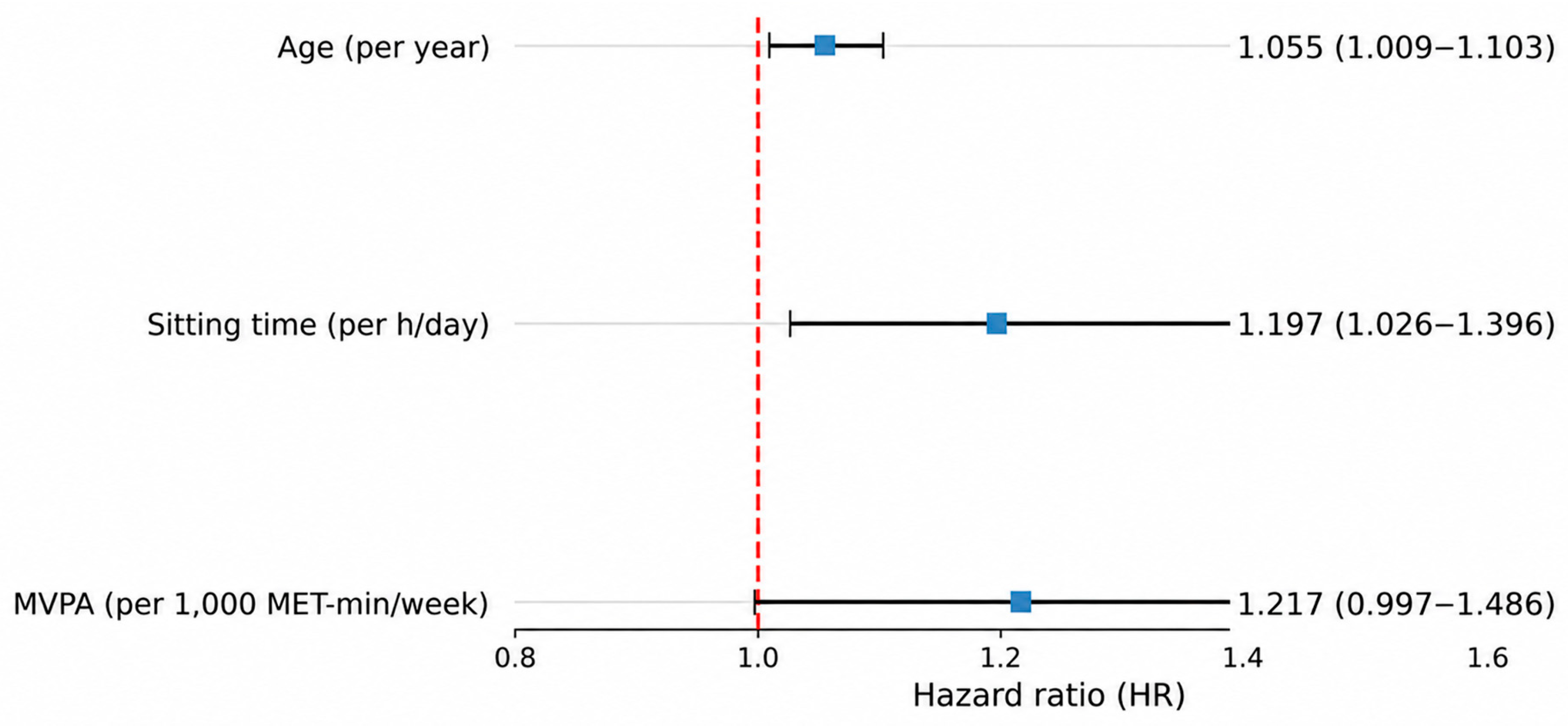
Figure 1 graphically summarizes the adjusted associations observed in the final parsimonious Cox model. Sitting time and age showed hazard ratios above 1.00 with confidence intervals that did not include the null value, indicating statistically significant positive associations with all-cause mortality. In contrast, the confidence interval for MVPA included the null value, consistent with the lack of statistical significance observed in the adjusted analysis. Overall, the figure highlights sitting time and age as the main variables independently associated with mortality in the final model.
Figure 1.
Adjusted associations of physical activity, sedentary behavior, and age with all-cause mortality in patients undergoing hemodialysis (n = 167). Note: Moderate-to-vigorous physical activity (MVPA) was expressed per 1000 MET-min/week, sitting time per 1 h/day, and age per 1-year increase. The dashed vertical line represents the null value (HR = 1.00).
3.3. Quality of Life and Mortality According to Combined Physical Activity and Sedentary Behavior Profiles
The distribution of participants across the combined PA and SB profiles was 68 (40.7%) for Active/Low SB, 24 (14.4%) for Active/High SB, 34 (20.4%) for Inactive/Low SB, and 41 (24.6%) for Inactive/High SB. Mortality was descriptively higher in the two profiles characterized by high sedentary behavior, reaching 12.5% in the Active/High SB profile and 14.6% in the Inactive/High SB profile, compared with 5.9% in both low-SB profiles. However, these differences were not statistically significant. In contrast, baseline quality of life differed significantly across the four profiles (Kruskal–Wallis p = 0.021). Participants classified as Active/Low SB showed the highest median QoL [74.0 (64.5–84.0)], whereas those classified as Inactive/High SB showed the lowest [66.0 (54.0–76.0)]. After Holm adjustment for multiple comparisons, the difference between these two profiles remained statistically significant (p = 0.017) (Table 3).
Table 3.
Baseline quality of life and all-cause mortality according to combined physical activity and sedentary behavior profiles in patients undergoing hemodialysis (n = 167).
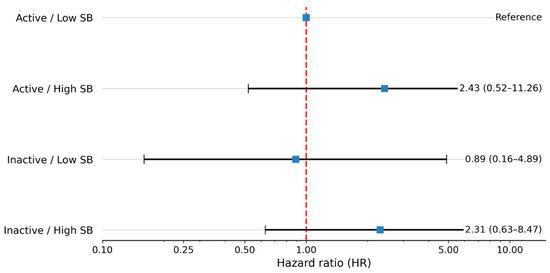
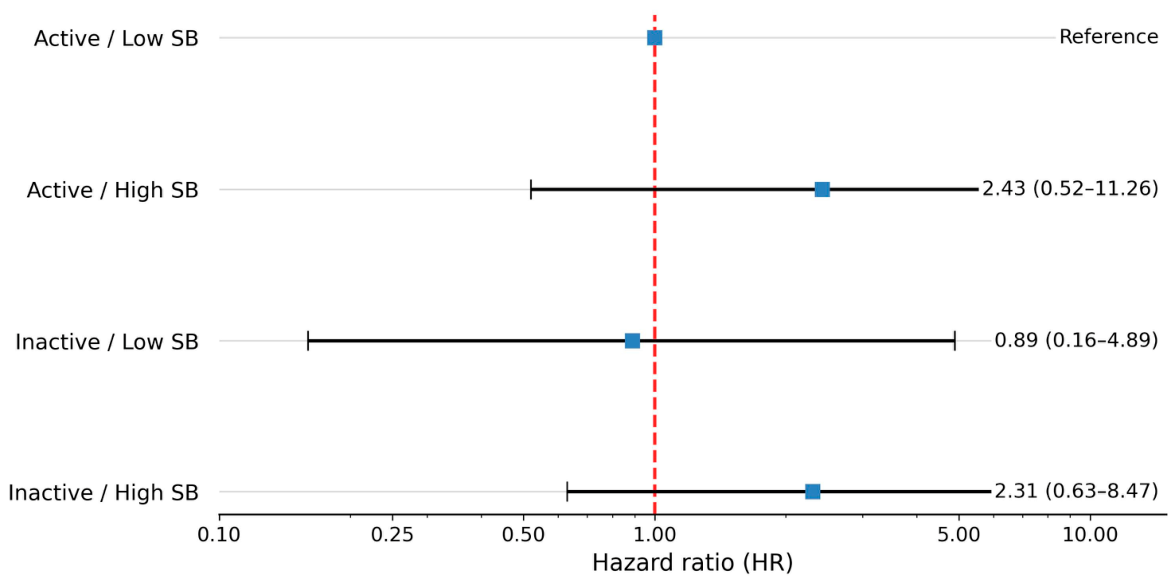
In the Cox regression analysis, the Active/High SB profile showed the highest point estimate for mortality hazard compared with the Active/Low SB reference profile (HR = 2.43, 95% CI: 0.52–11.26, p = 0.257). The Inactive/High SB profile also showed a higher point estimate (HR = 2.31, 95% CI: 0.63–8.47, p = 0.205), whereas the Inactive/Low SB profile showed a hazard estimate similar to that of the reference group (HR = 0.89, 95% CI: 0.16–4.89, p = 0.892). However, all confidence intervals were wide and included the null value, and the overall association between combined PA and SB profiles and all-cause mortality was not statistically significant (likelihood-ratio p = 0.410). Therefore, the apparent higher mortality hazard in the high-SB profiles should be interpreted as an exploratory descriptive pattern rather than as evidence of statistically significant between-profile differences (Figure 2).
Figure 2.
Mortality risk according to physical activity/sedentary behavior profile (n = 167).
3.4. Survival According to Physical Activity/Sedentary Behavior Profile
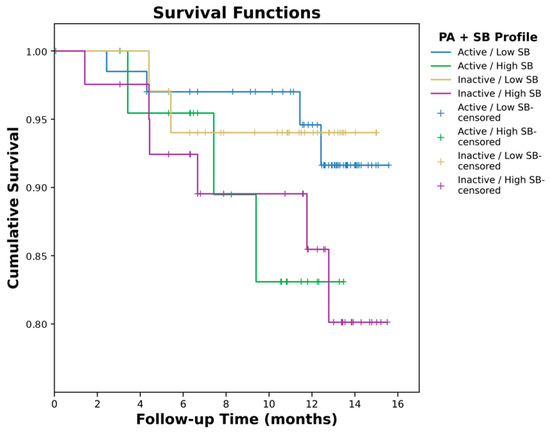
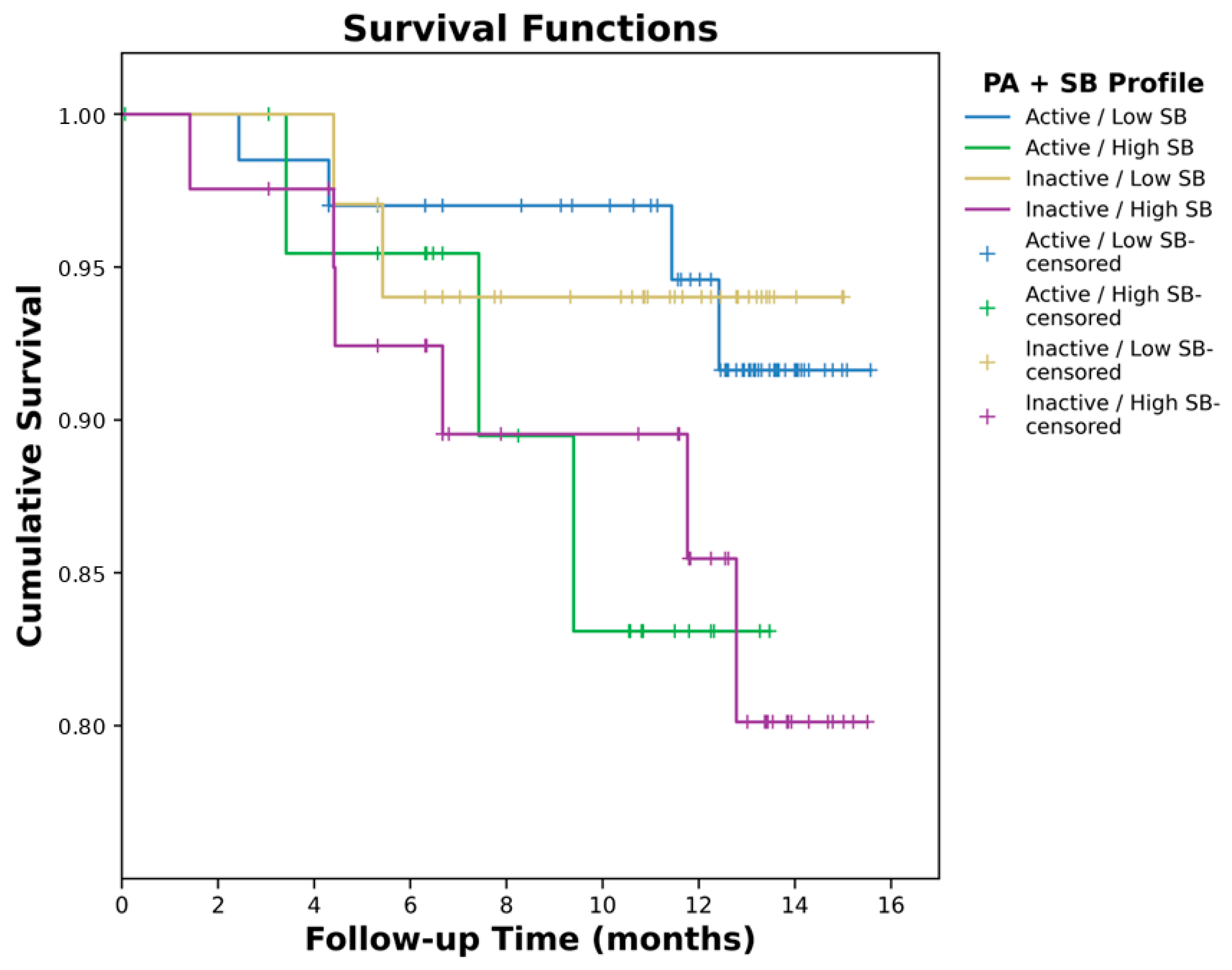
Figure 3 presents the Kaplan–Meier survival curves according to the combined physical activity (PA) and sedentary behavior (SB) profiles during the prospective follow-up period (2023–2024). Visually, the curves suggest differences in survival across the four profiles. Participants classified as Active/Low SB and Inactive/Low SB showed the most favorable survival patterns over follow-up, whereas the two profiles characterized by high sedentary behavior showed less favorable curves.
Figure 3.
Kaplan–Meier survival curves according to combined physical activity and sedentary behavior profiles during prospective follow-up (2023–2024). Note: Survival curves were estimated from baseline assessment to death or last follow-up. The comparison between curves was not statistically significant (log-rank χ2 = 3.587, df = 3, p = 0.310).
The Active/Low SB profile showed a high cumulative survival probability throughout follow-up, consistent with its lower mortality proportion [4 deaths; 5.9%]. Similarly, the Inactive/Low SB profile showed a survival pattern close to that of the Active/Low SB group [2 deaths; 5.9%]. In contrast, the Active/High SB and Inactive/High SB profiles showed less favorable survival patterns, with mortality proportions of 12.5% and 14.6%, respectively.
However, the comparison of survival curves was not statistically significant (log-rank χ2 = 3.587, df = 3, p = 0.310). Therefore, the observed differences between profiles should be interpreted as descriptive and exploratory. Overall, the Kaplan–Meier curves are consistent with the Cox regression results, suggesting a less favorable survival pattern among participants with high sedentary behavior, although without statistically significant between-profile differences.
4. Discussion
The primary objective of this study was to identify the association between sedentary behavior, physical activity, health-related quality of life, and all-cause mortality in patients with chronic kidney disease undergoing hemodialysis during a prospective follow-up of up to 16 months.
The findings of this study showed that longer daily sitting time and older age were independently associated with a higher hazard of all-cause mortality in the parsimonious multivariable model, whereas MVPA did not reach statistical significance. The combined PA and SB profiles were not significantly associated with mortality, although the two profiles characterized by high SB showed descriptively higher mortality proportions. Furthermore, the combination of high PA and low SB (Profile 1: Active/Low SB) showed the highest baseline health-related QoL and a favorable descriptive survival pattern. In contrast, the Inactive/High SB profile showed the highest proportion of deaths and the poorest perceived QoL. Interestingly, patients classified as Inactive/Low SB exhibited a more favorable descriptive survival pattern than those classified as Active/High SB. This pattern suggests that lower SB may be relevant regardless of PA status; however, the profile-specific mortality comparisons were not statistically significant and should therefore be interpreted as exploratory rather than as evidence of an independent protective effect.
Although MVPA was not independently associated with mortality in the present analysis, previous studies have reported inverse associations between PA and adverse outcomes in patients undergoing HD. Zhang et al. [24] found that higher levels of PA are associated with reduced mortality in patients undergoing HD. Matsuzawa et al. [10] and Bello et al. [2] reported that regular PA is associated with lower hospitalization rates and greater survival in this population. Likewise, other studies, such as those by Hishii et al. [7] and Astuti et al. [5], have highlighted that physical inactivity is a predictor of functional decline and poorer QoL.
Regarding SB, studies such as those by de Heer et al. [25] and Johansen et al. [12] have demonstrated that prolonged sitting time predicts adverse health outcomes, even after controlling for PA, which is consistent with the effects observed in our regression model. The study by Faúndez-Casanova et al. [26] also indicates that exceeding approximately 7 h/day of SB is associated with a poorer prognosis in patients with kidney disease, which is close to the 6.5 h/day cutoff adopted in the present study. Similarly, Sugahara et al. [27] demonstrated that prolonged periods of SB are negatively correlated with QoL in this population. In addition, Filipčič et al. [28] reported that habitual PA is positively associated with QoL in patients undergoing HD.
A major strength of this study is its prospective design, which allowed a more accurate estimation of the temporal association between health behaviors and mortality. In addition, a validated and disease-specific instrument was used to assess health-related QoL in patients undergoing HD (KDQOL-SF™), and model fit and discrimination were explicitly evaluated. Given that only 15 deaths occurred during follow-up, the final multivariable analysis was deliberately restricted to a parsimonious model to reduce the risk of overfitting. However, some limitations should be acknowledged. The follow-up period was relatively short (maximum of 16 months), which may have limited the detection of long-term events. The small number of deaths also limited statistical power and resulted in wide confidence intervals, particularly for comparisons between the combined PA and SB profiles. In addition, overall disease severity was not assessed using a validated objective severity measure. Although dialysis adequacy (Kt/V) and selected clinical characteristics were available, these measures may not fully capture overall disease burden; therefore, residual confounding by disease severity cannot be excluded. Finally, PA and SB were assessed using the self-reported IPAQ, which is susceptible to recall and social-desirability bias and may result in misclassification of the frequency, duration, and intensity of habitual activity. This limitation may be particularly relevant in patients undergoing HD because fatigue and functional status may fluctuate over time. Future studies should complement self-reported measures with objective assessments such as accelerometry.
From a practical perspective, the independent association between longer sitting time and mortality, together with the observed QoL differences across behavioral profiles, supports the relevance of strategies aimed at reducing prolonged SB while continuing to promote PA adapted to patients’ individual capabilities. Multidisciplinary healthcare teams can contribute to this process through personalized programs, education promoting active lifestyles, and structural adaptations within dialysis units.
5. Conclusions
In conclusion, longer daily sitting time and older age were independently associated with a higher hazard of all-cause mortality among patients with CKD undergoing HD, whereas MVPA did not show a statistically significant independent association with mortality. Thus, prolonged sitting time emerged as the main modifiable behavioral factor associated with survival in the present study. Combined PA and SB profiles were not significantly associated with mortality, and the observed survival differences across profiles should therefore be interpreted as exploratory. In contrast, health-related QoL differed significantly across behavioral profiles, with the Active/Low SB group showing the highest KDQOL-SF™ 1.3 scores and the Inactive/High SB group the lowest. These findings suggest that reducing prolonged sedentary time may be particularly relevant when considering survival risk, whereas promoting appropriately tailored physical activity and favorable PA/SB patterns may be especially important for health-related QoL in patients undergoing HD.
Author Contributions
Conceptualization, C.F.-C., M.C.-R., P.L.-V., V.C.-M., M.A., K.B.M., S.S.Y., A.A. and J.V.-G.; Methodology, C.F.-C., M.C.-R., P.L.-V., V.C.-M., A.A. and J.V.-G.; Software, C.F.-C., M.C.-R., A.A. and J.V.-G.; Validation, C.F.-C., M.C.-R., P.L.-V., V.C.-M., M.A., J.V.O., K.B.M., S.S.Y., A.A. and J.V.-G.; Formal analysis, C.F.-C., M.C.-R., A.A. and J.V.-G.; Investigation, C.F.-C., M.C.-R., P.L.-V., V.C.-M., M.A., J.V.O., K.B.M., S.S.Y., A.A. and J.V.-G.; Resources, C.F.-C., M.A., J.V.O., K.B.M., S.S.Y. and A.A.; Data curation, C.F.-C., M.C.-R., P.L.-V., V.C.-M., A.A. and J.V.-G.; Writing—original draft preparation, C.F.-C., M.C.-R., P.L.-V., V.C.-M., M.A., J.V.O., K.B.M., S.S.Y., A.A. and J.V.-G.; Writing—review and editing, C.F.-C., M.C.-R., P.L.-V., V.C.-M., M.A., J.V.O., K.B.M., S.S.Y., A.A. and J.V.-G.; Visualization, C.F.-C., M.C.-R., P.L.-V., V.C.-M., M.A., J.V.O., K.B.M., S.S.Y., A.A. and J.V.-G.; Supervision, C.F.-C., M.C.-R., P.L.-V., V.C.-M., M.A., J.V.O., K.B.M., S.S.Y., A.A. and J.V.-G.; Project administration, C.F.-C., M.C.-R., P.L.-V., V.C.-M., M.A., K.B.M., S.S.Y., A.A. and J.V.-G.; Funding acquisition, C.F.-C. and A.A. All authors have read and agreed to the published version of the manuscript.
Funding
This study was supported by the National Council for Scientific and Technological Development (CNPq), Brazil (Grant No. 421091/2023-1). The first author received a doctoral scholarship from the Coordination for the Improvement of Higher Education Personnel (CAPES), Brazil (Finance Code 001).
Institutional Review Board Statement
The study was conducted in accordance with the Declaration of Helsinki and approved by the Research Ethics Committee of Hospital Santa Casa de Maringá (HSCM) and the Research Ethics Committee of the State University of Maringá (COPEP/UEM) (protocol code 6.004.620 [CAAE: 67206523.6.0000.0104] 16 April 2023).
Informed Consent Statement
Informed consent was obtained from all subjects involved in the study.
Data Availability Statement
The data from this study are not available for ethical and privacy reasons.
Conflicts of Interest
The authors declare no conflicts of interest.
Abbreviations
The following abbreviations are used in this manuscript:
| PA | Physical activity |
| SB | Sedentary behavior |
| CKD | Chronic kidney disease |
| HD | Hemodialysis |
| KDQOL-SF | Kidney disease quality of life short form |
| HR | Hazard ratio |
| QoL | Quality of life |
| IPAQ | Physical activity questionnaire |
| MVPA | Moderate-to-vigorous physical activity |
| BMI | Body mass index |
| IQR | Interquartile range |
| Kt/V | Dialysis adequacy |
References
- Lv, J.C.; Zhang, L.X. Prevalence and disease burden of chronic kidney disease. Adv. Exp. Med. Biol. 2019, 1165, 3–15. [Google Scholar] [CrossRef] [Scilit] [PubMed]
- Bello, A.R.; Titapiccolo, J.I.; Godoy, I.B.; Samaniego, D.J.; Perez, S.O.; Perez, A.S.; Shkolenko, K.; Stuard, S.; Neri, L.; Salvador, M.E.B. Better health-related quality of life is associated with prolonged survival and reduced hospitalization risk among dialysis-dependent chronic kidney disease patients: A historical cohort study. BMC Nephrol. 2024, 25, 388. [Google Scholar] [CrossRef] [Scilit] [PubMed]
- Xie, K.; Cao, H.; Ling, S.; Zhong, J.; Chen, H.; Chen, P.; Huang, R. Global, regional, and national burden of chronic kidney disease, 1990–2021: A systematic analysis for the global burden of disease study 2021. Front. Endocrinol. 2025, 16, 1526482. [Google Scholar] [CrossRef] [Scilit] [PubMed]
- Loosman, W.L.; Rottier, M.A.; Honig, A.; Siegert, C.E.H. Association of depressive and anxiety symptoms with adverse events in Dutch chronic kidney disease patients: A prospective cohort study. BMC Nephrol. 2015, 16, 155. [Google Scholar] [CrossRef] [Scilit] [PubMed]
- Astuti, R.P.; Arovah, N.I.; Sukarmin, Y. The The association between physical activity levels and quality of life among patients with chronic kidney Disease receiving hemodialysis treatment. Retos 2024, 58, 804–810. [Google Scholar] [CrossRef] [Scilit]
- Cho, O.H.; Hong, I.; Kim, H. Effect of uncertainty in illness and fatigue on health-related quality of life of patients on dialysis: A cross-sectional correlation study. Healthcare 2022, 10, 2043. [Google Scholar] [CrossRef] [Scilit] [PubMed]
- Hishii, S.; Miyatake, N.; Nishi, H.; Katayama, A.; Ujike, K.; Koumoto, K.; Hashimoto, H. Relationship between Sedentary Behavior and Health-Related Quality of Life in Patients on Chronic Hemodialysis. Acta Med. Okayama 2018, 72, 395–400. [Google Scholar] [CrossRef] [PubMed]
- Gadaen, R.J.R.; Kooman, J.P.; Cornelis, T.; Van Der Sande, F.M.; Winkens, B.J.; Broers, N.J.H. The effects of chronic dialysis on physical status, quality of life, and arterial stiffness: A longitudinal study in prevalent dialysis patients. Nephron 2021, 145, 44–54. [Google Scholar] [CrossRef] [Scilit] [PubMed]
- Hu, H.; Chau, P.H.; Choi, E.P.H. Physical activity, exercise habits and health-related quality of life in maintenance hemodialysis patients: A multicenter cross-sectional study. J. Nephrol. 2024, 37, 1881–1891. [Google Scholar] [CrossRef] [Scilit] [PubMed]
- Matsuzawa, R.; Matsunaga, A.; Wang, G.; Kutsuna, T.; Ishii, A.; Abe, Y.; Takagi, Y.; Yoshida, A.; Takahira, N. Habitual physical activity measured by accelerometer and survival in maintenance hemodialysis patients. Clin. J. Am. Soc. Nephrol. 2012, 7, 2010–2016. [Google Scholar] [CrossRef] [Scilit] [PubMed]
- Pretto, C.R.; Winkelmann, E.R.; Hildebrandt, L.M.; Barbosa, D.A.; Colet, C.d.F.; Stumm, E.M.F. Quality of life of chronic kidney patients on hemodialysis and related factors. Rev. Lat. Am. Enferm. 2020, 28, e3327. [Google Scholar] [CrossRef] [Scilit] [PubMed]
- Johansen, K.L.; Chertow, G.M.; Ng, A.V.; Mulligan, K.; Carey, S.; Schoenfeld, P.Y.; Kent-Braun, J.A. Physical activity levels in patients on hemodialysis and healthy sedentary controls. Kidney Int. 2000, 57, 2564–2570. [Google Scholar] [CrossRef] [Scilit] [PubMed]
- Kot, G.; Wróbel, A.; Kuna, K.; Makówka, A.; Nowicki, M. The effect of muscle cramps during hemodialysis on quality of life and habitual physical activity. Medicina 2024, 60, 2075. [Google Scholar] [CrossRef] [Scilit] [PubMed]
- Tremblay, M. Letter to the editor: Standardized use of the terms “sedentary” and “sedentary behaviours”. Appl. Physiol. Nutr. Metab. 2012, 37, 540–542. [Google Scholar] [CrossRef] [Scilit] [PubMed]
- De Rezende, L.F.M.; Lopes, M.R.; Rey-Loṕez, J.P.; Matsudo, V.K.R.; Luiz, O.D.C. Sedentary behavior and health outcomes: An overview of systematic reviews. PLoS ONE 2014, 9, e105620. [Google Scholar] [CrossRef] [Scilit] [PubMed]
- Katayama, A.; Miyatake, N.; Nishi, H.; Ujike, K.; Hashimoto, H.; Kurato, R.; Koumoto, K. Relationship between changes in physical activity and changes in health-related quality of life in patients on chronic hemodialysis with 1-year follow-up. Acta Med. Okayama 2016, 70, 353–362. [Google Scholar] [CrossRef] [Scilit] [PubMed]
- World Medical Association. WMD Declaration of Helsinki—Ethical Principles for Medical Research Involving Human Participants. Available online: https://www.wma.net/policies-post/wma-declaration-of-helsinki/ (accessed on 6 July 2026).
- Duarte, P.S.; Miyazaki, M.C.O.S.; Ciconelli, R.M.; Sesso, R. Translation and cultural adaptation of the quality of life assessment instrument for chronic renal patients (KDQOL-SF). Rev. Assoc. Med. Bras. 2003, 49, 375–381. [Google Scholar] [CrossRef] [Scilit] [PubMed]
- Pakpour, A.H.; Yekaninejad, M.; Molsted, S.; Harrison, A.P.; Hashemi, F.; Saffari, M. Translation, cultural adaptation assessment, and both validity and reliability testing of the Kidney Disease Quality of Life—Short Form version 1.3 for use with Iranian patients. Nephrology 2011, 16, 106–112. [Google Scholar] [CrossRef] [Scilit] [PubMed]
- Craig, C.L.; Marshall, A.L.; Sjöström, M.; Bauman, A.E.; Booth, M.L.; Ainsworth, B.E.; Pratt, M.; Ekelund, U.L.; Yngve, A.; Sallis, J.F.; et al. International physical activity questionnaire: 12-Country reliability and validity. Med. Sci. Sports Exerc. 2003, 35, 1381–1395. [Google Scholar] [CrossRef] [Scilit] [PubMed]
- Matsudo, S.; Araújo, T.; Marsudo, V.; Andrade, D.; Andrade, E.; Oliveira, L.C.; Braggion, G. Questinário internacional de atividade física (IPAQ): Estudo de validade e reprodutibilidade no Brasil. Rev. Bras. Ativ. Fís Saúde 2001, 6, 5–18. [Google Scholar]
- Strain, T.; Flaxman, S.; Guthold, R.; Semenova, E.; Cowan, M.; Riley, L.M.; Bull, F.C.; A Stevens, G.; Raheem, R.A.; Agoudavi, K.; et al. National, regional, and global trends in insufficient physical activity among adults from 2000 to 2022: A pooled analysis of 507 population-based surveys with 5·7 million participants. Lancet Glob. Health 2024, 12, e123212–43. [Google Scholar] [CrossRef] [Scilit] [PubMed]
- Martins, H.X.; Camargo, H.X.A.d.A.; Siqueira, J.H.; Martinez, O.G.E.; Aprelini, C.M.D.O.; Pereira, T.S.S.; Molina, M.d.C.B. Actividad física, comportamiento sedentario y factores asociados en adultos brasileños. Av. Enferm. 2020, 38, 347–357. [Google Scholar] [CrossRef] [Scilit]
- Zhang, F.; Wang, H.; Wang, W.; Zhang, H. The role of physical activity and mortality in hemodialysis patients: A review. Front. Public Health 2022, 10, 818921. [Google Scholar] [CrossRef] [Scilit] [PubMed]
- de Heer, H.D.; Wilkinson, A.V.; Strong, L.L.; Bondy, M.L.; Koehly, L.M. Sitting time and health outcomes among Mexican origin adults: Obesity as a mediator. BMC Public Health 2012, 12, 896. [Google Scholar] [CrossRef] [Scilit] [PubMed]
- Faúndez-Casanova, C.; Oblanca, J.V.; Kauffman-Tacada, A.P.; Marchini, K.; Ardengue, M.; Torres, F.; Luna-Villouta, P.F.; Contreras-Mellado, V.; Trinidade, M.C.D.C.; Avelar, A. Association between sedentary behavior, physical activity, and quality of life in renal patients undergoing hemodialysis. Sport. Sci. J. 2025, 11, 1–27. [Google Scholar] [CrossRef] [Scilit]
- Sugahara, K.; Miyatake, N.; Kondo, T.; Namio, K.; Hishii, S.; Nishi, H.; Ujike, K.; Koumoto, K.; Suzuki, H.; Yamamoto, Y. Relationships between various parameters of prolonged sedentary bouts and health-related quality of life (HRQOL) in patients on chronic hemodialysis: A cross-sectional study. Cureus 2024, 16, e70126. [Google Scholar] [CrossRef] [Scilit] [PubMed]
- Filipčič, T.; Bogataj, Š.; Pajek, J.; Pajek, M. Physical activity and quality of life in hemodialysis patients and healthy controls: A cross-sectional study. Int. J. Environ. Res. Public Health 2021, 18, 1978. [Google Scholar] [CrossRef] [Scilit] [PubMed]

Disclaimer/Publisher’s Note: The statements, opinions and data contained in all publications are solely those of the individual author(s) and contributor(s) and not of MDPI and/or the editor(s). MDPI and/or the editor(s) disclaim responsibility for any injury to people or property resulting from any ideas, methods, instructions or products referred to in the content. |
© 2026 by the authors. Licensee MDPI, Basel, Switzerland. This article is an open access article distributed under the terms and conditions of the Creative Commons Attribution (CC BY) license.