1. Introduction
The increase in the urban heat island (UHI) phenomenon is one of the most critical challenges linked to rapid urbanization. UHI occurs when natural land is replaced with built surfaces, when cooling from vegetation and soil is reduced, and when heat from human activities such as traffic and buildings is released, resulting in higher urban temperatures compared to nearby rural areas [
1,
2,
3,
4]. Rising urban temperatures have broad impacts, including greater cooling energy demand, higher greenhouse gas emissions, reduced outdoor comfort, and more health risks during extreme heat events [
5,
6]. Addressing and reducing the drivers of UHI has therefore become a global priority, especially in fast-growing cities.
Among the many contributing factors, pavements play a particularly important role, as they often account for 30–45% of urban land [
1,
4]. Traditional asphalt and concrete pavements have low reflectivity, high heat storage, and limited cooling through evaporation, which together raise surface and near-surface temperatures [
7,
8]. This warmer environment around streets, parking lots, and sidewalks not only intensifies the UHI effect but also worsens local air quality and ecological conditions, as well as negatively affects human health [
9,
10]. Consequently, pavements have become a central focus of UHI mitigation strategies in urban planning and infrastructure design.
A variety of technological solutions have been investigated to reduce pavement-induced heat accumulation [
11]. Reflective or “cool” pavements, for example, are designed with higher albedo materials or surface coatings to minimize solar absorption and reduce surface temperatures [
2,
3,
12]. Permeable pavements allow water to seep through and cool the surface through evaporation [
9,
13]. More advanced solutions, such as pavements with phase change materials [
14], nano-coatings [
15], and near-infrared reflective additives [
16], have also shown positive results in laboratory and field trials. Beyond material innovations, strategies such as pavement watering, shading, and combined urban greenery interventions have been tested to provide additional cooling benefits [
17,
18]. Together, these studies show that pavement modifications can significantly reduce surface temperatures and help limit UHI.
Although several reviews have summarized material properties and technological advances [
2,
3,
5,
11], few have examined how the field has evolved or mapped its overall knowledge structure. Bibliometric analysis offers an effective way to visualize research fields and reveal hidden patterns in scholarly communication [
4,
19]. Tools such as VOSviewer [
20] allow researchers to analyze publications, citation networks, co-authorships, and keyword relationships to understand the organization of knowledge within a domain. For pavement and UHI research, this type of analysis is especially timely, as the literature has expanded rapidly [
6,
19] across diverse disciplines, including civil engineering, environmental science, architecture, urban planning, and climate adaptation.
This paper contributes to the literature by presenting a comprehensive bibliometric analysis of pavement-related UHI research. Specifically, it aims to: (1) identify the main contributing countries and journals in the field, (2) highlight the most influential publications, (3) trace the temporal evolution of research focuses, and (4) map the research themes through keyword network analysis. By integrating these perspectives, this study reveals not only the productivity and influence of research actors but also the evolving concepts and methodologies in this domain.
The findings provide two main benefits. First, they give researchers an overview of current knowledge structure, pointing to key works and major themes. Second, they help policymakers and practitioners understand where expertise is concentrated and which journals shape the field.
2. Materials and Methods
The identification of relevant literature was carried out through a structured search in the Web of Science Core Collection. This database was chosen over Scopus because it returned a similar number of articles, but its bibliometric analysis produced a slightly clearer result. The query was applied to titles, abstracts, and author-provided keywords, using the following terms to capture studies on UHI effects and pavements: (“heat island” OR “heat-island” OR “heat island effect”) AND (urban OR city) AND pavement. No restrictions were placed on publication year, region, or document type. The search, executed in August 2025, yielded 834 records published between 1993 and 2025. To position pavement-related research within the larger body of UHI studies, an additional search was conducted by removing the keyword pavement from the original query, which expanded the dataset to 14,572 records.
The bibliometric data were analyzed with VOSviewer 1.6.20 [
20]. Of the analytical techniques available in this software, two were selected for this study: citation analysis and co-occurrence analysis. Citation analysis was used to determine highly influential publications, whereas co-occurrence analysis enabled the examination of keyword patterns and thematic relationships. To identify the leading countries and journals, two common bibliometric indicators were applied: total publications (TP), representing research productivity, and total citations (TC), reflecting scholarly influence. These indicators were then used to rank the leading countries and journals.
Within the citation analysis, relationships between publications were measured according to the number of times they cited each other. This measure, known as link count, provides an indicator of the connection strength between documents. Articles with higher link counts were central to the citation network. On this basis, the 40 most central studies in the UHI–pavement citation network were identified and ranked.
Keyword analysis consisted of three components: (1) calculating the most frequently used terms, (2) examining their temporal evolution, and (3) constructing keyword co-occurrence maps. Prior to analysis, the dataset underwent a cleaning process through the development of a thesaurus, which consolidated different spellings, singular/plural forms, and synonymous concepts (e.g., “urban heat island” and “UHI”) into single standardized terms.
To explore how research interests evolved over time, keyword frequencies were examined for three periods: 2011–2015, 2016–2020, and 2021–2025. These intervals were chosen after iterative testing to ensure that each period contained a sufficient number of terms to enable meaningful temporal comparisons.
The mapping of keyword relationships was conducted through co-occurrence analysis in VOSviewer 1.6.20 [
20]. Here, author-provided keywords served as the unit of analysis. The resulting network diagrams represent keywords as nodes, where node size corresponds to frequency of appearance. Connections between nodes indicate co-occurrence in the same article, and the thickness of these connections reflects the strength of their association. For clarity, the maps can be simplified by retaining only the strongest connections. In such cases, the absence of a visible edge between two nodes does not imply the absence of a relationship, but rather that weaker links were excluded from display. Distances between nodes reflect the degree of similarity, and clusters are represented in distinct colors to highlight thematic groupings.
Finally, to aid qualitative interpretation, the most frequently occurring keywords in each cluster were ranked. Based on these rankings and the visual structure of the co-occurrence maps, thematic labels were assigned to each cluster.
3. Results
3.1. Leading Countries
Table 1 lists the 10 most active countries in pavement–UHI research, ranked by total publications (TP) as an indicator of productivity. China leads in output, followed by the United States, Italy, and England. Research influence was evaluated using total citations (TC), with China again occupying the top position, followed by the United States, Greece, and Australia.
3.2. Leading Journals
Table 2 summarizes the 20 journals most actively publishing in pavement–UHI research, ranked by total publications (TP) and total citations (TC).
Construction and Building Materials,
Sustainable Cities and Society, and
Energy and Buildings emerged as the most productive outlets. In terms of citation impact, however,
Energy and Buildings held the leading position, followed by
Sustainable Cities and Society and
Construction and Building Materials.
Table 1.
The 10 leading countries ranked by productivity (TP) and research impact (TC).
Table 1.
The 10 leading countries ranked by productivity (TP) and research impact (TC).
| Rank | Productivity | Impact |
|---|
| Country | TP | Country | TC |
|---|
| 1 | China | 265 | China | 8054 |
| 2 | USA | 143 | USA | 6766 |
| 3 | Italy | 85 | Greece | 3429 |
| 4 | England | 46 | Australia | 2938 |
| 5 | India | 44 | Canada | 2618 |
| 6 | Australia | 43 | Italy | 2588 |
| 7 | Japan | 41 | England | 2087 |
| 8 | France | 36 | Singapore | 1275 |
| 9 | Malaysia | 30 | India | 1251 |
| 10 | South Korea | 26 | Spain | 1125 |
Table 2.
The 20 journals ranked by productivity (TP) and research impact (TC).
Table 2.
The 20 journals ranked by productivity (TP) and research impact (TC).
| Rank | Productivity | | Impact | |
|---|
| Journal | TP | Journal | TC |
|---|
| 1 | Construction and Building Materials | 63 | Energy and Buildings | 3194 |
| 2 | Sustainable Cities and Society | 44 | Sustainable Cities and Society | 2453 |
| 3 | Energy and Buildings | 43 | Construction and Building Materials | 2146 |
| 4 | Sustainability | 39 | Solar Energy | 1858 |
| 5 | Urban Climate | 39 | Building and Environment | 1782 |
| 6 | Building and Environment | 33 | Renewable and Sustainable Energy Reviews | 1774 |
| 7 | Solar Energy | 23 | Urban Climate | 1386 |
| 8 | Buildings | 14 | Journal of Environmental Management | 970 |
| 9 | Journal of Cleaner Production | 14 | Journal of Cleaner Production | 742 |
| 10 | Journal of Materials in Civil Engineering | 13 | Landscape Ecology | 624 |
| 11 | Road Materials and Pavement Design | 12 | Sustainability | 620 |
| 12 | International Journal of Pavement Engineering | 11 | Journal of Materials in Civil Engineering | 548 |
| 13 | Materials | 10 | Environmental Research Letters | 439 |
| 14 | Applied Sciences-Basel | 9 | Transportation Research Record | 421 |
| 15 | Transportation Research Record | 9 | Journal of Civil Engineering and Management | 385 |
| 16 | Atmosphere | 8 | Applied Thermal Engineering | 321 |
| 17 | Case Studies in Construction Materials | 8 | Applied Energy | 306 |
| 18 | Applied Energy | 7 | Cities | 284 |
| 19 | Energies | 7 | Landscape and Urban Planning | 277 |
| 20 | Renewable Energy | 7 | Urban Forestry and Urban Greening | 271 |
3.3. Central Publications
Table 3 presents the 40 most central papers identified through citation analysis. Half of these papers are literature reviews that explore a variety of themes within the domain of pavement and UHI. These themes include pavements [
1,
4], cool pavements [
2,
3,
5,
6,
11,
19,
21], asphalt pavement [
22,
23,
24], permeable concrete pavement [
9], reflective roofs [
12], reflective pavements [
10,
17], and cool coatings [
25]. These reviews provide important syntheses that guide further exploration of specific subfields.
3.4. Most Frequently Occurring Keywords
A co-occurrence analysis was carried out with VOSviewer 1.6.20 [
20] to examine relationships among author-provided keywords, measured by their frequency of appearing together in publications. After iterative testing, a threshold of five occurrences was set to generate a balanced dataset and well-defined keyword clusters. The final analysis revealed the 40 most common keywords, which are summarized in
Table 4.
3.5. Temporal Evolution of Author-Provided Keywords from 2011 to 2025
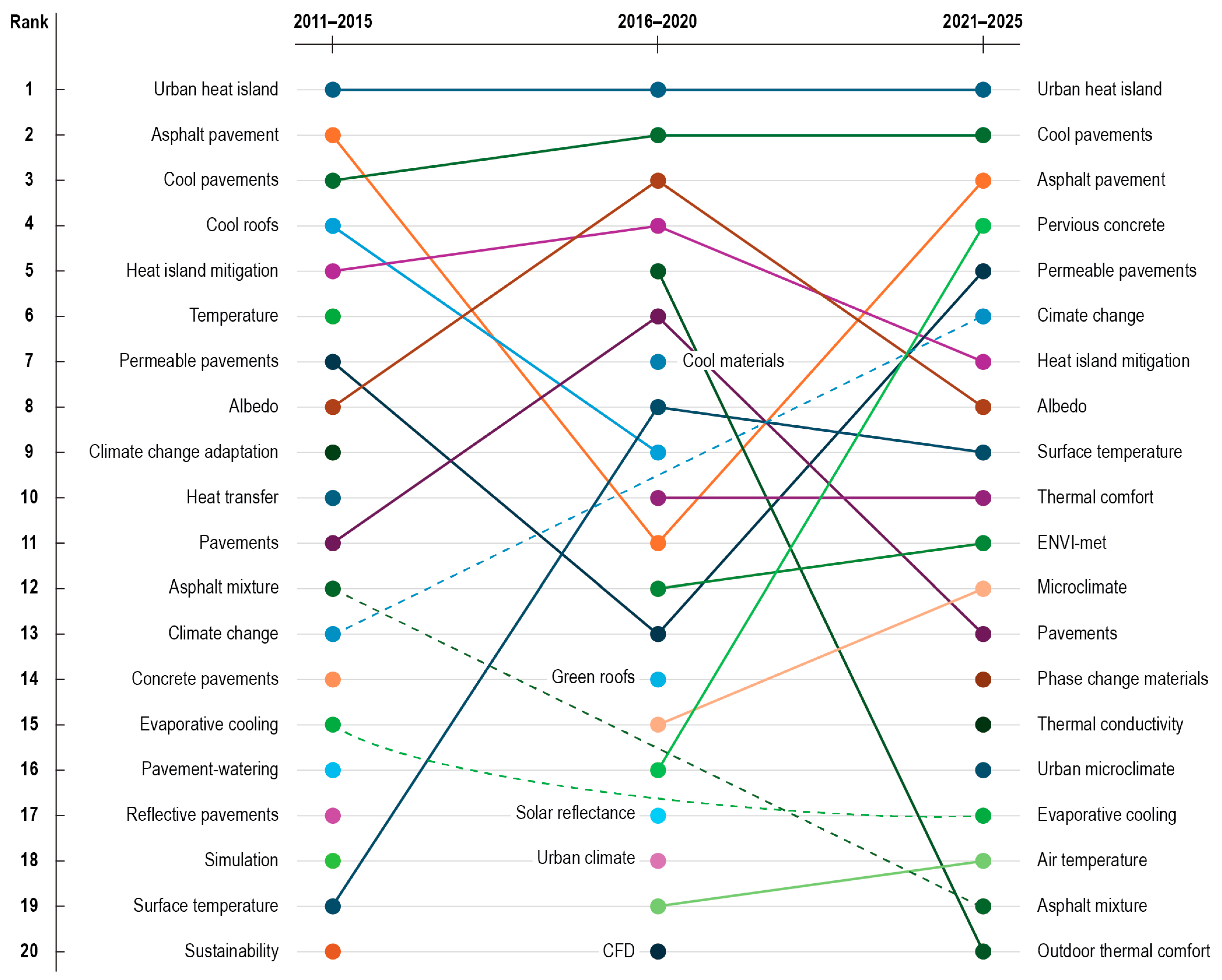
The temporal dynamics of author-provided keywords provide critical insight into the evolving research trajectories within pavement-related heat island studies. To capture these patterns, keywords were systematically categorized by frequency across three sequential intervals: 2011–2015, 2016–2020, and 2021–2025 (refer to
Table 5), and their ranking shifts are visually represented in
Figure 1.
A clear trend toward specialization is apparent: broad, generic terms decline in use, while more precise and context-specific terminology becomes more prominent. For example, concrete pavements—a leading keyword in 2011–2015—fell out of the top-20 rankings in later periods, replaced by pervious concrete, which highlights an engineered material designed to mitigate urban heat. Likewise, the general term temperature was replaced by more specific variables such as surface temperature and air temperature, reflecting a shift toward measurable, environment-specific indicators.
Methodological terms show a similar shift toward greater precision and sophistication. The broad keyword simulation, common in earlier studies, has been increasingly replaced by explicit references to modeling frameworks and computational techniques—such as ENVI-met and CFD—indicating a growing reliance on advanced tools for urban microclimate analysis.
Finally, the growing prominence of climate change reflects an expanded scope of inquiry. Its rise in the keyword ranking suggests that researchers increasingly recognize the significance of this issue and that greater effort and attention should be dedicated to addressing its implications within pavement and UHI research.
3.6. Thematic Structure Based on Keyword Co-Occurrence
To situate pavement research within the broader context of UHI studies, this section first examines the keyword network of the overall UHI literature. The analysis then narrows its focus to generate a keyword network specifically for studies addressing pavement and the UHI. The following subsections present these analyses sequentially.
3.6.1. Keyword Network of UHI Research
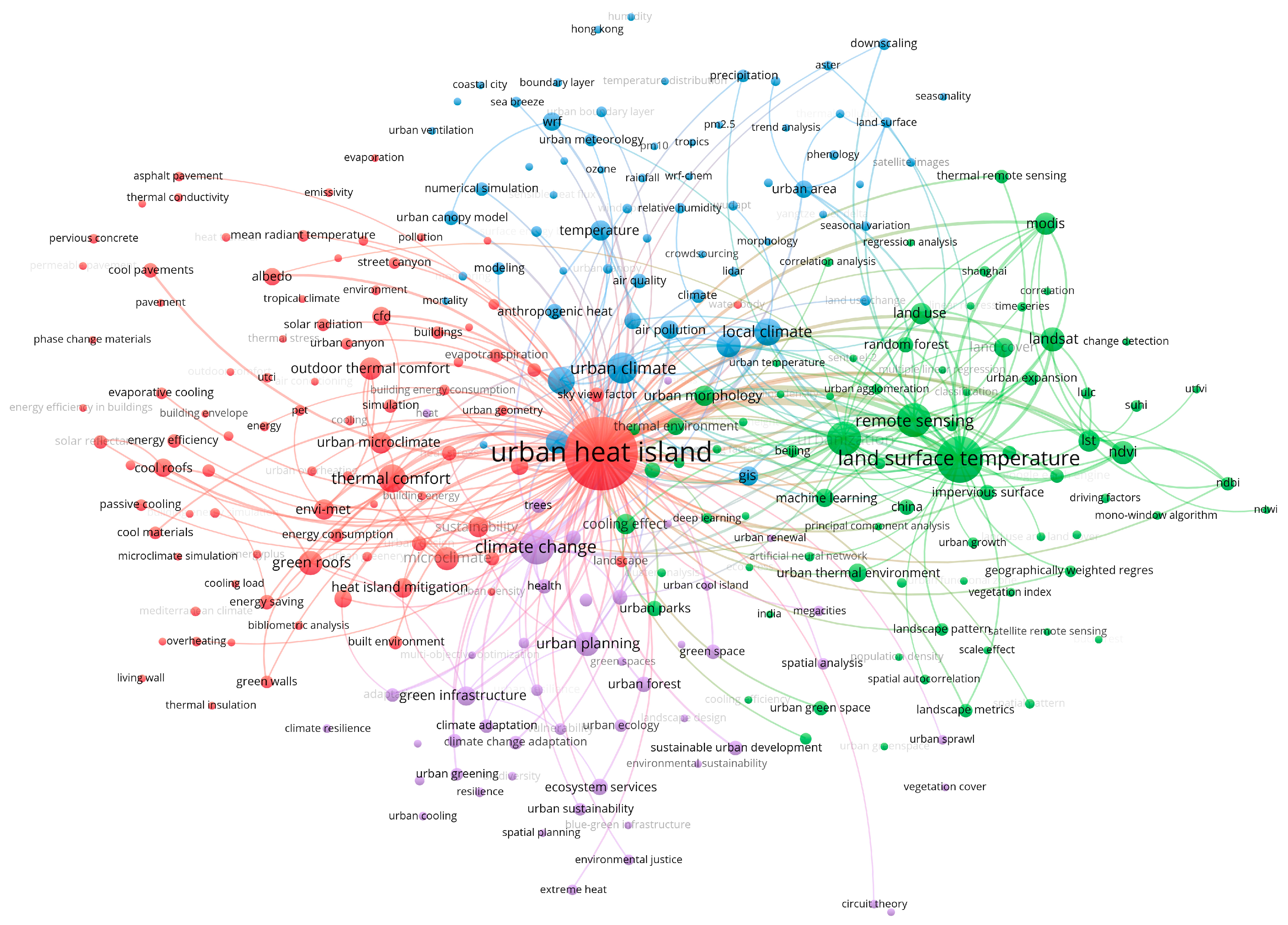
Figure 2 displays the keyword network of the UHI research, where each thematic cluster is visually represented using a distinct color. To reduce the noise in the clusters, after an iterative process the resolution value for clustering was set to 0.75. As a result, the initial seven clusters reduced to four clusters which resulted in a more meaningful partitioning between keywords. For clarity, the network visualization was limited to the 300 strongest connections. To support qualitative interpretation, the 30 most frequently occurring keywords within each cluster were extracted (
Table 6). The subsequent discussion examines the characteristics and implications of these clusters in greater detail.
The first cluster (shown in red in
Figure 2) focused on UHI mitigation through design and materials. It included keywords focused on pavements—such as
asphalt pavement and
pervious concrete—as well as building-oriented applications like
green roofs,
cool roofs, and
living walls. This cluster also included keywords pertaining to urban design, including
urban canyon and
street canyon. This cluster also highlighted terms related to cooling strategies, including
evaporating cooling,
passive cooling, and
ventilation.The second cluster (shown in green in
Figure 2) focused on metrics used to measure land cover attributes used for urban heat analysis. The key terms in this cluster included
remote sensing,
Landsat,
MODIS (Moderate Resolution Imaging Spectroradiometer),
NDBI (Normalized Difference Built-up Index),
NDWI (Normalized Difference Water Index),
vegetation index,
spectral indices, and
UTFVI (Urban Thermal Field Variance Index). This cluster also included keywords about analysis of such data, such as
deep learning and
machine learning.
The third cluster (shown in blue in
Figure 2) focused on climate dynamics and atmospheric factors. The key terms in this cluster included
urban climate,
local climate,
wind,
rainfall,
precipitation,
temperature,
air quality,
seasonality,
seasonal variation, and
ozone.
The fourth cluster (shown in purple in
Figure 2) focused on sustainable development. The key terms in this cluster included
sustainable urban development,
climate change,
green infrastructure,
climate adaptation,
urban ecology,
environmental justice,
urban forests,
green space,
urban greening,
climate resilience,
health, and
global warming. 3.6.2. Keyword Network of the Pavement Research in Relation to UHI
As outlined above, the examination of pavement types and their attributes constitutes a central mitigation strategy within the first cluster of UHI research. These measures are evaluated in conjunction with other established approaches, including green roofs, cool roofs, living walls, and evaporative cooling systems. The present section narrows its focus to the body of literature addressing pavements in relation to the UHI effect, with the aim of delineating the scientific landscape of this specific niche in greater detail.
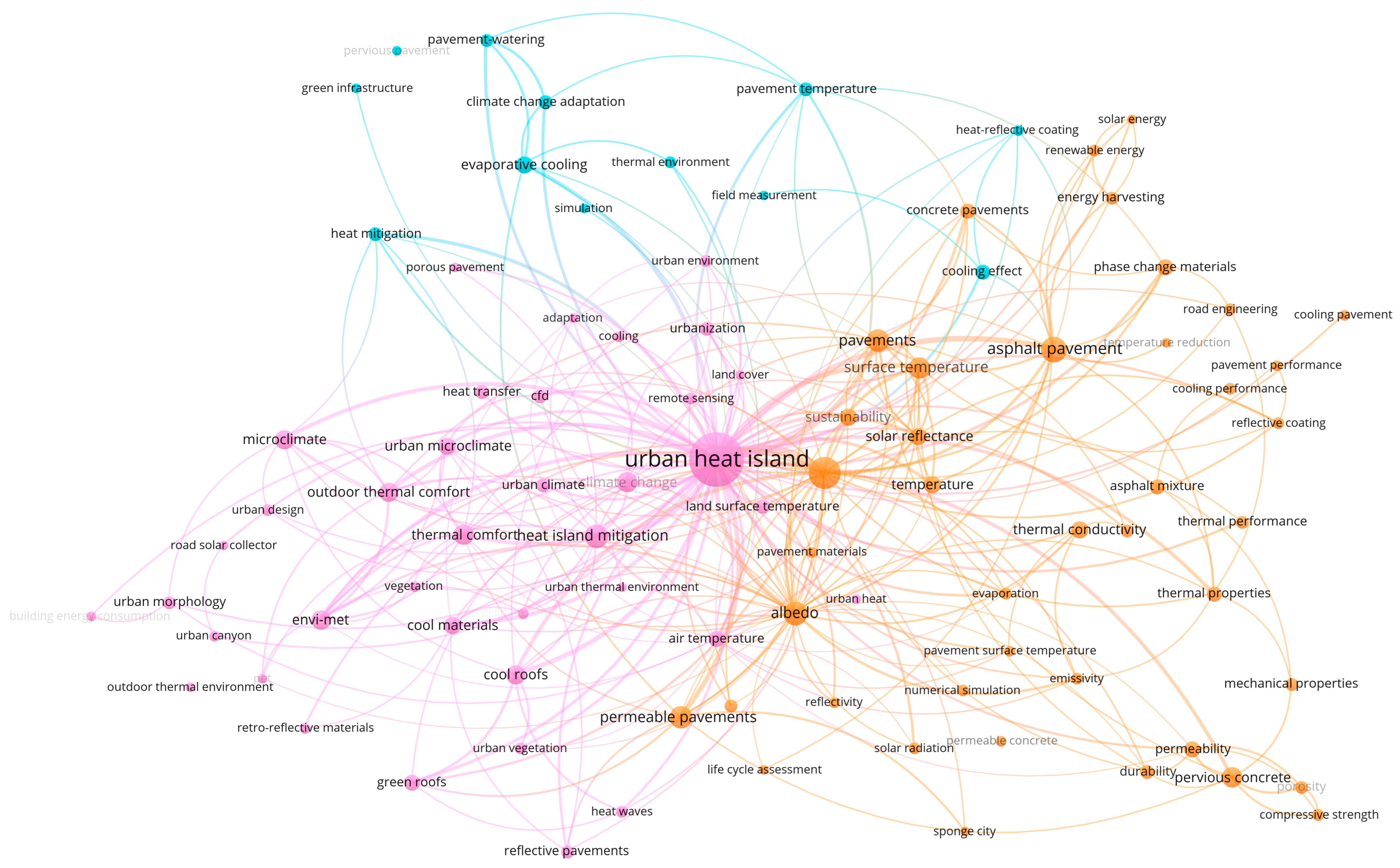
Figure 3 displays the keyword network of the pavement, where each thematic cluster is visually represented using a distinct color. To reduce the noise in the clusters, after an iterative process the resolution value for clustering was set to 0.5. As a result, the initial nine clusters reduced to three clusters which resulted in a more meaningful partitioning between keywords. For clarity, the network visualization was limited to the 300 strongest connections. To support qualitative interpretation, the 30 most frequently occurring keywords within each cluster were extracted (
Table 7). The following paragraphs provide detailed insights into the nature and implications of each identified cluster.
The first cluster (shown in orange in
Figure 3) focused on pavement materials and their properties. The keywords focused on pavement materials included
asphalt pavement, concrete pavements,
pervious concrete,
reflective coating,
cooling pavement, and
phase change materials. The keywords related to material properties included
albedo,
solar reflectance,
emissivity,
reflectivity,
thermal conductivity,
cooling performance,
mechanical properties,
compressive strength, and
permeability.
The second cluster (shown in pink in
Figure 3) focused on mitigation strategies that prevent UHI. It included keywords focused on urban design—such as
urban morphology,
urban canyon, and
urban vegetation—as well as building-oriented applications like
green roofs and
cool roofs.
The third cluster (shown in cyan in
Figure 3) focused on cooling interventions to mitigate UHI. The key terms in this cluster included
pavement watering,
evaporating cooling,
green infrastructure, and
heat-reflective coating.
4. Discussion
This paper first provides a comprehensive bibliometric overview of the broader UHI research landscape (the general UHI dataset, containing 14,572 records) and then examines pavement-related studies within the UHI context (the pavement UHI dataset, containing 834 records). Several supplementary analyses are also presented.
Regarding UHI research (14,572 records), as shown in
Figure 2, four clusters emerged. The first cluster focused on UHI mitigation through design and materials. For example, Lu et al. [
44] examined the effect of pervious concrete as a pavement material to mitigate UHI compared to conventional pavement options. In another study, Wang et al. [
45] investigated the self-cooling effect of a unidirectional heat-transfer asphalt pavement structure for mitigating UHI. Other studies in this cluster explored building-oriented applications, such as cool roofs [
46,
47], living walls [
48], and the optimal plant type for green roofs [
49], to reduce UHI. At the urban scale, Yamaoka et al. [
50], for instance, analyzed the impact of various urban canyon attributes (e.g., building height) on mitigating UHI.
The second cluster focused on the metrics used to measure land cover attributes for urban heat analysis. For example, Teng and Eun [
51] analyzed remote sensing images to examine how changes in various urban surface parameters (e.g., vegetation index and water body index) correlate with UHI. Other studies employed additional metrics such as UTFVI [
52], NDBI [
53], and NDWI [
54].
The third cluster focused on climate dynamics and atmospheric factors. Among these factors were wind [
55], rainfall [
56], air quality [
57], seasonal variation [
58,
59], and ozone levels [
60].
The fourth cluster focused on sustainable development. For example, Buegelmayer-Blaschek et al. [
61] examined the effects of large-scale greening in Vienna on the resilience of cities to climate change. Regarding the social pillar of sustainable development, Szemeredi and Remsei [
62] investigated how UHI can disproportionately impact neighborhoods with vulnerable demographic characteristics, which in turn can lead to environmental injustice.
While all four clusters discussed above contribute to UHI mitigation, the present study focuses specifically on the role that pavements play in UHI. This focus is justified because pavements account for approximately 30–45% of urban land area [
1], and their thermal behavior has a significant impact on surface and near-surface temperatures. Within the context of pavement-related UHI research (834 records), three clusters were identified (
Figure 3).
The first cluster of pavement-related research focused on pavement materials and their properties. For example, Anand and Sailor [
63] compared the effects of different asphalt pavements with varying thermal properties (i.e., thermal conductivity and thermal storage capacity) and reflectance (i.e., albedo) in mitigating UHI. Another example in this cluster is the work of Wanniarachchi et al. [
64], who explored the effects of a permeable resin-based paving material for mitigating UHI.
The second cluster of pavement-related research focused on mitigation strategies aimed at preventing UHI. For example, AzariJafari et al. [
65] adopted a comprehensive approach to evaluating UHI mitigation strategies and found that although increasing pavement albedo can lower air temperatures, it may negatively affect the energy demand of adjacent buildings that receive the reflected radiation. Using a similar approach, Morales-Gonzalez et al. [
66] compared the effectiveness of various UHI mitigation strategies, including the use of reflective pavements, and found that reflective pavement was more effective than tree cover or water fountains alone in reducing temperature.
The third cluster of pavement-related research focuses on cooling interventions designed to mitigate UHI. For example, Hendel et al. [
67] investigated the optimal watering rate and frequency for cooling pavements and reducing their surface temperatures in Paris, France. Similarly, Chen et al. [
68] examined the effect of a novel coating applied to asphalt concrete on reducing surface temperature.
The results underline the potential of pavement-based measures, such as reflective coatings, permeable designs, and composite materials, to significantly reduce surface temperatures and improve outdoor thermal comfort [
9,
10]. These cooling effects, although localized, can have broader benefits by moderating air temperatures in cities and reducing the strain of extreme heat events. In some cases, they may also indirectly lower cooling demand in nearby buildings [
12]. While this link is not yet widely quantified, the evidence suggests that pavements should be considered as part of comprehensive climate adaptation strategies that also account for stormwater management, air quality, and public health.
The cluster patterns identified in this review reveal not only how the field is organized but also where research emphasis is disproportionately concentrated. The dominance of material-focused terms, for example, indicates that UHI mitigation research remains largely rooted in technological solutions rather than integrated policy or planning frameworks. This imbalance suggests that pavement-based strategies are primarily evolving within engineering research environments, with comparatively limited translation into broader urban climate governance or decision-making structures.
The temporal analysis shows that certain pavement-related keywords, such as permeable pavements and pervious concrete, remain relatively stable across the three examined periods. This stability does not imply that the research on these technologies is stagnant. Instead, it reflects the fact that these are long-established mitigation strategies whose terminology has remained unchanged for decades. Although scientific advances continue—such as improved mixtures, enhanced hydraulic behavior, and climate-specific performance testing—these developments occur under consistent terminology and therefore do not appear as new trends in bibliometric mapping. This illustrates a methodological limitation, as keyword-based analysis captures shifts in vocabulary rather than the deeper evolution of technical knowledge.
The increasing appearance of terms such as sustainability and climate change in keyword analyses shows that pavement-related UHI research is aligning with international policy frameworks. In particular, the United Nations Sustainable Development Goals [
69], SDG 11 (sustainable cities and communities) and SDG 13 (climate action), are highly relevant. Pavement modifications can directly contribute to heat resilience while offering co-benefits such as improved water management and livability. For this reason, policymakers and urban planners should treat pavements not only as infrastructure but also as active components of urban climate resilience systems.
5. Gaps and Future Directions
Although the bibliometric analysis reveals a growing research field, several areas remain comparatively underexplored. These gaps are reflected in the limited presence of certain keywords within the co-occurrence networks and point to opportunities for further scholarly advancement.
One notable gap concerns life cycle cost analysis (LCCA). While life cycle assessment appears intermittently in the pavement-related UHI literature, explicit consideration of LCCA is largely absent. Given that many UHI mitigation strategies—such as high-albedo coatings or permeable pavements—require trade-offs among installation cost, maintenance frequency, durability, and long-term performance, integrating LCCA into future studies would provide a more comprehensive understanding of their cost-effectiveness. Such analyses could better inform decision-makers about the economic implications of adopting different pavement technologies, particularly when considered alongside environmental and social benefits.
A second area requiring deeper investigation relates to the long-term durability of pavement materials [
24]. Although durability appears as a keyword in the dataset, its frequency is low compared to other material attributes such as albedo. Long-term field performance appears insufficiently explored, especially regarding how aging processes influence the thermal behavior and reflectance properties of pavement materials over time. Future work should examine both the degradation mechanisms and the persistence of cooling benefits under realistic environmental and traffic conditions. Such studies could help determine whether initial performance gains—particularly for reflective materials—are sustained throughout a pavement’s service life.
Finally, the analysis highlights a potential gap in research addressing the role of policy frameworks in guiding UHI mitigation efforts. Despite previous studies emphasizing the importance of policy interventions [
4], the keyword analysis shows little engagement with policy-related terms. Effective policy design requires an understanding of regional constraints, including climatic variability, material availability, and the differential effectiveness of mitigation strategies across contexts. For example, evidence suggests that cool pavements may provide greater benefits in Mediterranean climates than green façades [
4]. Future research would therefore benefit from examining how regional policies can be tailored to local environmental conditions, infrastructure systems, and socioeconomic priorities to support strategic, scalable UHI mitigation.
Collectively, addressing these gaps—economic evaluation, long-term durability, and policy integration—will strengthen the foundation of pavement-related UHI research and broaden its relevance for urban planners, engineers, and policymakers.
6. Limitations
This study is subject to several limitations. First, the analysis was restricted to the Web of Science Core Collection. Although this database is widely regarded as authoritative and comprehensive, it does not index every relevant publication. Consequently, some studies published in other databases or non-indexed sources may not have been captured.
Second, despite careful query design and data cleaning, there remains the possibility that irrelevant or tangential studies were included in the dataset. The application of co-occurrence analysis helped to alleviate this concern by filtering out studies with weak connections to the central topics. Nevertheless, the risk of minor noise in the data cannot be completely eliminated.
Third, bibliometric techniques are inherently descriptive and do not provide insights into the causal nature or directionality of relationships between research elements. Thus, while the bibliometric results highlight structural patterns and trends, they should be complemented with in-depth qualitative or systematic reviews to draw more substantive conclusions.
In addition, citation-based indicators, such as total publications and citation counts, may be influenced by factors other than scholarly impact—such as database coverage biases, self-citations, or disciplinary citation practices—which may limit their accuracy as measures of influence. Finally, the choice of search terms and thesaurus construction may have shaped the scope of the dataset and introduced a degree of subjectivity into the analysis.