


Abstract
Background and Objectives: Gait impairment is a common and disabling manifestation of multiple sclerosis, affecting mobility, independence, and quality of life. However, gait differences between people with multiple sclerosis and healthy individuals have not been well characterized within corresponding age strata. Methods: This exploratory cross-sectional study included 23 participants with relapsing–remitting multiple sclerosis and 50 healthy individuals aged 20–69 years. Participants underwent instrumented gait analysis at self-selected walking speed using a Vicon motion-capture system synchronized with force plates. Spatiotemporal parameters, lower-limb and pelvic kinematics, and ground reaction forces were assessed. Between-group comparisons were performed within predefined age strata (20–39, 40–49, 50–59, and 60–69 years) using one-dimensional Statistical Parametric Mapping and non-parametric analyses. Results: Across age strata, participants with relapsing–remitting multiple sclerosis generally showed slower walking and shorter stride-related measures, together with phase-specific multi-joint kinematic and ground reaction force deviations. Estimated gait-speed and stride-length differences were largest in the youngest stratum, whereas mean stride width was 0.04 m greater in both the youngest and oldest strata; however, confidence intervals were wide, and no between-stratum contrast was tested. Exploratory threshold crossings were not interpreted as evidence that the underlying effects differed among strata. Conclusions: The age-stratified, participant-level analysis identified recurrent differences in forward progression, lower-limb and pelvic kinematics, and loading and propulsion. These findings provide a quantitative description that may support individualized gait assessment and hypothesis generation for adequately powered studies. They do not establish an independent effect of age or an age-by-disease interaction.
1. Introduction
Multiple sclerosis (MS) is a chronic inflammatory disease of the central nervous system characterized by demyelination and axonal loss [1]. Its clinical manifestations are highly heterogeneous and may affect motor, cognitive, psychological, and social functioning [1,2,3]. Mobility impairment affects up to 85% of people with MS and is among the most disabling manifestations of the disease [4]. Gait dysfunction may restrict independence and social participation, reduce quality of life, and adversely affect psychological well-being [3,5], making walking a major focus of clinical assessment and rehabilitation.
Gait impairment in MS is multifactorial and may arise from fatigue, muscle weakness, spasticity, ataxia, balance deficits, and sensory dysfunction [6]. Impaired proprioception may further compromise postural control, lower-limb positioning, and dynamic balance during walking [7]. In addition, the heterogeneous distribution of demyelinating lesions within the central nervous system contributes to substantial interindividual variability in gait abnormalities [6]. The Expanded Disability Status Scale (EDSS) is the most widely used clinician-administered measure of neurological disability in MS [8]. At intermediate scores, particularly between 4 and 6, the EDSS is increasingly influenced by ambulatory function, underscoring the clinical relevance of quantitative gait assessment [9].
Compared with healthy individuals, people with MS commonly exhibit slower walking speed, shorter strides, prolonged double-support time, and greater spatiotemporal variability [10,11]. Instrumented gait analysis allows these abnormalities to be characterized beyond global measures of walking performance by quantifying spatiotemporal variables, joint kinematics, and kinetic features [3,11]. Altered lower-limb kinematics involving the hip, knee, and ankle have also been reported [12], providing potentially relevant information for individualized assessment and rehabilitation planning.
The interpretation of gait abnormalities in MS is complicated by demographic and clinical characteristics that may also influence locomotor performance. Age and sex are established determinants of gait in the general population [13]. Men generally walk faster than women [14,15], whereas advancing age is associated with slower walking, shorter steps, and altered gait variability [13,16]. In people with MS, these influences coexist with disease-related factors such as disability severity, motor impairment, and fatigue. Consequently, observed differences between clinical and healthy groups cannot necessarily be attributed to MS alone without considering these potential sources of heterogeneity.
Although gait abnormalities in MS have been extensively described, differences between people with MS and healthy individuals remain less well characterized within corresponding age ranges. Comparisons within predefined age strata may reduce the influence of broad differences in age distribution between clinical and healthy samples and provide a more clinically interpretable description of gait impairment. Nevertheless, such comparisons remain descriptive. Without adequately powered formal interaction analyses, they cannot establish an independent effect of age or determine whether age modifies MS-associated gait differences. Moreover, a cross-sectional design cannot support causal or longitudinal conclusions regarding aging or disease progression.
Accordingly, this exploratory cross-sectional study aimed to characterize spatiotemporal, kinematic, and kinetic gait differences between people with relapsing–remitting MS and healthy individuals within predefined age strata. The analysis focused on the direction and magnitude of the within-stratum contrasts and was not designed to compare these contrasts formally across strata. The findings were intended to support individualized gait assessment and generate hypotheses for larger studies examining the relationship between age and MS-associated gait impairment.
2. Materials and Methods
2.1. Study Design and Participants
This exploratory cross-sectional study was conducted between February 2024 and October 2025 at the Neurorehabilitation Unit of the University Hospital of Verona, Verona, Italy. Eligibility was assessed by an experienced physiatrist. Participants with relapsing–remitting MS were eligible if they were aged 20–69 years and had an Expanded Disability Status Scale (EDSS) score between 1.5 and 6.5 [8,9]. Neurological disability was evaluated at enrollment using the EDSS, which integrates findings from the neurological examination of functional systems with ambulatory performance. Within the observed range of 1.5–6.0, scores of 1.5–3.5 indicated mild-to-moderate neurological abnormalities with independent ambulation, scores of 4.0–5.5 reflected progressively greater limitations in walking capacity, and a score of 6.0 indicated the possible need for unilateral assistance during ambulation. EDSS scores were summarized descriptively within each age stratum; participants were not additionally stratified by disability level because the small subgroup sizes precluded reliable disability-specific comparisons.
To reduce the influence of acute clinical or pharmacological changes, participants with relapsing–remitting MS were required to have experienced no clinical relapse or corticosteroid treatment during the preceding 3 months. Stable disease-modifying and symptomatic treatments, including fampridine, were permitted because the study aimed to characterize gait under habitual clinical conditions rather than estimate pharmacological effects. Medication was neither withdrawn nor used for stratification or covariate adjustment because treatment regimens were heterogeneous and the age-specific relapsing–remitting MS samples were too small to support stable adjusted models. Residual confounding by medication therefore cannot be excluded. Additional exclusion criteria were other neurological disorders, severe psychiatric disorders, drug or alcohol abuse, paroxysmal vertigo, lower-limb botulinum toxin type A injections during the preceding 5 months, and clinically relevant musculoskeletal or rheumatological conditions that could independently impair gait, including active inflammatory arthritis, severe osteoarthritis, or previous joint arthroplasty.
Healthy participants were community volunteers aged 20–69 years with a body mass index (BMI) of 18.5–29.9 kg/m2, no neurological or clinically relevant orthopedic disorders, and no history of lower-limb surgery. Their eligibility assessment comprised a medical-history review and focused clinical screening for neurological symptoms or signs, musculoskeletal or rheumatological pain or functional limitations, abnormal gait, previous lower-limb surgery, and other medical conditions or treatments likely to affect walking. Individuals with suspected gait-relevant conditions were not enrolled. No laboratory or imaging examinations were performed because the participants were asymptomatic volunteers; consequently, “healthy” indicates fulfillment of the study eligibility criteria rather than the exclusion of every possible subclinical condition. The selected BMI range included normal-weight and overweight adults but excluded underweight and obesity, thereby maintaining a community-based comparison sample while limiting the potential biomechanical effects of body-size extremes. Because the groups were not matched or adjusted for BMI, residual confounding by anthropometric differences remains possible.
Participants with relapsing–remitting MS were recruited from the outpatient Clinical Unit, whereas healthy participants were not receiving rehabilitation. All participants provided written informed consent for study participation and video recording and, where applicable, for the use of relevant clinical information from medical records. The study was approved by the local Ethics Committee and conducted in accordance with the Declaration of Helsinki and applicable ethical and regulatory requirements. The final analytic sample comprised 23 participants with relapsing–remitting MS—4 aged 20–39 years, 7 aged 40–49 years, 5 aged 50–59 years, and 7 aged 60–69 years—and 50 healthy participants—20, 10, 10, and 10 in the corresponding strata. Age, sex, standing height, and body mass were recorded for all participants, and BMI was calculated as body mass divided by squared height (kg/m2). For participants with relapsing–remitting MS, the use and type of any assistive device employed during gait assessment were also recorded by age stratum.
2.2. Age Stratification
Participants with relapsing–remitting MS and healthy participants were assigned to the same four predefined age strata: 20–39, 40–49, 50–59, and 60–69 years. Because few younger participants with relapsing–remitting MS were available, the 20–29- and 30–39-year categories were combined in both groups to form the 20–39-year stratum, whereas participants aged 40–49 years remained a separate group. Each relapsing–remitting MS subgroup was compared only with healthy participants from the corresponding age stratum. This pragmatic grouping was adopted to avoid an extremely small younger relapsing–remitting MS subgroup and should not be interpreted as evidence of equivalent gait characteristics across the two decades included in the 20–39-year stratum. No pooled comparison between the relapsing–remitting MS and healthy samples was performed because their overall age distributions differed.
2.3. Gait Assessment
Sixteen reflective markers were positioned on anatomical landmarks according to the Plug-in Gait model; their definitions and anatomical placement are provided in Appendix A. Instrumented gait analysis was performed using a Vicon Vero 2.2 motion-capture system (Vicon Motion Systems Ltd., Oxford, UK) comprising eight infrared cameras operating at 100 Hz and two synchronized Advanced Mechanical Technology, Inc. force plates. Two analog video cameras aligned with the sagittal and coronal planes provided complementary recordings. The anthropometric inputs required for the biomechanical model included body mass, height, trochanteric distance, bilateral lower-limb length, and bilateral knee and ankle widths.
Participants walked at a self-selected comfortable speed along a straight 6-m assessment section, with additional space for acceleration and deceleration, following a verbal cue. Participants with relapsing–remitting MS were evaluated under their habitual walking conditions and could use their usual assistive device when required. The same walking condition was maintained throughout the acquisition session. Device use reported in the participant-characteristics table refers specifically to the device employed during instrumented assessment rather than to devices prescribed or used only outside the laboratory. Up to 30 walking trials were attempted to obtain sufficient valid force-plate contacts, with an approximately 1-min rest period between consecutive trials to reduce cumulative fatigue.
A trial was considered technically valid when either foot made full contact with a force plate. Kinematic and kinetic analyses included valid observations from both limbs; therefore, neither the more nor the less affected side was selected in participants with relapsing–remitting MS, and no predefined reference limb was used for healthy participants. Right- and left-limb observations were transformed to a common limb-based coordinate convention, with mediolateral variables sign-adjusted when necessary to ensure anatomically consistent directions. Three to five valid trials, collectively including observations from both limbs, were retained and averaged pointwise within each participant to generate one representative value or trajectory for each outcome. Consequently, the participant—not the individual trial, gait cycle, or limb—constituted the statistical unit.
2.4. Data Processing
Data were processed using MATLAB R2026a (The MathWorks Inc., Natick, MA, USA) and Vicon Nexus version 2.11. Optical marker trajectories were acquired at 100 Hz, and force-plate signals were recorded synchronously at 1000 Hz. Marker gaps of no more than 10 consecutive frames were reconstructed in Nexus using cubic-spline interpolation. All reconstructed trajectories were visually inspected, and trials containing longer gaps or gaps that affected the identification of critical gait events were excluded. Marker and force-plate data were filtered using fourth-order, zero-phase, low-pass Butterworth filters with cutoff frequencies of 6 and 20 Hz, respectively.
Initial contact and toe-off were identified from force-plate data using a vertical ground reaction force threshold of 20 N. Lower-limb and pelvic kinematics were calculated using the Plug-in Gait model, and spatiotemporal parameters were obtained with Vicon Polygon version 4.4.6. Kinematic outcomes comprised hip, knee, and ankle flexion–extension and pelvic tilt, obliquity, and rotation. Kinematic trajectories were time-normalized to the complete gait cycle, from 0% to 100%. In contrast, ground reaction force trajectories were restricted to the stance phase, from initial contact to toe-off, and time-normalized from 0% to 100% of stance. Accordingly, percentages reported for force trajectories refer to stance duration rather than to the complete gait cycle.
Ground reaction forces were normalized to body weight and expressed as a percentage of body weight. The three components were defined as Vx, mediolateral force; Vy, anteroposterior force; and Vz, vertical force. In the limb-based coordinate system described above, positive Vx values indicated forces directed laterally relative to the analyzed limb. Negative and positive Vy values represented the braking and propulsive components, respectively, whereas positive Vz values represented upward vertical force.
For each participant, the three to five technically valid trials were averaged pointwise to obtain a single representative value or trajectory for each outcome. Consequently, the participant, rather than the individual trial, gait cycle, or limb observation, constituted the statistical unit for all between-group analyses.
2.5. Statistical Analysis
All analyses were conducted separately within each age stratum using the participant-level summaries described in Section 2.4. Continuous variables, including height, body mass, and BMI, are presented as mean ± standard deviation (SD), whereas EDSS scores are reported as median and interquartile range (IQR) because of their ordinal nature. Assistive-device use is summarized by count, proportion, and device type.
Time-series kinematic and ground-reaction-force trajectories were analyzed in MATLAB using one-dimensional Statistical Parametric Mapping (SPM), implemented with the SPM1D toolbox [17]. Within each age stratum, the relapsing–remitting MS and healthy groups were compared using two-sided non-parametric two-sample permutation tests, with group labels reallocated at the participant level. The nominal trajectory-level threshold was set at p < 0.05. For each biomechanical outcome, SPM controlled the family-wise error rate across the corresponding time-normalized trajectory; this control did not extend across different outcomes or age strata.
Scalar spatiotemporal variables were compared between groups within each age stratum using two-sided Mann–Whitney U tests, with a nominal threshold of p < 0.05. No additional Bonferroni correction was applied across the six scalar variables, different trajectory outcomes, or age strata because these prespecified outcomes were treated as separate exploratory endpoints. Accordingly, scalar p-values were unadjusted and were not used as the primary basis for interpretation. The direction, magnitude, and uncertainty of scalar contrasts were instead described using unstandardized mean differences and Hedges’ g with 95% confidence intervals. Mean differences were calculated as relapsing–remitting MS minus healthy values, with confidence intervals estimated using the Welch–Satterthwaite approach. Hedges’ g was reported as a small-sample-corrected standardized effect size with approximate 95% confidence intervals; negative values indicate lower values in the relapsing–remitting MS group.
No formal a priori sample-size calculation or post hoc power analysis was performed. The sample size was determined by the number of eligible participants with relapsing–remitting MS recruited during the study period and the healthy observations available from the normative dataset and community recruitment. Given the small and unequal strata—particularly the 20–39-year relapsing–remitting MS subgroup (n = 4)—all analyses were considered hypothesis-generating rather than confirmatory. Failure to cross an exploratory threshold was therefore considered inconclusive and was not interpreted as evidence of no difference or equivalence. No analysis was performed on the pooled samples, and the magnitude of the relapsing–remitting MS—healthy contrasts was not formally compared across age strata; consequently, no age-by-group interaction was tested. Sex-stratified analyses were not undertaken because only three participants with relapsing–remitting MS were male, with none in the two youngest strata. Speed-adjusted regression or covariance analyses were also considered inappropriate because the small relapsing–remitting MS subgroups would have produced unstable and potentially overfitted estimates. Walking speed was therefore addressed explicitly when interpreting the kinematic and kinetic findings.
3. Results
The analytic sample comprised 23 participants with relapsing–remitting MS (20 women and 3 men) and 50 healthy participants (25 women and 25 men), all aged 20–69 years. Across the four ascending age strata (20–39, 40–49, 50–59, and 60–69 years), the relapsing–remitting MS sample included 4, 7, 5, and 7 participants, respectively, whereas the healthy sample included 20, 10, 10, and 10 participants. The healthy sample was sex-balanced within each stratum, whereas no men with relapsing–remitting MS were included in the two youngest strata. In the relapsing–remitting MS group, EDSS scores ranged from 1.5 to 6.0, with an overall median of 3.00 (interquartile range 1.00). The corresponding stratum-specific medians were 4.25, 2.50, 2.00, and 3.00, respectively. Stratum-specific demographic, clinical, and anthropometric characteristics are reported in Table 1.
Table 1.
Demographic, clinical and anthropometric characteristics of participants by group and predefined age stratum.
During gait assessment, 5 of the 23 participants with relapsing–remitting MS used an assistive device: 3 used a single-point cane, and 2 used a forearm crutch. Assistive devices were used by 1 of 4 participants in the 20–39-year stratum, 1 of 7 in the 40–49-year stratum, 1 of 5 in the 50–59-year stratum, and 2 of 7 in the 60–69-year stratum. No healthy participant used an assistive device.
3.1. Spatiotemporal Gait Parameters
Spatiotemporal results are summarized in Table 2, and the corresponding unstandardized and standardized effect-size estimates are presented in Table 3.
Table 2.
Spatiotemporal gait parameters in participants with relapsing–remitting MS and healthy individuals within predefined age strata.
Table 3.
Magnitude and direction of relapsing–remitting MS–healthy differences in scalar spatiotemporal outcomes within each age stratum.
Across the four age strata, point estimates consistently indicated lower gait speed (mean differences ranging from −0.44 to −0.15 m/s), shorter stride length (−0.34 to −0.12 m), shorter half-stride length (−0.17 to −0.05 m), and longer double-support time (0.05 to 0.10 s) in participants with relapsing–remitting MS than in healthy participants (Table 3). Cadence differences ranged from −15.0 to −1.0 steps/min. Mean stride width was 0.040 m greater in both the 20–39- and 60–69-year strata, although the precision of these estimates differed. Confidence intervals were generally wide and, for several outcomes, included zero, reflecting the uncertainty associated with the small and unequal subgroup sizes. Because no formal between-stratum comparisons or age-by-group interaction tests were performed, differences in point estimates, confidence intervals, or exploratory threshold crossings should not be interpreted as evidence that the underlying effects varied with age.
3.2. Kinematic Gait Parameters
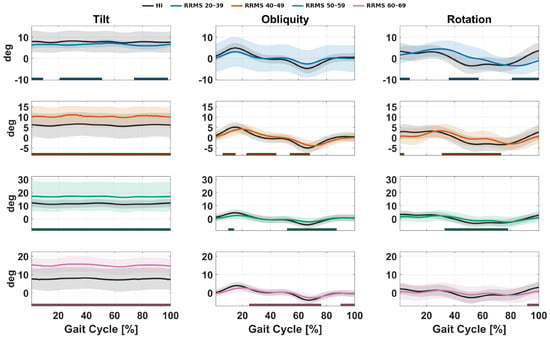
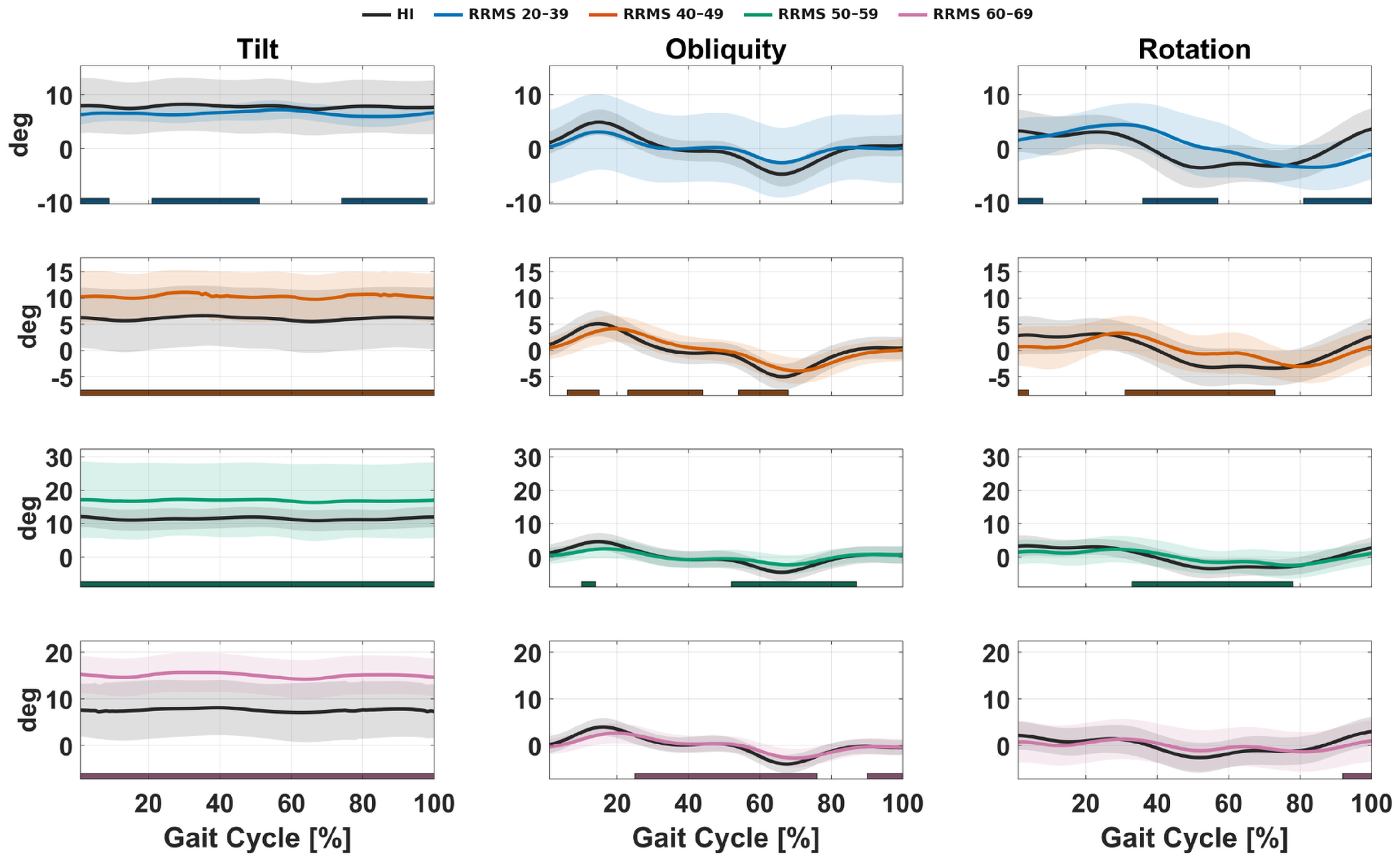
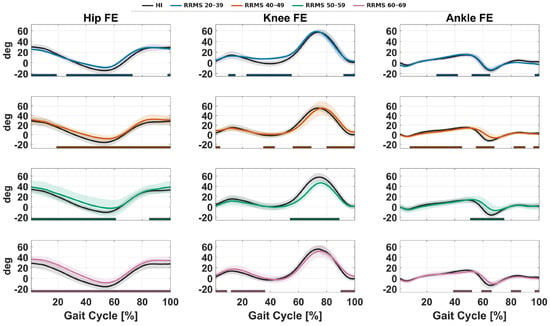
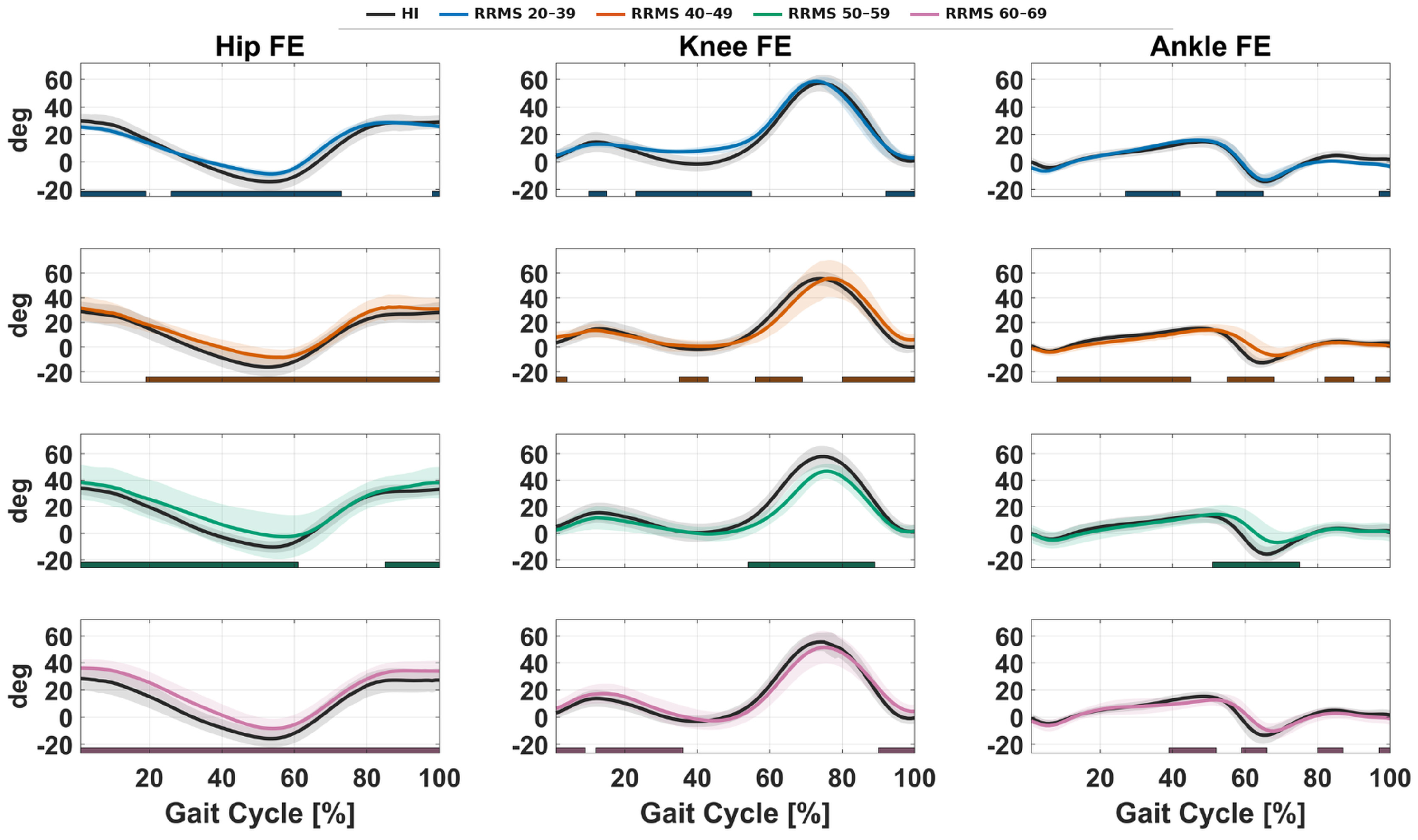
Participant-level pelvic and lower-limb kinematic trajectories are presented in Figure 1 and Figure 2. Horizontal bars indicate gait-cycle intervals in which the exploratory one-dimensional SPM statistic exceeded its trajectory-wise threshold within the corresponding age stratum.
Figure 1.
Pelvic kinematic trajectories during the gait cycle in participants with relapsing–remitting multiple sclerosis and healthy individuals across predefined age strata. Horizontal bars identify intervals in which the exploratory Statistical Parametric Mapping statistic exceeded its trajectory-wise threshold; these intervals should not be interpreted as evidence that effects differ among strata (HI, healthy individuals; RRMS, relapsing–remitting multiple sclerosis; deg, degree).
Figure 2.
Hip, knee, and ankle kinematic trajectories during the gait cycle in participants with relapsing–remitting multiple sclerosis and healthy individuals across predefined age strata. Horizontal bars identify intervals in which the exploratory Statistical Parametric Mapping statistic exceeded its trajectory-wise threshold; these intervals should not be interpreted as evidence that effects differ among strata (HI, healthy individuals; RRMS, relapsing–remitting multiple sclerosis; deg, degrees; FE, flexion–extension).
Exploratory clusters involved the hip, knee, ankle, and all three pelvic variables in each stratum, although their timing within the gait cycle varied. In the 20–39- and 40–49-year strata, hip and ankle clusters occurred during portions of both stance and swing. Knee clusters were concentrated in early stance and late swing in the youngest stratum and in terminal stance and swing in the 40–49-year stratum. In the 50–59-year stratum, lower-limb clusters involved hip flexion–extension during early stance and late swing, knee flexion–extension during terminal stance and early swing, and ankle dorsiflexion–plantarflexion during mid-to-late stance. In the 60–69-year stratum, hip and knee clusters occurred during portions of stance and swing, whereas ankle clusters involved mid-to-late stance and swing. Pelvic tilt, obliquity, and rotation showed clusters during different portions of stance and/or swing across all four strata. These findings represent exploratory within-stratum observations. Because cluster magnitude and duration were not formally compared across strata, differences in their timing, presence, or extent should not be interpreted as evidence that the underlying kinematic effects varied with age.
3.3. Ground Reaction Forces
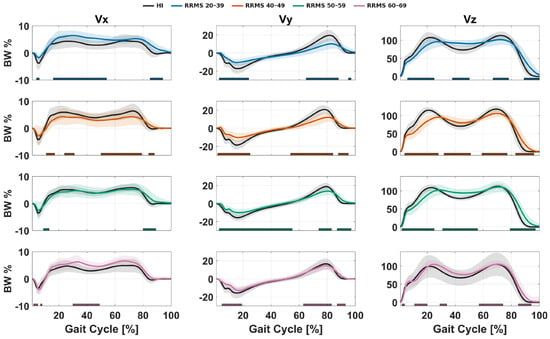
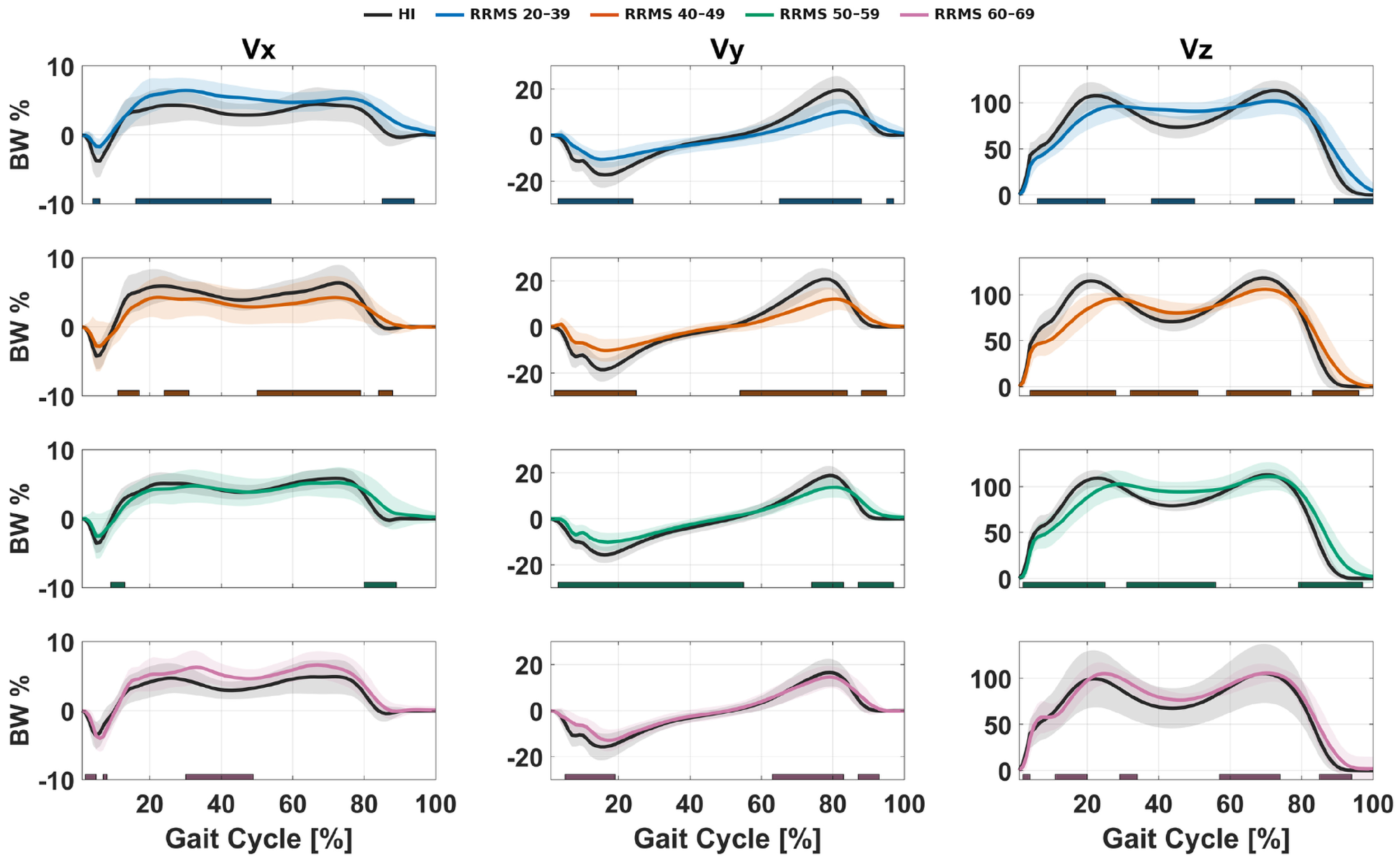
Body-weight-normalized ground reaction force trajectories are presented in Figure 3. Horizontal bars indicate stance-phase intervals in which the exploratory one-dimensional SPM statistic exceeded its trajectory-wise threshold within the corresponding age stratum.
Figure 3.
Ground reaction force components during the stance phase in participants with relapsing–remitting multiple sclerosis and healthy individuals across predefined age strata. Forces are normalized to body weight, and horizontal bars identify intervals in which the exploratory Statistical Parametric Mapping statistic exceeded its trajectory-wise threshold; these intervals should not be interpreted as evidence that effects differ among strata (HI, healthy individuals; RRMS, relapsing–remitting multiple sclerosis; BW, body weight; Vx, mediolateral ground reaction force; Vy, anteroposterior ground reaction force; Vz, vertical ground reaction force).
In the 20–39-year stratum, the relapsing–remitting MS trajectories showed higher mediolateral force (Vx) during mid-stance (approximately 15–60% of stance), attenuated anteroposterior braking and propulsion (Vy; approximately 0–20% and 70–85%, respectively), and lower vertical force peaks (Vz) during loading response and push-off. A similar pattern was observed in the 40–49-year stratum, with Vx clusters around the first positive peak and from mid- to late stance, together with attenuated Vy braking and propulsion and lower Vz loading and push-off peaks. In the 50–59-year stratum, Vx clusters were primarily confined to early and late stance, while the attenuated Vy braking peak extended through approximately the first half of stance and Vz clusters involved the loading-response and terminal-stance peaks. In the 60–69-year stratum, higher Vx values were observed during central stance, particularly at approximately 30–50%, whereas Vy and Vz clusters were limited to shorter intervals.
These findings describe exploratory within-stratum trajectory differences. Because cluster magnitude, timing, and duration were not formally compared across strata, their apparent variation should not be interpreted as evidence that the underlying kinetic effects differed with age.
4. Discussion
This exploratory cross-sectional study characterized gait differences between participants with relapsing–remitting MS and healthy individuals within predefined age strata. Across strata, participants with relapsing–remitting MS generally showed lower gait speed, shorter stride-related measures, and phase-specific deviations in lower-limb and pelvic kinematics and ground reaction forces. These observations are consistent with previous reports of slower, shorter, and more variable gait and altered lower-limb kinematics in MS [10,11,12,18]. By combining scalar estimates with participant-level full-trajectory analyses, the present study provides an age-stratified description of several complementary biomechanical domains. Because the relapsing–remitting MS–healthy contrasts were not formally compared across strata, however, the findings represent within-stratum observations and do not establish an independent effect of age or an age-by-disease interaction.
4.1. Relapsing–Remitting MS–Healthy Differences in the 20–39-Year Stratum
In the 20–39-year stratum, the relapsing–remitting MS group showed lower gait speed, stride length, half-stride length, and cadence, together with multi-joint and pelvic kinematic deviations and altered anteroposterior and vertical ground reaction forces. This combination is compatible with constrained forward progression and reduced loading and propulsion. The observed hip and pelvic deviations during pre-swing and swing may also reflect compensatory adjustments intended to facilitate limb advancement and foot clearance. Reduced force generation, impaired selective motor control, spasticity, fatigue, and slower self-selected walking could each have contributed to this pattern, but these mechanisms were not measured directly and should be considered hypotheses rather than causal explanations. Similar lower-limb abnormalities have been reported previously in MS [11,12,18]. Interpretation is particularly limited by the inclusion of only four participants with relapsing–remitting MS, all women, and by the comparatively high median EDSS score in this stratum.
4.2. Relapsing–Remitting MS–Healthy Differences in the 40–59-Year Strata
The two middle-aged relapsing–remitting MS strata showed a broadly similar combination of lower gait speed, shorter stride-related measures, multi-joint and pelvic kinematic deviations, and altered braking, propulsion, and vertical loading. This pattern supports previous evidence that instrumented gait analysis can identify abnormalities across several biomechanical domains even in individuals with relatively mild MS disability [11,12,18]. Shorter strides and reduced propulsive loading may indicate constrained forward progression, whereas pelvic and proximal-joint deviations may represent compensatory coordination used to maintain limb clearance. Because strength, spasticity, sensory impairment, and comparable electromyographic activity were not assessed, the physiological basis of these observations cannot be determined. The lower self-selected walking speeds in the relapsing–remitting MS groups may also have contributed to the kinematic and kinetic differences.
4.3. Relapsing–Remitting MS–Healthy Differences in the 60–69-Year Stratum
In the 60–69-year stratum, mean stride width was 0.040 m greater in relapsing–remitting MS, whereas the remaining scalar estimates were smaller and less precise. Kinematic deviations persisted at the hip, knee, ankle, and pelvis, and mediolateral ground reaction force differed during mid-stance. A wider base of support may reflect greater mediolateral stabilization requirements, consistent with adaptations described in older adults [19,20,21,22]. However, the same mean stride-width difference was observed in the 20–39-year stratum. The present findings therefore cannot determine whether this feature reflects relapsing–remitting MS-related compensation, aging, individual clinical characteristics, or a combination of these influences.
4.4. Descriptive Interpretation Across Age Strata
Taken together, the findings identify recurrent differences in forward progression, multi-joint and pelvic coordination, loading, propulsion, and mediolateral stability. Their distribution and timing were not identical across strata, but this descriptive variation does not demonstrate distinct age-dependent gait strategies. Healthy aging is itself associated with slower walking, shorter steps, and changes in gait stability and variability [13,16,19,20,21,22]. Comparing relapsing–remitting MS and healthy participants within corresponding age ranges therefore provides a more clinically relevant description than a pooled comparison, but it cannot separate aging-related from disease-related influences. Differences among the relapsing–remitting MS strata in neurological disability, sex composition, anthropometry, medication, assistive-device use, and other clinical characteristics further limit age-based interpretation.
Walking speed is particularly important because participants with relapsing–remitting MS walked more slowly than healthy individuals in most strata. Self-selected speed affects stride length, joint excursions, temporal parameters, and the magnitude and timing of ground reaction forces. The present kinematic and kinetic findings consequently describe gait under habitual walking conditions rather than biomechanical differences that are independent of speed. Moreover, walking speed may partly mediate the effect of neurological impairment on gait, meaning that statistical adjustment could remove clinically meaningful disease-related variation. Because the small age-specific samples precluded stable speed-adjusted analyses, the study cannot distinguish relapsing–remitting MS-specific alterations from changes mediated or confounded by slower walking.
4.5. Limitations and Future Directions
Several limitations should be considered. No formal a priori sample-size calculation was performed, and the availability-based relapsing–remitting MS strata were small and unequal, particularly the 20–39-year subgroup. The resulting estimates are imprecise, and findings that did not cross an exploratory threshold remain inconclusive rather than evidence of equivalence. Neurological disability was heterogeneous and was not used for stratification. The groups were also not matched for sex or anthropometry: the relapsing–remitting MS sample was predominantly female, the healthy sample was sex-balanced, and the healthy body mass index criterion included overweight adults. The subgroup sizes did not permit reliable adjustment for these characteristics. In addition, stable pharmacological treatments were permitted, but not modeled, and healthy status was established through medical history and focused clinical screening without laboratory or imaging examinations. Residual confounding by disability, sex, anthropometry, medication, and subclinical conditions therefore cannot be excluded.
Participants with relapsing–remitting MS were evaluated under habitual conditions, including the use of usual walking aids when required. Assistive devices may alter the base of support, redistribute loading, and influence ground reaction forces; because device-related loads were not quantified separately, kinetic findings among device users cannot be attributed exclusively to lower-limb function. Fatigue was not formally measured and may also have affected performance. Pooling right- and left-limb observations at the participant level avoided pseudo-replication but prevented separate examination of the more and less affected sides and may have attenuated gait asymmetry. Furthermore, no stable speed-adjusted analysis could be performed, and normalization of ground reaction forces to body weight does not eliminate the effects of walking speed, body dimensions, sex, or assistive-device use. Comparable electromyographic recordings were unavailable for healthy participants, and the cross-sectional design precludes conclusions about longitudinal aging or disease progression.
Future studies should recruit larger and more balanced samples, prespecify sample-size requirements for primary outcomes, and examine age as a continuous variable through formal age-by-group interaction models. Disability severity, medication, muscle strength, spasticity, sensory impairment, fatigue, walking speed, and assistive-device use should be measured systematically and incorporated where appropriate. Limb-specific analyses validated asymmetry measures, and habitual-speed analyses complemented by speed-matched or speed-adjusted sensitivity analyses would further clarify the observed biomechanical differences. Longitudinal biomechanical and neuromuscular assessments are ultimately required to distinguish aging-related changes from disease progression.
4.6. Clinical Implications
Quantitative gait assessment may complement neurological examination by identifying patient-specific alterations in forward progression, limb advancement, multi-joint and pelvic coordination, loading, propulsion, and mediolateral stability. The age-stratified comparisons provide descriptive reference information within broadly comparable age ranges but do not support prescriptive age-specific rehabilitation protocols. Their principal clinical value lies in guiding individualized assessment and identifying biomechanical targets for future investigation and rehabilitation planning.
5. Conclusions
Within corresponding age strata, participants with relapsing–remitting MS generally walked more slowly and with shorter stride-related measures than healthy individuals, while full-trajectory analyses identified phase-specific differences in lower-limb and pelvic kinematics and in loading and propulsion. By integrating scalar effect estimates with participant-level trajectory analyses, this study identifies forward progression, multi-joint coordination, propulsion, loading, and mediolateral stability as potentially relevant domains for individualized gait assessment. Because confidence intervals were wide and neither between-stratum contrasts nor an age-by-group interaction were tested, these findings should be interpreted as age-stratified observations rather than evidence of age-dependent gait patterns. Larger, prospectively powered studies using balanced samples and formal interaction analyses are required to determine whether age modifies gait differences associated with relapsing–remitting MS.
Author Contributions
Conceptualization, A.R., A.C., V.V., M.C., Z.S. and A.P.; methodology, A.R., A.C., Z.S. and A.P.; software, G.R., F.S. and M.D.V.; formal analysis, A.R., A.C., G.R., F.S., M.D.V. and S.Z.; investigation, A.R., A.C., G.R., F.S. and M.D.V.; resources, V.V.; data curation, A.R., A.C., G.R., F.S., M.D.V., E.E. and S.Z.; writing—original draft preparation, A.R. and A.C.; writing—review and editing, M.F., Z.S. and A.P.; supervision, N.S.; funding acquisition, V.V. and N.S. All authors have read and agreed to the published version of the manuscript.
Funding
This research was funded by the Italian Multiple Sclerosis Foundation (FISM), grant number 2022_R-Single_031.
Institutional Review Board Statement
The study was conducted in accordance with the Declaration of Helsinki and approved by the Comitato Etico Territoriale Area Sud-Ovest Veneto (protocol code 4257CESC; date of approval 5 July 2023).
Informed Consent Statement
Informed consent was obtained from all subjects involved in the study.
Data Availability Statement
The raw data supporting the conclusions of this article will be made available by the authors on request.
Acknowledgments
The authors would like to acknowledge Niccolò Cengiarotti, Francesco Donà, and Alessia Iero for their contribution to data collection during their internship. During the preparation of this manuscript, the authors used ChatGPT (OpenAI), version 5.6 Sol, to support journal formatting, language editing, and submission-file preparation. The authors reviewed and edited the output and take full responsibility for the content of this publication.
Conflicts of Interest
The authors declare no conflicts of interest.
Abbreviations
The following abbreviations are used in this manuscript:
| AMTI | Advanced Mechanical Technology, Inc. |
| BMI | Body mass index |
| BW | Body weight |
| CI | Confidence interval |
| EDSS | Expanded Disability Status Scale |
| FE | Flexion–extension |
| HIs | Healthy individuals |
| IQR | Interquartile range |
| MS | Multiple sclerosis |
| SD | Standard deviation |
| SPM | Statistical Parametric Mapping |
| Vx | Mediolateral ground reaction force |
| Vy | Anteroposterior ground reaction force |
| Vz | Vertical ground reaction force |
Appendix A
Plug-in Gait lower-body marker set used for kinematic analysis (see Table A1).
Table A1.
Definition and anatomical placement of the 16 reflective markers used for lower body.
References
- Sosnoff, J.J.; Sandroff, B.M.; Pula, J.H.; Morrison, S.M.; Motl, R.W. Falls and physical activity in persons with multiple sclerosis. Mult. Scler. Int. 2012, 2012, 315620. [Google Scholar] [CrossRef] [Scilit] [PubMed]
- Benedict, R.H.B.; Amato, M.P.; DeLuca, J.; Geurts, J.J.G. Cognitive impairment in multiple sclerosis: Clinical management, MRI, and therapeutic avenues. Lancet Neurol. 2020, 19, 860–871. [Google Scholar] [CrossRef] [Scilit] [PubMed]
- Cofré Lizama, L.E.; Bruijn, S.M.; Galea, M.P. Gait stability at early stages of multiple sclerosis using different data sources. Gait Posture 2020, 77, 214–217. [Google Scholar] [CrossRef] [Scilit] [PubMed]
- LaRocca, N.G. Impact of walking impairment in multiple sclerosis: Perspectives of patients and care partners. Patient 2011, 4, 189–201. [Google Scholar] [PubMed]
- Heesen, C.; Böhm, J.; Reich, C.; Kasper, J.; Goebel, M.; Gold, S.M. Patient perception of bodily functions in multiple sclerosis: Gait and visual function are the most valuable. Mult. Scler. J. 2008, 14, 988–991. [Google Scholar] [CrossRef] [Scilit] [PubMed]
- Bonanno, M.; De Nunzio, A.M.; Quartarone, A.; Militi, A.; Petralito, F.; Calabrò, R.S. Gait analysis in neurorehabilitation: From research to clinical practice. Bioengineering 2023, 10, 785. [Google Scholar] [CrossRef] [Scilit] [PubMed]
- Anastasi, D.; Lencioni, T.; Carpinella, I.; Castagna, A.; Crippa, A.; Gervasoni, E.; Corrini, C.; Marzegan, A.; Rabuffetti, M.; Ferrarin, M.; et al. Dynamic balance during walking in people with multiple sclerosis: A cross-sectional study. Proc. Inst. Mech. Eng. H 2023, 237, 199–208. [Google Scholar] [CrossRef] [Scilit] [PubMed]
- Kurtzke, J.F. Rating neurologic impairment in multiple sclerosis: An expanded disability status scale (EDSS). Neurology 1983, 33, 1444–1452. [Google Scholar] [PubMed]
- Meyer-Moock, S.; Feng, Y.S.; Maeurer, M.; Dippel, F.W.; Kohlmann, T. Systematic literature review and validity evaluation of the Expanded Disability Status Scale (EDSS) and the Multiple Sclerosis Functional Composite (MSFC) in patients with multiple sclerosis. BMC Neurol. 2014, 14, 58. [Google Scholar] [CrossRef] [Scilit] [PubMed]
- van Emmerik, R.E.A.; Jones, S.L.; Busa, M.A.; Remelius, J.G.; Averill, J.L. Enhancing postural stability and adaptability in multiple sclerosis. In Progress in Motor Control: Skill Learning, Performance, Health, and Injury; Levin, M.F., Ed.; Springer: New York, NY, USA, 2014; Volume 826, pp. 251–276. [Google Scholar]
- Benedetti, M.G.; Piperno, R.; Simoncini, L.; Bonato, P.; Tonini, A.; Giannini, S. Gait abnormalities in minimally impaired multiple sclerosis patients. Mult. Scler. 1999, 5, 363–368. [Google Scholar] [CrossRef] [Scilit]
- Crenshaw, S.J.; Royer, T.D.; Richards, J.G.; Hudson, D.J. Gait variability in people with multiple sclerosis. Mult. Scler. J. 2006, 12, 613–619. [Google Scholar] [CrossRef] [Scilit] [PubMed]
- Herssens, N.; Verbecque, E.; Hallemans, A.; Vereeck, L.; Van Rompaey, V.; Saeys, W. Do spatiotemporal parameters and gait variability differ across the lifespan of healthy adults? A systematic review. Gait Posture 2018, 64, 181–190. [Google Scholar] [CrossRef] [Scilit] [PubMed]
- Gillain, S.; Boutaayamou, M.; Dardenne, N.; Schwartz, C.; Demonceau, M.; Gerontitis, C.; Depierreux, F.; Salmon, E.; Garraux, G.; Bruyère, O.; et al. Data set of healthy old people assessed for three walking conditions using accelerometric and opto-electronic methods. Aging Clin. Exp. Res. 2017, 29, 1201–1209. [Google Scholar] [CrossRef] [Scilit] [PubMed]
- Bohannon, R.W.; Wang, Y.C. Four-meter gait speed: Normative values and reliability determined for adults participating in the NIH Toolbox study. Arch. Phys. Med. Rehabil. 2019, 100, 509–513. [Google Scholar] [CrossRef] [Scilit] [PubMed]
- Kawai, H.; Taniguchi, Y.; Seino, S.; Sakurai, R.; Osuka, Y.; Obuchi, S.; Watanabe, Y.; Kim, H.; Inagaki, H.; Kitamura, A.; et al. Reference values of gait parameters measured with a plantar pressure platform in community-dwelling older Japanese adults. Clin. Interv. Aging 2019, 14, 1265–1276. [Google Scholar] [CrossRef] [Scilit] [PubMed]
- Pataky, T.C. One-dimensional statistical parametric mapping in SPM. Comput. Methods Biomech. Biomed. Eng. 2012, 15, 295–301. [Google Scholar] [CrossRef] [Scilit] [PubMed]
- Fernández-Vázquez, D.; Calvo-Malón, G.; Molina-Rueda, F.; López-González, R.; Carratalá-Tejada, M.; Navarro-López, V.; Miangolarra-Page, J.C. Kinematic gait analysis in people with mild-disability multiple sclerosis using statistical parametric mapping: A cross-sectional study. Sensors 2023, 23, 7671. [Google Scholar] [CrossRef] [Scilit] [PubMed]
- Pavol, M.J.; Owings, T.M.; Foley, K.T.; Grabiner, M.D. Gait characteristics as risk factors for falling from trips induced in older adults. J. Gerontol. A Biol. Sci. Med. Sci. 1999, 54, M583–M590. [Google Scholar] [CrossRef] [Scilit] [PubMed]
- Guralnik, J.M.; Ferrucci, L.; Pieper, C.F.; Leveille, S.G.; Markides, K.S.; Ostir, G.V.; Studenski, S.; Berkman, L.F.; Wallace, R.B. Lower extremity function and subsequent disability: Consistency across studies, predictive models, and value of gait speed alone compared with the Short Physical Performance Battery. J. Gerontol. A Biol. Sci. Med. Sci. 2000, 55, M221–M231. [Google Scholar] [CrossRef] [Scilit] [PubMed]
- Kirkwood, R.N.; de Souza Moreira, B.; Vallone, M.L.D.C.; Mingoti, S.A.; Dias, R.C.; Sampaio, R.F. Step length appears to be a strong discriminant gait parameter for elderly females highly concerned about falls: A cross-sectional observational study. Physiotherapy 2011, 97, 126–131. [Google Scholar] [CrossRef] [Scilit] [PubMed]
- Inns, T.B.; Pina, I.; Macgregor, L.J.; Dudchenko, P.A.; Crockett, R.A.; Hunter, A.M. Age-related gait adaptations: Analysis of temporal gait parameters and variability, and muscle activation across flat vs. uneven surfaces in young, middle-aged, and older adults. Front. Aging 2025, 6, 1573778. [Google Scholar] [CrossRef] [Scilit] [PubMed]

Disclaimer/Publisher’s Note: The statements, opinions and data contained in all publications are solely those of the individual author(s) and contributor(s) and not of MDPI and/or the editor(s). MDPI and/or the editor(s) disclaim responsibility for any injury to people or property resulting from any ideas, methods, instructions or products referred to in the content. |
© 2026 by the authors. Licensee MDPI, Basel, Switzerland. This article is an open access article distributed under the terms and conditions of the Creative Commons Attribution (CC BY) license.