


Abstract
Adolescence and youth are key stages for acquiring responsible sexual behaviour. Previous research has focused on measuring knowledge; however, in order to achieve the goal of developing safe sexual behaviour, it is necessary to complement this with measures of attitudes, for which there is currently a lack of valid and reliable measurement tools specifically focused on attitudes toward contraceptive use. The objective of this research is to develop and psychometrically validate the Attitudes Toward Contraceptive Use Scale (ACUS) in university students. A cross-sectional correlational validation study was designed using Item Response Theory. The sample consisted of 411 nursing students aged between 18 and 25 years. The final version of the scale, comprising 12 items, was evaluated using the Rasch Rating Scale Model (Andrich model), and its reliability was assessed in terms of internal consistency and temporal stability. The Rasch model showed an excellent overall fit, high item reliability (0.989), adequate person reliability (0.81), and good temporal stability (ICC = 0.796). The ACUS is a valid and reliable instrument for assessing attitudes toward contraception among university students. It can be used to identify less favourable attitudinal profiles toward contraceptive use and subsequently guide educational interventions.
1. Introduction
Adolescence is a stage of profound personal change, characterized by the development of secondary sexual characteristics, the acquisition of reproductive capacity, and the onset of sexual activity [1]. Globally, there has been a progressive decline in the age of sexual debut, reinforcing the need for an early and effective approach that promotes healthy and responsible sexuality among adolescents and young people [1,2].
Various studies have shown that a significant proportion of the youth population begins sexual relations without having received formal education on sexual health. In a recent study of university students, 25% reported having begun sexual relations before the age of 16, and 31% had never participated in educational activities on sexuality, reflecting the persistence of inadequate sex education. This lack of structured education is associated with risky behaviors, such as having sex under the influence of substances or without protection, which increases the likelihood of sexually transmitted infections (STIs), HIV, or unwanted pregnancies. In this population, condoms remain the most widely used method, although according to recent data, 29.3% report not having used them during their last sexual encounter [3].
In addition to the characteristics of adolescent sexual development, there are sociocultural and gender factors that modulate the expression of sexuality. Society continues to establish different behavioral norms according to sex, associating men with an active and conquering role and women with passivity or restraint [3,4]. These stereotypes influence decision-making related to contraception and the perception of risk. Recent studies confirm that young women have more favorable attitudes toward contraception and greater concern about pregnancy, while men tend to minimize risk and prioritize trust in their partner [5,6]. Likewise, longitudinal studies show that attitudes and beliefs acquired during adolescence predict sexual behavior in adulthood, with gender differences observed in the perception of risk and the use of contraceptives [7].
Sexuality, understood as an essential component of being human, integrates biological, psychological, and sociocultural aspects that manifest themselves with particular intensity during adolescence [8,9,10]. According to the World Health Organization, sexual health is not merely the absence of disease or dysfunction, but a state of physical, mental, and social well-being related to sexuality, which implies a positive, responsible, and coercion-free experience [8,11]. This approach is in line with recent evidence linking comprehensive sexuality education to improved autonomy, gender equality, and reduced risky sexual behavior in adolescents [12]. Misinformation and myths persist as significant barriers. Young people continue to obtain information mainly from the internet and their peers, sources that, although accessible, often lack scientific rigor [3,13]. This lack of education can distort understanding of sexuality and reinforce misconceptions, highlighting the need for rigorous, evidence-based educational strategies.
The success of sex education programs depends on the balanced integration of three dimensions: knowledge, behavior, and attitudes [14]. Programs that focus solely on conveying information fail to change behavior because attitudes serve as critical mediators between knowledge and behavior [5,13]. In this context, behavioural models such as the Theory of Planned Behavior highlight the central role of attitudes, together with subjective norms and perceived behavioural control, in shaping behavioural intentions and preventive sexual behaviors [15,16,17,18].
According to Whittaker, attitudes are defined as ‘a learned predisposition to respond in a certain way to an object or situation’ [19]. These are structured into three components: cognitive, referring to knowledge about the object; affective, linked to the feelings it generates; and behavioral, which involves the predisposition to act [9,10,14,19,20]. Attitudes, therefore, are learned and consolidated from experience and the social environment, playing a decisive role in sexual and reproductive decisions.
Empirical evidence shows that many adolescents maintain attitudes of indifference or rejection toward contraceptive methods, particularly males, who tend to rely on their partner’s monogamy as a measure of protection [21,22,23,24]. Furthermore, gender differences must be considered when analyzing attitudes, as evidenced by Heras-Sevilla et al. [25], who found that males show greater interest in the technical aspects of sexual intercourse, while females express concern about pregnancy and the pain associated with first intercourse.
Although numerous studies have assessed knowledge related to sexuality and contraception, fewer have focused specifically on attitudes as a distinct construct, despite their central role in behaviour change. Moreover, existing instruments are often ad hoc or lack adequate psychometric validation, limiting comparability across studies [7,26].
Despite the abundance of descriptive studies, most instruments used to assess attitudes toward contraception are ad hoc tools that lack psychometric validation, thereby limiting the comparability and applicability of their results [5,6,13]. This limitation justifies the development of validated and culturally adapted instruments that can reliably measure attitudes toward the use of contraceptive methods in the university population, strengthening the empirical basis for designing effective and sustainable educational interventions.
2. Materials and Methods
2.1. Study Design
A descriptive cross-sectional correlational study was conducted to develop and validate an instrument that measures attitudes toward contraceptive use among university students, following an Item Response Theory approach using the Rasch Rating Scale Model (Andrich model).
2.2. Participants and Sample
The sample consisted of young people aged 18–25 enrolled in university studies. All participants were students enrolled in the Nursing Degree program at the University of Jaén, who met the established age range and agreed to participate in the study. The sampling was non-probabilistic for convenience in the main study, ensuring a minimum recommended sample size for psychometric validation analyses (≥300 participants).
For the pilot test, a multistage probabilistic sampling was used, with stratification by academic year and simple random selection by groups, until an approximate sample of 100 participants was reached [27,28].
2.3. Study Variables
To collect the information, a questionnaire was created, consisting of a first part with the sociodemographic variables of the selected sample (gender, age, religiosity, and main sources of information on sexuality), and a second part consisting of the study variable: attitudes toward the use of contraceptive methods. This construct was assessed using a self-administered Likert-type scale (1–5), in which a higher score reflects a more favorable attitude toward contraceptive use and responsible sexual behavior.
2.4. Instrument Development Process
A self-administered Likert-type scale (1–5) was designed, applying formal item-writing criteria (clarity, one idea per item, avoidance of ambiguity, jargon, and double negatives) [29].
To develop the initial item bank, a structured literature review was conducted in scientific databases (PubMed, CINAHL, Scopus, LILACS, and Cuiden Plus), complemented by theoretical frameworks related to sexual attitudes and contraceptive behavior, identifying a dimensional structure with a tendency toward unidimensionality. As a result, an initial pool of 29 items was generated.
Content validity was assessed by a panel of ten experts in sexual health, methodology, and psychometrics, who evaluated the clarity and relevance of each item using a 1–5 Likert scale. The degree of agreement was calculated using Aiken’s V coefficient, retaining those items with V ≥ 0.70 and with the lower limit of the 95% confidence interval >0.60. Based on these criteria, 11 items were eliminated due to insufficient relevance or redundancy, and 6 items were reworded according to expert recommendations.
The pilot study aimed to evaluate clarity, comprehension, and preliminary psychometric behavior. The questionnaire was administered under standardized conditions, with an approximate duration of 20–30 min. In this phase, semantic comprehension and item-total correlations were analyzed, establishing 0.40 as the minimum acceptable threshold. Based on these results, items not meeting these criteria were revised or eliminated, resulting in the rewording of two items.
The version of the scale applied to the full sample was obtained after integrating expert judgment, pilot testing results, and preliminary psychometric indicators related to discrimination and internal consistency. This version consisted of 18 items prior to Rasch analysis.
2.5. Psychometric Properties
To assess the psychometric properties of the scale, an Item Response Theory approach was used, specifically the Rasch Rating Scale Model (Andrich model), appropriate for polytomous items with a common response format. Prior to model estimation, the fundamental assumptions were evaluated [30]. Unidimensionality was assessed as a prerequisite for Rasch modelling using exploratory factor analysis and parallel analysis, while local independence was examined using Yen’s Q3 statistic (critical values ±0.20). Invariance was assessed through differential item functioning (DIF) analysis according to gender and prior training.
Item reduction was performed based on Rasch model fit criteria, particularly outfit statistics exceeding acceptable thresholds, while also considering content coherence and construct coverage. This process resulted in the elimination of six items, leading to a final 12-item version.
Model fit indices were estimated for both items and persons. Values between 0.5 and 1.5 were considered acceptable for infit and outfit statistics [31]. Reliability was estimated for both items and persons.
All analyses were performed using JASP version 0.18 and JMetrik, version 4.1.1 for Windows.
2.6. Variables Analysis
A descriptive analysis of the variables studied was performed, using frequency measures for qualitative variables and central tendency and dispersion for quantitative variables and attitude scale scores. Secondly, a descriptive analysis was conducted of the mean scores for the items comprising the final version of the scale. The reliability of the scale was assessed using the intraclass correlation coefficient to evaluate temporal stability and Cronbach’s alpha to assess internal consistency.
2.7. Ethical Considerations
The study was approved by the Ethics Committee of the University of Jaén (ENE.22/2.TES) in compliance with the Declaration of Helsinki and Regulation (EU) 2016/679 (GDPR) and its national implementing regulations. Participation was voluntary, with prior written informed consent and the right to withdraw without consequences. The questionnaires were anonymous, with separate codes and secure storage on institutional servers with restricted access; the data will be presented in aggregate form to prevent re-identification. The research was considered to be of minimal risk and did not include financial compensation.
3. Results
3.1. Sample Characteristics
The total sample consisted of 411 nursing students from the University of Jaen, with a mean age of 20.59 years (standard deviation: 2.09), and the majority were female (78.35%). Table 1 shows the sociodemographic characteristics of the sample (Table 1).
Table 1.
Characteristics of the sample.
3.2. Psychometric Properties Analysis
First, the assumption of unidimensionality of the construct was tested using exploratory factor analysis of the 18-item version, obtaining a value for the KMO test of 0.725 and a lower significance level in Bartlett’s sphericity test (p < 0.001). The value of the eigenvalues, with respect to the parallel analysis, finds a higher value for the first factor (4.249) than the simulated value (1.379), with a significant inflection for the value of the second factor (1.785), similar to that obtained in the simulation (1.287), assuming a unidimensional structure and accepting compliance with the first construct.
The Rasch Rating Scale Model (Andrich model) fit analysis was performed, finding that six items had values higher than the critical fit value for the outfit. These were eliminated, and the analysis was repeated using the final version of the scale, which consisted of 12 items.
The Rasch model showed excellent overall fit for the instrument in its final 12-item version. The reliability of the items was 0.989, and that of the individuals was 0.81, with separation indices of 9.4 and 2.08, respectively. These values indicate adequate measurement precision and discriminatory capacity for both items and participants.
The infit and outfit values of the items remained within acceptable limits (0.6–1.4). No items with serious misfits were detected; only items 4, 5, and 6 had values above 1.3, which was interpreted as slight variability in their behaviour. The difficulty of the items ranged from −1.35 to +0.89, distributed evenly across the attitude continuum, reflecting uniform coverage of the construct. Table 2 shows the model fit values.
Table 2.
Model fit values.
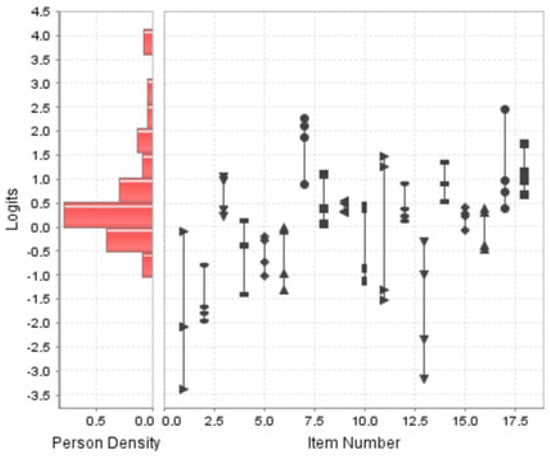
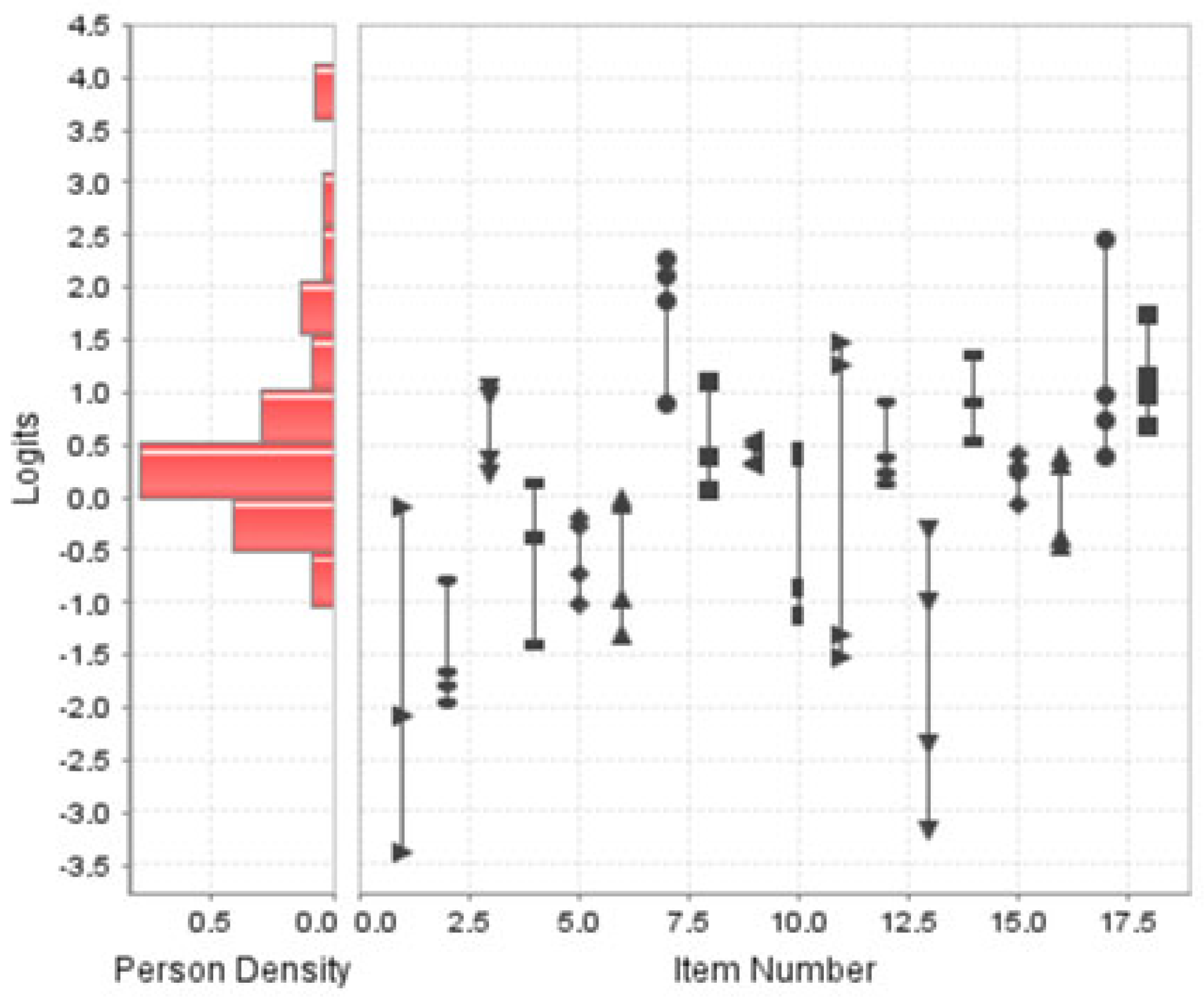
The unidimensionality analysis showed a dominant first component (eigenvalue = 4.82; explained variance = 41.3%), with no significant local dependence (Yen’s Q3 < ±0.20). Wright’s map showed an adequate correspondence between the difficulty of the items and the participants’ abilities, with no saturation or void zones (Figure 1). The agreement between the mean score for individuals (ability/quality of life) and the mean score for items (difficulty/impact) on a common scale, measured in logits, was assessed, yielding a mean value of 0.6092. This was slightly higher than the mean ability scores relative to the mean item score but fell within the optimal adaptation range of ±2.
Figure 1.
Item map.
Table differential analysis of the items showed non-significant results for all items on the scale when adjusting the significance level using the Bonferroni contrast (α = 0.05/12), with no significant problems found in the differential functioning of the items (Table 3).
Table 3.
Differential item functioning (DIF).
3.3. Construct Validity
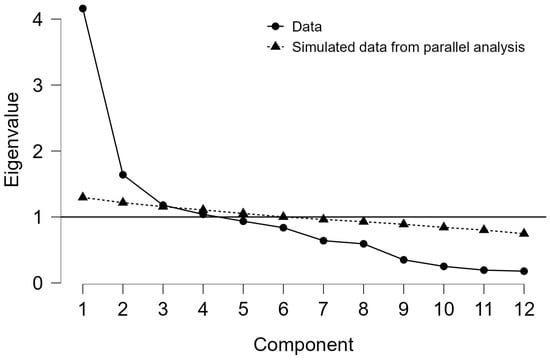
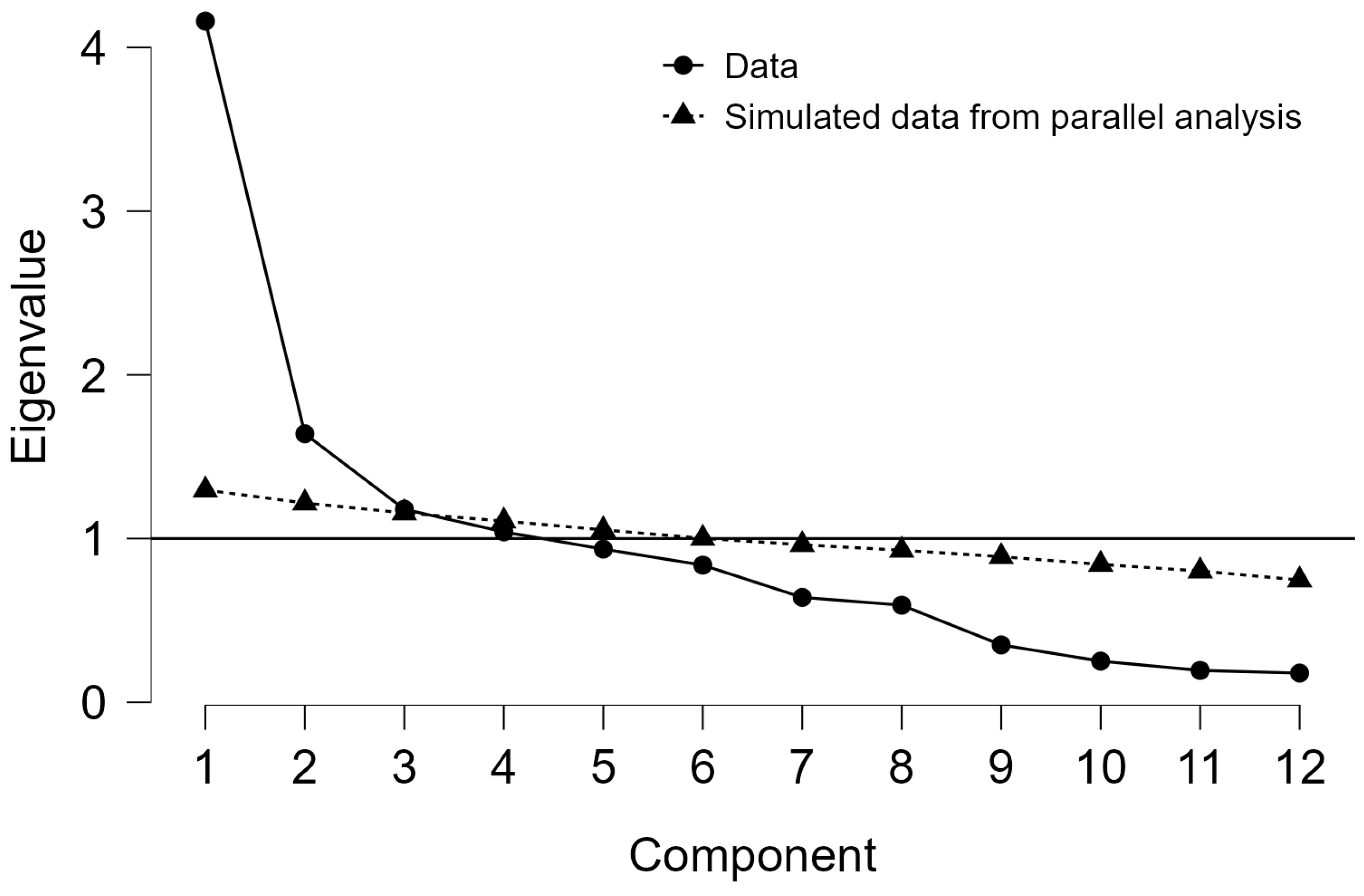
Additional evidence of construct validity was obtained through exploratory factor analysis of the 12-item version of the scale. The KMO test yielded a result of 0.758 and a lower significance level in Bartlett’s sphericity test (p < 0.001). For factor extraction, the Principal Components method was used, showing a unifactorial structure when comparing the eigenvalues obtained for the first factor (4.160) with the eigenvalue (1.284) and the representation of the factor loadings of the eigenvalues confirming the unifactorial structure (Figure 2).
Figure 2.
Model factor loadings.
3.4. Descriptive Analysis and Reliability Analysis
The final version of the Attitudes Toward Contraceptive Use Scale (ACUS) consisted of 12 grouped items. Total scores ranged from 12 to 60, with an overall mean of 41.55 ± 9.13, suggesting predominantly favourable attitudes toward contraceptive use. The item that presented the most negative attitude was number 3 (‘If I don’t have a condom, I would use the withdrawal method’), related to an aspect of sexual practice. In contrast, items based on theoretical aspects, such as number 1 (‘If I have drunk alcohol or taken drugs, I am more likely to have unprotected sex’) or number 6 (‘I would not mind wearing condoms if it meant that my sexual relations would be safer’) showed the highest values (Table 4).
Table 4.
Descriptive values of the scale items.
The internal consistency of the instrument was high (Cronbach’s α = 0.818; McDonald’s ω: 0.829). No item showed an increase in alpha when removed, confirming the homogeneity of the items. The test–retest analysis, carried out on a subsample of 44 students after 14 days, showed excellent temporal stability (ICC = 0.796; 95% CI: 0.657–0.883).
4. Discussion
The results of this study show that the Attitudes Toward Contraceptive Use Scale (ACUS) has adequate psychometric properties, demonstrating a unidimensional structure, high internal consistency, and robust temporal stability. The factorial solution identified a single factor that explains a moderate proportion of the variance, suggesting that attitudes toward contraception among university students constitute a global and coherent construct. This approach is consistent with previous research conceptualizing attitudes as integrated predispositions that directly influence decision-making, and with studies validating attitudinal scales in other areas of health that emphasize the importance of ensuring internal consistency, item refinement, and construct stability for valid and comparable measurement [32,33].
In line with the existing literature, our results reinforce the evidence that attitudes and levels of knowledge about sexuality and contraception depend largely on access to adequate sex education and the sociocultural contexts in which young people develop. Previous studies have shown that when education is insufficient or based primarily on informal sources, myths and misconceptions about pregnancy, contraception, and the risks associated with sexual activity persist [34,35,36,37], as well as variations linked to individual characteristics and contextual factors [38,39]. In this regard, the participants expressed demand for access to reliable, higher-quality information sources is consistent with findings from other studies conducted among university populations [40].
Evidence also indicates that the absence of systematic sex education encourages the acquisition of distorted information through digital media and social networks, which can shape inappropriate attitudes in the absence of reliable references [38]. Conversely, providing rigorous, accessible, and structured information has been associated with improved sexual well-being and a reduction in unwanted pregnancies and sexually transmitted infections [41,42,43]. In this context, the assessment of the attitudinal component takes on special relevance, as it acts as a mediator between knowledge and sexual behavior, as proposed by behavioural models such as the Theory of Planned Behaviour. Recent studies have shown that attitudes and beliefs can constitute significant barriers even among health science students [33].
When analyzing the behavior of the scale items, it was observed that items related to impulsivity, partner communication, or decision-making in risky contexts exhibited the least favorable attitudes. This pattern is consistent with previous research that underscores the need to address the affective, relational, and decisional dimensions of sexuality, beyond theoretical knowledge, to promote responsible sexual behaviors [44,45,46,47,48,49]. In contrast, the items linked to more cognitive aspects of sexual behavior showed more positive attitudes, which reinforces the need for an educational approach that integrates knowledge and attitudes. This difference between cognitive and behavioural–attitudinal domains may also reflect a potential gap between knowledge acquisition and real-life behavioural application.
Likewise, several studies have identified differences by gender and age in sexual attitudes, highlighting the influence of social roles and expectations on the construction of these attitudes [50,51,52]. Although the present study did not observe problems of differential functioning of the items according to sex or prior training, this finding can be interpreted as an indicator of the stability of the instrument and its ability to evaluate the construct in an equitable way, without excluding the existence of attitudinal differences that should continue to be explored in future research.
Addressing attitudes is therefore a fundamental strategic approach in promoting sexual health, given its central role in shaping preventive behaviours during adolescence and young adulthood. Longitudinal studies have shown that attitudes toward sexuality more consistently predict subsequent sexual behaviours than mere knowledge about reproduction, contraception, or sexually transmitted infections [53,54]. Furthermore, these attitudinal dimensions interact with other relevant psychological determinants, such as self-efficacy and prior experiences, reinforcing their dynamic nature and their susceptibility to intervention [55].
From an applied perspective, the validation of the ACUS has significant implications not only in the university setting but also in other educational, clinical, and community contexts related to promoting sexual health. The ability to identify early on profiles with less favourable attitudes toward the use of contraceptive methods allows for the targeting of more specific educational and preventive interventions, the evaluation of their impact, and the complementation of traditional assessments focused exclusively on knowledge, in line with studies that indicate the need to integrate sex education into health training systematically [33].
This study also presents several limitations that should be considered when interpreting the findings. First, the use of a convenience sampling method and the exclusive inclusion of nursing students may limit the generalizability of the results, as this population may have greater baseline knowledge and more favourable attitudes toward contraception. Second, the self-reported nature of the data may introduce social desirability bias, particularly given the sensitive nature of the topic. Third, the relatively high mean score observed (41.55 out of 60) suggests a potential ceiling effect, which may reduce the sensitivity of the scale to detect variability in more favourable attitudinal ranges. Additionally, confirmatory factor analysis was not performed, nor were convergent or discriminant validity assessed, and measurement invariance according to variables such as sexual orientation was not explored. Finally, the test–retest subsample size was relatively small, which may affect the robustness of temporal stability estimates.
Future studies should consider multicenter validation of the scale in different university contexts and its application in non-health populations, as well as assessing its sensitivity to change after educational interventions. Further research should also explore cross-cultural validation and the applicability of the scale in diverse sociocultural settings.
5. Conclusions
The Attitudes Toward Contraceptive Use Scale (ACUS) has proven to be a valid, reliable, and appropriate instrument for assessing university students’ attitudes toward contraceptive use. The identified unidimensional structure, along with high levels of internal consistency, temporal stability, and fit to the Rasch model, supports that the scale measures a coherent and homogeneous attitudinal construct, allowing for the discrimination of different levels of support for contraception.
The results of this study underscore the importance of assessing the attitudinal component in sexual health, particularly among a population that will soon assume healthcare roles. Having brief, rigorous, and culturally adapted tools such as the ACUS enables the identification of less favourable attitudinal profiles toward contraceptive use, the development of more specific educational interventions, and the evaluation of their effectiveness, thereby contributing to the design of comprehensive, evidence-based sex education programs.
However, these findings should be interpreted considering the limitations of the study, particularly the use of a convenience sample composed exclusively of nursing students, which may limit generalizability. Future research should focus on cross-cultural validation, assessment of additional psychometric properties, and evaluation of the instrument’s sensitivity to change following educational interventions.
Author Contributions
Conceptualization, M.F.-M., S.S.-M. and C.Á.-N.; Data curation, M.F.-M.; Formal analysis, M.F.-M., S.S.-M. and C.Á.-N.; Investigation, M.F.-M., S.S.-M., C.F.-M., G.O. and C.Á.-N.; Methodology, M.F.-M., S.S.-M. and C.Á.-N.; Project administration, S.S.-M. and C.Á.-N.; Software, M.F.-M.; Supervision, S.S.-M. and C.Á.-N.; Writing—original draft; M.F.-M., S.S.-M., C.F.-M., G.O. and C.Á.-N.; Writing—review & editing, M.F.-M., S.S.-M., C.F.-M., G.O. and C.Á.-N. All authors will be informed of each step of manuscript processing, including submission, revision, revision reminders, etc., via emails from our system or the assigned Assistant Editor. All authors have read and agreed to the published version of the manuscript.
Funding
This research received no external funding.
Institutional Review Board Statement
The study was conducted in accordance with the Declaration of Helsinki and approved by the Ethics Committee of the University of Jaen (ENE.22/2.TES), approval on 22 February 2023.
Informed Consent Statement
Informed consent was obtained from all subjects involved in the study. Written informed consent has been obtained from the participants to publish this paper.
Data Availability Statement
All data generated or analyzed during this study are available at: https://hdl.handle.net/10953/7239 (accessed on 1 February 2026).
Acknowledgments
We would like to thank all the nursing students who voluntarily participated in this study.
Conflicts of Interest
The authors declare no conflicts of interest.
References
- Uribe, J.I.; Riaño, M.E.; Bonilla, N.J.; Carrillo, S.M.; Hernández, Y.; Bahamón, M.J. Percepción de autoeficacia vs. rechazo del uso del condón en las prácticas sexuales de mujeres y hombres jóvenes. Psicogente 2017, 20, 25–35. [Google Scholar] [CrossRef] [Scilit]
- Rojas, M.; Méndez, R.; Montero, L. Salud sexual y reproductiva en adolescentes: La fragilidad de la autonomía. Hacia Promoc. Salud 2016, 21, 52–62. [Google Scholar] [CrossRef] [Scilit]
- Sanz-Martos, S.; López-Medina, I.M.; Álvarez-García, C.; Clavijo-Chamorro, M.Z.; Ramos-Morcillo, A.J.; López-Rodríguez, M.M.; Fernández-Feito, A.; Navarro-Prado, S.; Álvarez-Serrano, M.A.; Baena-García, L.; et al. Young Nursing Student’s Knowledge and Attitudes about Contraceptive Methods. Int. J. Environ. Res. Public Health 2020, 17, 5869. [Google Scholar] [CrossRef] [Scilit]
- Contreras, K.; Caballero, C.; Palacio, J.; Pérez, A.M. Factores asociados al fracaso académico en estudiantes universitarios de Barranquilla (Colombia). Psicol. Desde El Caribe 2008, 22, 110–135. [Google Scholar]
- Scarano-Pereira, J.-P.; Martinino, A.; Manicone, F.; Álvarez-García, C.; Ortega-Donaire, L.; Clavijo-Chamorro, M.-Z.; López-Medina, I.M.; Álvarez-Nieto, C.; Sanz-Martos, S. Young nursing and medical students’ knowledge and attitudes towards sexuality and contraception in two spanish universities: An inferential study. BMC Med. Educ. 2023, 23, 283. [Google Scholar] [CrossRef] [Scilit]
- Brown, S. ‘They think it’s all up to the girls’: Gender, risk and responsibility for contraception. Cult. Health Sex. 2015, 17, 312–325. [Google Scholar] [CrossRef] [Scilit]
- Guzzo, K.B.; Lang, V.W.; Hayford, S.R. Do adolescent sexual and reproductive attitudes and knowledge predict men and women’s adult sexual partnerships? J. Adolesc. Health 2021, 68, 95–102. [Google Scholar] [CrossRef] [Scilit]
- Santow, G. Social roles and physical health: The case of female disadvantage in poor countries. Soc. Sci. Med. 1995, 40, 147–161. [Google Scholar] [CrossRef] [Scilit] [PubMed]
- Olivera, C.; Bertard, A.M.; Fell, L.; Brizuela, S.; Bujardón, A. Estrategia educativa sobre sexualidad en adolescentes. Humanidades Médicas 2014, 14, 629–645. [Google Scholar]
- Salazar-Granada, A.; María-Álvarez, A.S.; Solano-Romero, I.; Lázaro-Vivas, K.; Arroyo-Sollis, S.; Araujo-Tocas, V.; Luna-Rengifo, D.; Echazu-Irala, C. Conocimientos de sexualidad, inicio de relaciones sexuales y comunicación familiar, en adolescentes de instituciones educativas nacionales del distrito del Agustino, Lima-Perú. Rev. Horiz. Médico 2007, 7, 79–85. [Google Scholar]
- Morales, E.; Solanalles, A.; Mora, S.; Miranda, O. Embarazo no deseado en alumnas universitarias. Rev. Cubana Med. Mil. 2013, 42, 153–163. [Google Scholar]
- Hill, A.V.; Hill, A.L.; Jackson, Z.; Gilreath, T.D.; Fields, A.; Miller, E. Adolescent Relationship Abuse, Gender Equitable Attitudes, Condom and Contraception Use Self-Efficacy Among Adolescent Girls. J. Interpers. Violence 2022, 37, 22329–22351. [Google Scholar] [CrossRef] [Scilit] [PubMed]
- Sanz-Martos, S. Conocimientos, Actitudes y Prácticas Sobre Sexualidad y Anticoncepción en Jóvenes Universitarios. Doctoral Dissertation, Universidad de Jaén, Jaén, Spain, 2019. Available online: https://ruja.ujaen.es/items/f50da889-b9cb-48ed-a6eb-861cf97a9ac5 (accessed on 1 February 2026).
- Machiyama, K.; Huda, F.A.; Ahmmed, F.; Odwe, G.; Obare, F.; Mumah, J.N.; Wamukoya, M.; Casterline, J.B.; Cleland, J. Women’s attitudes and beliefs toward specific contraceptive methods in Bangladesh and Kenya. Reprod. Health 2018, 15, 75. [Google Scholar] [CrossRef] [Scilit]
- Gamélia, E.; Anies, B.; Widjanarko, B.; Shaluhiyah, Z. Systematic review: Risk sexual behavior, sexually transmitted infections, and adolescent pregnancy prevention interventions. J. Public Health Afr. 2023, 14, 2672. [Google Scholar] [CrossRef] [Scilit]
- Ajzen, I. The theory of planned behaviour: Reactions and reflections. Psychol. Health 2011, 26, 1113–1127. [Google Scholar] [CrossRef] [Scilit]
- Bosnjak, M.; Ajzen, I.; Schmidt, P. The Theory of Planned Behavior: Selected Recent Advances and Applications. Eur. J. Psychol. 2020, 16, 352–356. [Google Scholar] [CrossRef] [Scilit]
- Asare, M. Using the Theory of planned behavior to determine the condom use behavior among College Students. Am. J. Health Stud. 2015, 30, 43–50. [Google Scholar] [CrossRef] [Scilit]
- Whittaker, J.O. Psicología Social en el Mundo de Hoy; Editorial Trillas: Mexico City, Mexico, 2013. [Google Scholar]
- León-Larios, F.; Gómez-Baya, D. Diseño y validación de un cuestionario sobre conocimiento de sexualidad responsable en jóvenes. Rev. Esp. Salud Pública 2018, 92, e1–e15. Available online: https://hdl.handle.net/11441/87656 (accessed on 1 February 2026).
- Santín-Vilariñio, C.; Torrico-Linares, E.; López-López, J.M.; Revilla-Delgado, C. Conocimiento y utilización de los métodos anticonceptivos y su relación con la prevención de enfermedades de transmisión sexual. An. Psicol. 2003, 19, 81–90. [Google Scholar]
- Varela-Salgado, M.; Paz-Esquete, J. Estudio sobre conocimientos y actitudes sexuales en adolescentes y jóvenes. Rev. Int. Androl. 2010, 8, 74–80. [Google Scholar] [CrossRef] [Scilit]
- Peterson, Y.; Johnson, M.; Hutchins, M.; Florence, C. Reported condom use among students enrolled in personal health and wellness course. Health Educ. 2013, 45, 13–19. [Google Scholar]
- Oliva, A.; Serra, L.; Vallejo, R. Sexualidad y Contracepción en Jóvenes Andaluces. Estudio Cuantitativo. Universidad de Sevilla. Servicio Andaluz de Salud. Junta de Andalucía; Consejería de Salud: Sevilla, Spain, 1993. [Google Scholar]
- Heras Sevilla, D.; Lara Ortega, F. Actitudes e inquietudes sobre sexualidad en la adolescencia: Diferencias de género. Int. J. Dev. Educ. Psychol. Rev. INFAD Psicol. 2009, 4, 335–344. [Google Scholar]
- Sanz-Martos, S.; López-Medina, I.M.; Álvarez-García, C.; Álvarez-Nieto, C. Sexuality and contraceptive knowledge in university students: Instrument development and psychometric analysis using item response theory. Reprod. Health 2019, 16, 127. [Google Scholar] [CrossRef] [Scilit]
- Catena, A.; Ramos, M.M.; Trujillo, H.M. Análisis Multivariado: Un Manual Para Investigadores; Editorial Biblioteca Nueva: Madrid, Spain, 2003. [Google Scholar]
- Hernández-Sampieri, R.; Fernández-Colla, C.; Baptista-Lucio, P. Metodología De La Investigación; McGraw Hill: Columbus, OH, USA, 2013. [Google Scholar]
- Polit, D.F.; Beck, C.T. Nursing Research: Generating and Assessing Evidence for Nursing Practice; Lippincott Williams & Wilkins: Philadelphia, PA, USA, 2008. [Google Scholar]
- Jiménez, K.; Montero, E. Aplicación del modelo de Rasch en el análisis psicométrico de una prueba de diagnóstico en matemática. Rev. Digit. Matemática Educ. Internet 2013, 13, 1–38. [Google Scholar] [CrossRef] [Scilit]
- Linacre, J.A. User’s Guide to Winstep. Ministep Rasch-Model Computer Programs: Program Manual 3.73.0. 2018. Available online: https://www.winsteps.com/winman/copyright.htm (accessed on 1 February 2026).
- Haag, D.G.; Santiago, P.H.R.; Macedo, D.M.; Bastos, J.L.; Paradies, Y.; Jamieson, L. Development and initial psychometric assessment of the race-related attitudes and multiculturalism scale in Australia. PLoS ONE 2020, 15, e0230724. [Google Scholar] [CrossRef] [Scilit]
- Marcinowicz, L.; Ślusarska, B.; Zahor, M. Sexuality Attitudes and Beliefs Survey (SABS): Validation of the instrument for Polish nursing and midwifery students. Sci. Rep. 2024, 14, 19186. [Google Scholar] [CrossRef] [Scilit]
- Guo, R.; Xie, H.; Zhao, W.; Wang, J. Web-based sexual and reproductive health education for adolescents aged 10-17 years: A systematic review and meta-analysis. BMJ Paediatr. Open 2025, 9, e003714. [Google Scholar] [CrossRef] [Scilit]
- Han, J. Sexual knowledge, sexual attitude and reproductive health promotion behavior among North Korean women defectors: Alienated women’s sex. J. Korea Acad.-Industr. Coop. Soc. 2020, 21, 385–397. [Google Scholar] [CrossRef]
- Korri, R.; Hess, S.; Froeschl, G.; Ivanova, O. Sexual and reproductive health of Syrian refugee adolescent girls: A qualitative study using focus group discussions in an urban setting in Lebanon. Reprod. Health 2021, 18, 130. [Google Scholar] [CrossRef] [Scilit] [PubMed]
- Nurgitz, R.; Pacheco, R.A.; Senn, C.Y.; Hobden, K.L. The impact of sexual education and socialization on sexual satisfaction, attitudes, and self-efficacy. Can. J. Hum. Sex. 2021, 30, 265–277. [Google Scholar] [CrossRef] [Scilit]
- Park, Y.W.; Se, E.H. Effects of interpersonal relationships, media literacy, and critical thinking on sexual knowledge, sexual attitude, and sexual behavior of middle school students. J. Learn.-Centered Curric. Instr. 2019, 19, 139–162. [Google Scholar] [CrossRef] [Scilit]
- Jabareen, R.; Zlotnick, C. Levels and sources of adolescents’ sexual knowledge in traditional societies: A cross-sectional study. Nurs. Health Sci. 2023, 25, 120–129. [Google Scholar] [CrossRef] [Scilit] [PubMed]
- Min, H.Y.; Lee, J.M.; Min, H.Y.; Jeong, Y.W. University freshman’s sexual knowledge, attitudes, and satisfaction with sex education. J. Korean Acad. Soc. Nurs. Educ. 2019, 25, 238–250. [Google Scholar] [CrossRef] [Scilit]
- Ahn, Y.H.; Lim, Y.M.; Kim, K.; Kim, K.K.; Song, H.Y. Impacts of sexual knowledge and sexual self-efficacy on sexual autonomy among middle school students in a rural area. J. Korean Public Health Nurs. 2015, 29, 90–101. [Google Scholar] [CrossRef] [Scilit]
- El Ayoubi, L.E.L.; Abdulrahim, S.; Sieverding, M. Sexual and reproductive health information and experiences among Syrian refugee adolescent girls in Lebanon. Qual. Health Res. 2021, 31, 983–998. [Google Scholar] [CrossRef] [Scilit]
- Peterson, A.J.; Silver, G.K.; Bell, H.A.; Guinosso, S.A.; Coyle, K.K. Young people’s views on pornography and their sexual development, attitudes, and behaviors: A systematic review and synthesis of qualitative research. Am. J. Sex. Educ. 2023, 18, 171–209. [Google Scholar] [CrossRef] [Scilit]
- Deutsch, A.R.; Hoffman, L.; Wilcox, B.L. Sexual self-concept: Testing a hypothetical model for men and women. J. Sex. Res. 2014, 51, 932–945. [Google Scholar] [CrossRef] [Scilit]
- Hensel, D.J.; Fortenberry, J.D.; O’Sullivan, L.F.; Orr, D.P. The developmental association of sexual self-concept with sexual behavior among adolescent women. J. Adolesc. 2011, 34, 675–684. [Google Scholar] [CrossRef] [Scilit]
- Breuner, C.C.; Mattson, G.; Committee on Adolescence; Committee on Psychosocial Aspects of Child and Family Health; Adelman, W.P.; Alderman, E.M.; Garofalo, R.; Marcell, A.V.; Powers, M.E.; Upadhya, K.K.; et al. Sexuality education for children and adolescents. Pediatrics 2016, 138, e20161348. [Google Scholar] [CrossRef] [Scilit]
- Descheneaux, J.; Pagé, G.; Piazzesi, C.; Pirotte, M. Promouvoir Des Programmes D’éducation à la Sexualité Positive, Inclusive et Émancipatrice; FQPN: Montreal, QC, Canada, 2018. [Google Scholar]
- Hensel, D.J.; Fortenberry, J.D. A multidimensional model of sexual health and sexual and prevention behavior among adolescent women. J. Adolesc. Health 2013, 52, 219–227. [Google Scholar] [CrossRef] [Scilit] [PubMed]
- Tolman, D.L.; Striepe, M.I.; Harmon, T. Gender matters: Constructing a model of adolescent sexual health. J. Sex. Res. 2003, 40, 4–12. [Google Scholar] [CrossRef] [Scilit]
- Horne, S.; Zimmer-Gembeck, M.J. The female sexual subjectivity inventory: Development and validation of a multidimensional inventory for late adolescents and emerging adults. Psychol. Women Q. 2005, 30, 125–138. [Google Scholar] [CrossRef] [Scilit]
- Zimmer-Gembeck, M.J.; Ducat, W.H.; Boislard-Pepin, M.A. A prospective study of young females’ sexual subjectivity: Associations with age, sexual behavior, and dating. Arch. Sex. Behav. 2011, 40, 927–937. [Google Scholar] [CrossRef] [Scilit] [PubMed]
- Zimmer-Gembeck, M.J.; French, J. Associations of sexual subjectivity with global and sexual well-being: A new measure for young males and comparison to females. Arch. Sex. Behav. 2016, 45, 315–327. [Google Scholar] [CrossRef] [Scilit] [PubMed]
- Cadely, H.S.; Finnegan, V.; Spears, E.C.; Kerpelman, J.L. Adolescents and sexual risk-taking: The interplay of constraining relationship beliefs, healthy sex attitudes, and romantic attachment insecurity. J. Adolesc. 2020, 84, 136–148. [Google Scholar] [CrossRef] [Scilit]
- McElwain, A.D.; Kerpelman, J.L.; Pittman, J.F. The role of romantic attachment security and dating identity exploration in understanding adolescents’ sexual attitudes and cumulative sexual risk-taking. J. Adolesc. 2015, 39, 70–81. [Google Scholar] [CrossRef] [Scilit]
- Subbarao, N.T.; Akhilesh, A. Knowledge and attitude about sexually transmitted infections other than HIV among college students. Indian. J. Sex. Transm. Dis. AIDS 2017, 38, 10–14. [Google Scholar] [CrossRef] [Scilit]

Disclaimer/Publisher’s Note: The statements, opinions and data contained in all publications are solely those of the individual author(s) and contributor(s) and not of MDPI and/or the editor(s). MDPI and/or the editor(s) disclaim responsibility for any injury to people or property resulting from any ideas, methods, instructions or products referred to in the content. |
© 2026 by the authors. Licensee MDPI, Basel, Switzerland. This article is an open access article distributed under the terms and conditions of the Creative Commons Attribution (CC BY) license.