


Abstract
Large-scale surveys consistently show there is an orgasm gap in heterosexual partner sex of 20% to 36%—with more women not experiencing orgasm during heterosexual partner sex than men. In two Dutch/Flemish general population convenience samples (N = 1028; 756 women (73.5%), 271 men (26.4%), 1 non-binary (0.1%); Mage = 34.8 years; SDage = 12.7 years) of exclusively and almost exclusively heterosexual respondents, 140 women (20.4%) and 3 men (1.2%) who had sex in the last six months did not regularly experience orgasm during partner sex—representing an orgasm gap of 19.2% (p < 0.001). Women who did regularly experience orgasm during partner sex did more often than men experience orgasm more than once (24.2% of women versus 11.2% of men, a 13% difference; p < 0.001). MANOVA followed by post hoc ANOVAs were used to investigate group differences. Women who did not experience orgasm showed higher levels of sexual distress and sexual inhibition, and lower levels of sexual satisfaction and self-esteem than women who did experience orgasm. Also, higher levels of depressive symptoms and social anxiety were reported by the women not experiencing orgasm during partner sex. The strongest predictor of the number of orgasms during one sex session was the number of orgasms the partner presumably experienced. The current study confirmed the existence of a heterosexual gap, whilst results of this large-scale study also suggest a “reversed” orgasm gap: more women than men experience orgasm more than once during a heterosexual partner sex session.
1. Introduction
It seems that heterosexual men experience more sexual pleasure than heterosexual women and that “women get worse sex” [1] (p. 1) given the consistent findings of the orgasm gap [2,3]. This gap consists in heterosexual partnered sexual activity more often leading to orgasm for men than for women, with differences ranging from 72% versus 94% [4] to 65% versus 95% [2]. More extreme differences have been found in other populations—for instance, in a large-scale Dutch sample of those under 25, 49% versus 85% [4] or 33% versus 84% in casual hookups of women and men [5]. Other orgasm gaps exist, for instance between lesbian and heterosexual women, with lesbian women experiencing orgasm more frequently [2,6]. Although the occurrence of orgasm does not necessarily align with sexual pleasure (e.g., [7]), for most women and men experiencing orgasm during partner sex is seen as very gratifying and relates to higher levels of sexual pleasure and satisfaction [8]. The absence of orgasmic equality might be due to a failure of men—or couples—to diverge from Penis In Vagina (PIV) sex, for instance, by taking recourse to oral sex or other means of clitoral stimulation, via which female orgasm is more likely to occur [9]. All in all, research suggests women lag behind in orgasmic pleasure during heterosexual partner sex [10,11]—this might have consequences for mental and physical health, as sexual pleasure is positively related to general health outcomes [12]. But do women across the board lag behind in orgasmic pleasure during heterosexual partner sex? In heterosexual encounters, women who like men reach orgasm experience levels of positive emotional outcomes that are equal to men’s [5], and when orgasm itself is regarded women seem to enjoy it even more than men [13]. However, there are cultural, social, historico-medical, and empirical arguments that seem to support the idea that, overall, women do not enjoy sex as much as men [1,14]. Culturally, women expressing sexual liberty need to overcome sexual double standards and risk being “slut-shamed” [15], or—in more extreme cultural settings—risk being murdered. Furthermore, only twenty years ago [16] was the clitoris fully identified and shown to be comparable to the penis in physical structure, size, and capability of enjoyment. This discovery of the clitoris might be denoted a rediscovery, as the clitoris had already been discovered anatomically [17]—though instead of being unanimously seen as a source of pleasure, it was rather seen as a cause of several disorders, with clitorectomy its cure in late 19th century Europe [18]. In the first half of the 20th century the imperative of vaginal orgasms wielded influence [19]—clouding out clitoral orgasm—leading to denoting women as “frigid” if they were not interested in having sex. However, as Conley and Klein [1] pose, if women have worse sex than men, this might be the reason there is not much that is desirable for them in having sex (also [20]). The current study aims to investigate if a “traditional” heterosexual orgasm gap can be corroborated in a large-scale sample of the Dutch/Flemish population; this study hopes to also assess if traces can be found of the substantial potential for sexual pleasure women might possess [20,21,22].
1.1. Orgasm as an Indicator of Sexual Pleasure
The physical aspect of orgasm suggests it is the moment of maximum sexual enjoyment and a “symbol of successful sex” [11] (p. 251). However, orgasm has also been described as a subjective experience [23,24], sometimes experienced as unpleasant [7], that in some cases can be coerced, either physically or psychologically, to satisfy performative sexual demands of oneself or the sex partner [25]. Orgasm usually presents itself physically as contractions of the perineal area and the genital organs accompanying the release of sexual build-up, and is usually followed by feelings of intense satisfaction [26]. Lack of the ability to reach orgasm has been incorporated in notions of “anorgasmia” for women, which was translated into “Female Orgasmic Disorder” in previous versions of the DSM and the current DSM-5 [23,27,28]—expressing how despite “a normal excitement phase” orgasm is not reached. Related to this is the DSM-5 category of Female Sexual Interest/Arousal Disorder—lack of sexual fantasy, desire, and arousal, causing distress [28]. However, people identifying as asexual might not perceive the lack of desire and orgasm as distressing—though culturally they might feel forced to do so, thus experiencing stigma due to lack of desire and arousal [29]. It is estimated that 90% of both women and men have faked orgasm at least once in their life [30]. Reasons for faking orgasm can be to simulate sexual pleasure with the aim of providing positive feedback or avoiding sexual boredom or both. Orgasm frequency standards might be hard to set, although they have been set, for instance, for “Paraphilia Related Disorder” [31]—a precursor of Hypersexuality Disorder [32,33]—where an orgasm frequency per week—Total Sexual Outlet (TSO)—of seven or more for at least six months was deemed indicative of the disorder. This proved to be untenable, however, as, for instance, in a large-scale Canadian sample the average TSO was 6.2, with 38% of respondents showing an orgasm frequency of once a day or more [34]. All in all, there are caveats to regarding orgasm as the gold standard of sexual pleasure. This notwithstanding, it might still be a clearly delineated indicator of sexual pleasure [8], as orgasm is in most cases pleasurable and relatively easy to measure—it stands out and tends to be memorable. Thus, the “orgasm gap” has been taken as a case in point for the differences in sexual pleasure between women and men—women experience orgasm less often during heterosexual partner sex than men [2], though large contextual effects occur (e.g., casual hookups versus long-term relationships [5,35]—or PIV sex versus oral sex). In this study I do regard orgasm frequency during heterosexual partner sex but at the same time note that the subjective experience of orgasm itself can be highly variable both between and within persons, and orgasm might in some cases not be an indicator of sexual pleasure [25].
1.2. Differences in Orgasmic Experience and Frequency Between Women and Men
Differences in levels of sexual pleasure suggest that, on average, women currently enjoy sex less than men [4], and that they also experience less spontaneous sex drive [14,36], less sexual excitation, and more sexual inhibition [37]. Specific sexual behaviors like, for instance, watching pornography or masturbation, show higher frequencies in men than in women [34]. Together with the primacy of PIV sex over a wider range of other sexual activities [9], this might have led to orgasmic inequality between women and men [38]. If, on the other hand, other techniques are used, for instance, oral sex performed by the man, this leads to higher chances of orgasm for women [2,20]. Studies suggest women are less open to casual sex offers, but this might also be a consequence of women finding less sexual pleasure in casual sex [1], with only 11% of women reaching orgasm in a first casual hookup encounter [35]. Differences in orgasm occurrence are even bigger for sexual debut, with only 7% of women experiencing orgasm, as compared to 79% of men [39]. While men do not seem to care too much for the orgasm of their one-time casual female hookup partner [35], women sometimes downplay the importance of their own orgasm, both in casual hookups and long-term relationships [40]. However, women also report five to six times higher odds of experiencing sexual enjoyment when they do reach orgasm [35]. This indicates that experiencing orgasm during sex is important to women as well, as is also shown by results of Mah and Binik [13], who measured adjectives with which female and male respondents scored orgasmic sensations. Women scored generally higher than men on most sensations, both in solitary and partner sex (e.g., “general spasms” in partner sex, p = 0.003, d = 0.3), except for “shooting sensations”, where men scored significantly higher (p < 0.001; d = −1.0) (post hoc calculations, done by the author, were based on Table 5 of Mah and Binik [13]). Thus, orgasm is at least as pleasurable and important for women as for men, but there might be “phallocentric imperatives” [6] (p. 1565) that privilege men’s orgasmic experiences, possibly leading to the obfuscation of ways to stimulate female orgasm in heterosexual partner sex. This might turn orgasm for some women into an incidental occurrence [10,20].
The bleak percentages of the heterosexual orgasm gap suggest sex is worse for women [1]. However, women are also capable of multi-orgasmic partner sex experiences [20,21,22], and probably more so than men [41,42]. Multi-orgasm is here defined as the occurrence of more than one orgasm during one sexual encounter (this preliminary definition is different from Post-Ejaculation Refractory Time (PERT; [42]) as it regards orgasm (male or female) and not ejaculation). Such experiences partly depend on the refractory period—the time period immediately after orgasm when sexual stimulation does not lead towards another orgasm. For women this period might be shorter or even non-existent [26]. Multi-orgasmic experiences fall in two categories that might both occur in the same sexual encounter: (1) a single burst of one long lasting orgasm or a series of orgasms following quickly after one another with no determinable refractory period in between; and (2) multiple orgasms experienced in one sex session, each followed by a sufficient refractory period, lasting a certain amount of time (e.g., minutes or parts of an hour). Both can be experienced in one sex session, also in combination, and refractory periods can be absent or might be so short that no viable distinction between category 1 and 2 can be made. While Masters and Johnson report that “the female has no such refractory period” [26] (p. 283), this seems to be refuted in research by Humphries and Cioe [43] and the Hite report [20], where some women report sensitivity of the clitoris after orgasm and the impossibility to immediately experience orgasm again—not all women experience multi-orgasms [22]. For men a refractory period is more commonly reported, and it is assumed that aging increases its time length, but this has not been investigated yet [42]. While Darling et al. [21] report that 24.7% of women in their sample experienced multiple orgasms during partner sex, Wibowo and Wassersug [44] in their review on male multi-orgasms found that less than 10% of men are capable of multiple orgasms during partner sex. These percentages suggest a reversed heterosexual orgasm gap might be extant, which, contrary to the “traditional” orgasm gap, favors women as they are expected to experience orgasm more than once more often than men.
1.3. The Current Study
The current study aims to explore gender differences in orgasm frequency during heterosexual partnered sexual activity. The research question is as follows:
What characterizes the differences in orgasm frequency between heterosexual women and men?
Two hypotheses are tested:
H1.
women more often than men do not experience orgasm at all during a session of heterosexual partner sex (heterosexual orgasm gap).
H2.
if orgasm is experienced regularly during a session of heterosexual partner sex, women will more often than men experience orgasm more than once (reversed heterosexual orgasm gap).
After testing these hypotheses, further exploration will take two turns:
- (1)
- What differentiates women—and men—who do not experience orgasm during partner sex from women and men who do?
- (2)
- What predicts the number of orgasms during one session of heterosexual partnered sexual activity?
2. Method
2.1. Participants and Procedure
Data for this study were collected between February 2024 and November 2025 via an online survey, using two samples: (1) students of the Open University in the Netherlands who participated in a statistics course of a bachelor program, thereby receiving study credits; and (2) respondents sampled by bachelor thesis students who collected these data among their acquaintances. In Table 1 characteristics of both samples are presented. The questionnaire for this study was originally designed to develop and validate a new sex positivity questionnaire, and results pertaining to that validation study still await publication. Median completion time of the survey was 21 min, and the mode completion time was 17 min.
Table 1.
Description of the two samples used in the study.
A total of 43 (8.0%) respondents of the first sample and 56 (9.5%) respondents of the second sample did not consent to the use of their data, which subsequently have been excluded. Study inclusion signified participants were at least 18 years old—the data of three participants under 18 have been excluded. There were no other inclusion or exclusion criteria. For the current study, only those indicating to be “heterosexual” or “almost exclusively heterosexual” were included, and data of bisexual, homosexual/lesbian, and asexual respondents (Nsample1 = 71; Nsample2 = 99) were excluded from the current study. The research ethics committee of the Open Universiteit Netherlands granted approval for this study on the 8th of September 2023, letter “Ceto_RP331/U202307538”, available via the Open Science Framework (OSF). Link at the end of the article.
In Table 1 the two samples this study consists of are represented. What can be seen is that, generally, more women than men participated, especially in the first sample. One participant in the second sample presented as non-binary and as “almost exclusively heterosexual”. Age is higher in the second sample while frequency of partner sex is lower in the second sample. Relationship duration did not differ much in both samples. Both samples were generally highly educated. Participants had sex with a partner on average somewhat less than once.
2.2. Variables
2.2.1. Demographic Characteristics
Participants were asked to provide information regarding their age (in years), gender (with an open response category besides “woman” and “man”), relationship length (“no relation/shorter than three months/three months to a year/one year to five years/ longer than five years”), sexual orientation (Kinsey scale—7 response categories, with asexuality added as an eighth option), frequency of watching pornography (8 categories), frequency of having partner sex (7 categories), and general orgasm frequency (8 categories). Additionally, the number of different sex partners in the last six months was assessed. The codebook containing all items and response categories can be found on OSF.
2.2.2. Number of Orgasms During a Session of Partner Sex and the Number of Orgasms of One’s Regular Sex Partner During a Sex Session
Two questions were used to measure this: “If you had sex with someone (most frequent partner), how often did you usually have an orgasm?” and “… how often did your partner usually have an orgasm?” Possible answers were “I had no sex/I (or “my partner”) did not have an orgasm/did have an orgasm once/twice/three to five times/more than five times”.
2.2.3. Use of Sex Toys During Solo and Partner Sex
Two questions were used: “How often do you use sex toys during solo sex/sex with a partner“. Possible answers ranged from “Never” (=1), “rarely” (=2), “sometimes” (=3), and “often” (=4) to “very often” (=5).
2.2.4. Sexual Satisfaction—One Question Was Used: “How Satisfied Are You with Your Sex Life”
Possible answers were “Very satisfied” (=1), “somewhat satisfied” (=2), “not unsatisfied or satisfied” (=3), and “somewhat unsatisfied” (=4) to “very unsatisfied” (=5).
2.2.5. Symptom Questionnaire—Short Form
SQ-SF; [45]—a 24-item scale with Likert-type scores ranging from “never” (=0), “rarely” (=1), “sometimes” (=2), and “often” (=3) to “very often” (=4). The validation of the currently used SQ-short form is under development. The short form is based on the original 48 items of the SQ-48 and consists of nine subscales—like the long form. The subscales aim to measure psychological symptoms, such as depressive symptoms, anxiety, or social fear, in the last seven days including today—with higher scores indicating higher levels of psychological symptoms and distress (except for the scales “Vitality” and “Work/study”). In this study, nine items were used that were deemed most relevant. These items stem from the MOOD, SOPH, and ANXI subscales, intended to measure depressive symptoms (e.g., “I could not enjoy anything at all”), social anxiety (e.g., “I was afraid of rejection by others”), and general anxiety (e.g., “I was afraid or anxious”). CFA, testing a three-factor structure, showed good fit measures of CFI/TLI = 1.00/1.00; SRMR = 0.022; and RMSEA = 0.026. No Differential Item Functioning (DIF) was found for women versus men on any of the three scales, indicating that, with the same underlying trait score, similar observed scores were found for women and men. No individual CFAs on the separate scales could be performed as they consisted of less than four items. Monotonicity plots for each item—within the context of each of the three scales—showed steady increases in the item step response function with an increase in rest group score, indicating adequate monotonicity—see also Figure S1 in the Supplemental Material. Internal consistency was found to be sufficient for depressive symptoms (ω = 0.86), social anxiety (ω = 0.85), and general anxiety (ω = 0.85), and correlations between the three items of each subscale ranged between 0.60 and 0.72. Data of the current study and analysis script of the CFA, together with all other statistical analyses in this study, and further supplemental material—such as Figures, codebook—can be found on OSF.
2.2.6. Rosenberg Self-Esteem Scale
RSES; [46]—a ten-item scale with Likert-type scores ranging from “strongly disagree” (=0), “disagree” (=1), and “agree” (=2) to “strongly agree” (=3). The scale aims to measure general self-esteem, with higher scores indicating higher self-esteem. An example item is as follows: “On the whole, I feel satisfied with myself”. After recoding 5 negatively phrased items, CFA showed fit measures of CFI/TLI = 0.98/.98; SRMR = 0.089; and RMSEA = 0.14. These last two values are not optimal and warrant further psychometric investigations. For the current study, however, the previously used scale structure is followed (e.g., Franck et al., 2008) [46], aggregating all ten items into one average score of general self-esteem. Monotonicity plots showed steady increases (Figure S1, Supplemental Material). No DIF was found for women versus men. Internal consistency was found to be sufficient (ω = 0.90).
2.2.7. Shame-Inventory
SI; [47]—a three-item scale with Likert-type item scores ranging from 1 to 5. For instance, for the item “How often do you experience feelings of shame?”, the response categories were “never” (=1), “rarely” (=2), “sometimes” (=3), “often” (=4), and “very often” (=5). The scale aims to measure general shame, with higher scores indicating higher levels of general shame. No CFA fit measures could be assessed due to there being too few items in the scale. No DIF was found for women versus men. Internal consistency was found to be sufficient (ω = 0.80) and correlations between items ranged from 0.51 to 0.61. Monotonicity plots showed steady increases (Figure S1, Supplemental Material). The three item scores were aggregated into one mean score measuring general shame.
2.2.8. Sexual Distress Scale—Short Form
SDS-SF; [48]—a five-item scale with Likert-type scores ranging from “never” (=0), “rarely” (=1), “sometimes” (=2) and “often” (=3) to “very often” (=4). The scale aims to measure frustration, worry, stress, unhappiness and inadequacy in relation to sexuality with higher scores indicating higher levels of sexual distress. An example item: “How often—in the last 30 days—did you feel distressed about your sex life?”. CFA showed fit measures of CFI/TLI = 1.0/1.0, SRMR = 0.010; RMSEA = 0.011. No DIF was found for women versus men. Internal consistency was found to be sufficient (ω = 0.91). Monotonicity plots showed steady increases for each item (Figure S1 the Supplemental Material). The scores of the five items were aggregated into one mean score measuring sexual distress.
2.2.9. Sexual Inhibition Scales Sexual Excitation Scale—Short Form
SISSES-SF; [49]—a 14-item scale with Likert-type scores ranging from “strongly disagree” (=1), “disagree” (=2), and “agree” (=3) to “strongly agree” (=4). The scale aims to measure proneness to sexual excitation and inhibition, with higher scores on the subscales indicating higher levels of sexual excitation and sexual inhibition proneness. Though previous research showed that the scale consisted of three factors (e.g., [50], a CFA specifying two factors showed that, for the current data, two factors are sufficient, with fit measures showing a CFI/TLI of 0.95/0.94, RMSEA of 0.087, and an SRMR of 0.82. Separate analyses on the scales showed that the Sexual Excitation Scale—SES—6 items—had acceptable to good fit measures, with a CFI/TLI of 0.98/0.97, RMSEA of 0.104, and an SRMR of 0.061. An example item of the SES is as follows: “When I start fantasizing about sex, I quickly become sexually aroused”. Furthermore, internal consistency of the SES was found to be sufficient (ω = 0.85). The Sexual Inhibition Scale—SIS—8 items—showed acceptable fit measures with a CFI/TLI of 0.97/0.96, RMSEA of 0.092, and an SRMR of 0.072. An example item of the SIS: “When I can be seen while having sex, I am unlikely to stay sexually aroused”. Internal consistency of the SIS was found to be sufficient (ω = 0.81). While most items of both measures showed sufficient monotonicity, item 9 of the SIS scale showed insufficient monotonicity, also visible in Figure S1 in the Supplemental Material. Further validation research on SISSES-SF is recommended. No DIF was found for women versus men in either the SES or the SIS. The scores of the six items measuring SES and the eight items measuring SIS were aggregated into two sum scores representing sexual excitation and sexual inhibition proneness. The correlation of SES and SIS was 0.00. Of note here is that a two-factor structure of the SISSES-SF aligns best with the Dual Control Model [51], which specifies sexual excitation and inhibition proneness as two relatively independent mechanisms that control the sexual response—the brakes and gas.
2.3. Data Analysis
Data analysis was conducted using R [52]. Descriptive analyses are reported separately for women and men, including mean and standard deviations of the variables included in the analyses. Also included are Pearson correlations of the variables with the number of orgasms regularly experienced during one partner sex session. After description of the data, the two hypotheses were tested. For testing hypothesis 1, concerning the heterosexual orgasm gap, Barnard’s test was used, regarding only those in the sample who had sex in the last six months. Barnard’s test offers a comparison of two binomial distributions in which, contrary to Fisher’s exact test, cell frequencies are not dependent on marginal frequencies [53]—in other words, for Barnard’s test row and column totals need not to be fixed but are allowed to vary, according to sampling results, which aligns with current data collection. For testing hypothesis 2—of all who experience orgasm regularly during partner sex sessions, women more often than men experience orgasm twice or more—Barnard’s test was used again, regarding only those who experienced orgasm during partner sex. After testing these hypotheses, two questions were explored, each with different statistical techniques. The first explorative question was as follows: What differentiates women—and men—who do not experience orgasm during partner sex from women and men who do? To explore this, MANOVA was used, the outcomes being all of the variables mentioned above (see Section 2.2.) except those variables used to create the groups of the predictor grouping variable—“gender” and “number of orgasms experienced during one sex session”. Follow-up post hoc ANOVAs of the significant results were explored to locate group differences, using Tukey Honest Significant Difference correction for multiple testing. For the significant group differences, Cohen’s d was calculated. The second explorative question was as follows: What predicts the number of orgasms during one session of heterosexual partner sex? To answer this question, exploratory regression analyses were performed, using the same variables as described above as predictors—excepting the outcome “number of orgasms experienced during one sex session”. Significant predictors were then further explored by separately investigating their interaction with “gender” in predicting the outcome.
3. Results
3.1. Descriptive Analyses
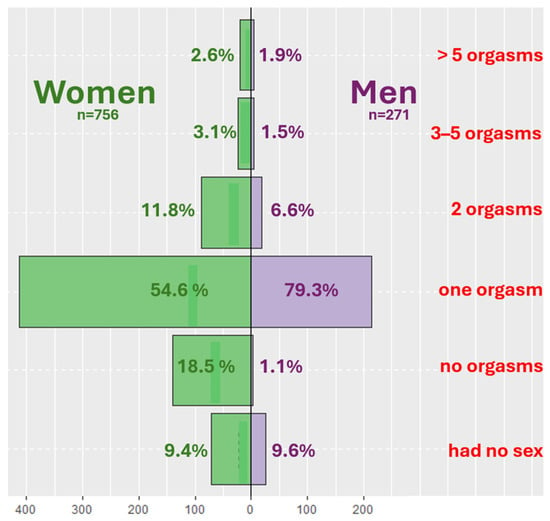
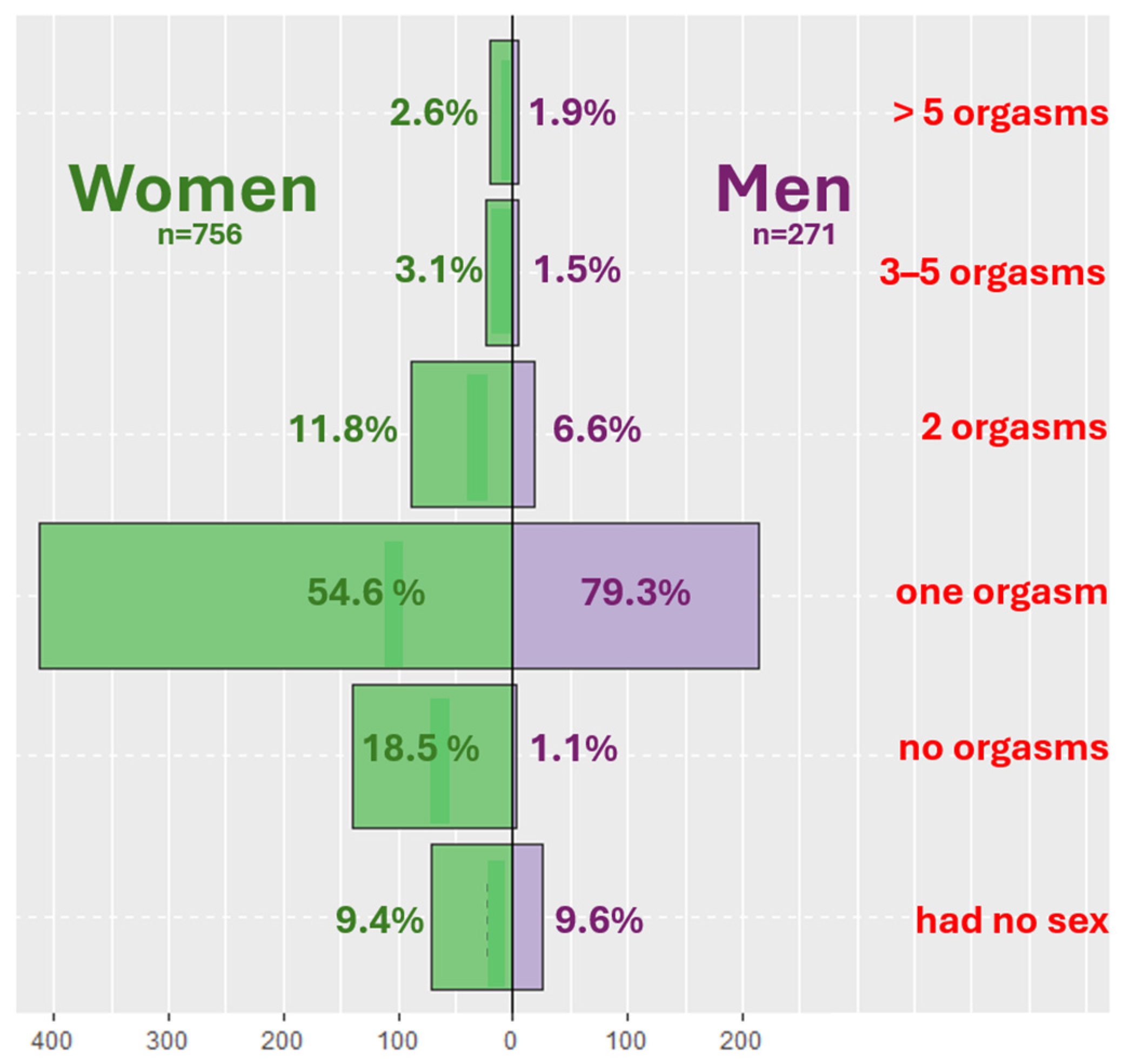
In Table 2, scores for the variables included in this study are described for women and men. A total of 97 respondents reported not having had partner sex in the last six months. Of all heterosexually inclined women and men in this study who had sex in the past six months (n = 930; 684 women—245 men), 140 women (20.5%) and 3 men (1.2%) had partner sex without regularly experiencing orgasm—furthermore, of all who regularly experienced orgasm during partner sex (n = 787; 545 women—242 men), 132 women (24.2%) and 27 men (11.2%) regularly experienced more than one orgasm during one sexual encounter. In Figure 1, an overview of the number of orgasms experienced per partner sex session is presented. Note that, in this graph, respondents who did not have sex were also included and percentages reported in the figure are based on a sample of n = 1027 (the non-binary respondent was not included). What can be seen furthermore is that there is more spread in the number of orgasms during one partner sex session for women than for men.
Table 2.
Description of variables included in MANOVA and regression analyses.
Figure 1.
Number of orgasms experienced during a heterosexual partner sex session by women and men. Note that percentages in Figure 1 pertain to the total number of women (green) or men (purple) and that the totals also include those women and men who had no sex in the previous six months.
Gender differences as shown in Table 2 are largest for orgasm frequency—solo plus partnered—(d = 0.8) and frequency of watching pornography (d = 1.3), with men showing much higher frequencies than women in both cases. Women, on the other hand, show much higher scores for the use of sex toys during masturbation (d = −1.0). What should also be noted is that the average number of orgasms experienced during one partner sex session does not differ significantly for women and men (p = 0.31).
In the last column of Table 2 the correlations of included variables with the number of orgasms experienced during one partner sex session are presented. Most correlations are in the expected direction—e.g., depressive symptoms, social and general anxiety, shame, and sexual inhibition all correlate negatively with the number of orgasms during one sex session—though with small effect sizes. Sexual satisfaction (with higher scores representing less satisfaction) showed a moderate correlation of ρ = −0.30 (p < 0.001), indicating that, with an increase in the number of orgasms, sexual satisfaction increased as well. The strongest—positive—correlations with number of orgasms were with the variables “Frequency of sex” (partner sex frequency; ρ = 0.39; p < 0.001) and the estimated number of a partner’s orgasms during one sex session (ρ = 0.54; p < 0.001).
3.2. Comparing Women and Men—Who Does and Who Does Not Experience Orgasm During Partnered Sexual Activity?
In testing the first hypothesis—of all who have sex, women more often than men experience no orgasm at all during a session of heterosexual partner sex—an orgasm gap of 19.2% was found (20.4% of women versus 1.2% of men), indicating that more women than men do not experience orgasm during heterosexual partner sex (Figure 1). Using Barnard’s test on the 2 × 2 contingency table—first row: women who did (n = 545) and did not (n = 140) experience orgasm, and second row: men who did (n = 242) and did not (n = 3) experience orgasm—this difference was found to be significant (statistic: 7.2; p < 0.001).
Three groups were constructed to be included in MANOVAs as categories of the categorical predictor: (1) women not experiencing orgasm—“w1” (n = 140); (2) women experiencing orgasm—“w2” (n = 545); and (3) men experiencing orgasm during a partner sex session—“m” (n = 242). The data of the non-binary respondent and the data of three men not experiencing orgasm were not included in these analyses as these groups were too small to lead to meaningful results. Furthermore, those who had no sex in the last six months were excluded—97 respondents (9.4%)—leading to a total of 927 respondents included in the MANOVA. With 18 outcome variables, the exploratory one-way MANOVA was significant (Pillai’s trace = 0.66; F(36,1816) = 24.8; p < 0.001), indicating that group differences predicted the combined outcomes—with a large effect size ηp2 = 0.33. All outcomes but one were significantly predicted by the grouping variable—“Number of sex partners (in the last six months)” was not significant (p = 0.12). “Anxiety” had a p-value of 0.0010, while all other outcomes showed significant overall group differences with p < 0.001. After MANOVA, ANOVA post hoc tests with TukeyHSD correction for multiple testing were performed to locate which groups differed on what outcomes. Results are presented in Table 3 by means of effect sizes (Cohen’s d) for the significant group differences. What can be seen is that women and men who did experience orgasm regularly were in longer relationships, had sex more often, and showed lower levels of sexual inhibition than women who did not experience orgasm regularly during partner sex. Sexual satisfaction, self-esteem, orgasm frequency (solo plus partnered), and the use of sex toys during partner sex were all higher among women and men who did experience orgasm than among women who did not. On the other hand, depressive symptoms, social anxiety, and sexual distress were higher among women who did not regularly experience orgasm during partner sex, compared to both women and men who did experience orgasm. There were no differences between both groups of women in levels of anxiety, shame, sexual excitation, frequency of watching porn, age, and the use of sex toys during masturbation. Men showed higher levels of sexual excitation, lower levels of anxiety and shame, and watched pornography more often than both groups of women. Men made use of sex toys less often than women during masturbation—compared to both women who did not experience orgasm (d = −1.3) and women who did experience orgasm (d = −1.0). Men estimate the number of orgasms experienced by their regular sex partner higher than women who experience orgasm regularly do (d = 0.3).
Table 3.
Outcomes of post hoc ANOVAs—after MANOVA—significant results represented by effect size d.
3.3. Comparing Women and Men—What Predicts the Number of Orgasms During One Partner Sex Session?
In testing the second hypothesis—of all who had sex, women experience orgasm more than once more often than men—a reversed orgasm gap of 13.0% was found (24.2% of women versus 11.2% of men), indicating that women do experience orgasm more often than men more than once during a session of heterosexual partner sex. Using Barnard’s test on the 2 × 2 contingency table—first row: women who did experience orgasm once (n = 413) or more than once (n = 132) and second row: men who did experience orgasm once (n = 215) or more than once (n = 27)—this difference was found to be significant (statistic: 4.2; p < 0.001).
Further exploration using regression analyses showed that, of the 18 predictors, 6 significantly predicted the number of orgasms during one session of partner sex (see Table 4). The total model was significant (F(19,910) = 7.4; p < 0.001) with R2 = 0.134 and R2adj = 0.116, indicating 13.4% of the variance in the outcome was explained by the predicting variables. Age (B = 0.005; p = 0.028), orgasm frequency (B = 0.15; p < 0.001), use of sex toys during partner sex (B = 0.05; p = 0.043), sexual excitation (B = 0.02; p = 0.030), and number of partner orgasms during one sex session (B = 0.22; p < 0.001) were positive predictors of the number of orgasms of the respondent, while gender (B = −0.18; p = 0.026) was a negative predictor. The latter result suggests that, for men, a slightly lower number of orgasms during one sex session is predicted than for women within the context of the current model.
Table 4.
Regression of 18 predictors on the outcome “Number of orgasms during one sex session”.
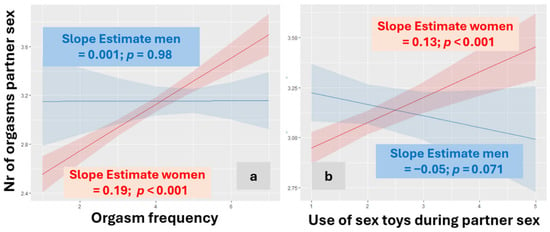
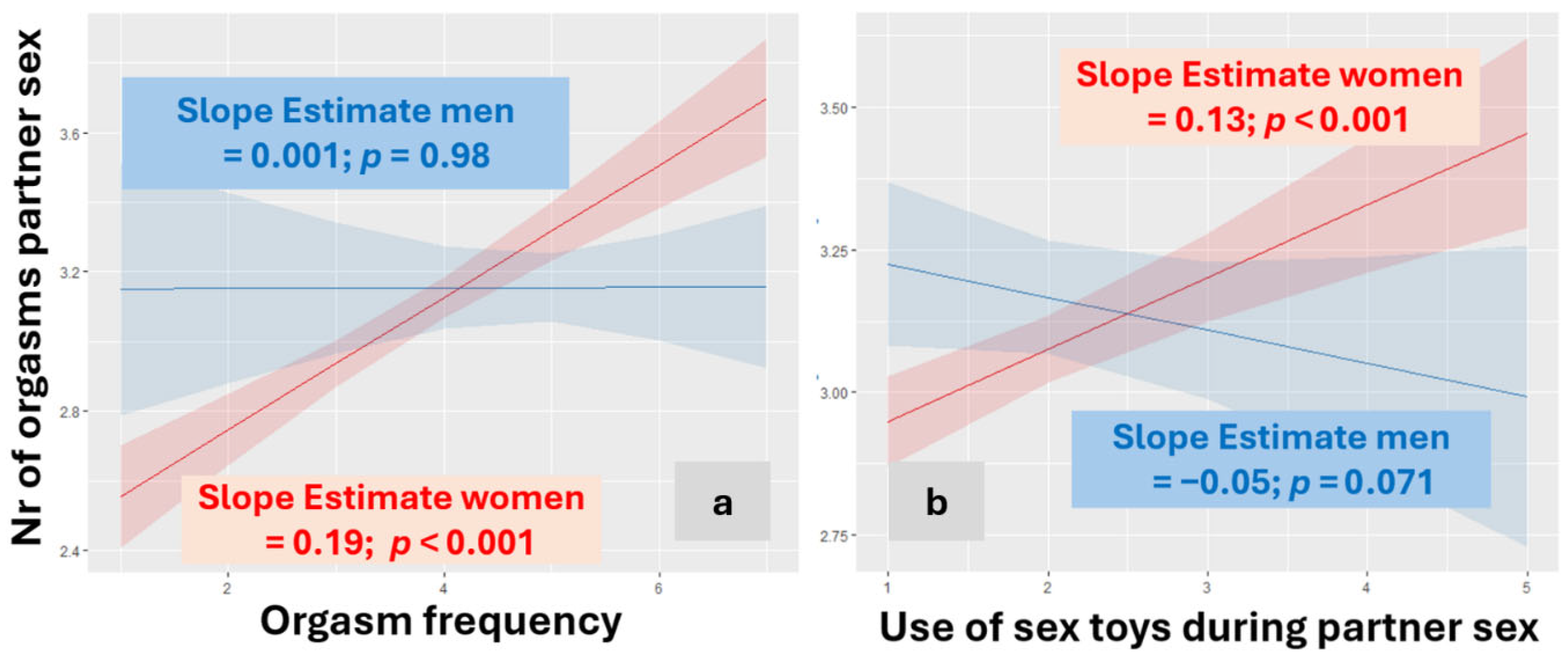
The exploration of separate interactions of the five significant predictors with gender showed that the interaction of orgasm frequency with gender was significant (p < 0.001), with simple slope analyses for women indicating that an increase in general orgasm frequency goes together with an increase in the number of orgasms during a sex session, while for men this association is absent (Figure 2a).
Figure 2.
Interactions of orgasm frequency (a) and use of sex toys during partner sex (b) with gender in predicting the number of orgasms during partner sex. Men = blue lines. Women = pink lines.
Furthermore, the interaction of the use of sex toys during partner sex with gender was significant (p < 0.001) with simple slope analyses implying that for women an increase in sex toy use during partner sex is associated with a higher frequency of orgasms during partner sex, while for men there is no association (Figure 2b). (As suggested by a reviewer, the interaction of sex toy use during masturbation and partner sex has been investigated in predicting the number of orgasms during partner sex, sexual excitation, and inhibition proneness, both for women and men—see Supplementary Material, document “Extended analyses on sex toy use”. These analyses exemplify how the data are not exhausted by current investigations and might be used by other researchers.) The interaction of age and gender bordered on significance (p = 0.058), with simple slope analyses showing that for women a steady increase with age occurs in the number of orgasms during a partner sex session (B = 0.007; p = 0.029), while for men this was not the case (B = −0.002; p = 0.43). The interactions of SES and gender (p = 0.49) and number of orgasms of the partner and gender (p = 0.93) were not significant, indicating that there were no gender differences in the associations of SES—and number of partner’s orgasms—with the number of the respondent’s orgasms during one sexual encounter.
4. Discussion
This study tested two main hypotheses and both were accepted: (1) there is a heterosexual orgasm gap—in line with previous results [2,3,4]—indicating that more women than men generally do not experience orgasm during heterosexual partner sex; and (2) there is a reversed orgasm gap—indicating that of all who experience orgasm at least once, women more often than men experience orgasm more than once. In the current analyses no difference between women and men was found when the total number of orgasms during partner sex was compared. Women showed more spread than men when the number of orgasms is regarded, statistically compensating for women who do not experience orgasm with women who experience orgasm more than once. This does not mean that the traditional and reversed heterosexual orgasm gaps are similar in nature, as the pleasure gap linked to the traditional orgasm gap might be larger than for the reversed orgasm gap.
The current study showed that women who do not experience orgasm significantly differ in several ways from women—and men—who do. Both women and men who do experience orgasm have more partner sex than women who do not experience orgasm, suggesting these groups are more interested in sex—as is also indicated by higher general orgasm frequency and lower levels of sexual inhibition. On the other hand, both groups of women do not differ in levels of sexual excitation. This, together with the outcome that women not experiencing orgasm during partner sex are less often in a relationship and maybe therefore have sex less often, could mean sexual interest is of a similar level in both groups of women, but that there is less partner sex outlet for the group not experiencing orgasm. Additionally, the outcome that both groups of women use sex toys during masturbation as often might indicate sexual interest is similarly high in both groups. Higher levels of sexual distress have been found in women not experiencing orgasm during partner sex than in women and men who do, indicating that these women experience more frustration and worry regarding their sexual experiences. Furthermore, psychological indicators show higher levels for depressive symptoms and social anxiety for women not experiencing orgasm. They also show lower levels of self-esteem. The exploratory MANOVA cannot support causal conclusions but nonetheless shows that psychological symptoms and sexological indicators point to more favorable associations in women who do than in women who do not regularly experience orgasm during partner sex. The exploratory analyses do not allow for the further specification of results. Thus, not experiencing orgasm might be an important causal aspect in experiencing higher levels of sexual distress and psychological symptoms, but then again so might, for instance, relationship status. Further investigations—first using qualitative studies and then using large-scale longitudinal studies—are needed to further detail differences between women who regularly do and those who do not experience orgasm during heterosexual partner sex. While the current results do suggest that the use of sex toys during partner sex might increase orgasmic pleasure for women, other techniques not investigated in this study also might, e.g., oral sex or the use of a finger [9]. All in all, exploratory MANOVAs showed important group differences with more positive psychological and sexological outcomes favoring women and men who do over women who do not experience orgasm during heterosexual partner sex.
The number of orgasms during one sexual encounter has not often been regarded in previous research. The current study showed that this number is best predicted by the number of orgasms the respondent presumed their regular sex partner experienced. This seems to suggest that if someone has more sexual stamina, experiences more orgasms in one sex session, then her or his sexual encounters will probably last longer—might be given more attention—giving a partner more chance to experience (more) orgasms as well. Furthermore, orgasms might be contagious, in the sense that if one sees or feels that the partner is experiencing orgasm this sexually stimulates them to have an orgasm themself—the orgasmic experience gets transferred. Mutual and reciprocal excitation is probably beneficial for a mutual and reciprocal orgasmic experience. There has not been research into the transference of orgasm to my knowledge—i.e., that orgasmic sensations of one sexual partner ignite orgasm in the other—and while physiological research might not be able to prove this connection exists, qualitative studies are recommended as these might indicate if and how such transference is experienced [20]. It is of note that both general orgasm frequency (solo and partnered) and the use of sex toys during partner sex correlated positively with the number of orgasms for women. The use of sex toys suggests that a more creative way of partner sex than PIV sex is advisable—as this can generally be more stimulating to women [2,9,22]. It also places more focus on female pleasure in heterosexual partner sex—as it is mainly women who use sex toys during masturbation and it will probably be women who take the initiative to use sex toys during partner sex as well, suggesting sexual assertiveness [54]. Masturbation practices have not been further specified in the variable “orgasm frequency”—future studies should use such specification—but the positive association between orgasm frequency and the number of orgasms experienced suggests that “practicing orgasm” with oneself might result in more pleasurable partner sex experiences as well, especially for women.
4.1. Implications
Female orgasm has been subject to numerous speculations, e.g., [55,56], many of which have in combination with dominant cultural contexts led to deleterious effects on women’s sexual pleasure, for instance by stressing PIV sex [9] and that this “should be” enjoyable to women as well [57]. Or, if it isn’t, the Female Orgasmic Disorder [28] diagnosis might help in setting therapeutic goals for women who do not experience orgasm during heterosexual partner sex. The FOD diagnosis states that orgasm can be expected after “a normal excitement phase” (based on [27])—thus echoing Freud’s thoughts on frigidity and the PIV imperative [19]. Until recently the clitoris [16] was seen as hitch hiking on the evolution of the penis and considered a “glorious accident” [58]. As mentioned by Frank de Waal, however, the organ is found over a wide range of mammals and this, together with the fact that its sensitivity might exceed that of the penis [59], makes it hard to see it as just an accident of evolution [60] (pp. 223–227) as evolution is too invested in the clitoris. The theoretically proposed glorious accident idea has been taken up outside scientific discussion, for instance, in the realm of the manosphere by male dating coaches who proclaim that male orgasm is essential and female orgasm is not [61,62]—survival of the species depends on the former and not on the latter. The current study shows, however, the importance of experiencing orgasm for women, showing its association with higher levels of sexual satisfaction and self-esteem, and lower levels of depressive symptoms, social anxiety, and sexual distress. Additionally, partner sex frequency is higher for women experiencing orgasm. This suggests that survival of the species might be linked to orgasm not only for men but also for women—if women do not experience sexual pleasure and orgasm, chances are they would rather not have sex [2] or have less sex, as this study shows. Throughout time, females—human or mammal—not experiencing sexual pleasure and orgasm probably stopped having sex [63], thus limiting their chances of successful offspring. Whatever direction this discussion will take [64], the current study showed empirically that women do not lack the potential to experience orgasm but contrarily might in part even “be better in it” than men: despite sociocultural and historico-medical impediments, women more often than men experience orgasm more than once during sex.
An original finding of this study is that the average number of orgasms experienced during a heterosexual partner sex session is equal for women and men—but it was also found that the distribution of the number of orgasms for women is less uniform than that for men. Most men experience orgasm once during partner sex, while for women there is more variation in the number of orgasms during sex. This by no means suggests that partnered orgasms represent a zero-sum game, or rather a zero-difference game—nor does it mean the current status quo defines how it should be. Additionally, in this sample more than 20% of women did not experience orgasm during partner sex [2,3,4], which shows that there is room for improvement for women to experience more sexual pleasure [8,13] and satisfaction. Several data suggest there might be a decades long learning or growth curve for women in consistently attaining orgasm during heterosexual partner sex [65] as compared to men [66]. Armstrong et al. [35] showed that if a relationship develops from a casual hookup to being long term, chances increase for women to reach orgasm. A similar result was found in the current study: women in longer relationships reach orgasm more consistently, and with an increase in age the number of orgasms during partner sex increases for women. More sexual empowerment and assertiveness [54] might come with age, for instance in communicating wishes for other forms of sex than PIV [9,67]. All this implies younger women, or women in casual hookup situations, should be supported in taking more control of their own sex lives and expressing their wishes to their—male—sex partners. The latter might be better informed about the importance to listen to their—female—sex partners, because, as this study suggests, more attunement to each other’s wishes leads to better sex for both partners.
4.2. Limitations and Suggestions for Future Research
Some limitations of this study need to be mentioned, together with recommendations for follow-up research. Firstly, the current study did not ask in what way orgasm was experienced by either women or men, while previous research showed the importance of techniques and the variation in pathways to orgasm [2,20]. In follow-up quantitative research, questions addressing orgasm techniques and context should be included. Secondly, the samples used were disbalanced in gender and education, including more women and more highly educated respondents, making the results less externally valid regarding the general Dutch-speaking population. In follow-up research, attention should be devoted to targeting a sampling frame that includes equal percentages of women and men and reflects the education levels in the population. Furthermore, as a third limitation, data were collected from a Dutch-speaking sample and cannot be generalized to other countries and cultures. As a fourth limitation, it should be realized that the data represent a snapshot of the orgasm gap in 2024–2025. As relations between women and men change continuously—for instance, due to increased autonomy for women or other social or cultural aspects—a monitor including measurement of orgasm during solo and partner sex is recommended to gauge development in correlates with orgasm frequencies through the years. As a fifth limitation I mention the small sample sizes of non-heterosexual and non-binary participants, precluding analyses on them, while these have been shown to be relevant in diverging from heterosexual outcomes [3]. Other subpopulations are relevant as well in investigating orgasmic pleasure, for instance, post-cancer treatment patients or people experiencing different sexual dysfunctions. To conclude this section, I mention that follow-up studies of the orgasm gap should include measures of sexual desire, arousal, pleasure, and sexual pain, or if women were menopausal or not. Including these measures will give a better view into the black box of the orgasm gap, which without further exploration will be nothing but a number. Qualitative and longitudinal quantitative studies in relevant subpopulations can be used to find out what the reality behind that number is. In the case of the traditional heterosexual orgasm gap, such research might give us clues for the improvement of sexual health and pleasure, where improvement is needed [9,68].
5. Conclusions
This study showed that, on average, women experience an equal number of orgasms during heterosexual partner sex as men. However, a higher percentage of women than men do not experience orgasm at all during partner sex—in line with previous results [2,3,4]. This “heterosexual orgasm gap” favoring men is numerically compensated by a “reversed orgasm gap” favoring women, as it was also found that a higher percentage of women than men do experience orgasm twice or more during one partner sex session. Women who do not experience orgasm showed lower sexual satisfaction and self-esteem, lower frequency of partner sex, and orgasm (solo plus partnered), and higher levels of sexual distress, inhibition, and psychological symptoms. The use of sex toys during partner sex was lower for them as well. This result, together with the result that the use of sex toys predicted the number of orgasms experienced during partner sex for women, suggests that experimentation with sex toys or other techniques diverging from PIV sex might be considered to improve orgasmic and sexual pleasure for women. For both women and men, the presumed number of partner orgasms best predicts one’s own number of orgasms, suggesting that harmonization of the sex partner’s desires and one’s own improves chances of pleasurable sex. This study has extended investigations of the heterosexual orgasm gap by regarding the number of orgasms that are experienced during one partner sex session, showing that women have a high potential for sexual pleasure—possibly higher than men’s—though this high potential might not always be fulfilled.
Supplementary Materials
The following supporting information can be downloaded at: https://www.mdpi.com/article/10.3390/sexes7010015/s1, Figure S1, Monotonicity plots for scale items; Figure S2, Group comparison for men and women who do/do not experience orgasm during partner sex; File S1, Codebook Orgasmgap study; File S2, OrgasmgapAnalysesForOSF.R (script of analyses); File S3, OrgasmgapFor OSF.sav (data); File S4, Extended analyses on sex toy use (report).
Funding
This research received no external funding.
Institutional Review Board Statement
This study was approved by the research ethics committee of the Open Universiteit Netherlands, code Ceto_RP331/U202307538, date 8 September 2023.
Informed Consent Statement
Informed consent was obtained from all subjects involved in the study.
Data Availability Statement
Data and other resources (analysis script, codebook, ethical approval, and extra analyses) can be accessed via https://osf.io/vkyjw (accessed on 9 January 2026). Other authors are invited to explore and make use of the data and other sources offered for their own purposes.
Conflicts of Interest
The author declares no conflicts of interest.
References
- Conley, T.D.; Klein, V. Women Get Worse Sex: A confound in the explanation of gender differences in sexuality. Perspect. Psychol. Sci. 2022, 17, 960–978. [Google Scholar] [CrossRef] [Scilit] [PubMed]
- Frederick, D.A.; St John, H.K.; Garcia, J.R.; Lloyd, E.A. Differences in orgasm frequency among gay, lesbian, bisexual, and heterosexual men and women in a U.S. national sample. Arch. Sex. Behav. 2017, 47, 273–288. [Google Scholar] [CrossRef] [Scilit] [PubMed]
- Garcia, J.R.; Lloyd, E.A.; Wallen, K.; Fisher, H.E. Variation in orgasm occurrence by sexual orientation in a sample of U.S. singles. J. Sex. Med. 2014, 11, 2645–2652. [Google Scholar] [CrossRef] [Scilit]
- De Graaf, H.; Kraan, Y.; Oldenhof, A.; Joemmanbaks, F. Monitor Seksuele Gezondheid; Rutgers: New Brunswick, NJ, USA, 2023. [Google Scholar]
- Piemonte, J.L.; Conley, T.D.; Gusakova, S. Orgasm, gender, and responses to heterosexual casual sex. Personal. Individ. Differ. 2019, 151, 109487. [Google Scholar] [CrossRef] [Scilit]
- Willis, M.; Jozkowski, K.N.; Lo, W.-J.; Sanders, S.A. Are women’s orgasms hindered by phallocentric imperatives? Arch. Sex. Behav. 2018, 47, 1565–1576. [Google Scholar] [CrossRef] [Scilit]
- Chadwick, S.B.; Francisco, M.; Van Anders, S.M. When Orgasms do not equal pleasure: Accounts of “Bad” orgasm experiences during consensual sexual encounters. Arch. Sex. Behav. 2019, 48, 2435–2459. [Google Scholar] [CrossRef] [Scilit]
- Dienberg, M.-F.; Oschatz, T.; Piemonte, J.L.; Klein, V. Women’s Orgasm and Its Relationship with Sexual Satisfaction and Well-being. Curr. Sex. Health Rep. 2023, 15, 223–230. [Google Scholar] [CrossRef] [Scilit]
- Laan, E.T.M.; Klein, V.; Werner, M.A.; Van Lunsen, R.H.W.; Janssen, E. In Pursuit of Pleasure: A Biopsychosocial perspective on sexual pleasure and gender. Int. J. Sex. Health 2021, 33, 516–536. [Google Scholar] [CrossRef] [Scilit]
- Wade, L.D.; Kremer, E.C.; Brown, J. The incidental orgasm: The presence of clitoral knowledge and the absence of orgasm for women. Women Health 2005, 42, 117–138. [Google Scholar] [CrossRef] [Scilit] [PubMed]
- Janssen, A.K.; Csako, R.I.; Rowland, D.L.; Hevesi, K. The Satisfaction of Women’s Orgasms: The relationship between women’s orgasmic pleasure and sexual relationship satisfaction in Aotearoa/New Zealand. Int. J. Sex. Health 2025, 37, 251–262. [Google Scholar] [CrossRef] [Scilit]
- Anderson, R.M. Positive sexuality and its impact on overall well-being. Bundesgesundheitsblatt Gesundheitsforschung Gesundheitsschutz 2013, 56, 208–214. [Google Scholar] [CrossRef] [Scilit] [PubMed]
- Mah, K.; Binik, Y.M. Do all orgasms feel alike? Evaluating a two-dimensional model of the orgasm experience across gender and sexual context. J. Sex Res. 2002, 39, 104–113. [Google Scholar] [CrossRef] [Scilit]
- Baumeister, R.F.; Catanese, K.R.; Vohs, K.D. Is there a gender difference in strength of sex drive? theoretical views, conceptual distinctions, and a review of relevant evidence. Personal. Soc. Psychol. Rev. 2001, 5, 242–273. [Google Scholar] [CrossRef] [Scilit]
- Endendijk, J.J.; Van Baar, A.L.; Deković, M. He is a stud, she is a slut! A meta-analysis on the continued existence of sexual double standards. Personal. Soc. Psychol. Rev. 2019, 24, 163–190. [Google Scholar] [CrossRef] [Scilit]
- O’Connell, H.E.; DeLancey, J.O.L. Clitoral anatomy in nulliparous, healthy, premenopausal volunteers using unenhanced magnetic resonance imaging. J. Urol. 2005, 173, 2060–2063. [Google Scholar] [CrossRef] [Scilit]
- Kobelt, G.L. Die Männlichen und Weibleichn Wollustorgane des Menschen und Einiger Säugethiere; Heidelberg University: Freiburg, Germany, 1844. [Google Scholar]
- Moore, A.M. Victorian medicine was not responsible for repressing the clitoris: Rethinking homology in the long history of women’s genital anatomy. Signs 2018, 44, 53–81. [Google Scholar] [CrossRef] [Scilit]
- Hitschmann, E.; Bergler, E.; Weil, P.L. Frigidity in Women: Its Characteristics and Treatment; Nervous and Mental Disease Publications: Washington, DC, USA, 1936. [Google Scholar]
- Hite, S. The Hite Report: A Nationwide Study of Female Sexuality; Macmillan: New York, NY, USA, 1976. [Google Scholar]
- Darling, C.A.; Davidson, J.K.; Jennings, D.A. The female sexual response revisited: Understanding the multiorgasmic experience in women. Arch. Sex. Behav. 1991, 20, 527–540. [Google Scholar] [CrossRef] [Scilit]
- Cerwenka, S.; Dekker, A.; Pietras, L.; Briken, P. Single and multiple orgasm experience among women in heterosexual partnerships. results of the German Health and Sexuality Survey (GESID). J. Sex. Med. 2021, 18, 2028–2038. [Google Scholar] [CrossRef] [Scilit] [PubMed]
- Graham, C.A. The DSM diagnostic criteria for female orgasmic disorder. Arch. Sex. Behav. 2010, 39, 256–270. [Google Scholar] [CrossRef] [Scilit]
- Mangas, P.; Granados, R.; Cervilla, O.; Sierra, J.C. Validation of the orgasm rating scale in context of sexual relationships of gay and lesbian adults. Int. J. Environ. Res. Public Health 2022, 19, 887. [Google Scholar] [CrossRef] [Scilit] [PubMed]
- Chadwick, S.B.; Van Anders, S.M. Orgasm coercion and negative Relationship and Psychological Outcomes: The role of gender, sexual identity, perpetration tactics, and perceptions of the perpetrator’s intentions. Arch. Sex. Behav. 2022, 51, 653–671. [Google Scholar] [CrossRef] [Scilit] [PubMed]
- Masters, W.H.; Johnson, V.E. Human Sexual Response; Little, Brown: Boston, MA, USA, 1966. [Google Scholar]
- American Psychiatric Association. Diagnostic and Statistical Manual of Mental Disorders, 4th ed.; Text Revision; American Psychiatric Association: Washington, DC, USA, 2000. [Google Scholar] [CrossRef] [Scilit]
- American Psychiatric Association, DSM-5 Task Force. Diagnostic and Statistical Manual of Mental Disorders: DSM-5™, 5th ed.; American Psychiatric Publishing, Inc.: Washington, DC, USA, 2013. [Google Scholar] [CrossRef] [Scilit]
- Kelleher, S.; Murphy, M. Asexual identity development and internalisation: A thematic analysis. Sex. Relatsh. Ther. 2022, 39, 865–893. [Google Scholar] [CrossRef] [Scilit]
- Jonason, P.K. Reasons to pretend to orgasm and the mating psychology of those who endorse them. Personal. Individ. Differ. 2019, 143, 90–94. [Google Scholar] [CrossRef] [Scilit]
- Kafka, M.P. Hypersexual Desire in Males: An Operational Definition and Clinical Implications for Males with Paraphilias and Paraphilia-Related Disorders. Arch. Sex. Behav. 1997, 26, 505–526. [Google Scholar] [CrossRef] [Scilit]
- Kafka, M.P. Hypersexual Disorder: A Proposed diagnosis for DSM-V. Arch. Sex. Behav. 2009, 39, 377–400. [Google Scholar] [CrossRef] [Scilit]
- Kafka, M.P. What happened to hypersexual disorder? Arch. Sex. Behav. 2014, 43, 1259–1261. [Google Scholar] [CrossRef] [Scilit] [PubMed]
- Kingston, D.A.; Olver, M.E.; Levaque, E.; Sawatsky, M.L.; Seto, M.C.; Lalumière, M.L. Establishing Canadian metrics for self-report measures used to assess hypersexuality. Can. J. Hum. Sex. 2020, 29, 65–78. [Google Scholar] [CrossRef] [Scilit]
- Armstrong, E.A.; England, P.; Fogarty, A.C.K. Accounting for women’s orgasm and sexual enjoyment in college hookups and relationships. Am. Sociol. Rev. 2012, 77, 435–462. [Google Scholar] [CrossRef] [Scilit]
- Frankenbach, J.; Weber, M.; Loschelder, D.D.; Kilger, H.; Friese, M. Sex drive: Theoretical conceptualization and meta-analytic review of gender differences. Psychol. Bull. 2022, 148, 621–661. [Google Scholar] [CrossRef] [Scilit] [PubMed]
- Pinxten, W.; Lievens, J. An exploratory study of factors associated with sexual inhibition and excitation: Findings from a representative survey in Flanders. J. Sex Res. 2014, 52, 679–689. [Google Scholar] [CrossRef] [Scilit]
- Mahar, E.A.; Mintz, L.B.; Akers, B.M. Orgasm equality: Scientific findings and societal implications. Curr. Sex. Health Rep. 2020, 12, 24–32. [Google Scholar] [CrossRef] [Scilit]
- Sprecher, S.; Barbee, A.; Schwartz, P. “Was it good for you, too?”: Gender differences in first sexual intercourse experiences. J. Sex Res. 1995, 32, 3–15. [Google Scholar] [CrossRef] [Scilit]
- Salisbury, C.M.A.; Fisher, W.A. “Did you come?” A qualitative exploration of gender differences in beliefs, experiences, and concerns regarding female orgasm occurrence during heterosexual sexual interactions. J. Sex Res. 2013, 51, 616–631. [Google Scholar] [CrossRef] [Scilit]
- Corre, P.H.C.; Rapsey, C.M.; Wibowo, E. Description of how men achieve multiple orgasms. Sex. Relatsh. Ther. 2025, 40, 360–372. [Google Scholar] [CrossRef] [Scilit]
- Levin, R.J. Revisiting Post-Ejaculation Refractory Time—What we know and what we do not know in males and in females. J. Sex. Med. 2009, 6, 2376–2389. [Google Scholar] [CrossRef] [Scilit]
- Wibowo, E.; Wassersug, R.J. Multiple Orgasms in Men—What we know so far. Sex. Med. Rev. 2016, 4, 136–148. [Google Scholar] [CrossRef] [Scilit]
- Humphries, A.K.; Cioe, J. Reconsidering the refractory period: An exploratory study of women’s post-orgasmic experiences. Can. J. Hum. Sex. 2009, 18, 127–135. [Google Scholar]
- Carlier, I.; Maaren, Y.S.-V.; Wardenaar, K.; Giltay, E.; Van Noorden, M.; Vergeer, P.; Zitman, F. Development and validation of the 48-item Symptom Questionnaire (SQ-48) in patients with depressive, anxiety and somatoform disorders. Psychiatry Res. 2012, 200, 904–910. [Google Scholar] [CrossRef] [Scilit] [PubMed]
- Franck, E.; De Raedt, R.; Barbez, C.; Rosseel, Y. Psychometric properties of the Dutch Rosenberg Self-Esteem Scale. Psychol. Belg. 2008, 48, 25. [Google Scholar] [CrossRef] [Scilit]
- Rizvi, S.L. Development and preliminary validation of a new measure to assess shame: The Shame Inventory. J. Psychopathol. Behav. Assess. 2009, 32, 438–447. [Google Scholar] [CrossRef] [Scilit]
- Santos-Iglesias, P.; Bergeron, S.; Brotto, L.A.; Rosen, N.O.; Walker, L.M. Preliminary validation of the Sexual Distress Scale-Short Form: Applications to Women, Men, and Prostate Cancer Survivors. J. Sex Marital. Ther. 2020, 46, 542–563. [Google Scholar] [CrossRef] [Scilit]
- Carpenter, D.L.; Janssen, E.; Graham, C.A.; Vorst, H.; Wicherts, J. The Sexual Inhibition/Sexual Excitation scales-Short Form (SIS/SES-SF). In Handbook of Sexuality-Related Measures; Fisher, T.D., Davis, C.M., Yarber, W.L., Davis, S.L., Eds.; Routledge: London, UK, 2011; pp. 236–239. [Google Scholar]
- Willis, M. Measuring Sexual Excitation and Sexual Inhibition in a Dutch-Speaking Sample; University of Arkansas: Fayetteville, Arkansas, 2020. [Google Scholar]
- Bancroft, J.; Janssen, E. The dual control model of male sexual response: A theoretical approach to centrally mediated erectile dysfunction. Neurosci. Biobehav. Rev. 2000, 24, 571–579. [Google Scholar] [CrossRef] [Scilit] [PubMed]
- R Core Team. R: A Language and Environment for Statistical Computing; R Foundation for Statistical Computing: Vienna, Austria, 2025; Available online: https://www.R-project.org/ (accessed on 2 March 2026).
- Boschloo, R.D. Raised conditional level of significance for the 2x2-table when testing the equality of two probabilities. Stat. Neerl. 1970, 24, 1–35. [Google Scholar] [CrossRef] [Scilit]
- Kiefer, A.K.; Sanchez, D.T. Scripting sexual passivity: A gender role perspective. Pers. Relatsh. 2007, 14, 269–290. [Google Scholar] [CrossRef] [Scilit]
- Freud, S. Female Sexuality. In The Standard Edition of the Complete Psychological Works of Sigmund Freud; Strachey, J., Ed.; Hogarth: London, UK, 1961; Volume 21, pp. 225–243. [Google Scholar]
- Rodriguez, S.W. Rethinking the history of Female circumcision and clitoridectomy: American Medicine and Female Sexuality in the late Nineteenth century. J. Hist. Med. Allied Sci. 2007, 63, 323–347. [Google Scholar] [CrossRef] [Scilit]
- Koedt, A. The Myth of the Vaginal Orgasm; New England Free Press: Woburn, MA, USA, 1970. [Google Scholar]
- Gould, S.J. Male nipples and clitoral ripples. Columbia A J. Lit. Art 1993, 20, 80–96. [Google Scholar]
- Uloko, M.; Isabey, E.P.; Peters, B.R. How many nerve fibers innervate the human glans clitoris: A histomorphometric evaluation of the dorsal nerve of the clitoris. J. Sex. Med. 2023, 20, 247–252. [Google Scholar] [CrossRef] [Scilit] [PubMed]
- De Waal, F. Different: Gender Through the Eyes of a Primatologist; W. W. Norton & Company: New York, NY, USA, 2022. [Google Scholar]
- Washko, A. Tightrope Routines: A Feminist Artist Interviews the Internet’s Most Infamous Misogynist. Master’s Thesis, University of California San Diego, La Jolla, CA, USA, 2015. [Google Scholar]
- Bachaud, L.; Murphy, M.; Johns, S.E. A hundred and two just-so stories: Exploring the lay evolutionary hypotheses of the manosphere. Evol. Hum. Sci. 2025, 7, e41. [Google Scholar] [CrossRef] [Scilit]
- Puts, D.A.; Dawood, K. The evolution of female orgasm: Adaptation or byproduct? Twin Res. Hum. Genet. 2006, 9, 467–472. [Google Scholar] [CrossRef] [Scilit]
- Basanta, S.; De La Rosa, L.N. The female orgasm and the homology concept in evolutionary biology. J. Morphol. 2022, 284, e21544. [Google Scholar] [CrossRef] [Scilit] [PubMed]
- Kinsey, A.; Pomeroy, W.; Martin, C.; Gebhard, P. Sexual Behavior in the Human Female; WB Saunders: Philadelphia, PA, USA, 1953. [Google Scholar]
- Kinsey, A.; Pomeroy, W.; Martin, C. Sexual Behavior in the Human Male; WB Saunders: Philadelphia, PA, USA, 1948. [Google Scholar]
- Andrejek, N.; Fetner, T. The Gender Gap in Orgasms: Survey Data from a Mid-Sized Canadian City. Int. J. Sex. Health 2019, 31, 26–35. [Google Scholar] [CrossRef] [Scilit]
- World Health Organization. Defining Sexual Health Report of a Technical Consultation on Sexual Health; World Health Organization: Geneva, Switzerland, 2006; Available online: https://www.who.int/teams/sexual-and-reproductive-health-and-research/key-areas-of-work/sexual-health/defining-sexual-health (accessed on 2 March 2026).

Disclaimer/Publisher’s Note: The statements, opinions and data contained in all publications are solely those of the individual author(s) and contributor(s) and not of MDPI and/or the editor(s). MDPI and/or the editor(s) disclaim responsibility for any injury to people or property resulting from any ideas, methods, instructions or products referred to in the content. |
© 2026 by the author. Licensee MDPI, Basel, Switzerland. This article is an open access article distributed under the terms and conditions of the Creative Commons Attribution (CC BY) license.