


Abstract
This article examines Chunfeng Yang’s 1981 Chinese picture book adaptation of William Shakespeare and George Wilkins’ Pericles, Prince of Tyre, as an early post-Cultural Revolution reimagining of the Shakespeare canon for young adult readers. Extending Lawrence Venuti’s concept of re-foreignisation beyond language to the visual realm, I argue that Yang’s adaptation transforms the play’s heterogeneous Mediterranean world into a coherent yet constructed fantasy of Westernness. Whilst scholarship on Anglophone young adult adaptations has shown how Shakespeare is often simplified or supplemented for younger audiences, this article shifts attention to a historically situated Chinese adaptation that reconfigures Shakespeare visually and ideologically. Drawing on textual analysis of the adaptation’s translation choices alongside its illustrations, this article shows how narrative ambiguity is replaced with moral clarity and how diverse historical, religious and cultural traditions are reduced into a homogenised image of the West. At the same time, the adaptation renders this Westernness through visual forms shaped by Chinese woodcut traditions and the cultural priorities of the early Reform Era. By examining why Pericles—a marginal and collaborative Shakespearean romance—was selected for adaptation alongside more canonical tragedies, this article argues that the picturebook functions not merely as a children’s adaptation but as a site through which China negotiated its identity in the early 1980s.
1. Introduction
Chunfeng Yang’s 1981 Chinese 连环画 [picturebook]1 adaptation of Pericles, Prince of Tyre (hereafter Pericles), re-foreignises William Shakespeare and George Wilkins’ play. Borrowing the term re-foreignisation from translation theorist Lawrence Venuti, who used it to describe translation techniques that retain the source’s linguistic and cultural difference to challenge dominant receiving norms (Venuti 2018, pp. 19–20), I hope to extend this concept beyond language itself to the graphic aesthetic of the picturebook format. In Yang’s adaptation, re-foreignisation operates as a visual strategy that projects a homogenised, exoticised image of Westernness through a Chinese aesthetic and translation practice, simultaneously alienating and engaging its audience. The adaptation’s treatment of Pericles therefore reveals not merely a translation technique but the ideological navigation of post-Mao reform-era China: how the culture filters itself through the pedagogical and gender differences in foreign influence?
That Pericles was selected as the second Shakespeare play adapted in this series—after Othello in 1980 and before more canonical plays such as King Lear, Macbeth, and Hamlet in 1982—reflects a conscious reimagining of Shakespeare as a medium through which China could negotiate its own narratives of moral renewal and cultural progress following the upheavals of the 1960s and 70s. Nonetheless, this raises questions: why should Pericles—a marginal, rarely staged romance—become the focus for negotiating the image of the West at all? And why does this negotiation depend on presenting the West as a single, unified entity opposed to the East, rather than engaging with the play’s own resistance to cultural homogenisation?2
This question must be examined against the backdrop of a longer Chinese tradition of mediating Shakespeare for local audiences, especially the younger readership. Pericles first appeared in Chinese through Shu Lin and Yi Wei’s 吟边燕语 [On the Edge Where Swallows Sing], translated from Charles and Mary Lamb’s children’s book Tales from Shakespeare in 1904. Mass-reprinted during the Republic of China, the play was retitled ‘神合’ [Providential Reunion] and heavily abridged, giving it a condensed, morally streamlined form. Yang’s picturebook echoes this precedent in the form of the picturebook medium. Historically marketed to ‘mostly children and lower class people [through] street bookstall owners, instead of going through the bookstores’ as they were considered ‘vulgar and low taste by intellectuals’ (Shen 2001, p. 103), this medium prioritises narrative clarity and visual immediacy over textual complexity, and frequently adapts familiar narratives drawn from popular novels, folklore and opera traditions. As its primary meaning-making system is not linguistic but visual, the written text remains marginal, occupying less than a third of each page to support the graphics in clarifying the plot for younger readers.
More broadly speaking, as Wong notes, translators themselves often resorted to sinicising or domesticating texts because, ‘owing to the lack of knowledge about the West amongst the readers’, they struggled to bridge the gap between the two cultures (Wong 2017, p. 401). Early twentieth-century Shakespeare translation similarly privileged an intuitive interpretation of the work’s ‘wholes’—its overall essence and cultural background—over fidelity to its linguistic and formal ‘parts’ (Li 2020, p. 80). In the context of the picturebook’s publication, this meant that Chinese translation theory was still largely influenced by Fu Yan’s approach, which emphasised fidelity, fluency and elegance (Luo 1984, p. 4). Hence, they are, to an extent, necessarily shaped by the legacies of China’s ‘revolutionary realism and romanticism’ (C. Xu 1983, p. 399), as well as the country’s efforts to differentiate itself from Western realism through the process of sinicisation, the ‘tracing of indigenous origins, the logic of voluntary importation, the dissociation of form from content, and the vindication of total homogenization’ (Z. Xu 1987, p. 32). In Pericles, these pressures produce what seems to be a uniform image of the West, suggesting that the adaptation is less concerned with the play’s cultural particularities than with constructing a coherent and ideologically legible Western style. The adaptation’s attempted removal of narrative ambiguity reflects this broader process. Here, I distinguish between ideological coherence and narrative consistency. The picturebook seeks to replace the original play’s uncertainty with a morally coherent version of Pericles, simplifying its complexities into a more intelligible plot of cause and effect. This reflects the wider cultural environment of reform-era China, where the development of popular culture was inseparable from the continual negotiation with state cultural policies and agendas (Ma 2022, p. 179). Cultural producers worked within these boundaries whilst finding subtle ways to negotiate their limits (Ma 2022, p. 180), creating a context in which foreign cultural material could be reshaped according to locally intelligible forms and values. The picturebook’s narrative simplification therefore also participates in this process of cultural negotiation, making Shakespeare’s ambiguities more accessible through a clear moral framework, often at the expense of logical consistency. The adaptation’s attempt to create a narratively coherent plot ultimately coexists with that of refashioning Shakespeare’s Mediterranean world into a morally cohesive and legible Western fantasy.
At the same time, I argue that this transformation emerges through the filtering of the original play via a Chinese humanist perspective that reflects an ongoing negotiation between foreign influence and national identity, as well as a broader cultural habit of reframing the alien as morally intelligible and pedagogically useful. In this sense, the adaptation does not merely simplify Pericles but rewrites it: Yang transforms the play’s heterogeneous Mediterranean world into a coherent, albeit constructed, fantasy of Westernness through recognisably European iconography, and reframes Shakespeare himself as culturally legible to young Chinese readers. Thus, the picturebook simultaneously functions as a children’s adaptation and as a site through which China negotiates its relationship with foreign culture during the early reform era.
2. The Re-Foreignisation and Domestication Paradox
2.1. Homogenisation as Disguised Domestication
What makes the analysis of Yang’s adaptation particularly complex is that whilst the narrative undergoes domestication, the visual strategy appears to invoke a rhetoric of hybridity and cultural difference. The Chinese picturebook imposes a new perspective on Pericles, reshaping the narrative to meet specific moral and aesthetic expectations. Before looking specifically at how it mediates certain episodes, I hope to first acknowledge the liminal space occupied by Shakespeare through this specific picturebook series amongst the younger readership in China. Although it is impossible to determine with certainty which edition of Pericles was used as the source text, it is interesting how Shakespeare was introduced to Chinese readers not as a dramatist to be read in the original or performed on stage but through a translation of a retelling for young readers. This approach established a model in which the plays were reshaped into morally instructive prose narratives. Charles and Mary Lamb originally intended Tales from Shakespeare (hereafter Tales) to be ‘submitted to the young reader as an introduction to the study of Shakespeare’ (Lamb [1918] 1933, p. xiii). Notably, they acknowledge in an 1807 letter to William Wordsworth that Pericles is a standout piece of their collection: ‘We think Pericles of hers the best, and Othello of mine; but I hope all have some good’ (Lamb 1971, vol. 2, p. 87). Yet in China, this children’s literature occupied a more complex position. As Jenny Wong notes, Lin Shu’s translations of these Shakespearean tales were read primarily by an educated male elite who did not know much about Shakespeare, thus feeding into an already existing ‘top-down’ translation practice that prioritises wholes over parts, relying on ‘macro-discoursal perspective’ and privileging the story (the sense of what happens) and its significance (the deeper theme or moral derived from secondary reading) over the discourse (how it is told) (Stephens 1992, pp. 29–30). More significantly, unlike Lin Shu’s translations, which circulated largely among elite intellectuals, the picturebook medium targets younger readers, upon whom a culture’s future relies, thus making it all the more crucial that the narrative’s moral message is moulded into ‘“desirable” forms’ either to perpetuate certain traditions and values or to actively resist dominant societal values (Stephens 1992, p. 3). The picturebook therefore occupies a formative space in which literary adaptation and cultural education overlap. Its simplification of Pericles determines not only what younger readers learn about Shakespeare’s story but also how they are encouraged to recognise moral behaviour, cultural difference and the unfamiliar Western world.
This history also helps reframe the question of why Pericles was selected for adaptation at all. Rather than assuming that the play was chosen despite its marginal status within the Shakespeare canon, its very marginality may have made it especially useful. Chinese readers had long encountered Pericles not as a theatrical text but through children’s retellings, where its episodic narrative, emphasis on familial separation and reunion and, broadly speaking, redemptive moral structure distinguished it from Shakespeare’s major tragedies. By the time Yang’s picturebook appeared in 1981, Pericles had, therefore, accumulated a reception history that made it particularly compatible with the educational functions of the picturebook form. Its Mediterranean, religious and dramatic contexts were more easily detached without disrupting the plot and reinterpreted within a Chinese pedagogical and humanist framework.
2.2. The Symbolic Convenience of Shakespeare
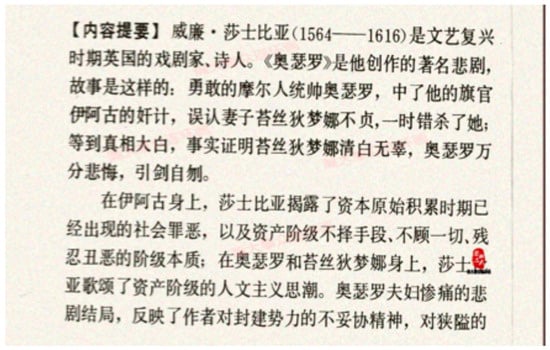
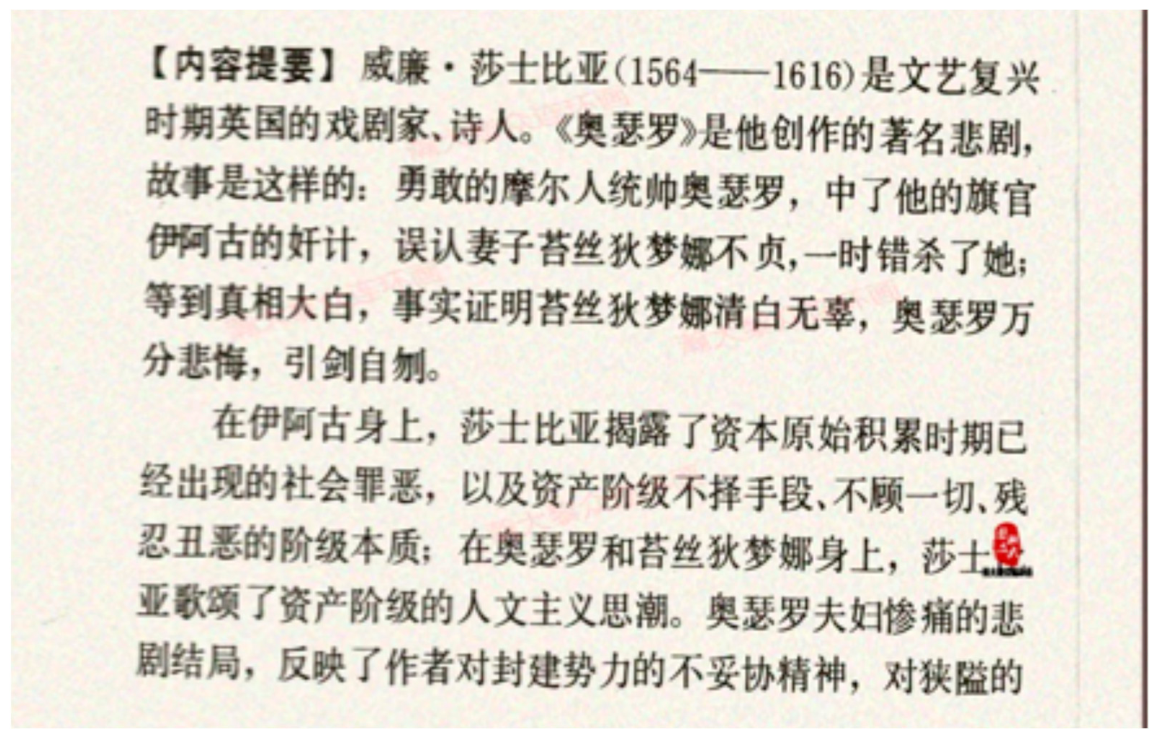
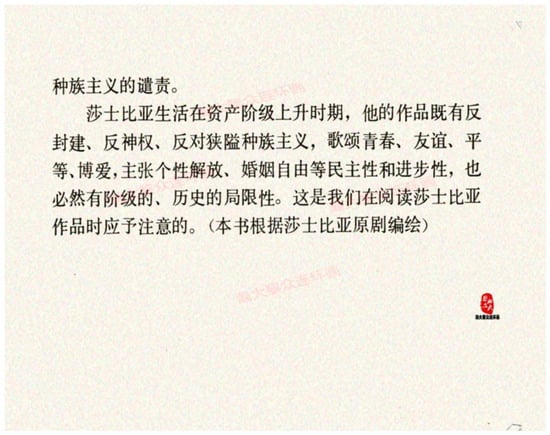
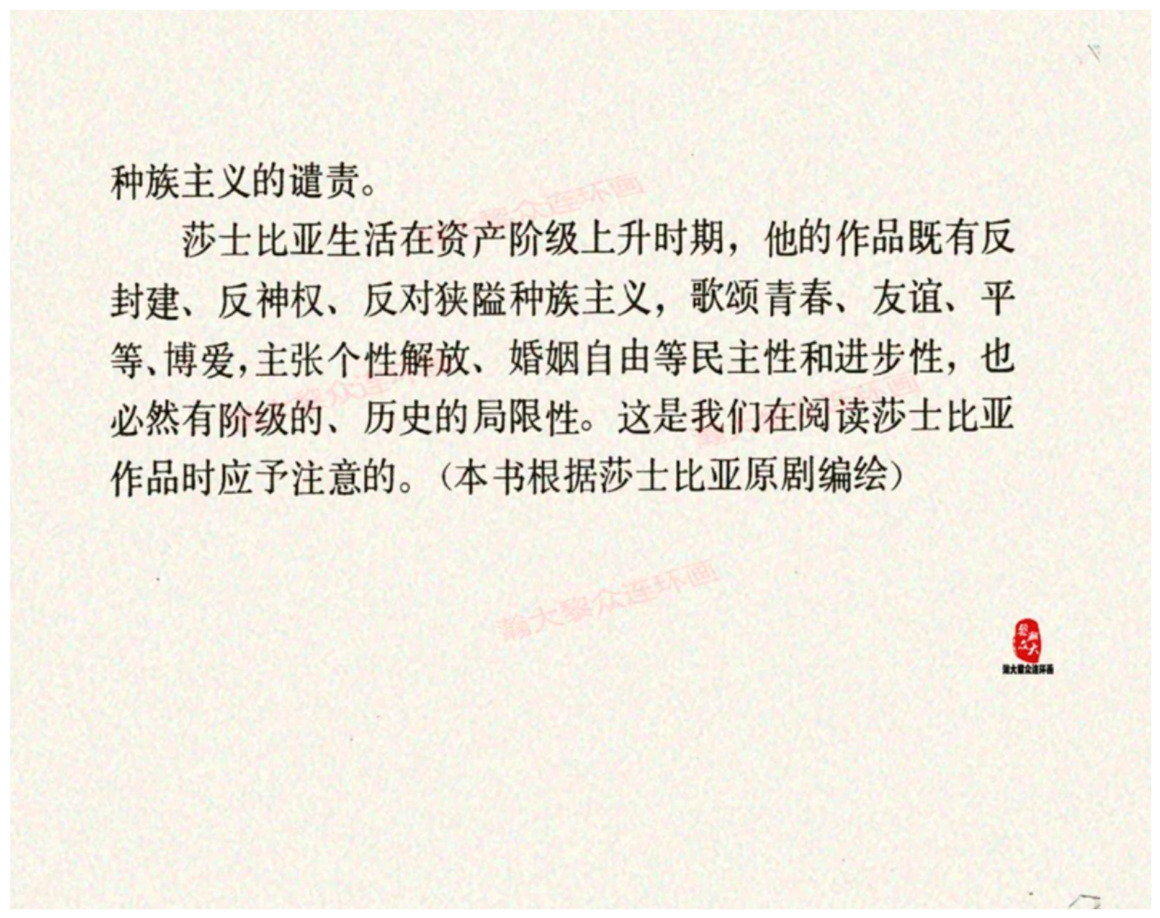
As the series’ preface informs, Shakespeare challenged the ‘class nature of the bourgeoisie’ and advocated for the ‘humanist ideals’ of freedom and benevolence (Figure 1 and Figure 2) despite remaining a product of his class and time. Thus, Shakespeare is introduced not only as a foreign playwright to unfamiliar young readers but also as a culturally constructed representation of the West, an intellectual Western counterpart whose progressive yet instructive work is explicitly compatible with the efforts of socialist humanism. The young reader occupies a particularly important position within this process because the adaptation does not assume an established knowledge of Shakespeare against which its alterations can be measured. Instead, its treatment of cultural difference participates in forming the reader’s initial understanding of what Shakespeare represents. In this sense, what the picturebook mediates is not only the play itself but also the mutable cultural construct of Shakespeare as a genre. As Alexander C. Y. Huang observes,
the West represented by Shakespeare is itself a complicated, slippery category. “Shakespeare” refers to not only the works but also the reputation and values associated with William Shakespeare. Just as China does not remain the same every time it encounters Shakespeare, “Shakespeare” signifies anew its attendant values each time it encounters China.(Huang 2009, p. 40)
Figure 1.
Chinese picturebook adaptation of Othello (1980), Preface: ‘William Shakespeare (1564–1616) was an English playwright and poet of the Renaissance. Othello is one of his most famous tragedies. The story is as follows: the brave Moorish general Othello falls victim to the malicious plot of his ensign, Iago. Believing that his wife, Desdemona, is unfaithful to him, he kills her in a moment of anger. When the truth is finally revealed and Desdemona’s innocence is proven, Othello is filled with deep remorse and takes his own life with his sword. Through the character of Iago, Shakespeare exposes the social evils that had already emerged during the earlier period of capitalism and the fundamental class nature of the bourgeoisie—cruel, vicious and willing to go to any lengths. Through Othello and Desdemona, Shakespeare celebrates the humanist ideals of the bourgeoisie. Their tragic ending reflects the author’s uncompromising spirit towards feudal power…’3
Figure 2.
Chinese picturebook adaptation of Othello (1980), Preface: ‘Shakespeare lived during the rise of capitalism. His work both challenges feudalism, theocracy and racism whilst celebrating youthhood, friendship, equality and love. They advocate for the liberation of self, freedom of marriage, democracy and innovation, but remain invariably bound by the limitations of their class-bound, historical nature. These are the things we should bear in mind when reading Shakespeare’s works. (This book is adapted from Shakespeare’s original play)’
The distinction, or lack thereof, between tragedy and romance is central to the adaptation’s reconstruction of Pericles. I use tragedy here to describe the play’s sustained generic instability via characters who encounter consequences that cannot always be reduced to a clear relationship between action and punishment. Romance, by contrast, allows suffering to be absorbed into a larger narrative of reunion and recovery. Pericles exists within the threshold between these modes, but the picturebook intensifies its romantic aspect by removing much of the ambiguity through which Shakespeare allows suffering to remain unresolved.
2.3. The Incest Riddle Scene
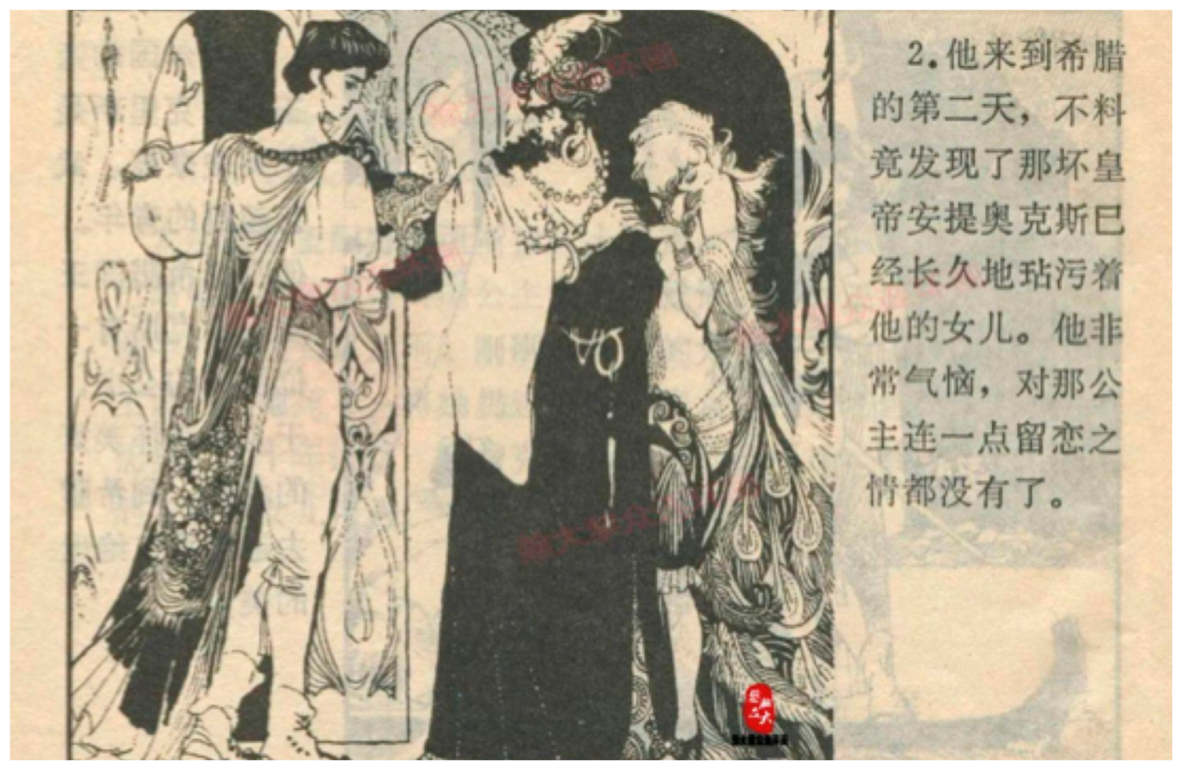
The incest riddle scene is one of the most visibly mediated episodes that suggests such a filtering. In the play, the horror of the incest is never directly confronted but always mediated through language, first via the riddle and then through Pericles’ asides. Spoken from the daughter’s perspective, the riddle is deliberately cryptic: she denies she is a ‘viper’—a creature mythically known for matricide—yet admits that she ‘feed[s] [o]n mother’s flesh which did [her] breed’ (I.i.65-6), casting the incest as both a displacement of her mother and a kind of self-cannibalisation, as she is born of her mother. Such linguistic instability performs a kind of verbal incest, where relational nouns and meanings collapse into one another. By granting the daughter a voice, an effect amplified in productions like Wentworth’s 2016 version (The Adventures of Pericles 2016), where the riddle is actually sung by Deborah Hay, the actress for King Antiochus’ daughter (and, ironically, also for Thaisa), the play frames the transgression as disturbingly mutual between them. The picturebook, however, notably lacks this mediation but in ways more complex than how the Lambs’ Pericles entirely skips it. In the picturebook, the incest is ‘discovered’, and the graphic shows Pericles stumbling upon Antiochus ‘defiling’ his daughter (Figure 3). This translation removes the interpretive ambiguity entirely, framing the act as a moral crime committed one-sidedly by the father and a case of accidental revelation, whereas in the original play the riddle is a deliberate device through which Antiochus both conceals the secret and deters his daughter’s suitors. Where Shakespeare’s hero turns pale, horrified at the ‘ill’ stored within the ‘glorious casket’ of the princess (I.i.78), the picturebook reduces his emotion to pure anger directed towards the daughter, stating he ‘no longer had even the slightest affection left for that princess’. Here is a fundamental non sequitur: he identifies Antiochus as the transgressor yet blames and punishes the princess for it, implying that she is equally corrupt without the logical justification that is implied in the play. This is not merely ‘interpretation masked as simple information’ (Perret 2004, p. 74), wherein the translator imposes their reading of the text, but a deliberate ideological substitution that overwrites the play’s moral ambiguity. More generally, this episode establishes a pattern that recurs throughout the adaptation. Whenever the original play contains material that appears unsuitable for young readers, it is isolated and replaced with moral certainties to render the narrative more pedagogically appropriate to younger readers. In this sense, the young reader is positioned as someone who requires the ethical relations between characters to remain immediately legible so that their interpretation of what they see can be regulated. Yet these newly imposed certainties frequently produce new narrative inconsistencies and logical tensions within the story itself without necessarily disrupting the narrative’s movement, as ideological simplification does not always preserve Shakespeare’s causal or ethical complexity. Published in the early 1980s, a period of cautious re-engagement with Western literature, China tries to do more than just ‘reclaim its Chineseness’ following the Cultural Revolution (Wang 1996, p. 148). More than anything, it is also an attempt to reconcile cultural openness with the pedagogical demands of children’s publishing, performing domestication through homogenisation. Sexual ambiguity is therefore recast as a clearer opposition between victim and villain, even at the cost of the original play’s internal logic.
Figure 3.
Chinese picturebook adaptation of Pericles (1981), page 2: ‘On the second day after he arrived in Greece, he unexpectedly discovered that the evil King Antiochus had long been defiling his daughter. He became extremely angry and no longer had even the slightest affection left for that princess.’
3. The Inconsistent Homogenisation of the West
3.1. Collapsing Shakespeare’s Mediterranean Heterogeneity
There lies a crucial distinction between exoticisation and foreignisation. Exoticisation is fundamentally a domesticating strategy aimed to create an exotic image of the Other. It allows the receiving culture to imagine the foreign as radically different, as a coherent ‘other’ that can be consumed, managed and controlled. Re-foreignisation, by contrast, insists on the resistance of the foreign text to being fully understood.
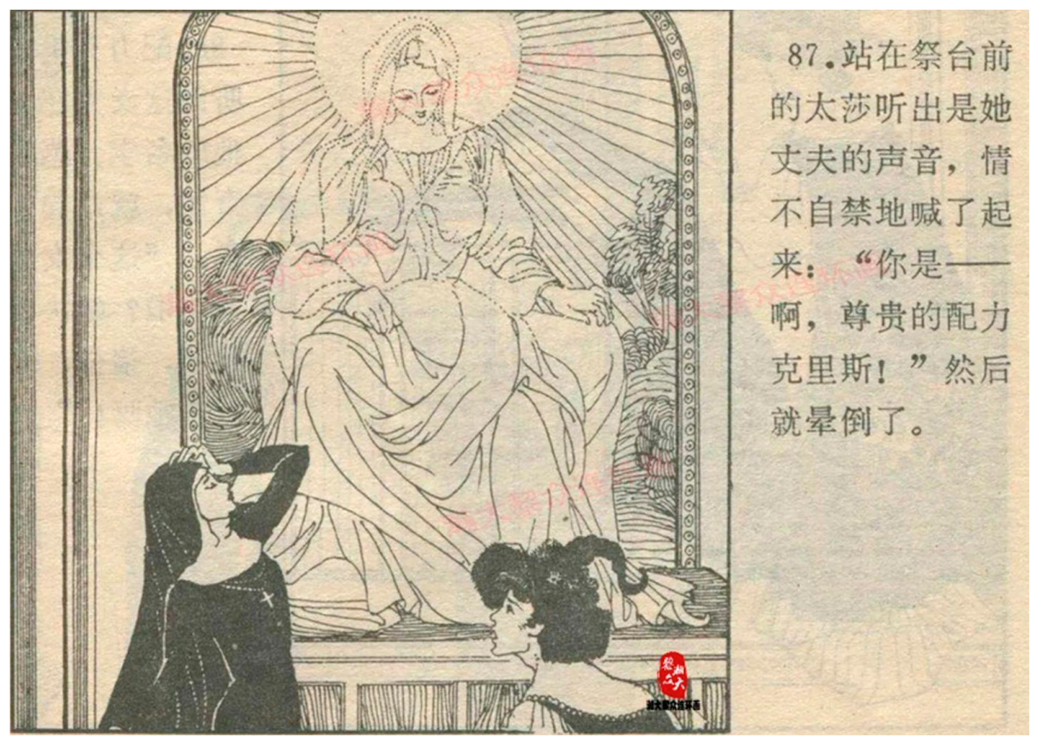
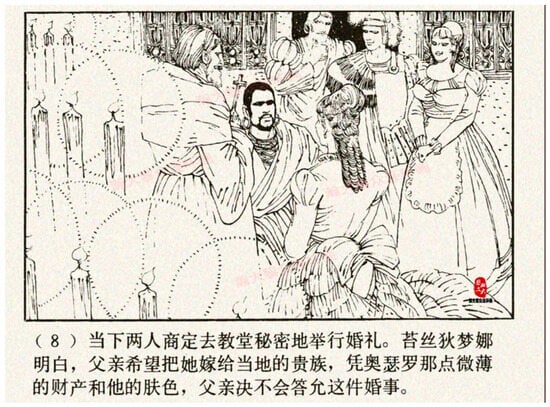
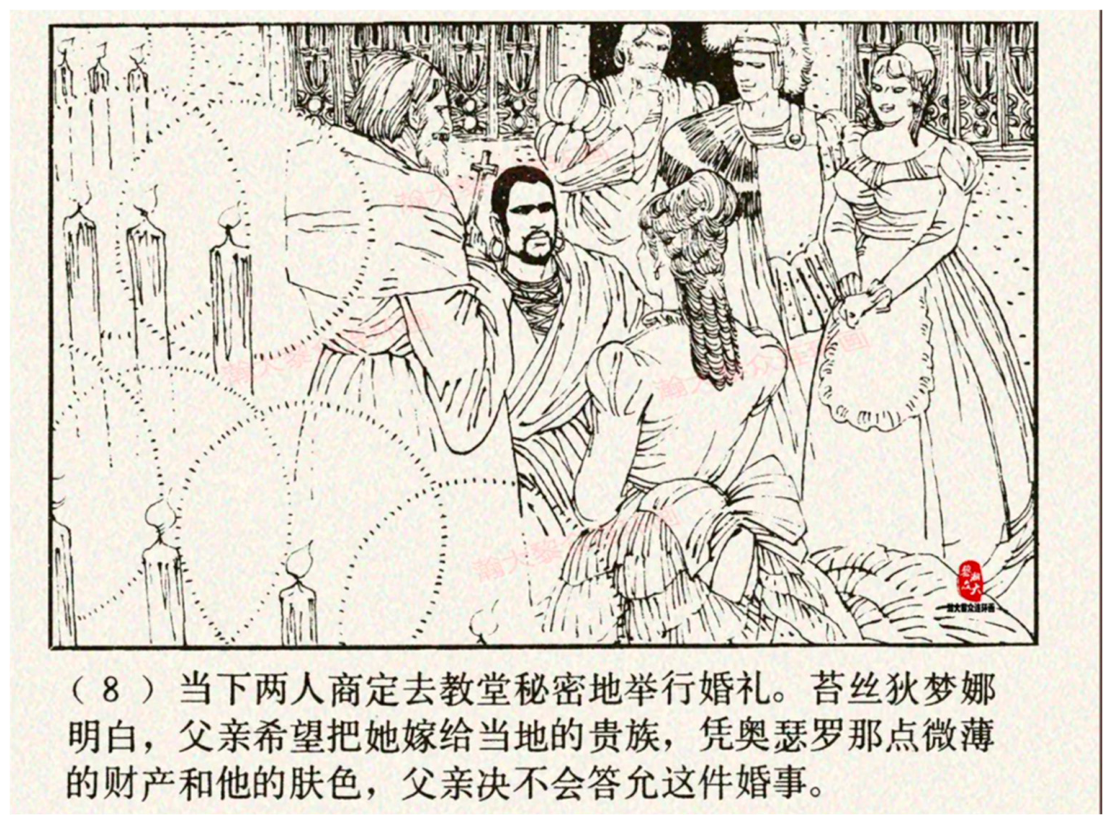
What distinguishes the adaptation from merely being a case of cultural re-foreignisation is that, in pursuit of a homogenised view, it also erases what critics like Suzanne Tartamella identify as the ‘Eastern Christian aesthetic’ (Tartamella 2018, p. 474) central to Shakespeare and Wilkins’ play and ironically restores its geographical and religious Westernness. As Tartamella observes, Pericles undertakes a ‘genealogical journey outside the periphery of the West’ (Tartamella 2018, p. 472), moving across the Eastern Mediterranean through Tyre, Antioch, Tarsus, Pentapolis, Epheseus and Mytilene. In this way, Shakespeare’s Pericles ‘deliberately emphasi[zes] the pagan details’ (Hamlin 2018, p. 141) of its world, invoking Roman classical gods like ‘Jove’, ‘Juno’ and ‘Diana’ (I.i.8, II.iii.27, IV.ii.140) whilst allowing a loose ‘Christian resonance’ through glimpses of biblical allusions (Hamlin 2018, p. 140). For example, Pericles’ appeal to Neptune—‘[t]heir vessel shakes [o]n Neptune’s billow’ (III.Chorus.45)—would likely appear to echo the divine storm in the story of Jonah for an early modern audience (Hamlin 2018, pp. 144–5). By juxtaposing classical gods with biblical references, Shakespeare presents a world still informed by biblical culture despite its pagan setting. The picturebook, however, imposes a monolithic and rather anachronistic vision of the West and its religious context through chronologically and geographically incompatible images: neoclassical architecture (columns, ornate ceilings); Edwardian clothing (top hats, opera gloves, tuxedos); and Christian-style wedding ceremonies, all drawn in a late nineteenth- and early twentieth-century Art Nouveau style associated with artists such as Beardsley and Rackham. Most strikingly, Thaisa is painted as a Catholic nun after serving as a priestess of Diana (Figure 4). Whilst Shakespeare’s original play does indeed briefly refer to her as a ‘nun’ (V.iii.15), it must be acknowledged that this term was frequently used in the early modern period to describe any woman living in a religious temple, regardless of the specific religion (Roper 1989, p. 206). In this case, for instance, her role is actually rooted in a pre-Christian pagan tradition. The picturebook, however, dresses Thaisa in a black veil and robe, which aligns her visually with Catholic iconography, projecting a Christian lens onto a polytheistic figure whilst keeping the stature of the goddess Diana in the centre. For a young reader encountering the play primarily through images, this visual substitution provides an immediate religious category through which Thaisa can be understood. The distinction between a pagan priestess and a Christian nun requires foreknowledge that the picturebook does not expect its reader to possess. The image therefore makes the foreign setting accessible by translating religious difference into a recognisable Western form, even as it obscures the cultural ambiguity of Shakespeare’s original. Interestingly, this collapsing of pagan and Christian elements into a singular Western fantasy can be seen in almost every contemporary Chinese picturebook adaptation of Shakespeare’s play, with the exception of Othello. Here the adapter, Li, does not attempt to erase Othello’s racial difference but visually amplifies his physical difference. Although due to the limitations of the picturebook medium, his skin does not appear dark, and his hair and beard (a feature neither the original play nor Lamb’s edition includes) are rendered in particularly bold and heavy lines in comparison to the other characters (Figure 5). Like Pericles, graphic accuracy is less important for its own sake than for making visible how Othello’s difference underpins his position within the plot. The homogenisation present in Pericles is therefore not merely a market-driven curation of Western literature as a singular entity but largely strategic in its teaching of young readers how to recognise the foreign: cultural ambiguity is flattened when it threatens moral clarity but accepted when it is either vital to the plot or fits Chinese society’s imagination of the West. These visual markers cumulatively construct an image of ‘Westernness’ as coherent and consumable for Chinese readers. However, this exoticisation is achieved by removing everything about Shakespeare’s text that might resist easy consumption. The picturebook thus actually performs a certain level of domestication through exoticisation: it domesticates at the level of narrative and ideology whilst appearing to preserve foreignness at the level of visual aesthetics.
Figure 4.
Chinese picturebook adaptation of Pericles (1981), page 86: ‘Thaisa, standing in front of the altar, recognised her husband’s voice and could not help but call out, “You are, ah, the noble Pericles!” And then she fainted.’
Figure 5.
Chinese picturebook adaptation of Othello (1980), page 8: ‘Right then, the two decided to get married secretly at the church. Desdemona knew that her father wanted her to marry a local aristocrat, and that he would not agree to this marriage because of Othello’s lack of wealth and skin colour.’
3.2. When Homogenisation Fails
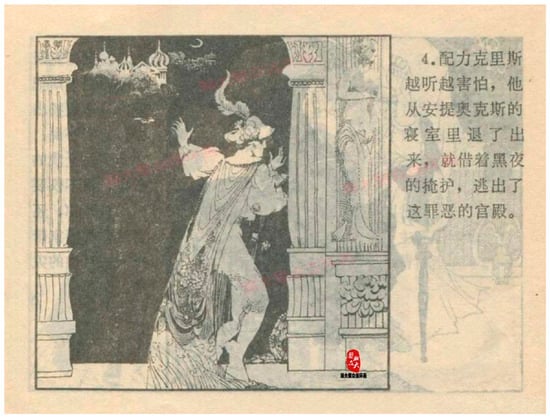
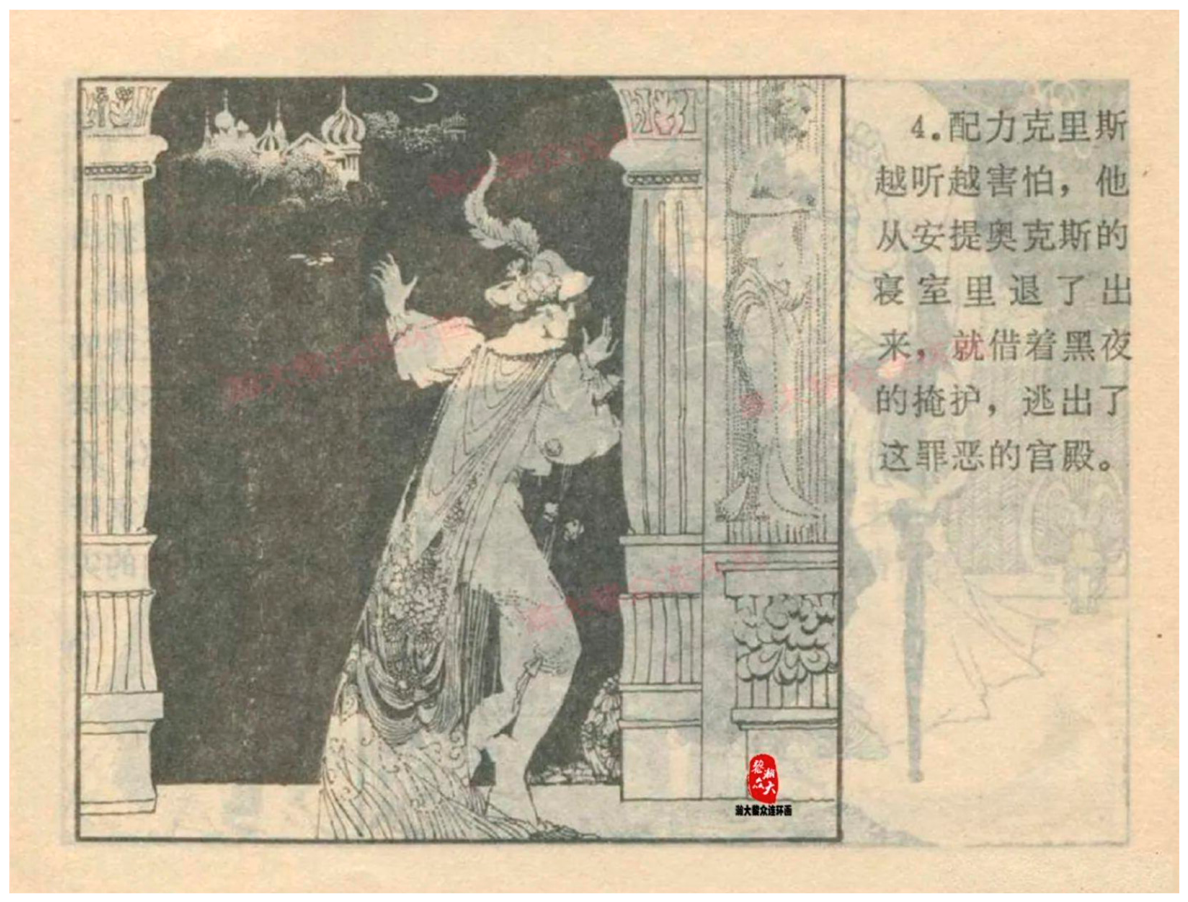
It must not be overlooked, however, that many such visual inconsistencies can be explained by the conditions under which Chinese picturebooks were produced. Since it was necessary for these copies to be printed quickly, artists often worked within a workshop system in which a master sketched the main placements and compositions whilst their disciples helped fill in backgrounds, architecture and other details, drawing visual elements from generic reference materials (Shen 2001, p. 105). As a result, there are occasionally aesthetic discrepancies between the foreground figures and the background setting. In the image depicting Pericles’ escape from Antioch, for example, the building in the distant backdrop is drawn with onion domes that resemble Moscow’s Saint Basil’s Cathedral (Figure 6). Thus, the image combines classical columns vaguely suggesting Greece or Rome and Russian-style architecture whilst painting Pericles himself in the style of fin-de-siècle illustrations. Indeed, the picturebook’s aesthetic is not altogether deliberate, aimed to construct a certain image of the Western culture, but can be equally revealing of the limited and mediated nature of Western cultural knowledge available to many illustrators.
Figure 6.
Chinese picturebook adaptation of Pericles (1981), page 4: ‘The more Pericles overheard, the more scared he grew. He withdrew from Antiochus’ chamber and fled the evil palace under cover of night.’
4. Gender and Agency
4.1. Creating a ‘Western Fantasy’ and ‘Emotionality’
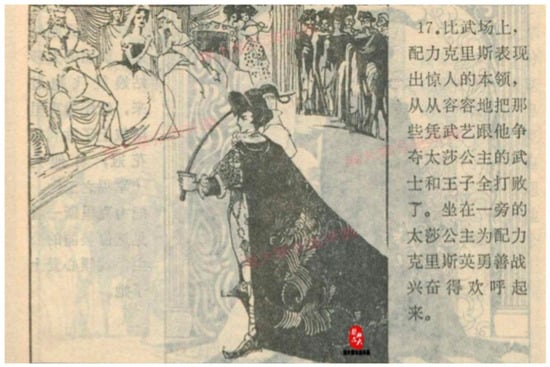
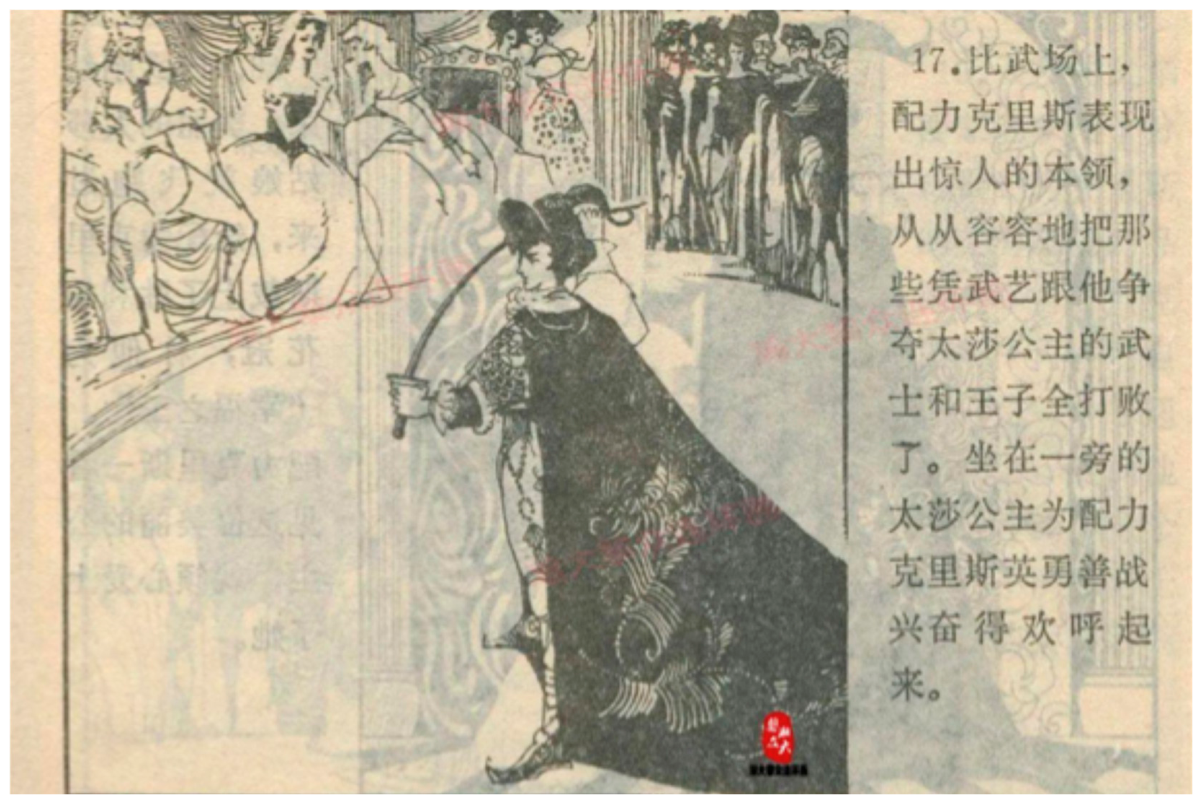
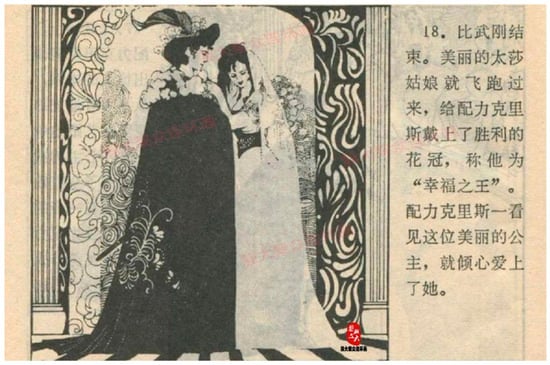
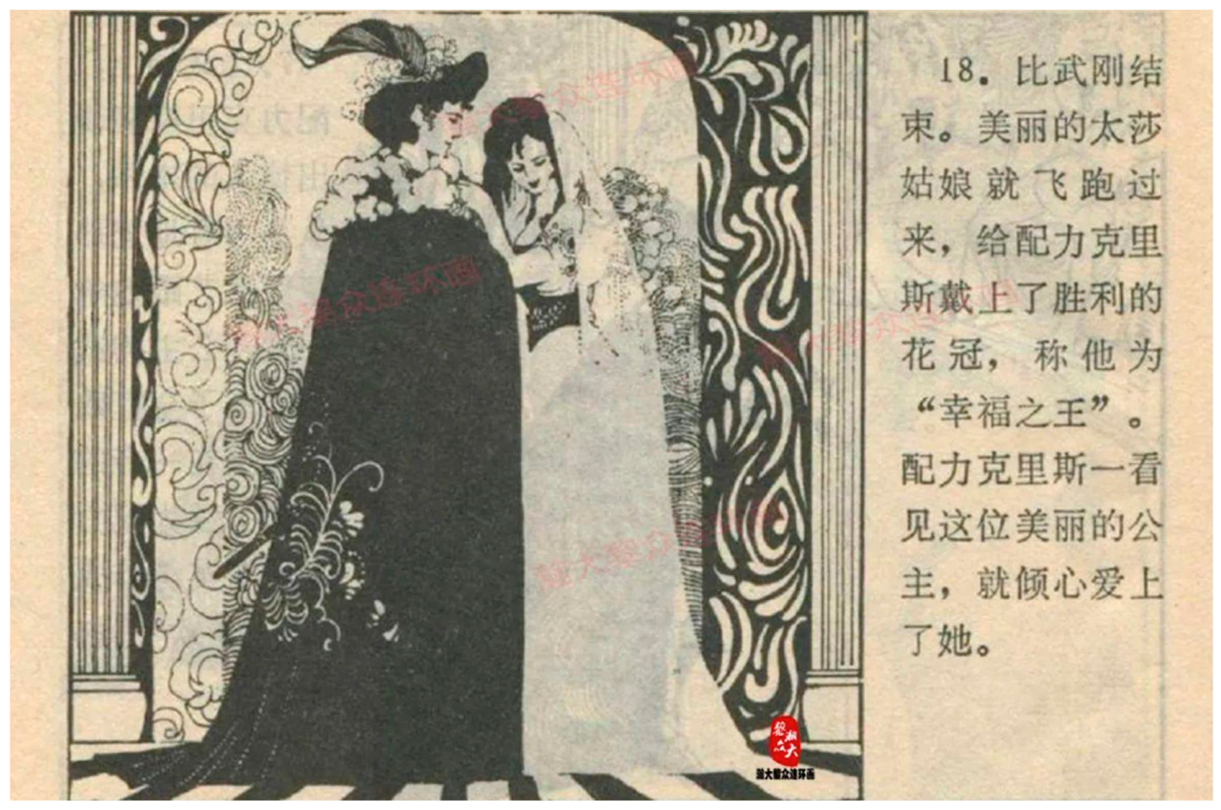
The tension between the play’s Eastern Mediterranean setting and the illustrations’ generic European aesthetic extends to its textual translation, heavily influenced by Western fantasies and fairy tales. In Pericles, Shakespeare omits describing the joust itself as it happens, focusing instead on Pericles’s treatment before and after his victory. The ‘wither’d branch […] only green at top’ (II.ii.43) on Pericles’s shield is emblematic of his misfortunes and ostracised status as a ‘stranger’ (52), as well as his hope of winning Thaisa and restoring his fortune. As a total ‘stranger’ (II.ii.50), he is initially mocked as having ‘practis’d more the whipstock than the lance’ (II.iii.49) compared to a cart driver, socially marginalised amongst the knights. It is not until he has proven his worth in fighting that he is honoured at a banquet where Thaisa privately confesses how ‘he could not please [her] better’ (II.iii.69) in an aside but refrains from being forward, for that would be ‘impuden[t]’ (69), thus embodying courtly and female decorum. The picturebook removes both episodes, focusing instead on how ‘in the tournament, Pericles […] easily defeated all the knights and princes’ (Figure 7) and Thaisa was so ‘filled with admiration’ that she ‘cheered for him eagerly’ and immediately ‘came running’ to him (Figure 8). Whilst such emphasis on Pericles’ victory as opposed to the nuanced dynamics leading up to it can be justified by the picturebook’s young target audience, it fundamentally romanticises a complex social trial as a simple display of Pericles’ ‘astonishing skill’ and into a trope of ‘love at first sight’. For younger readers, this also removes the lengthy nuances around courtship and replaces them with an immediately recognisable heroic narrative in which virtue is visibly rewarded.
Figure 7.
Chinese picturebook adaptation of Pericles (1981), page 17: ‘In the tournament, Pericles displayed astonishing skill and easily defeated all the knights and princes who had come to compete for Princess Thaisa’s hand. Sitting on the side, Princess Thaisa was filled with admiration for Pericles’s bravery and valour, and she cheered for him eagerly.’
Figure 8.
Chinese picturebook adaptation of Pericles (1981), page 18: ‘No sooner was the tournament over than the beautiful Thaisa came running and crowned Pericles with the wreath of victory, calling him the “king of happiness”. As soon as Pericles saw this beautiful princess, he fell deeply in love with her.’
This tendency is largely consistent with broader trends in twentieth-century Chinese adaptations of Western literature and helps explain why the picturebook format proved particularly well suited to Pericles, for it already contains the raw material and archetypes that make up the narrative conventions of a fairy tale, familiar to Chinese readers. As the dramatist Moruo Guo observed, since Lin’s translation of Lamb’s Tales, ‘it seems that […] telling these stories as fairy tales was more appealing’ (in Wong 2017, p. 400). The adaptation consequently introduces the young Chinese reader to Shakespeare through a recognisable fairy-tale structure whilst simultaneously presenting that structure as a characteristic form of Western storytelling. In this process, the young reader is positioned to both understand the foreign through familiar narrative conventions and learn to associate certain forms of expression with the West.
The fact that Thaisa’s response is changed into an expressive public outburst further reinforces a Chinese stereotype of Western emotionality as comparatively more ‘unsubdued’ (Sun 1991, p. 29), particularly when contrasted with contemporary Chinese ideals of emotional restraint (Chiu and Zheng 2008, p. 216). Using Sun’s words, even today, a ‘rapturous embrace and kissing is rare for two Chinese lovers meeting at the airport after a period of separation. Upon receiving a piece of good news, a Chinese person is most unlikely to jump from his chair, to shout, to dance around’ (Sun 1991, p. 9). Not to mention how, ‘according to the old rigid Chinese etiquette, women and men should be separated from each other and a woman’s hand could not be touched by a man’ (Chang 1953, p. 58). In this light, the translation is less a neutral simplification than a culturally mediated reimagining that equates emotional spontaneity with Western authenticity, faithful not to Shakespeare’s text but to a projected fantasy of it. It selectively amplifies traits already associated with the West, thereby defining Chinese identity through their perceived contrast and contributing to the adaptation’s broader process of re-foreignisation, which allows suffering to culminate in a kind of moral restoration.
By illustrating a conventional heroic joust, the picturebook sits awkwardly in its own historical context. For Shakespeare’s audience, likely familiar with the Geneva Bible maps and Ortelius’s Theatrum Orbis Terrarum, Pericles’ movement through the eastern Mediterranean would not have registered primarily as a chivalric romance but as a narrative closely mirroring that of the Apostle Paul, such that Antioch, Ephesus, Tyre, Tarsus, and Mytilene belonged to a shared Christian cartographic imagination rather than to an exoticised elsewhere. In this context, the play complicates rather than affirms cultural otherness. The picturebook’s emphasis on a visually codified joust therefore displaces the play’s religious and ethical frame in favour of a flattened romance iconography that satisfies a 1980s Chinese readership’s demand for a legible stand-in of the West. For its younger readers in particular, this visual symbol offers an immediately recognisable image of Western culture through familiar conventions of knights, princes and courtly romance. The adaptation thus shows that the Chinese reception of Shakespeare is shaped by the same simplifying impulses it seeks to negotiate. This dynamic is not unique to representations of the West, for cross-cultural interpretation frequently produces idealised symbolic cultural abstractions. (Wang 1996, p. 37). Rather than simply reproducing Westernness, the picturebook reconstructs it through a Chinese cultural imagination that is itself engaged in acts of selective idealisation and simplification. The young reader encounters ‘the West’ as a coherent cultural category assembled through these visual and narrative conventions, whilst Chinese identity is positioned as the perspective from which this category becomes legible. In this sense, the text reveals that the West is not alone in struggling to recognise that the ‘“Oriental” holistic self […] is receding further and further away from the social and cultural imagination of post-Mao China.’ (Wang 1996, p. 195) The Chinese intellectual world, too, grapples with, or, perhaps, prefers not to engage with, the notion that the West is not a single, coherent entity and that not all Western texts are necessarily straightforwardly Western.
4.2. The Conflicting Case in Marina’s Portrayal
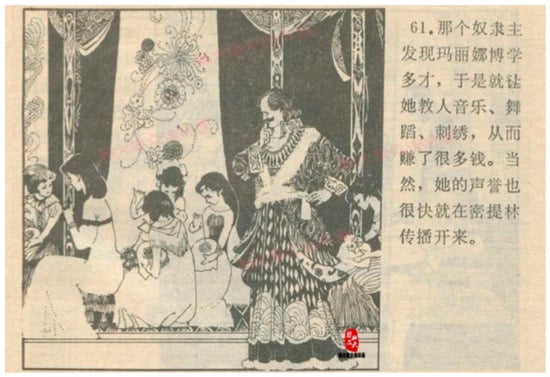
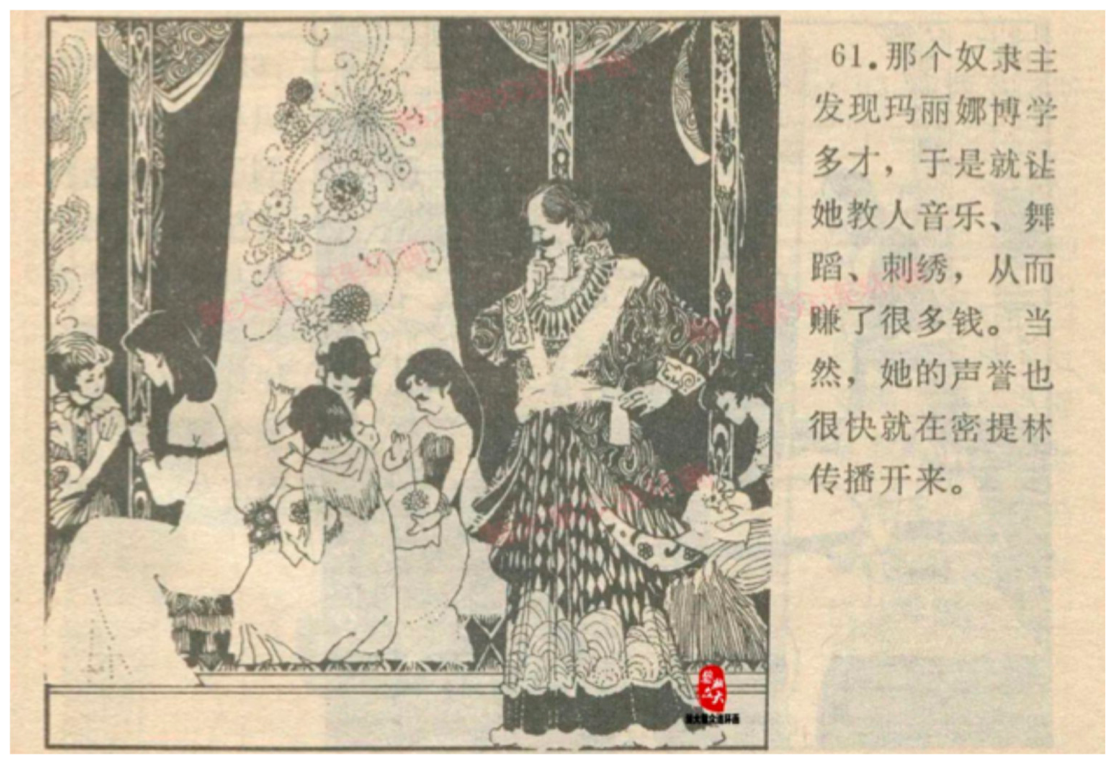
The picturebook’s stereotyping of Western femininity is nonetheless inconsistent, particularly in its treatment of female agency. One of the most significant revisions Shakespeare and Wilkins make relative to the source text, Twine’s The Pattern of Painful Adventures, translated from the Gesta Romanorum version, lies in their portrayal of Marina. Where Twine’s heroine preserves her chastity ‘through the grace of God’ (p. 48) and by the protection of her first two customers, Athanagoras and Aportatus, Shakespeare and Wilkins fundamentally change the episode by replacing Twine’s providential model of rescue with one in which Marina must actively justify her worth. In framing Marina as an active negotiator who earns her own salvation by proposing to ‘sing, weave, sew, and dance’ (IV.vi.199) and shifts her value from her body to her skills: ‘Prove that I cannot, take me home again,/And prostitute me to the basest groom’ (IV.vi.205), they place a greater emphasis on human agency and economic negotiation over passive virtue. By using the verb ‘prostitute’ herself, Marina gains a semblance of control over her fate. The picturebook, however, reverses this effort. It erases the existence of the brothel entirely and renames Bolt, the bawd’s servant, as ‘that slave owner’ (Figure 9), avoiding the ‘bawdy language’ Lu speaks of that Chinese translators do not allow themselves to use (Lu in Chang 1953, p. 58), especially for a text with educational purposes and pedagogical expectations of children’s publishing, and thereby generalising the sexual exploitation Marina suffers into a culturally palatable narrative of oppression. The fact that her talents are ‘discovered’ by Bolt, allowing her to escape slavery by teaching, further reorients the narrative from active, verbal resistance—the very agency Shakespeare and Wilkins introduce—to passive virtue, where worth is acknowledged rather than earned. This presents the young reader with a model of femininity in which a woman’s value lies in what is considered a socially useful application of her talents rather than in her ability to negotiate her sexuality or speak against the structures that constrain her. In line with what Wang terms the post-Maoist ‘descriptivist strategy’ (Wang 1996, p. 164), the picturebook seems to promote here a silent, feminised ideal that undermines its earlier association of Thaisa with emotional expressiveness as a marker of Western authenticity.
Figure 9.
Chinese picturebook adaptation of Pericles (1981), page 61: ‘That slave owner discovered that Marina was erudite and multi-talented, so he had her teach others music, dance and embroidery, thereby earning a great deal of money. Naturally, her fame soon spread throughout Mytilene.’
This internal inconsistency or selectivity is, however, not without its own patterns. To an extent, it seems that the adaptation allows Shakespeare’s heroines to perform two distinct ideological functions simultaneously. If Thaisa represents an idealised Western authenticity characterised by emotional openness and spontaneity, Marina’s agency is progressively tempered and redirected into socially validated virtues. Traditionally, as Chen-Hsien Chang notes, Chinese scholars ‘tend[ed] to appreciate characters with passion, awakening self-consciousness, desire for freedom and competitive individualism, which inspires the spirit of emancipation from spiritual fetters and demands human rights and dignity’ (Chang 1953, p. 31)—a critical framework that re-emerged during the 1980s from a humanist perspective in relation to the social and political problems of post-Mao China. This creates a fundamental tension: Shakespeare’s Marina fits the need because she actively negotiates her survival and freedom, but this kind of individualism in a woman equally needs to be softened. Hence, her autonomy is redefined from being purely active self-agency to socially validated worth. Moreover, with the removal of the brothel scene and its sexual context, Marina can no longer argue within that system. Her original speech loses its force because the conditions that make her agency visible in the first place have already been erased. By embedding Shakespeare’s heroines in visual and moral narratives familiar to Chinese readers, the adaptation redefines agency itself as contained socially rather than individual. The contrast between Thaisa and Marina reveals a selective negotiation of Westernness: one heroine embodies a fantasy of emotional and cultural freedom, whilst the other is reshaped to conform to an ideal of passive femininity. In this sense, the adaptation may be considered a hybrid mode that negotiates modern Chinese identity alongside residual traditional gender norms, conflicted between celebrating Western individualism and containing female sexual autonomy. Thaisa’s emotional expressiveness allows the adaptation to present the West as a site of freedom and authenticity—a valued quality in reform-era discourse about modernisation and progress. Yet this freedom is carefully limited to not extend to economic or sexual agency. Marina’s case is precisely the reverse. Her potential for independence and sexual self-determination—which would be ideologically threatening—is erased entirely. What remains is her value as a pedagogically useful figure. She is celebrated for her accomplishments in music and dance, but only within a framework where these accomplishments are recognised by male authority figures.
4.3. Selective Westernism
The picturebook’s collapse of the West not as a single, coherent entity is further rendered to a young Chinese readership through a historically and culturally charged Chinese woodcut lineage which, after Lu Xun’s 1931 New Woodcut Movement, became increasingly associated with modern ideals of equality and cultural renewal. Such visuals embody the synthesis modern Chinese artists sought to achieve, as Mao famously mandated in his ‘A Talk to Music Workers’ Speech’ in 1956: the ‘idea of “wholesale westernization” of art’ is far from acceptable. It would be much better to use Chinese art as our foundation and then to absorb certain foreign things that can be applied in our own creative work’ (in Chiu and Zheng 2008, p. 216). In the case of translation, Mao has also explicitly noted how:
I would rather agree with using stiff translation for books on theory. Then there would be one advantage: accuracy… By absorbing good things from foreign countries, we enable our own things to leap forward. Chinese and foreign things must be integrated into an organic whole. We should not simply copy things from abroad. We must master the western way of sewing hats in order to sew Chinese hats. All useful things from foreign countries should be mastered and used to improve and further develop Chinese things, as well as to create new things that are uniquely Chinese.(in Chiu and Zheng 2008, p. 218)
However, the adaptation recontextualises these theories in a post-Cultural Revolution environment. Its connection to woodcut printings also helps justify the use of a fin de siècle decadent style that might otherwise appear anachronistic. As Xiaobing Tang observes, Art Nouveau was central to Lu Xun’s movement. The latter described the ‘shock’ of encountering an Aubrey Beardsley print and, in his 1929 preface to a second volume of Selections of Modern Woodcuts, called for an ‘aesthetic of vigor’, achievable only through a kind of creative woodcut (Tang 2008, p. 83). This ‘aesthetic of vigor’ became central to modern Chinese woodcut practice and helps explain the visual style of Yang’s adaptation. Rather than striving for historical accuracy, the illustrations combine Art Nouveau aesthetics with a materiality associated with Chinese woodcuts. By presenting Western characters through a visual language rooted in Chinese woodcut traditions yet shaped by selected foreign influences, the adaptation embodies the popular saying ‘洋为中用’ [making the foreign serve China], rendering Shakespeare legible through a culturally familiar artistic form whilst remaining recognisably Western. The result is a form of visual re-foreignisation in which Shakespeare appears simultaneously alien and domesticated, allowing the adaptation to negotiate China’s relationship with Western culture with a confidence in its ability to repurpose that culture through its own artistic traditions.
5. Conclusions
The significance of Yang’s adaptation of Pericles lies not in whether it faithfully reproduces Shakespeare but in its revelation of China’s changing relationship with foreign culture. By translating Shakespeare through the conventions of children’s literature, socialist humanism and the visual language of modern Chinese print culture, the picturebook constructs an image of the West that is simultaneously foreign and familiar. The adaptation demonstrates that cultural translation operates bilaterally through the transmission of texts and the production of new interpretations in which China and the West are continually redefined. In this sense, the adaptation should not be judged via the criteria of being entirely internally coherent, for that was never the intention. Rather, it hopes to create a coherent moral and ideological vision for its intended young readership, often at the cost of narrative logic and historical accuracy. In this light, perhaps Pericles was selected for this picturebook adaptation precisely because it is a marginal play, thereby uniquely suited to negotiating an image of the West, even as it flattens the very heterogeneity the original play celebrates.
Funding
This research received no external funding.
Institutional Review Board Statement
Not applicable.
Informed Consent Statement
Not applicable.
Data Availability Statement
Restrictions apply to the availability of these data. Data were obtained from 知乎 (on which the full picturebook is published for public access) and are available https://zhuanlan.zhihu.com/p/708723791 (accessed on 9 August 2026).
Conflicts of Interest
The authors declare no conflicts of interest.
Notes
| 1 | All translations from Chinese into English in this article are my own. |
| 2 | The main text examined in this article is Chunfeng Yang’s 1981 Chinese picturebook adaptation of Pericles, Prince of Tyre. I was unfortunately unable to recover the original physical copy that I first encountered as a child in my grandmother’s library. However, the following online version (accessed via Chinese website zhihu) faithfully preserves the original text and its illustrations. |
| 3 | The overlapping content in all referenced figures in this article does not affect scientific understanding. |
References
Primary Sources
Li, Baiying. 1980. 奥赛罗 [Othello]. Shanghai: Shanghai Renmin Meishu Chubanshe. Available online: https://zhuanlan.zhihu.com/p/704645983 (accessed on 29 April 2026).Shakespeare, William. 2004. Pericles. Edited by Suzanne Gossett. London: Arden Shakespeare.Twine, Lawrence. 1903. The Patterne of Painefull Adventures, Gathered into English by Laurence Twine. New York: Elston Press.Yang, Chunfeng. 1981. 太尔亲王 [Pericles, Prince of Tyre]. Nanchang: Jiangxi Renmin Chubanshe. Available online: https://zhuanlan.zhihu.com/p/708723791 (accessed on 29 April 2026).Secondary Sources
- Chang, Chen-Hsien. 1953. Shakespeare Survey an Annual Survey of Shakespearian Study & Production. Edited by Allardyce Nicoll. Cambridge: Cambridge University Press. [Google Scholar]
- Chiu, Melissa, and Shengtian Zheng, eds. 2008. Art and China’s Revolution. New Haven: Yale University Press. [Google Scholar]
- Hamlin, Hannibal. 2018. The Acts of Pericles: Shakespeare’s Biblical Romance. In The Bible on the Shakespearean Stage: Cultures of Interpretation in Reformation England. Edited by Thomas Fulton and Kristen Poole. Cambridge: Cambridge University Press, pp. 140–55. [Google Scholar]
- Huang, Alexander C. Y. 2009. Chinese Shakespeares: Two Centuries of Cultural Exchange. New York: Columbia University Press. [Google Scholar]
- Lamb, Charles. 1933. 吟边燕语 [On the Edge Where Swallows Sing]. Translated by Shu Lin, and Yi Wei. Shanghai: Shangwu Yinshuguan, Originally published as 1918. Tales from Shakespeare. London: Harper & Brothers. [Google Scholar]
- Lamb, Charles. 1971. The Life, Letters, and Writings of Charles Lamb. 6 vols. Edited by Percy Fitzgerald. New York: For Libraries Press. [Google Scholar]
- Li, Xiangmin. 2020. Aesthetic Translation Theories in China and the West. The Frontiers of Society, Science and Technology 2: 78–81. Available online: https://francis-press.com/papers/1870 (accessed on 27 April 2026).
- Luo, Xinzhang. 1984. 翻译论集 [Collected Papers on Translation]. Beijing: Shangwu Yinshuguan. [Google Scholar]
- Ma, Zhao. 2022. Revisiting popular culture in China’s early reform era, 1978–1989: A historical overview. InterAsia Cultural Studies 23: 175–84. [Google Scholar] [CrossRef] [Scilit]
- Perret, Marion D. 2004. Not Just Condensation: How Comic Books Interpret Shakespeare. College Literature 31: 72–93. [Google Scholar] [CrossRef] [Scilit]
- Roper, Lyndal. 1989. The Reformation of Convents. In The Holy Household: Women and Morals in Reformation Augsburg. Oxford: Clarendon. [Google Scholar]
- Shen, Kuiyi. 2001. Lianhuanhua and Manhua—Picture Books and Comics in Old Shanghai. In Illustrating Asia: Comics, Humour Magazines, and Picture Books. Edited by John Lent. Richmond: Curzon, pp. 100–20. Available online: https://www.researchgate.net/publication/282186832_Lianhuanhua_and_Manhua--Picture_Books_and_Comics_in_Old_Shanghai (accessed on 8 June 2026).
- Stephens, John. 1992. Language and Ideology in Children’s Fiction. New York: Longman Publishing. [Google Scholar]
- Sun, Lung-kee. 1991. Contemporary Chinese Culture: Structure and Emotionality. The Australian Journal of Chinese Affairs 26: 1–41. [Google Scholar] [CrossRef] [Scilit]
- Tang, Xiaobing. 2008. Origins of the Chinese Avant Garde: The Modern Woodcut Movement. Berkeley: University of California Press. [Google Scholar]
- Tartamella, Suzanne. 2018. Shakespeare the Escape Artist: Sourcing the East in Pericles, Prince of Tyre. Studies in Philology 115: 472–504. Available online: https://www.jstor.org/stable/90022563 (accessed on 27 April 2026). [CrossRef] [Scilit]
- The Adventures of Pericles, 2016. Directed by Scott Wentworth, Stratford Festival, Tom Patterson Theatre, Digital Theatre+.
- Venuti, Lawrence. 2018. The Translator’s Invisibility: A History of Translation, 2nd ed. London: Routledge. [Google Scholar]
- Wang, Jing. 1996. High Culture Fever: Politics, Aesthetics, and Ideology in Deng’s China. Berkeley: University of California Press. [Google Scholar]
- Wong, Jenny. 2017. Lin Shu’s Translation of Shakespeare’s Religious Motifs in Twentieth-Century China. Studies in Church History 53: 389–404. [Google Scholar] [CrossRef] [Scilit]
- Xu, Chi. 1983. Xiandai HuaYu Xiandai Pai. In Xifang Xiandai Pai Wenxue Wenti Lunzheng Ji. Edited by Wangxian He. Beijing: Renmin Wenxue Chubanshe, pp. 395–400. [Google Scholar]
- Xu, Zidong. 1987. Xiandai Zhuyi Yu Zhongguo Xinshiqi Wenxue. Wenxue Pinglun 4: 21–34. [Google Scholar]
Disclaimer/Publisher’s Note: The statements, opinions and data contained in all publications are solely those of the individual author(s) and contributor(s) and not of MDPI and/or the editor(s). MDPI and/or the editor(s) disclaim responsibility for any injury to people or property resulting from any ideas, methods, instructions or products referred to in the content. |
© 2026 by the author. Licensee MDPI, Basel, Switzerland. This article is an open access article distributed under the terms and conditions of the Creative Commons Attribution (CC BY) license.