

You are currently viewing a new version of our website. To view the old version click .

Fishes, Volume 4, Issue 2

June 2019 - 13 articles

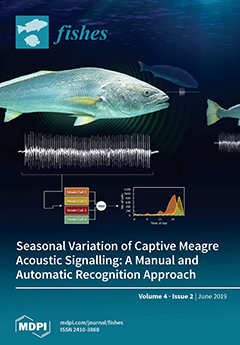
Cover Story: Many fish species produce sounds to mediate social interactions. Acoustic monitoring can provide information on fish reproductive status and welfare and should be considered a relevant non-intrusive tool in aquaculture management. Assessing fish acoustic activity, however, requires automatic methods to detect and extract the relevant biological information from long sound recordings. Here, we characterize meagre (Argyrosomus regius) acoustic rhythms in captivity using an automatic pattern-recognition methodology based on hidden Markov models. Acoustic activity peaked from 15:00 to midnight and was concurrent with spawning events, opening the possibility of using meagre vocal activity to predict spawning periods in aquaculture management. View this paper.
  • Issues are regarded as officially published after their release is announced to the table of contents alert mailing list .
  • You may sign up for email alerts to receive table of contents of newly released issues.
  • PDF is the official format for papers published in both, html and pdf forms. To view the papers in pdf format, click on the "PDF Full-text" link, and use the free Adobe Reader to open them.

Articles (13)

  • Review
  • Open Access
13 Citations
8,905 Views
14 Pages

Structures Associated with Oogenesis and Embryonic Development during Intraovarian Gestation in Viviparous Teleosts (Poeciliidae)

  • Mari Carmen Uribe,
  • Gabino De la Rosa Cruz,
  • Adriana García Alarcón,
  • Juan Carlos Campuzano Caballero and
  • María Guadalupe Guzmán Bárcenas

19 June 2019

Viviparity in teleosts involves, invariably, the ovary in a gestational role. This type of viviparity is due to the combination of unique aspects, different from those found in the rest of vertebrates. These aspects are: The ovary has a saccular stru...

  • Article
  • Open Access
16 Citations
5,384 Views
11 Pages

Trap Happiness and Catch Bias in Sea Lamprey Traps

  • Ulrich G. Reinhardt and
  • Peter J. Hrodey

12 June 2019

Sampling fish by trapping can lead to biased conclusions about a population. We used catch data to assess differences between two types of traps for adult sea lamprey (Petromyzon marinus), submerged-funnel traps and studded-tile traps, which are angl...

  • Article
  • Open Access
5 Citations
4,773 Views
16 Pages

31 May 2019

Alaska’s salmon fisheries are one of the more intensely managed natural resources in the world. The state’s salmon fisheries support recreational, subsistence, and commercial harvest with multiple billions of dollars flowing into the econ...

  • Article
  • Open Access
9 Citations
4,055 Views
13 Pages

Respiratory Physiology of European Plaice (Pleuronectes platessa) Exposed to Prymnesium parvum

  • Heiðrikur Bergsson,
  • Nikolaj Reducha Andersen,
  • Morten Bo Søndergaard Svendsen,
  • Per Juel Hansen and
  • John Fleng Steffensen

28 May 2019

During the last century, the blooms of the toxic haptophyte Prymnesium parvum have been responsible for massive fish kills in both aquaculture and wild populations. Despite decades of research, the ichthyotoxic properties of P. parvum, and how this a...

  • Review
  • Open Access
63 Citations
12,086 Views
14 Pages

23 May 2019

Traditional animal welfare paradigms have focused on maintaining physical health and mitigating negative impacts to wellbeing. Recently, however, the field has increasingly recognized the importance of positive welfare (i.e., mental and physical stat...

  • Feature Paper
  • Review
  • Open Access
63 Citations
11,841 Views
18 Pages

A Global Assessment of Welfare in Farmed Fishes: The FishEthoBase

  • João Luis Saraiva,
  • Pablo Arechavala-Lopez,
  • Maria Filipa Castanheira,
  • Jenny Volstorf and
  • Billo Heinzpeter Studer

16 May 2019

Fish welfare is an essential issue that needs to be tackled by the aquaculture industry. In order to address it, studies have been limited to a small number of species and the information is generally scattered. In order to have a consistent overview...

  • Article
  • Open Access
7 Citations
4,647 Views
10 Pages

The movement of fish can be regulated by behavioural manipulation through non-physical barrier systems. Aquatic invasive species are becoming one of the major management issues in North America, and threaten native aquatic ecosystems, including fresh...

  • Article
  • Open Access
31 Citations
6,398 Views
19 Pages

Seasonal Variation of Captive Meagre Acoustic Signalling: A Manual and Automatic Recognition Approach

  • Manuel Vieira,
  • Beatriz P. Pereira,
  • Pedro Pousão-Ferreira,
  • Paulo J. Fonseca and
  • M. Clara P. Amorim

18 April 2019

Many species rely on acoustic communication to fulfil several functions such as advertisement and mediation of social interactions (e.g., agonistic, mating). Therefore, fish calls can be an important source of information, e.g., to recognize reproduc...

  • Article
  • Open Access
15 Citations
6,345 Views
15 Pages

A Blend of F Prostaglandins Functions as an Attractive Sex Pheromone in Silver Carp

  • Peter W. Sorensen,
  • Mara C. P. Rue,
  • Joseph M. Leese,
  • Ratna Ghosal and
  • Hangkyo Lim

9 April 2019

A series of laboratory experiments tested the hypothesis that the Silver Carp (Hypophthalmichthys molitrix), an invasive river carp from China, employs a prostaglandin F2α-derived sex pheromone that is attractive and species-specific. Using ele...

  • Article
  • Open Access
15 Citations
5,197 Views
15 Pages

Influence of Age on Stress Responses of White Seabream to Amyloodiniosis

  • Márcio Moreira,
  • Anaísa Cordeiro-Silva,
  • Marisa Barata,
  • Pedro Pousão-Ferreira and
  • Florbela Soares

8 April 2019

Amyloodiniosis is a disease that represents a major bottleneck for semi-intensive aquaculture, especially in Southern Europe. The inefficacy of many of the treatments for this disease on marine fish produced in semi-intensive aquaculture has led to a...

of 2

Get Alerted

Add your email address to receive forthcoming issues of this journal.

XFacebookLinkedIn
Fishes - ISSN 2410-3888