


Abstract
The Phaistos Disc is an undeciphered Minoan-era artifact bearing 242 stamped occurrences of 45 distinct signs. We test whether it encodes one or more protein sequences, with each sign representing an amino acid or post-translationally modified amino acid and the 45 signs mapping many-to-one onto the 20 canonical residues. We treat this as a substitution cipher using a pre-specified battery of methods. Map-invariant statistics disfavor the hypothesis: the disc is more repetitive than length-matched proteins, with a 15-sign exact repeat on Side A, and one sign occurs 19 times, always in group-initial position, a confinement not observed for any amino acid. A Shannon unicity-distance calculation on Swiss-Prot shows that 242 signs are too few to identify a unique map from k-mer statistics. Simulated annealing fails to make the disc more protein-like than optimizer-matched nulls, and a known-plaintext attack against Swiss-Prot finds no decoding that beats a shuffled-disc null in any reading direction. Short stretches can be read as fragments of real proteins, from a woolly mammoth enzyme to a human topoisomerase, but the null predicts such matches by chance. We claim no decipherment and report effect sizes and p-values against matched nulls; the protein hypothesis is not supported.
1. Introduction
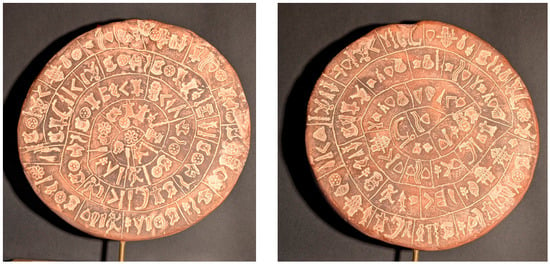
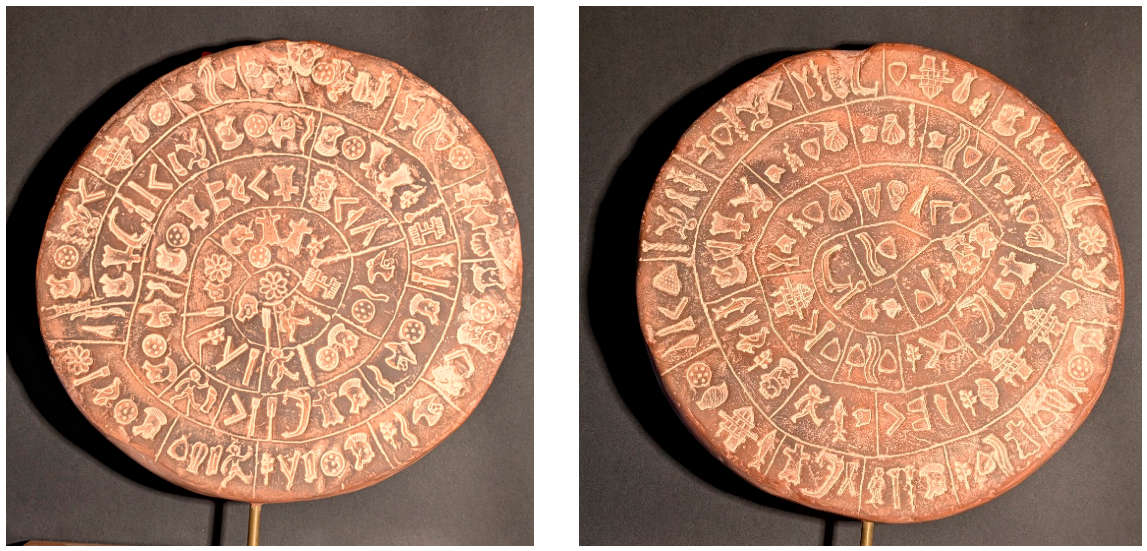
The Phaistos Disc (Figure 1) is an ancient artifact that was recovered in 1908 during excavations of the Minoan palace at Phaistos, in southern Crete, and is conventionally dated to the first half of the second millennium BCE. It is among the most famous undeciphered texts in the world. Its pictographic signs are usually associated with Cretan Hieroglyphic, a script broadly contemporary with Linear A. Linear A was the main administrative script of the Minoan palaces and recorded a local, non-Greek, probably non-Indo-European language. The two scripts had very different geographical distributions: Linear A is attested across the Aegean and even on the Greek mainland, whereas Cretan Hieroglyphic remained largely confined to Crete, and to Knossos and Malia in particular. The Disc’s own signs, moreover, show little direct overlap with the contemporary Cretan sign inventories, which has led some scholars to suspect that it was imported from elsewhere and stands apart from the two great palace archives [1].
Figure 1.
The Phaistos Disc, photographed from the author’s copy. Side A (left) carries 123 sign-occurrences in 31 groups and Side B (right) carries 119 in 30 groups, for 242 occurrences of 45 distinct signs in total. On each face the signs are stamped into the clay and arranged in a spiral running from the rim toward the center, with groups delimited by incised radial lines; 18 of the groups also bear a short oblique stroke beneath their final sign. Throughout this paper, the disc is read outside-to-inside, the scholarly consensus direction.
Each of the Disc’s two clay faces carries signs impressed into the wet clay with pre-formed stamps. This technique has been described as the earliest known instance of movable type and points to a deliberate, repeatable system of writing rather than a one-off inscription. The signs are arranged in a spiral and separated into groups by incised radial strokes, with a short oblique stroke beneath the final sign of certain groups; the text runs from the rim inward, read from right to left, and Face A is generally taken to precede Face B. In all, the two faces bear 242 occurrences of 45 distinct signs, catalogued 01 to 45 following Evans [2]. If, as many suppose, knowledge of the script was lost with the collapse of the Cretan palaces, the Disc may be an isolated survivor, which would explain both the absence of comparable texts and the difficulty of its decipherment. A century of proposed readings, whether syllabic, logographic, calendrical, or prayer-like, has produced no consensus, in large part because 242 symbols on a single object provide limited evidence with which to constrain any hypothesis [3,4].
Computational methods have recently been brought to bear on Aegean scripts. Revesz [5], for example, used phylogenetic tree-building algorithms borrowed from molecular evolution to relate a family of ancient scripts, among them Cretan Hieroglyphic, Linear A, Linear B, and the Cypriot syllabary, using distance methods also applied to reconstruct gene and species trees. In that analysis, the Phaistos Disc is treated as a form of Cretan Hieroglyphic rather than as a separate script. That work illustrates how naturally methods from bioinformatics and Aegean epigraphy can overlap. Statistical and cryptanalytic methods have likewise been used to test whether undeciphered texts carry genuine linguistic structure at all, as in the debate over whether the Voynich manuscript is meaningful writing or an elaborate hoax [6,7] and in broader computational decryption of historical manuscripts [8]. The present paper explores a different and more literal intersection of the two fields.
Here we ask a bioinformatic question that, as far as we are aware, has not been posed before: whether the disc encodes a biological sequence, with each sign representing an amino acid or a post-translationally modified amino acid. On this reading, the 45 signs map many-to-one onto the 20 canonical residues, with the additional 25 signs interpreted as modified forms of those residues, such as phosphoserine, phosphothreonine, hydroxyproline, hydroxylysine, and methylated or acetylated residues, so that several signs may share a single underlying amino acid. Under this reading, the disc would be a 242-residue polypeptide, or two shorter chains, one per face, written in an unknown alphabet. The idea is attractive precisely because it is testable. In cryptanalytic terms, it is a monoalphabetic substitution in which the plaintext is drawn from a known and enumerable corpus, the set of real proteins. This paper sets out to test it properly.
Of course, we are aware this sign inventory does not point uniquely to proteins. Forty-five signs can accommodate the 20 standard amino acids together with modified residues, but the same number is also compatible with a syllabary, the usual interpretation of the disc. The disc is a fixed, closed text made with reusable stamps, so it can be examined as a single ciphertext. The protein proposal also yields falsifiable predictions: candidate plaintexts can be sought in an enumerated corpus and their fit compared with controls. We test it on those grounds, without treating it as likely a priori.
We test the protein sequence hypothesis in stages: mapping invariant properties of the text, the information available for recovering a map of this size, and a database search for compatible sequences. In each stage, the null must go through the same machinery as the disc, and no decipherment is claimed on the strength of a score alone.
2. Materials and Methods
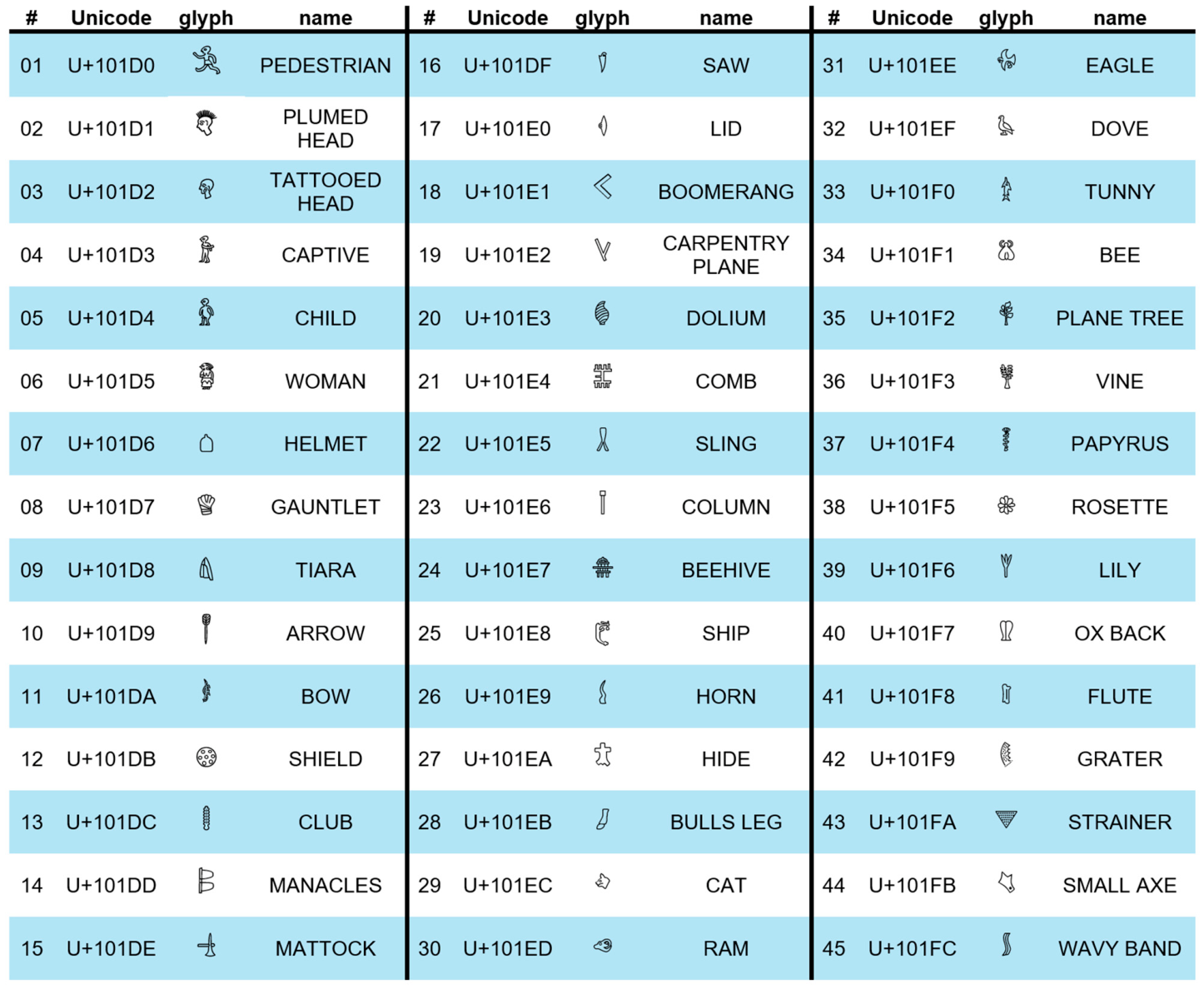
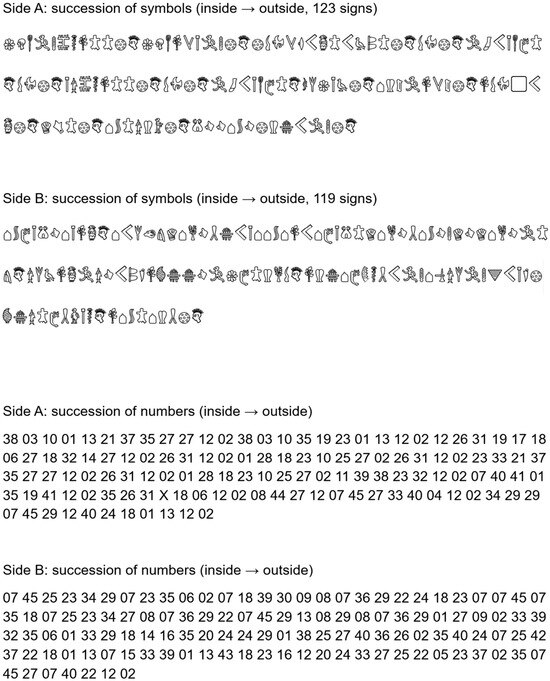
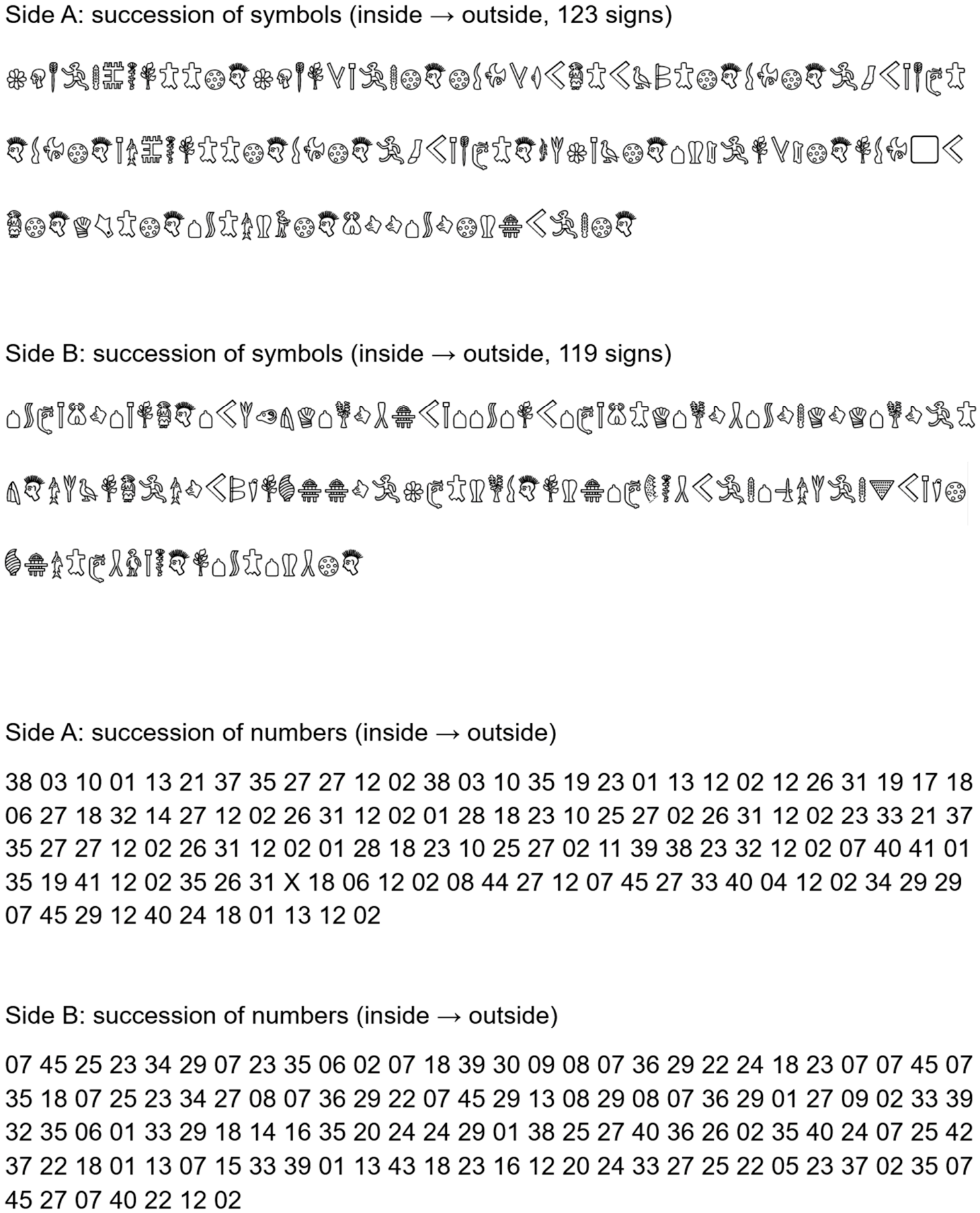
We transcribed the disc (Figure 1) in the outside-to-inside direction, the scholarly consensus, and recorded for each sign its face (A or B), group, within-group position, Evans number, and whether its group bears the oblique stroke. The transcription was validated programmatically against the standard census: Side A carries 123 signs in 31 groups, Side B carries 119 signs in 30 groups, for 242 occurrences of 45 distinct signs; the oblique stroke occurs 18 times; and a single sign, in group A8, is illegible and is encoded as a wildcard. Because the reading direction and even the starting face are disputed, and Evans himself first argued a center-outward reading before retracting it, every analysis was run over eight orderings: Side A alone, Side B alone, the two concatenations A + B and B + A, and each of these reversed. Figure 2 gives the sign-to-number key. The Evans series matches the order of the Unicode Phaistos Disc block (U+101D0 to U+101FC): sign k is U+101CF + k. Thus sign 01 is U+101D0 (Pedestrian) and sign 45 is U+101FC (Wavy Band). This correspondence allows the transcription to be stored as text. Unicode encodes the oblique stroke separately (U+101FD), in keeping with its treatment here as a group-level mark. Figure 3 presents both faces, read inside-to-outside, as sign glyphs and Evans numbers.
Figure 2.
Sign-to-number key. Each of the 45 distinct Phaistos Disc signs is listed with its Evans number (used throughout this paper), its Unicode code point in the Phaistos Disc block, its glyph, and the descriptive Unicode name. The Evans numbering coincides with the Unicode ordering, so sign k is code point U+101CF + k. The key is reproduced as an image so that no special font is needed to read it.
Figure 3.
The sequence of the Phaistos disc transcription, read inside-to-outside for both faces, as glyphs (top) and numbers (bottom).
Swiss-Prot release 2026_02 (10 June 2026; downloaded 18 July 2026) supplied the reference sequences [9]. It contains 575,503 entries and 208,906,902 residues. We derived background compositions, k-mer models, and entropy estimates from this release and searched against the same database. Here, a k-mer is a contiguous sequence of k residues. We used the manually curated Swiss-Prot set rather than the combined UniProtKB archive to limit the effect of near-duplicate proteins and to reduce entries containing fragments or unknown-residue placeholders. Its size also allowed us to scan the database for the disc and for every shuffled control. Sequences absent from Swiss-Prot could not be found in this analysis; we return to that limitation in the Discussion.
Longest repeated substring. The longest exactly repeated substring of each reading was computed with a suffix automaton, a finite-state structure recognizing all substrings of a string that is built in time and space linear in the sequence length. The length of the longest repeat is obtained as the maximum state length over states reachable from at least two distinct end positions. Overlapping repeats were allowed. The null distribution was formed from every Swiss-Prot protein in the matching length bin rather than from a random sample, giving 7193 proteins of length 119 to 123 and 5196 of length 240 to 244.
Entropy estimation. Block entropies Fn were computed from exact n-gram counts over the 20 canonical residues, with n-grams restricted to windows containing no non-canonical symbol and never spanning two proteins. The order-k conditional entropy is
Because plug-in entropy estimates are biased downward at finite sample size, every block entropy was corrected with the Miller–Madow term [10],
where N is the number of counted n-grams and Kobs the number of distinct n-grams observed. Coverage, defined as
is reported for each order, and an order is treated as adequately sampled when coverage is at least 10.
Fitness function. The quantity maximized in the guided search is the k-mer log-likelihood ratio of the decoded sequence under an order-m Swiss-Prot Markov model against the order-0 background model,
summed over all positions having full context. Conditional probabilities were estimated from Swiss-Prot (m + 1)-gram and m-gram counts with add-one (Laplace) smoothing, and F0 is the marginal residue frequency. The ratio against the composition-only model cancels the contribution of residue composition, so that the score reflects sequential structure alone. Positions whose context window contained the illegible sign were excluded from the sum. We used m = 4, the highest adequately sampled order.
Simulated annealing. The search state is an assignment of one residue to each of the 45 numeric signs. Each move reassigns one randomly chosen sign to a randomly chosen residue from its allowed set and is accepted by the Metropolis criterion: always when the score does not decrease, and otherwise with probability exp(delta/T), where delta is the change in score. The temperature follows a geometric schedule from T0 = 2.0 to T1 = 0.02 across the iterations of each restart. Production runs used 6 restarts of 12,000 iterations each, retaining the best score over all restarts. Anchored signs were held fixed and removed from the move set; every other sign was restricted to the feasible residue sets of Section 3.1.3. The identical configuration, including the move distribution, the cooling schedule, the restart count, and the feasible set, was applied to the disc and to every null sequence.
Known-plaintext consistency scan. For a reading of length L, every position whose sign has already occurred generates one back-reference constraint requiring that position to carry the same residue as the first occurrence of its sign; the A + B reading yields 196 such constraints. For every window of every Swiss-Prot protein of at least 119 residues, 496,762 proteins in total, the number of satisfied constraints was counted by direct comparison of the corresponding residue positions. A window was retained only if it contained exclusively canonical residues and at least 15 distinct residues. For the best window, the identity of the best consistent map was obtained by assigning each sign-class its majority residue, which is the highest identity any consistent map can attain for that window.
Computing environment. Analyses were run on a workstation with an Intel Core i9-14900KS processor (24 cores, 32 logical processors) and 128 GB of RAM. The known-plaintext scan is independent across replicates and was distributed over 28 worker processes, an implementation that reproduces the sequential one exactly for a given seed.
Linear A positional comparison. The two statistics reported for sign 02 were computed for every Linear A sign, using the machine-readable transcriptions of the lineara.xyz corpus, a digitization of GORILA [11] prepared from the Ecole francaise d’Athenes scans. Words of a single sign were excluded, because every Phaistos group contains at least two signs whereas 58% of Linear A words consist of one sign, in which every sign is trivially initial; words carrying the corpus’s editorial damage marker were also excluded, since a marker at a word edge leaves the identity of the first sign unknown. This leaves 967 words and 2881 sign occurrences over 148 distinct signs, and the result is unchanged if the damaged words are retained instead (88.4% against 87.6%). Significance was assessed by permuting all signs across all positions with the word lengths held fixed, 100,000 times. No comparable open machine-readable corpus exists for Cretan Hieroglyphic, for which CHIC [12] remains the reference edition, so that script is not analyzed here.
3. Results
3.1. Mapping-Invariant Tests
The map is unknown, but many properties of the text are unchanged under every map or can change only in a predictable direction. These tests require no search over mappings and therefore provide the first line of falsification.
3.1.1. Internal Repetition
A many-to-one substitution can only increase the amount of exact repetition in a sequence, because merging two signs onto one residue can create new coincidental repeats but can never break an existing one. The length of the longest exactly repeated substring in the disc is therefore a lower bound on that of any protein it could encode. We computed it with a suffix automaton and compared it to the distribution over all length-matched Swiss-Prot proteins (Table 1).
Table 1.
Longest exact internal repeat of the disc versus length-matched Swiss-Prot proteins. The full length-matched populations are 7193 proteins of length 119 to 123 and 5196 of length 240 to 244.
Side A contains a striking 15-sign exact repeat, the block 02 27 25 10 23 18 28 01 02 12 31 26 02 12 27, which spans groups A14 to A17 and recurs at A20 to A23. A repeat of that length places Side A at the 99.8th percentile of length-matched proteins. Only about 0.2% of real proteins of this length are as repetitive, and those are low-complexity outliers. Because a many-to-one map can only preserve or increase this value, the encoded protein would be even more repetitive. This does not by itself falsify the hypothesis, but it weighs against it: the disc looks unlike an ordinary protein and more like structured, formulaic text.
3.1.2. Positional Structure of Sign 02
Sign 02 is the most frequent on the disc. It occurs 19 times, and every single occurrence is the first sign of its group; it appears nowhere else. Under random placement among the 242 positions, the probability that all nineteen occurrences fall within the 61 group-initial slots is about 10−12 (φ = 0.50). One might compare this to the strong positional bias that real proteins show at their N-terminus: the near-universal initiator methionine, and the compositional bias at position 2 imposed by methionine-aminopeptidase specificity, N-terminal acetylation, and the N-end rule. The comparison reveals a different pattern. In Swiss-Prot, the first position is an extremely pure slot (97.4% methionine), yet methionine is not confined to it, since only 11.1% of all methionines sit at position 1. On the disc, the group-initial slot is impure, because sign 02 is just 31% of initials, yet sign 02 is perfectly confined to it. No canonical amino acid shows a comparable positional pattern in Swiss-Prot. The protein hypothesis does not explain this pattern. Under a linguistic interpretation, it is compatible with a word-initial marker or determinative.
3.1.3. Frequency Compatibility
For completeness, we checked a weak necessary condition: whether any map can reproduce the Swiss-Prot residue composition. Each assignment induces a residue composition by summing the counts of signs assigned to each residue; we call this the pushforward composition. We compare it with the Swiss-Prot background using total-variation distance (TV), half the sum of the absolute differences between two frequency distributions. TV is 0 for identical distributions and 1 for non-overlapping distributions. We minimized TV by integer programming over sign-count classes, requiring every residue to receive at least one sign. The optimum is TV = 0.010 (χ2 = 0.23), and it is provably attainable. The frequencies are therefore compatible, but this condition eliminates very few mappings. A single optimal composition is realized by roughly 1016 distinct labeled maps, within a total key space of 2045, about 1059, and within a generous feasible set (TV ≤ 0.05), none of the 45 signs is forced to a unique residue. Composition cannot identify the map.
3.2. Feasibility: The Unicity Distance
Before searching for a map, we asked whether 242 signs could in principle determine one. Shannon’s unicity distance [13] is U = H(key)/D, where H(key) = log2(2045), about 194.5 bits, is the key entropy, and D = log2(20) − h is the redundancy of the plaintext per residue, with h the entropy rate of the protein sequence. We estimated h from Swiss-Prot as the order-k conditional entropy, computed from block entropies of k-mer counts with the Miller-Madow bias correction [10], for k = 0 to 5, and reported per-order coverage to make undersampling explicit (Table 2).
Table 2.
Redundancy and unicity distance of the sign-to-residue map, estimated from 208.9 million Swiss-Prot residues. The k = 5 row is undersampled, with an average coverage of six k-mers per cell, which biases its entropy low and its U low; it is shown for completeness only.
Across every adequately sampled order, the unicity distance is between 592 and 1264 residues. Even the most conservative reliable estimate, 592 residues, is 2.4 times the length of the disc, so the 242 signs amount to about 41% of the estimated text length required to identify a unique map. At order 4, the estimated redundancy is only about 0.33 bits per residue, too little for k-mer or compositional statistics to select a unique map from a text of this length. Consequently, k-mer fit alone cannot discriminate among mappings; the stronger test must come from homology against real proteins. Any search must therefore be evaluated against null sequences optimized in exactly the same way.
3.3. Guided Search Against Optimizer-Matched Nulls
We searched the map space by simulated annealing [14], maximizing a k-mer log-likelihood ratio of the decoded disc against an order-4 Swiss-Prot Markov model, the highest adequately sampled order in Section 3.2, restricted to the feasible set of Section 3.1.3. We tested two conditions: an unanchored search and an anchored search that fixed sign 02 to methionine, motivated by its invariable group-initial position, and sign 12 to cysteine, the Met-Cys N-degron of Licausi et al. [15]. The decisive control is that the identical optimizer, with the same restarts, iterations, cooling schedule, feasible set, and anchors, was run on 1000 shuffled discs with exact sign composition preserved and on 1000 random composition-matched sequences. We considered a map informative only if the real disc outperformed these optimizer-matched nulls.
A methodological subtlety proved important. The disc required a longer annealing budget than shuffled controls. Its internal repetition ties many windows to the same sign, which slows convergence; with a limited budget, the disc appeared worse than the nulls. We defined convergence as no improvement in the best score during the final half of a run. For the disc, the best score appeared at iteration 2354 of 12,000 and did not improve. Increasing the budget from 10,000 to 40,000 iterations left it unchanged. We therefore used 12,000 iterations per restart for the disc and all controls.
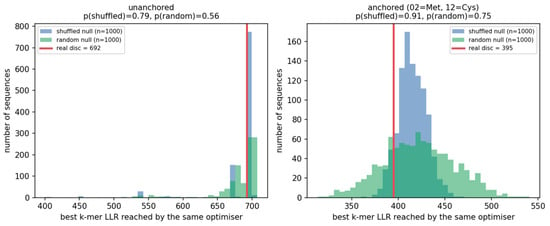
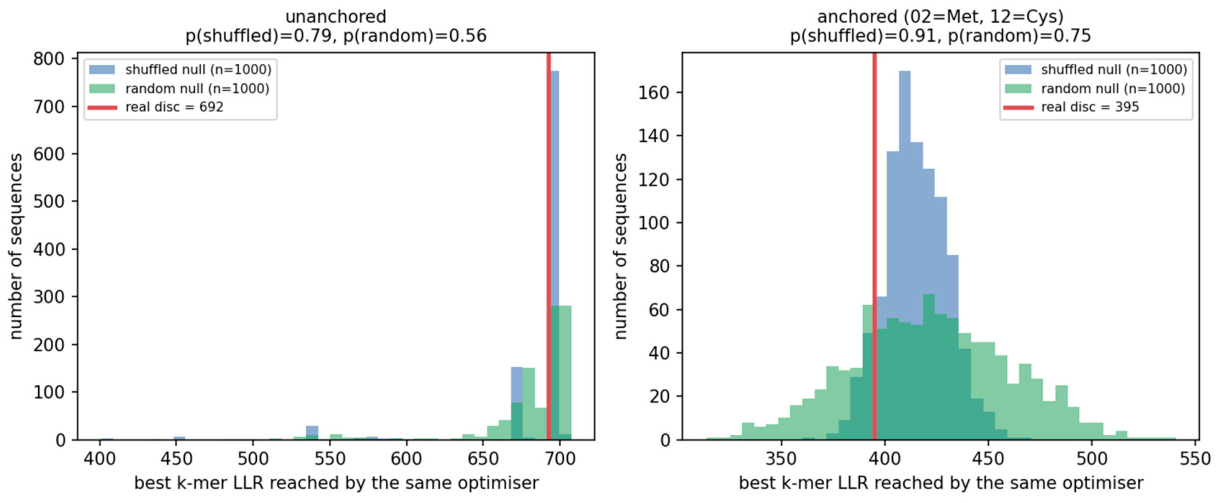
The result is negative in both conditions (Figure 4). Unanchored, the real disc reaches a score of 692.5, against a shuffled-null mean of 680.6 (SD 38.8; median 692.5; interquartile range 692.5 to 692.5; range 400.9 to 704.4) and a random-null mean of 682.0 (SD 35.1; median 692.5; interquartile range 677.6 to 707.3; range 448.8 to 707.3), giving empirical p-values of 0.79 and 0.56, respectively. The null interquartile range is degenerate because the distribution contains a large point mass: 767 of the 1000 shuffled discs and 275 of the 1000 composition-matched random sequences converge to the same optimum as the real disc, 692.4844, to all reported digits. Both null distributions are therefore strongly non-normal, comprising a point mass at the disc’s score together with a left tail, and their standard deviations should not be interpreted as symmetric dispersions; Figure 4 shows the full distributions for this reason. The achievable score is bounded by a composition ceiling attained by the majority of sequences, including the real disc, so the arrangement of signs carries no protein-like k-mer signal beyond that attributable to composition. In the anchored condition, the real disc scores 394.8 against a shuffled-null mean of 415.0 (SD 15.0; interquartile range 404.9 to 425.5) and a random-null mean of 421.9 (SD 38.2; interquartile range 394.9 to 449.0). Constraining two high-frequency signs to two rare residues (methionine 2.4%, cysteine 1.4%) displaces the composition from the protein background, and the real disc falls below the null mean (p = 0.91), consistent with this compositional mismatch.
Figure 4.
Best k-mer log-likelihood ratio reached by simulated annealing for the real disc (red line) against 1000 shuffled and 1000 random sequences processed by the identical optimizer. (Left): unanchored. (Right): anchored, with sign 02 fixed to methionine and sign 12 to cysteine. In neither condition does the real disc exceed the null cloud; the achievable score is capped by a composition ceiling that nearly every sequence reaches. The text reports dispersion statistics for both null distributions. Each has a large point mass at the composition ceiling, which the real disc also reaches.
3.4. A Known-Plaintext Attack Against Swiss-Prot
The strongest form of the hypothesis, that the disc encodes a protein represented in Swiss-Prot, permits a far more powerful test than any k-mer score, and one that never requires us to guess the map. If the disc encodes protein P under a many-to-one map, then wherever two positions carry the same sign they must decode to the same residue; equivalently, P must be constant within every sign-class. This is a hard constraint that a candidate protein either satisfies or does not, and it is checkable directly against the database. Scanning every window of every protein for one that is constant across all sign-classes jointly identifies the candidate protein and the implied map. It is more appropriate than submitting a post hoc decoded sequence to a database search, whether by blastp or by one of the fast large-scale aligners built for this scale of problem, DIAMOND [16] or MMseqs2 [17], because with roughly 1016 composition-compatible maps available, a map can be chosen after the fact to make a decoded sequence match a database entry. An unguarded BLAST v2.12.0+ search of an unknown-map decoding would therefore generate many post hoc false positives. The consistency scan avoids this problem because it does not require a map to be chosen in advance.
Run naively, the scan immediately succeeds, and the manner of its success is instructive. The first match satisfying all constraints was a window of collagen alpha-1(II) from the American mastodon, Mammut americanum (UniProt P85153). The match was an artifact. The collagen entry is a fragment in which a long run of residues is recorded as unknown (X), and a window of identical unknown symbols trivially satisfies every equality constraint. That a mastodon briefly presented itself as the full decipherment of a Minoan disc is a useful reminder of how readily a permissive test fabricates meaning. We therefore required decoded windows to consist only of the 20 canonical residues and to contain at least 15 distinct residues, which removes trivial low-complexity matches, and we calibrated every result against shuffled-disc nulls that preserve the same sign-class size structure and pass through the identical scan.
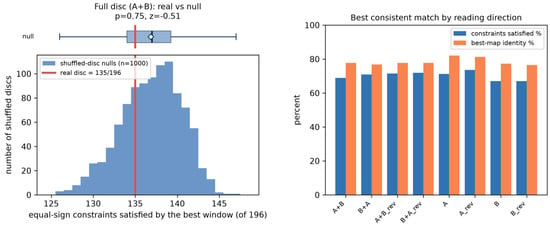
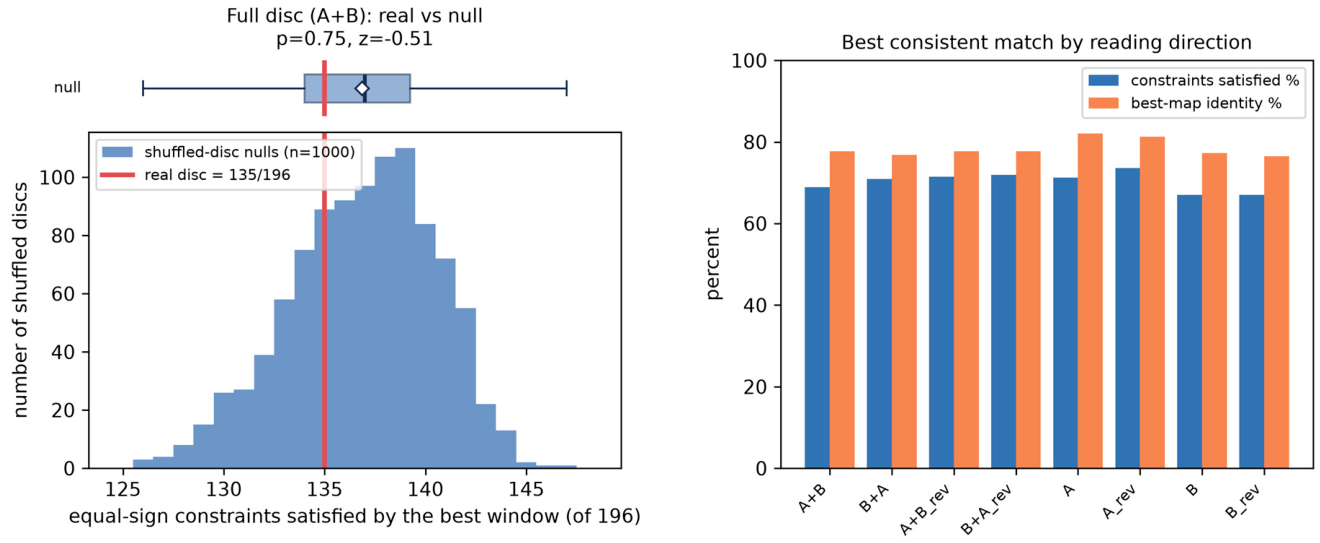
With these controls, the attack is negative (Figure 5, Table 3). In the consensus A + B reading the best diverse protein window satisfies 135 of 196 equal-sign constraints, an identity of 77.7% under the best map, but 745 of 1000 shuffled versions of the disc do as well or better, with a null mean of 136.9 (SD 3.6; median 137; interquartile range 134.0 to 139.2; range 126 to 147), so the real disc lies below the null average (p = 0.75, z = −0.51). No reading direction is anomalous. The best-scoring protein in each of the eight orientations is an unrelated Dictyostelium discoideum (a unicellular amoeba) low-complexity protein; this slime-mold species proteome is famously rich in poly-asparagine and poly-glutamine tracts, which coincidentally fit almost any repeated-symbol pattern. No protein in Swiss-Prot matches a disc decoding better than expected from random rearrangements of the same signs, and consequently no candidate that would justify a confirmatory blastp against the far larger nr database.
Figure 5.
Known-plaintext attack. (Left): the best consistent match of the full disc (A + B), measured as the number of the disc’s equal-sign constraints satisfied by the best-scoring Swiss-Prot window, among windows containing only canonical residues and at least 15 distinct residues, against 1000 shuffled-disc nulls; the real disc, at 135 of 196, falls below the null mean (p = 0.75). The strip above the histogram gives the null median, interquartile range, full range, and mean (diamond); the red line marks the real disc in both. (Right): the best match by reading direction. No orientation stands out, and all top hits are unrelated low-complexity proteins. The null distribution has mean 136.9, SD 3.6, median 137, interquartile range 134.0 to 139.2, and range 126 to 147.
Table 3.
Best consistent (constant-within-sign-class) match of each reading direction against Swiss-Prot, restricted to windows containing only canonical residues and at least 15 distinct residues. Reverse readings of the individual faces are omitted for brevity because their results are indistinguishable from the forward readings. All matches lie within the shuffled-disc null distribution.
One thousand shuffled replicates were used, matching the null size of the guided search in Section 3.3. The exact Clopper-Pearson 95% confidence interval for the probability that a shuffled disc matches the database at least as well as the real disc is 0.72 to 0.77, so the result lies far from the threshold at which the disc could be judged anomalous.
The character of these best matches is worth making explicit (Figure 6). The highest-identity match of any reading is Side A against the Dictyostelium protein Q54HS1, at 82% identity, and its longest uninterrupted matching run is 69 residues. Every one of those 69 residues is asparagine. The induced map simply sends almost every frequent sign to a single residue, and the protein window is a poly-asparagine tract, so the apparent match is a property of low sequence complexity rather than of any correspondence between disc and protein. The highest-identity global match is therefore an artifact of low sequence complexity.
Figure 6.
The best consistent match in detail: disc Side A against the Dictyostelium protein Q54HS1 (82% identity). Disc sign numbers are shown above the aligned protein residues for the longest uninterrupted matching run. The run is 69 residues long and consists entirely of asparagine (N): the induced map sends nearly every sign to a single residue, and the protein window is a poly-asparagine tract, so the match reflects low sequence complexity rather than homology. Only the first thirty aligned positions are shown.
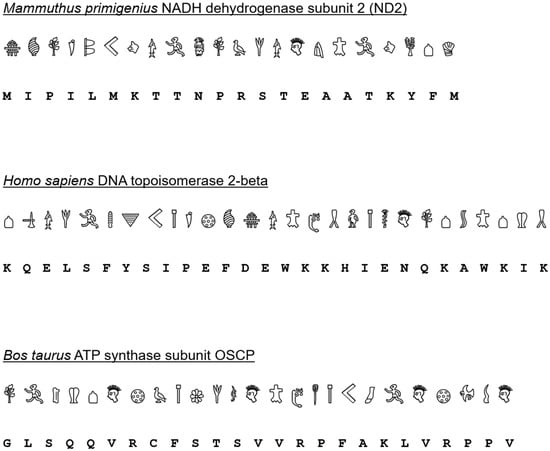
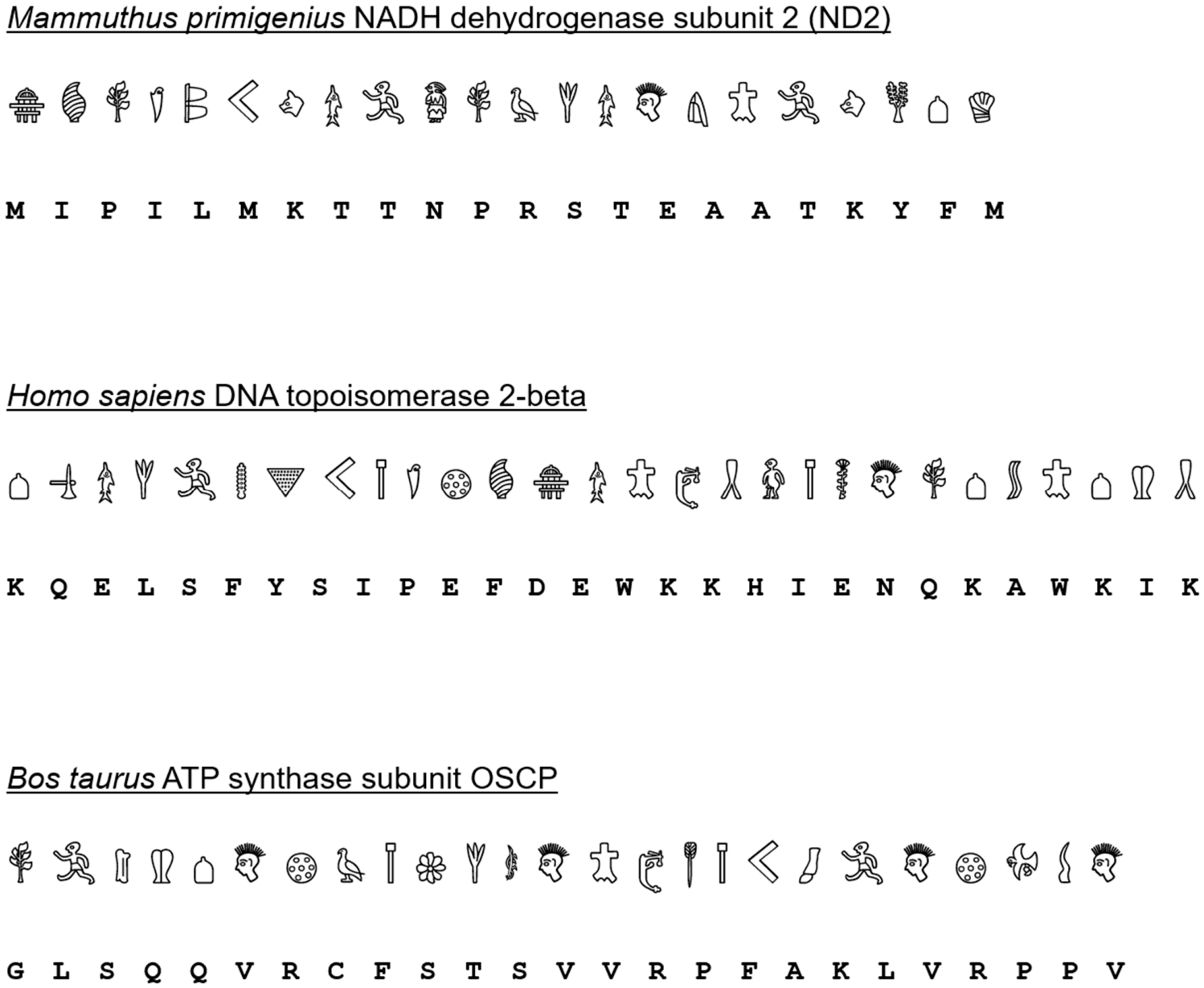
Local windows can produce apparently strong alignments when the requirement of consistency across the full text is relaxed (Figure 7). These examples show the kind of false positive generated by that weaker test. A run of 22 signs on Side B maps onto a stretch of NADH dehydrogenase subunit 2 from the woolly mammoth, with four signs recurring and each landing on the same residue every time; a 28-sign run maps to a segment of human DNA topoisomerase 2-beta, and a 25-sign run on Side A maps to the OSCP subunit of ATP synthase from cattle, the emblematic animal of Minoan Crete. Each is a genuine, checkable, gapless alignment across a compositionally diverse window, not a low-complexity tract. These matches do not support the hypothesis. The null distribution in Figure 5 predicts local stretches of this length and consistency by chance, and the selected species add no statistical evidence. The issue is multiple testing, not low sequence complexity: the scan tests roughly 10^8 window positions, so some short windows will admit a consistent assignment by chance. This is why the global test is evaluated against shuffled discs rather than by the apparent quality of individual alignments. The matches illustrate what a genuine local correspondence would look like and show that the same 45 signs that resist every global test can still be made, here and there, to match fragments from a mammoth protein, a human enzyme, or a cattle protein.
Figure 7.
Local, internally consistent alignments between disc segments and proteins from selected animal species. They result from a deliberately weakened test and are shown only as examples of overfitting. Each panel places a contiguous stretch of Phaistos signs (shown as glyphs, (top)) over the amino-acid residues (bottom) of a window from a Swiss-Prot protein, under a single many-to-one substitution that holds across the whole stretch: wherever a sign recurs within the window it is assigned the same residue. These are local, gapless matches selected from the scan in Section 3.4, restricted here to selected animal proteins and to windows containing at least six distinct residues. They are illustrative coincidences but not evidence; as Figure 5 shows, the disc as a whole matches such proteins no better than shuffled controls, and stretches of this length and consistency are expected by chance. The Evans sign-number key is given in Figure 2; the repeated sign-to-residue assignments are listed below. Panels, top to bottom: (top) Woolly mammoth (Mammuthus primigenius) NADH dehydrogenase subunit 2 (ND2; UniProt Q38PS1, 347 aa), residues 40–61, aligned to the 22 signs at reading positions 52–73 of Side B (groups B13 to B18, read outside-to-inside). Thirteen distinct residues; four signs recur and stay consistent (sign 35 → P, 33 → T, 01 → T, 29 → K). (middle) Human (Homo sapiens) DNA topoisomerase 2-beta (UniProt Q02880, 1626 aa), residues 605–632, aligned to the 28 signs at reading positions 90–117 of Side B (groups B8 to B1, read inside-to-outside). Fourteen distinct residues; five signs recur and stay consistent (sign 07 → K three times, 33 → E, 23 → I, 27 → W, 22 → K), including two matched tryptophans. (bottom) Cattle (Bos taurus) ATP synthase peripheral stalk subunit OSCP (UniProt P13621, 213 aa), residues 8–32, aligned to the 25 signs at reading positions 39–63 of Side A (groups A10 to A17, read outside-to-inside). Twelve distinct residues; four signs recur and stay consistent (sign 02 → V four times, 01 → L, 12 → R, 23 → F).
4. Discussion
Five independent tests converge on the same answer, and two provide direct evidence against a protein reading. The repeated-sign and positional patterns are inconsistent with a typical protein sequence (Section 3.1.1 and Section 3.1.2). The 242 signs also fall well below the estimated unicity distance (Section 3.2). Neither the optimized k-mer score nor the database scan distinguishes the disc from matched controls (Section 3.3 and Section 3.4). The best full-disc reading, with 77.7% identity to a Dictyostelium low-complexity protein, is statistically indistinguishable from what shuffled discs achieve, and therefore does not support the protein hypothesis.
These results do not prove that the disc cannot encode a protein sequence. What we can say is that the specific mechanism tested here, in which signs represent canonical or modified amino acids under a many-to-one substitution, fails at every stage at which it makes a testable prediction. The observed patterns are more compatible with structured text than with a protein sequence, since repetition at the phrase level and a recurrent group-initial marker are hallmarks of formulaic text such as lists, invocations, or names, rather than of a polypeptide. This interpretation is also consistent with computational studies of Aegean writing: Revesz [5] treats it as a form of Cretan Hieroglyph and places that script within a family of related human writing systems.
Sign 02 can be compared with signs that carry positional functions in other Cretan scripts, but that comparison cannot identify it. In Aegean writing, separate punctuation marks word and phrase boundaries; the disc’s radial strokes serve that graphic role. Sign 02 lies inside the group it begins, so it is not the delimiter. Nor is it a universal opening sign: it begins 19 of 61 groups (31%). Its distribution is consistent with a marker used for some groups, perhaps a determinative/classifier or a recurring formulaic word in lists, dedications, or names. The comparison has two limits. The disc shares few signs with the contemporary Cretan inventories [1], whose Hieroglyphic and Linear A corpora are collected in [12] and [11], respectively, so a sign-by-sign equation is unavailable. And because the script is undeciphered, a determinative-like role can only be inferred from distribution. We therefore treat this as a distributional interpretation, not an epigraphic identification. The comparison can nevertheless be measured rather than asserted, and we have measured it. Applying the same two statistics to the Linear A corpus [11], the word-initial slot is impure in the same way as the disc’s group-initial slot: its entropy is 5.55 bits and its most frequent occupant accounts for 11.1% of word-initial positions. One sign is nevertheless strongly confined to that slot. Sign AB008 occurs 121 times in words of two or more signs and is word-initial in 88.4% of them, against 33.6% expected under random placement; across 100,000 permutations of the corpus, the most confined sign never exceeded 85.7% (p = 1 × 10⁻⁵), and the next most confined sign in the real corpus reaches only 64.2%. The configuration shown by the disc (a strongly confined sign occupying a slot that it does not dominate) therefore occurs in Linear A as well, in a less extreme form: 88.4% of 121 occurrences there against 100% of 19 here. It does not occur in protein sequence, where the N-terminal slot is pure and its occupant unrestricted (Section 3.1.2). The proposed measures, the fraction of a sign’s occurrences in a fixed slot and the purity of that slot, can nevertheless be computed for any segmented corpus and used for direct comparison with Linear A and Cretan Hieroglyphic.
Our procedure can be applied to other proposed mappings from unknown scripts to known symbol systems. It requires an explicit search for the best map, matched controls that preserve the relevant features of the text, and a report of where the original lies in that control distribution. A good score alone is insufficient when the map is flexible. This principle is independent of whether the search uses the procedures here or machine-learning approaches to cipher analysis [18]. The same approach could be applied to the Voynich manuscript [6,7] and the Rohonc Codex [19], with controls designed for each corpus. More generally, mapping-invariant tests, an estimate of the unicity distance, and null-calibrated scoring provide a useful basis for assessing such proposals [8].
We note the limits of the test. We assumed a contiguous window with no insertions or deletions; an indel-tolerant search would be substantially more permissive and would require a separate, more stringent null model. We assumed the modern residue alphabet and the modern proteome, whereas a genuinely ancient or engineered sequence need not be present in Swiss-Prot. We also tested a substitution at the level of amino acids, rather than at the level of codons or an acrophonic mapping. These are separate hypotheses, each of which would need its own pre-specified null. The framework used here, combining invariant statistics, the unicity distance, a matched-optimizer search, and a null-calibrated known-plaintext scan, could be adapted to test them.
5. Conclusions
Under the substitution-cipher model tested here, the Phaistos Disc does not yield a supported protein decoding. Its repetition is unusually high; its most frequent sign is strongly positionally constrained; its length is below the estimated unicity distance; and its best decoding performs no better than chance. We claim no decipherment and report only effect sizes and empirical p-values against matched nulls. The results do not support the interpretation of the disc as an encoded protein sequence and are more compatible with a structured human text.
Author Contributions
Conceptualization, F.M.G. and F.B.; Methodology, F.M.G.; Software, F.M.G.; Validation, F.M.G. and F.B.; Formal analysis, F.M.G.; Investigation, F.M.G.; Resources, F.M.G.; Data curation, F.M.G.; Writing—original draft, F.M.G.; Writing—review & editing, F.M.G. and F.B.; Visualization, F.M.G.; Supervision, F.M.G.; Project administration, F.M.G.; Funding acquisition, F.M.G. All authors have read and agreed to the published version of the manuscript.
Funding
The study was supported by the Department of Pharmacy and Biotechnology, University of Bologna, Italy, grant RFO.
Data Availability Statement
The original data presented in the study are openly available in UniProtKB/Swiss-Prot at https://www.uniprot.org (accessed on 18 July 2026), release 2026_02.
Conflicts of Interest
The authors declare no conflict of interest.
References
- Godart, L. The Phaistos Disc: The Enigma of an Aegean Script; Éditions Itanos: Heraklion, Greece, 1995. [Google Scholar]
- Evans, A.J. Scripta Minoa: The Written Documents of Minoan Crete, with Special Reference to the Archives of Knossos; The Hieroglyphic and Primitive Linear Classes; Clarendon Press: Oxford, UK, 1909; Volume 1. [Google Scholar]
- Duhoux, Y. How Not to Decipher the Phaistos Disc: A Review Article. Am. J. Archaeol. 2000, 104, 597–600. [Google Scholar] [CrossRef] [Scilit]
- Robinson, A. Lost Languages: The Enigma of the World’s Undeciphered Scripts; McGraw-Hill: New York, NY, USA, 2002. [Google Scholar]
- Revesz, P.Z. Bioinformatics Evolutionary Tree Algorithms Reveal the History of the Cretan Script Family. Int. J. Appl. Math. Inform. 2016, 10, 67–76. [Google Scholar]
- Rugg, G. An Elegant Hoax? A Possible Solution to the Voynich Manuscript. Cryptologia 2004, 28, 31–46. [Google Scholar] [CrossRef] [Scilit]
- Montemurro, M.A.; Zanette, D.H. Keywords and Co-Occurrence Patterns in the Voynich Manuscript: An Information-Theoretic Analysis. PLoS ONE 2013, 8, e66344. [Google Scholar] [CrossRef] [Scilit] [PubMed]
- Megyesi, B.; Esslinger, B.; Fornés, A.; Kopal, N.; Láng, B.; Lasry, G.; de Leeuw, K.; Pettersson, E.; Wacker, A.; Waldispühl, M. Decryption of historical manuscripts: The DECRYPT project. Cryptologia 2020, 44, 545–559. [Google Scholar] [CrossRef] [Scilit]
- The UniProt Consortium. UniProt: The Universal Protein Knowledgebase in 2023. Nucleic Acids Res. 2023, 51, D523–D531. [Google Scholar] [CrossRef] [Scilit] [PubMed]
- Miller, G.A. Note on the Bias of Information Estimates. In Information Theory in Psychology: Problems and Methods; Quastler, H., Ed.; Free Press: Glencoe, IL, USA, 1955; pp. 95–100. [Google Scholar]
- Godart, L.; Olivier, J.-P. Recueil des Inscriptions en Linéaire A; Études Crétoises 21; École Française d’Athènes: Athens, Greece, 1976–1985; Volumes 1–5. [Google Scholar]
- Olivier, J.-P.; Godart, L. Corpus Hieroglyphicarum Inscriptionum Cretae; Études Crétoises 31; École Française d’Athènes: Athens, Greece; École Française de Rome: Rome, Italy, 1996. [Google Scholar]
- Shannon, C.E. Communication Theory of Secrecy Systems. Bell Syst. Tech. J. 1949, 28, 656–715. [Google Scholar] [CrossRef] [Scilit]
- Kirkpatrick, S.; Gelatt, C.D., Jr.; Vecchi, M.P. Optimization by Simulated Annealing. Science 1983, 220, 671–680. [Google Scholar] [CrossRef] [Scilit] [PubMed]
- Licausi, F.; Kosmacz, M.; Weits, D.A.; Giuntoli, B.; Giorgi, F.M.; Voesenek, L.A.C.J.; Perata, P.; van Dongen, J.T. Oxygen sensing in plants is mediated by an N-end rule pathway for protein destabilization. Nature 2011, 479, 419–422. [Google Scholar] [CrossRef] [Scilit] [PubMed]
- Buchfink, B.; Xie, C.; Huson, D.H. Fast and sensitive protein alignment using DIAMOND. Nat. Methods 2015, 12, 59–60. [Google Scholar] [CrossRef] [Scilit] [PubMed]
- Steinegger, M.; Söding, J. MMseqs2 enables sensitive protein sequence searching for the analysis of massive data sets. Nat. Biotechnol. 2017, 35, 1026–1028. [Google Scholar] [CrossRef] [Scilit] [PubMed]
- Park, S.; Kim, H.; Moon, I. Automated Classical Cipher Emulation Attacks via Unified Unsupervised Generative Adversarial Networks. Cryptography 2023, 7, 35. [Google Scholar] [CrossRef] [Scilit]
- Király, L.Z.; Tokai, G. Cracking the code of the Rohonc Codex. Cryptologia 2018, 42, 285–315. [Google Scholar] [CrossRef] [Scilit]



Disclaimer/Publisher’s Note: The statements, opinions and data contained in all publications are solely those of the individual author(s) and contributor(s) and not of MDPI and/or the editor(s). MDPI and/or the editor(s) disclaim responsibility for any injury to people or property resulting from any ideas, methods, instructions or products referred to in the content. |
© 2026 by the authors. Licensee MDPI, Basel, Switzerland. This article is an open access article distributed under the terms and conditions of the Creative Commons Attribution (CC BY) license.