

Skip to Content

Philosophies, Volume 9, Issue 4

2024 August - 41 articles

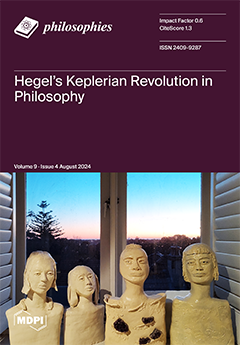
Cover Story: Hegel’s philosophy is approached under the banner of a “Keplerian Revolution”, a variant on Kant’s supposed Copernican philosophical revolution. As an early supporter of the Copernican paradigm in astronomy, Kepler went beyond the work of Copernicus and is invoked here so as to capture the ways in which Hegel attempted to go beyond the philosophy of Kant. However, interpreting Hegel as a philosophical Keplerian will require that we broach worrisome aspects of Kepler’s astronomy, such as his support for Plato’s suggestion of a “music of the spheres”. But such “harmonies”, it is argued, express a mathematical structure with connections to Hegel’s own approach to logic. So understood, Kepler’s astronomy helps shed light on the meaning of Hegel’s idealism and, in particular, on its usually unacknowledged Platonic dimensions. View this paper
  • Issues are regarded as officially published after their release is announced to the table of contents alert mailing list .
  • You may sign up for email alerts to receive table of contents of newly released issues.
  • PDF is the official format for papers published in both, html and pdf forms. To view the papers in pdf format, click on the "PDF Full-text" link, and use the free Adobe Reader to open them.

Articles (41)

  • Essay
  • Open Access
2,143 Views
15 Pages

This article examines a problematic of the ordinary as it emerges in the poetical theology of an early poem of John Milton. This poem, Lycidas, has captured the attention of every major critic from the 18th century to the present, who has minutely ex...

  • Article
  • Open Access
3,108 Views
12 Pages

In continental and analytical philosophy, which developed in parallel in the 20th century, there was a turn to language, which in particular was marked by the creation of a philosophy of dialogue in continental philosophy and dialogical logic in anal...

  • Article
  • Open Access
1,694 Views
19 Pages

This essay assesses the relevance of Søren Kierkegaard’s non-pseudonymous, edifying writings for considering themes of desire, detachment, and humility within the religious context of Christian spiritual formation. Building on the argume...

  • Article
  • Open Access
1 Citations
2,322 Views
18 Pages

The outputs of a Turing machine are not revealed for inputs on which the machine fails to halt. Why is an observer not allowed to see the generated output symbols as the machine operates? Building on the pioneering work of Mark Burgin, we introduce a...

  • Article
  • Open Access
1,972 Views
15 Pages

For many 20th century philosophers, the “death of God” became an opportunity to rethink the limits of the human, eliminating its claims to a transcendent foundation in order to start again, more modestly, “from below”. The new...

  • Article
  • Open Access
1,886 Views
12 Pages

The relationship between science and philosophy is contentious. Quine saw philosophy as continuous with science (broadly understood), but many philosophers see a dichotomy between them. The present paper discusses cases where the relevance of certain...

  • Article
  • Open Access
1 Citations
3,238 Views
11 Pages

Alain Badiou in his philosophy on ethics underscores four fields of truth procedures—love, politics, art, and science—that seek to break with the existing order or conventional flow of things. These four fields indicate both collective (p...

  • Article
  • Open Access
2,863 Views
14 Pages

This article delves into the theme of the death of God in Giorgio Agamben’s work from a political perspective, seeking to interpret the notion of “God” in Agamben through the concepts of “government” and “transcend...

  • Article
  • Open Access
1,577 Views
13 Pages

Recent discussions of logical pluralism trace its origins to Rudolf Carnap’s principle of tolerance; indeed, the principle is seen as one of Carnap’s lasting philosophical contributions. In this paper, I will argue that Carnap’s rea...

  • Article
  • Open Access
1,332 Views
10 Pages

Conventional wisdom holds that human bodies do not and cannot persist through beaming: scanning and destruction of the body, followed by transmission of the scan information and replication of the body in another location. I argue that given the mini...

  • Article
  • Open Access
3,749 Views
15 Pages

Should We Vote in Non-Deterministic Elections?

  • Bob M. Jacobs and
  • Jobst Heitzig

This article investigates reasons to participate in non-deterministic elections, where the outcomes incorporate elements of chance beyond mere tie-breaking. The background context situates this inquiry within democratic theory, specifically non-deter...

  • Article
  • Open Access
1 Citations
3,361 Views
15 Pages

The nature and practice of Christianity is a major, if not the primary, topic in Kierkegaard’s authorship. What it means to live a Christian life is a persistent topic in many of his major works, and yet, he spends most of his authorship critic...

  • Article
  • Open Access
2 Citations
4,004 Views
13 Pages

This paper explores the philosophical perspectives of Nietzsche and Heidegger, tracing their analyses of the death of God and its aftermath. My aim is to clarify the diagnosis of this nihilism and its underlying causes, as well as evaluate the propos...

  • Article
  • Open Access
1,621 Views
16 Pages

This essay forwards an intensive model of mediation contrasted with the extensive model implicit in much of media theory, which conceives of communication media as an extension of human faculties. An intensive model, instead, conceives of mediation a...

  • Article
  • Open Access
1 Citations
3,807 Views
15 Pages

At Plato’s insistence to become as godlike as one can, the Neoplatonists seek their salvation in union with the first principle they call the One, identifying this union as the highest end of philosophy. As with all aspirations, the transition...

  • Article
  • Open Access
2,659 Views
21 Pages

Nikk Effingham and Huw Price argue that in certain cases of Newcomb problems involving time travel and foreknowledge, being given information about the future makes it rational to choose as an evidential decision theorist would choose. Although the c...

  • Article
  • Open Access
4 Citations
3,793 Views
24 Pages

The ontology behind quantum mechanics has been the subject of endless debate since the theory was formulated some 100 years ago. It has been suggested, at one time or another, that the objects described by the theory may be individual particles, wave...

  • Commentary
  • Open Access
1,630 Views
5 Pages

I have argued against the Principle of Alternative Possibilities using a time travel-based counterexample. Kelly McCormick has responded to my counterexample by arguing that the time travel scenario must be a scenario in which a time traveler’s...

  • Article
  • Open Access
1 Citations
2,149 Views
17 Pages

The present paper argues that the standardised treatment of disaster research and practice perpetuates the production of systematic epistemic injustices against victims of disasters. On the one hand, disaster victims are often prevented from contribu...

  • Article
  • Open Access
1,989 Views
17 Pages

This paper reconstructs Merleau-Ponty’s philosophical project in terms of a phenomenology of sensible transcendence. According to this framework, (i) any given data are correlative to a subjective apprehension, (ii) but they cannot be fully cap...

  • Article
  • Open Access
2,429 Views
12 Pages

There are possible worlds in which time is circular and finite in duration, forming a loop of, say, 12,000 years. There are also possible worlds in which time is linear and infinite in both directions and in which history is repetitive, consisting of...

  • Article
  • Open Access
1 Citations
2,274 Views
17 Pages

Starting from the observation that there is a gap between knowledge of the environmental sciences and practical engagement, for example, in climate change or biodiversity loss, this article explores one possible explanation for this situation—n...

Get Alerted

Add your email address to receive forthcoming issues of this journal.

XFacebookLinkedIn
Philosophies - ISSN 2409-9287