
You are currently viewing a new version of our website. To view the old version click .

Philosophies, Volume 6, Issue 4

December 2021 - 27 articles

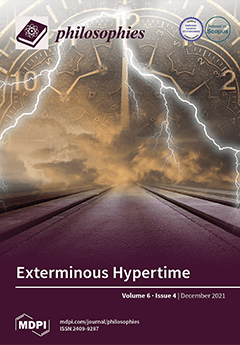
Cover Story: This paper discusses the “exterminous hypertemporal” model of time travel. Part one discusses what laws would govern exterminous hypertime, demonstrating that there are no problems with overdetermination. Part two examines a specific version of the model that, unlike some competing models, allows for time travelers going to different times. I also discuss how we can use it to make sense of certain time travel fictions. Part three discusses how to understand expectations and decision making at hypertemporal worlds. An appendix discusses how exterminous hypertime dovetails with different theories in the metaphysics of time (eternalism, growing block theory, etc.).View this paper
  • Issues are regarded as officially published after their release is announced to the table of contents alert mailing list .
  • You may sign up for email alerts to receive table of contents of newly released issues.
  • PDF is the official format for papers published in both, html and pdf forms. To view the papers in pdf format, click on the "PDF Full-text" link, and use the free Adobe Reader to open them.

Articles (27)

  • Article
  • Open Access
1 Citations
4,678 Views
16 Pages

Inductive thinking is a universal human habit; we generalise from our experiences the best we can. The induction problem is to identify which observed regularities provide reasonable justification for inductive conclusions. In the natural sciences, w...

  • Article
  • Open Access
2,657 Views
9 Pages

This article argues for a neural basis behind Edgar Allen Poe’s ‘Poetic Principle’ and Charles Olson’s ‘Projective Verse’ to create a more robust cross-disciplinary aesthetic model. Brian Boyd and Ellen Dissanayake...

  • Article
  • Open Access
1 Citations
10,410 Views
27 Pages

Douglas Harding developed a unique first-person experimental approach for investigating consciousness that is still relatively unknown in academia. In this paper, I present a critical dialogue between Harding, Sartre and Merleau-Ponty on the phenomen...

  • Article
  • Open Access
1 Citations
4,176 Views
7 Pages

Literacy is, literally, a question not of education but of the letter. More than that, it is the question of the letter in the two senses the word has in English: as a symbol of the alphabet and a piece of correspondence. It is my hypothesis that eco...

  • Article
  • Open Access
1 Citations
13,346 Views
16 Pages

In this article, I interpret Book V of the Nicomachean Ethics in which Aristotle presents a geometrical problem to explain which is the Best Criterion for the Distribution of Political and Economic Rights and Duties among Citizens, starting from the...

of 3

Get Alerted

Add your email address to receive forthcoming issues of this journal.

XFacebookLinkedIn
Philosophies - ISSN 2409-9287