


Abstract
Neonatal screening using Dried Blood Spot (DBS) cards is an important and successful public health facility in Europe, enabling early detection of congenital disorders for early treatment and prevention of overt disease. Biobanks of stored DBS cards offer significant potential for biomedical research. Biobanking and secondary use of DBS cards also raise ethical and legal issues, particularly concerning the rights of parents and children. This study provides a comprehensive overview of legislation and legal practices governing DBS biobanking across 29 European countries, based on a survey conducted in collaboration with the International Society for Neonatal Screening. Findings reveal a highly heterogeneous landscape: 15 countries have national legislation, five have regional guidelines, and nine lack formal regulations. Only four countries require explicit parental consent for DBS storage, with considerable variation in approval processes for research use. A harmonization of practices, with the European General Data Protection Regulation (GDPR) as a basis for future regulation, supplemented by clearer guidance on ‘public interest’ and robust safeguards for individual rights may lead to more transparent and consistent governance, which is essential to balance scientific progress with the protection of parental and children’s rights in DBS-based research across Europe.
1. Introduction
Neonatal screening is one of the cornerstones of public preventive health, ensuring that serious congenital disorders are identified within days of birth. This early detection allows for timely treatment, preventing severe disability or even death. The method is simple yet powerful: a few drops of blood from, usually collected from the heel of the baby on filter paper (a dried blood spot (DBS) card) shortly after birth, which enables laboratory analysis of a panel of disorders for which early treatment is available. The immediate intended use of the DBS cards is clinical, to ultimately diagnose and treat affected infants. Yet additionally, these DBS cards, containing DNA, RNA, proteins, and metabolites, hold great potential in secondary use for quality control, method development and biomedical research, both disease-oriented and population-wide, when stored in biobanks. For the purpose of this article, ‘biobank’ is the generic term for any storage of DBS cards, although it is recognized that ‘biobank’ can be defined differently depending on national legal and organizational regulations.
Denmark provides a striking example of the scientific value of such material. Newborn screening in Denmark is centralized at the Statens Serum Institute (SSI), where approximately 58,000 infants are screened each year for 25 congenital diseases [1]. Since 1981, all residual DBS cards have been stored systematically in the Danish National Biobank. Today, more than 2.5 million cards are preserved. In essence, this means that nearly every Danish citizen under the age of 45 has a sample archived [2]. This archive was initially intended primarily for quality assurance and retrospective diagnosis, but it soon became a foundation for research. Early studies demonstrated that DNA could be reliably extracted from filter paper and amplified, thereby opening the door to population-scale genetic research [3]. Indeed, research including genotyping, epigenetic profiling, next-generation sequencing, metabolomics, and RNA sequencing has meanwhile proven that these samples can be used in genetic studies [4,5,6,7]. Between 1981 and 2017, more than 50 projects have been approved, with over 180,000 DBS cards used for research [2]. The most notable of these, the iPSYCH project, genotyped 140,000 samples to explore the genetic and environmental basis of psychiatric disorders [8]. What makes this research particularly powerful is the ability to link biological data to nationwide registers through social security numbers. These registers encompass health records, demographics, education, income, and even life-course trajectories [9]. When combined with molecular data from the biobank, they enable studies on the interaction between genetics, environment, and social factors at a scale rarely possible elsewhere.
Yet such potential also comes with challenges. The use of residual DBS samples raises important ethical and legal questions and hence issues of consent, privacy, and the secondary use of material collected for clinical purposes are at the forefront of public debate [10]. Ultimately, there is the (rare) possibility that DBS cards are used for juridical purposes, demanding strict legal provisions. Although Danish law allows research use of DBS samples without explicit consent, provided that approval is obtained from a medical ethical review board, concerns have grown regarding transparency and data protection, particularly in light of the European General Data Protection Regulation (GDPR) [11]. The GDPR lists strict rules for organizations in the European Union (EU) that use personal data of individuals; it was established in 2016 and implemented in 2018.
These developments in Denmark trigger the research question of this study: How are similar issues handled in other European countries? It is well known that the practice of biobanking of DBS cards in Europe varies widely. A publication by the ISNS in 2021 indicated that 44 countries in Europe store DBS cards and 12 countries reported doing so with parental consent [12]. Another recent paper included a limited inventory of DBS card biobanks in South Eastern and Central European countries [13]. To further explore this, we evaluated in more detail how the biobanking and residual use of DBS samples is legally and ethically embedded in European countries, to identify good and best practice. In this study, we focus on two subjects: 1) the legal basis of biobanks and 2) the process of approval of an application for the secondary use of samples. We present an overview of the approaches in Europe and assess the potential for developing shared practice across Europe.
2. Materials and Methods
To investigate the international landscape of DBS storage and research use, a survey was conducted in collaboration with the International Society for Neonatal Screening (ISNS) [14].
2.1. Survey Instrument
The survey instrument was designed in MSForms (Microsoft, Redmond, WA) online version. The survey instrument consisted of 26 structured questions, designed to capture key aspects of both biobank infrastructure and governance (see Supplementary Materials).
Questions covered two main areas: storage practices and research use. Under storage, participants were asked whether DBS cards were kept after laboratory analysis for screening, whether and when consent is required (no specific distinction was made between opt-in and opt-out), when their biobank was established, how many samples were currently stored, and under what conditions (e.g., room temperature, −20 °C, etc.). They were also asked to report the age of their oldest stored cards.
The residual use of DBS cards was further examined through questions regarding the types of studies for which such use occurs. Additional questions addressed the ethical and legal frameworks governing the residual use of DBS samples, as well as the processes required for approval.
2.2. Study Population
The survey was distributed digitally on 11 December 2024 via an email link and was shared with a selected group of 64 participants in all European countries that were considered to be aware of the particulars of their NBS program across 51 countries. This group had previously been approached regularly to survey the current national and regional state of neonatal screening, and the summarized outcomes of their responses have been published previously [12]. Hence, this group was assumed to be able to also answer the questions on the survey of the current study. Nevertheless, respondents were encouraged to forward the survey within their professional networks to maximize the quality of responses. A reminder was sent to the non-respondents to motivate them to hand in their answers on 1 February 2025. After that, no additional reminders were pursued.
2.3. Processing and Analysis of Results
Results were collected in an online Excel sheet (MSExcel, Microsoft, Redmond, WA). Quantitative data (number of samples in biobank, oldest samples in biobank, storage time, storage temperature) were summarized and combined.
The outcomes of two research questions were analyzed qualitatively, namely:
- “What is the legal basis for residual use of DBS cards?” With the added instruction to be at liberty to answer in 3–10 lines and add links to prevailing rules and legislation if possible.
- “Please describe the process for approval to use DBS” again with the added instruction to feel at liberty to answer in 3–10 lines and also to elaborate on different approval grounds for different uses.
After the data compilation, author Sophie ter Braak and Christian Munch Hagen performed an initial narrative analysis and summary of the answers to the questions, especially to resolve small discrepancies in one instance in responses were received twice from the same respondent and one instance in which where answers were received for the same country from two different respondents. Then, this summary and narrative analysis were reviewed by the authors Peter Schielen and Mette Nyegaard to determine whether the summaries of the answers still reflected the original answers given by the respondents and that no meaning was lost. Summary results were mapped per country on a map of Europe.
When appropriate, information from respondents was used to find more elaborate information from open sources on the internet.
For presentation purposes, some truncated and abbreviated answers were adapted to make the text more readable (raw data is available upon request).
3. Results
After sending out the survey (December 2024) responses were received from respondents of 25 countries and regions and after one reminder (February 2025) four additional responses were received, totaling 29 countries/regions with responses. For Belgium, Germany, Hungary, Italy, Romania, and Spain, data from only some regions are available. NBS programs in these countries are organized regionally, and collecting data from all provinces of these countries was not feasible within the timelines of this study.
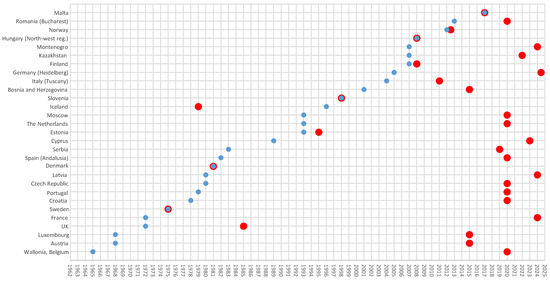
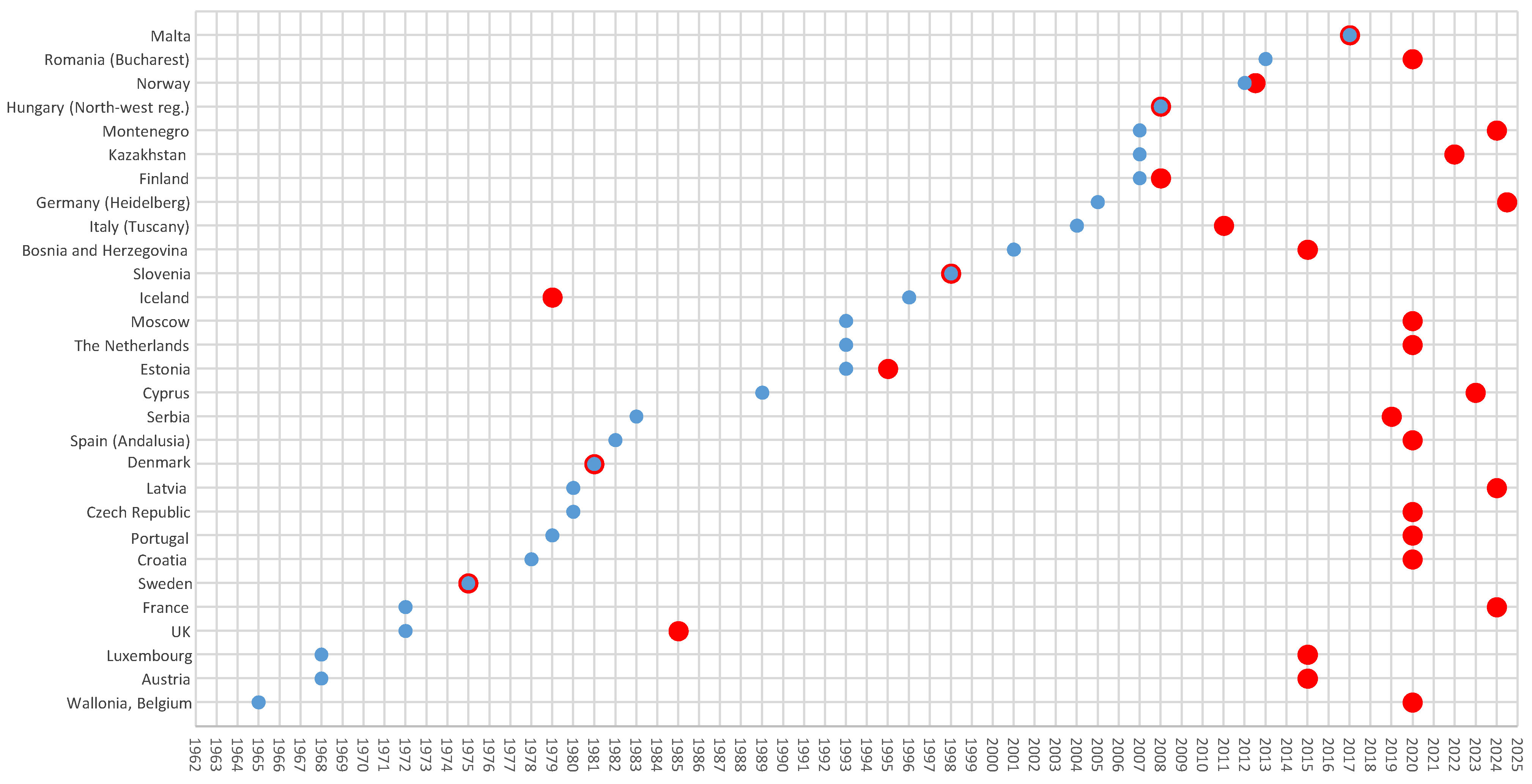
Figure 1 shows an overview of European countries with biobanks and the age of the oldest samples in the respective biobanks. DBS cards can be stored in separate facilities or in the screening laboratory. These are all considered DBS card biobanks in the current study.
Figure 1.
Overview of European countries with DBS card biobanks (sorted by year of establishment, blue symbols) and the storage year of the oldest cards in storage (red symbols; reference year: 2025).
Screening organizations and laboratories in The United Kingdom, Iceland (56,000 samples from 1979–1991 stored in the biobank of Staten Serum Institut, Copenhagen, Denmark), and Sweden hold old samples, going back sometimes over 50 years, but in most countries, samples are stored for 1–5 or 10 years. In the Netherlands, a small selection of NBS cards of interesting (often: confirmed) cases are stored for 12 years (with parental consent, to be renewed by the child at 12 years of age). The Norwegian biobank for DBS cards was established in 2003 but legal changes in 2018 resulted in the destruction of all cards prior to 2012, and DBS cards from 2012 onwards have since been stored henceforth without a set end date.
Relative and absolute size of biobanks
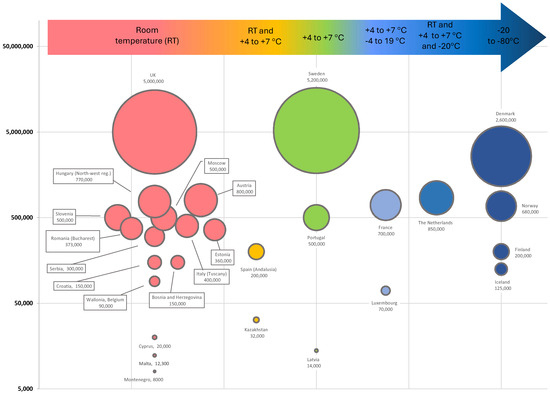
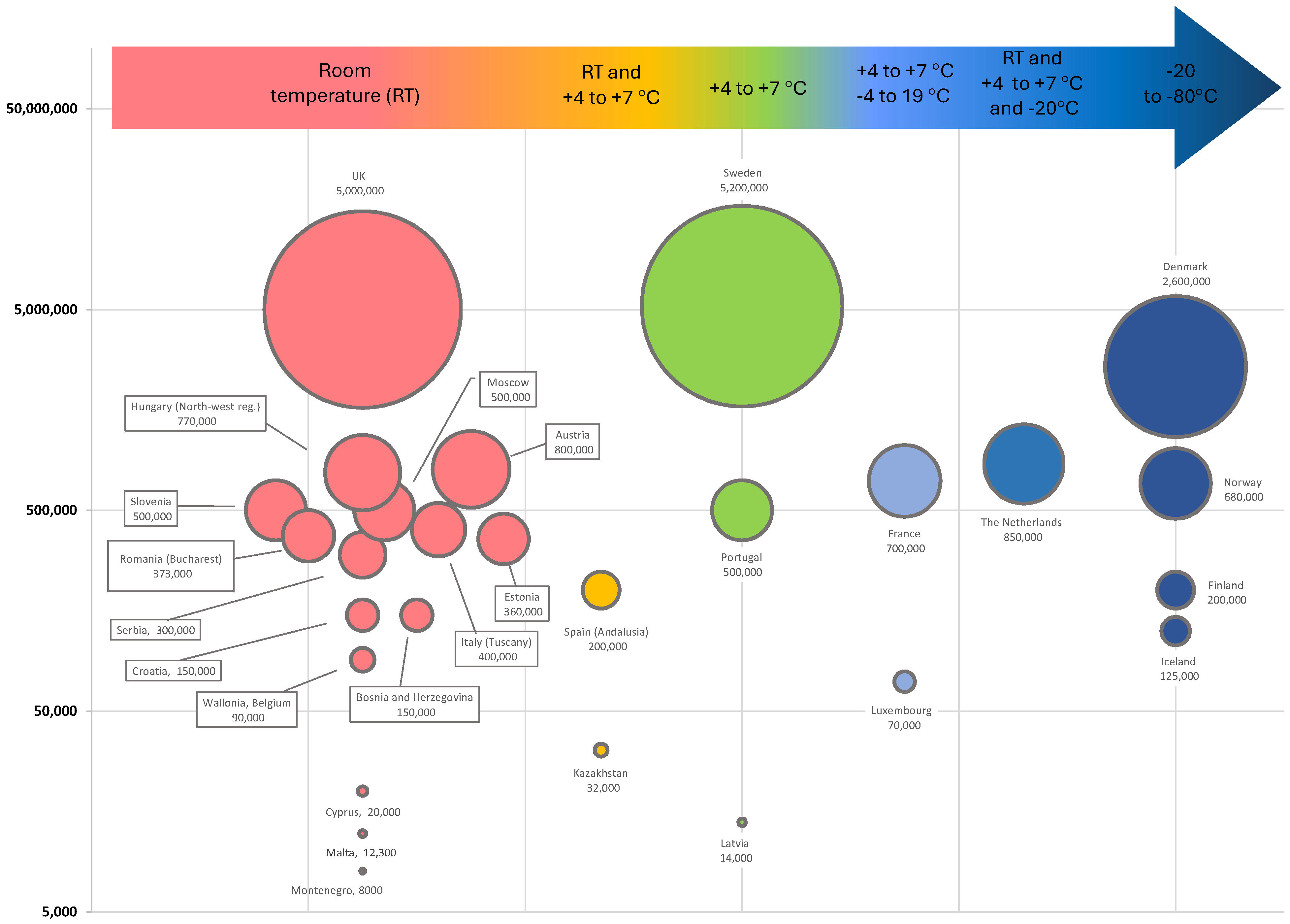
Figure 2 gives an overview of the number of DBS cards stored in biobanks and storage conditions per country.
Figure 2.
Number of DBS cards in biobanks in storage and storage conditions per country. The sizes of the biobank indicators (circles) are proportional to the total number of samples stored in each biobank. The circles are sorted along the horizontal axis from ambient to frozen. The color of the circles represents the storage conditions as presented by the matching color in the arrow. Note: Data from Germany (Heidelberg) and Czech Republic were not available.
A majority of 16 out of 29 respondents from countries/regions indicate that NBS cards are stored at room temperature (RT), and another six at RT and/or 4 to 7 °C. Seven respondents indicate they store samples frozen (either at −4 to −19 C or −20 to −80 °C). Notably, many countries apply two (or even three; the Netherlands) storage conditions, e.g., a first period at RT or 4 to 9 °C, and a second period when samples are stored frozen, often at −20 to −80 °C.
Four of 29 respondents indicated that samples were stored under dry conditions (less than 30% humidity). Seventeen of 29 respondents indicated that retrieval data (name/address, demographics of the baby, sample code, etc.) were digitized for ease of access to samples. In the UK it is mandatory to physically separate demographic data from the uniquely coded stored cards.
The data from Figure 2, taken together, represent a lower limit of the total number of DBS cards stored in European countries and regions and provinces. Thus it can be calculated that a minimum of 20.6 million DBS cards are stored in Europe, of which 4.5 million (21.6%) are stored frozen.
The handling and issuing of samples from biobanks that contain millions of DBS cards will demand resources. To get an impression of the availability of such resources, we asked whether sufficient funds and personnel are provided to handle applications for samples. Fourteen of 29 respondents (48.3%) answered ‘No’ to that question. Nine of 29 (31%) indicated that they were properly funded and 6 indicated that the number of requests was low or that costs were covered by research projects, implying that 51.2% of respondents had no funding issues for managing the issuing of DBS cards.
Legislative and regulatory aspects of biobanking
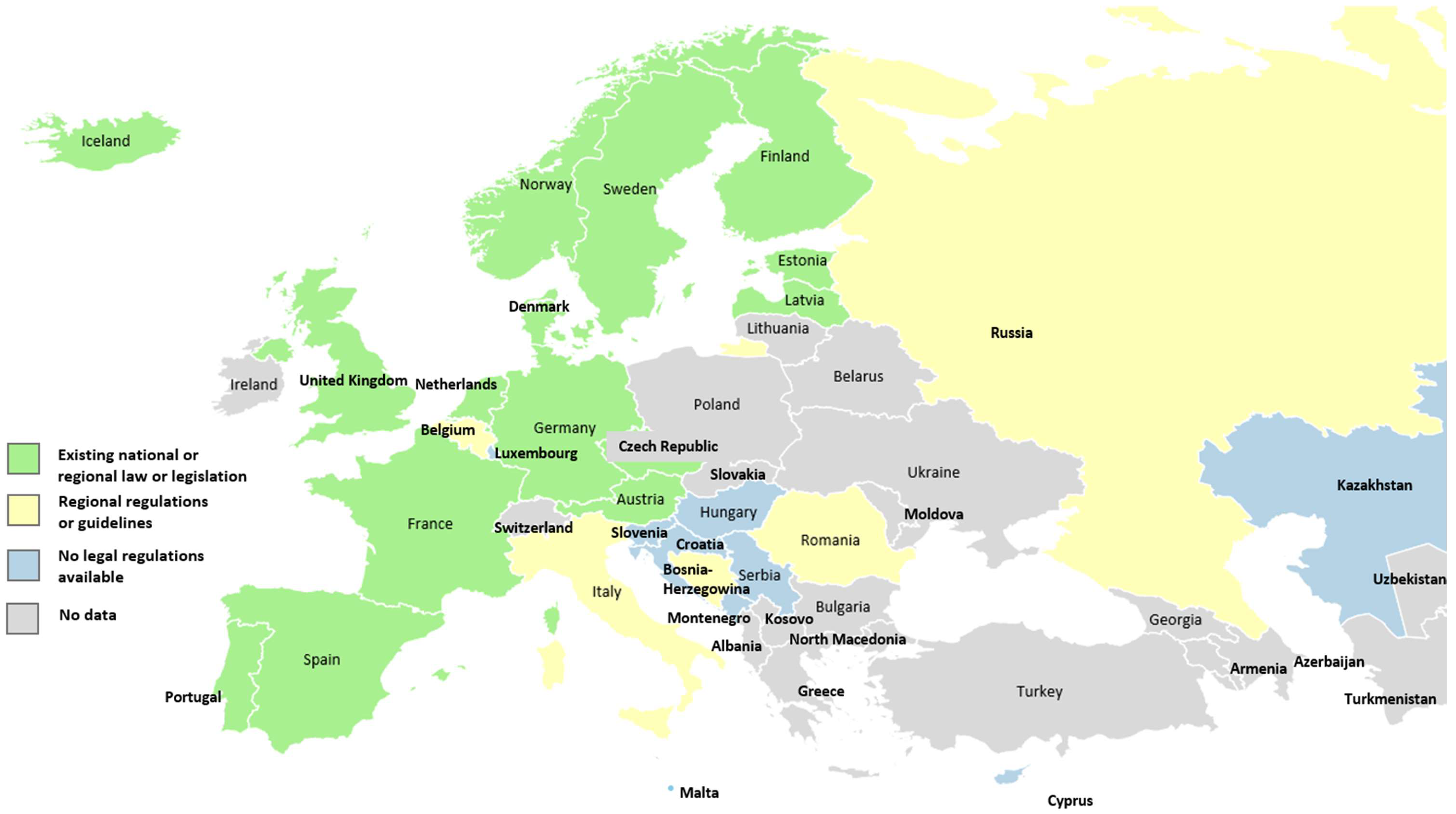
Table 1 and Figure 3 give an overview of various legislative and regulatory aspects of biobanking, where the color coding in both the table and Figure 3 is as follows: countries with national legislation: green; countries with regulations at a regional level: yellow; countries with no legal regulation present: blue; and no data received: grey. Of representatives of 19 of 51 countries, no reply was received.
Table 1.
Summarized answers of 29 European countries, representing national or regional responses to the survey questions: “What is the legal basis for residual use of dried blood spot cards?” and “What is the process for approval to use dried blood spot samples?” Green represents the presence of national law, yellow the presence of regional regulations, and blue the absence of any regulation. PKU = phenylketonuria; PKU Biobank stores the dried blood spot DBS cards. CMV = cytomegalovirus.
Figure 3.
Legal basis for residual use of DBS cards in European countries. Green: countries with national legislation; yellow: countries with regulation at a regional level; blue: countries with no legal regulations present; and grey: no data received.
Data from Table 1 illustrate that among the 29 countries included, 20 have a defined legal basis for residual DBS card use. Of these, 15 countries (in green in Table 1 and Figure 3) rely on nationally specified legislation, the Netherlands primarily also referring to the EU General Data Protection Regulation (GDPR). European law is considered here the highest order of law, as compared to national laws and regional regulation and guidelines. Five countries (in yellow in Table 1 and Figure 3), Belgium (more specifically; Wallonia), Bosnia and Herzegovina, Italy, Romania and Russia use guidelines of a lower order than national law and with only local applicability to guide biobanking and use of residual DBS cards. Legislation in Wallonia is again based on GDPR legislation. Sweden, France, Czech Republic, Spain, Germany, Estonia, Austria, Latvia, Iceland, Romania, the UK and Norway, follows national law specifically designed for biobanks and use of bodily tissues as their legal basis for residual use of DBS cards. Finland has national legislation that regulates the secondary use of samples and health data; however, the legislation does not contain any specific provisions regarding DBS cards. Respondents from Croatia, Cyprus, Hungary, Kazakhstan, Luxembourg, Malta, Montenegro, Serbia, and Slovenia indicate that they have no specific legal regulations for residual use.
Consent for storage
Three of 29 countries (Iceland, the Netherlands, and Spain) require explicit consent for a sample to be stored. In the Netherlands and Spain individuals retain the right to request removal of their DBS card (and associated data). In Norway and Sweden, consent is deemed to exist if the parents participate in the NBS program. In Norway, parents are recontacted when the child is two years old and the child at 16 years of age, informing them about the stored DBS card and indicating they can request destruction of the sample. In the Netherlands, for a small selection of samples stored for 12 years, consent needs to be renewed by the child when the child reaches 12 years of age. In Iceland, consent is irrevocable, but it is possible to request that samples are not used for research purposes. In Finland, the laboratory may store samples for internal quality control and method validation purposes. Under the Finnish Biobank Law, written consent is required for biobanking but samples stored at the laboratory are not considered a biobank under Finnish law. The Czech Republic constitutes a partial exception: DBS samples are mandatorily stored for five years, after which they are all destroyed.
Formal procedures for re-use of stored DBS cards
Regarding the approval processes for DBS card use, 24 countries have established formal procedures.
Four countries, Finland, Iceland, Latvia and Spain, require a high-order three-step approval for re-use for scientific purposes of DBS cards, namely individual or parental consent, ethics committee approval, and an additional form of authorization. Three countries (Czech Republic, Portugal and Italy) require at least parental consent and ethics committee approval. Five countries only require approval from an ethics committee, and three require only parental or legal guardian consent. Many different organizations can be involved in the authorization process, such as institutional approval in Latvia and Italy, application to the PKU Biobank in Sweden, Denmark and Spain, national committee approval in the UK, newborn screening reference group approval in Norway and detailed specified requests in Slovenia and the Netherlands. For medical purposes, retrospective analyses are generally accepted with either parental consent or a physician referral, or both (Sweden). It is of interest that most respondents indicate that stored DBS cards can be made the subject of legal procedure, but only by court order and applying very strict legal requirements.
Details of procedures in various countries give a more granular view of the many variations in approval procedures in Europe.
In Sweden, the approval process is dependent on the purpose. For instance, a physician’s referral, as well as patient or guardian oral consent, is needed for retrospective diagnosis for a patient while for research purposes it is mandatory to obtain approval from the Swedish Ethical Approval Authority, an approval which may be (but is not always) conditional on written informed consent. In Spain, for research purposes ethics approval, application to the PKU Biobank and parental consent is needed. For research with anonymized samples, however, such approval is not needed. In Estonia, the approval process is also dependent on the purpose. Secondary use for medical purposes or law enforcement requires parental permission, whereas use for laboratory quality improvements does not. Research additionally requires ethics committee approval. The same rules apply in Austria, in which ethical approval is required in the case of data reuse for research, however for quality assurance and cutoff studies no approval is needed. Residual use for research in Latvia requires approval from the ethics committee, the hospital, and the parents. Clinical tests require only oral parental permission.
4. Discussion
This study surveyed the legal basis for the residual use of DBS cards in Europe, and the procedures required for approval of such usage.
We invited 64 respondents from 51 European countries to fill in the survey. With representatives of 29 countries responding to the survey, we reached sufficient saturation to illustrate similarities and differences in European practice but we caution to overgeneralize; data of this study cannot be seen as being fully representative for all European countries and regions.
Data from Figure 1 and Figure 2 indicate that many European countries have biobanks and some have been founded decades ago. Roughly, biobanks mentioned in Figure 1 and Figure 2 together contain a minimum of 20.6 million samples, of which 4.5 million are stored frozen. From published literature [12,13] it can be derived that at least 18 other European countries have established biobanks, storing samples varying from less than 0.5 years to ‘indefinitely’, so the total number of stored samples in Europe may be many millions more.
This study shows that the vast majority of samples is stored at RT and only a minority of samples is stored at conditioned low humidity. It is well known, however, that most biomarkers measured in neonatal screening are vulnerable to high temperature and moist conditions [24]. The utility of massive storage of cards at RT may therefore be reconsidered, and replaced with a policy to store less DBS cards and matched controls but under superior storage conditions (dry and at −20 to −80 °C).
The findings of this study provide insight into how European countries navigate the balance between scientific opportunities, individual rights, and public trust. They also illustrate a heterogeneous regulatory landscape across Europe, highlighting the variation in legal frameworks and approval requirements for DBS card utilization, with possible gaps in medical ethical standards for biobanking and re-use of DBS cards.
The diversity in approval requirements suggests different ethical priorities. Countries emphasizing parental consent appear to place autonomy and family control at the center of decision-making. Others that allow access through ethics committee approval or institutional authorization may prioritize collective benefit and the facilitation of research. Systems requiring multiple levels of authorization, such as those in Finland, Iceland, Latvia and Spain, but also Norway, Sweden, Denmark and the Netherlands, reflect attempts to combine safeguards, but they also introduce procedural complexity that may hinder research efficiency.
The heterogeneity of governance has significant practical implications. Inconsistent standards make multinational research collaborations unmanageable, particularly for large-scale studies of rare diseases where cross-border sample sharing is necessary. Researchers may face additional administrative burdens, delays, or exclusions depending on the country of origin of the DBS samples. Conversely, permissive frameworks that minimize parental involvement risk generating mistrust, as illustrated by Denmark’s suspension of new DBS research projects after public concern, despite following the legal rules [10,25].
The findings underscore the pressing need for greater clarity and harmonization. Fragmentation not only complicates the work of researchers but also threatens the trust in neonatal screening programs themselves if parents perceive a lack of transparency regarding how residual samples are used. Effective governance must therefore strike a careful balance between safeguarding individual rights and enabling collective scientific progress. The legal practice of storing DBS cards in biobanks inevitably implies the management of personal data. Future regulation at the European level could build upon the GDPR. Since 25 May 2018, all member states should follow the European Data Protection Regulation with the goal to harmonize data privacy laws across Europe [11]. Both Belgium and the Netherlands base the residual use of individual data on the GDPR (Table 1).
Under the GDPR processing of personal data (including genetic and biometric data and health data) is generally prohibited, but there are several exceptions [26]. One of these exceptions is that data may be used for preventive or occupational medicine; for public health reasons, such as serious cross-border threats to health or ensuring safety of medicinal devices; and for archiving, scientific, historical, or statistical research purposes in the public interest, provided it protects fundamental rights also included in the GDPR [27].
In the context of the results of this study, depending on what country is considered, several of these exceptions may apply. The first pertains to situations in which explicit consent is obtained from the data subject or, where relevant, their legal guardian. A second exception arises where processing is justified on grounds of substantial public interest or public health. Lastly, data derived from DBS cards may be processed for scientific or statistical research purposes in the public interest, provided that such processing is conducted in accordance with Article 89 of the GDPR. This article requires that the use of identifiable data is limited to what is strictly necessary and demands the implementation of appropriate safeguards. Such safeguards include the application of pseudonymization, whereby identifiers are replaced with codes, or, where feasible, full anonymization. When anonymized data makes the research impossible, an exception can be made [27]. Realizing that many of the countries surveyed in this study are not European Union member states, we incline here that the provisions of the GDPR could help to build national or even regional frameworks for biobanking of DBS cards, respecting parents and child rights and still facilitating collaborative research to improve screening programs for all European countries. Building future regulation on the GDPR also presents certain challenges. Countries that rely mainly on GDPR face greater interpretative challenges, as GDPR was not designed with biobanking specifically in mind [11]. Its ideas about sensitive personal data and research exemptions are open to differing interpretations. Future initiatives should therefore place particular emphasis on clarifying the concept of ‘public interest,’ since this determines whether personal data may be used without consent. Rather than creating new laws, efforts should focus on providing clearer and more detailed guidance within the framework of the GDPR.
One facility that may become important in the near future to standardize the personal data underlying biobanking in European countries is the European Health Data Space (EHDS) [28]. Combining the legislation of the GDPR, and the European Data Governance Act, Data Act and Network and Information Systems Directive, the EHDS will facilitate the access of data and materials in European biobanks, guaranteeing the rights of European citizens, still enabling scientific research in a responsible way.
One other organization that may hold important information, expertise and support to better organize biobanks of DBS cards in Europe is the Biobanking and BioMolecular resources Research Infrastructure—European Research Infrastructure Consortium (BBMRI-ERIC; https://www.bbmri-eric.eu accessed on 5 April 2026) [29,30]. BBMRI-ERIC was established in 2013 under EU legislation and enables the development of innovative technology and processes as a cross-domain network that facilitates responsible access to high quality samples, data and biomolecular resources. Finally, the ISNS in 2025 has issued updated guidelines for neonatal bloodspot screening, including guidelines for biobanking [31].
The situation in Denmark regarding the storage and residual use of DBS cards was the starting point of this research. Access to biological samples from the Danish National Biobank (DNB) follows a structured approval process: researchers must first obtain permission from both a Danish Research Ethics Committee and their research institution, after which the DNB Coordinating Centre grants final authorization based on a project description and a detailed specification of the requested samples. This framework aligns with the requirements of the GDPR, which permits the processing of sensitive data when research is considered to be in the public interest. Consequently, the iPSYCH project, assuming to be in the public interest, is regarded as GDPR-compliant, even though it gave rise to public mistrust. The extent to which further safeguards were implemented to reduce the risk of re-identification remains difficult to conclude.
Limitations of this study are that data were gathered from twenty-nine countries, so not including all European nations, and possibly missing intra-country variation, particularly in regionally governed systems. In addition, sometimes participants responded for a region, province or even city within a country, so the data can be used only to a limited extent as an approximation for the entire country. Second, the data were self-reported by national representatives, which introduces the risk of bias, incomplete responses, or inconsistencies. Third, legal frameworks are evolving; for example, draft laws in Slovenia and Serbia are likely to reshape their governance landscapes.
5. Conclusions
In conclusion, this study reveals that while many European countries have taken steps to establish governance mechanisms for DBS use, the overall landscape remains fragmented. Without a clearer and more consistent framework, Europe may struggle to fully realize the scientific potential of DBS collections. The way forward lies in developing more clearly stated rules, based on the GDPR and using the groundwork already developed by BBMRI-ERIC and EHDS. Such a framework should integrate strong safeguards for individual rights while facilitating collaborative biomedical research. Given that screening disorders are rare disorders, European collaboration is necessary and ultimately, DBS-based research can only proceed and succeed if governance across Europe is transparent, trustworthy, and fair.
Supplementary Materials
The following supporting information can be downloaded at: https://www.mdpi.com/article/10.3390/ijns12030064/s1, Survey: 20260505_ISNS_survey_biobanking_2024–2025.
Author Contributions
Conceptualization, M.N. and P.C.J.I.S., methodology, M.N., P.C.J.I.S., D.W., O.M. and L.S.; formal analysis, C.M.H., S.t.B. and P.C.J.I.S.; data curation, C.M.H., S.t.B., P.C.J.I.S., all co-authors; writing—original draft preparation, S.t.B. and P.C.J.I.S.; writing—review and editing, all co-authors. All authors have read and agreed to the published version of the manuscript.
Funding
This research received no external funding.
Institutional Review Board Statement
Not applicable.
Informed Consent Statement
Not applicable.
Data Availability Statement
An Excel file with all raw data is available upon request to peter.schielen@isns-neoscreening.org.
Conflicts of Interest
Marie Bækvad-Hansen, James R. Bonham, Raquel Yahyaoui, Dianne Webster and Peter C. J. I. Schielen are the Editorial Board Members of the International Journal of Neonatal Screening. To ensure editorial independence, they had no involvement in the peer-review process or editorial decision for this manuscript. The other authors declare no conflicts of interest.
References
- Congenital Disorders. Available online: https://en.ssi.dk/about-us/contact/departments/c/congenital-disorders (accessed on 15 September 2025).
- Nørgaard-Pedersen, B.; Hougaard, D.M. Storage Policies and Use of the Danish Newborn Screening Biobank. J. Inherit. Metab. Dis. 2007, 30, 530–536. [Google Scholar] [CrossRef] [PubMed]
- Hollegaard, M.V.; Grauholm, J.; Børglum, A.; Nyegaard, M.; Nørgaard-Pedersen, B.; Ørntoft, T.; Mortensen, P.B.; Wiuf, C.; Mors, O.; Didriksen, M.; et al. Genome-Wide Scans Using Archived Neonatal Dried Blood Spot Samples. BMC Genom. 2009, 10, 297. [Google Scholar] [CrossRef] [PubMed]
- Hollegaard, M.V.; Grauholm, J.; Nørgaard-Pedersen, B.; Hougaard, D.M. DNA Methylome Profiling Using Neonatal Dried Blood Spot Samples: A Proof-of-Principle Study. Mol. Genet. Metab. 2013, 108, 225–231. [Google Scholar] [CrossRef] [PubMed]
- Bybjerg-Grauholm, J.; Hagen, C.M.; Khoo, S.K.; Johannesen, M.L.; Hansen, C.S.; Bækvad-Hansen, M.; Christiansen, M.; Hougaard, D.M.; Hollegaard, M.V. RNA Sequencing of Archived Neonatal Dried Blood Spots. Mol. Genet. Metab. Rep. 2016, 10, 33–37. [Google Scholar] [CrossRef] [PubMed]
- Hollegaard, M.V.; Grauholm, J.; Nielsen, R.; Grove, J.; Mandrup, S.; Hougaard, D.M. Archived Neonatal Dried Blood Spot Samples Can Be Used for Accurate Whole Genome and Exome-Targeted next-Generation Sequencing. Mol. Genet. Metab. 2013, 110, 65–72. [Google Scholar] [CrossRef] [PubMed]
- Ottosson, F.; Russo, F.; Abrahamsson, A.; MacSween, N.; Courraud, J.; Nielsen, Z.K.; Hougaard, D.M.; Cohen, A.S.; Ernst, M. Effects of Long-Term Storage on the Biobanked Neonatal Dried Blood Spot Metabolome. J. Am. Soc. Mass Spectrom. 2023, 34, 685–694. [Google Scholar] [CrossRef] [PubMed]
- Pedersen, C.B.; Bybjerg-Grauholm, J.; Pedersen, M.G.; Grove, J.; Agerbo, E.; Bækvad-Hansen, M.; Poulsen, J.B.; Hansen, C.S.; McGrath, J.J.; Als, T.D.; et al. The iPSYCH2012 Case-Cohort Sample: New Directions for Unravelling Genetic and Environmental Architectures of Severe Mental Disorders. Mol. Psychiatry 2018, 23, 6–14. [Google Scholar] [CrossRef] [PubMed]
- Schmidt, M.; Schmidt, S.A.J.; Sandegaard, J.L.; Ehrenstein, V.; Pedersen, L.; Sørensen, H.T. The Danish National Patient Registry: A Review of Content, Data Quality, and Research Potential. Clin. Epidemiol. 2015, 7, 449–490. [Google Scholar] [CrossRef] [PubMed]
- Nordfalk, F.; Ekstrøm, C.T. Newborn Dried Blood Spot Samples in Denmark: The Hidden Figures of Secondary Use and Research Participation. Eur. J. Hum. Genet. 2019, 27, 203–210. [Google Scholar] [CrossRef] [PubMed]
- General Data Protection Regulation (GDPR)—Legal Text. General Data Protection Regulation (GDPR). Available online: https://gdpr-info.eu/ (accessed on 15 September 2025).
- Loeber, J.G.; Platis, D.; Zetterström, R.H.; Almashanu, S.; Boemer, F.; Bonham, J.R.; Borde, P.; Brincat, I.; Cheillan, D.; Dekkers, E.; et al. Neonatal Screening in Europe Revisited: An ISNS Perspective on the Current State and Developments Since 2010. Int. J. Neonatal Screen. 2021, 7, 15. [Google Scholar] [CrossRef] [PubMed]
- Požun, N.; Perko, D.; Anastasovska, V.; Barić, I.; Baša, M.; Battelino, T.; Bilandžija, I.; Brincat, I.; Brkušanin, M.; Djordević, M.; et al. Current Status of Newborn Screening in Southeastern and Central Europe. Int. J. Neonatal Screen. 2026, 12, 14. [Google Scholar] [CrossRef] [PubMed]
- Home—ISNS. Available online: https://www.isns-neoscreening.org/ (accessed on 15 September 2025).
- Danish Ministry of Internal Affairs and Health. An Account on Biobanks; Summary in English; No. 1414; Danish Ministry of Internal Affairs and Health: Copenhagen, Denmark, 2002; pp. 245–248. [Google Scholar]
- Access to Biological Samples. Available online: https://www.danishnationalbiobank.com/access (accessed on 4 September 2025).
- Arrêté du 22 février 2018 relatif à l’organisation du programme national de dépistage néonatal recourant à des examens de biologie médicale. Available online: https://www.legifrance.gouv.fr/jorf/id/JORFTEXT000036650121 (accessed on 5 April 2026).
- Kinder-Richtlinie (in der Version mit Inkrafttreten vom 13.07.2024)|G-BA. Available online: https://www.g-ba.de/richtlinien/historie/3691/ (accessed on 4 September 2025).
- Dzemdību Palīdzības Nodrošināšanas Kārtība. LIKUMI.LV. Available online: https://likumi.lv/doc.php?id=140695 (accessed on 4 September 2025).
- Centrālās Medicīnas Ētikas Komitejas Nolikums. LIKUMI.LV. Available online: https://likumi.lv/doc.php?id=46597 (accessed on 4 September 2025).
- Genoma Izpētes Padomes Nolikums. LIKUMI.LV. Available online: https://likumi.lv/doc.php?id=92349 (accessed on 4 September 2025).
- Biobankslag. 2023. Available online: https://www.riksdagen.se/sv/dokument-och-lagar/dokument/svensk-forfattningssamling/biobankslag-202338_sfs-2023-38/ (accessed on 28 August 2025).
- Sverige, B. The Swedish Biobank Act. Biobank Sverige. Available online: https://biobanksverige.se/en/the-swedish-biobank-act/ (accessed on 15 September 2025).
- van Rijt, W.J.; Schielen, P.C.J.I.; Özer, Y.; Bijsterveld, K.; van der Sluijs, F.H.; Derks, T.G.J.; Heiner-Fokkema, M.R. Instability of Acylcarnitines in Stored Dried Blood Spots: The Impact on Retrospective Analysis of Biomarkers for Inborn Errors of Metabolism. Int. J. Neonatal Screen. 2020, 6, 83. [Google Scholar] [CrossRef] [PubMed]
- 140508@au.dk. Aarhus University Will Investigate the Possibility of Informing Danes in Research Project. Available online: https://ipsych.dk/en/translate-to-english-display/artikel/aarhus-universitet-vil-undersoege-muligheden-for-at-informere-danskere-i-forskningsprojekt (accessed on 15 September 2025).
- Art. 9 GDPR—Processing of Special Categories of Personal Data. General Data Protection Regulation (GDPR). Available online: https://gdpr-info.eu/art-9-gdpr/ (accessed on 16 September 2025).
- Art. 89 GDPR—Safeguards and Derogations Relating to Processing for Archiving Purposes in the Public Interest, Scientific or Historical Research Purposes or Statistical Purposes. General Data Protection Regulation (GDPR). Available online: https://gdpr-info.eu/art-89-gdpr/ (accessed on 16 September 2025).
- Available online: https://health.ec.europa.eu/ehealth-digital-health-and-care/european-health-data-space-regulation-ehds_en#what-is-the-timeline-for-the-implementation-of-the-ehds-regulation (accessed on 5 April 2026).
- Kaur, G.; Dandekar, S. (Eds.) Biobanking of Human Biospecimens: Principles and Practice, 1st ed.; Academic Press: Cambridge, MA, USA, 2017. [Google Scholar]
- Goisauf, M.; Martin, G.; Bentzen, H.B.; Budin-Ljøsne, I.; Ursin, L.; Durnová, A.; Leitsalu, L.; Smith, K.; Casati, S.; Lavitrano, M.; et al. Data in question: A survey of European biobank professionals on ethical, legal and societal challenges of biobank research. PLoS ONE 2019, 14, e0221496. [Google Scholar] [CrossRef] [PubMed]
- Webster, D.; Gaviglio, A.; Khan, A.H.; Baker, M.; Cheillan, D.; Chabraoui, L.; Abdoh, G.; Cabello, J.; Giugliani, R.; Platis, D.; et al. ISNS General Guidelines for Neonatal Bloodspot Screening 2025. Int. J. Neonatal Screen. 2025, 11, 45. [Google Scholar] [CrossRef] [PubMed]

Disclaimer/Publisher’s Note: The statements, opinions and data contained in all publications are solely those of the individual author(s) and contributor(s) and not of MDPI and/or the editor(s). MDPI and/or the editor(s) disclaim responsibility for any injury to people or property resulting from any ideas, methods, instructions or products referred to in the content. |
© 2026 by the authors. Published by MDPI on behalf of the International Society for Neonatal Screening. Licensee MDPI, Basel, Switzerland. This article is an open access article distributed under the terms and conditions of the Creative Commons Attribution (CC BY) license.