Article

Optimization of Triterpenoid Production in Floccularia luteovirens Liquid Culture Using Response Surface Methodology


1
Institute of Urban Agriculture, Chinese Academy of Agricultural Sciences, Chengdu 610299, China
2
Chengdu National Agricultural Science and Technology Center, Chengdu 610299, China
3
The Edible Fungi Research Institute, Shanghai Academy of Agricultural Sciences, Shanghai 201403, China
4
College of Food and Biological Engineering, Chengdu University, Chengdu 610106, China
*
Author to whom correspondence should be addressed.
These authors contributed equally to this work.
Horticulturae 2026, 12(3), 302; https://doi.org/10.3390/horticulturae12030302
Submission received: 30 January 2026 / Revised: 26 February 2026 / Accepted: 1 March 2026 / Published: 4 March 2026
(This article belongs to the Section Medicinals, Herbs, and Specialty Crops)

Abstract

The rare edible and medicinal mushroom Floccularia luteovirens faces challenges from limited wild resources and low triterpenoid yield in submerged fermentation. To address this, we systematically optimized the fermentation medium using one-factor-at-a-time experiments combined with Response Surface Methodology (RSM). Wheat flour, peptone, and KH2PO4 were identified as the optimal carbon, nitrogen, and inorganic salt sources, respectively. Subsequently, we developed and validated distinct, highly predictive mathematical models for intracellular (R2 = 0.9989) and extracellular (R2 = 0.9984) triterpenoid production. This yielded two optimized media: one designed to maximize intracellular accumulation (29.71 g/L wheat flour, 2.03 g/L peptone, 1.02 g/L KH2PO4), achieving a yield of 18.83 mg/g, and another tailored for high extracellular secretion (30.28 g/L wheat flour, 2.08 g/L peptone, 1.05 g/L KH2PO4), achieving a titer of 0.63 g/L. The experimental results for both targets closely matched the model predictions. Thus, this study not only significantly enhanced overall triterpenoid production but also delineated nutrient-specific strategies for targeting different product locales. The findings provide a reliable technical and theoretical foundation for the scalable and sustainable production of these bioactive compounds.

1. Introduction

Floccularia luteovirens is a rare edible and medicinal mushroom endemic to the alpine meadows of the Qinghai–Tibet Plateau. Its fruiting bodies are rich in highly bioactive metabolites, including polysaccharides, terpenoids, and ergothioneine [1]. Among these, triterpenoids serve as key pharmacological components. However, the sustainable utilization of this resource is severely constrained by the limited availability of wild specimens, a result of their specialized habitat, slow growth [2], and the current lack of viable artificial cultivation methods [3]. Consequently, developing an efficient and controllable bioprocess for the scalable production of its active compounds is an urgent priority to facilitate the exploitation of this fungal resource.
Submerged fermentation, valued for its short cycle, controllable conditions, and scalability, has become a cornerstone for producing mycelial biomass and metabolites from edible and medicinal fungi [4,5]. Compared to solid-state culture or wild harvesting, this technique not only enables rapid mycelial proliferation but also permits the targeted enhancement of specific secondary metabolites, including triterpenoids, through precise manipulation of culture parameters [6,7]. Preliminary studies have confirmed the presence of abundant terpenoids in the mycelium of F. luteovirens from liquid culture [8]. Genomic analyses further reveal a significant genetic potential in this species for synthesizing terpenoids and other secondary metabolites [9,10]. Critically, culture conditions (e.g., carbon and nitrogen sources) can modulate terpenoid biosynthesis by affecting the transcription of key genes such as terpene synthases [11,12]. This provides a molecular rationale for enhancing triterpenoid yield through medium optimization.
Among fungal secondary metabolites, terpenoids are classified by the number of isoprene units into monoterpenes, sesquiterpenes, diterpenes, triterpenes, and others. Triterpenoids, predominantly found in certain basidiomycetes and often biosynthesized from lanosterol, exhibit diverse bioactivities such as antitumor and immunomodulatory effects [13]. To clearly analyze the triterpenoid components in the fermentation mycelium of the F. luteoviren, this study selected oleanolic acid (a representative pentacyclic triterpenoid compound) as the standard substance for quantitative analysis, in order to ensure the specificity and accuracy of the detection method. Beyond triterpenes, sesquiterpenes isolated from F. luteovirens also demonstrate notable antioxidant and antimicrobial activities [14], underscoring the broad potential of this species for natural product development.
Foundational research on medium optimization for F. luteovirens has been established. Early work focused on preliminary screening of carbon and nitrogen sources [15], later expanding to factors like inorganic salts, pH, and temperature [16,17]. However, existing studies have predominantly employed one-factor-at-a-time and orthogonal array designs [18,19,20]. These approaches are inherently limited in their capacity to systematically unravel the complex interactions among core nutritional factors (e.g., carbon, nitrogen, and inorganic salts) or their synergistic effects on the triterpenoid biosynthetic pathway. This gap in understanding the multi-factor mechanistic interplay hinders further process optimization and breakthroughs in product yield.
Response Surface Methodology (RSM), a robust statistical optimization strategy, effectively identifies optimal factor combinations and their interactions by constructing mathematical models between multiple variables and responses. It has demonstrated considerable utility in optimizing microbial fermentation processes [21,22,23]. Building on this, the present study aims to systematically optimize the fermentation medium for F. luteovirens liquid culture using RSM. Core nutritional factors (carbon, nitrogen, and inorganic salts) influencing mycelial growth and triterpenoid synthesis will first be screened via single-factor experiments. A Box–Behnken design will then be employed to investigate their interactions and establish predictive models with mycelial biomass and intra- and extracellular triterpenoid yields (expressed in terms of oleanolic acid) as key responses. The ultimate goal is to obtain a high-performance, stable medium formulation, thereby providing a solid theoretical foundation and a practical technical framework for enhancing the fermentative production and enabling the scalable exploitation of triterpenoids from F. luteovirens.

2. Materials and Methods

2.1. Materials

2.1.1. Test Strain

The test strain S4-1 was derived from wild F. luteovirens fruiting bodies collected in Zhuoni County (102°46–104°02′ E, 34°10′–35°10′ N) in August 2022. The pure culture was established via tissue isolation and confirmed by ITS molecular identification and subsequently deposited at the Institute of Urban Agriculture, Chinese Academy of Agricultural Sciences.

2.1.2. Reagents

Potato Dextrose Broth (PDB) powder medium and agar (Guangdong Huankai Microbial Sci. & Tech. Co., Ltd., Guangzhou, China). Reverse osmosis (RO) water and double-distilled water (ddH2O) were prepared in our laboratory.
Oleanolic acid (AR, purity ≥ 98%, HPLC grade) and vanillin (AR, 99%) (Aladdin Reagent Co., Ltd., Shanghai, China). Glacial acetic acid (AR) (Tianjin Aopusheng Chemical Co., Ltd., Tianjin, China). Absolute ethanol (AR), perchloric acid (AR), and methanol (AR) (Kelong Chemical Reagent Co., Ltd., Chengdu, China). Seventy-five percent ethanol was prepared in our laboratory.
DNA marker, Tris, and 50× TAE buffer (Biosharp Life Sciences, Hefei, China). The Plant DNA Extraction Kit (TSINGKE Biotechnology Co., Ltd., Beijing, China). Single-strand cDNA synthesis kit and dye-based quantitative PCR kit (Quanshijin Biotechnology Co., Ltd., Beijing, China).

2.2. Methods

2.2.1. Strain Isolation and Purification

Pure cultures were obtained using the tissue isolation method. In a laminar flow cabinet, the surface of wild mushroom fruiting bodies was wiped with cotton balls soaked in 75% ethanol. The junction between the stipe and pileus was carefully split open, and multiple rectangular sections were excised from this region using a sterile scalpel. These tissue pieces were promptly picked with an inoculation needle and transferred to the center of PDA (Potato Dextrose Agar) medium plates, followed by incubation in the dark at 25 °C. After mycelial germination, purification was carried out using the hyphal-tip isolation method. This process was repeated multiple times until robust and contamination-free single colonies were obtained. The purified strains were then stored at 4 °C for subsequent use.

2.2.2. Morphological Identification

The collected wild fruiting bodies were subjected to macroscopic morphological observation, with particular attention paid to characteristics such as fruiting body size, color, lamellar arrangement, and the presence or absence of an annulus. Following strain isolation and purification, the slide culture method was employed to observe mycelial characteristics. Sterile cover slips were inserted into the medium at a 45° angle; after mycelial growth had extended onto the slips, the mycelial morphology and the presence of clamp connections were examined under a light microscope.

2.2.3. ITS Identification

Mycelial DNA was extracted using a DNA extraction kit. PCR amplification was performed with the fungal universal primers ITS1 and ITS4. The PCR reaction system is shown in Table S1 After electrophoresis detection of the PCR amplification products using 1.5% agarose gel, the target bands were excised and sent to TSINGKE Biotechnology Co., Ltd. (Chengdu, China) for purification and bidirectional sequencing. The obtained ITS gene sequences were submitted to the NCBI database, and homology analysis was conducted using the BLAST (Blast+2.14.0) algorithm. Phylogenetic comparison with reference sequences deposited in GenBank was performed to determine the taxonomic status of the tested strain. The sequences of the universal ITS primers are as follows:
ITS1: 5′—TCCGTAGGTGAACCTGCGG—3′
ITS4: 5′—TCCTCCGCTTATTGATATGC—3′

2.2.4. Preparation of Basal Media and Seed Culture

Solid plate culture (for strain activation and maintenance): A solid medium, prepared according to a formula previously optimized by our research group, was sterilized at 121 °C for 20 min using an autoclave. The preserved S4-1 strain was first activated on this medium. Subsequently, mycelial plugs (0.8 cm in diameter) were aseptically obtained from the actively growing edge of the colony using a cork borer and inoculated onto fresh solid plates. The inoculated plates were sealed and incubated in the dark at 25 °C in a constant temperature and humidity incubator for 25 days.
Liquid primary seed culture: Potato Dextrose Broth (PDB) powder was dissolved in reverse osmosis (RO) water to prepare the primary seed culture medium. Aliquots of 150 mL were dispensed into 250 mL Erlenmeyer flasks. To initiate the liquid culture, 15 sterile mycelial plugs (0.8 cm diameter) from healthy, uncontaminated solid plates were inoculated into each flask. The cultures were then incubated in a rotary shaker incubator at 25 °C and 125 rpm under dark conditions for 7 days.

2.2.5. Experimental Design Strategy and Fixed Culture Conditions

The optimization strategy in this study was conducted in two steps: first, one-factor-at-a-time experiments were employed to screen for key medium components that significantly influence mycelial growth and triterpene accumulation; subsequently, response surface methodology was applied to analyze the interactions and optimize the concentrations of the selected key factors. Throughout the optimization process, to focus specifically on the effects of medium composition, the following culture conditions were kept constant in all experiments: initial pH (unadjusted, natural), temperature (25 °C), agitation speed (125 rpm), filling volume (100 mL in 250 mL flasks), inoculum size (10%, v/v), and fermentation time (20 days) under dark. These conditions were selected based on preliminary experiments in our laboratory and were confirmed to be suitable for the basal growth of the fungus. We acknowledge that these fixed process parameters may have the potential for further optimization and that there may be interactive effects between them and the medium components. This represents a limitation of the current study and an important direction for future investigations.

2.2.6. Carbon Source Screening

Based on prior research in our group, four carbon sources—corn flour, wheat flour, sucrose, and brown sugar—were evaluated at concentrations of 10, 20, 30, and 40 g/L. The nitrogen source and inorganic salt were fixed at 2 g/L peptone and 0.5 g/L KH2PO4, respectively. For each treatment, 100 mL of the respective medium was prepared in a 250 mL conical flask and sterilized. The 7-day-old liquid primary seed culture was homogenized using a sterile blender. Subsequently, 10 mL of this homogenized inoculum was aseptically transferred into each flask, and subsequent cultivation conditions were identical to those described in Section 2.2.5.

2.2.7. Nitrogen Source Screening

Three nitrogen sources—peptone, yeast extract, and (NH4)2SO4—were tested at concentrations of 1, 2, 3, and 4 g/L. The medium contained a fixed concentration of brown sugar (20 g/L) as the carbon source and KH2PO4 (0.5 g/L) as the inorganic salt. The media preparation, inoculation (with 10 mL of homogenized 7-day-old seed culture per 100 mL medium), and subsequent cultivation conditions were identical to those described in Section 2.2.5.

2.2.8. Inorganic Salt Screening

Three inorganic salts—KCl, MgSO4, and KH2PO4—were selected for evaluation at concentrations of 0, 0.5, 1.0, and 1.5 g/L. The basal medium contained fixed concentrations of brown sugar (20 g/L) as the carbon source and peptone (2 g/L) as the nitrogen source. The media preparation, inoculation procedure, and cultivation conditions followed the same protocol as detailed in Section 2.2.5.

2.2.9. Estimation of Mycelial Biomass

After the 20-day cultivation period, the entire culture broth from each flask was vacuum-filtered to separate the mycelia from the spent medium. The harvested mycelial mat was thoroughly washed three times with distilled water and then dried to a constant weight in an oven at 65 °C. The dry weight of the mycelial biomass for each sample was recorded.

2.2.10. Determination of Intracellular and Extracellular Triterpenoid Content

The total triterpenoid content was determined by spectrophotometry and expressed in the form of oleanolic acid equivalent (OAE). This method was based on the relative estimation of the total triterpenoid content for the standardized compounds, while taking into account the structural diversity of triterpenoid compounds in the samples. The quantification of total triterpenoids was performed using a colorimetric method adapted from Shen et al. [24], which is based on the assay described in the Pharmacopoeia of the People’s Republic of China (2020 Edition, Volume I) for Ganoderma triterpenoids and sterols [25], with minor modifications.
Preparation of the Standard Curve: Aliquots (0.1, 0.2, 0.3, 0.4, and 0.5 mL) of the oleanolic acid standard solution were precisely transferred into separate 15 mL screw-cap tubes. The solvent was evaporated, and the tubes were cooled. Subsequently, 0.2 mL of freshly prepared 5% (w/v) vanillin-glacial acetic acid solution and 0.8 mL of perchloric acid (AR) were added sequentially. The mixture was vortexed, heated in a 70 °C water bath for 15 min, and then immediately cooled in an ice bath for 10 min. After cooling, 5 mL of glacial acetic acid was added, and the mixture was vortexed again. The absorbance was measured at 546 nm using a spectrophotometer, with a reagent blank as the reference. A standard curve was plotted with absorbance as the y-axis and oleanolic acid mass as the x-axis.
Preparation and Analysis of Intracellular Samples: Grind and pulverize the mycelium that has been dried at 65 °C, pass it through a 100-mesh sieve, and accurately weigh the powder remaining on the sieve for subsequent ethanol extraction. Intracellular triterpenoids were extracted by adding absolute ethanol at a solid-to-solvent ratio of 1:100 (g:mL), followed by ultrasonication and filtration. A 0.2 mL aliquot of the filtrate was transferred to a 15 mL screw-cap tube. The procedure followed the “evaporation” step and subsequent steps as described for the standard curve preparation. The absorbance was measured, and the triterpenoid content (expressed as OAE) in the sample was calculated from the standard curve. The total intracellular triterpenoid content was calculated using the following formula:
Total intracellular triterpenoid content (mg/g dry biomass) = (m1/V1) × (Ve/m)
where m1 = mass of triterpenoids in the measured aliquot (μg, derived from the standard curve);
V1 = volume of the aliquot taken for analysis (mL; in this study, V1 = 0.2 mL);
Ve = total volume of extraction solvent used (mL; in this study, with a 1:100 solid-to-solvent ratio, if m = 0.1 g, then Ve = 10 mL);
m = dry mass of mycelial powder used for extraction (g).
This product, calculated on a dry basis, contains triterpenoids and sterols, expressed as oleanolic acid (C30H48O3).
Preparation and Analysis of Extracellular Samples: The filtered fermentation broth was mixed with absolute ethanol at a ratio of 1:4 (v:v, broth:ethanol), followed by ultrasonication and filtration to obtain the sample extract. A 0.2 mL aliquot was then processed and analyzed identically to the intracellular samples, starting from the evaporation step. The extracellular triterpenoid content was calculated using the following formula:
Total extracellular triterpenoid content (mg/L fermentation broth) = (m1/V1) × (Vt/V_broth)
where: m1 = mass of triterpenoids in the measured aliquot (μg, derived from the standard curve);
V1 = volume of the aliquot taken for analysis (mL; in this study, V1 = 0.2 mL);
Vt = total volume of the extraction mixture (mL; Vt = V_broth + V_ethanol, where V_ethanol is the volume of ethanol added for extraction);
V_broth = volume of the original fermentation broth contained in the total extraction mixture (mL; if V_broth = 5 mL and V_ethanol = 20 mL (1:4 ratio), then Vt = 25 mL).
This product, calculated on a liquid basis, contains triterpenoids and sterols expressed as oleanolic acid (C30H48O3).
Detailed definitions of all variables used in the quantification formulas, along with their respective units and applications, are provided in Supplementary Table S2.

2.2.11. Single-Factor Experiment Data Analysis

Data from the single-factor experiments were processed using Microsoft Excel 2016 and SPSS 24.0 software for statistical analysis, including significance testing (e.g., ANOVA). Graphs were generated using Origin 2021 software.

2.2.12. Response Surface Methodology (RSM) Optimization

Based on the optimal types of carbon source, nitrogen source, and inorganic salt identified in the preliminary single-factor screenings, Response Surface Methodology (RSM) was employed to optimize their respective concentrations. A three-factor, three-level Box–Behnken design (BBD) was constructed using Design-Expert software (Version 13). The independent variables were the concentrations of the carbon source, nitrogen source, and inorganic salt. The response variables were mycelial biomass and intra- and extracellular triterpenoid content, with the optimization goal set to maximize these responses comprehensively. The specific factors and their corresponding levels for the RSM experiments are presented in Table 1, while the detailed experimental parameters and results are provided in the Supplementary Materials (Tables S3 and S4).

2.2.13. Validation Experiment

Based on the predictive models generated by the Response Surface Methodology (RSM) software (Design-Expert version 13.0), with intracellular and extracellular triterpenoid yields as the target responses, the optimal theoretical medium composition was determined. A subsequent validation experiment was then conducted by preparing and inoculating the culture medium according to this predicted optimal combination. The actual triterpenoid yields obtained were measured and compared against the model’s predictions to verify its accuracy and reliability.

2.3. Data Processing and Statistical Analysis

Experimental data were processed and subjected to significance analysis using Excel 2016 and SPSS 24.0 software. The main factors influencing the fermentation medium formulation for the F. luteovirens liquid inoculum were analyzed using the Box–Behnken design-based Response Surface Methodology. Data analysis and graphical representations were performed using Origin 2021 and Design-Expert 13 software.

3. Results

3.1. Morphological Identification Analysis

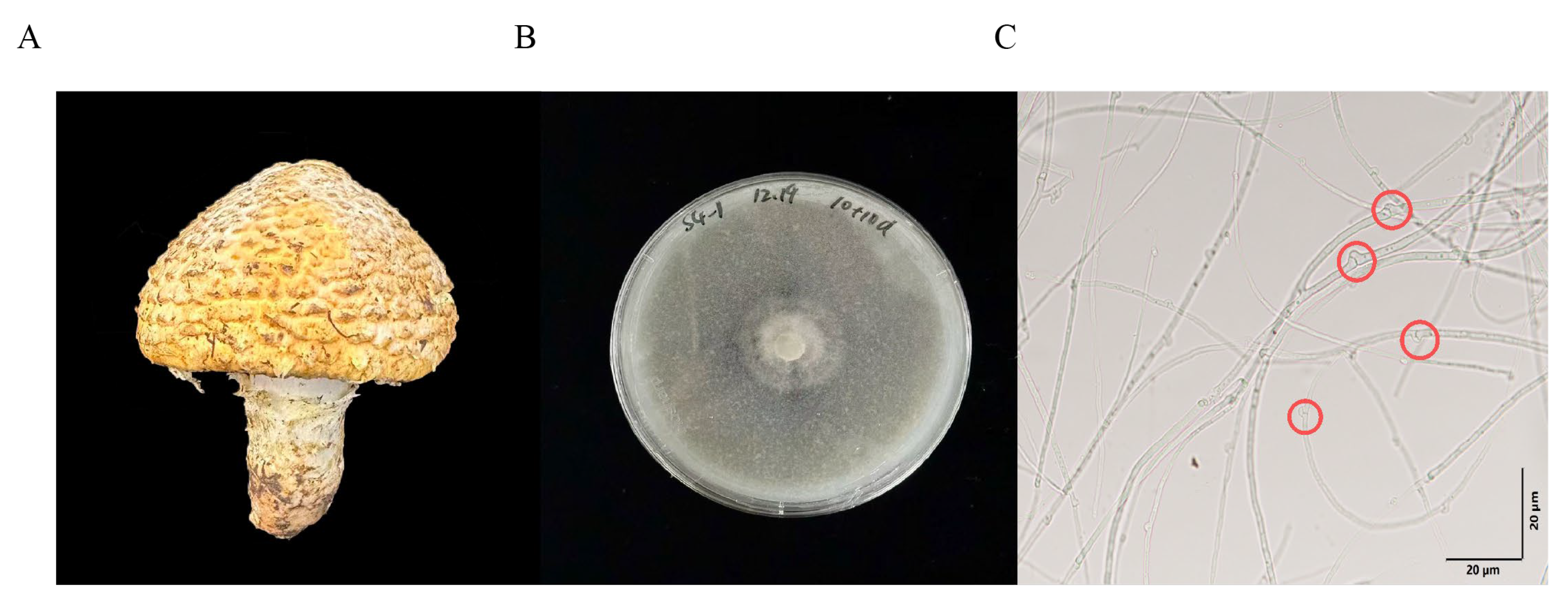
As shown in (Figure 1A), the wild fruiting body of F. luteovirens used for tissue isolation exhibited a scaly pileus surface, with context ranging from white to light yellow in color and a strong aromatic odor. The lamellae were yellow and adnate. The stipe was cylindrical with a slightly enlarged base, featuring spirally arranged flocci and remnants of the veil on its surface. Based on these morphological characteristics, the collected wild mushroom was preliminarily identified as F. luteovirens.
The isolated strain, designated as S4-1, was obtained through tissue isolation. On glucose medium, the colonies exhibited irregular margins, with white mycelia showing prostrate growth in (Figure 1B). Observation of mycelial morphology using the slide culture method revealed distinct clamp connections under light microscopy (Figure 1C), indicating that the mycelium consisted of dikaryotic hyphae capable of sexual reproduction.

3.2. ITS Sequence Analysis

The target gene fragment was successfully amplified from the isolated strain by PCR using universal ITS primers following total DNA extraction. Agarose gel electrophoresis revealed a single, clear amplification product (Figure S1). Sequencing analysis showed that the amplified ITS fragment was 665 bp in length. BLAST homology comparison of the ITS sequence from strain S4-1 against the GenBank database exhibited 100% sequence identity with the reference sequence of F. luteovirens (accession number: JQ846349.1) (Figure S2). Therefore, the isolated strain S4-1 was unequivocally identified as F. luteovirens.

3.3. Establishment of the Standard Curve

Following the protocol described in Section 2.2.6, a standard curve was constructed by plotting the measured absorbance at 546 nm against the corresponding mass of the oleanolic acid standard. The calibration exhibited a strong linear relationship, characterized by the regression equation y = 5.7241x − 0.0333 with a coefficient of determination (R2) of 0.9913. This result confirms a reliable linear response within the tested concentration range. The standard curve for oleanolic acid quantification presented in Figure S3 in the Supplementary Materials.

3.4. Screening of Carbon Sources

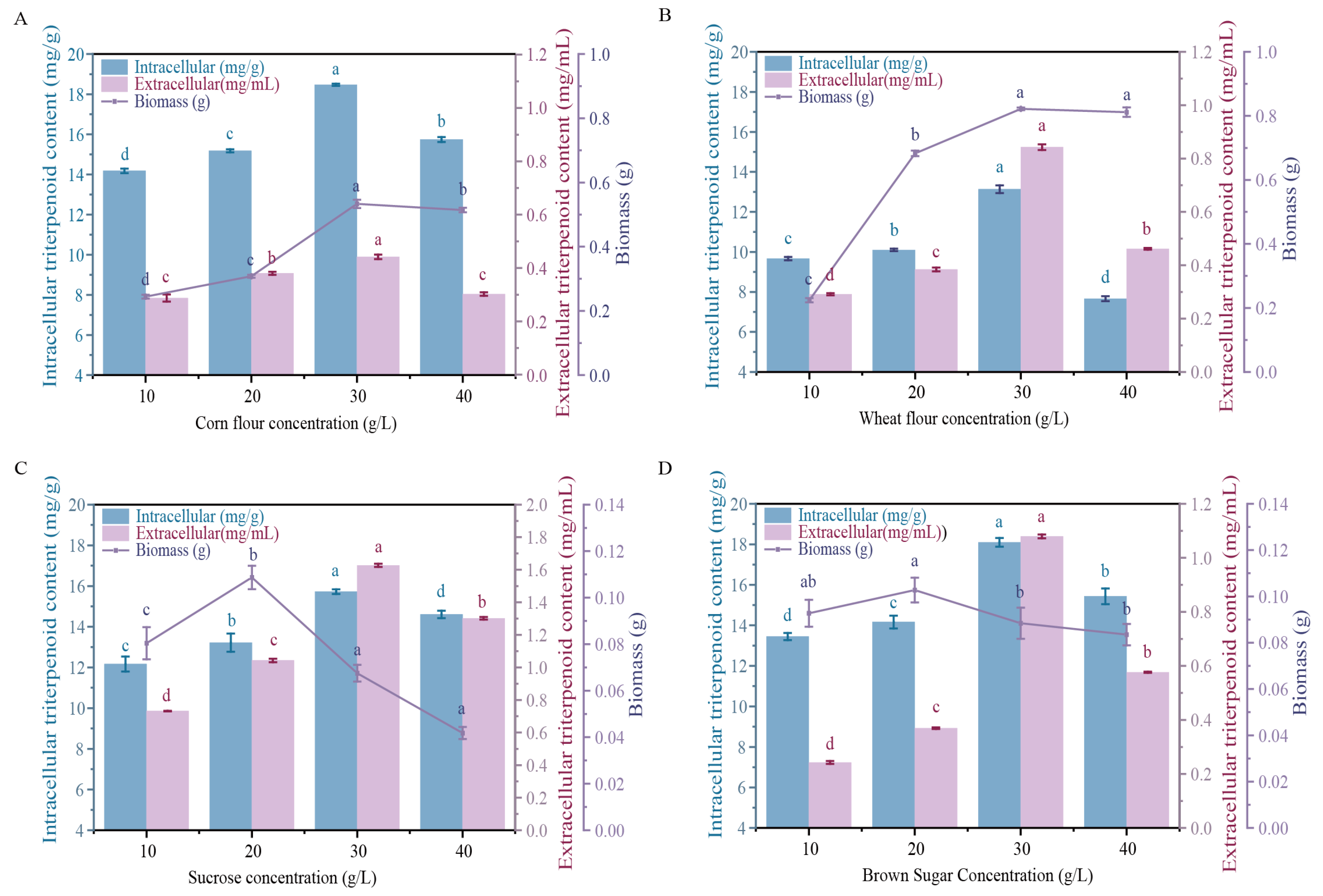
The effects of different carbon sources on the mycelial biomass, intracellular triterpenoid content, and extracellular triterpenoid content of F. luteovirens were investigated, as shown in Figure 2A–D. The experimental data revealed that the mycelial biomass was significantly higher when corn flour or wheat flour was used as the carbon source, compared to sucrose or brown sugar. Notably, wheat flour at a concentration of 30 g/L supported the maximum mycelial biomass of 0.82 g, demonstrating a pronounced advantage.
With respect to triterpenoid metabolism, the influence of carbon sources varied. The intracellular triterpenoid content was highest with corn flour, followed by brown sugar, sucrose, and was relatively lower with wheat flour. In contrast, the extracellular triterpenoid content was highest with sucrose, followed by brown sugar, wheat flour, and corn flour. A comprehensive analysis integrating both mycelial biomass and triterpenoid accumulation indicated that the highest total triterpenoid yield was achieved with wheat flour at 30 g/L.
Consequently, wheat flour was identified as the optimal carbon source for the cultivation of F. luteovirens. At a concentration of 30 g/L, it not only maximized mycelial biomass but also maintained both intra- and extracellular triterpenoid contents at relatively high levels, resulting in an overall favorable production outcome.

3.5. Screening of Nitrogen Sources

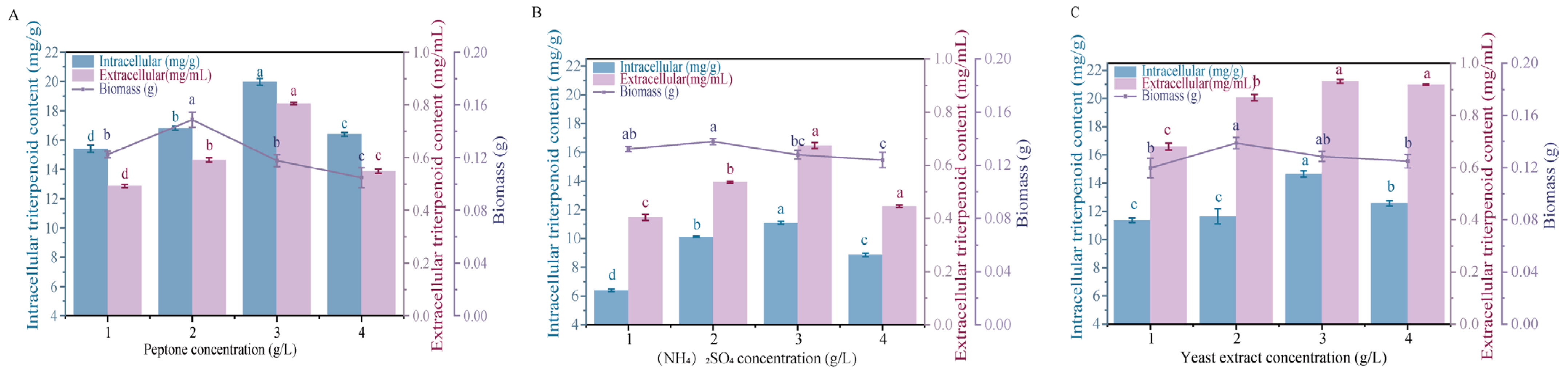
To further elucidate the influence of nitrogen sources on the growth and triterpenoid synthesis of F. luteovirens, this study compared the effects of peptone, yeast extract, and (NH4)2SO4 (Figure 3A–C). Analysis showed no significant differences in mycelial biomass among the different nitrogen source treatments. Notably, however, the total triterpenoid yield varied substantially, with the observed ranking being peptone > yeast extract > (NH4)2SO4. This order indicates that organic nitrogen sources confer a significantly greater promotion effect on triterpenoid production than inorganic sources. Among them, peptone most effectively enhanced the synthesis of intracellular triterpenoids. Further analysis of the concentration effect revealed that the maximum mycelial biomass was achieved at a peptone concentration of 2 g/L, while both intra- and extracellular triterpenoid contents peaked at 3 g/L. By integrating the factors of mycelial growth and triterpenoid accumulation, a peptone concentration of 3 g/L was ultimately selected as the optimal nitrogen source condition for subsequent studies.

3.6. Screening of Inorganic Salts

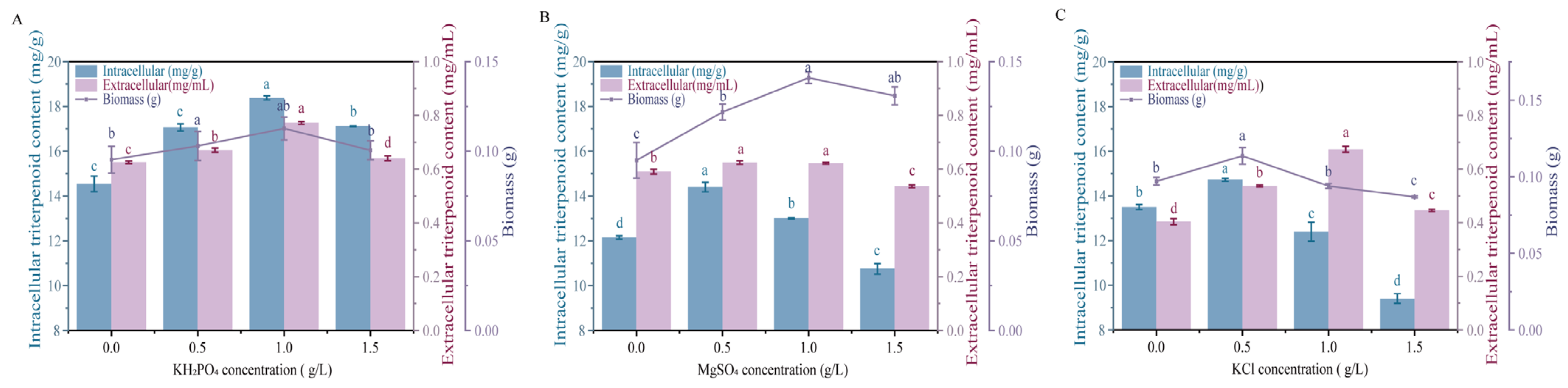
The effects of different inorganic salts were compared (Figure 4A–C). The results demonstrated that the use of KH2PO4 resulted in a significantly higher mycelial dry weight and a concomitantly higher triterpenoid yield compared to other treatments, establishing it as the optimal inorganic salt type. Further investigation into the concentration effect of KH2PO4 showed that both triterpenoid production and mycelial biomass increased with its concentration up to a peak at 1.0 g/L, beyond which further increases led to a decline in both parameters. This trend suggests that excessively high K+ concentrations may inhibit both mycelial growth and triterpenoid biosynthesis. Based on the collective data, the optimal concentration of KH2PO4 was determined to be 1.0 g/L.

3.7. Results and Analysis of Response Surface Optimization

Based on the screening results from the single-factor experiments, the fermentation medium composition for the liquid inoculum of F. luteovirens was further optimized using response surface methodology. A three-factor, three-level experimental design was established with wheat flour (A), peptone (B), and KH2PO4 (C) as the independent variables, as detailed in Section 2.2.8. The intracellular and extracellular triterpenoid contents of F. luteovirens mycelia were selected as the response variables, denoted as Y1 and Y2, respectively. A Box–Behnken design was employed to conduct the response surface optimization experiments, and the corresponding results are presented in Table 2. Subsequently, analysis of variance and multiple quadratic regression fitting were performed using the response values from Table 2. The quality of the fitted models is summarized in Table 3. The resulting quadratic polynomial regression equations for the intracellular and extracellular triterpenoid contents are given as Equations (3) and (4), respectively.
Y1 = 19.83 − 0.2610A + 0.1625B + 0.2401C + 0.0299AB + 0.2387AC + 0.3829BC − 4.43A2 − 2.87B2 − 2.74C2
Y2 = 0.5111 + 0.0096A + 0.0136B + 0.0091C − 0.0034AB − 0.0076AC − 0.0095BC − 0.1502A2 − 0.0770B2 − 0.0383C2
where AB, AC, and BC denote the two-factor interaction terms between wheat flour & peptone, wheat flour & KH2PO4, and peptone & KH2PO4, respectively.
Intracellular triterpenoid model (Y1): The ANOVA results (Table S5) revealed a highly significant model (F-value = 709.77; p < 0.0001). The model included 5 replicates at the center point (as reflected by the Pure Error degrees of freedom, df = 4, where replicates = df + 1), providing a robust estimate of experimental variability. The non-significant lack-of-fit (p = 0.4285) indicates excellent agreement between the experimental data and the model predictions, confirming its validity for analyzing intracellular triterpenoid content. The model demonstrated exceptional explanatory power and predictive ability, as evidenced by a high coefficient of determination (R2 = 0.9989), an adjusted R2 of 0.9975, and a predicted R2 of 0.9909. The close agreement between adjusted R2 and predicted R2 (difference < 0.01) confirms that the model is not overfitted and possesses excellent predictive capability. The adequate precision value of 63.745, which measures the signal-to-noise ratio and is well above the desired threshold of 4, indicates adequate model discrimination. The relative importance of each factor, inferred from the magnitude of its F-value, followed the order: wheat flour (A) > KH2PO4 (C) > peptone (B). Residual diagnostics (Supplementary Figure S3) confirmed the assumptions of normality and homoscedasticity, further validating the model’s robustness.
Extracellular triterpenoid model (Y2): Similarly, the model for extracellular content was highly significant (F-value = 499.16; p < 0.0001) with a non-significant lack-of-fit (p = 0.7959), affirming its robustness for prediction (Table S6). The six center point replicates (Pure Error df = 4) provided reliable estimation of pure experimental error. All three main factors (A, B, C) showed significant influences (p < 0.01), with the BC interaction term also being significant (p = 0.0114). The model’s goodness-of-fit and predictive performance were supported by an R2 of 0.9984, an adjusted R2 of 0.9964, and a predicted R2 of 0.9930. The excellent agreement among these values (adjusted-predicted difference < 0.004) confirms that the model is not overparameterized and can reliably predict extracellular triterpenoid content under untested conditions. The adequate precision of 59.321 further confirms a strong signal-to-noise ratio. The order of factor influence on extracellular triterpenoid yield, based on F-values, was: peptone (B) > wheat flour (A) > KH2PO4 (C). Comprehensive residual diagnostics (Supplementary Figure S4) verified the assumptions of normality and constant variance, confirming the model’s statistical validity.

3.7.1. Analysis of Interaction Effects on Intracellular Triterpenoids

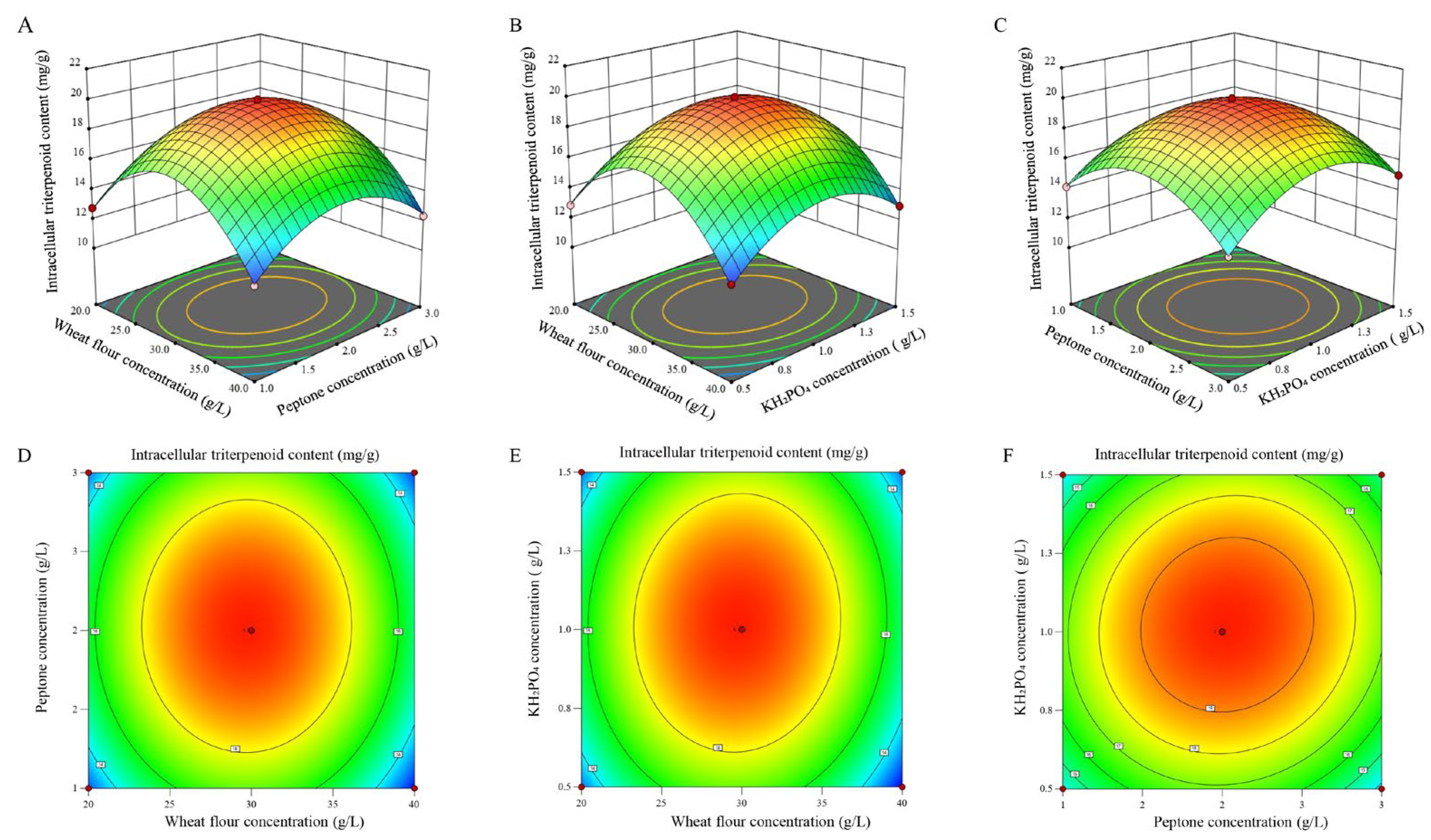
Response surface and corresponding contour plots for the interaction terms between wheat flour and peptone (AB), wheat flour and KH2PO4 (AC), and peptone and KH2PO4 (BC) from the regression equation were generated (Figure 5) to analyze their effects on intracellular triterpenoid content. The strength of the interaction between factors is indicated by the steepness of the three-dimensional response surface and the slope (ellipticity) of the two-dimensional contour lines; both reflect the degree to which changes in the two factors influence the response value. As shown in Figure 5, the steep response surfaces and pronounced slopes of the contour lines suggest that interactions exist between wheat flour and peptone (AB), wheat flour and KH2PO4 (AC), and peptone and KH2PO4 (BC). Furthermore, the dense, elliptical contours in subplots A/D and B/E of Figure 5 indicate that the interactions between wheat flour and peptone (AB) and between wheat flour and KH2PO4 (AC) are particularly significant.

3.7.2. Analysis of Interaction Effects on Extracellular Triterpenoids

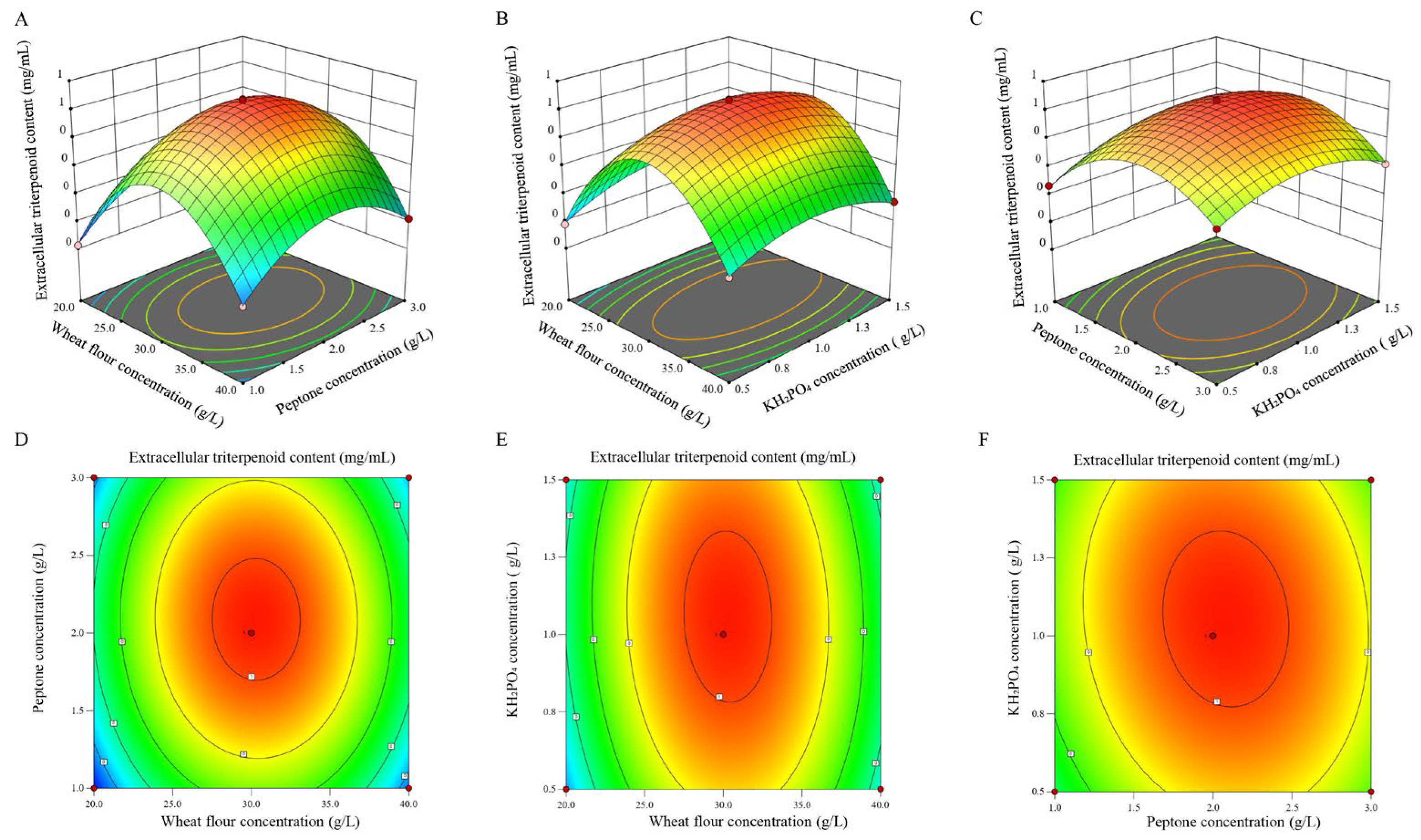
Similarly, response surface and contour plots for the same interaction terms (AB, AC, BC) were generated (Figure 6) to analyze their effects on extracellular triterpenoid content. As shown in subplots A/D and B/E of Figure 6, the steep response surfaces, significant contour line slopes, and dense elliptical shapes demonstrate that significant interactions exist between wheat flour and peptone (AB) and between wheat flour and KH2PO4 (AC). In contrast, subplots C/F of Figure 6 show a relatively flat response surface and contour lines with minimal slope, indicating that the interaction between peptone and KH2PO4 (BC) is not significant for extracellular triterpenoid production.

3.7.3. Validation of the Optimized Formulations

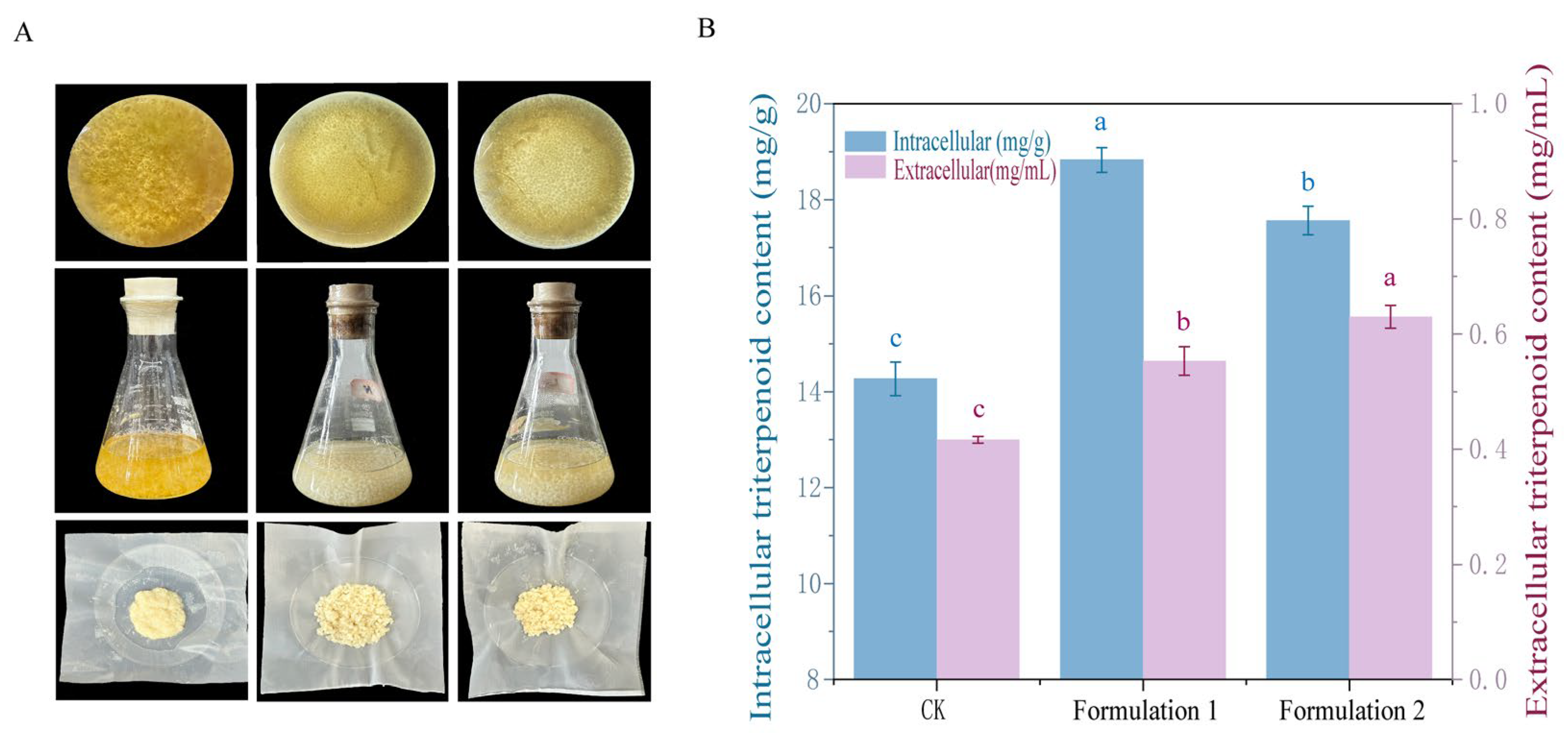
Through analysis with Design Expert 13, two optimized medium formulations were established for the liquid fermentation of strain S4-1. Formulation 1, designed to enhance intracellular triterpenoid accumulation, comprised 29.71 g/L wheat flour, 2.03 g/L peptone, and 1.02 g/L KH2PO4, resulting in an experimentally determined intracellular triterpenoid content of 18.83 mg/g, in close agreement with the predicted value of 19.84 mg/g. Formulation 2, aimed at increasing extracellular triterpenoid yield, contained 30.28 g/L wheat flour, 2.08 g/L peptone, and 1.05 g/L KH2PO4, with the actual extracellular triterpenoid content reaching 0.63 g/L, which also aligned well with the predicted level of 0.51 g/L. Both optimized formulations exhibited significantly elevated triterpenoid production (p < 0.05) relative to the conventional Potato Dextrose Broth (PDB) medium used as the control (Figure 7). These findings confirm that the response surface methodology employed in this study offers a reliable and accurate model for medium optimization, supporting its application for the targeted regulation and efficient biosynthesis of triterpenoids in F. luteovirens liquid fermentation systems.

3.7.4. Clarification on Fixed Conditions and Discussion of Limitations

It is important to note that this study aimed to optimize the medium composition; therefore, process parameters such as temperature, pH, agitation speed, filling volume, inoculum size, and fermentation time were held constant. Although the selection of these fixed values was based on preliminary experiments, there may be potential synergistic or antagonistic interactions between them and the optimal medium components (wheat flour, peptone, KH2PO4) identified in this study. In other words, the current fixed process parameters may have limited the full potential of the optimized medium. Therefore, in subsequent studies, systematic optimization of key process parameters—such as temperature, pH, and dissolved oxygen (regulated by agitation speed and filling volume)—will be an important direction to further enhance triterpenoid production by this fungus.

4. Discussion

This study successfully demonstrates the application of Response Surface Methodology (RSM) to systematically optimize a fermentation medium for F. luteovirens, culminating in a high-performance formulation centered on wheat flour, peptone, and KH2PO4. The validation results confirm the model’s accuracy and highlight a significant improvement in triterpenoid synthesis, thereby providing both a practical bioprocess and insights into the nutritional regulation of this fungus.

4.1. Regulatory Roles of Nutritional Factors

The differential effects of carbon sources align with established principles in fungal biotechnology. While complex carbon sources like corn and wheat flour supported robust biomass, likely by supplying micronutrients alongside carbon skeletons [26], their impact on secondary metabolism varied. The superior overall performance of wheat flour underscores the need to balance growth with metabolite yield when selecting a carbon source. Further analysis revealed an interesting distinction: wheat flour (carbon source) exhibited the strongest influence on intracellular triterpenoid accumulation, suggesting that carbon availability primarily drives overall biosynthetic capacity within the cells.
The clear superiority of organic nitrogen (peptone, yeast extract) over inorganic ((NH4)2SO4) for triterpenoid production is consistent with reports for other fungal metabolites [27]. Organic nitrogen sources provide complex precursors and potential growth cofactors [28] that may upregulate biosynthetic pathways. The observed optimum concentration for peptone (3 g/L) and the inhibitory effect at higher levels suggest a delicate balance in nitrogen metabolism, where excessive amounts may redirect cellular resources or disrupt the carbon-to-nitrogen balance, a critical regulator in fungal physiology [29,30]. Notably, peptone (nitrogen source) showed the most pronounced effect on extracellular triterpenoid content, hinting at a potential role for nitrogen metabolism in processes related to secretion or cell membrane integrity. This differential influence—carbon source primarily driving intracellular accumulation, nitrogen source more strongly affecting extracellular yield—suggests that while total triterpenoid biosynthesis and partitioning may be governed by overlapping regulatory mechanisms, individual nutrients can exert distinct effects on these two pools.
The identification of KH2PO4 as the optimal inorganic salt and its concentration-dependent effect (optimal at 1.0 g/L) underscores the pivotal role of phosphate. Beyond its fundamental role in energy and nucleic acid metabolism, phosphate acts as a key signaling molecule influencing secondary metabolism [31]. The decline in performance beyond the optimum concentration may be attributed to ionic stress or disruption of cellular homeostasis [32], emphasizing the importance of precise mineral supplementation.
The observation that intracellular and extracellular triterpenoid accumulation were optimized under very similar nutritional conditions raises interesting questions about the relationship between these two pools. A positive correlation was observed between intra- and extracellular yields across experimental runs, suggesting that conditions enhancing overall triterpenoid biosynthesis tend to promote accumulation in both pools concurrently. Within the range of conditions explored in this study, we found no clear evidence of a competitive trade-off between intracellular retention and extracellular secretion; both responses were maximized under similar conditions.
Several factors might contribute to this distribution pattern. First, under optimal nutritional conditions, enhanced metabolic flux through the triterpenoid biosynthetic pathway could lead to proportional increases in both pools, with partitioning ratios remaining relatively constant. Second, it is possible that extracellular triterpenoids derive partly from passive diffusion or cell lysis rather than active secretion. Under balanced growth conditions optimized for both biomass and secondary metabolism, cell integrity might be maintained, potentially limiting non-specific release. This could explain why extracellular yields, while significant, remained approximately dozens of times lower than intracellular content on a per-biomass basis.

4.2. Model Reliability and Factor Interactions

The high statistical significance, excellent fit (R2 > 0.998), and predictive accuracy of the RSM models confirm their robustness for this system. The successful validation experiment, where the predicted values closely matched the values obtained experimentally, provides direct proof of the model’s predictive accuracy. More importantly, the analysis revealed significant interaction effects, particularly between nutrients for intracellular triterpenoid production (e.g., the BC interaction). This finding is crucial, as it moves beyond a simplistic single-factor understanding and reveals the interdependent nature of nutritional regulation in fungal metabolism [33,34], and has now been validated experimentally.

4.3. Implications and Future Perspectives

The optimal culture medium formulations obtained in this study provide a direct and reliable technical solution for scaling up the fermentation production of high-value active compounds from F. luteovirens. Beyond practical application, the established mathematical models offer significant predictive utility and, more importantly, yield deeper insights into the metabolic behavior of this fungus under defined nutritional regimes.
Building on these foundations, several promising research directions emerge. First, it is important to acknowledge that although total triterpene content was reliably quantified using oleanolic acid as a representative standard, this method has limitations: it cannot distinguish between different types of triterpenes, and other components in the culture medium may interfere with the measurements. Consequently, the exact chemical composition of the triterpenes produced under optimal conditions remains to be characterized. Due to the rarity of this wild medicinal fungus, the limited prior research on its metabolome, and project funding constraints, LC-MS-based chemical profiling was not feasible in the current study. Addressing this gap will be a priority in our subsequent investigations. Second, while this optimization focused on three core nutritional factors, future work should pursue a more holistic strategy by integrating key environmental parameters—such as initial pH, dissolved oxygen, cultivation temperature, and illumination [35,36,37]—into a multidimensional global optimization framework. Third, having established a substantial yield improvement, the underlying molecular mechanisms warrant detailed investigation. Building on future LC-MS metabolomics data that clarify the specific triterpene compounds involved, subsequent studies integrating transcriptomics and metabolomics could delineate the expression changes of key genes (e.g., terpene synthases) and the corresponding shifts in metabolic flux within the triterpenoid biosynthetic pathway under the optimized conditions. This would elucidate the fundamental nature of nutritional regulation at a molecular level. Finally, to bridge the gap between laboratory discovery and industrial application, these findings should be translated into bioreactor scale-up studies. This requires systematic investigation of critical engineering parameters, such as agitation speed and aeration rate, to ensure a successful transition from shake-flasks to production-scale fermenters.

5. Conclusions

To address the challenges of scarce wild resources and the difficulty of artificial cultivation of the rare edible-medicinal mushroom F. luteovirens from the Qinghai–Tibet Plateau, this study systematically optimized its liquid fermentation medium with the dual objectives of enhancing mycelial biomass and triterpenoid production. An efficient and feasible fermentation protocol was established by integrating single-factor experiments with Response Surface Methodology.
Single-factor screening identified wheat flour as the optimal carbon source, supporting maximum mycelial biomass at 30 g/L while maintaining a high overall triterpenoid yield. Peptone was determined to be the superior nitrogen source, significantly outperforming inorganic nitrogen in promoting triterpenoid synthesis, with a yield peak at 3 g/L. KH2PO4 was the optimal inorganic salt, exhibiting the best synergistic effect on both mycelial growth and triterpenoid production at 1.0 g/L, beyond which inhibitory effects were observed.
Response surface analysis based on a Box–Behnken design generated highly predictive mathematical models for both intra- and extracellular triterpenoid content, with exceptional goodness-of-fit (R2 = 0.9989 and 0.9984, respectively) and minimal error. Analysis of variance indicated that wheat flour concentration exerted the greatest influence on intracellular triterpenoids, while peptone concentration was most significant for extracellular yield. Notably, the interaction between peptone and KH2PO4 had a highly significant effect on intracellular triterpenoid accumulation.
Validation experiments confirmed the reliability of optimization. The best-performing medium for intracellular triterpenoid accumulation (wheat flour 29.71 g/L, peptone 2.03 g/L, KH2PO4 1.02 g/L) yielded 18.83 mg/g, aligning closely with the predicted value. Similarly, the optimal formulation for extracellular triterpenoid production (wheat flour 30.28 g/L, peptone 2.08 g/L, KH2PO4 1.05 g/L) produced 0.63 g/L, which was consistent with model predictions.
In conclusion, this study successfully enhanced triterpenoid production in F. luteovirens liquid fermentation through targeted nutritional regulation. It clarified the synergistic roles of carbon, nitrogen, and phosphate sources, addressed a gap in the systematic, multi-factor optimization research for this species, and provided key technical parameters for the scaled-up production of its mycelium and bioactive triterpenoids. These findings significantly advance the prospects for the sustainable utilization and industrial development of this precious fungal resource.

Supplementary Materials

The following supporting information can be downloaded at: https://www.mdpi.com/article/10.3390/horticulturae12030302/s1, Table S1. PCR amplification system and amplification procedure; Table S2. Variable definitions and units for triterpenoid quantification formulas. Table S3. Response surface design for the experiment on the total triterpenoids content (calculated as oleanolic acid) in the intracellular tissues of F. luteovirens and the results of the experiment. Table S4. Response surface design for the experiment on the total triterpenoids content (calculated as oleanolic acid) in the intracellular tissues of F. luteovirens and the results of the experiment. Table S5. Analysis of variance (ANOVA) for the regression model of intracellular triterpenoid content in F. luteovirens. Table S6. Analysis of variance (ANOVA) for the regression model of extracellular triterpenoid content in F. luteovirens. Figure S1. Agarose gel electrophoresis of PCR-amplified ITS region from strain S4-1. Figure S2. BLAST analysis of ITS sequences from strain S4-1. Figure S3. Standard curve for oleanolic acid.

Author Contributions

Conceptualization, X.Z.; Methodology, T.S.; Software, W.L.; Validation, S.G.; Formal analysis, T.S.; Resources, L.T.; Data curation, T.S.; Writing—original draft, T.S.; Writing—review & editing, X.Z.; Supervision, Y.N. All authors have read and agreed to the published version of the manuscript.

Funding

This work was supported by Tianfu Emei Plan Young Talent Project (Sichuan Emei No. 2688), Chengdu City Major Talent Plan: Rong Piao Talent Project (Cheng special appointment No. 1312), Tianfu New District Talent Plan in Sichuan (Certificate number: 2025-0093) and Zhuo ni County Strong Science and Technology Subsidy Project.

Data Availability Statement

The original contributions presented in the study are included in the article/Supplementary Materials, further inquiries can be directed to the corresponding author.

Conflicts of Interest

The authors declare no conflicts of interest.

References

  1. Ni, Y.; Cao, L.; Li, W.; Zhang, Q.; Feng, R.; Zhao, Z.; Zhao, X. The Research Status and Prospects of Floccularia Luteovirens: A Mycorrhizal Fungus with Edible Fruiting Bodies. J. Fungi 2023, 9, 1071. [Google Scholar] [CrossRef]
  2. Li, W.Y.; Wang, J.S.; Yu, C.Q.; Zhang, Y.J.; Wu, J.X.; Zheng, Z.T.; Cai, Y.Q.; Liu, Y.G.; Zhu, J.T. Native Site and Indoor Experimental Study of Endemic Floccularia luteovirens in Xizang. Tibet. J. Agric. Sci. 2023, 45, 17–21. (In Chinese) [Google Scholar] [CrossRef]
  3. Xie, Z.L.; Zhao, L.Z.; Li, Y.; Lei, J.Q.; Zhang, F.M. The correlation of geographic distribution and ecological environment of endemic species Floccularia luteovirens on Qinghai-Tibet Plateau. Acta Ecol. Sin. 2016, 36, 2851–2857. (In Chinese) [Google Scholar]
  4. Zhang, B.-B.; Guan, Y.-Y.; Hu, P.-F.; Chen, L.; Xu, G.-R.; Liu, L.; Cheung, P.C.K. Production of Bioactive Metabolites by Submerged Fermentation of the Medicinal Mushroom Antrodia cinnamomea: Recent Advances and Future Development. Crit. Rev. Biotechnol. 2019, 39, 541–554. [Google Scholar] [CrossRef] [PubMed]
  5. Yan, M.-Q.; Feng, J.; Liu, Y.-F.; Hu, D.-M.; Zhang, J.-S. Functional Components from the Liquid Fermentation of Edible and Medicinal Fungi and Their Food Applications in China. Foods 2023, 12, 2086. [Google Scholar] [CrossRef] [PubMed]
  6. Li, N.; Feng, J.; Feng, N.; Liu, Y.F.; Zhang, J.S. Research progress in submerged fermentation for triterpenes of Ganoderma. Microbiol. China 2020, 47, 3451–3469. (In Chinese) [Google Scholar] [CrossRef]
  7. Liu, C.; Feng, J.; Wang, S.; Cao, Y.; Shen, Y. Enhancement of Hyphae Growth and Medium Optimization for Pleurotus Eryngii-3 under Submerged Fermentation. Agronomy 2022, 12, 2413. [Google Scholar] [CrossRef]
  8. Ni, Y.; Liao, Q.; Gou, S.; Shi, T.; Li, W.; Feng, R.; Zhao, Z.; Zhao, X. Study on Enzyme Activity and Metabolomics during Culture of Liquid Spawn of Floccularia Luteovirens. J. Fungi 2024, 10, 618. [Google Scholar] [CrossRef]
  9. Liu, Z.; Lu, H.; Zhang, X.; Chen, Q. The Genomic and Transcriptomic Analyses of Floccularia Luteovirens, a Rare Edible Fungus in the Qinghai-Tibet Plateau, Provide Insights into the Taxonomy Placement and Fruiting Body Formation. J. Fungi 2021, 7, 887. [Google Scholar] [CrossRef] [PubMed]
  10. Qi, J.; Li, X.-Z.; Zhang, M.; Liu, Y.; Wang, Z.; Tang, C.; Xing, R.; Vadim, K.; Li, M.; Li, Y. Haplotype-Phased Chromosome-Level Genome Assembly of Floccularia Luteovirens Provides Insights into Its Taxonomy, Adaptive Evolution, and Biosynthetic Potential. J. Fungi 2025, 11, 621. [Google Scholar] [CrossRef]
  11. González-Hernández, R.A.; Valdez-Cruz, N.A.; Macías-Rubalcava, M.L.; Trujillo-Roldán, M.A. Overview of Fungal Terpene Synthases and Their Regulation. World J. Microbiol. Biotechnol. 2023, 39, 194. [Google Scholar] [CrossRef]
  12. Lian, L.; Wang, L.; Song, S.; Zhu, J.; Liu, R.; Shi, L.; Ren, A.; Zhao, M. GCN4 Regulates Secondary Metabolism through Activation of Antioxidant Gene Expression under Nitrogen Limitation Conditions in Ganoderma lucidum. Appl. Environ. Microbiol. 2021, 87, e00156-21. [Google Scholar] [CrossRef] [PubMed]
  13. Schmidt-Dannert, C. Biosynthesis of Terpenoid Natural Products in Fungi. In Biotechnology of Isoprenoids; Schrader, J., Bohlmann, J., Eds.; Springer International Publishing: Cham, Switzerland, 2015; pp. 19–61. [Google Scholar]
  14. Zhang, X.; Zhu, Q.Y.; Xu, H.M.; Wu, M.Y.; Chen, X.E.; Chen, Q.H.; Liu, Z.J. Optimization of extraction process and activity of protoilludane sesquiterpene aryl esters from Floccularia luteovirens. J. Zhejiang Univ. (Agric. Life Sci.) 2023, 49, 813–824. (In Chinese) [Google Scholar] [CrossRef]
  15. Diao, Z.M. A preliminary study on nutrition physiological characteristics of Armillaria luteo-virens mycelia. Microbiol. China 1997, 1, 14–17. (In Chinese) [Google Scholar]
  16. Liu, H.Z.; Wang, H.X.; Liu, Q.H.; Feng, K. Preliminary Study on Mycelium Growing Conditions of Armillaria luteo-virens. Edible Fungi China 2007, 16–19. (In Chinese) [Google Scholar] [CrossRef]
  17. Zhou, J.S.; Jiao, Y.C.; Sheng, H.Y.; Xiong, H.Y.; Yang, C.J. Effects of Triacontanol, Culture Medium pH, and Incubation Temperature on the Mycelial Growth of Armillaria luteovirens. Edible Fungi 2011, 33, 8–9. (In Chinese) [Google Scholar] [CrossRef]
  18. Cai, X.; Zhang, Y.; Wang, X.L. Study on Medium Optimization of Yellow-green Armillaria Luteo Virens and Condition of Artificial Culture. Anhui Agric. Sci. Bull. 2013, 19, 33–34, 50. (In Chinese) [Google Scholar] [CrossRef]
  19. Shi, Q.Q.; Dang, J.; Yuan, X.; Yue, H.L.; Wang, Q.L. Study on the separation and domestication of Armillaria luteo-rivens strain. Sci. Technol. Food Ind. 2015, 36, 180–182, 187. (In Chinese) [Google Scholar] [CrossRef]
  20. Zhou, L.Y.; Geng, G.Q.Z.; Tang, D.H.; Mi, Q. Preliminary Study on Effect of Se on Mycelial biomass of Armillaria luteo-virens in Liquid Culture. Edible Fungi 2018, 40, 12–14. (In Chinese) [Google Scholar] [CrossRef]
  21. Gao, Y.; Li, X.; Xu, H.; Sun, H.; Zhang, J.; Wu, X.; Fu, J. Response Surface Methodology-Based Optimization of Inonotus Hispidus’ Liquid Fermentation Medium and Evaluation of Its Exopolysaccharide Activities. Front. Microbiol. 2024, 15, 1456461. [Google Scholar] [CrossRef]
  22. Liu, X.; John Martin, J.J.; Li, X.; Zhou, L.; Li, R.; Li, Q.; Zhang, J.; Fu, D.; Cao, H. Optimization of the Fermentation Culture Conditions of Bacillus Amyloliquefaciens Ck-05 Using Response Surface Methodology. Front. Microbiol. 2025, 16, 1552645. [Google Scholar] [CrossRef] [PubMed]
  23. Gao, Y.; Li, X.; Xu, H.; Sun, H.; Zhang, J.; Wu, X.; Fu, J. Optimization of Fermentation Culture Medium for Sanghuangporus Alpinus Using Response-Surface Methodology. Horticulturae 2024, 10, 474. [Google Scholar] [CrossRef]
  24. Shen, S.-F.; Zhu, L.-F.; Wu, Z.; Wang, G.; Ahmad, Z.; Chang, M.-W. Production of Triterpenoid Compounds from Ganoderma lucidum Spore Powder Using Ultrasound-Assisted Extraction. Prep. Biochem. Biotechnol. 2020, 50, 302–315. [Google Scholar] [CrossRef]
  25. Chinese Pharmacopoeia Commission. Pharmacopoeia of the People’s Republic of China Volume I, 2020th ed.; Chinese Pharmacopoeia Commission: Beijing, China, 2020. (In Chinese)
  26. Xiong, Y.; Wu, V.W.; Lubbe, A.; Qin, L.; Deng, S.; Kennedy, M.; Bauer, D.; Singan, V.R.; Barry, K.; Northen, T.R.; et al. A Fungal Transcription Factor Essential for Starch Degradation Affects Integration of Carbon and Nitrogen Metabolism. PLoS Genet. 2017, 13, e1006737. [Google Scholar] [CrossRef]
  27. Li, S.D.; Li, Y.; Wang, L.; Zhou, Y.P.; Zhang, H.S.; Cheng, X.H. Screening of Strains with High-Yielding Ganoderma Triterpene and Its Optimization of Liquid Medium. J. Microbiol. 2025, 45, 43–56. (In Chinese) [Google Scholar] [CrossRef]
  28. Sakamoto, Y. Influences of Environmental Factors on Fruiting Body Induction, Development and Maturation in Mushroom-Forming Fungi. Fungal Biol. Rev. 2018, 32, 236–248. [Google Scholar] [CrossRef]
  29. Wu, F.; Zhang, H.; Fang, F.; Liu, H.; Tang, M. Arbuscular Mycorrhizal Fungi Alter Nitrogen Allocation in the Leaves of Populus × Canadensis ‘Neva’. Plant Soil 2017, 421, 477–491. [Google Scholar] [CrossRef]
  30. Nuralykyzy, B.; Nie, J.; Mei, H.; Zhang, Y.; Rogers, K.M.; Li, C.; Yuan, Y. Synergies between Carbon Sequestration, Nitrogen Utilization, and Mushroom Quality: A Comprehensive Review of Substrate, Fungi, and Soil Interactions. J. Agric. Food Chem. 2025, 73, 14144–14157. [Google Scholar] [CrossRef] [PubMed]
  31. Bhalla, K.; Qu, X.; Kretschmer, M.; Kronstad, J.W. The Phosphate Language of Fungi. Trends Microbiol. 2022, 30, 338–349. [Google Scholar] [CrossRef]
  32. Wood, J.M. Osmotic Stress; Storz, G., Hengge, R., Eds.; The American Society for Microbiology: Washington, DC, USA, 2011. [Google Scholar]
  33. Cui, M.; Yang, H.; He, G. Submerged Fermentation Production and Characterization of Intracellular Triterpenoids from Ganoderma lucidum Using HPLC-ESI-MS. J. Zhejiang Univ.-Sci. B 2015, 16, 998–1010. [Google Scholar] [CrossRef]
  34. Fan, G.Z.; Wang, X.D.; Li, X.C.; Fan, J.S.; Zhai, Q.L.; Zhan, Y.G. Effect of Fungal Elicitor on Carbon and Nitrogen Status and Triterpenoid Production in Cell Suspension Cultures of Betula Platyphylla Suk. J. Med. Plants Res. 2011, 5, 5413–5422. [Google Scholar]
  35. Tang, Y.-J.; Zhong, J.-J. Role of Oxygen Supply in Submerged Fermentation of Ganoderma lucidum for Production of Ganoderma Polysaccharide and Ganoderic Acid. Enzyme Microb. Technol. 2003, 32, 478–484. [Google Scholar] [CrossRef]
  36. Morelli, L.; Patwari, P.; Pruckner, F.; Bastide, M.; Fabris, M. Specific Light-Regime Adaptations, Terpenoid Profiles and Engineering Potential in Ecologically Diverse Phaeodactylum tricornutum Strains. Algal Res. 2025, 86, 103920. [Google Scholar] [CrossRef]
  37. Ahmad, M.F.; Wahab, S.; Ahmad, F.A.; Ashraf, S.A.; Abullais, S.S.; Saad, H.H. Ganoderma lucidum: A Potential Pleiotropic Approach of Ganoderic Acids in Health Reinforcement and Factors Influencing Their Production. Fungal Biol. Rev. 2022, 39, 100–125. [Google Scholar] [CrossRef]
Figure 1. Morphological characteristics of the F. luteovirens strain S4-1. (A) The morphology of the fruiting body used for isolation. (B) The colony morphology. (C) The mycelium morpho logy under a microscope (10 × 40), with clamp connections highlighted by a red circle.
Horticulturae 12 00302 g001
Figure 2. Effects of carbon sources on the biomass and intra- and extracellular triterpenoid contents of F. luteovirens, (mean ± SD, n = 3, the triterpenoid content expressed as OAE) (A) corn flour concentration; (B) wheat flour concentration; (C) sucrose concentration; (D) brown sugar concentration. Different lowercase letters indicate significant differences among treatments at p < 0.05 level according to LSD post hoc test.
Horticulturae 12 00302 g002
Figure 3. Effects of nitrogen sources on the biomass and intra- and extracellular triterpenoid contents of F. luteovirens, (mean ± SD, n = 3, the triterpenoid content expressed as OAE). (A) Peptonecorn concentration; (B) (NH4)2SO4 concentration; (C) yeast extract concentration. Different lowercase letters indicate significant differences among treatments at p < 0.05 level according to LSD post hoc test.
Horticulturae 12 00302 g003
Figure 4. Effects of inorganic salts on the biomass and intra- and extracellular triterpenoid contents of F. luteovirens, (mean ± SD, n = 3, the triterpenoid content expressed as OAE). (A) KH2PO4 concentration; (B) MgSO4 concentration; (C) KCl concentration. Different lowercase letters indicate significant differences among treatments at p < 0.05 level according to LSD post hoc test.
Horticulturae 12 00302 g004
Figure 5. Response surface and contour plots for the intracellular triterpenoid content of F. luteovirens as influenced by binary factor interactions (The color gradient represents the predicted response value, with red indicating higher values and blue indicating lower values). Panels (AC) present the three-dimensional response surface plots, while panels (DF) present the two-dimensional contour plots, respectively. The interacting factor pairs are (A,D) wheat flour and peptone; (B,E) wheat flour and KH2PO4; (C,F) peptone and KH2PO4.
Horticulturae 12 00302 g005
Figure 6. Response surface and contour plots for the extracellular triterpenoid content of F. luteovirens as influenced by binary factor interactions (The color gradient represents the predicted response value, with red indicating higher values and blue indicating lower values). Panels (AC) present the three-dimensional response surface plots, while panels (DF) present the two-dimensional contour plots, respectively. The interacting factor pairs are (A,D) wheat flour and peptone; (B,E) wheat flour and KH2PO4; (C,F) peptone and KH2PO4.
Horticulturae 12 00302 g006
Figure 7. Validation results of the response surface-optimized medium formulations for F. luteovirens liquid fermentation, (mean ± SD, n = 3, the triterpenoid content expressed as OAE). (A) Growth profiles of different formulations cultured in liquid Erlenmeyer flasks. (B) Validated intracellular and extracellular triterpenoid contents under different formulations. Different lowercase letters indicate significant differences among treatments at p < 0.05 level according to LSD post hoc test.
Horticulturae 12 00302 g007
Table 1. Factor-Level coding table for medium optimization of F. luteovirens liquid culture.
LevelFactor
A: Wheat flour (g/L)B: Peptone (g/L)C: KH2PO4 (g/L)
−1203040
0123
10.511.5
Table 2. Experimental design and results for the extraction of triterpenoids from F. luteovirens.
NumberFactorsY1: Intracellular Triterpene Content (mg/g)Y2: Extracellular Triterpene Content (mg/g)
ABC
1302119.660.52
22021.512.790.33
3403112.360.31
42020.512.870.29
5401111.990.28
6302120.070.52
73030.513.740.41
8201112.760.26
94021.512.940.34
10302119.730.50
11203113.010.29
12302119.880.51
13302119.830.52
144020.512.060.33
153010.514.160.37
163031.515.060.41
173011.513.960.40
Table 3. Fit statistics of Y.
Predictive Model
Y1: Intracellular Triterpene ContentY2: Extracellular Triterpene Content
Model F-value709.77499.16
Lack of fit p-value0.42850.7959
R-square0.9989 0.9984
Predicted R-square0.9909 0.9930
Adjusted R-square0.9975 0.9964
Coefficient of variation0.0107 0.0145
Disclaimer/Publisher’s Note: The statements, opinions and data contained in all publications are solely those of the individual author(s) and contributor(s) and not of MDPI and/or the editor(s). MDPI and/or the editor(s) disclaim responsibility for any injury to people or property resulting from any ideas, methods, instructions or products referred to in the content.