


Abstract
In this work, boron incorporation in diamond grown by microwave plasma-enhanced chemical vapor deposition is investigated as a function of methane concentration, boron precursor concentration, crystalline orientation, oxygen addition to the plasma, and deposition temperature. The boron incorporation efficiency, i.e., the ratio between the boron concentration in diamond and the gas-phase boron-to-carbon ratio, spans several orders of magnitude and can exceed unity for all investigated crystalline orientations. Overall results demonstrate that methane concentration and the substrate’s crystalline orientation are key factors governing boron incorporation. The temperature study reveals that boron incorporation is also governed by thermally activated boron-loss mechanisms. Finally, all results show that boron incorporation is not exclusively controlled by the plasma composition but also by surface growth mechanisms.
1. Introduction
Plasma-enhanced chemical vapor deposition (PECVD) has been extensively studied for the synthesis of epitaxial boron-doped diamond layers over the past few decades, primarily due to its potential for electronic applications. Key advances include the achievement of record-high carrier mobility (>2000 cm2·V−1·s−1) [1,2,3], exceptionally high boron concentrations (up to several 1021 cm−3) [4], and the observation of superconductivity at low temperatures [5]. Beyond electronic devices [6], boron-doped diamond has also attracted considerable interest for electrochemical applications [7,8,9] such as sensing [10,11,12], CO2 reduction [13,14] and water purification [15]. The electrical properties of boron-doped diamond (carrier concentration, mobility and conductivity) are primarily governed by the boron concentration as well as by the presence of other impurities and defects [16]. Most studies on boron-doped epitaxial diamond growth have focused on (100)- and (111)-oriented diamond substrates, while more recent works have explored growth on alternative crystallographic orientations [17,18,19,20,21]. These studies report unusually high boron incorporation efficiencies [17,18] together with high growth rates and smooth surface morphologies [19,22]. Such properties are particularly attractive for the fabrication of electronic devices [23,24]. A detailed understanding of boron incorporation mechanisms is essential for tailoring the electrical properties of boron-doped diamond layers to specific applications. It is particularly essential in the fabrication of electronic devices where the dopant concentration defines the final properties of the devices. Despite the large number of published studies, direct comparison of boron incorporation data remains challenging due to variations in reactor design, process gas composition, growth parameters, and substrate mounting configuration [25]. In a previous work, we reported on the incorporation efficiencies of boron as a function of the dopant precursor concentration and crystalline orientation, independently of other process parameters, based on a comprehensive literature analysis [20]. In the present study, we examine experimentally and in greater detail the influence of the methane concentration, deposition temperature, oxygen concentration, substrate crystalline orientation, and boron precursor concentration on boron incorporation efficiency in diamond.
2. Experimental Section
Epitaxial boron-doped diamond layers studied in this work were grown on high-pressure, high-temperature (HPHT) Ib diamond substrates of ca. 10 mm2 from Sumitomo Hardmetal GmbH, Willich, Germany with different crystalline orientations, specifically (100), (115), (113), and (111) orientations, using a 1.5 kW resonance cavity microwave plasma-enhanced chemical vapor deposition system (AX5010, Seki Diamond Systems, San Jose, CA, USA). The base pressure in the system is below 2 × 10⁻⁶ mbar, and the deposition was carried out using a gas mixture of methane (5.5 N purity) diluted in hydrogen (5.6 N purity), with trimethylboron (2000 ppm in H2, with an overall 4.8 N purity) serving as the boron precursor. The gas flows were controlled using MKS 1479A mass flow controllers with a specified accuracy of ±1% of the full scale. The process gases were diluted in hydrogen for precise control of their flow in the reactor. Prior to loading into the reactor, the substrates were cleaned in hot sulfuric acid containing potassium nitrate for 10 min. Subsequently, they were rinsed twice in non-boiling hot deionized water in an ultrasonic bath for 10 min, and finally they were dried with filtered compressed air. Boron incorporation efficiency (η), defined as the ratio of the boron-to-carbon atomic concentration in the diamond (B/C)s to the atomic dopant-to-carbon atomic ratio in the gas phase (B/C)g, i.e., η = (B/C)s/(B/C)g, was studied through the chemical analysis (i.e., determination of atomic boron concentration and assuming an atomic carbon concentration of 1.76 × 1021 cm−3) of epitaxial multilayers, with each layer grown with different process conditions, i.e., the gas flows of carbon and boron precursors. To determine the effect of the boron-to-carbon ratio in the gas phase under different methane concentrations and crystalline orientations, four multilayer samples were deposited at fixed boron-to-carbon ratios (B/C)g of 200, 400, 700, and 1000 ppm, while for each sample the CH4 concentration was varied between 0.05% and 1% for each crystalline orientation, keeping the pressure (100 mbar), the microwave power (580 W), the substrate position, and the total gas flow rate (500 sccm) constant and adjusting the boron precursor flow to keep (B/C)g to studied values. Undoped diamond spacer layers were deposited between successive boron-doped layers to provide clear markers for depth profiling by secondary ion mass spectrometry (SIMS). The deposition time for each boron-doped layer was adjusted to obtain a target thickness of approximately 200 nm. The measured layer thicknesses ranged from 51 to 975 nm. The substrate temperature during deposition was measured in the range of 1000 °C. To explore the effects of the addition of oxygen (4.5 N purity) in the process gas and the deposition temperature, epitaxial multilayers were grown with varying atomic oxygen-to-carbon ratios (O/C) and at different substrate positions relative to the plasma on (100)- and (111)-oriented substrates while keeping other process parameters constant. The substrate temperature was adjusted by varying the vertical position of the sample using a custom-built substrate holder mounted on a linear motion feedthrough (MDC Vacuum). A description of the sample holder is available in the Supplementary Materials (Figure S1). The temperature dependence on the stage position was independently calibrated using the same type of HPHT substrate and a Williamson PRO 92-38 pyrometer. These epitaxial layers were grown at the same pressure (100 mbar) and microwave power (570 W), with 0.4% methane concentration and (B/C)g = 1000 ppm on (100)-oriented substrates and 0.1% methane concentration and (B/C)g = 4000 ppm on (111)-oriented substrates. The different methane concentrations and (B/C)g ratios were selected intentionally to compensate for the substantially different boron incorporation efficiencies of the two substrate orientations while remaining within the operating range of the gas control system. Additionally, a small volume of nitrogen gas was pulsed during changes in either the oxygen concentration or the substrate position to create a nitrogen δ-doped layer, which serves as a marker between different layers during SIMS measurement. The total boron concentrations in epitaxial diamond layers, analyzed by SIMS, were extracted from the plateau regions of each layer and, when applicable, away from the nitrogen δ-doped marker layers. All boron-doped layers exhibited boron concentrations well above those measured in the undoped spacer layers, enabling unambiguous identification of the doped regions. Depth profiles were acquired using both a magnetic sector SIMS (CAMECA, IMS-4f) and a time-of-flight (TOF) SIMS (IONTOF, M6 plus). The TOF-SIMS depth profiling was conducted using a dual-beam mode, combining a sputter beam of 2 keV O2+ ions (I = 450–600 nA) with a primary beam of 30 keV Bi+ ions (I = 6.5–8 pA) for crater analysis. The raster size was set at 300 μm × 300 μm or 250 μm × 250 μm for sputtering and 80 μm × 80 μm or 50 μm × 50 μm for analysis. The boron concentrations in the samples were quantified from the ratio of the 11B+ secondary-ion signal to the 12C+ matrix signal using a relative sensitivity factor (RSF) obtained from repeated measurements of an appropriate 11B-implanted diamond calibration standard and corrected for the natural isotopic abundance of boron. The associated calibration uncertainty is below 3% of the reported boron concentration. The detection limit was approximately 1017 cm−3.
Finally, data from the literature used in this study were extracted directly from the text when numerical values were available; otherwise, numerical values were extracted from graphical representations using the GetDataGraph Digitizer software (version 2.26.0.20). The relative uncertainty associated with digitized values is estimated to be ±10%, primarily due to the use of nonlinear scales (e.g., log–log plots).
3. Results and Discussion
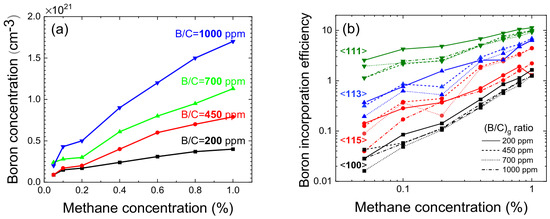
Figure 1a presents the boron concentration in epitaxial diamond layers grown on (111)-oriented substrates as a function of methane concentration for different (B/C)g ratios. Consistent with data from the literature, this figure shows the increase in boron concentration in diamond by increasing (B/C)g at constant methane concentration for all methane concentrations. It also shows that the boron concentration increases quasi-linearly with methane concentration for all investigated (B/C)g values except for a slight deviation at low methane concentrations. Similar quasi-linear trends are observed for epitaxial layers grown on substrates with other crystalline orientations, although with different absolute boron concentrations. Although the addition of methane in the plasma slightly increases the substrate temperature, this trend cannot be attributed to a temperature effect, since boron incorporation efficiency decreases with temperature, as discussed in a later section. The dependence of boron incorporation efficiency on methane concentration for different (B/C)g ratios and substrates crystalline orientations is shown in a log–log scale in Figure 1b. Although the incorporation efficiency increases with increasing methane concentration for all substrates and crystalline orientations, it actually decreases with increasing (B/C)g at constant methane concentration and crystalline orientation. This trend is consistent with our recent review on boron incorporation efficiency in diamond, and it has been attributed to boron saturation or shifts in incorporation kinetics at elevated (B/C)g ratios [20]. Beyond these absolute values, the sensitivity of boron incorporation efficiency to methane concentration is itself orientation dependent. The slope of the incorporation efficiency versus methane concentration (expressed as a fraction between 0 and 1) increases markedly when changing the substrate orientation from (100) to (111). Specifically, slopes in the range of approximately 130–170 are obtained for (100)-oriented boron-doped diamond layers, while much higher slopes, between approximately 790 and 960, are measured for (111)-oriented layers.
Figure 1.
(a) Boron concentration in (111)-oriented epitaxial diamond layers as a function of methane concentration for different (B/C)g as measured by TOF-SIMS; (b) boron incorporation efficiency as a function of the methane concentration for different (B/C)g and substrate crystalline orientations. (Note: the numerical data generated in this study and underlying these figures are provided in Tables S1 and S2 of the Supplementary Materials).
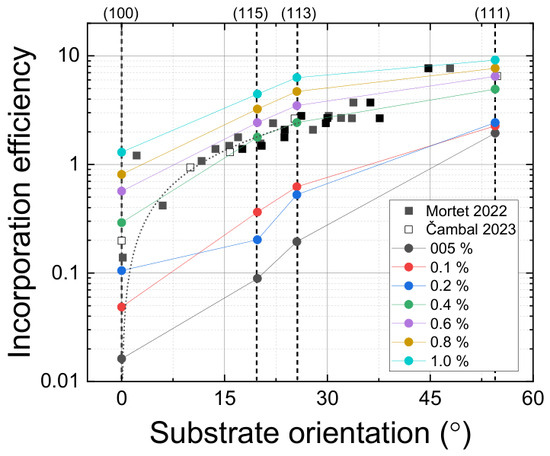
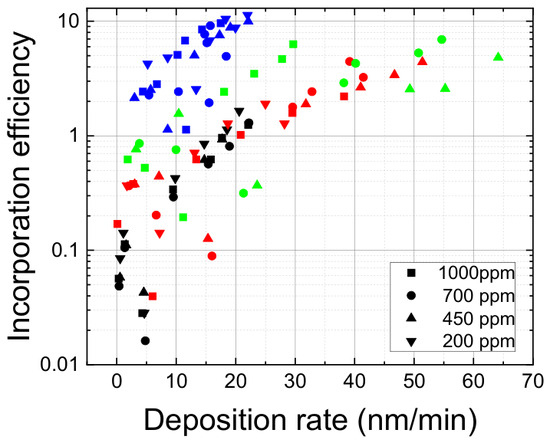
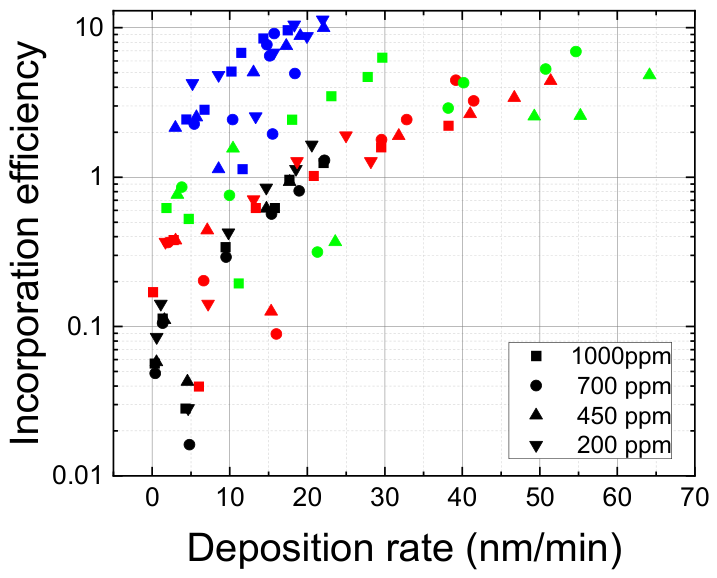
At constant methane concentration and (B/C)g, the absolute incorporation efficiency systematically increases as the substrate orientation varies from (100) to (115), (113), and finally (111). The variations of the boron incorporation efficiency with substrate crystalline orientations for different methane concentrations and constant (B/C)g = 700 ppm are also reported in Figure 2 and are compared with results from previous studies [17,21]. The crystalline orientation of each diamond substrate is defined by the angle θ between its surface normal and the normal to the (100) plane. The incorporation efficiencies determined in this work follow parallel trends that are consistent with these earlier studies, with a minimum for (100)-oriented substrates and a rapid increase with increasing misorientation toward the (111) orientation. The origin of this increase in the boron incorporation with the substrate crystalline orientation has not been studied extensively until now. Taylor et al. attribute this increase in boron intake efficiency to the increasing step/riser junctions [22], whereas Ogura attributes this effect for (100)-oriented epitaxial layers with small off-angles to a competition between desorption and step-flow overgrowth, with higher step densities favoring incorporation by shortening the exposure time of boron atoms at the growth surface [26]. However, those models are not fully satisfactory in the studied range of substrate crystalline orientations; for instance, they are incompatible with the observed highest incorporation efficiency on atomically flat (111)-oriented surfaces. Rouzbahani et al. suggested that methane-rich conditions may enhance boron incorporation by increasing the probability of H-defect sites near CH2 surface species. However, their DFT calculations did not explicitly compare boron and carbon incorporations [27]. A possible interpretation of this variation in boron incorporation efficiency with substrate orientation considers the evolution of the terrace–step structure across the investigated orientations. From (100) to (113), the surface may be described as (100)-like terraces separated by steps, whereas between (113) and (111) it may alternatively be described as (111)-like terraces separated by a different family of steps. For a vicinal surface, the nominal step density is given by ρstep = tan(θ)/h, where h is the step height and the crystalline orientation is represented by θ. This geometric dependence provides a reasonable description of the increase in boron incorporation efficiency reported for substrate orientations between (100) and (113), consistent with preferential boron incorporation at step sites. However, beyond the (113) orientation, the boron incorporation efficiency continues to increase despite the decrease in the nominal density of steps. This observation suggests that dominant boron incorporation mechanisms differ fundamentally between (100) and (111) terraces or surfaces. To further examine the relationship between diamond growth kinetics and boron incorporation, Figure 3 presents the boron incorporation efficiency as a function of the diamond deposition rate for all investigated crystalline orientations, gas-phase boron-to-carbon ratios and methane concentrations. The boron incorporation efficiency increases with deposition rate, which is consistent with the enhancement of boron incorporation observed with increasing methane concentration.
Figure 2.
Effect of substrate orientation (defined by the angle θ between its surface normal and the normal to the (100) plane) on the boron incorporation efficiency ratio. Full black squares [17] and open black squares [21] represent species grown in the same deposition conditions with (B/C)g of 1000 ppm. Data from this study for a (B/C)g of 700 ppm and various methane concentrations are represented by full circles with different colors (black, red, blue, green, violet, gold, and cyan) to represent the different methane concentrations of 0.05, 0.1, 0.2, 0.4, 0.6, 0.8, and 1%. The black dotted line corresponds to the geometric dependence ρstep ∝ tan(θ), scaled by an arbitrary constant for comparison with the experimental data. (Note: the numerical data generated in this study and underlying this figure is provided in Table S2 of the Supplementary Materials).
Figure 3.
Boron incorporation efficiency as a function of deposition rate for all investigated crystalline orientations, gas-phase boron-to-carbon ratios (B/C)g, and methane concentrations. The different crystalline orientations are distinguished by color; black, red, green, and blue correspond to the (100)-, (115)-, (113)-, and (111)-oriented substrates, respectively, while symbols denote the gas-phase boron-to-carbon ratio (B/C)g. (Note: the numerical data generated in this study and underlying this figure is provided in Table S2 of the Supplementary Materials).
Although the incorporation efficiencies follow approximately parallel trends for all crystalline orientations, the incorporation efficiency depends strongly on the substrate crystalline orientation at a given deposition rate. In particular, epitaxial layers grown on (100)-oriented substrates exhibit incorporation efficiencies that are approximately one order of magnitude lower than those grown on (111)-oriented substrates at comparable deposition rates. Interestingly, the data obtained for (115)-oriented substrates closely follow the trend observed for (100)-oriented substrates, whereas the (113)-oriented layers display greater scatter and occupy an intermediate position between the two orientation families. This behavior may reflect the transitional nature of the (113) surface, which may consist of either (100)-like terraces or (111)-like terraces depending on the substrate miscut.
Overall, these results demonstrate that boron incorporation efficiency in diamond can vary by several orders of magnitude through controlled variations of methane concentration and crystalline orientation while all other growth parameters are kept constant. The incorporation efficiencies vary over a wide range from values as low as 0.01 at low methane concentration on (100)-oriented substrates to values well above unity for all crystalline orientations, which even reach 11 for epitaxial layers grown at high methane concentration (1%) and (B/C)g = 1000 ppm on (111)-oriented substrates with a final boron concentration of 1.7 × 1021 cm−3. The occurrence of incorporation efficiencies exceeding unity at high methane concentrations for all crystalline orientations indicates that boron incorporation is not limited by the availability of boron-containing species in the plasma but is likely governed by additional processes, including surface-controlled incorporation mechanisms that depend on the substrate’s crystalline orientation. The mechanisms responsible for incorporation efficiencies well above unity remain unclear and require further experimental and theoretical investigation.
The addition of oxygen to the process gas is known to influence boron incorporation, and hence the electrical properties of boron-doped diamond; however, this effect remains relatively poorly documented and is not yet fully understood. The few studies available in the literature are discussed below and constitute, to the best of our knowledge, the main experimental investigations dedicated to this topic.
Volpe et al. reported a dramatic decrease in boron concentration—and therefore in boron incorporation efficiency—by approximately three orders of magnitude upon the addition of oxygen to the process gas. The incorporation efficiency decreased from about 2 × 10⁻² without oxygen to a minimum value of approximately 3.4 × 10⁻⁵ at a maximum (O/C)g value of 10 [28].
Bogdanov et al. [29] investigated the effect of oxygen addition using trimethylborate (B(OCH3)3) as the boron precursor for different methane concentrations and (B/C)g ratios. Their data show a systematic decrease in boron incorporation efficiency upon oxygen addition. However, these experiments were performed under varying methane concentrations, with the highest (O/C)g values corresponding to the lowest methane concentrations. They also reported higher incorporation efficiencies at low (B/C)g = 500 ppm, which may be partially attributed to a boron background in the reactor.
Issaoui et al. [30] carried out similar experiments in a reactor operating at high pressure and high microwave power, where (O/C)g was increased proportionally with methane concentration. In this case, the boron incorporation efficiency initially decreases with increasing (O/C)g and methane concentration before increasing again for methane concentrations above 7% in hydrogen. This behavior is consistent with the opposite effects of methane concentration and (O/C)g on boron incorporation efficiency in (100)-oriented diamond, with the oxygen effect dominating at methane concentrations below 7%.
Barday [31] also reported in his thesis a decrease in boron concentration—and thus in boron incorporation efficiency—in (100)-oriented epitaxial diamond layers with increasing (O/C)g. Consistently, Sakaguchi et al. observed a strong decrease in boron incorporation with increasing (O/C)g, with the incorporation efficiency dropping by factors between 100 and 350 when comparing layers grown without oxygen and with 0.25% oxygen added to the plasma [32]. Interestingly, he also reported an increase in the deposition rate upon small additions of oxygen to the gas phase.
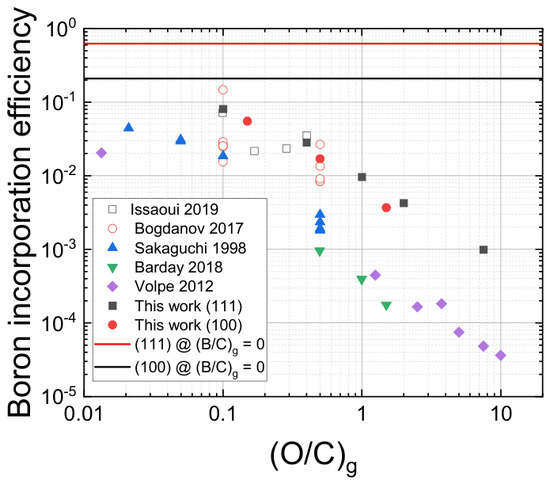
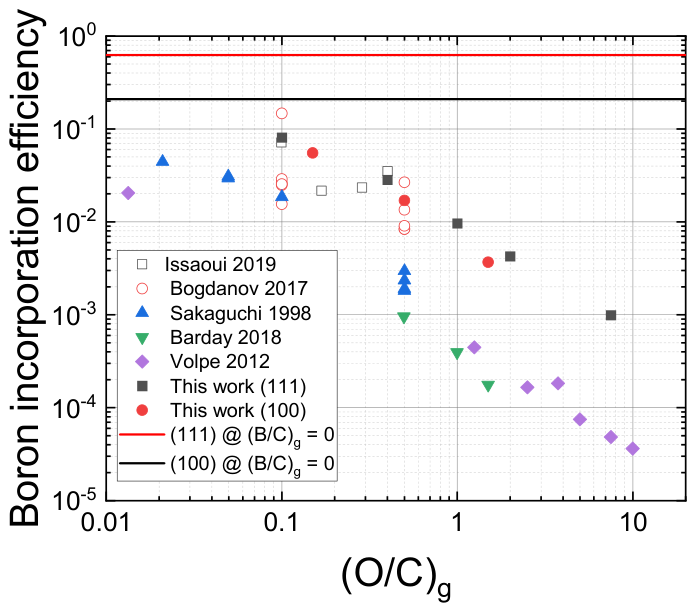
Figure 4 compiles boron incorporation efficiency data as a function of the oxygen-to-carbon ratio in the gas phase, (O/C)g, from previous studies on (100)-oriented epitaxial diamond layers [28,29,30,31,32] together with the results of the present work. Despite the scatter among datasets from the literature, which is attributed to the variation of the incorporation efficiency with the other process parameters of these different studies (the methane concentration, growth temperature, (B/C)g ratio and the reactor type), all studies exhibit a similar trend of the boron incorporation efficiency decreasing by approximately one order of magnitude for each order-of-magnitude increase in (O/C)g. Remarkably, the incorporation efficiencies of both the (100)- and (111)-oriented epitaxial layers in our work exhibit the same decrease with increasing (O/C)g as other data from the literature. The parallel trends indicate that the reduction in boron incorporation efficiency with increasing oxygen concentration is independent of the other growth parameters and the substrate’s crystalline orientation. While the origin of this effect has not been clearly identified until now, oxygen is generally considered to reduce the concentration of active boron species in the plasma. However, if oxygen suppressed boron incorporation primarily through direct scavenging of boron-containing plasma species, different (B/O)g ratios would be expected to produce different dependences of boron incorporation efficiency on (O/C)g, contrary to the observations summarized in Figure 4. Instead, the similar (O/C)g dependences point toward an additional surface-mediated contribution. This interpretation is consistent with the mechanism proposed by Marton et al. [33], who attributed the suppression of boron incorporation upon the addition of CO2 to the process gas in nanocrystalline boron-doped diamond grown in a surface-wave plasma system, with the oxygen-containing species lowering desorption energies and enabling boron removal from the growing diamond surface, akin to the oxygen-assisted etching process.
Figure 4.
Effect of the oxygen-to-carbon ratio on the boron incorporation efficiency ratio. Full symbols represent studies with constant methane concentrations, whereas open symbols represent studies with varying methane concentrations. All data from the literature correspond to (100)-oriented epitaxial diamond layers [28,29,30,31,32]. Horizontal lines represent the boron incorporation efficiencies of (111)- and (100)-oriented layers from this work obtained without addition of oxygen in the gas phase. Note: as the Sakaguchi article [32] had inconsistent notation for boron concentration in the process gas, we used the results from Ref. [34] to determine accurate boron incorporation efficiencies. (Note: the numerical data generated in this study and underlying this figure is provided in Table S3 of the Supplementary Materials).
The role of deposition temperature in the incorporation efficiency of boron, and generally all dopants, in diamond is the most understudied effect in the synthesis of doped diamond. This assessment is likely to be attributed to the lack of independent temperature control for the substrate temperature during PECVD diamond deposition, the complexity of accurate measurement of the substrate temperature (usually carried out using a non-contact optical method using pyrometers or a disappearing-filament pyrometer), and the scarcity of PECVD reactors with independent substrate temperature control systems. This problem becomes more acute when using high-purity diamond, which does not emit light in the mid-IR or visible range, rendering standard temperature measurement by pyrometry not possible.
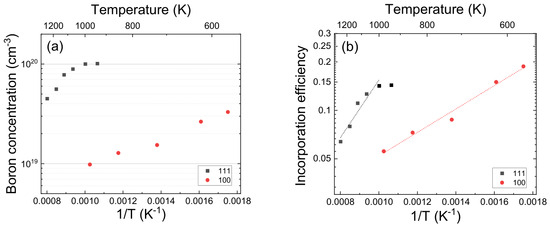
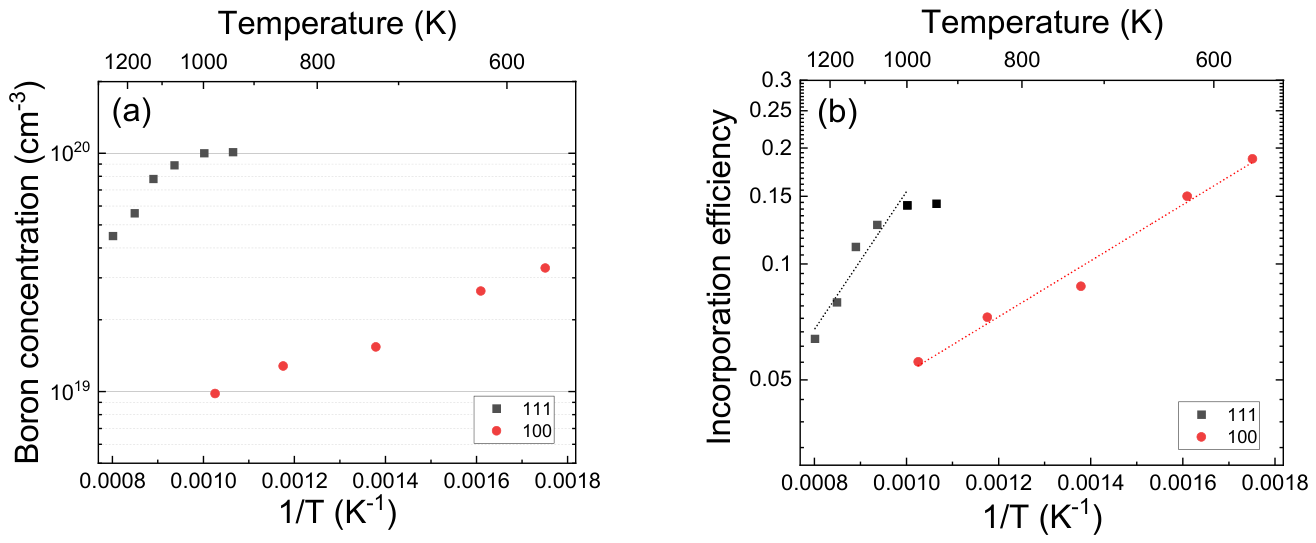
Figure 5a presents an Arrhenius plot of the boron concentration measured in boron-doped diamond multilayers grown on (111)- and (100)-oriented substrates. For each substrate orientation, the gas composition and process parameters were kept constant throughout the temperature series, while the substrate temperature was varied by adjusting the position of the substrate holder. The observed decrease in boron concentration with increasing temperature contrasts with the results reported in Ref. [35]. On the other hand, Kato et al. reported that the temperature dependence of phosphorus incorporation also depends on the substrate crystalline orientation, with phosphorus incorporation decreasing with increasing temperature on (100)-oriented diamond substrates [36]. Corresponding calculated boron incorporation efficiencies are shown in Figure 5b. The incorporation efficiency decreases with increasing temperature for both the (100)- and (111)-oriented substrates. The Arrhenius plot for the (100)-oriented diamond exhibits a linear dependence (R2 = 0.983), corresponding to an apparent activation energy of 144 ± 11 meV, where the uncertainty represents the standard error derived from the fitted slope. The observed Arrhenius dependence [37], together with the good linear fit, is characteristic of a thermally activated process and suggests that the measured temperature dependence is primarily governed by thermal activation rather than by changes in the local plasma environment associated with variations in the substrate position relative to the plasma. In comparison, the incorporation efficiency of the (111)-oriented diamond also exhibits an approximately linear dependence at high temperatures (R2 = 0.926), corresponding to an apparent activation energy of 355 ± 58 meV, whereas it appears to saturate at lower temperatures (note: only the incorporation efficiency of the (111)-oriented layer deposited at the lowest temperature was not used in the Arrhenius fit to determine activation energies). The origin of this saturation at low temperature needs to be addressed. We speculate it might be related to the relatively high boron concentration in the (111)-oriented layer (1020 cm−3) as compared to the (100)-oriented one (≤3.3 × 1019 cm−3). In an attempt to understand these results, we might assume the mechanism of boron incorporation to be analogous to the accepted growth mechanism of diamond by CVD, i.e., atomic insertion of the carbon atom into the diamond lattice through multiple reaction steps: hydrogen abstraction from the hydrogenated surface, adsorption of a gaseous radical, and hydrogen abstraction from the surface-bound radical [38]. The insertion of carbon or boron is a dynamic process that involves simultaneous growth and etching reactions. As boron incorporation is significantly less energy-demanding than carbon incorporation [38], variations in hydrogen abstraction, radical adsorption, or atomic insertion cannot account for the observed decrease in boron incorporation efficiency with increasing temperature. Instead, this behavior is consistent with thermally activated boron-loss processes. Determined characteristic energies of boron incorporation efficiency are consistent with the characteristic energies (0.1–0.6 eV) reported for various boron-loss mechanisms by Chessman et al. [38], and they are of the same order as the characteristic energy associated with hydrogen abstraction from the hydrogen-terminated diamond surface under low-energy hydrogen atom irradiation [39,40]. Taken together with the suppression of boron incorporation by oxygen addition, these results suggest that boron incorporation efficiency is governed not only by the adsorption of boron-containing species at the growth surface but also by their retention prior to permanent incorporation into the diamond lattice.
Figure 5.
(a) Boron concentration and (b) boron incorporation efficiency in Arrhenius plots for doped layers grown at different temperatures on (100)- and (111)-oriented substrates. (Note: the numerical data generated in this study and underlying this figure is provided in Table S4 of the Supplementary Materials).
4. Conclusions
In this work, we studied the effects of process gas composition, substrate orientation, and temperature on boron incorporation efficiency in diamond. The boron incorporation efficiency spans several orders of magnitude and can exceed unity. Increasing the methane concentration systematically enhances boron incorporation for all investigated orientations, and the absolute incorporation efficiency increases from (100)-oriented substrates to (115)-, (113)-, and (111)-oriented substrates. Oxygen addition strongly suppresses boron incorporation, with an approximately one-order-of-magnitude decrease in incorporation efficiency for each order-of-magnitude increase in the O/C ratio. The temperature-dependent experiments are consistent with a thermally activated boron-loss mechanism. These results indicate that boron incorporation efficiency is not governed solely by the concentration of boron-containing species in the plasma but is also influenced by surface growth processes, including thermally activated and oxygen-assisted boron-loss mechanisms, as well as by the substrate crystallographic orientation. Overall, these results provide practical guidelines for controlling boron doping in diamond and establish a framework for tailoring boron-doped diamond layers for electronic, electrochemical, and quantum-device applications.
Supplementary Materials
The following supporting information can be downloaded at: https://www.mdpi.com/article/10.3390/c12030067/s1, Figure S1: Top picture: Top view of substrate stage; Left hand side picture: Picture of the whole substrate stage, including the linear motion feedthrough; Right hand side picture: Schematic of the substrate stage featuring the linear motion mechanism of the substrate holder; Table S1: Boron concentration in the boron-doped epitaxial diamond layers grown on (111)-oriented substrates for the different methane concentrations and gas-phase boron-to-carbon ratios (B/C)g investigated in this work; Table S2: Deposition time, deposition rate, thickness and incorporation efficiency of the boron-doped epitaxial diamond layers grown on (100)-, (115)-, (113)-, and (111)-oriented substrates for the different methane concentrations and gas-phase boron-to-carbon ratios (B/C)g investigated in this work; Table S3: Incorporation efficiency of the boron-doped epitaxial diamond layers grown with different oxygen-carbon ratios (O/C)g investigated in this work and from the literature; Table S4: Boron concentration and incorporation efficiency of the boron-doped epitaxial diamond layers grown at different temperatures investigated in this work.
Author Contributions
Conceptualization, V.M.; Methodology, V.M., M.A., P.S., K.S., P.S. and L.K.; Validation, V.M.; Formal Analysis, V.M. and Y.B.; Investigation, V.M., M.A., K.S., P.S. and L.K.; Resources, V.M., L.K. and W.K.; Data Curation, V.M.; Writing—Original Draft Preparation, V.M.; Writing—Review and Editing, V.M., M.A., P.S., K.S., Y.B., L.K. and W.K.; Visualization, V.M. and Y.B.; Supervision, V.M. and W.K.; Project Administration, V.M. and W.K.; Funding Acquisition, V.M. and W.K. All authors have read and agreed to the published version of the manuscript.
Funding
The financial support from the following sources is gratefully acknowledged: the Federal Ministry of Education and Research BMBF, grant ID: 13N16208–DE-BRILL, and the Czech Science Foundation, grant IDs: 21-03538S and 22-04533S.
Data Availability Statement
The data supporting the findings of this study are available within the article and its Supplementary Materials. Further inquiries can be directed to the corresponding author.
Acknowledgments
During the preparation of this work, the authors used a large language model in order to improve the language and refine the scientific writing. After using this tool/service, the authors reviewed and edited the content as needed and take full responsibility for the content of the published article.
Conflicts of Interest
Yan Busby and Wolfgang Klesse are employed by Quantum Brilliance GmbH. Vincent Mortet was employed by Quantum Brilliance GmbH. The remaining authors declare that the research was conducted in the absence of any commercial or financial relationships that could be construed as a potential conflict of interest.
References
- Teraji, T.; Wada, H.; Yamamoto, M.; Arima, K.; Ito, T. Highly efficient doping of boron into high-quality homoepitaxial diamond films. Diam. Relat. Mater. 2006, 15, 602–606. [Google Scholar] [CrossRef] [Scilit]
- Mortet, V.; Daenen, M.; Teraji, T.; Lazea, A.; Vorlicek, V.; D’Haen, J.; Haenen, K.; D’Olieslaeger, M. Characterization of boron doped diamond epilayers grown in a NIRIM type reactor. Diam. Relat. Mater. 2008, 17, 1330–1334. [Google Scholar] [CrossRef] [Scilit]
- Volpe, P.-N.; Pernot, J.; Muret, P.; Omnès, F. High hole mobility in boron doped diamond for power device applications. Appl. Phys. Lett. 2009, 94, 092102. [Google Scholar] [CrossRef] [Scilit]
- Takano, Y.; Takenouchi, T.; Ishii, S.; Ueda, S.; Okutsu, T.; Sakaguchi, I.; Umezawa, H.; Kawarada, H.; Tachiki, M. Superconducting properties of homoepitaxial CVD diamond. Diam. Relat. Mater. 2007, 16, 911–914. [Google Scholar] [CrossRef] [Scilit]
- Takano, Y. Superconductivity in CVD diamond films. J. Phys. Condens. Matter 2009, 21, 253201. [Google Scholar] [CrossRef] [Scilit]
- Araujo, D.; Suzuki, M.; Lloret, F.; Alba, G.; Villar, P. Diamond for Electronics: Materials, Processing and Devices. Materials 2021, 14, 7081. [Google Scholar] [CrossRef] [Scilit]
- Cobb, S.J.; Ayres, Z.J.; Macpherson, J.V. Boron Doped Diamond: A Designer Electrode Material for the Twenty-First Century. Annu. Rev. Anal. Chem. 2018, 11, 463–484. [Google Scholar] [CrossRef] [Scilit]
- Yang, N.; Yu, S.; Macpherson, J.V.; Einaga, Y.; Zhao, H.; Zhao, G.; Swain, G.M.; Jiang, X. Conductive diamond: Synthesis, properties, and electrochemical applications. Chem. Soc. Rev. 2019, 48, 157–204. [Google Scholar] [CrossRef] [Scilit]
- Macpherson, J.V. A practical guide to using boron doped diamond in electrochemical research. Phys. Chem. Chem. Phys. 2015, 17, 2935–2949. [Google Scholar] [CrossRef] [Scilit]
- Baluchová, S.; Daňhel, A.; Dejmková, H.; Ostatná, V.; Fojta, M.; Schwarzová-Pecková, K. Recent progress in the applications of boron doped diamond electrodes in electroanalysis of organic compounds and biomolecules—A review. Anal. Chim. Acta 2019, 1077, 30. [Google Scholar] [CrossRef] [Scilit]
- Baluchová, S.; Taylor, A.; Mortet, V.; Sedláková, S.; Klimša, L.; Kopeček, J.; Hák, O.; Schwarzová-Pecková, K. Porous boron doped diamond for dopamine sensing: Effect of boron doping level on morphology and electrochemical performance. Electrochim. Acta 2019, 327, 135025. [Google Scholar] [CrossRef] [Scilit]
- Baroch, M.; Baluchová, S.; Taylor, A.; Míka, L.; Fischer, J.; Dejmková, H.; Mortet, V.; Sedláková, S.; Klimša, L.; Kopeček, J.; et al. Flow-through working electrode based on free-standing porous boron-doped diamond. Electrochim. Acta 2022, 426, 140758. [Google Scholar] [CrossRef] [Scilit]
- Ashcheulov, P.; Otake, A.; Akai, K.; Taylor, A.; Klimša, L.; Hubík, P.; More-Chevalier, J.; Einaga, Y. Surface morphology-assisted electrochemical conversion of carbon dioxide to formic acid via nanocrystalline boron-doped diamond electrodes. Chem. Eng. J. 2023, 473, 145463. [Google Scholar] [CrossRef] [Scilit]
- Nakata, K.; Ozaki, T.; Terashima, C.; Fujishima, A.; Einaga, Y. High-Yield Electrochemical Production of Formaldehyde from CO2 and Seawater. Angew. Chem. Int. Ed. 2014, 53, 871–874. [Google Scholar] [CrossRef] [Scilit]
- Chaplin, B.P. Critical review of electrochemical advanced oxidation processes for water treatment applications. Environ. Sci. Processes Impacts 2014, 16, 1182–1203. [Google Scholar] [CrossRef] [Scilit] [PubMed]
- Pernot, J.; Volpe, P.N.; Omnès, F.; Muret, P.; Mortet, V.; Haenen, K.; Teraji, T. Hall hole mobility in boron-doped homoepitaxial diamond. Phys. Rev. B 2010, 81, 205203. [Google Scholar] [CrossRef] [Scilit]
- Mortet, V.; Taylor, A.; Davydova, M.; Jiránek, J.; Fekete, L.; Klimša, L.; Šimek, D.; Lambert, N.; Sedláková, S.; Kopeček, J.; et al. Effect of substrate crystalline orientation on boron-doped homoepitaxial diamond growth. Diam. Relat. Mater. 2022, 122, 108887. [Google Scholar] [CrossRef] [Scilit]
- Tallaire, A.; Valentin, A.; Mille, V.; William, L.; Pinault-Thaury, M.A.; Jomard, F.; Barjon, J.; Achard, J. Growth of thick and heavily boron-doped (113)-oriented CVD diamond films. Diam. Relat. Mater. 2016, 66, 61–66. [Google Scholar] [CrossRef] [Scilit]
- Mortet, V.; Taylor, A.; Lambert, N.; Gedeonová, Z.; Fekete, L.; Lorinčik, J.; Klimša, L.; Kopeček, J.; Hubík, P.; Šobáň, Z.; et al. Properties of boron-doped (113) oriented homoepitaxial diamond layers. Diam. Relat. Mater. 2021, 111, 108223. [Google Scholar] [CrossRef] [Scilit]
- Mortet, V.; Leschiutta, A. Experimental Insights into Impurity Incorporation in Chemical Vapor Deposition Doped Diamond. Phys. Status Solidi A 2026, 223, 2500461. [Google Scholar] [CrossRef] [Scilit]
- Čambal, P.; Baluchová, S.; Taylor, A.; Míka, L.; Vondráček, M.; Gedeonová, Z.; Hubík, P.; Mortet, V.; Schwarzová-Pecková, K. Boron-doped {113}, {115} and {118}-oriented single-crystal diamond electrodes: Effect of surface pre-treatment. Electrochim. Acta 2023, 469, 143214. [Google Scholar] [CrossRef] [Scilit]
- Taylor, A.; Baluchová, S.; Fekete, L.; Klimša, L.; Kopeček, J.; Šimek, D.; Vondráček, M.; Míka, L.; Fischer, J.; Schwarzová-Pecková, K.; et al. Growth and comparison of high-quality MW PECVD grown B doped diamond layers on {118}, {115} and {113} single crystal diamond substrates. Diam. Relat. Mater. 2022, 123, 108815. [Google Scholar] [CrossRef] [Scilit]
- Hazdra, P.; Laposa, A.; Šobáň, Z.; Alam, M.; Povolný, V.; Mortet, V. Vertical Schottky diode on (113) oriented homoepitaxial diamond. Diam. Relat. Mater. 2024, 146, 111180. [Google Scholar] [CrossRef] [Scilit]
- Hazdra, P.; Laposa, A.; Soban, Z.; Taylor, A.; Lambert, N.; Povolny, V.; Kroutil, J.; Gedeonova, Z.; Hubik, P.; Mortet, V. Pseudo-vertical Mo/Au Schottky diodes on {113} oriented boron doped homoepitaxial diamond layers. Diam. Relat. Mater. 2022, 126, 109088. [Google Scholar] [CrossRef] [Scilit]
- Jiang, Y.; Bose, M.; Cuenca, J.A.; Creedon, D.L.; Belcourt, J.; Van Engers, C.D.; Nadarajah, A.; Ganesan, K.; McCallum, J.C.; Fox, K.; et al. Enhanced boron doping for diamond growth in cylindrical CVD reactors using a Faraday cage. Diam. Relat. Mater. 2025, 160, 113009. [Google Scholar] [CrossRef] [Scilit]
- Ogura, M.; Kato, H.; Makino, T.; Okushi, H.; Yamasaki, S. Misorientation-angle dependence of boron incorporation into (001)-oriented chemical-vapor-deposited (CVD) diamond. J. Cryst. Growth 2011, 317, 60–63. [Google Scholar] [CrossRef] [Scilit]
- Rouzbahani, R.; Nicley, S.S.; Vanpoucke, D.E.P.; Lloret, F.; Pobedinskas, P.; Araujo, D.; Haenen, K. Impact of methane concentration on surface morphology and boron incorporation of heavily boron-doped single crystal diamond layers. Carbon 2021, 172, 463–473. [Google Scholar] [CrossRef] [Scilit]
- Volpe, P.-N.; Arnault, J.-C.; Tranchant, N.; Chicot, G.; Pernot, J.; Jomard, F.; Bergonzo, P. Boron incorporation issues in diamond when TMB is used as precursor: Toward extreme doping levels. Diam. Relat. Mater. 2012, 22, 136–141. [Google Scholar] [CrossRef] [Scilit]
- Bogdanov, S.A.; Vikharev, A.L.; Drozdov, M.N.; Radishev, D.B. Synthesis of thick and high-quality homoepitaxial diamond with high boron doping level: Oxygen effect. Diam. Relat. Mater. 2017, 74, 59–64. [Google Scholar] [CrossRef] [Scilit]
- Issaoui, R.; Achard, J.; William, L.; Mehmel, L.; Thaury, M.-A.P.; Bénédic, F. Thick and widened high quality heavily boron doped diamond single crystals synthetized with high oxygen flow under high microwave power regime. Diam. Relat. Mater. 2019, 94, 88–91. [Google Scholar] [CrossRef] [Scilit]
- Barday, C. Films de Diamant Monocristallin Dopés au Bore Pour des Applications en Electronique de Puissance. Ph.D. Thesis, Université Paris Saclay, Gif-sur-Yvette, France, 2018. Available online: https://theses.hal.science/tel-02048182 (accessed on 1 January 2025).
- Sakaguchi, I.; Nishitani-Gamo, M.; Loh, K.P.; Yamamoto, K.; Haneda, H.; Ando, T. Effect of oxygen addition on boron incorporation on semiconductive diamond CVD. Diam. Relat. Mater. 1998, 7, 1144–1147. [Google Scholar] [CrossRef] [Scilit]
- Marton, M.; Konôpka, M.; Dobrovodský, J.; Vaňa, D.; Shetty, S.J.; Veis, P.; Michniak, P.; Reháček, V.; Behúl, M.; Vančo, Ľ.; et al. Role of oxygen in suppression of boron incorporation in diamond films: Surface reactions insight. Appl. Surf. Sci. 2025, 709, 163832. [Google Scholar] [CrossRef] [Scilit]
- Ushizawa, K.; Watanabe, K.; Ando, T.; Sakaguchi, I.; Nishitani-Gamo, M.; Sato, Y.; Kanda, H. Boron concentration dependence of Raman spectra on {100} and {111} facets of B-doped CVD diamond. Diam. Relat. Mater. 1998, 7, 1719–1722. [Google Scholar] [CrossRef] [Scilit]
- Demlow, S.N.; Rechenberg, R.; Grotjohn, T. The effect of substrate temperature and growth rate on the doping efficiency of single crystal boron doped diamond. Diam. Relat. Mater. 2014, 49, 19–24. [Google Scholar] [CrossRef] [Scilit]
- Kato, H.; Watanabe, H.; Yamasaki, S.; Okushi, H. N-type doping on (001)-oriented diamond. Diam. Relat. Mater. 2006, 15, 548–553. [Google Scholar] [CrossRef] [Scilit]
- Avery, H.E. Dependence of Rate on Temperature. In Basic Reaction Kinetics and Mechanisms; Macmillan Education UK: London, UK, 1974; pp. 47–58. [Google Scholar] [CrossRef] [Scilit]
- Cheesman, A.; Harvey, J.N.; Ashfold, M.N.R. Computational studies of elementary steps relating to boron doping during diamond chemical vapour deposition. Phys. Chem. Chem. Phys. 2005, 7, 1121–1126. [Google Scholar] [CrossRef] [Scilit]
- Mortet, V.; Kromka, A.; Kravets, R.; Rosa, J.; Vorlicek, V.; Zemek, J.; Vanecek, M. Investigation of diamond growth at high pressure by microwave plasma chemical vapor deposition. Diam. Relat. Mater. 2004, 13, 604–609. [Google Scholar] [CrossRef] [Scilit]
- Chein, T.-H.; Wei, J.; Tzeng, Y. Synthesis of diamond in high power-density microwave methane/hydrogen/oxygen plasmas at elevated substrate temperatures. Diam. Relat. Mater. 1999, 8, 1686–1696. [Google Scholar] [CrossRef] [Scilit]
Disclaimer/Publisher’s Note: The statements, opinions and data contained in all publications are solely those of the individual author(s) and contributor(s) and not of MDPI and/or the editor(s). MDPI and/or the editor(s) disclaim responsibility for any injury to people or property resulting from any ideas, methods, instructions or products referred to in the content. |
© 2026 by the authors. Licensee MDPI, Basel, Switzerland. This article is an open access article distributed under the terms and conditions of the Creative Commons Attribution (CC BY) license.