


You are currently viewing a new version of our website. To view the old version click .

Gels, Volume 3, Issue 1

March 2017 - 11 articles

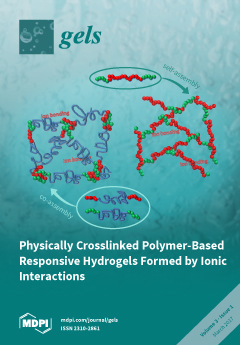
Cover Story: Physically crosslinked polymer-based responsive hydrogels with tunable properties can be formed by intermolecular polyionic complexation of oppositely charged repeating units (ion bonding). Two types of hydrogels are envisioned: (i) hydrogels formed by triblock copolymers bearing oppositely charged blocks (self-assembled network); and (ii) hydrogels formed by co-assembly of oppositely charged polyelectrolyte segments belonging to different macromolecules (co-assembled network). View Paper here
  • Issues are regarded as officially published after their release is announced to the table of contents alert mailing list .
  • You may sign up for email alerts to receive table of contents of newly released issues.
  • PDF is the official format for papers published in both, html and pdf forms. To view the papers in pdf format, click on the "PDF Full-text" link, and use the free Adobe Reader to open them.

Articles (11)

  • Communication
  • Open Access
8 Citations
6,099 Views
8 Pages

17 March 2017

Stimuli-responsive colloidal nanocomposite hydrogels are prepared by exploiting non-covalent interactions between anionic cellulose nanocrystals and polycationic delaminated sheets of aminopropyl-functionalized magnesium phyllosilicate clays.

  • Article
  • Open Access
39 Citations
10,623 Views
10 Pages

25 February 2017

We investigated the mechanical, swelling, and structural properties of mechanically tough clay/sodium polyacrylate (PAAS) hydrogels prepared by simple mixing. The gels had large swelling ratios, reflecting the characteristics of the constituent polym...

  • Feature Paper
  • Article
  • Open Access
7 Citations
5,879 Views
6 Pages

Synthesis of Helical Phenolic Resin Bundles through a Sol-Gel Transcription Method

  • Changzhen Shao,
  • Jiangang Li,
  • Hao Chen,
  • Baozong Li,
  • Yi Li and
  • Yonggang Yang

23 February 2017

Chiral and helical polymers possess special helical structures and optical property, and may find applications in chiral catalysis and optical devices. This work presents the preparation and formation process of helical phenolic resins through a sol-...

  • Feature Paper
  • Article
  • Open Access
29 Citations
11,999 Views
15 Pages

22 February 2017

Mesoporous silica nanoparticles (MSNs) with ordered pore structure have been synthesized and used as carriers for the anticancer drug curcumin. MSNs were functionalized with amine groups and further attached with carboxymethyl cellulose (CMC) using 1...

  • Article
  • Open Access
8 Citations
7,703 Views
17 Pages

15 February 2017

The result of polymeric nanogels and lipid vesicles interaction—lipobeads—can be considered as multipurpose containers for future therapeutic applications, such as targeted anticancer chemotherapy with superior tumor response and minimum side effects...

  • Review
  • Open Access
914 Citations
35,906 Views
15 Pages

24 January 2017

Hydrogels are hydrophilic, three-dimensional networks that are able to absorb large quantities of water or biological fluids, and thus have the potential to be used as prime candidates for biosensors, drug delivery vectors, and carriers or matrices f...

  • Feature Paper
  • Review
  • Open Access
167 Citations
21,883 Views
31 Pages

Thermoresponsive Gels

  • M. Joan Taylor,
  • Paul Tomlins and
  • Tarsem S. Sahota

10 January 2017

Thermoresponsive gelling materials constructed from natural and synthetic polymers can be used to provide triggered action and therefore customised products such as drug delivery and regenerative medicine types as well as for other industries. Some m...

  • Feature Paper
  • Review
  • Open Access
70 Citations
17,595 Views
18 Pages

1 January 2017

Supramolecular polysaccharide-based hydrogels have attracted considerable research interest recently due to their high structural functionality, low toxicity, and potential applications in foods, cosmetics, catalysis, drug delivery, tissue engineerin...

  • Feature Paper
  • Review
  • Open Access
12 Citations
5,206 Views
12 Pages

1 January 2017

Chiral low-molecular-weight gelators (LMWGs) derived from amino acids can self-assemble into helical fibers and twisted/coiled nanoribbons by H-bonding and π–π interaction. Silica nanotubes with single-handed helices have been prepared using chiral L...

of 2

Get Alerted

Add your email address to receive forthcoming issues of this journal.

XFacebookLinkedIn
Gels - ISSN 2310-2861