


You are currently viewing a new version of our website. To view the old version click .

Journal of Fungi, Volume 10, Issue 11

November 2024 - 76 articles

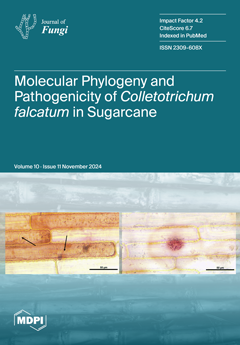
Cover Story: Red rot disease reduces sugarcane yield and quality, posing a significant threat to Florida’s industry. Although Colletotrichum falcatum, the causal agent in Florida, was first morphologically identified in 1984, molecular and pathological data remain limited, highlighting the need for comprehensive characterization. Phylogenetic analyses of five genetic markers confirmed C. falcatum as the cause of red rot in Southern Florida. Additionally, disease progression was detailed at the cellular level, and the pathogenicity of representative strains was assessed. The local varieties CP96-1252 and CP89-2143 showed greater host resistance. These findings represent the first report of C. falcatum causing red rot in southern Florida, provide insights for red rot management, and support future breeding programs for enhanced sugarcane resistance. View this paper
  • Issues are regarded as officially published after their release is announced to the table of contents alert mailing list .
  • You may sign up for email alerts to receive table of contents of newly released issues.
  • PDF is the official format for papers published in both, html and pdf forms. To view the papers in pdf format, click on the "PDF Full-text" link, and use the free Adobe Reader to open them.

Articles (76)

  • Article
  • Open Access
1,387 Views
24 Pages

15 November 2024

White rot fungi, especially representatives of the genus Trametes spp. (Polyporaceae), are effective destructors of various xenobiotics, including oestrogens (phenol-like steroids), which are now widespread in the environment and pose a serious threa...

  • Article
  • Open Access
1 Citations
1,995 Views
22 Pages

15 November 2024

Endophytic fungi are commonly used to control plant diseases, overcoming the drawbacks of chemical agents. The internal browning (IB) of postharvest pineapple fruit, a physiological disease, leads to quality losses and limits industrial development....

  • Brief Report
  • Open Access
1 Citations
2,254 Views
10 Pages

Evaluation of a New Automated Mono-Test for the Detection of Aspergillus Galactomannan: Comparison of Aspergillus Galactomannan Ag VirCLIA® Mono-Test with PlateliaTM Aspergillus Ag ELISA Assay

  • Giuliana Lo Cascio,
  • Valentina Lepera,
  • Annarita Sorrentino,
  • Domenico Caleca,
  • Paolo Gigante,
  • Gabriella Tocci,
  • Alda Bazaj,
  • Annalisa Mancini,
  • Marina Bolzoni and
  • Evelina Cattadori
  • + 5 authors

15 November 2024

The analytical performance of the new Aspergillus Galactomannan Ag VirCLIA® mono-test (Vircell S.L.) was compared to the Platelia™ Aspergillus Ag ELISA assay (Bio-Rad). Prospective serum and bronchoalveolar lavage (BAL) samples from patient...

  • Article
  • Open Access
1,447 Views
12 Pages

Response of the Endophytic Microbiome in Cotinus coggygria Roots to Verticillium Wilt Infection

  • Yanli Cheng,
  • Juan Zhao,
  • Yayong Liu,
  • Taotao Zhang,
  • Tom Hsiang,
  • Zhihe Yu and
  • Wentao Qin

15 November 2024

Verticillium wilt caused by Verticillium dahliae Kleb. is a lethal soil-borne fungal disease of Cotinus coggygria. The plant endophytic microbiome plays an important role in maintaining plant health and disease resistance, but it is unclear how the e...

  • Article
  • Open Access
1 Citations
1,951 Views
34 Pages

14 November 2024

In this study, a new species of Alanomyces was isolated as an endophyte from the bark of Azadirachta indica from Mulshi, Maharashtra. The identity of this isolate was confirmed based on the asexual morphological characteristics as well as multi-gene...

  • Article
  • Open Access
8 Citations
3,769 Views
14 Pages

Prevalence and Risk Factors Predicting Onychomycosis in Patients with and Without Diabetes Mellitus in Spain: A Cross-Sectional Study

  • David Navarro-Pérez,
  • José Luis Lázaro-Martínez,
  • Sara García-Oreja,
  • Teresa Pérez-Pérez,
  • Francisco Javier Álvaro-Afonso and
  • Aroa Tardáguila-García

14 November 2024

Background: A cross-sectional study was conducted to investigate the prevalence of onychomycosis (ONM) and its causative pathogens in populations with and without diabetes in Spain. The association between the presence of ONM, different risk factors,...

  • Article
  • Open Access
4 Citations
1,684 Views
19 Pages

14 November 2024

This study was conducted in order to explore the pathogens that cause stem rot of fresh onions during postharvest storage, identify the incidence of stem rot, investigate the influence of pathogen infection on the active components of onion, and prov...

  • Case Report
  • Open Access
1 Citations
2,080 Views
9 Pages

Invasive Aspergillosis with Cavernous Sinus Thrombosis Following High-Dose Corticosteroid Therapy: A Challenging Case of Rhino-Orbital-Cerebral Mycosis

  • Faruk Karakeçili,
  • Orçun Barkay,
  • Betül Sümer,
  • Umut Devrim Binay,
  • Kemal Buğra Memiş,
  • Özlem Yapıcıer and
  • Mecdi Gürhan Balcı

13 November 2024

Invasive aspergillosis is a rare but severe fungal infection primarily affecting immunocompromised individuals. The Coronavirus Disease-2019 (COVID-19) pandemic has introduced new complexities in managing aspergillosis due to the widespread use of co...

  • Article
  • Open Access
1,311 Views
10 Pages

The Effects of COVID-19 on Antifungal Prescribing in the UK—Lessons to Learn

  • Katharine Pates,
  • Zhendan Shang,
  • Rebeka Jabbar,
  • Darius Armstrong-James,
  • Silke Schelenz,
  • Jimstan Periselneris,
  • Rossella Arcucci and
  • Anand Shah

13 November 2024

Fungal infections are increasingly prevalent; however, antifungal stewardship attracts little funding or attention. Previous studies have shown that knowledge of guidelines and scientific evidence regarding antifungals is poor, leading to prescribing...

  • Review
  • Open Access
3 Citations
3,689 Views
18 Pages

Roles of Different Signaling Pathways in Cryptococcus neoformans Virulence

  • Fawad Mahmood,
  • Jun-Ming Chen,
  • Ammar Mutahar Al-Huthaifi,
  • Abdullah Ali Al-Alawi and
  • Tong-Bao Liu

13 November 2024

Cryptococcus neoformans is a widespread fungal pathogen that can infect the human central nervous system (CNS) and cause fungal meningitis, leading to hundreds of thousands of deaths worldwide each year. Previous studies have demonstrated that many s...

of 8

Get Alerted

Add your email address to receive forthcoming issues of this journal.

XFacebookLinkedIn
J. Fungi - ISSN 2309-608X