



Next Issue
Volume 12, August
Previous Issue
Volume 12, June


Beverages, Volume 12, Issue 7 (July 2026) – 8 articles
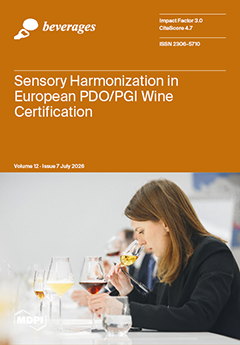
Cover Story (view full-size image): Sensory evaluation is an essential component of quality control for wines protected under the European Union’s PDO and PGI schemes. This review examines sensory certification practices across several European countries, with particular focus on Portugal’s mandatory batch-level approval system. By comparing national approaches, EU regulatory requirements, accreditation standards, and the International Olive Council’s Panel Test model, the study identifies increasing convergence in formal sensory certification while highlighting continued differences in the evaluation of typicity. It proposes a conceptual framework that supports harmonized conformity assessment through consistent evidence-based procedures while preserving the regional identity and distinctive sensory characteristics of geographical indication wines. View this paper
  • Issues are regarded as officially published after their release is announced to the table of contents alert mailing list.
  • You may sign up for e-mail alerts to receive table of contents of newly released issues.
  • PDF is the official format for papers published in both, html and pdf forms. To view the papers in pdf format, click on the "PDF Full-text" link, and use the free Adobe Reader to open them.
Order results
Result details
Section
Select all
Export citation of selected articles as:
15 pages, 463 KB  
Communication
Preliminary Assessment of Physicochemical and Microbial Stability in CBD-Infused Water Beverages
by Harry Chiririwa
Beverages 2026, 12(7), 83; https://doi.org/10.3390/beverages12070083 - 22 Jul 2026
Viewed by 555
Abstract
Cannabidiol (CBD)-infused bottled water has recently become one of the new types of functional beverages in the expanding cannabinoid and nutraceutical market. This paper presents preliminary experimental observations combined with a literature-based analysis to investigate quality and stability parameters of CBD-infused bottled water. [...] Read more.
Cannabidiol (CBD)-infused bottled water has recently become one of the new types of functional beverages in the expanding cannabinoid and nutraceutical market. This paper presents preliminary experimental observations combined with a literature-based analysis to investigate quality and stability parameters of CBD-infused bottled water. Physicochemical characterization, microbial quality analysis and stability monitoring of CBD under storage conditions were included in the experimental work. The results indicated that the formulation maintained the properties of its initial dispersion during the first period of storage. An increase in transparency and a decrease in CBD concentration were noted. Microbial counts increased during storage, suggesting that microbiological stability is limited by time under the tested conditions. Reviewing the literature underlines the significance of cannabinoid stability in aqueous beverages aided by nanoemulsion delivery systems, packaging materials and controlled storage environments. The results show that CBD can be infused into bottled water but challenges regarding formulation and storage exist. The research was not conducted to address long shelf-life, commercial scalability or compliance with regulations but to provide primary information on quality and stability factors influencing CBD beverages. More research using standardized procedures is required to understand safety, efficacy and stability over time. Full article
(This article belongs to the Topic Advances in Analysis of Food and Beverages, 2nd Edition)
Show Figures

Graphical abstract

23 pages, 2227 KB  
Article
Physicochemical Stability, Sensory Acceptance, and Biological Impact of Green Tea Kombucha Flavored with Native Cerrado Fruits (Spondias mombin L. and Anacardium occidentale L.)
by Maria Fernanda Rossetti Rogerio, Ana Elisa Barbosa Siqueira, Maria Isabela da Silva Figueiredo, Jasmim Esmeralda Silva Lima, Marcos Antônio Soares, Claudia Puerari, Maressa Caldeira Morzelle and Juliana Aparecida Correia Bento
Beverages 2026, 12(7), 82; https://doi.org/10.3390/beverages12070082 - 22 Jul 2026
Viewed by 562
Abstract
Kombucha is a functional beverage produced through the fermentation of Camellia sinensis by a symbiotic culture of bacteria and yeast (SCOBY). Incorporating cashew (Anacardium occidentale L.) and Cajá (Spondias mombin L.) pulps represents a value-addition strategy to mitigate the post-harvest perishability [...] Read more.
Kombucha is a functional beverage produced through the fermentation of Camellia sinensis by a symbiotic culture of bacteria and yeast (SCOBY). Incorporating cashew (Anacardium occidentale L.) and Cajá (Spondias mombin L.) pulps represents a value-addition strategy to mitigate the post-harvest perishability of native Cerrado fruits. This study evaluated physicochemical kinetics, 21-day refrigerated shelf life, consumer acceptance, and biological effects in Caenorhabditis elegans of flavored kombuchas. During a 9-day primary fermentation, the pH decreased to 2.95 while total acidity reached 5.38%. Following flavoring (10% v/v pulp/juice), cashew kombucha exhibited the highest total phenolic content (4.19 mg GAE/mL) and ferric reducing power (FRAP), whereas Cajá kombucha showed superior DPPH scavenging activity (1236 µM TroloxE/mL). Refrigerated storage (4 °C) maintained high counts of viable microorganisms (>105 CFU/mL), though active residual fermentation induced ongoing sugar cleavage and a transient yeast proliferation peak on day 7 (8.15 log CFU/mL in Cajá kombucha). Toxicity assays using C. elegans revealed the initial mortality (31.5–62.5%); however, adjusting the pH to near-neutrality restored high organism viability (<10% mortality), confirming that mortality was acidity-driven. In pH-adjusted media, cashew kombucha promoted a modest extension of nematode lifespan, whereas Cajá kombucha reduced lipid accumulation. Sensory testing revealed moderate consumer acceptance, with cashew kombucha achieving a higher Acceptance Index (72.92%) than Cajá (67.26%). Overall, fruit supplementation enriches the bioactive potential of green tea kombucha, provided that post-fermentation acidity is appropriately managed. Full article
Show Figures

Graphical abstract

19 pages, 14990 KB  
Article
Suitability of Alternative Approaches to Extracting Wine Sensory Insights from Text Data: A Case Study in Champagne Wines
by Gonzalo Garrido-Bañuelos, Mpho Mafata and Astrid Buica
Beverages 2026, 12(7), 81; https://doi.org/10.3390/beverages12070081 - 16 Jul 2026
Viewed by 425
Abstract
In wine sensory evaluation, the integration of advanced data analysis techniques with more traditional approaches is essential for addressing challenges and improving practical applications. The current work explores some innovative text mining approaches for obtaining sensory information from various sources. One aspect of [...] Read more.
In wine sensory evaluation, the integration of advanced data analysis techniques with more traditional approaches is essential for addressing challenges and improving practical applications. The current work explores some innovative text mining approaches for obtaining sensory information from various sources. One aspect of interest is creating specialised dictionaries and lexicons through automated processing (e.g., Natural Language Processing/NLP), so that raw text data can be converted into standardised sensory terms understood by specialists. Programmatic processing, in this context, refers to the automated extraction, transformation, consolidation, and analysis of sensory data, significantly reducing human error and allowing for the efficient handling of large data volumes, which is something not possible through manual processing only. The approach is illustrated using diverse data sources, such as structured database-type (for example, from wine sellers) and open-source data from sensory and consumer research publications. The manuscript introduces new ways to draw insights using coupled pipelines for dimension reduction (Multiple Correspondence Analysis/MCA), cluster analysis (Latent Semantic Analysis/LSA), and visual tools (network analysis, chord diagrams, wordvenn diagrams). This manuscript aims to provide practical tools and new insights for sensory specialists looking to enhance their evaluation techniques using text data, showcasing the versatility of advanced analysis techniques in extracting relevant sensory information. These tools use open-source languages such as Python and R and can be further applied for different product spaces. Full article
(This article belongs to the Section Wine, Spirits and Oenological Products)
Show Figures

Graphical abstract

17 pages, 331 KB  
Review
Traditional Fermented Beverages as Drinks of the Future
by Kristina Habschied, Ingo Barkow and Krešimir Mastanjević
Beverages 2026, 12(7), 80; https://doi.org/10.3390/beverages12070080 - 13 Jul 2026
Viewed by 749
Abstract
Fermentation is a foundational process that has historically underpinned the development of global civilizations. By extending the shelf life of perishable ingredients while enhancing flavor, nutrition, and bioactive properties, fermentation has provided the food security necessary for societies to flourish. Traditionally, these processes [...] Read more.
Fermentation is a foundational process that has historically underpinned the development of global civilizations. By extending the shelf life of perishable ingredients while enhancing flavor, nutrition, and bioactive properties, fermentation has provided the food security necessary for societies to flourish. Traditionally, these processes utilized locally available raw materials—such as milk, cereals, fruits, and vegetables—to produce a diverse array of non-alcoholic, alcoholic, and functional foods. This review explores the evolution of prominent ancient fermentation products and the contemporary movement to revive their authentic sensory profiles, including unique aromas and textures. Furthermore, it examines the transition from traditional artisanal methods to modern industrial production, where the use of standardized starter cultures and precise process parameters ensures product uniformity for the global market while employing precision fermentation to improve traditional fermentation products. By bridging ancestral wisdom with modern food science, this review highlights the enduring relevance of fermentation in the current food landscape. Full article
(This article belongs to the Special Issue New Insights into Artisanal and Traditional Beverages)
17 pages, 2480 KB  
Article
Aroma Identity of Red Wines from Old-Vine Genotypes Cultivated on Mount Etna
by Fabrizio Cincotta, Gianluca Tripodi, Leonardo Paul Luca, Lorenzo Rapisarda, Salvatore Sparla, Antonio Sparacio, Filippo Salvatore Ferlito, Antonella Verzera and Elisabetta Nicolosi
Beverages 2026, 12(7), 79; https://doi.org/10.3390/beverages12070079 - 6 Jul 2026
Viewed by 453
Abstract
The slopes of Mount Etna (Sicily, Italy) are home to an extraordinary viticultural heritage, comprising several vine genotypes at risk of extinction, whose oenological potential remains largely unexplored. This study aims to provide an aromatic characterization of red wines produced from five old-vine [...] Read more.
The slopes of Mount Etna (Sicily, Italy) are home to an extraordinary viticultural heritage, comprising several vine genotypes at risk of extinction, whose oenological potential remains largely unexplored. This study aims to provide an aromatic characterization of red wines produced from five old-vine genotypes (Barbarossa Etna, Madama Nera, Moscatella Nera, Minnella Nera, and Terribile), comparing them with local and international cultivars. The wines were produced using standardized microvinification techniques; physicochemical parameters were measured according to OIV methods, volatile aromatic compounds were analyzed using HS-SPME/GC-MS, and sensory analysis was carried out using quantitative descriptive analysis. The wines from old-vine genotypes exhibited physicochemical characteristics in line with Etna DOC standards. The profiling of volatile organic compounds revealed clear cultivar-specific aromatic characteristics, with Moscatella Nera exhibiting the most complex and terpene-rich content. The sensory analysis confirmed a distinctive aroma for each old-vine genotype wine, with substantial differences from traditional and international wines. These results support the oenological significance of these old-vine genotypes and their potential reintroduction into production to enhance the biodiversity and identity of Etna wines. Full article
(This article belongs to the Section Wine, Spirits and Oenological Products)
Show Figures

Graphical abstract

14 pages, 523 KB  
Article
Physicochemical, Sensory, and Microbiological Evaluation of a Beverage Formulated from Hibiscus sabdariffa L., Ananas comosus L., and Theobroma cacao L. Mucilage
by Rossy Rodríguez-Castro, Carol Daniela Coello, Javier Martínez-Sarabia, Dayana Menendez-Toala, Gabriela Palacios-Loor and Ángel Fernández
Beverages 2026, 12(7), 78; https://doi.org/10.3390/beverages12070078 - 3 Jul 2026
Viewed by 532
Abstract
The study developed and characterized a natural beverage formulated from hibiscus extract (Hibiscus sabdariffa L.), pineapple (Ananas comosus L.), and cacao mucilage (Theobroma cacao L.), with the aim of valorizing agricultural by-products and providing a natural, healthy, and sustainable alternative. [...] Read more.
The study developed and characterized a natural beverage formulated from hibiscus extract (Hibiscus sabdariffa L.), pineapple (Ananas comosus L.), and cacao mucilage (Theobroma cacao L.), with the aim of valorizing agricultural by-products and providing a natural, healthy, and sustainable alternative. A completely randomized design with a 3 × 2 factorial arrangement was used. Six beverage formulations were prepared by combining three levels of Hibiscus extract–pineapple proportion (Factor A) with two levels of cacao mucilage (Factor B), resulting in six treatments that were evaluated in triplicate for their physicochemical, sensory, and microbiological properties. The analyses showed significant variations in °Brix (14.90–22.40), density (1.087–1.119 g/mL), and pH (2.71–3.31), indicating that cacao mucilage increased soluble solids retention and colloidal stability without altering acidity. In the sensory evaluation, treatment T1 (30% hibiscus extract, 10% pineapple, and 40% cacao mucilage) achieved the highest acceptance due to its balanced color, flavor, and texture. Microbiological analyses confirmed that the beverage complied with the limits established by the Ecuadorian standard NTE INEN 2337:2008 for non-carbonated fruit beverages. Overall, cacao mucilage proved to be an effective natural stabilizer that enhances the physicochemical and sensory quality of tropical beverages, representing an innovative strategy for the sustainable valorization of cacao by-products in the food industry. Full article
Show Figures

Figure 1

26 pages, 436 KB  
Review
Sensory Evaluation and Methodological Standardization in PDO/PGI Wine Certification: A Comparative Analysis of European Practices, Accreditation Frameworks, and the Portuguese Context
by Manuel Pinto, Elisete Correia and Alice Vilela
Beverages 2026, 12(7), 77; https://doi.org/10.3390/beverages12070077 - 3 Jul 2026
Viewed by 1112
Abstract
Accredited sensory certification is increasingly central to the credibility of EU Geographical Indications (GIs), particularly for wine, where typicity and regional identity complicate harmonization. In the absence of shared descriptors, reference standards, and decision rules, sensory control may produce inconsistent conformity outcomes across [...] Read more.
Accredited sensory certification is increasingly central to the credibility of EU Geographical Indications (GIs), particularly for wine, where typicity and regional identity complicate harmonization. In the absence of shared descriptors, reference standards, and decision rules, sensory control may produce inconsistent conformity outcomes across certification bodies. This study examines the main drivers and limitations of sensory harmonization in GI wine certification, with particular focus on Portugal’s mandatory batch-level sensory approval system. Using a structured narrative review and comparative analysis, it integrates sensory science literature with the EU regulatory framework requiring verifiable organoleptic characteristics in product specifications. National approaches from Portugal, Croatia, France, Germany, Greece, Italy, Romania and Spain are compared, alongside the harmonized IOC Panel Test model for virgin olive oil. Accreditation is analyzed through International Organization for Standardization standards ISO/IEC 17025 and ISO/IEC 17065, as well as EA guidance. Results show increasing convergence toward formal sensory certification but persistent divergence in how typicity is operationalized and translated into conformity decisions. The study proposes a conceptual framework in which harmonization focuses on evidential conditions rather than uniform sensory identities. Full article
Show Figures

Figure 1

17 pages, 2577 KB  
Article
Co-Fermentation with Cider By-Products for Enhanced Beverage Quality: Kinetics, Functionality, and Sensory Impact
by Murilo de Freitas Peres, Bruno Wasilewski Neto, Isabela Maria Macedo Simon Sola, Thaís Estéfane Fischer, José Pedro Wojeicchowski, Aline Alberti and Alessandro Nogueira
Beverages 2026, 12(7), 76; https://doi.org/10.3390/beverages12070076 - 1 Jul 2026
Viewed by 560
Abstract
This study evaluated a new co-valorization strategy using apple pomace and a nitrogen-rich yeast lees extract to correct low concentrations of amino acids and phenolic compounds that can impair fermentation kinetics, aroma formation, and antioxidant activity, thereby improve cider quality and support the [...] Read more.
This study evaluated a new co-valorization strategy using apple pomace and a nitrogen-rich yeast lees extract to correct low concentrations of amino acids and phenolic compounds that can impair fermentation kinetics, aroma formation, and antioxidant activity, thereby improve cider quality and support the principles of the circular economy. Apple must (Gala) was supplemented with nitrogen extract (80 mg/L), dehydrated apple pomace (47.3 g/L), or both, and fermented with Saccharomyces cerevisiae. Fermentation kinetics, physicochemical parameters, individual phenolic profile (HPLC), antioxidant activity (DPPH, ABTS, FRAP, and CUPRAC), color (CIELAB), and sensory attributes were assessed. Nitrogen supplementation accelerated fermentation, increasing the maximum rate from 9 to 16 g CO2/L/day when combined with apple pomace. While nitrogen extract alone reduced phenolic levels, its combination with pomace resulted in a balanced phenolic profile and superior fruity aroma. Apple pomace addition increased titratable acidity (1.6 times) and ethanol content (>1% v/v) and enhanced total phenolics (up to 20%) and antioxidant activity (up to 46% by FRAP). Sensory analysis indicated that the combined treatment achieved the highest overall acceptance. The integrated use of apple pomace and yeast lees extract represents a sustainable new strategy to enhance cider bioactivity, fermentation performance, and sensory quality while valorizing agro-industrial residues. Full article
(This article belongs to the Section Quality, Nutrition, and Chemistry of Beverages)
Show Figures

Figure 1

Previous Issue
Next Issue
Back to TopTop
