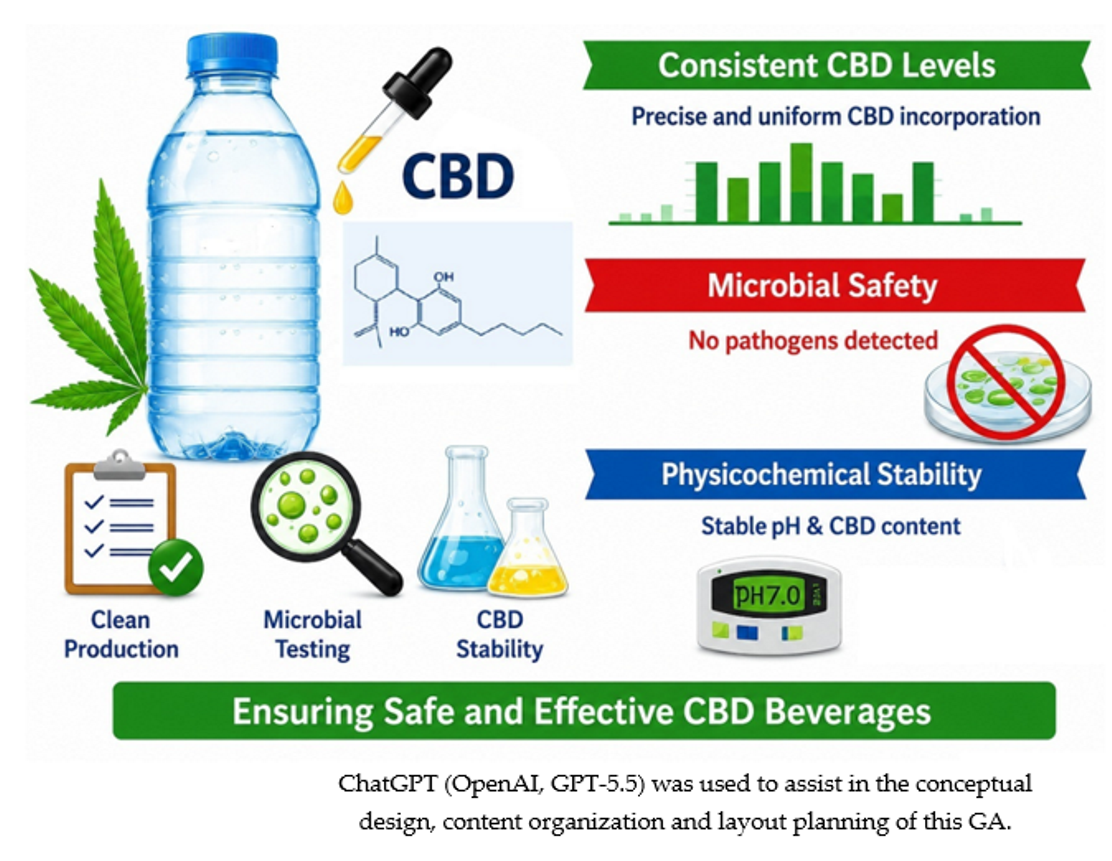


Preliminary Assessment of Physicochemical and Microbial Stability in CBD-Infused Water Beverages


Abstract
1. Introduction
1.1. Background on Functional Beverages and CBD Use
1.2. Significance of CBD-Infused Water for Health and Wellness
1.3. Knowledge Gap: Limited Data on Microbial Safety, Chemical Stability and Production Methods
1.4. Study Objectives and Novelty
2. Materials and Methods
2.1. Study Design and Scope
2.2. Materials
2.3. Preparation of CBD-Infused Water Formulation
2.4. Experimental Design and Replicates
2.5. Storage Conditions
2.6. Physicochemical Analysis
2.7. Microbiological Analysis
2.8. HPLC Analysis of CBD
2.9. Statistical Analysis
2.10. Methodological Limitations
3. Results
3.1. Study Overview and Data Classification
3.2. Physicochemical Properties of CBD-Infused Water
3.3. Microbial Quality Assessment
3.4. CBD Stability During Storage (HPLC Analysis)
3.5. Statistical Analysis
3.6. Literature-Supported Comparative Observations
3.7. Summary of Key Experimental Findings
- It is feasible to incorporate CBD into bottled water by using a carrier-based formulation system [33].
- Formulated CBD degrades to some extent after being stored for a period [34].
- The microbial population increases during storage, and only limited antimicrobial protection exists [35].
- Physicochemical stability is retained during short-term storage, but gradual changes take place over long periods of time [36].
4. Discussion
5. Limitations
6. Conclusions
Future Perspectives
Funding
Institutional Review Board Statement
Informed Consent Statement
Data Availability Statement
Acknowledgments
Conflicts of Interest
References
- Giri, N.A.; Sakhale, B.K.; Nirmal, N.P. Functional beverages: An emerging trend in beverage world. In Recent Frontiers of Phytochemicals; Elsevier: Amsterdam, The Netherlands, 2023; pp. 123–142. [Google Scholar] [CrossRef] [Scilit]
- Bagheri, H.; Akhavan-Mahdavi, S.; Sarabi-Aghdam, V.; Mirarab Razi, S.; Singh Beniwal, A.; Rashidinejad, A. Targeted dairy fortification: Leveraging bioactive compounds to enhance nutritional value. Crit. Rev. Food Sci. Nutr. 2026, 66, 295–319. [Google Scholar] [CrossRef] [Scilit] [PubMed]
- Tihăuan, B.M.; Onisei, T.; Slootweg, W.; Gună, D.; Iliescu, C.; Chifiriuc, M.C. Cannabidiol-A friend or a foe? Eur. J. Pharm. Sci. 2025, 208, 107036. [Google Scholar] [CrossRef] [Scilit] [PubMed]
- Martínez, V.; Iriondo De-Hond, A.; Borrelli, F.; Capasso, R.; Del Castillo, M.D.; Abalo, R. Cannabidiol and Other Non-Psychoactive Cannabinoids for Prevention and Treatment of Gastrointestinal Disorders: Useful Nutraceuticals? Int. J. Mol. Sci. 2020, 21, 3067. [Google Scholar] [CrossRef] [Scilit] [PubMed] [PubMed Central]
- Fordjour, E.; Manful, C.F.; Khalsamehta, T.S.K.; Armah, A.; Cheema, M.; Thomas, R. Cannabis-infused foods: Phytonutrients, health, and safe product innovations. Compr. Rev. Food Sci. Food Saf. 2024, 23, e70021. [Google Scholar] [CrossRef] [Scilit] [PubMed]
- Parlak Khalily, M.E.L.E.K. Improving the water solubility of cannabidiol using a peptide carrier. Turk. J. Chem. 2024, 48, 229–236. [Google Scholar] [CrossRef] [Scilit] [PubMed]
- Lachenmeier, D.W.; Sproll, C.; Walch, S.G. Does cannabidiol (CBD) in food supplements pose a serious health risk? Consequences of the European food safety authority (EFSA) clock stop regarding novel food authorisation. Psychoactives 2023, 2, 66–75. [Google Scholar] [CrossRef] [Scilit]
- Mostafa, N.; Taha, I.E.; Abourobe, N.M.; Ashour, E.A. Development and Characterization of Cannabidiol Self-Emulsifying Drug Delivery System: In Vitro and In Vivo Evaluation. Biomolecules 2025, 16, 21. [Google Scholar] [CrossRef] [Scilit] [PubMed]
- Mullen, L.D.; Hart, E.D.; Vikingsson, S.; Winecker, R.E.; Hayes, E.; Flegel, R.; Cone, E.J. Stability of nano-emulsified cannabidiol in acidic foods and beverages. Cannabis Cannabinoid Res. 2025, 10, 213–219. [Google Scholar] [CrossRef] [Scilit] [PubMed]
- Xie, Y.; Li, P.; Fu, D.; Yang, F.; Sui, X.; Huang, B.; Liu, J.; Chi, J. CBD-loaded nanostructured lipid carriers: Optimization, characterization, and stability. ACS Omega 2024, 9, 40632–40643. [Google Scholar] [CrossRef] [Scilit] [PubMed]
- Staples, A.J. Canning cannabis: Consumer preferences for CBD-and THC-infused beverages. J. Wine Econ. 2024, 19, 313–334. [Google Scholar] [CrossRef] [Scilit]
- Cásedas, G.; Yarza-Sancho, M.D.; López, V. Cannabidiol (CBD): A systematic review of clinical and preclinical evidence in the treatment of pain. Pharmaceuticals 2024, 17, 1438. [Google Scholar] [CrossRef] [Scilit] [PubMed]
- Hoch, E.; Volkow, N.D.; Friemel, C.M.; Lorenzetti, V.; Freeman, T.P.; Hall, W. Cannabis, cannabinoids and health: A review of evidence on risks and medical benefits. Eur. Arch. Psychiatry Clin. Neurosci. 2025, 275, 281–292. [Google Scholar] [CrossRef] [Scilit] [PubMed]
- Sant’Ana, R.R.A.; Soldi, C.; Amboni, R.D.D.M.C.; Fritzen-Freire, C.B. Cannabis sativa in beverages: Incorporation methods, bioactive stability and sensory impact–a critical review. Crit. Rev. Food Sci. Nutr. 2026, 66, 4062–4073. [Google Scholar] [CrossRef] [Scilit] [PubMed]
- Astray, G.; Mejuto, J.C.; Xiao, J.; Simal-Gandara, J. Benefits, toxicity and current market of cannabidiol in edibles. Crit. Rev. Food Sci. Nutr. 2023, 63, 5800–5812. [Google Scholar] [CrossRef] [Scilit] [PubMed]
- O’Brien, K. Cannabidiol (CBD) in cancer management. Cancers 2022, 14, 885. [Google Scholar] [CrossRef] [Scilit] [PubMed]
- Muta, T.; Khetan, R.; Song, Y.; Garg, S. Optimising cannabidiol delivery: Improving water solubility and permeability through phospholipid complexation. Int. J. Mol. Sci. 2025, 26, 2647. [Google Scholar] [CrossRef] [Scilit] [PubMed]
- Nyland, C.R.; Moyer, D.C. Regulating for safety: Cannabidiol dose in food: A review. J. Food Prot. 2022, 85, 1355–1369. [Google Scholar] [CrossRef] [Scilit] [PubMed]
- Ozturk, B.; McClements, D.J. Progress in natural emulsifiers for utilization in food emulsions. Curr. Opin. Food Sci. 2016, 7, 1–6. [Google Scholar] [CrossRef] [Scilit]
- Mozola, M.; Gray, L.R.; Feldpausch, J.; Alles, S.; McDougal, S.; Montei, C.; Sarver, R.; Steiner, B.; Cooper, C.; Rice, J. Validation of the Soleris® NF-TVC method for determination of total viable count in a variety of foods. J. AOAC Int. 2013, 96, 399–403. [Google Scholar] [CrossRef] [Scilit] [PubMed]
- Sieuwerts, S.; De Bok, F.A.; Mols, E.; De Vos, W.M.; van Hylckama Vlieg, J.E.T. A simple and fast method for determining colony forming units. Lett. Appl. Microbiol. 2008, 47, 275–278. [Google Scholar] [CrossRef] [Scilit] [PubMed]
- WHO. Guidelines for drinking-water quality. WHO Chron. 2011, 38, 104–108. [Google Scholar]
- Hädener, M.; König, S.; Weinmann, W. Quantitative determination of CBD and THC and their acid precursors in confiscated cannabis samples by HPLC-DAD. Forensic Sci. Int. 2019, 299, 142–150. [Google Scholar] [CrossRef] [Scilit] [PubMed]
- Jaidee, W.; Siridechakorn, I.; Nessopa, S.; Wisuitiprot, V.; Chaiwangrach, N.; Ingkaninan, K.; Waranuch, N. Kinetics of CBD, Δ9-THC Degradation and Cannabinol Formation in Cannabis Resin at Various Temperature and pH Conditions. Cannabis Cannabinoid Res. 2022, 7, 537–547. [Google Scholar] [CrossRef] [Scilit] [PubMed]
- Jeong, M.; Lee, S.; Seo, C.; Kwon, E.; Rho, S.; Cho, M.; Kim, M.Y.; Lee, W.; Lee, Y.S.; Hong, J. Chemical transformation of cannabidiol into psychotropic cannabinoids under acidic reaction conditions: Identification of transformed products by GC-MS. J. Food Drug Anal. 2023, 31, 165–176. [Google Scholar] [CrossRef] [Scilit] [PubMed]
- Leibtag, S.; Peshkovsky, A. Cannabis extract nanoemulsions produced by high-intensity ultrasound: Formulation development and scale-up. J. Drug Deliv. Sci. Technol. 2020, 60, 101953. [Google Scholar] [CrossRef] [Scilit]
- Selvaraj, S.; Nawfer, N.; Dharmawansa, K.V.S.; Redha, A.A.; Rupasinghe, H.P.V. Recent advances in cannabidiol (CBD) extraction: A review of potential eco-friendly solvents and advanced technologies. Green Anal. Chem. 2025, 13, 100270. [Google Scholar] [CrossRef] [Scilit]
- Kosović, E.; Sýkora, D.; Kuchař, M. Stability Study of Cannabidiol in the Form of Solid Powder and Sunflower Oil Solution. Pharmaceutics 2021, 13, 412. [Google Scholar] [CrossRef] [Scilit] [PubMed]
- Paczkowska-Walendowska, M.; Trzaskoma, P.; Dziopa, A.; Moeini, A.; Soczawa, M.; Krasiński, Z.; Cielecka-Piontek, J. Innovative Strategies to Enhance the Bioavailability of Cannabidiol: Nanotechnology and Advanced Delivery Systems. Pharmaceuticals 2025, 18, 1637. [Google Scholar] [CrossRef] [Scilit] [PubMed]
- Freire, D.T.; Dourado, D.; Miranda, J.A.; Pereira, D.T.; Freire, D.P.; Alencar, E.N.; Egito, E.S.T. Unraveling approaches for cannabidiol delivery nanosystems: A patent review. Biomed. Pharmacother. 2026, 199, 119509. [Google Scholar] [CrossRef] [Scilit] [PubMed]
- Animasaun, J.B.; Ijiga, O.M.; Ayoola, V.B.; Enyejo, L.A. Evaluating the stability of cannabinoid extracts following different solvent evaporation conditions: A GC-MS/LC-MS degradation profiling study. Int. J. Sci. Res. Mod. Technol. 2024, 3, 55–70. [Google Scholar] [CrossRef] [Scilit]
- Valdez, A.S.B.; Castañeda, J.B.B.; Borges, N.; Rastely, C.; Ferreira, W.; Nascimento, F.P.; Theodoro, A. Evaluation of the Stability of Cannabidiol and delta-9-tetrahydrocannabinol in Cannabis-based Oily Product: Effects of Light, Temperature, Excipients and Antioxidant Additives. Braz. J. Anal. Chem. 2026, 13, 133–149. [Google Scholar] [CrossRef] [Scilit]
- Singh, V.; Vihal, S.; Rana, R.; Rathore, C. Nanocarriers for cannabinoid delivery: Enhancing therapeutic potential. Recent Adv. Drug Deliv. Formul. 2024, 18, 247–261. [Google Scholar] [CrossRef] [Scilit] [PubMed]
- Schwarzenberg, A.; Carpenter, H.; Wright, C.; Bayazeid, O.; Brokl, M. Characterizing the degradation of cannabidiol in an e-liquid formulation. Sci. Rep. 2022, 12, 20058. [Google Scholar] [CrossRef] [Scilit] [PubMed]
- Blaskovich, M.A.; Kavanagh, A.M.; Elliott, A.G.; Zhang, B.; Ramu, S.; Amado, M.; Lowe, G.; Hinton, A.; Pham, D.M.T.; Zuegg, J.; et al. The antimicrobial potential of cannabidiol. Commun. Biol. 2021, 4, 7. [Google Scholar] [CrossRef] [Scilit] [PubMed]
- Vlad, R.A.; Farczádi, L.; Paliștan, D.; Pintea, C.; Antonoaea, P.; Rédai, E.M.; Pintea, A.; Cotoi, C.T.; Ciurba, A.; Bîrsan, M.; et al. Formulation and Analytical Evaluation of Liquid Cannabidiol Preparations: Comparative Study of Oil-Based Solutions and Emulsions. Pharmaceutics 2025, 17, 1533. [Google Scholar] [CrossRef] [Scilit] [PubMed]
- Hossain, K.R.; Alghalayini, A.; Valenzuela, S.M. Current challenges and opportunities for improved cannabidiol solubility. Int. J. Mol. Sci. 2023, 24, 14514. [Google Scholar] [CrossRef] [Scilit] [PubMed]
- Blal, K.; Maroukian, G.; Shapira, A.; Procaccia, S.; Meiri, D.; Benny, O. Development and Characterization of a High-CBD Cannabis Extract Nanoemulsion for Oral Mucosal Delivery. Int. J. Mol. Sci. 2025, 26, 11525. [Google Scholar] [CrossRef] [Scilit] [PubMed]
- García-Valverde, M.T.; Sánchez-Carnerero Callado, C.; Díaz-Liñán, M.C.; Sánchez de Medina, V.; Hidalgo-García, J.; Nadal, X.; Hanus, L.; Ferreiro-Vera, C. Effect of temperature in the degradation of cannabinoids: From a brief residence in the gas chromatography inlet port to a longer period in thermal treatments. Front. Chem. 2022, 10, 1038729. [Google Scholar] [CrossRef] [Scilit] [PubMed]
- Tonoyan, L.; Babu, D.; Reiz, B.; Le, T.; Siraki, A.G. Heating of consumer cannabis oils can lead to free radical initiated degradation, causing CBD and THC depletion. Free Radic. Biol. Med. 2022, 192, 77–83. [Google Scholar] [CrossRef] [Scilit] [PubMed]
- Henriques, A. Cannabinoid spoilage, metabolism and cannabidiol (CBD) conversion to Tetrahydrocannabinol (THC) mechanisms with energetic parameters. J. Cannabis Res. 2025, 7, 11. [Google Scholar] [CrossRef] [Scilit] [PubMed]
- Wei, J.; Shang, J.; Gao, Y.; Yuan, F.; Mao, L. Insights into the Stability and Lipid Oxidation of Water-in-Oil High Internal Phase Emulsions: Roles of the Concentration of the Emulsifier, Aqueous Phase, and NaCl. Foods 2025, 14, 1606. [Google Scholar] [CrossRef] [Scilit] [PubMed]
- Wang, C.; Li, J.; Sun, Y.; Wang, C.; Guo, M. Fabrication and characterization of a cannabidiol-loaded emulsion stabilized by a whey protein-maltodextrin conjugate and rosmarinic acid complex. J. Dairy Sci. 2022, 105, 6431–6446. [Google Scholar] [CrossRef] [Scilit] [PubMed]
- Kumari, M.; Gohil, D.; Sadhu, P. Nanostructured lipid carriers for topical drug delivery: A comprehensive review of design, mechanisms, and therapeutic advances. Next Nanotechnol. 2026, 9, 100367. [Google Scholar] [CrossRef] [Scilit]
- Hao, M.; Tan, X.; Liu, K.; Xin, N. Nanoencapsulation of nutraceuticals: Enhancing stability and bioavailability in functional foods. Front. Nutr. 2025, 12, 1746176. [Google Scholar] [CrossRef] [Scilit] [PubMed]
- Reddy, T.S.; Zomer, R.; Mantri, N. Nanoformulations as a strategy to overcome the delivery limitations of cannabinoids. Phyther. Res. 2023, 37, 1526–1538. [Google Scholar] [CrossRef] [Scilit] [PubMed]
- Biranjia-Hurdoyal, S.; Latouche, M.C. Factors affecting microbial load and profile of potential pathogens and food spoilage bacteria from household kitchen tables. Can. J. Infect. Dis. Med. Microbiol. 2016, 2016, 3574149. [Google Scholar] [CrossRef] [Scilit] [PubMed]
- Galasong, Y.; Charles-Vegdahl, A.; Worobo, R.W. Evaluation of antimicrobial efficacy against spoilage microorganisms and impact on beverage color and turbidity of commercial preservatives derived from edible mushrooms. Int. J. Food Microbiol. 2025, 433, 111130. [Google Scholar] [CrossRef] [Scilit] [PubMed]



| Storage Time | pH (Mean ± SD) | Appearance/Clarity | Observations |
|---|---|---|---|
| Day 0 | 6.82 ± 0.03 | Clear, homogeneous | Stable formulation |
| Day 14 | 6.79 ± 0.04 | Clear, homogeneous | No change observed |
| Day 28 | 6.75 ± 0.05 | Clear, homogeneous | No visible instability |
| Day 42 | 6.71 ± 0.04 | Clear, homogeneous | Slight decrease in pH; appearance unchanged |
| Day 56 | 6.68 ± 0.06 | Clear, homogeneous | Progressive destabilization |
| Day 70 | 6.64 ± 0.05 | Clear, homogeneous | Physically stable |
| Day 84 | 6.59 ± 0.07 | Clear, homogeneous | No visible signs of degradation or turbidity |
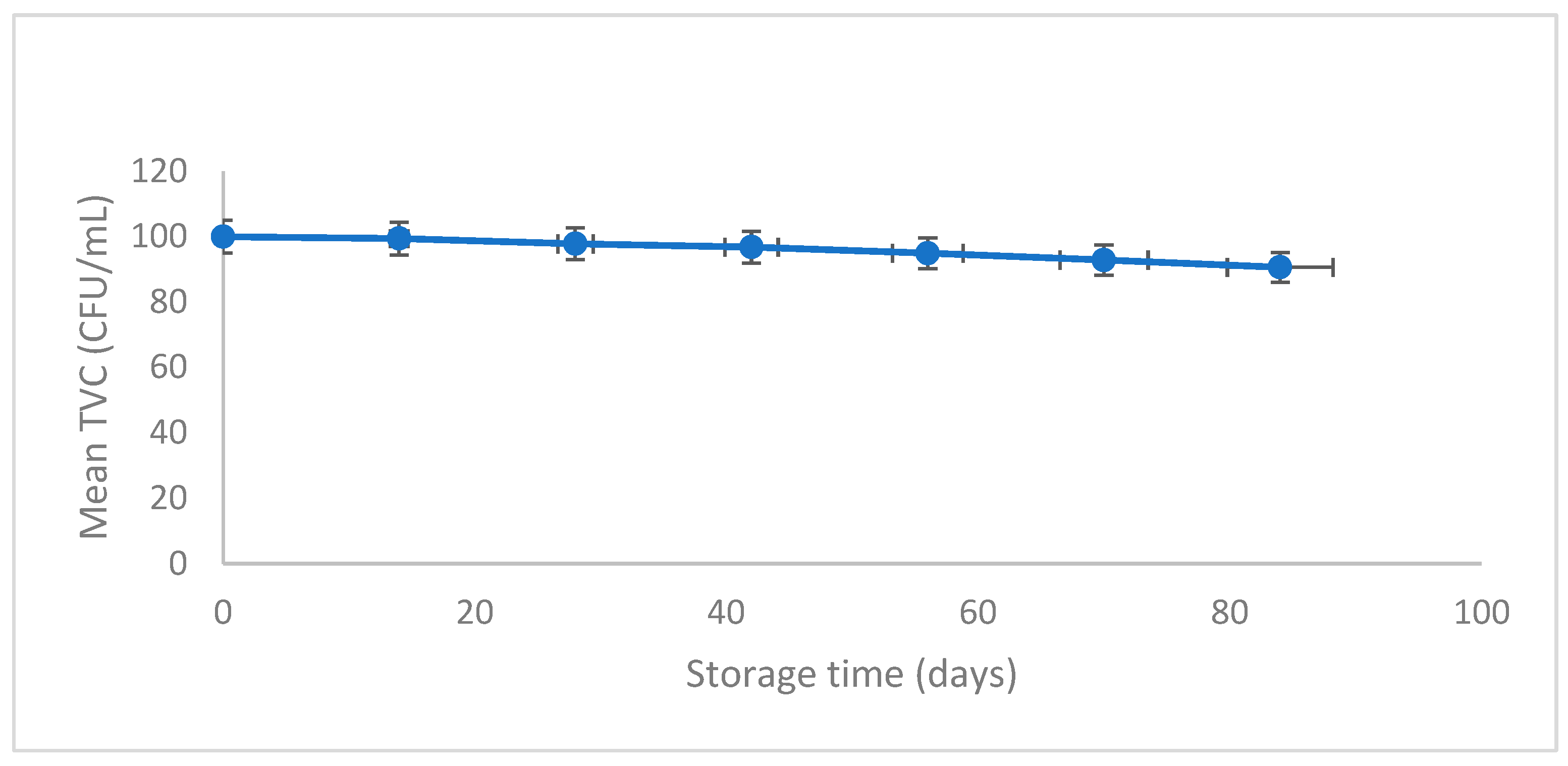
| Storage Time | TVC (CFU/mL) (Mean ± SD) | Microbial Quality Interpretation |
|---|---|---|
| Day 0 | <10 (not detected/very low) | Excellent microbiological quality |
| Day 14 | 1.4 × 101 ± 0.3 × 101 | Excellent microbiological quality |
| Day 28 | 2.7 × 101 ± 0.5 × 101 | Excellent microbiological quality |
| Day 42 | 4.9 × 101 ± 0.8 × 101 | Excellent microbiological quality |
| Day 56 | 7.5 × 101 ± 1.1 × 101 | Good microbiological quality |
| Day 70 | 1.3 × 10² ± 0.2 × 10² | Good microbiological quality |
| Day 84 | 1.9 × 10² ± 0.3 × 10² | Acceptable microbiological quality |
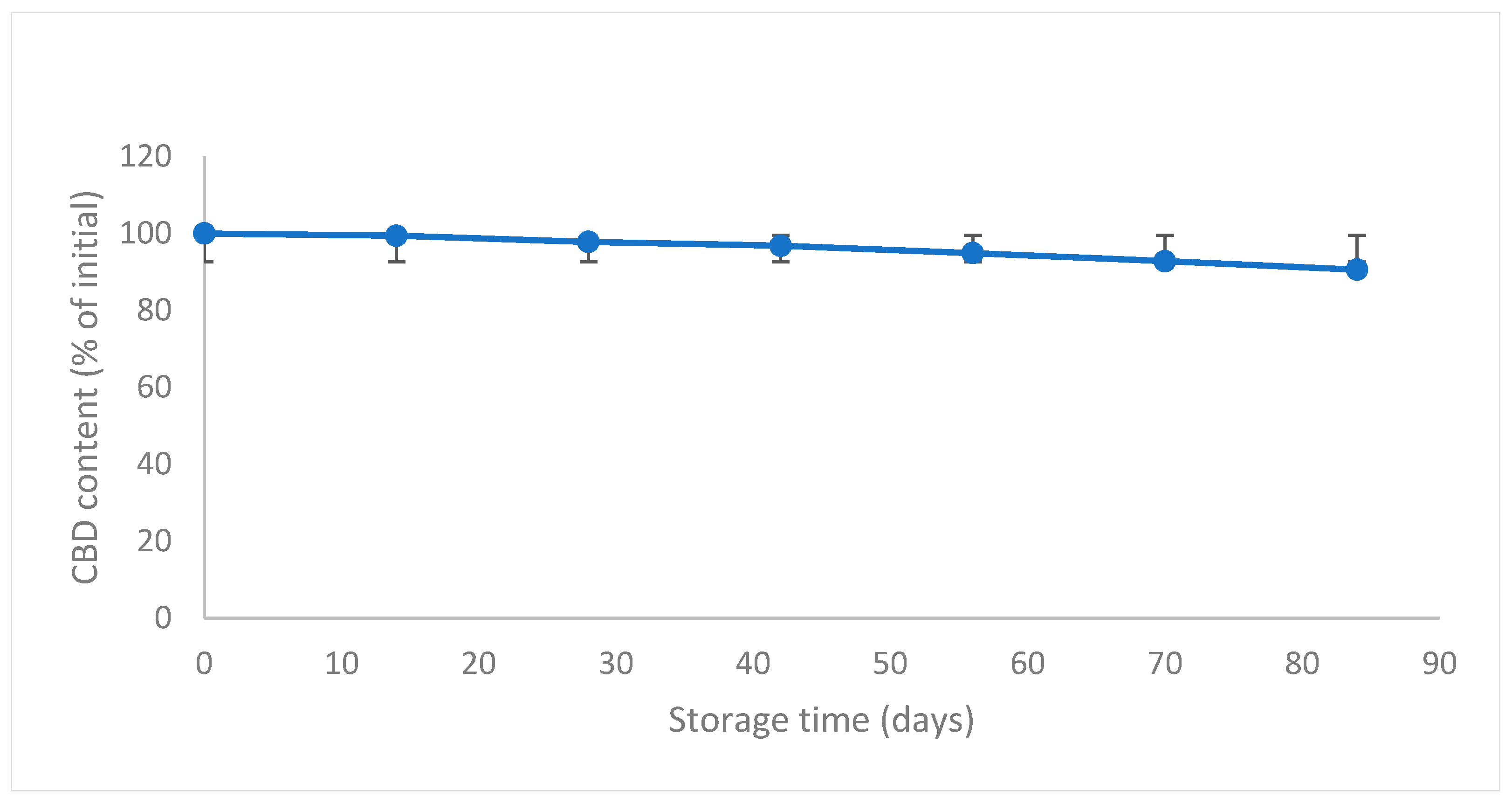
| Storage Time | CBD Remaining (%) Mean ± SD | Stability Interpretation |
|---|---|---|
| Day 0 | 100.0 ± 0.0 | Initial concentration |
| Day 14 | 99.4 ± 0.8 | Excellent stability |
| Day 28 | 97.8 ± 1.1 | Excellent stability |
| Day 42 | 96.8 ± 1.3 | Excellent stability |
| Day 56 | 94.9 ± 1.5 | Good stability |
| Day 70 | 92.8 ± 1.8 | Good stability |
| Day 84 | 90.6 ± 2.1 | Acceptable stability |
| Parameter | Statistical Test | Test Statistic | p-Value | Significant Difference (Across Time) | Trend Summary |
|---|---|---|---|---|---|
| pH | One-way ANOVA | F = 18.42 | p < 0.001 | Yes | Significant gradual decrease over storage period |
| Total viable count (TVC) | One-way ANOVA | F = 52.76 | p < 0.001 | Yes | Significant increase in microbial load over time |
| CBD concentration (HPLC) | One-way ANOVA | F = 64.31 | p < 0.001 | Yes | Significant time-dependent decline in CBD levels |
Disclaimer/Publisher’s Note: The statements, opinions and data contained in all publications are solely those of the individual author(s) and contributor(s) and not of MDPI and/or the editor(s). MDPI and/or the editor(s) disclaim responsibility for any injury to people or property resulting from any ideas, methods, instructions or products referred to in the content. |
© 2026 by the author. Licensee MDPI, Basel, Switzerland. This article is an open access article distributed under the terms and conditions of the Creative Commons Attribution (CC BY) license.
Share and Cite
Chiririwa, H. Preliminary Assessment of Physicochemical and Microbial Stability in CBD-Infused Water Beverages. Beverages 2026, 12, 83. https://doi.org/10.3390/beverages12070083
Chiririwa H. Preliminary Assessment of Physicochemical and Microbial Stability in CBD-Infused Water Beverages. Beverages. 2026; 12(7):83. https://doi.org/10.3390/beverages12070083
Chicago/Turabian StyleChiririwa, Harry. 2026. "Preliminary Assessment of Physicochemical and Microbial Stability in CBD-Infused Water Beverages" Beverages 12, no. 7: 83. https://doi.org/10.3390/beverages12070083
APA StyleChiririwa, H. (2026). Preliminary Assessment of Physicochemical and Microbial Stability in CBD-Infused Water Beverages. Beverages, 12(7), 83. https://doi.org/10.3390/beverages12070083