Effects of Sintering Parameters on the Microstructure and Optical Transmittance of Monolithic 4 mol% Yttria-Partially Stabilized Zirconia




Abstract
1. Introduction
2. Materials and Methods
2.1. Materials and Specimen Preparation
2.2. Sintering Protocols
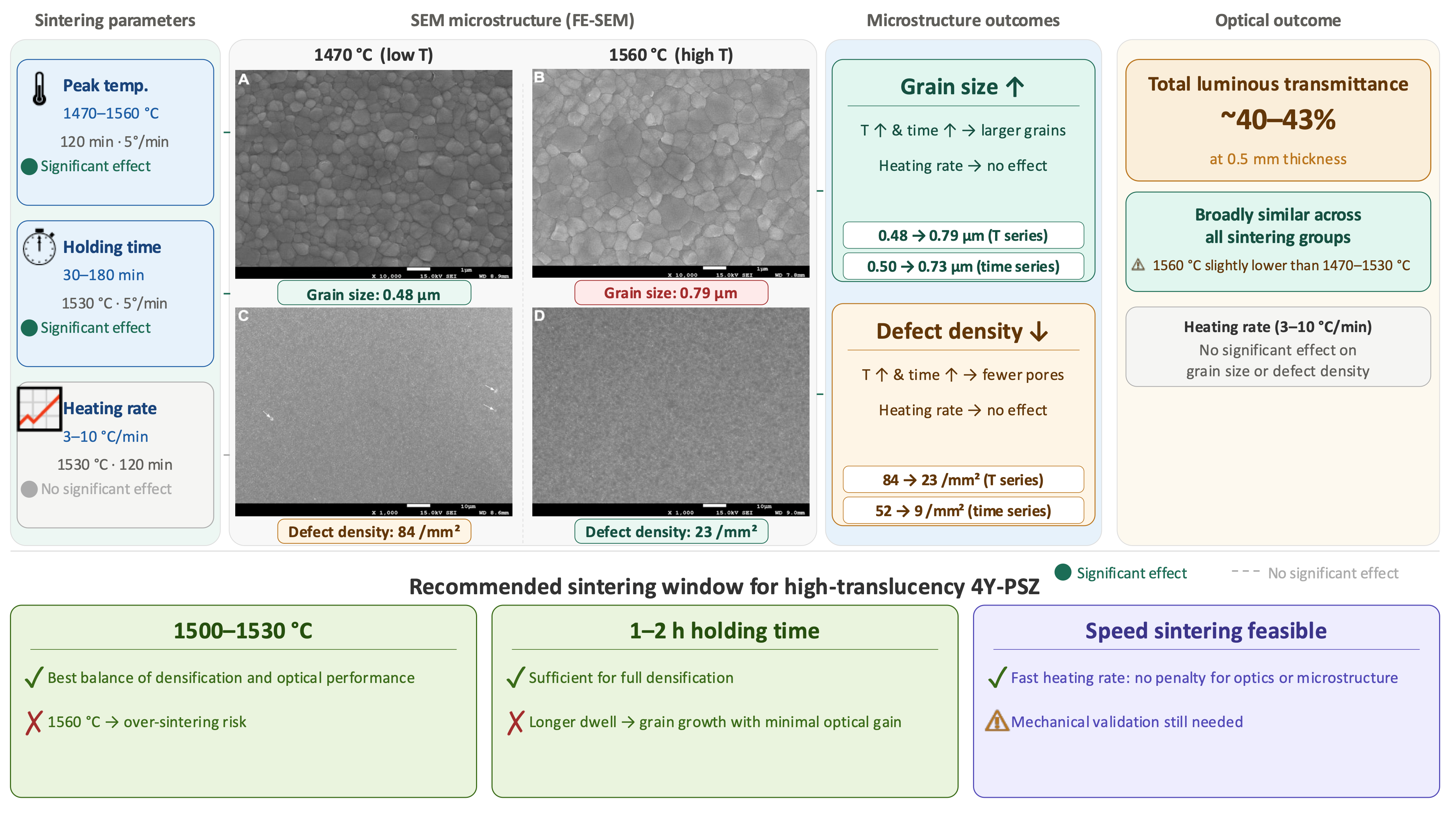
- Peak-temperature series (Tp1470, Tp1500, Tp1530, and Tp1560): sintering temperatures of 1470, 1500, 1530, and 1560 °C, with a heating rate of 5 °C/min and a holding time of 120 min.
- Holding-time series (Tm30, Tm60, Tm120, and Tm180): holding times of 30, 60, 120, and 180 min, with a peak temperature of 1530 °C and a heating rate of 5 °C/min.
- Heating-rate series (HR3, HR5, HR7, and HR10): heating rates of 3, 5, 7, and 10 °C/min, with a peak temperature of 1530 °C and a holding time of 120 min.
2.3. Microstructural Characterization by Scanning Electron Microscopy
2.4. Optical Transmittance Measurement
2.5. Statistical Analysis
3. Results
3.1. Grain Size
3.1.1. Peak Temperature
3.1.2. Holding Time
3.1.3. Heating Rate
3.2. Defect Density
3.2.1. Peak Temperature
3.2.2. Holding Time
3.2.3. Heating Rate
3.3. Optical Transmittance
3.3.1. Peak Temperature
3.3.2. Holding Time
3.3.3. Heating Rate
4. Discussion
4.1. Effect of Sintering Temperature
4.2. Effect of Holding Time
4.3. Effect of Heating Rate
4.4. Relationship Between Defect Density and Transmittance
4.5. Integrated Effects of Sintering Parameters on Microstructure and Transmittance
4.6. Clinical Implications
4.7. Limitations
5. Conclusions
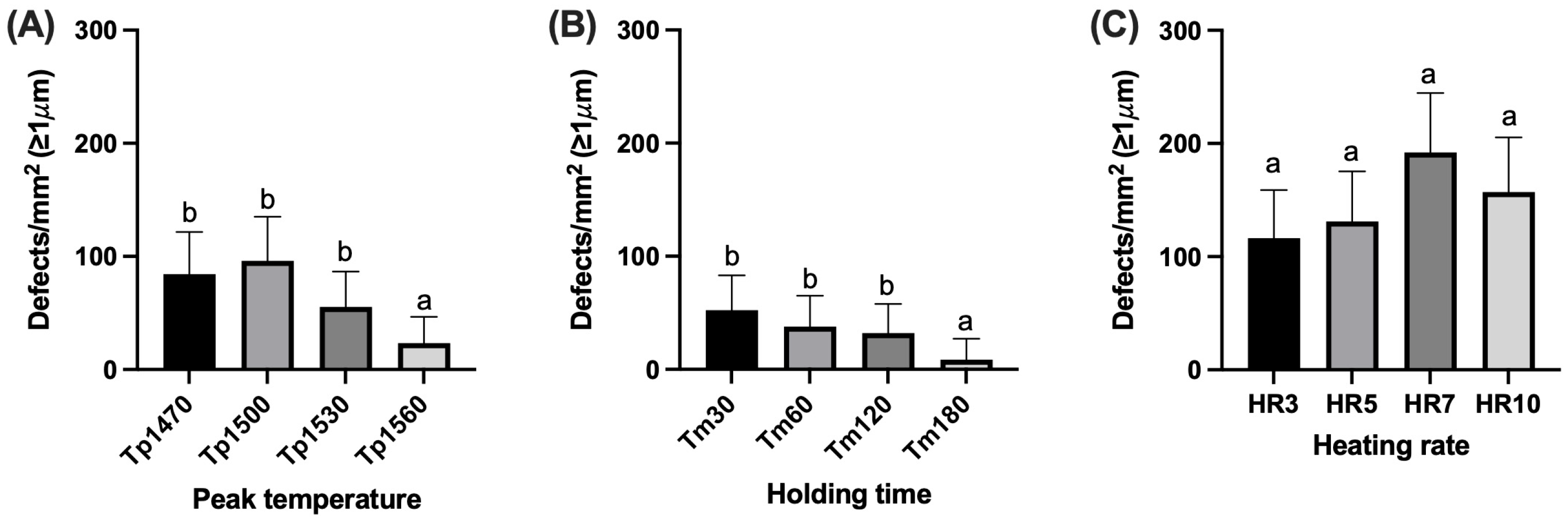
- Higher peak sintering temperatures and longer holding times increased grain size and reduced internal defect density. These microstructural changes produced only modest changes in total luminous transmittance, indicating diminishing optical returns once near-full density is approached.
- Variations in heating rate (3–10 °C/min) had no significant effect on final grain size or defect density and only limited associations with transmittance.
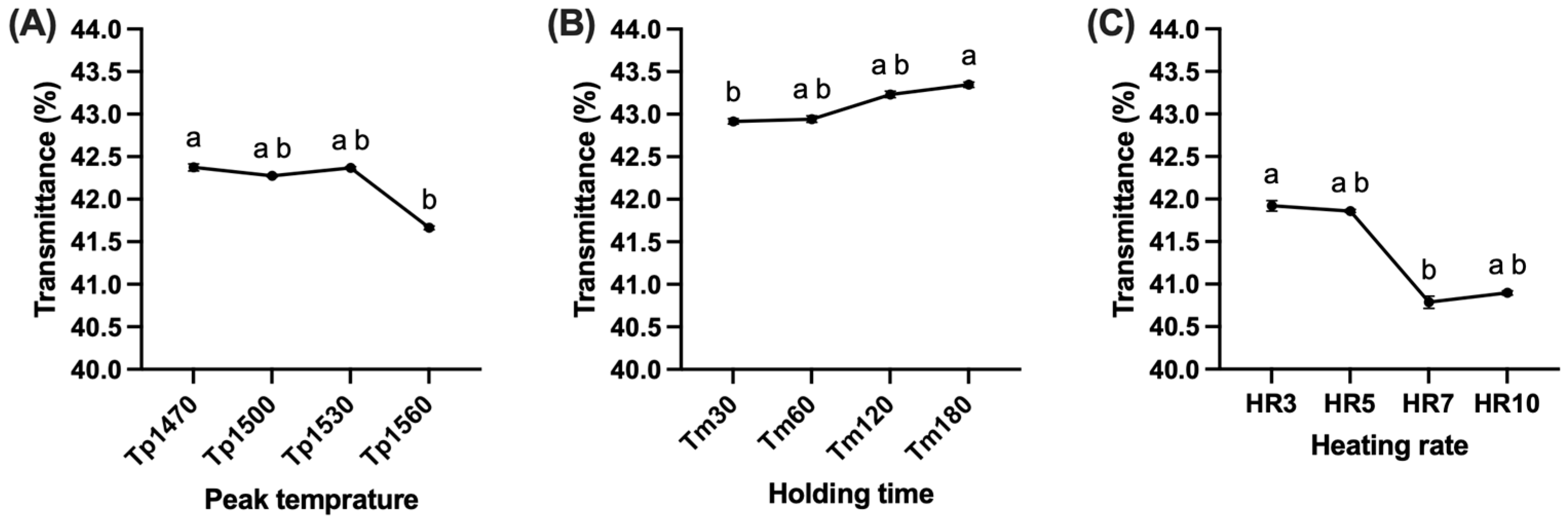
- All sintering schedules yielded broadly comparable total luminous transmittance values of approximately 40–43% at 0.5 mm thickness. Thus, the tested monolithic 4Y-PSZ material showed minimal optical penalty under moderately accelerated sintering protocols, provided that over-sintering at 1560 °C was avoided.
- A peak temperature of 1500–1530 °C combined with a holding time of 1–2 h appeared to provide a favorable balance between densification, grain coarsening, and optical transmittance for the tested monolithic 4Y-PSZ material.
- Before broader clinical recommendations can be made, this processing window should be validated through mechanical testing (biaxial flexural strength, fracture toughness, and hardness), low-temperature (hydrothermal) aging studies, and evaluation of additional commercial 4Y-PSZ products.
- By independently isolating peak temperature, holding time, and heating rate, this study provides a quantitative process-structure-property framework that can guide the optimization of sintering protocols for high translucency 4Y-PSZ. These findings are directly relevant to dental CAD/CAM workflows, where reliable translucency and efficient furnace scheduling are both clinically important, and the quantitative defect-density approach may also inform the broader processing of translucent zirconia ceramics for biomedical and optical applications.
Author Contributions
Funding
Institutional Review Board Statement
Informed Consent Statement
Data Availability Statement
Acknowledgments
Conflicts of Interest
Abbreviations
| 4Y-PSZ | 4 mol% yttria-partially stabilized zirconia |
| 3Y-TZP | 3 mol% yttria-stabilized tetragonal zirconia polycrystal |
| CAD/CAM | Computer-aided design/computer-aided manufacturing |
| LTD | Low-temperature degradation |
| SEM | Scanning electron microscopy |
| ASTM | American Society for Testing and Materials |
| ANOVA | Analysis of variance |
| HSD | Honestly significant difference |
| LRT | Likelihood-ratio test |
| IRR | Incidence rate ratio |
| CI | Confidence interval |
| SD | Standard deviation |
| CIE | Commission Internationale de l’Éclairage |
| CIELab | CIE L*a*b* color space |
| CIEDE2000 | CIEDE2000 color-difference formula |
| ISO | International Organization for Standardization |
| SPSS | Statistical Package for the Social Sciences |
References
- Denry, I.; Kelly, J.R. State of the art of zirconia for dental applications. Dent. Mater. 2008, 24, 299–307. [Google Scholar] [CrossRef] [PubMed]
- Miyazaki, T.; Nakamura, T.; Matsumura, H.; Ban, S.; Kobayashi, T. Current status of zirconia restoration. J. Prosthodont. Res. 2013, 57, 236–261. [Google Scholar] [CrossRef] [PubMed]
- Guess, P.C.; Schultheis, S.; Bonfante, E.A.; Coelho, P.G.; Ferencz, J.L.; Silva, N.R. All-ceramic systems: Laboratory and clinical performance. Dent. Clin. N. Am. 2011, 55, 333–352. [Google Scholar] [CrossRef] [PubMed]
- Baldassarri, M.; Zhang, Y.; Thompson, V.P.; Rekow, E.D.; Stappert, C.F. Reliability and failure modes of implant-supported zirconium-oxide fixed dental prostheses related to veneering techniques. J. Dent. 2011, 39, 489–498. [Google Scholar] [CrossRef] [PubMed]
- Cesar, P.F.; Miranda, R.B.P.; Santos, K.F.; Scherrer, S.S.; Zhang, Y. Recent advances in dental zirconia: 15 years of material and processing evolution. Dent. Mater. 2024, 40, 824–836. [Google Scholar] [CrossRef] [PubMed]
- Zhang, F.; Inokoshi, M.; Batuk, M.; Hadermann, J.; Naert, I.; Van Meerbeek, B.; Vleugels, J. Strength, toughness and aging stability of highly-translucent Y-TZP ceramics for dental restorations. Dent. Mater. 2016, 32, e327–e337. [Google Scholar] [CrossRef] [PubMed]
- Liu, H.; Inokoshi, M.; Xu, K.; Tonprasong, W.; Minakuchi, S.; Van Meerbeek, B.; Vleugels, J.; Zhang, F. Does speed-sintering affect the optical and mechanical properties of yttria-stabilized zirconia? A systematic review and meta-analysis of in-vitro studies. Jpn. Dent. Sci. Rev. 2023, 59, 312–328. [Google Scholar] [CrossRef] [PubMed]
- Chevalier, J. What future for zirconia as a biomaterial? Biomaterials 2006, 27, 535–543. [Google Scholar] [CrossRef] [PubMed]
- Chevalier, J.; Gremillard, L.; Deville, S. Low-Temperature Degradation of Zirconia and Implications for Biomedical Implants. Annu. Rev. Mater. Res. 2007, 37, 1–32. [Google Scholar] [CrossRef]
- Yousry, M.; Hammad, I.; Halawani, M.E.; Aboushelib, M. Translucency of recent zirconia materials and material-related variables affecting their translucency: A systematic review and meta-analysis. BMC Oral Health 2024, 24, 309. [Google Scholar] [CrossRef] [PubMed]
- Anselmi-Tamburini, U.; Woolman, J.N.; Munir, Z.A. Transparent nanometric cubic and tetragonal zirconia obtained by high-pressure pulsed electric current sintering. Adv. Funct. Mater. 2007, 17, 3267–3273. [Google Scholar] [CrossRef]
- Zhang, Y. Making yttria-stabilized tetragonal zirconia translucent. Dent. Mater. 2014, 30, 1195–1203. [Google Scholar] [CrossRef] [PubMed]
- Stawarczyk, B.; Ozcan, M.; Hallmann, L.; Ender, A.; Mehl, A.; Hämmerlet, C.H. The effect of zirconia sintering temperature on flexural strength, grain size, and contrast ratio. Clin. Oral Investig. 2013, 17, 269–274. [Google Scholar] [CrossRef] [PubMed]
- Stawarczyk, B.; Emslander, A.; Roos, M.; Sener, B.; Noack, F.; Keul, C. Zirconia ceramics, their contrast ratio and grain size depending on sintering parameters. Dent. Mater. J. 2014, 33, 591–598. [Google Scholar] [CrossRef] [PubMed]
- Kim, M.J.; Ahn, J.S.; Kim, J.H.; Kim, H.Y.; Kim, W.C. Effects of the sintering conditions of dental zirconia ceramics on the grain size and translucency. J. Adv. Prosthodont. 2013, 5, 161–166. [Google Scholar] [CrossRef] [PubMed]
- Ersoy, N.M.; Aydoğdu, H.M.; Değirmenci, B.; Çökük, N.; Sevimay, M. The effects of sintering temperature and duration on the flexural strength and grain size of zirconia. Acta Biomater. Odontol. Scand. 2015, 1, 43–50. [Google Scholar] [CrossRef] [PubMed]
- Matsui, K.; Yoshida, H.; Ikuhara, Y. Isothermal sintering effects on phase separation and grain growth in yttria-stabilized tetragonal zirconia polycrystal. J. Am. Ceram. Soc. 2009, 92, 467–475. [Google Scholar] [CrossRef]
- Cokic, S.M.; Vleugels, J.; Van Meerbeek, B.; Camargo, B.; Willems, E.; Li, M.; Zhang, F. Mechanical properties, aging stability and translucency of speed-sintered zirconia for chairside restorations. Dent. Mater. 2020, 36, 959–972. [Google Scholar] [CrossRef] [PubMed]
- Liu, H.; Inokoshi, M.; Nozaki, K.; Shimizubata, M.; Nakai, H.; Too, T.D.C.; Minakuchi, S. Influence of high-speed sintering protocols on translucency, mechanical properties, microstructure, crystallography, and low-temperature degradation of highly translucent zirconia. Dent. Mater. 2022, 38, 451–468. [Google Scholar] [CrossRef] [PubMed]
- Kaizer, M.R.; Gierthmuehlen, P.C.; Dos Santos, M.B.; Cava, S.S.; Zhang, Y. Speed sintering translucent zirconia for chairside one-visit dental restorations: Optical, mechanical, and wear characteristics. Ceram. Int. 2017, 43, 10999–11005. [Google Scholar] [CrossRef] [PubMed]
- Lawson, N.C.; Maharishi, A. Strength and translucency of zirconia after high-speed sintering. J. Esthet. Restor. Dent. 2020, 32, 219–225. [Google Scholar] [CrossRef] [PubMed]
- Nakamura, T.; Nakano, Y.; Usami, H.; Okamura, S.; Wakabayashi, K.; Yatani, H. In vitro investigation of fracture load and aging resistance of high-speed sintered monolithic tooth-borne zirconia crowns. J. Prosthodont. Res. 2020, 64, 182–187. [Google Scholar] [CrossRef] [PubMed]
- Al-Haj Husain, N.; Özcan, M.; Dydyk, N.; Joda, T. Conventional, Speed Sintering and High-Speed Sintering of Zirconia: A Systematic Review of the Current Status of Applications in Dentistry with a Focus on Precision, Mechanical and Optical Parameters. J. Clin. Med. 2022, 11, 4892. [Google Scholar] [CrossRef] [PubMed]
- Oyar, P.; Durkan, R. The effects of heating rate and sintering time on the biaxial flexural strength of monolithic zirconia ceramics. Biomed. Tech. 2023, 68, 437–443. [Google Scholar] [CrossRef] [PubMed]
- Öztürk, C.; Çelik, E. Influence of heating rate on the flexural strength of monolithic zirconia. J. Adv. Prosthodont. 2019, 11, 202–208. [Google Scholar] [CrossRef] [PubMed]
- ASTM E112-24; Standard Test Methods for Determining Average Grain Size. ASTM International: West Conshohocken, PA, USA, 2024.
- Mendelson, M.I. Average Grain Size in Polycrystalline Ceramics. J. Am. Ceram. Soc. 1969, 52, 443–446. [Google Scholar] [CrossRef]
- ISO 13468-1:2019; Determination of the Total Luminous Transmittance of Transparent Materials—Part 1: Single-Beam Instrument. International Organization for Standardization: Geneva, Switzerland, 2019.
- Alshahrani, A.M.; Lim, C.H.; Wolff, M.S.; Janal, M.N.; Zhang, Y. Current speed sintering and high-speed sintering protocols compromise the translucency but not strength of yttria-stabilized zirconia. Dent. Mater. 2024, 40, 664–673. [Google Scholar] [CrossRef] [PubMed]
- Lubauer, J.; Schuenemann, F.H.; Belli, R.; Lohbauer, U. Speed-sintering and the mechanical properties of 3–5 mol% Y2O3-stabilized zirconias. Odontology 2023, 111, 883–890. [Google Scholar] [CrossRef] [PubMed]
- Kim, H.-K.; Kim, S.-H. Comparison of the optical properties of pre-colored dental monolithic zirconia ceramics sintered in a conventional furnace versus a microwave oven. J. Adv. Prosthodont. 2017, 9, 394. [Google Scholar] [CrossRef] [PubMed]
- Nonaka, K.; Teramae, M.; Pezzotti, G. Evaluation of the Effect of High-Speed Sintering and Specimen Thickness on the Properties of 5 mol% Yttria-Stabilized Dental Zirconia Sintered Bodies. Materials 2022, 15, 5685. [Google Scholar] [CrossRef] [PubMed]



| Group | Peak Temperature (°C) | Holding Time (min) | Heating Rate (°C/min) |
|---|---|---|---|
| Peak-temperature series | |||
| Tp1470 | 1470 | 120 | 5 |
| Tp1500 | 1500 | ||
| Tp1530 (reference) | 1530 | ||
| Tp1560 | 1560 | ||
| Holding-time series | |||
| Tm30 | 1530 | 30 | 5 |
| Tm60 | 60 | ||
| Tm120 (reference) | 120 | ||
| Tm180 | 180 | ||
| Heating-rate series | |||
| HR3 | 1530 | 120 | 3 |
| HR5 (reference) | 5 | ||
| HR7 | 7 | ||
| HR10 | 10 |
| Sintering Parameter | Group | Grain Size (μm) |
|---|---|---|
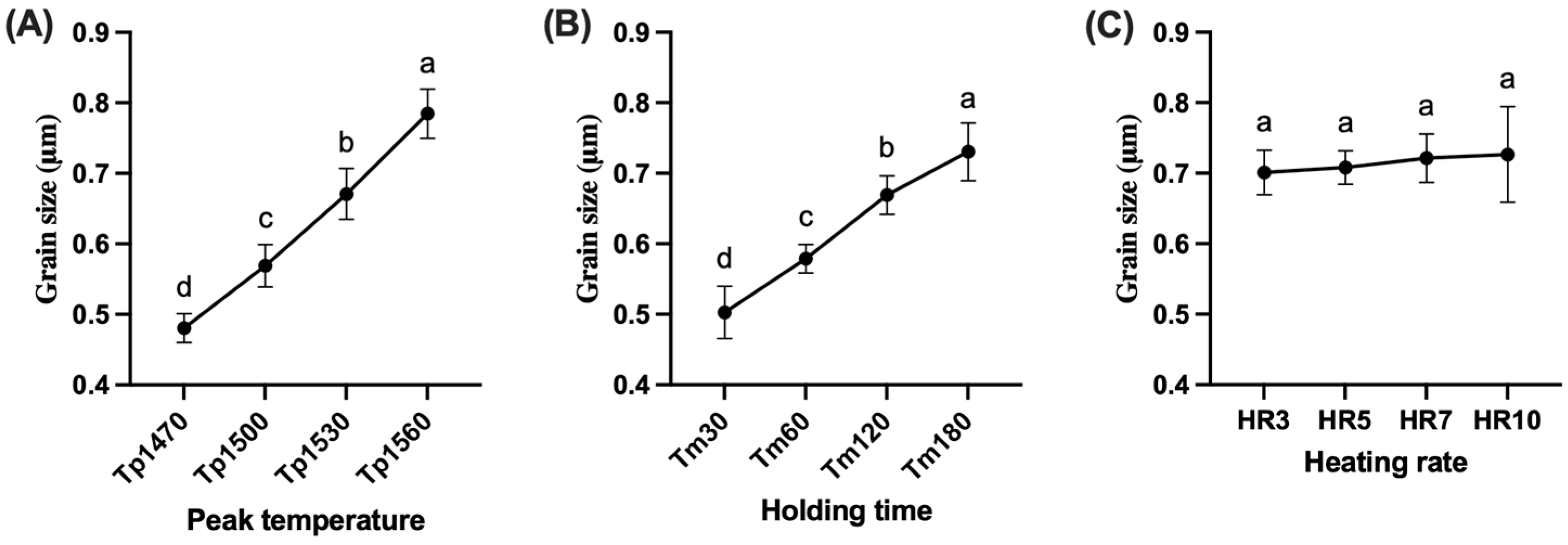
| Peak temperature | Tp1470 | 0.481 ± 0.020 d |
| Tp1500 | 0.569 ± 0.030 c | |
| Tp1530 | 0.671 ± 0.036 b | |
| Tp1560 | 0.785 ± 0.035 a | |
| Holding time | Tm30 | 0.503 ± 0.037 d |
| Tm60 | 0.579 ± 0.020 c | |
| Tm120 | 0.669 ± 0.027 b | |
| Tm180 | 0.730 ± 0.041 a | |
| Heating rate | HR3 | 0.701 ± 0.032 a |
| HR5 | 0.708 ± 0.024 a | |
| HR7 | 0.721 ± 0.034 a | |
| HR10 | 0.727 ± 0.068 a |
| Sintering Parameter | Group | Predicted Defect Density (counts·mm−2) | 95% CI |
|---|---|---|---|
| Peak temperature | Tp1470 | 84.44 b | 58.68–121.50 |
| Tp1500 | 96.08 b | 68.31–135.15 | |
| Tp1530 | 55.32 b | 35.29–86.73 | |
| Tp1560 | 23.29 a | 11.65–46.58 | |
| Holding time | Tm30 | 52.41 b | 33.02–83.18 |
| Tm60 | 37.85 b | 21.98–65.19 | |
| Tm120 | 32.03 b | 17.74–57.83 | |
| Tm180 | 8.73 a | 2.82–27.08 | |
| Heating rate | HR3 | 116.46 a | 85.43–158.77 |
| HR5 | 131.02 a | 97.82–175.48 | |
| HR7 | 192.16 a | 150.97–244.59 | |
| HR10 | 157.22 a | 120.42–205.28 |
| Sintering Parameter | Group | Transmittance (%) (Mean ± SD) |
|---|---|---|
| Peak temperature | Tp1470 | 42.37 ± 0.04 a |
| Tp1500 | 42.28 ± 0.02 ab | |
| Tp1530 | 42.37 ± 0.02 ab | |
| Tp1560 | 41.66 ± 0.02 b | |
| Holding time | Tm30 | 42.92 ± 0.03 b |
| Tm60 | 43.05 ± 0.02 ab | |
| Tm120 | 43.16 ± 0.02 ab | |
| Tm180 | 43.35 ± 0.03 a | |
| Heating rate | HR3 | 41.92 ± 0.06 a |
| HR5 | 41.86 ± 0.02 ab | |
| HR7 | 40.79 ± 0.07 b | |
| HR10 | 40.90 ± 0.03 ab |
Disclaimer/Publisher’s Note: The statements, opinions and data contained in all publications are solely those of the individual author(s) and contributor(s) and not of MDPI and/or the editor(s). MDPI and/or the editor(s) disclaim responsibility for any injury to people or property resulting from any ideas, methods, instructions or products referred to in the content. |
© 2026 by the authors. Licensee MDPI, Basel, Switzerland. This article is an open access article distributed under the terms and conditions of the Creative Commons Attribution (CC BY) license.
Share and Cite
Chung, T.-J.; Kim, M.-J.; Kwon, H.-B.; Kim, B.; Lim, Y.-J. Effects of Sintering Parameters on the Microstructure and Optical Transmittance of Monolithic 4 mol% Yttria-Partially Stabilized Zirconia. Bioengineering 2026, 13, 702. https://doi.org/10.3390/bioengineering13060702
Chung T-J, Kim M-J, Kwon H-B, Kim B, Lim Y-J. Effects of Sintering Parameters on the Microstructure and Optical Transmittance of Monolithic 4 mol% Yttria-Partially Stabilized Zirconia. Bioengineering. 2026; 13(6):702. https://doi.org/10.3390/bioengineering13060702
Chicago/Turabian StyleChung, Taek-Jun, Myung-Joo Kim, Ho-Beom Kwon, Bongju Kim, and Young-Jun Lim. 2026. "Effects of Sintering Parameters on the Microstructure and Optical Transmittance of Monolithic 4 mol% Yttria-Partially Stabilized Zirconia" Bioengineering 13, no. 6: 702. https://doi.org/10.3390/bioengineering13060702
APA StyleChung, T.-J., Kim, M.-J., Kwon, H.-B., Kim, B., & Lim, Y.-J. (2026). Effects of Sintering Parameters on the Microstructure and Optical Transmittance of Monolithic 4 mol% Yttria-Partially Stabilized Zirconia. Bioengineering, 13(6), 702. https://doi.org/10.3390/bioengineering13060702