Evaluating the Predictive Value of Post-Treatment Superb Microvascular Imaging for Complete Response to Neoadjuvant Chemotherapy in Invasive Breast Cancer

 , , ,
, , ,
Abstract
1. Introduction
2. Material and Methods
2.1. Study Design and Patient Cohort
2.2. Study Outcomes
- Comparison of the diagnostic performance of SMI, grayscale ultrasound, and MRI in predicting pCR;
- Evaluation of the incremental value of combining imaging modalities (US, SMI, MRI) with clinicopathological parameters (including HER-2 status);
- Assessment of the association between the SMI index and tumor biological features, including molecular subtype, Ki-67 proliferation index, and axillary status.
2.3. NAC Regimens
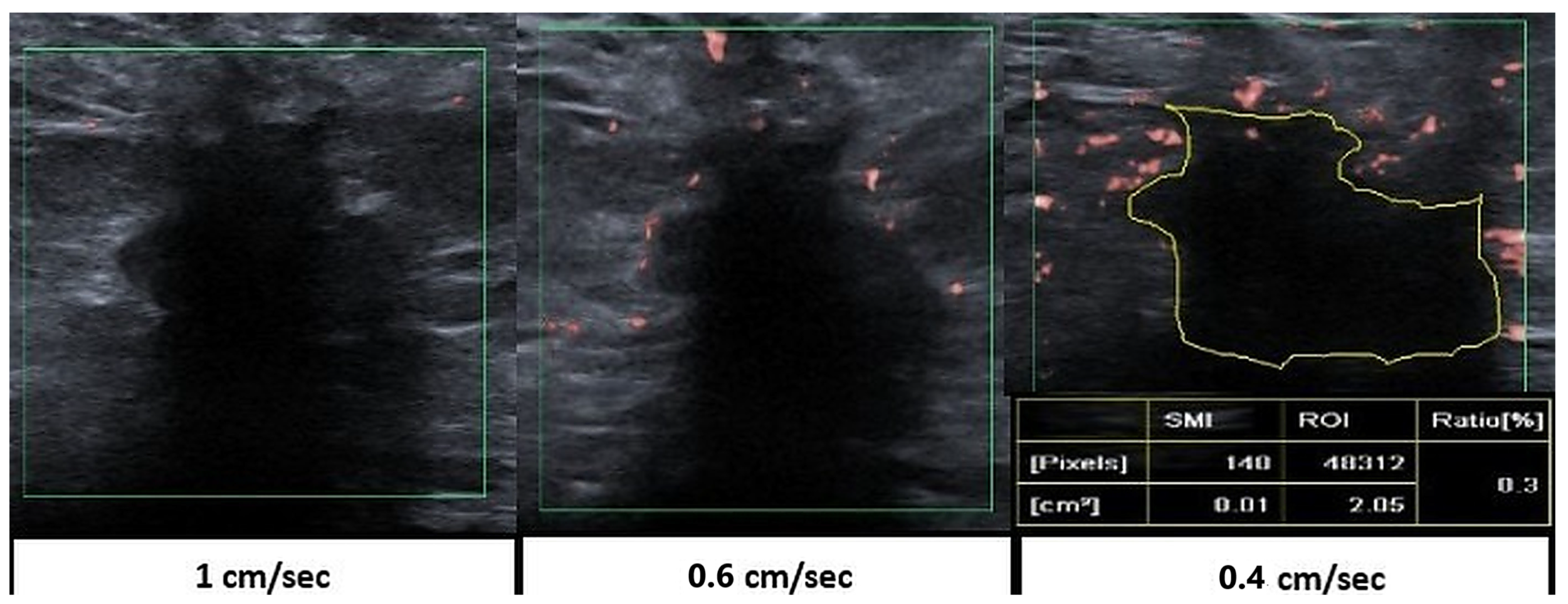
2.4. Ultrasound and SMI Examination Technique
2.5. MRI Examination
2.6. Clinical and Pathology Information
2.7. Statistical Analysis of Data
3. Results
3.1. Patient, Tumor and Response Characteristics
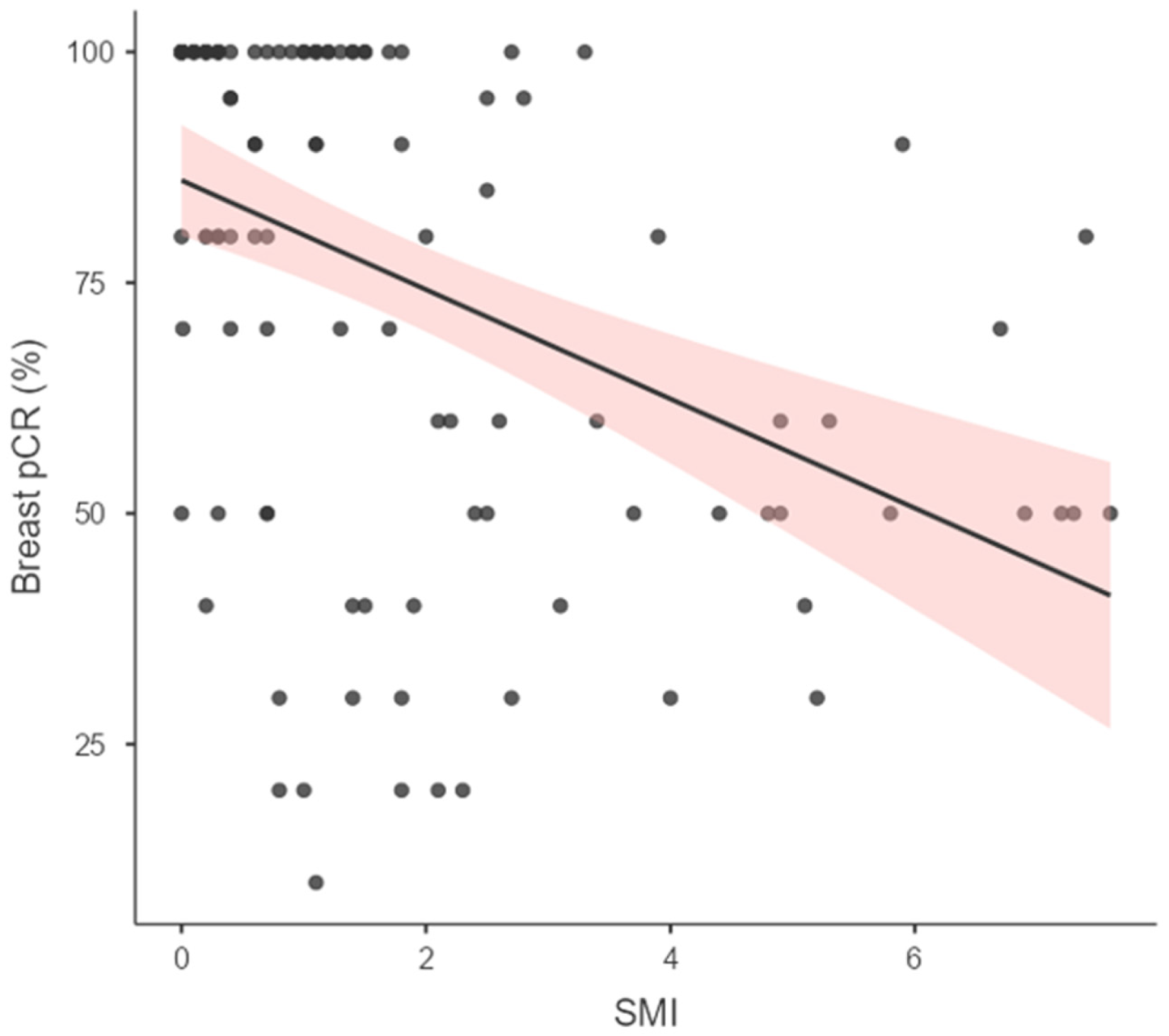
3.2. SMI Index Level
3.3. Variables Associated with Breast-pCR Presence
3.3.1. Univariate Analysis Results
3.3.2. Diagnostic Performance of Independent Parameters (US, MRI, SMI, and HER-2) in Predicting Breast Pathologic Response
3.4. Multivariate Analysis Results
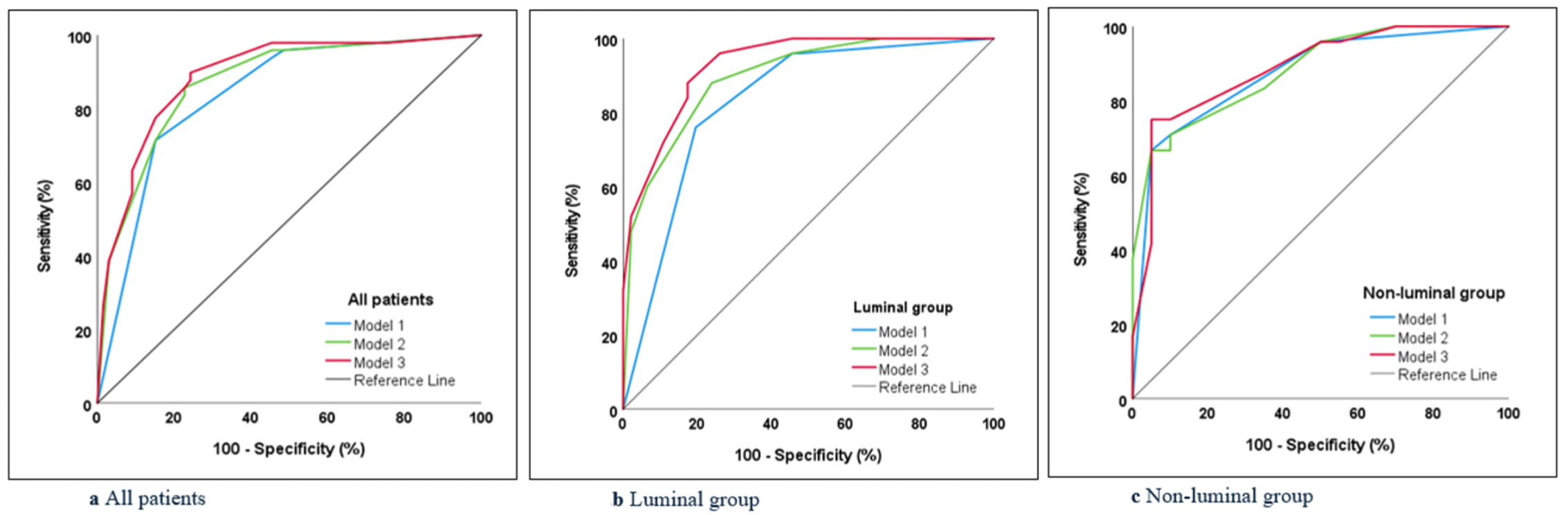
3.5. ROC Analyses of Multivariate Logistic Regression Models
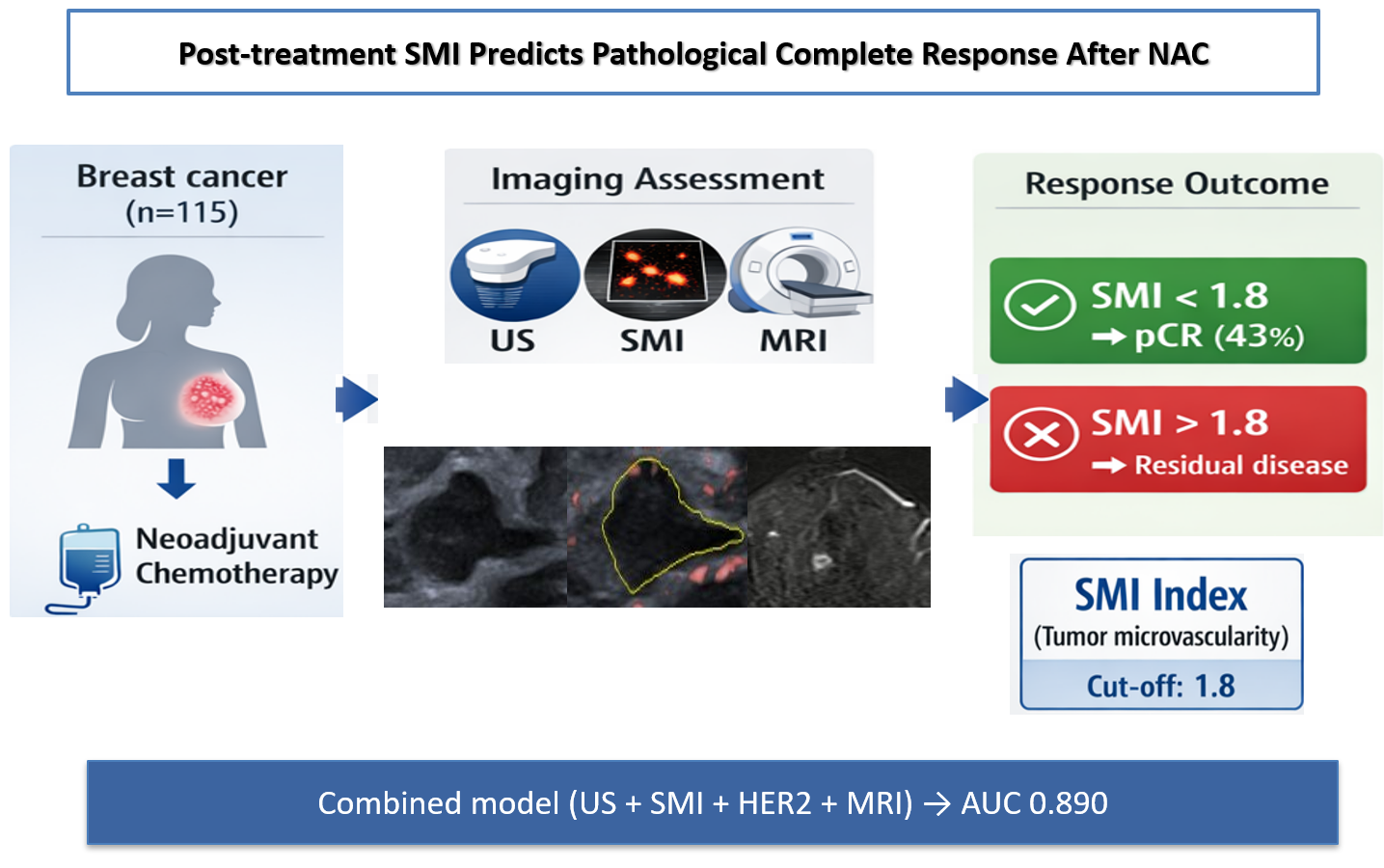
- Model 1 (US and SMI): Sensitivity, specificity, and accuracy rates were 71.4%, 84.8%, and 79.1%, respectively.
- Model 2 (Model 1 plus HER-2 positivity): Sensitivity, specificity, and accuracy rates were 85.7%, 77.3%, and 80.9%, respectively.
- Model 3 (Model 2 plus MRI): Sensitivity, specificity, and accuracy rates were 89.8%, 75.8%, and 81.7%, respectively.
4. Discussion
5. Conclusions
Author Contributions
Funding
Institutional Review Board Statement
Informed Consent Statement
Data Availability Statement
Acknowledgments
Conflicts of Interest
Abbreviations
| CDUS | Color Doppler Ultrasound |
| CEUS | Contrast-Enhanced Ultrasound |
| DCIS | Ductal Carcinoma In Situ |
| DR | Dynamic Range |
| ER | Estrogen Receptor |
| FPS | Frames Per Second |
| HER-2 | Human Epidermal Growth Receptor 2 |
| IDC | Invasive Ductal Carcinoma |
| MG | Mammography |
| MRI | Magnetic Resonance Imaging |
| NAC | Neoadjuvant Chemotherapy |
| pCR | Pathological Complete Response |
| PDUS | Power Doppler Ultrasound |
| PET | Positron Emission Tomography |
| PR | Progesterone Receptor |
| ROC | Receiver Operating Characteristic |
| ROI | Regions of Interest |
| SE | Sensitivity |
| SMI | Superb Microvascular Imaging |
| SP | Specificity |
| TNBC | Triple-Negative Breast Cancer |
| US | Ultrasound |
References
- Asaoka, M.; Gandhi, S.; Ishikawa, T.; Takabe, K. Neoadjuvant Chemotherapy for Breast Cancer: Past, Present, and Future. Breast Cancer 2020, 14, 1178223420980377. [Google Scholar] [CrossRef] [Scilit]
- Spring, L.M.; Fell, G.; Arfe, A.; Sharma, C.; Greenup, R.; Reynolds, K.L.; Smith, B.L.; Alexander, B.; Moy, B.; Isakoff, S.J.; et al. Pathologic Complete Response after Neoadjuvant Chemotherapy and Impact on Breast Cancer Recurrence and Survival: A Comprehensive Meta-analysis. Clin. Cancer Res. 2020, 26, 2838–2848. [Google Scholar] [CrossRef] [Scilit]
- Bonnefoi, H.; Litière, S.; Piccart, M.; MacGrogan, G.; Fumoleau, P.; Brain, E.; Petit, T.; Rouanet, P.; Jassem, J.; Moldovan, C.; et al. Pathological complete response after neoadjuvant chemotherapy is an independent predictive factor irrespective of simplified breast cancer intrinsic subtypes: A landmark and two-step approach analyses from the EORTC 10994/BIG 1-00 phase III trial. Ann. Oncol. 2014, 25, 1128–1136. [Google Scholar] [CrossRef] [Scilit]
- Lee, E.J.; Chang, Y.W. Prediction of complete response after neoadjuvant chemotherapy for invasive breast cancers: The utility of shear wave elastography and superb microvascular imaging in pretreatment breast ultrasound. Eur. J. Radiol. 2024, 175, 111432. [Google Scholar] [CrossRef] [Scilit] [PubMed]
- Kumar, A.; Srivastava, V.; Singh, S.; Shukla, R.C. Color Doppler ultrasonography for treatment response prediction and evaluation in breast cancer. Future Oncol. 2010, 6, 1265–1278. [Google Scholar] [CrossRef] [Scilit] [PubMed]
- Kim, S.Y.; Lee, H.B.; Han, W.; Lee, S.H.; Chang, J.M.; Cho, N. Role of Doppler US and elastography prior to biopsy to identify candidates for avoidance of surgery following neoadjuvant chemotherapy for breast cancer. Ultrasonography 2023, 42, 323–332. [Google Scholar] [CrossRef] [Scilit] [PubMed]
- Nakashima, K.; Uematsu, T.; Harada, T.L.; Takahashi, K.; Nishimura, S.; Tadokoro, Y.; Hayashi, T.; Watanabe, J.; Sugino, T.; Notsu, A. Can breast MRI and adjunctive Doppler ultrasound improve the accuracy of predicting pathological complete response after neoadjuvant chemotherapy? Breast Cancer 2021, 28, 1120–1130. [Google Scholar] [CrossRef] [Scilit]
- Qi, J.; Wang, C.; Ma, Y.; Wang, J.; Yang, G.; Wu, Y.; Wang, H.; Mi, C. The potential role of combined shear wave elastography and superb microvascular imaging for early prediction the pathological response to neoadjuvant chemotherapy in breast cancer. Front. Oncol. 2023, 13, 1176141. [Google Scholar] [CrossRef] [Scilit]
- Park, A.Y.; Seo, B.K.; Woo, O.H.; Jung, K.S.; Cho, K.R.; Park, E.K.; Cha, S.H.; Cha, J. The utility of ultrasound superb microvascular imaging for evaluation of breast tumour vascularity: Comparison with colour and power Doppler imaging regarding diagnostic performance. Clin. Radiol. 2018, 73, 304–311. [Google Scholar] [CrossRef] [Scilit]
- Park, A.Y.; Seo, B.K.; Han, M.R. Breast Ultrasound Microvascular Imaging and Radiogenomics. Korean J. Radiol. 2021, 22, 677–687. [Google Scholar] [CrossRef] [Scilit]
- Zhong, L.; Wang, C. Diagnostic accuracy of ultrasound superb microvascular imaging for breast tumor: A meta-analysis. Med. Ultrason. 2020, 22, 313–318. [Google Scholar] [CrossRef] [Scilit]
- Bian, J.; Zhang, J.; Hou, X. Diagnostic accuracy of ultrasound shear wave elastography combined with superb microvascular imaging for breast tumors: A protocol for systematic review and meta-analysis. Medicine 2021, 100, E26262. [Google Scholar] [CrossRef] [Scilit]
- Liang, M.; Ou, B.; Wu, J.; Xiao, X.; Ruan, J.; Tian, J.; Xu, X.; Wang, B.; Yang, H.; Luo, B. Combined use of strain elastography and superb microvascular imaging with grayscale ultrasound according to the BI-RADS classification for differentiating benign from malignant solid breast masses. Clin. Hemorheol. Microcirc. 2020, 74, 391–403. [Google Scholar] [CrossRef] [Scilit]
- Lee, E.J.; Chang, Y.W. Combination of quantitative parameters of shear wave elastography and superb microvascular imaging to evaluate breast masses. Korean J. Radiol. 2020, 21, 1045–1054. [Google Scholar] [CrossRef] [Scilit]
- Abedi, M.; Sahebi, L.; Eslami, B.; Saberi, A.; Orouji, M.; Alipour, S.; Shahsavarhaghighi, S. Using a combination of superb microvascular imaging and other auxiliary ultrasound techniques to increase the accuracy of gray-scale ultrasound for breast masses. BMC Cancer 2024, 24, 224. [Google Scholar] [CrossRef] [Scilit] [PubMed]
- Diao, X.; Zhan, J.; Chen, L.; Chen, Y.; Cao, H. Role of Superb Microvascular Imaging in Differentiating Between Malignant and Benign Solid Breast Masses. Clin. Breast Cancer 2020, 20, e786–e793. [Google Scholar] [CrossRef] [Scilit] [PubMed]
- Kayadibi, Y.; Kargin, O.A.; Aladag Kurt, S.; Ozturk, T.; Yilmaz, M.H. Pilot Study to Evaluate the Association Between Superb Microvascular Imaging (SMI) and Histologic Markers of Angiogenesis in Patients with Invasive Ductal Carcinoma. J. Ultrasound Med. 2025, 44, 1201–1211. [Google Scholar] [CrossRef] [Scilit] [PubMed]
- Sharma, A.; Grover, S.B.; Mani, C.; Ahluwalia, C. Contrast enhanced ultrasound quantitative parameters for assessing neoadjuvant chemotherapy response in patients with locally advanced breast cancer. Br. J. Radiol. 2021, 94, 20201160. [Google Scholar] [CrossRef] [Scilit]
- Eisenhauer, E.A.; Therasse, P.; Bogaerts, J.; Schwartz, L.H.; Sargent, D.; Ford, R.; Dancey, J.; Arbuck, S.; Gwyther, S.; Mooney, M.; et al. New response evaluation criteria in solid tumours: Revised RECIST guideline (version 1.1). Eur. J. Cancer 2009, 45, 228–247. [Google Scholar] [CrossRef] [Scilit]
- Ploumen, R.A.W.; de Mooij, C.M.; Gommers, S.; Keymeulen, K.B.M.I.; Smidt, M.L.; van Nijnatten, T.J.A. Imaging findings for response evaluation of ductal carcinoma in situ in breast cancer patients treated with neoadjuvant systemic therapy: A systematic review and meta-analysis. Eur. Radiol. 2023, 33, 5423–5435. [Google Scholar] [CrossRef] [Scilit]
- NCCN Clinical Practice Guidelines in Oncology, Breast Cancer, Version 4. 2025. Available online: https://www.nccn.org/professionals/physician_gls/pdf/breast.pdf (accessed on 17 April 2025).
- Park, A.Y.; Seo, B.K.; Cha, S.H.; Yeom, S.K.; Lee, S.W.; Chung, H.H. An innovative ultrasound technique for evaluation of tumor vascularity in breast cancers: Superb micro-vascular imaging. J. Breast Cancer 2016, 19, 210–213. [Google Scholar] [CrossRef] [Scilit]
- Lee, E.J.; Chang, Y.W.; Oh, E.; Hwang, J.; Kim, H.J.; Hong, S.S. Reproducibility and diagnostic performance of the vascular index of superb microvascular imaging in real-time breast ultrasonography for evaluating breast masses. Ultrasonography 2021, 40, 398–406. [Google Scholar] [CrossRef] [Scilit]
- Feng, J.; Lu, J.; Jin, C.; Chen, Y.; Chen, S.; Guo, G.; Gong, X. Diagnostic Value of Superb Microvascular Imaging in Differentiating Benign and Malignant Breast Tumors: A Systematic Review and Meta-Analysis. Diagnostics 2022, 12, 2648. [Google Scholar] [CrossRef] [Scilit] [PubMed]
- Ma, Y.; Li, G.; Li, J.; Ren, W.D. The diagnostic value of superb microvascular imaging (SMI) in detecting blood flow signals of breast lesions: A preliminary study comparing SMI to color doppler flow imaging. Medicine 2015, 94, e1502. [Google Scholar] [CrossRef] [Scilit] [PubMed]
- Kurt, S.A.; Kayadibi, Y.; Saracoglu, M.S.; Ozturk, T.; Korkmazer, B.; Cerit, M.; Velidedeoğlu, M. Prediction of Molecular Subtypes Using Superb Microvascular Imaging and Shear Wave Elastography in Invasive Breast Carcinomas. Acad. Radiol. 2023, 30, 14–21. [Google Scholar] [CrossRef] [Scilit] [PubMed]
- Bulut, I.N.; Kayadibi, Y.; Deger, E.; Kurt, S.A.; Velidedeoglu, M.; Onur, I.; Ozturk, T.; Adaletli, I. Preoperative Role of Superb Microvascular Imaging and Shear-Wave Elastography for Prediction of Axillary Lymph Node Metastasis in Patients with Breast Cancer. Ultrasound Q. 2024, 40, 111–118. [Google Scholar] [CrossRef] [Scilit]
- Zhang, X.Y.; Cai, S.M.; Zhang, L.; Zhu, Q.L.; Sun, Q.; Jiang, Y.X.; Wang, H.Y.; Li, J.C. Association Between Vascular Index Measured via Superb Microvascular Imaging and Molecular Subtype of Breast Cancer. Front. Oncol. 2022, 12, 861151. [Google Scholar] [CrossRef] [Scilit]
- Amioka, A.; Masumoto, N.; Gouda, N.; Kajitani, K.; Shigematsu, H.; Emi, A.; Kadoya, T.; Okada, M. Ability of contrast-enhanced ultrasonography to determine clinical responses of breast cancer to neoadjuvant chemotherapy. Jpn. J. Clin. Oncol. 2016, 46, 303–309. [Google Scholar] [CrossRef] [Scilit]
- Wan, C.F.; Liu, X.S.; Wang, L.; Zhang, J.; Lu, J.S.; Li, F.H. Quantitative contrast-enhanced ultrasound evaluation of pathological complete response in patients with locally advanced breast cancer receiving neoadjuvant chemotherapy. Eur. J. Radiol. 2018, 103, 118–123. [Google Scholar] [CrossRef] [Scilit]
- Schroeder, R.J.; Bostanjoglo, M.; Rademaker, J.; Maeurer, J.; Felix, R. Role of power Doppler techniques and ultrasound contrast enhancement in the differential diagnosis of focal breast lesions. Eur. Radiol. 2003, 13, 68–79. [Google Scholar] [CrossRef] [Scilit]
- Zhang, X.; Cheng, F.; Song, X.; Wang, P.; Tian, S.; Zhao, X.; Wang, Q.; Zhang, M. Superb microvascular imaging for evaluation of microvascularity in breast nodules compared with conventional Doppler imaging. Quant. Imaging Med. Surg. 2023, 13, 7029–7040. [Google Scholar] [CrossRef] [Scilit] [PubMed]
- Yang, W.T.; Tse, G.M.; Lam, P.K.; Metreweli, C.; Chang, J. Correlation between color power Doppler sonographic measurement of breast tumor vasculature and immunohistochemical analysis of microvessel density for the quantitation of angiogenesis. J. Ultrasound Med. 2002, 21, 1227–1235. [Google Scholar] [CrossRef] [Scilit] [PubMed]
- Park, A.Y.; Seo, B.K. Up-to-date Doppler techniques for breast tumor vascularity: Superb microvascular imaging and contrast-enhanced ultrasound. Ultrasonography 2018, 37, 98–106. [Google Scholar] [CrossRef] [Scilit] [PubMed]
- Park, A.Y.; Kwon, M.; Woo, O.H.; Cho, K.R.; Park, E.K.; Cha, S.H.; Song, S.E.; Lee, J.H.; Cha, J.; Son, G.S.; et al. A prospective study on the value of ultrasound microflow assessment to distinguish malignant from benign solid breast masses: Association between ultrasound parameters and histologic microvessel densities. Korean J. Radiol. 2019, 20, 759–772. [Google Scholar] [CrossRef] [Scilit]
- Zhou, J.; Li, G.; Sheng, F.; Qiao, P.; Zhang, H.; Xing, X. Magnetic resonance imaging evaluation of residual tumors in breast cancer after neoadjuvant chemotherapy: Surgical implications. Acta Radiol. 2016, 57, 529–537. [Google Scholar] [CrossRef] [Scilit]
- Belli, P.; Costantini, M.; Malaspina, C.; Magistrelli, A.; LaTorre, G.; Bonomo, L. MRI accuracy in residual disease evaluation in breast cancer patients treated with neoadjuvant chemotherapy. Clin. Radiol. 2006, 61, 946–953. [Google Scholar] [CrossRef] [Scilit]
- Denis, F.; Desbiez-Bourcier, A.V.; Chapiron, C.; Arbion, F.; Body, G.; Brunereau, L. Contrast enhanced magnetic resonance imaging underestimates residual disease following neoadjuvant docetaxel based chemotherapy for breast cancer. Eur. J. Surg. Oncol. 2004, 30, 1069–1076. [Google Scholar] [CrossRef] [Scilit]
- Kwon, M.R.; Chu, J.; Kook, S.H.; Kim, E.Y. Factors associated with radiologic-pathologic discordance in magnetic resonance imaging after neoadjuvant chemotherapy for breast cancer. Clin. Imaging 2022, 89, 1–9. [Google Scholar] [CrossRef] [Scilit]
- Feng, K.; Jia, Z.; Liu, G.; Xing, Z.; Li, J.; Li, J.; Ren, F.; Wu, J.; Wang, W.; Wang, J.; et al. A review of studies on omitting surgery after neoadjuvant chemotherapy in breast cancer. Am. J. Cancer Res. 2022, 12, 3512–3531. [Google Scholar]
- Song, Y.; Liu, Y.; Lin, Z.; Zhou, J.; Li, D.; Zhou, T.; Leung, M.F. Learning From AI-Generated Annotations for Medical Image Segmentation. IEEE Trans. Consum. Electron. 2025, 71, 1473–1481. [Google Scholar] [CrossRef] [Scilit]






| Variables | n (%) |
|---|---|
| All | 115 (100) |
| Age (years), group | |
| ≤50 | 57 (49.6) |
| >50 | 58 (50.4) |
| Tumor type | |
| IDC | 109 (94.8) |
| Other | 6 (5.2) |
| Grade | |
| I/II | 52 (45.2) |
| III | 63 (54.8) |
| ER | |
| Positive | 71 (61.7) |
| Negative | 44 (38.3) |
| PR | |
| Positive | 57 (49.6) |
| Negative | 58 (50.4) |
| HER-2 | |
| Positive | 51 (44.3) |
| Negative | 64 (55.7) |
| Ki-67 expression | |
| Positive (≥40%) | 67 (58.3) |
| Negative (<40%) | 48 (41.7) |
| Molecular subgroup | |
| Luminal HER-2(-) | 41 (35.7) |
| Luminal HER-2(+) | 30 (26.1) |
| HER-2(+) | 21 (18.3) |
| Triple negative | 23 (20) |
| Molecular subgroup | |
| Luminal | 71 (61.7) |
| Non-luminal | 44 (38.3) |
| Breast-pCR | |
| Yes | 49 (42.6) |
| No | 66 (57.4) |
| Axilla-pCR (n = 90) | |
| Yes | 48 (53.3) |
| No | 42 (46.7) |
| SMI | Breast-pCR | |||||
|---|---|---|---|---|---|---|
| Variables | Category | n | Mean ± SD | p-Value | n (%) | p-Value |
| All | - | 115 | 1.70 ± 1.95 | 49 (42.6) | ||
| Age (years), group | ≤50 | 57 | 2.09 ± 2.25 | 0.031 a,* | 28 (49.1) | 0.161 c |
| >50 | 58 | 1.31 ± 1.53 | 21 (36.2) | |||
| Tumor type | IDC | 109 | 1.63 ± 1.92 | 0.138 a | 48 (44) | 0.238 d |
| Other | 6 | 2.85 ± 2.33 | 1 (16.7) | |||
| Grade | I/II | 52 | 1.94 ± 2.17 | 0.223 a | 16 (30.8) | 0.020 c,* |
| III | 63 | 1.50 ± 1.75 | 33 (52.4) | |||
| ER | Positive | 71 | 1.94 ± 2.16 | 0.097 a | 25 (35.2) | 0.042 c,* |
| Negative | 44 | 1.31 ± 1.51 | 24 (54.5) | |||
| PR | Positive | 57 | 2.12 ± 2.17 | 0.019 a,* | 17 (29.8) | 0.006 c,* |
| Negative | 58 | 1.28 ± 1.62 | 32 (55.2) | |||
| HER-2 | Positive | 51 | 1.78 ± 2.03 | 0.672 a | 27 (52.9) | 0.045 c,* |
| Negative | 64 | 1.63 ± 1.90 | 22 (34.4) | |||
| Ki-67 expression | Positive (≥40%) | 67 | 1.47 ± 1.79 | 0.136 a | 34 (50.7) | 0.037 c,* |
| Negative(<40%) | 48 | 2.02 ± 2.14 | 15 (31.3) | |||
| Molecular subgroup | Luminal HER-2(-) | 41 | 1.91 ± 2.09 | 0.366 b | 9 (22) | 0.011 c,* |
| Luminal HER-2(+) | 30 | 1.97 ± 2.28 | 16 (53.3) | |||
| HER-2(+) | 21 | 1.51 ± 1.63 | 11 (52.4) | |||
| Triple negative | 23 | 1.13 ± 1.40 | 13 (56.5) | |||
| Molecular subgroup | Luminal | 71 | 1.94 ± 2.16 | 0.097 a | 25 (35.2) | 0.042 c,* |
| Non-Luminal | 44 | 1.31 ± 1.51 | 24 (54.5) | |||
| US | pCR | 48 | 0.94 ± 1.22 | <0.001 a,* | 36 (75) | <0.001 c,* |
| non-pCR | 67 | 1.95 ± 1.84 | 13 (19.4) | |||
| MRI | pCR | 34 | 0.71 ± 0.85 | <0.001 b,* | 27 (79.4) | <0.001 c,* |
| Non-pCR | 50 | 2.27 ± 2.06 | 9 (18) | |||
| Absent MRI | 31 | 1.85 ± 2.24 | 13 (41.9) | |||
| Breast-pCR | Yes | 49 | 0.64 ± 0.74 | <0.001 a,* | ||
| No | 66 | 2.49 ± 2.19 | ||||
| Axilla-pCR (n = 90) | Yes | 48 | 1.65 ± 2.01 | 0.354 a | ||
| No | 42 | 2.04 ± 2.00 |
| Group | Variables | Cut-Off | SE (95% CI) | SP (95% CI) | PPV (95% CI) | NPV (95% CI) | ACC (95% CI) |
|---|---|---|---|---|---|---|---|
| All | US | pCR | 73.5 (61.1–85.8) | 81.8 (72.5–91.1) | 75 (62.8–87.3) | 80.6 (71.1–90.1) | 78.3 (70.7–85.8) |
| (n = 115) | MRI | pCR | 55.1 (41.2–69) | 89.4 (82–96.8) | 79.4 (65.8–93) | 72.8 (63.2–82.5) | 74.8 (66.8–82.7) |
| SMI | <1.8 | 93.9 (87.2–100) | 54.5 (42.5–66.6) | 60.5 (49.5–71.5) | 92.3 (83.9–100) | 71.3 (63–79.6) | |
| HER-2 | positive | 55.1 (41.2–69) | 63.6 (52–75.2) | 52.9 (39.2–66.6) | 65.6 (54–77.3) | 60 (51–69) | |
| Luminal | US | pCR | 76 (59.3–92.7) | 78.3 (66.3–90.2) | 65.5 (48.2–82.8) | 85.7 (75.1–96.3) | 77.5 (67.7–87.2) |
| (n = 71) | MRI | pCR | 60 (40.8–79.2) | 89.1 (80.1–98.1) | 75 (56–94) | 80.4 (69.5–91.3) | 78.9 (69.4–88.4) |
| SMI | <1.8 | 96 (88.3–104) | 54.3 (40–68.7) | 53.3 (38.8–67.9) | 96.2 (88.8–100) | 69 (58.3–79.8) | |
| HER-2 | positive | 64 (45.2–82.8) | 69.6 (56.3–82.9) | 53.3 (35.5–71.2) | 78 (65.4–90.7) | 67.6 (56.7–78.5) | |
| Non-luminal | US | pCR | 70.8 (52.6–89) | 90 (76.9–100) | 89.5 (75.7–100) | 72 (54.4–89.6) | 79.5 (67.6–91.5) |
| MRI | pCR | 50 (30–70) | 90 (76.9–100) | 85.7 (67.4–100) | 60 (42.5–77.5) | 68.2 (54.4–81.9) | |
| (n = 44) | SMI | <1.8 | 91.7 (80.6–100) | 55 (33.2–76.8) | 71 (55–86.9) | 84.6 (65–104) | 75 (62.2–87.8) |
| HER-2 | positive | 45.8 (25.9–65.8) | 50 (28.1–71.9) | 52.4 (31–73.7) | 43.5 (23.2–63.7) | 47.7 (33–62.5) |
| Model | Variables | B | SE | OR (95% CI) | p-Value | R2N | χ2 |
|---|---|---|---|---|---|---|---|
| Step 1 | US (pCR) | 2.523 | 0.454 | 12.462 (5.113–30.369) | <0.001 | 0.369 | 36.988 |
| Step 2 | US (pCR) | 1.812 | 0.498 | 6.124 (2.307–16.251) | <0.001 | 0.476 | 50.347 |
| SMI | −0.706 | 0.250 | 0.494 (0.303–0.806) | 0.005 | |||
| Step 3 | US (pCR) | 1.866 | 0.528 | 6.465 (2.295–18.213) | <0.001 | 0.523 | 56.669 |
| HER-2 (+) | 1.265 | 0.523 | 3.544 (1.271–9.881) | 0.016 | |||
| SMI | −0.772 | 0.267 | 0.462 (0.274–0.780) | 0.004 | |||
| Step 4 | MRI (pCR) | 1.213 | 0.604 | 3.363 (1.029–10.992) | 0.045 | 0.551 | 60.758 |
| US (pCR) | 1.395 | 0.579 | 4.036 (1.298–12.553) | 0.016 | |||
| HER-2 (+) | 1.144 | 0.534 | 3.140 (1.103–8.933) | 0.032 | |||
| SMI | −0.745 | 0.274 | 0.475 (0.278–0.812) | 0.007 |
| Variables | AUC (95% CI) | SE (95% CI) | SP (95% CI) | PPV (95% CI) | NPV (95% CI) | ACC (95% CI) |
|---|---|---|---|---|---|---|
| All | ||||||
| Model 1 | 0.838 (0.764–0.912) | 71.4 (58.8–84.1) | 84.8 (76.2–93.5) | 77.8 (65.6–89.9) | 80 (70.6–89.4) | 79.1 (71.7–86.6) |
| Model 2 | 0.872 (0.806–0.937) | 85.7 (75.9–95.5) | 77.3 (67.2–87.4) | 73.7 (62.3–85.1) | 87.9 (79.5–96.3) | 80.9 (73.7–88.1) |
| Model 3 | 0.890 (0.829–0.950) | 89.8 (81.3–98.3) | 75.8 (65.4–86.1) | 73.3 (62.1–84.5) | 90.9 (83.3–98.5) | 81.7 (74.7–88.8) |
| Luminal | ||||||
| Model 1 | 0.831 (0.734–0.928) | 76 (59.3–92.7) | 80.4 (69–91.9) | 67.9 (50.6–85.2) | 86 (75.7–96.4) | 78.9 (69.4–88.4) |
| Model 2 | 0.896 (0.822–0.970) | 88 (75.3–100) | 76.1 (63.8–88.4) | 66.7 (50.6–82.8) | 92.1 (83.5–100) | 80.3 (71–89.5) |
| Model 3 | 0.929 (0.874–0.985) | 88 (75.3–100) | 82.6 (71.7–93.6) | 73.3 (57.5–89.2) | 92.7 (84.7–100) | 84.5 (76.1–92.9) |
| Non-luminal | ||||||
| Model 1 | 0.874 (0.769–0.979) | 66.7 (47.8–85.5) | 95 (85.4–100) | 94.1 (82.9–100) | 70.4 (53.1–87.6) | 79.5 (67.6–91.5) |
| Model 2 | 0.882 (0.787–0.978) | 66.7 (47.8–85.5) | 95 (85.4–100) | 94.1 (82.9–100) | 70.4 (53.1–87.6) | 79.5 (67.6–91.5) |
| Model 3 | 0.888 (0.789–0.986) | 75 (57.7–92.3) | 95 (85.4–100) | 94.7 (84.7–100) | 76 (59.3–92.7) | 84.1 (73.3–94.9) |
Disclaimer/Publisher’s Note: The statements, opinions and data contained in all publications are solely those of the individual author(s) and contributor(s) and not of MDPI and/or the editor(s). MDPI and/or the editor(s) disclaim responsibility for any injury to people or property resulting from any ideas, methods, instructions or products referred to in the content. |
© 2026 by the authors. Licensee MDPI, Basel, Switzerland. This article is an open access article distributed under the terms and conditions of the Creative Commons Attribution (CC BY) license.
Share and Cite
Comert, R.G.; Yilmaz, R.; Cingoz, E.; Bayramoglu, Z.; Bayram, A.; Mollavelioglu, B.; Muslumanoglu, M.; Bagci, U. Evaluating the Predictive Value of Post-Treatment Superb Microvascular Imaging for Complete Response to Neoadjuvant Chemotherapy in Invasive Breast Cancer. Bioengineering 2026, 13, 449. https://doi.org/10.3390/bioengineering13040449
Comert RG, Yilmaz R, Cingoz E, Bayramoglu Z, Bayram A, Mollavelioglu B, Muslumanoglu M, Bagci U. Evaluating the Predictive Value of Post-Treatment Superb Microvascular Imaging for Complete Response to Neoadjuvant Chemotherapy in Invasive Breast Cancer. Bioengineering. 2026; 13(4):449. https://doi.org/10.3390/bioengineering13040449
Chicago/Turabian StyleComert, Rana Gunoz, Ravza Yilmaz, Eda Cingoz, Zuhal Bayramoglu, Aysel Bayram, Baran Mollavelioglu, Mahmut Muslumanoglu, and Ulas Bagci. 2026. "Evaluating the Predictive Value of Post-Treatment Superb Microvascular Imaging for Complete Response to Neoadjuvant Chemotherapy in Invasive Breast Cancer" Bioengineering 13, no. 4: 449. https://doi.org/10.3390/bioengineering13040449
APA StyleComert, R. G., Yilmaz, R., Cingoz, E., Bayramoglu, Z., Bayram, A., Mollavelioglu, B., Muslumanoglu, M., & Bagci, U. (2026). Evaluating the Predictive Value of Post-Treatment Superb Microvascular Imaging for Complete Response to Neoadjuvant Chemotherapy in Invasive Breast Cancer. Bioengineering, 13(4), 449. https://doi.org/10.3390/bioengineering13040449