


Abstract
Generative artificial intelligence (GenAI), including large language models, retrieval-augmented generation (RAG), and multi-agent systems, is used both as a tool around the medical device lifecycle and, less often, inside devices. These uses should not be conflated. This scoping review characterises current applications in design, regulatory management, maintenance, and risk assessment, and identifies where published evidence is thinnest. PubMed, IEEE Xplore, Scopus, and arXiv were searched for 2022–2026 studies applying GenAI to hardware devices, SaMD, or medical wearables. Sixty-one studies were charted with the population–concept–context framework and mapped to the four pillars. Most included work is experimental. Reports cluster in regulatory document analysis and in risk or cybersecurity modelling. Live maintenance and generative hardware design remain sparse in this search. RAG and agent pipelines are commonly used to ground outputs, but published metrics are task-specific and do not demonstrate automated MDR or FDA compliance. GenAI can assist retrieval and drafting across the lifecycle, yet longitudinal real-world validation and human-in-the-loop controls are still scarce. In this corpus, operationally validated maintenance and in-device safety systems are the thin end of the map, not another document-mining prototype.
1. Introduction
The medical device (MD) sector is moving from static, deterministic software toward systems that can incorporate generative artificial intelligence (GenAI), large language models (LLMs), and agentic workflows. Two uses of these technologies must be kept apart. The first is GenAI in the development and management process: drafting requirements, mining vigilance data, supporting quality documentation, or assisting biomedical engineers. The second is GenAI integrated into a device or software as a medical device (SaMD), where model output can affect diagnosis, therapy, or device behaviour. Conflating them mixes different intended uses, different evidence, and different regulatory questions. Traditional frameworks such as the European Union Medical Device Regulation (EU MDR) 2017/745 [1], including its mandate for continuous post-market surveillance (PMS) [2], and the United States Food and Drug Administration (US FDA) definition of SaMD [3] were written for systems with predictable, repeatable outputs. GenAI, with stochastic behaviour and possible hallucinations, challenges clinical validation, repeatability, and safety as those frameworks conceive them [4,5]. That tension between foundation-model flexibility and a fixed intended use is still poorly mapped. Recent work, including Luschi et al. [6], has begun to use natural language processing (NLP) for risk-informed design, but a synthesis across the full technical lifecycle is missing.
The World Health Organisation [7] and the EU AI Act (2024) [8] set risk-based ethical and legal expectations, yet operational evidence of how GenAI is actually applied to devices remains scattered. Health technology assessment (HTA) still lacks a unified method for AI-enabled devices [9]. Much of the wider literature concerns clinical diagnostics. Agentic systems, meaning models that plan, call tools, and act over several steps, open a separate question for the management of healthcare technology rather than for diagnosis alone [10]. This review therefore asks: what is the current state of GenAI applications in medical device design, regulatory management, maintenance, and risk assessment, and which lifecycle stages show the greatest unmet potential?
1.1. The Clinical Engineering Context
Facility-level device fleets have outgrown purely reactive maintenance. The OHIO project illustrated IoT-based tracking as one response [11]. Evidence-based maintenance depends on real-world data; an XML protocol has been proposed to standardise the exchange of maintenance records [12]. That infrastructure is what would allow GenAI tools to turn unstructured failure text into usable safety information. The reliability of those interfaces belongs in risk management, not only in information technology.
1.2. Scoping the GenAI Frontier
A scoping review fits this literature because it is heterogeneous across engineering, computer science, and regulation. The aim is to map the extent, range, and nature of the work [13], not to estimate a single effect. The method is suited to a field in which models move faster than journals or notified-body practice [14]. Adaptive generative components also force a re-examination of how devices are specified and validated.
1.3. Integrated Lifecycle Mapping
Objectives follow the population, concept, and context (PCC) framework [15]. The population includes manufacturers, regulators, and biomedical engineers. The concept is GenAI (LLMs, RAG, and agentic workflows) applied either to the device lifecycle or inside a device. The context is high-stakes industrial and clinical settings under evolving rules (MDR, FDA SaMD guidance, the EU AI Act, and related national pathways).
Evidence is organised in four pillars: (1) design and development, including generative geometry and automated requirements work; (2) management and regulatory alignment, including documentation, vigilance, and quality processes; (3) maintenance and operations, including first-line fault support, planned service, software or model updates, and cybersecurity triage performed as device-level reliability work; and (4) risk assessment, including hallucinations, cybersecurity, and safety assurance. This review reports what the included studies actually show, where the four pillars are thin, and where in-process tools have been studied more than in-device GenAI. It does not offer a regulation-aware implementation roadmap; that would require industry and grey sources beyond this search.
2. Methods
2.1. Study Design and Protocol Compliance
The methodology for this scoping review was guided by a formal internal protocol, developed in accordance with the JBI Manual for Evidence Synthesis [15], to ensure procedural transparency and reproducibility. The protocol predefined the research question, search strings, and eligibility criteria used to map GenAI applications across the medical device technical lifecycle. It also specified a thematic extraction plan covering architecture, lifecycle stage, and regulatory or safety content. Findings are reported according to the PRISMA extension for scoping reviews (PRISMA-ScR) [16].
2.2. Eligibility Criteria and Study Selection
Studies were assessed against inclusion and exclusion criteria intended to capture GenAI applied to the medical device product lifecycle, not general clinical AI. As detailed in Table 1, the time frame 2022–2026 was chosen to coincide with widely available high-performance LLMs and the later appearance of RAG and agentic workflows. English was required so that architectural and regulatory claims could be extracted with consistent technical wording. Studies limited to diagnostics, surgery, drug discovery, patient-facing chatbots, or hospital administration were excluded unless they also addressed device design, regulatory management, maintenance, or risk assessment. These rules, summarised in Table 2, keep the review focused on industrial and operational device work. Grey literature from arXiv was eligible. Preprints often describe agentic or RAG architectures months before journal indexing and were needed to reflect the 2026 technical baseline. They were not treated as equivalent to peer-reviewed clinical evidence. Eligible work could use GenAI in the development or management process, or as a function inside a device or SaMD. Those two uses were coded separately during extraction. Policy and legal analyses of GenAI-enabled devices were retained when they addressed MDR, FDA, the EU AI Act, or equivalent pathways, even without a trained model. Two non-generative studies were retained solely as methodological context and are excluded from all technology and density-matrix counts: Festor et al. [17] (AMLAS safety-case method for a reinforcement-learning agent; workshop paper, 2022) and Diaz et al. [18] (in-line manufacturing quality control). They appear in Appendix A, Table A1, and the evidence tables only to provide background; they are not treated as generative-AI applications.
Table 1.
Inclusion criteria and database selection for the scoping review of generative AI in the medical device lifecycle.
Table 2.
Exclusion criteria for isolating generative AI applications in the medical device lifecycle.
2.3. Information Sources and Search Strategy
Four databases were searched: PubMed, Scopus, IEEE Xplore, and arXiv. They were chosen to cover clinical indexing, interdisciplinary work, engineering architectures, and fast preprint disclosure. The final search was executed on5 August 2026, and was limited to PubMed, IEEE Xplore, Scopus, and arXiv for records dated 2022–2026. Citation chasing and manual screening of reference lists of included studies were not performed. The four databases were selected to cover clinical (PubMed), engineering (IEEE Xplore), interdisciplinary (Scopus), and preprint (arXiv) literature. Search strings combined three concept blocks: generative technology, medical device or SaMD terms, and lifecycle or regulatory operations. Full strings are given in Appendix B.
2.4. Selection and Data Extraction
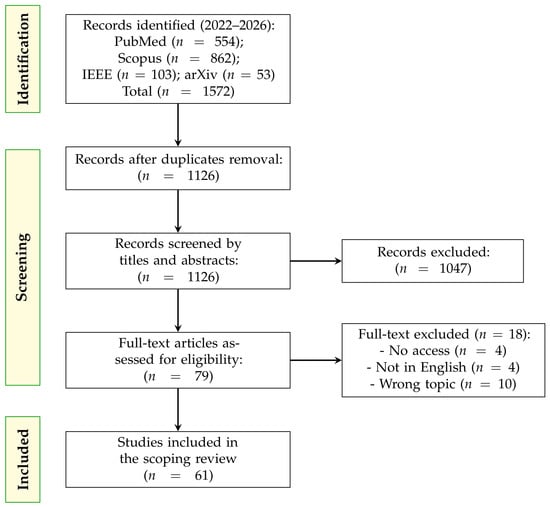
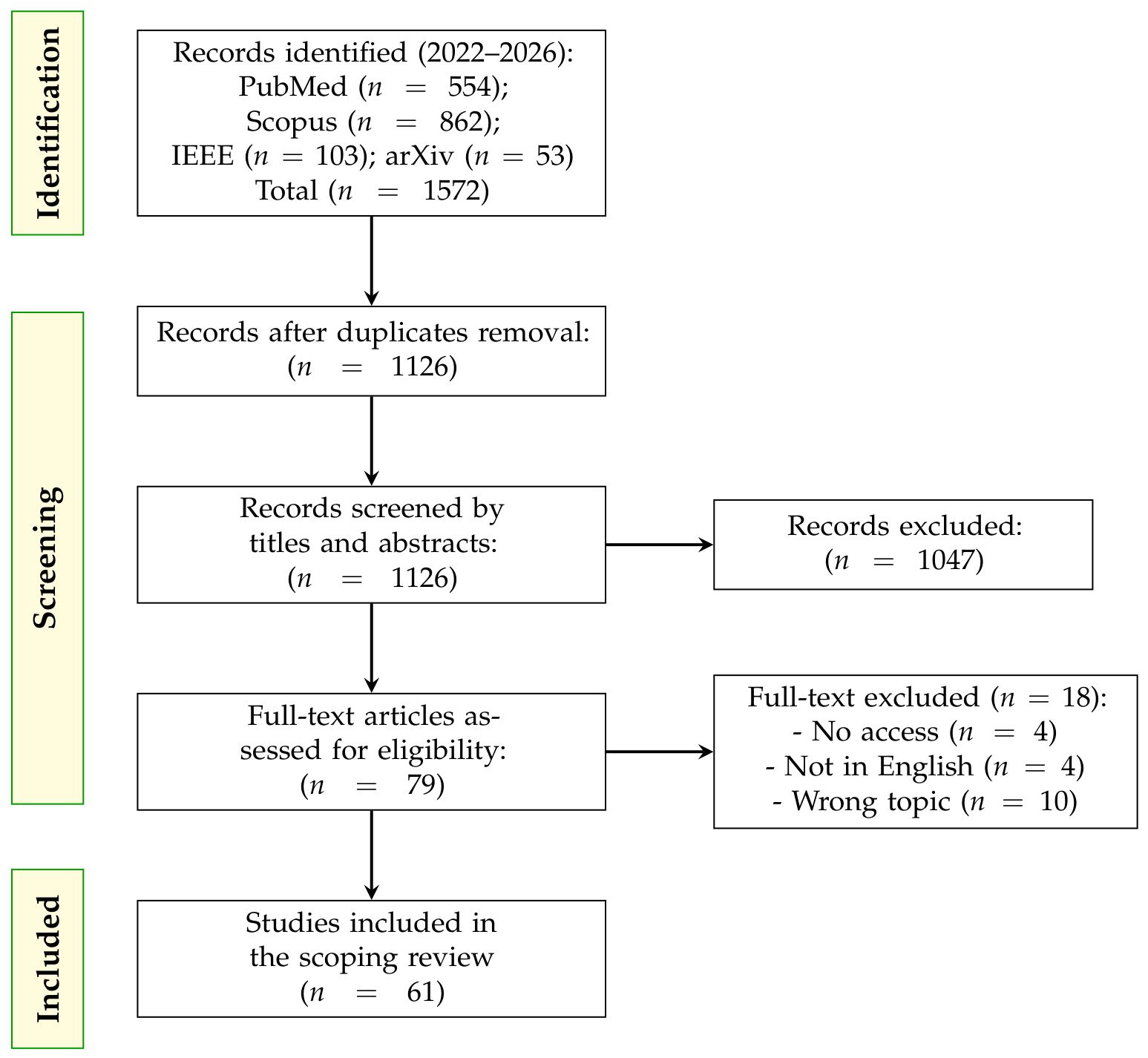
Selection followed identification, screening, and eligibility assessment (Figure 1). Deduplication and blinded title/abstract screening used Rayyan [19]. The search retrieved 1572 records (PubMed ; Scopus ; IEEE Xplore ; arXiv ). After removal of duplicates, 1126 unique records remained. Title and abstract screening excluded 1047 records. A total of 79 full texts were assessed; 18 were excluded (no access ; not in English ; wrong topic ), and 61 studies were included. Two reviewers independently screened titles and abstracts. A third reviewer resolved disagreements. Inter-rater agreement was not calculated; conflicts were settled by consensus. Records on general administration or purely clinical outcomes were removed at this stage.
Figure 1.
PRISMA flow of study identification and selection. After duplicate removal, title–abstract screening, and full-text assessment, 61 records were included and coded as GenAI used around the device lifecycle or as a function inside a device or SaMD.
Data were extracted by one reviewer after the extraction form was piloted on a subset of papers, and the coding rules for the four lifecycle pillars and technology categories were predefined. No second reviewer checked the extraction, so inter-rater agreement was not calculated. For each of the four lifecycle pillars, a study was coded yes when the paper performed or demonstrated that task with a generative model, partial when the task was mentioned only as background or context, and no when the task was absent. Technology categories were assigned only when the corresponding architecture (base LLM, RAG, agentic, or specialised generative method) was used in the reported work. Eight variables were charted (Table 3). Each study was labelled as GenAI used in the device process or GenAI embedded in a device or SaMD. Dual independent extraction was not performed. One included preprint was first posted on medRxiv [20] and entered the corpus through the screened set rather than a dedicated medRxiv search.
Table 3.
Operational definitions and extraction variables for mapping generative AI across the medical device lifecycle pillars.
2.5. Quality Assessment and Synthesis Strategy
A formal clinical risk-of-bias tool was not applied. The aim was to map technological breadth and gaps, including prototypes and preprints, rather than to grade clinical effectiveness. Inclusion therefore rested on eligibility and relevance to the device lifecycle.
Synthesis was narrative. Studies were described by geography, technology, and stakeholder, and then grouped by the four pillars in Section 1.3. An implementation density matrix was used to show how often each technology class (base LLM, RAG, agentic, other generative methods) appeared in each pillar. Because most reports are experimental and metrics are not comparable across tasks, the matrix is a frequency map, not a claim of industrial maturity. Reported accuracies are reproduced as published and are not pooled. The metrics in Appendix A, Table A2 cannot be compared across studies: datasets, validation methods, and baseline models differ, and most numbers come from single-task prototype evaluations rather than standardised benchmarks.
3. Results
3.1. Synthesis of Evidence and Stakeholder Mapping
The systematic selection process resulted in a final cohort of 61 studies meeting all eligibility criteria, as detailed in Figure 1. Two of these (Festor et al. and Diaz et al.) are non-generative contextual studies; they appear in the evidence tables for background but are excluded from all technology and density-matrix counts (Section 2.2). The remaining sources span 2022–2026 and document experimental prototypes, regulatory analyses, and a smaller set of operational tools.
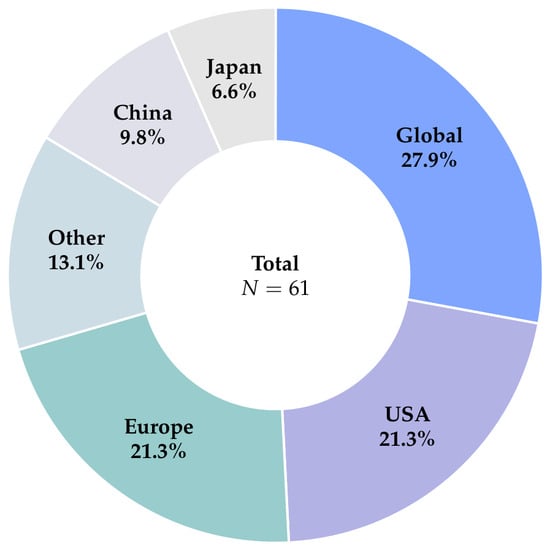
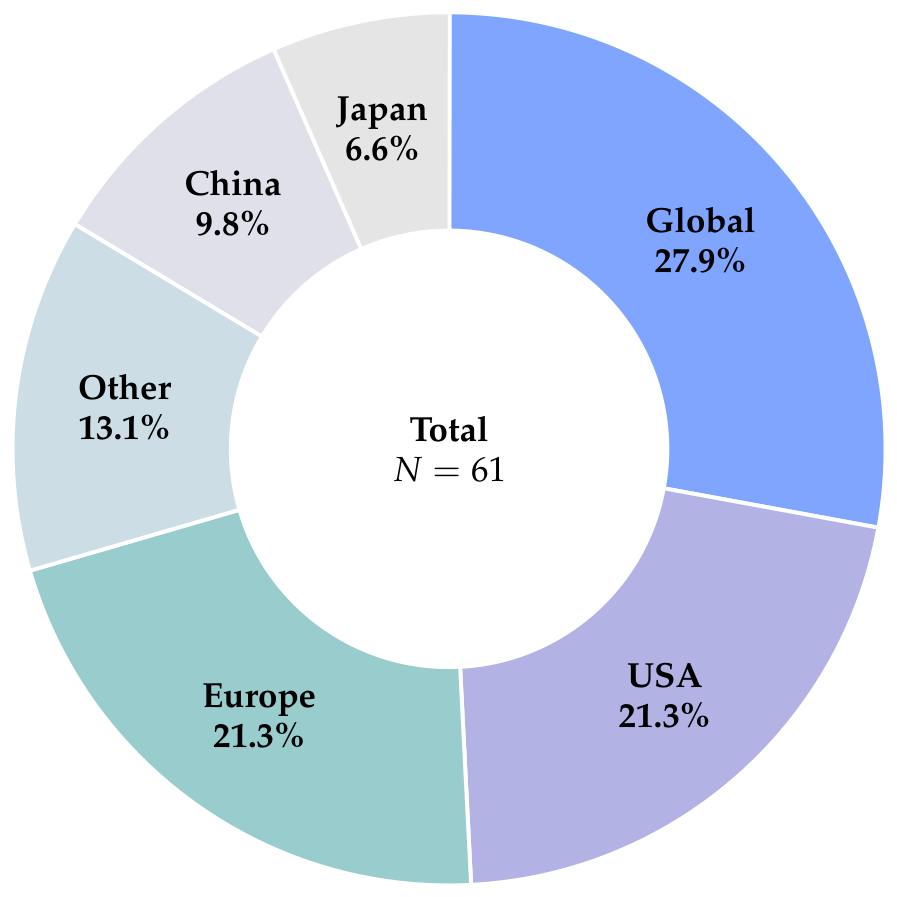
They do not document widespread industry deployment of generative AI inside cleared medical devices. A year-by-year and preprint versus peer-reviewed split was not tabulated. Publication status was not used as an inclusion or quality filter; peer-reviewed papers and preprints are combined, and validation maturity ranges from conceptual arguments to single-task prototype evaluations. Metadata mapped via the PCC framework in Appendix A, Table A1 show a mixed geography: multi-country or geographically unspecified papers (, 27.9%; these two sub-groups are combined under “Global” in Figure 2), the United States (n = 13, 21.3%), Europe (, 21.3%), China (, 9.8%), Japan (, 6.6%), and other single-country sites (, 13.1%). Stakeholders are mainly researchers, regulators, and manufacturers’ quality or cybersecurity staff. Front-line biomedical technicians and in-device autonomous agents appear in only a few studies. Most work uses a base LLM. RAG and specialised models appear as grounding or domain-adaptation layers. Multi-agent systems remain uncommon. Most included studies used GenAI around the device: documentation, vigilance mining, requirements, or cybersecurity analysis. A minority embedded a generative function in a device, wearable, or SaMD prototype. Of the 61 studies, 58 were coded as GenAI used around the device lifecycle and 3 as GenAI embedded in a device or SaMD prototype. The unique-paper pillar counts in Section 3.2 cut across both classes. The main conclusions (document and safety assistance is common; live maintenance and cleared in-device functions are rare) rest primarily on the around-device evidence; the device-embedded subset is small and prototype-level.
Figure 2.
Geographical distribution of the study cohort (). “Global” combines multi-country analyses and papers that do not locate the work in a single jurisdiction; the two sub-groups are not separated in the figure.
3.2. Architectural Distribution Across Lifecycle Pillars
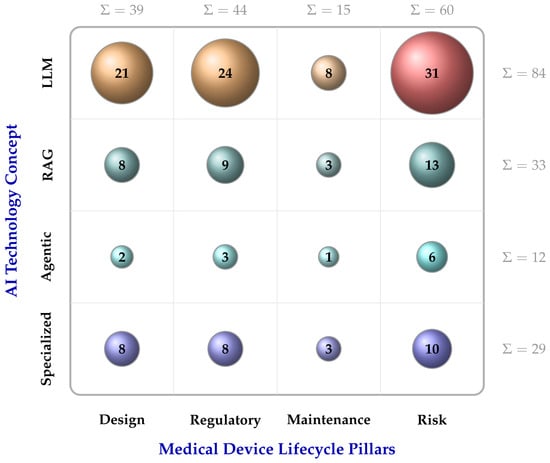
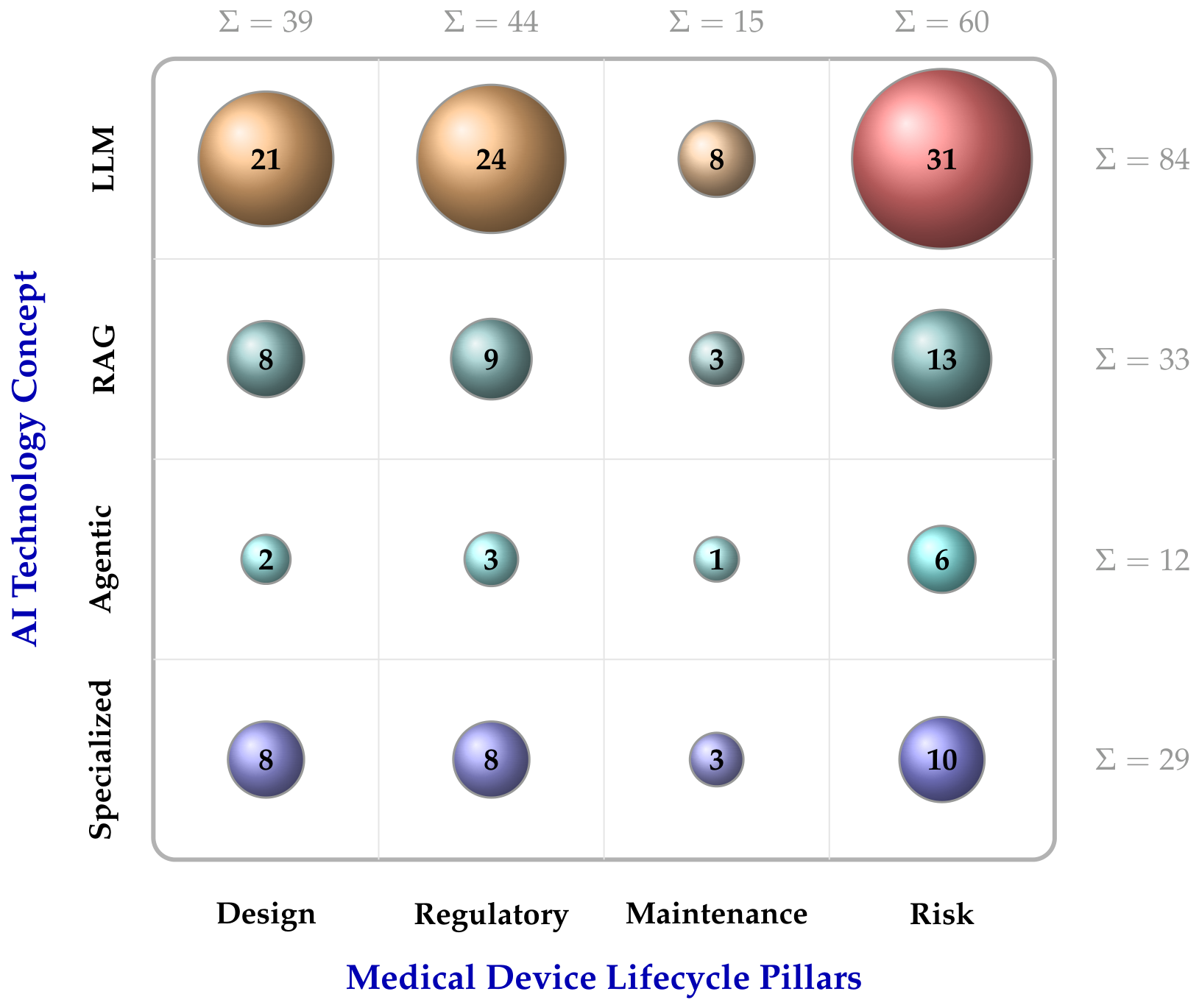
Each study was coded yes/partial/no for design, regulatory work, live maintenance, and risk. A yes was assigned only when the paper performed that task. On that unique-paper count, 26 studies addressed design, 32 regulatory analysis or compliance tooling, 8 live maintenance or first-line repair, and 40 risk or safety analysis. These four numbers (design 26, regulatory 32, maintenance 8, risk 40) are the unique-paper counts. Figure 3 and Table A3 use a different unit: each technology–pillar pair. A paper that uses more than one technology or addresses more than one pillar is counted in multiple cells, so the cell totals exceed 61. The Regulatory LLM cell in Figure 3 (n = 24) therefore lists more sources than a unique-paper row; Table A3 is the article-level mapping of those pairs. The implementation density matrix (Figure 3) uses a different unit. It counts every technology–pillar pair. A paper is entered in a cell when it both uses that technology class (base LLM, RAG, agentic, or specialised generative method) and performs a yes-coded task in that pillar. Papers that combine several architectures or address several pillars therefore occupy multiple cells. Policy papers with no trained model receive no technology cell. Those application totals () therefore exceed and do not equal the unique-paper n values above. Risk () and regulatory work () dominate the matrix. Live maintenance is the smallest column (). Foundational LLMs account for most cells (). Agentic systems remain sparse (), with a single yes-coded maintenance application. Article-level mapping is given in Table A3.
Figure 3.
Implementation density matrix (). Each cell is the number of yes-coded technology–pillar pairs. A paper that uses more than one technology class or addresses more than one pillar occupies multiple cells. Policy papers with no trained model are not assigned a technology cell. Marginal values sum that row or column. The two non-generative contextual studies [17,18] are excluded from all cell counts. See Table A3.
Across the matrix, the majority of yes-coded cells come from experimental prototypes or proof-of-concept studies; peer-reviewed operational deployments and validated in-device systems remain rare. Conceptual and policy papers contribute to the unique-paper pillar counts but receive no technology cell.
3.2.1. Pillar 1: Design and Development
Design work is common ( unique papers) but uneven. General-purpose LLMs are used for ideation, requirements, and code in digital-health projects [21]. A smaller set applies generative models to physical form, for example, point-cloud crown geometry [22] and a conversational closed-loop epilepsy prototype [20]. RAG is used to ground requirements in standards and manuals [23,24,25]. Safety-driven design methods such as AMLAS appear in non-generative reinforcement-learning work [17]. These studies show feasible pipelines. They do not show that generative design is a routine step in manufacturer design-control files.
3.2.2. Pillar 2: Management and Regulatory Compliance
Regulatory applications are the second-largest yes set ( unique papers). Typical tasks are MAUDE/openFDA retrieval and summarisation [26,27,28], extraction from FDA AI/ML clearance texts [29,30], premarket classification against 21 CFR [31], and QMS or requirement checking [25,32]. Policy papers map MDR, the EU AI Act, FDA TPLC/PCCP, and Japanese IDATEN pathways for generative SaMD [33,34,35,36,37]. Performance numbers are task-specific (for example, URL-generation gains with few-shot examples [26]; high checklist F1 in a specialised QMS model [32]). Almost all of this work analyses or drafts documents. It is not evidence that notified bodies or FDA reviewers have adopted these tools. The Regulatory and Risk pillars are broad by design. Regulatory work includes both policy analysis and tool prototypes; Risk work includes MAUDE mining, SBOM/CVE analysis, threat modelling, and ISO 14971-style simulation. These activities were not further subdivided into document retrieval, compliance drafting, safety assurance, and runtime safety. Policy papers receive no technology cell in Figure 3; tool prototypes are the source of the technology–pillar pairs.
3.2.3. Pillar 3: Technical Maintenance and Operations
In this review, the maintenance pillar covers operational reliability work on the device or its supporting systems (fault diagnosis, technician support, battery or performance estimation, software/model updates, and SBOM/CVE triage over the device life). Cybersecurity monitoring and software updates were coded here only when they addressed ongoing device reliability rather than pure design-time threat modelling or regulatory documentation. Live maintenance is the unmet pillar (n = 8 unique papers) within the indexed literature searched. Studies that meet the bar include pacemaker battery estimation from remote-monitoring files [38], first-line equipment-fault chat on LINE [39], TPM-style technician support [40], repair guidance in low-resource settings [41], SBOM/CVE triage over a long device life [42,43,44], and on-device detector updates from patient labels [20]. References [42,43] describe the same CVE-LLM system in a conference paper and a magazine article; they are retained as separate bibliographic records but count as one underlying approach in the unique-paper maintenance tally. These eight papers span battery monitoring, first-line fault chat, technician guidance, SBOM/CVE triage, and on-device model updates; they are not a single maintenance activity. The gap claim refers to the absence of integrated work-order, planned preventive-maintenance, or field-service systems linked to a manufacturer’s QMS, not to the absence of every technical task. Many other papers mention post-market surveillance or “lifecycle management” only as context; those were coded partial and are excluded from the maintenance column of Figure 3. There is little evidence of work-order systems, planned preventive maintenance, or field service integrated with a manufacturer’s QMS.
3.2.4. Pillar 4: Risk Assessment and Safety
Risk is the largest yes set ( unique papers). Recurring tasks are adverse-event mining [26,27,45], hallucination and failure-mode analysis for LLM-SaMD [46,47,48], threat modelling and false-data-injection paths [49,50,51], and SBOM-driven exploit demonstration [44,52]. Quantitative safety claims exist but are local: Likert ratings of MAUDE summaries [26], ISO 14971-style / simulation [48], and examination scores that fall on industrial standards and diagrams [53]. Human review remains the default control. Most proposed safeguards in this corpus are conceptual recommendations or local prototype checks (human review, refusal gates, or post hoc scoring); few studies report validated mitigation effectiveness under prospective or multi-site conditions.
3.3. Technological Evolution and Operational Barriers
Across the 2022–2026 window the included studies show a qualitative shift from standalone LLM prompts toward RAG, constrained decoding, and occasional multi-agent pipelines. That shift is visible for document grounding and cyber analysis; it is not yet a shift to autonomous device operations. A year-by-year or peer-review versus preprint tabulation was not performed, so the contribution of recent preprints to the observed shift cannot be quantified. Policy papers argue that generative SaMD breaks fixed-specification review and that TPLC, change control, and post-market vigilance are unfinished [35,36]. The main barriers in this corpus are prototype evaluations and retrospective public-database studies [26,38,45]. Few papers separate generative AI inside a device from generative AI used to develop or regulate a device. Live maintenance and manufacturer CAPA remain thin. Until those gaps close, the evidence supports a regulation-aware research agenda, not a claim that industry has implemented one.
4. Discussion
The evidence supports a narrow claim. Generative AI is being trialled as a document and safety assistant around medical devices. It is rarely shown as a live maintenance function or as a cleared runtime component. That is the state of the literature, not the state of the industry.
4.1. What the Map Shows
Two objects are still being treated as one. Generative models that summarise 510(k) text, MAUDE records, requirements, labels, or CVE notes sit outside the device. Generative models that answer a CGM query, update an implant detector, or speak to a patient sit inside it. Only the second is SaMD in the usual sense. SaMD classification under MDR and FDA guidance turns on the intended medical purpose and the significance of the information provided, not solely on whether the model is physically embedded; the inside/outside distinction used here is an analytic convenience for mapping the literature, not a regulatory classification rule. Mixing them overstates what this corpus shows. What exists is retrieval over public regulatory text, plus a few prototypes that would themselves need TPLC and change control. Risk and compliance look busy because the tasks are cheap to benchmark: public adverse-event files, clearance PDFs, SBOMs, and exam questions. High F1 on those corpora does not mean a notified body or a hospital workshop has adopted the tool. Maintenance looks empty for the opposite reason. Work orders, planned service, spare parts, and CAPA live in CMMS systems that this search never reached. The eight operational papers are local chats, battery reads, LMIC repair guides, and vulnerability triage. They do not add up to autonomous maintenance. Agentic architectures do not change that reading. They appear in cyber modelling and labelling more than in field service. RAG is the actual workhorse: it is how authors try to stop the model from inventing a clause of IEC 60601-1 or a MAUDE record. Two kinds of gap should be kept apart. Evidence gaps are absences in the indexed literature (for example, almost no prospective BMET work-order studies). Technological limitations are properties of the systems that were studied (hallucination risk, lack of change-control mechanisms, and absence of validated human-release gates). The thin maintenance column is primarily an evidence gap: the literature does not yet report integrated field-service deployments. The scarcity of cleared in-device generative functions is both an evidence gap and a technological limitation, because the required intended-use, PMS, and model-change controls are not yet demonstrated.
4.2. Implications
The regulatory implication is modest. MDR, the AI Act, FDA TPLC/PCCP, and Japan’s PMD Act are being used as source text and as arguments that fixed-specification review will fail for generative SaMD. They are not being used as completed assurance cases. A usable next step is to keep the two objects apart in the technical file: generative authoring tools under the QMS; generative device functions under intended use, PMS, and model-change control, with a human release gate.
4.3. Limitations
This review is limited to English-language research and preprints indexed in PubMed, IEEE Xplore, Scopus, and arXiv. Citation chasing and manual reference-list screening were not performed, so relevant studies outside these databases (or cited only in the reference lists of included papers) may have been missed. Four full texts could not be accessed and were excluded; their content is unknown, so any additional evidence they might have contained is absent from the map. Vendor tools, unpublished 510(k) language, hospital maintenance logs, and CMMS records are also absent. Consequently, the identified gaps, particularly the scarcity of live maintenance applications, should be interpreted as gaps in the indexed literature rather than as absolute gaps in the field. Preprints and conceptual or policy papers are included to capture the 2026 technical baseline, but they differ in evidential strength from peer-reviewed experimental systems and inflate the newest years; they are not treated as equivalent evidence. Most of the 61 studies are prototypes, simulations, or retrospective analyses of public databases; real operational deployments are rare. A formal maturity tier was not applied to each study, so readers should treat the scarcity of operational validation as a description of this corpus rather than a graded evidence hierarchy. Yes/partial coding can be argued at the margin for dual-use papers. These limits are why the paper maps gaps in the published record instead of claiming industry implementation. Title and abstract screening was dual and consensus-based, but data extraction and pillar coding were performed by a single reviewer, so residual classification bias is possible.
5. Conclusions
This review mapped 61 studies of generative AI against four device-lifecycle pillars. The literature is not empty, and it is not industrial practice. Most papers use an LLM, often with RAG, to retrieve or draft text around a device: MAUDE and clearance files, requirements, QMS checklists, SBOMs, and threat models. Far fewer papers put a generative model inside a device or into a workshop. Live maintenance is the thin pillar within the indexed literature searched. Physical generative design is rare. Multi-agent systems are uncommon and sit mainly in cyber and labelling work.
The two uses must stay separate in any later technical file. A model that writes a 510(k) paragraph or a QMS note is a QMS tool. A model that answers a CGM query, updates an implant detector, or speaks to a patient is SaMD, or an SaMD accessory, and needs intended use, PMS, and change control. This corpus argues that case. It does not show that manufacturers or regulators have implemented it.
The evidence supports a research agenda, not a claim of automated MDR or FDA compliance. Needed next are prospective maintenance studies in real BMET workflows, head-to-head comparison of in-device versus around-device generation under the same ISO 14971 file, and follow-up after model drift, not another single-shot F1 on a frozen public database.
Funding
This scoping review received no external grants or financial compensation for its design, analysis, or preparation.
Data Availability Statement
No new data were created or analyzed in this study. Data sharing is not applicable to this article.
Conflicts of Interest
The authors declare no conflicts of interest.
Appendix A
Table A1.
PCC framework distribution across the evidence base (), mapping stakeholder populations, AI concepts, and study settings. Entries report the stakeholders, technology, and setting as described by the original authors; they do not distinguish proposed applications from demonstrated outcomes.
Table A2.
Thematic synthesis of included studies across the primary medical-device lifecycle pillars (N = 61). Performance figures are reproduced as reported by the original authors and are not standardised or pooled; differences in datasets, validation methods, and baselines preclude direct comparison. Pillar cells and key findings report the applications and results as stated by the original authors; proposed uses and measured outcomes are not separately coded.
Table A3.
Referential mapping of yes-coded implementations by technology and lifecycle pillar (). A paper may appear in more than one cell. Policy papers with no trained model are not assigned a technology cell. Cell counts match Figure 3. A paper is listed when the original authors report use of the technology class on a yes-coded task; the table does not grade whether the application was demonstrated or only proposed.
Appendix B
Searches were run on 5 August 2026 and limited to 2022–2026. Strings combine three blocks: generative technology, device or SaMD terms, and lifecycle or regulatory operations.
Appendix B.1. PubMed
Medical subject headings and title/abstract tags.
(("Generative Artificial Intelligence"[MeSH] OR "Generative AI"[tiab] OR "GenAI"[tiab] OR "Large Language Models"[tiab] OR "LLM"[tiab] OR "RAG"[tiab] OR "Retrieval-Augmented Generation"[tiab] OR "AI Agent*"[tiab] OR "Agentic AI"[tiab])) AND (("Medical Device*"[tiab] OR "SaMD"[tiab] OR "Digital Health"[tiab] OR "Health Technology"[tiab] OR "Diagnostic Equipment"[tiab] OR "medical equipment"[tiab] OR "Equipment and Supplies"[MeSH])) AND (("Design"[tiab] OR "Development"[tiab] OR "Maintenance"[tiab] OR "Life Cycle"[tiab] OR "Regulatory"[tiab] OR "Post-Market"[tiab] OR "Compliance"[tiab] OR "Management"[tiab] OR "Risk Assessment"[tiab] OR "CAPA"[tiab] OR "Quality Management"[tiab] OR "Quality"[tiab] OR "Safety"[tiab] OR "Monitoring"[tiab] OR "Reliability"[tiab] OR "Fault*"[tiab]))
Appendix B.2. Scopus
Title, abstract, and keywords, with year filter.
TITLE-ABS-KEY ( ( "Generative AI" OR "GenAI" OR "Large Language Models" OR "LLM" OR "RAG" OR "Retrieval-Augmented Generation" OR "AI Agent*" OR "Agentic AI" ) AND ( "Medical Device*" OR "SaMD" OR "Digital Health" OR "Health Technology" OR "Diagnostic Equipment" OR "medical equipment" ) AND ( "Design" OR "Development" OR "Maintenance" OR "Life Cycle" OR "Regulatory" OR "Post-Market" OR "Compliance" OR "Management" OR "Risk Assessment" OR "CAPA" OR "Quality Management" OR "Quality" OR "Safety" OR "Monitoring" OR "Reliability" OR "Fault*" ) ) AND PUBYEAR > 2021 AND PUBYEAR < 2027
Appendix B.3. IEEE Xplore
All Metadata command search.
("All Metadata":"Generative AI" OR "All Metadata":GenAI OR "All Metadata":LLM OR "All Metadata":RAG OR "All Metadata":"Retrieval-Augmented Generation" OR "All Metadata":"AI Agent*" OR "All Metadata":"agentic AI") AND ("All Metadata":"Medical Device*" OR "All Metadata":SaMD OR "All Metadata":"Software as a Medical Device" OR "All Metadata":"Digital Health" OR "All Metadata":"medical equipment") AND ("All Metadata":Design OR "All Metadata":Development OR "All Metadata":Maintenance OR "All Metadata":Regulatory OR "All Metadata":Compliance OR "All Metadata":Management OR "All Metadata":"Post-Market" OR "All Metadata":"Risk Assessment" OR "All Metadata":CAPA OR "All Metadata":"Quality Management" OR "All Metadata":Reliability OR "All Metadata":Fault*)
Appendix B.4. arXiv
Advanced search in cs and eess, including cross-lists. Exact executable query:
order: -announced_date_first; size: 100; date_range: from 2022-01-01 to 2026-12-31; classification: Computer Science (cs), Electrical Engineering and Systems Science (eess); include_cross_list: True; terms: AND abstract=("Generative AI" OR GenAI OR LLM OR RAG OR "AI Agent" OR "agentic AI") AND abstract=("Medical Device" OR SaMD OR "Digital Health" OR "medical equipment") AND abstract=(Design OR Development OR Regulatory OR Compliance OR Management OR Maintenance OR "Risk Assessment" OR "Post-Market" OR CAPA OR "Quality Management")
References
- European Parliament and Council. Regulation (EU) 2017/745 on Medical Devices, Amending Directive 2001/83/EC, Regulation (EC) No 178/2002 and Regulation (EC) No 1223/2009 and Repealing Council Directives 90/385/EEC and 93/42/EEC; European Union: Brussels, Belgium, 2017. [Google Scholar]
- Luschi, A.; Nesi, P.; Iadanza, E. Evidence-based clinical engineering: Health information technology adverse events identification and classification with natural language processing. Heliyon 2023, 9, e21723. [Google Scholar] [CrossRef] [Scilit]
- U.S. Food and Drug Administration. Software as a Medical Device (SaMD); Digital Health Center of Excellence, FDA: Silver Spring, MD, USA, 2017.
- U.S. Food and Drug Administration. Software as a Medical Device (SaMD): Clinical Evaluation—Guidance for Industry and Food and Drug Administration Staff; Guidance Document; International Medical Device Regulators Forum (IMDRF): Silver Spring, MD, USA, 2017.
- Meskó, B.; Topol, E.J. The imperative for regulatory oversight of large language models (or generative AI) in healthcare. npj Digit. Med. 2023, 6, 184. [Google Scholar] [CrossRef] [Scilit]
- Luschi, A.; Zazzeri, A.; Cevenini, G.; Iadanza, E. Risk-informed design of Software as a Medical Device through Natural Language Processing techniques. Biomed. Signal Process. Control 2026, 119, 109994. [Google Scholar] [CrossRef] [Scilit]
- World Health Organization. Ethics and Governance of Artificial Intelligence for Health: WHO Guidance; WHO: Geneva, Switzerland, 2021; ISBN 978-92-4-002920-0. [Google Scholar]
- European Union. Regulation (EU) 2024/1689 of the European Parliament and of the Council of 13 June 2024 Laying Down Harmonised Rules on Artificial Intelligence (Artificial Intelligence Act); European Union: Brussels, Belgium, 2024. [Google Scholar]
- Di Bidino, R.; Piaggio, D.; Andellini, M.; Merino-Barbancho, B.; Lopez-Perez, L.; Zhu, T.; Raza, Z.; Ni, M.; Morrison, A.; Borsci, S.; et al. Scoping Meta-Review of Methods Used to Assess Artificial Intelligence-Based Medical Devices for Heart Failure. Bioengineering 2023, 10, 1109. [Google Scholar] [CrossRef] [Scilit]
- Wang, L.; Ma, C.; Feng, X.; Zhang, Z.; Yang, H.; Zhang, J.; Chen, Z.; Tang, J.; Chen, X.; Lin, Y.; et al. A survey on large language model based autonomous agents. Front. Comput. Sci. 2024, 18, 186345. [Google Scholar] [CrossRef] [Scilit]
- Luschi, A.; Ghisalberti, G.; Daino, G.L.; Mezzatesta, V.; Iadanza, E. OHIO: Integrating IoT Technologies for Enhanced Clinical Engineering and Dynamic Tracking of Medical Equipment; IFMBE Proceedings; Springer: Berlin/Heidelberg, Germany, 2024; pp. 169–177. [Google Scholar] [CrossRef] [Scilit]
- Luschi, A.; Crapanzano, F.; Satta, F.; Sani, L.; Iadanza, E. Proposal of an XML Standard Protocol for Evidence-Based Medical Equipment Maintenance. In Proceedings of the EMBEC 2024, 9th European Medical and Biological Engineering Conference; Springer: Berlin/Heidelberg, Germany, 2024; pp. 245–251. [Google Scholar] [CrossRef] [Scilit]
- Arksey, H.; O’Malley, L. Scoping studies: Towards a methodological framework. Int. J. Soc. Res. Methodol. 2005, 8, 19–32. [Google Scholar] [CrossRef] [Scilit]
- Levac, D.; Colquhoun, H.; O’Brien, K.K. Scoping studies: Advancing the methodology. Implement. Sci. 2010, 5, 69. [Google Scholar] [CrossRef] [Scilit]
- Peters, M.D.; Marnie, C.; Tricco, A.C.; Pollock, D.; Munn, Z.; Alexander, L.; McInerney, P.; Godfrey, C.M.; Khalil, H. Updated methodological guidance for the conduct of JBI scoping reviews. JBI Evid. Synth. 2020, 18, 2119–2126. [Google Scholar] [CrossRef] [Scilit]
- Tricco, A.C.; Lillie, E.; Zarin, W.; O’Brien, K.K.; Colquhoun, H.; Levac, D.; Moher, D.; Peters, M.D.; Horsley, T.; Weeks, L.; et al. PRISMA extension for scoping reviews (PRISMA-ScR): Checklist and explanation. Ann. Intern Med. 2018, 169, 467–473. [Google Scholar] [CrossRef] [Scilit]
- Festor, P.; Luise, G.; Komorowski, M.; Faisal, A.A. Enabling risk-aware reinforcement learning for medical interventions through uncertainty decomposition. arXiv 2022, arXiv:2106.14324. [Google Scholar]
- Zanon Diaz, J.; Siogkas, G.; Corcoran, P. Dual-Mode Deep Anomaly Detection for Medical Manufacturing: Structural Similarity and Feature Distance, 2025. arXiv 2025, arXiv:2509.05796. [Google Scholar] [CrossRef] [Scilit]
- Ouzzani, M.; Hammady, H.; Fedorowicz, Z.; Elmagarmid, A. Rayyan—A web and mobile app for systematic reviews. Syst. Rev. 2016, 5, 210. [Google Scholar] [CrossRef] [Scilit]
- Goldblum, Z.; Shi, H.; Xu, Z.; Ojemann, W.K.S.; Aguila, C.A.; Long, K.; Xie, K.; Nix, K.C.; Walsh, K.; Chang, E.; et al. An Implantable Device that Converses with Patients and Learns to Co-Manage Epilepsy. medRxiv 2026. [Google Scholar] [CrossRef] [Scilit]
- Rodriguez, D.V.; Lawrence, K.; Gonzalez, J.; Brandfield-Harvey, B.; Xu, L.; Tasneem, S.; Levine, D.L.; Mann, D. Leveraging Generative AI Tools to Support the Development of Digital Solutions in Health Care Research: Case Study. JMIR Hum. Factors 2024, 11, e52885. [Google Scholar] [CrossRef] [Scilit]
- Ying, S.; Huang, F.; Yin, J.; Liu, W.; He, F. Tooth3dNet: A preliminary exploration for automatic 3D morphology design of dental crowns with a deep generative network. J. Dent. 2026, 170, 106696. [Google Scholar] [CrossRef] [Scilit]
- Le Ray, J.M. Policy-Governed RAG—Research Design Study: Cryptographic Receipts for Audit-Ready Generation. arXiv 2025, arXiv:2510.19877. [Google Scholar] [CrossRef] [Scilit]
- Han, Y.; Ceross, A.; Bergmann, J.H. Standard Applicability Judgment and Cross-jurisdictional Reasoning: A RAG-based Framework for Medical Device Compliance. arXiv 2025, arXiv:2506.18511. [Google Scholar] [CrossRef] [Scilit]
- Sirin, O.; Samil, M.A.; Granlund, T.; Rasku, J.; Zhang, Z.; Abrahamsson, P. Enhancing Regulation-Adherent Requirement Engineering with Contextual AI: An Industrial Study. In Proceedings of the International Working Conference on Requirements Engineering: Foundation for Software Quality (REFSQ 2025); Springer: Berlin/Heidelberg, Germany, 2025; pp. 69–86. [Google Scholar] [CrossRef] [Scilit]
- Yu, Y.; Shi, Y.; Feng, Y.; Gong, Y. Developing a Generative AI-Powered Chatbot for Analyzing MAUDE Database. Stud. Health Technol. Inform. 2024, 316, 1255–1259. [Google Scholar] [CrossRef] [Scilit] [PubMed]
- Shah, F.; Yu, Y.; Shi, Y.; Gong, Y. Leveraging Data Pipeline and LLM to Advance Patient Safety Event Studies. In Proceedings of the Intelligent Health Systems—From Technology to Data and Knowledge; Studies in Health Technology and Informatics; IOS Press: Amsterdam, The Netherlands, 2025; Volume 323, pp. 1214–1218. [Google Scholar] [CrossRef] [Scilit]
- Kesharwani, R.; Cvijic, L.; Denecke, K. Automating Safety Surveillance for Software-Based Medical Devices: Insights from FDA MAUDE Data. In Opening the Personal Gate Between Technology and Health Care; Studies in Health Technology and Informatics; Giacomini, M., Ed.; IOS Press: Amsterdam, The Netherlands, 2026; p. 615. [Google Scholar] [CrossRef] [Scilit]
- do Amaral, D.M.; Wang, Y.; Magrabi, F. Applying LLMs for Analysis of AI/ML Medical Device Approvals. In Proceedings of the MEDINFO 2025: Healthcare Smart Medicine Deep; Studies in Health Technology and Informatics; Househ, M.S., Ed.; IOS Press: Amsterdam, The Netherlands, 2025; Volume 320, pp. 1798–1802. [Google Scholar] [CrossRef] [Scilit]
- Wang, Y.; Amaral, D.M.D.; Magrabi, F. Feasibility of Using LLMs to Automate Analysis of AI/ML Medical Device Approvals. In Proceedings of the 2025 18th Health Informatics Knowledge Management Conference; Association for Computing Machinery: New York, NY, USA, 2025; pp. 1–4. [Google Scholar] [CrossRef] [Scilit]
- Chattoraj, S.; Joshi, K.P. LLM based Knowledge Graph Approach to Automating Medical Device Regulatory Compliance. In Proceedings of the 2025 IEEE International Conference on Big Data (Big Data); IEEE: Piscataway, NJ, USA, 2025. [Google Scholar] [CrossRef] [Scilit]
- Li, Y.; Shi, Z.; Li, Y.; Chen, Y.; Wu, G.; Yang, M. LLMES: An LLMs-based expert system for quality management system audits. In Artificial Intelligence and Law; Springer: Berlin/Heidelberg, Germany, 2025. [Google Scholar] [CrossRef] [Scilit]
- Olimid, A.P.; Georgescu, C.M.; Olimid, D.A. Legal Analysis of EU Artificial Intelligence Act (2024): Insights from Personal Data Governance and Health Policy. Access Just. East. Eur. 2024, 7, 120. [Google Scholar] [CrossRef] [Scilit]
- Hauglid, M.K.; Mahler, T. Doctor Chatbot: The EU’s Regulatory Prescription for Generative Medical AI. Oslo Law Rev. 2023, 10, 1–23. [Google Scholar] [CrossRef] [Scilit]
- Takahashi, S.; Makino, T.; Mizutani, R.; Hirano, T.; Nomura, Y. Japanese regulation and approval process for medical artificial intelligence (AI) as software as a medical device (SaMD): Current status and emerging challenges. Glob. Health Med. 2026, 8, 140–147. [Google Scholar] [CrossRef] [Scilit]
- Ong, J.C.L.; Ning, Y.; Liu, M.; Ma, Y.; Zhao, L.; Singh, K.; Chang, R.T.; Vogel, S.; Lim, J.C.W.; Tan, I.S.K.; et al. Innovating global regulatory frameworks for generative AI in medical devices is an urgent priority. npj Digit. Med. 2026, 9, 364. [Google Scholar] [CrossRef] [Scilit]
- Jung, S.; Son, K. Regulatory Approaches to Cybersecurity Risk Management for AI-Enabled Medical Device Software in Korea, the United States, and the European Union: Comparative Document Analysis. JMIR Med. Inform. 2026, 14, e94846. [Google Scholar] [CrossRef] [Scilit]
- Iwai, R.; Shimazaki, T.; Hyry, J.; Fukuda, M.; Mine, T.; Kawakubo, Y.; Ata, S.; Yokoyama, T.; Anzai, D. Evaluation of Pacemaker Battery Level Estimation using Large Language Model and Remote Monitoring Historical Data. In Proceedings of the 2025 47th Annual International Conference of the IEEE Engineering in Medicine and Biology Society (EMBC); IEEE: Piscataway, NJ, USA, 2025; p. 11251697. [Google Scholar] [CrossRef] [Scilit]
- Suwannoi, A. Chatbot on LINE Application Using Natural Language Processing for Providing Preliminary Solutions in the Use of Medical Equipment for Healthcare Facilities. In Proceedings of the 2025 IEEE International Conference on Cybernetics and Innovations (ICCI); IEEE: Piscataway, NJ, USA, 2025. [Google Scholar] [CrossRef] [Scilit]
- Mahfoud, H.; Masmoudi, M.; Hassani, A.; Moutaoukil, O. AI chatbots for healthcare maintenance: Transforming total productive maintenance in the Industry 5.0 era. TQM J. 2025, ahead-of-print. [Google Scholar] [CrossRef] [Scilit]
- Atabonfack, B.L.; Issah, A.T.; Baaki, M.H.A.; Ingabire, C.; Olusuyi, T.; Adewole, M.; Anazodo, U.; Brown, T. Empowering Medical Equipment Sustainability in Low-Resource Settings: An AI-Powered Diagnostic and Support Platform for Biomedical Technicians. arXiv 2026, arXiv:2601.16967. [Google Scholar] [CrossRef] [Scilit]
- Ghosh, R.; von Stockhausen, H.M.; Schmitt, M.; Vasile, G.M.; Karn, S.K.; Farri, O. CVE-LLM: Ontology-Assisted Automatic Vulnerability Evaluation Using Large Language Models. Proc. AAAI Conf. Artif. Intell. 2025, 39, 28757–28765. [Google Scholar] [CrossRef] [Scilit]
- Ghosh, R.; von Stockhausen, H.M.; Schmitt, M.; Vasile, G.M.; Karn, S.K.; Farri, O. Automated vulnerability evaluation with large language models and vulnerability ontologies. AI Mag. 2025, 46, e70031. [Google Scholar] [CrossRef] [Scilit]
- Deng, J.; Yang, Y.; Rushanan, M. The SBOM Transparency v. Exposure Dilemma: A Case Study on Adversarial Access to Public SBOMs in Healthcare. In Proceedings of the 2025 Annual Computer Security Applications Conference Workshops (ACSAC Workshops); IEEE: Piscataway, NJ, USA, 2025. [Google Scholar] [CrossRef] [Scilit]
- Xia, W.; Zhu, W.; Li, T.; Wang, L.; Li, W.; Zhang, P. Analysis Model for Infant Incubator Adverse Events Using Retrieval-Augmented Generation Combined With Dual-Adapter Fine-Tuning: Development and Evaluation Study. JMIR Med. Inform. 2026, 14, e83745. [Google Scholar] [CrossRef] [Scilit]
- Healey, E.; Kohane, I. LLM-CGM: A Benchmark for Large Language Model-Enabled Querying of Continuous Glucose Monitoring Data for Conversational Diabetes Management. In Proceedings of the Pacific Symposium on Biocomputing 2025; World Scientific: Singapore, 2025; pp. 421–432. [Google Scholar]
- Granstedt, J.; Kc, P.; Deshpande, R.; Garcia, V.; Badano, A. Hallucinations in medical devices. Artif. Intell. Life Sci. 2025, 8, 100145. [Google Scholar] [CrossRef] [Scilit]
- Kalinich, M.; Luccarelli; Maria, J.S.; Moss, F.; Torous, J. Leveraging simulation to provide a practical framework for estimating the novel scope of risk of large language models in healthcare. BMJ Ment. Health 2026, 29, e302626. [Google Scholar] [CrossRef] [Scilit]
- Kwarteng, E.; Cebe, M.; Kwarteng, J.; Bansal, N. A Comprehensive User Study on Medical Device Threat Modeling Methodologies and CyberLlama2 - MEDICALHARM Threat Modeling Assistant. Int. J. Inf. Secur. 2025, 24, 180. [Google Scholar] [CrossRef] [Scilit]
- Hallajiyan, M.; Dharmalingam, A.P.; Mitra, G.; Alemzadeh, H.; Iqbal, S.; Pattabiraman, K. SAM: Foreseeing Inference-Time False Data Injection Attacks on ML-enabled Medical Devices. In Proceedings of the 2024 Workshop on Cybersecurity in Healthcare; Association for Computing Machinery: New York, NY, USA, 2024; pp. 77–84. [Google Scholar] [CrossRef] [Scilit]
- Erdogan, G.; Gillette, M.; Tverdal, S.; Halvorsrud, R. From Manual to Automated Cyber Risk Assessment: LLM- and RAG-Driven Multi-Agent Threat Modeling with CORAS in Healthcare Case Studies. In Proceedings of the 2025 12th International Conference on Dependable Systems and Their Applications (DSA); IEEE: Piscataway, NJ, USA, 2025. [Google Scholar] [CrossRef] [Scilit]
- Stein, S.; Pilgermann, M.; Weber, S.; Sedlmayr, M. Leveraging MDS2 and SBOM data for LLM-assisted vulnerability analysis of medical devices. Comput. Struct. Biotechnol. J. 2025, 28, 267–280. [Google Scholar] [CrossRef] [Scilit]
- Ishida, K.; Arisaka, N.; Fujii, K. Analysis of Responses of GPT-4 V to the Japanese National Clinical Engineer Licensing Examination. J. Med. Syst. 2024, 48, 83. [Google Scholar] [CrossRef] [Scilit]
- Nehme, M.; Schneider, F.; Amruthalingam, E.; Schnarrenberger, E.; Tremeaud, R.; Guessous, I. Chatbots in medicine: Certification process and applied use case. Swiss Med. Wkly. 2024, 154, 3954. [Google Scholar] [CrossRef] [Scilit]
- Tang, C.; Zhang, R.; Gao, S.; Zhao, Z.; Zhang, Z.; Wang, J.; Li, C.; Chen, J.; Dai, Y.; Wang, S.; et al. An AI-Driven Multimodal Smart Home Platform for Continuous Monitoring and Assistance in Post-Stroke Motor Impairment. IEEE Trans. Neural Syst. Rehabil. Eng. 2025, 33, 481–492. [Google Scholar] [CrossRef] [Scilit]
- Wakabayashi, S.; Seto, R. Extracting Pharmaceutical Safety Information from Nursing Records: Utilizing ChatGPT for Data Categorization. In Proceedings of the MEDINFO 2025: Healthcare Smart Medicine Deep; Studies in Health Technology and Informatics; IOS Press: Amsterdam, The Netherlands, 2025; Volume 320, pp. 352–356. [Google Scholar] [CrossRef] [Scilit]
- Pawana, I.W.A.J.; Astillo, P.V.; You, I. Lightweight LLM-Based Anomaly Detection Framework for Securing IoTMD Enabled Diabetes Management Control Systems. IEEE J. Biomed. Health Inform. 2025, 30, 6356–6367. [Google Scholar] [CrossRef] [Scilit]
- Ishida, K. Evaluating Chat Generative Pretrained Transformer (GPT-4o) Problem-Solving Performance in the Japan Certificate Examination for Biomedical Engineering Class 1. Cureus 2025, 17, e81029. [Google Scholar] [CrossRef] [Scilit]
- Hua, L.; Gong, Y. AutoQUEST: A Chain-of-Thought Pipeline for Automated Question Generation and Validation in MAUDE Research. In Proceedings of the MEDINFO 2025: Healthcare Smart Medicine Deep; Studies in Health Technology and Informatics; IOS Press: Amsterdam, The Netherlands, 2025; Volume 320, pp. 421–425. [Google Scholar] [CrossRef] [Scilit]
- Zhu, W.; Zhang, P.; Xia, W.; Gao, Z.; Li, W.; Tian, R.; Wang, L. AI-Driven Medical Device Risk Management: A New Paradigm Integrating Large Language Models and Prompt Engineering for Standard-Risk Knowledge Graph Construction and Application. Risk Manag. Healthc. Policy 2025, 18, 755–773. [Google Scholar] [CrossRef] [Scilit]
- Liu, X.; Liu, P.; Yang, B.; Chen, Y. One multi-receiver certificateless searchable public key encryption scheme for IoMT assisted by LLM. J. Inf. Secur. Appl. 2025, 90, 104011. [Google Scholar] [CrossRef] [Scilit]
- Nuka, S.T. Leveraging AI and Generative AI for Medical Device Innovation: Enhancing Custom Product Development and Patient Specific Solutions. J. Neonatal Surg. 2025, 14, 1825. [Google Scholar] [CrossRef] [Scilit]
- Krautz, A.E.; Langner, J.; Helmhold, F.; Volkening, J.; Hoffmann, A.; Hasler, G. Bridging AI innovation and healthcare: Scalable clinical validation methods for voice biomarkers. Front. Digit. Health 2025, 7, 1575753. [Google Scholar] [CrossRef] [Scilit]
- Onitiu, D.; Wachter, S.; Mittelstadt, B. Walking Backward to Ensure Risk Management of Large Language Models in Medicine. J. Law Med. Ethics 2025, 53, 454–464. [Google Scholar] [CrossRef] [Scilit]
- Alsaif, K.; Albeshri, A.; Khemakhem, M.; Eassa, F. Healthcare 4.0: A Large Language Model-Based Blockchain Framework for Medical Device Fault Detection and Diagnostics. Int. J. Adv. Comput. Sci. Appl. (IJACSA) 2025, 16, 495–512. [Google Scholar] [CrossRef] [Scilit]
- Wang, Z.; Wang, H.; Danek, B.; Li, Y.; Mack, C.; Arbuckle, L.; Biswal, D.; Poon, H.; Wang, Y.; Rajpurkar, P.; et al. A perspective for adapting generalist AI to specialized medical AI applications and their challenges. npj Digit. Med. 2025, 8, 429. [Google Scholar] [CrossRef] [Scilit]
- Chakraborty, A.; Karhade, M. Global AI Governance in Healthcare: A Cross-Jurisdictional Regulatory Analysis. arXiv 2024, arXiv:2406.08695. [Google Scholar] [CrossRef] [Scilit]
- Sigloch, P.; Benzmüller, C. Neuro-Symbolic Verification of LLM Outputs for Data-Sensitive Domains. In Proceedings of the KI 2026: Advances in Artificial Intelligence; Lecture Notes in Computer Science; Wolter, D., Schwalbe, G., Eds.; Springer: Cham, Switzerland, 2026; Volume 16830, pp. 324–331. [Google Scholar] [CrossRef] [Scilit]
- Hallajiyan, M.; Ge, X.; Dharmalingam, A.P.; Mitra, G.; Iqbal, S.; Alemzadeh, H.; Pattabiraman, K. SAMD: A Tool for Identifying False Data Injection Scenarios in AI/ML-enabled Medical Devices. arXiv 2026, arXiv:2605.29210. [Google Scholar] [CrossRef] [Scilit]
- Banham, M.R. Beyond Initial Design: AI Advancement of Portable Ultrasound Technology for Brain Perfusion Imaging. In Proceedings of the 2025 IEEE International Conference on Image Processing Workshops (ICIPW); IEEE: Piscataway, NJ, USA, 2025; pp. 80–84. [Google Scholar] [CrossRef] [Scilit]
- Bernardi, M.; Okaro, I.; Van Der Burgt, O.; Hicks, M. Autonomous AI-Driven FMEA Optimization for Safety and Reliability in Healthcare. In Proceedings of the 2026 Annual Reliability and Maintainability Symposium (RAMS); IEEE: Piscataway, NJ, USA, 2026; pp. 1–6. [Google Scholar] [CrossRef] [Scilit]
- Liu, X.; Yuan, B.; Wang, P.; Ding, N.; Chu, J. An approach based on hybrid-augmented intelligence for the combination and optimization of human-machine teams. J. Manuf. Syst. 2025, 83, 306–321. [Google Scholar] [CrossRef] [Scilit]
- Li, H.; He, X.; Subbaswamy, A.; Vossler, P.; Gossmann, A.; Singh, K.; Feng, J. Scaling medical device regulatory science using large language models. npj Digit. Med. 2026, 9, 221. [Google Scholar] [CrossRef] [Scilit]
- Islayem, R.; Musamih, A.; Salah, K.; Jayaraman, R.; Yaqoob, I. Enhancing medical digital twins within metaverse using blockchain, NFTs and LLMs. Internet Things 2025, 32, 101648. [Google Scholar] [CrossRef] [Scilit]
- Ferdowsi, M.; Moustafa, N.; Keshk, M.; Turnbull, B. Trustworthy Intelligence: Split Learning–Embedded Large Language Models for Smart IoT Healthcare Systems. Electronics 2026, 15, 1519. [Google Scholar] [CrossRef] [Scilit]
- Kendell, P.; Semenov, A.; Zhang, W. An Agentic, Multimodal RAG Framework for Risk-Aware Surgical Robotics User Manual Creation. In Proceedings of the 2026 IEEE International Systems Conference (SysCon); IEEE: Piscataway, NJ, USA, 2026; pp. 1–3. [Google Scholar] [CrossRef] [Scilit]
- Malpure, S.; Kanungo, R.; Loomis, B.R.; Reza, S.M.S. Securing AI and Agentic Systems in Medical Devices: Methods, Risks, and Defenses. In Proceedings of the 2025 Third International Conference on Cyber Physical Systems, Power Electronics and Electric Vehicles (ICPEEV); IEEE: Piscataway, NJ, USA, 2025. [Google Scholar] [CrossRef] [Scilit]
- Dutta, N.; Dhar, D. Investigating Usability of Conversational User Interfaces for Integrated System-Physical Interactions: A Medical Device Perspective. Int. J. Hum.–Comput. Interact. 2025, 41, 271–304. [Google Scholar] [CrossRef] [Scilit]

Disclaimer/Publisher’s Note: The statements, opinions and data contained in all publications are solely those of the individual author(s) and contributor(s) and not of MDPI and/or the editor(s). MDPI and/or the editor(s) disclaim responsibility for any injury to people or property resulting from any ideas, methods, instructions or products referred to in the content. |
© 2026 by the authors. Licensee MDPI, Basel, Switzerland. This article is an open access article distributed under the terms and conditions of the Creative Commons Attribution (CC BY) license.