


1. Introduction
Anaerobic digestion (AD) plays an important role in sustainable waste management, renewable energy production, and the transition towards a circular bioeconomy. Beyond conventional biogas production, AD offers opportunities for recovering energy, nutrients, and value-added products from diverse biomass and organic waste streams. Advances in mathematical modeling, microbial ecology, substrate pretreatment, and resource recovery have improved our understanding of anaerobic conversion processes. Nevertheless, microbial complexity, feedstock variability, and challenges related to process stability, economic feasibility, and industrial implementation continue to limit its wider application.
The Special Issue “Anaerobic Digestion Advances in Biomass and Waste Treatment” brings together 14 contributions covering different aspects of AD and complementary waste valorization technologies. Together, these studies provide a basis for assessing recent advances, identifying unresolved challenges, and outlining future research priorities for more efficient, resilient, and sustainable biomass conversion systems.
2. Recent Advances and Contributions of the Special Issue
The contributions to this Special Issue reflect advances in AD and related waste valorization technologies, spanning process modeling and numerical optimization, microbial investigations, biomass conversion, and resource recovery.
Mathematical modeling and numerical optimization play an important role in advancing AD by improving process understanding, predicting system behavior, and identifying opportunities for enhanced performance. In this context, Kegl et al. [1] developed and validated a comprehensive, mechanistically inspired mathematical Biomodel incorporating trace metal activities and demonstrated, through numerical optimization, the potential to improve biogas production and quality by adjusting trace metal concentrations. Their findings highlight the importance of representing complex biochemical interactions and trace element effects in AD modeling and optimization. From a complementary data-driven perspective, Ostos et al. [2] developed a multiple linear regression model integrating microbial community and operational data to predict methane concentrations during co-digestion of cassava residues and pig manure. Their results illustrate the value of combining microbial community information with operational parameters to improve the prediction of methane concentrations. Together, these studies demonstrate how mechanistically inspired and data-driven modeling approaches can complement each other in advancing AD process understanding, prediction, and optimization.
The biological and technological challenges of lignocellulosic biomass conversion were addressed in three studies by Chen et al. [3,4,5], who investigated hemicellulose degradation, natural cellulose digestion, and corn stover pretreatment. Their findings highlighted the methane production potential of xylan, substrate-dependent differences in methanogenic pathways, and the inhibitory effects of lignin on cellulose and hemicellulose conversion. Deep eutectic solvent pretreatment also enhanced methane production from corn stover, accompanied by changes in biomass structure and microbial communities. These studies collectively emphasize how lignocellulosic composition and structural accessibility influence microbial conversion and methane production. Addressing a related microbiological challenge, Bele et al. [6] demonstrated the feasibility of simplified cultivation of selected cellulolytic and methanogenic microorganisms without fully specialized anaerobic infrastructure. However, a functional methane-producing consortium was not established under the investigated conditions, highlighting the challenges of developing effective microbial systems for direct lignocellulosic conversion.
The importance of operating conditions and pretreatment strategies was further demonstrated by Fatima and Kommalapati [7], who investigated solid-state AD of poultry processing residues. Their results highlighted the effects of pH, substrate-to-inoculum ratio, and temperature, with superior performance under mesophilic conditions in the investigated system. Lee et al. [8] showed that ball-milling accelerated digestion kinetics without significantly increasing the ultimate methane yield, whereas combined thermal–mechanical pretreatment caused initial acidification and delayed methanogenic activity. These findings demonstrate that improving substrate accessibility does not necessarily translate into higher methane recovery and must be balanced against potential process inhibition. Extending the perspective to decentralized applications, Vinocunga-Pillajo et al. [9] assessed the potential for biogas production from filter cake in artisanal panela production through stoichiometric simulation and environmental and occupational safety evaluations. Their study highlighted opportunities for replacing conventional solid biomass fuels while identifying associated environmental impacts and occupational risks.
Beyond conventional methane production, dos Santos Neto and Taherzadeh [10] reviewed opportunities for expanding AD into integrated biorefinery systems through syngas fermentation, focusing on biohydrogen and volatile fatty acid production. They emphasized the roles of microbial metabolic pathways, thermodynamic constraints, and operating conditions in directing product formation. Complementing this perspective, Kamusoko and Mukumba [11] reviewed conventional and advanced biogas upgrading technologies, particularly for decentralized domestic applications, highlighting opportunities to improve biomethane quality through process optimization and innovative purification strategies. Together, these reviews demonstrate the potential to extend the value of AD beyond conventional biogas production through integrated bioconversion and upgrading technologies.
Further contributions focused on resource recovery from residual and alternative waste streams. Hou et al. [12] investigated digestate biodrying with recycled biodried products, demonstrating improvements in drying efficiency and nutrient enrichment, together with energy recovery potential. Their findings also highlighted the importance of optimizing recycling ratios according to the intended use of the final product. Akkouche et al. [13] studied activated carbon derived from cotton textile waste for tetracycline adsorption from aqueous solutions, demonstrating the potential of waste-derived adsorbents for water treatment. Li et al. [14] investigated a combined biological and chemical approach for recovering ammonia and calcium phosphate from urine and ash, illustrating opportunities for recovering valuable nutrients from underutilized waste streams. Although the latter two studies do not directly address AD, they illustrate complementary waste valorization strategies within the circular bioeconomy.
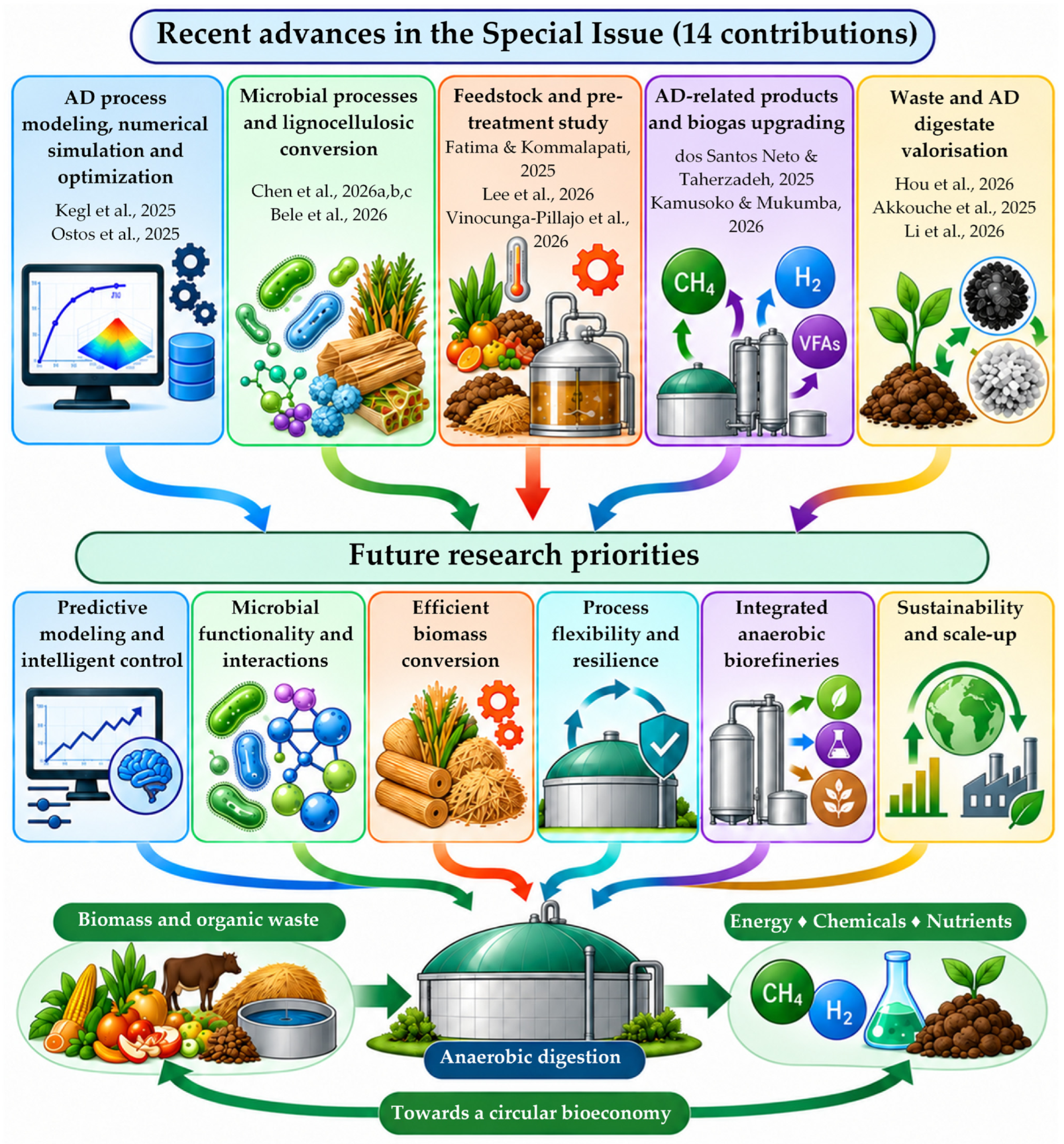
Collectively, these contributions illustrate advances across complementary aspects of AD and waste valorization, from improved process understanding and substrate conversion to diversified energy and material recovery. At the same time, they highlight the challenges of translating experimental and modeling results into robust, transferable, and sustainable technologies. The main research themes and their connections to future research priorities are summarized in Figure 1.
Figure 1.
Recent advances and future research priorities in AD and waste valorization. The 14 contributions to this Special Issue are synthesized into five key research areas: (i) AD process modeling, numerical simulation and optimization [1,2]; (ii) microbial processes and lignocellulosic conversion [3,4,5,6]; (iii) feedstock and pretreatment study [7,8,9]; (iv) AD-related products and biogas upgrading [10,11]; and (v) waste and AD digestate valorization [12,13,14]. Together, these advances provide a foundation for six interconnected future research priorities aimed at developing more reliable, transferable, efficient, and sustainable AD technologies within a circular bioeconomy.
3. Remaining Knowledge Gaps and Future Research Directions
Despite these advances, translating improved process understanding into reliable and sustainable AD technologies remains challenging. Current research emphasizes the integration of mathematical modeling, microbial ecology, advanced monitoring, and process optimization [15,16,17]. Building on the contributions of this Special Issue, several interconnected priorities emerge for future research.
One of the main challenges is the development of reliable and transferable mathematical models and intelligent process control strategies. The predictive performance of mechanistic and data-driven approaches remains strongly dependent on substrate characteristics, microbial communities, and operating conditions. Integrating mechanistic descriptions with machine learning, microbial information, and real-time monitoring offers opportunities to improve process prediction and optimization [15,16,17]. Recent developments in digital twins and reinforcement-learning-based control further demonstrate the potential of model-based supervisory control strategies for full-scale AD systems [16,18]. However, their generalizability, interpretability, and long-term reliability under variable operating conditions require further validation. Particular attention should therefore be given to uncertainty quantification, model transferability, and the development of robust and affordable monitoring solutions, including those suitable for decentralized installations.
A deeper understanding of microbial functionality and interactions is equally essential. Although molecular techniques have improved the characterization of anaerobic communities, the relationships among microbial composition, metabolic activity, syntrophic interactions, and process performance remain incompletely understood. Research should move beyond taxonomic descriptions towards identifying the functional mechanisms governing microbial adaptation, metabolic cooperation, and resilience to disturbances. Metagenomic approaches provide valuable insights into microbial community dynamics [19], while their integration with metatranscriptomics, metaproteomics, and metabolomics could improve the identification of active metabolic pathways. Developing reproducible microbial cultivation and enrichment strategies and linking microbial functionality with process models represent important steps towards biologically informed monitoring and control.
The efficient conversion of heterogeneous and lignocellulosic biomass remains another important challenge. Although pretreatment can improve substrate accessibility and accelerate hydrolysis, its effectiveness depends on biomass composition, structural properties, and treatment intensity. Excessive pretreatment may create inhibitory conditions without increasing the ultimate methane yield. Further investigations should therefore focus on relationships among biomass structure, pretreatment severity, microbial responses, and conversion efficiency, particularly for selective and energy-efficient technologies. Understanding interactions among cellulose, hemicellulose, and lignin will also be essential for optimizing complex biomass conversion. Recent advances in process intensification and data-driven optimization offer further opportunities for improving lignocellulosic biomass conversion [20]. Nevertheless, pretreatment performance should be evaluated beyond methane yield, considering energy consumption, economic feasibility, environmental impacts, and compatibility with downstream processes [21].
Greater process flexibility and resilience are also required to accommodate variable and potentially inhibitory waste streams. Agricultural, food-processing, and industrial residues differ considerably in substrate composition, nutrient availability, and biodegradability, making stable operation under fluctuating conditions challenging. Promising directions include adaptive co-digestion, microbial acclimation, optimized nutrient supplementation, and reactor configurations capable of handling variations in feedstock composition and organic loading rates. Improved understanding of the combined inhibitory effects of ammonia, long-chain fatty acids, volatile fatty acids, and trace element deficiencies or excesses is particularly important. Integrating early-warning indicators with predictive monitoring and intelligent control could help prevent operational disturbances [16,17,18], although the reliability of these approaches must be established through long-term investigations under realistic operating conditions.
The transition towards integrated anaerobic biorefineries offers opportunities to expand resource recovery beyond conventional methane production. Combining AD with syngas fermentation, dark fermentation, biogas upgrading, and complementary waste treatment processes could enable the production of biohydrogen, volatile fatty acids, biomethane, recovered nutrients, and other valuable products. Recent studies on biohydrogen production highlight the importance of feedstock selection, microbial dynamics, and process integration, while also identifying challenges related to operational stability and scale-up [22]. Digestate valorization represents another essential component, requiring consideration of nutrient availability, potential agricultural applications, and environmental impacts [23]. However, product diversification does not necessarily ensure greater sustainability, as additional processing and separation steps may increase energy demand, operational complexity, and costs. Future efforts should therefore focus on identifying integrated configurations that provide demonstrable environmental and economic advantages over conventional AD systems.
Finally, bridging the gap between laboratory-scale advances and industrial implementation requires comprehensive sustainability assessment and long-term process validation. Improvements achieved under controlled experimental conditions may not translate directly to full-scale facilities operating with variable feedstocks and economic constraints. Experimental research should therefore be combined with techno-economic analysis, life cycle assessment, and environmental and occupational safety evaluations. Particular attention should be paid to energy efficiency, methane emissions, digestate management, and the environmental consequences of pretreatment and upgrading technologies. Integrated assessments of AD and digestate reuse emphasize the importance of evaluating technical, environmental, and economic performance together [21,23]. Standardized experimental procedures, transparent reporting, and long-term pilot- and full-scale studies will be essential for improving comparability and supporting technology transfer.
Overall, addressing these challenges requires a shift from optimizing individual process stages towards integrated, system-oriented approaches. Connecting microbial functionality, predictive modeling, feedstock conversion, and resource recovery with environmental and economic assessment will be essential for developing AD technologies that remain reliable and sustainable under practical operating conditions.
4. Concluding Remarks
The contributions to this Special Issue highlight advances in process modeling, microbial understanding, biomass conversion, and resource recovery, while also identifying challenges related to process reliability, technological transferability, and sustainability. Together, they underline the need to evaluate improvements in individual processes within the broader context of integrated biomass and waste treatment systems.
Future progress will depend on translating fundamental research and laboratory-scale advances into robust, adaptable, and economically viable technologies. We hope that this Special Issue will encourage further interdisciplinary collaboration and contribute to the development of efficient and demonstrably sustainable AD systems within the circular bioeconomy.
Author Contributions
Conceptualization, T.K. and B.K.; writing—original draft preparation, T.K. and B.K.; writing—review and editing, T.K. and B.K. All authors have read and agreed to the published version of the manuscript.
Acknowledgments
As Guest Editors, we sincerely thank all authors for their valuable contributions and the reviewers for their constructive evaluations. We also gratefully acknowledge the editorial team of for their professional support throughout the preparation of this Special Issue. Special thanks go to editors for their dedicated assistance and excellent coordination.
Conflicts of Interest
The authors declare no conflicts of interest.
References
- Kegl, T.; Paramasivan, B.; Maharaj, B.C. Mathematical Model-Based Optimization of Trace Metal Dosage in Anaerobic Batch Bioreactors. Bioengineering 2025, 12, 117. [Google Scholar] [CrossRef] [Scilit] [PubMed]
- Ostos, I.; Ruiz, I.; Cruz, D.; Flórez-Pardo, L.M. Methane Concentration Prediction in Anaerobic Codigestion Using Multiple Linear Regression with Integrated Microbial and Operational Data. Bioengineering 2025, 12, 1133. [Google Scholar] [CrossRef] [Scilit] [PubMed]
- Chen, X.; Yuan, H.; Li, X. Biomethane Conversion of Hemicellulose: Biomethane Production, Kinetic Analysis, Substance Conversion, and Microbial Community Dynamics. Bioengineering 2026, 13, 295. [Google Scholar] [CrossRef] [Scilit] [PubMed]
- Chen, X.; Yuan, H.; Li, X. Methane Yield, Substrate Conversion, Microbial Community Structure and Metabolic Pathways During Anaerobic Digestion of Natural Cellulosic Biomass. Bioengineering 2026, 13, 613. [Google Scholar] [CrossRef] [Scilit] [PubMed]
- Chen, X.; Liu, L.; Yuan, H.; Li, X. Enhancing Biomethane Production from Corn Stover: Insights into Lignocellulosic Component Interactions and Pretreatment Efficacy. Bioengineering 2026, 13, 630. [Google Scholar] [CrossRef] [Scilit] [PubMed]
- Bele, V.; Rizzi, A.; Hausladen, D.M.; Achouri, I.E. Simplified Anaerobic Cultivation of Acetivibrio cellulolyticus and Methanosarcina barkeri: Implications for Lignocellulosic Biomethane Research. Bioengineering 2026, 13, 960. [Google Scholar] [CrossRef] [Scilit] [PubMed]
- Fatima, F.; Kommalapati, R.R. Solid-State Anaerobic Digestion of Organic Solid Poultry Waste for Biomethane Production. Bioengineering 2025, 12, 712. [Google Scholar] [CrossRef] [Scilit] [PubMed]
- Lee, S.H.; Gweon, O.H.; Lee, H.S.; Jeon, B.S.; Go, Y.; Jin, C.S.; Yu, Y.; Sang, B.-I.; Lee, J.H. Impact of Ball-Milling and Thermal Hydrolysis on Physicochemical Properties and Anaerobic Digestion Kinetics of Mixed Slaughterhouse and Agricultural Wastes. Bioengineering 2026, 13, 326. [Google Scholar] [CrossRef] [Scilit] [PubMed]
- Vinocunga-Pillajo, R.D.; Guardado Yordi, E.; Pico Poma, J.; Pico Poma, L.; Sarabia Guevara, D.; Diéguez-Santana, K.; Pérez Martínez, A. The Energy Potential, Environmental Impact, and Occupational Health and Safety Potential of Biogas Obtained from Filter Cake in Artisanal Panela Production. Bioengineering 2026, 13, 182. [Google Scholar] [CrossRef] [Scilit] [PubMed]
- Dos Santos Neto, A.; Taherzadeh, M.J. Guiding Microbial Crossroads: Syngas-Driven Valorisation of Anaerobic-Digestion Intermediates into Bio-Hydrogen and Volatile Fatty Acids. Bioengineering 2025, 12, 816. [Google Scholar] [CrossRef] [Scilit] [PubMed]
- Kamusoko, R.; Mukumba, P. Advanced Strategies for Upgrading Raw Biogas into High-Quality Biomethane for Domestic Applications. Bioengineering 2026, 13, 543. [Google Scholar] [CrossRef] [Scilit] [PubMed]
- Hou, X.; Liao, H.; Wu, B.; An, N.; Zhang, Y.; Li, Y. Optimal Recycling Ratio of Biodried Product at 12% Enhances Digestate Valorization: Synergistic Acceleration of Drying Kinetics, Nutrient Enrichment, and Energy Recovery. Bioengineering 2026, 13, 109. [Google Scholar] [CrossRef] [Scilit] [PubMed]
- Akkouche, F.; Madi, K.; Aissani-Benissad, F.; Ali, F.A.A.; Assadi, A.A.; Assadi, A.A.; Azzaz, A.A.; Yahiaoui, I. Adsorbents Made from Cotton Textile Waste—Application to the Removal of Tetracycline in Water. Bioengineering 2025, 12, 1230. [Google Scholar] [CrossRef] [Scilit] [PubMed]
- Li, Z.; Tiganescu, E.; Böhm, K.; Nasim, M.J.; Jacob, C. From Waste to Value: Urine and Ash as Sustainable Sources for Green Ammonia and Calcium Phosphate Fertilizers. Bioengineering 2026, 13, 720. [Google Scholar] [CrossRef] [Scilit] [PubMed]
- Kegl, T.; Torres Jiménez, E.; Kegl, B.; Kovač Kralj, A.; Kegl, M. Modeling and Optimization of Anaerobic Digestion Technology: Current Status and Future Outlook. Prog. Energy Combust. Sci. 2025, 106, 101199. [Google Scholar] [CrossRef] [Scilit]
- Marycz, M.; Turowska, I.; Glazik, S.; Jasiński, P. Artificial Intelligence in Anaerobic Digestion: A Review of Sensors, Modeling Approaches, and Optimization Strategies. Sensors 2025, 25, 6961. [Google Scholar] [CrossRef] [Scilit] [PubMed]
- Murali, R.; Dekhici, B.; Du, B.; Guo, B.; Chen, T.; Zhang, D.; Short, M. Towards the Integration of Mechanistic, Microbial, and Machine Learning Approaches in Anaerobic Digestion Modelling and Control: A Review of Current Progress and Implementation Strategies. Bioresour. Technol. 2027, 464, 135967. [Google Scholar] [CrossRef] [Scilit] [PubMed]
- Yunus, A.I.; Jalla, S.; Bozeman, J.F., III; Chen, Y. Reinforcement-Learning-Enabled Supervisory Control of a Full-Scale Anaerobic Digestion Facility Using a Calibrated Digital Twin. Environ. Sci. Technol. 2026, 60, 28064–28078. [Google Scholar] [CrossRef] [Scilit] [PubMed]
- Niya, B.; Yaakoubi, K.; Beraich, F.Z.; Arouch, M.; Kadmiri, I.M. Current Status and Future Developments of Assessing Microbiome Composition and Dynamics in Anaerobic Digestion Systems Using Metagenomic Approaches. Heliyon 2024, 10, e28221. [Google Scholar] [CrossRef] [Scilit] [PubMed]
- Wang, J.; Liu, S.; Feng, K.; Lou, Y.; Ma, J.; Xing, D. Anaerobic Digestion of Lignocellulosic Biomass: Process Intensification and Artificial Intelligence. Renew. Sustain. Energy Rev. 2025, 210, 115264. [Google Scholar] [CrossRef] [Scilit]
- Boarino, A.; Demichelis, F.; Ertani, A.; Bulgari, R.; Iannicelli, M.; Nicola, S.; Deorsola, F.; Celi, L.; Padoan, E. Technical, Environmental, and Economic Assessment of Anaerobic Digestion of Pre-Treated Municipal Organic Waste for Energy Production and Reuse of Liquid Digestate. Bioresour. Technol. 2026, 457, 134957. [Google Scholar] [CrossRef] [Scilit] [PubMed]
- Binchebo, T.L.; Narra, S.; Ancha, V.R.; Asefa, S.K.; Mengesha, T.T.; Jiru, E.B.; Narra, M.-M. Recent Developments in Biohydrogen Production through Dark Fermentation of Biomass Waste: Feedstocks, Microbial Population Dynamics, and System Integration. Front. Energy Res. 2026, 14, 1819152. [Google Scholar] [CrossRef] [Scilit]
- Martín-Sanz-Garrido, C.; Revuelta-Aramburu, M.; Santos-Montes, A.M.; Morales-Polo, C. A Review on Anaerobic Digestate as a Biofertilizer: Characteristics, Production, and Environmental Impacts from a Life Cycle Assessment Perspective. Appl. Sci. 2025, 15, 8635. [Google Scholar] [CrossRef] [Scilit]
Disclaimer/Publisher’s Note: The statements, opinions and data contained in all publications are solely those of the individual author(s) and contributor(s) and not of MDPI and/or the editor(s). MDPI and/or the editor(s) disclaim responsibility for any injury to people or property resulting from any ideas, methods, instructions or products referred to in the content. |
© 2026 by the authors. Licensee MDPI, Basel, Switzerland. This article is an open access article distributed under the terms and conditions of the Creative Commons Attribution (CC BY) license.