


Abstract
Indoor exposure to particulate matter (PM) is increasingly recognized as a major contributor to respiratory and cardiovascular risk, yet the relative contributions of outdoor pollution, building characteristics, and occupant behavior remain poorly resolved. PM1 (aerodynamic diameter < 1 μm) warrants focus due to its higher alveolar deposition. “Evidence driven indoor air quality improvement” (EDIAQI) project aims to enhance indoor air quality guidelines and increase awareness by providing accessible data on exposure, pollution sources, and related risk factors. As part of the Zagreb pilot within the project, 103 paired indoor/outdoor PM1 samples were analyzed. Seasonal analysis revealed substantial wintertime outdoor PM1 spikes, while indoor medians remained stable. Chemometric analysis identified factors such as dwelling size, outdoor pollution, resuspension, building age/heating type, and urban context. Among the tested models, the validated gradient-boosted regressor (GBR) achieved the strongest performance, explaining ~65% variance in indoor PM1 (test R2 ≈ 0.65). Explainable machine learning analysis (SHAP) identified outdoor PM1 levels, infiltration, and resuspension as the most influential predictors. Findings underscore wintertime outdoor emissions (e.g., residential heating and traffic) and dwelling-related and behavioral factors as key drivers, with the machine learning–environmental data integration enabling targeted residential IAQ management: optimized ventilation protocols, resuspension mitigation via behavior, and infiltration reduction through retrofits.
1. Introduction
Indoor air quality (IAQ) has emerged as a critical factor in environmental health because people in high-income countries now spend approximately 70–90% of their time in enclosed spaces such as homes, schools, and workplaces [1,2]. Residential buildings are particularly important microenvironments, as they accommodate vulnerable populations, and their IAQ reflects an interplay of geography, building type, ventilation design, and occupants’ daily activities [1]. A large body of epidemiological and toxicological evidence identifies particulate matter (PM) as one of the predominant air pollutants affecting human health globally, with fine PM among the main contributors to premature mortality and reduced life expectancy [2,3,4,5]. Since a substantial fraction of total exposure occurs indoors, especially in residential settings, indoor PM pollution has become a key focus for public health risk assessment and mitigation [6,7,8,9]. Globally, the World Health Organization (WHO) identifies air pollution, driven primarily by PM, as the single largest environmental health risk and a leading cause of mortality. Ambient and household air pollution together are estimated to cause roughly 7 million premature deaths annually, with household (indoor) pollution accounting for about 3.8 million [9,10]. WHO’s current air quality guidelines [11], as well as regulatory air quality standards, continue to focus on mass-based PM10 and PM2.5 metrics. However, due to the growing evidence that smaller fractions such as PM1 and ultrafine particles (UFPs) pose particularly severe health risks [12,13], their measurements are strongly encouraged.
IAQ in residential buildings is shaped by the interaction of outdoor air quality, occupant behavior, and building characteristics [14]. Outdoor pollutant concentrations and building airtightness govern the extent to which ambient PM infiltrates indoors, with ventilation rate, pollutant lifetimes, and indoor-to-outdoor mixing ratios controlling how strongly indoor levels track outdoor conditions [14,15,16,17]. In many settings, outdoor pollutant concentrations are the dominant driver of indoor concentrations [18,19]. However, there are also situations in which indoor pollutant levels exceed outdoor levels, challenging traditional assumptions and underscoring the importance of indoor sources and microenvironment-specific processes [20]. Occupant presence and activities constitute a major source of indoor PM, often amplifying outdoor contributions. Across indoor environments, higher occupancy systematically increases PM through direct human emissions, resuspension of settled dust, intensified movement, and activity-related sources such as cooking, smoking, and cleaning [21,22,23,24,25]. Construction materials, ongoing renovations, and building geometries (e.g., large open rooms, floor level close to traffic, and façade orientation) further modulate PM levels by altering emission sources, resuspension dynamics, and exposure to outdoor PM [26].
Particle size largely determines respiratory deposition, systemic distribution, and toxicity. Fine particles (PM2.5) and smaller fractions (PM1 and UFPs) can efficiently bypass the upper airways, deposit deep in the bronchioles and alveoli, and, in the smallest size ranges, cross the air–blood barrier into the bloodstream [2,27,28]. Toxicological studies show that smaller particles, per unit mass, exhibit greater oxidative and pro-inflammatory potency because their high surface-area-to-volume ratio allows them to carry more redox-active components, such as transition metals and polycyclic aromatic hydrocarbons (PAHs), thereby catalyzing the formation of reactive oxygen species (ROS), oxidative DNA damage, and mitochondrial dysfunction [28]. Consistent with these mechanisms, smaller particles are linked not only to respiratory outcomes (e.g., asthma and chronic obstructive pulmonary disease) but also to cardiovascular events, diabetes, neurodevelopmental and neurodegenerative disorders, and systemic inflammation, while long-term exposure is associated with increased mortality from ischemic heart disease, stroke, and cancer [3,12,27,29,30,31,32,33,34,35].
Recent research indicates that PM1 can generate a health burden comparable to that of PM2.5. In one study, PM1 accounted for 4.47% of emergency visits, nearly matching the 5.05% attributable to PM2.5, despite PM1 being a subset of PM2.5 mass [36].
In this study, the PM1 fraction, in particular, has been selected because it allows investigation of particle exposures and associated health risks that are not fully captured by the more commonly studied PM2.5 and PM10 metrics. While routine outdoor monitoring of PM2.5 and PM10 has enabled the establishment of associations with health outcomes and informed guideline values, including those proposed by the WHO [11], finer particles such as PM1 and ultrafine particles remain considerably less studied. PM1 particles are small enough to penetrate deep into the alveolar region, cross cellular membranes, and enter the bloodstream, which may increase the risk of adverse health effects. Indoor air can be dominated by combustion-related PM1 particles from sources such as cooking, frying, grilling, smoking, and candles, making PM1 a sensitive indicator of recent combustion activity [37]. Outdoor sources of PM1, such as traffic, can contribute more to indoor pollution than larger particles due to their higher infiltration capability. Previous research in the studied area has shown that PM1 in ambient air often represents a large proportion of the PM2.5 fraction, which also refers to the many carcinogenic PM-bound compounds. Their PM1/PM2.5 ratio was about 80% during the winter months [38], sometimes exceeding 90% for individual PAHs [39]. Preliminary studies of PAHs and polybrominated diphenyl ethers (PBDEs), carried out in a smaller number of households, have also shown their presence in the PM1 particle fraction [40,41]. These characteristics justify the focus on PM1 in the present study and address the existing knowledge gaps regarding fine particle exposures and their health implications.
Accurate characterization of indoor PM concentrations and temporal dynamics is essential for both exposure assessment and intervention design, yet it remains methodologically challenging. Regulatory monitoring is traditionally grounded in gravimetric filter-based reference methods, which provide accurate 24 h mass concentrations, enable subsequent chemical analysis, and serve as the basis for standards and long-term trend analyses [42,43]. However, these methods are noisy, expensive, and ill-suited to occupied indoor environments. Real-time optical monitors and low-cost sensors can resolve fine-scale temporal patterns but exhibit biases that depend on particle size, composition, relative humidity, and other factors, creating the need for setting-specific calibration against gravimetric reference instruments [27,44]. These measurement constraints contribute to the scarcity of large-scale, long-term indoor PM datasets and complicate efforts to link IAQ to health outcomes.
Meteorological and climatic conditions strongly influence both outdoor PM and its indoor manifestations. In continental regions characterized by flat terrain and strong cold–hot contrasts, such as inland Croatia, statistical models show that PM2.5 levels are closely linked to thermal and land surface variables that reflect residential heating, stable cold layers, and urban structure, all of which favor pollution build-up under inversion conditions [45]. Winter temperature inversions and associated high-pressure, weak-mixing regimes can lead to more than 10-fold higher PM1-bound PAH concentrations in the cold season compared with warmer months, when stronger mixing and higher wind speeds promote dilution and advection of cleaner air masses [46]. At the building scale, seasonal meteorology modulates indoor-to-outdoor gradients. In winter, strong negative correlations between wind speed and PM (especially PM1) and negative associations with minimum temperature indicate that cold, anticyclonic conditions favor pollutant accumulation, while large indoor–outdoor temperature differences enhance the “chimney effect” and more tightly couple indoor PM to outdoor concentrations. In summer, smaller or reversed temperature gradients can produce a “reverse chimney effect,” whereby infiltration pathways change and indoor PM remains elevated even when outdoor levels are relatively low [47].
With the aim of finding relationships between indoor and outdoor pollutant concentrations, meteorological parameters, outdoor environment, indoor occupancy, and building characteristics, recent research has increasingly focused on predictive modeling of indoor PM as a complement to, or alternative to, direct monitoring. For example, machine learning (ML) and hybrid approaches have been proposed to estimate indoor PM2.5 using outdoor concentrations, building characteristics, meteorological parameters, and limited IAQ measurements, with a goal of providing generalized, easy-to-use tools for population-level exposure assessment [6,7,48,49,50]. Even in the more data-limited settings, typical of single-city or single-station studies, relatively simple regression methods can achieve satisfactory performance with modest computational cost, enabling broader uptake in applied IAQ and building environment research [51]. A wide range of supervised models has been deployed for IAQ and indoor PM applications, including linear regression, decision trees, Random Forest, support-vector regression, k-nearest neighbors, gradient-boosted trees, and neural architectures such as LSTMs [9,12,52].
Comparative studies using diverse regressors on sensor data show that calibration and prediction performance are strongly sensor- and pollutant-dependent rather than algorithm-agnostic, highlighting the need to test multiple model classes for each specific deployment. In outdoor AQ forecasting and post-processing of deterministic models, ensemble and boosting algorithms such as Random Forest (RF), XGBoost, LightGBM, and CatBoost consistently demonstrate strong performance. RF is often the dominant model overall, while boosted trees or hybrid and deep learning approaches can excel in specific cases or tasks [53]. Despite these advances, recent reviews emphasize persistent challenges in indoor applications, including small and location-specific datasets, inconsistent labels, limited representation of rare events, sensor variability, and weak integration of physical and chemical knowledge. These factors continue to constrain model transferability across building types and hinder robust uncertainty quantification [54].
In the IAQ domain specifically, ML techniques have been applied to address a range of tasks, including (i) calibration of low-cost PM sensors in nurseries, schools, and other indoor environments, (ii) prediction of indoor pollutant time series, and (iii) modeling of key IAQ indicators such as indoor PM2.5, CO2, and airflow from limited sensor inputs [9,55,56,57,58,59]. For instance, gradient-boosted tree models have been used to link occupancy, area per person, outdoor meteorological variables, and Air Quality Index (AQI) with indoor CO2 concentration, as well as to jointly predict temperature and humidity. These studies demonstrate that ML models can operate effectively within building-scale monitoring networks and smart building control systems [60,61]. In residential and complex building settings, boosted ensemble models such as CatBoost have shown strong predictive power for identifying indoor PM2.5 exceedance events, suggesting that such exceedances arise from intricate interactions among outdoor PM levels, meteorological factors, occupancy patterns, and building characteristics that are effectively captured by tree-based approaches [62,63]. However, most previous studies have focused on relatively isolated modeling objectives or single pollutant-specific analyses, while integrated frameworks that jointly consider physical, environmental, and human-related factors remain scarce. Further research is therefore needed to develop structured, comprehensive modeling strategies, an aspect that is addressed in this study.
This research was carried out within the framework of the project “Evidence driven indoor air quality improvement” (EDIAQI) [64], which aims to enhance IAQ guidelines and increase awareness across Europe and beyond by providing accessible data on exposure, pollution sources, and related risk factors. The Zagreb (Croatia) pilot study, as part of EDIAQI, aims to evaluate the effects of indoor and outdoor air pollution on children’s health. It employed advanced monitoring techniques and biological sampling to investigate the links between IAQ, health outcomes, and environmental factors in residential environments.
This study represents the first comprehensive investigation of indoor PM1 pollution in this region, combining direct measurements, questionnaire data, publicly available datasets, and advanced statistical and machine learning (ML) tools. The research is based on parallel gravimetric indoor and outdoor PM1 measurements in residential households in Zagreb City and Zagreb County, and includes: (i) reporting indoor PM1 mass concentrations from more than 100 households, which are currently the only such data available for this part of Europe; (ii) investigating seasonal and indoor–outdoor differences in PM1 concentrations; (iii) exploring the relationships between indoor and outdoor PM1, household characteristics, occupant activities, and environmental and land use indicators using advanced statistical methods; and (iv) identifying variables of significance for predictive ML models.
The novelty of this study lies in its structured analytical approach, which integrates process-based chemometric analysis, principal component analysis (PCA), feature engineering, supervised ML, and SHapley Additive exPlanations (SHAP) interpretation toward addressing the main research objective. To the best of our knowledge, research that combines traditional approaches, supervised ML with SHAP analysis to interpret residential PM1 concentrations in Central and Southeastern Europe remains scarce. By addressing this gap, our study provides new insights into the determinants of indoor PM1 pollution and demonstrates the utility of modern analytical approaches for exposure assessment and risk evaluation.
2. Materials and Methods
2.1. Data Collection
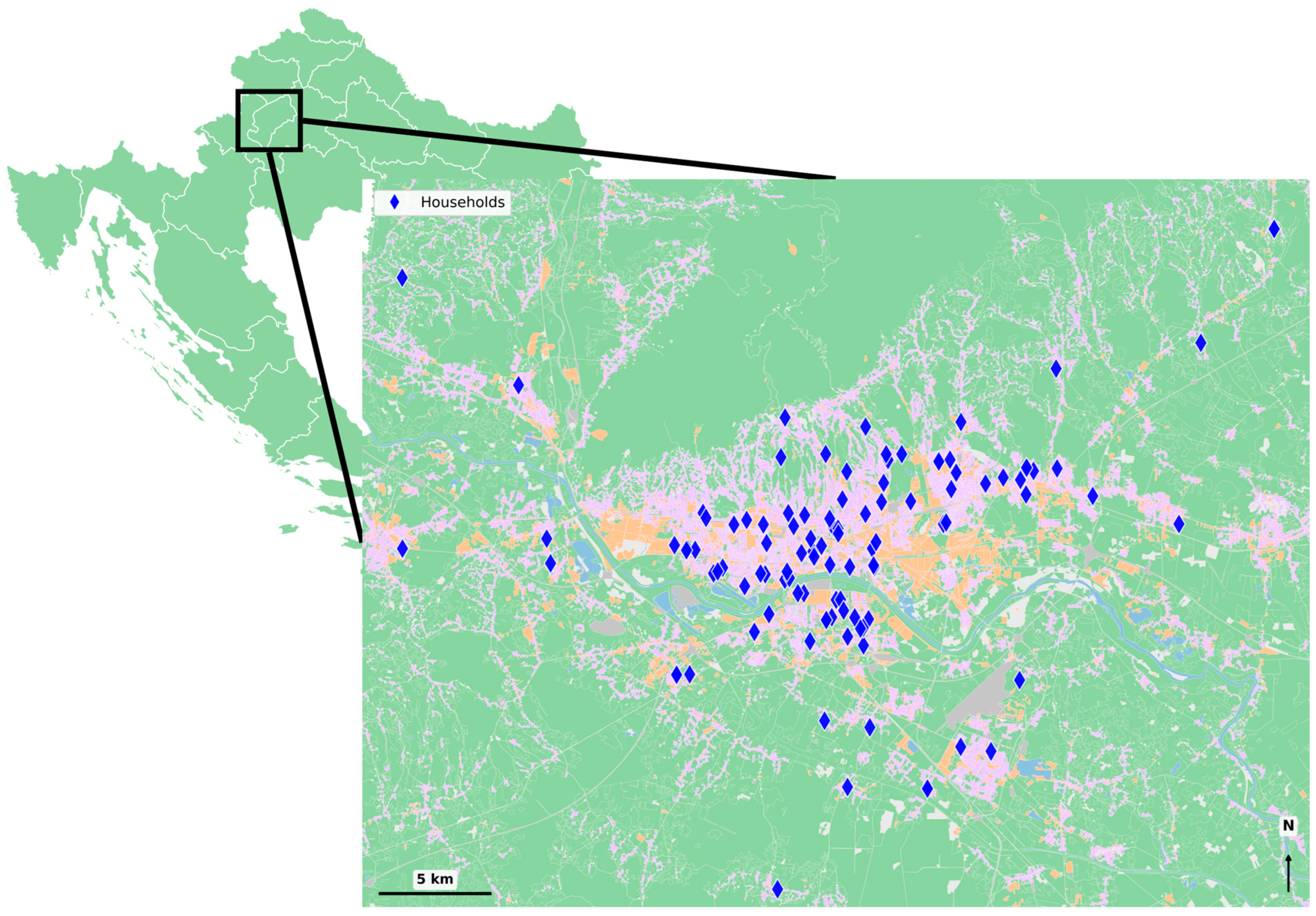
Within the scope of the Zagreb pilot within the “Evidence driven indoor air quality improvement” (EDIAQI) project, the indoor and outdoor PM1 (particulate matter with an aerodynamic diameter below 1 μm) samples were collected in the participant households on filters through active sampling using pumps over a 7-day (~168 h) period. Conventional low-volume reference samplers typically used for outdoor or ambient air monitoring (operating at approximately 55 m3 day−1) are unsuitable for indoor use because of their large size and high noise levels. Instead, we employed smaller, quieter devices (Sven-Leckel MiniVS-C, Berlin, Germany, and MiniVol Portable Air Sampler, AirMetrics, Eugene, OR, USA; 5 L min−1), which are specifically suited for week-long indoor deployments and, when used over 7 days, provide adequate sampling volumes for reliable filter-based PM1 analysis in this residential context. These instruments were fitted with a size-selective impactor inlet targeting the PM1 fraction of particulate matter and a filter holder containing quartz filters (Whatman, Tisch Scientific, Cleves, OH, USA). The samplers were placed in residential bedrooms or living rooms of households across the Zagreb City (767,131 residents) and Zagreb County (299,985 residents) [65] with regard to uniform coverage of samples in the area (Figure 1 was generated in Jupyter notebook using Copernicus Urban Atlas and approximate dwelling coordinates [66]).
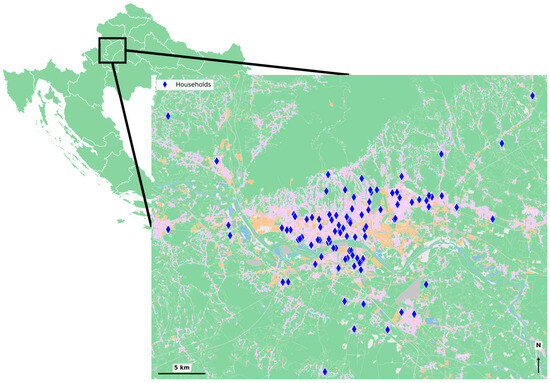
Figure 1.
Measurement locations across Zagreb City and Zagreb County, Croatia (blue diamonds—sampling sites; urban area—purple; roads—grey; industrial/commercial area—orange; green/nature—green; water—blue).
Outdoor PM1 samples were collected using identical samplers installed on balconies or terraces directly attached to the participating dwellings, which comprised both apartments and detached/semi-detached houses. The samplers were placed in semi-sheltered positions a few meters from the main façade, typically within a few meters of doors or windows while avoiding immediate proximity to local point sources (e.g., exhaust vents and barbecues). Their placement was designed to capture the dwelling-specific near-outdoor environment rather than distant urban background conditions. Distances to roads and playgrounds, therefore, varied across sites but followed the general residential context of each home. The collected dataset comprised PM1 indoor and outdoor concentration data, as well as variables constructed from participants’ questionnaire responses.
2.2. Chemometric Analysis
Chemometric analyses were performed on a dataset containing paired indoor–outdoor PM1 measurements obtained from residential dwellings. Pollutant metrics included indoor PM1, outdoor PM1, and their difference (PM1,diff = PM1,IN − PM1,OUT). In this study, household and environmental variables were encoded as numerical predictors within the ML framework. Floor area, floor number, and construction year were treated as continuous variables, while renovation status and heating and ventilation system indicators were encoded as ordinal or categorical variables consistent with the questionnaire design. Occupancy, vacuuming frequency, presence of carpets and curtains, presence of tumble-drier, and number of AC units were likewise translated into count, frequency, or binary indicators, ensuring that behavioral and interior surface characteristics could be directly related to indoor PM1 levels. Urban land use descriptors (roads, urban, industrial, green) were constructed from the Copernicus Urban Atlas data [66] using the approximate longitude and latitude of dwellings, and they were represented by a compact, multi-level built-form categorical variable. Seasonal conditions were classified into heating and non-heating periods based on the measurement date.
Given the skewed distributions and non-normality typical of environmental concentration data, the analytical workflow relied on non-parametric and multivariate chemometric methods for pattern recognition and variable selection. Before multivariate analysis, all continuous variables were scaled to account for differing measurement units and to ensure balanced feature contributions in subsequent analyses.
2.3. Principal Component Analysis (PCA)
Principal component analysis (PCA) is a dimensionality reduction technique that projects the data onto a plane where each coordinate represents a data feature and then transforms the data into a new space where the variation is maximized. Every dataset can have several components, up to the number of features in that dataset, with the first component representing the maximum variation and the last the least [67,68,69,70,71]. The number of retained components was chosen to preserve a high proportion of total variance (approximately 80%) while limiting dimensionality. PCA was applied to identify latent variable domains and to visualize the underlying structure in the dataset. All variables were scaled before analysis. Principal components (PCs) were retained based on inspection of the scree plot and the interpretability of loading patterns. Variables with high absolute loadings (|loading| ≥ 0.2) on a given component were considered influential and used to characterize that component. Principal components were interpreted in terms of indoor-to-outdoor concentration gradients, seasonal variation, urban exposure patterns, and building-related factors, and the loading structure was used to delineate latent domains that subsequently informed variable selection for modeling.
2.4. Cluster Analysis
Unsupervised clustering was performed on PCA scores to identify groups of observations with similar sources [72]. A distance-based clustering algorithm was used, with k = 3 clusters chosen based on the silhouette score, visual separation in PCA score plots, and interpretability. Cluster separation was assessed using Mann–Whitney U tests, comparing PM1 levels between indoor and outdoor clusters and between clusters with differential PM1 levels. Independent Mann–Whitney U tests examined differences between heating and non-heating seasons for indoor PM1, outdoor PM1, and their difference (PM1,diff = PM1,IN − PM1,OUT).
2.5. Statistical Software
All analyses were executed in Python 3.12 using the following packages:
- scipy.stats [73] for non-parametric tests (Mann–Whitney U).
- pandas [74] for data management.
- numpy [75] for numerical operations.
- scikit-learn [76] for PCA and clustering.
- matplotlib [77] and seaborn [78,79] for data visualization.
Chemometric methods were employed because environmental exposure datasets are inherently complex: they are typically non-normal, heteroscedastic, and multivariate, with strong inter-variable correlations. The combined application of PCA, clustering, and non-parametric testing enabled the robust identification of latent pollution regimes, seasonal patterns, and indoor-to-outdoor gradients in PM1 behavior. Within this framework, PCA primarily served as a structure detection tool to guide feature selection for subsequent ML rather than as a dimensionality reduction step. Variables with the highest loadings on each principal component were interpreted as indicators of distinct latent domains, including dwelling characteristics, ventilation, pollution dynamics, interior surfaces, occupancy, heating systems, and overall building context. To minimize redundancy and multicollinearity while maintaining interpretability, a subset of representative raw variables was selected from each component based on both loading magnitude and conceptual relevance.
2.6. Machine Learning (ML)
Machine learning approaches were selected because indoor PM concentrations are influenced by complex and potentially non-linear interactions among outdoor pollution, building characteristics, and occupant behavior. The objective of the ML framework was to predict indoor PM1 concentrations from selected predictor variables using supervised regression algorithms. We modeled indoor concentrations in dwellings using a dataset containing outdoor concentrations, building characteristics, land use, and occupant behavior variables selected by chemometric analysis. The data were randomly split into 80% training and 20% test sets (seed = 42).
2.7. Feature Engineering
To better reflect the underlying physical processes, we derived a small set of composite predictors from the original variables. Indoor-to-outdoor relationship is highlighted by the truncated I/O ratio , along with its interaction with heating season and the interaction between and heating season. Infiltration effects were summarized by an infiltration index , its interaction with PM1,OUT, and a to capture vertical variation. Traffic and land use influences were represented by an interaction between outdoor PM1 and proximity to major roads. Occupancy and resuspension were described using occupancy density (household members per m2), total soft surfaces (carpets + curtains), and a cleaning/resuspension index combining vacuuming frequency with soft surface count. Finally, building age, its interaction with heating season, and a “heating type” category derived from multiple heating system indicators were used to capture building age and heating-related effects.
2.8. Pre-Processing and Models
All models shared a common pre-processing pipeline to ensure comparability and cross-validation safety. Predictors were scaled to support stable optimization in gradient-based models [12,80,81]. Based on preliminary performance comparisons, RobustScaler (median and interquartile-range scaling) was chosen. We implemented and compared several commonly used supervised learning algorithms for tabular environmental data, including Decision Tree Regressor (DT), Random Forest Regressor (RF), Gradient Boosting Regressor (GBR), AdaBoost Regressor, Extreme Gradient Boosting (XGB), and CatBoost Regressor. Tree-based ensemble models were chosen due to their ability to balance predictive accuracy with interpretability. Preliminary exploratory runs indicated that tree-based and boosting ensemble models were well-suited to capturing non-linearities and interactions between building, behavioral, and environmental predictors, which motivated their inclusion and subsequent focus in this study. Because PM1 was right-skewed, we applied a log-transform to the target using a wrapped regressor with , an inverse . The wrapper was included in cross-validation so that tuning and evaluation were performed on the transformed scale, while performance metrics were reported on the original scale.
2.9. Hyperparameter Tuning and Model Evaluation
For each algorithm, we performed a hyperparameter search with multi-metric evaluation. Search spaces were regularized (e.g., max_depth 3–6, 100–400 trees, learning rates 0.01–0.1, moderate leaf sizes and strong L2 penalties) to limit overfitting. Cross-validation used repeated k-fold (5 folds × 3 repeats, shuffled, seed = 42). Multiple scoring metrics (negative MSE, negative MAE, R2) were computed and models were refit on the configuration, maximizing cross-validated R2. The best estimator per algorithm was then retrained on the full training set. Final model performance and generalization was assessed on the held-out test set using the following metrics:
- Mean Absolute Error (MAE).
- Mean Squared Error (MSE).
- Root Mean Squared Error (RMSE).
- Coefficient of Determination (R2).
2.10. Model Interpretability
Interpretability has become a key requirement as ML outputs are increasingly used to support health-protective decisions and building operation strategies. Tree-based ensembles (RF, XGB, and GBR) are popular partly because they offer built-in measures of feature importance while retaining strong predictive performance [12,82]. Post hoc, model-agnostic tools such as SHapley Additive exPlanations (SHAP) are used to explain complex models without altering their predictive function. To obtain more reliable and consistent attributions, the SHAP values were computed [82,83], providing model-agnostic local and global explanations of feature contributions. SHAP approximates the Shapley values from the cooperative game theory and assigns signed contributions to each feature for each prediction. Aggregating these contributions yields global importance rankings and characteristic directional effects. Global SHAP importance plots and summary (bee swarm) plots were used to interpret dominant predictors and their effect directions on indoor PM1, in line with recent applications of explainable ML in air quality research. All implementations were carried out in Python, using scikit-learn for model wrappers, cross-validation, and pre-processing [76], and specialized libraries for XGB [84], CatBoost [85], and SHAP [86], consistent with ML workflows for environmental data analysis.
3. Results
3.1. Descriptive Statistics of PM1, Saeasonal, and Indoor–Outdoor Differences
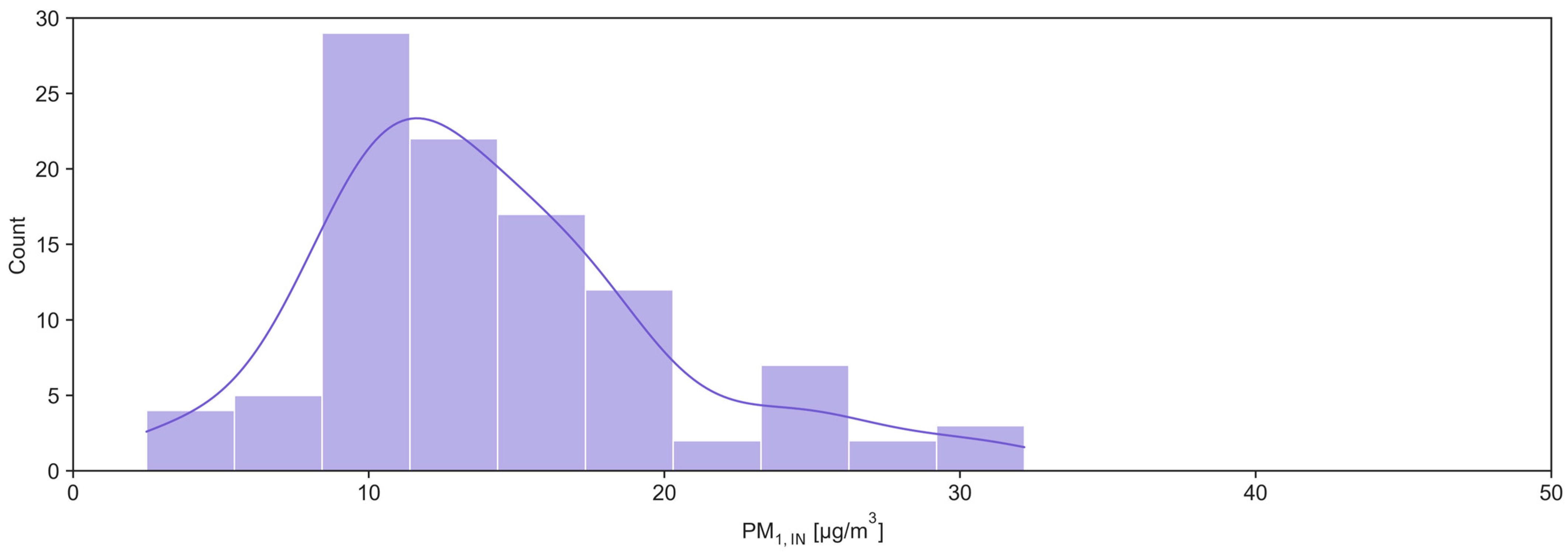
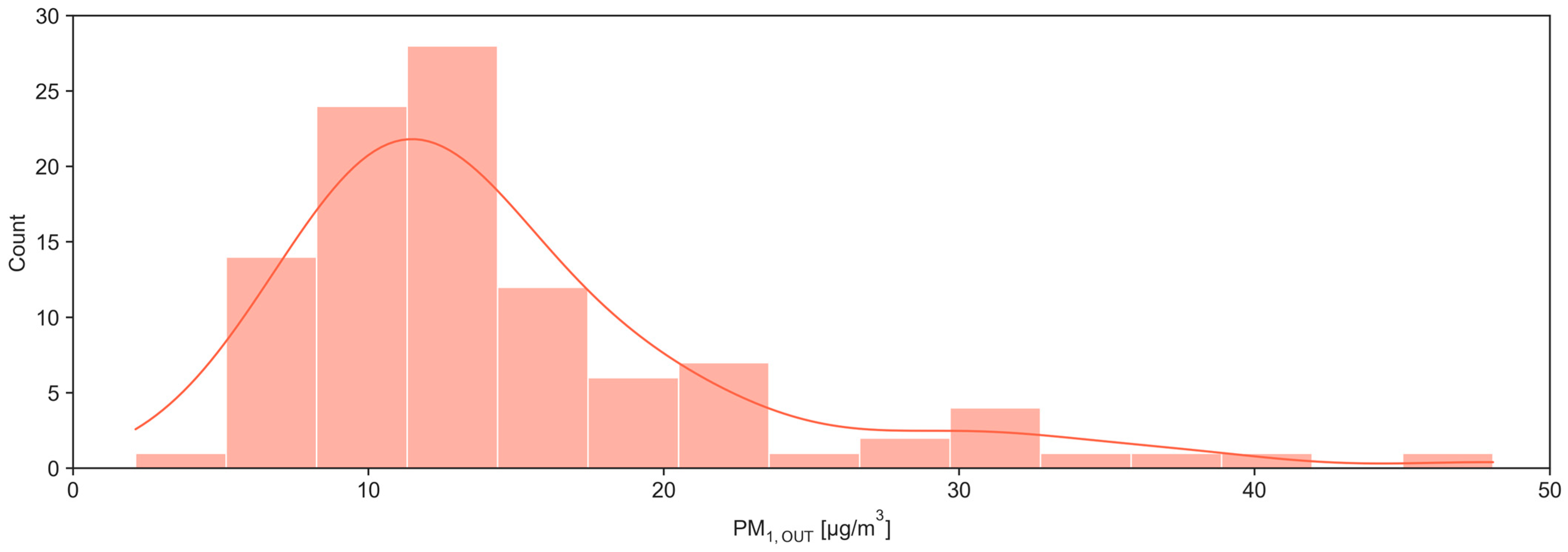
After preliminary analysis and following removal of extreme outliers using the interquartile range (IQR) method, where IQR is defined as the difference between the 75th and 25th percentiles, and observations lying beyond 2 × IQR from the lower or upper quartile are excluded, a total of 103 out of 109 paired indoor and outdoor PM1 measurements were retained. Across all measurements, indoor PM1 exhibited a slightly right-skewed distribution, with values ranging from 2.48 to 32.17 µg m−3 and clustering between roughly 10 and 20 µg m−3, whereas outdoor PM1 spanned a wider range (2.11–48.07 µg m−3), with a more pronounced long tail toward high concentrations (Figure 2 and Figure 3).
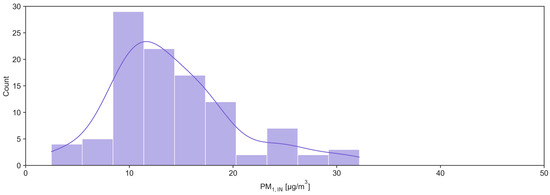
Figure 2.
Indoor PM1 distribution plot.
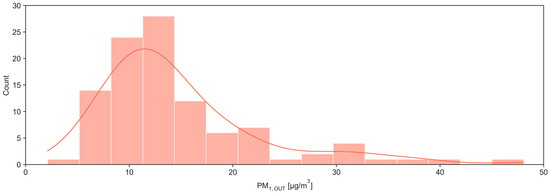
Figure 3.
Outdoor PM1 distribution plot.
Indoor PM1 had a slightly higher median overall than outdoor PM1 (13.04 vs. 12.56 µg m−3), with the median indoor–outdoor median difference (PM1,diff) being slightly positive at 0.17 µg m−3, although the data show substantial dispersion (|PM1,diff| median 3.21 µg m−3). The Shapiro–Wilk test for indoor PM1 (W = 0.939, p = 0.00013) rejected normality, consistent with the visually skewed histogram and supporting the use of non-parametric statistics. The Spearman correlation analysis revealed a moderate positive association between indoor and outdoor PM1 concentrations (ρ = 0.48, p < 0.001), indicating that outdoor particulate levels contribute measurably but only partially to indoor variability (ρ2 ≈ 0.23), with additional indoor and building-related factors likely playing a substantial role. The Spearman correlation did not show an association between heating season and indoor PM1, but it indicated a moderate correlation between heating season and outdoor PM1 (ρ = 0.45).
Further seasonal analysis (Table 1) revealed that indoor medians were similar between heating and non-heating seasons (13.47 vs. 12.86 µg m−3; p = 0.41), whereas outdoor PM1 was significantly elevated during the heating season (median 15.94 vs. 11.18 µg m−3; p = < 0.001). Consequently, the indoor-to-outdoor difference inverted. In the non-heating period, PM1,diff was positive (median 1.64 µg m−3), while in the heating period, it was negative (median −3.55 µg m−3), with both the signed (p < 0.001) and absolute differences (p < 0.001) significantly larger in the heating versus non-heating (p < 0.001) period. The I/O ratio shifted from >1 in the non-heating season (median 1.15) to <1 in the heating season (median 0.80), and the truncated I/O ratio showed the same pattern, indicating stronger outdoor dominance in winter.

Table 1.
Descriptive statistics and non-parametric statistics of indoor and outdoor PM1 measurements and the indoor-to-outdoor interactions.
3.2. Relationship Between PM1, Household Characteristics, and Occupant Activities Explored Through Principal Component and Clustering Analysis
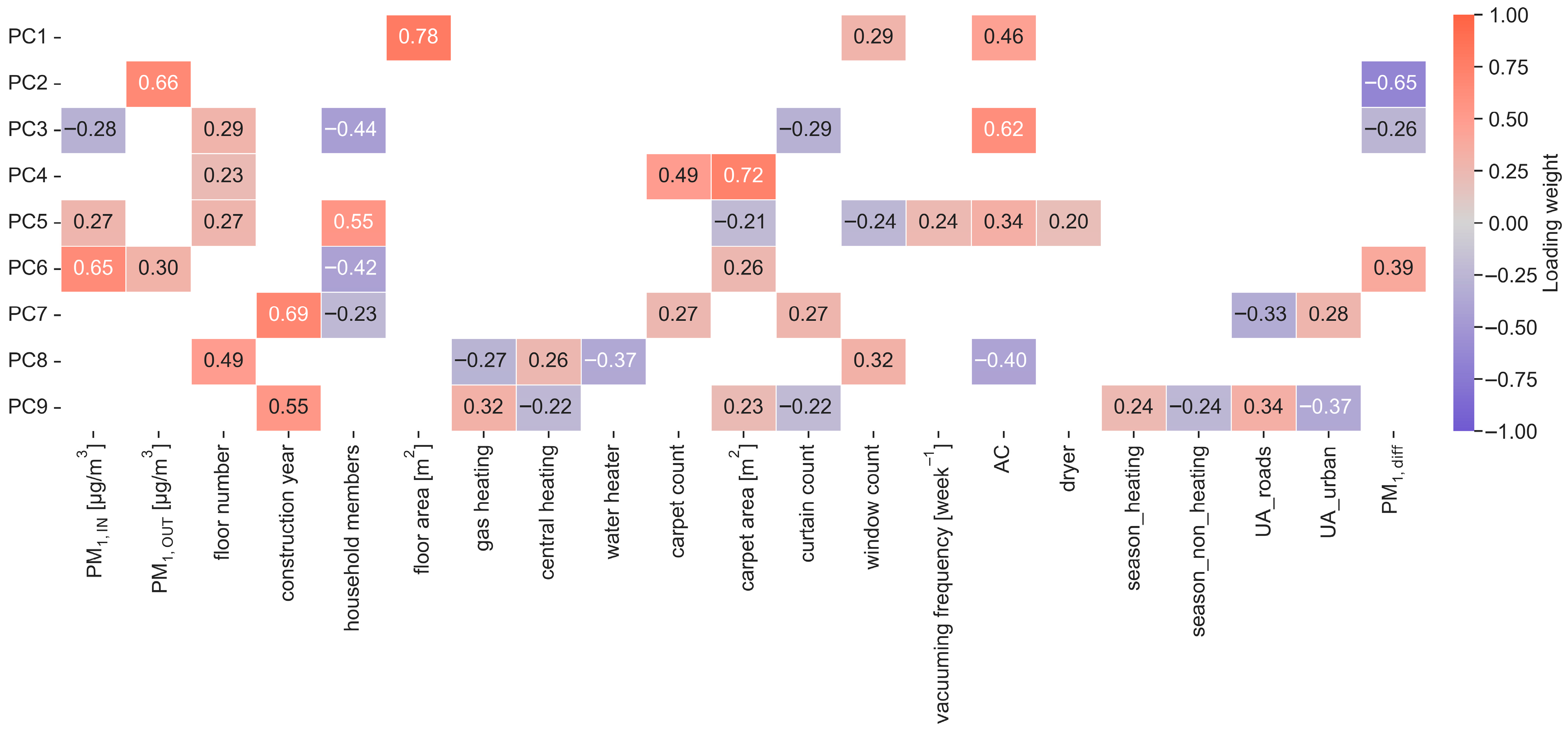
Principal component analysis (PCA) identified nine components that together explained approximately 80% of the total variance in the dataset (Figure 4). PC1 showed strong positive loadings for floor area [m2] (0.78), window count (0.29), and air conditioning (AC; 0.46), capturing a dwelling size and ventilation dimension. PC2 was dominated by PM1,OUT (0.66), with a strong negative loading for the indoor-to-outdoor difference PM1,diff (−0.65), reflecting an outdoor pollution gradient that shapes indoor-to-outdoor contrasts. PC3 combined positive loadings for AC (0.62) and floor number (0.29) with negative loadings for PM1,IN (−0.28), household members (−0.44), curtain count (−0.29), and PM1,diff (−0.26), representing a mixed structural and occupancy factor inversely related to indoor concentrations. PC4 and PC5 were primarily associated with interior features: PC4 with carpet area [m2] (0.72), carpet count (0.49), and floor number (0.23), and PC5 with PM1,IN (0.27), floor number (0.27), household members (0.55), window count (0.24), AC (0.34), and dryer (0.20), together with negative loadings for carpet area [m2] (−0.21) and curtain count (−0.24), indicating structural, furnishing, and appliance use attributes relevant for particle retention and resuspension. PC6 captured a pollution-oriented pattern with positive loadings for PM1,IN (0.65), PM1,OUT (0.30), carpet area [m2] (0.26), and PM1,diff (0.39), and a negative loading for household members (−0.42), whereas PC7, PC8, and PC9 were linked mainly to construction year, heating type (central heating or gas heating), season (heating vs. non_heating), and urbanization (UA*).
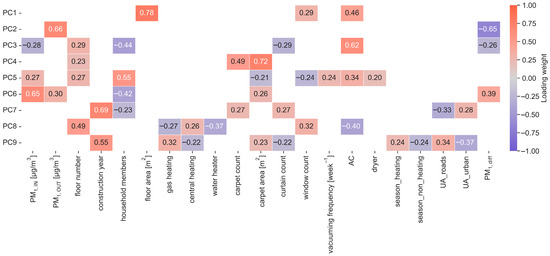
Figure 4.
Principal component analysis heatmap of |loading| ≥ 0.2, explaining 80% of variance.
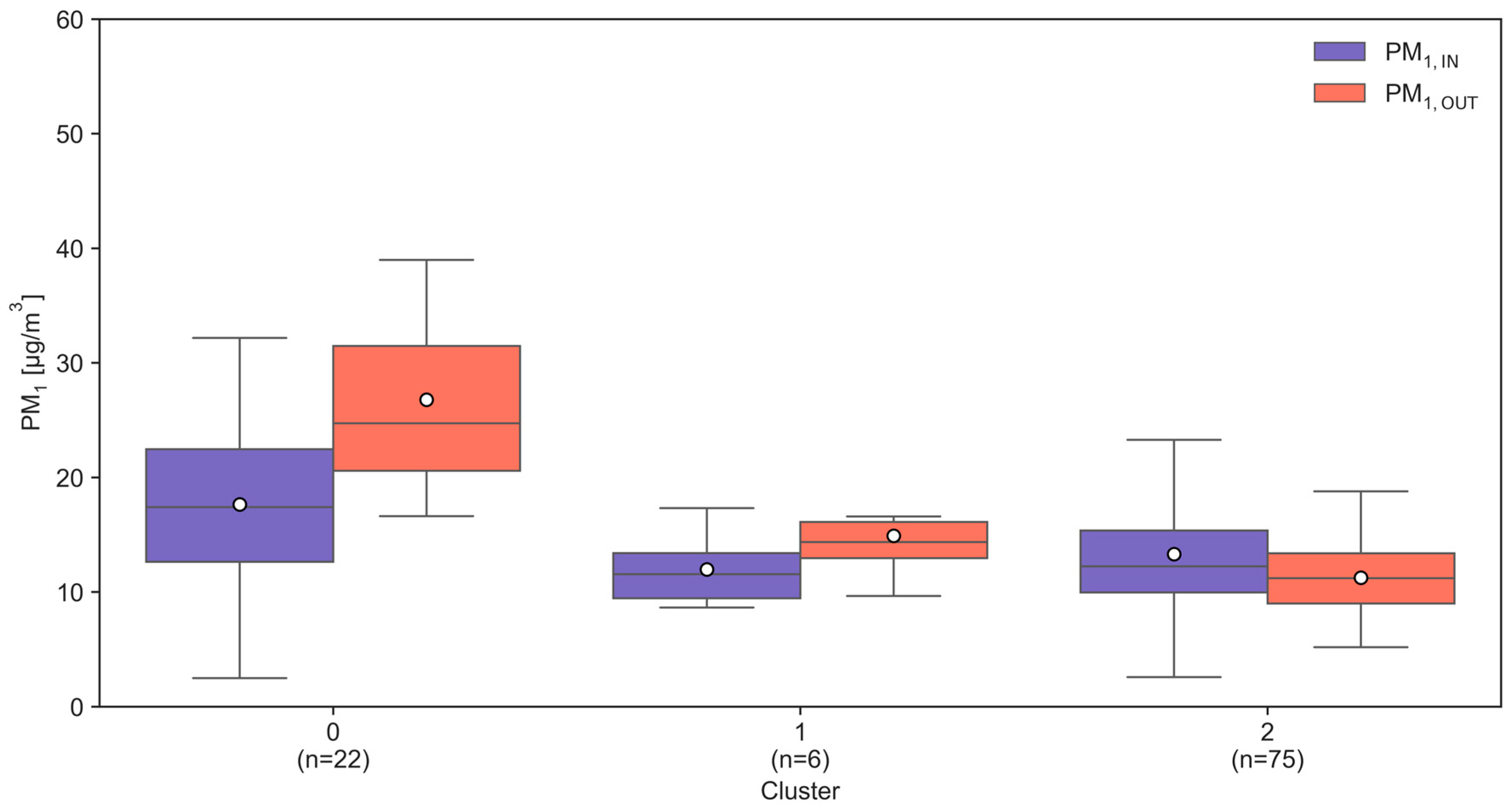
PCA-informed feature selection then focused on variables with strong loadings in each component, yielding a reduced set of raw predictors representing the key latent domains of dwelling structure and ventilation, pollution dynamics, interior surface characteristics, occupancy-related activity, heating systems, and building context. These predictors were used as inputs for subsequent clustering of homes in the principal component space, which separated the sample into three clusters (Figure 5) (n = 22, 6, and 75) with distinct indoor-to-outdoor PM1 profiles.
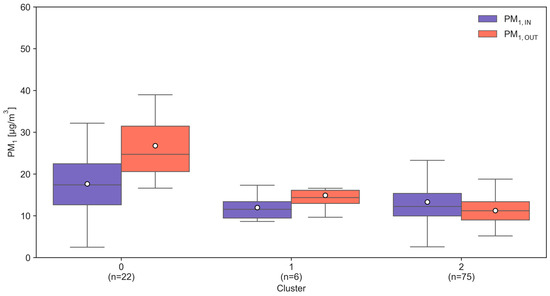
Figure 5.
Boxplots of indoor (PM1,IN) and outdoor (PM1,OUT) PM1 concentrations across three clusters with distinct indoor-to-outdoor PM1 profiles (median, lower quartile, interquartile range, upper quartile, and minimum and maximum values).
Cluster 0 comprised dwellings with the highest overall PM1 levels, characterized by elevated indoor and especially outdoor concentrations, with outdoor medians exceeding indoor medians. Cluster 1 showed intermediate PM1 levels with relatively similar indoor and outdoor medians, while Cluster 2 was defined by the lowest PM1 concentrations in both environments. Mann–Whitney U tests indicated that indoor PM1 did not differ significantly between Clusters 0 and 1 (p = 0.0517) or between Clusters 1 and 2 (p = 0.5198) but was significantly higher in Cluster 0 than in Cluster 2 (p = 0.0061). In contrast, outdoor PM1 differed significantly across most pairwise comparisons: Cluster 0 versus 1 (p = 0.0005), Cluster 0 versus 2 (p < 0.0001), and Cluster 1 versus 2 (p = 0.0298), indicating that between-cluster separation was driven predominantly by outdoor exposure levels. The differences in the indoor-to-outdoor contrast further emphasized this pattern. The PM1,diff was significantly different between Cluster 0 and 1 (p = 0.0143), Cluster 0 and 2 (p < 0.0001), and Cluster 1 and 2 (p = 0.0300), with Cluster 0 tending toward a larger positive PM1,diff.
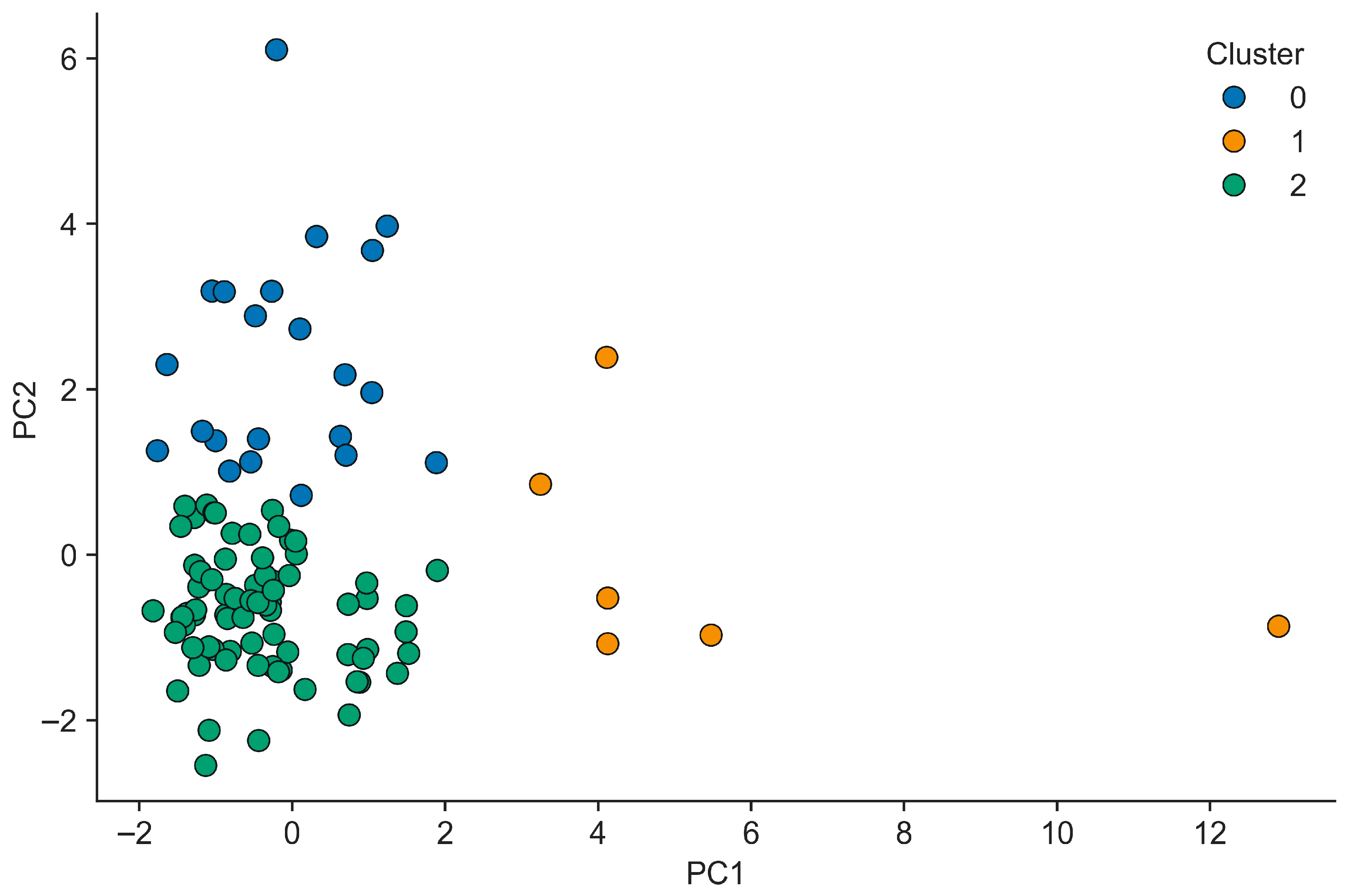
When looking into the distinct Cluster 2 containing the majority of households, it can be noted that the indoor PM1 concentration is higher than the outdoor concentration (median 12.24 vs. 11.22 µg m−3) as opposed to the other two clusters highlighting the contribution of indoor factors alongside outdoor pollution. The visualization of clusters (Figure 6) in the PC1–PC2 space showed Cluster 0 occupying regions associated with larger, better ventilated dwellings but higher overall pollution, Cluster 1 positioned at extreme positive PC1 scores with few observations, and Cluster 2 concentrated near the origin with lower pollution and more moderate structural characteristics.
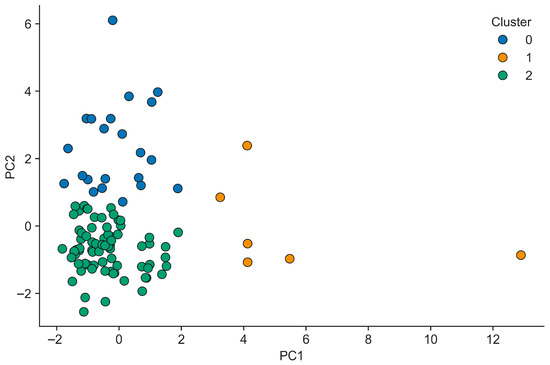
Figure 6.
Distinct indoor-to-outdoor PM1 profiles visualized in the principal component (PC) space.
3.3. Optimization and Predictive Capability of Machine Learning Models for PM1
Gradient Boosting (GBR), CatBoost, XGBoost, Random Forest (RF), AdaBoost, and Decision Tree (DT) Regressors were tuned using randomized hyperparameter search, yielding compact models tailored to the relatively small sample size.
Across all tested models, gradient boosting (GBR) achieved the best predictive performance, with the lowest test RMSE (4.39) and the highest test R2 (0.65), followed closely by CatBoost and XGB (Table 2). Simpler tree-based ensembles (AdaBoost, RF, and DT) showed substantially higher test errors and much lower R2 values, indicating a limited ability to capture the non-linear relationships that drive indoor PM1, compared with boosted gradient models.
Table 2.
Model evaluation metrics on the training and test set.
The tuned GBR model used a moderate learning rate (0.05), 400 estimators, shallow trees (max_depth = 4, min_samples_leaf = 2, min_samples_split = 10), and sub-sampling (subsample = 0.60, max_features = None), consistent with a bias-variance trade-off favoring generalization. The tuned CatBoost model used 300 iterations, depth = 4, learning rate = 0.05, and moderate regularization and stochasticity (bagging_temperature = 0.5, random_strength = 0.5, subsample = 0.8, l2_leaf_reg = 5).
The optimal XGBoost configuration similarly combined a low learning rate (0.01) with 400 trees, max_depth = 5, min_child_weight = 2, and subsample = 0.60, with weak regularization (reg_lambda = 0.10, reg_alpha = 0) and full column sampling (colsample_bytree = 1.0).
While simpler ensembles failed in generalizing on the data, they were also retained to provide interpretable baselines against which to compare the more complex gradient-boosting models. AdaBoost used learning_rate = 0.1 and n_estimators = 200, while Random Forest employed 400 trees of limited depth (max_depth = 5, min_samples_leaf = 2, min_samples_split = 10) with bootstrap sampling and √-rule feature selection and pruned decision tree used max_depth = 4, min_samples_leaf = 4, min_samples_split = 20, ccp_alpha ≈ 0 and max_features = None.
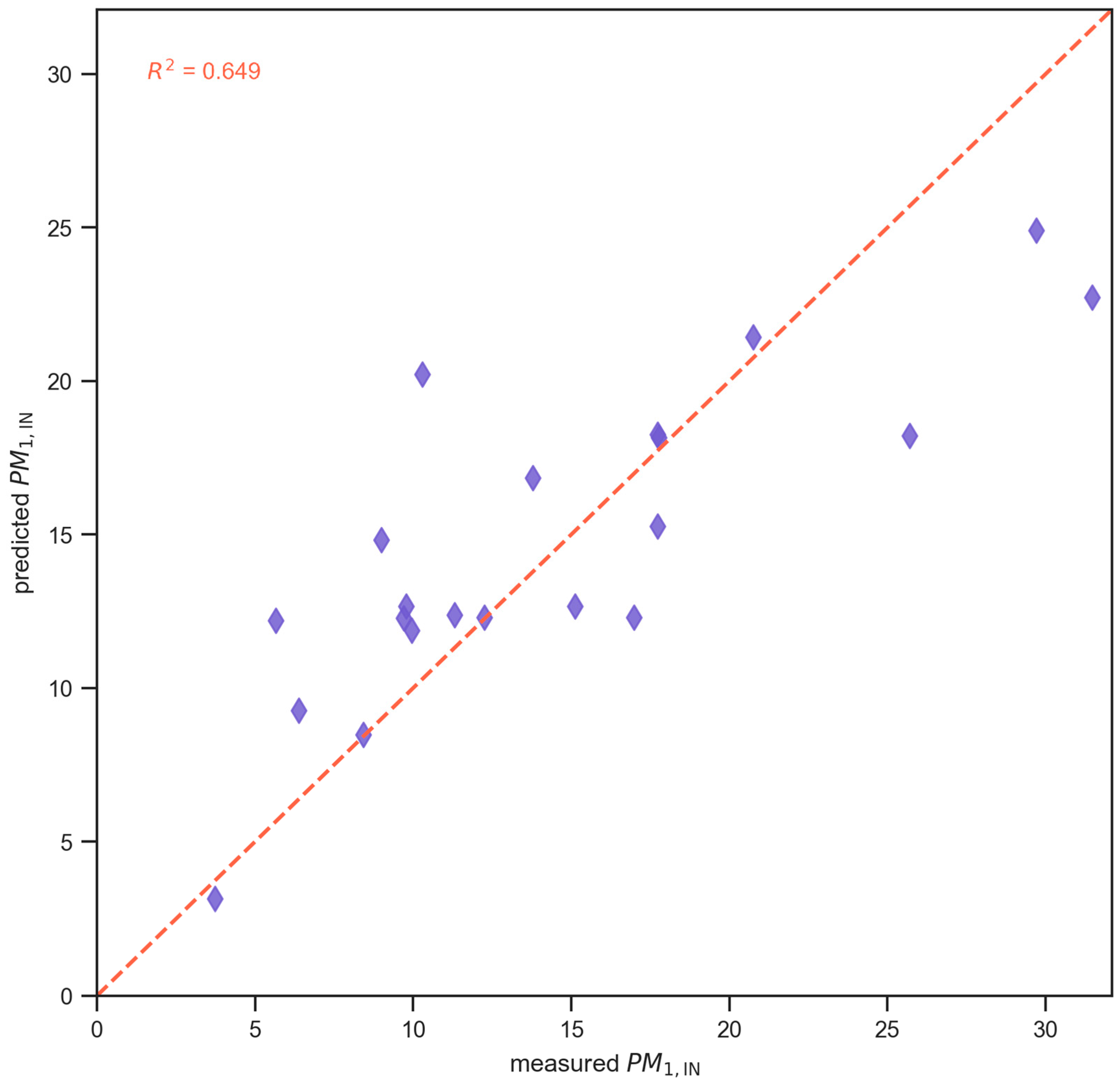
Figure 7 presents a scatter plot comparing measured and GBR predicted indoor PM1 concentrations, with each point representing one observation, a red dashed line indicating the 1:1 perfect agreement line signifying that the model accounts for approximately 65% of the variance in measured PM1 with moderate dispersion around the ideal line.
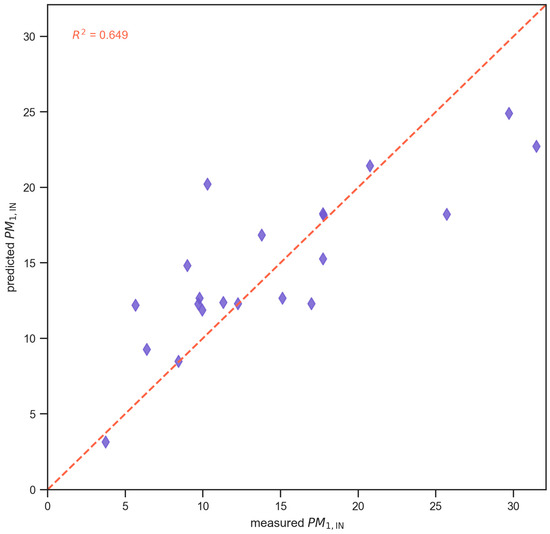
Figure 7.
Measured vs. Gradient Boosting Regressor-predicted indoor PM1 concentrations.
4. Discussion
Indoor-to-outdoor PM1 relationships in this residential dataset were shaped jointly by season, outdoor pollution, and dwelling characteristics. Overall, indoor and outdoor medians were similar, and the overall PM1,diff was close to zero, indicating that indoor PM1 largely tracked outdoor conditions rather than being dominated by persistent indoor sources. Nonetheless, the skewed distributions and large |PM1,diff| values indicate substantial variability across homes and seasons, consistent with episodic indoor activities and differing ventilation.
Seasonal analysis revealed stable indoor medians but markedly higher outdoor PM1 in the heating season, resulting in an inversion of the indoor-to-outdoor gradient and a shift in I/O ratios from >1 in the non-heating period to <1 in winter. This pattern aligns with reports that winter combustion and reduced dispersion increase outdoor fine particles, so that indoor levels increasingly reflect outdoor infiltration rather than indoor generation. PCA highlighted distinct latent domains: dwelling size/ventilation (floor area, windows, air conditioning), outdoor pollution, interior surface characteristics (carpets, curtains), occupancy and appliance use, building age, heating systems, and urban context [87,88].
Collectively, the chemometric analyses demonstrate that combinations of dwelling structure, ventilation, occupancy, and heating-related factors give rise to distinct exposure profiles, with cluster membership strongly linked to outdoor PM1 levels and to the magnitude and direction of the indoor-to-outdoor gradient. In the absence of the established regulatory limit values for PM1, the three identified clusters are best understood as empirically derived exposure profiles rather than formal compliance categories. The distributions of indoor and outdoor PM1 within each cluster (including the direction and magnitude of the indoor-to-outdoor gradient) inform the development of future guideline frameworks that distinguish between outdoor-dominated and indoor-dominated exposure scenarios, helping to design targeted mitigation strategies such as reducing outdoor particle infiltration or addressing indoor sources and behaviors. The results also show how data-driven profiling, combined with evolving health-based recommendations, can help define provisional, context-specific trigger ranges for residential PM1 in future applications. Overall, the evidence suggests that wintertime outdoor pollution is the main contributor to elevated indoor PM1 levels, while building design, furnishings, and occupant behavior influence how effectively outdoor particles enter and remain indoors, pointing to opportunities for both outdoor emission reduction and building-level interventions.
Tree-based ensemble models were also preferred over more complex deep learning architectures because they provide strong predictive performance on small tabular datasets while retaining a higher level of interpretability, which is essential for understanding environmental drivers of indoor PM1 variability. The results show that several advanced ensemble methods converge to similar predictive performance, which suggests that the remaining prediction error is largely driven by dataset constraints rather than model limitations.
Reducing the number of estimators in the Gradient Boosting Regressor decreased the training performance a from near-perfect fit (R2 = 0.9998) to a more realistic value (R2 = 0.9754), indicating that the model no longer memorizes the training data, but the validation performance remained stable (test R2 = 0.6511), suggesting a reduction in overfitting. Consequently, additional improvements in predictive accuracy would likely require improvements in data quality, feature engineering, or increased dataset size rather than further increases in model complexity.
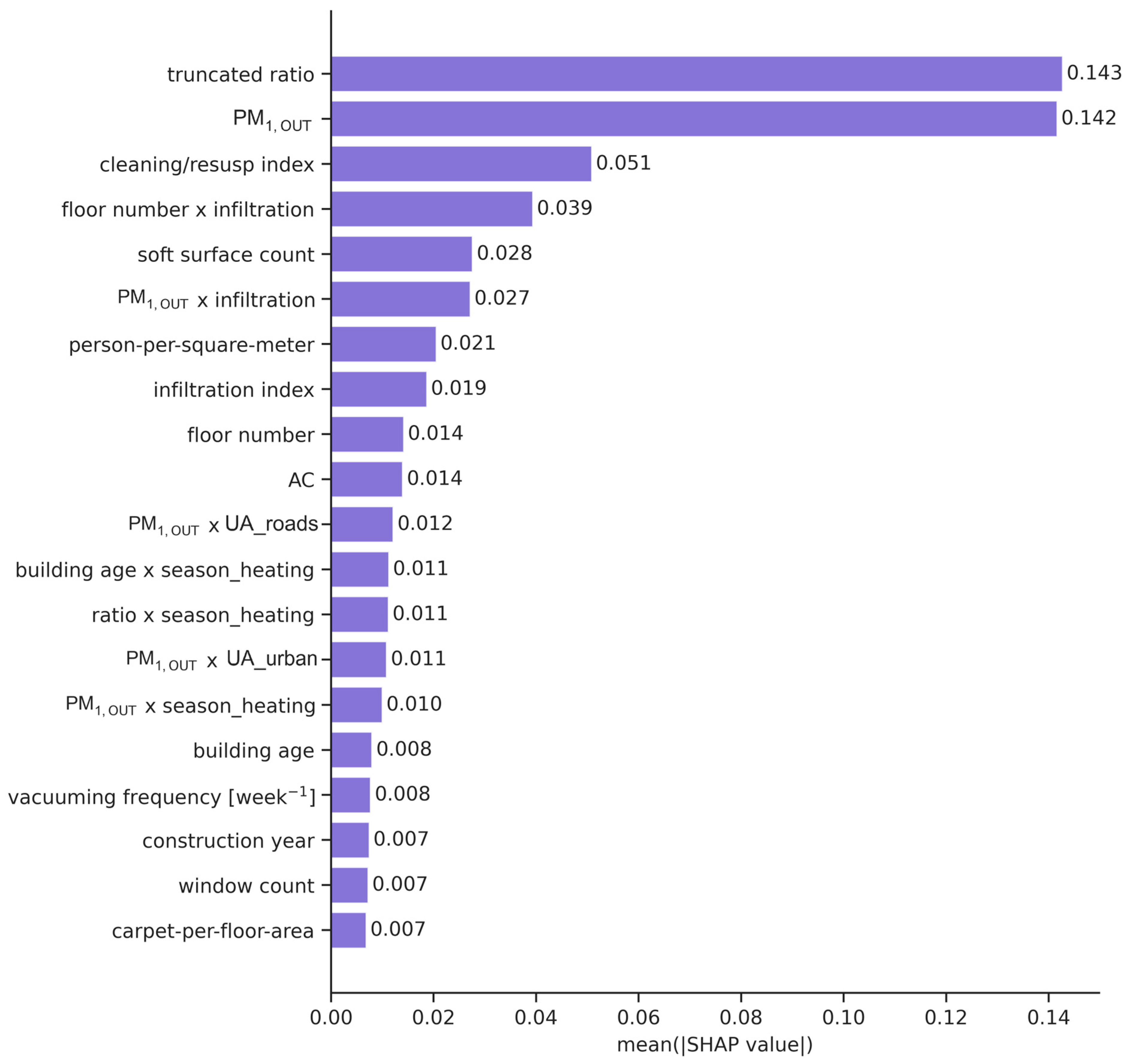
In addition to the intrinsic feature importance metrics inherent to tree-based models, a comprehensive feature examination was conducted, accompanied by the SHAP analysis, to ensure a robust and transparent identification of dominant predictors. The SHAP analysis of the best-performing Gradient Boosting Regressor (Figure 8) showed that outdoor PM1 and the truncated ratio were by far the most influential predictors of indoor PM1, with mean absolute SHAP values of 0.142 and 0.143, respectively. Secondary contributors included a cleaning/resuspension index, a composite floor number × infiltration variable, a soft surface count, a PM1,OUT × infiltration interaction, and person-per-square-meter density, indicating additional modulation by resuspension, infiltration efficiency, surface reservoirs, and crowding.
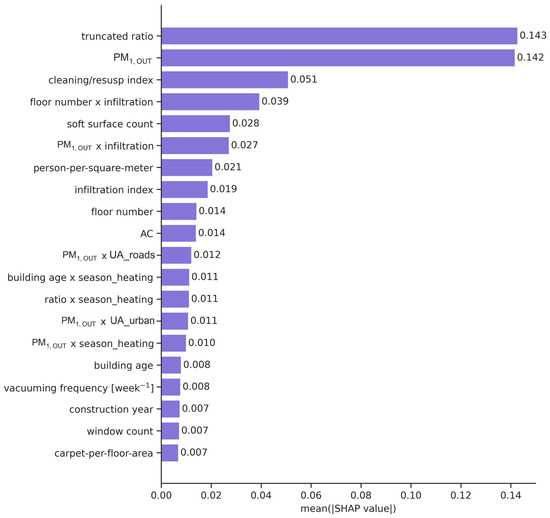
Figure 8.
SHAP feature importance for the Gradient Boosting Regressor.
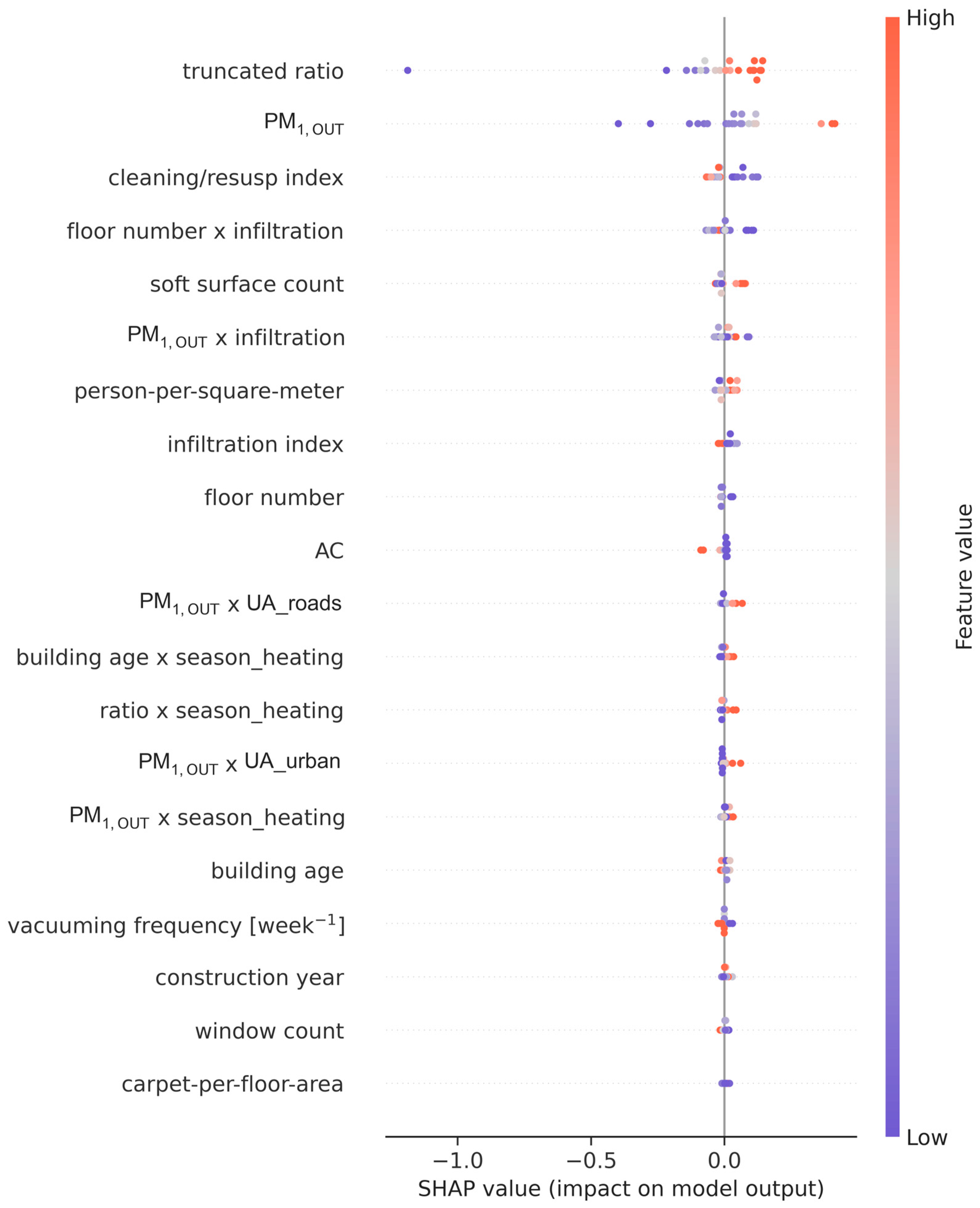
The SHAP summary plot (Figure 9) revealed that higher outdoor PM1 and higher truncated ratio values generally increased predicted indoor concentrations, confirming the dominant role of outdoor pollution and infiltration in driving indoor exposure. Elevated cleaning/resuspension scores and greater soft surface counts were also associated with positive SHAP values, supporting the contribution of indoor resuspension processes. In contrast, certain structural and contextual features such as higher floor number, greater building age, and increased carpet-per-floor-area showed more mixed or modest effects, suggesting that their influence operates mainly through interactions with infiltration and outdoor PM1 rather than as stand-alone drivers.
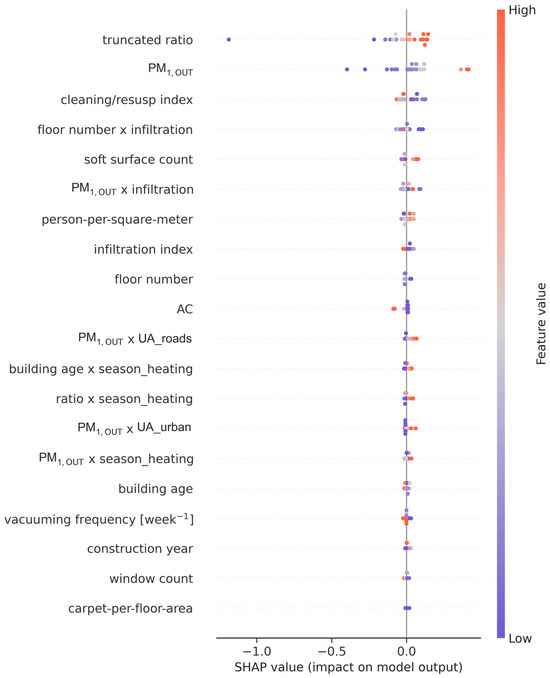
Figure 9.
SHAP summary plot for the Gradient Boosting Regressor.
Although numerous studies have applied machine learning methods to predict PM10 and PM2.5, few explicitly include explainable ML approaches such as SHAP analysis [53,82,89,90], and such approaches are even rarer for the PM1 fraction. In contrast to time series models that leverage continuous indoor monitoring and rich HVAC or sensor inputs and that can reach R2 values above 0.8 for fine particle prediction, most campaign-style studies with sparse indoor sampling and limited contextual information report lower explanatory power. For example, regression models linking indoor PM to outdoor concentrations and a small set of building or behavioral covariates typically explain only a modest fraction of variability, with reported R2 often in the 0.3–0.7 range even for PM2.5. Within this context, the performance of our PM1 models based on 103 paired indoor and outdoor measurements and a limited set of structural and behavioral predictors (test R2 ≈ 0.56–0.65) is consistent with and toward the upper end of what is realistically achievable from short residential campaigns without high-frequency indoor sensing or detailed ventilation control data [17,37,47,88,91]. A key strength of this study lies in the use of campaign-based primary measurements conducted in real residential settings rather than relying on secondary datasets or modeled exposure estimates.
While our study provides valuable insights into indoor PM1 dynamics using campaign-based primary measurements in real residential settings, a key strength over secondary datasets or modeled estimates several limitations should be noted. The sampling was constrained to weekly measurements to enable subsequent chemical analysis, providing low temporal resolution that likely missed short-term PM1 events like cooking or cleaning episodes. Predictor variables derived from participant questionnaires introduce subjectivity and potential recall bias. The measurements were focused solely on living rooms and bedrooms, where children spend most time, excluding other household areas that could influence the overall exposure. Finally, the modest sample size of 103 paired indoor–outdoor observations limits statistical power and model generalizability. Because the holdout test set comprised only ~20 observations (20% of the full dataset), the corresponding test R2 values are inherently sensitive to the specific train–test split and should be viewed as an indicative but potentially high-variance estimate of out-of-sample performance. Model selection and performance assessment, therefore, relied primarily on repeated k-fold cross-validation on the training data, which stabilizes performance estimates, although the limited overall sample size still introduces uncertainty in the reported out-of-sample metrics.
5. Conclusions
This study shows that in examined households in Zagreb City and Zagreb County (Croatia), indoor PM1 concentrations are tightly coupled to ambient levels but exhibit pronounced seasonal and dwelling-specific variability that is toxicologically relevant. During the wintertime, elevated outdoor PM1 and stronger indoor-to-outdoor gradients resulted in I/O ratios below unity, indicating that residents were predominantly exposed to particles of outdoor origin even indoors. Multivariate chemometric analysis and clustering demonstrated that this relationship is further modulated by dwelling size and ventilation, the presence of soft furnishings that act as particle reservoirs, occupancy density, cleaning behavior, building age, and heating systems.
Tree-based ensemble machine learning models, specifically the best-performing Gradient Boosting Regressor, reinforced these conclusions by attributing most of the predictive power for indoor PM1 to outdoor concentrations, I/O behavior, and variables reflecting infiltration and resuspension processes. Additional improvements in predictive accuracy would likely require improvements in data quality, feature engineering, or increased dataset size rather than further increases in model complexity. From a public health and toxicological perspective, the results highlight that effective reduction in residential PM1 exposure cannot rely solely on indoor source control but must combine measures that lower ambient emissions, especially wintertime combustion sources, with building-level interventions such as improved airtightness, filtration, and management of resuspension from carpets and other soft surfaces. Such models could be used population-wide, given the lack of indoor air quality measurements but may rely on available information from questionnaires and ambient air. Hence, it can serve in risk management.
A particular strength of this study lies in the integration of gravimetric indoor and outdoor PM1 measurements collected in real residential households with chemometric analysis and explainable machine learning, providing region-specific, exposure-relevant insights grounded in empirical field data, enabling targeted residential IAQ management: optimized ventilation protocols, resuspension mitigation via behavior, and infiltration reduction through retrofits. The use of explainable machine learning strengthens the scientific robustness and trustworthiness of the findings, supporting their relevance for exposure assessment and evidence-based mitigation strategies.
Author Contributions
Conceptualization, M.J.L.Š.; methodology, M.J.L.Š. and I.B. (Ivan Bešlić); software, M.J.L.Š.; validation, M.J.L.Š. and S.D.; formal analysis, M.J.L.Š.; investigation, M.J.L.Š.; resources, M.J.L.Š.; data curation, M.J.L.Š., L.K. and I.B. (Ivana Banić); writing—original draft preparation, M.J.L.Š.; writing—review and editing, S.D., G.P., I.B. (Ivan Bešlić), Ž.U.A., L.K., I.B. (Ivana Banić), M.T., M.L. and G.G.; visualization, M.J.L.Š.; supervision, S.D., G.P., M.L. and G.G.; project administration, G.G.; funding acquisition, M.L. and G.G. All authors have read and agreed to the published version of the manuscript.
Funding
This work is funded by the research project “Evidence driven indoor air quality improvement” (EDIAQI) funded by European Union’s Horizon Europe research and innovation program under grant agreement No. 101057497 (EDIAQI). A part of the research was performed using the facilities and equipment funded within the European Regional Development Fund project KK.01.1.1.02.0007 “Research and Education Centre of Environmental Health and Radiation Protection—Reconstruction and Expansion of the Institute for Medical Research and Occupational Health” and supported by the Institute for Medical Research and Occupational Health and the European Union—Next Generation EU projects (Program Contract of 8 December 2023, Class: 643-02/23-01/00016, Reg. no. 533-03-23-0006; BioMolTox and EnvironPollutHealth).
Institutional Review Board Statement
Not applicable.
Informed Consent Statement
Not applicable.
Data Availability Statement
The data presented in this study are available upon reasonable request from the corresponding author because the data are not yet being publicly available from the EDIAQI project. This publication has been prepared using the European Union’s Copernicus Land Monitoring Service information; https://doi.org/10.2909/fb4dffa1-6ceb-4cc0-8372-1ed354c285e6 (accessed on 12 January 2026).
Acknowledgments
The authors would like to acknowledge the staff of the Division of Environmental Hygiene of the Institute for Medical Research and Occupational Health who contributed to sampling, sample preparation, and analysis. During the preparation of this manuscript, the authors used Mendeley Desktop (Version 1.19.8) for the purposes of references format. The authors have reviewed and edited the output and take full responsibility for the content of this publication.
Conflicts of Interest
The authors declare no conflicts of interest.
References
- Maciejewska, M.; Azizah, A.; Szczurek, A. IAQ Prediction in Apartments Using Machine Learning Techniques and Sensor Data. Appl. Sci. 2024, 14, 4249. [Google Scholar] [CrossRef]
- Lovrić, M.; Antunović, M.; Šunić, I.; Vuković, M.; Kecorius, S.; Kröll, M.; Bešlić, I.; Godec, R.; Pehnec, G.; Geiger, B.C.; et al. Machine Learning and Meteorological Normalization for Assessment of Particulate Matter Changes during the COVID-19 Lockdown in Zagreb, Croatia. Int. J. Environ. Res. Public Health 2022, 19, 6937. [Google Scholar] [CrossRef]
- Chen, F.; Zhang, W.; Mfarrej, M.F.B.; Saleem, M.H.; Khan, K.A.; Ma, J.; Raposo, A.; Han, H. Breathing in Danger: Understanding the Multifaceted Impact of Air Pollution on Health Impacts. Ecotoxicol. Environ. Saf. 2024, 280, 116532. [Google Scholar] [CrossRef]
- Dimitroulopoulou, S.; Dudzińska, M.R.; Gunnarsen, L.; Hägerhed, L.; Maula, H.; Singh, R.; Toyinbo, O.; Haverinen-Shaughnessy, U. Indoor Air Quality Guidelines from across the World: An Appraisal Considering Energy Saving, Health, Productivity, and Comfort. Environ. Int. 2023, 178, 108127. [Google Scholar] [CrossRef]
- Hartiala, M.; Elenius, V.; Pesquera, A.A.; Androulakis, S.; Annesi-Maesano, I.; Badyda, A.; Brandsma, S.; Chatziprodromidou, I.; Gajski, G.; Garcia-Aymerich, J.; et al. Exposures in Indoor Air Affecting Health. Allergy 2025, 81, 700–719. [Google Scholar] [CrossRef]
- Dai, H.; Liu, Y.; Wang, J.; Ren, J.; Gao, Y.; Dong, Z.; Zhao, B. Large-Scale Spatiotemporal Deep Learning Predicting Urban Residential Indoor PM2.5 Concentration. Environ. Int. 2023, 182, 108343. [Google Scholar] [CrossRef] [PubMed]
- Du, Y.; Zhang, Y.; Li, Y.; Huang, Q.; Wang, Y.; Wang, Q.; Ma, R.; Sun, Q.; Wang, Q.; Li, T. Big Data from Population Surveys and Environmental Monitoring-Based Machine Learning Predictions of Indoor PM2.5 in 22 Cities in China. Ecotoxicol. Environ. Saf. 2024, 287, 117285. [Google Scholar] [CrossRef] [PubMed]
- Omidvarborna, H.; Kumar, P.; Hayward, J.; Gupta, M.; Nascimento, E.G.S. Low-Cost Air Quality Sensing towards Smart Homes. Atmosphere 2021, 12, 453. [Google Scholar] [CrossRef]
- Saini, J.; Dutta, M.; Marques, G. Machine Learning for Indoor Air Quality Assessment: A Systematic Review and Analysis. Environ. Model. Assess. 2024, 30, 417–434. [Google Scholar] [CrossRef]
- Lee, K.K.; Bing, R.; Kiang, J.; Bashir, S.; Spath, N.; Stelzle, D.; Mortimer, K.; Bularga, A.; Doudesis, D.; Joshi, S.S.; et al. Adverse Health Effects Associated with Household Air Pollution: A Systematic Review, Meta-Analysis, and Burden Estimation Study. Lancet Glob. Health 2020, 8, e1427–e1434. [Google Scholar] [CrossRef]
- WHO (Ed.) WHO Global Air Quality Guidelines: Particulate Matter (PM2.5 and PM10), Ozone, Nitrogen Dioxide, Sulfur Dioxide and Carbon Monoxide; World Health Organization: Geneva, Switzerland, 2021. [Google Scholar]
- Zhang, Z.; Johansson, C.; Engardt, M.; Stafoggia, M.; Ma, X. Improving 3-Day Deterministic Air Pollution Forecasts Using Machine Learning Algorithms. Atmos. Chem. Phys. 2024, 24, 807–851. [Google Scholar] [CrossRef]
- Sun, Y.; Milando, C.W.; Spangler, K.R.; Wei, Y.; Schwartz, J.; Dominici, F.; Nori-Sarma, A.; Sun, S.; Wellenius, G.A. Short Term Exposure to Low Level Ambient Fine Particulate Matter and Natural Cause, Cardiovascular, and Respiratory Morbidity among US Adults with Health Insurance: Case Time Series Study. BMJ 2024, 384, e076322. [Google Scholar] [CrossRef]
- Van Tran, V.; Park, D.; Lee, Y.-C. Indoor Air Pollution, Related Human Diseases, and Recent Trends in the Control and Improvement of Indoor Air Quality. Int. J. Environ. Res. Public Health 2020, 17, 2927. [Google Scholar] [CrossRef]
- Zhang, H.; Srinivasan, R. A Systematic Review of Air Quality Sensors, Guidelines, and Measurement Studies for Indoor Air Quality Management. Sustainability 2020, 12, 9045. [Google Scholar] [CrossRef]
- Jelili, M.O.; Gbadegesin, A.S.; Alabi, A.T. Comparative Analysis of Indoor and Outdoor Particulate Matter Concentrations and Air Quality in Ogbomoso, Nigeria. J. Health Pollut. 2020, 10, 201205. [Google Scholar] [CrossRef]
- Alonso-Blanco, E.; Gómez-Moreno, F.J.; Díaz-Ramiro, E.; Fernández, J.; Coz, E.; Yagüe, C.; Román-Cascón, C.; Gómez-Garre, D.; Narros, A.; Borge, R.; et al. Indoor/Outdoor Particulate Matter and Related Pollutants in a Sensitive Public Building in Madrid (Spain). Int. J. Environ. Res. Public Health 2025, 22, 1175. [Google Scholar] [CrossRef] [PubMed]
- Peng, Z.; Yang, J.; Sun, J.; Duan, J.; Chen, Z.; Niu, X.; Hu, T.; Huang, Y.; Xu, H.; Cao, J.; et al. Exploring Indoor PM2.5 Pollution Characteristics in Xi’an City and Its Health Implications Using Interpretable Machine Learning. Sustain. Horiz. 2025, 13, 100131. [Google Scholar] [CrossRef]
- Ouyang, R.; Yang, S.; Xu, L. Analysis and Risk Assessment of PM2.5-Bound PAHs in a Comparison of Indoor and Outdoor Environments in a Middle School: A Case Study in Beijing, China. Atmosphere 2020, 11, 904. [Google Scholar] [CrossRef]
- Huda, R.K.; Kumar, P.; Gupta, R.; Sharma, A.K.; Toteja, G.S.; Babu, B.V. Air Quality Monitoring Using Low-Cost Sensors in Urban Areas of Jodhpur, Rajasthan. Int. J. Environ. Res. Public Health 2024, 21, 623. [Google Scholar] [CrossRef] [PubMed]
- Martins, C.; Teófilo, V.; Clemente, M.; Corda, M.; Fermoso, J.; Aguado, A.; Rodriguez, S.; Moshammer, H.; Kristian, A.; Ferri, M.; et al. Sources, Levels, and Determinants of Indoor Air Pollutants in Europe: A Systematic Review. Sci. Total Environ. 2025, 964, 178574. [Google Scholar] [CrossRef]
- Baldacci, S.; Maio, S.; Cerrai, S.; Sarno, G.; Baïz, N.; Simoni, M.; Annesi-Maesano, I.; Viegi, G. Allergy and Asthma: Effects of the Exposure to Particulate Matter and Biological Allergens. Respir. Med. 2015, 109, 1089–1104. [Google Scholar] [CrossRef]
- Azimi, M.N.; Rahman, M.M. Unveiling the Health Consequences of Air Pollution in the World’s Most Polluted Nations. Sci. Rep. 2024, 14, 9856. [Google Scholar] [CrossRef]
- Johnson, M.; Piedrahita, R.; Pillarisetti, A.; Shupler, M.; Menya, D.; Rossanese, M.; Delapeña, S.; Penumetcha, N.; Chartier, R.; Puzzolo, E.; et al. Modeling Approaches and Performance for Estimating Personal Exposure to Household Air Pollution: A Case Study in Kenya. Indoor Air 2021, 31, 1441–1457. [Google Scholar] [CrossRef] [PubMed]
- Chen, Y.; Fei, J.; Sun, Z.; Shen, G.; Du, W.; Zang, L.; Yang, L.; Wang, Y.; Wu, R.; Chen, A.; et al. Household Air Pollution from Cooking and Heating and Its Impacts on Blood Pressure in Residents Living in Rural Cave Dwellings in Loess Plateau of China. Environ. Sci. Pollut. Res. 2020, 27, 36677–36687. [Google Scholar] [CrossRef] [PubMed]
- Branco, P.T.; Sousa, S.I.; Dudzińska, M.R.; Ruzgar, D.G.; Mutlu, M.; Panaras, G.; Papadopoulos, G.; Saffell, J.; Scutaru, A.M.; Struck, C.; et al. A Review of Relevant Parameters for Assessing Indoor Air Quality in Educational Facilities. Environ. Res. 2024, 261, 119713. [Google Scholar] [CrossRef]
- Manisalidis, I.; Stavropoulou, E.; Stavropoulos, A.; Bezirtzoglou, E. Environmental and Health Impacts of Air Pollution: A Review. Front. Public Health 2020, 8, 505570. [Google Scholar] [CrossRef]
- Valavanidis, A.; Fiotakis, K.; Vlachogianni, T. Airborne Particulate Matter and Human Health: Toxicological Assessment and Importance of Size and Composition of Particles for Oxidative Damage and Carcinogenic Mechanisms. J. Environ. Sci. Health Part C 2008, 26, 339–362. [Google Scholar] [CrossRef] [PubMed]
- Wei, Y.; Feng, Y.; Yazdi, M.D.; Yin, K.; Castro, E.; Shtein, A.; Qiu, X.; Peralta, A.A.; Coull, B.A.; Dominici, F.; et al. Exposure-Response Associations between Chronic Exposure to Fine Particulate Matter and Risks of Hospital Admission for Major Cardiovascular Diseases: Population Based Cohort Study. BMJ 2024, 384, e076939. [Google Scholar] [CrossRef]
- Kazensky, L.; Matković, K.; Gerić, M.; Žegura, B.; Pehnec, G.; Gajski, G. Impact of Indoor Air Pollution on DNA Damage and Chromosome Stability: A Systematic Review. Arch. Toxicol. 2024, 98, 2817–2841. [Google Scholar] [CrossRef]
- Hwang, Y.-S.; Lee, O.E.-K.; Kim, W.-J.; Jo, H.-S. Designing a Socially Assistive Robot to Assist Older Patients with Chronic Obstructive Pulmonary Disease in Managing Indoor Air Quality. Appl. Sci. 2024, 14, 5647. [Google Scholar] [CrossRef]
- Rackow, B.; König, H.-H.; Wall, M.; Konnopka, C. The Interaction between Air Pollution, Weather Conditions, and Health Risks: A Systematic Review. Sci. Total Environ. 2025, 996, 180080. [Google Scholar] [CrossRef]
- Leão, M.L.P.; Zhang, L.; da Silva Júnior, F.M.R. Effect of Particulate Matter (PM2.5 and PM10) on Health Indicators: Climate Change Scenarios in a Brazilian Metropolis. Environ. Geochem. Health 2022, 45, 2229–2240. [Google Scholar] [CrossRef] [PubMed]
- Chen, K.-C.; Tsai, S.-W.; Shie, R.-H.; Zeng, C.; Yang, H.-Y. Indoor Air Pollution Increases the Risk of Lung Cancer. Int. J. Environ. Res. Public Health 2022, 19, 1164. [Google Scholar] [CrossRef]
- Jakovljević, I.; Štrukil, Z.S.; Pehnec, G.; Horvat, T.; Sanković, M.; Šumanovac, A.; Davila, S.; Račić, N.; Gajski, G. Ambient Air Pollution and Carcinogenic Activity at Three Different Urban Locations. Ecotoxicol. Environ. Saf. 2025, 289, 117704. [Google Scholar] [CrossRef] [PubMed]
- Chen, G.; Li, S.; Zhang, Y.; Zhang, W.; Li, D.; Wei, X.; He, Y.; Bell, M.L.; Williams, G.; Marks, G.B.; et al. Effects of Ambient PM 1 Air Pollution on Daily Emergency Hospital Visits in China: An Epidemiological Study. Lancet Planet. Health 2017, 1, e221–e229. [Google Scholar] [CrossRef] [PubMed]
- Viana, M.; Díez, S.; Reche, C. Indoor and Outdoor Sources and Infiltration Processes of PM1 and Black Carbon in an Urban Environment. Atmos. Environ. 2011, 45, 6359–6367. [Google Scholar] [CrossRef]
- Pehnec, G.; Jakovljević, I. Carcinogenic Potency of Airborne Polycyclic Aromatic Hydrocarbons in Relation to the Particle Fraction Size. Int. J. Environ. Res. Public Health 2018, 15, 2485. [Google Scholar] [CrossRef]
- Jakovljević, I.; Pehnec, G.; Vađić, V.; Čačković, M.; Tomašić, V.; Jelinić, J.D. Polycyclic Aromatic Hydrocarbons in PM10, PM2.5 and PM1 Particle Fractions in an Urban Area. Air Qual. Atmos. Health 2018, 11, 843–854. [Google Scholar] [CrossRef]
- Lovrić, M.; Račić, N.; Pehnec, G.; Horvat, T.; Štefiček, M.J.L.; Jakovljević, I. Indoor Polycyclic Aromatic Hydrocarbons—Relationship to Ambient Air, Risk Estimation, and Source Apportionment Based on Household Measurements. Atmosphere 2024, 15, 1525. [Google Scholar] [CrossRef]
- Klinčić, D.; Jagić Nemčić, K.; Jakovljević, I.; Lovrić Štefiček, M.J.; Dvoršćak, M. Polybrominated Diphenyl Ethers (PBDEs) in PM1 of Residential Indoor Air: Levels, Seasonal Variability, and Inhalation Exposure Assessment. J. Xenobiot. 2025, 15, 195. [Google Scholar] [CrossRef]
- Wang, W.-R.; Chen, H.-L.; Su, H.-J. The Approach to Adjusting Commercial PM2.5 Sensors with a Filter-Based Gravimetric Method. E3S Web Conf. 2023, 396, 1119. [Google Scholar] [CrossRef]
- Zhu, Y.; Smith, T.J.; Davis, M.E.; Levy, J.I.; Herrick, R.; Jiang, H. Comparing Gravimetric and Real-Time Sampling of PM2.5 Concentrations Inside Truck Cabins. J. Occup. Environ. Hyg. 2011, 8, 662–672. [Google Scholar] [CrossRef]
- Mun, E.; Cho, J. Review of Internet of Things-Based Artificial Intelligence Analysis Method through Real-Time Indoor Air Quality and Health Effect Monitoring: Focusing on Indoor Air Pollution That Are Harmful to the Respiratory Organ. Tuberc. Respir. Dis. 2023, 86, 23–32. [Google Scholar] [CrossRef] [PubMed]
- Mamić, L.; Gašparović, M.; Kaplan, G. Developing PM2.5 and PM10 Prediction Models on a National and Regional Scale Using Open-Source Remote Sensing Data. Environ. Monit. Assess. 2023, 195, 644. [Google Scholar] [CrossRef] [PubMed]
- Jakovljević, I.; Štrukil, Z.S.; Godec, R.; Bešlić, I.; Davila, S.; Lovrić, M.; Pehnec, G. Pollution Sources and Carcinogenic Risk of PAHs in PM1 Particle Fraction in an Urban Area. Int. J. Environ. Res. Public Health 2020, 17, 9587. [Google Scholar] [CrossRef] [PubMed]
- Merenda, B.; Drzeniecka-Osiadacz, A.; Sówka, I.; Sawiński, T.; Samek, L. Influence of Meteorological Conditions on the Variability of Indoor and Outdoor Particulate Matter Concentrations in a Selected Polish Health Resort. Sci. Rep. 2024, 14, 19461. [Google Scholar] [CrossRef] [PubMed]
- Petrić, V.; Hussain, H.; Časni, K.; Vuckovic, M.; Schopper, A.; Andrijić, Ž.U.; Kecorius, S.; Madueno, L.; Kern, R.; Lovrić, M. Ensemble Machine Learning, Deep Learning, and Time Series Forecasting: Improving Prediction Accuracy for Hourly Concentrations of Ambient Air Pollutants. Aerosol Air Qual. Res. 2024, 24, 230317. [Google Scholar] [CrossRef]
- Altamirano-Astorga, J.; Gutierrez-Garcia, J.O.; Roman-Rangel, E. Forecasting Indoor Air Quality in Mexico City Using Deep Learning Architectures. Atmosphere 2024, 15, 1529. [Google Scholar] [CrossRef]
- Hsu, W.-T.; Ku, C.-H.; Chen, M.-J.; Wu, C.-D.; Lung, S.-C.C.; Chen, Y.-C. Model Development and Validation of Personal Exposure to PM2.5 among Urban Elders. Environ. Pollut. 2022, 316, 120538. [Google Scholar] [CrossRef]
- Méndez, M.; Merayo, M.G.; Núñez, M. Machine Learning Algorithms to Forecast Air Quality: A Survey. Artif. Intell. Rev. 2023, 56, 10031–10066. [Google Scholar] [CrossRef]
- Taştan, M. Machine Learning–Based Calibration and Performance Evaluation of Low-Cost Internet of Things Air Quality Sensors. Sensors 2025, 25, 3183. [Google Scholar] [CrossRef] [PubMed]
- Jovanović, G.; Perišić, M.; Bezdan, T.; Stanišić, S.; Radusin, K.; Popović, A.; Stojić, A. The PM2.5-Bound Polycyclic Aromatic Hydrocarbon Behavior in Indoor and Outdoor Environments, Part III: Role of Environmental Settings in Elevating Indoor Concentrations of Benzo(a)Pyrene. Atmosphere 2024, 15, 1520. [Google Scholar] [CrossRef]
- Saraga, D.; Duarte, R.M.B.O.; Manousakas, M.-I.; Maggos, T.; Tobler, A.; Querol, X. From Outdoor to Indoor Air Pollution Source Apportionment: Answers to Ten Challenging Questions. TrAC Trends Anal. Chem. 2024, 178, 117821. [Google Scholar] [CrossRef]
- Chojer, H.; Branco, P.T.B.S.; Martins, F.G.; Alvim-Ferraz, M.C.M.; Sousa, S.I.V. Can Data Reliability of Low-Cost Sensor Devices for Indoor Air Particulate Matter Monitoring Be Improved?—An Approach Using Machine Learning. Atmos. Environ. 2022, 286, 119251. [Google Scholar] [CrossRef]
- Mohammadshirazi, A.; Kalkhorani, V.A.; Humes, J.; Speno, B.; Rike, J.; Ramnath, R.; Clark, J.D. Predicting Airborne Pollutant Concentrations and Events in a Commercial Building Using Low-Cost Pollutant Sensors and Machine Learning: A Case Study. Build. Environ. 2022, 213, 108833. [Google Scholar] [CrossRef]
- Li, X.; Sun, W.; Qin, C.; Yan, Y.; Zhang, L.; Tu, J. Evaluation of Supervised Machine Learning Regression Models for CFD-Based Surrogate Modelling in Indoor Airflow Field Reconstruction. Build. Environ. 2024, 267, 112173. [Google Scholar] [CrossRef]
- Dai, Z.; Yuan, Y.; Zhu, X.; Zhao, L. A Method for Predicting Indoor CO2 Concentration in University Classrooms: An RF-TPE-LSTM Approach. Appl. Sci. 2024, 14, 6188. [Google Scholar] [CrossRef]
- García, M.R.; Spinazzé, A.; Branco, P.T.; Borghi, F.; Villena, G.; Cattaneo, A.; Di Gilio, A.; Mihucz, V.G.; Álvarez, E.G.; Lopes, S.I.; et al. Review of Low-Cost Sensors for Indoor Air Quality: Features and Applications. Appl. Spectrosc. Rev. 2022, 57, 747–779. [Google Scholar] [CrossRef]
- Kapoor, N.R.; Kumar, A.; Kumar, A.; Kumar, A.; Mohammed, M.A.; Kumar, K.; Kadry, S.; Lim, S. Machine Learning-Based CO2 Prediction for Office Room: A Pilot Study. In Wireless Communications and Mobile Computing; Wiley Online Library: Hoboken, NJ, USA, 2022. [Google Scholar] [CrossRef]
- Martínez-Comesaña, M.; Eguía-Oller, P.; Martínez-Torres, J.; Febrero-Garrido, L.; Granada-Álvarez, E. Optimisation of Thermal Comfort and Indoor Air Quality Estimations Applied to In-Use Buildings Combining NSGA-III and XGBoost. Sustain. Cities Soc. 2022, 80, 103723. [Google Scholar] [CrossRef]
- Guo, Z.; Wang, X.; Ge, L. Classification Prediction Model of Indoor PM2.5 Concentration Using CatBoost Algorithm. Front. Built Environ. 2023, 9, 1207193. [Google Scholar] [CrossRef]
- Shi, Y.; Du, Z.; Zhang, J.; Han, F.; Chen, F.; Wang, D.; Liu, M.; Zhang, H.; Dong, C.; Sui, S. Construction and Evaluation of Hourly Average Indoor PM2.5 Concentration Prediction Models Based on Multiple Types of Places. Front. Public Health 2023, 11, 1213453. [Google Scholar] [CrossRef]
- Lovrić, M.; Gajski, G.; Fernández-Agüera, J.; Pöhlker, M.; Gursch, H.; Lovrić, M.; Switters, J.; Borg, A.; Mureddu, F.; Auguštin, D.H.; et al. Evidence Driven Indoor Air Quality Improvement: An Innovative and Interdisciplinary Approach to Improving Indoor Air Quality. BioFactors 2025, 51, e2126. [Google Scholar] [CrossRef]
- Državni Zavod Za Statistiku—Objavljeni Konačni Rezultati Popisa 2021. Available online: https://dzs.gov.hr/vijesti/objavljeni-konacni-rezultati-popisa-2021/1270 (accessed on 19 February 2026).
- European Union’s Copernicus Land Monitoring Service Information Urban Atlas Land Cover/Land Use 2018 (Vector), Europe, 6-Yearly. Available online: https://sdi.eea.europa.eu/catalogue/copernicus/api/records/fb4dffa1-6ceb-4cc0-8372-1ed354c285e6?language=all (accessed on 12 January 2026).
- Pandey, B.; Agrawal, M.; Singh, S. Assessment of Air Pollution around Coal Mining Area: Emphasizing on Spatial Distributions, Seasonal Variations and Heavy Metals, Using Cluster and Principal Component Analysis. Atmos. Pollut. Res. 2013, 5, 79–86. [Google Scholar] [CrossRef]
- Rahmat, F.; Zulkafli, Z.; Ishak, A.J.; Rahman, R.Z.A.; De Stercke, S.; Buytaert, W.; Tahir, W.; Ab Rahman, J.; Ibrahim, S.; Ismail, M. Supervised Feature Selection Using Principal Component Analysis. Knowl. Inf. Syst. 2023, 66, 1955–1995. [Google Scholar] [CrossRef]
- Radeef, Z.M.; Hashem, S.H.; Gbashi, E.K. New Feature Selection Using Principal Component Analysis. J. Soft Comput. Comput. Appl. 2024, 1, 4. [Google Scholar] [CrossRef]
- Azid, A.; Juahir, H.; Toriman, M.E.; Endut, A.; Kamarudin, M.K.A.; Rahman, M.N.A.; Hasnam, C.N.C.; Saudi, A.S.M.; Yunus, K. Source Apportionment of Air Pollution: A Case Study In Malaysia. J. Teknol. 2014, 72, 83–88. [Google Scholar] [CrossRef]
- Núñez-Alonso, D.; Pérez-Arribas, L.V.; Manzoor, S.; Cáceres, J.O. Statistical Tools for Air Pollution Assessment: Multivariate and Spatial Analysis Studies in the Madrid Region. J. Anal. Methods Chem. 2019, 2019, 9753927. [Google Scholar] [CrossRef] [PubMed]
- Hua, A.K. Applied Chemometric Approach in Identification Sources of Air Quality Pattern in Selangor, Malaysia. Sains Malays. 2018, 47, 471–479. [Google Scholar] [CrossRef]
- SciPy API—SciPy v1.17.0 Manual. Available online: https://docs.scipy.org/doc/scipy/reference/index.html (accessed on 17 February 2026).
- Pandas Documentation—Pandas 3.0.0 Documentation. Available online: https://pandas.pydata.org/pandas-docs/stable/index.html (accessed on 17 February 2026).
- NumPy Documentation—NumPy v2.4 Manual. Available online: https://numpy.org/doc/stable/index.html (accessed on 17 February 2026).
- Scikit-Learn: Machine Learning in Python—Scikit-Learn 1.8.0 Documentation. Available online: https://scikit-learn.org/stable/index.html (accessed on 17 February 2026).
- Matplotlib Documentation—Matplotlib 3.10.8 Documentation. Available online: https://matplotlib.org/stable/ (accessed on 17 February 2026).
- Waskom, M. Seaborn: Statistical Data Visualization. J. Open Source Softw. 2021, 6, 3021. [Google Scholar] [CrossRef]
- Seaborn: Statistical Data Visualization—Seaborn 0.13.2. Documentation. Available online: https://seaborn.pydata.org/index.html (accessed on 17 February 2026).
- Sidhu, K.K.; Balogun, H.; Oseni, K.O. Predictive Modelling of Air Quality Index (AQI) Across Diverse Cities and States of India Using Machine Learning: Investigating the Influence of Punjab’s Stubble Burning on AQI Variability. Int. J. Manag. Inf. Technol. 2024, 16, 15–35. [Google Scholar] [CrossRef]
- Wong, P.-Y.; Lee, H.-Y.; Chen, L.-J.; Chen, Y.-C.; Chen, N.-T.; Lung, S.-C.C.; Su, H.-J.; Wu, C.-D.; Laurent, J.G.C.; Adamkiewicz, G.; et al. An Alternative Approach for Estimating Large-Area Indoor PM2.5 Concentration—A Case Study of Schools. Build. Environ. 2022, 219, 109249. [Google Scholar] [CrossRef]
- Houdou, A.; El Badisy, I.; Khomsi, K.; Abdala, S.A.; Abdulla, F.; Najmi, H.; Obtel, M.; Belyamani, L.; Ibrahimi, A.; Khalis, M. Interpretable Machine Learning Approaches for Forecasting and Predicting Air Pollution: A Systematic Review. Aerosol Air Qual. Res. 2023, 24, 230151. [Google Scholar] [CrossRef]
- Banihashemi, F.; Weber, M.; Deghim, F.; Zong, C.; Lang, W. Occupancy Modeling on Non-Intrusive Indoor Environmental Data through Machine Learning. Build. Environ. 2024, 254, 111382. [Google Scholar] [CrossRef]
- XGBoost Python Package—Xgboost 3.2.0 Documentation. Available online: https://xgboost.readthedocs.io/en/release_3.2.0/python/index.html (accessed on 17 February 2026).
- CatBoost. Available online: https://catboost.ai/docs/en/concepts/python-quickstart#regression (accessed on 17 February 2026).
- Welcome to the SHAP Documentation—SHAP Latest Documentation. Available online: https://shap.readthedocs.io/en/latest/ (accessed on 17 February 2026).
- National Academies of Sciences, Engineering, and Medicine; National Academy of Engineering; Program Office; Committee on Health Risks of Indoor Exposures to Fine Particulate Matter and Practical Mitigation Solutions. Health Risks of Indoor Exposure to Fine Particulate Matter and Practical Mitigation Solutions; National Academies Press: Washington, DC, USA, 2024; ISBN 978-0-309-71275-0. [Google Scholar]
- Chen, C.; Zhao, B. Review of Relationship between Indoor and Outdoor Particles: I/O Ratio, Infiltration Factor and Penetration Factor. Atmos. Environ. 2011, 45, 275–288. [Google Scholar] [CrossRef]
- Rajesh, M.; Babu, R.G.; Moorthy, U.; Easwaramoorthy, S.V. Machine Learning-Driven Framework for Realtime Air Quality Assessment and Predictive Environmental Health Risk Mapping. Sci. Rep. 2025, 15, 28801. [Google Scholar] [CrossRef]
- Faye, D.; Lguensat, R.; Kaly, F.; Sudmant, A.; Gaye, A.T.; Kalisa, E. Machine Learning for Air Quality Forecasting: Insights from Five Provinces of Rwanda. Sci. Afr. 2025, 30, e02959. [Google Scholar] [CrossRef]
- Ahmed, T.; Kumar, P.; Mottet, L. Experimental and Numerical Analysis of Indoor Air Quality Affected by Outdoor Air Particulate Levels (PM1.0, PM2.5 and PM10), Room Infiltration Rate, and Occupants’ Behaviour. Sci. Total Environ. 2022, 851, 158026. [Google Scholar] [CrossRef]
Disclaimer/Publisher’s Note: The statements, opinions and data contained in all publications are solely those of the individual author(s) and contributor(s) and not of MDPI and/or the editor(s). MDPI and/or the editor(s) disclaim responsibility for any injury to people or property resulting from any ideas, methods, instructions or products referred to in the content. |
© 2026 by the authors. Licensee MDPI, Basel, Switzerland. This article is an open access article distributed under the terms and conditions of the Creative Commons Attribution (CC BY) license.