Systematic Review

Sourcing Risk in Supply Chains: A Systematic Literature Review

by
Hameem Bin Hameed
1,*,
Fernanda Strozzi
1,
Gloria Puliga
1,
Giulia Verdoliva
2,
Andrea Fronzetti Colladon
3 and
Syed Muhammad Abbas
1
1
School of Industrial Engineering, University Carlo Cattaneo, 21053 Castellanza, Italy
2
Department of Industrial Engineering, University of Perugia, 06123 Perugia, Italy
3
Department of Civil, Computer Science and Aeronautical Technologies Engineering, Roma Tre University, 00146 Rome, Italy
*
Author to whom correspondence should be addressed.
Logistics 2026, 10(4), 88; https://doi.org/10.3390/logistics10040088
Submission received: 8 January 2026 / Revised: 13 March 2026 / Accepted: 2 April 2026 / Published: 13 April 2026

Abstract

Background: This study explores sourcing risk in supply chains by identifying key risk categories, trends, and management strategies. It responds to increased vulnerabilities exposed by recent global disruptions such as the COVID-19 pandemic and geopolitical conflicts. Methods: The research applies a Systematic Literature Network Analyses (SLNA) combined with textual analysis to examine 687 peer-reviewed publications over the past three decades using the PRISMA protocol. Citation network analysis, keyword co-occurrence mapping, and main path analysis were conducted to map intellectual developments. Additionally, textual analysis using the Semantic Brand Score (SBS) approach revealed thematic relevance, novelty, and impact. Results: A shift exists from foundational supplier optimization models to resilience-building/strengthening, ethical sourcing, and technology-enabled strategies. Responsible sourcing and modern slavery were found to be the most innovative and underexplored areas. Research on sector-specific challenges, particularly for small and medium-sized enterprises, remains limited. Conclusions: Sourcing risk has become a systemic challenge requiring resilience, ethics, and data-driven coordination across supply networks.

1. Introduction

Global supply chains are exposed to various risks that are due to internal factors, such as supplier selection, and external factors, such as geopolitical instability. Recent events, including the COVID-19 pandemic, the USA–Israel–Iran conflict affecting the Strait of Hormuz and the Ukrainian crisis, have highlighted the vulnerability of supply chains, demonstrating how the failure of certain nodes can have cascading effects on the entire system. Supply chains are increasing in complexity, and interdependence makes proactive and informed risk management essential.
Many real and recent examples of supply chain disruption exist. For example, the COVID-19 pandemic significantly disrupted the UK’s fresh food supply chain. Lockdowns and safety measures led to labor shortages and transportation challenges, affecting the availability of fresh produce. Despite these challenges, the supply chain exhibited notable resilience, which in turn underscored the importance of innovation and adaptability for managing future disruptions more effectively [1]. Similarly, in 2021, the container transport ship Ever Given became lodged in the Suez Canal, blocking one of the world’s most critical maritime trade routes for nearly a week. This incident delayed goods, impacting industries with existing shortages, such as semiconductors, thereby influencing markets already at risk of collapsing. The blockage highlighted the fragility of global supply chains and the need for effective contingency planning [2]. Recent years have seen an escalation in macro-level disruptions affecting global supply chain operations, including rising geopolitical tensions, trade tariff fluctuations, and extreme climate events [3]. While these examples highlight the general volatility of the modern operating environment, our systematic review specifically focuses on how the literature addresses the resulting upstream vulnerabilities. With global supply chains connected more than ever, there is a constant need for robust resilience and risk mitigation strategies to navigate these compounding macro-environmental uncertainties. Because the cascading effects of these systemic shocks often originate at the very start of the product lifecycle, managing supply chain risk fundamentally relies on understanding and mitigating sourcing-specific vulnerabilities.
To establish a clear scope for this analysis, we follow the definition of [4] sourcing risk as “the likelihood that a stable procurement process, suitable costs and relationships with supply chain partners cannot be established within the expected duration”. It is crucial to distinguish this from general supply chain risk, which serves as an umbrella term covering all upstream, internal, and downstream vulnerabilities, including logistics and customer demand fluctuations. Additionally, while supplier risk is a subset of sourcing risk specifically focused on the characteristics and potential failure of an individual vendor, such as bankruptcy or capacity constraints, procurement risk typically refers to the operational and transactional hazards in the purchasing process, such as price volatility, contract non-compliance, or administrative errors [5].
Although there have been a few reviews regarding supply chain risk management [6,7,8,9,10], these studies collectively offer fragmented coverage of sourcing-specific risks. This leaves gaps in the understanding of how ethical, technological, and sector-dependent concerns interact specifically within sourcing decisions. Underlying these fragmented gaps is a fundamental, unresolved tension in the literature. The clash between the traditional paradigm of sourcing that is heavily rooted in Transaction Cost Economics (TCE) and focused on cost-minimization and supplier optimization, and modern institutional pressures that demand supply chain resilience, sustainability, and ethical compliance. While prior reviews synthesize specific technological interventions [6] or sector-specific vulnerabilities [9], they largely treat these emerging themes in isolation. Consequently, the specific mechanisms by which the field is structurally and conceptually transitioning from efficiency-focused mathematical models to robustness- and ethics-focused paradigms remain poorly understood.
To address this specific problem, it is necessary to move beyond qualitative synthesis or basic bibliometric counting. While existing bibliometric studies in supply chain management have mapped co-authorship or citation networks, they have traditionally not integrated textual content analysis to connect structural clusters with semantic themes, nor have they employed innovation metrics to distinguish mature from emerging frontiers. We leverage Systematic Literature Network Analysis (SLNA) combined with advanced textual analysis because this integrated methodology is uniquely suited to bridge this gap and decode the theoretical tension. SLNA allows us to structurally map the citation “backbone” of the field, while semantic textual analysis enables us to quantify the conceptual conversations happening within those structures. By evaluating abstract similarity, we can empirically trace how novel ethical and resilience frameworks are actively bridging or replacing traditional efficiency models. Building upon this integrated methodology, this study addresses the following research question: ‘What are the main approaches developed in the literature to manage sourcing risks, and what gaps emerge from this analysis?’ We address this question not merely by cataloging topics, but by critically interpreting how the structural and semantic evolution of the field reflects the underlying theoretical tension between traditional cost-optimization and emerging resilience and ethical paradigms.

2. Existing Literature

2.1. Theoretical Interpretive Lenses

To move beyond a descriptive mapping of keywords, this study utilizes established theoretical perspectives as interpretive lenses to categorize and understand the evolution of sourcing risk literature. While we do not seek to formally test these theories, we utilize TCE, the Resource-Based View (RBV), and the Dynamic Capabilities View (DCV) as analytical categories to interpret the structural and semantic shifts identified in our results. TCE serves as the lens for interpreting traditional efficiency and cost-optimization models, while RBV and DCV provide the framework for understanding the transition toward strategic resilience and resource reconfiguration. The necessity of this theoretical shift is strongly reinforced by the latest literature, which demonstrates that proactive anticipation and adaptation capabilities are now critical antecedents for disaster recovery following acute supply chain disruptions [11].

2.2. Foundational Concepts and Risk Frameworks

Supply chain risks originate from a diverse spectrum of internal and external factors. The internal dimension frequently involves supplier-related vulnerabilities, such as inadequate capacity to fulfill demand [12,13]. In contrast, external risks stem from macroscopic influences, encompassing geopolitical instability [14], economic conditions like currency fluctuations [15], and environmental factors such as natural disasters or climate change [3,16]. Beyond these macro-level distinctions, organizations must also contend with distinct operational challenges, such as process failures and logistics issues [17]. Furthermore, strategic decisions, like relying on single sourcing, introduce their own specific vulnerabilities. Finally, technological risks, including cybersecurity threats or slow technology adoption, present increasingly critical challenges that must be managed independently [18]. A comprehensive understanding requires classifying these risks across the strategic, operational, and tactical levels of the supply chain.
Several frameworks are present in the literature to address these risks. Supply Chain Risk Management (SCRM) is defined by systematic processes for identifying, assessing, and mitigating potential risks [8]. Complementing this, the Resilience advocates for the cultivation of flexibility and redundancy within the network to absorb shocks [19], while the concept of Agile Supply Chains focuses on enabling rapid and effective responses to disruptive events [20]. These frameworks collectively underscore the need for a multifaceted approach to effectively mitigate sourcing and operational exposures.
On the other hand, there are other theoretical models that address risk in an indirect manner, such as TCE, which highlight various risks a firm might expose itself to when new opportunities are presented [21]. Similarly, RBV provides a theoretical lens for examining a firm’s inherent capabilities (resources and competencies) to expertly manage and mitigate risk, especially during periods of system disruption [22]. Expanding this, the theoretical framework is not limited to TCE or RBV; models such as DCV by [23] highlight that firms are able to sense, seize and reconfigure resources in order to prepare for countering and recuperating from risky situations [24]. Moving beyond anecdotal illustration, the COVID-19 pandemic is analytically linked to the risk frameworks. The pandemic relates to [5]’s work on environmental and supply market risk. Here, external shocks flow through independent networks. Similarly, ref. [14] highlights the complexity and the limited slack present in all signals towards failure. Every given incident, on the other hand, is evidence of the work of [8], which mentions that disruptions stem from a single physical point (a bottleneck).
Previous systematic reviews have examined specific aspects of supply chain risk management. For instance, ref. [25] focused specifically on price risks, analyzing 138 articles and finding that the literature was heavily dominated by financial and operational research, particularly focusing on hedging and optimization models for commodity risks; this narrow focus reinforces the need for our study, which addresses sourcing risk from a broader, more holistic perspective. Additionally, ref. [9] explored SCRM specifically within the healthcare sector, identifying research gaps and risk management techniques. They found that local risks are transversal and can extend to other parts of the supply chain. While these insights are highly valuable, they are heavily context-dependent. The strictly regulated and highly perishable nature of healthcare supply chains limits the direct operational transferability of findings from these chains to broader industrial contexts. Our review expands upon this by capturing cross-sectoral sourcing dynamics, ensuring a more generalizable understanding of these vulnerabilities. The authors of [10] analyzed integrated supply chain risk management (ISCRM), focusing on risk sources. They highlight that SC integration remains vital and collaboration on multiple levels would benefit all stakeholders; however, adjustments are needed to maintain competitive advantages. The authors of [6] reviewed the role of AI and machine learning in SCRM, proposing frameworks to enhance resilience through technologies like blockchain and the Industrial Internet of Things (IIoT). While their four-phase model is comprehensive, it leaves open the specific challenge of AI interpretability, the degree to which human procurement managers can understand, trace, and trust algorithmic risk flags. Because strategic sourcing decisions ultimately require human accountability and alignment with organizational goals, this ‘black box’ problem remains a critical barrier to adoption that our review highlights as a future research gap. Even within the traditional quantitative domain, contemporary optimization models are increasingly being forced to adapt, balancing external procurement risks with rapidly evolving institutional pressures, such as consumer preferences for low-carbon and sustainable products [26]. Furthermore, the evaluation of these risks is becoming highly nuanced; recent behavioral studies highlight how the framing of supply risk through relative scorecard benchmarking directly dictates critical supplier termination and retention decisions [27]. Ref. [28] explored the risks that the supply chain faces in the context of SMEs and found that strategic risk persists as vital and core for firms and that industry such as the construction industry has a greater affinity for and clarity regarding the separation of risk delineation and mitigation. The authors of [29] presented an account of the literature regarding the decision support system for a resilient and sustainable closed-loop supply chain, and they highlighted that the risks in both directions of flow, i.e., for the complete supply chain, need to be studied. Collectively, these emerging perspectives underscore that operationalizing resilient sourcing frameworks is no longer merely a conceptual exercise, but an urgent strategic imperative to navigate escalating global uncertainties [30].
To enhance clarity, we summarize the key types of risks and frameworks in Table 1 and Table 2, providing a consolidated view of the literature. Additionally, we highlight how previous reviews have shaped the current understanding of supply chain risk management and outline how our approach extends these contributions. While prior studies have focused on specific sectors or technologies, this paper adopts a broader perspective, aiming to provide a comprehensive view of sourcing risk solutions and their evolution over time.
Sourcing represents a fundamental component of supply chain management, with sourcing decisions widely recognized as pivotal for creating value and enhancing overall supply chain performance [33]. Access to accurate pricing and cost information, alongside reliable demand data, is essential for developing resilient supply chains capable of effectively mitigating risks [34]. Given that a single firm may participate in multiple supply chains and engage with numerous suppliers [35], the selection of appropriate suppliers becomes crucial for minimizing exposure to disruptions and ensuring continuity of operations [36]. Therefore, firms must place strategic emphasis on their sourcing activities, particularly in environments characterized by demand uncertainty and fluctuating supply reliability [37].
Given the fragmented and rapidly evolving nature of this literature across multiple disciplines, traditional qualitative reviews are often insufficient to map the full conceptual landscape. To comprehensively understand how the field is addressing these complex sourcing vulnerabilities, a structural and semantic approach is required. Building on this foundation, this study employs the SLNA methodology to examine the intellectual structure and evolution of research on sourcing risks in supply chains. By integrating SLNA with text mining tools, we aim to uncover key themes, emerging trends, existing research gaps, and indicators of innovation. Specifically, we analyze author networks, keywords, and abstracts to identify the underlying dynamics within the literature. Text analysis plays a vital role in cross-validating the findings and offering a clearer interpretation of the results obtained through SLNA. The two methodologies complement each other: SLNA provides a broad thematic landscape and structural overview, while text analysis offers more precise and focused insights within those overarching themes.
The innovation ratio is firmly grounded in combinatorial innovation theory, which posits that scientific novelty arises from the unique recombination of existing knowledge components. Recent research emphasizes that the novelty of scientific contributions depends not only on the presence of new elements but also on how these elements are newly combined within existing knowledge spaces. For example, ref. [38] demonstrated that technological evolution is driven by the recombination of existing components and that the direction of innovation is strongly influenced by the configuration of these recombinations. To operationalize this theory, our methodology relies on the semantic analysis of publication abstracts. We operate under the premise that a paper’s abstract represents its core knowledge components. Therefore, the semantic distance (dissimilarity) between a focal abstract and prior literature reflects how far the paper diverges from established combinations of knowledge (novelty). Conversely, semantic similarity to subsequent literature reflects the extent to which that new combination is adopted by future research (impact). By mathematically quantifying these semantic relationships in text, the innovation ratio provides a concise, quantitative indicator of the underlying combinatorial structure.
To operationalize this combinatorial theory, our methodology relies on the semantic analysis of publication abstracts. We operate under the premise that a paper’s abstract represents its core knowledge components. Therefore, the semantic distance (dissimilarity) between a focal abstract and prior literature reflects how far the paper diverges from established knowledge combinations. Conversely, semantic similarity to subsequent literature reflects how successfully that new combination is adopted by future research.
By mathematically measuring these semantic text relationships, the innovation ratio provides an interpretable indicator of this underlying combinatorial structure. Work on exploratory search and knowledge diversification further supports this approach. For instance, ref. [39] demonstrate that boundary spanning across intellectual domains promotes innovative outcomes, despite introducing integration challenges. The innovation ratio captures this tension. It reflects the balance between cognitively proximate inputs and distant, cross-domain knowledge sources. This balance mirrors the exploration-exploitation dynamics documented in organizational learning research [40].
Recent bibliometric scholarship also highlights the interplay between conventional and atypical combinations. The authors of [41] state that high-impact research frequently integrates familiar knowledge with distinctively new elements, rather than relying on extreme unconventionality alone. The innovation ratio aligns with this perspective. It offers a concise, quantitative metric that directly connects theoretical accounts of combinatorial innovation with the measurable semantic text similarity of scholarly abstracts.
The paper is structured as follows: Section 2 provides the theoretical background; Section 3 outlines the methodology of the SLNA and textual analysis processes; Section 4 presents the main findings; and Section 5 discusses practical implications and future research directions.

3. Methodology

This study employs a two-phase methodology combining SLNA and textual analysis to investigate sourcing risks in supply chains.

3.1. Systematic Literature Network Analysis (SLNA)

SLNA [42] integrates the Systematic Literature Review (SLR) approach with bibliographic network analysis to provide a comprehensive view of the research field. This method minimizes bias and ensures rigor, replicability, and significant findings [43].
The SLR phase follows established guidelines and consists of several sequential steps. First, to define the scope of the analysis, the research question was formulated using the CIMO framework (Context, Intervention, Mechanism, Outcome) [43], ensuring a focused and structured review of sourcing risks. Next, for locating studies, the literature was retrieved using the Scopus database, selected for its extensive coverage and reliability [44]. To ensure relevance and quality, strict inclusion and exclusion criteria were established. Studies were included if they: (1) specifically addressed upstream sourcing vulnerabilities, supplier network design, or strategic purchasing risk mitigation; (2) were peer-reviewed articles or conference papers; and (3) were published in English. Studies were excluded if they: (1) solely focused on downstream logistics, internal manufacturing process failures, or broad macro-environmental disruptions without a direct link to sourcing; or (2) were non-peer-reviewed materials, white papers, or book chapters.
Finally, during the screening process, title and abstract screening were conducted independently by two authors to determine relevance based on the predefined scope. Any disagreements regarding the inclusion or exclusion of a document were resolved through discussion with a third author until a consensus was reached. Due to the high rate of initial agreement and the effectiveness of the consensus discussions, a formal inter-rater reliability statistic was not calculated. In line with the PRISMA 2020 (Preferred Reporting Items for Systematic Reviews and Meta-Analyses, see Table S1) guidelines [45], this study makes use of the systematic layout and follows the procedure in order to be replicable, i.e., identification, screening (filtering), eligibility and inclusion of important studies.
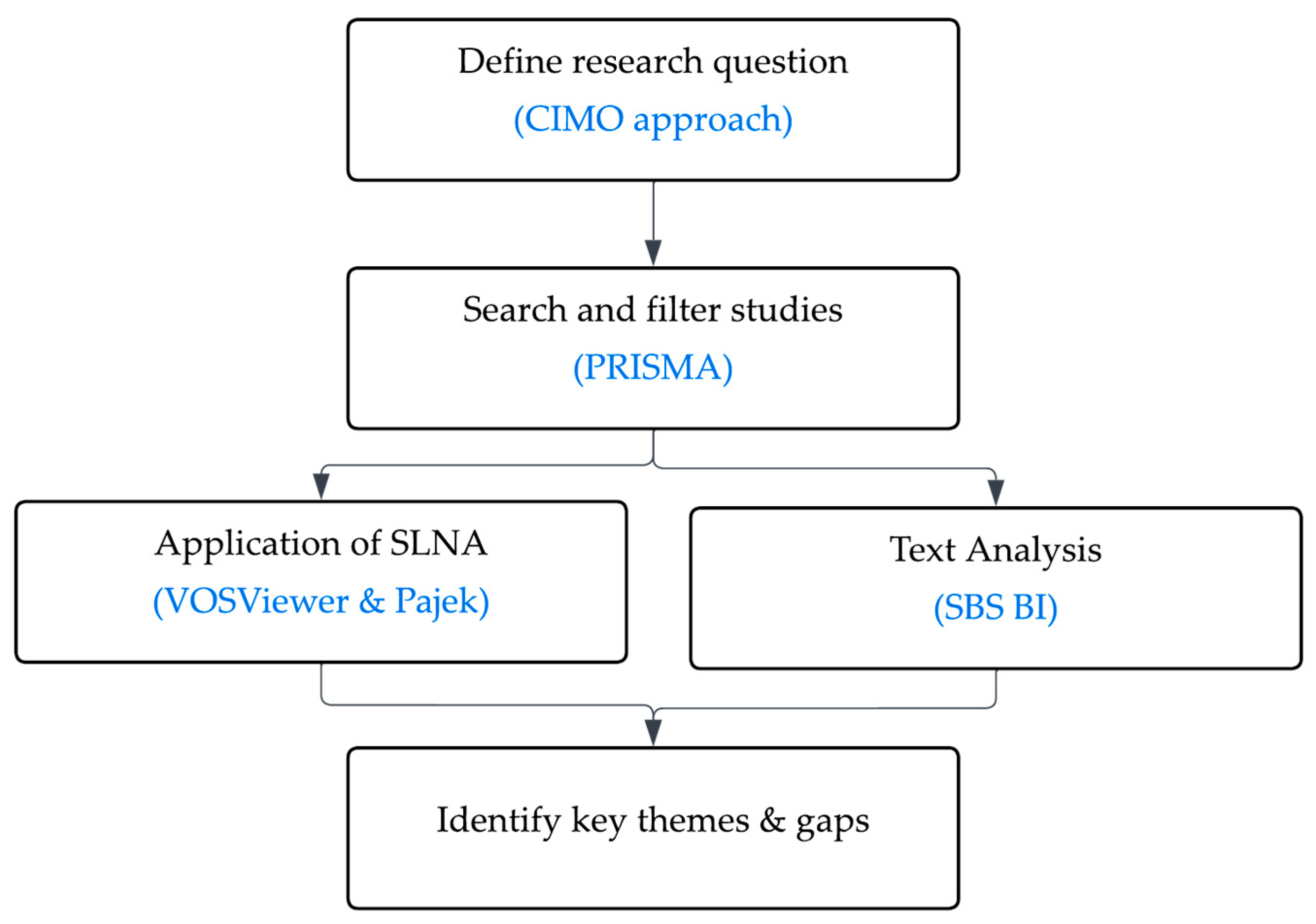
Following the systematic retrieval of the literature, the bibliographic network analysis phase was conducted. This phase began with Citation Network Analysis (CNA), mapping the relationships between articles based on citations to identify influential papers and key contributors. Concurrently, Keyword Analysis was performed through the visualization of keyword networks using tools like VOSviewer 1.6.20 to identify trends and research clusters. Finally, the Main Path Analysis was utilized to identify the most influential paths of knowledge propagation within the citation network [46]. This was applied to the largest connected component and individual research clusters to trace the evolution of ideas. The analytical workflow is illustrated in Figure 1, summarizing the integration of SLR and network analysis tools. This visual representation ensures clarity and facilitates replication.

3.2. Text Analysis

Textual analysis complements SLNA by providing deeper insights into the content of the selected papers. To examine the texts of the abstracts, we used the Semantic Brand Score Business Intelligence (SBS BI 9.3.00) application [47]. This software tool allowed us to identify the relevant themes through the use of the Semantic Brand Score (SBS) metric [48] and to conduct an analysis about the novelty and impact of the selected papers. The SBS is a metric designed to measure the semantic importance of specific concepts within a large textual corpus. It is calculated based on three key dimensions: prevalence, diversity and connectivity. Prevalence highlights how frequently a concept appears across texts. Diversity captures the uniqueness of a topic’s connections within the corpus’s semantic network. It is computed using a centrality metric, known as Distinctiveness [49]. Connectivity, on the other hand, expresses the “brokerage power” of a concept, i.e., how much it bridges connections among terms in the discourse and is measured through Weighted Betweenness Centrality [50]. In this study, we use SBS to identify the main themes discussed in supply chain risk management.
To ensure scientific reproducibility, the SBS is formally defined as the sum of three standardized indices derived from social network analysis. Because these components are standardized based on the specific dataset, the final SBS does not operate on a fixed absolute scale (e.g., 0 to 100); rather, it serves as a continuous, relative metric to rank the semantic importance of terms within this specific textual corpus. For a given concept i, the score is calculated as: S B S i = P r e v a l e n c e i + D i v e r s i t y i + C o n n e c t i v i t y i . This multi-dimensional metric allows for an assessment of a term’s importance that accounts for both its frequency and its structural role within the discourse. These metrics are grounded in established graph theory: Diversity is operationalized through Distinctiveness Centrality, which identifies unique semantic neighbors by weighting connections by the inverse of their degree. Connectivity utilizes Weighted Betweenness Centrality to identify concepts that act as “bridges” between disparate thematic clusters in the semantic network.
Traditional bibliometric indicators, such as pure citation counts, primarily measure the overall popularity or impact of a publication rather than its originality. Furthermore, existing bibliometric novelty indicators often rely on atypical combinations of referenced journals or static keyword co-occurrences [51], which may fail to capture the deep semantic evolution of the academic discourse over time. These traditional metrics are insufficient for fully capturing the combinatorial nature of innovation, where true novelty emerges from how different knowledge elements are newly combined within existing intellectual spaces. To address this limitation and bridge the gap between theoretical accounts of combinatorial innovation and quantitative measurement, we introduce the Innovation Ratio.
The Innovation Ratio is a novel metric designed to quantify the degree of originality and influence of a scientific publication relative to both preceding and subsequent scholarly contributions. Our analysis is based on the textual content of each paper’s abstract. Drawing on methodologies established in the patent literature [52,53] and recent advances in textual analysis to identify and measure originality and dissemination of scientific ideas [54]. We define a publication as novel if its abstract exhibits a high degree of dissimilarity from the body of prior research, and impactful if later publications show substantial textual similarity with its abstract.
A key element of this approach is the temporal dimension: the publication year of the focal paper is used to construct two distinct datasets, one comprising earlier abstracts (to assess novelty) and another comprising subsequent abstracts (to assess impact). Novelty is calculated as the average cosine distance between the focal abstract and abstracts published before it, while Impact is measured as the average cosine similarity between the focal abstract and those published afterward. The use of Cosine Similarity to calculate these distances is a standard, robust technique in Natural Language Processing (NLP) for measuring document relationships, ensuring the metric’s stability across varying corpus sizes [55].
In this study, we adopt a 5-year time window, both before and after each publication, to define these comparative sets. This choice is consistent with prior work in the patent and innovation literature [52,53], where a five-year horizon is commonly used to capture local novelty and short- to medium-term influence while maintaining thematic coherence. By focusing on this temporal window, the proposed metrics are designed to identify emerging research trajectories rather than long-term citation dynamics. Finally, the Innovation Ratio is defined as the ratio of Impact to 1-Novelty, capturing the relationship between a publication’s influence on future research and its degree of divergence from earlier work. This indicator assigns greater scientific value to publications that are both novel relative to their predecessors and influential for subsequent research.
The calculation of the Innovation Ratio follows a transparent, four-step vectorization process to ensure the results can be replicated across different computational environments: (1) Vector construction: Abstracts are converted into numerical vectors using a Term Frequency-Inverse Document Frequency (TF-IDF) approach. (2) Cosine similarity (S): The similarity between a focal paper (p) and its comparative reference sets (ref) is determined by the dot product of their vectors divided by the product of their magnitudes:
S ( p , r e f ) = v p .   v r e f | | v p | | | | v r e f | |
(3) Novelty is defined as 1 S ¯ p r i o r where S ¯ p r i o r is the average similarity to the preceding 5-year corpus. Impact is the average similarity to the subsequent 5-year corpus. (4) The final innovation ratio is calculated as i n n o v a t i o n   r a t i o =   i m p a c t 1 n o v e l t y . Similar to the SBS, this ratio does not have a fixed upper bound but is used to rank the corpora relative to one another. A higher Innovation Ratio indicates that a publication is highly original (exhibiting significant divergence from prior literature) and exerts a strong influence on subsequent research.

3.3. Software and Tools

The study employed multiple software tools for data processing and visualization: Prisma2020 has been used to generate the flowchart for the study selection [56]; VOSViewer 1.6.20 is applied to generate bibliometric networks and clusters [57]; Pajek 5.08 is used for advanced social network analysis, such as community detection and main path plotting [58]. VosViewer has an established track record in mapping patterns and structures that appear in bibliographic studies. It is widely used in management and operations research; additionally, its availability at no cost and its straightforward interface/UI also facilitate reproducibility. Pajek allows for handling large networks and is one of the only tools that enable main path analysis, which is essential for mapping the development trajectory of a research topic. Both tools complement each other in terms of visualization and structural analysis, whereas SBS BI is employed for textual and semantic network analysis [47]. While established peer-reviewed bibliometric software such as VOSviewer, CiteSpace 6.4.R2, and Bibliometrix 5.0 are highly effective for mapping static co-occurrence networks and structural metadata, the SBS BI application was specifically selected for its unique capability to perform dynamic, longitudinal semantic analysis. Unlike traditional packages that focus on descriptive bibliometric counting, the SBS approach enables the calculation of the Innovation Ratio by analyzing the deep textual content of abstracts over a moving temporal window. This allows the study to transition from structural mapping to tracking semantic evolution.
The combined SLNA and textual analysis approach offers a holistic perspective by integrating the literature’s structural and semantic dimensions. While SLNA reveals the field’s intellectual structure, textual analysis provides a granular view of its content, ensuring a robust and multi-faceted understanding of sourcing risks and future research directions.

4. Results

4.1. Application of SLNA

4.1.1. SLR Phase Using PRISMA Guidelines

To establish the context of this study, the research question is: what are the main approaches developed in the literature to manage sourcing risks, and what gaps emerge from this analysis? In order to seek answers to the research question, a search was conducted in 2024 using the following query: (TITLE-ABS-KEY (supply AND chain*) AND TITLE-ABS-KEY (sourcing) AND TITLE-ABS-KEY (risk* OR disruption)) AND (LIMIT-TO (DOCTYPE, “ar”) OR LIMIT-TO (DOCTYPE, “cp”)) AND (LIMIT-TO (LANGUAGE, “English”)) in Scopus.
In general, the field TITLE-ABS-KEY allows searching for the core terms (supply chains, sourcing, risks, and disruptions) using wildcards and Boolean operators for comprehensive results and applies document type limitations such as restricted to articles (“ar”) and conference papers (“cp”) for peer-reviewed and cutting-edge research, this limitations was placed as these articles have more credibility and reliability. Additionally, a language filter, i.e., English, is the dominant language of scientific publications. No other restrictions were applied to the search process.
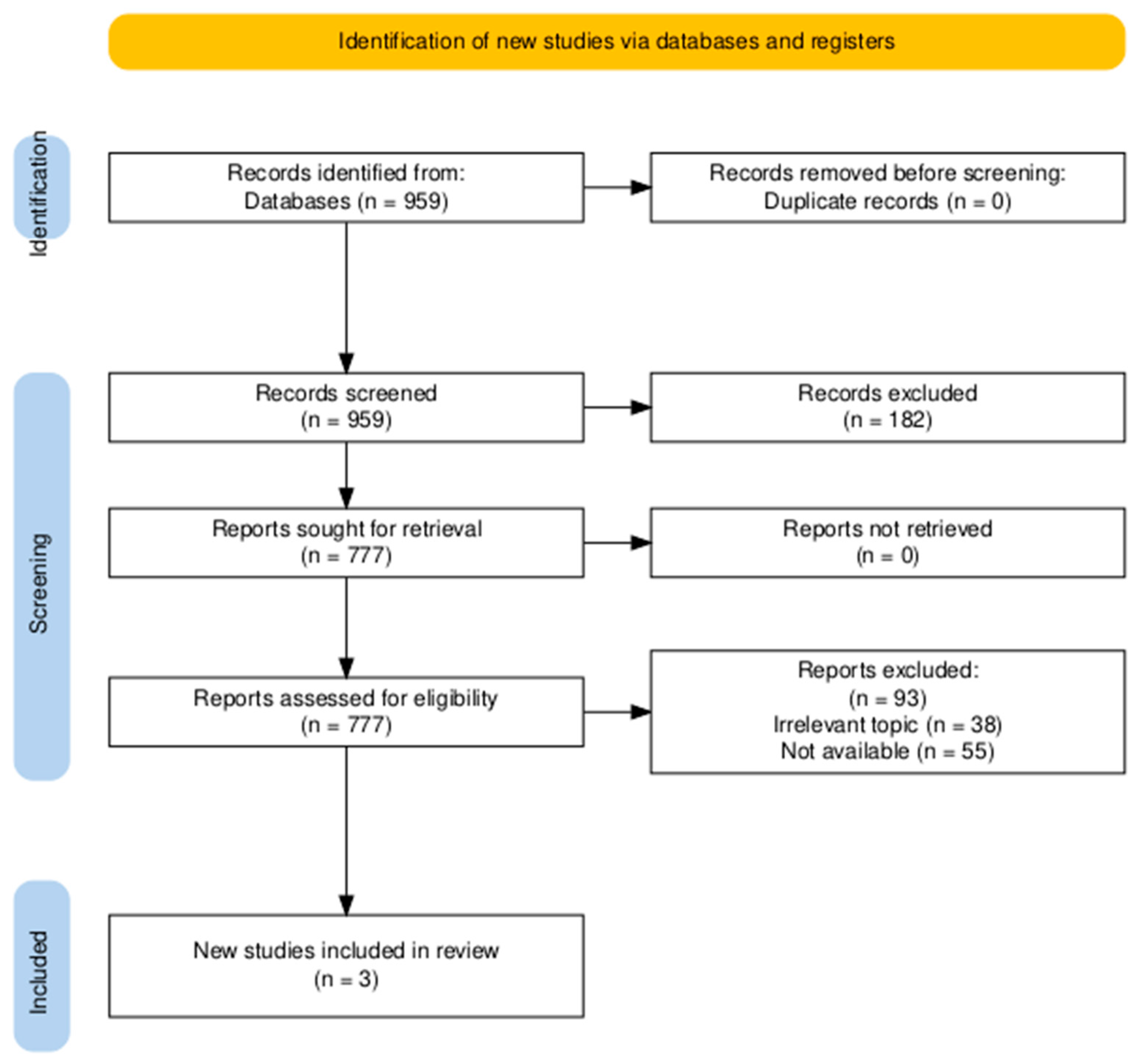
The study selected papers from the Scopus database without placing any restrictions on the time period. Scopus covers over 57 million records, including scientific journals, books, and conference proceedings [44]. While the Web of Science (WoS) was also evaluated, it yielded fewer results, with the vast majority already captured within the Scopus sample. More importantly, conducting SLNA, specifically citation network mapping and main path analysis via tools like Pajek and VOSviewer, requires strict data homogeneity. Merging datasets from Scopus and WoS frequently introduces metadata inconsistencies, mismatched citation formats, and untraceable duplicate records that compromise the structural integrity of the bibliographic network. Therefore, Scopus was exclusively selected to maintain a unified, high-quality dataset, supported by its generally broader coverage in management, logistics, and operations research. Additionally, Google Scholar was excluded from the systematic retrieval process. While expansive, Google Scholar lacks the structured, standardized metadata, API access, and reliable bulk-export capabilities necessary for constructing rigorous, reproducible citation networks. The data retrieval and screening process followed a strict, sequential PRISMA workflow to ensure transparency and reproducibility (Figure 2). The initial database search yielded 959 records. During the first screening phase, 182 records were excluded because they did not correspond to our primary filters (e.g., incorrect document types or language constraints). The remaining 777 reports were sought for retrieval, all of which were successfully obtained. These 777 reports then underwent a rigorous eligibility assessment. During this phase, 93 reports were excluded: 38 were removed because, upon closer inspection, the topic was deemed irrelevant to sourcing risk, and 55 were excluded because their full texts or extended metadata were not available. This filtering resulted in 684 eligible studies. We manually identified and included three additional highly relevant studies, bringing the final dataset to 687 papers. From this final set of 687 papers, a citation network was generated, and the largest connected component consisting of 378 strongly interlinked papers was extracted to conduct the subsequent community and main path analyses. It is important to clearly position this methodology. This research is fundamentally a bibliometric mapping through an SLNA designed to chart the intellectual structure, thematic evolution, and semantic trends of the field. As the objective is to map the scientific discourse rather than to evaluate the empirical strength, effect sizes, or clinical validity of specific interventions, a formal risk of bias assessment at the individual study level was not applicable. The PRISMA framework was utilized strictly to ensure a highly transparent, structured, and reproducible literature retrieval and filtering process.
This precise approach identified 687 relevant works on sourcing risks in supply chains, ensuring high-quality literature for systematic review and analysis.

4.1.2. Bibliographic Network Analysis

As mentioned previously, the bibliographic network analysis itself contains sub-analyses, which are based on the citation network and the author keyword analysis.
Citation Network
The first bibliographic network studied is the citation network. To better understand the research, aim inside the citation network, we have applied a community detection tool called the Louvain method on the biggest connected component with 378 papers. The method applied was developed by [59], and it is a popular and efficient algorithm for community (cluster) detection in large networks. The application of the Louvain method to the biggest connected component with 378 papers detects four main clusters: Community 1: 184 papers; Community 2: 172 papers; Community 3: 17 Papers; Community 4: 5 papers.
To ensure the structural integrity of the identified clusters, network topological metrics were calculated. The citation network exhibited a high Modularity Index (Q = 0.84), which significantly exceeds the typical threshold of 0.4, indicating a well-defined community structure where nodes are more densely connected within clusters than between them. Furthermore, the Average Path Length of 3.12 suggests a ‘small-world’ property, where information and theoretical influence propagate efficiently across the field. These metrics provide the statistical foundation for the subsequent semantic analysis, ensuring that the thematic clusters identified are not artifacts of the software but represent genuine, distinct intellectual communities. This structural robustness is a prerequisite for our Innovation Ratio, as it allows us to reliably measure how ‘original’ ideas move from these dense foundational clusters into emerging, more sparsely connected research frontiers.
(a)
Main Path of Community 1: Supply Chain disruption
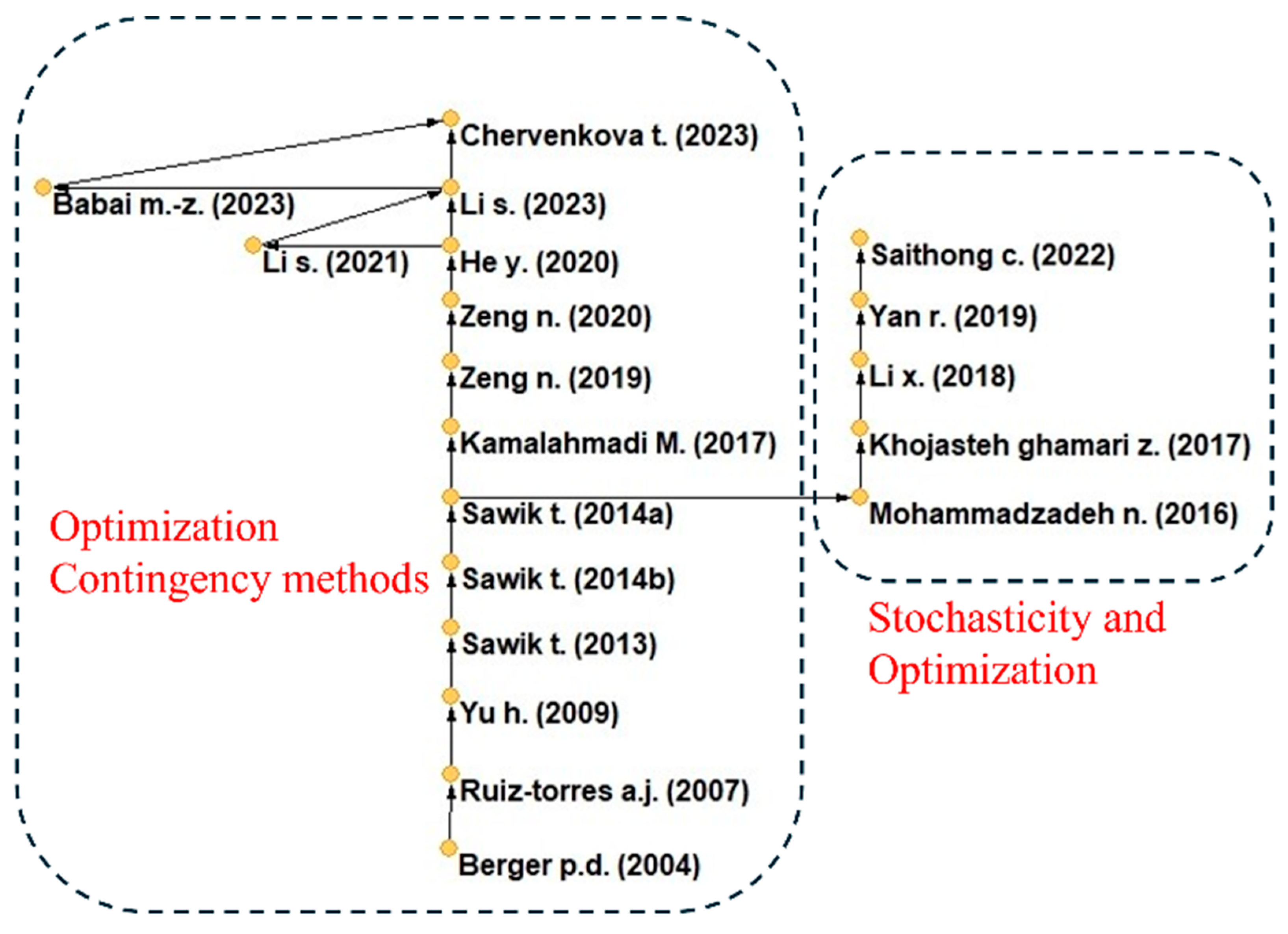
The main path of Component 1 has two branches (Figure 3). The right branch shows that the research started from the foundational works of [60] focused on determining the optimal number of suppliers and early strategies for managing supplier risks, then evolved towards integrated strategies, such as dual sourcing and contingent sourcing, highlighting flexibility and redundancy as critical elements [61]. Recent studies such as [62] addressed adaptive strategies during unprecedented global events like the COVID-19 pandemic, emphasizing the importance of agility.
The analysis of the left branch reveals a shift in focus over time. In the mid-2010s, research emphasized coordination and multi-sourcing strategies to handle supply chain disruptions. The authors of [63] introduced cooperative mechanisms for triple sourcing, followed by [64], who proposed a multi-criteria optimization approach for double sourcing, highlighting the benefits of diversification. By the late 2010s, attention turned to optimizing procurement and order policies under disruptions. The author of [65] explored procurement strategies under random yield risks, while [66] developed order policies for dual-sourcing under supply disruptions. More recently, ref. [67] advanced this research by integrating stochastic elements into dual-sourcing strategies. Overall, studies in this branch evolve from general coordination mechanisms to sophisticated optimization models addressing multiple uncertainties in supply chain management.
(b)
Main Path of Community 2: Evolution of Supply Chain Resilience and Mitigation Strategies (2004–2023)
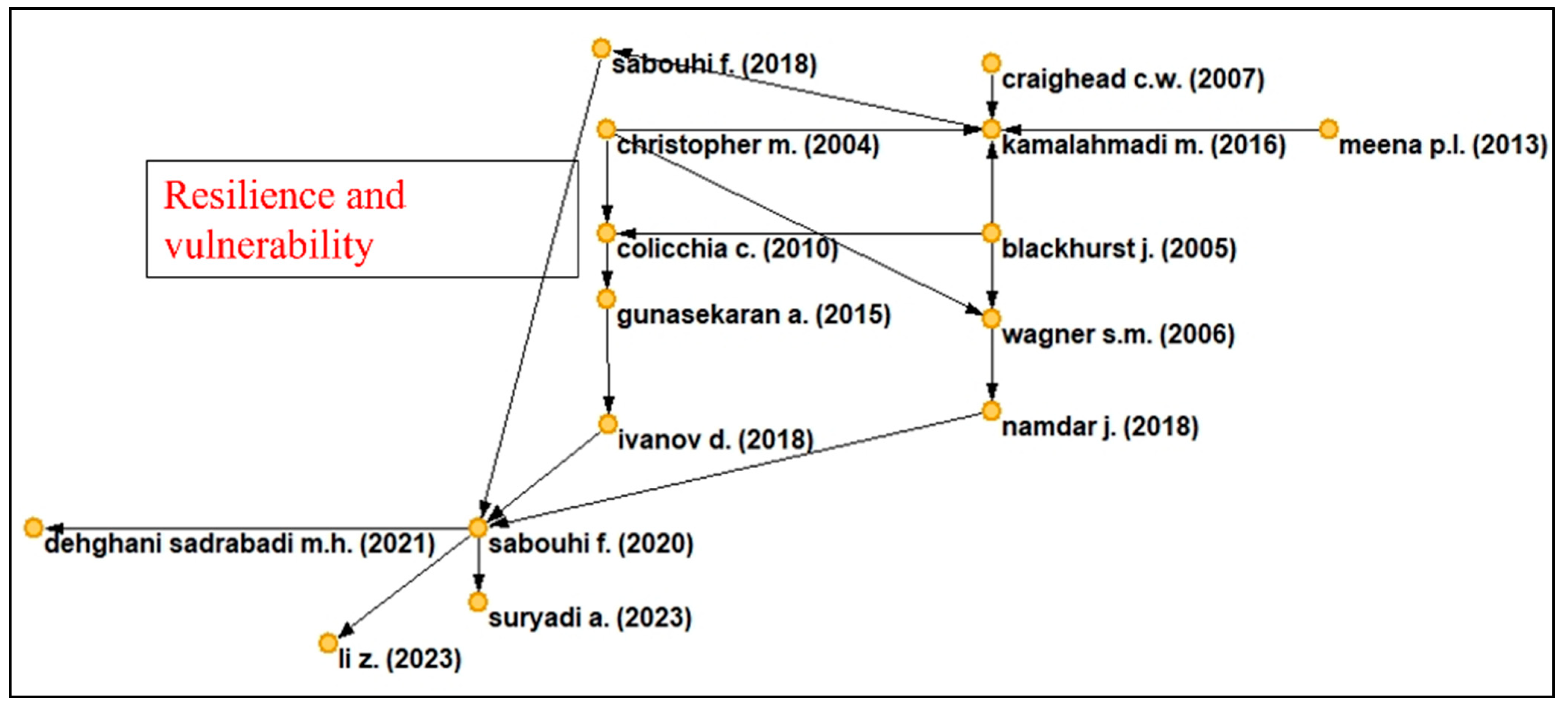
Community 2 has 172 papers, and it was considered appropriate to extract the Main Path (Figure 4). The references of the papers are in Table A3. The papers have been analyzed, and the following contents have been identified. In the early 2000s, foundational work began to define and build resilient supply chains. Ref. [14] was among the first to focus on “Building the Resilient Supply Chain,” laying the groundwork for understanding the components and importance of resilience. Following this, ref. [68] conducted an empirical investigation into supply chain vulnerability, which highlighted the various factors contributing to supply chain disruptions. The authors of [69] examined the severity of supply chain disruptions and the design characteristics and mitigation capabilities needed to address them.
The authors of [70] introduced a simulation-based framework to evaluate strategies for managing global inbound supply risk by exploring multiple sourcing under supplier failure risk and quantity discount, utilizing a genetic algorithm approach to optimize sourcing decisions. This period marked a move towards more analytical and quantitative methods in managing supply chain risks.
By the mid-2010s, the focus had firmly shifted to improving supply chain resilience. The authors of [71] discussed the role of complexities and strategies in building resilient supply chains. The authors of [72] conducted assessments of supply chain disruption mitigation strategies, contributing to a deeper understanding of how to handle disruptions. The authors of [73] focused on resilience for single and multiple sourcing in the presence of disruption risks, and [74] explored resilient supply chain design under operational and disruption risks through a case study.
Recent years have seen the development of advanced strategies and real-life applications aimed at improving supply chain resilience. Ref. [75] proposed a multi-cut L-shaped method for resilient and responsive supply chain network design. Ref. [76] examined designing disruption-aware supply chain networks with precautionary and contingency strategies through a real-life case study. The authors of [77] focused on designing a resilient retail supply network for fresh products under disruption risks, while [78] considered regional risks and mitigation strategies in the supplier selection process.
These studies are important in the context of sourcing risk because they collectively show how modern supply chains must move from simple risk-aware purchasing to structured, analytical, and resilience-focused sourcing strategies. Each set of contributions deepens the understanding of how firms should anticipate, withstand, and recover from disruptions that threaten material availability, supplier performance, and operational continuity. Additionally, the message is that sourcing risk is not just about choosing supplies but also about designing systems that can function and operate during disruptions.
(c)
Main Path of Community 3: strategic sourcing, responsible sourcing and modern slavery
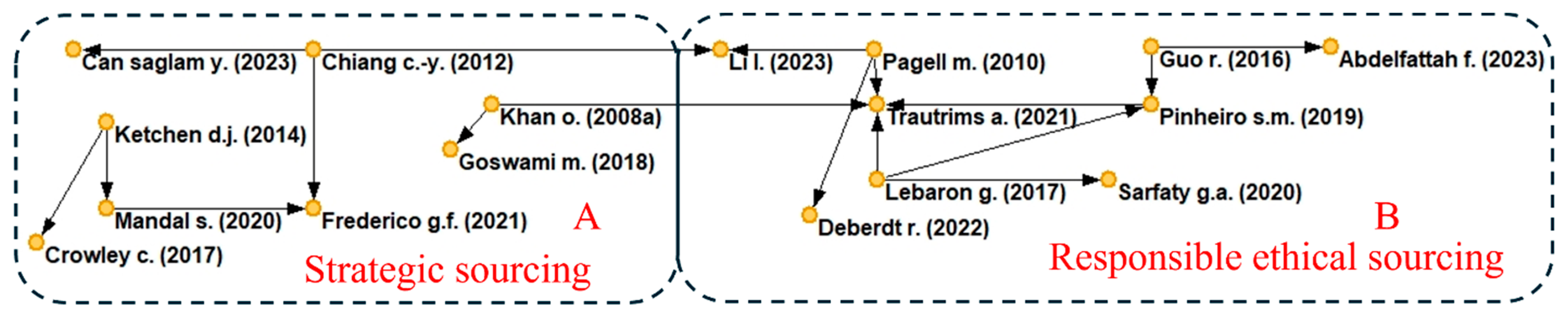
Community 3 consists of only 17 papers; therefore, it was possible to analyze the entire cluster comprehensively without the need to extract a narrowed Main Path. As illustrated in Figure 5, the citation network structurally bifurcates into two distinct branches. Because algorithmic sub-clustering can be unstable on such a small sample size, we employed a manual, qualitative thematic analysis of the full texts to interpret these structural branches. This qualitative review confirmed a clear thematic divergence aligning with the network’s visual topology: Group A papers predominantly focus on ‘strategic sourcing’ and agility, whereas Group B papers form a cohesive discourse around ‘responsible sourcing,’ ethics, and modern slavery.
Papers in Group A range from 2008 to 2023, and research on supply chain management evolved from studying product design’s impact on risk to advanced strategies for agility and resilience. Early work by [79] explored the influence of design decisions on supply chain vulnerabilities. The 2010s shifted focus to strategic sourcing, with Chiang et al. (2012) [80] highlighting its role in agility and [33] expanding to supply ecosystems. The digital era brought innovative sourcing practices, as studied by [81,82]. Recent research emphasized resilience, innovativeness, and agility, with [83] identifying key enablers for agile responses to disruptions, among the many enablers, the author mentions that strategic sourcing and competence are fundamental to supply chain agility.
Considering the papers of B Group, from 2010 to 2023, it seems that research on sustainable and responsible sourcing evolved from foundational concepts to addressing complex global challenges. Early work by [84] emphasized integrating sustainability into purchasing decisions. By 2016, ref. [85] highlighted ethical sourcing and the role of audits in maintaining sustainability. Late 2010s research, such as [86] focused on legal compliance and combating modern slavery. Recent studies, including [87] on mineral sourcing and [88] on SMEs during disruptions, emphasize adaptability, ethics, and resilience in supply chains, reflecting a holistic, global approach.
(d)
Main Path of Community 4: Evolution of Data Visibility, Quality, and Sustainability in Supply Chains (2012–2023)
The papers of Community 4 are only five and illustrate the evolving landscape of supply chain management. Taken together, these papers mark a decade-long progression in how supply chains moved from basic traceability concerns toward sophisticated, data-driven visibility and integrated planning. From 2012 to 2023, supply chain research evolved from managing quality and visibility to leveraging data for sustainability and agility. The authors of [89] emphasized transparency in multi-layer supply chains; they discussed deep uncertainty about the upstream quality by mentioning the product recall scenarios, all of which highlight the aspect of product integrity. The authors of [90] addressed asymmetric quality information, mentioning that when manufacturers cannot observe suppliers’ quality levels, the entire structure of optimal purchasing, pricing, and production must change to account for hidden quality variance and uncertainty. They, however, only mentioned this in a general framework without testing actual scenarios. Later, ref. [91] highlighted data quality’s role in procurement, and [92] stressed strategic location decisions for sustainability. The author of [93] advanced real-time data visibility for agile operations. This research trajectory underscores the importance of data-driven decision-making, flexibility, and resilience in adapting to dynamic supply chain environments.
As a whole set (community), these papers reveal a coherent narrative that a sourcing risk cannot be mitigated through sourcing decisions alone unless firms possess trustworthy, timely, and actionable visibility into upstream processes. In the earliest stage of this progression, visibility is shown to be the direct mechanism through which quality failures propagate undetected across a multi-layer supply chain. The references for the papers of Community 4 are in Table A6.
Authors’ Keywords Network
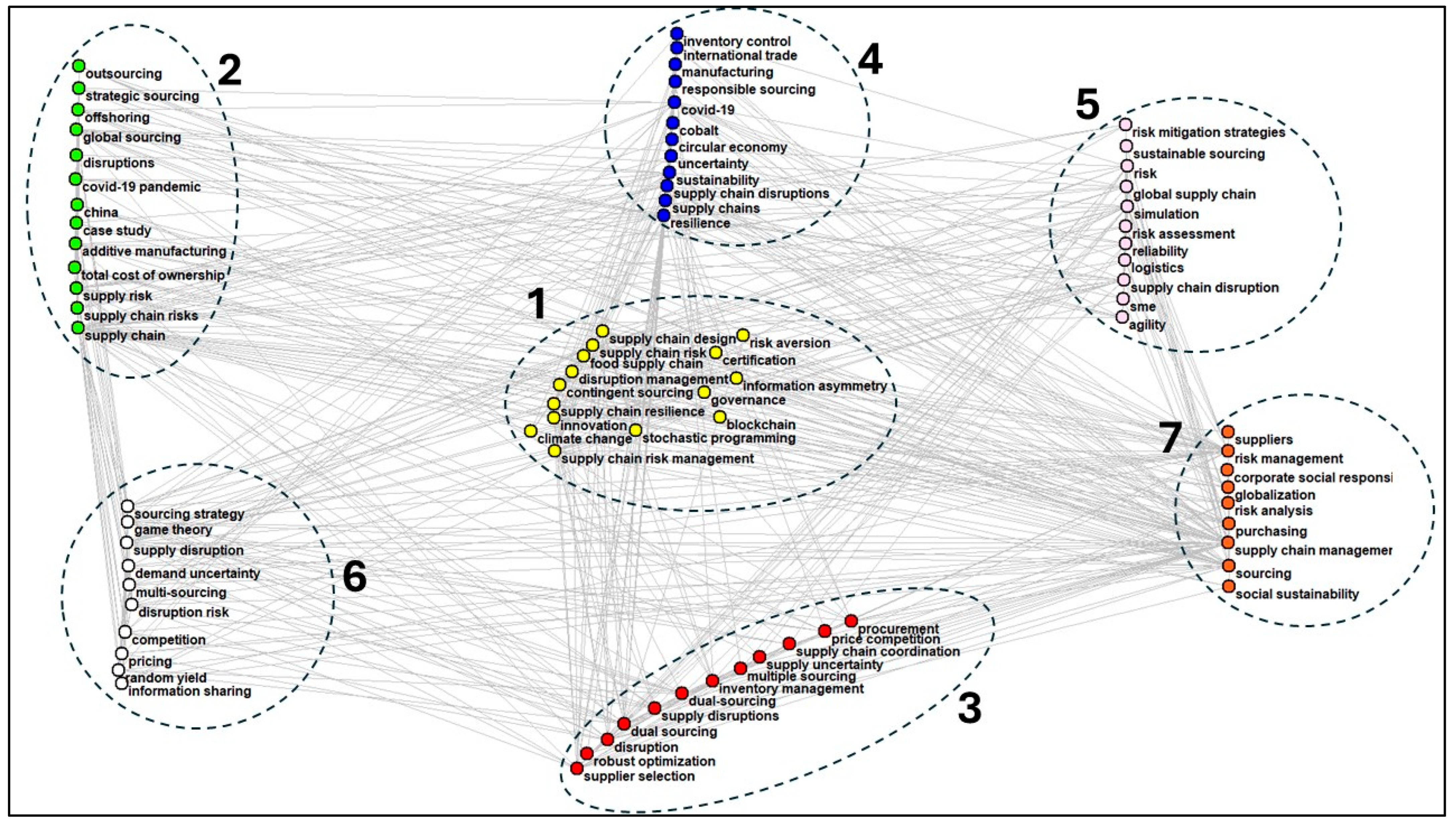
Author keywords provide a concise representation of the conceptual focus of publications and are widely used to identify thematic structures within a research field. To identify the dominant research areas, author keywords were analyzed using VOSviewer co-occurrence analysis. VOSviewer is particularly appropriate for keyword co-occurrence mapping, which aligns with this study’s objectives. Clustering relies on association-strength normalization (VOS clustering algorithm). The minimum keyword occurrence threshold was set at 5, full counting was employed, and cluster resolution was set to 1. No manual normalization was performed; synonymous terms and keyword variants were intentionally not merged to preserve the original author-defined terminology. As in standard bibliometric analyses, results may be affected by preprocessing choices. Thematic interpretation is performed on algorithmically generated clusters.
As global co-occurrence networks can become visually dense, Table 3 details the top-occurring keywords within each of the seven identified clusters to provide a clear, scannable summary of the network’s composition.
  • First cluster: Blockchain, Food, Information Asymmetry
The keyword network reveals a tight clustering around “blockchain,” “food supply chain,” and “information asymmetry,” indicating that the literature predominantly views blockchain as a primary technological solution for tracking vulnerabilities. From a theoretical standpoint, the adoption of blockchain in the food supply chain is a highly relevant topic as it provides solutions to improve transparency, reduce information asymmetry, and enhance food safety [94]. Blockchain enables real-time traceability of food products, fostering greater trust among producers, distributors, and consumers [95]. This area receives a great deal of attention as food contamination can readily affect relationships with other stakeholders [96,97]. Recent advancements further emphasize the critical role of security and privacy-preserving architectures in these food tracking networks. For instance, a recent model by [98] proposes a blockchain-enabled, privacy-preserved supply chain management system specifically designed for tracing food goods. By utilizing Ethereum and smart contracts, coupled with QR code scanning. This architectural approach ensures that product tracking data remains completely immutable and transparent, thereby effectively mitigating traceability vulnerabilities and security risks without the need for traditional third-party trust mechanisms.
  • Second cluster: Global Sourcing
The second cluster structurally bridges “global sourcing” and “offshoring” with nodes representing “disruptions” and the “COVID-19 pandemic,” demonstrating that global sourcing is explicitly tied to systemic vulnerabilities in the academic discourse rather than just cost-saving mechanisms. This matters because global sourcing, while a key strategy for companies operating in international markets, inherently involves geopolitical, economic, and environmental risks [99]. For instance, ref. [100] emphasize the critical role of structural mitigation, demonstrating how supplier diversification and dual-sourcing act as primary buffers against such localized disruptions. Complementing this, ref. [101] highlights the necessity of operational agility; their work shows that building dynamic capabilities and utilizing continuous supplier monitoring can proactively identify hidden risks before they materialize. Together, these strategies provide a comprehensive defense against global sourcing uncertainties. It is pertinent to mention that the risks emanating from COVID-19 have had a drastic change, while mitigation strategies have helped; some risks, particularly related to logistics/transportation, have seen an increase [102].
  • Third cluster: Optimization, Number of Suppliers
In the third cluster, the map shows a strong co-occurrence of terms like “supplier selection,” “robust optimization,” “dual-sourcing,” and “inventory management,” visualizing the methodological focus on quantifying supply base risks. The underlying relevance of this cluster is that optimizing the number of suppliers is a strategic decision in supply chain management. Too many suppliers can increase management costs and reduce efficiency, while too few may increase vulnerability to disruptions [103]. To navigate this, researchers commonly employ quantitative approaches, such as linear programming models and optimization algorithms, to balance costs, risks, and reliability [104].
  • Fourth cluster: Circular Economy, Responsible Sourcing, and Sustainability
The fourth cluster groups “circular economy,” “responsible sourcing,” and “sustainability,” highlighting a distinct thematic convergence around environmental impact. This structural grouping is significant because the circular economy and sustainability in supply chains are becoming essential for companies aiming to reduce their environmental footprint [105]. Responsible sourcing ensures that resources are acquired ethically and sustainably, minimizing environmental and social risks [106,107].
  • Fifth cluster: Simulation and Risk Mitigation Strategies
The fifth cluster visually connects “simulation” with “risk assessment,” “risk mitigation strategies,” and “agility.” This network link indicates that simulation methodologies are the primary analytical vehicle for testing mitigation tactics. Thematically, the use of simulation and risk mitigation strategies allows companies to anticipate and manage potential disruptions in supply chains before they manifest [108]. Techniques such as Monte Carlo simulation and digital twin technology are advanced tools for scenario analysis and improving supply chain resilience [109].
  • Sixth cluster: Game Theory, Competition, Information Sharing
The sixth cluster shows a strong linkage between “game theory,” “competition,” “pricing,” and “information sharing,” demonstrating that sourcing risk is frequently modeled as a multi-agent economic problem. In practice, the application of game theory in supply chains helps model competition and cooperation dynamics among stakeholders [110]. Information sharing plays a crucial role in enhancing coordination and reducing uncertainty in supply chain operations.
  • Seventh cluster: Social Sustainability, Responsibility
Finally, the seventh cluster maps “corporate social responsibility” alongside “social sustainability,” “globalization,” and “purchasing,” isolating the human and ethical dimensions of sourcing from purely operational risks. This topic matters because social sustainability is an increasingly relevant aspect of supply chain management, focusing on workers’ well-being, Corporate Social Responsibility (CSR), and fair wages [111]. Companies must implement strategies to ensure ethical and responsible working conditions throughout the supply chain [112].
The theoretical tension between traditional cost optimization and modern resilience is a central finding of our network analysis. Historically, foundational sourcing models prioritized efficiency and lean operations. However, our recent cluster data highlights a distinct paradigm shift toward the circular economy and robust supply chain resilience. This transition inherently creates conflicting operational objectives for managers, who must now balance cost-minimization with sustainable practices. By mapping these distinct clusters, our analysis reveals exactly how recent literature is attempting to reconcile these competing priorities.
This theoretical conflict is visible in the structural distance between these communities within the citation network. Literature rarely integrates these opposing paradigms comprehensively. Mathematical optimization models frequently fail to incorporate the non-linear, qualitative variables required for true supply chain resilience, while sustainability research often lacks the rigorous quantitative optimization required for cost-effective implementation. Consequently, this structural isolation highlights a critical gap in the literature: the field has yet to widely develop hybrid frameworks that can mathematically balance the trade-offs between cost-efficiency and ethical robustness.
The overall network topology reveals a distinct core-periphery structure that maps the field’s intellectual flow. The ‘Optimization’ and ‘Supplier Selection’ communities exhibit a high degree of centrality, forming the mathematical backbone of the literature. Conversely, highly innovative topics like ‘Ethics and Modern Slavery’ and ‘Circular Economy’ remain on the network’s periphery, indicating they are not yet fully integrated into the dominant discourse. Between these extremes, ‘Supply Chain Resilience’ and ‘Agility’ function as critical boundary-spanning clusters. Possessing high betweenness centrality, they act as intellectual bridges connecting the quantitative, cost-focused core with the qualitative, sustainability-focused periphery. This structural mediation illustrates the field’s ongoing effort to reconcile traditional efficiency paradigms with emerging institutional demands.

4.2. Text Analysis

To identify the topics of greatest interest and assess their semantic importance, we first examined the author keywords of each study and then performed a textual analysis of the abstracts.
Before conducting any textual analysis, a comprehensive abstract pre-processing phase was carried out to reduce linguistic complexity while retaining the most meaningful terms. Specifically, for the English corpus, non-informative elements such as punctuation, hyperlinks, and special characters were removed, and stopwords were filtered out using the standard English stopword list from the NLTK Python 3.12 package [113]. The text was then normalized through conversion to lowercase, and Porter stemming was applied (also using NLTK) to reduce words to their root forms by removing affixes [114]. In the final stage of text preparation, the processed content was transformed into undirected networks to enable the calculation of the SBS metric. Once pre-processing was completed, keyword extraction was performed employing the Term Frequency-Inverse Document Frequency (TF-IDF) approach. Candidate keywords were initially selected based on term frequency, after which terms appearing in more than 85 percent of the documents were excluded to reduce noise from overly generic words. The TF-IDF was then computed as t f   ×   log ( N d f ) , with L2 normalization applied at the document level. Rather than using a fixed TF-IDF threshold, the terms were ranked by their TF-IDF scores, and the top 1000 terms were retained for further analysis.
This method enhances the importance of keywords based on their frequency within the text while proportionally decreasing their relevance in relation to their overall distribution across the entire collection. While the resulting keyword lists provide a data-driven representation of salient terms, their aggregation into coherent research topics requires interpretative judgment. To mitigate the subjectivity inherent in qualitative topic construction and ensure the interpretative step was validated, a triangulated expert-validation protocol was employed. After the initial quantitative TF-IDF extraction of the top 1000 keywords, two senior academic experts in supply chain risk management independently reviewed and grouped the terms based on conceptual proximity and established theoretical frameworks. This double-blind categorization was followed by a Consensus-Building Session to resolve discrepancies, particularly regarding terms that could span multiple categories. This rigorous process ensures that the 16 identified topics represent robust theoretical constructs rather than subjective or non-validated clusters. Table 4 illustrates the topics identified, along with representative words associated with each of them.
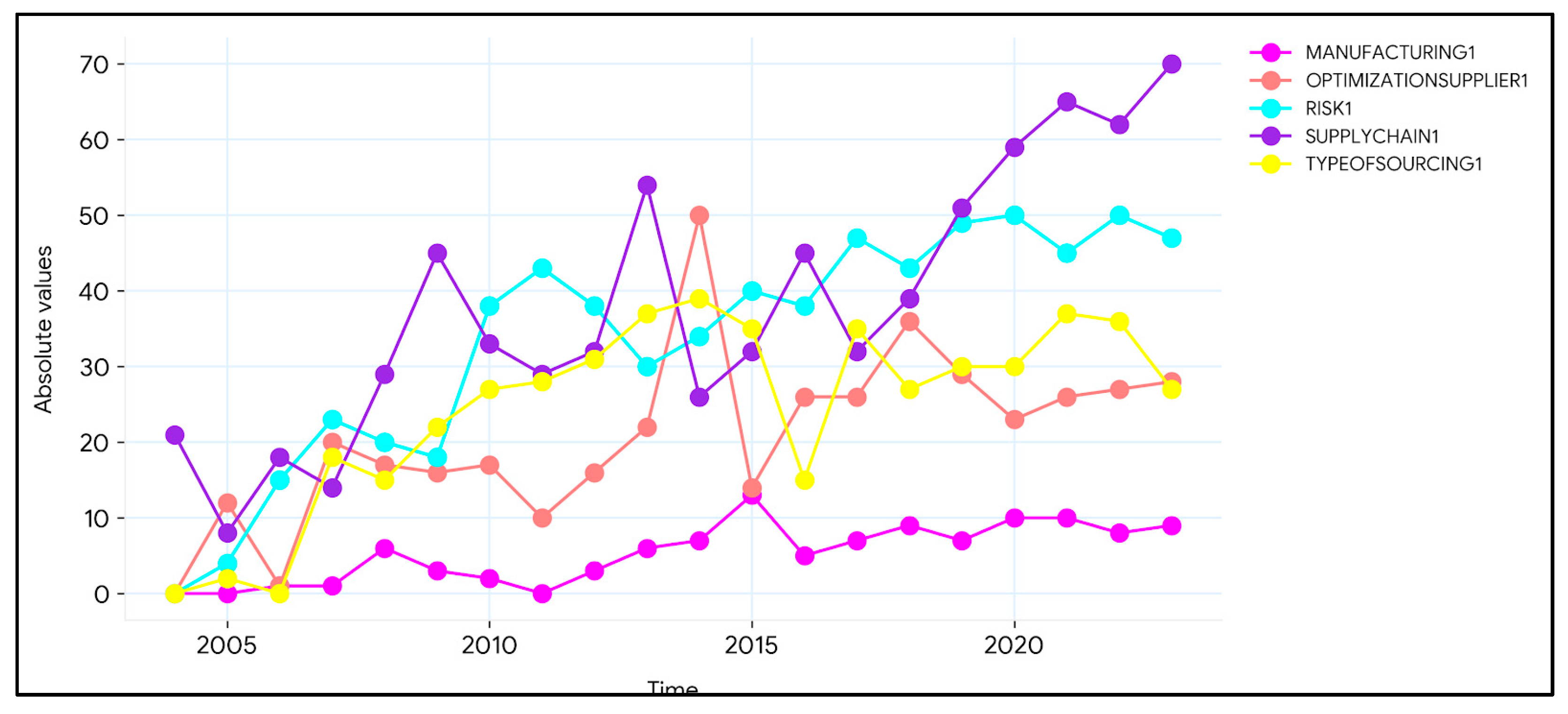
Once the topics were defined, their semantic importance over time was analyzed using the Semantic Brand Score (SBS). The longitudinal trajectory of the SBS indicates a structural theoretical break. While traditional operational topics like ‘Manufacturing’ maintain a consistent yet peripheral semantic presence, the rising prevalence and distinctiveness of themes such as resilience and agility signify the field’s progressive adoption of the RBV and DCV as dominant interpretive frameworks. This evolution suggests that the conceptualization of sourcing risk has matured from a deterministic focus on efficiency to a complex systems perspective that prioritizes adaptive capacity under conditions of severe uncertainty.
The thematic boundaries delineated in Figure 6 illustrate this theoretical fragmentation. The clusters do not merely represent distinct operational topics but highlight competing academic paradigms. The isolation of ethical sourcing topics within the network topology, despite their high semantic novelty, underscores a theoretical rigidness within the core literature. The core of the field remains mathematically anchored to optimization algorithms, while the conceptual frontier is exploring unquantifiable institutional risks. This visualizes the precise mechanism by which the literature is attempting, and occasionally failing, to integrate non-linear social risks into traditional cost-based supply chain models. Furthermore, as illustrated in Figure 7, the semantic evolution extends beyond a mere chronological shift in keyword popularity; it represents a fundamental epistemological transition within the sourcing risk literature. The early dominance and distinct historical peaks (observed around 2008 and 2014) of terms such as ‘supplier optimization’ and ‘types of sourcing’ reflect the foundational influence of TCE, where risk was treated as a calculable hazard to be minimized.

Innovation Analysis

For the Innovation analysis, we used the SBS BI application to calculate the Innovation, impact and Novelty scores of each paper, as described above. We then averaged these values for articles based on the previously defined communities. Table 5 presents the average Innovation value of the abstracts belonging to each community, arranged in descending order.
The research area of Community 3B, which focuses on responsible sourcing, ethics, and modern slavery, exhibits the highest level of innovation, reflected in an Innovation index of 1.09. This indicates that the documents within this community are more distinct from prior literature and more closely aligned with themes that emerge in subsequent publications, suggesting that Community 3B occupies a structurally innovative and potentially relevant position within the evolving research landscape.
When comparing the two largest communities, namely Community 1 (Suppliers Optimization and Stochastic Failure, encompassing 184 papers) and Community 2 (Resilience and Vulnerability, with 172 papers), we find that Community 1 has the lowest innovation score; however, it has the highest impact value of 0.077. However, the effect is heavily impacted by the novelty score. We find that Community 2 stands out as recently owing to the COVID-19 pandemic, resilience has become important in all walks of life and business.
Overall, the integration of community detection, main path analysis, and innovation indexing offered a robust approach to understanding the evolving landscape of supply chain research. Clustering revealed distinct thematic communities, with Community 3B, which is centered on responsible sourcing and ethics, that emerge as the most innovative. This finding aligns with the growing academic and industry focus on ethical and sustainable supply chain practices in response to regulatory pressures and social expectations [115,116]. A notable paradox emerges when evaluating Community 3B (Responsible Sourcing, Ethics, and Modern Slavery): while it achieves the highest Innovation Ratio (1.09), it simultaneously records the lowest absolute Impact score (0.048) among all interlinked communities. Rather than indicating a lack of relevance, this divergence is characteristic of a ‘latency period‘ in the lifecycle of a scientific paradigm.
Theoretically, this indicates that this community represents a ‘frontier‘ topic. Its conceptual ideas are highly original and significantly diverge from traditional TCE frameworks (yielding high novelty), but they have not yet achieved mainstream integration or the dense citation volume seen in foundational clusters like supplier optimization (yielding low current impact). Practically, this signals a critical window of high potential. As ethical sourcing and modern slavery regulations (e.g., the UK Modern Slavery Act) increasingly demand corporate compliance, the literature is mathematically destined to shift in this direction. Therefore, early adoption of these highly innovative, nascent frameworks offers managers a strategic advantage to build resilience and trust before these practices become standardized baseline requirements.
Furthermore, while Community 1, focused on supplier optimization and stochastic failure, had the lowest innovation score, its high impact reflects the ongoing relevance of operational efficiency and risk mitigation models, especially in complex global networks [117]. Meanwhile, the elevated attention to Community 2 on resilience and vulnerability mirrors recent trends driven by systemic shocks like the COVID-19 pandemic, which highlighted the need for adaptable and robust supply chains [118,119].
By combining bibliometric techniques with innovation metrics, this study not only maps established and emerging research fronts but also provides a forward-looking lens to identify high-potential areas for future inquiry. These insights are critical for scholars, practitioners, and policymakers aiming to enhance supply chain resilience and sustainability in the face of increasing global uncertainty.

4.3. Synthesis of Structural and Semantic Findings

By synthesizing the structural results from the Citation Network and Main Path Analysis with the semantic results from the SBS analysis, a clear evolutionary pattern emerges. Topics identified as having high ‘Impact’ but lower ‘Novelty’ in the SBS analysis (such as Supplier Selection and Optimization Models) correspond directly to the dense, central clusters in the citation network. This indicates that while these themes are no longer the ‘frontier’ of innovation, they remain the structural ‘anchor’ of the field, providing the mathematical and theoretical foundations upon which newer research is built.
Conversely, topics with high ‘Novelty’ and rising ‘Relevance’ (such as Modern Slavery and Circular Economy) are currently located on the periphery of the citation network. This structural positioning suggests these are emerging communities that have not yet achieved the dense interconnectedness of foundational topics but are rapidly gaining conceptual importance. To quantify this thematic evolution, we rely on the Innovation Ratio derived in our methodology, recalling that this metric mathematically balances a publication’s semantic novelty against its subsequent impact. Our semantic findings reveal exceptionally high Innovation Ratios within clusters focused on responsible sourcing and modern slavery. Because these papers exhibit substantial quantitative divergence from prior texts yet high similarity with subsequent texts, they represent what we term ‘paradigm stretching.’ In other words, the metrics confirm that these publications are significantly expanding the traditional boundaries of sourcing risk literature while successfully dictating the direction of future research.

5. Discussion

Using SLNA and textual analysis, this study explores scholarly literature. By analyzing and mapping the 687 research papers, intellectual structure and exploring the thematic content of research, we identified key trends, approaches, and research gaps in this critical area of supply chain management. To synthesize the structural and theoretical landscape of the field, Table 6 summarizes the dominant methodologies, theories, and key risks addressed across the analyzed literature.
As detailed in Table 6, the quantitative distribution of the literature substantiates a major paradigm shift. This field of study has fundamentally progressed from foundational supplier optimization toward holistic frameworks emphasizing resilience-building and ethical considerations. This is empirically supported by our finding that Resilience Theory now dominates the theoretical landscape (173 papers), vastly outnumbering traditional, efficiency-focused frameworks like TCE (only 6 explicitly stated papers). Furthermore, the risk categories highlight a broadening scope; while supply disruption remains the primary concern (282 papers), sustainability and ESG risks have surged to become the second most prominent category (121 papers). Methodologically, however, a gap remains: while analytical modeling still dominates (329 papers), dynamic system testing is severely underexplored, with only 10 papers utilizing simulation. The underlying mechanisms driving this shift are twofold, stemming from both external macro-environmental shocks and internal theoretical limitations within traditional modeling. Externally, unprecedented systemic disruptions, most notably the COVID-19 pandemic [1], intensifying geopolitical conflicts [14], and the rapid escalation of Environmental, Social, and Governance (ESG) regulatory mandates acted as institutional catalysts. These events exposed the inherent fragility of highly optimized, lean supply chains, proving that traditional approaches emphasizing supplier capacity and demand fulfillment [12,13] are insufficient in modern contexts.
Internally, this evolutionary shift highlights the critical theoretical limits of classical optimization paradigms. Specifically, we find that the stream of Community 1 focused on supplier optimization and stochastic failure models yields the highest impact value (0.077), hinting at the persistent relevance of these foundational mathematical models. While quantifiable optimization approaches remain a fundamental component of supply chain risk mitigation, our text analysis results suggest that pure optimization approaches may be reaching theoretical saturation. This saturation occurs because classical cost-minimization frameworks inherently struggle to process severe, non-linear ambiguity. Furthermore, they structurally neglect unquantifiable social costs, such as the reputational damage associated with modern slavery or environmental degradation. Consequently, the inability of mathematical models to handle qualitative institutional pressures created the academic space for new frameworks grounded in resilience [19] and ethical responsibility. Nevertheless, our text analysis results suggest that pure optimization approaches may be reaching theoretical saturation, as evidenced by their lower novelty scores relative to newer, ethical and sustainability-focused communities. The impact gap identified in Community 3B (characterized by high innovation but low structural impact) suggests a theoretical decoupling within the literature. Although scholars increasingly recognize ethical and social risks as critical emerging themes, the citation structures of the field remain anchored in foundational optimization models. Consequently, the conceptual expansion of sourcing risk has outpaced its structural valuation in citation networks. Future research must bridge this gap by integrating these highly innovative ethical themes into mainstream quantitative optimization frameworks.
Identifying the optimal empirical setting to test this integration is crucial. In this regard, our results point directly to the agricultural and food industries as the primary frontier. Although the systematic search was strictly sector-agnostic, the disproportionate prominence of the agri-food sector in our results requires critical theoretical contextualization. The food supply chain does not merely represent a vulnerable operational environment due to product perishability and seasonal constraints [120]. Rather, it serves as the primary empirical boundary condition for modern supply chain risk theories. Due to its extreme exposure to intersecting systemic shocks, such as climate-induced agricultural volatility and geopolitical instability [121], alongside intense institutional pressures for ethical traceability and blockchain integration, the food sector represents the exact intersection where traditional optimization models fail. Consequently, it acts as the primary arena where the theoretical tension between foundational cost-optimization and the necessity for dynamic resilience is currently being debated in the literature.
A central theoretical contribution of this study emerges from the synthesis of the citation-based main path and text-based semantic topics. By contrasting these two dimensions, we identify a profound ‘structural-semantic decoupling’ within the field. The main path analysis reveals that the structural backbone of the literature remains heavily anchored in mathematically conservative, path-dependent optimization and stochastic failure models. In contrast, the semantic analysis of textual topics reveals a highly progressive conceptual conversation that is rapidly expanding into qualitative, institutional risks, such as modern slavery, circular economy, and ethical sourcing. This divergence yields a critical higher-order insight: while scholars are conceptually recognizing a broader, more complex risk landscape in their discourse, the mathematical and structural foundations of the field have not yet evolved to formally model these qualitative variables. Bridging this gap between progressive conceptual discourse and conservative structural models represents the most critical imperative for future supply chain risk research.
This decoupling advances theoretical understanding by diagnosing a methodological lock-in within the discipline. It reveals that while institutional theories and stakeholder pressures have successfully expanded the definition of sourcing risk, the analytical tools historically rooted in TCE have remained path-dependent and resistant to unquantifiable variables.
To overcome this, future research must operationalize qualitative semantic topics into structural mathematical models. As a conceptual bridge, we propose the integration of ‘Shadow Pricing of Institutional Risk’ into traditional multi-objective optimization algorithms. For example, topics like modern slavery or circular economy, which currently exist predominantly as qualitative discourse, can be operationalized by assigning quantitative penalty functions (shadow costs) to supplier selection algorithms. Rather than optimizing strictly for unit cost, lead time, and physical delivery failure, a bridged structural model would utilize fuzzy multi-criteria decision-making (MCDM) to translate qualitative ethical audit scores into a quantifiable disruption probability. Under this framework, a supplier with poor modern slavery compliance or a high carbon footprint would mathematically trigger a high ‘reputational failure’ probability. This would effectively render them sub-optimal in a stochastic network design, thereby forcing the algorithm to balance traditional cost-efficiency with ethical resilience.
From this conceptual bridging, specific hypotheses can be formulated for future empirical testing. For instance, future research could test the proposition that: Supply chain networks designed using multi-objective models that incorporate weighted penalty functions for qualitative ESG risks exhibit significantly higher long-term survivability and lower financial volatility during macro-environmental shocks than networks optimized solely on traditional cost and capacity metrics. By developing and testing such hybrid frameworks, scholars can successfully recodify the progressive semantic discourse back into the structural backbone of the field.

6. Conclusions

This study provides a comprehensive and systematic synthesis of the sourcing risk literature by integrating Systematic Literature Network Analysis with advanced textual analysis techniques. By examining 687 peer-reviewed publications through citation structures, thematic evolution, and semantic relevance, the paper clarifies how sourcing risk research has developed over time and where it is currently heading. The findings demonstrate a clear transition from early supplier optimization and cost efficiency models toward more holistic approaches that emphasize resilience, ethical responsibility, and data-enabled decision-making. This evolution reflects the increasing complexity, interconnectedness, and fragility of global supply chains exposed by recent systemic disruptions.
A central contribution of the study lies in revealing how different research streams coexist yet evolve at uneven rates. By mapping these trajectories, we directly answer our primary research aim of identifying the main approaches to sourcing risk and uncovering critical research gaps. While supplier optimization and stochastic modeling remain highly influential foundational approaches, their lower novelty scores suggest theoretical maturity. In contrast, responsible sourcing, ethics, and modern slavery emerge as the most innovative and underexplored areas. This uneven evolution exposes a significant research gap: it indicates a shift in scholarly conceptual attention toward social and institutional dimensions of sourcing risk that has not yet been matched by structural, quantitative modeling. The introduction of the innovation ratio further strengthens this contribution by offering a transparent and replicable metric to assess how research balances novelty and influence over time. Together, these insights extend existing theoretical perspectives by linking sourcing risk management to dynamic capabilities, resource-based considerations, and transaction cost reasoning.
Overall, the study underscores that sourcing risk can no longer be addressed through isolated purchasing decisions or purely analytical models. Effective risk management increasingly depends on system-level resilience, ethical governance, and reliable information visibility across supply networks.

6.1. Theoretical Contributions

The main theoretical contributions of this work are the following. The study highlights the evolution of sourcing risk management, from foundational supplier optimization models to advanced frameworks integrating resilience, sustainability, and ethics. Moreover, the community and Main Path analyses clearly visualize how ideas and strategies have developed over time, offering a roadmap for future research. Additionally, our network analysis reveals that the evolution of sourcing risk aligns with the progression of distinct theoretical lenses. Community 1 focuses on the supplier optimization and modeling (stochastic), which is fundamentally grounded in TCE [19,32], as it focuses on mathematical approaches to minimize costs. Community 2 focuses on resilience and vulnerability; here, the theoretical perspectives shift to RBV and DCV [20,22]. For this, flexibility and network redundancy are viewed as strategic resources that firms dynamically reconfigure to absorb systemic shocks. Community 3 addresses responsible sourcing and modern slavery; this links to [86,122]. This community highlights that sourcing risks are no longer purely operational; they are driven by the need to maintain institutional legitimacy and manage reputational risks from external stakeholders. Finally, Community 4, exploring data visibility and quality, corresponds heavily to Agency Theory and Organizational Information Processing Theory (OIPT) [90,123]. This stream addresses the information asymmetry that exists between buyers and suppliers, pointing towards the fact that the firms must adopt new technologies to mitigate uncertainties.

6.2. Managerial Contributions

The work has practical implications, as findings underline the importance of adopting multifaceted strategies that balance traditional risk mitigation with emerging approaches like dual sourcing, resilience-building, and digitalization. Practitioners are encouraged to integrate technologies like blockchain and AI to enhance visibility, traceability, and agility within supply chains. Ethical sourcing and compliance with regulations such as modern slavery acts should be prioritized, as they are gaining prominence in global supply chain practices.

6.3. Future Directions

The analysis identified several gaps that represent opportunities for future research. While general strategies for sourcing risk management are well-studied, sector-specific approaches remain underexplored, particularly in healthcare and technology. Our findings also reveal notable gaps in the literature. Research on sector-specific challenges, particularly for small and medium-sized enterprises (SMEs), remains limited despite the SME cluster appearing in our keyword analysis. From the analysis, it was apparent that there are discussions on the firms related to food and agriculture. However, other sectors, such as those of pharmaceuticals, are still missing. The results indicate that the food supply chain is both the most prominent and the most sensitive. Other sectors, such as telecommunications, pharmaceuticals, and petroleum, should therefore be examined independently. Additionally, issues related to cold–heat management remain a critical concern throughout the supply chain.
This gap is concerning, given that strategic risk remains vital and core for SMEs, with certain industries such as construction having a greater affinity for and clarity regarding the separation of risk delineation and mitigation [28]. Moreover, SMEs face unique challenges in managing sourcing risks such as digital transformation, collaboration with partners and workforce adjustments, as described by, but their needs and solutions are insufficiently addressed in the literature. Specifically, exploring what sourcing risk mitigation mechanisms work best for SMEs in capital-intensive sectors remains an urgent future direction. Because SMEs often lack the financial resources to maintain optimal inventory buffers or multi-tier backup suppliers, they must rely heavily on relational mitigation mechanisms such as strategic alliances, deep supplier collaboration, and extreme organizational agility rather than capital-heavy physical optimization.
In addition, although technologies like blockchain and AI are recognized as transformative, their practical implementation and impact on sourcing risks require deeper investigation. Regarding the interaction between blockchain adoption and ethical sourcing in high-risk regions, future research should explore how blockchain provides the immutable traceability necessary to combat information asymmetry. In areas where auditing is difficult and institutional voids exist, blockchain can act as a decentralized trust mechanism, enforcing compliance with modern slavery acts by making the provenance of raw materials fully visible to end consumers. Finally, the integration of Artificial Intelligence in sourcing introduces new vulnerabilities, particularly regarding AI interpretability. While AI can process vast amounts of risk data, the “black box” nature of these models can adversely affect sourcing decisions. If procurement managers cannot interpret why an AI model flagged a supplier as high-risk or recommended a specific contingent sourcing action, it breeds algorithmic aversion. This lack of interpretability prevents strategic alignment, as human decision-makers bear the ultimate accountability for ethical or operational failures that the AI failed to transparently justify.

6.4. Limitations

This study has several limitations. First, the analysis was limited to English-language publications, which may exclude relevant research in other languages. Second, the focus on bibliometric and textual analyses may overlook qualitative insights from case studies or interviews. Lastly, the time frame for textual analysis innovation (five years) may limit the detection of longer-term impacts. Additionally, the automated textual analysis is subject to algorithmic bias; the results are sensitive to the specific parameters chosen, such as the 85% TF-IDF frequency cut-off and the five-year temporal window used for novelty and impact scores. While the SBS metric identifies semantic prominence, it does not inherently evaluate the sentiment or the empirical validity of the underlying studies.

Supplementary Materials

The following supporting information can be downloaded at: https://www.mdpi.com/article/10.3390/logistics10040088/s1, Table S1: PRISMA 2020 for Abstract Checklist.

Author Contributions

Conceptualization, F.S.; methodology, F.S. and A.F.C.; software, A.F.C.; formal analysis, H.B.H.; investigation, F.S., G.P., G.V. and A.F.C.; writing—original draft preparation, G.V.; writing—review and editing, H.B.H. and S.M.A.; visualization, H.B.H., F.S., G.P. and G.V.; project administration, H.B.H., F.S. and A.F.C.; funding acquisition, F.S. All authors have read and agreed to the published version of the manuscript.

Funding

This research received no external funding.

Data Availability Statement

The raw data supporting the conclusions of this article will be made available by the authors on request.

Conflicts of Interest

The authors declare no conflict of interest.

Appendix A

Table A1. Main Path Papers of Community 1 (Left branch).
AuthorsTitle
[60]How many suppliers are best? A decision-analysis approach
[62]Adaptation strategies for building supply chain viability: A case study analysis of the global automotive industry re-purposing during the COVID-19 pandemic
[72]An assessment of supply chain disruption mitigation strategies
[124]Optimal ordering quantity under stochastic time-dependent price and demand with a supply disruption: A solution based on the change in measure technique
[125]Supply chain hoarding and contingent sourcing strategies in anticipation of price hikes and product shortages
[126]Dynamic compensation and contingent sourcing strategies for supply disruption
[127]An In-Depth Analysis of Contingent Sourcing Strategy for Handling Supply Disruptions
[128]Drop-shipping and backup-sourcing strategies are at risk of supply disruption
[129]Dual Sourcing Strategy for High-Tech Manufacturer under Supply Risk and Capacity Constraint
[130]Developing a resilient supply chain through supplier flexibility and reliability assessment
[131]Optimization of cost and service level in the presence of supply chain disruption risks: Single vs. multiple sourcing
[132]Joint supplier selection and scheduling of customer orders under disruption risks: Single vs. dual sourcing
[133]Integrated selection of suppliers and scheduling of customer orders in the presence of supply chain disruption risks
[134]Single or dual sourcing: decision-making in the presence of supply chain disruption risks
[135]The optimal number of suppliers, considering the costs of individual supplier failures
Table A2. Main Path of Community 1 (Right branch).
AuthorsTitle
[64]A Multi-Criteria Double Sourcing-Based Optimization Approach to Manage the Supply Chain Risk
[63]Coordination in a triple sourcing supply chain using a cooperative mechanism under disruption
[65]Optimal procurement strategies from suppliers with random yield and all-or-nothing risks
[66]Optimal order policies for dual-sourcing supply chains under random supply disruption
[67]On the optimal ordering policy of a dual-sourcing system considering stochastic supply disruption together with stochastic ordering yield
[75]A multi-cut L-shaped method for resilient and responsive supply chain network design
[76]Designing a disruption-aware supply chain network considering precautionary and contingency strategies: A real-life case study
[77]Designing a resilient retail supply network for fresh products under disruption risks
Table A3. Main Path Papers of Community 2.
AuthorsTitle
[14]Building the Resilient Supply Chain
[68]An empirical investigation into supply chain vulnerability
[69]The severity of supply chain disruptions: Design characteristics and mitigation capabilities
[70]Multiple sourcing under supplier failure risk and quantity discount: A genetic algorithm approach
[71]Supply chain resilience: Role of complexities and strategies
[72]An assessment of supply chain disruption mitigation strategies
[73]Supply chain resilience for single and multiple sourcing in the presence of disruption risks
[78]Considering region risks and mitigation strategies in the supplier selection process for improving supply chain resilience
[136]Resilient supply chain design under operational and disruption risks considering quantity discount: A case study of the pharmaceutical supply chain
[137]Revealing interfaces of supply chain resilience and sustainability: a simulation study
[138]A simulation-based framework to evaluate strategies for managing global inbound supply risk
Table A4. Community 3, Group A.
AuthorsTitle
[33]From supply chains to supply ecosystems: Implications for strategic sourcing research and practice
[79]The impact of product design on supply chain risk: A case study
[80]An empirical investigation of the impact of strategic sourcing and flexibility on a firm’s supply chain agility
[81]Supply chain-centric product line selection: A functional risk-focused approach
[82]Rethinking IT sourcing and supplier management for the digital age
[83]Fostering supply chain agility by identifying prominent enablers and developing conceptual modeling based on the ISM-MICMAC approach
[139]Impact of the strategic sourcing process on the supply chain response to the COVID-19 effects
[140]Impact of supplier innovativeness, top management support and strategic sourcing on supply chain resilience
Table A5. Community 3, Group B.
AuthorsTitle
[84]Thinking differently about purchasing portfolios: An assessment of sustainable sourcing
[85]Responsible sourcing in supply chains
[86]‘For the English to see’ or effective change? How supply chains are shaped by laws and regulations, and what that means for the exposure of modern slavery
[87]Land access rights in minerals’ responsible sourcing. The case of cobalt in the Democratic Republic of the Congo
[88]Towards measuring SMEs’ performance amid the COVID-19 outbreak: exploring the impact of integrated supply chain drivers
[141]Sustainable sourcing and agility performance: The moderating effects of organizational ambidexterity and supply chain disruption
[142]The UK construction and facilities management sector’s response to the Modern Slavery Act: An intra-industry initiative against modern slavery
[143]Translating modern slavery into management practice
[144]Governing Global Supply Chain Sustainability through the Ethical Audit Regime
Table A6. Papers of Community 4.
AuthorsTitle
[89]Managing product quality risk and visibility in a multi-layer supply chain
[90]A game-theoretic model for manufacturing planning with a single manufacturer and multiple suppliers with asymmetric quality information.
[91]Incorporating data quality into a multi-product procurement planning under risk
[92]A strategic location decision-making approach for multi-tier supply chain sustainability
[93]Data visibility, sourcing flexibility, and pricing decisions in supply chains

References

  1. Mitchell, R.; Maull, R.; Pearson, S.; Brewer, S.; Collison, M. The Impact of COVID-19 on the UK Fresh Food Supply Chain. arXiv 2020, arXiv:2006.00279. [Google Scholar] [CrossRef]
  2. Boviatsis, M. M/V Ever Given: Legal Assessment of the Causes and Consequences of the Accident. In Proceedings of the 28th International Conference on Urban and Maritime Transport and the Environment, Valencia, Spain, 28 November 2022; pp. 185–196. [Google Scholar]
  3. Bednarski, L.; Roscoe, S.; Blome, C.; Schleper, M.C. Geopolitical Disruptions in Global Supply Chains: A State-of-the-Art Literature Review. Prod. Plan. Control 2025, 36, 536–562. [Google Scholar] [CrossRef]
  4. Daultani, Y.; Goswami, M.; Vaidya, O.S.; Kumar, S. Inclusive Risk Modeling for Manufacturing Firms: A Bayesian Network Approach. J. Intell. Manuf. 2019, 30, 2789–2803. [Google Scholar] [CrossRef]
  5. Zsidisin, G.A. A Grounded Definition of Supply Risk. J. Purch. Supply Manag. 2003, 9, 217–224. [Google Scholar] [CrossRef]
  6. Deiva Ganesh, A.; Kalpana, P. Future of Artificial Intelligence and Its Influence on Supply Chain Risk Management—A Systematic Review. Comput. Ind. Eng. 2022, 169, 108206. [Google Scholar] [CrossRef]
  7. Fan, Y.; Stevenson, M. A Review of Supply Chain Risk Management: Definition, Theory, and Research Agenda. Int. J. Phys. Distrib. Logist. Manag. 2018, 48, 205–230. [Google Scholar] [CrossRef]
  8. Jüttner, U.; Peck, H.; Christopher, M. Supply Chain Risk Management: Outlining an Agenda for Future Research. Int. J. Logist. Res. Appl. 2003, 6, 197–210. [Google Scholar] [CrossRef]
  9. Senna, P.; Reis, A.; Santos, I.L.; Dias, A.C.; Coelho, O. A Systematic Literature Review on Supply Chain Risk Management: Is Healthcare Management a Forsaken Research Field? Benchmarking Int. J. 2021, 28, 926–956. [Google Scholar] [CrossRef]
  10. Zhu, Q.; Krikke, H.; Caniëls, M.C.J. Integrated Supply Chain Risk Management: A Systematic Review. Int. J. Logist. Manag. 2017, 28, 1123–1141. [Google Scholar] [CrossRef]
  11. Acquah, I.S.K.; Arhin, M.; Tchouchu, E.; Botwe-Koomson, A. Opening the Black Box of Disaster Recovery in SMEs: Unpacking the Antecedent Roles of Anticipation Capabilities, Risk Management Culture and Supply Chain Agility. Bus. Process Manag. J. 2026, 1–28. [Google Scholar] [CrossRef]
  12. Chopra, S.; Sodhi, M.S. Managing Risk to Avoid Supply-Chain Breakdown. MIT Sloan Manag. Rev. 2004, 46, 53–61. [Google Scholar]
  13. Uk, Z.C.; Basfirinci, C.; Mitra, A. Weighted Interpretive Structural Modeling for Supply Chain Risk Management: An Application to Logistics Service Providers in Turkey. Logistics 2022, 6, 57. [Google Scholar] [CrossRef]
  14. Christopher, M.; Peck, H. Building the Resilient Supply Chain. Int. J. Logist. Manag. 2004, 15, 1–14. [Google Scholar] [CrossRef]
  15. Kotabe, M.; Murray, J.Y. Global Sourcing Strategy and Sustainable Competitive Advantage. Ind. Mark. Manag. 2004, 33, 7–14. [Google Scholar] [CrossRef]
  16. Sarkis, J.; Zhu, Q.; Lai, K. An Organizational Theoretic Review of Green Supply Chain Management Literature. Int. J. Prod. Econ. 2011, 130, 1–15. [Google Scholar] [CrossRef]
  17. Bowersox, D.J.; Closs, D.J.; Cooper, M.B. Supply Chain Logistics Management; McGraw-Hill/Irwin: New York, NY, USA, 2002. [Google Scholar]
  18. Lenny Koh, S.C.; Demirbag, M.; Bayraktar, E.; Tatoglu, E.; Zaim, S. The Impact of Supply Chain Management Practices on Performance of SMEs. Ind. Manag. Data Syst. 2007, 107, 103–124. [Google Scholar] [CrossRef]
  19. Sheffi, Y.; Rice, J.B., Jr. A Supply Chain View of the Resilient Enterprise. MIT Sloan Manag. Rev. 2005, 4s7, 110. [Google Scholar]
  20. Christopher, M. The Agile Supply Chain: Competing in Volatile Markets. Ind. Mark. Manag. 2000, 29, 37–44. [Google Scholar] [CrossRef]
  21. Wever, M.; Wognum, P.M.; Trienekens, J.H.; Omta, S.W.F. Supply Chain-wide Consequences of Transaction Risks and Their Contractual Solutions: Towards an Extended Transaction Cost Economics Framework. J. Supply Chain Manag. 2012, 48, 73–91. [Google Scholar] [CrossRef]
  22. El Baz, J.; Ruel, S. Can Supply Chain Risk Management Practices Mitigate the Disruption Impacts on Supply Chains’ Resilience and Robustness? Evidence from an Empirical Survey in a COVID-19 Outbreak Era. Int. J. Prod. Econ. 2021, 233, 107972. [Google Scholar] [CrossRef]
  23. Teece, D.J.; Pisano, G.; Shuen, A. Dynamic Capabilities and Strategic Management. Strateg. Manag. J. 1997, 18, 509–533. [Google Scholar] [CrossRef]
  24. Stadtfeld, G.M.; Gruchmann, T. Dynamic Capabilities for Supply Chain Resilience: A Meta-Review. Int. J. Logist. Manag. 2024, 35, 623–648. [Google Scholar] [CrossRef]
  25. Fischl, M.; Scherrer-Rathje, M.; Friedli, T. Digging Deeper into Supply Risk: A Systematic Literature Review on Price Risks. Supply Chain Manag. Int. J. 2014, 19, 480–503. [Google Scholar] [CrossRef]
  26. Xie, L.; Li, X.; Yin, C.; Meng, Q.; Hou, P. Sourcing Strategies for Mixed-Component Products Considering the Risk of External Procurement and Consumer Information Perception. Int. Trans. Oper. Res. 2025, itor.70091. [Google Scholar] [CrossRef]
  27. O’Connor, N.G.; Romero, J.; Asiaei, K. Benchmarking Supplier Performance: How Scorecard Comparisons and Supply Risk Influence Termination Decisions. Int. J. Prod. Econ. 2026, 291, 109838. [Google Scholar] [CrossRef]
  28. Chen, S.; Eyers, D.R.; Gosling, J.; Huang, Y. Supply Chain Risks for SMEs in Construction Projects: A Structured Literature Review and Research Agenda. Int. J. Logist. Manag. 2025, 36, 747–774. [Google Scholar] [CrossRef]
  29. Wube, W.; Berhan, E.; Tesfaye, G. Decision Support Systems for a Resilient and Sustainable Closed Loop Supply Chain under Risk: A Systematic Review and Future Research Directions. Clean. Logist. Supply Chain 2025, 15, 100217. [Google Scholar] [CrossRef]
  30. Roy, A. Resilient Sourcing and Strategic Adaptation in High-Technology Supply Chains: A Theoretical Synthesis for Semiconductor Reshoring and Disruption Mitigation. Eur. Int. J. Multidiscip. Res. Manag. Stud. 2025, 5, 72–83. [Google Scholar]
  31. Hoek, R.V. Responding to COVID-19 Supply Chain Risks—Insights from Supply Chain Change Management, Total Cost of Ownership and Supplier Segmentation Theory. Logistics 2020, 4, 23. [Google Scholar] [CrossRef]
  32. Ivanov, D.; Dolgui, A.; Sokolov, B. The Impact of Digital Technology and Industry 4.0 on the Ripple Effect and Supply Chain Risk Analytics. Int. J. Prod. Res. 2019, 57, 829–846. [Google Scholar] [CrossRef]
  33. Ketchen, D.J.; Crook, T.R.; Craighead, C.W. From Supply Chains to Supply Ecosystems: Implications for Strategic Sourcing Research and Practice. J. Bus. Logist. 2014, 35, 165–171. [Google Scholar] [CrossRef]
  34. Patra, S.P.; Wankhede, V.A.; Agrawal, R. Circular Economy Practices in Supply Chain Finance: A State-of-the-Art Review. Benchmarking Int. J. 2024, 31, 2197–2216. [Google Scholar] [CrossRef]
  35. Hervani, A.A.; Helms, M.M.; Sarkis, J. Performance Measurement for Green Supply Chain Management. Benchmarking Int. J. 2005, 12, 330–353. [Google Scholar] [CrossRef]
  36. Sahu, A.K.; Datta, S.; Mahapatra, S.S. Evaluation and Selection of Resilient Suppliers in Fuzzy Environment: Exploration of Fuzzy-VIKOR. Benchmarking Int. J. 2016, 23, 651–673. [Google Scholar] [CrossRef]
  37. Burke, G.J.; Carrillo, J.E.; Vakharia, A.J. Sourcing Decisions with Stochastic Supplier Reliability and Stochastic Demand. Prod. Oper. Manag. 2009, 18, 475–484. [Google Scholar] [CrossRef]
  38. Youn, H.; Strumsky, D.; Bettencourt, L.M.A.; Lobo, J. Invention as a Combinatorial Process: Evidence from US Patents. J. R. Soc. Interface 2015, 12, 20150272. [Google Scholar] [CrossRef]
  39. Leahey, E.; Beckman, C.M.; Stanko, T.L. Prominent but Less Productive: The Impact of Interdisciplinarity on Scientists’ Research*. Adm. Sci. Q. 2017, 62, 105–139. [Google Scholar] [CrossRef]
  40. Piao, M.; Zajac, E.J. How Exploitation Impedes and Impels Exploration: Theory and Evidence. Strateg. Manag. J. 2016, 37, 1431–1447. [Google Scholar] [CrossRef]
  41. Wang, J.; Veugelers, R.; Stephan, P. Bias against Novelty in Science: A Cautionary Tale for Users of Bibliometric Indicators. Res. Policy 2017, 46, 1416–1436. [Google Scholar] [CrossRef]
  42. Colicchia, C.; Strozzi, F. Supply Chain Risk Management: A New Methodology for a Systematic Literature Review. Supply Chain. Manag. Int. J. 2012, 17, 403–418. [Google Scholar] [CrossRef]
  43. Denyer, D.; Tranfield, D. Producing a Systematic Review. In The Sage Handbook of Organizational Research Methods; Sage Publications Ltd.: Thousand Oaks, CA, USA, 2009; pp. 671–689. [Google Scholar]
  44. Baas, J.; Schotten, M.; Plume, A.; Côté, G.; Karimi, R. Scopus as a Curated, High-Quality Bibliometric Data Source for Academic Research in Quantitative Science Studies. Quant. Sci. Stud. 2020, 1, 377–386. [Google Scholar] [CrossRef]
  45. Page, M.J.; McKenzie, J.E.; Bossuyt, P.M.; Boutron, I.; Hoffmann, T.C.; Mulrow, C.D.; Shamseer, L.; Tetzlaff, J.M.; Akl, E.A.; Brennan, S.E.; et al. The PRISMA 2020 Statement: An Updated Guideline for Reporting Systematic Reviews. BMJ 2021, 372, n71. [Google Scholar] [CrossRef] [PubMed]
  46. Hummon, N.P.; Dereian, P. Connectivity in a Citation Network: The Development of DNA Theory. Soc. Netw. 1989, 11, 39–63. [Google Scholar] [CrossRef]
  47. Fronzetti Colladon, A.; Grippa, F. Brand Intelligence Analytics. In Digital Transformation of Collaboration; Przegalinska, A., Grippa, F., Gloor, P.A., Eds.; Springer Proceedings in Complexity; Springer International Publishing: Cham, Switzerland, 2020; pp. 125–141. [Google Scholar]
  48. Fronzetti Colladon, A. The Semantic Brand Score. J. Bus. Res. 2018, 88, 150–160. [Google Scholar] [CrossRef]
  49. Fronzetti Colladon, A.; Naldi, M. Distinctiveness Centrality in Social Networks. PLoS ONE 2020, 15, e0233276. [Google Scholar] [CrossRef]
  50. Borgatti, S.P.; Everett, M.G.; Johnson, J.C. Analyzing Social Networks; SAGE Publications: Los Angeles, CA, USA, 2013. [Google Scholar]
  51. Aksnes, D.W.; Langfeldt, L.; Wouters, P. Citations, Citation Indicators, and Research Quality: An Overview of Basic Concepts and Theories. Sage Open 2019, 9, 2158244019829575. [Google Scholar] [CrossRef]
  52. Arts, S.; Hou, J.; Gomez, J.C. Natural language processing to identify the creation and impact of new technologies in patent text: Code, data, and new measures. Res. Policy 2021, 50, 104144. [Google Scholar] [CrossRef]
  53. Kelly, B.; Papanikolaou, D.; Seru, A.; Taddy, M. Measuring Technological Innovation over the Long Run. Am. Econ. Rev. Insights 2021, 3, 303–320. [Google Scholar] [CrossRef]
  54. Arts, S.; Melluso, N.; Veugelers, R. Beyond Citations: Measuring Novel Scientific Ideas and Their Impact in Publication Text. Rev. Econ. Stat. 2025, 1–33. [Google Scholar] [CrossRef]
  55. Manning, C.D.; Raghavan, P.; Schütze, H. Introduction to Information Retrieval; Cambridge University Press: New York, NY, USA, 2008. [Google Scholar]
  56. Haddaway, N.R.; Page, M.J.; Pritchard, C.C.; McGuinness, L.A. PRISMA2020: An R Package and Shiny App for Producing PRISMA 2020-compliant Flow Diagrams, with Interactivity for Optimised Digital Transparency and Open Synthesis. Campbell Syst. Rev. 2022, 18, e1230. [Google Scholar] [CrossRef]
  57. van Eck, N.J.; Waltman, L. Software Survey: VOSviewer, a Computer Program for Bibliometric Mapping. Scientometrics 2010, 84, 523–538. [Google Scholar] [CrossRef] [PubMed]
  58. de Nooy, W.; Mrvar, A.; Batagelj, V. Exploratory Social Network Analysis with Pajek, 2nd ed.; Structural Analysis in the Social Sciences; Cambridge University Press: Cambridge, UK, 2011. [Google Scholar]
  59. Blondel, V.D.; Guillaume, J.-L.; Lambiotte, R.; Lefebvre, E. Fast Unfolding of Communities in Large Networks. J. Stat. Mech. 2008, 2008, P10008. [Google Scholar] [CrossRef]
  60. Berger, P.D.; Gerstenfeld, A.; Zeng, A.Z. How Many Suppliers Are Best? A Decision-Analysis Approach. Omega 2004, 32, 9–15. [Google Scholar] [CrossRef]
  61. Sawik, T. Selection of Resilient Supply Portfolio under Disruption Risks. Omega 2013, 41, 259–269. [Google Scholar] [CrossRef]
  62. Chervenkova, T.; Ivanov, D. Adaptation Strategies for Building Supply Chain Viability: A Case Study Analysis of the Global Automotive Industry Re-Purposing during the COVID-19 Pandemic. Transp. Res. Part E Logist. Transp. Rev. 2023, 177, 103249. [Google Scholar] [CrossRef]
  63. Mohammadzadeh, N.; Zegordi, S.H. Coordination in a Triple Sourcing Supply Chain Using a Cooperative Mechanism under Disruption. Comput. Ind. Eng. 2016, 101, 194–215. [Google Scholar] [CrossRef]
  64. Khojasteh Ghamari, Z.; Irohara, T. A Multi-Criteria Double Sourcing Based Optimization Approach to Manage the Supply Chain Risk. In Proceedings of the 2017 International Conference on Industrial Engineering, Management Science and Application (ICIMSA), Seoul, Republic of Korea, 13–15 June 2017; pp. 1–5. [Google Scholar]
  65. Li, X. Optimal Procurement Strategies from Suppliers with Random Yield and All-or-Nothing Risks. Ann. Oper. Res. 2017, 257, 167–181. [Google Scholar] [CrossRef]
  66. Yan, R.; Kou, D.; Lu, B. Optimal Order Policies for Dual-Sourcing Supply Chains under Random Supply Disruption. Sustainability 2019, 11, 698. [Google Scholar] [CrossRef]
  67. Saithong, C.; Rukanna, W. On the Optimal Ordering Policy of a Dual-Sourcing System Considering Stochastic Supply Disruption Together with Stochastic Ordering Yield. Cogent Eng. 2022, 9, 2014023. [Google Scholar] [CrossRef]
  68. Wagner, S.M.; Bode, C. An Empirical Investigation into Supply Chain Vulnerability. J. Purch. Supply Manag. 2006, 12, 301–312. [Google Scholar] [CrossRef]
  69. Craighead, C.W.; Blackhurst, J.; Rungtusanatham, M.J.; Handfield, R.B. The Severity of Supply Chain Disruptions: Design Characteristics and Mitigation Capabilities. Decis. Sci. 2007, 38, 131–156. [Google Scholar] [CrossRef]
  70. Meena, P.L.; Sarmah, S.P. Multiple Sourcing under Supplier Failure Risk and Quantity Discount: A Genetic Algorithm Approach. Transp. Res. Part E Logist. Transp. Rev. 2013, 50, 84–97. [Google Scholar] [CrossRef]
  71. Gunasekaran, A.; Subramanian, N.; Rahman, S. Supply Chain Resilience: Role of Complexities and Strategies. Int. J. Prod. Res. 2015, 53, 6809–6819. [Google Scholar] [CrossRef]
  72. Kamalahmadi, M.; Parast, M.M. An Assessment of Supply Chain Disruption Mitigation Strategies. Int. J. Prod. Econ. 2017, 184, 210–230. [Google Scholar] [CrossRef]
  73. Namdar, J.; Li, X.; Sawhney, R.; Pradhan, N. Supply Chain Resilience for Single and Multiple Sourcing in the Presence of Disruption Risks. Int. J. Prod. Res. 2018, 56, 2339–2360. [Google Scholar] [CrossRef]
  74. Jabbarzadeh, A.; Fahimnia, B.; Sabouhi, F. Resilient and Sustainable Supply Chain Design: Sustainability Analysis under Disruption Risks. Int. J. Prod. Res. 2018, 56, 5945–5968. [Google Scholar] [CrossRef]
  75. Sabouhi, F.; Jabalameli, M.S.; Jabbarzadeh, A.; Fahimnia, B. A Multi-Cut L-Shaped Method for Resilient and Responsive Supply Chain Network Design. Int. J. Prod. Res. 2020, 58, 7353–7381. [Google Scholar] [CrossRef]
  76. Sadrabadi, M.H.D.; Ghousi, R.; Makui, A. Designing a Disruption-Aware Supply Chain Network Considering Precautionary and Contingency Strategies: A Real-Life Case Study. RAIRO-Oper. Res. 2021, 55, 2827–2860. [Google Scholar] [CrossRef]
  77. Li, Z.; Zhao, P. Designing a Resilient Retail Supply Network for Fresh Products under Disruption Risks. Front. Public Health 2023, 11, 1099227. [Google Scholar] [CrossRef]
  78. Suryadi, A.; Rau, H. Considering Region Risks and Mitigation Strategies in the Supplier Selection Process for Improving Supply Chain Resilience. Comput. Ind. Eng. 2023, 181, 109288. [Google Scholar] [CrossRef]
  79. Khan, O.; Christopher, M.; Burnes, B. The Impact of Product Design on Supply Chain Risk: A Case Study. Int. J. Phys. Distrib. Logist. Manag. 2008, 38, 412–432. [Google Scholar] [CrossRef]
  80. Chiang, C.; Kocabasoglu-Hillmer, C.; Suresh, N. An Empirical Investigation of the Impact of Strategic Sourcing and Flexibility on Firm’s Supply Chain Agility. Int. J. Oper. Prod. Manag. 2012, 32, 49–78. [Google Scholar] [CrossRef]
  81. Goswami, M. Supply Chain Centric Product Line Selection: A Functional Risk Focused Approach. Int. J. Prod. Res. 2018, 56, 6678–6700. [Google Scholar] [CrossRef]
  82. Crowley, C.; Carcary, M.; Doherty, E.; Conway, G. Rethinking IT Sourcing and Supplier Management for the Digital Age: 11th European Conference on Information Systems Management, ECISM 2017. Proc. 11th Eur. Conf. Inf. Syst. Manag. ECISM 2017, 2017, 64–72. [Google Scholar]
  83. Can Saglam, Y. Fostering Supply Chain Agility by Prominent Enablers’ Identification and Developing Conceptual Modeling Based on the ISM-MICMAC Approach. J. Model. Manag. 2023, 19, 980–1002. [Google Scholar] [CrossRef]
  84. Pagell, M.; Wu, Z.; Wasserman, M.E. Thinking Differently About Purchasing Portfolios: An Assessment of Sustainable Sourcing. J. Supply Chain. Manag. 2010, 46, 57–73. [Google Scholar] [CrossRef]
  85. Guo, R.; Lee, H.L.; Swinney, R. Responsible Sourcing in Supply Chains. Manag. Sci. 2016, 62, 2722–2744. [Google Scholar] [CrossRef]
  86. Pinheiro, S.M.; Emberson, C.; Trautrims, A. ‘For the English to See’ or Effective Change? How Supply Chains Are Shaped by Laws and Regulations, and What That Means for the Exposure of Modern Slavery. J. Br. Acad. 2019, 7, 167–190. [Google Scholar] [CrossRef]
  87. Deberdt, R. Land Access Rights in Minerals’ Responsible Sourcing. The Case of Cobalt in the Democratic Republic of the Congo. Resour. Policy 2022, 75, 102534. [Google Scholar] [CrossRef]
  88. Abdelfattah, F.; Malik, M.; Al Alawi, A.M.; Sallem, R.; Ganguly, A. Towards Measuring SMEs Performance amid the COVID-19 Outbreak: Exploring the Impact of Integrated Supply Chain Drivers. J. Glob. Oper. Strateg. Sourcing 2023, 16, 520–540. [Google Scholar] [CrossRef]
  89. Tse, Y.K.; Tan, K.H. Managing Product Quality Risk and Visibility in Multi-Layer Supply Chain. Int. J. Prod. Econ. 2012, 139, 49–57. [Google Scholar] [CrossRef]
  90. Yin, S.; Nishi, T.; Zhang, G. A Game Theoretic Model to Manufacturing Planning with Single Manufacturer and Multiple Suppliers with Asymmetric Quality Information. Procedia CIRP 2013, 7, 115–120. [Google Scholar] [CrossRef][Green Version]
  91. Shabani-Naeeni, F.; Yaghin, R.G. Incorporating Data Quality into a Multi-Product Procurement Planning under Risk. J. Bus. Ind. Mark. 2021, 36, 1176–1190. [Google Scholar] [CrossRef]
  92. Sirilertsuwan, P.; Thomassey, S.; Zeng, X. A Strategic Location Decision-Making Approach for Multi-Tier Supply Chain Sustainability. Sustainability 2020, 12, 8340. [Google Scholar] [CrossRef]
  93. Ghasemy Yaghin, R. Data Visibility, Sourcing Flexibility, and Pricing Decisions in Supply Chains. J. Oper. Res. Soc. 2024, 75, 378–394. [Google Scholar] [CrossRef]
  94. Saberi, S.; Kouhizadeh, M.; Sarkis, J.; Shen, L. Blockchain Technology and Its Relationships to Sustainable Supply Chain Management. Int. J. Prod. Res. 2019, 57, 2117–2135. [Google Scholar] [CrossRef]
  95. Casino, F.; Dasaklis, T.K.; Patsakis, C. A Systematic Literature Review of Blockchain-Based Applications: Current Status, Classification and Open Issues. Telemat. Inform. 2019, 36, 55–81. [Google Scholar] [CrossRef]
  96. Kim, M.; Narasimhan, R.; Schoenherr, T. Leveraging Logistics Competence in New Product Sourcing: The Role of Strategic Intent and Impact on Performance. Logistics 2020, 4, 24. [Google Scholar] [CrossRef]
  97. Bin Hameed, H.; Creazza, A. Exploring the Adoption of Blockchain by a Small and Medium-Sized Enterprise: An Italian Action Research Case Study. Bus. Process Manag. J. 2025. ahead of print. [Google Scholar] [CrossRef]
  98. Chinnasamy, P.; Ayyasamy, R.K.; Tiwari, V.; Dhanasekaran, S.; Kumar, B.S.; Sivaprakasam, T. Blockchain Enabled Privacy-Preserved Supply-Chain Management for Tracing the Food Goods. In Proceedings of the 2024 International Conference on Science Technology Engineering and Management (ICSTEM), Coimbatore, India, 26–27 April 2024; IEEE: New York, NY, USA, 2024; pp. 1–5. [Google Scholar]
  99. Golini, R.; Gualandris, J. An Empirical Examination of the Relationship between Globalization, Integration and Sustainable Innovation within Manufacturing Networks. Int. J. Oper. Prod. Manag. 2018, 38, 874–894. [Google Scholar] [CrossRef]
  100. Handfield, R.B.; Graham, G.; Burns, L. Corona Virus, Tariffs, Trade Wars and Supply Chain Evolutionary Design. Int. J. Oper. Prod. Manag. 2020, 40, 1649–1660. [Google Scholar] [CrossRef]
  101. Urmston, A.; Song, D.; Lyons, A. The Development of Risk Assessments and Supplier Resilience Models for Military Industrial Supply Chains Considering Rare Disruptions. Logistics 2024, 8, 57. [Google Scholar] [CrossRef]
  102. Van Hoek, R. Exploring Progress with Supply Chain Risk Management during the First Year of the COVID-19 Pandemic. Logistics 2021, 5, 70. [Google Scholar] [CrossRef]
  103. Krajlic, P. Purchasing Must Become Supply Management. Harv. Bus. Rev. 1983, 61, 109–117. [Google Scholar]
  104. Govindan, K.; Soleimani, H.; Kannan, D. Reverse Logistics and Closed-Loop Supply Chain: A Comprehensive Review to Explore the Future. Eur. J. Oper. Res. 2015, 240, 603–626. [Google Scholar] [CrossRef]
  105. Geissdoerfer, M.; Savaget, P.; Bocken, N.M.P.; Hultink, E.J. The Circular Economy—A New Sustainability Paradigm? J. Clean. Prod. 2017, 143, 757–768. [Google Scholar] [CrossRef]
  106. Moreno, M.; De los Rios, C.; Rowe, Z.; Charnley, F. A Conceptual Framework for Circular Design. Sustainability 2016, 8, 937. [Google Scholar] [CrossRef]
  107. Carissimi, M.C.; Bin Hameed, H.; Creazza, A. Circular Economy: The Future Nexus for Sustainable and Resilient Supply Chains? Sustain. Futures 2024, 8, 100365. [Google Scholar] [CrossRef]
  108. Ivanov, D. Viable Supply Chain Model: Integrating Agility, Resilience and Sustainability Perspectives—Lessons from and Thinking beyond the COVID-19 Pandemic. Ann. Oper. Res. 2022, 319, 1411–1431. [Google Scholar] [CrossRef]
  109. Choi, T.; Wallace, S.W.; Wang, Y. Big Data Analytics in Operations Management. Prod. Oper. Manag. 2018, 27, 1868–1883. [Google Scholar] [CrossRef]
  110. Cachon, G.P.; Netessine, S. Game Theory in Supply Chain Analysis. In Models, Methods, and Applications for Innovative Decision Making; INFORMS TutORials in Operations Research; INFORMS: Catonsville, MD, USA, 2006; pp. 200–233. [Google Scholar]
  111. Carter, C.R.; Rogers, D.S. A Framework of Sustainable Supply Chain Management: Moving toward New Theory. Int. J. Phys. Distrib. Logist. Manag. 2008, 38, 360–387. [Google Scholar] [CrossRef]
  112. Hutchins, M.J.; Sutherland, J.W. An Exploration of Measures of Social Sustainability and Their Application to Supply Chain Decisions. J. Clean. Prod. 2008, 16, 1688–1698. [Google Scholar] [CrossRef]
  113. Willett, P. The Porter Stemming Algorithm: Then and Now. Program 2006, 40, 219–223. [Google Scholar] [CrossRef]
  114. Roelleke, T.; Wang, J. TF-IDF Uncovered: A Study of Theories and Probabilities. In Proceedings of the 31st Annual International ACM SIGIR Conference on Research and Development in Information Retrieval, Singapore, 20–24 July 2008; Association for Computing Machinery: New York, NY, USA, 2008; pp. 435–442. [Google Scholar]
  115. Busse, C.; Schleper, M.C.; Weilenmann, J.; Wagner, S.M. Extending the Supply Chain Visibility Boundary: Utilizing Stakeholders for Identifying Supply Chain Sustainability Risks. Int. J. Phys. Distrib. Logist. Manag. 2017, 47, 18–40. [Google Scholar] [CrossRef]
  116. Tachizawa, E.M.; Yew Wong, C. Towards a Theory of Multi-Tier Sustainable Supply Chains: A Systematic Literature Review. Supply Chain Manag. Int. J. 2014, 19, 643–663. [Google Scholar] [CrossRef]
  117. Tang, O.; Nurmaya Musa, S. Identifying Risk Issues and Research Advancements in Supply Chain Risk Management. Int. J. Prod. Econ. 2011, 133, 25–34. [Google Scholar] [CrossRef]
  118. Ivanov, D.; Dolgui, A. Viability of Intertwined Supply Networks: Extending the Supply Chain Resilience Angles towards Survivability. A Position Paper Motivated by COVID-19 Outbreak. Int. J. Prod. Res. 2020, 58, 2904–2915. [Google Scholar] [CrossRef]
  119. Queiroz, M.M.; Ivanov, D.; Dolgui, A.; Fosso Wamba, S. Impacts of Epidemic Outbreaks on Supply Chains: Mapping a Research Agenda amid the COVID-19 Pandemic through a Structured Literature Review. Ann. Oper. Res. 2022, 319, 1159–1196. [Google Scholar] [CrossRef]
  120. He, C.; Rasiah, R.; Fong, C.S. Rice, Rules, and Rural Roads: Evolutionary Dynamics of China’s Milled Rice Industry. Agric. Rural Stud. 2025, 3, 22. [Google Scholar] [CrossRef]
  121. Ul Huda, N.; Gul, A.; Ozturk, M.; Altay, V. Impact of Geopolitical Conflicts on Food Supply Chain, Droughts, and Water Scarcity. In Climate Change Impacts on the Water-Energy-Food Nexus; Elsevier: Amsterdam, The Netherlands, 2026; pp. 11–28. [Google Scholar]
  122. Freeman, R.E. Strategic Management: A Stakeholder Approach; Nachdr.; Cambridge Univ. Press: Cambridge, UK, 1984. [Google Scholar]
  123. Galbraith, J.R. Designing Complex Organizations; Addison-Wesley series on organization development; Addison-Wesley Pub. Co.: Reading, MA, USA, 1973. [Google Scholar]
  124. Babai, M.Z.; Ivanov, D.; Kwon, O.K. Optimal Ordering Quantity under Stochastic Time-Dependent Price and Demand with a Supply Disruption: A Solution Based on the Change of Measure Technique. Omega 2023, 116, 102817. [Google Scholar] [CrossRef]
  125. Li, S.; He, Y.; Huang, H.; Lin, J.; Ivanov, D. Supply Chain Hoarding and Contingent Sourcing Strategies in Anticipation of Price Hikes and Product Shortages. IISE Trans. 2023, 56, 746–761. [Google Scholar] [CrossRef]
  126. Li, S.; He, Y.; Minner, S. Dynamic Compensation and Contingent Sourcing Strategies for Supply Disruption. Int. J. Prod. Res. 2021, 59, 1511–1533. [Google Scholar] [CrossRef]
  127. He, Y.; Li, S.; Xu, H.; Shi, C. An In-Depth Analysis of Contingent Sourcing Strategy for Handling Supply Disruptions. IEEE Trans. Eng. Manag. 2020, 67, 201–219. [Google Scholar] [CrossRef]
  128. Zeng, N.; Zeng, D.; Liu, A.; Jin, L. Drop-Shipping and Backup-Sourcing Strategies under the Risk of Supply Disruption. IEEE Access 2020, 8, 169496–169515. [Google Scholar] [CrossRef]
  129. Zeng, N.; He, Q. Dual Sourcing Strategy for High-Tech Manufacturer under Supply Risk and Capacity Constraint. IEEE Access 2019, 7, 42672–42682. [Google Scholar] [CrossRef]
  130. Kamalahmadi, M.; Mellat-Parast, M. Developing a Resilient Supply Chain through Supplier Flexibility and Reliability Assessment. Int. J. Prod. Res. 2016, 54, 302–321. [Google Scholar] [CrossRef]
  131. Sawik, T. Optimization of Cost and Service Level in the Presence of Supply Chain Disruption Risks: Single vs. Multiple Sourcing. Comput. Oper. Res. 2014, 51, 11–20. [Google Scholar] [CrossRef]
  132. Sawik, T. Joint Supplier Selection and Scheduling of Customer Orders under Disruption Risks: Single vs. Dual Sourcing. Omega 2014, 43, 83–95. [Google Scholar] [CrossRef]
  133. Sawik, T. Integrated Selection of Suppliers and Scheduling of Customer Orders in the Presence of Supply Chain Disruption Risks. Int. J. Prod. Res. 2013, 51, 7006–7022. [Google Scholar] [CrossRef]
  134. Yu, H.; Zeng, A.Z.; Zhao, L. Single or Dual Sourcing: Decision-Making in the Presence of Supply Chain Disruption Risks. Omega 2009, 37, 788–800. [Google Scholar] [CrossRef]
  135. Ruiz-Torres, A.J.; Mahmoodi, F. The Optimal Number of Suppliers Considering the Costs of Individual Supplier Failures. Omega 2007, 35, 104–115. [Google Scholar] [CrossRef]
  136. Sabouhi, F.; Pishvaee, M.S.; Jabalameli, M.S. Resilient Supply Chain Design under Operational and Disruption Risks Considering Quantity Discount: A Case Study of Pharmaceutical Supply Chain. Comput. Ind. Eng. 2018, 126, 657–672. [Google Scholar] [CrossRef]
  137. Ivanov, D. Revealing Interfaces of Supply Chain Resilience and Sustainability: A Simulation Study. Int. J. Prod. Res. 2018, 56, 3507–3523. [Google Scholar] [CrossRef]
  138. Colicchia, C.; Dallari, F.; Melacini, M. A Simulation-Based Framework to Evaluate Strategies for Managing Global Inbound Supply Risk. Int. J. Logist. Res. Appl. 2011, 14, 371–384. [Google Scholar] [CrossRef]
  139. Frederico, G.F.; Kumar, V.; Garza-Reyes, J.A. Impact of the Strategic Sourcing Process on the Supply Chain Response to the COVID-19 Effects. Bus. Process Manag. J. 2021, 27, 1775–1803. [Google Scholar] [CrossRef]
  140. Mandal, S. Impact of Supplier Innovativeness, Top Management Support and Strategic Sourcing on Supply Chain Resilience. Int. J. Product. Perform. Manag. 2020, 70, 1561–1581. [Google Scholar] [CrossRef]
  141. Li, L.; Shan, S.; Shou, Y.; Kang, M.; Park, Y.W. Sustainable Sourcing and Agility Performance: The Moderating Effects of Organizational Ambidexterity and Supply Chain Disruption. Aust. J. Manag. 2023, 48, 262–283. [Google Scholar] [CrossRef]
  142. Trautrims, A.; Gold, S.; Touboulic, A.; Emberson, C.; Carter, H. The UK Construction and Facilities Management Sector’s Response to the Modern Slavery Act: An Intra-Industry Initiative against Modern Slavery. Bus. Strategy Dev. 2021, 4, 279–293. [Google Scholar] [CrossRef]
  143. Sarfaty, G. Translating Modern Slavery into Management Practice. Law Soc. Inq. 2020, 45, 1027–1051. [Google Scholar] [CrossRef]
  144. LeBaron, G.; Lister, J.; Dauvergne, P. Governing Global Supply Chain Sustainability through the Ethical Audit Regime. Globalizations 2017, 14, 958–975. [Google Scholar] [CrossRef]
Figure 1. The integrated analytical workflow.
Logistics 10 00088 g001
Figure 2. PRISMA flow diagram, generated using PRISMA2020.
Logistics 10 00088 g002
Figure 3. Main Path of Community 1. The arrows represent the flow of knowledge.
Logistics 10 00088 g003
Figure 4. Main Path of Community 2. The arrows represent the flow of knowledge. The early 2010s saw a shift towards developing simulation-based frameworks and evaluating strategies for managing supply chain risks.
Logistics 10 00088 g004
Figure 5. Community 3. Group A papers deal with ‘strategic sourcing’ while Group B papers deal with responsible sourcing, ethics and modern slavery. The arrows represent the flow of knowledge.
Logistics 10 00088 g005
Figure 6. Clusters of Author’s keywords.
Logistics 10 00088 g006
Figure 7. Semantic Brand Score evolution.
Logistics 10 00088 g007
Table 1. Supply Chain Risks.
Risk TypeDescriptionSource
Supplier RisksInadequate supplier capacity to meet demand[12]
Geopolitical RisksPolitical instability, trade barriers, and other external disruptions[3]
Economic RisksCurrency fluctuations, market instability, and economic conditions[15,31]
Environmental RisksNatural disasters, climate change, and ecological disruptions[16]
Operational RisksProcess failures, logistics challenges, and transportation problems[17,29]
Strategic RisksDependency on single sourcing or specific supplier relationships[13]
Technological RisksCybersecurity threats, slow technology adoption, and system failures[32]
Table 2. Supply Chain Risk Management Frameworks.
Framework/TheoryDescriptionSource
Supply Chain Risk Management (SCRM)Systematic process for identifying, assessing, and mitigating risks[8]
Resilience FrameworkStrategies to build flexibility and redundancy to handle disruptions[19]
Agile Supply ChainsEnabling rapid responses to changes in the supply chain environment[20]
Integrated SCRM (ISCRM)The connection between supply chain integration and risk management[10]
Technology-Driven SCRMUse of AI, blockchain, and IIoT for smarter and more resilient supply chains[6]
TCEUncertainty is a key attribute, whereas opportunities present risks[21]
RBVFirms use strategic resources to build resilience and robustness against risk[22]
Table 3. Dominant Author Keywords.
ClusterDominant Author Keyword Per Cluster
Cluster 1Supply chain resilience, supply chain risk management, climate change, innovation
Cluster 2Global sourcing, outsourcing, strategic sourcing, disruptions, case study
Cluster 3Supplier selection, robust optimization, dual-sourcing, and inventory management
Cluster 4Sustainability, circular economy, responsible sourcing, COVID-19
Cluster 5Risk assessment, risk mitigation strategies, simulation and agility
Cluster 6Sourcing strategy, game theory, demand uncertainty, pricing
Cluster 7Corporate social responsibility, globalization, risk analysis, purchasing
Table 4. Topic identified with textual analysis of abstracts. The “*” represents a wildcard.
TopicRepresentative KeywordDescription
Blockchainblockchain, blockchain technology, blockchain technologies, food securityFocuses on the role of blockchain in enhancing traceability, transparency, and security in supply chains.
Circular Economycircular economy, closed loop economy, circular economies, circularityHighlights sustainable sourcing practices and recycling initiatives within supply chains.
Climate Changeclimate change, climate changesExplores risks related to climate change and their impact on supply chain resilience and sustainability.
COVID-19 PandemicCOVID-19 pandemic, COVID crisis, COVID pandemic, COVID outbreak, COVID impactAnalyzes disruptions caused by the pandemic and corresponding mitigation strategies.
Game Theorygame theory, Stackelberg game, game theoretic, game theoretical, Nash gameInvestigates strategic decision-making models for managing supply chain risks.
Globalizationglobalization, chain governance, governance *Examines the effects of global supply chain integration and governance on sourcing risks.
Informationasymmetric information, information asymmetry, information sharingFocuses on challenges in information sharing and coordination among supply chain partners.
Inventory Managementinventory management, inventory control, inventory optimization, inventory systemDeals with strategies for managing inventory under risk conditions.
Manufacturingadditive manufacturing, manufact *Explores risks and strategies related to manufacturing disruptions and innovations.
Optimization Supplierdual suppliers, multiple suppliers, tier suppliers, supplier managementFocuses on optimizing supplier relationships and reducing sourcing risks through diversification.
Resilienceresilience green, resilien *Highlights strategies for building resilient supply chains to handle disruptions.
Riskglobal risk, risk assessment, risk mitigation strategies, risk analysisCovers comprehensive approaches to assessing and mitigating supply chain risks.
SMESME, small and medium-sized enterprise, SMEsInvestigate how small and medium-sized enterprises manage sourcing and supply chain risks.
Sustainabilitycorporate social responsibility, social sustainability, sustainab *Emphasizes sustainable practices in supply chain management.
Type of Sourcingstrategic sourcing, outsourcing, global sourcing, dual sourcing, multiple sourcingExamines various sourcing strategies and their effectiveness in managing risks.
Table 5. Innovation measures of Topics identified with text analysis of abstracts, clusters of papers and clusters of authors’ keywords.
Risk TypeInnovation = Impact/(1 − Novelty)NoveltyImpact
Main path community 3B-responsible sourcing, ethics and modern slavery1.090.9550.048
Main path community 2-resilience and sustainability1.070.9220.075
Main path community 3A-strategic sourcing0.960.9400.068
Main path community 4-different thematic0.900.9340.068
Main path community 1-stochastic failure and random disruption0.860.9170.077
Table 6. Summary of the Literature on Sourcing Risk.
CategorySub-CategoryNum_PapersBasis of Identification
Number of papersTotal687All records
Dominant methodsModeling/Analytical329Model, optimization, stochastic, analytical
Conceptual/Review268Conceptual frameworks, the literature reviews
Case study/Empirical80Case study, survey, empirical analysis
Simulation10Simulation, Monte Carlo, system dynamics
Dominant theoriesResilience theory173Resilience, robustness, recovery, redundancy
Supply Chain Risk Management theory89Risk management, SCRM terminology
Systems/Network theory55Network structure, interdependencies, complexity
Institutional/Stakeholder theory20Institutional pressure, stakeholder, legitimacy
DCV23Dynamic capabilities, sensing, seizing
TCE6Transaction cost, TCE terminology
RBV16Resource-based view, firm resources
Not explicitly stated305No explicit theoretical framing in metadata
Key risks addressedSupply disruption risk282Disruption, disaster, supplier failure
Sustainability/ESG risk121Environmental, social and sustainability, ESG
Financial/cost risk96Cost, price volatility and financial uncertainty
Technological risk86Digitalization, IT, cyber, technology-related risk
Operational risk58Capacity, lead-time, process-related risks
Geopolitical risk44Trade barriers, tariffs, geopolitical instability
Disclaimer/Publisher’s Note: The statements, opinions and data contained in all publications are solely those of the individual author(s) and contributor(s) and not of MDPI and/or the editor(s). MDPI and/or the editor(s) disclaim responsibility for any injury to people or property resulting from any ideas, methods, instructions or products referred to in the content.