
LOESS-Based Cephalometric Growth Curves for Clinical Assessment of Craniofacial Development: A Cross-Sectional Study

 , ,
, ,  ,
,  , , ,
, , ,  and
and
Abstract
1. Introduction
2. Materials and Methods
2.1. Sample Size
2.2. Statistical Methods
2.3. Construction of LOESS-Based Growth Charts
2.4. Ethical Approval and Consent to Participate
2.5. Use of Artificial Intelligence
3. Results
3.1. Clinical Utility of LOESS Growth Charts for Individual Growth Assessment
3.2. LOESS Growth Graphs for Cephalometric Measurements by Anatomical Factor
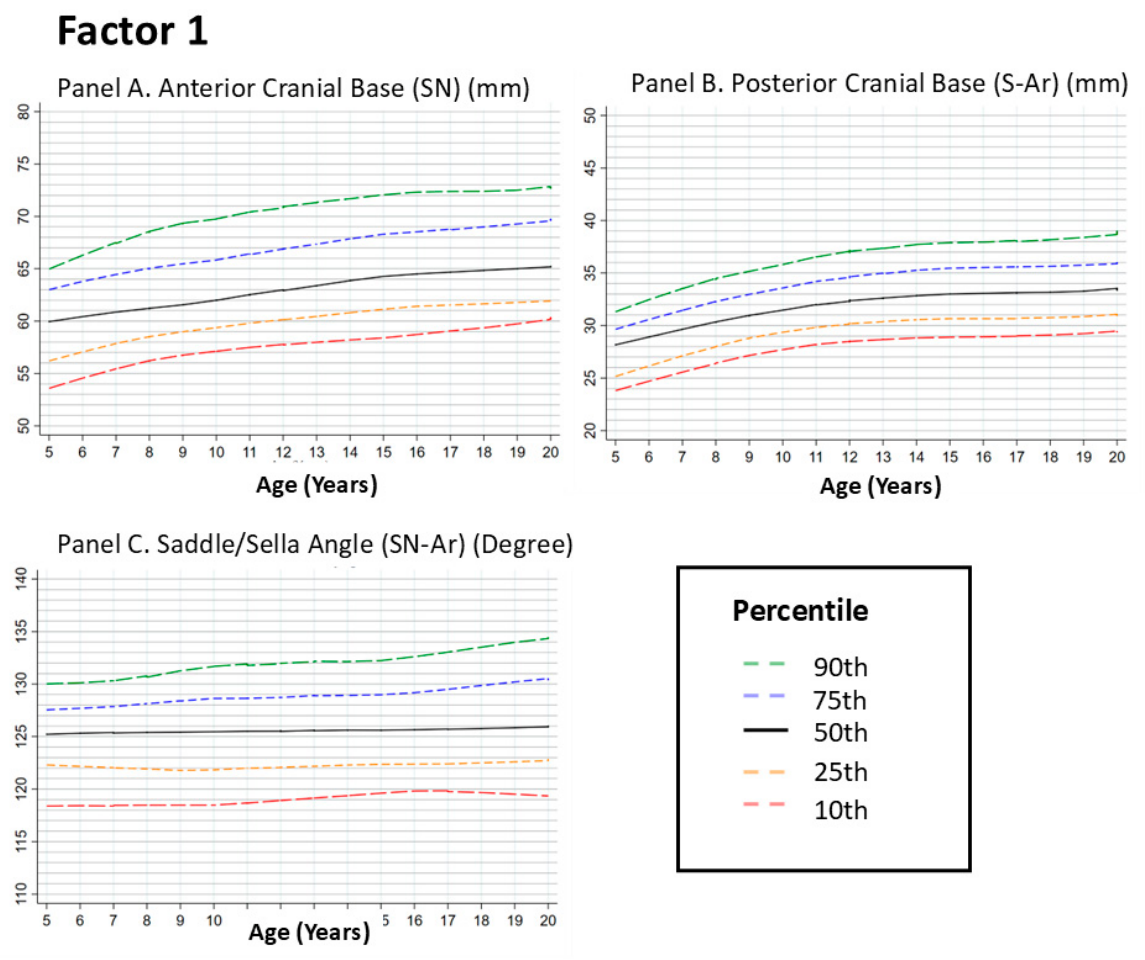
3.2.1. Factor 1: Cranial Base Features
Anterior Cranial Base (Sella–Nasion [SN])
Posterior Cranial Base (Sella–Articulare [S–Ar])
Saddle (Sella) Angle (SN–Ar)
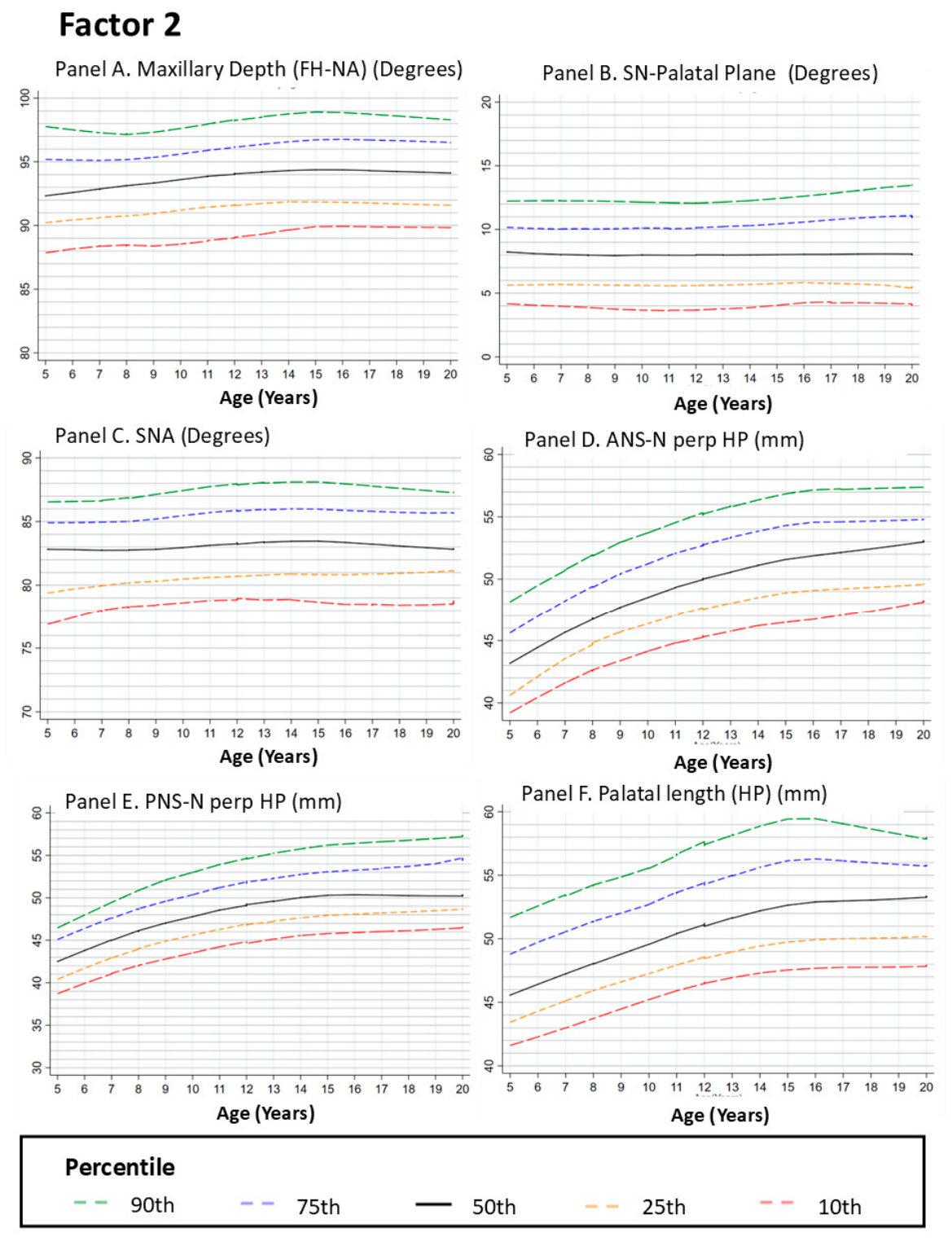
3.2.2. Factor 2: Maxillary Features
Maxillary Depth (Frankfort Horizontal to Nasion–Point A)
Sella–Nasion to Palatal Plane Angle (SN–PP)
SNA Angle
Anterior Nasal Spine Perpendicular to the Horizontal Plane (ANS ⟂ HP)
Posterior Nasal Spine Perpendicular to the Horizontal Plane (PNS ⟂ HP)
Palatal Length (Posterior Nasal Spine [PNS]–Anterior Nasal Spine [ANS])
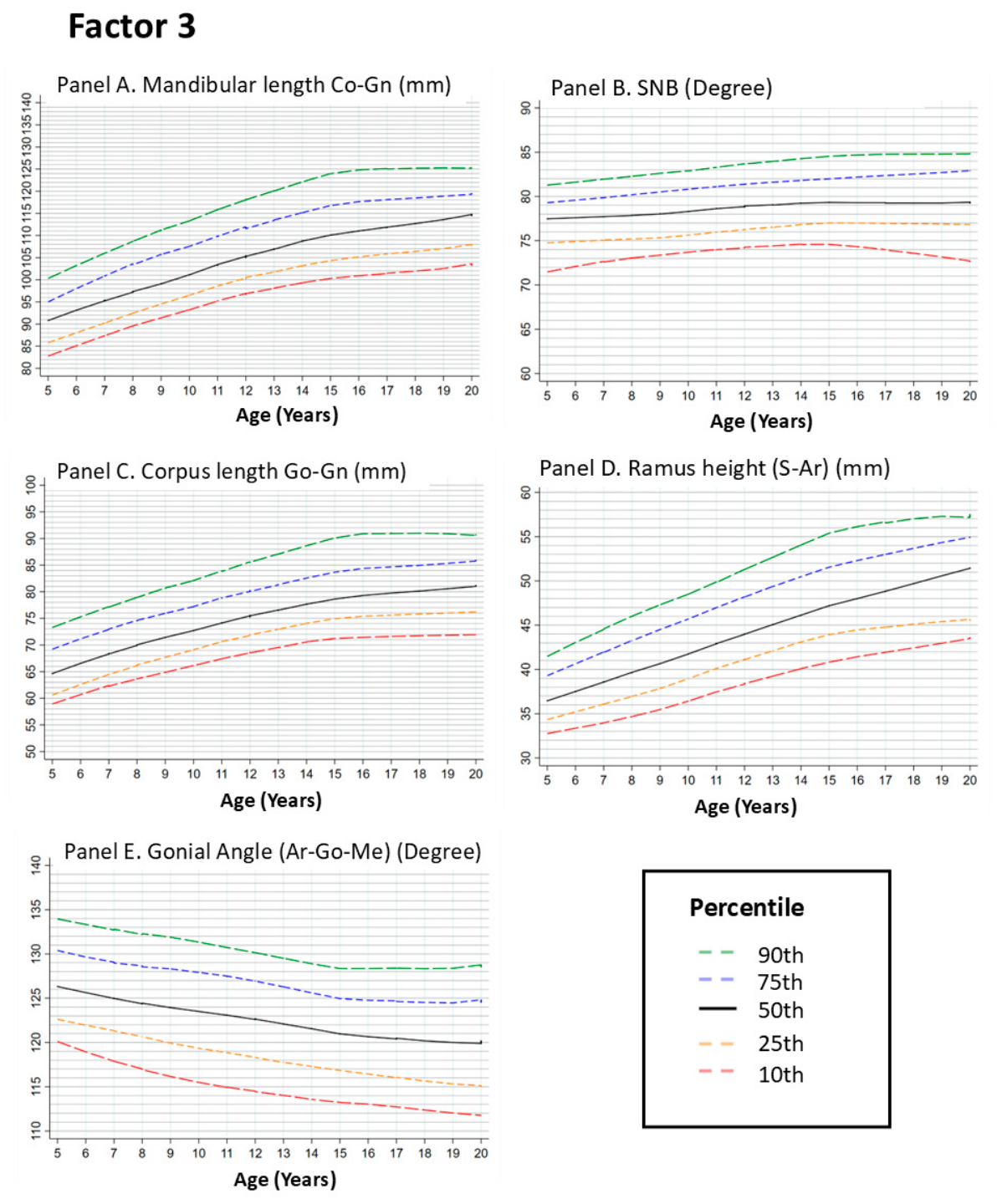
3.2.3. Factor 3. Mandibular Features
Mandibular Length (Condylion–Gnathion [Co–Gn])
SNB Angle
Corpus Length (Gonion–Gnathion [Go–Gn])
Ramus Height (Sella–Articulare [S–Ar])
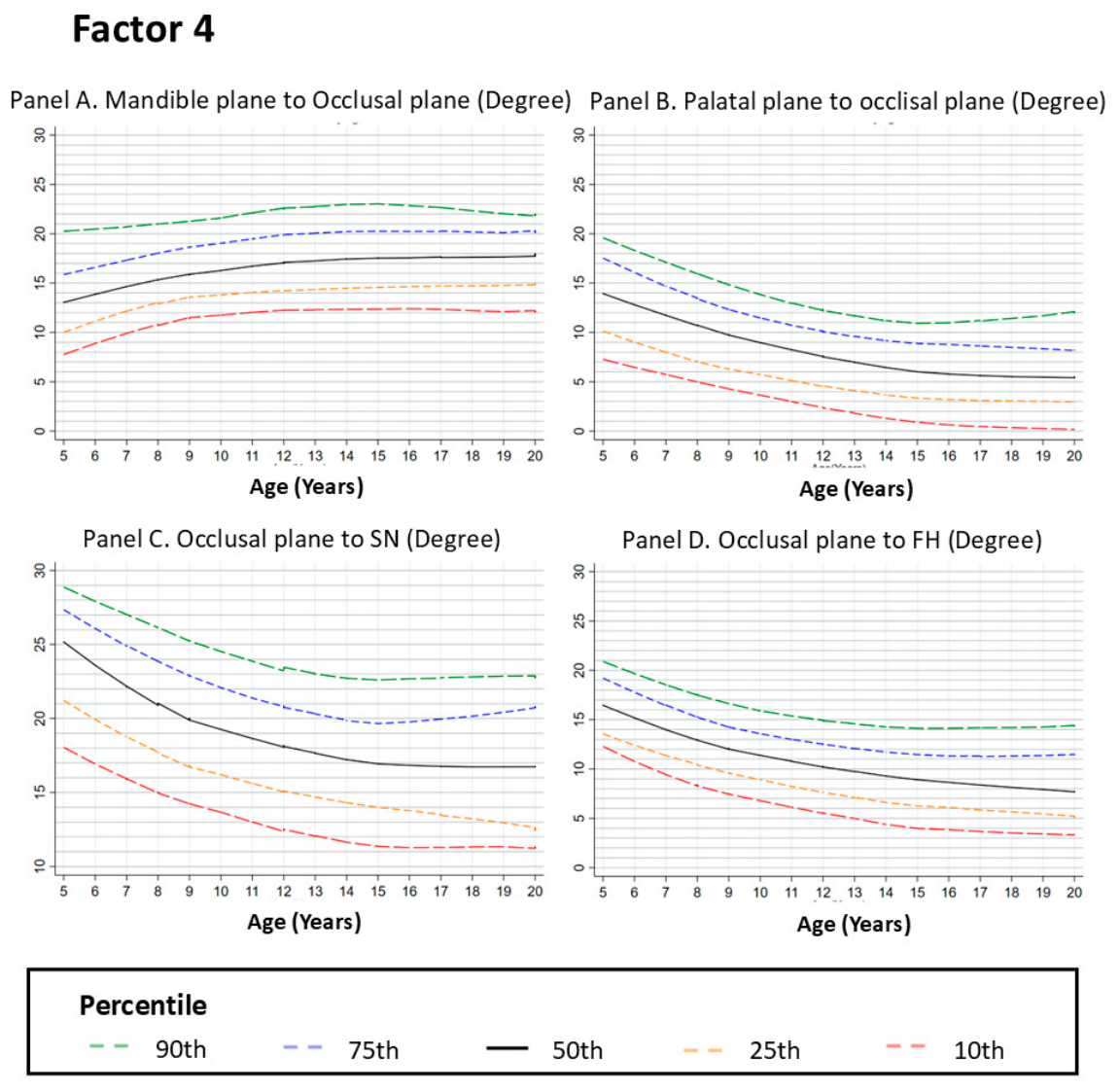
3.2.4. Factor 4. Occlusal Features
Mandibular Plane to Occlusal Plane (°)
Palatal Plane to Occlusal Plane (°)
Occlusal Plane to Sella–Nasion Plane (°)
Occlusal Plane to Frankfort Horizontal (FH) (°)
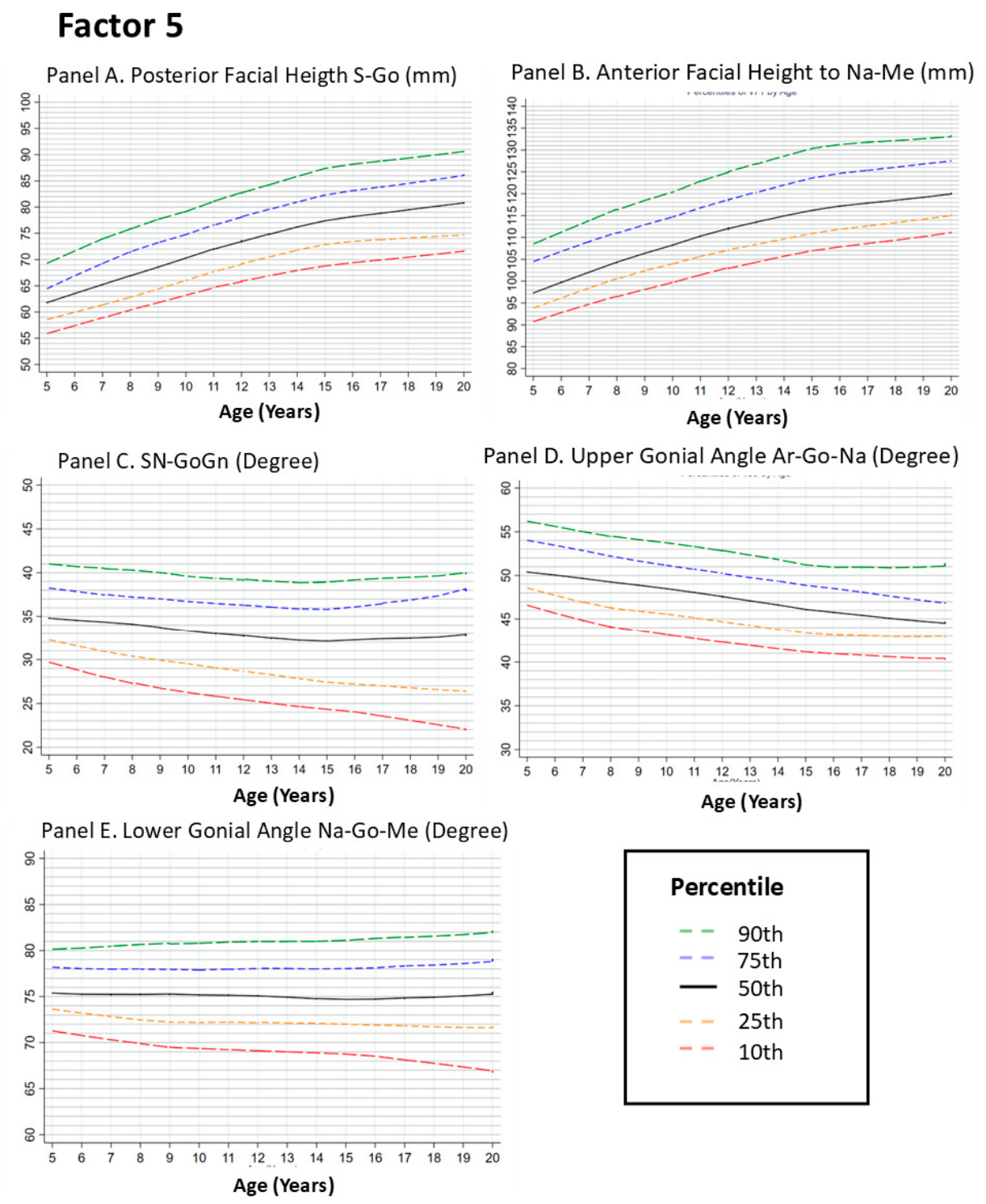
3.2.5. Factor 5. Vertical Dimension Features
Posterior Facial Height (Sella–Gonion [S–Go])
Anterior Facial Height (Nasion–Menton [Na–Me])
SN–GoGn Angle
Upper Gonial Angle (Articulare–Gonion–Nasion [Ar–Go–Na])
Lower Gonial Angle (Nasion–Gonion–Menton [Na–Go–Me])
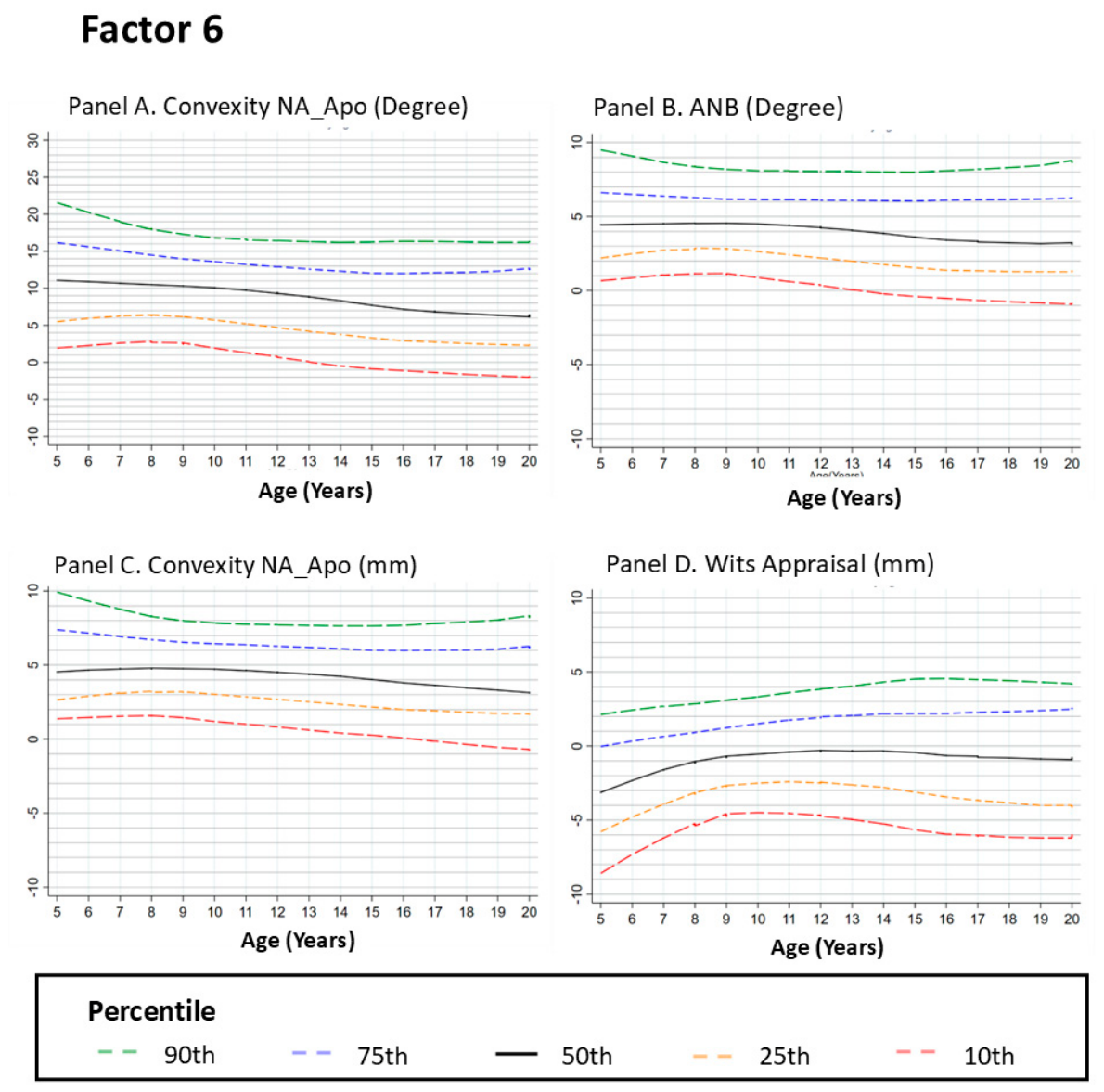
3.2.6. Factor 6: SAGITTAL Relation Features
Convexity at Nasion–Pogonion (N–Pog)
ANB Angle
Convexity at Point A
Wits Appraisal
4. Discussion
4.1. Cranial Base Growth
4.2. Maxillary Growth
4.3. Mandibular Growth
4.4. Occlusal and Vertical Relationships
4.5. Sagittal Relationships
4.6. Limitations
5. Conclusions
Supplementary Materials
Author Contributions
Funding
Institutional Review Board Statement
Informed Consent Statement
Data Availability Statement
Acknowledgments
Conflicts of Interest
Abbreviations
| AI | Artificial intelligence |
| ANS | Anterior nasal spine |
| ANB | Angle formed by points A, N, and B |
| Ar | Articulare |
| Co | Condylion |
| FH | Frankfort horizontal plane |
| Go | Gonion |
| Gn | Gnathion |
| HP | Horizontal plane |
| ICC | Intraclass correlation coefficient |
| IQR | Interquartile range |
| LOESS | Locally Estimated Scatterplot Smoothing |
| Me | Menton |
| Na | Nasion |
| OP | Occlusal plane |
| Pg/Pog | Pogonion |
| PNS | Posterior nasal spine |
| PP | Palatal plane |
| S | Sella |
| SD | Standard deviation |
| SN | Sella–Nasion |
| SNA | Angle between Sella–Nasion line and point A |
| SNB | Angle between Sella–Nasion line and point B |
| SN–GoGn | Angle between Sella–Nasion and mandibular plane |
| Wits | Wits appraisal |
References
- Moyers, R.E.; Bookstein, F.L. The Inappropriateness of Conventional Cephalomettics. Am. J. Orthod. 1979, 75, 599–617. [Google Scholar] [CrossRef] [Scilit]
- Bookstein, F.L. Reconsidering “The Inappropriateness of Conventional Cephalometrics”. Am. J. Orthod. Dentofac. Orthop. 2016, 149, 784–797. [Google Scholar] [CrossRef] [Scilit]
- Ajayi, E.O. Cephalometric Norms of Nigerian Children. Am. J. Orthod. Dentofac. Orthop. 2005, 128, 653–656. [Google Scholar] [CrossRef] [Scilit]
- Franchi, L.; Baccetti, T.; McNamara, J.A. Mandibular Growth as Related to Cervical Vertebral Maturation and Body Height. Am. J. Orthod. Dentofac. Orthop. 2000, 118, 335–340. [Google Scholar] [CrossRef] [Scilit]
- McIntyre, G.T.; Mossey, P.A. Size and Shape Measurement in Contemporary Cephalometrics. Eur. J. Orthod. 2003, 25, 231–242. [Google Scholar] [CrossRef] [Scilit]
- Moldez, M.A.; Sato, K.; Sugawara, J.; Mitani, H. Linear and Angular Filipino Cephalometric Norms According to Age and Sex. Angle Orthod. 2006, 76, 800–805. [Google Scholar] [PubMed]
- Nguyen, T.K.; Cambala, A.; Hrit, M.; Zimmermann, E.A. A Scoping Review of Cephalometric Normative Data in Children. Korean J. Orthod. 2024, 54, 210–228. [Google Scholar] [CrossRef] [Scilit] [PubMed]
- Thilander, B.; Persson, M.; Adolfsson, U. Roentgen–Cephalometric Standards for a Swedish Population. A Longitudinal Study between the Ages of 5 and 31 Years. Eur. J. Orthod. 2005, 27, 370–389. [Google Scholar] [CrossRef] [Scilit]
- Obloj, B.; Fudalej, P.; Dudkiewicz, Z. Cephalometric Standards for Polish 10-Year-Olds with Normal Occlusion. Angle Orthod. 2008, 78, 262–269. [Google Scholar] [CrossRef] [Scilit]
- Bjrk, A.; Skieller, V. Normal and Abnormal Growth of the Mandible. A Synthesis of Longitudinal Cephalometric Implant Studies over a Period of 25 Years. Eur. J. Orthod. 1983, 5, 1–46. [Google Scholar] [CrossRef] [Scilit] [PubMed]
- Stahl De Castrillon, F.; Baccetti, T.; Franchi, L.; Grabowski, R.; Klink-Heckmann, U.; McNamara, J.A. Lateral Cephalometric Standards of Germans with Normal Occlusion from 6 to 17 Years of Age. J. Orofac. Orthop. Fortschritte Kieferorthopädie 2013, 74, 236–256. [Google Scholar] [CrossRef] [Scilit]
- Sevilla-Naranjilla, M.A.; Rudzki-Janson, I. Cephalometric Floating Norms as a Guide toward a Harmonious Individual Craniofacial Pattern among Filipinos. Angle Orthod. 2009, 79, 1162–1168. [Google Scholar] [CrossRef] [Scilit]
- Antoun, J.S.; Cameron, C.; Sew Hoy, W.; Herbison, P.; Farella, M. Evidence of Secular Trends in a Collection of Historical Craniofacial Growth Studies. Eur. J. Orthod. 2015, 37, 60–66. [Google Scholar] [CrossRef] [Scilit] [PubMed]
- Goleij, N.; Hafezi, P.; Ahmadi, O. Investigating the Trends and Causes of Changes in Human Anthropometric Dimensions over the Past Three Decades: A Challenge for Ergonomic Design. Int. J. Occup. Saf. Ergon. 2024, 30, 480–485. [Google Scholar] [CrossRef] [Scilit]
- Hendrickx, J.; Gracea, R.S.; Vanheers, M.; Winderickx, N.; Preda, F.; Shujaat, S.; Jacobs, R. Can Artificial Intelligence-Driven Cephalometric Analysis Replace Manual Tracing? A Systematic Review and Meta-Analysis. Eur. J. Orthod. 2024, 46, cjae029. [Google Scholar] [CrossRef] [Scilit]
- Patcas, R.; Bornstein, M.M.; Schätzle, M.A.; Timofte, R. Artificial Intelligence in Medico-Dental Diagnostics of the Face: A Narrative Review of Opportunities and Challenges. Clin. Oral Investig. 2022, 26, 6871–6879. [Google Scholar] [CrossRef] [Scilit]
- Dhingra, K. Artificial Intelligence in Dentistry: Current State and Future Directions. Bull. R. Coll. Surg. Engl. 2023, 105, 380–383. [Google Scholar] [CrossRef] [Scilit]
- Arboleda, C.; Buschang, P.H.; Camacho, J.A.; Botero, P.; Roldan, S. A Mixed Longitudinal Anthropometric Study of Craniofacial Growth of Colombian Mestizos 6-17 Years of Age. Eur. J. Orthod. 2011, 33, 441–449. [Google Scholar] [CrossRef] [Scilit] [PubMed]
- Alessandri Bonetti, G.; Zanarini, M.; Danesi, M.; Parenti, S.I.; Gatto, M.R. Percentiles Relative to Maxillary Permanent Canine Inclination by Age: A Radiologic Study. Am. J. Orthod. Dentofac. Orthop. 2009, 136, 486.e1–486.e6. [Google Scholar] [CrossRef] [Scilit]
- Buschang, P.H.; Tanguay, R.; Demirjian, A.; LaPalme, L.; Goldstein, H. Modeling Longitudinal Mandibular Growth: Percentiles for Gnathion from 6 to 15 Years of Age in Girls. Am. J. Orthod. Dentofac. Orthop. 1989, 95, 60–66. [Google Scholar] [CrossRef] [Scilit]
- Alves Junior, C.A.S.; Da Silva, A.F.; Hinnig, P.D.F.; De Assis, M.A.A.; Conde, W.L.; Andaki, A.C.R.; De Vasconcelos, F.D.A.G.; Silva, D.A.S. Reference Growth Curves of Anthropometric Markers in Brazilian Children and Adolescents Aged 7–14 Years from Southern Brazil. Nutr. Bull. 2024, 49, nbu.12705. [Google Scholar] [CrossRef] [Scilit]
- Hou, G.; Li, K.; Cao, W.; Tao, M.; Tian, W.; Chang, R. Growth Charts for Children Aged 6-17 Years in Shanxi, China: Comparison with Other Cities of China and WHO. BMC Pediatr. 2024, 24, 423. [Google Scholar] [CrossRef] [Scilit]
- Cleveland, W.S.; Devlin, S.J. Locally Weighted Regression: An Approach to Regression Analysis by Local Fitting. J. Am. Stat. Assoc. 1988, 83, 596–610. [Google Scholar] [CrossRef]
- Polizzi, A.; Leonardi, R. Automatic Cephalometric Landmark Identification with Artificial Intelligence: An Umbrella Review of Systematic Reviews. J. Dent. 2024, 146, 105056. [Google Scholar] [CrossRef] [Scilit]
- Prewitt, K.; Lohr, S. Bandwidth Selection in Local Polynomial Regression Using Eigenvalues. J. R. Stat. Soc. Ser. B Stat. Methodol. 2006, 68, 135–154. [Google Scholar] [CrossRef] [Scilit]
- Afrand, M.; Ling, C.P.; Khosrotehrani, S.; Flores-Mir, C.; Lagravère-Vich, M.O. Anterior Cranial-Base Time-Related Changes: A Systematic Review. Am. J. Orthod. Dentofac. Orthop. 2014, 146, 21–32.e6. [Google Scholar] [CrossRef] [Scilit] [PubMed]
- Arat, Z.M.; Türkkahraman, H.; English, J.D.; Gallerano, R.L.; Boley, J.C. Longitudinal Growth Changes of the Cranial Base from Puberty to Adulthood. A Comparison of Different Superimposition Methods. Angle Orthod. 2010, 80, 725–732. [Google Scholar] [CrossRef] [Scilit]
- Lux, C.J.; Burden, D.; Conradt, C.; Komposch, G. Age-Related Changes in Sagittal Relationship between the Maxilla and Mandible. Eur. J. Orthod. 2005, 27, 568–578. [Google Scholar] [CrossRef] [Scilit]
- Perinetti, G.; Contardo, L. Reliability of Growth Indicators and Efficiency of Functional Treatment for Skeletal Class II Malocclusion: Current Evidence and Controversies. BioMed Res. Int. 2017, 2017, 1367691. [Google Scholar] [CrossRef] [Scilit] [PubMed]
- Samietz, S.; Borof, K.; Hertrampf, K.; Aarabi, G.; Ciardo, A.; Finke, H.; Hagenfeld, D.; Kühnisch, J.; Rütters, M.; Baumeister, S.-E.; et al. Dental and Oral Health Assessments in the German National Cohort (NAKO). BMC Oral Health 2025, 25, 149. [Google Scholar] [CrossRef] [Scilit]
- Cole, T.J.; Green, P.J. Smoothing Reference Centile Curves: The Lms Method and Penalized Likelihood. Stat. Med. 1992, 11, 1305–1319. [Google Scholar] [CrossRef] [Scilit]
- Zimbalist, A.; Radimer, K.H.; Ergas, I.J.; Roh, J.M.; Quesenberry, C.P.; Kwan, M.L.; Kushi, L.H. Utilization of Locally Estimated Scatterplot Smoothing (LOESS) Regression to Estimate Missing Weights in a Longitudinal Cohort of Breast Cancer Patients. Ann. Epidemiol. 2025, 104, 55–60. [Google Scholar] [CrossRef] [Scilit]



| Factor | Variable | Definition |
|---|---|---|
| 1. Cranial base | Sella–Nasion (SN) | Linear distance from S to N (mm) |
| S–Articulare (S–Ar) | Linear distance from S to Ar (mm) | |
| Saddle/Sella Angle (SN–Ar) | Angle between SN and Ar lines (°) | |
| 2. Maxillary complex | SNA | Angle between Sella–Nasion line and Point A (°) |
| ANS-N to HP | Perpendicular distance from ANS to horizontal plane (mm) | |
| PNS–ANS | Palatal length (mm) | |
| SN–PP | Angle between SN and palatal plane (°) | |
| PNS–N to HP | Distance from PNS to horizontal plane (mm) | |
| A–FH | Linear distance from Point A to Frankfort plane (mm) | |
| 3. Mandibular complex | Go–Gn | Linear distance from Gonion to Gnathion (mm) |
| Co–Gn | Linear distance from Condylion to Gnathion (mm) | |
| Ar–Go | Linear distance from Articulare to Gonion (mm) | |
| Ar–Go–Me | Gonial angle (°) | |
| SNB | Angle between SN and Point B (°) | |
| 4. Occlusal plane | MP–OP | Angle between mandibular and occlusal planes (°) |
| PP–OP | Angle between palatal and occlusal planes (°) | |
| OP–SN | Angle between occlusal and SN planes (°) | |
| OP–FH | Angle between occlusal and FH planes (°) | |
| 5. Vertical dimension | S–Go | Posterior facial height (mm) |
| Na–Me | Anterior facial height (mm) | |
| SN–GoGn | Angle between SN and mandibular plane (°) | |
| Ar–Go–Na | Upper gonial angle (°) | |
| Na–Go–Me | Lower gonial angle (°) | |
| 6. Sagittal relationships | ANB | Angle between points A, N, and B (°) |
| Wits appraisal | Distance between A and B points projected on occlusal plane (mm) | |
| Convexity at Point A | Angle formed by N–A–Pg (°) | |
| Convexity (N–Pog) | Linear measurement from Nasion to Pogonion (mm) |
| Age (Years) | Female | Male | Total | |||
|---|---|---|---|---|---|---|
| Frequency | % | Frequency | % | Frequency | % | |
| 5 | 18 | 51.4% | 17 | 48.6% | 35 | 3.1% |
| 6 | 23 | 54.8% | 19 | 45.2% | 42 | 3.7% |
| 7 | 36 | 56.3% | 28 | 43.8% | 64 | 5.6% |
| 8 | 47 | 53.4% | 41 | 46.6% | 88 | 7.7% |
| 9 | 52 | 54.2% | 44 | 45.8% | 96 | 8.4% |
| 10 | 69 | 62.2% | 42 | 37.8% | 111 | 9.7% |
| 11 | 70 | 59.3% | 48 | 40.7% | 118 | 10.3% |
| 12 | 73 | 64.6% | 40 | 35.4% | 113 | 9.9% |
| 13 | 68 | 59.6% | 46 | 40.4% | 114 | 9.9% |
| 14 | 48 | 51.6% | 45 | 48.4% | 93 | 8.1% |
| 15 | 35 | 63.6% | 20 | 36.4% | 55 | 4.8% |
| 16 | 33 | 66.0% | 17 | 34.0% | 50 | 4.4% |
| 17 | 21 | 44.7% | 26 | 55.3% | 47 | 4.1% |
| 18 | 28 | 66.7% | 14 | 33.3% | 42 | 3.7% |
| 19 | 16 | 50.0% | 16 | 50.0% | 32 | 2.8% |
| 20 | 30 | 63.8% | 17 | 36.2% | 47 | 4.1% |
| Total | 667 | 58.2% | 480 | 41.8% | 1147 | 100.0% |
Disclaimer/Publisher’s Note: The statements, opinions and data contained in all publications are solely those of the individual author(s) and contributor(s) and not of MDPI and/or the editor(s). MDPI and/or the editor(s) disclaim responsibility for any injury to people or property resulting from any ideas, methods, instructions or products referred to in the content. |
© 2026 by the authors. Licensee MDPI, Basel, Switzerland. This article is an open access article distributed under the terms and conditions of the Creative Commons Attribution (CC BY) license.
Share and Cite
Cruz-Hervert, L.P.; Cruz-Chávez, L.; Kiseri-Kubati, J.; González-Aragón Pineda, Á.E.; Martínez-Suárez, G.; Ramírez-Martínez, C.M.; Borges-Yañez, S.A.; Solorio-Quezada, J.C.; Trujillo-Sánchez, M.F.; Martínez-Contreras, S.P.; et al. LOESS-Based Cephalometric Growth Curves for Clinical Assessment of Craniofacial Development: A Cross-Sectional Study. Dent. J. 2026, 14, 269. https://doi.org/10.3390/dj14050269
Cruz-Hervert LP, Cruz-Chávez L, Kiseri-Kubati J, González-Aragón Pineda ÁE, Martínez-Suárez G, Ramírez-Martínez CM, Borges-Yañez SA, Solorio-Quezada JC, Trujillo-Sánchez MF, Martínez-Contreras SP, et al. LOESS-Based Cephalometric Growth Curves for Clinical Assessment of Craniofacial Development: A Cross-Sectional Study. Dentistry Journal. 2026; 14(5):269. https://doi.org/10.3390/dj14050269
Chicago/Turabian StyleCruz-Hervert, Luis Pablo, Luis Cruz-Chávez, Jeta Kiseri-Kubati, Álvaro Edgar González-Aragón Pineda, Gerardo Martínez-Suárez, Carla Monserrat Ramírez-Martínez, Socorro Aída Borges-Yañez, Juan Carlos Solorio-Quezada, María Fernanda Trujillo-Sánchez, Silvia Paulina Martínez-Contreras, and et al. 2026. "LOESS-Based Cephalometric Growth Curves for Clinical Assessment of Craniofacial Development: A Cross-Sectional Study" Dentistry Journal 14, no. 5: 269. https://doi.org/10.3390/dj14050269
APA StyleCruz-Hervert, L. P., Cruz-Chávez, L., Kiseri-Kubati, J., González-Aragón Pineda, Á. E., Martínez-Suárez, G., Ramírez-Martínez, C. M., Borges-Yañez, S. A., Solorio-Quezada, J. C., Trujillo-Sánchez, M. F., Martínez-Contreras, S. P., Jiménez-Corona, M.-E., & Jacinto-Alemán, L. F. (2026). LOESS-Based Cephalometric Growth Curves for Clinical Assessment of Craniofacial Development: A Cross-Sectional Study. Dentistry Journal, 14(5), 269. https://doi.org/10.3390/dj14050269