


Abstract
Background/Objectives: Dental bleaching outcomes may vary according to patient-related factors. Age-related changes in dental tissues may influence bleaching efficacy, adverse effects, and patient-reported outcomes. This systematic review evaluated the influence of patient age on outcomes of vital tooth bleaching. Methods: The review followed PRISMA 2020 guidelines and was registered in PROSPERO (CRD420261473683). PubMed/MEDLINE, Embase, Cochrane Library, Scopus, LILACS, and OpenGrey were searched without date or language restrictions. Clinical studies assessing bleaching outcomes according to age were included. The primary outcome was color change; secondary outcomes included tooth sensitivity, gingival irritation, and patient-reported outcomes. Risk of bias was assessed using RoB 2 and ROBINS-I, and certainty of evidence using GRADE. Because of clinical and methodological heterogeneity among the included studies, a meta-analysis was not feasible, and the findings were synthesized narratively. Results: Four studies involving 296 participants were included. Three reported greater color change in younger individuals in at least one protocol, whereas one found no age-related differences. Differences favoring younger participants were more frequent after in-office bleaching, while at-home bleaching with 10% carbamide peroxide showed comparable outcomes among age groups. Tooth sensitivity findings were inconsistent: three studies found no significant age-related differences, while one reported greater sensitivity in younger individuals. One study reported greater gingival irritation in younger participants, whereas oral health-related quality of life and most measures of esthetic self-perception did not differ between age groups. Certainty of evidence was very low for color change and tooth sensitivity. Conclusions: The available evidence suggests that age-related differences in bleaching-related color change may vary according to the bleaching protocol, with greater color change in younger individuals more consistently reported following in-office bleaching. However, the very low certainty of the evidence limits confidence in these findings. No consistent age-related differences were observed for tooth sensitivity, while findings for at-home bleaching were inconsistent and evidence regarding gingival irritation and patient-reported outcomes remains limited. Further well-designed clinical studies are needed to clarify the association between patient age and dental bleaching outcomes.
1. Introduction
Tooth discoloration is one of the main esthetic concerns, directly affecting self-image, psychosocial well-being, and individuals’ quality of life [1]. Consequently, dental bleaching has become one of the most sought-after esthetic procedures in dental practices [2]. The procedure is based on the action of bleaching agents, primarily hydrogen peroxide and carbamide peroxide, which promote the degradation and oxidation of chromogenic molecules responsible for tooth pigmentation [3]. In addition, several protocols can be clinically employed, including in-office and supervised at-home techniques, with variations in the concentration of bleaching agents, application time, and treatment frequency [4].
Although dental bleaching is considered a safe and effective procedure, its outcomes may vary among individuals [5]. The clinical assessment of treatment encompasses efficacy, reflected by the magnitude of the color change achieved, and safety, primarily determined by the occurrence and intensity of adverse effects, particularly tooth sensitivity and transient gingival irritation, while also considering the stability of the achieved color over time and patient-reported satisfaction [6]. However, treatment response may vary widely among individuals, not only due to protocol-related parameters, such as the bleaching agent, its concentration, and the technique used, but also due to patient-related variables, including initial tooth color, age-related factors, and the patient’s clinical and behavioral conditions [7].
The response of dental hard tissues to the chemical action of bleaching agents is directly related to their histological and physiological characteristics, which undergo continuous changes throughout life as a result of aging [8]. The natural aging process of teeth promotes progressive enamel wear and continuous deposition of secondary dentin by odontoblasts, resulting in increased dentin thickness and a gradual yellowing of tooth color [9]. In parallel, progressive mineralization and occlusion of dentinal tubules occur over the years, substantially reducing dentin permeability and hindering the diffusion of peroxide-derived oxygen radicals [10]. Due to these structural changes and the higher organic content present in younger teeth, the literature indicates greater bleaching efficacy in young adults, with an estimated 7% reduction in bleaching efficacy for each additional year of the patient’s age [11].
Although dental bleaching is widely used in individuals of different ages, the extent to which age influences bleaching outcomes remains unclear. Age-related differences in tooth structure, composition, optical properties, and pulpal characteristics may potentially affect the response to bleaching agents and the occurrence of treatment-related adverse effects [10,12]. However, clinical studies such as those by Kiwan et al. [13], Forville et al. [14], Martins et al. [15], and Veloso et al. [16] have reported inconsistent findings regarding the influence of age on bleaching efficacy and tooth sensitivity, and differences in bleaching protocols, outcome measures, and age classifications make direct comparisons difficult. Therefore, a systematic synthesis of the available evidence is needed to clarify whether age contributes to differences in the effectiveness and tolerability of dental bleaching. Accordingly, this systematic review aimed to evaluate the influence of age on dental bleaching outcomes.
2. Materials and Methods
2.1. Protocol and Registration
This systematic review was conducted according to the Preferred Reporting Items for Systematic Reviews and Meta-Analyses (PRISMA 2020) statement [17] (Supplementary Materials, Table S1) to ensure transparency and methodological rigor in the reporting of the findings. The review protocol was registered in the International Prospective Register of Systematic Reviews (PROSPERO) under registration number CRD420261473683.
2.2. Information Sources and Search Strategy
A comprehensive electronic search was performed in the following databases: PubMed/MEDLINE, Embase, Cochrane Library, Scopus, Latin American and Caribbean Literature in Health Sciences (LILACS), and OpenGrey. Two reviewers (S.B.M. and L.K.S.A.) independently performed the searches in August 2026 using controlled vocabulary terms (MeSH, Emtree, and DeCS) combined with free-text keywords related to dental bleaching and patient age.
The search strategy was developed to identify clinical studies evaluating whether patient age influences bleaching outcomes. The search terms included combinations of terms related to vital tooth bleaching procedures, whitening agents, bleaching efficacy, tooth sensitivity, and age-related factors. Boolean operators (AND and OR) were used to combine the terms, and the complete search strategies for each database are presented in Table 1.
Table 1.
Search strategies used in the electronic databases.
No restrictions regarding publication year or language were applied. Additionally, the reference lists of all included studies and relevant reviews were manually screened to identify additional eligible studies.
2.3. Eligibility Criteria
The eligibility criteria were established according to the Population, Intervention/Exposure, Comparator, Outcomes, and Study Design (PICOS) framework: Population (P): Patients undergoing vital tooth bleaching procedures. Intervention/Exposure (I): Patient age as a potential modifying factor influencing bleaching outcomes. Comparator (C): Comparisons between different age groups or between younger and older patients. Outcomes (O): The primary outcomes were bleaching efficacy and color change assessed through objective or subjective methods, including ΔE*ab, ΔE00, and whiteness index for dentistry (WID). Secondary outcomes included tooth sensitivity, gingival irritation, patient satisfaction, and esthetics-related quality of life. Study Design (S): Randomized clinical trials, non-randomized clinical trials, and prospective clinical studies involving human participants.
Therefore, the research question was: “Is patient age associated with the efficacy and adverse effects of vital tooth bleaching procedures?”
The inclusion criteria were: (1) clinical studies involving human participants; (2) studies evaluating vital tooth bleaching procedures; (3) studies comparing bleaching outcomes between different age groups or investigating age as a potential modifying factor; and (4) studies reporting bleaching efficacy, adverse effects, or patient-reported outcomes according to patient age.
The exclusion criteria were: (1) in vitro studies; (2) studies involving non-vital tooth bleaching; (3) case reports or case series without a comparison group; (4) narrative reviews, systematic reviews, editorials, letters, and conference abstracts; and (5) studies without sufficient age-related information or without outcomes related to bleaching performance.
2.4. Study Selection
All records retrieved from the electronic databases were imported into Rayyan software (Free version, Qatar Computing Research Institute, Ar-Rayyan, Qatar) [18] for reference organization and screening management. After duplicate removal, two reviewers (S.B.M. and L.K.S.A.) independently screened titles and abstracts according to the predefined eligibility criteria.
Studies considered potentially eligible were subsequently assessed through full-text evaluation. Any disagreements between reviewers were resolved through discussion, and when consensus was not reached, a third reviewer (C.d.F.C.L.) was consulted. When necessary, corresponding authors were contacted by email to obtain additional information regarding study eligibility or missing data.
The study selection process was presented in a flow diagram. Reference management was conducted using Mendeley software (version 2.141.0; Elsevier, Mendeley). The agreement between reviewers regarding study inclusion was assessed using Cohen’s kappa coefficient [19]. The study selection process is summarized in the PRISMA flow diagram.
2.5. Data Extraction
Data extraction was performed by one reviewer (S.B.M.) and independently verified by a second reviewer (L.K.S.A.) using a standardized Excel spreadsheet (Version 2610, Microsoft, Redmond, WA, USA).
The following information was extracted from the included studies: author, publication year, country, study design, sample size, participant characteristics, age distribution, age groups or categories analyzed, sex distribution, dental inclusion criteria, bleaching protocol (in-office, at-home, or combined), bleaching agent, peroxide concentration, number of bleaching sessions, application time, light activation protocol when applicable, evaluation methods, color assessment parameters (ΔE*ab, ΔE00, and WID), tooth sensitivity assessment methods and intensity, gingival irritation, patient-reported outcomes, esthetics-related quality of life measures, follow-up periods, and main findings regarding the association between patient age and bleaching outcomes. Age was handled differently across the included studies: it was treated as the exposure of interest in two studies and as a covariate in the other two.
2.6. Risk of Bias Assessment
The risk of bias of the included randomized clinical trials was assessed independently by two reviewers (S.B.M. and L.K.d.S.A.) using the Cochrane Risk of Bias 2 (RoB 2) tool [20]. The assessment considered five domains: (1) bias arising from the randomization process; (2) bias due to deviations from intended interventions; (3) bias due to missing outcome data; (4) bias in measurement of the outcome; and (5) bias in selection of the reported result. Each domain was classified as “low risk of bias,” “some concerns,” or “high risk of bias” according to the RoB 2 algorithm. For non-randomized studies or studies with non-randomized age-comparison groups, the risk of bias was assessed using the ROBINS-I V2 (Risk Of Bias In Non-randomized Studies—of Interventions) tool [21]. The assessment considered six domains: (1) bias due to confounding; (2) bias in the classification of interventions; (3) bias in the selection of participants into the study; (4) bias due to missing outcome data; (5) bias in the measurement of outcomes; and (6) bias in the selection of the reported result. Disagreements between reviewers were resolved through discussion, and a third reviewer (C.d.F.C.L.) was consulted when necessary.
2.7. Assessment of Certainty of Evidence
The certainty of evidence was assessed using the Grading of Recommendations Assessment, Development and Evaluation (GRADE) classification [22], for the primary outcome of color change and the secondary outcome of tooth sensitivity, accessible at http://www.gradeworkinggroup.org/, accessed on 15 August 2026. The evaluation considered five domains: risk of bias, inconsistency, indirectness, imprecision, and publication bias. The certainty of evidence was classified as high, moderate, low, or very low.
Evidence from randomized clinical trials was initially rated as high certainty and was downgraded when limitations were identified. Evidence from non-randomized clinical studies was initially rated as low certainty and could be further downgraded according to methodological limitations. Upgrading was considered when effects of large magnitude or other relevant factors supported greater confidence in the findings.
3. Results
3.1. Study Selection
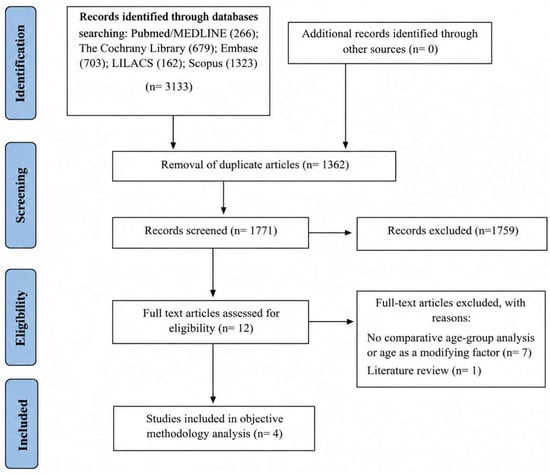
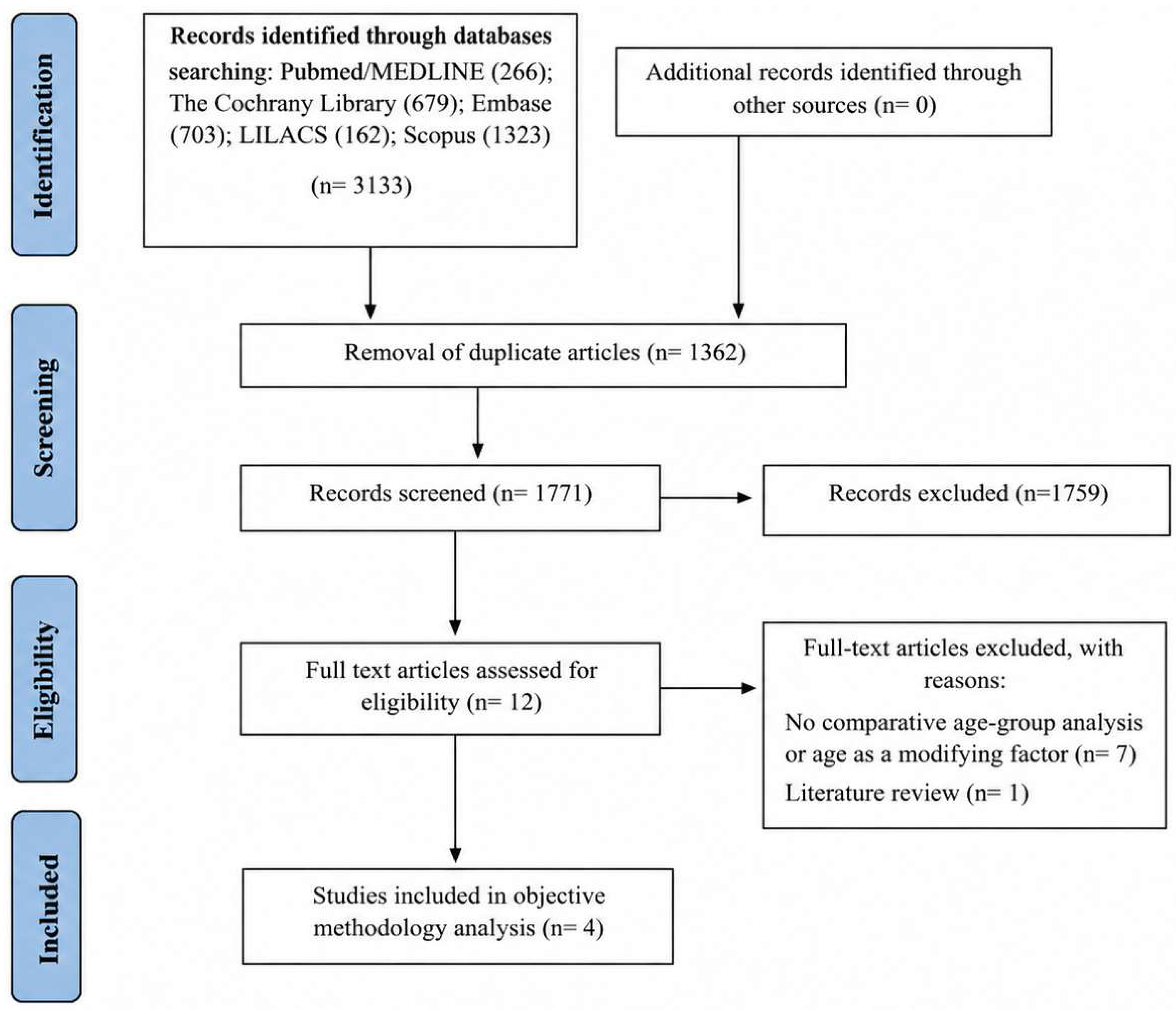
A total of 3133 records were identified through database searches conducted in August 2026, including PubMed/MEDLINE (266), The Cochrane Library (679), Embase (703), LILACS (162), and Scopus (1323). After removing duplicates, 1771 records remained for title and abstract screening. Following title and abstract screening, 1759 records were excluded for not meeting the predefined eligibility criteria, and 12 articles were retrieved for full-text assessment. After full-text evaluation, eight studies were excluded: seven due to the absence of comparative age-group analysis or age as a modifying factor, and one because it was a literature review. Therefore, four studies were included in the final methodological analysis. The selection process is summarized in the PRISMA flowchart (Figure 1).
Figure 1.
Flowchart of articles included in the systematic review.
The results of the inter-examiner agreement test showed “almost perfect agreement” between the examiners in the article selection phase. The Cohen’s kappa coefficients for the databases were PubMed/MEDLINE (0.89), Embase (1.00), The Cochrane Library (1.00), LILACS (0.94), and Scopus (0.86), with a mean kappa coefficient of 0.94 across all databases, indicating “almost perfect agreement” between the examiners.
3.2. Characteristics of the Included Studies
The characteristics of the four included studies are summarized in Table 2. The studies were published between 2025 and 2026 and included a total of 296 participants, with ages ranging from 14 to 74 years. Three studies were conducted in Brazil and one in Syria. Age-group classifications varied considerably across studies. Veloso et al. [16] compared younger participants aged 14–20 years with adults aged 40–60 years, whereas Forville et al. [14] compared individuals aged 15–24 years with those aged 45–74 years. Kiwan et al. [13] evaluated three age categories (14–18, 20–40, and >50 years), while Martins et al. [15] compared young adults aged 18–25 years with middle-aged individuals aged 40–65 years. Thus, the definitions of younger, adult, middle-aged, and older participants were study-specific, with no standardized age classification across the included studies. Both at-home and in-office bleaching protocols were investigated, using 10% carbamide peroxide or 35–40% hydrogen peroxide. The analytical approach to age also varied across studies, as it was treated as the primary exposure in two studies and as a covariate in the other two.
Table 2.
Characteristics of the included studies.
Regarding bleaching efficacy, the included studies assessed changes in tooth color between age groups using instrumental color measurements, including ΔE, ΔE00, and ΔWID. For in-office bleaching, Veloso et al. [16], using 40% hydrogen peroxide, reported greater color change in younger participants (14–20 years) than in adults aged 40–60 years. Similarly, Martins et al. [15], using 35% hydrogen peroxide, found greater bleaching efficacy among participants aged 18–25 years than among those aged 40–65 years. For at-home bleaching with 10% carbamide peroxide, Forville et al. [14] reported greater bleaching efficacy in younger adults aged 15–24 years than in older adults aged 45–74 years. In contrast, Kiwan et al. [13], who compared participants aged 14–18, 20–40, and over 50 years, found no significant differences in bleaching efficacy among age groups. Veloso et al. [16] also found no significant age-related differences following at-home bleaching.
For tooth sensitivity, age-related comparisons were less consistent. Veloso et al. [16] reported no significant differences in sensitivity between younger and adult participants following either at-home or in-office bleaching, as assessed using the visual analog scale (VAS) and a numerical rating scale. Similarly, Kiwan et al. [13] found no significant differences in the risk or intensity of sensitivity among the three age groups. In contrast, Martins et al. [15] reported greater sensitivity risk and intensity among younger adults than among middle-aged participants following in-office bleaching with 35% hydrogen peroxide. Forville et al. [14] also assessed tooth sensitivity using the VAS. Overall, three studies found no statistically significant age-related differences in tooth sensitivity, whereas Martins et al. [15] reported significantly greater sensitivity among younger participants.
Other age-related outcomes were reported in individual studies. Veloso et al. [16] found no significant age-related differences in oral health-related quality of life, assessed using the OHIP-14. Forville et al. [14] reported lower gingival irritation in older adults, indicating greater irritation among younger participants. However, as this outcome was assessed in only one study, the finding should be interpreted cautiously. Forville et al. [14] also evaluated esthetic self-perception using the Orofacial Esthetic Scale. Martins et al. [15] additionally assessed the psychosocial impact of dental esthetics using the PIDAQ.
Overall, three of the four included studies reported significantly greater color change in younger participants in at least one bleaching protocol, whereas one study found no statistically significant differences among age groups. Regarding in-office bleaching, both studies reported greater color change in younger participants [15,16]. For at-home bleaching, the findings were inconsistent: Forville et al. [14] reported greater color change in younger participants, whereas Kiwan et al. [13] and Veloso et al. [16] found no statistically significant differences between age groups. Although age-related differences in color change appeared more consistent following in-office bleaching, the limited number of studies and variations in age classifications and bleaching protocols preclude definitive conclusions.
3.3. Color Outcomes
The color-related outcomes reported by the included studies are summarized in Table 3. Color change was assessed using ΔE, ΔEab, ΔE00, and ΔWID at different post-treatment evaluation times.
Table 3.
Color analysis.
Significantly greater color change was observed in the younger group compared with the adult group following in-office bleaching, as indicated by both ΔE00 (4.1 ± 1.2 vs. 3.3 ± 1.6; *p* = 0.010) and ΔWID (8.5 ± 5.8 vs. 6.6 ± 3.7; *p* = 0.010). In contrast, no statistically significant age-related differences were observed following at-home bleaching for either ΔE00 (4.6 ± 1.6 vs. 3.6 ± 1.7; *p* = 0.266) or ΔWID (10.0 ± 4.0 vs. 9.9 ± 4.7; *p* = 0.257) [16].
Similarly, significantly greater color change was observed among younger participants compared with older participants after at-home bleaching with 10% carbamide peroxide. The younger group presented higher ΔEab values (16.8 ± 4.9 vs. 10.5 ± 4.7), ΔE00 values (11.0 ± 3.2 vs. 7.0 ± 3.2), and ΔWID values (25.7 ± 14.8 vs. 12.4 ± 15.3), with *p* < 0.001 for all comparisons [14].
No statistically significant differences in color change were observed among participants aged 14–18, 20–40, and >50 years. For canines, ΔE values were 10.74 ± 4.03, 9.15 ± 2.39, and 9.54 ± 2.90, respectively (*p* = 0.877), while ΔWID values were 19.38 ± 9.35, 14.69 ± 4.93, and 16.06 ± 5.10, respectively (*p* = 0.845). Similarly, for central incisors, neither ΔE (*p* = 0.319) nor ΔWID (*p* = 0.263) differed significantly among age groups [13].
In contrast, significantly greater color change was observed among younger participants following in-office bleaching with 35% hydrogen peroxide. For incisors, younger participants showed higher ΔE00 (4.6 ± 1.7 vs. 3.1 ± 1.6) and ΔWID (10.7 ± 4.7 vs. 7.5 ± 4.2), with *p* < 0.001 for both outcomes. Similar findings were observed for canines, with higher ΔE00 (7.6 ± 1.5 vs. 5.5 ± 2.5) and ΔWID (22.1 ± 5.2 vs. 14.0 ± 6.9) among younger participants (*p* < 0.001 for both comparisons) [15].
Overall, the two studies evaluating in-office bleaching with 35–40% hydrogen peroxide reported significantly greater color change in younger participants [15,16]. Among the three studies evaluating at-home bleaching with 10% carbamide peroxide, Forville et al. [14] reported significantly greater color change in younger participants, whereas Kiwan et al. [13] and Veloso et al. [16] found no statistically significant differences between age groups. Although these findings suggest that age-related differences in color change may be more consistently observed following in-office bleaching, the limited number of studies and the differences in age classifications and assessment protocols preclude definitive conclusions.
3.4. Tooth Sensitivity
The results of the tooth sensitivity analysis are presented in Table 4. Tooth sensitivity was evaluated in four studies using VAS, NRS, and/or VRS, with assessments performed during bleaching and at different post-treatment time points.
Table 4.
Analysis of tooth sensitivity.
No significant differences in the risk of tooth sensitivity were observed between younger and adult participants for either at-home or in-office bleaching. For at-home bleaching, sensitivity risk was 75% (95% CI: 53–90) among younger participants and 90% (95% CI: 68–98) among adults (*p* = 0.699). For in-office bleaching, the corresponding risks were 95% (95% CI: 75–99) and 80% (95% CI: 58–92), respectively (*p* = 0.711) [16].
Similarly, after at-home bleaching with 10% carbamide peroxide, the overall tooth sensitivity risk was 64% (95% CI: 55–73), with no significant difference between younger and older participants (*p* = 0.361; RR = 0.9; 95% CI: 0.7–1.2). Sensitivity intensity also did not differ significantly between age groups (*p* > 0.415) [14].
No significant differences were observed in either the risk or intensity of tooth sensitivity among participants aged 14–18, 20–40, and ≥50 years. Sensitivity risk was 70%, 40%, and 50%, respectively (*p* = 0.392), while mean sensitivity intensity was 1.74 ± 0.438, 0.93 ± 0.417, and 1.63 ± 0.673, respectively (*p* = 0.52) [13].
In contrast, significantly greater tooth sensitivity was observed among younger participants following in-office bleaching with 35% hydrogen peroxide. The overall sensitivity risk was 100% among participants aged 18–25 years compared with 85.7% among those aged 40–65 years (RR = 1.17; 95% CI: 1.00–1.36; *p* = 0.038). Sensitivity intensity was also higher in the younger group, with a mean worst pain score of 6.9 ± 2.5 compared with 3.5 ± 2.8 in the middle-aged group [15].
Overall, three of the four included studies found no statistically significant age-related differences in the risk or intensity of tooth sensitivity, despite some numerical differences between age groups [13,14,16]. In contrast, Martins et al. [15] reported a significantly higher risk and intensity of sensitivity among younger participants following in-office bleaching. Thus, the available evidence did not demonstrate a consistent association between younger age and greater tooth sensitivity.
3.5. Other Dental Outcomes
The findings for other dental and patient-reported outcomes are presented in Table 5. These outcomes included oral health-related quality of life, esthetic self-perception, gingival irritation, and the psychosocial impact of dental esthetics.
Table 5.
Analysis of other dental outcomes.
Regarding oral health-related quality of life, no significant differences between younger and adult participants were observed in either absolute OHIP-14 scores or changes from baseline following at-home or in-office bleaching (*p* = 0.813) [16]. Both younger and older participants showed significant improvements in esthetic self-perception after bleaching (*p* < 0.001), with no significant between-group differences in the magnitude of change for most OES domains [14]. In contrast, gingival irritation differed significantly according to age, with younger participants presenting a higher risk (66% vs. 46%; p = 0.022) and greater irritation intensity (1.4 ± 2.0 vs. 0.7 ± 1.5; p = 0.019) than older participants [14]. As this outcome was assessed in only one study, this finding should be interpreted cautiously.
Regarding the psychosocial impact of dental esthetics, esthetic concern decreased significantly after bleaching in both younger participants (5.4 ± 2.1 to 4.6 ± 2.5; *p* = 0.001) and middle-aged participants (5.2 ± 1.9 to 4.0 ± 1.5; *p* = 0.006) [15]. However, psychological impact increased significantly among younger participants (15.3 ± 4.2 to 15.8 ± 3.3; *p* = 0.009), whereas no significant change was observed among middle-aged participants (14.7 ± 2.9 to 13.4 ± 4.1; *p* = 0.085). Overall perception did not change significantly among younger participants (*p* = 0.154), but significantly improved among middle-aged participants (46.7 ± 7.2 to 43.7 ± 8.3; *p* = 0.018) [15].
Overall, no significant age-related differences were observed in oral health-related quality of life or in most measures of esthetic self-perception. However, younger participants presented a higher risk and intensity of gingival irritation than older participants in one study [14]. Age-related differences were also observed in specific domains of the psychosocial impact of dental esthetics, with changes varying according to the evaluated domain [15]. These findings should be interpreted cautiously, as each outcome was investigated in a limited number of studies.
3.6. Risk of Bias
The risk-of-bias assessment was performed according to the study design and the role of age within the research question. Forville et al. [14] and Kiwan et al. [13] were evaluated using ROBINS-I because age was considered the exposure of interest rather than an intervention assigned by randomization. Therefore, these studies were assessed for potential biases related to non-randomized exposure groups. Conversely, Martins et al. [15] and Veloso et al. [16] were assessed using RoB 2 because participants were randomly allocated to bleaching interventions, allowing evaluation according to the domains established for randomized clinical trials.
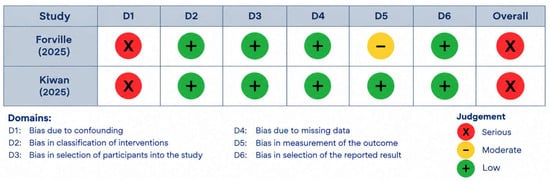
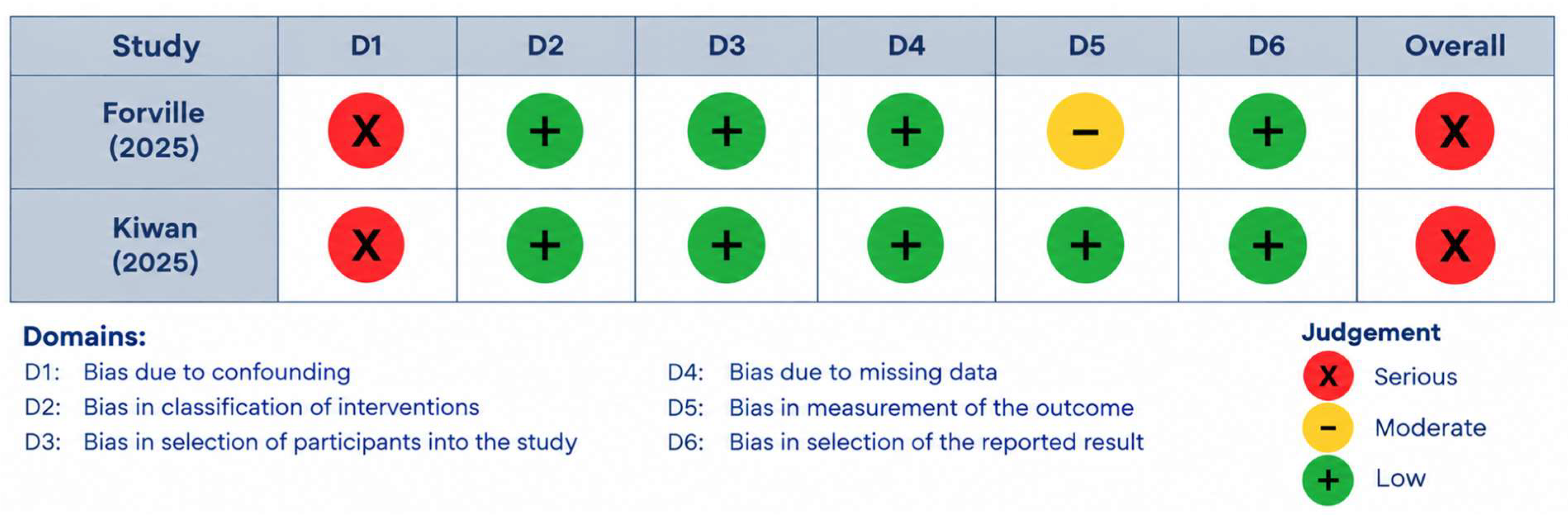
Among the studies evaluated with ROBINS-I (Figure 2), Forville et al. [14] was classified as presenting an overall serious risk of bias, mainly due to D1 (bias due to confounding), with moderate risk identified in D5 (bias in measurement of outcomes). Kiwan et al. [13] also showed an overall serious risk of bias, primarily related to D1, whereas the remaining domains were considered at low risk.
Figure 2.
Risk of bias assessment of the studies included Forville et al. [14] and Kiwan et al. [13], using the ROBINS-I V2 tool.
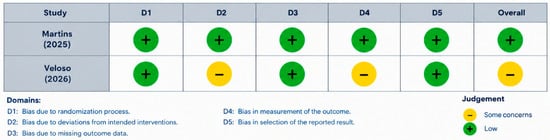
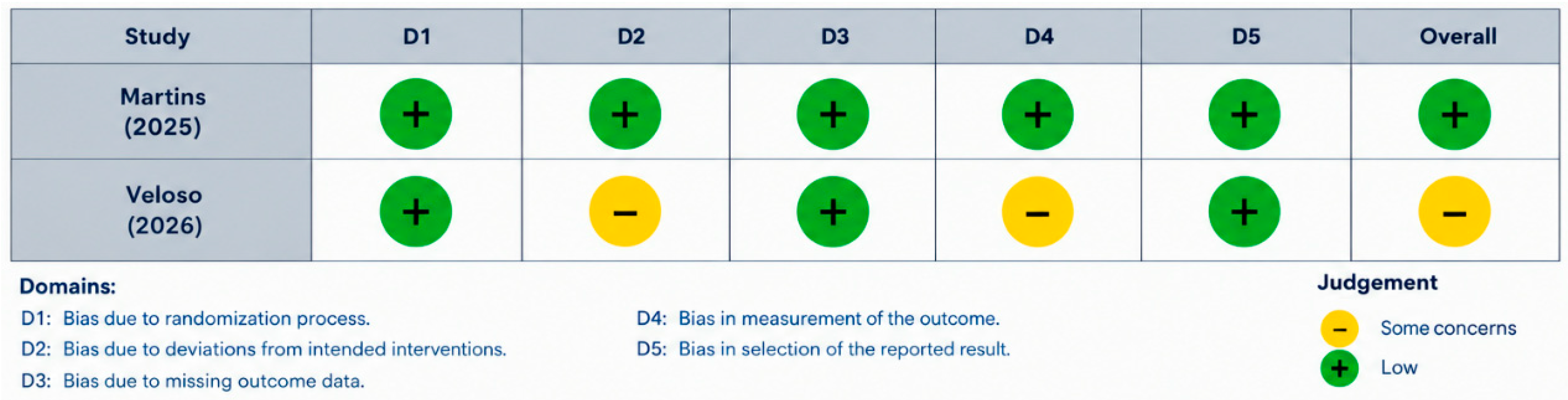
Among the studies assessed using RoB 2 (Figure 3), Martins et al. [15] showed low risk of bias in all domains, resulting in an overall low-risk classification. Veloso et al. [16] presented some concerns in D2 (bias due to deviations from intended interventions) and D4 (bias in measurement of outcomes), while the remaining domains were judged to be at low risk of bias, leading to an overall classification of some concerns.
Figure 3.
Risk of bias assessment of the studies included Martins et al., 2025 [15] and Veloso et al., 2026 [16], using the RoB 2 tool.
3.7. Certainty of Evidence
The certainty of evidence was assessed using the GRADE approach for color change and tooth sensitivity, as presented in Table 6 and Table 7, respectively. GRADE assessments were not performed for gingival irritation or patient-reported outcomes; therefore, the certainty of evidence for these outcomes was not formally classified. For color change, the certainty of evidence was rated as very low for ΔEab, ΔE00, and ΔWID. The evidence was downgraded primarily because of concerns regarding the risk of bias of the included studies and imprecision resulting from the limited number of studies and participants. Inconsistency and indirectness were not considered serious, as the studies directly evaluated age-related differences in bleaching-related color outcomes in clinical populations, and the direction of the findings was generally consistent.
Table 6.
Certainty of evidence assessed using the GRADE tool—Color change.
Table 7.
Certainty of evidence assessed using the GRADE tool—Tooth sensitivity.
For tooth sensitivity, the certainty of evidence was also rated as very low for VAS, VRS, and NRS outcomes. Downgrading was based on concerns regarding risk of bias and imprecision due to the limited number of available studies and participants. No serious concerns regarding inconsistency or indirectness were identified. Overall, the GRADE assessment indicates that there is considerable uncertainty regarding the estimates of age-related differences in both bleaching-related color change and tooth sensitivity.
4. Discussion
This systematic review suggests that the association between patient age and bleaching-related color change may vary according to the bleaching protocol. Greater color change in younger individuals was more consistently observed following in-office bleaching, whereas findings for at-home bleaching were inconsistent. In contrast, age-related differences in tooth sensitivity were not consistently observed across studies. For secondary outcomes, age appeared to influence specific parameters, such as gingival irritation and some domains related to the psychosocial impact of dental esthetics, whereas no significant differences were identified in oral health-related quality of life or most measures of esthetic self-perception.
Although the studies by Martins et al. [15], Forville et al. [14], and Veloso et al. [16] demonstrated a statistically significantly greater color change in the younger groups in at least one of the protocols tested, this phenomenon was not universal. In contrast to this trend, Kiwan et al. [13] found that there was no statistically significant difference among adolescents, adults, and individuals over 50 years of age. This discrepancy suggests that age alone may not be sufficient to explain the magnitude of color change following dental bleaching, indicating that its influence may depend on other factors, such as the protocol employed, baseline tooth characteristics, and the measurement method used.
These clinical differences in the response to tooth bleaching among different age groups are supported by the histological and structural changes that occur in dental tissues with advancing age. Histological changes resulting from physiological dental aging encompass progressive alterations in the dentin–pulp complex and mineralized dental tissues [23]. With aging, the dental pulp undergoes a marked reduction in cellularity, exhibiting approximately half the number of fibroblasts and odontoblasts found in younger individuals [24]. Furthermore, Warwar et al. [23] point out that the continuous deposition of secondary and tertiary dentin gradually reduces the size of the pulp chamber and root canals, while the extracellular matrix of the pulp becomes more fibrous and dense due to an increase in collagen fiber content.
However, the exact explanation for this divergence in results remains a matter of debate in the literature. Martins et al. [15] and Forville et al. [14] suggested that the greater bleaching efficacy observed in younger individuals may be biologically related to the higher permeability of younger teeth, which exhibit wider dentinal tubules, less secondary dentin deposition, and a larger pulp chamber. These characteristics may facilitate peroxide diffusion and contribute to differences in bleaching response. Conversely, Kiwan et al. [13] proposed that, although aged teeth exhibit lower permeability and smaller tubular diameters, their proportionally greater organic matrix content may compensate for reduced peroxide diffusion, resulting in comparable bleaching responses across age groups. These contrasting biological explanations indicate that the relationship between tooth aging and bleaching response is likely multifactorial and cannot be attributed solely to changes in dentinal permeability.
The mechanism of action of tooth bleaching involves the diffusion of peroxide-derived substances through enamel and dentin, where they act on the chromophores responsible for tooth discoloration [25]. Hydrogen peroxide, either applied directly or released from carbamide peroxide, generates reactive oxygen species that oxidize chromophores, breaking them down into smaller, less pigmented molecules [26]. In vitro studies have demonstrated that peroxide can penetrate dental tissues and reach the pulp chamber [27]. Since dentin plays a fundamental role in tooth color, age-related changes may influence peroxide diffusion and the number of chromophores present, thereby affecting the response to bleaching.
With aging, secondary dentin deposition reduces the volume of the pulp chamber, while dentinal sclerosis [28] and mineral deposition within the dentinal tubules may decrease dentin permeability and hinder peroxide diffusion [10]. This could explain the greater color change observed in younger patients undergoing in-office bleaching, particularly when high peroxide concentrations and short application times are used. Conversely, aging also leads to enamel wear, gingival recession [28], and tooth yellowing [9]. Reduced enamel thickness and dentin exposure, as observed in gingival recession, non-carious cervical lesions, and cracks [14], may facilitate peroxide penetration. Furthermore, more heavily discolored teeth may contain a greater number of chromophores available for oxidation.
These factors may partially compensate for reduced dentin permeability, potentially explaining the similar outcomes across age groups reported by Kiwan et al. [13] and those observed with at-home bleaching protocols, in which longer contact times may compensate for slower peroxide diffusion. Baseline tooth color may also influence ΔE and ΔWID values, as it was not uniformly controlled across studies. However, since none of the studies directly assessed dentin permeability, dentin thickness, or chromophore content, these explanations remain hypothetical.
The analysis of different color assessment methods suggests that age-related differences may depend on the approach used to evaluate bleaching efficacy and on baseline tooth characteristics. Veloso et al. [16] observed greater color change in the younger group when bleaching efficacy was assessed using objective digital color analysis based on ΔE00 and ΔWID parameters, whereas visual shade assessment methods (VITA Classical and Bleachedguide) did not demonstrate statistically significant differences between younger and older adults (*p* > 0.05). This discrepancy may be explained by differences in the ability of each assessment approach to detect and reproduce small color variations, as objective color measurements may detect subtle chromatic variations that are not always distinguishable through conventional visual shade scales.
The variation in results among the studies indicates that the impact of age on bleaching efficacy depends considerably on the bleaching protocol employed. For at-home bleaching with 10% carbamide peroxide, Forville et al. [14] reported a greater bleaching response in younger individuals, whereas Kiwan et al. [13] found no statistically significant differences among age groups. Similarly, Veloso et al. [16] found no significant age-related differences in color change following at-home bleaching. For in-office bleaching, both Martins et al. [15], using 35% hydrogen peroxide, and Veloso et al. [16], using 40% hydrogen peroxide, reported greater color change in younger individuals. However, given the small number of studies, the serious risk of bias due to confounding in the non-randomized studies, and the very low certainty of the evidence, this potential difference between protocols should be interpreted cautiously.
Consistently, Martins et al. [15], using 35% hydrogen peroxide in-office, also found greater color change in young adults. The available findings suggest that bleaching protocols with greater intensity may reveal more pronounced age-related differences, possibly due to the interaction between peroxide concentration and age-related characteristics of dental tissues. Conversely, mild and prolonged at-home protocols may minimize differences associated with tooth aging. However, this hypothesis should be interpreted with caution, considering the limited number of studies and the heterogeneity of the protocols.
Regarding tooth sensitivity, the findings do not consistently support the expectation that younger teeth—and, consequently, younger patients—should experience more intense sensitivity due to their wider dentinal tubules and greater permeability. However, only Martins et al. [15] reported a significantly higher risk and intensity of tooth sensitivity among young individuals (100% vs. 85.7%; *p* = 0.038), with greater pain intensity (VAS worst pain 6.9 vs. 3.5; *p* < 0.05) following in-office bleaching with 35% hydrogen peroxide. In contrast, Forville et al. [14], Veloso et al. [16], and Kiwan et al. [13] found no statistically significant differences in the risk or intensity of sensitivity among young, middle-aged, and older individuals (*p* > 0.05). According to Forville et al. [14] and Veloso et al. [16], the absence of consistent age-related differences may be explained by the coexistence of opposing structural effects during aging. While reduced dentinal permeability and increased secondary dentin deposition may theoretically decrease peroxide diffusion and sensitivity in older teeth, age-related changes such as non-carious cervical lesions, gingival recession, enamel cracks, and tooth wear may increase dentin exposure and facilitate peroxide penetration [14]. Therefore, these mechanisms may partially counterbalance each other, resulting in similar sensitivity rates between younger and older individuals.
The analysis of secondary outcomes revealed different results concerning soft tissue manifestations and psychosocial aspects related to dental bleaching. Forville et al. [14] were the only authors to assess gingival irritation (GI), demonstrating that older individuals had a significantly lower absolute risk of tissue inflammation than younger individuals (46% vs. 66%; *p* = 0.022). This finding was attributed by the authors to the greater extent of the clinical crown resulting from gingival recession observed in older individuals and to more careful application of the gel in the tray. Regarding psychosocial aspects, Martins et al. [15], using the PIDAQ, identified a significant increase in the individual psychological impact after bleaching among young participants (*p* = 0.009), whereas the middle-aged group showed an improvement in overall psychosocial perception (*p* = 0.018). In turn, Forville et al. [14], using the OES, demonstrated an improvement in esthetic perception in both groups, with a greater perceived improvement in tooth color among young participants.
In contrast, Veloso et al. [16], assessing oral health-related quality of life using the OHIP-14, found no significant changes after bleaching in any age group. The heterogeneity of these findings may be partly related to the distinct nature of the assessment instruments, because the OES addresses esthetic perception, the PIDAQ addresses the psychosocial impact of dental esthetics, and the OHIP-14 assesses a broader dimension of oral health-related quality of life [16]. Taken together, the findings suggest that age may act as a potential modifier of certain secondary outcomes, but its influence does not manifest uniformly across all outcomes.
The included studies presented different perspectives regarding the influence of age on dental bleaching outcomes. Martins et al. [15] and Forville et al. [14] suggested that age-related differences may need to be considered during treatment planning to achieve bleaching outcomes comparable to those observed in younger individuals. Conversely, Kiwan et al. [13] and Veloso et al. [16] reported that at-home bleaching with 10% carbamide peroxide produced satisfactory outcomes across different age groups, including adolescents with fully erupted permanent dentition, suggesting that chronological age alone may not justify major modifications to this protocol.
These findings also have implications for restorative dentistry. Because restorative materials do not bleach like tooth structure, bleaching may leave restorations with a different shade from the surrounding tooth [29], a concern that is particularly relevant for older patients, who more often present gingival recession and exposed root surfaces [28] and may therefore more often have cervical restorations. Laboratory studies report material- and agent-dependent changes in color, gloss, and surface roughness of resin-based materials after bleaching [30,31]. The included studies enrolled participants with unrestored teeth [14,15] or did not report restorations among their eligibility criteria [13,16]; therefore, the present evidence cannot inform bleaching outcomes in restored dentitions.
The divergences observed among the authors should be interpreted in light of the risk of bias and methodological limitations characterizing the available body of evidence. This review comprised only four studies, totaling 296 participants. In the ROBINS-I assessment, Forville et al. [14] and Kiwan et al. [13] were classified as having a serious risk of bias due to confounding (Domain 1). Differences in baseline tooth color, bleaching protocols, and follow-up periods may have influenced the observed results, making it difficult to distinguish the effects of age from those of other clinical and methodological factors. In particular, follow-up duration varied from 3 weeks to 6 months, which may have affected the assessment of color stability. Shorter follow-up periods may primarily reflect the immediate bleaching response, whereas longer periods allow for the assessment of color maintenance and potential color rebound. Consequently, differences in follow-up duration may limit comparisons between studies, and the available evidence is insufficient to determine whether age-related differences in bleaching efficacy persist over time. Therefore, the findings from these studies should be interpreted with caution, particularly given the limited number of included studies and the very low certainty of the evidence. Among the studies assessed using RoB 2, Martins et al. [15] presented a low risk of bias, whereas Veloso et al. [16] presented some concerns, attributed to the impossibility of blinding participants and professionals to the different bleaching techniques.
This systematic review has some limitations that should be considered when interpreting the findings. Only four clinical studies involving 296 participants were included, limiting the robustness and generalizability of the findings. The studies differed in terms of participants’ age ranges, bleaching protocols, peroxide concentrations, treatment duration, follow-up periods, and outcome assessment methods. In particular, differences in the definitions and categorization of age groups may have limited direct comparisons across studies. This clinical and methodological heterogeneity precluded meta-analysis; therefore, the findings were synthesized narratively. The evaluation of secondary outcomes was also limited, as gingival irritation and patient-reported outcomes were investigated in only a small number of studies. The mechanistic explanations discussed above were not directly assessed in the included studies, and the evidence cannot be extrapolated to patients with restored teeth. Methodological concerns identified in the risk-of-bias assessment, particularly regarding confounding and outcome measurement, should also be considered. Reporting bias was not formally assessed because only four studies were included and no meta-analysis was conducted; therefore, its potential influence on the findings cannot be excluded. Furthermore, the certainty of evidence was rated as very low for color change and tooth sensitivity, indicating substantial uncertainty in these findings. Consequently, the results should be considered preliminary rather than conclusive. Further well-designed clinical studies are needed to clarify the association between patient age and dental bleaching outcomes.
Future research should aim to overcome the current methodological limitations by including larger samples, standardized age classifications, and comparable bleaching protocols to determine whether age represents an independent determinant of bleaching outcomes or interacts with other clinical factors, such as baseline color, tooth substrate characteristics, and treatment modality. The use of standardized and validated methods for assessing color change, tooth sensitivity, and other patient-reported outcomes would also facilitate comparisons across studies. Further prospective clinical studies with larger samples and rigorous control of potential confounding factors are needed to determine whether age consistently influences bleaching efficacy, tooth sensitivity, gingival irritation, and patient-reported outcomes. Such evidence may help clarify the relevance of age in the evaluation and planning of dental bleaching treatment.
5. Conclusions
The available evidence suggests that age-related differences in bleaching-related color change may vary according to the bleaching protocol, with greater color change in younger individuals more consistently reported following in-office bleaching. However, the very low certainty of the evidence limits confidence in these findings. No consistent age-related differences were observed for tooth sensitivity, while evidence regarding gingival irritation and psychosocial outcomes remains limited. Further well-designed clinical studies using standardized age classifications, bleaching protocols, and outcome assessment methods are needed to clarify the association between patient age and dental bleaching outcomes.
Supplementary Materials
The following supporting information can be downloaded at: https://www.mdpi.com/article/10.3390/dj14110734/s1, Table S1: Preferred Reporting Items for Systematic Reviews and Meta-Analyses (PRISMA) guidelines.
Author Contributions
S.B.M., L.K.D.S.A., C.d.F.C.L., R.B.E.L. and M.A.J.R.M. contributed to the study conception and design. S.B.M. and L.K.D.S.A. performed data collection and analysis. C.d.F.C.L. and R.B.E.L. contributed to data interpretation and methodological validation. M.A.J.R.M. contributed to study supervision and methodological validation. S.B.M. and L.K.D.S.A. wrote the first draft of the manuscript. S.B.M., C.d.F.C.L., R.B.E.L. and M.A.J.R.M. critically revised the manuscript. All authors have read and agreed to the published version of the manuscript.
Funding
This research received no external funding.
Institutional Review Board Statement
Not applicable.
Informed Consent Statement
Not applicable.
Data Availability Statement
All data are available within the manuscript.
Acknowledgments
The authors acknowledge the Academic Strengthening Program of the University of Pernambuco. During the preparation of the graphical abstract, the authors used ChatGPT (OpenAI, GPT-6) to assist in its development. The authors reviewed and approved the final output and take full responsibility for the content of this publication.
Conflicts of Interest
The authors declare no conflicts of interest.
References
- Goettems, M.L.; Fernandez, M.S.; Donassollo, T.A.; Donassollo, S.H.; Demarco, F.F. Impact of tooth bleaching on oral health-related quality of life in adults: A triple-blind randomised clinical trial. J. Dent. 2021, 105, 103564. [Google Scholar] [CrossRef] [Scilit] [PubMed]
- Centenaro, G.G.; Favoreto, M.W.; Carneiro, T.S.; Cordeiro, D.C.F.; Loguercio, A.D. Efficacy and tooth sensitivity of low- versus high-concentration hydrogen peroxide for in-office bleaching: A randomized clinical trial. J. Esthet. Restor. Dent. 2026, 38, 905–914. [Google Scholar] [CrossRef] [Scilit] [PubMed]
- Buzatu, B.L.R.; Luca, M.M.; Galuscan, A.; Vaduva, A.O.; Fratila, A.D.; Dumitrescu, R.; Sava-Rosianu, R.; Balean, O.; Buzatu, R.; Jumanca, D. From microstructure to shade shift: Confocal and spectrophotometric evaluation of peroxide-induced dental bleaching. J. Clin. Med. 2025, 14, 4642. [Google Scholar] [CrossRef] [Scilit] [PubMed]
- Aidos, M.; Marto, C.M.; Amaro, I.; Cernera, M.; Francisco, I.; Vale, F.; Marques-Ferreira, M.; Oliveiros, B.; Spagnuolo, G.; Carrilho, E.; et al. Comparison of in-office and at-home bleaching techniques: An umbrella review of efficacy and post-operative sensitivity. Heliyon 2024, 10, e25833. [Google Scholar] [CrossRef] [Scilit] [PubMed]
- Gönüllü, İ.; Devrimci, E.E.; Singün, B.; Türkmen, E.; Kemaloğlu, H. Evaluation of the effectiveness and color stability of in-office bleaching agents: A retrospective study. J. Clin. Med. 2026, 15, 3458. [Google Scholar] [CrossRef] [Scilit]
- Hajeer, O.; Hasan, A. In-office tooth bleaching protocols: An umbrella review of systematic reviews and meta-analyses on whitening efficacy and tooth sensitivity. Saudi Dent. J. 2026, 38, 39. [Google Scholar] [CrossRef] [Scilit] [PubMed]
- Kury, M.; Prunes, B.B.; Saraceni, C.H.C.; Hilgert, L.A.; Fronza, B.M.; Lima, A.F. Clinical decision-making in tooth bleaching based on current evidence: A narrative review. Dent. Mater. 2025, 41, 536–552. [Google Scholar] [CrossRef] [Scilit] [PubMed]
- Butera, A.; Maiorani, C.; Rederiene, G.; Checchi, S.; Nardi, G.M. Evaluation of the effectiveness of different types of professional tooth whitening: A systematic review. Bioengineering 2024, 11, 1178. [Google Scholar] [CrossRef] [Scilit] [PubMed]
- Gasparik, C.; Pérez, M.M.; Ruiz-López, J.; Ghinea, R.I.; Dudea, D. The color of natural teeth: A scoping review of in-vivo studies. J. Dent. 2025, 158, 105725. [Google Scholar] [CrossRef] [Scilit] [PubMed]
- Weerakoon, A.T.; Meyers, I.A.; Thomson, D.H.; Cooper, C.; Ford, P.J.; Symons, A.L. Coronal dentin differs between young and mature adult humans: A systematic review. Arch. Oral Biol. 2022, 144, 105553. [Google Scholar] [CrossRef] [Scilit] [PubMed]
- Santos, M.E.; Azevedo, D.A.I.C.; Rocha, V.F.N.; Meireles, S.S. One-year color stability of a reduced 37.5% hydrogen peroxide in-office bleaching protocol: A randomized clinical trial. J. Esthet. Restor. Dent. 2026, 38, 1629–1637. [Google Scholar] [CrossRef] [Scilit] [PubMed]
- Donato, M.V.; dos Reis-Prado, A.H.; Abreu, L.G.; de Arantes, L.C.; Goto, J.; Chaves, H.G.D.S.; Cintra, L.T.A.; Briso, A.L.F.; Peixoto, I.F.C.; Benetti, F. Influence of dental bleaching on the pulp tissue: A systematic review of in vivo studies. Int. Endod. J. 2024, 57, 630–654. [Google Scholar] [CrossRef] [Scilit] [PubMed]
- Kiwan, A.; Banerjee, A.; Milly, H. Effect of age on the efficiency and tooth sensitivity associated with at-home tooth whitening: A randomized three-arm clinical trial. Heliyon 2025, 11, e43607. [Google Scholar] [CrossRef] [Scilit]
- Forville, H.; de Andrade, P.L.R.; Machado, A.G.; Dias, R.M.; Dal Bosco, L.; Favoreto, M.W.; Aguirre-Balseca, M.; Best, A.M.; Loguercio, A.; Reis, A. Clinical performance of at-home dental bleaching in younger and older adults: A non-randomized, double-blind trial. J. Dent. 2025, 159, 105825. [Google Scholar] [CrossRef] [Scilit] [PubMed]
- Martins, J.L.; Araújo, I.S.; Rabelo, J.F.; Soares, C.J.; Faria-E-Silva, A.L.; Loguercio, A.D.; Santos-Filho, P.C.F.; Carlo, H.L.; da Silva, G.R. Does patient age impact in-office tooth bleaching outcomes? A parallel clinical trial. Oper. Dent. 2025, 50, 251–261. [Google Scholar] [CrossRef] [Scilit] [PubMed]
- Veloso, S.R.M.; Veloso, S.M.; de Souza, J.M.; Bresciani, E.; Caneppele, T.M.F.; Monteiro, G.Q.M. Tooth sensitivity, bleaching efficacy, and quality of life in young people and adults: A stratified, randomized bi-center study. J. Esthet. Restor. Dent. 2026, 1–12. [Google Scholar] [CrossRef] [Scilit] [PubMed]
- Page, M.J.; McKenzie, J.E.; Bossuyt, P.M.; Boutron, I.; Hoffmann, T.C.; Mulrow, C.D.; Shamseer, L.; Tetzlaff, J.M.; Akl, E.A.; Brennan, S.E.; et al. The PRISMA 2020 statement: An updated guideline for reporting systematic reviews. BMJ 2021, 372, n71. [Google Scholar] [CrossRef] [Scilit] [PubMed]
- Ouzzani, M.; Hammady, H.; Fedorowicz, Z.; Elmagarmid, A. Rayyan—A web and mobile app for systematic reviews. Syst. Rev. 2016, 5, 210. [Google Scholar] [CrossRef] [Scilit] [PubMed]
- Landis, J.R.; Koch, G.G. The measurement of observer agreement for categorical data. Biometrics 1977, 33, 159–174. [Google Scholar] [CrossRef] [Scilit]
- Sterne, J.A.C.; Savović, J.; Page, M.J.; Elbers, R.G.; Blencowe, N.S.; Boutron, I.; Cates, C.J.; Cheng, H.Y.; Corbett, M.S.; Eldridge, S.M.; et al. RoB 2: A revised tool for assessing risk of bias in randomised trials. BMJ 2019, 366, l4898. [Google Scholar] [CrossRef] [Scilit] [PubMed]
- Sterne, J.A.C.; Mathur, M.B.; Elbers, R.G.; Hróbjartsson, A.; McAleenan, A.; Reeves, B.C.; Shrier, I.; Tilling, K.; Armstrong, R.; Berkman, N.D.; et al. The Risk of Bias in Non-randomized Studies—Of Interventions, Version 2 (ROBINS-I V2) Assessment Tool. Risk of Bias Tools. 2025. Available online: https://www.riskofbias.info/welcome/robins-i-v2 (accessed on 23 September 2026).
- Atkins, D.; Best, D.; Briss, P.A.; Eccles, M.; Falck-Ytter, Y.; Flottorp, S.; Guyatt, G.H.; Harbour, R.T.; Haugh, M.C.; Henry, D.; et al. Grading quality of evidence and strength of recommendations. BMJ 2004, 328, 1490. [Google Scholar] [CrossRef] [Scilit] [PubMed]
- Warwar, A.N.H.; Abdullah, M.I.; Sami, W.A.; Mohammed, W.K. Histological changes in dental pulp tissue with age: A comparative study. Cell. Mol. Biol. 2025, 71, 75–79. [Google Scholar] [CrossRef] [Scilit] [PubMed]
- Maeda, H. Aging and senescence of dental pulp and hard tissues of the tooth. Front. Cell Dev. Biol. 2020, 8, 605996. [Google Scholar] [CrossRef] [Scilit] [PubMed]
- Goldberg, M.; Grootveld, M.; Lynch, E. Undesirable and adverse effects of tooth-whitening products: A review. Clin. Oral Investig. 2010, 14, 1–10. [Google Scholar] [CrossRef] [Scilit] [PubMed]
- Guo, B.; Tao, Y.; Yang, T.; Su, X.; Tan, X.; Tian, W.; Xie, L. Biomaterials based on advanced oxidation processes in tooth whitening: Fundamentals, progress, and models. J. Mater. Chem. B 2024, 12, 9459–9477. [Google Scholar] [CrossRef] [Scilit] [PubMed]
- De León, I.M.E.L.; Barbosa, L.M.M.; Centenaro, G.G.; Santos, M.E.; Meireles, S.S.; Loguercio, A.D. Effects of overnight whitening pens on hydrogen peroxide penetration, color change, and enamel surface properties. J. Esthet. Restor. Dent. 2026, 38, 2013–2022. [Google Scholar] [CrossRef] [Scilit] [PubMed]
- Carvalho, T.S.; Lussi, A. Age-related morphological, histological and functional changes in teeth. J. Oral Rehabil. 2017, 44, 291–298. [Google Scholar] [CrossRef] [Scilit] [PubMed]
- Miranda, S.B.; Leal, C.d.F.C.; Lins, R.B.E.; Montes, M.A.J.R. Clinical Implications of Color Adjustment in Single-Shade Resins Post-Dental Bleaching: A Systematic Review. J. Clin. Med. 2025, 14, 3194. [Google Scholar] [CrossRef] [Scilit] [PubMed]
- Özyurt, E.; Nezir, M.; Altınışık, H.; Dindar, M.B. Impact of in-office bleaching agents on the optical properties of universal resin composites: An in vitro analysis. BMC Oral Health 2025, 25, 1016. [Google Scholar] [CrossRef] [Scilit] [PubMed]
- Atay, A.; Canpolat, D.; Sismanoglu, S.; Usumez, A. Comparative evaluation of different bleaching agents on the color stability, hardness and surface roughness of indirect esthetic restorative materials with different manufacturing methods. BMC Oral Health 2026, 26, 36. [Google Scholar] [CrossRef] [Scilit] [PubMed]

Disclaimer/Publisher’s Note: The statements, opinions and data contained in all publications are solely those of the individual author(s) and contributor(s) and not of MDPI and/or the editor(s). MDPI and/or the editor(s) disclaim responsibility for any injury to people or property resulting from any ideas, methods, instructions or products referred to in the content. |
© 2026 by the authors. Licensee MDPI, Basel, Switzerland. This article is an open access article distributed under the terms and conditions of the Creative Commons Attribution (CC BY) license.