You are currently viewing a new version of our website. To view the old version click .

Inorganics, Volume 7, Issue 12

December 2019 - 7 articles

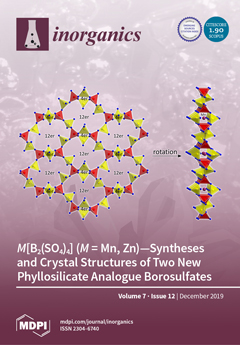
Cover Story: Borosulfates are a rapidly expanding class of silicate analog materials. They are composed of vertex shared (BO4)- and (SO4)-tetrahedra, whereas borosulfates with cross-linking of the anionic network into two or even three dimensions are still very rare. We found that reactions between oleum enriched with 65% SO3 and boric acid in evacuated torch-sealed glass ampoules can be a powerful strategy to synthesize borosulfates with layer-like anionic substructures of divalent metals. The two new representatives Mn[B2(SO4)4] and Zn[B2(SO4)4] reveal alternating vierer- and zwölfer-rings of exclusively corner-linked (SO4)- and (BO4)-tetrahedra within the anionic layers. Both borosulfates are the first representatives with cations residing in the planes of the anionic networks. View this paper.
  • Issues are regarded as officially published after their release is announced to the table of contents alert mailing list .
  • You may sign up for email alerts to receive table of contents of newly released issues.
  • PDF is the official format for papers published in both, html and pdf forms. To view the papers in pdf format, click on the "PDF Full-text" link, and use the free Adobe Reader to open them.

Articles (7)

  • Article
  • Open Access
12 Citations
4,183 Views
9 Pages

17 December 2019

Borosulfates are a rapidly expanding class of silicate analogue materials, where the structural diversity is expected to be at least as large as known for silicates. However, borosulfates with cross-linking of the anionic network into two or even thr...

  • Review
  • Open Access
35 Citations
8,364 Views
16 Pages

14 December 2019

This mini-review focuses on the 2015–2019 literature survey of thiazole- and thiadiazole-containing Metal–Organic Frameworks (MOFs) and Coordination Polymers (CPs) exploited in the applicative field of luminescent sensing.

  • Article
  • Open Access
8 Citations
4,167 Views
12 Pages

High-Pressure Modification of BiI3

  • Ulrich Schwarz,
  • Aron Wosylus,
  • Marcus Schmidt,
  • Lev Akselrud,
  • Alim Ormeci,
  • Michael Hanfland,
  • Volker Hermann and
  • Christine Kuntscher

13 December 2019

Structural and optical properties as well as chemical bonding of BiI3 at elevated pressures are investigated by means of refinements of X-ray powder diffraction data, measurements of the optical absorption, and calculations of the band structure invo...

  • Article
  • Open Access
1 Citations
3,749 Views
10 Pages

Technetium Nitrido-Peroxo Complexes: An Unexplored Class of Coordination Compounds

  • Micol Pasquali,
  • Emilija Janevik-Ivanovska and
  • Adriano Duatti

11 December 2019

The purpose of this work was to further expand the chemistry of mixed technetium nitrido-peroxo complexes, a still poorly explored class of compounds containing the Tc(VII) moiety, [99gTc][Tc(N)(O2)2]. A number of novel complexes of the formula [99gT...

  • Article
  • Open Access
18 Citations
4,355 Views
14 Pages

Alkali-Activated Metakaolin as a Zeolite-Like Binder for the Production of Adsorbents

  • Kristine Vegere,
  • Laura Vitola,
  • Pauls P. Argalis,
  • Diana Bajare and
  • Andrey E. Krauklis

6 December 2019

This work reports and describes a novel alkali-activated metakaolin as a potential binder material for the granulation of zeolites, which are widely used as CO2 adsorbents. The alkali-activated binders are zeolite-like materials, resulting in good ma...

  • Communication
  • Open Access
19 Citations
4,771 Views
10 Pages

A PAlP Pincer Ligand Bearing a 2-Diphenylphosphinophenoxy Backbone

  • Kazuhiko Semba,
  • Ikuya Fujii and
  • Yoshiaki Nakao

28 November 2019

A PAlP pincer ligand derived from 2-diphenylphosphino-6-isopropylphenol was synthesized. The Lewis acidity of the Al center of the ligand was evaluated with coordination of (O)PEt3. A zwitterionic rhodium-aluminum heterobimetallic complex bearing the...

  • Review
  • Open Access
22 Citations
5,319 Views
15 Pages

21 November 2019

Two closed-cycle cryogenic refrigerators were used to generate temperatures of ~18 K via evaporation of liquid hydrogen at the interfaces with radiofrequency and infrared sensors on an Earth-orbiting spacecraft that measured the anisotropy of the cos...

Get Alerted

Add your email address to receive forthcoming issues of this journal.

XFacebookLinkedIn
Inorganics - ISSN 2304-6740