1. Introduction
Laser irradiation of biological tissue can induce thermal, mechanical, and photochemical effects and has been widely used for disease diagnosis and treatment [
1,
2]. The mid-infrared (mid-IR) spectral region covers the principal absorption bands of key tissue constituents, including water, proteins, and hydroxyapatite [
3,
4], making it particularly attractive for tissue ablation. Currently, mid-IR lasers operating at 2–3 μm and 10.6 μm exploit the strong absorption of water to achieve photothermal ablation and have been applied in tumor removal [
5,
6]. However, ablation at these wavelengths relies primarily on a single water-mediated thermal mechanism and often results in significant collateral thermal damage [
7,
8]. In contrast, laser radiation at 6.45 μm overlaps with the amide II absorption band of proteins while maintaining moderate water absorption. The combined effects of protein denaturation and water absorption enable efficient tissue ablation with reduced collateral damage, making 6.45 μm lasers particularly suitable for high-precision medical applications [
8,
9,
10,
11].
Common sources of 6.45 μm radiation include free-electron lasers (FELs), strontium vapor lasers, gas Raman lasers, and solid-state systems based on optical parametric oscillation (OPO), optical parametric amplification (OPA), and difference-frequency generation (DFG). FELs offer broad wavelength tunability and can deliver both high average and peak powers, making them early sources for 6.45 μm mid-IR laser ablation studies [
12,
13]. However, their high cost, large size, and structural complexity severely limit practical applications [
14]. Although strontium vapor and gas Raman lasers provide multiple spectral lines, high output power, and compact size, they suffer from complex setups, low overall efficiency, poor output stability, and demanding maintenance, which hinder their suitability for clinical use [
15,
16].
For the generation of 6.45 μm radiation, solid-state sources based on OPO, OPA, and DFG architectures are highly regarded for their portability and operational stability. The OPO scheme features a simple structure, with no requirement for seed injection or an additional intense pump beam, while still delivering high conversion efficiency. This makes it an ideal choice for obtaining high-power lasers. To date, OPOs based on AgGaS2 [
17], AgGaSe2 [
18], BaGa4S7 [
19], and BaGa4Se7 [
20,
21] crystals have achieved 6.45 μm radiation with millijoule-level pulse energies. Nevertheless, their inherent low thermal conductivity limits high-average-power pumping, typically capping output power below 100 mW. While CdSiP2 (CSP) and ZnGeP2 (ZGP) crystals present a viable alternative with their superior thermal and nonlinear properties for high-power 6.45 μm generation, the development of CSP-based OPO is limited by difficult growth processes, material quality and a restrictive absorption edge (near 6.5 μm). Consequently, the reported output power at 6.45 μm for CSP systems has peaked at a mere 105 mW [
22].
In contrast, ZGP crystals stand out as an ideal nonlinear medium for 6.45 μm generation, as they synergistically combine a broad transparency range and high damage threshold with superior thermal conductivity and nonlinear coefficients. However, due to the lack of pump sources with wavelengths > 1.8 μm required for ZGP crystals, early ZGP OPO studies [
23,
24,
25,
26] achieved wide wavelength tuning ranges but delivered low average output powers of only tens of milliwatts in the 6–7 μm band. Representative examples include the following: In 1997, a ZGP OPO pumped by a 2.79 μm Cr, Er:YSGG laser was reported with peak output power of ~24 mW at 6.9 μm [
23]. In 2003, a cascaded PPLN-OPO-pumped ZGP OPO employing a double-pass singly resonant linear cavity was reported, generating tunable mid-infrared output from 3.7 to 10.2 μm with peak output power of ~12 mW at 6.6 μm [
25]. In 2012, a ZGP OPO pumped by a PPKTP MOPA system was reported, delivering a maximum 6.45 μm output power of 91 mW with a peak power of 193 kW and a pump-to-idler conversion efficiency of 4.7% [
26].
With breakthroughs in output power and beam quality of Tm- and Ho-doped lasers, ZGP OPOs have achieved significant improvements in output power and efficiency near 6.45 μm. In 2012, a ZGP OPO pumped by a high-energy 2.05 μm Ho
3+:LLF MOPA nanosecond laser was demonstrated [
27]. By adopting a nonplanar ring cavity, the system achieved 0.95 W output at 6.45 μm with a peak power of 150 kW, an average beam quality factor M
2 of 2.5, and a conversion efficiency of 10.8% at a repetition rate of 200 Hz. More recently, in 2022, a linear-cavity ZGP OPO pumped by a 2.09 μm Ho:YAG oscillator produced 1.53 W of 6.45 μm output at 10 kHz. However, the peak power and conversion efficiency remained relatively low, with a peak power of only 3.69 kW and an efficiency of 8.2% [
28].
Previous studies underscore that simultaneous optimization of average and peak power is paramount for effective tissue ablation [
29,
30]; high average power accelerates ablation rates for hard tissues, while elevated peak power effectively lowers the ablation threshold. Consequently, engineering a compact, stable 6.45 μm source that harmonizes these two metrics is essential for advancing clinical surgical efficiency.
In this work, we demonstrate a robust, high-power 6.45 μm ZGP OPO pumped by a high-power Ho:YAG MOPA system. By employing an optimized four-mirror ring cavity, we achieved efficient generation of 10 W-class 6.45 μm radiation. A systematic investigation into pump spot size, phase-matching configurations, and crystal dimensions was conducted to pinpoint the optimal operational regime. Utilizing a 30 mm-long Type I ZGP crystal, the system delivered a record-breaking maximum average power of 14.5 W with a pump-to-idler conversion efficiency of 17.57% and a peak power of 51.4 kW. Notably, this performance represents a tenfold increase in average power and nearly a twofold enhancement in efficiency compared to previously reported 6.45 μm sources.
2. Experimental Setup and Methods
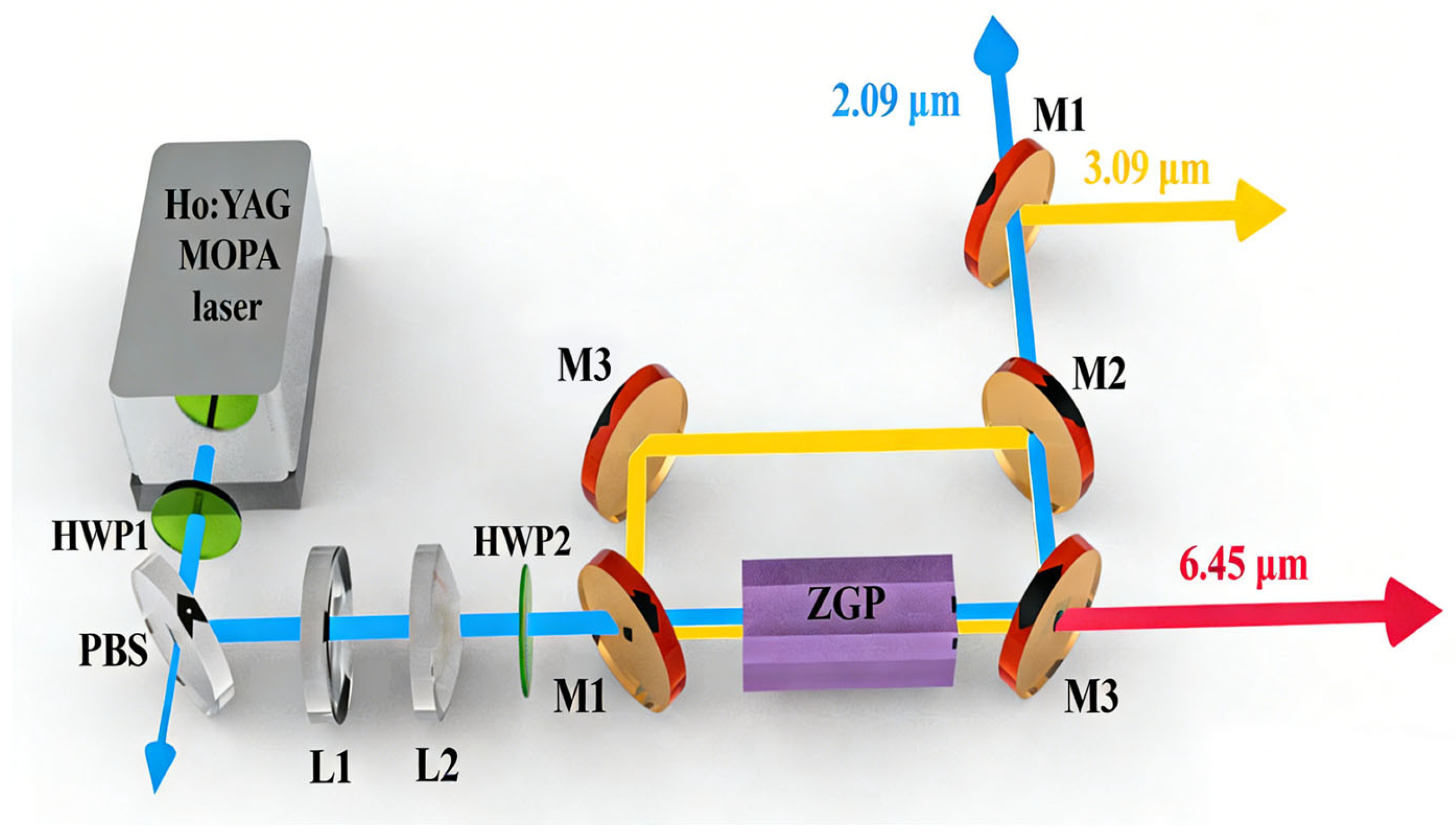
The experimental setup of the high-power 6.45 μm optical parametric oscillator is shown in
Figure 1. The system consists of a pump source, a beam delivery and shaping stage, and a singly resonant ring OPO cavity. The pump source is a self-developed Ho:YAG master oscillator power amplifier (MOPA), comprising an acousto-optically Q-switched Ho:YAG oscillator and a double-end-pumped single-stage amplifier. It delivers radiation at 2.09 μm with a repetition rate of 10 kHz, a maximum average output power of 90 W, a minimum pulse duration of 28 ns, and an average beam quality factor of M
2 = 1.53. In the beam delivery and shaping stage, a half-wave plate (HWP1) combined with a polarization beam splitter (PBS) is used to obtain linearly polarized pump light with adjustable power. Lenses L1 and L2 form a telescope to control the pump beam size and divergence, while a second half-wave plate (HWP2) is employed to obtain horizontally polarized pump light.
The singly resonant ring OPO adopts a four-mirror ring configuration composed of M1, M2, and two diagonally arranged M3 mirrors, with a total cavity length of 160 mm. M1 is the input coupler, highly transmissive for the 2.09 μm pump (T > 98%) and highly reflective for the 2.88–3.3 μm signal (Rs > 99.5%). M2 serves as the signal output coupler, with high pump transmission (T > 98%) for 2.09 μm pump light and partial transmission (Ts ≈ 50%) for 2.88–3.3 μm signal light. M3 functions as the idler output coupler, highly reflective for the pump and signal (R > 99.5%) and highly transmissive for the 5.7–7.6 μm idler (Ti ≈ 97%). To reduce idler loss, the two M3 mirrors are placed diagonally, enabling direct extraction of a clean idler beam without additional splitting. The signal and residual pump are separated outside the cavity, and the output powers of the signal and idler are measured with an OPHIR power meter, while the idler wavelength is monitored using an Arcoptix FT-IR spectrometer (Manufactured by ARCoptix, Neuchâtel, Switzerland).
To compare the OPO performance of ZGP crystals under type I and type II phase matching and to explore the crystal length and beam size required for higher-power 6.45 μm output at a fixed pump power, comparative experiments were carried out using four ZGP crystals with different phase-matching schemes and lengths. These crystals were supplied by Chengdu Dien Photoelectric Technology Co., Ltd., Chengdu, China, and grown using the horizontal ultralow-gradient growth method, exhibiting good uniformity and low absorption loss with an absorption coefficient < 0.02 cm−1 at 2.09 μm pump wavelength.
The detailed parameters of the four ZGP crystals used in the experiments are listed in
Table 1. Crystals #1 and #2, both with cutting angles of θ = 75° and φ = 45°, are Type II phase-matching crystals. Crystal #3 has cutting angles of θ = 54.3° and φ = 0°, while crystal #4 has θ = 52.05° and φ = 0°; both are Type I phase-matching crystals. All ZGP crystals were polished on both end faces and coated with high-transmission (T > 99%) antireflection coatings at 2.09 μm, 3.09 μm, and 6.45 μm. The crystals were wrapped in indium foil, mounted in copper heat sinks, and temperature-stabilized at 16 °C using a water-cooled chiller, with a control precision of ±0.5 °C.
3. Results and Analysis
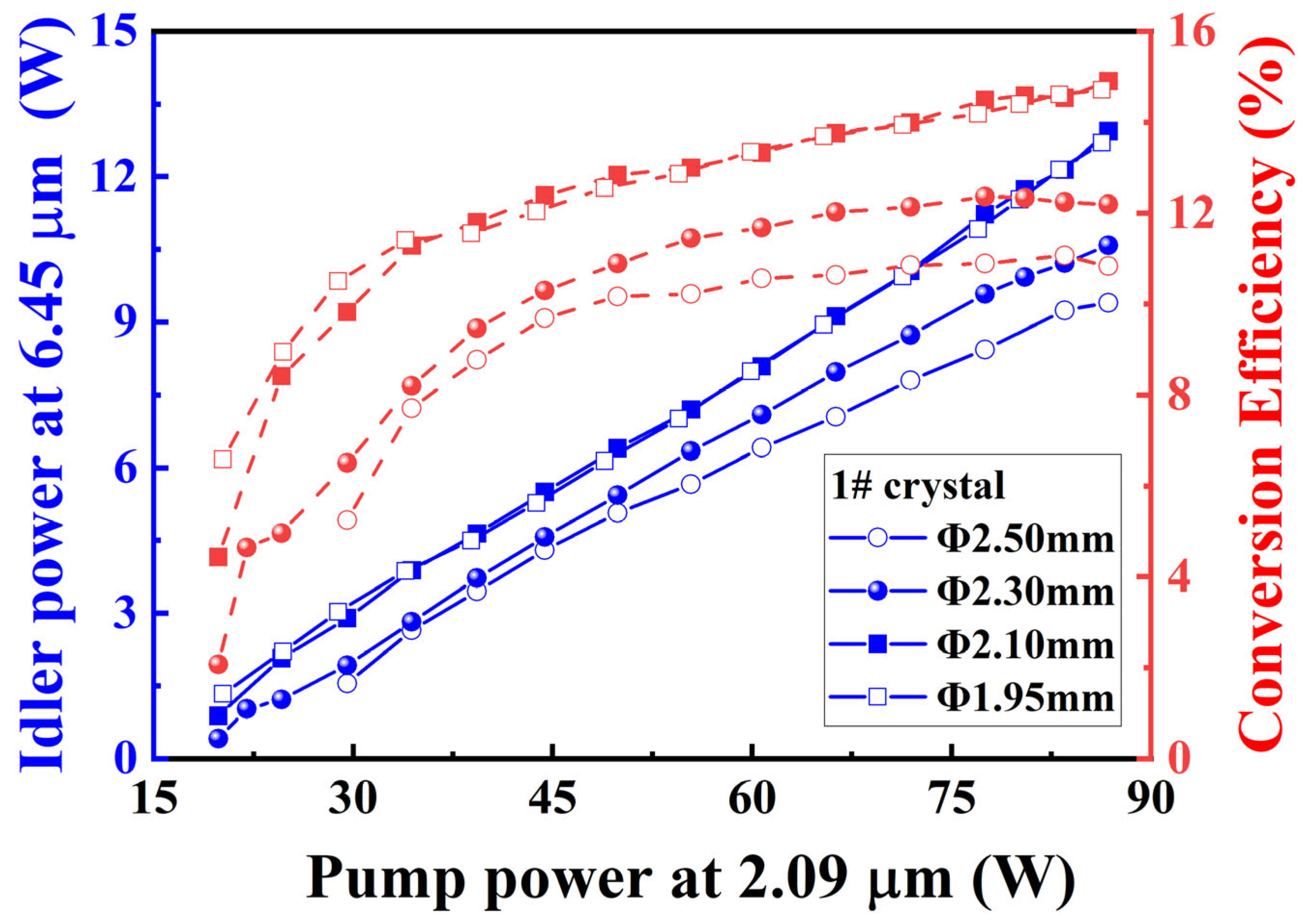
According to the optical parametric oscillator (OPO) theory, the pump spot size is a critical factor affecting the output performance of ZGP OPO, as it determines both the peak power density and the spatial walk-off effect. Finding an optimal spot size is essential for balancing conversion efficiency and crystal damage prevention. In this study, the impact of pump spot diameter on OPO performance was investigated using a Type II phase-matched crystal (#1). To ensure comparability, parameters such as pump divergence angle, mirror coupling, and environmental conditions were kept constant.
Figure 2 shows the output power and conversion efficiency of the 6.45 μm idler as a function of pump power under different spot sizes. As the spot diameter decreased from 2.50 mm to 1.95 mm, the oscillation threshold dropped, while the output power and efficiency initially increased and then stabilized. At a maximum pump power of 86.8 W, for pump diameters of 2.50 mm, 2.30 mm, 2.10 mm, and 1.95 mm, the corresponding peak power densities were 5.71, 6.7, 8.1, and 8.7 MW/cm
2, respectively. Under these conditions, the 6.45 μm idler output powers were 9.47, 10.58, 12.94, and 12.70 W, with corresponding optical-to-optical conversion efficiencies of 10.9%, 12.2%, 14.9%, and 14.7%. Further reduction to 1.95 mm yielded no noticeable improvement, owing to enhanced back-conversion and increased spatial walk-off at higher peak intensities. Further decreasing the pump diameter would reduce efficiency and significantly increase the risk of crystal damage. Therefore, a pump beam diameter of 2.10 mm was selected for subsequent experiments.
Using the four ZGP crystals listed in
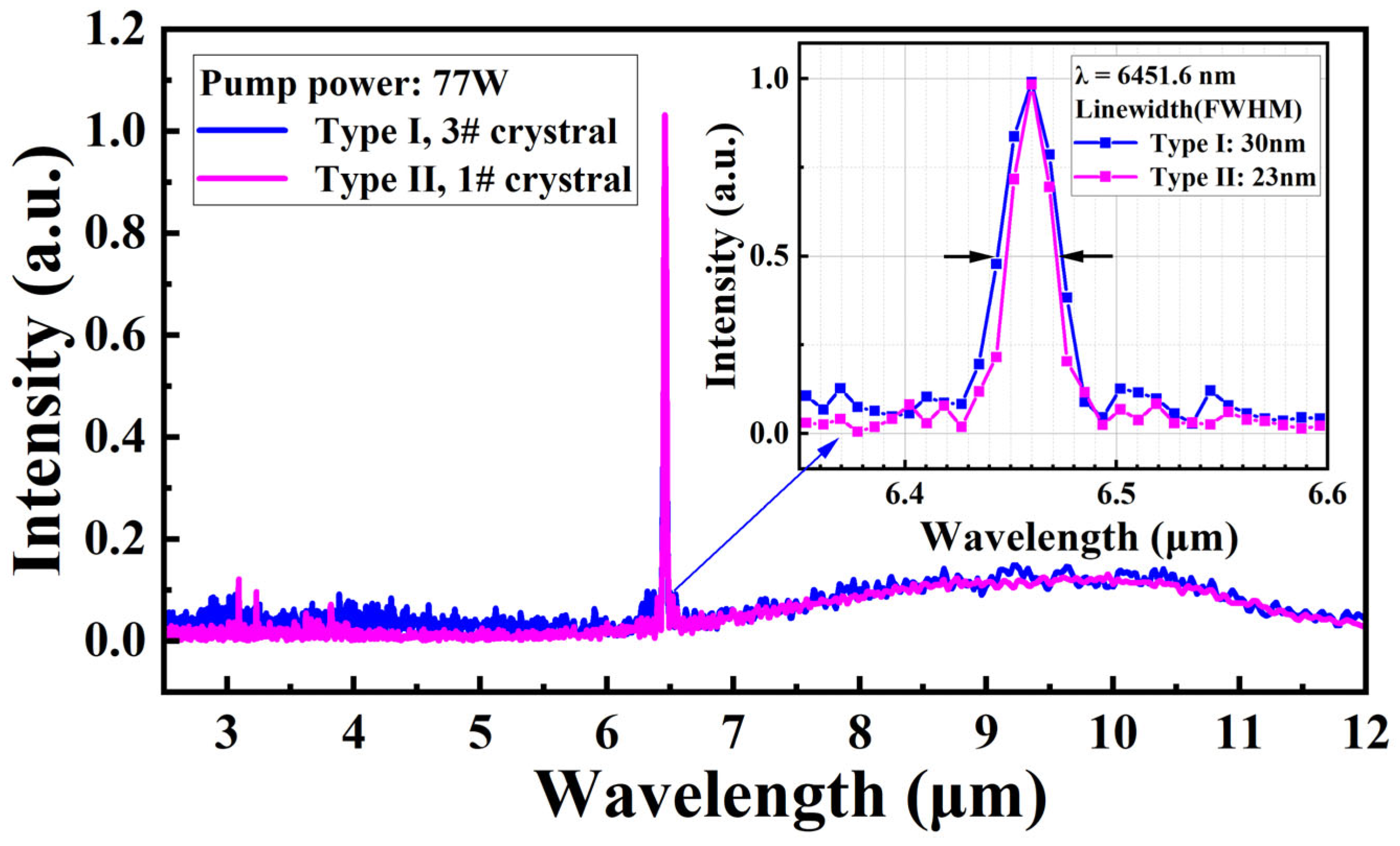
Table 1, we compared the effects of phase-matching type and crystal length on the OPO output. Due to slight differences in cutting angles, the crystal orientation was adjusted so that all crystals produced idler radiation at 6.45 μm. At 77 W pump power, we measured the idler output spectra of 30 mm long Type II ZGP (1#) and Type I ZGP (3#) crystals using a mid-infrared Fourier transform spectrometer (Arcoptix, FT-IR, 2–12 μm), as shown in
Figure 3. The Type II crystal exhibited lower spectral noise, sharper peaks, and no center wavelength drift during extended operation. The inset shows a magnified view near 6.45 μm, revealing a center wavelength of 6451.6 nm for both Type I and Type II ZGP crystals. The spectral widths were ~30 nm for Type I and 23 nm for Type II ZGP OPOs. While the Type II output spectrum appears only slightly narrower than Type I, this result may be limited by the relatively low resolution (~8 nm) of the spectrometer (Arcoptix, FT-IR, 2–12 μm). According to empirical guidelines, accurate measurement of spectral linewidth requires widths 3 to 5 times the instrument resolution (8 nm), corresponding to 24–40 nm, indicating that our measurements are near this limit.
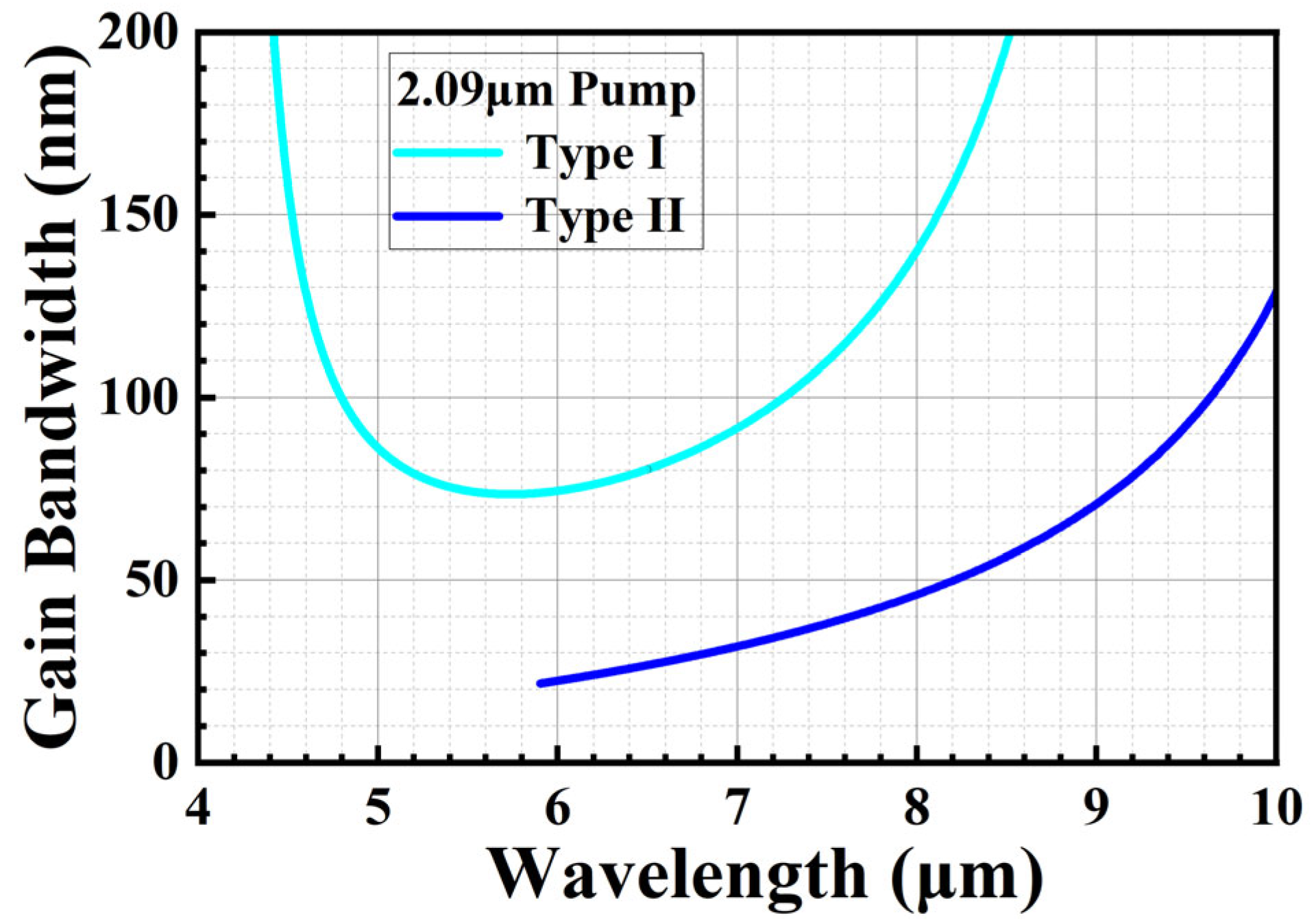
According to the theory of birefringent phase matching, the crystal gain bandwidth is determined by the phase mismatch Δk, crystal length L, the central wavelength of the parametric wave, and the group refractive indices. By applying the ZGP crystal parameters and setting the phase mismatch to Δk = 2π/L, we calculated the gain bandwidths of Type I and Type II ZGP crystals as a function of central wavelength, as shown in
Figure 4. The results indicate that near 6.45 μm, both crystals exhibit relatively narrow gain bandwidths, with values of ~80 nm for type I and ~26 nm for type II, with the latter being approximately one third of the former. Considering pump intensity and intracavity mode competition, the output linewidth of a ZGP OPO is typically significantly narrower than its gain bandwidth. Based on the linewidth narrowing factor observed for the Type I ZGP OPO (30 nm output linewidth versus 80 nm gain bandwidth), the output linewidth of the Type II ZGP OPO is estimated to be below 10 nm.
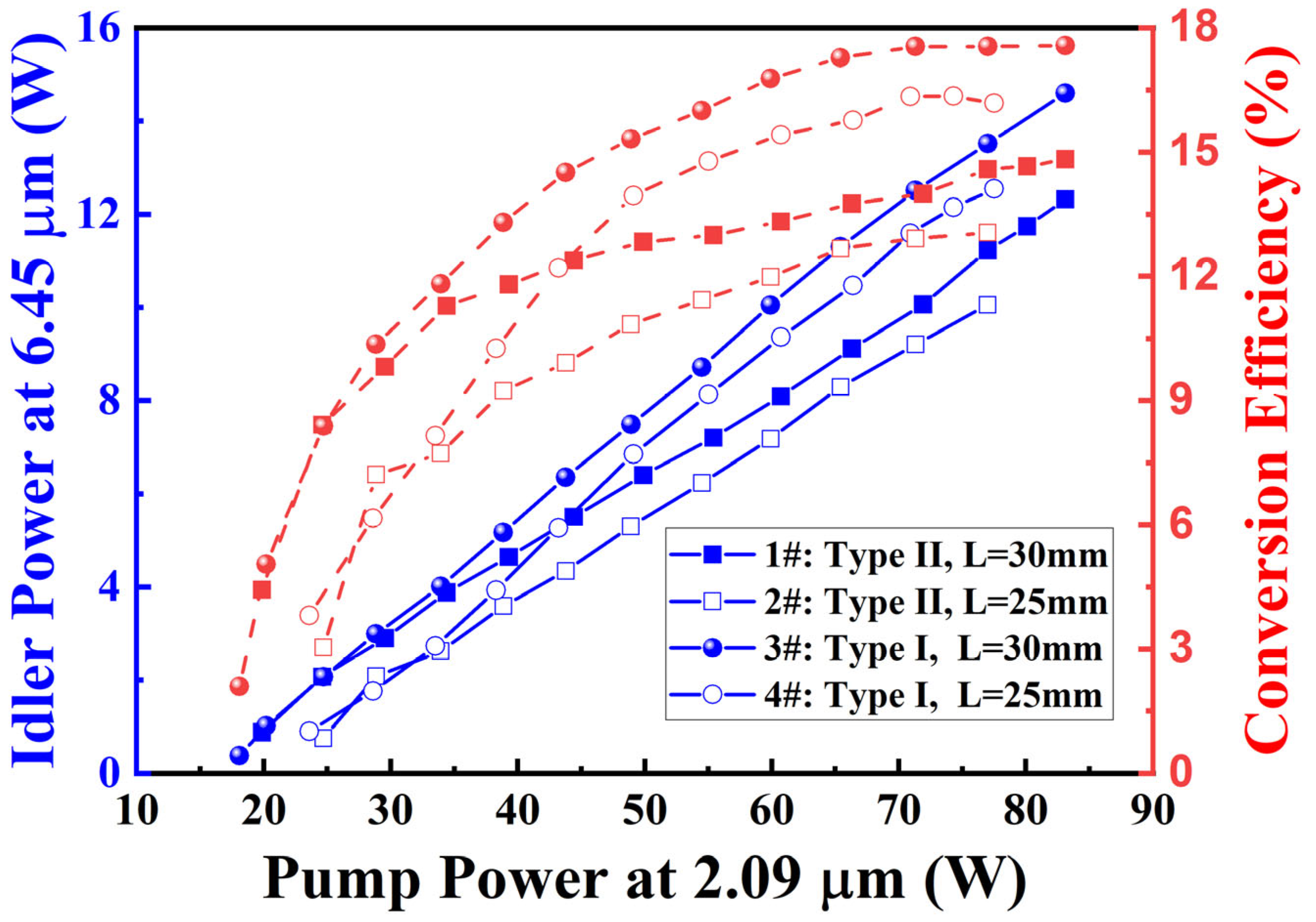
Figure 5 shows the 6.45 μm idler output power and conversion efficiency for type II and type I ZGP OPOs with different crystal lengths. At a pump power of 77 W, the output powers for samples #1 to #4 are 11.23, 10.05, 13.51, and 12.54 W, corresponding to conversion efficiencies of 14.58%, 13.05%, 17.54%, and 16.18%, respectively. For crystals of the same length, the oscillation thresholds are similar: ~17 W for 30 mm crystals and ~21.5 W for 25 mm crystals. As the pump power increases, the type I OPOs outperform the type II OPOs in both output power and efficiency, exhibiting higher slope efficiency. For the same phase-matching type, the 30 mm crystals yield lower thresholds and higher output power and efficiency than the 25 mm crystals. Notably, the slope efficiency is almost independent of crystal length, being ~23% for type I and ~18% for type II, because although a longer crystal provides higher single-pass gain and lower threshold, it also suffers more walk-off and absorption loss. At a maximum pump power of 83 W (incident pump power on the OPO crystal), the type II ZGP crystal (#1, 30 mm) produced a maximum 6.45 μm idler power of 12.32 W with a conversion efficiency of 14.82%. The type I ZGP crystal (30 mm) achieved a maximum idler power of 14.60 W and a conversion efficiency of 17.57%, corresponding to a quantum efficiency of 54.2%.
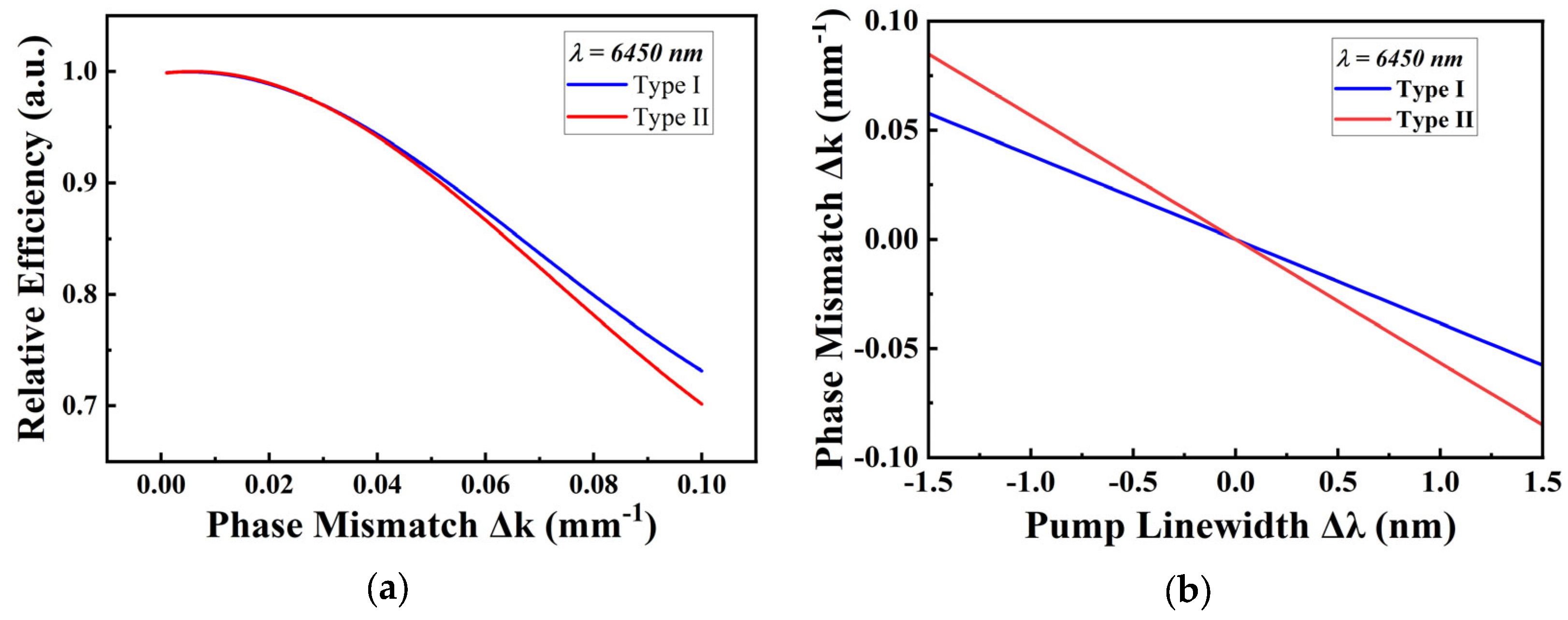
Considering the nearly identical pump conditions, environmental variables, crystal lengths, and nonlinear coefficients for Type I and Type II crystals in our experiments, along with analysis of the primary factors influencing OPO phase mismatch Δk, we attribute the superior output performance of Type I ZGP crystals to their smaller phase mismatch under equivalent pump conditions. While pump spectral width and beam divergence both affect the phase mismatch Δk, the near-collimated pump beam with small divergence allows us to focus primarily on phase mismatch induced by pump linewidth. Based on OPO theory, we calculated the relationship between pump linewidth and phase mismatch for Type I and Type II phase matching, as well as the relative conversion efficiency versus phase mismatch, shown in
Figure 6a and 6b, respectively. It is evident that the phase mismatch increases with the pump spectral width. For a given pump linewidth, Type I phase matching exhibits significantly smaller phase mismatch than Type II. Additionally, conversion efficiency decreases rapidly with increasing phase mismatch for both crystal types, dropping to ~70% of maximum efficiency at Δk = 0.1 mm
−1. At 6.45 μm, Type I phase-matched ZGP OPO has broader pump acceptance bandwidth and smaller phase mismatch, resulting in higher output power and efficiency.
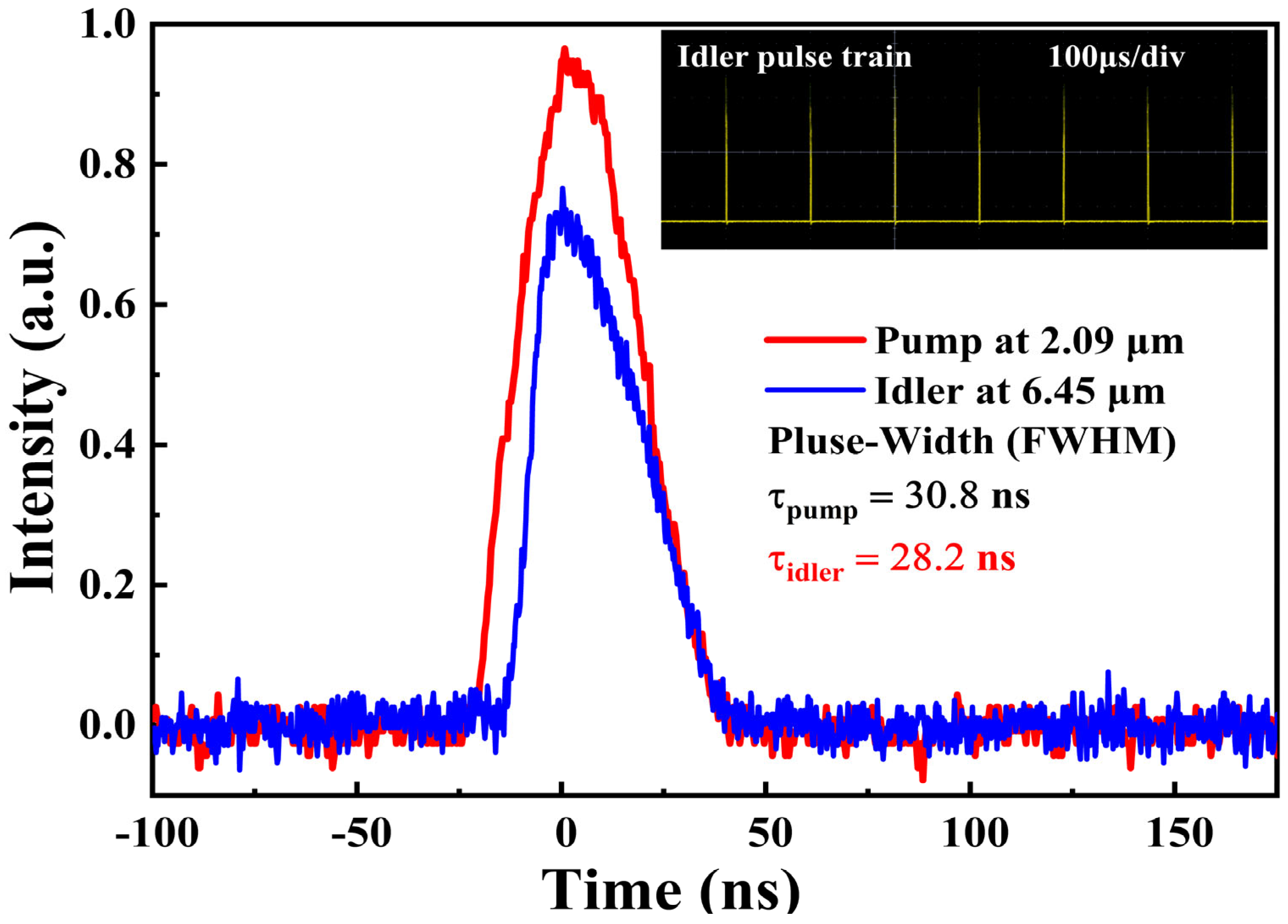
This represents the highest reported output power and conversion efficiency for ZGP OPOs in this wavelength range. The pump and idler pulse profiles were measured using an HgCdTe detector (Model PDAVJ10, Thorlabs, Newton, NJ, USA) and recorded by a 1 GHz digital oscilloscope (Model MOD34, Tektronix, Beaverton, OR, USA). As shown in
Figure 7, the pump pulse width was 30.8 ns, while the idler pulse width was 28.2 ns. The idler pulse exhibits a steeper leading edge and slight narrowing compared with the pump, indicating pulse narrowing. The inset shows a stable idler pulse train at 10 kHz. Based on the measured idler pulse width, the calculated peak power of the 6.45 μm laser is approximately 51.7 kW, which is 14 times higher than that reported in Ref. [
28].
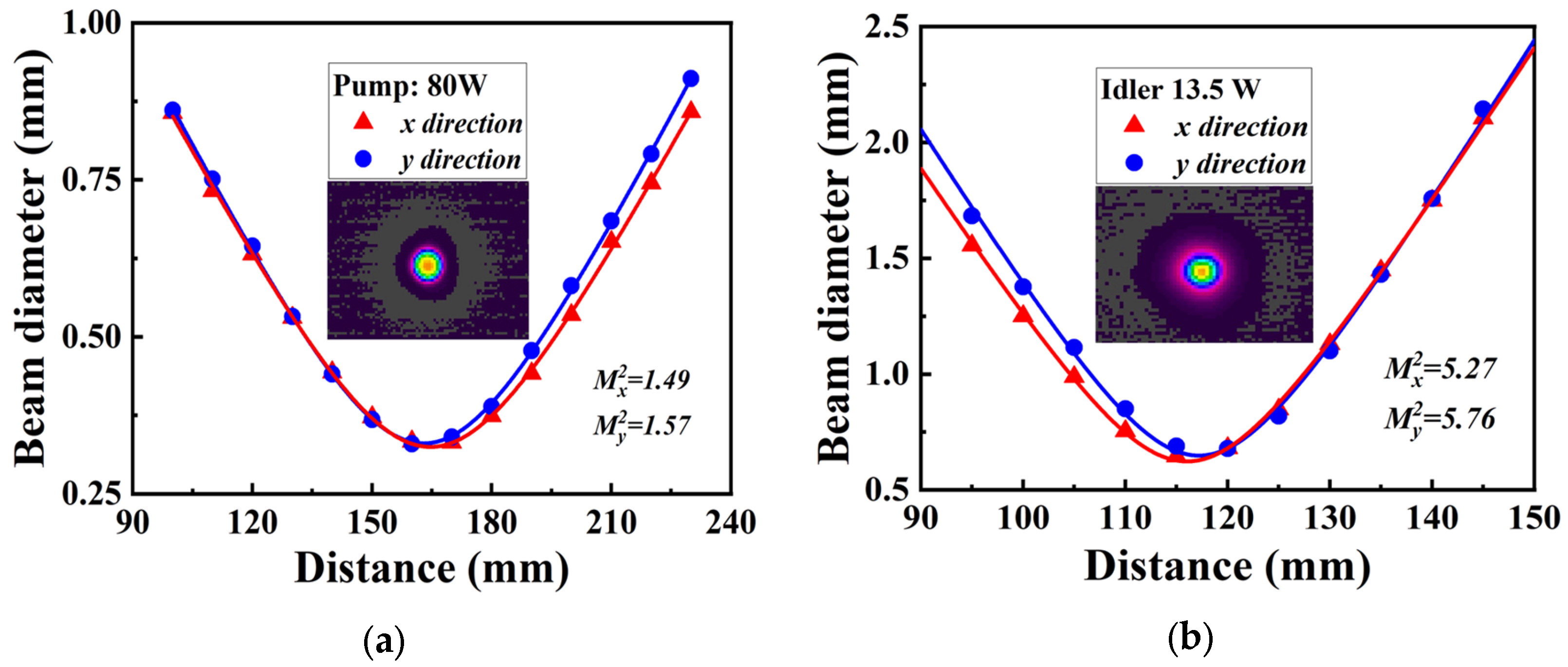
At a pump power of 80 W, the beam quality of both the pump light and the 6.45 μm idler light was measured using a mid-infrared beam profiler (Spiricon: Pyrocam III HR with a pixel size of 75 μm × 75 μm). The results are shown in
Figure 8a and b, respectively. The beam quality factors (M
2) of the pump light were measured to be 1.49 (horizontal direction) and 1.57 (vertical direction). Under this condition, the output idler power from the ZGP OPO was 13.5 W, and its M
2 factors were measured to be 5.27 and 5.76 in the horizontal and vertical directions, respectively. The insets in the figures show the near-field two-dimensional beam profiles of both the pump and idler beams, which exhibit good circularity.
Compared to the beam quality of the pump light, that of the output idler light significantly deteriorated. The primary reasons for this are likely twofold. First, under high-power pumping, heat deposition within the ZGP crystal exacerbates the thermal lensing effect, which in turn increases the divergence angles of both the resonating signal light and the output idler light. At 80 W pump power, the divergence angle of the idler light directly output from the ZGP OPO was measured to be ~10 mrad, significantly larger than that of the incident pump light, indicating pronounced thermal lensing effects in the ZGP crystal under high-power pumping. Additionally, the increased nonlinear gain in the crystal promotes the oscillation of higher-order modes. These two factors collectively lead to the degradation of the output beam quality. To improve beam quality, the ZGP OPO cavity should have stronger mode selection and compensation for thermal lensing under high-power pumping. Common approaches include increasing cavity length and inserting intracavity apertures or diffractive elements, but these significantly reduce output power. More viable alternatives include using intracavity lenses to compensate divergence and employing low Fresnel number cavity designs, such as three-mirror ring cavities [
31] and nonplanar image-rotating resonators [
32], which enhance mode selectivity while avoiding substantial power loss. Additionally, since the OPO cavity Fresnel number is inversely proportional to the resonant wavelength, an idler singly resonant oscillator (Idler-SRO) configuration can leverage the longer wavelength (6.45 μm) to reduce the cavity Fresnel number, fundamentally improving beam quality.
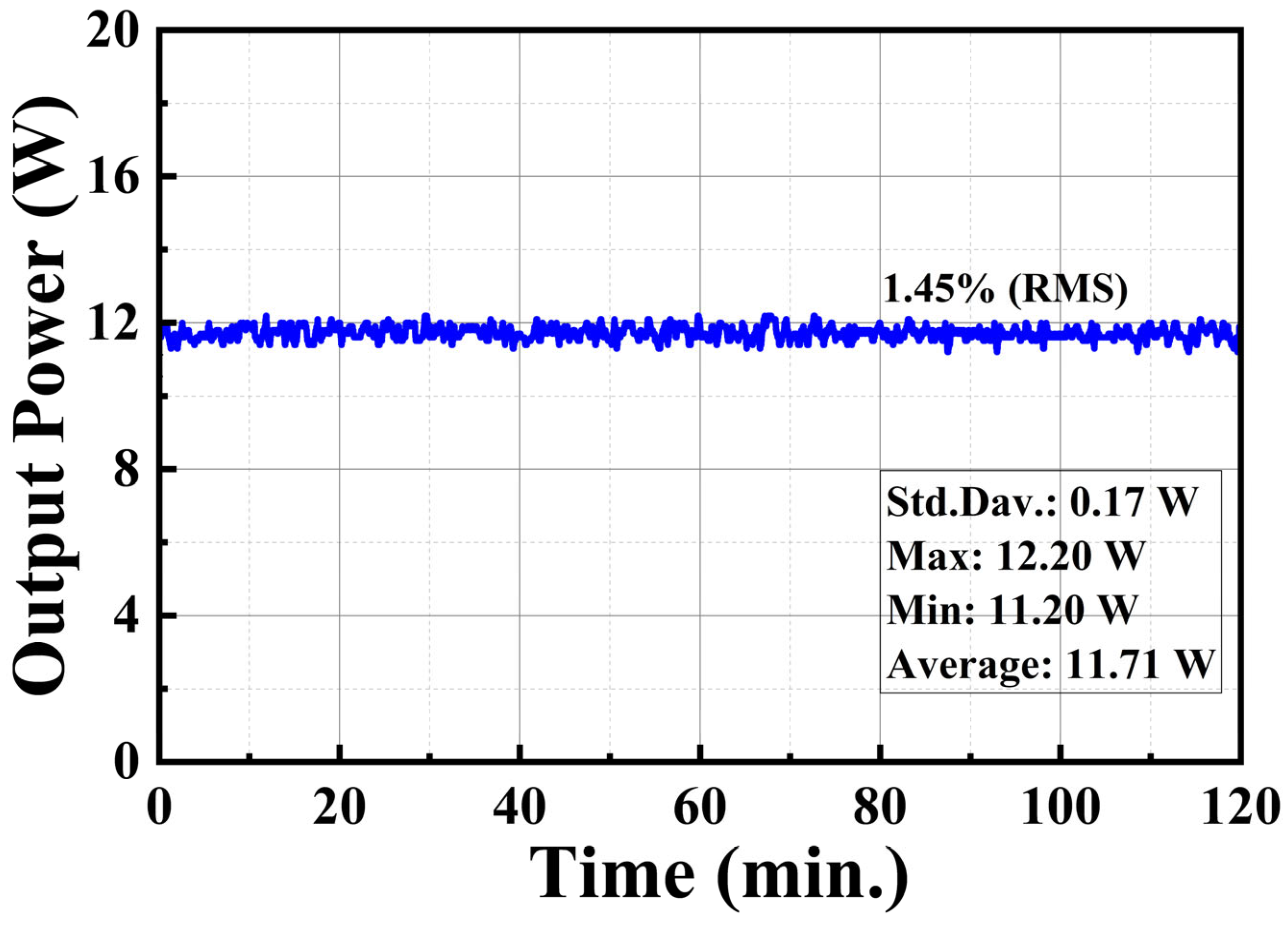
Considering the risk of crystal damage under prolonged operation at maximum power, we selected an operating point near 11 W of 6.45 μm idler output to measure the power stability. To evaluate long-term system stability, we conducted 2 h power stability monitoring, with results shown in
Figure 9. Over this period, the average idler output power was 11.71 W with maximum and minimum values of 12.2 W and 11.2 W, respectively, yielding a power instability of 1.45% (RMS). This demonstrates excellent power stability and reliability of the high-power 6.45 μm ZGP OPO system, which is critical for practical applications such as laser ablation.
4. Discussion
This work demonstrates a record-high 14.6 W output at 6.45 μm with 17.57% optical-to-optical efficiency from a ring-cavity ZGP OPO pumped by a Ho:YAG MOPA—an order-of-magnitude power increase and near-doubled efficiency relative to prior ZGP OPOs [
25]. The implications are discussed below regarding phase-matching, repetition-rate scalability, stability, and limitations.
Phase-matching comparison. For the first time, Type I and Type II ZGP OPOs were systematically compared under identical pumping conditions. At 30 mm crystal length, the Type I OPO delivers superior performance (14.6 W, 17.57%) over its Type II counterpart (12.32 W, 14.82%). This contrasts with earlier Type II results (RISTRA [
24], linear cavity [
25]), where no direct Type I benchmark existed. Theoretical analysis identifies the origin of this advantage: Type I phase matching provides a broader pump acceptance bandwidth and, consequently, a substantially smaller phase mismatch, leading to higher conversion efficiency.
Repetition rate scalability. The system operates at 10 kHz, a trade-off among pulse energy, average power, and damage risk. Benefiting from Ho:YAG’s long upper-level lifetime (~7 ms), pump extraction efficiency remains nearly constant above 3 kHz. Lower repetition rates increase pulse energy and peak power, elevating damage risk and back-conversion; larger beam diameters are then required. Higher rates (e.g., 20 kHz) sustain higher average power but reduce pulse energy, demanding careful beam-size optimization to maintain OPO efficiency.
Power stability. At 11.71 W, an RMS instability of 1.45% over 2 h is achieved—enabled by (i) intrinsically stable Ho:YAG MOPA (RMS < 0.5%), (ii) ring cavity elimination of spatial hole burning, and (iii) 16 °C water cooling (ΔT < ±0.5 °C). As emphasized by Edwards et al. [
26] and Hutson et al. [
27], preclinical studies of 6.45 μm lasers demand sources that simultaneously deliver high average power and excellent stability—criteria that the present laser source fully satisfies.
Despite the advances reported above, several limitations remain. First, the beam quality (M2 ≈ 5.5) remains insufficient for applications demanding high transverse-mode purity—such as fiber-coupled delivery of 6.45 μm radiation for interventional ablation—where poor beam quality incurs substantial coupling and transmission losses. Second, the spectral resolution of the FT-IR spectrometer (~8 nm at 6.45 μm) precludes precise discrimination of the output linewidth difference between Type I and Type II crystals. Our theoretical analysis predicts a sub-10 nm linewidth for the Type II OPO, which requires validation using a high-resolution spectrometer (<0.5 cm−1).
Biomedical validation, including tissue ablation, has yet to be performed. Future work will focus on collaborative ex vivo and in vivo ablation studies with medical institutions, systematically benchmarking ablation efficiency and thermal damage zones against existing 6.45 μm free-electron laser sources—thereby advancing the clinical translation of all-solid-state 6.45 μm lasers.