Article

Simplified See-Through Head-Mounted Display Optics with Achromatic Metalens

Shaanxi Key Laboratory of Optical Information Technology, Key Laboratory of Light Field Manipulation and Information Acquisition, Ministry of Industry and Information Technology, School of Physical Science and Technology, Northwestern Polytechnical University, Xi’an 710129, China
*
Author to whom correspondence should be addressed.
Photonics 2026, 13(3), 229; https://doi.org/10.3390/photonics13030229
Submission received: 23 December 2025 / Revised: 28 January 2026 / Accepted: 9 February 2026 / Published: 27 February 2026
(This article belongs to the Special Issue Optical Systems and Design)

Abstract

To address the critical challenges of minimizing optical thickness and correcting chromatic aberrations in optically transparent head-mounted displays (HMDs), we propose a folded hybrid design incorporating freeform prisms and a discrete multi-wavelength achromatic metalens. Our approach integrates advanced optical engineering techniques to achieve optimal performance while maintaining compactness. The system leverages a phase-optimized SiNx/SiO2 metalens combined with ray-tracing-based system optimization, enabling the development of a compact 12 mm thickness OST-HMD featuring an 8 mm exit pupil and a 39° virtual field of view (FOV). Through simulations, we demonstrate that this configuration achieves impressive modulation transfer function (MTF) values exceeding 0.7 at 50 lp/mm for see-through viewing and maintaining MTFs above 0.3 at 30 lp/mm for virtual imaging across wavebands. Simulation results highlight an improvement both in the miniaturization of the HMD while maintaining high resolution and in effective correction of chromatic aberrations, offering a robust solution for lightweight, high-performance AR display systems. This work represents an advancement in optically transparent display technology by providing an optimized design framework that balances compactness with visual fidelity.

Graphical Abstract

1. Introduction

In recent years, near-eye display technologies, especially augmented reality (AR) systems, have drawn growing research interest, with optical see-through head-mounted displays (OST-HMDs) as their core component [1,2,3,4]. By superimposing virtual imagery onto the real scene, OST-HMDs require an optical module that is simultaneously lightweight, compact, and capable of delivering high-resolution, low-distortion visual performance. Achieving these metrics in a single architecture, however, remains a persistent challenge. OST-HMDs overlay virtual scenes onto real views, and their form factor, weight, and image quality directly shape user experience. However, balancing compactness, light weight, high optical performance, and efficiency remains a key challenge. To address this, early solutions adopted aspheric elements [5,6], geometric waveguides [7,8], and diffractive/holographic elements [9,10], but with limitations; for example, geometric waveguides suffered from stray light, while diffractive/holographic ones lacked efficiency. Prism-based OST-HMDs, traced to 1990s, advancements with freeform optics design, offering compactness and wear-ability [11,12].
Unlike waveguides, freeform prisms avoid constraints from diffraction efficiency or partial reflective mirror array (PRMA) reflectance, enabling higher overall efficiency. The development of freeform surface description and design methodologies has significantly advanced OST-HMD technologies. OST-HMDs based on freeform prisms not only are compact and lightweight but also hold strong potential for wearable display applications. In addition, ultra-precision diamond turning has now enabled mass-producing freeform optics, driving high-performance OST-HMDs. Cheng extended the field of view (FoV) to 82° × 32° via freeform prism tiling [13]. Subsequently, dual focal planes were added [14] for 30°diagonal stereoscopic imaging, and a three-freeform-element design [15] reduced distortion to 0.6% (for virtual channel) and 0.4% (for see-through channel), with diopter adjustment, but more components increased assembly complexity and bulk. To reduce the thickness of freeform prism optics, a relay-folding mirror thinned the system but limited vertical see-through and felt intrusive. By adding an additional reflection above the optical system, the overall thickness was substantially improved. However, this configuration restricted the vertical see-through range, and the structural components located above the eye became intrusive during actual use, adversely affecting the user experience. While freeform optics enable wide FoV and small F-numbers, and while progress has been made in distortion suppression and visual correction, most designs remain thick or complex, with limited clarity. Therefore, developing a freeform OST-HMD that combines a compact form factor with high-resolution imaging performance remains an urgent and unresolved challenge.
Metalenses provide ultrathin, lightweight optical power and are therefore attractive for compact OST-HMD architectures. Composed of artificially engineered subwavelength nanostructures, they enable flexible manipulation of the phase, amplitude, and polarization state of electromagnetic waves. As one of the most representative applications, the metalens has been extensively explored to address limitations in conventional optics and has demonstrated significant potential for practical implementation. Early achromatic designs by Khorasaninejad relied on highly complex nano-array structures [16]; Li achieved RGB achromatism with an all-dielectric metalens but faced efficiency limits from material dispersion [17]. For OST-HMD integration, Li proposed an ultracompact reflective metalens module (off-axis imaging, coupling, magnification) but had lateral chromatic aberration [18]; Song combined freeform optics with microlens arrays to mitigate vergence-accommodation conflict [19]. However, this method was not specifically designed for chromatic aberration correction. To date, no existing OST-HMD balances compactness, low chromatic aberration, and high efficiency. Some sacrifice quality for miniaturization; others use bulky achromatic assemblies. Thus, a simplified system with low-complexity, high-transmission, thin-form achromatic metalenses is highly desirable. Recent CMOS-compatible metalens fabrication [20] paves the way for scalability.
Here, we propose a folded hybrid-optics OST-HMD with two freeform elements, a plano-convex lens and a metalens. The main innovations of this study are: (1) a 12 mm thick folded architecture that significantly reduces system thickness compared with conventional freeform designs; (2) a discrete multi-wavelength metalens that compensates both material and diffractive chromatic aberrations in polymer optics; and (3) a co-optimization strategy linking DOE-based phase retrieval with a meta-atom library, enabling high imaging performance with MTF above 0.3 (virtual) and 0.7 (see-through). These advances provide a practical route toward compact, lightweight, and high-resolution OST-HMDs.

2. Design Principle

2.1. Optical System Configuration

Optical see-through head-mounted displays (OST-HMDs) require a stringent balance between form factor, FoV, and image quality. While early solutions utilizing aspheric elements or geometric waveguides often faced trade-offs between bulkiness and stray light artifacts [2,6], freeform prism-based designs have emerged as a promising solution for compact wearable displays. However, correcting chromatic aberration in a single-element prism typically requires complex achromatic doublets or multi-element assemblies, which counteracts the compactness benefit.
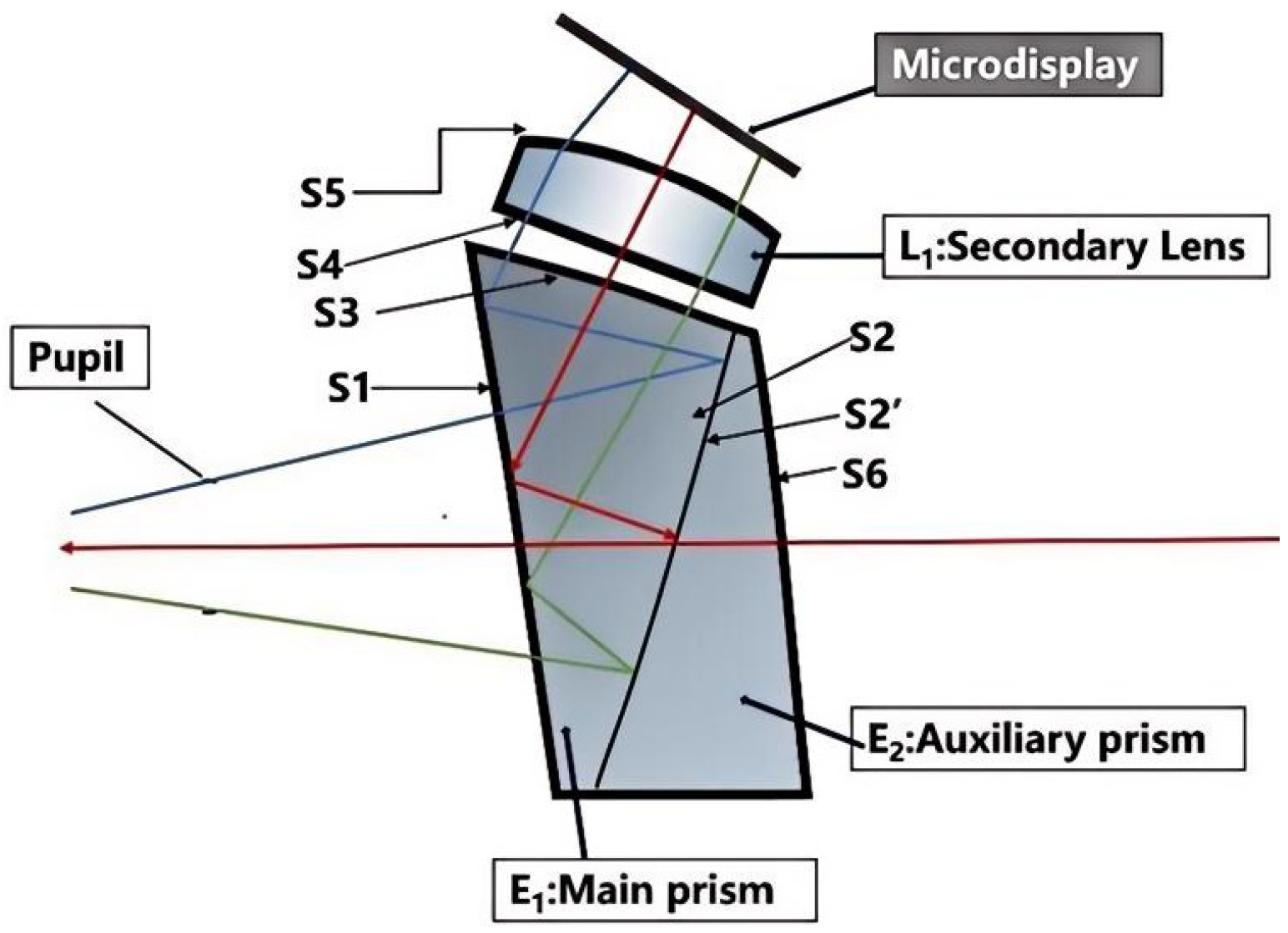
To address this, we propose a folded hybrid optical design, illustrated in Figure 1. The system consists of a primary freeform prism (E1), an auxiliary prism (E2) for see-through distortion correction, and a secondary plano-convex lens (L1). The key innovation is the integration of an achromatic metalens on the planar surface of L1. This hybrid configuration leverages the high optical power of the freeform prism for image formation while utilizing the dispersion-correcting capability of the metalens to suppress chromatic aberrations without adding significant weight or thickness.

2.2. Principle of Chromatic Aberration Correction in Metalens

Enhancing the imaging quality of AR systems presents significant challenges. The use of metalenses represents a major breakthrough. Compared to traditional diffractive optical elements (DOEs), which suffer from efficiency drops off-blaze, metalenses optimize meta-atom dispersion to maintain high efficiency across discrete RGB wavelengths. The phase-control mechanisms generally fall into resonant, geometric, and propagation phases. Notably, recent advancements have expanded these frontiers; for instance, Zhang utilized cascaded chiral birefringent media to achieve programmable chromatic aberration control [21], highlighting the evolving capabilities of planar optics.
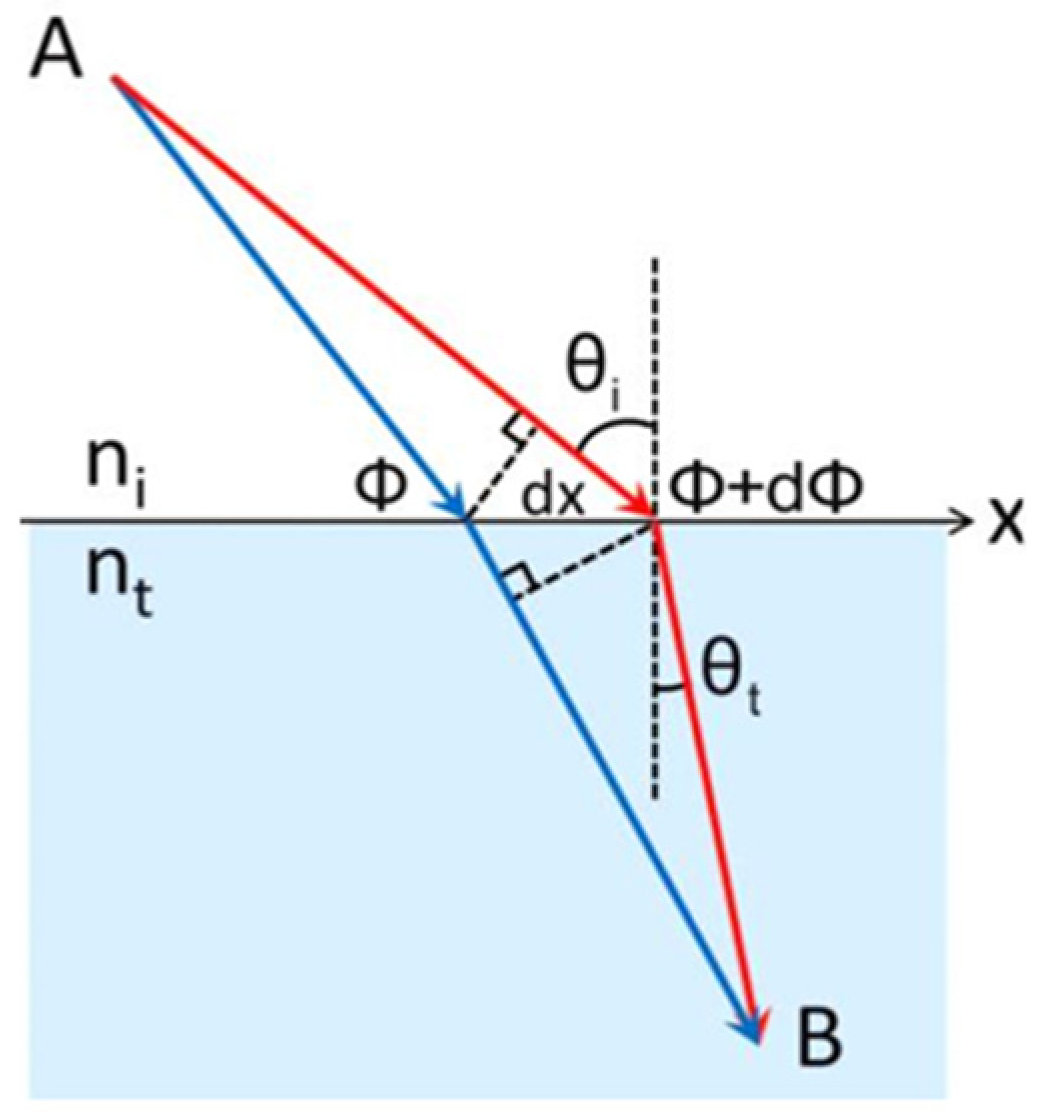
In this study, we employ a propagation-phase metalens composed of SiNx nanopillars. To precisely control the beam propagation, the design is governed by the generalized Snell’s law. As illustrated in Figure 2, the phase gradient d ϕ /dx along the interface determines the direction of the refracted ray according to
n t sin ( θ t ) n i sin ( θ i ) = 1 k 0 d ϕ d x
where nt and ni are the refractive indices of the transmission and incidence media.
The required phase gradient is realized by the constituent meta-atoms. For a propagation-phase metalens, each meta-atom functions as a waveguide with an effective refractive index n eff . The additional phase shift ψ imparted to the incident light is given by
ψ = k 0 n eff H
where k 0   =   2 π / λ is the wave number in vacuum and H is the height of the nanopillar in the upper layer of the meta-atom. By employing nanopillars of different geometries (thereby modulating n eff ) while keeping H fixed, a full 0–2π phase coverage can be achieved. Based on these principles, to focus incident light of wavelength λ to a focal length f, the required phase delay at each spatial position can be expressed as
ϕ ( x , y ) = 2 π 2 π λ ( x 2 + y 2 + f 2 f )
where λ is the working wavelength and f is the focal length. Based on this relationship, nanopillars of appropriate diameters can be arranged to construct the metalens, ensuring that the required phase profile is achieved at each spatial position.
However, metalenses exhibit chromatic dispersion due to the wavelength dependence of the effective refractive index and the diffractive nature of the phase profile. Therefore, eliminating chromatic dispersion requires addressing both the material-induced dispersion and the diffractive dispersion.
In this work, we use a discrete multi-wavelength achromatic design strategy. Specifically, we combine meta-atoms optimized for three discrete wavelengths (490, 590, and 660 nm) to build a single-layer achromatic metalens. These three wavelengths are chosen as representative spectral anchors corresponding to the blue, green, and red emission peaks of the micro-display, ensuring that suppressing phase errors at these points effectively reduces chromatic aberrations across the operating visible band. This approach demands optimizing the focusing phase at multiple sampled wavelengths across the operating band: we select meta-atoms from a material library that simultaneously meet the required phase delays at all target wavelengths, ultimately achieving an identical focal length. Because it relies on minimizing phase errors via a sufficiently dense meta-atom library, this method is especially suited for achromatic metalenses with complex phase profiles or large apertures.
In this design, we reframe desired phase distributions as optimization constraints. Integrating phase requirements with multi-wavelength phase response data lets us define a mathematically rigorous objective function and corresponding constraints for the optimization process, as
Max { p i , j } = min ( I 490 , I 590 , I 660 )
I λ i = 1 N j = 1 N [ T λ ( p i , j ) f p h a s e ( δ ϕ λ ( p i , k ) ) ]
where { p i , j } is the set of optimization variables, the structural parameters of all unit cells in the metalens. For example, for a rectangular nanopillar, { p i , j } may represent its length and width, while i and j are the row and column indices of the corresponding unit cell. I λ denotes the optical intensity at the metalens focal point for wavelength λ , and T λ represents the transmission efficiency of the meta-atom at wavelength λ, f p h a s e δ ϕ λ ( p i , k ) characterizing how well the phase response of the meta-atom matches the target phase profile. Based on Equation (3) together with the above relations, the objective function and constraints for the optimization can be formulated.
In Zemax OpticStudio, the diffractive optical element (DOE) is used as a substitute for the metalens component. This DOE is not used as a physical element in the final system; instead, it serves as a computational placeholder that enables efficient optimization of the folded optical architecture. The hybrid optical system incorporating the DOE is modeled and simulated using ray tracing combined with the damped least-squares (DLS) optimization method. The optimization focuses on both the system parameters and the structural parameters of the DOE to achieve the desired imaging performance, thereby determining the phase profile of the DOE surface. To enhance aberration correction within the optical system, wavefront modulation can be introduced by modifying the phase experienced by the light as it propagates through the surface. Accordingly, the binary surface imparts different phase delays to the incident light, which can be expressed using the following polynomial expansion. This expansion describes the phase variation experienced by the wavefront across the entire DOE surface and is given by
ϕ = M i = 1 N A i ρ 2 i
where M is the diffraction order, N is the number of polynomial coefficients, A i is the coefficient associated with ρ 2 i , and ρ is the normalized radial aperture coordinate. For a ray incident on an optical surface at a radial position R , the normalized radial coordinate is defined as ρ   =   r / R , with R being the normalization radius of the aperture.
From the above, it can be seen that a metalens generates the required surface phase distribution by arranging subwavelength nanostructures of varying geometries periodically on a substrate. This establishes a clear correspondence between binary DOEs and metalenses, allowing the two to be connected and effectively utilized within an integrated system design framework. This relationship also provides a feasible pathway for the implementation of our proposed approach.

3. Optical Design and Image Quality Evaluation

3.1. Optical Design

Our design aims to develop a lightweight, compact OST-HMD that delivers both a wide virtual-display FoV and a wide see-through FoV. As the image source, we use a 0.49-inch OLED micro-display with 1920 × 1080 resolution and 8 μm pixel pitch. Based on the spectral characteristics of the display, the optical system is designed to operate at three discrete wavelengths, 490, 590, and 660 nm, with 590 nm serving as the central wavelength.
In near-eye optical systems, especially those requiring binocular fusion, a large exit pupil offers critical advantages: it prevents FoV loss during eye rotation and accommodates a broader inter-pupillary distance (IPD) range, eliminating the need for mechanical IPD-adjustment mechanisms that would add complexity. Yet enlarging the exit pupil typically increases system volume and weight while making a large FOV harder to achieve. Balancing these trade-offs, we set the exit pupil size to 8 mm.
During optimization, we iteratively adjusted parameters like focal length, ultimately settling on 17 mm, corresponding to an F-number of 2.1. The physical size of the image source is directly related to the field of view and the focal length of the optical system, which can be expressed as
D p a n e l = 2 f tan FOV 2
where D p a n e l is the physical length of the image source and f is the effective focal length of the optical system. Based on this relationship, the virtual-display field of view is determined to be 39° diagonally, with horizontal and vertical fields of view of 30° × 24°. This corresponds to a resolution of approximately 51 pixels per degree (PPD), which is close to the human visual acuity limit of approximately 60 PPD and is therefore capable of delivering highly detailed virtual imagery.
To accommodate users with refractive errors, we set eye relief to 18.5 mm. Key system specifications are summarized in Table 1. To ensure high-quality imaging performance, MTF at half the Nyquist frequency of the display is required to reach at least 10%. Since distortion in the virtual-imaging path does not degrade image sharpness and because mature image process and display technologies can compensate for geometric distortion electronically, strict constraints on optical distortion are not imposed in this design.
Given that such optical systems are typically mass-produced through injection molding, the prism module in this design is fabricated using an optical-grade resin. In this work, we employ APL5514ML from Mitsui Chemicals (Tokyo, Japan), a material known for its excellent optical transparency, low birefringence, high rigidity, and strong chemical stability. However, because all refractive elements share the same material, chromatic aberration cannot be fully corrected through refractive design alone. This limitation is one of the key motivations for introducing a metalens into the system.
As shown in Figure 2, the system consists of primary prism E1, auxiliary prism E2, and secondary lens L1. The virtual image is projected into the human eye through E1 and L1, while E1 and E2 jointly provide distortion-free optical see-through functionality. The primary prism E1 supplies the main optical power of the system and magnifies the image displayed by the micro-display. The secondary lens L1, placed between the micro-display and E1, is a plano-convex lens whose planar surface serves as the substrate for the metalens. On the opposite side of the primary prism, the auxiliary prism E2 is employed to correct distortion in the see-through optical path.
In this system, the primary prism E1 is designed with three optical effective surfaces to realize the specific folded optical path (TIR, reflection, transmission). This topological configuration is the minimal surface set required to fold the optical path within a 12 mm thickness while ensuring the separation of the virtual and see-through channels. In the Zemax OpticStudio model, the virtual-image optical path is constructed using reverse ray tracing. Rays are launched from the pupil position of the human eye and propagate through surfaces S1–S3 of the primary prism and surfaces S4 and S5 of the secondary lens L1 before reaching the micro-display.
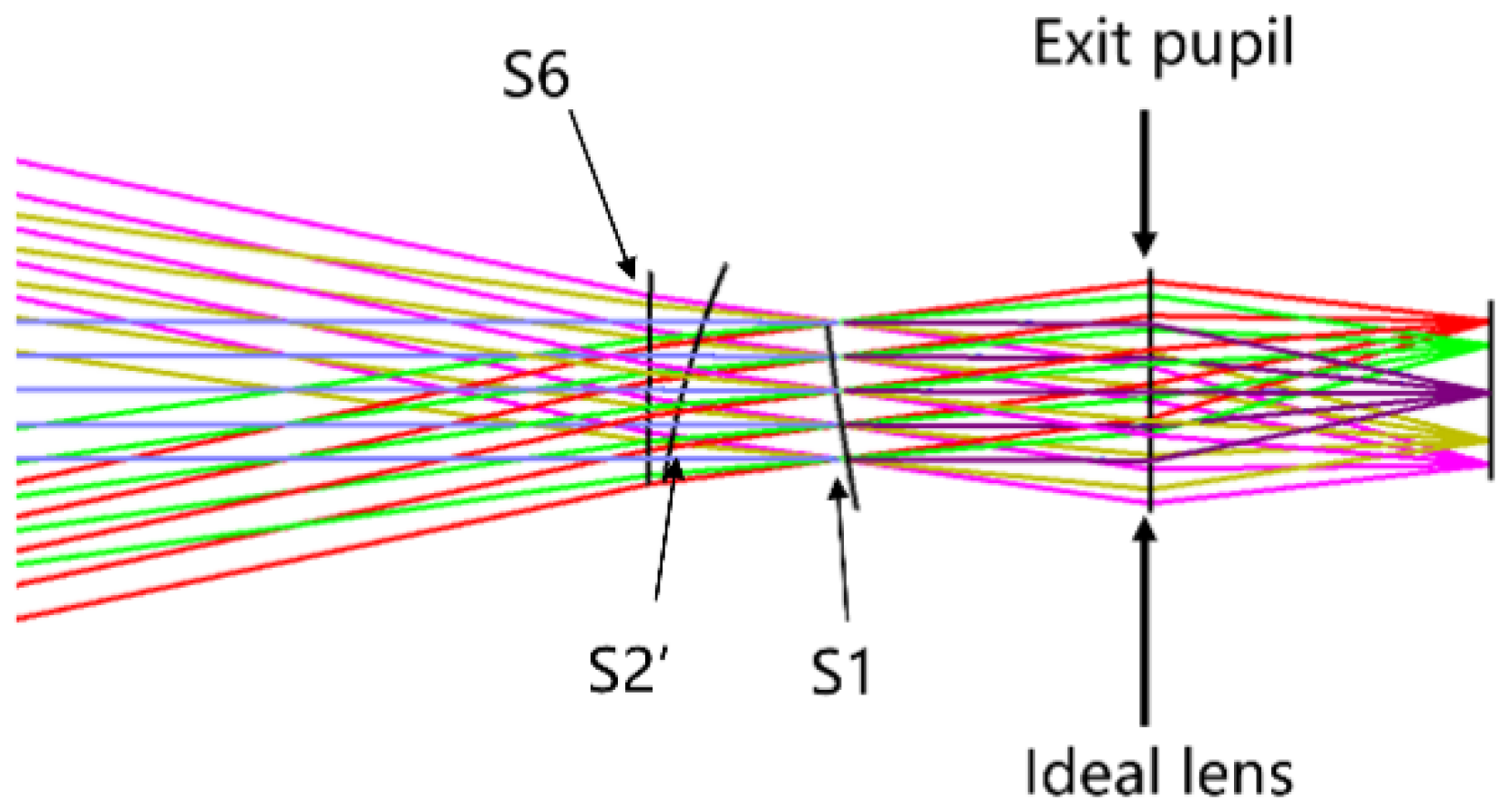
For the see-through optical path, forward ray tracing is employed. Rays originating from the real environment sequentially pass through surfaces S6 and S2′ of the auxiliary prism followed by surfaces S2 and S1 of the primary prism before finally entering the human eye.
In the virtual-display optical path, the prism geometry plays a critical role in determining both the optical performance and the manufacturability of the final design. It is therefore essential to control the structure of the primary freeform prism E1, ensuring that rays from all fields of view propagate correctly through the system and reach the user’s eye. Since global coordinates cannot be used directly in Zemax OpticStudio for such geometries, optimization requires the use of operands to read ray coordinates and constrain the ray paths, thereby guaranteeing correct ray propagation across the entire field.
For the freeform surfaces in Zemax OpticStudio, the extended polynomial representation is employed. The optimal freeform shape is obtained through a combination of least-squares optimization and ray-tracing-based evaluation. Because such off-axis systems impose strict constraints on the total optical path length, geometric distance alone is insufficient for describing the system’s behavior. Therefore, optical-path-related operands are typically used during optimization to constrain the ray path and consequently regulate the overall system length.
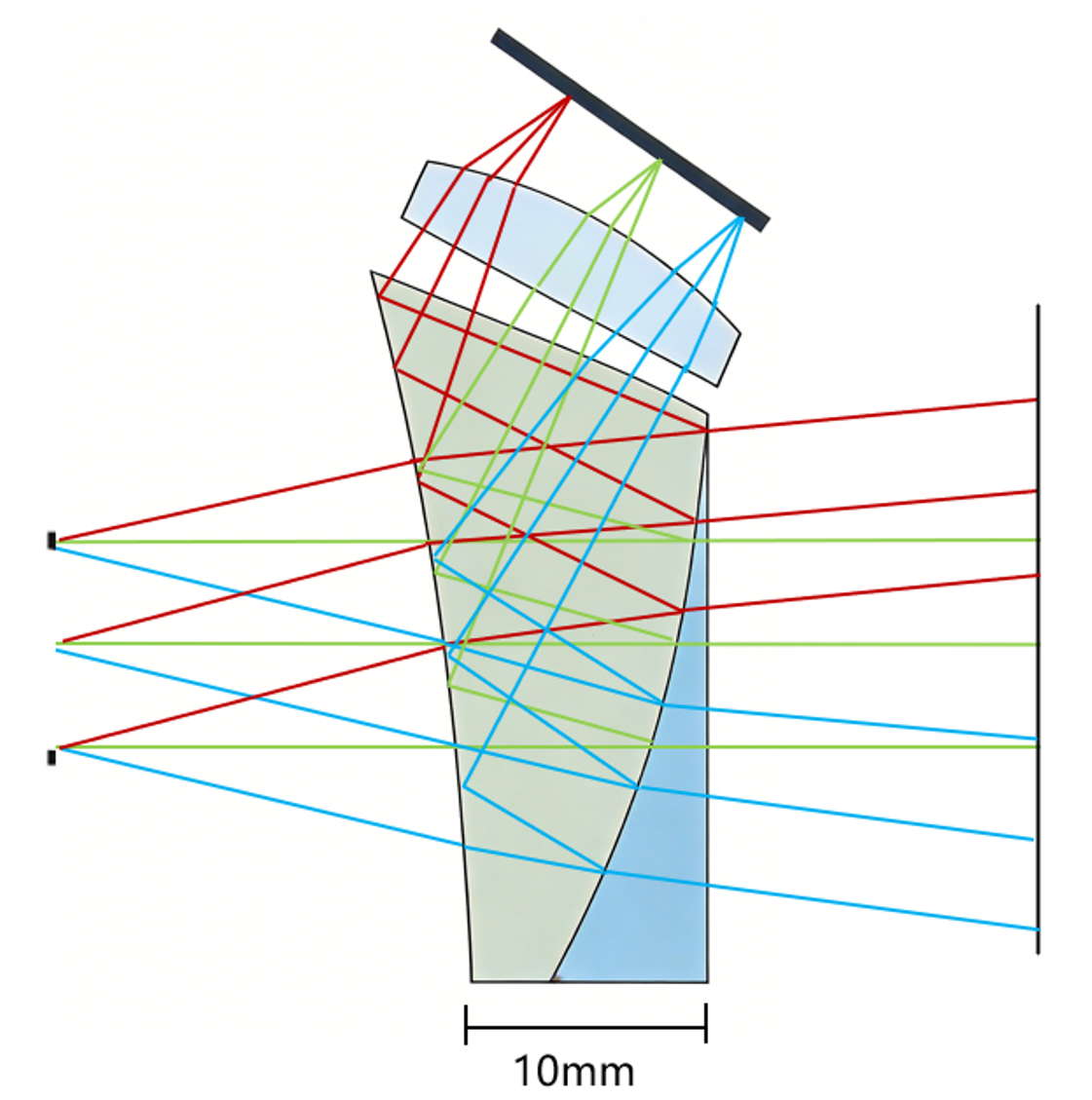
For the see-through optical path, the auxiliary prism E2 is primarily responsible for compensating distortion. Its thickness must also be constrained to meet engineering and fabrication requirements. In the Zemax OpticStudio model, the see-through path is constructed using forward ray tracing. Rays originating from real-world objects sequentially pass through surfaces S6, S2′, and S1 before entering the human eye. Due to the nature of the see-through path, the combination of the primary prism and auxiliary prism forms an afocal system for objects located at infinity in the real environment. Because an afocal system generates parallel output rays, an ideal lens is inserted at the exit pupil position to simulate the human eye and enable image formation. The effective focal length of the ideal eye lens is set to 20 mm, and image quality is evaluated at the corresponding focal plane. The schematic diagram of perspective optical system optimization is presented in Figure 3.
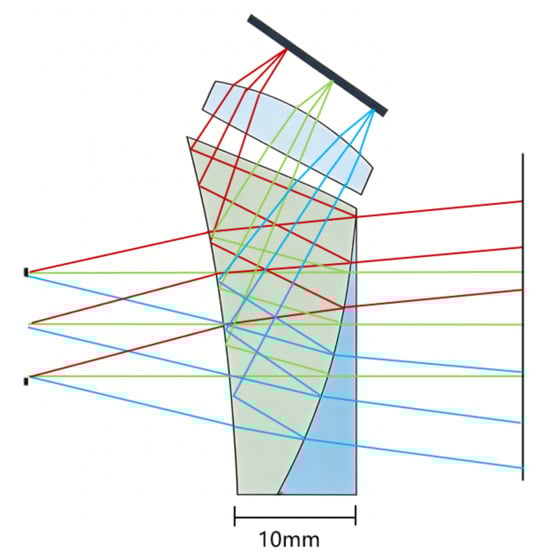
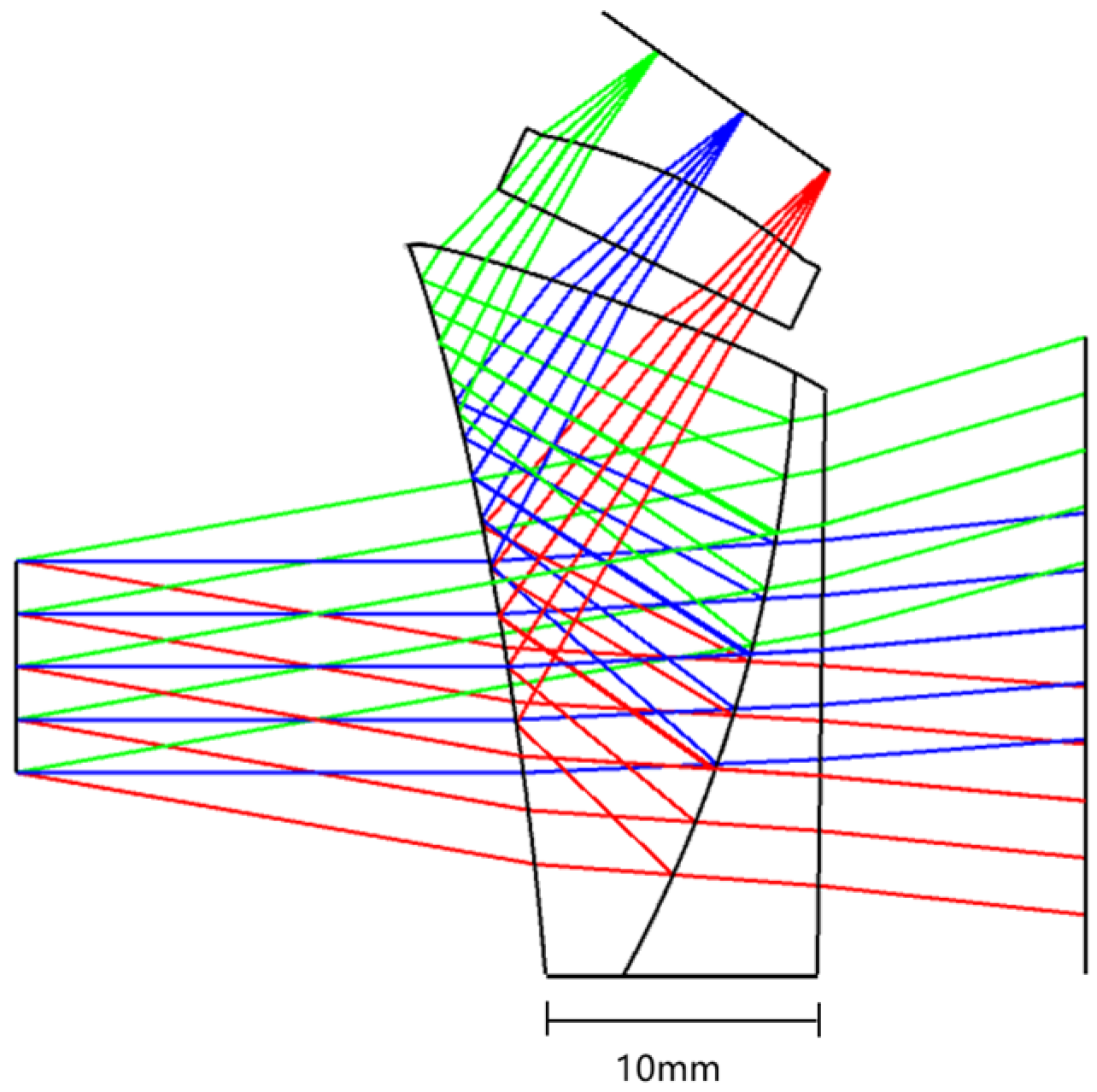
During the optimization, constraining the system thickness is a key consideration, and both distortion and chromatic aberration must be carefully balanced to achieve the desired performance. All prism optics are made of the optical resin APL5514ML. To ensure good augmented reality functionality, appropriate coatings are applied to the prism surfaces. As shown in Figure 2, surface S2 is coated with a partial-reflection film. After the light emerges from the micro-display, it first reaches surface S1, where the total internal reflection (TIR) condition is satisfied; therefore, no reflective coating is required on S1. Ray-tracing analysis confirms that the incident angles at surface S1 remain larger than the critical angle of the resin material (approximately 40.5°) across the entire 39° FOV, ensuring that the TIR condition is strictly maintained without leakage even for marginal rays. While folded systems are typically prone to ghosting due to multiple surface interactions, this design mitigates such artifacts by relying on strict TIR conditions at S1 rather than a semi-reflective coating, which prevents secondary reflections. Additionally, high-efficiency anti-reflection (AR) coatings are applied to the remaining prism surfaces to suppress stray light. After completing all optimization steps, the final system configuration is obtained, as illustrated in Figure 4.

3.2. Metalens Design and Analysis

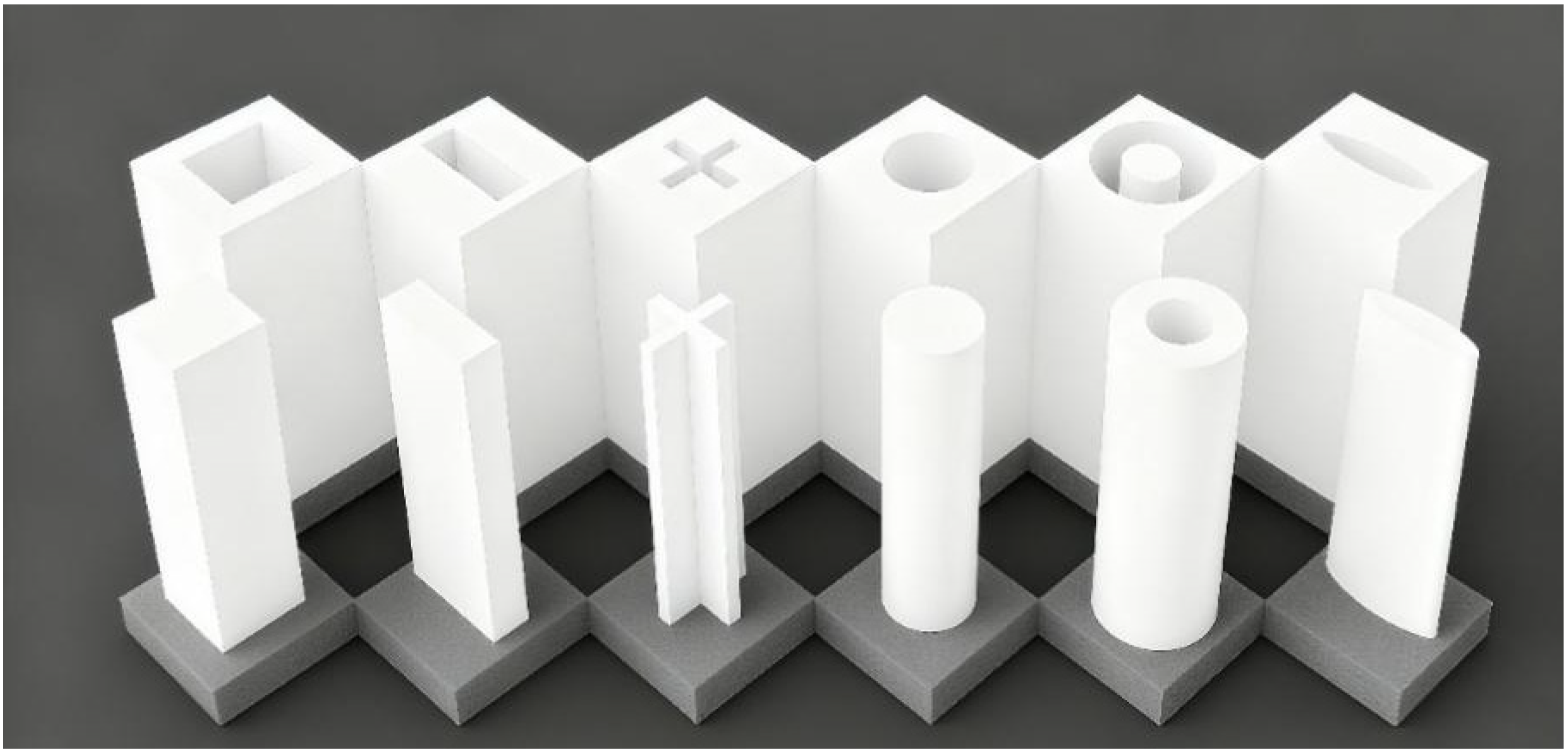
Then, a discrete multi-wavelength achromatic metalens design is employed. The primary goal is to identify suitable meta-atom geometries and spatial arrangements that together enable achromatic performance across multiple wavelengths. To achieve this, we select silicon nitride nanopillars (positive-type structures) along with their corresponding Babinet-inverted hollow counterparts (negative-type structures). The combination of these complementary unit-cell designs allows the resulting metalens to achieve high focusing efficiency while meeting the multi-wavelength achromatic constraints. The schematics of 12 kinds of meta-unit architectures, including nanopillars and their Babinet hollow structures is presented in Figure 5.
In this design, we selected SiNx nanopillars on a SiO2 substrate for their high refractive index and fabrication compatibility. To ensure full phase coverage, we constructed a library of 12 symmetric unit-cell geometries (including square, circular, cross, and their Babinet-inverted counterparts) with a standard 350 nm period. The geometric parameters were optimized with specific constraints: First, the height was fixed at 1 μm to streamline fabrication and simulation, as transmission sweeps confirmed optimal efficiency at this value. Second, lateral dimensions were restricted (50–320 nm) to maintain sufficient air gaps from the cell boundaries, thereby preventing near-field coupling between adjacent meta-atoms.
Electromagnetic simulations were performed using Lumerical FDTD Solutions, producing the electric-field distribution of each unit cell. The phase response was extracted using angle function, and only structures with transmission above 95% were retained to form the initial phase library.
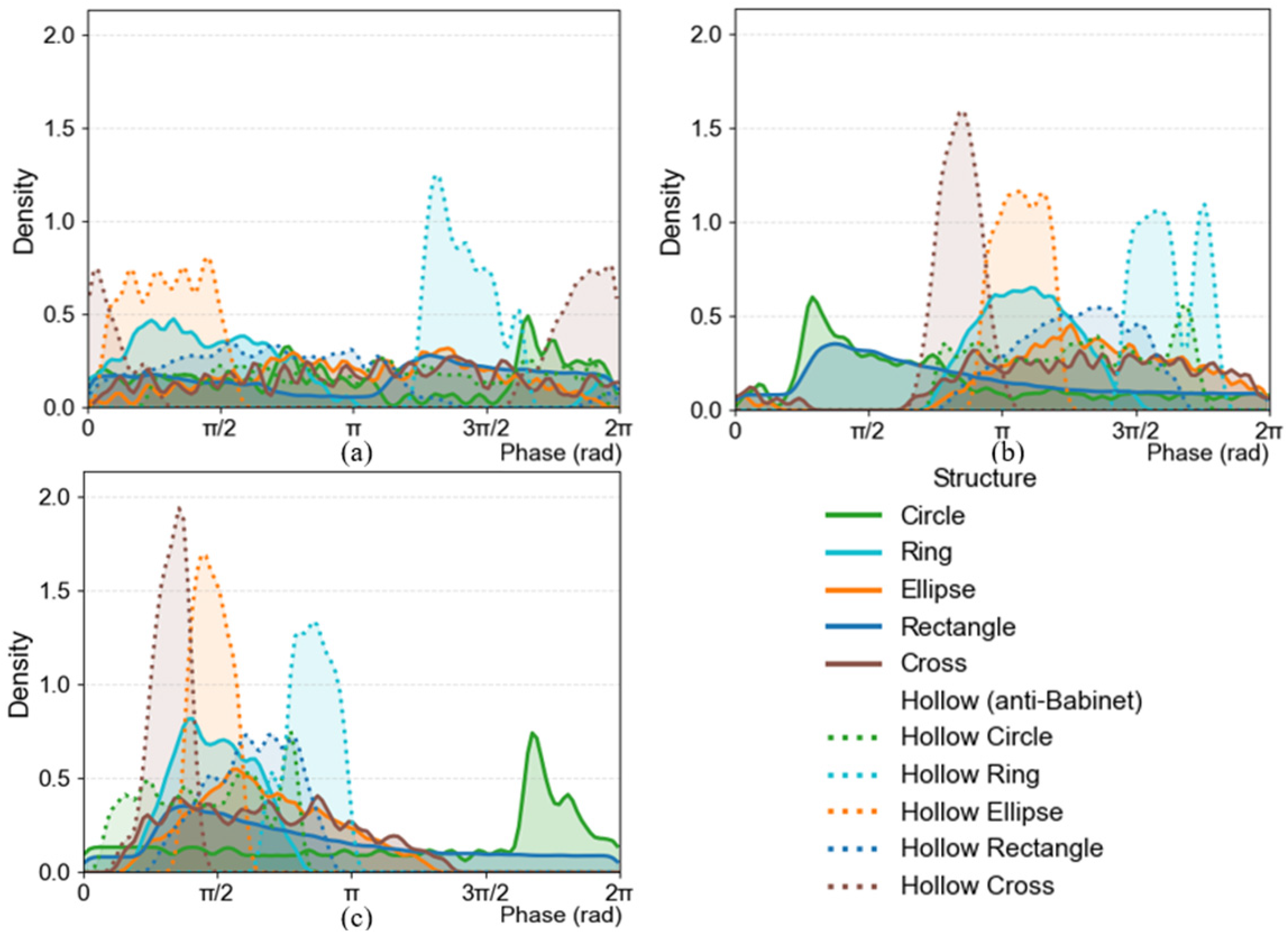
To analyze and compare the multi-wavelength phase responses of the different geometries, an automated data-processing and visualization script was developed. The script imports simulation results for all solid and hollow structures at multiple wavelengths, normalizes the phase into the [ 0 ,   2 π ) range, and constructs a comprehensive phase response database. For visualization, kernel density estimation (KDE) with Gaussian smoothing is applied to obtain physically meaningful and noise-suppressed phase distribution curves. As shown in Figure 6, solid structures (circle, ring, ellipse, rectangle, cross) are plotted in the upper panel and their Babinet-inverted counterparts below, using matched colors with different line styles for ease of comparison. This visualization framework provides clear quantitative insight into the phase behavior of the various nanopillar geometries and supports subsequent optimization of the achromatic metalens design.
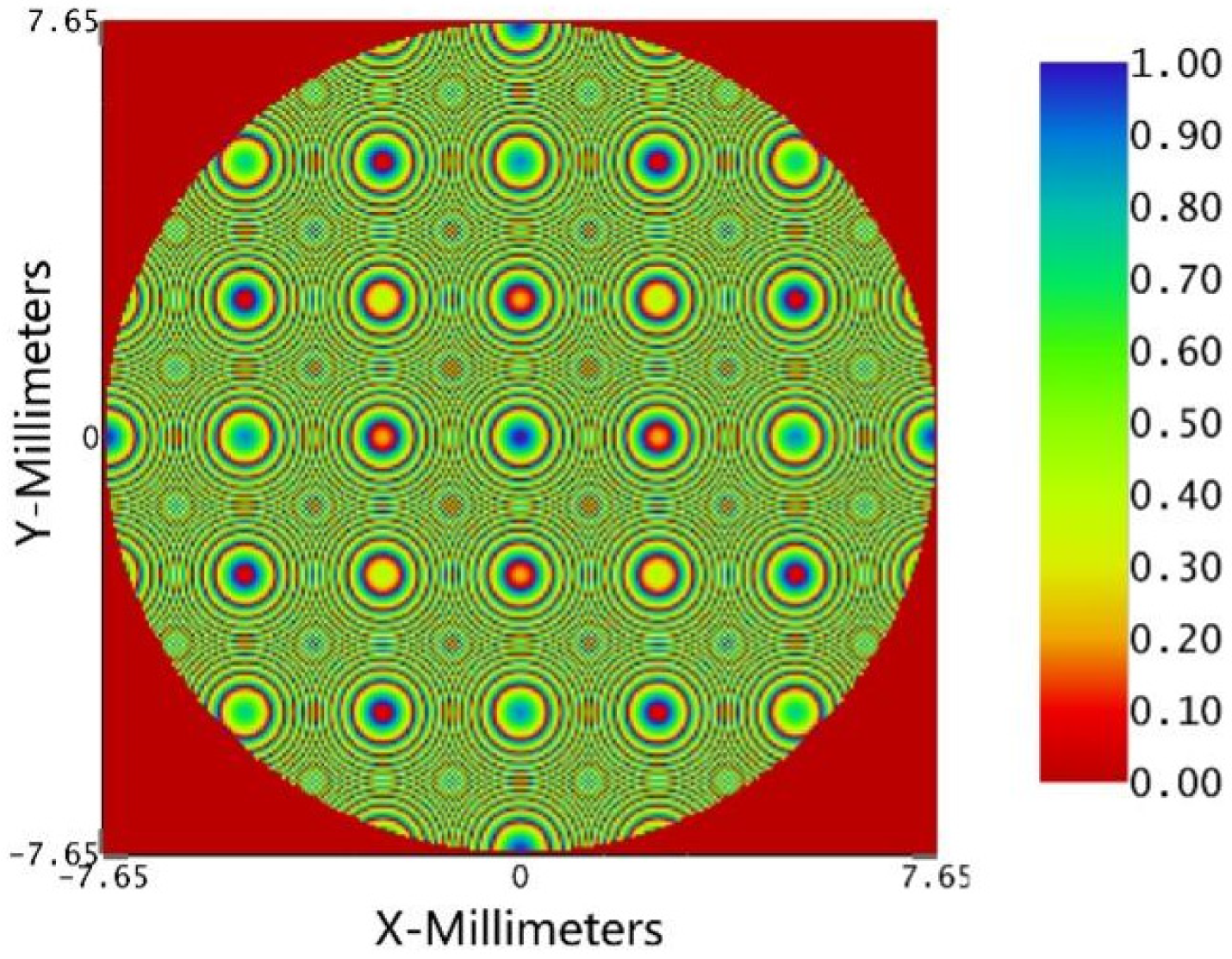
Based on the phase profile obtained from the binary diffractive surface, the metalens can be designed on the S4 planar substrate. Following the folded hybrid-optics design scheme, the phase distribution of the binary surface is shown in Figure 7, and the corresponding parameters are summarized in Table 2.
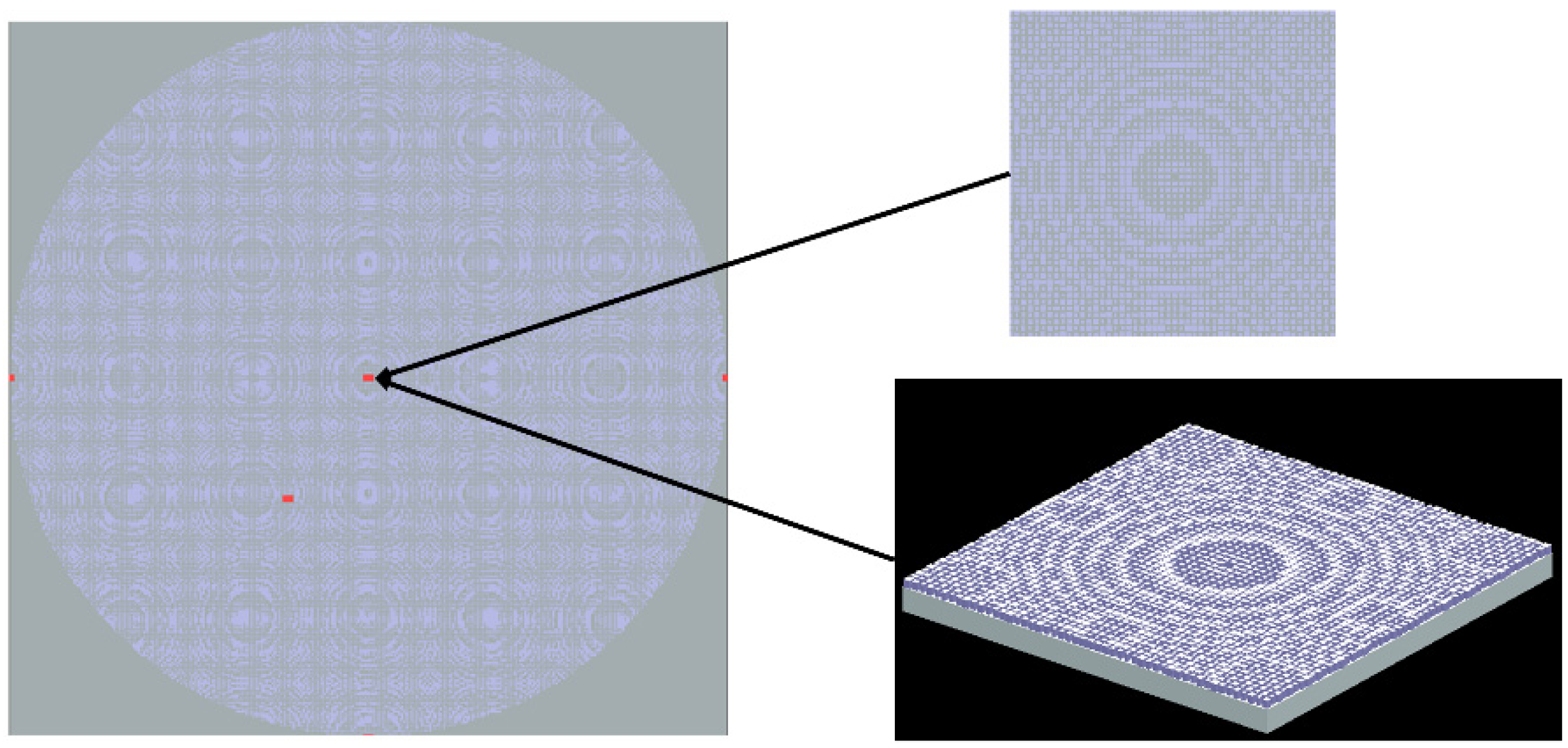
With the phase library established, the macroscopic metalens layout was generated by discretely matching the most suitable meta-atoms from the library to the target phase profile, shown in Figure 8 at each spatial coordinate.
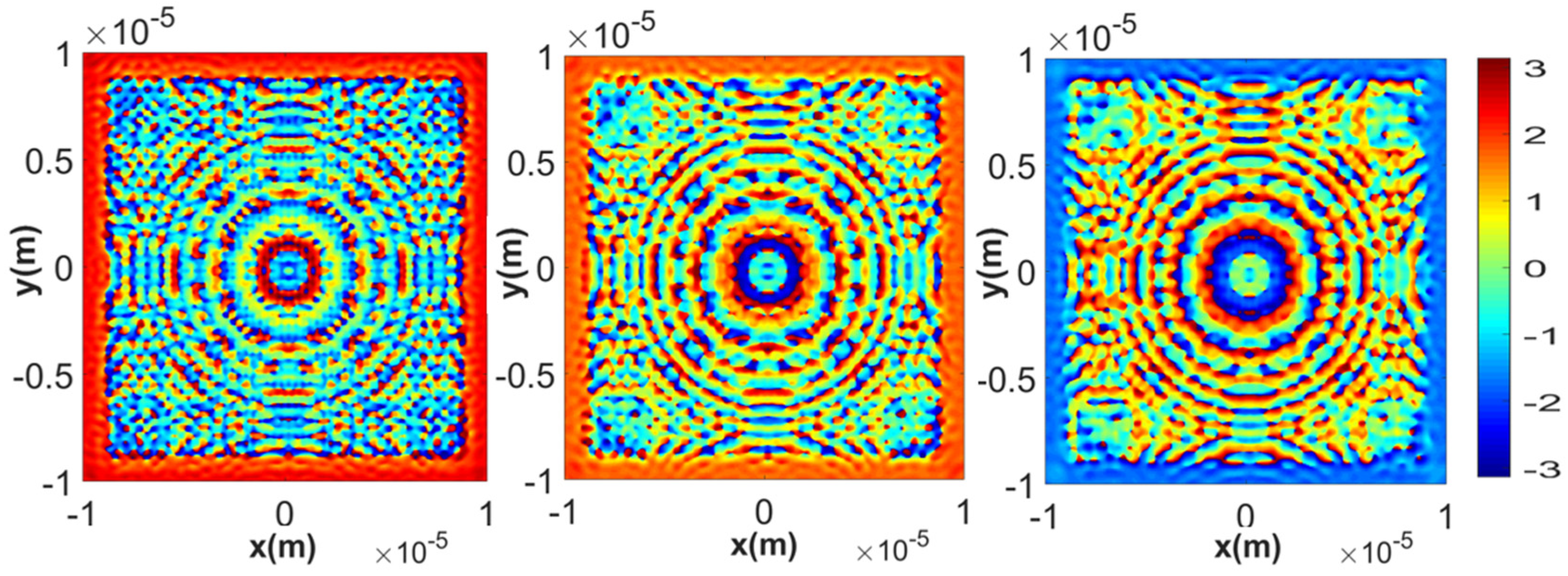
To verify the achromatic performance and light utilization, a representative central sub-array of the constructed metalens was extracted and simulated at the three discrete design wavelengths (490, 590, and 660 nm). As shown in Figure 9, the phase distributions of this sub-array remain nearly identical across the three wavelengths, indicating a stable phase response with minimal wavelength dependence. Furthermore, consistent with the high-transmission selection criteria (>95%) described in the design process, the constructed device inherently ensures high light throughput and efficient wavefront modulation within the selected spectral range.
To clarify the rigorous design process, the optimization was governed by a specific Figure of Merit (FoM). We defined the FoM as the weighted sum of the phase errors at the three discrete design wavelengths.
FoM = λ { 490 , 590 , 660 } ω λ e i ϕ t a r g e t ( x , y , λ ) e i ϕ m e t a ( x , y , λ ) 2
where ϕ t a r g e t and ϕ m e t a denote the required hyperboloidal phase and the actual phase provided by the meta-atom library, respectively. Considering the need for balanced color performance, we assigned equal optimization weights to all three wavelengths.
Regarding efficiency, performing a full-wave simulation for the entire macroscopic metalens is computationally prohibitive. Therefore, we adopted a localized optimization strategy. By strictly constraining the transmission of selected meta-atoms to exceed 95%, we minimized absorption and scattering losses at the element level. This high local transmission, combined with the low phase error ensured by the FoM, guaranteed effective wavefront modulation, which was macroscopically validated by the high MTF values presented in Section 3.3.

3.3. Imaging Performance Analysis

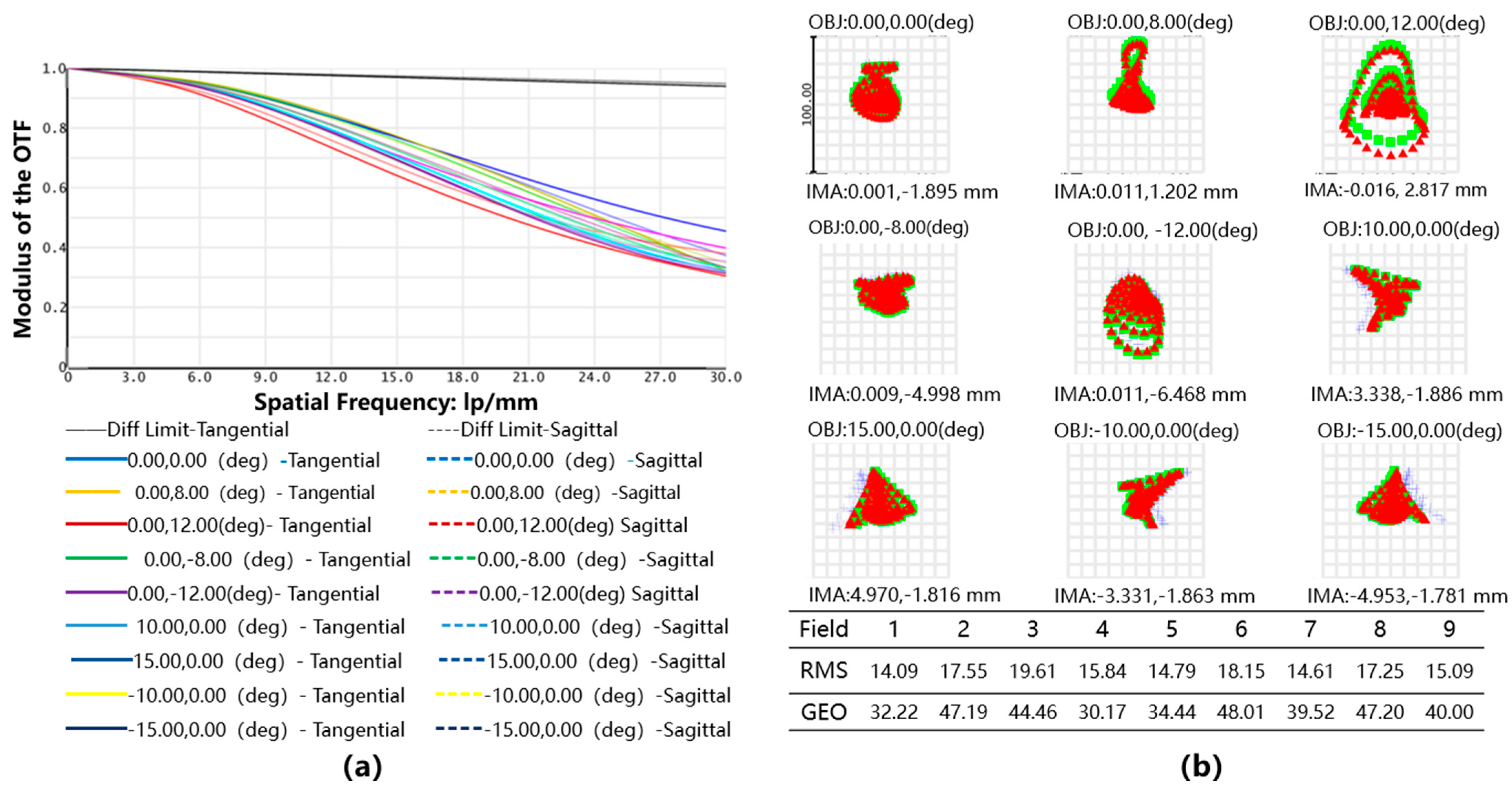
After the joint optimization of the folded hybrid optical system, the imaging performance is evaluated as follows. For the virtual-display path, Figure 10a presents the MTF for the selected fields. The spatial frequency is evaluated up to 30 lp/mm, and MTF curves for nine fields, including both the center and edge fields, are shown. The optimization aims to balance image quality across the entire field of view. At 30 lp/mm, all MTF values exceed 0.3. With an exit pupil of 8 mm, Figure 10b shows that the average RMS spot diameter across the full field is only 15 μm, indicating high imaging quality and good uniformity.
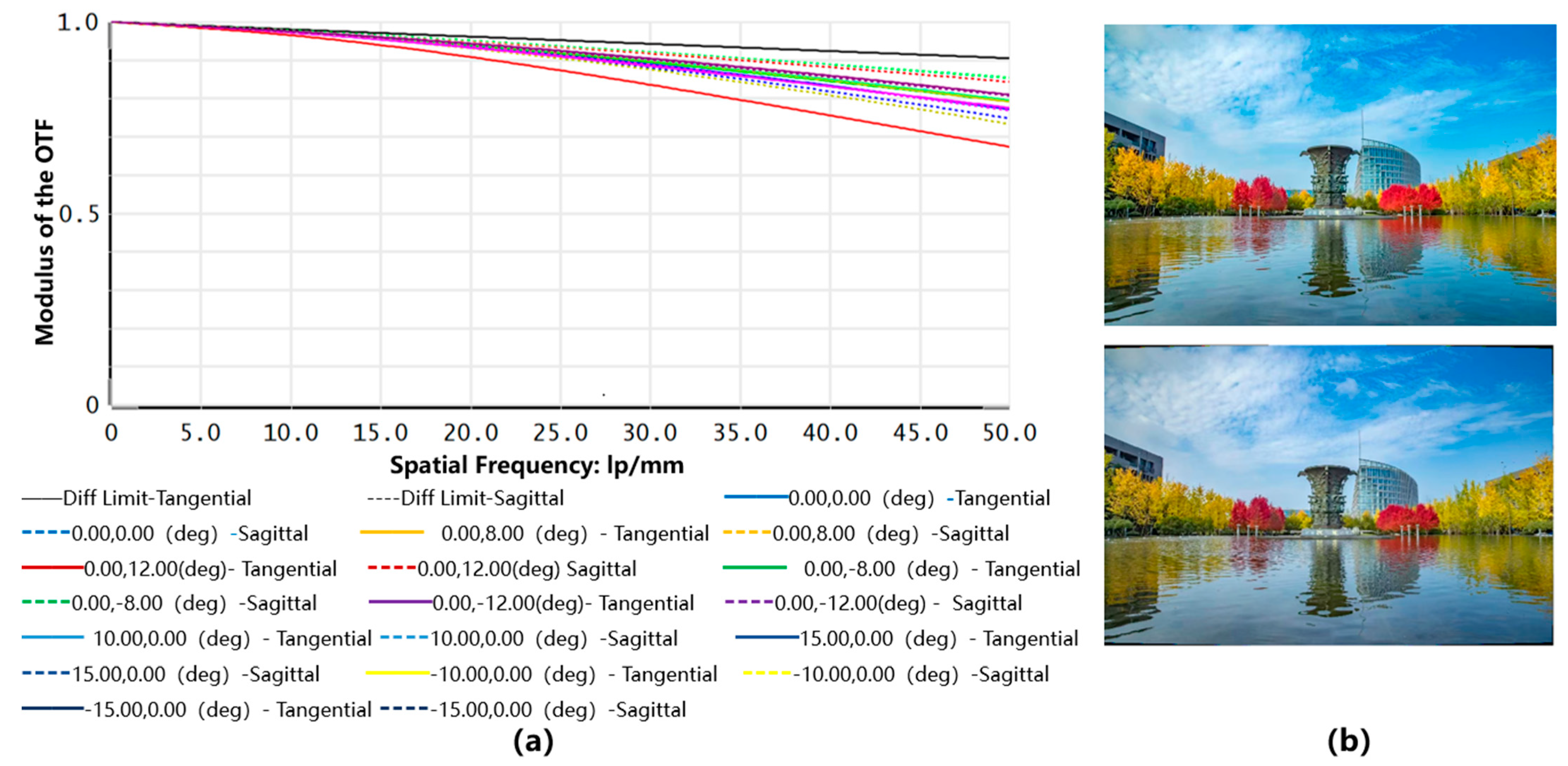
For the see-through optical path, Figure 11a shows that the MTF values for all fields exceed 0.7 at 50 lp/mm. In addition, the distortion is well controlled across the entire field of view, effectively meeting the requirements for accurate real-world imaging through the human eye, shown in Figure 11b.

4. Conclusions

We present a compact folded OST-HMD that integrates freeform prisms with a discrete multi-wavelength achromatic metalens. The hybrid design effectively reduces system thickness to 12 mm while maintaining a 39° virtual FOV, 18.5 mm eye relief, and 8 mm exit pupil. The metalens, constructed from SiNx nanopillars and their Babinet-inverted counterparts, successfully compensates the chromatic aberration inherent to polymer freeform optics. Simulation results confirm that the virtual path achieves MTF values above 0.3 at 30 lp/mm, and the see-through path exceeds 0.7 at 50 lp/mm with well-controlled distortion. These results demonstrate that combining freeform folding optics with a multi-wavelength achromatic metalens provides an effective approach for achieving thin, lightweight, and high-resolution OST-HMDs. The proposed method offers a promising design framework for compact AR displays. While experimental validation is the next critical step, the simulation results indicate that combining freeform optics with metalenses can effectively balance form factor and image quality. This work establishes a theoretical basis for future lightweight OST-HMDs, with potential applications in next-generation augmented reality systems.

Author Contributions

Conceptualization and funding acquisition, S.M.; methodology J.H. and Y.X.; and thesis structure, Z.H. and S.L. All authors have read and agreed to the published version of the manuscript.

Funding

This research received funding from the National Natural Science Foundation of China (62375222, 61927810, 61905195) and the Shaanxi Fundamental Science Research Project for Mathematics and Physics (22JSQ025).

Institutional Review Board Statement

Not applicable.

Informed Consent Statement

Not applicable.

Data Availability Statement

Data are contained within the article.

Conflicts of Interest

The authors declare no conflicts of interest.

References

  1. Hua, H.; Brown, L.; Gao, C. Scape: Supporting stereoscopic collaboration in augmented and projective environments. IEEE Comput. Graph. Appl. 2004, 24, 66–75. [Google Scholar] [CrossRef]
  2. Azuma, R.; Baillot, Y.; Behringer, R.; Feiner, S.; Julier, S.; MacIntyre, B. Recent advances in augmented reality. IEEE Comput. Graph. Appl. 2001, 21, 34–47. [Google Scholar] [CrossRef]
  3. Jensen, L.; Konradsen, F. A review of the use of virtual reality head-mounted displays in education and training. Educ. Inf. Technol. 2018, 23, 1515–1529. [Google Scholar] [CrossRef]
  4. Hua, H.; Javidi, B. Augmented reality easy on the eyes. Opt. Photonics News 2015, 26, 26–33. [Google Scholar] [CrossRef]
  5. Cheng, D.; Chen, H.; Yao, C.; Hou, Q.; Hou, W.; Wei, L.; Yang, T.; Wang, Y. Design, stray light analysis, and fabrication of a compact head-mounted display using freeform prisms. Opt. Express 2022, 30, 36931–36948. [Google Scholar] [CrossRef]
  6. Cakmakci, O.; Rolland, J.P. Head-Worn Displays: A Review. Disp. Technol. 2006, 2, 199–216. [Google Scholar] [CrossRef]
  7. Wang, Q.; Cheng, D.; Hou, Q.; Gu, L.; Wang, Y. Design of an ultra-thin, wide-angle, stray-light-free near-eye display with a dual-layer geometrical waveguide. Opt. Express 2020, 28, 35376–35394. [Google Scholar] [CrossRef]
  8. Cheng, D.; Wang, Y.; Xu, C.; Song, W.; Jin, G. Design of an ultra-thin near-eye display with geometrical waveguide and freeform optics. Opt. Express 2014, 22, 20705–20719. [Google Scholar] [CrossRef]
  9. Pan, C.; Liu, Z.; Pang, Y.; Zheng, X.; Cai, H.; Zhang, Y.; Huang, Z. Design of a high-performance in-coupling grating using differential evolution algorithm for waveguide display. Opt. Express 2018, 26, 26646–26662. [Google Scholar] [CrossRef]
  10. Liu, Z.; Cui, Q.; Huang, Z.; Guo, L.J. Transparent colored display enabled by flat glass waveguide and nanoimprinted multilayer gratings. ACS Photonics 2020, 7, 1418–1424. [Google Scholar] [CrossRef]
  11. Shuetal, T. Compact full-color augmented reality near-eye dis play using freeform optics and a holographic optical combiner. Opt. Express 2022, 30, 31714–31727. [Google Scholar]
  12. Han, J.; Liu, J.; Yao, X.; Wang, Y. Portable waveguide display system with a large field of view by integrating freeform elements and volume holograms. Opt. Express 2015, 23, 3534–3549. [Google Scholar] [CrossRef]
  13. Cheng, D.; Wang, Y.; Hua, H.; Sasian, J. Design of a wide-angle, lightweight head-mounted display using free-form optics tiling. Opt. Lett. 2011, 36, 2098–2100. [Google Scholar] [CrossRef]
  14. Cheng, D.; Wang, Q.; Wang, Y.; Jin, G. Lightweight spatial-multiplexed dual focal-plane head mounted display using two freeform prisms. Chin. Opt. Lett. 2013, 11, 031201. [Google Scholar] [CrossRef]
  15. Cheng, D.; Duan, J.; Chen, H.; Wang, H.; Li, D.; Wang, Q.; Hou, Q.; Yang, T.; Hou, W.; Wang, D.; et al. Freeform OST-HMD system with large exit pupil diameter and vision correction capability. Photonics Res. 2022, 10, 21–32. [Google Scholar] [CrossRef]
  16. Khorasaninejad, M.; Capasso, F. Metalenses: Versatile multifunctional photonic components. Science 2017, 358, eaam 8100. [Google Scholar] [CrossRef] [PubMed]
  17. Li, Z.; Lin, P.; Huang, Y.; Park, J.-S.; Chen, W.T.; Shi, Z.; Qiu, C.-W.; Cheng, J.-X.; Capasso, F. Meta-optics achieves RGB-achromatic focusing for virtual reality. Sci. Adv. 2021, 7, eabe4458. [Google Scholar] [CrossRef]
  18. Li, Y.; Chen, S.; Liang, H.; Ren, X.; Luo, L.; Ling, Y.; Liu, S.; Su, Y.; Wu, S.-T. Ultracompact multifunctional metalens visor for augmented reality displays. PhotoniX 2022, 3, 29. [Google Scholar] [CrossRef]
  19. Yu, N.; Genevet, P.; Kats, M.A.; Aieta, F.; Tetienne, J.-P.; Capasso, F.; Gaburro, Z. Light propagation with phase discontinuities: Generalized laws of reflection and refraction. Science 2011, 334, 333–337. [Google Scholar] [CrossRef] [PubMed]
  20. Song, W.; Wang, Y.; Cheng, D.; Liu, Y. Light field head-mounted display with correct focus cue using micro structure array. Chin. Opt. Lett. 2014, 12, 060010. [Google Scholar] [CrossRef]
  21. Zhang, D.; Xu, C.; Chen, Q.; Cao, H.; Yu, H.; Tan, Q.; Lu, Y.; Hu, W. Cascaded chiral birefringent media enable planar lenses with programmable chromatic aberration. PhotoniX 2024, 5, 17. [Google Scholar] [CrossRef]
Figure 1. Layout of OST-HMD optical system.
Photonics 13 00229 g001
Figure 2. Schematic diagram of generalized Snell’s law [19].
Photonics 13 00229 g002
Figure 3. Schematic diagram of perspective optical system optimization.
Photonics 13 00229 g003
Figure 4. Final optical layout of the OST-HMD.
Photonics 13 00229 g004
Figure 5. The schematics of 12 kinds of meta-unit architectures, including nanopillars and their Babinet hollow structures.
Photonics 13 00229 g005
Figure 6. Phase distribution comparison between nanostructures and their anti-Babinet forms.
Photonics 13 00229 g006
Figure 7. Phase distribution of the binary surface.
Photonics 13 00229 g007
Figure 8. Constructed achromatic metalens.
Photonics 13 00229 g008
Figure 9. Comparison of near-field phase maps at 490 nm, 590 nm, and 660 nm, demonstrating the achromatic behavior of the metalens.
Photonics 13 00229 g009
Figure 10. Optical performance analysis of the final system for the virtual-image light path.
Photonics 13 00229 g010
Figure 11. MTF plot and distortion for the see-through light path.
Photonics 13 00229 g011
Table 1. Specifications of the HMD optical system.
ParameterSpecification
Wavelength/nm490~660
Active area of display/inch0.49
Resolution1920 × 1080
Field of view/°39
Exit pupil diameter/mm8
Eye relief/mm18.5
MTF@30 lp/mm for all fields>0.3
Table 2. Phase distribution of the binary surface.
Diffraction OrderNormalizedA1A2
18−1.021 × 10331.015
Disclaimer/Publisher’s Note: The statements, opinions and data contained in all publications are solely those of the individual author(s) and contributor(s) and not of MDPI and/or the editor(s). MDPI and/or the editor(s) disclaim responsibility for any injury to people or property resulting from any ideas, methods, instructions or products referred to in the content.