Article

Research on Defect Detection of Ceramic Matrix Composites Based on Terahertz Frequency Modulated Continuous Wave Technology


1
School of Mathematics and Information Technology, Yuncheng University, Yuncheng 044000, China
2
School of Information and Communication Engineering, North University of China, Taiyuan 030051, China
3
State Key Laboratory of Extreme Environment Optoelectronic Dynamic Measurement Technology and Instrument, North University of China, Taiyuan 030051, China
*
Author to whom correspondence should be addressed.
Photonics 2026, 13(3), 231; https://doi.org/10.3390/photonics13030231
Submission received: 25 January 2026 / Revised: 11 February 2026 / Accepted: 24 February 2026 / Published: 27 February 2026
(This article belongs to the Special Issue Emerging Terahertz Devices and Applications)

Abstract

Ceramic Matrix Composites (CMC) are widely used in critical applications such as leading edges of aircraft wings and thermal insulation layers of thermal protection systems due to their advantages of being lightweight, high-temperature resistant, and impact-resistant. However, influenced by manufacturing processes and service environments, internal defects such as pores and delamination are prone to occur, significantly compromising the mechanical properties and service reliability of the material. This paper primarily evaluates the feasibility and applicability of using Terahertz Frequency Modulated Continuous Wave (FMCW) technology for the non-contact detection of CMC. First, the measurement principle of FMCW is introduced, and the structure of the detection system, including a two-dimensional mechanical scanning platform, optical lenses, a control platform, and a data acquisition unit, is outlined. Subsequently, scanning imaging was performed on CMC specimens and their bonded thermal protection structure (TPS) specimens, demonstrating the feasibility of Terahertz FMCW technology as an advanced non-destructive testing tool for CMC inspection. The issues of diffraction and the Rayleigh limit inherent in real-aperture terahertz imaging were analyzed and discussed. A multi-scale fusion defect detection method incorporating background estimation is proposed to enable precise delineation of defect regions. Experimental results show that, after processing with the proposed algorithm, the minimum detectable pore diameter at the focal plane is 1 mm, with a regional error of approximately 3%. The detection error for pores and debonding areas in CMC is maintained within 6.44%. Analysis indicates that combining terahertz imaging technology with image processing algorithms enables the quantitative analysis of internal defects in composite materials, offering a new technical approach for defect detection in composite materials.

1. Introduction

Owing to their exceptional properties such as low density, high strength, impact resistance, and high-temperature tolerance, Ceramic Matrix Composites (CMC) have progressively emerged as candidate materials for critical components in aerospace applications, including leading edges of aircraft wings and thermal insulation layers for thermal protection systems [1,2,3]. However, constrained by intricate fabrication processes, multi-stage manufacturing procedures, and harsh service environments, internal defects such as pores and delamination inevitably arise within components. These defects can significantly compromise the material’s mechanical performance and service reliability, potentially leading to severe consequences and posing substantial risks to property and personal safety [4,5]. Consequently, employing advanced non-destructive testing (NDT) techniques for non-contact inspection is imperative.
Traditional NDT methodologies primarily encompass ultrasonic testing [6,7], radiographic testing [8,9], and microwave testing [10,11]. Although these technologies are relatively mature, they exhibit certain limitations when applied to the inspection of composite materials. For instance, ultrasonic testing operates based on differences in acoustic properties (impedance, attenuation, wave velocity) during ultrasonic wave propagation within materials. However, its requirement for a couplant precludes a truly non-contact operation, and the high acoustic attenuation in non-metallic materials renders it not viable for CMC inspection. Radiographic testing involves the interaction of radiation with the specimen, enabling internal inspection based on attenuation levels. However, the high-energy radiation poses significant health hazards, limiting its applicability for outdoor inspections. Microwave testing relies on the interaction of electromagnetic waves within the microwave frequency band with objects, inducing changes such as reflection and refraction for detection. The relatively low frequencies in this band result in poor resolution, making it inadequate for high-precision inspection scenarios. In contrast, terahertz testing technology, as a novel inspection approach, constitutes a genuinely non-contact measurement technique [12]. Terahertz waves, occupying the electromagnetic spectrum between microwaves and infrared light with frequencies ranging from 0.1 THz to 10 THz, exhibit both electronic and optical characteristics [13]. They demonstrate specific reflection and transmission properties when irradiating optically opaque dielectric materials, thereby partially addressing the shortcomings of traditional NDT methods in composite material inspection and offering a promising solution.
In recent years, terahertz technology has become a prominent research focus due to its advantages such as low single-photon energy, high precision, strong penetration capability, and spectroscopic identification potential. With advancing research, its applications have gradually extended into diverse fields, including biomedical imaging [14,15], cancer screening [16], artwork inspection [17], bridge structure inspection [18], cultural heritage preservation [19], and inspection of foams and polymer materials [20,21]. Terahertz Frequency Modulated Continuous Wave (FMCW) technology is a terahertz wave excitation and detection technique predominantly based on all-solid-state electronics. Its detection principle is analogous to radar, with core components comprising microwave oscillators, Schottky diodes, and frequency multiplier chains. It is characterized by fast imaging speed, strong robustness, and high integration level [13]. Common terahertz FMCW inspection and imaging techniques are categorized into synthetic aperture imaging and real-aperture imaging [22]. The former, where the beam energy is relatively divergent in free space with significant attenuation, is frequently employed in security screening applications. The latter utilizes a set of optical focusing lenses to concentrate the beam energy at the focal plane, thereby achieving optimal echo signals and imaging performance. The German Fraunhofer Research Institution developed a dual-band terahertz inspection imaging system, enabling the detection of internal defects in press cylinder sleeves [23]. Zhang et al. utilized a stepped-frequency inspection imaging system and a broadband millimeter-wave system to detect metal objects concealed beneath foam [24]. Hu et al. combined multi-band terahertz waves using time-division multiplexing technology to develop an ultra-wideband terahertz inspection system. By incorporating a common-aperture quasi-optical system to reduce the focused spot size, they achieved internal inspection of chips with favorable results, albeit undoubtedly at higher inspection costs and with increased demands on system stability [25]. Dai et al. employed a terahertz FMCW inspection system to examine CMC structures, introducing continuous wavelet transform for terahertz signal processing, which effectively identified debonding defects. However, quantitative analysis of the detected defects was not conducted [2]. Xue et al. utilized a terahertz imaging system to inspect CMC bonded structures. Based on the analysis of inspection image characteristics, they proposed a multi-directional structural filter for measuring defect edges, enabling quantitative analysis of defects in layered structures, though the detection error remained above 10% [13].
In practice, influenced by optical lenses, the energy attenuation and focusing capability of terahertz waves deteriorate rapidly outside the focal plane. This undoubtedly impacts the accurate characterization of defects, manifesting as significant artifacts in imaging results, blurred defect edges, and low accuracy in quantitative analysis. More importantly, the scarcity of CMC defect samples often leads to high false alarm rates in CNN-based deep learning methods. Addressing this issue, building upon previous research, this paper analyzes the characteristics of terahertz echo signals under different focusing conditions and investigates the energy attenuation patterns of terahertz waves with various lenses. CMC structures with prefabricated pore defects and delamination defects were prepared and inspected to validate the feasibility of terahertz technology as an advanced NDT method for CMC inspection. The effects of diffraction and diffusion are discussed. A multi-scale fusion defect detection method incorporating background estimation is proposed, enabling effective identification of small-sized defects and facilitating quantitative analysis. The proposed method does not rely on large volumes of annotated data, offers high computational efficiency, and ensures clear physical interpretability of its parameters. It is also well suited for other engineering applications where samples are scarce and where rapid, interpretable detection is required. This provides insights for the application of terahertz FMCW technology in the field of non-destructive testing for composite materials.

2. FMCW Theory and Method

2.1. FMCW Measuring Principle

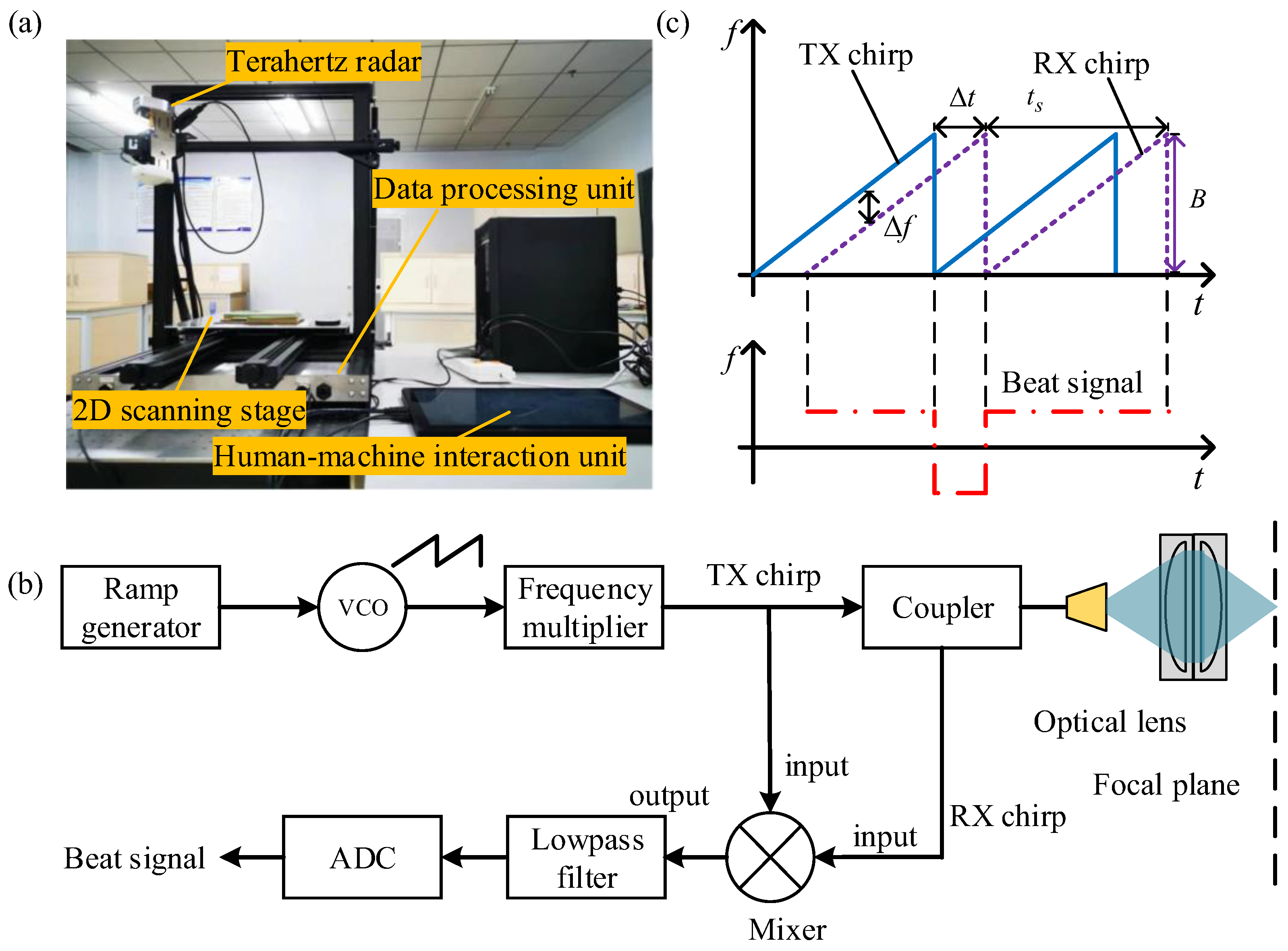
The terahertz inspection system employed in this study consists of a terahertz FMCW radar, three linear actuators, a data acquisition and processing platform, and a human–machine interaction unit. And the terahertz radar is the TRAD-152 Sensor manufactured by TRILITEC GmbH (Germany), operating within a frequency range of 126 GHz to 182 GHz and featuring a sweep time of 1.024 ms. The system features a sampling rate of 1 MHz and a maximum scanning area of 400 mm × 400 mm. The radio frequency portion of the radar includes a horn antenna and an optical focusing lens assembly. During inspection, the sample is typically positioned at the focal plane of the lens to optimize the reflected signal quality. The terahertz radar is mounted on the X-axis linear stage and interfaced with the data acquisition unit via USB. Figure 1 illustrates the overall system architecture and the workflow of the terahertz radar.
First, a voltage-controlled oscillator (VCO) is driven by a ramp generator to generate a fast saw-tooth low-frequency sweep signal. The low-frequency sweep signal is amplified through a frequency doubling link to become the transmission signal (TX chirp, shown as the solid blue line in Figure 1c), part of which is radiated into the air by the antenna, and the other part is directed straight into the mixer. Under the action of a focusing lens, the radiated signal converges. When encountering interfaces between different media, it generates reflection and transmission. The reflected wave returns along the transmission path back to the terahertz radar as the received signal (RX chirp, shown as the dashed purple line in Figure 1c) and enters the mixer, whereas the transmitted wave continues to propagate forward. The TX chirp and RX chirp undergo down-conversion processing in the mixer, producing a beat signal (shown as the dash-dot red line in Figure 1c), which is ultimately recorded by the data acquisition and processing platform.
Figure 1c illustrates the measurement principle of FMCW, where B denotes the sweep frequency bandwidth, t s is the period of a sweep cycle, ∆f is the frequency difference, and ∆t indicates the time offset caused by the distance of the measured target. Fundamentally, the beat signal comprises a combination of multiple cosine signals with different frequencies. In the FMCW mechanism, the TX chirp and RX chirp can be expressed by the following equations:
S T X t = A t exp j 2 π f 0 t + 1 2 K t 2
S R X t = A r exp j 2 π f 0 t Δ t + 1 2 K t Δ t 2
where A t and A r represent the amplitudes of transmitted and reflected signals, respectively, f 0 is the initial frequency, K = B / t s is the chirp rate. Consequently, the down-converted beat signal can be expressed as:
S B e a t t = A t A r 2 exp j 2 π t K Δ t + f 0 Δ t 1 2 K Δ t 2
Based on the relationship between the propagation distance of the terahertz signal and the time delay, the frequency-distance relationship can be derived by performing a Fast Fourier Transform (FFT) on the beat signal, which can be obtained as follows:
d = c t s f / 2 n B
where c is the speed of light and n is the refractive index of the medium. Since the terahertz signal is a periodically varying continuous wave, according to the properties of the Fast Fourier Transform (FFT), the observation time within a given observation window determines the minimum resolvable frequency interval. For the system employed in this study, the theoretically minimum detectable thickness is calculated as follows:
δ = c / 2 n B
Theoretically, the minimum detectable thickness of this system is 2.7 mm (in air). However, in practical detection, the minimum detectable thickness is also influenced by the refractive index of the medium. For delamination defects, their detectability depends on the separation and intensity of the echo signals generated by the defect in the depth direction relative to the echoes from the upper and lower interfaces. When the defect thickness approaches or is smaller than the axial resolution, and the intensity information is similar, its signal will overlap with the interface echoes, making independent resolution difficult. Therefore, for defects with thicknesses greater than the resolution, the thickness measurement accuracy is affected by noise and the signal processing algorithm. For defects with small thicknesses, unavoidable errors in thickness measurement will occur.
Terahertz signals contain information such as amplitude, frequency, and phase. These can be transformed into characteristic quantities like intensity, thickness, and attenuation through signal processing and characterization methods, thereby enabling internal structure detection. Generally, the performance of terahertz detection and imaging is influenced by two main factors: the Rayleigh characteristics of the focused spot and the defocusing detection method. Due to the action of a focusing lens assembly, the terahertz wave is first collimated into a parallel beam upon passing through the initial lens, then converged by the subsequent lens to form a small focused spot at the focal plane. A shorter focal length results in improved focusing performance, higher energy concentration, and enhanced lateral resolution at the focal point. However, constrained by fabrication precision and the inherent wavelength properties of terahertz radiation, the size of the focused spot cannot be reduced indefinitely, which ultimately defines the detection resolution limit of the system. Taking a lens with a 50 mm focal length as an example, the terahertz energy deteriorates sharply outside the focal plane, dropping to only about 30% of its value at the focal point when the distance reaches approximately 30 mm [13].

2.2. Sample Detection Results and Problem Analysis

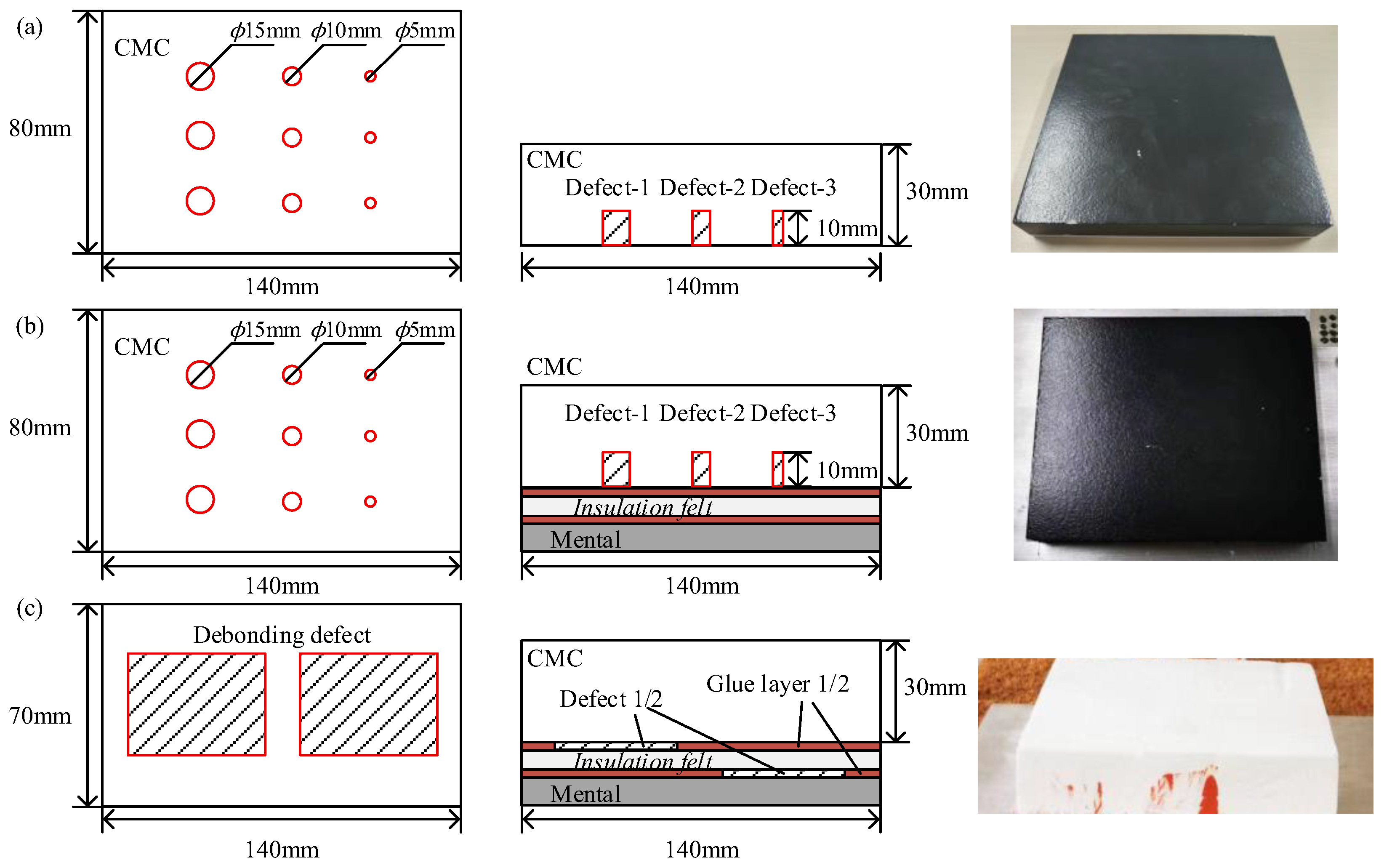
The specimens employed in this study consist of CMC with pre-defined defects and their bonded counterparts. These specimens exhibit a loose, porous structure with a dense surface film primarily composed of alumina and silica, designated as Sample 1, Sample 2, and Sample 3. Sample 1 and Sample 2 have dimensions of 140 mm × 80 mm × 30 mm, while Sample 3 measures 140 mm × 70 mm × 30 mm. Sample 1 is a pure CMC specimen with three rows of hole defects at the same depth but varying sizes, marked sequentially from top to bottom and left to right as 1-1, 1-2, 1-3, 2-1, 2-2, 2-3, 3-1, 3-2, 3-3, with diameters of 15 mm, 10 mm, and 5 mm, respectively. Sample 2 and 3 are bonded specimens composed of CMC, thermal insulation felt, and a metal plate, simulating the structure of spacecraft thermal protection tiles. Sample 2 contains the same pre-defined defects as Sample 1. Sample 3 is prepared by applying dry adhesive to the adhesive layers 1 and 2 to create delamination defects. Figure 2 provides schematic illustrations of the structures of Sample 1, Sample 2, and Sample 3. The experimental step size is set to 1 mm.
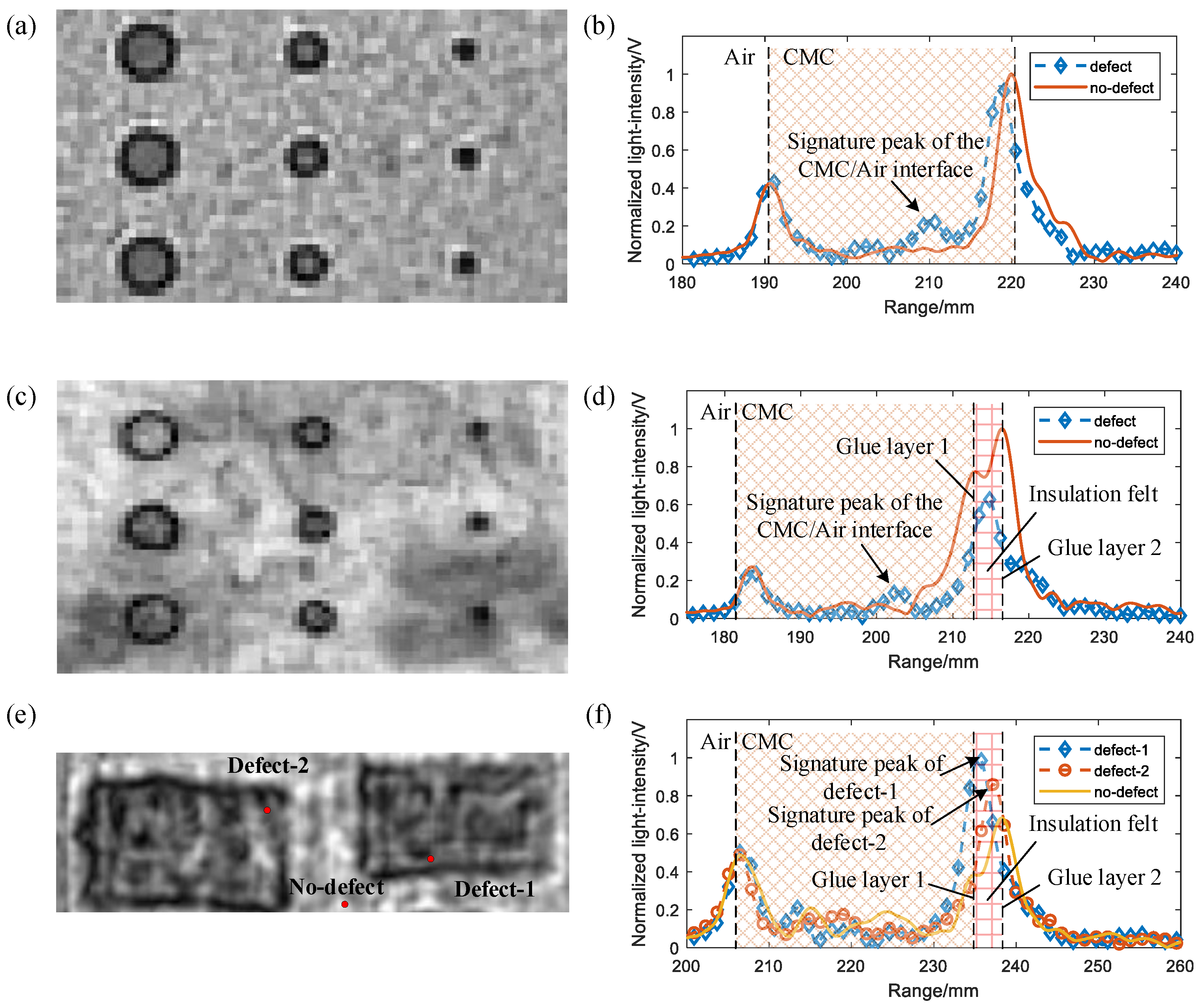
During the inspection process, the upper surface of the specimen was set as the focal plane, and the system was employed to inspect the specimens. In this configuration, the defect layer relative to the focal plane constitutes an out-of-focus detection scenario. The inspection results and representative signals are shown in Figure 3, where (a), (c), and (e) correspond to the two-dimensional imaging results of Sample 1, Sample 2, and Sample 3, respectively, while (b), (d), and (f) depict the range-domain information of typical positional signals for each specimen.
Based on the principle illustrated in Figure 1c, for Sample 1, when the terahertz wave enters the CMC layer, it generates transmitted and reflected waves at the Air/CMC interface. The transmitted wave continues to propagate forward, while the reflected wave returns along the original path to the terahertz radar, where it mixes with the local oscillator signal, manifesting as the first interface peak in Figure 3b. When the transmitted terahertz wave encounters a pore defect, it again generates transmitted and reflected waves at the Hole defects/Air interface. The transmitted wave continues forward, and the reflected wave returns to the terahertz radar along the source path, mixing with the local oscillator signal, which appears as the second interface peak in Figure 3b. Upon reaching the metal layer, the transmitted terahertz wave undergoes total reflection at the Air/Metal interface, returning to the terahertz radar and mixing with the local oscillator signal, represented as the third interface peak in Figure 3b. Similarly, during the inspection of Sample 2, the terahertz wave excited by the source undergoes four reflections: at the Air/CMC interface, the Hole defects/Air interface, Glue layer 1, and Glue layer 2, as illustrated in Figure 3d. For Sample 3, the terahertz wave excited by the source experiences three reflections: at the Air/CMC interface, Glue layer 1, and Glue layer 2, as shown in Figure 3f.
In practice, terahertz waves converge under the influence of the focusing lens, achieving optimal echo signals within the focal plane. But it also has drawbacks. There is no doubt that a lens with a short focal length has a short focal depth. It is found that with the influence of the characteristics of the optical lens, the energy outside the range of the focal depth shows a nonlinear cliff attenuation, which directly leads to a sharp decline in deep detection. When the system is equipped with a 50 mm lens for inspection, the energy of the terahertz signal attenuates to approximately 35% at a distance of 30 mm away from the focal plane. Due to the effects of defocused detection and diffraction, issues such as low contrast and blurred edges arise in terahertz imaging results, which also limit the minimum detectable defect size of the system.
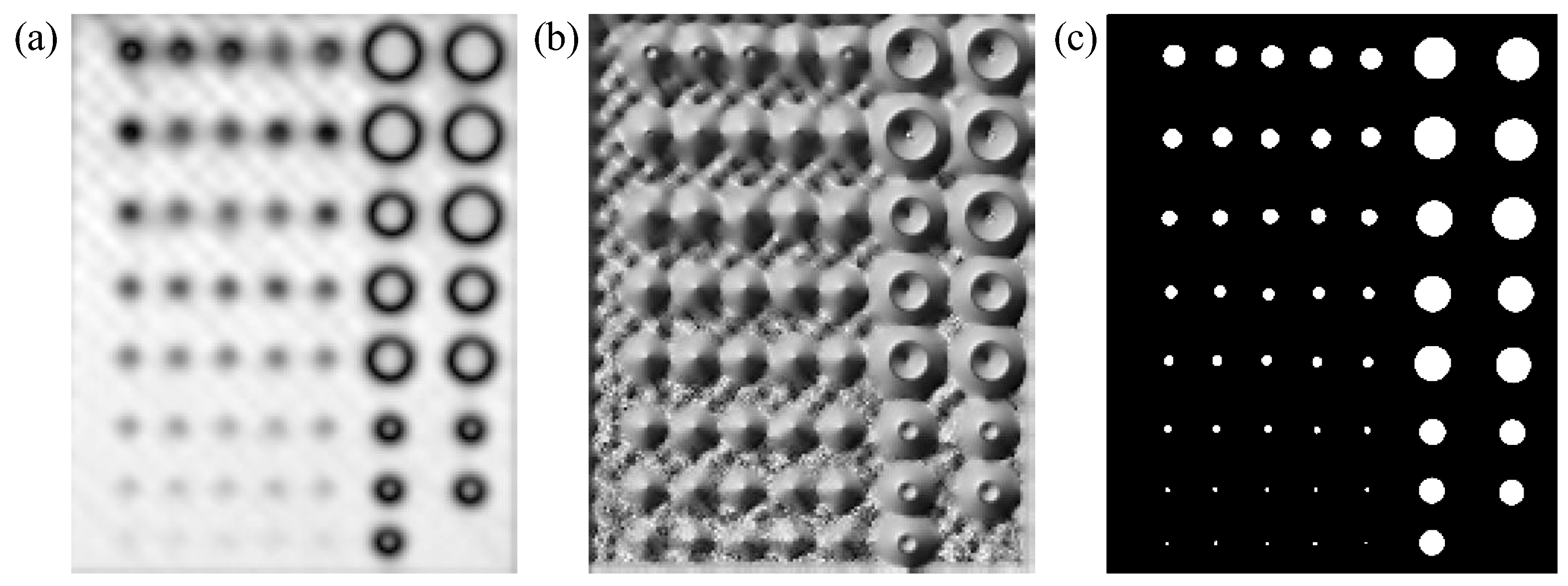
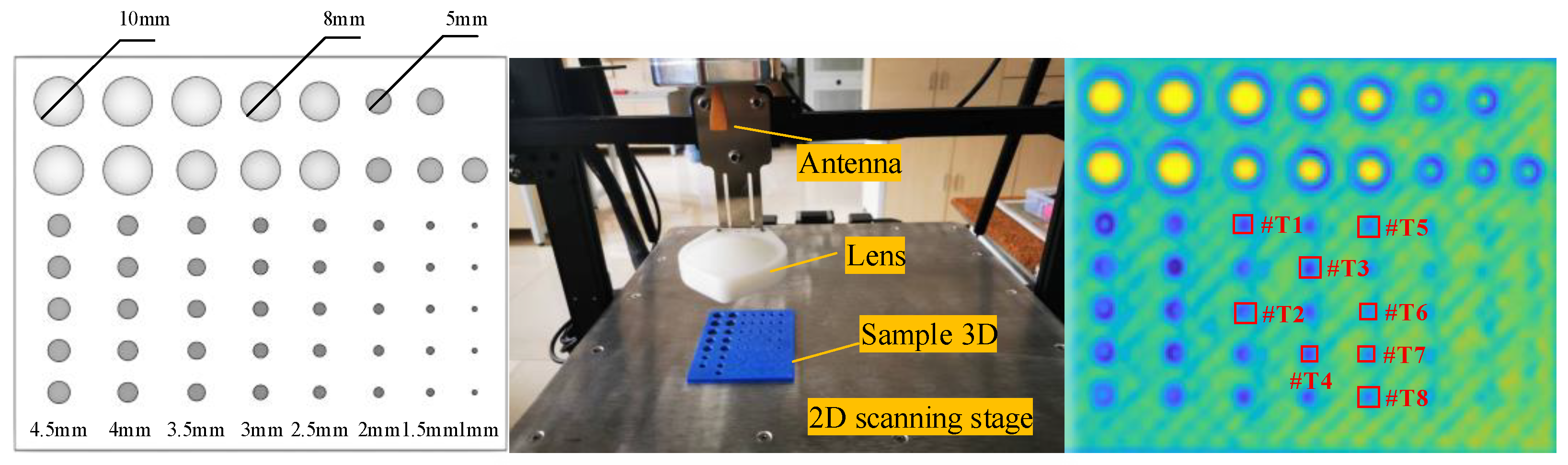
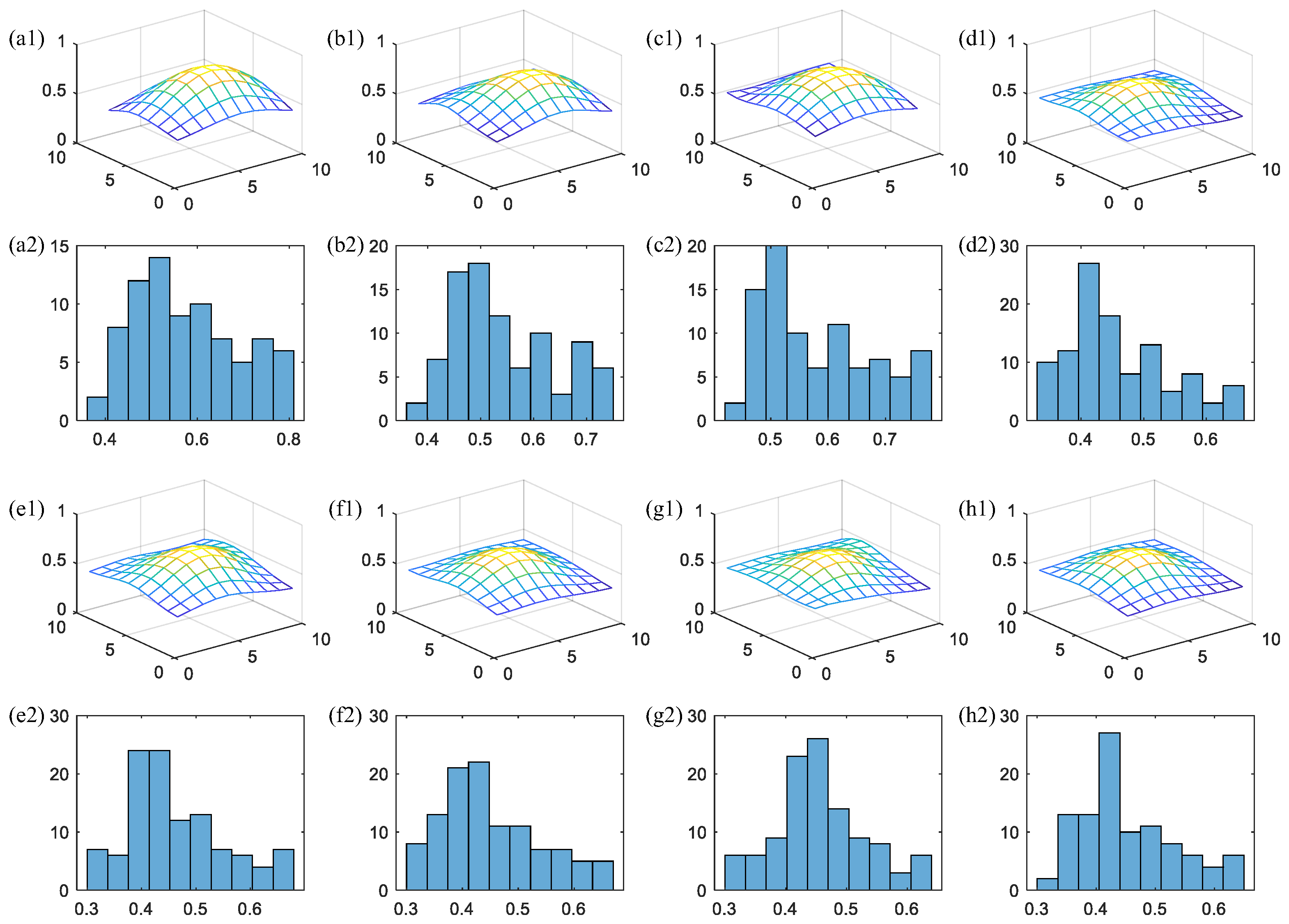
To evaluate the minimum detectable defect size of the system, the 3D-printed specimen made of polylactic acid (PLA) was fabricated and designated as Sample-3D. This specimen contains circular hole defects of varying diameters and is placed on a metal inspection platform. The detection results were analyzed utilizing the principle of total reflection, with a scanning step size of 1 mm. The dimensional specifications and detection results are shown in Figure 4, while grid diagrams and pixel distributions of typical regional imaging results are presented in Figure 5. Furthermore, the grid diagrams and pixel distributions for the red boxed areas in Figure 4 are respectively shown in Figure 5a–h.
As shown in Figure 4 and Figure 5, influenced by diffraction effects, pore defects with diameters larger than 2 mm can be clearly distinguished. Due to the total reflection characteristic of terahertz waves on the metal plate, these defects exhibit higher brightness. However, the contour regions of the defects show lower energy in the terahertz echo signals as a result of edge scattering. As the diameter of the circular holes gradually decreases, fine defects within 2 mm become undetectable. Similarly to infrared imaging, the terahertz FMCW imaging system achieves image formation by detecting terahertz waves reflected from the object and converting them into frequency-distance relationships. The images obtained by this system are typical discrete images, and there is no linear relationship between the grayscale distribution and the target reflection characteristics. Therefore, it is necessary to investigate signal processing algorithms to overcome the issues of edge blurring and the detection of fine defects constrained by the Rayleigh limit.

3. Defect Detection Enhancement Methods

Under the influence of diffraction and diffusion effects, the core challenge in detecting fine defects lies in their low spatial proportion in the target feature space, low contrast, and severe interference from background noise, making them difficult to identify at a single resolution. Traditional local contrast detection methods fail to fully suppress false targets, and genuine targets tend to be distorted into block-like structures, leading to variations in detected dimensions. To address this issue, a multi-scale fusion defect detection method incorporating joint background estimation is proposed.

3.1. Local Background-Aware Operator

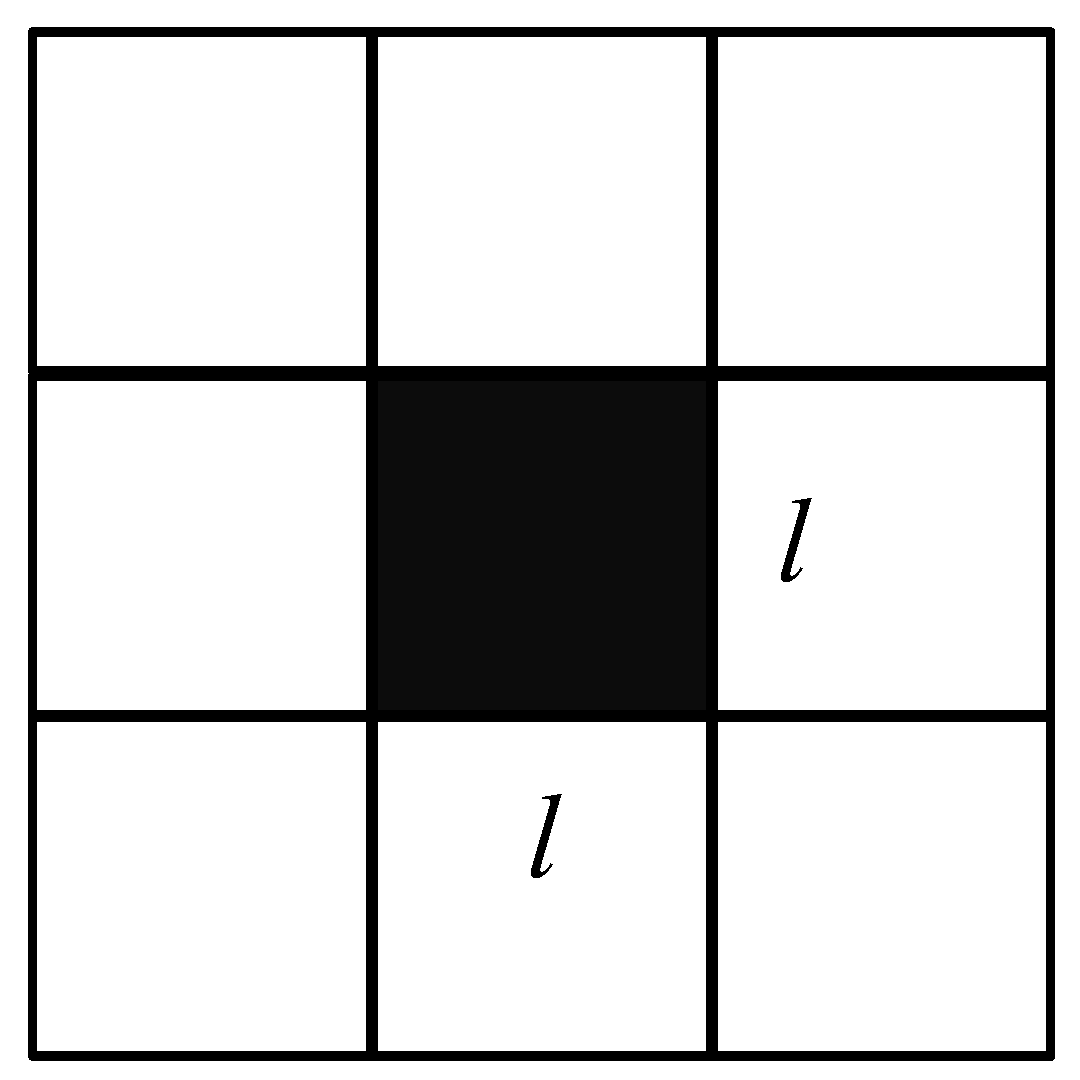
To detect fine defects and delineate the boundaries of defect regions, a local background-aware operator is designed. Figure 6 illustrates the structure of the local-aware operator, where the central window T perceives the defect target, and the neighboring windows B k capture background information. The size of the perception operator is set to 3 l × 3 l , and the central window T is set to l × l . The designed scale sizes are 1, 3, 5, and 7. The operator traverses the original image from left to right and top to bottom to compute the multi-scale local contrast values for the background region of each pixel.
Assuming the positional coordinates of the central window T are x , y , the ratio-based local contrast measure (RLCM) parameter is defined as follows:
R L C M = L 2 x , y m i n P B k l , l = 1,2 , 3,4
where P B k l denotes the average value formed by the pixel regions above the local mean in the neighborhood window at the scale i , m i n · indicates taking the minimum of the mean values at the scale i , and L 2 x , y represents the square of the gray value at the center position ( x , y ) of the window T . Based on this, the background estimation filter is constructed, which can be expressed by the following formula:
F i l t e r B k E = 1 N p p = 1 N p M G , l q + η M G , l p + η
where N p is the number of pixels, G denotes the smoothed guidance image, M G , l represents the mean value within the neighborhood l × l around the central pixel q , η is the constraint value (usually set to ( 0.001 × R ) 2 ), and R is the grayscale range [26,27]. Based on Equations (1) and (2), the joint ratio estimation-based local contrast measurement (RELCM) method can be described by the following equation:
R E L C M = R L C M F i l t e r B k E

3.2. Multi-Scale Difference Measurement

Since the background estimation filter is highly sensitive to high-frequency clutter components, which can easily cause residual edge clutter in the processed results, a single-scale measurement is first introduced based on RELCM. It can be expressed by the following formula:
S D C M = m a x S D C M i = m a x M i P B k i , M k i > P B i , i = 1,2 , 3,4 0 , o t h e r w i s e
where M i denotes the maximum pixel gray value within the central window T in the i -th scale image. When the sliding window traverses to the background edge, the neighborhood window B k contains more high gray-value pixels. Therefore, even if the sliding window size changes, M i remains smaller than P B k i . At this point, setting the SDCM value calculated for background edge pixels to 0 can effectively mitigate the impact of edge clutter. Meanwhile, to overcome the limitations of single-scale measurement, a multi-scale difference measurement method is designed as shown in the following equation:
M D C M = m a x ( P T i ) m i n ( P B k i ) , m a x ( P T i ) > m i n ( P B k i ) , i = 1,2 , 3,4 0 , o t h e r w i s e
where P T i denotes the average value of the set of pixels in the central window T that are higher than the mean value of the i -th scale image. When the sliding window traverses a defect target pixel, this pixel is salient in the local region, resulting in a relatively high gray value in the central window TT. While the neighborhood window B k captures bright pixels, it also includes darker background areas, making m a x ( P T i ) significantly larger than m i n ( P B k i ) in this case. The multi-scale difference measurement method not only accounts for features across different scales but also ensures the integrity of larger-scale target contours. By combining the single-scale and multi-scale measurement methods, the final result can be expressed as:
D C M = S D C M × M D C M

3.3. Multi-Frame Pipeline Filtering and Threshold Segmentation

According to FMCW measurement theory, different frequency components can be used to generate imaging on distinct range-dimensional planes. Combining time-frequency analysis, imaging across successive layers can be regarded as a frame-by-frame detection process, which is one of the fundamental principles of tomography. Influenced by the bonding process, the extraction of multi-directional detection data often inevitably leaves residual clutter blocks, which appear as bright or dark regions in the detection results and interfere with the accurate separation of real targets. Considering that the spectral peak of defect echo signals in the range dimension has a certain pulse width, defect targets can be approximated as continuous relative to the frequency-modulated wave over short time scales, whereas fluctuating noise exhibits incoherent and time-varying characteristics in the time dimension. If a candidate target appears with a frequency satisfying a preset condition across consecutive multiple frames in adjacent regions, it can be identified as a real target; otherwise, it should be classified as a false alarm. In multi-frame pipeline filtering, the values of the pipeline length N and the occurrence frequency M affect the accuracy and robustness of detection. And N depends on the effective number of frames in the range dimension and can be estimated based on the system range resolution and target thickness, as expressed in the following equation:
d = c t s 2 n B · f
The frequency threshold M should be determined based on the statistical characteristics of the noise to balance detection sensitivity and false alarm rates. Under multi-frame and strong noise environments, it is often set to 0.6. This method effectively enhances the stability and clutter resistance of defect detection through spatio-temporal dual constraints, making it suitable for the identification of internal defects in multilayer composite structures.
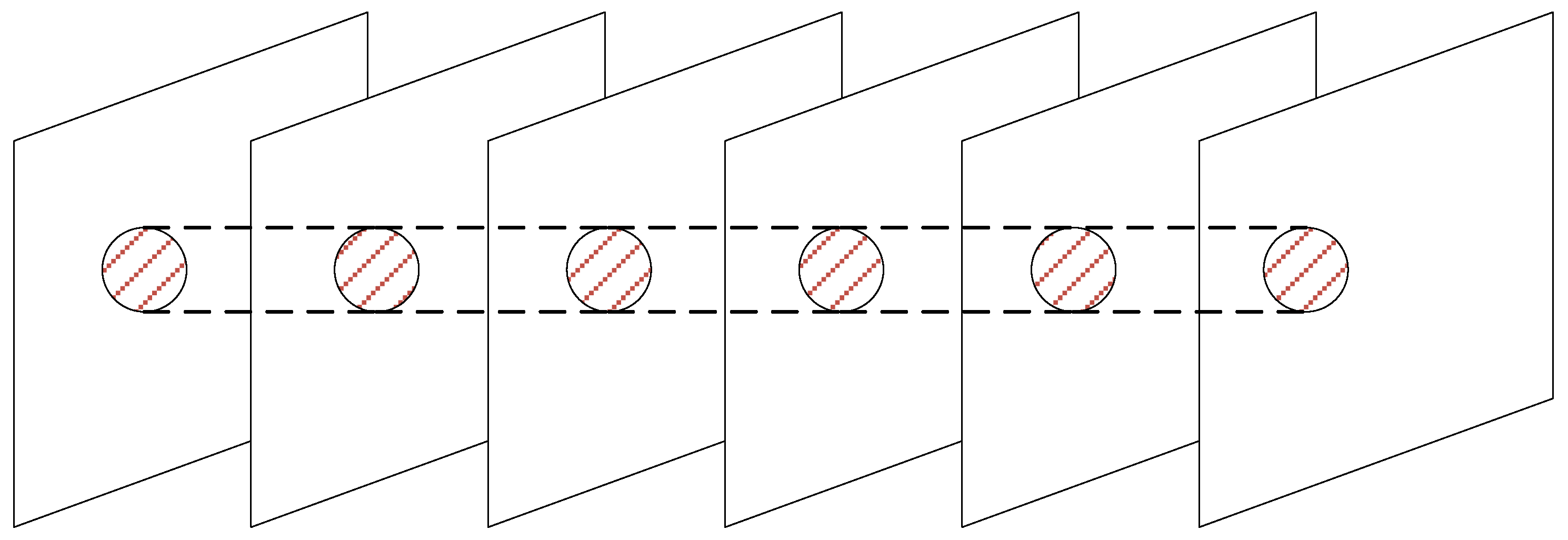
The basic principle of pipeline filtering is illustrated in Figure 7. The processing steps are as follows:
Step 1. Candidate point labeling. For each terahertz image frame, a dual-threshold segmentation method is used to perform binarization processing, extracting pixels above a preset threshold as candidate points. Connected component analysis is then performed to generate candidate regions.

Step 2. Multi-frame accumulation. A detection pipeline of length N is constructed along the range dimension direction, recording the number of occurrences of each candidate region across consecutive N frames.

Step 3. Frequency judgment. If any candidate region appears no less than M times within consecutive N frames, it is identified as a real target region. Otherwise, it is classified as noise and filtered out. This process continues until all candidate regions are traversed.

Step 4. Adaptive threshold optimization. To further suppress residual false alarms, an adaptive threshold operator is introduced after pipeline filtering. The improved Otsu method [13] is used to estimate the overall grayscale distribution of the image, and the optimal segmentation threshold is determined based on maximizing inter-class variance.
Output: Terahertz image containing defect features.
Figure 7. Schematic of pipeline filtering principle.
Photonics 13 00231 g007
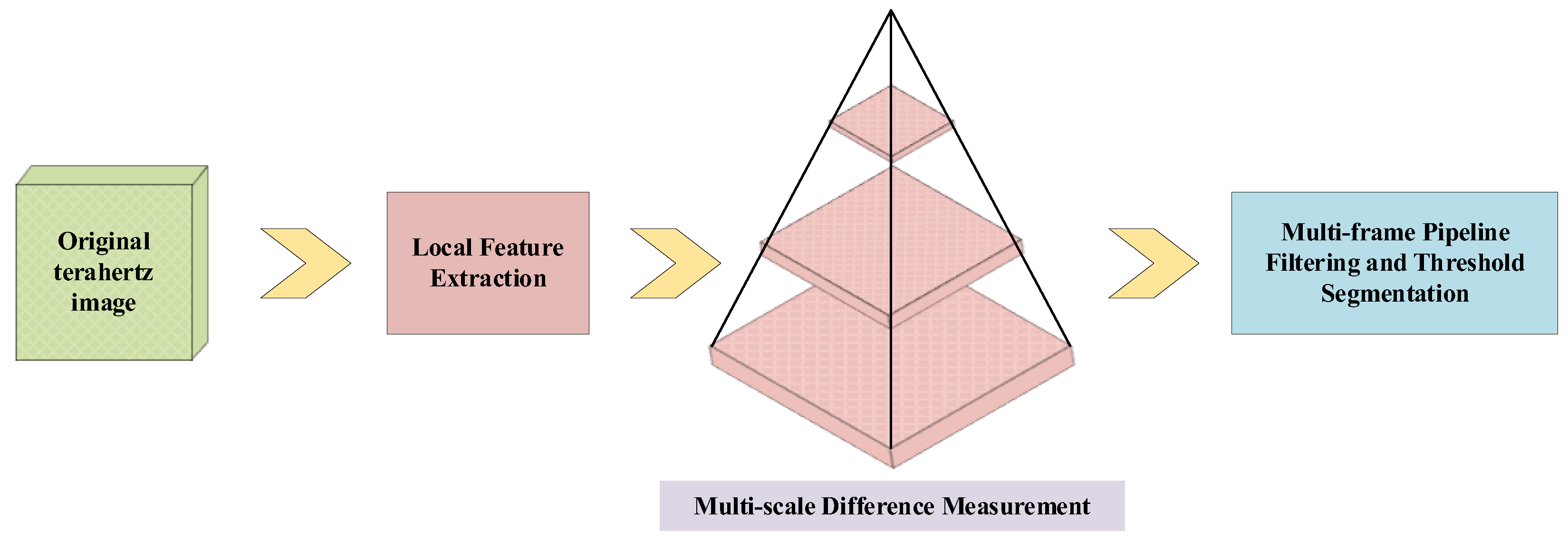
Furthermore, Figure 8 illustrates the overall processing pipeline proposed in this paper.

4. Results Analysis and Discussion

4.1. Analysis of Algorithm Advancement

Since it is very difficult to obtain a large number of FMCW images and their corresponding noise-free FMCW images in the real world, we generated multiple sets of synthetic images using simulation software based on sample detection results to evaluate the proposed algorithm. The proposed method was compared against three traditional methods (Sobel, Prewitt, Roberts), two learning-based methods (DexiNed [28], VDSR [29]), and a similar improved algorithm (MDED [13]). All experiments were performed on a computer equipped with a 4.01 GHz i5-6500K CPU and 32 GB RAM, and the training process was completed on an NVIDIA 3050Ti GPU. The image sets underwent necessary preprocessing steps—such as downsampling, magnification, and smoothing—via the simulation software. Comparisons were made in terms of Peak Signal-to-Noise Ratio (PSNR), Structural Similarity Index (SSIM), Background Suppression Ratio (BSR), and Information Fidelity Criterion (IFC). Due to space limitations, only imaging results of good quality are presented. We performed feature extraction using terahertz images affected by different noise factors. Table 1 presents a comparison of objective evaluation indicators. Except for a slightly lower PSNR, the proposed method outperforms all other algorithms in the remaining parameters. This advantage primarily stems from the proposed terahertz image-processing mechanism, which actively estimates and suppresses background interference while simultaneously enhancing defect features.

4.2. Analysis of Small-Size Defect Detection Results

The method proposed in the previous subsection was applied to process the detection results of Sample-3D. First, a local background-aware operator was employed to measure the overall terahertz image, delineate the edge regions of defect targets, and compute the local contrast value of each pixel’s background region. Subsequently, a multi-scale difference measurement method was utilized to capture image features across different scales, thereby maximizing the integrity of target contours. Finally, a multi-frame pipeline filtering and threshold segmentation method was adopted to partition the target regions. The processing results for Sample-3D are shown in Figure 9 and Table 2, where the measured values are derived from bilinear interpolation fitting of the defect contours. As observed from the figure and the table, the proposed method can effectively extract small-sized defects, with the average detection error for defect areas maintained at approximately 3%. Due to step size effects, the error for the 1mm defect is relatively larger, approximately 8.43%. It is noteworthy that the observed error is primarily constrained by the system’s lateral spatial resolution. Since the 1 mm defect size is smaller than this resolution limit, its measured signal is essentially the convolution of the true defect structure with the system’s point spread function, leading to an inherent overestimation bias in size. For such defects, the current method is more suitable for presence detection and coarse localization, while precise size quantification presents an inherent challenge.

4.3. Quantitative Analysis of Defect Detection in Ceramic Matrix Composites

In practical detection scenarios, except for a few cases involving highly reflective hidden defects, most FMCW images exhibit extremely low signal-to-noise ratios. That is, influenced by lens and wavelength diffraction, the detection results retain strong clutter or shadow regions, posing challenges for quantitative defect analysis. In this paper, a multi-scale fusion defect detection method incorporating joint background estimation is adopted to enable automatic discrimination and edge extraction for ceramic matrix composites. The detection error is defined as the percentage difference between the measured and true values of the defect area. To mitigate the impact of uncontrollable factors during the manufacturing process on prefabricated defects, focal-plane detection results are used as the true values and compared with the measured values from defocused detection. Figure 10 illustrates the processing results for samples 1–3.
Based on the lens dimensions and wavelength information, the estimated lateral resolution of the system is approximately 2 mm. For the detection of a 5 mm diameter hole, since the defect size is significantly larger than the scanning step size and the resolution, its detectability is extremely high, with ample signal-to-noise ratio. The positioning accuracy of the defect edges is limited by the scanning step size and the resolution. Meanwhile, the detected imaging size of the defect tends to expand due to the point spread function. This effect can be effectively corrected through the proposed multi-scale image processing mechanism. Table 3 presents the quantitative analysis error results for defects in Sample 1 and Sample 2, where the detection error remains within 6.44%. This validates the effectiveness of the proposed method in detecting ceramic matrix composites and offers insights and methodologies for defect discrimination and quantitative analysis in terahertz FMCW detection. It is worth noting that as defect sizes decrease to levels approaching the system resolution, the quantitative analysis and localization of defects become increasingly prone to ambiguity and deviation. Strong scattering within the material may also overwhelm the signals from minute defects.

5. Conclusions

Based on the FMCW measurement mechanism, this paper establishes a terahertz detection imaging system by integrating beam focusing and a full-matrix scanning approach. Solid-state electronics technology is employed to generate terahertz FMCWs for internal structural detection, demonstrating the feasibility and advancement of terahertz technology in inspecting ceramic matrix composites. The Rayleigh limit issue inherent in real-aperture detection is discussed, and a multi-scale fusion defect detection method combining background estimation is proposed. The effectiveness of the proposed method is validated through experiments on CMC specimens with prefabricated hole defects, TPS specimens with debonding defects, and polylactic acid 3D-printed materials. After processing with the proposed method, the minimum detectable hole diameter at the focal plane is 1 mm, with a regional error of approximately 3%. The detection error for holes and debonding areas in ceramic matrix composites remains within 6.44%. These results indicate that combining terahertz imaging technology with image processing algorithms enables quantitative analysis of internal defects in composite materials, providing insights and methodologies for assessing the health status of composites. However, when the surface flatness of the sample is poor, the characteristic signatures in the terahertz signal can become obscured by noise, posing challenges for feature extraction. And in engineering applications, due to the uncertainty of defects, most inspections are conducted under defocused conditions. Future work should incorporate corrections for beam diffusion effects under defocused states.

Author Contributions

Conceptualization, W.Z. and K.X.; methodology, W.Z.; Platform construction, W.Z. and K.X.; data curation, W.Z. and B.J.; formal analysis, Z.W.; writing—original draft preparation, W.Z.; writing—review and editing, Y.C. and K.X.; supervision, K.X. funding acquisition, W.Z. and K.X. All authors have read and agreed to the published version of the manuscript.

Funding

Supported by National Natural Science Foundation of China (U23A20636); Scientific and Technological Innovation Programs of Higher Education Institutions in Shanxi (2025L105, 2025L112); Doctoral Research Start-up Fund of Yuncheng University (YXBQ-3-202506).

Institutional Review Board Statement

Not applicable.

Informed Consent Statement

Not applicable.

Data Availability Statement

The data that support the findings of this study are available from the corresponding author upon reasonable request.

Conflicts of Interest

The authors declare no conflicts of interest.

References

  1. Zhang, F.; Zhou, S.; You, H.; Zhang, G.; Yang, J.; Shi, Y. 3D printing of ceramic matrix composites: Strengthening and toughening strategies. Compos. Part B Eng. 2025, 297, 112335. [Google Scholar] [CrossRef]
  2. Dai, B.; Wang, P.; Wang, T.; You, C.; Yang, Z.; Wang, K.; Liu, J. Improved terahertz nondestructive detection of debonds locating in layered structures based on wavelet transform. Compos. Struct. 2020, 168, 562–568. [Google Scholar] [CrossRef]
  3. Wen, Y.; Du, Y.; Qu, W.; Gao, J.; Zhang, Y. Dual-Mode Nondestructive Uniformity Characterization of Special-Shaped Ceramic Matrix Composites. J. Nondestruct. Eval. 2025, 44, 92. [Google Scholar] [CrossRef]
  4. Xue, K.; Zhang, W.; Song, J.; Wang, Z.; Jin, Y.; Nandi, A.; Chen, Y. Three-dimensional reconstruction method for layered structures based on a frequency modulated continuous wave terahertz radar. Opt. Express 2024, 32, 27303–27316. [Google Scholar] [CrossRef] [PubMed]
  5. Huang, J.; Li, P.; Yao, W. Thermal protection system gap analysis using a loosely coupled fluid-structural thermal numerical method. Acta Astronaut. 2018, 146, 368–377. [Google Scholar] [CrossRef]
  6. Zhu, T.; Zhou, Z.; Zhou, W.; Ahmad, H.E. Precise internal geometric characterization of multilayer structures using ultrasonic array imaging technology. NDT E Int. 2025, 156, 103468. [Google Scholar] [CrossRef]
  7. Song, M.; Wang, Z.; Chen, Y.; Li, Y.; Jin, Y.; Jia, B. A lightweight multi scale fusion network for IGBT ultrasonic tomography image segmentation. Sci. Rep. 2025, 15, 888. [Google Scholar] [CrossRef]
  8. Wei, X.; Bo, T.; Wang, P.; Ma, X.; Lou, Y.; Chen, J. Burning Rate Enhancement Analysis of End-Burning Solid Propellant Grains Based on X-Ray Real-Time Radiography. Int. J. Aerosp. Eng. 2020, 2020, 7906804. [Google Scholar]
  9. Xi, Y.; Zhou, P.; Yu, H.; Zhang, T.; Zhang, L.; Qiao, Z.; Liu, F. Adaptive-weighted high order TV algorithm for sparse-view CT reconstruction. Med. Phys. 2023, 50, 5568–5584. [Google Scholar] [CrossRef]
  10. Song, P.; Gao, M.; Liang, Z.; Yang, G.; Wang, F.; Liu, J.; Yue, H.; Pawlak, M.; Guo, F. Simulations and experimental study on imaging of thick defect in reusable thermal protective system using microwave NDT. Measurement 2024, 233, 114713. [Google Scholar] [CrossRef]
  11. Wu, B.; He, L. Multilayered Circular Dielectric Structure SAR Imaging Based on Compressed Sensing for FOD Detection in NDT. IEEE Trans. Instrum. Meas. 2020, 69, 7588–7593. [Google Scholar] [CrossRef]
  12. Yang, S.; Zhang, Y.; Zou, Q.; Jiang, X.; Jiang, S. Non-destructive quantification of corrosion under coatings and evaluation of coating performance using terahertz time-domain spectroscopy. Constr. Build. Mater. 2025, 501, 144251. [Google Scholar] [CrossRef]
  13. Xue, K.; Chen, Y.; Zhang, W.; Song, J.; Wang, Z.; Jin, Y.; Guo, X. Continuous Terahertz Wave Imaging for Debonding Detection and Visualization Analysis in Layered Structures. IEEE Access 2023, 11, 31607–31618. [Google Scholar] [CrossRef]
  14. Selvaraj, M.; Sreeja, B.S.; Aly, M.A.S. Terahertz-based biosensors for biomedical applications: A review. Methods 2025, 234, 54–66. [Google Scholar] [CrossRef]
  15. Duan, X.; Han, S.; Yuan, Y.; Shen, J.; Dai, Y.; Mi, J.; Wang, Z. Application of terahertz spectroscopy and imaging techniques in biomedicine. iScience 2025, 28, 113990. [Google Scholar] [CrossRef]
  16. Selvaraj, M.; Sreeja, B. Ultra-sensitive graphene micro-ribbon integrated THz biosensor for breast cancer cell detection. Methods 2025, 240, 125–136. [Google Scholar] [CrossRef]
  17. Moffa, C.; Francescone, D.; Curcio, A.; Felici, A.C.; Bellaveglia, M.; Piersanti, L.; Migliorati, M.; Petrarca, M. Deciphering hidden layers’s images through terahertz spectral fingerprints. Spectrochim. Acta Part A 2025, 343, 126510. [Google Scholar] [CrossRef]
  18. Yee, D.; Yahng, J.; Cho, S. D-Band THz A-Scanner for Grout Void Inspection of External Bridge Tendons. Appl. Sci. 2025, 15, 10859. [Google Scholar] [CrossRef]
  19. Moffa, C.; Felici, A.C.; Petrarca, M. Terahertz Investigation of Cultural Heritage Synthetic Materials: A Case Study of Copper Silicate Pigments. Minerals 2025, 15, 490. [Google Scholar] [CrossRef]
  20. Mao, Y.; Wu, T.; Chen, Y.; Ma, S. A 0.2-Terahertz Ceramic Relic Detection System Based on Iterative Threshold Filtering Imaging and Neural Network. Electronics 2021, 10, 2213. [Google Scholar] [CrossRef]
  21. Liu, Y.; Hu, Y.; Guo, X.; Zhang, J.; Xia, X.; Fu, K. Terahertz-based optical parameters analysis and quantitative inclusion defects detection in glass fiber-reinforced polymer laminate. NDT E Int. 2025, 151, 103310. [Google Scholar] [CrossRef]
  22. Xue, K.; Chen, Y.; Wang, Z.; Zhang, W. Terahertz Frequency Modulated Continuous Wave Detection Based on Image Restoration and Multi-View Scanning. Acta Opt. Sin. 2024, 44, 115–124. [Google Scholar]
  23. Friederich, F.; May, H.; Baccouche, B.; Matheis, C.; Bauer, M.; Jonuscheit, J.; Moor, M.; Denman, D.; Bramble, J.; Savage, N. Terahertz Radome Inspection. Photonics 2018, 5, 1. [Google Scholar] [CrossRef]
  24. Zhang, X.; Liang, J.; Wang, N.; Chang, T.; Guo, Q.; Cui, H. Broadband Millimeter-Wave Imaging Radar-Based 3-D Holographic Reconstruction for Nondestructive Testing. IEEE Trans. Microw. Theory Tech. 2020, 68, 1074–1085. [Google Scholar] [CrossRef]
  25. Hu, W.; Xu, Z.; Jiang, H.; Liu, Y.; Yao, Z.; Zhang, K.; Ligthart, L. High Range Resolution Wideband Terahertz FMCW Radar with a Large Depth of Field. Appl. Opt. 2022, 61, 7189–7196. [Google Scholar] [CrossRef] [PubMed]
  26. Li, Z.; Zheng, J.; Zhu, Z.; Yao, W.; Wu, S. Weighted Guided Image Filtering. IEEE Trans. Image Process. 2015, 24, 120–129. [Google Scholar]
  27. Lu, Z.; Liu, S.; Yilahun, H.; Hamdulla, A. Infrared Small Target Detection Based on Background Estimation and Scale Fusion. IEEE Geosci. Remote Sens. Lett. 2024, 21, 7001105. [Google Scholar] [CrossRef]
  28. Soria, X.; Riba, E.; Sappa, A. Dense extreme inception network: Towards a robust CNN model for edge detection. In Proceedings of the IEEE Winter Conference on Applications of Computer Vision, Snowmass Village, CO, USA, 1–5 March 2020; pp. 1923–1932. [Google Scholar]
  29. Kim, J.; Lee, J.K.; Lee, K.M. Accurate image superresolution using very deep convolutional networks. In Proceedings of the IEEE Conference on Computer Vision and Pattern Recognition, Las Vegas, NV, USA, 27–30 June 2016; pp. 1646–1654. [Google Scholar]
Figure 1. System architecture and scanning process illustration. (a) Physical diagram of the system; (b) Terahertz FMCW radar workflow; (c) FMCW measurement principle.
Photonics 13 00231 g001
Figure 2. Structural schematic of Sample 1, Sample 2 and Sample 3. (a) Top view, side view, and physical drawing of Sample 1; (b) Top view, side view, and physical drawing of Sample 2; (c) Top view, side view, and physical drawing of Sample 3.
Photonics 13 00231 g002
Figure 3. Detection results and typical range of Sample 1 and Sample 2. (a) Imaging result of Sample 1; (b) Typical range of Sample 1; (c) Imaging result of Sample 2; (d) Typical range of Sample 2; (e) Imaging result of Sample 3; (f) Typical range of Sample 3.
Photonics 13 00231 g003
Figure 4. The size specifications and inspection results of Sample-3D.
Photonics 13 00231 g004
Figure 5. Grid diagram (a1h1) and pixel distribution (a2h2) of imaging results from typical regions of Sample-3D.
Photonics 13 00231 g005
Figure 6. Background-aware operator.
Photonics 13 00231 g006
Figure 8. The overall processing pipeline.
Photonics 13 00231 g008
Figure 9. Processing Results of Sample-3D. (a) Local background awareness; (b) multi-scale difference filtering; (c) pipeline filtering and threshold segmentation processing.
Photonics 13 00231 g009
Figure 10. Processing Results of Sample 1~3. (a) Sample 1; (b) Sample 2; (c) Sample 3.
Photonics 13 00231 g010
Table 1. Comparison of objective evaluation indicators.
AlgorithmPSNR (dB)SSIMBSR (dB)IFC
Sobel25.990.647112.760.6613
Prewitt24.870.621812.540.6608
Roberts25.430.654113.240.6549
DexiNed25.760.642312.890.6617
VDSR26.180.681513.430.6813
MDED26.020.679413.460.6792
Proposed method in this paper26.110.691713.590.6872
Table 2. Defect quantitative analysis results (Sample-3D).
Real Value (mm2)Measured Value (mm2)Average Error (%)
314.00314314315.26314316.520.20
200.96201.46200.96200.96200.46199.960.20
78.5078.578.8178.577.8779.760.56
63.5963.5963.5963.8763.5963.590.09
50.2450.2452.0149.7450.2451.51.41
38.4638.4739.3538.2539.5738.691.26
28.2628.4528.2628.2629.0227.71.07
19.6319.6319.1620.5818.2419.313.18
12.5612.5612.6912.5612.6912.560.40
7.077.167.076.66.977.071.84
3.143.143.22.954.153.088.43
Table 3. Defect quantitative analysis results (Sample 1~3).
SampleDefect NumberQuantitative Analysis
Real Value (mm2)Measured Value (mm2)Error (%)
Sample 1
(Hole defects)
Defect-1-1706.50684.193.16
Defect-1-2706.50670.435.11
Defect-1-3706.50677.184.15
Defect-2-1314.00293.796.44
Defect-2-2314.00301.633.94
Defect-2-3314.00297.475.26
Defect-3-178.5081.784.18
Defect-3-278.5081.533.86
Defect-3-378.5080.152.10
Sample 2
(Hole defects)
Defect-1-1706.50671.244.99
Defect-1-2706.50674.184.57
Defect-1-3706.50685.492.97
Defect-2-1314.00302.773.57
Defect-2-2314.00303.153.46
Defect-2-3314.00299.044.76
Defect-3-178.5083.416.25
Defect-3-278.5082.655.29
Defect-3-378.5082.835.52
Sample 3
(Debonding defect)
Defect-11627.931560.114.17
Defect-21758.691667.295.20
Disclaimer/Publisher’s Note: The statements, opinions and data contained in all publications are solely those of the individual author(s) and contributor(s) and not of MDPI and/or the editor(s). MDPI and/or the editor(s) disclaim responsibility for any injury to people or property resulting from any ideas, methods, instructions or products referred to in the content.