


Abstract
Adolescence is a particularly sensitive period for adoptees in regard to psychological, social, and physical transformations, particularly for children adopted from abroad. Past studies highlighted that age at adoption could have an effect on child development. Through our research on 350 internationally adopted adolescents in Quebec we show that the intensity of attachment behaviours to mothers, as well as maternal monitoring style, may have an impact on the emergence of behavioural problems in adolescence.
Introduction
Recent studies have shown that international adoption has an impact on emotional and social development in adolescence, specifically in regard to attachment and separation processes [1, for a review]. There is some evidence of the role of preadoptive environment, age at adoption and attachment problems as risk factors for behavioural problems in adolescence [2].
Most abandoned and then adopted children have experienced a number of adverse factors [3] that may influence their adjustment [4,5,6] and the parent-child relationship. Some of these factors are pre- or perinatal (stress, malnutrition or disease of the mother), whereas others occur after birth (e.g., persistent malnutrition, discontinuities of caretaking or of adequate stimulation, poor medical care [7,8]). These adverse factors appear predominant for internationally adopted children from countries where war, poverty, disease and famine prevail, often cumulative with negative attitudes toward unwanted pregnancy, single parenthood, and international adoption [2,9]. All of these factors may have long-term implications for the lives of both adopted children and their adoptive parents.
Adolescence represents an especially critical period for adopted children, due to a variety of physical and cognitive changes [9]: having been adopted may constitute a risk factor for psychological development when social identity and filiation are questioned [2,9].
Overall, the literature reports that behavioural problems tend to increase in adolescence in adopted children [8, for a review]. Behavioural problems are more frequent in adopted adolescents than in non-adopted peers [10,11,12,13,14,15,16]. While externalising behavioural problems prevail [9,17,18], some studies also found increased internalising problems among adolescent adoptees [13,15,19,20], and two meta-analyses showed a larger number of total behaviour problems [8,9].
The effect of age at adoption on behavioural problems
A late adoption frequently implies a long time spent in institutions in poor living conditions [21,22], and increases the risk of being subjected to adverse circumstances with potentially long-term consequences [23,24]. Howe showed that infants adopted after six months of age were more at risk of developing later behavioural problems [25]. Rutter found that children adopted between 6 and 24 months presented more cognitive impairments at six years of age than children adopted sooner [26]. Gunnar et al. found that children adopted from institutions after 24 months of age were at increased risk of attention, thought and social problems at school age [2].
The effect of age at adoption on parent–child attachment
Poor affective life conditions before adoption may influence the development of emotional regulation and later social adaptation [27]. Indeed, institutional rearing environments may not provide the environmental input that promotes selective attachment relationships [28].
Most adoption professionals emphasise the importance of attachment in the emotional well-being of internationally adopted children [29,30,31]. Whereas children adopted within the first 6 months of life tend to show normative patterns of attachment with their adoptive parents [32,33], those adopted beyond the age of 6 to 12 months may be at risk for attachment problems and developmental difficulties [34,35]. O’Connor et al. have found that the duration of deprivation was associated with a lower rate of secure attachment in adopted children and a higher rate of atypical patterns of insecure attachment (whereas the typical forms of insecure attachment did not seem to be affected by deprivation) [28]. Consequently, the earlier the child is adopted, the less he/she is at risk of developing negative patterns of attachment [27]. In spite of these results, there is no firm evidence yet regarding a sensitive period beyond which risks would be dramatically increased.
Consequences in adolescence of disrupted parent–child attachment
Attachment is related to the capacity for self-reliance, emotional regulation and the development of social competence [36]. Although attachment seems to be relatively stable along childhood, changes may occur at adolescence due to distancing from parents [37]. Zimmermann and Grossmann showed that adolescents with positive representations of interpersonal relationships were more socially competent and more accepted among peers [38]. Adolescents with less positive representations or insecure attachment have been shown to present more hostility, to be often on their own, to present more eating problems and substance abuse [38,39], anxiety, distress, depressive symptoms, suicidal [40] and criminal behaviour [41,42]. Indeed, when expanding their social network many adolescent adoptees may find it difficult to establish selective bonds with others, leading to social loneliness and feelings of helplessness [24,36].
Rosnati and Marta showed that the quality of the relationship with the adoptive parents can be predictive of affective and behavioural problems among adolescents [43]. Verissimo and Salvaterra showed that the quality of mothers’ attachment representations (“attachment scripts”) can predict the attachment security of the adopted child; age at adoption did not affect the predictive effect [44]. These results point up the influence of mothers’ representations of attachment on caregiving behaviours, and on the ways in which these behaviours shape the relationship with the child. In spite of these results, it should be mentioned that most adopted children are able to establish secure bonds with their adoptive parents. In other words, the quality of attachment does not strictly depend on having experienced a continuous relationship from birth, and adopted children may recover from early deprivation.
The influence of parental monitoring on behavioural problems
Parenting practices have been shown to influence the onset and persistence of behavioural problems in children and adolescents [45,46,47,48]. Campbell, Pierce, Moore et al. found high levels of maternal negative control at 4 years old to predict externalising problems at 9 years [49]. Other studies evidenced a link between parental practices and behavioural problems, delinquency, and academic performance [50,51,52,53,54,55]. Patterson and Bank showed that children who were closely monitored by their parents were less likely to be involved in delinquent activities [47]. Kerns et al. found that children’s and parents’ perception of a secure attachment relationship were related to parental monitoring [50].
Concerning adopted children, Dishion & McMahon showed that, during infancy, high levels of control by the adoptive parents predicted antisocial behaviour at adolescence [56]. Reciprocally, a lack of parental control has been highlighted as a strong predictor for antisocial personality in adoptees [57]. Patterson, Reid & Dishion showed that inappropriate parental supervision may encourage the adolescent to spend more time with his/her delinquent peers [58]. Rothbaum and Weisz found a relationship between adopted children’s externalising problems and close parental control [59]. A meta-analysis evidenced a link between close parental control and child anxiety in adopted children [60]. Many authors have linked high levels of parental monitoring to less delinquency or antisocial behaviour [51,53,55], less risky behaviours [61], less substance use [62], and fewer deviant friends [57,63]. The way parents monitor their children also has an influence on their behaviour. A tracking style has been linked to poor adjustment, lower self-esteem, more depressive symptoms and a poorer parent-child relationship [64]. A study run in 2000 by Kerr and Stattin separated parental monitoring into three different behaviours: child disclosure, parental solicitation, and parental control. Their results showed that child disclosure is the strongest indicator of adjustment, of a better parentchild relationship, better self-esteem and fewer depressive symptoms.
Aim of the study
The literature shows an association between the emergence of behavioural problems in adopted adolescents and a wide range of factors. In the present study we will examine the influence of different categories of age at adoption, intensity of child attachment behaviours and maternal monitoring style on behavioural problems.
Method
Participants
Families taking part at this study are all Canadians. They adopted a child from abroad between 1985 and 2002, and were contacted in the context of a survey conducted by Tessier et al. [27] with the help of the International Adoption Secretaryship in Quebec. Ninety percent of the files collected in the survey (questionnaires sent by post; return rate: 44%) were complete enough to be included in the analysis. For the present report we retained only adolescents aged between 12 and 18 years at the time of the study (N = 350, 186 girls and 164 boys). The sample has been split into four groups in respect of age at adoption. Age cut-points refer to important developmental steps as described by the attachment theory [see 65, 66]: 1) before 6 months (attachment “in the making”), N = 83; 2) from 6 to 12 months (“clear-cut” attachment), N = 52; 3) from 12 to 24 months, N = 43; and 4) after 24 months, N = 172 (table 1).

Table 1.
Participants’ age means and SD (years).
Instruments
Attachment behaviour questionnaire
The questionnaire of Kerns et al. [50] was used to assess how the parents describe their adolescents’ attachment behaviours and their intensity. This instrument includes 10 questions on how the parents perceive the interaction with their child and, more specifically, about their attachment relationship with their child (i.e., “I am often angry with my child.” or “I encourage my child to talk about his problems.”). Responses are provided on a Likert-type scale ranging from 1 (very unlike me) to 5 (very like me). The total score is obtained by adding up the ten items, regarding reversal scales. The higher the total score, the more the adolescents’ attachment behaviours are close to security. Very low scores are correlated with poor attachment security.
Parental Monitoring Questionnaire [64]
The Parental Monitoring Questionnaire is composed of 15 items separated into three factors regarding the potential sources of information about adolescents’ daily activities: child disclosure (the child talks to his parents in a spontaneous way about things that upset him), parental solicitation (parents ask the child about what he did at school, etc.) and parental control. For Child disclosure, mothers answer in a five-point response scale questions such as “Does your child tell you how school was when he gets home?” or “Is your child very secretive about what he does during his free time?” Alpha reliabilities were 0.80. The two month testretest correlation was 0.70. Concerning Parental solicitation, items are like “In the last month, did you talk with your child about his/her friends?” or “In the last month, how often did you start a conversation with your child about his free time?” The alpha reliability is 0.70 and the test-retest correlation 0.84. Parental Control was measured by five questions such as “Has your child to ask for your permission to stay out late?” or “Does your child need to ask you before he can decide with his friends what they will do on Saturday?” The alpha reliability was 0.78, and the test-retest reliability was 0.82.
Child Behaviour Checklist [67]
The parental-report of the Child Behaviour Checklist (French version) was used to evaluate the behavioural problems of the adopted adolescents. This is a 113 items questionnaire. Items scores range 0 to 2; eight scales are computed by summing up items: anxiety/depression, somatic problems, social withdrawal, aggressive behaviour, rule-breaking behaviour, attention problems and thought problems, and into three global scales: internalising (regrouping items from the anxiety/depression, social withdrawal and somatic problems scales), externalising (aggressive behaviour, rule-breaking behaviour, thought problems) and total score (all items) of behavioural problems.
Results
We evaluated the number of reported behavioural problems of the 12–18 y.o. participants (N = 350), in regard to age at adoption (see table 2).
Table 2.
CBCL Behaviour problems scales related to age at adoption.
These results show a significant difference between the groups of adolescents adopted before six months and after 24 months regarding behavioural problems in most scales of the CBCL: more behavioural problems are reported by parents of adolescents adopted late. For the attention problem and the rule-breaking behaviour scales there is also a difference between having been adopted in the first year of life versus later.
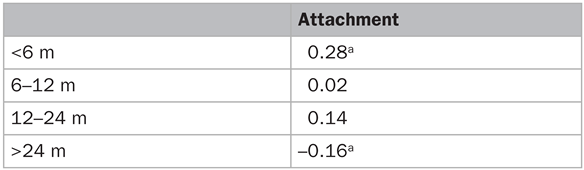
We then evaluated the relationship between attachment and age at adoption. Again we found a significant difference between groups of adolescents adopted before six months and after 24 months (table 3): having been adopted after the second year of life seems to be a risk factor regarding attachment, as reported by the mother.
Table 3.
Attachment scores related to age at adoption.
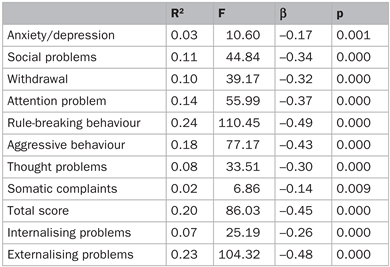
We assessed the relationship between behavioural problems and the attachment index (linear regression on the whole sample). We found a significant relationship between these two variables (see table 4). For each scale of the CBCL we found that poor attachment to the mother could predict an increase in behavioural problems. For rule-breaking behaviour, the CBCL total score and the externalising problems scales, one fifth to nearly one quarter of the variance is explained by attachment behaviours (both domains reported by the mother).
Table 4.
Linear regressions, attachment predicting behavioural problems.
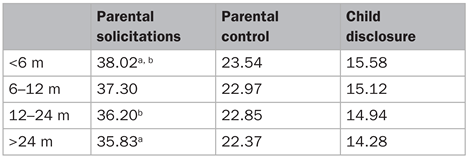
We assessed the influence of age at adoption on parental monitoring style (table 5). We found age at adoption to significantly affect the parental solicitations. Indeed, when the child has been adopted earlier, mothers report more solicitation style than when the child has been adopted later. For child disclosure and parental control, age at adoption was not found to have an influence.
Table 5.
Parental monitoring style related to age at adoption.
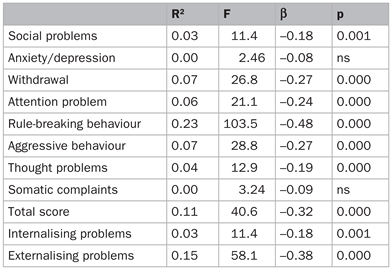
For the next step, we calculated the influence of parental monitoring style on behavioural problems in adopted adolescents (table 6). As there were no significant results for child disclosure and parental control, we did not report it on the table.
Table 6.
Linear regression of behavioural problems on maternal solicitations.
For almost all CBCL scales (except somatic complaints and anxiety/depression), parental solicitations have a significant influence on behavioural problems. The influence is especially important for rule-breaking behaviour: nearly a quarter of the total variance is explained by parental solicitations, in the sense that the more the mother asks her child about him/herself, the less the child presents behavioural problems.
Finally, we evaluate two models in which maternal solicitations and attachment were considered as moderating variables regarding the association between age at adoption and CBCL. We found that maternal solicitations style moderated the link between age at adoption and aggressive behaviour (b = 0.175, t = 1.92, p <0.05); between age at adoption and CBCL total scores (b = 0.186, t = 2.07, p <0.05); and lastly between age at adoption and externalising behaviours (b = 0.169, t = 1.85, p <0.05). It indicates that parental monitoring through child solicitation could be a protective factor between age at adoption and behavioural problems. For the second model, with attachment as a moderation variable, we found no significance.
Discussion
Our results show that age at adoption represents a strong indicator of the emergence of behavioural problems in adolescence (at least as reported by the mothers). As we were expecting, the later the child is adopted, the more he/she is at risk of presenting a large number of problems, especially during the critical period of life which is adolescence. Indeed, having been adopted later means a long time spent in institutions, in poor living conditions which may not provide adequate stimuli to promote healthy development. At the opposite end of the scale, having been adopted before six months may constitute a protective factor regarding behavioural problems in adolescence.
Age at adoption also seems to influence attachment to the mother. It is likely that when the child is adopted later, probably because of the time spent without a specific attachment figure, it is more difficult for him/her to establish a selective attachment [68]. According to the attachment theory, selective attachments form during the second semester of life. Beyond the second semester the child exposed to inadequate care and poor stimulation may form undifferentiated relationships (reactive attachment disorder, DSMIV) and if some children may restore a differentiated relationship after adoption [69], some difficulties may subsist. Low parental solicitations in the case of a child adopted later could also reflect the poor attachment quality and the lack of communication between the adoptive mother and the child. These seem particularly right for children adopted after 24 months in contrast to those adopted before 6 months.
Concerning behavioural problems, our results show that attachment and parental monitoring style are clearly related to the emergence of problems in adopted adolescents. Indeed, the more the child is attached to her/his mother and the more she talks to him/her about him/her, the less he/she will develop behavioural problems. Many studies showed the importance of parental supervision and attachment as a protective factor against behavioural problems and psychopathology, particularly in adolescence.
Our last result shows a moderating role of maternal monitoring style between age at adoption and aggressive, externalising, and total scores of problems. It seems so, that high maternal solicitations may attenuate the impact of late adoption. In contrast, attachment seems to be influenced by age at adoption, which means that it is really difficult to establish secure bonds with a child adopted after 24 months. It is also possible that the behaviour and the emotional capacities of the child, affected by a long time spent in institutions, may directly affect how others treat the child and have an impact on the emergence of behavioural problems [70].
On the whole, having been adopted after 24 months may constitute a risk factor regarding behavioural problems in adolescence. Through these results we also highlight the importance of the parent-child quality of the attachment relationship and maternal monitoring style and frequency as protective factors against the emergence of behavioural problems in adopted adolescents. Of course, an important limitation on these results is that attachment, parenting practices and behavioural problems are only reported by mothers.
Funding/potential conflict of interest
No funding. No conflict of interest.
Acknowledgments
We would like to thank the Mustela Foundation, France, for the generous donation which made possible the writing of this article.
References
- Harf, A; Taïeb, O; Moro, M-R. Adolescence et adoptions internationales: Une nouvelle problématique? Psychiatrie de l’enfant 2006, 49(2), 543–72. [Google Scholar] [CrossRef]
- Gunnar, MR; Van Dulmen, M. and the international adoption project team. Behavior problems in postinstitutionalized internationally adopted children. Dev Psychopathol. 2007, 19, 129–48. [Google Scholar] [CrossRef] [PubMed]
- Rutter, M; Garmezy, N. Developmental psychopathology. In Handbook of child psychology, 4th ed; Mussen, P.H., Ed.; Wiley: New York, 1983; pp. 775–911. [Google Scholar]
- O’Connor, TG; Rutter, M. Attachment disorder behavior following early severe deprivation: Extension and longitudinal follow-up. J Am Acad Child Adolesc Psychiatry 2000, 39, 703–12. [Google Scholar] [CrossRef] [PubMed]
- Vehulst, F; Althaus, M; Versluis-den-Bieman, HJM. Problem behavior in international adoptees. An epidemiological study I– II. J Am Acad Child Adolesc Psychiatry 1990, 29, 94–103, 104–11. [Google Scholar]
- Vorria, P; Papaligoura, Z; Dunn, J; Van Ijzendoorn, MH; Steele, H; Kontopoulou, A; et al. Early experiences and attachment relationships of Greek infants raised in residential group care. J Child Psychol Psychiatry 2003, 44, 1208–20. [Google Scholar] [CrossRef]
- Verhulst, FC. Internationally adopted children: the Dutch longitudinal adoption study. Adoption Quarterly 2000, 4, 27–44. [Google Scholar] [CrossRef]
- Juffer, F; Van Ijzendoorn, MH. Behavior problems and mental health referrals of international adoptees: a meta-analysis. JAMA 2005, 294(20), 2501–15. [Google Scholar] [CrossRef]
- Bimmel, N; Juffer, F; Van Ijzendoorn, MH; Bakermans-Kranenburg, MJ. Problem behavior of internationally adopted adolescents: A review and meta-analysis. Harv Rev Psychiatry 2003, 11, 64–77. [Google Scholar]
- Versluis-den-Bierman, HJM; Verhulst, FC. Self-reported and parent reported problems in adolescent international adoptees. J Child Psychol Psychiatr. 1995, 36, 1411–28. [Google Scholar] [CrossRef]
- Bogaerts, S; Van Aelst, G. Adolescentie en interculturele adopttie: Psycho-sociale integratie in Vlaamse gezinnen; Garant: Leuven, Belgium, 1998. [Google Scholar]
- Andresen, ILK. Behavioral and school adjustment of 12–13 years old internationally adopted children in Norway: a research note. J Child Psychol Psychiatry 1992, 33(2), 427–39. [Google Scholar] [CrossRef]
- Dalen, M. School performance among internationally adopted children in Norway. Adoption Quarterly 2001, 5, 39–58. [Google Scholar] [CrossRef]
- De Jong, DK. The well-being of Russian and Romanian intercountry adoptees in New Zealand; Massey University: Palmerston North, New Zealand, 2001. [Google Scholar]
- Fan, X; Miller, BC; Christensen, M; et al. Questionnaire and interview inconsistencies exaggerated differences between adopted and non adopted adolescents in a national sample. Adoption Quarterly 2002, 6, 7–27. [Google Scholar] [CrossRef]
- Golombok, S; McCallum, F; Goodman, E. The “test-tube” generation: Parent-child relationships and the psychological well-being of in vitro fertilization children at adolescence. Child Develop 2001, 72, 599–608. [Google Scholar] [CrossRef]
- Wierzbicki, M. Psychological adjustment of adoptees: a meta-analysis. J Clin Child Psychol. 1993, 22, 447–54. [Google Scholar] [CrossRef]
- Castle, NA; London, DO; Creech, C; Fajloun, Z; Stocker, JW; Sabatier, J.-M. Maurotoxin − a potent inhibitor of intermediate conductance Ca2+activated potassium channels. Mol Pharmacol. 2003, 63, 409–18. [Google Scholar] [CrossRef]
- Borders, LD; Penny, JM; Portnoy, F. Adult adoptees and their friends: current functioning and psycho-social well-being. Fam Relat. 2000, 49, 407–18. [Google Scholar] [CrossRef]
- Storsbergen, HE. Psychiche gezondheid en welbevinden van volwassen Grieks geadopteerden in Nederlands: de invloed van het geadopteerd zijn; Utrecht University: Utrecht, the Netherlands, 2004. [Google Scholar]
- Vinay, A. L’adolescent adopté: pour une nouvelle compréhension. Neuropsychiatr. Enfance Adolesc. 2003, 51, 269–76. [Google Scholar] [CrossRef]
- Grotevant, HD; Van Dulmen, MH; Dunbar, N; Nelson-Christinedaughter, J; Christensen, M; Fan, X; Miller, BC. Antisocial behavior of adoptees and non adoptees: Prediction from early history and adolescent relationships. J Res Adolesc. 2006, 16(1), 105–31. [Google Scholar] [CrossRef]
- Groza, V; Ryan, SD. Pre adoption stress and its association with child behavior in domestic special needs and international adoption. Psychoneuroendo 2002, 27, 181–97. [Google Scholar] [CrossRef]
- Pratti, B. Les adolescents adoptés sont-ils plus à risque de suicide que leurs pairs non adoptés? Adolescence 2005, 24, 111–28. [Google Scholar] [CrossRef]
- Howe, D. Patterns of adoption: nature, nurture, and psychosocial development; Blackwell: Oxford, 1998. [Google Scholar]
- Rutter, M. Developmental catch-up and delay following adoption after severe global early privation. J Child Psychol Psychiatry 1998, 39, 465–76. [Google Scholar] [PubMed]
- Tessier, R; Larose, S; Moss, E; Nadeau, L; Tarabulsy, G.M. L’adoption internationale au Québec de 1985 à 2002. L’adaptation sociale des enfants nés à l’étranger et adoptés par des familles au Québec. Rapport de recherche. In Secrétariat à l’adoption internationale; Ministère de la santé et des Services Sociaux (MSSS): Québec, 2005. [Google Scholar]
- O’Connor, TG; Marvin, RS; Rutter, M; Olrick, JT; Britner, PA. & the English and Romanian adoptees study team. Child-parent attachment following early institutional deprivation. Dev Psychopathol. 2003, 15, 19–38. [Google Scholar] [PubMed]
- Johnson, F; Fein, E. The concept of attachment: application to adoption. Child Youth services Rev. 1991, 13, 397–412. [Google Scholar] [CrossRef]
- Milan, SE; Pinderhughes, EE. Factors influencing maltreated children’s early adjustment to foster care. Dev Psychopathol. 2000, 12, 63–81. [Google Scholar] [CrossRef]
- Brodzinski, AB; Pinderhughes, E. Parenting and child development in adoptive families. In Handbook of parenting, 2nd ed; Bornstein, M.H., Ed.; Erlbaum: London, 2002; Vol 1, pp. 279–311. [Google Scholar]
- Juffer, F; Rosenboom, LG. Infant-mother attachment of internationally adopted children in the Netherlands. Int J Behav Dev. 1997, 20, 93–107. [Google Scholar] [CrossRef]
- Singer, L; Brodzinsky, D; Ramsay, D; Steir, M; Waters, E. Mother-infant attachment in adoptive families. Child Dev. 1985, 56, 1543–51. [Google Scholar] [CrossRef]
- Bowlby, J. Attachment and loss ((Vol. 2. Separation). Basic Books: New York, 1973. [Google Scholar]
- Yarrow, LJ; Goodwin, MS. The immediate impact of separation: Reactions of infants to a change in mother figure. In The competent infant; Stone, L., Smith, H., Murphy, L., Eds.; Basic Books: New York, 1973. [Google Scholar]
- Sroufe, A. Attachment and development: A prospective, longitudinal study from birth to adulthood. Attach Hum Dev. 2005, 7(4), 349–67. [Google Scholar] [CrossRef]
- Ammaniti, M; Van Ijzendoorn, MH; Speranza, AM; Tambelli, R. Internal working models of attachment during late childhood: an exploration of stability and change. Attach Hum Dev. 2000, 2(3), 328–46. [Google Scholar] [CrossRef]
- Zimmermann, P; Grossmann, KE. Attachment and adaptation in adolescence. In Development of interaction and attachment: Traditional and non-traditional approaches; Koops, W., Hoeksma, J. B., Van den Boom, D. C., Eds.; North Holland: Amsterdam, 1997; pp. 271–279. [Google Scholar]
- Cole-Detke, H; Kobak, R. Attachment process in eating disorder and depression. J Consult Clin Psychol. 1996, 64, 282–90. [Google Scholar] [CrossRef]
- Slap, G; Goodman, E; Huang, B. Adoption as a risk factor for attempted suicide during adolescence. Pediatrics 2001, 108, 1–8. [Google Scholar] [CrossRef]
- Adam, KS; Sheldon-Keller, AE; West, M. Attachment organization and history of suicidal behavior in clinical adolescents. J Clin Consult Psychol. 1996, 64, 264–72. [Google Scholar] [CrossRef] [PubMed]
- Allen, JP; Hauser, ST; Borman-Spurrell, E. Attachment theory as a framework for understanding sequelae of severe adolescent psychopathology: An 11-year follow-up study. J Consult Clin Psychol. 1996, 64, 254–63. 43. [Google Scholar] [CrossRef] [PubMed]
- Rosnati, R; Marta, E. Parent-child relationship as a protective factor in preventing adolescents’ psychosocial risk in inter-racial adoptive and non adoptive families. J Adolesc. 1997, 20, 617–31. [Google Scholar] [CrossRef] [PubMed]
- Verissimo, M; Salvaterra, F. Maternal secure based scripts and children’s attachment security in an adopted sample. Attach Hum Dev. 2006, 8(3), 261–73. [Google Scholar] [CrossRef]
- Campbell, S. Behavior problems in preschool children: Clinical and developmental issues; Guilford Press: New York, 1990. [Google Scholar]
- Greenberg, M; Spiltz, M; Deklyen, M. The role of attachment in the early development of disruptive behavior problems. Development and psychopathology 1993, 5, 191–213. [Google Scholar] [CrossRef]
- Patterson, GR; Bank, L. Some amplifying mechanisms for pathologic processes in families. In Systems and development: The Minnesota Symposia on Child Psychol; Gunnar, M. R., Thelen, E., Eds.; Erlbaum: Hillsdale, NJ, 1989; Volume 22, pp. 167–209. [Google Scholar]
- Webster-Stratton, C. Stress: a potential disruptive of parent perceptions and family interactions. J Clin Child Psychol. 1990, 4, 302–12. [Google Scholar] [CrossRef]
- Campbell, S; Pierce, E; Moore, G; Marakovitz, S; Newby, K. Boys externalizing problems at elementary school age. Dev Psychopathol. 1996, 8, 701–19. [Google Scholar] [CrossRef]
- Kerns, KA; Aspelmeier, JE; Gentzler, AL; Grabill, M. Parent-child attachment and monitoring in childhood. J Fam Psychol. 2001, 15(1), 69–81. [Google Scholar] [CrossRef]
- Sampson, RJ; Laub, JH. Urban poverty and the family context of delinquency: a new look at structure and process in a classic study. Child Develop 1994, 65, 523–40. [Google Scholar] [CrossRef]
- Bank, L; Patterson, GR. The use of structural equation modeling in combining data from different types of assessment. In Advances in psychological assessment; Rosen, J. C., McReynolds, P., Eds.; Plenum: New York, 1992; Volume 8, pp. 41–74. [Google Scholar]
- Weintraub, KJ; Gold, M. Monitoring and delinquency. Criminal behavior and mental health 1991, 1, 268–81. [Google Scholar] [CrossRef]
- Stice, E; Barrera, Jr M. A longitudinal examination of the reciprocal relations between perceived parenting and adolescents’ substance use and externalizing behaviors. Dev Psychol. 1995, 31, 322–34. [Google Scholar] [CrossRef]
- Crouter, AC; McDermid, SM; McHale, SM; Perry-Jenkins, M. Parental monitoring and perceptions of children’s school performance and conduct in dual and single earner families. Dev Psychol. 1990, 26, 649–57. [Google Scholar] [CrossRef]
- Dishion, TJ; McMahon, RJ. Parental monitoring and the prevention of child and adolescent problem behavior: a conceptual analysis and empirical formulation. Clin Child Fam Psychol Rev. 1998, 1, 61–75. [Google Scholar] [CrossRef] [PubMed]
- Dishion, TJ; Andrews, DW. Preventing Escalation in Problem Behaviors With High-Risk Young Adolescents: Immediate and 1-Year Outcomes. J Consult Clin Psychol. 1995, 63(4), 538–48. [Google Scholar] [CrossRef] [PubMed]
- Patterson, GR; Reid, JB; Dishion, TJ. Antisocial boys. In A social interactional approach; Castalia: Eugene, OR, 1992; Volume 4. [Google Scholar]
- Rothbaum, F; Weisz, J. Parental caregiving and child externalizing behavior in non-clinical samples: a meta-analysis. Psychol Bull. 1994, 116, 55–74. [Google Scholar] [CrossRef] [PubMed]
- McLeod, BD; Wood, JJ; Weisz, JR. Examining the association between parenting and childhood anxiety: a meta-analysis. Clin Psychol Rev. 2007, 27, 155–72. [Google Scholar] [CrossRef]
- Metzler, CW; Noell, J; Biglan, A; Ary, D; Smolkowski, K. The social context for risky sexual behaviors among adolescents. J Behav Med. 1994, 17, 419–38. [Google Scholar] [CrossRef]
- Flannery, DJ; Vazsonyi, AT; Torquati, J; Frifrich, A. Ethnic and gender differences in risk of early adolescent substance use. J Youth Adoles 1994, 23, 195–213. [Google Scholar] [CrossRef]
- Chassin, L; Pillow, DR; Curran, PJ; Molina, BSG; Barrera, M., Jr. Relation of parental alcoholism to early adolescent substance use: A test of three mediating mechanisms. J Abnorm Psychol. 1993, 102, 3–19. [Google Scholar] [CrossRef]
- Kerr, M; Stattin, H. What parents know, how they know it, and several forms of adolescent adjustment: further support for a reinterpretation of monitoring. Developmental Psychology 2000, 36(3), 366–80. [Google Scholar] [CrossRef]
- Bowlby, J. Attachment and loss; PUF: Paris, 1969. [Google Scholar]
- Ainsworth, MD; Blehar, MC; Waters, E; Wall, S. Pattern of attachment: a psychological study of the strange situation; Erlbaum: Hillsdale, NJ, 1978. [Google Scholar]
- Achenbach, TM. Manual for the CBCL/4-18 and 1991 profile; University of Vermont Press: Burlington, 1991. [Google Scholar]
- Zeanah, CH. Disturbances of attachment in young children adopted from institutions. J Dev Behav Pediatrics 2000, 21, 230–6. [Google Scholar]
- Smyke, AT; Dimitriescu, A; Zeanah, CH. Attachment disturbances in young children I: The continuum of caretaking casualty. J Am Acad Child Adolesc Psychiatry 2002, 41, 972–82. [Google Scholar] [CrossRef]
- Belsky, J.; Hsieh, K; Crnic, K. Mothering, fathering, and infant negativity as antecedents of boys’ internalizing problems and inhibition at age 3 years: Differential susceptibility to rearing experience? Dev Psychopathol. 1998, 10, 301–19. [Google Scholar] [CrossRef]


This is an open-access article distributed under the terms of the Creative Commons Attribution Non-Commercial No Derivatives (CC BY-NC-ND) 4.0 License.