


Abstract
Asphaltenes are the most polar and refractory fraction of crude oil, and are typically isolated using petroleum-derived precipitants (e.g., n-hexane, n-heptane) and then dissolved in aromatic solvents such as toluene, which raises safety and sustainability concerns. Here we evaluate D-limonene, a renewable terpene, as a green, room-temperature precipitant for asphaltene fractionation and benchmark it against n-alkanes and the ASTM D-6560 workflow. Multi-technique characterization (ATR-FTIR/NIR, TGA, CHN, EDS, LDI(+) FT-ICR MS, and 1H/13C NMR) shows that D-limonene yields a lower mass of precipitate yet a fraction with reduced thermal refractoriness (lowest TGA residue, broader/attenuated DTG peak). Molecular readouts indicate lower aromatic condensation/cross-linking in the precipitated subpopulation—narrower DBE envelopes by FT-ICR MS and lower aromatic carbon indices (Car_tot, Car-b, Car-j) by 13C NMR—consistent with a mechanism in which π–π/dispersion interactions retain highly condensed multi-ring aggregates in solution under cold, static conditions. These results establish D-limonene as a selective green precipitant for asphaltenes, offering immediate analytical benefits (cleaner, safer fractionation for molecular studies) and a sustainable basis for pretreatments of heavy fractions.
1. Introduction
Asphaltenes are the most polar and refractory fraction of crude oil. They comprise polyaromatic cores connected to naphthenic rings and aliphatic side chains, often bearing heteroatoms (N, O, S) that modulate aggregation, precipitation, and rheology. In analytical workflows and pretreatments, asphaltenes are routinely isolated by precipitation with petroleum-derived solvents (e.g., n-hexane, n-heptane) after dissolution in aromatic media such as toluene [1,2]. While effective, these conventional protocols raise safety and sustainability concerns due to toxicity, volatility, and non-renewable origin, and they provide limited insight into how solvent identity and contact conditions shape the selectivity of the precipitated subpopulations [3,4,5].
Within the principles of green chemistry, there is growing interest in bio-based, low-toxicity solvents that can replace n-alkanes/toluene without compromising analytical robustness [3,5]. D-limonene, a terpene sourced from citrus peel waste, combines renewability with favorable dispersion and π–π interactions [6], suggesting it could act as an alternative precipitant for polyaromatic systems. Yet, systematic assessments of D-limonene for cold (room-temperature) precipitation/fractionation of asphaltenes—benchmarked against n-alkane precipitants and the widely used ASTM D-6560 workflow and supported by molecular-level characterization—remain scarce [7].
D-limonene is a solvent with wide industrial applications, initially standing out in the cosmetics industry, followed by the pharmaceutical and food industries [8]. In recent years, its use has expanded to the chemical, resin, and polymer, and petroleum sectors, where it is employed as a solvent, cleaning agent, and odor neutralizer in petroleum operations [9]. These established applications demonstrate their technical feasibility and compatibility with conventional industrial equipment, supporting their applicability at an industrial scale.
In addition to its technological versatility, D-limonene has a favorable toxicological profile, characterized by low toxicity and no evidence of carcinogenic effects under usual exposure conditions [10], reinforcing its potential as a safer alternative to conventional petrochemical solvents. From a process perspective, D-limonene exhibits adequate thermal stability and a relatively high boiling point, enabling its recovery and reuse via conventional separation techniques such as distillation. Efficient solvent recovery reduces solvent losses, improves process sustainability, and lowers effective solvent consumption in industrial operations [6,11].
In economic terms, the global D-limonene market totaled approximately US$69.8 million in 2021 and is currently estimated at US$312.1 million, with projected annual growth of around 6% until 2030 [12]. This expansion is attributed not only to its broad industrial applicability but also to the increasing demand for solvents with lower environmental impact and improved safety profiles. Although the initial cost of D-limonene may be higher than that of some petrochemical solvents, its renewable origin, lower health and environmental risks, and potential for solvent recovery and recycling can offset these costs, making it a competitive option for industrial-scale applications [13].
This study evaluates D-limonene as a green precipitant for asphaltenes under mild (room-temperature, static) conditions, benchmarking it against n-hexane, n-heptane, and ASTM D-6560. We employ complementary techniques (ATR-FTIR/NIR, TGA, CHN, EDS, LDI(+) FT-ICR MS, and 1H/13C NMR) to test the hypothesis that solvent identity and contact conditions modulate the selective precipitation of distinct asphaltene subpopulations. No attempt is made here to evaluate recovery processes; the focus is strictly on a greener analytical/fractionation workflow and on the solvent–asphaltene interaction mechanisms that underlie it.
2. Materials and Methods
2.1. Materials
Crude oil samples were obtained from Brazil’s post-salt oil reserves and provided by DOPOLAB (Department of Organic Processes Laboratory, Rio de Janeiro, Brazil). The solvents used for asphaltene extraction were: n-hexane (≥95%, Sigma-Aldrich, Steinheim, Germany), n-heptane (≥98.5%, Sigma-Aldrich, Steinheim, Germany), and D-limonene (food grade, ≥95%, Sigma-Aldrich, Steinheim, Germany).
2.2. Cold Extraction of Asphaltenes
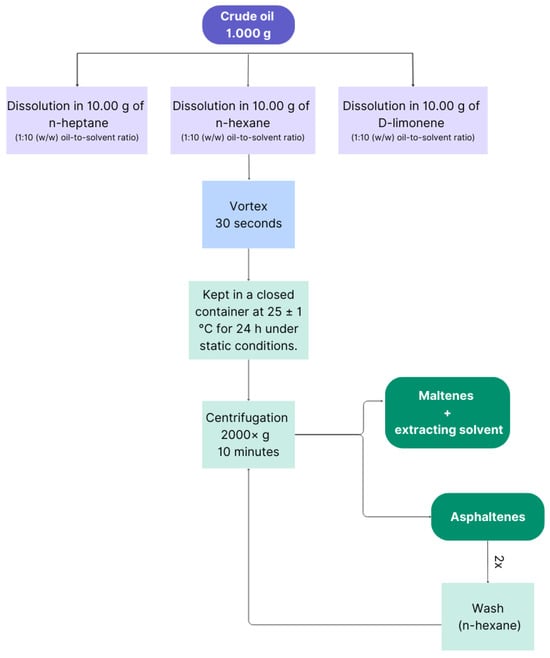
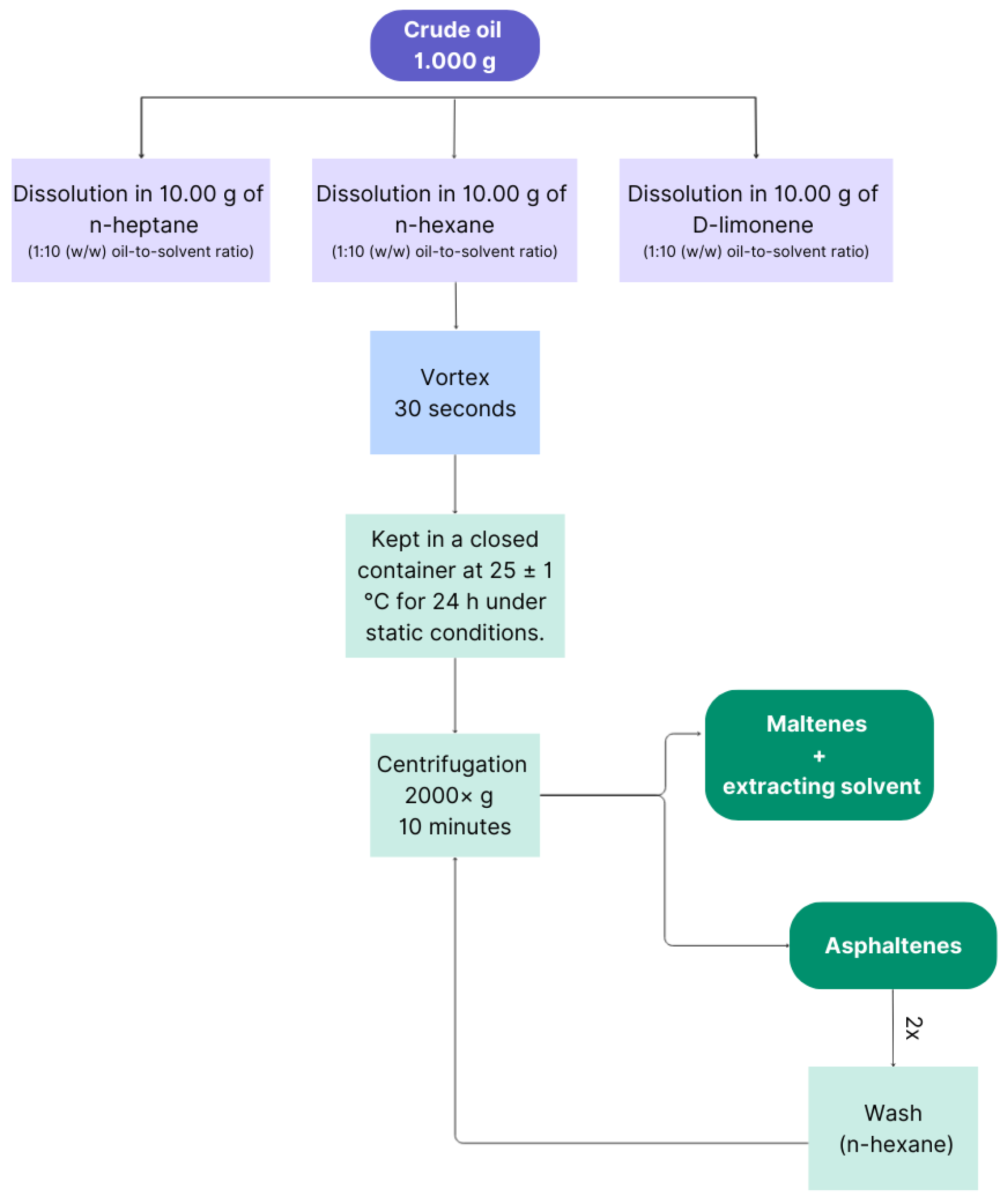
The extraction protocol was adapted from Ferreira et al. [14] (Figure 1). Approximately 1.000 g of crude oil was weighed and transferred to a 50 mL Falcon tube, followed by the addition of 10.00 g of solvent (n-hexane, n-heptane, or D-limonene), resulting in a 1:10 (w/w) oil-to-solvent ratio. The mixture was vortexed (KASVI K45-2810, Pinhais, Brazil) for 30 s to promote initial dispersion and then left to rest in a closed container at room temperature (25 ± 1 °C) for 24 h under static conditions.
Figure 1.
Process flow diagram of the cold asphaltene extraction method.
After the resting period, samples were centrifuged (Eppendorf 5810R, Hamburg, Germany) at 2000× g for 10 min. The resulting precipitates, corresponding to the asphaltene fractions, were carefully decanted, washed twice with 5 mL of fresh solvent, and dried in a vacuum oven at 25 °C until constant weight (<0.1 mg in 30 min).
2.3. Physicochemical Analysis of Asphaltenes
To investigate the physicochemical properties and structural differences among asphaltenes extracted using different solvents (n-hexane, n-heptane, and D-limonene), a comprehensive analytical approach was employed. The analyses included vibrational spectroscopy (FTIR and NIR) to assess functional groups, thermogravimetric analysis (TGA) for thermal behavior, elemental analysis (CHN and EDS) for compositional evaluation, high-resolution mass spectrometry (LDI FT-ICR MS) to determine molecular profiles, and nuclear magnetic resonance (NMR) spectroscopy for structural elucidation. Together, these techniques provide insight into how the choice of solvent influences asphaltene composition, aromaticity, and complexity.
2.3.1. Fourier-Transform Infrared (FTIR) and Near-Infrared (NIR) Spectroscopy
Fourier-Transform Infrared (FTIR) and Near-Infrared (NIR) spectra were collected using a Shimadzu IRTracer-100 (Kyoto, Japan) spectrometer equipped with an attenuated total reflectance (ATR) module. Samples were analyzed using 45 scans at a resolution of 2 cm−1. FTIR spectra were acquired in the 4000–400 cm−1 range, and NIR spectra in the 12,000–4000 cm−1 range. The equipment was previously calibrated to disregard atmospheric CO2 during sample analysis, with an air background of 64 scans.
2.3.2. Thermogravimetric Analysis (TGA)
Thermal stability was assessed using a Shimadzu TGA-50 (Kyoto, Japan). Approximately 10 mg of each dried asphaltene sample was placed in a platinum pan and heated from room temperature to 900 °C at a rate of 10 °C min−1 in a nitrogen atmosphere (flow rate: 60 mL min−1).
2.3.3. Elemental Analysis (CHN)
Carbon, hydrogen, and nitrogen contents were determined by combustion using a PerkinElmer (Waltham, MA, USA) CHNS/O 2400 analyzer. Samples (~5 mg) were combusted in a pure oxygen atmosphere at 900–1200 °C. Calibration was performed using acetanilide as a standard.
2.3.4. Energy Dispersive X-Ray Spectroscopy (EDS)
Samples were fixed to carbon adhesive tape on aluminum stubs and analyzed using a Bruker (Billerica, MA, USA) XFlash 630M detector coupled to a scanning electron microscope. The accelerating voltage was set at 20 kV, and qualitative elemental mapping was performed.
2.3.5. Laser Desorption/Ionization FT-ICR Mass Spectrometry (LDI FT-ICR MS)
High-resolution mass spectra were acquired using a 7 T SolariX 2xR FT-ICR MS (Bruker Daltonics, Bremen, Germany) equipped with a MALDI source operating in LDI(+) mode. Samples were dissolved in toluene (1 mg mL−1), and 1 μL aliquots were spotted on the MALDI target plate. After solvent evaporation, spectra were recorded with laser power ranging from 17% to 35%, with 15–400 laser shots accumulated depending on signal intensity.
2.3.6. Nuclear Magnetic Resonance (NMR)
NMR analyses were performed on a Varian INOVA 500 MHz spectrometer (11.7 T). Proton (1H) spectra were acquired using a single-pulse sequence, while carbon (13C) spectra were recorded using an inverse-gated decoupling sequence. Samples were dissolved in deuterated chloroform (CDCl3, 99.8%, Sigma-Aldrich), using ~10 mg of sample per 0.7 mL of solvent.
2.4. Use of Artificial Intelligence for Textual Revision
With the aim of improving the quality of the writing, the artificial intelligence tool ChatGPT (GPT-5.2), was used exclusively for textual revision, focusing on enhancing clarity, coherence, and appropriate vocabulary. The authors are fully responsible for the conception, execution, data analysis, interpretation, and scientific content of this study.
2.5. Statistical Analysis
Differences among the mean values obtained from the extraction using different solvents were assessed by one-way analysis of variance (ANOVA) using STATISTICA software 8.0. The significance level was set at α = 0.05.
3. Results and Discussion
Asphaltenes comprise a complex mixture of high molecular weight and highly polar molecules, representing the most polar fraction of crude oil. Their precipitation is typically induced by the addition of low-polarity straight-chain aliphatic hydrocarbons, such as n-pentane, n-hexane, or n-heptane. Conversely, they remain soluble in aromatic solvents, including toluene, due to favorable π–π interactions between the asphaltene aromatic cores and the solvent molecules [15].
The choice of solvent plays a crucial role in the precipitation of asphaltenes, as different solvents can yield distinct fractions from the same crude oil. Variations in the aliphatic chain length of the precipitating solvent influence the efficiency of the fractionation, which likely defines the types of compounds that precipitate. For instance, asphaltenes precipitated with n-heptane typically exhibit lower molecular weight, reduced aromaticity, and decreased polarity compared to those obtained using shorter-chain solvents such as n-hexane or n-pentane [16]. This behavior reflects the selective solvency mechanism, where solvents with different Hildebrand or Hansen solubility parameters favor the precipitation of asphaltenes with varying structural features [17]. Longer-chain alkanes like n-heptane exhibit weaker dispersion interactions with aromatic cores, promoting the precipitation of less polar and more compact molecular species [16].
3.1. Cold Extraction of Asphaltenes
The evaluation of a solvent for asphaltene extraction should not be based solely on the yield of the precipitated fraction but must also consider the physicochemical characteristics of the recovered material. As shown in Table 1, the cold precipitation methodology revealed significant differences in asphaltene yield depending on the solvent employed. D-limonene led to a lower asphaltene recovery (1.4 ± 0.002% w/w) compared to n-hexane (2.7 ± 0.001% w/w) and n-heptane (2.9 ± 0.004% w/w), with a statistically significant difference among the three groups (F(2,6) = 244.00, p < 0.001). The results demonstrate that the variability between groups was significantly greater than the variability within the group. This result suggests differences in solvating capacity and selectivity toward polar and aromatic species.
Table 1.
Yield of asphaltenes (% w/w) obtained by cold precipitation using different solvents.
The crude oil used in this study is a Brazilian post-salt sample characterized in our previous study by Ferreira et al. [14], with an API gravity of 19.39 and asphaltene content of 3.2% determined by the ASTM D6560 method. The cold extraction approach yielded values comparable to the ASTM standard when using n-hexane and n-heptane; however, D-limonene resulted in a significantly lower recovery. These differences suggest a more selective interaction between D-limonene and certain molecular subpopulations of asphaltenes, potentially favoring smaller or less polar aromatic species. The lower recovery may reflect a limited ability of D-limonene to disrupt and precipitate higher molecular weight polar aggregates under the applied conditions.
3.2. Physicochemical Analysis of Asphaltenes
3.2.1. Fourier-Transform Infrared (FTIR) and Near-Infrared (NIR) Spectroscopy
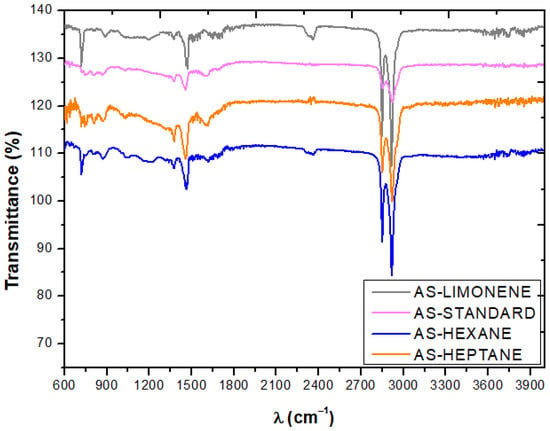
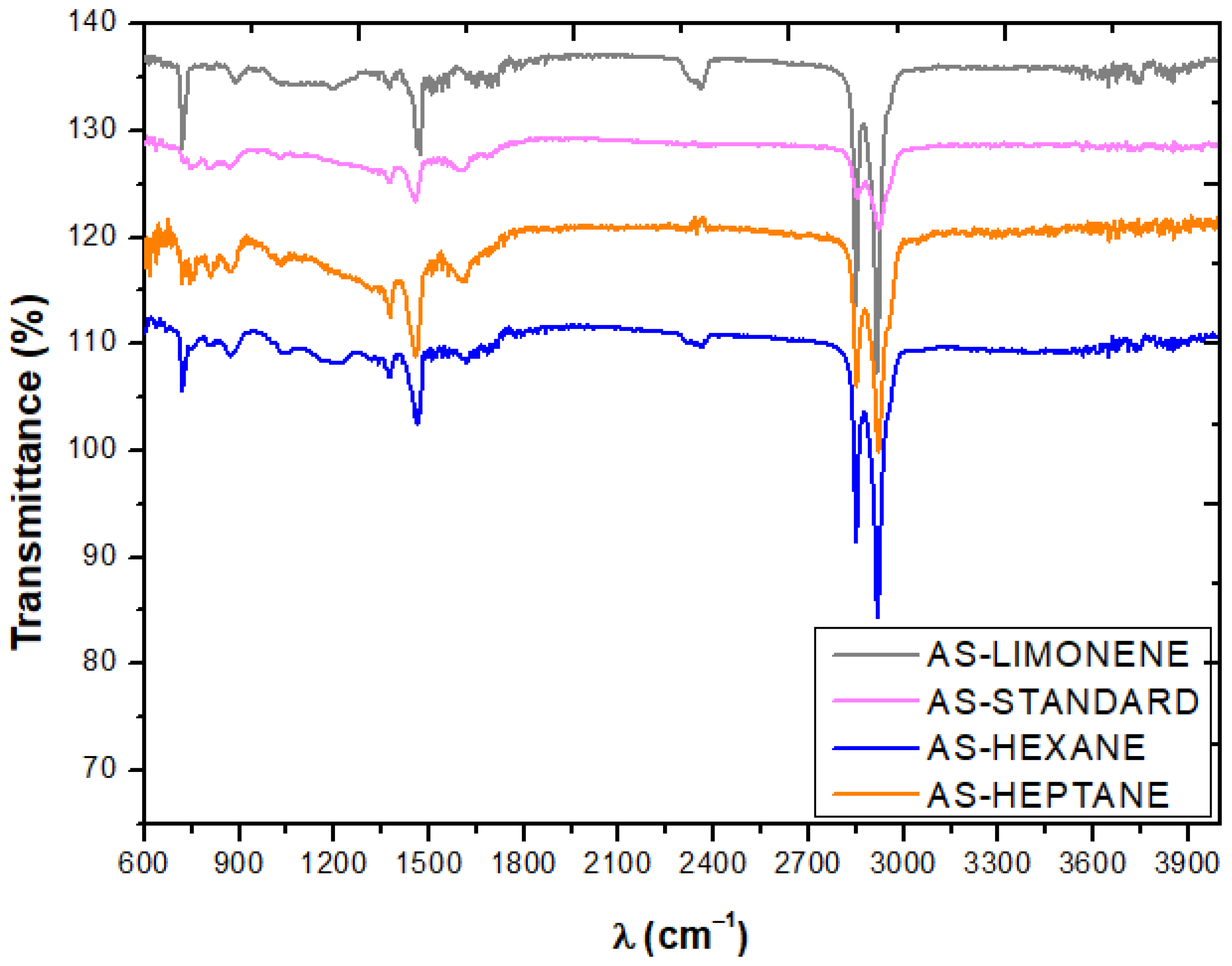
As shown in Figure 2, the FTIR spectra of all asphaltene samples display a similar overall profile, with characteristic absorption bands attributed to aliphatic hydrocarbons. A strong doublet is observed at 2920 cm−1 and 2875 cm−1, corresponding to the asymmetric and symmetric C–H stretching vibrations of methylene (–CH2–) and methyl (–CH3) groups, respectively. A weaker doublet at 1460–1375 cm−1 is assigned to bending and deformation modes of aliphatic –CH3 and –CH2– groups.
Figure 2.
Fourier-Transform Infrared (FTIR) spectra of asphaltenes obtained by cold extraction using D-limonene, n-hexane, and n-heptane, as well as by the standard ASTM D6560 method.
Samples extracted with D-limonene and n-hexane show a more pronounced absorption near 717 cm−1, which is attributed to the out-of-plane bending of aromatic C–H bonds [18], suggesting a higher relative aromatic content in these fractions.
This spectral profile is consistent with previous studies on oxidized asphaltenes, which report characteristic peaks in the ranges of 717–805 cm−1 (aromatic C–H bending), 1389–1471 cm−1 (aliphatic C–H deformation), and 2848–2925 cm−1 (C–H stretching in alkanes) [19]. These findings show that while the core structures remain similar across solvents, D-limonene may selectively precipitate asphaltenes with distinct structural features, particularly in sulfur and aromatic content.
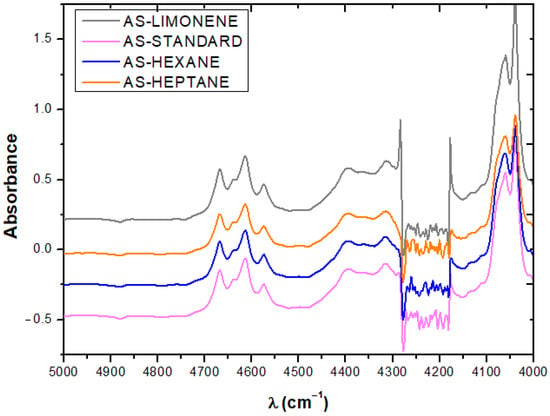
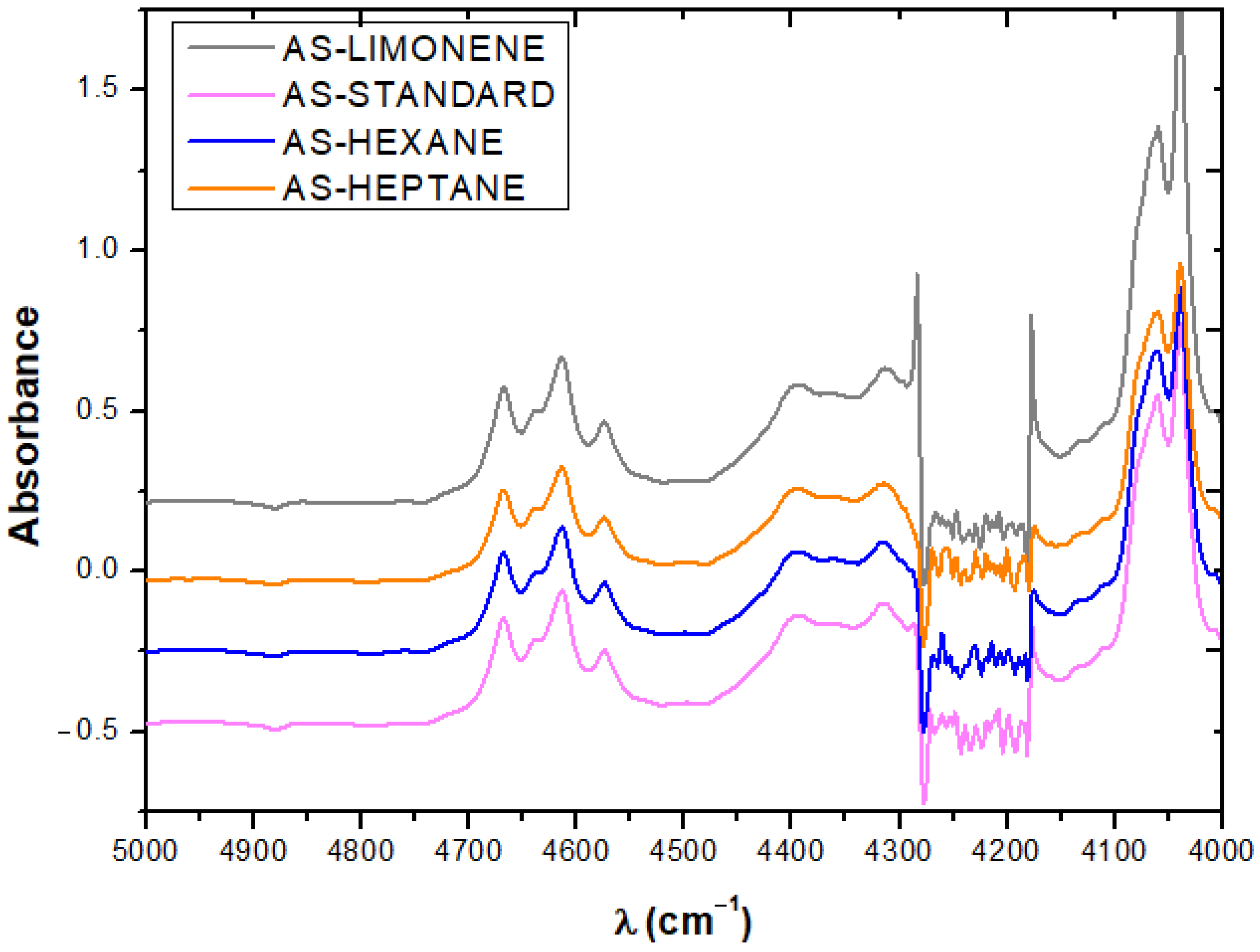
As shown in Figure 3, all four asphaltene samples exhibited similar spectral features in the near-infrared region (5000–4000 cm−1), with characteristic overtone and combination bands attributed to C–H vibrations. Notable harmonic bands were observed at 4667, 4613, and 4578 cm−1, associated with overtone vibrations of aromatic C–H stretching. The absorption band at 4283 cm−1 corresponds to a combination of C–H stretching and CH2 deformation modes, while the intense band at 4178 cm−1 is related to overlapping contributions from C–H stretching and angular deformation of aromatic C–H bonds. Additionally, a doublet at 4059 and 4040 cm−1 is attributed to second-order combination bands involving C–H bending and C–C angular deformation in aromatic structures [20].
Figure 3.
NIR spectra of asphaltenes with different methods of extraction.
The similarity in NIR spectral profiles among all samples suggests the presence of comparable functional groups, primarily associated with aromatic and aliphatic hydrocarbons. These results are consistent with previous studies on Brazilian crude oils, which reported typical hydrocarbon overtone regions in the 5000–4000 cm−1 range, corresponding to vibrational combinations involving O–H, N–H, C–C, and C–H bonds [21]. Minor differences in band intensities, particularly in the samples extracted with D-limonene, may reflect subtle variations in molecular environment, aromatic density, or degree of aggregation.
3.2.2. Thermogravimetric Analysis (TGA)
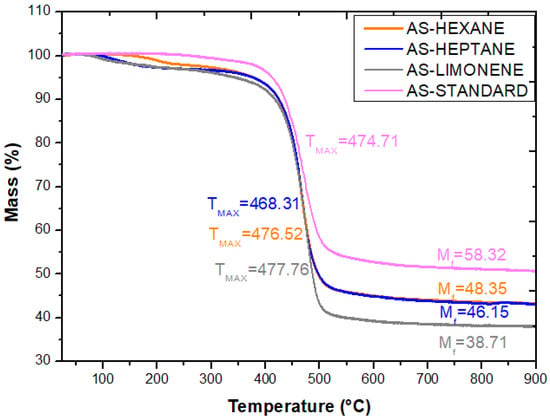
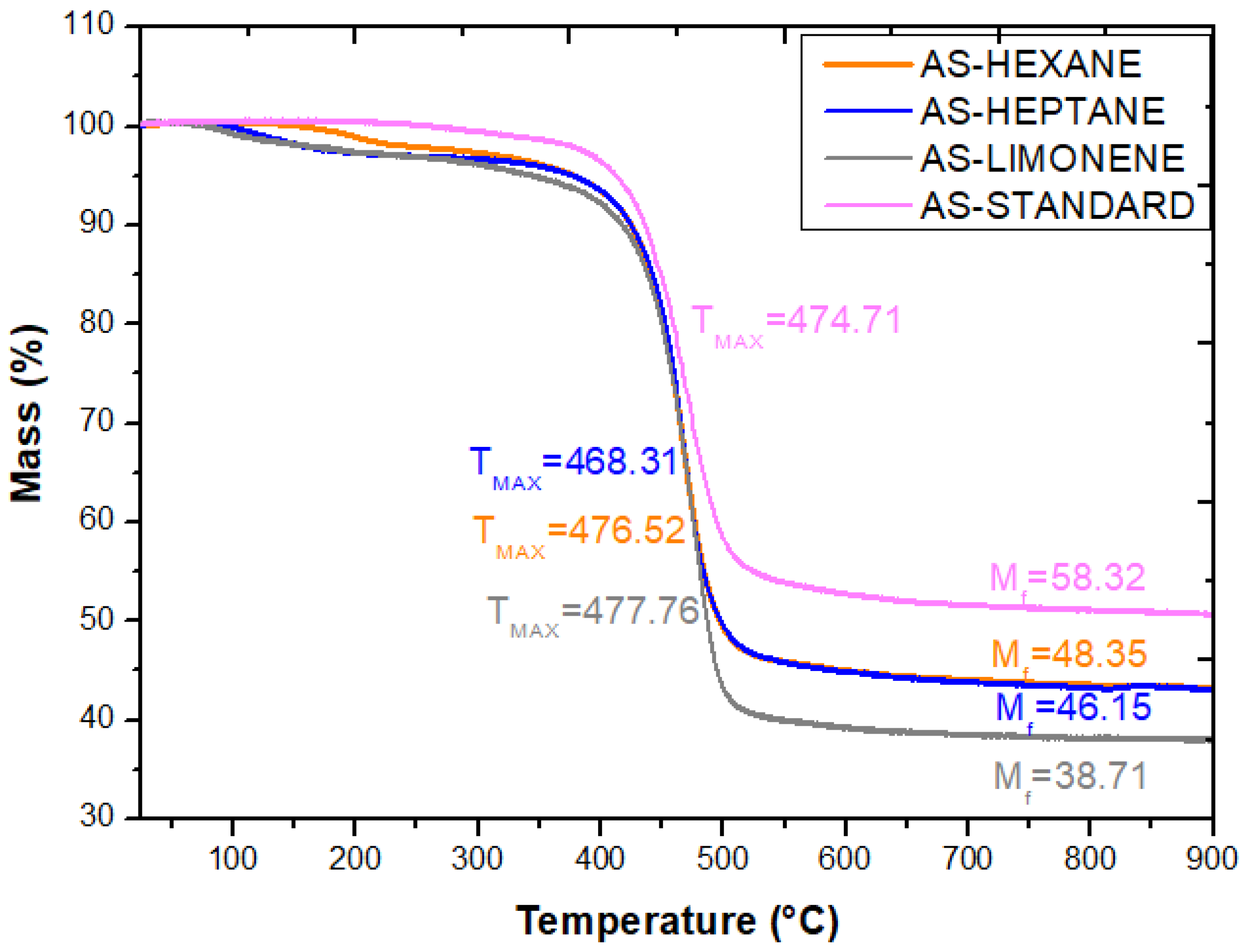
Complementing the spectroscopic results (Section 3.2.1), TGA under N2 (60 mL min−1) with a 10 °C min−1 ramp to 900 °C revealed clear solvent-dependent differences among the asphaltene fractions (Figure 4; Table 2). The D-limonene fraction exhibited the largest overall mass loss and the lowest residual mass at 900 °C (38.71%), followed by the n-heptane (46.15%) and n-hexane (48.35%) fractions; the ASTM D6560 asphaltene showed the highest residue (53.82%). The lower coke/char residue for the D-limonene extract indicates a reduced proportion of highly condensed, refractory domains, in agreement with its broader and more attenuated main decomposition event.
Figure 4.
Thermogravimetric analysis (TGA) profiles of asphaltenes obtained by cold extraction with D-limonene, n-hexane, and n-heptane, and by the ASTM D6560 method, acquired under N2 (60 mL min−1) at 10 °C min−1 up to 900 °C.
Table 2.
TGA of asphaltenes under N2 (60 mL.min−1) at 10 °C.min−1 up to 900 °C.
Region I (≈21–200 °C) accounts for modest losses attributed to desorption of light volatiles/occluded species (2.87% for AS-Limonene; 2.68% for AS-Hexane; 1.69% for AS-Heptane; 0.47% for AS-Standard). The main devolatilization (Region II) spans 253–677 °C for AS-Limonene (58.42% mass loss), broader than the ASTM fraction (361–598 °C; 45.71%). Although the DTG peak temperatures (TMAX) are comparable (468–478 °C), the maximum mass loss rate differs: DTG_max = 0.88 mg min−1 (AS-Limonene) < 0.96 mg min−1 (AS-Hexane/Heptane) < 1.17 mg min−1 (AS-Standard). A broader decomposition window combined with a lower DTG_max for AS-Limonene points to a more distributed breakdown of less cross-linked species rather than rapid scission of highly condensed clusters.
These trends are consistent with reports in the literature that locate the dominant mass loss event of asphaltenes between ~400 and 480 °C, associated with low-temperature oxidation/thermal cracking and the combustion of heavier asphaltene fractions [22,23].
3.2.3. Elemental Analysis (CHN)
To rationalize the thermal behavior, we examined elemental composition (Table 3). Using mass percentages to compute molar ratios (H/C = (H/1.008)/(C/12.011)), AS-Limonene shows H/C ≈ 1.05 (C/H ≈ 0.95), whereas AS-Hexane and AS-Heptane display H/C ≈ 1.31 and 1.27 (C/H ≈ 0.76 and 0.78), and the ASTM fraction H/C ≈ 1.16 (C/H ≈ 0.85). In general, a lower H/C is associated with a higher average aromatic character [16]. However, the reduced residue and attenuated DTG_max of AS-Limonene indicate that, despite its lower H/C, its aromatic domains are less condensed/cross-linked and carbonize less efficiently under inert conditions. Differences in heteroatom/metal content and aggregation state likely modulate coking propensity beyond what H/C alone captures. As shown below (Section 3.2.5 and Section 3.2.6), FT-ICR MS and NMR provide molecular-level evidence for smaller aromatic kernels and/or shorter side-chain distributions in the D-limonene fraction, coherently explaining its lower thermal refractoriness.
Table 3.
Elemental analysis of asphaltene samples with different methods of extraction.
3.2.4. Energy Dispersive X-Ray Spectroscopy (EDS)
The EDS survey (Table 4) qualitatively detected carbon as the major element in all samples and identified heteroatoms commonly associated with asphaltenes—oxygen and sulfur—across the four fractions [16,24]. Nitrogen was detected in three samples (AS-Heptane, AS-Limonene, AS-Standard) but was below the detection threshold in AS-Hexane, which is consistent with the low N contents measured by CHN and the known limited sensitivity of EDS to light elements. Trace signals of chlorine and silicon appeared only in the n-hexane/n-heptane extracts, whereas chromium was observed in AS-Heptane, AS-Limonene, and AS-Standard, and iron appeared in all four spectra.
Table 4.
Elements detected by EDS in asphaltene samples obtained by different extraction methods (qualitative presence/absence).
Because EDS is surface-sensitive and semi-quantitative, these minor signals (Cl, Si, Cr, Fe) should be interpreted with caution: they may originate from sample handling or mounting (e.g., adhesives, stubs, environmental particulates) rather than the organic matrix itself. The absence of Ni and V, which are heteroatoms often reported in crude oils, likely reflects concentrations below EDS detection and/or matrix effects [16,24]. Altogether, the EDS profiles corroborate the overall similarity in heteroatom families among the four asphaltenes while indicating subtle differences that are better resolved by bulk CHN and molecular-level MS/NMR analyses.
3.2.5. Laser Desorption/Ionization FT-ICR Mass Spectrometry (LDI FT-ICR MS)
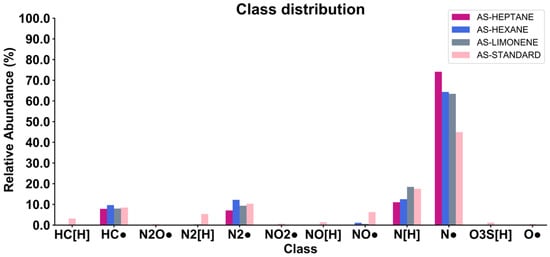
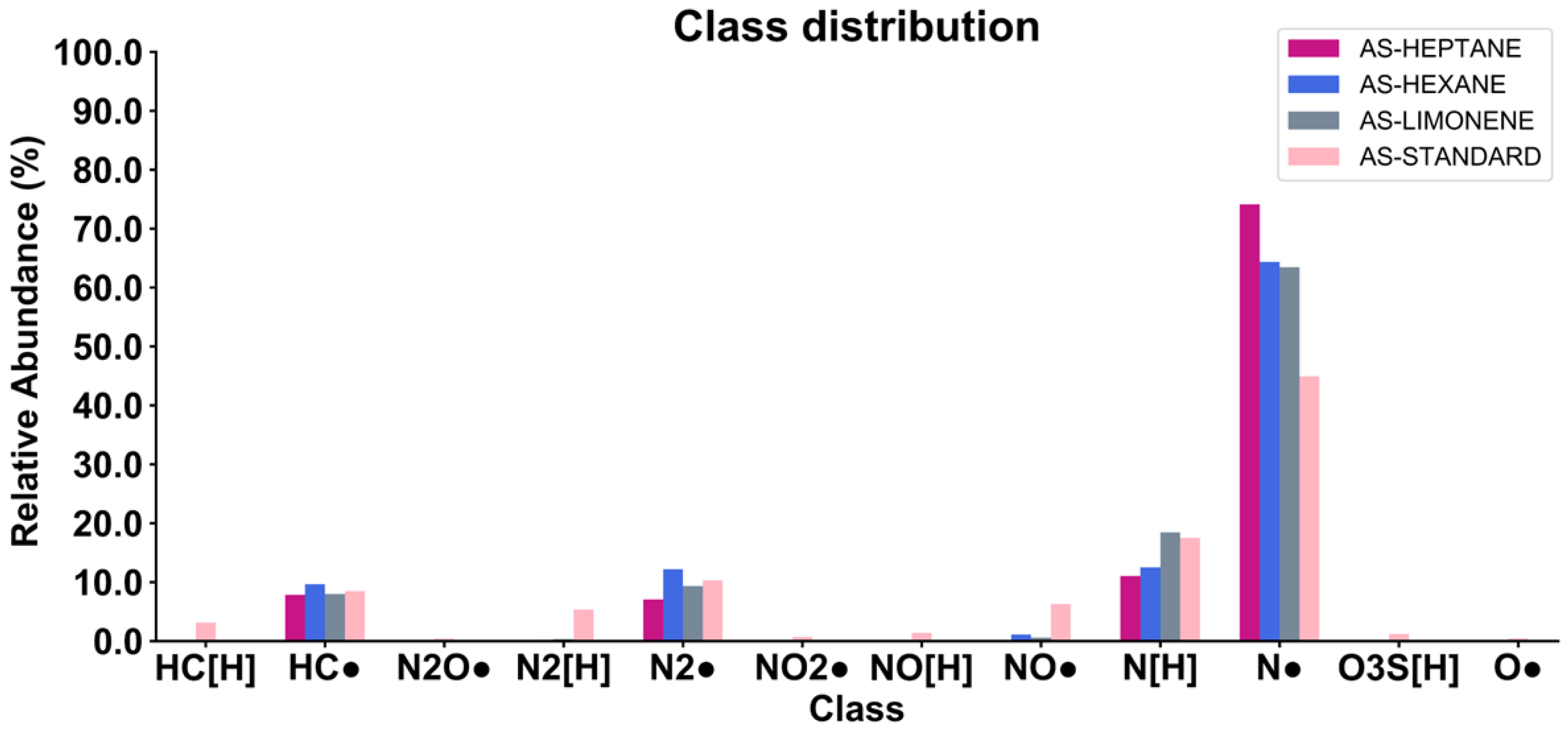
Asphaltenes are widely described as polyaromatic cores connected to naphthenic rings and aliphatic side chains, bearing diverse functional groups (carboxylic acids, amides/amines, alcohols) and heteroatoms (O, N, S, trace metals) [16]. In our LDI(+) FT-ICR MS data (Figure 5), all samples show higher relative abundances of nitrogen-containing classes (e.g., N1, N2) relative to purely hydrocarbon (HC) classes, with lower contributions from aliphatic HC. This trend is consistent with the expectation that more aromatic species (often containing pyridinic/pyrrolic N) ionize efficiently in positive mode and that higher aromatic content correlates with a reduced fraction of aliphatic HC classes [25,26].
Figure 5.
Class distribution from LDI(+) FT-ICR MS of asphaltenes obtained by cold extraction with D-limonene, n-hexane, and n-heptane, and by ASTM D6560. The symbol “●” demotes radical cations (M●+), and [H] indicates protonated species ((M+H)+).
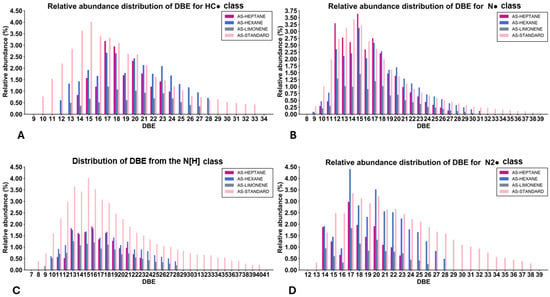
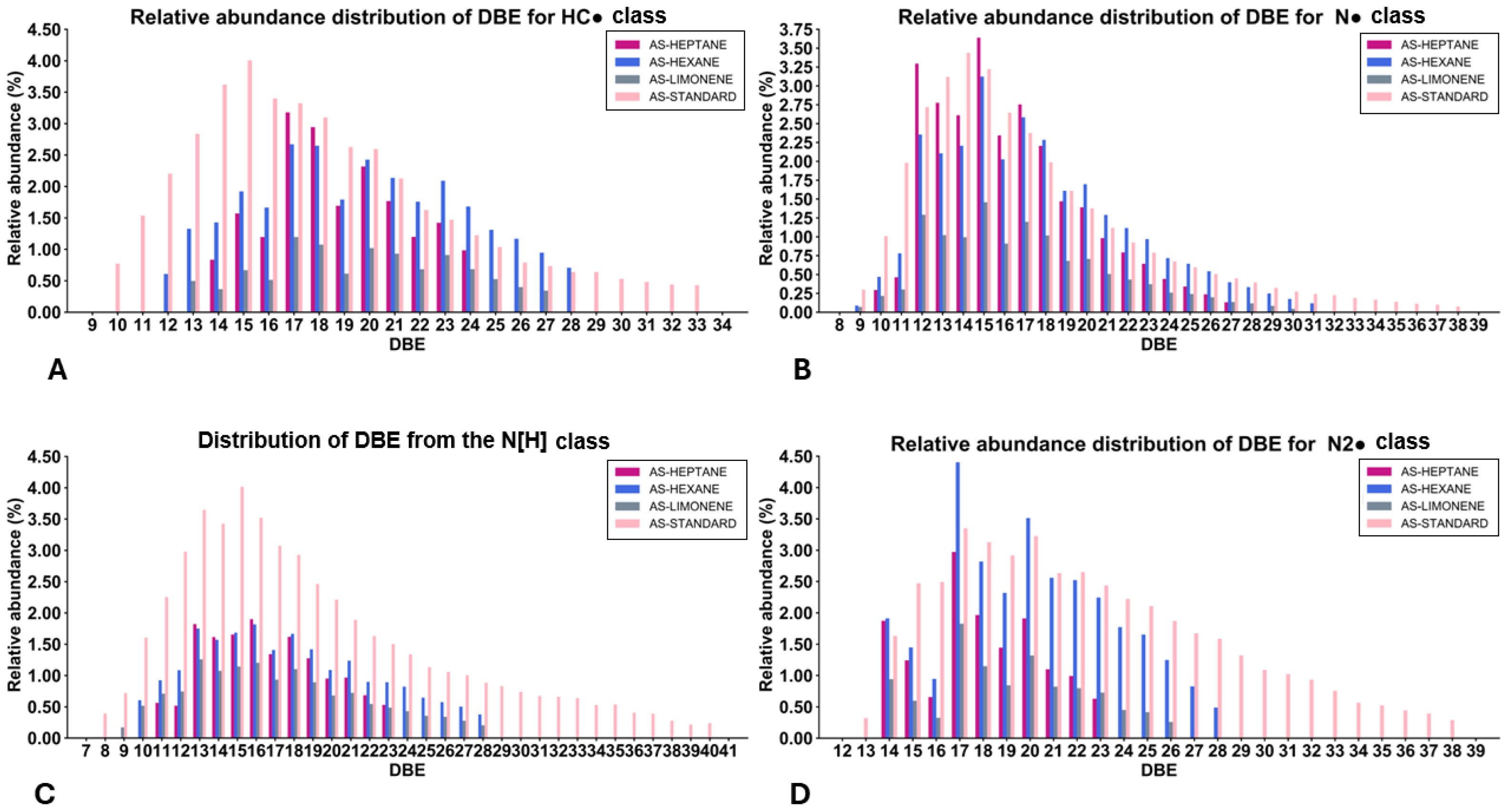
The double bond equivalent (DBE) distributions further differentiate the extraction routes. For both HC (Figure 6A) and nitrogen classes (Figure 6B–D for N1, protonated N1H+, and N2), the ASTM D6560 asphaltene exhibits a broader DBE envelope (≈9–40), consistent with the presence of more condensed/aromatic subpopulations and a wider range of side-chain substitution. In contrast, the cold-extracted fractions (n-hexane, n-heptane, D-limonene) show narrower DBE windows (≈9–31), indicating enrichment in less condensed aromatic frameworks. Notably, the fraction extracted with n-heptane at low temperature differs from that obtained by the ASTM method, which can be attributed to the markedly different thermal conditions employed in each procedure, as higher extraction temperatures favor the solubilization of more condensed and highly aromatic species. Among the cold extracts, the D-limonene fraction most consistently tracks lower coking propensity in TGA, coherently supporting enrichment in smaller/less cross-linked aromatic domains.
Figure 6.
DBE distributions by class for asphaltenes: (A) HC; (B) N1; (C) N1H+; (D) N2. The symbol “●” demotes radical cations (M●+).
The LDI(+) method preferentially ionizes aromatic species and those containing heteroatoms, which tends to underrepresent possible aliphatic and weakly aromatic components. Nevertheless, DBE distributions are presented as a direct indication of structural reality [14]. Therefore, the possibility of method-induced selectivity must be considered, and the corresponding limitations must be acknowledged.
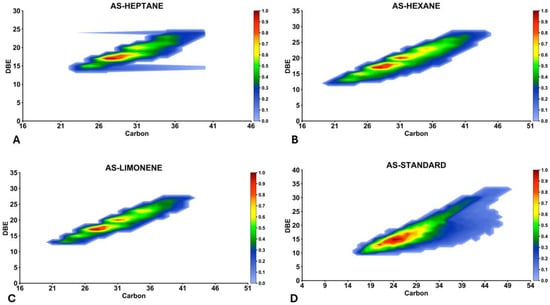
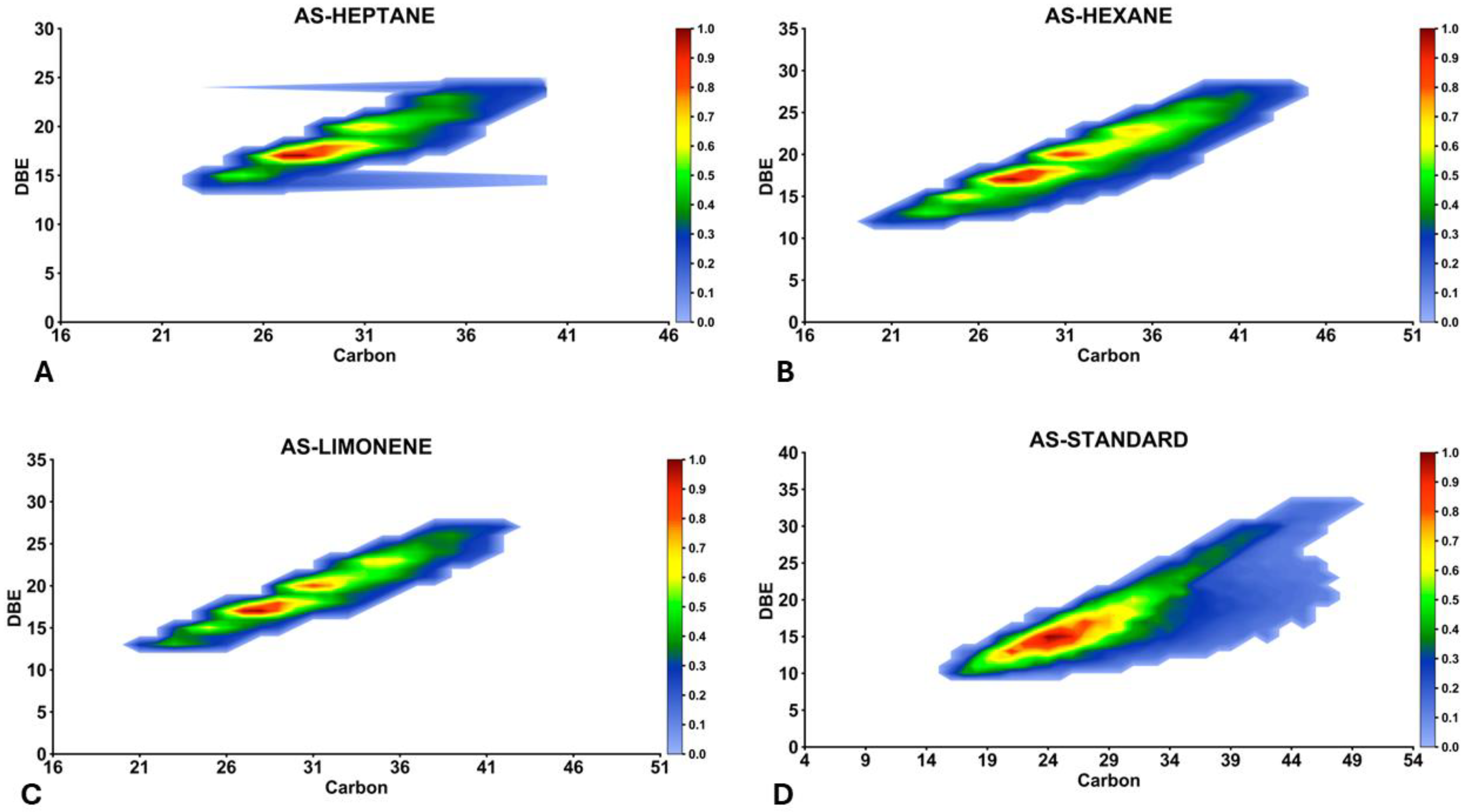
A mechanistic rationale emerges from solvent quality and contact conditions. The ASTM protocol involves heated dissolution in toluene followed by prolonged heptane precipitation, which can promote aggregation and co-precipitation of highly condensed species; this is compatible with the broader, higher-DBE tails seen for the ASTM fraction. Conversely, cold extraction at room temperature offers milder kinetics and weaker aggregation, favoring the precipitation of smaller, less aromatic subpopulations while leaving more extensively condensed clusters in solution. Within the cold extraction set, D-limonene—an aromatic terpene with π-systems and solubility parameters distinct from linear alkanes—likely stabilizes multi-aromatic aggregates more effectively via π–π and dispersion interactions, thereby preventing their precipitation. Reports of solubilization of heavy oils with D-limonene are consistent with this selectivity [27]. This interpretation is also in agreement with prior observations that stronger solvent–asphaltene interactions may precipitate larger/aromatic species earlier [26]: in our case, the combination of (i) cold, static conditions and (ii) a π-rich but relatively “good” solvent (D-limonene) appears to retain the most condensed multi-ring aggregates in solution, thus enriching the precipitate in lower-DBE species (Figure 7A–D). Together with FTIR/NIR (aromatic C–H signatures) and TGA (lower residue and attenuated DTG_max for D-limonene), the LDI(+) FT-ICR MS data support the conclusion that D-limonene selects less refractory, less cross-linked aromatic domains compared to ASTM D6560.
Figure 7.
DBE x carbon number plots for the HC class: (A) AS-Heptane; (B) AS-Hexane; (C) AS-Limonene; (D) AS-Standard.
3.2.6. Nuclear Magnetic Resonance (NMR)
The molar percentages derived from the integrated 1H and 13C NMR spectra are summarized in Table 5. Integrations followed the aromatic/aliphatic windows and assignments described in Chinelatto Júnior et al. [22].
Table 5.
1H/13C NMR-derived molar percentages for asphaltenes obtained by cold extraction with D-limonene, n-hexane, and n-heptane, and by ASTM D6560.
From 1H NMR, the fraction of aromatic hydrogens in di/polyaromatic environments (Hdar) is lowest for AS-Limonene (7.2%), compared with AS-Heptane (7.6%), AS-Hexane (8.6%) and the ASTM fraction (8.9%). The Hdar/Hmar ratio—often used as a qualitative indicator of polycondensed vs. monoaromatic character—equals 2.0 (AS-Limonene), 3.17 (AS-Heptane), 2.61 (AS-Hexane) and 1.82 (ASTM), i.e., >1 in all cases (as expected for asphaltenes), with the cold-extracted fractions enriched in di/polyaromatic relative to monoaromatic hydrogens compared with ASTM. The total aliphatic hydrogen fraction (Hsat) remains high for all samples (86–90%), with AS-Heptane showing the largest Hsat (90.0%) and AS-Limonene close behind (89.2%).
From 13C NMR, the total aromatic carbon fraction (Car tot) is lowest for AS-Limonene (40.5%), and higher for AS-Hexane (46.4%) and AS-Heptane (48.0%); ASTM sits in between (42.3%). Within aromatic carbons, bridged/head positions (Car-b) and peripheral carbons (Car-j) in AS-Limonene (14.5% and 22.2%) are lower than the n-alkane extracts (Hexane: 16.6%/24.6%; Heptane: 16.0%/26.4%), indicating relatively smaller/less cross-linked aromatic kernels among the cold-extracted fractions when D-limonene is used. (Note: the ASTM fraction shows slightly lower Car-b and Car-j than AS-Limonene—13.5% and 20.9%—but a higher fraction of protonated aromatic carbons (Car H = 13.8%), reflecting a different aromatic substitution pattern under the hot toluene → heptane ASTM workflow).
On the aliphatic side, Csat is highest for AS-Limonene (59.5%), consistent with its lower Car tot, and Hβ (paraffinic/naphthenic hydrogens β to aromatic rings, including CH2 in longer chains) is also largest for AS-Limonene (55.5%) among the cold extracts, while Hγ (terminal/isolated CH3) is slightly lower (16.6% vs. ~19–20%). Together, these trends suggest longer/less branched aliphatic segments tethered to smaller aromatic cores in the D-limonene precipitate—coherent with the lower coke residue and attenuated DTG_max observed in TGA and the lower-DBE envelopes in LDI(+) FT-ICR MS.
In summary, NMR corroborates the idea that D-limonene selectively precipitates asphaltene subpopulations with lower aromatic carbon fraction and smaller/less cross-linked aromatic motifs, enriched in β-methylene environments—consistent with a reduced thermal refractoriness (TGA) and lower DBE (FT-ICR MS). These findings align with solvent selectivity arguments grounded in solubility parameter and π–π interaction considerations [16,25,26], and with reports of D-limonene acting as an effective solvent for heavy oils in enhanced oil recovery contexts [27].
4. Conclusions
Cold precipitation with D-limonene (a renewable, low-toxicity solvent) produced an asphaltene fraction with lower yield (1.4% w/w) but reduced thermal refractoriness relative to n-alkanes and ASTM D6560, as shown by the lowest TGA residue at 900 °C, a broader main decomposition window, and a lower maximum mass loss rate (DTG_max). Molecular data are consistent with this selectivity: LDI(+) FT-ICR MS indicates a narrower DBE envelope (≈9–31) for cold-extracted samples compared with ASTM (≈9–40), and 1H/13C NMR shows lower aromatic carbon indices (lower Car_tot, Car-b, Car-j) and relatively higher aliphatic environments (e.g., Hβ) in the D-limonene precipitate. While CHN yields a lower H/C for the D-limonene fraction, the combined thermal and spectroscopic evidence indicates that condensation/cross-linking and aggregation state, rather than H/C alone, govern coking propensity under inert conditions. EDS qualitatively confirms O/S/N heteroatoms across all fractions, in line with the FT-ICR/NMR inferences.
Overall, the results establish D-limonene as a selective green precipitant that, under cold/static conditions, likely retains highly condensed multi-ring aggregates in solution via π–π/dispersion interactions and precipitates less cross-linked, less refractory subpopulations. Beyond replacing petroleum-based precipitants, this greener route offers (i) an analytical benefit—cleaner fractionation that facilitates structural elucidation of targeted asphaltene subpopulations—and (ii) a processing benefit—a more sustainable basis for pretreatments of heavy fractions.
Finally, we consider the practical implications of asphaltene architecture. If a crude oil system is island-dominated (larger single PAH kernels), π-rich D-limonene at room temperature may preferentially keep the most condensed aggregates in solution, yielding lower-DBE, less refractory precipitates—useful when the goal is a safer analytical fractionation or a pretreatment that minimizes coking propensity. For archipelago-leaning systems (several smaller aromatic kernels linked by aliphatic bridges), n-alkanes or ASTM-like workflows may co-precipitate more condensed material, which can be advantageous when the goal is maximum removal of highly aromatic/refractory species. These guidelines are consistent with our dataset but should be validated across crude types; mapping solvent choice to crude descriptors is a natural next step alongside assessing solvent recyclability.
Author Contributions
R.d.M.F.: Conceptualization, Investigation, Data curation, Validation, Methodology, Formal analysis, Writing—original draft, Visualization, Writing—review and editing. T.F.F.: Supervision, Writing—review and editing. L.S.C.J.: Investigation, Methodology. M.O.Q.d.A.: Investigation, Data curation, Validation, Methodology. E.C.A.N.C.: Investigation, Validation, Methodology, Formal analysis. B.D.R.: Resources, Conceptualization. M.A.Z.C.: Project Administration, Resources, Supervision, Funding Acquisition. All authors have read and agreed to the published version of the manuscript.
Funding
This research was funded by Fundação Carlos Chagas Filho de Amparo à Pesquisa do Estado do Rio de Janeiro (FAPERJ—grant number E-26/210.448/2021 (M.A.Z.C.) and grant number E-26/201.419/2022 (T.F.F.)).
Data Availability Statement
The data generated during the current study are available from the corresponding author upon request.
Acknowledgments
We acknowledge the Laboratory of Macromolecules and Colloids in the Petroleum Industry (LMCP) for the elemental analysis of asphaltenes. MAZC thanks CNPq and FAPERJ for research fellows.
Conflicts of Interest
The authors declare no conflicts of interest.
Abbreviations
The following abbreviations are used in this manuscript:
| ASTM | American Society for Testing and Materials |
| ASTM D6560 | Standard Test Method for Determination of Asphaltenes (Heptane Insolubles) in Crude Petroleum and Petroleum Products |
| ATR-FTIR | Attenuated Total Reflectance Fourier-Transform Infrared Spectroscopy |
| NIR | Near-Infrared Spectroscopy |
| TGA | Thermogravimetric Analysis |
| CHN | Carbon, Hydrogen, and Nitrogen Elemental Analysis |
| EDS | Energy-Dispersive X-ray Spectroscopy |
| LDI(+) | Positive-Ion Mode Laser Desorption/Ionization |
| FT-ICR MS | Fourier-Transform Ion Cyclotron Resonance Mass Spectrometry |
| 1H NMR | Proton Nuclear Magnetic Resonance Spectroscopy |
| 13C NMR | Carbon-13 Nuclear Magnetic Resonance Spectroscopy |
| DBE | Double Bond Equivalent |
References
- Yuan, Y.; Liu, S.; Yuan, S. Novel Insights into the Effects of Asphaltenes on Oil Phase Properties: Crude Oil, Oil-Water Interface, and Graphene Oxide Synergistic Demulsification. J. Mol. Liq. 2023, 391, 123405. [Google Scholar] [CrossRef] [Scilit]
- Wu, J.-X.; Li, S.-F.; Li, Q.-F.; Yan, F.; Zhou, Q.-L.; Ma, S.; Zhang, Y.-H.; Zhao, S.-Q.; Shi, Q. Characterization of Chemical Composition of High Viscosity Heavy Oils: Macroscopic Properties, and Semi-Quantitative Analysis of Molecular Composition Using High-Resolution Mass Spectrometry. Pet. Sci. 2024, 21, 3612–3620. [Google Scholar] [CrossRef] [Scilit]
- Kernaghan, S.; Coady, T.; Kinsella, M.; Lennon, C.M. A Tutorial Review for Research Laboratories to Support the Vital Path toward Inherently Sustainable and Green Synthetic Chemistry. RSC Sustain. 2024, 2, 578–607. [Google Scholar] [CrossRef] [Scilit]
- Zhu, B.; Yang, M.; Yan, Y.; Zhong, J.; Li, J.; Li, Z.; Zhang, J. Insights into the Effect of Water Content on Asphaltene Aggregation Behavior and Crude Oil Rheology: A Molecular Dynamics Simulation Study. J. Mol. Liq. 2024, 396, 124042. [Google Scholar] [CrossRef] [Scilit]
- Bhui, U.K. Hydrocarbon Cycle for Sustainable Future: Clean Energy and Green Environment of the Earth. In Macromolecular Characterization of Hydrocarbons for Sustainable Future: Applications to Hydrocarbon Value Chain; Bhui, U.K., Ed.; Springer: Singapore, 2021; pp. 3–18. ISBN 978-981-336-133-1. [Google Scholar]
- Venkataraman, S.; Rajendran, D.S.; Kumar, P.S.; Rangasamy, G.; Vaidyanathan, V.K. A Comprehensive Review on the Refinery of Citrus Peel Towards the Production of Bioenergy, Biochemical and Biobased Value-Added Products: Present Insights and Futuristic Challenges. Waste Biomass Valorization 2024, 15, 6491–6512. [Google Scholar] [CrossRef] [Scilit]
- Ovalles, C.; Rogel, E.; Moir, M.E.; Morazan, H. Effect of Temperature on the Analysis of Asphaltenes by the On-Column Filtration/Redissolution Method. Fuel 2015, 146, 20–27. [Google Scholar] [CrossRef] [Scilit]
- Leong, E.J.; Tan, L.F.; Yap, V.L.; Rajagopal, M.; Chandran, R. Cosmetological Applications of Citrus Limon: A Mini-Review. Indian J. Nat. Prod. Resour. IJNPR Former. Nat. Prod. Radiance NPR 2024, 15, 286–293. [Google Scholar] [CrossRef] [Scilit]
- Morris, M.; Wolf, K. Alternatives to VOC and Toxic Solvents in Batch Loaded Cold Cleaning. Environ. Qual. Manag. 2002, 12, 19–34. [Google Scholar] [CrossRef] [Scilit]
- Sun, J. D-Limonene: Safety and Clinical Applications. Altern. Med. Rev. 2007, 12, 259. [Google Scholar]
- Alimohammadi, S.; Zendehboudi, S.; James, L. A Comprehensive Review of Asphaltene Deposition in Petroleum Reservoirs: Theory, Challenges, and Tips. Fuel 2019, 252, 753–791. [Google Scholar] [CrossRef] [Scilit]
- Grand View Research Limonene Market Size, Share and Growth Report, 2030. Available online: https://www.grandviewresearch.com/industry-analysis/limonene-market-report (accessed on 13 February 2026).
- D’Orazio, G.; Ragone, R.; Rizzuti, A.; Abatematteo, F.S.; Ciampa, A.; Ghisa, G.; Casini, M.; Latronico, M.; Gallo, V.; Mastrorilli, P.; et al. Dl-Limonene as an Alternative Sustainable Solvent to Xylenes for the Industrial Preparation of Release Formulations. ChemistryOpen 2025, 14, e202400259. [Google Scholar] [CrossRef] [Scilit]
- Ferreira, R.D.M.; De Almeida, M.O.Q.; Nunes Chrisman, E.C.A.; Ribeiro, B.D.; Coelho, M.A.Z. Cold Extraction of Post-Salt Oil Asphaltenes and Their Solubilization in Deep Eutectic Solvents. Chem. Eng. Res. Des. 2023, 198, 349–356. [Google Scholar] [CrossRef] [Scilit]
- Islam, R.; Khan, M.M.; Chhetri, A.B. (Eds.) Green Petroleum: How Oil and Gas Can Be Environmentally Sustainable, 1st ed.; Wiley: Hoboken, NJ, USA, 2012; ISBN 978-1-118-07216-5. [Google Scholar]
- Mullins, O.C. (Ed.) Asphaltenes, Heavy Oils, and Petroleomics; Springer: New York, NY, USA, 2007; ISBN 978-0-387-31734-2. [Google Scholar]
- Lin, F. Efficient Recovery of Extra-Heavy Oil Using a Naturally Abundant Green Solvent: Toward a More Sustainable Oil-Solid-Water Separation. Sustain. Mater. Technol. 2020, 25, e00185. [Google Scholar] [CrossRef] [Scilit]
- Deng, M.; Cao, X.; Yuan, Y.; Yang, X.; Tang, B.; Li, X. Response of Oxidized Asphaltene Aggregations in Presence of Rejuvenators and Characteristics of Molecular Assembly Behavior. Constr. Build. Mater. 2023, 397, 132468. [Google Scholar] [CrossRef] [Scilit]
- Asemani, M.; Rabbani, A.R.; Sarafdokht, H. Evaluation of Oil Fingerprints Similarity by a Novel Technique Based on FTIR Spectroscopy of Asphaltenes: Modified Moving Window Correlation Coefficient Technique. Mar. Pet. Geol. 2020, 120, 104542. [Google Scholar] [CrossRef] [Scilit]
- Zuo, P.; Qu, S.; Shen, W. Asphaltenes: Separations, Structural Analysis and Applications. J. Energy Chem. 2019, 34, 186–207. [Google Scholar] [CrossRef] [Scilit]
- Santos, F.D.; Vianna, S.G.T.; Cunha, P.H.P.; Folli, G.S.; de Paulo, E.H.; Moro, M.K.; Romão, W.; de Oliveira, E.C.; Filgueiras, P.R. Characterization of Crude Oils with a Portable NIR Spectrometer. Microchem. J. 2022, 181, 107696. [Google Scholar] [CrossRef] [Scilit]
- Chinelatto Júnior, L.S.; Cabral De Menezes, S.M.; Honorato, H.D.A.; De Oliveira, M.C.K.; Marques, L.C.D.C. Diffusion-Ordered Spectroscopy Nuclear Magnetic Resonance as an Alternative Technique to Improve Asphaltene Characterization. Energy Fuels 2018, 32, 2793–2800. [Google Scholar] [CrossRef] [Scilit]
- Najjar, P.A.M.Z.; Mohammadi, S.; Mirzayi, B.; Mahmoudi Alemi, F.; Ghanbarpour, O. A Mechanistic Study of Asphaltene Formation and Aggregation in Presence of Metallic-Based Nanoparticles. Geoenergy Sci. Eng. 2024, 234, 212637. [Google Scholar] [CrossRef] [Scilit]
- Alves, C.A.; Romero Yanes, J.F.; Feitosa, F.X.; de Sant’Ana, H.B. Influence of Asphaltenes and Resins on Water/Model Oil Interfacial Tension and Emulsion Behavior: Comparison of Extracted Fractions from Crude Oils with Different Asphaltene Stability. J. Pet. Sci. Eng. 2022, 208, 109268. [Google Scholar] [CrossRef] [Scilit]
- Melenevskii, V.; Kontorovich, A.; Kashirtsev, V.; Kim, N. Biomarkers in the Pyrolysis Products of Asphaltenes from Ancient Crude Oils of East Siberia as Indicators of Source Rock Depositional Environment. Pet. Chem. 2009, 49, 274–281. [Google Scholar] [CrossRef] [Scilit]
- Witt, M.; Godejohann, M.; Oltmanns, S.; Moir, M.; Rogel, E. Characterization of Asphaltenes Precipitated at Different Solvent Power Conditions Using Atmospheric Pressure Photoionization (APPI) and Laser Desorption Ionization (LDI) Coupled to Fourier Transform Ion Cyclotron Resonance Mass Spectrometry (FT-ICR MS). Energy Fuels 2018, 32, 2653–2660. [Google Scholar] [CrossRef] [Scilit]
- Mathews, T.A.; Azzu, P.; Hascakir, B. Unlocking Sustainable Solutions: Exploring Terpene-Based Green Solvents for Enhanced Heavy Oil Recovery. Energy Fuels 2024, 38, 23336–23347. [Google Scholar] [CrossRef] [Scilit]

Disclaimer/Publisher’s Note: The statements, opinions and data contained in all publications are solely those of the individual author(s) and contributor(s) and not of MDPI and/or the editor(s). MDPI and/or the editor(s) disclaim responsibility for any injury to people or property resulting from any ideas, methods, instructions or products referred to in the content. |
© 2026 by the authors. Licensee MDPI, Basel, Switzerland. This article is an open access article distributed under the terms and conditions of the Creative Commons Attribution (CC BY) license.