


Abstract
To address the lack of quantitative cross-industry comparisons in safety risk management and control in power engineering construction, this study develops a cross-industry safety feature-analysis framework that integrates the DeepSeek large language model (LLM) with Python-based automated text mining. The framework is applied to 36 real-world safety cases from 18 enterprises across four major power engineering sectors (hydropower, thermal power, renewable energy, and power transmission and transformation). It uses Python to automatically traverse directories and extract text from paragraphs and tables in documents. A domain-specific lexicon is constructed using prompt engineering with the DeepSeek LLM to generate candidate professional terms. These candidate terms are subsequently verified against the original texts and manually screened before being incorporated into the final lexicon. The validated lexicon is then dynamically loaded into the Jieba tokenizer to improve the recognition of long specialized terms, thereby generating matrix-based word frequency statistics. Both raw and case-normalized word frequencies (CNWF) are calculated to support cross-sector comparison. The results reveal a common characteristic across the examined cases: “dual prevention” institutional support combined with technology-enabled safety management, including grid-based management and video surveillance. However, distinct emphases are observed across subsectors: hydropower cases show greater emphasis on microseismic monitoring and digital twins to mitigate geological risks; thermal power prioritizes institutional checklists and pre-shift safety briefings; renewable energy cases focus on meteorological warnings and remote video surveillance; and the transmission and transformation sector emphasize high-risk construction procedures and comprehensive supervision documentation. These findings indicate that safety management characteristics vary across engineering scenarios and highlight the value of differentiated and scenario-specific safety strategies. Given the relatively small and unevenly distributed sample, the findings should be interpreted as exploratory rather than as statistically representative of the entire power engineering construction industry.
1. Introduction
Power engineering construction, a core component of the national energy infrastructure, involves multiple sectors such as hydropower, thermal power, renewable energy (primarily wind and photovoltaic power), and power transmission and transformation. These projects are characterized by complex construction environments, high technical difficulty, multiple participating organizations, and diverse safety risk sources. In recent years, with the deepening implementation of the “dual carbon” strategy and the accelerated development of new-type power systems, the scale of power engineering construction has continued to expand, accompanied by an increasing proportion of projects in special scenarios such as high altitudes, deep underground, and marine environments. Safety risk management and control therefore remain critical concerns throughout project execution.
Existing research on power engineering safety management has primarily focused on risk identification, risk assessment, and risk control. For risk identification, widely used methods include fault tree analysis (FTA) [1], failure mode and effects analysis (FMEA) [2], and the safety checklist method [3] to systematically identify potential risk factors during the power engineering construction process. Zhu et al. [4] analyzed 59 power engineering accident cases and identified 66 accident causes, which were classified into 14 categories. Ting et al. [5] analyzed risk data from completed power transmission projects and identified 79 significant risks across 11 categories.
For risk assessment, methods such as the analytic hierarchy process (AHP) [6], fuzzy comprehensive evaluation [7], and Monte Carlo simulation [8] have been widely applied in the quantitative evaluation of risk levels. These approaches provide structured tools for evaluating risk levels, but they generally require predefined assessment indicators, expert judgment, or structured historical data [9,10]. Such requirements may limit their applicability when the available safety information is primarily recorded in heterogeneous textual case documents.
At the level of risk control, the Chinese power industry has vigorously promoted the “dual prevention” mechanism, encompassing risk grading control and hazard inspection and management [11], with the aim of strengthening proactive risk prevention and control. Regulatory authorities, such as the National Energy Administration, have continuously strengthened the supervision and inspection of safety in power engineering construction, establishing a relatively comprehensive regulatory and standard system. However, research by Zhu et al. [4] indicated that, despite the increasingly refined institutional framework, insufficient implementation of risk grading and stratification, along with inadequate depth of hazard inspection, remain the primary shortcomings in current safety management of power engineering construction.
With the rapid development of big data, artificial intelligence (AI), and natural language processing technologies, data-driven approaches have increasingly been applied to safety management [12,13,14]. Existing studies have demonstrated their potential in risk identification, safety monitoring, prediction, and decision support [15,16,17]. However, these studies have mainly focused on structured or continuously generated data, such as sensor measurements, monitoring information, and video data. In contrast, engineering projects also generate large amounts of unstructured textual information, including accident reports, inspection records, construction logs, safety cases, and corrective-action records.
These texts contain abundant risk knowledge and safety control experience. Text mining techniques provide an effective tool for extracting patterns and identifying rules from such data. Based on massive daily inspection data, the BERT-Att-BiLSTM-CRF model was proposed, achieving precise extraction of construction safety hazards in large-scale hydropower projects (F1 > 95%), and a multi-dimensional knowledge graph was constructed, encompassing 9 entity types and 8 relationship types [18]. In terms of risk coupling and evolution analysis, some studies have utilized the BERT-GPLinker model to extract risk factors and their relationships from accident description texts of mega hydropower projects, constructed a knowledge graph, and proposed a coupling evolution path reasoning method [19].
In the field of power engineering, text mining techniques have been increasingly applied to safety-related analysis [20]. Other scholars have further revealed the coupling evolution process of construction risks in mega hydropower projects through textual semantic analysis. In terms of causal intelligent identification and reasoning for power engineering accident texts, researchers have proposed deep learning-based entity recognition models to identify root and direct cause factors in power accident texts [21]. Nevertheless, existing text-mining research in power engineering has predominantly focused on individual power engineering sectors, particularly hydropower, or on specific types of safety risks. Comparative analysis across multiple power engineering sectors based on a common set of textual safety cases remains relatively limited.
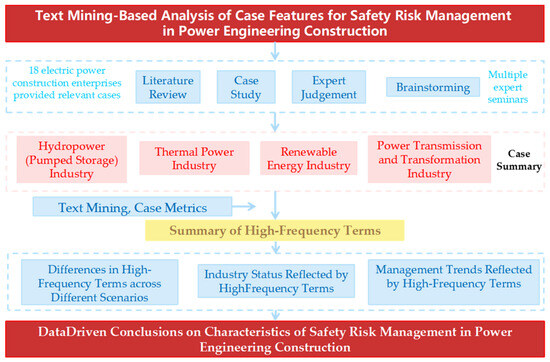
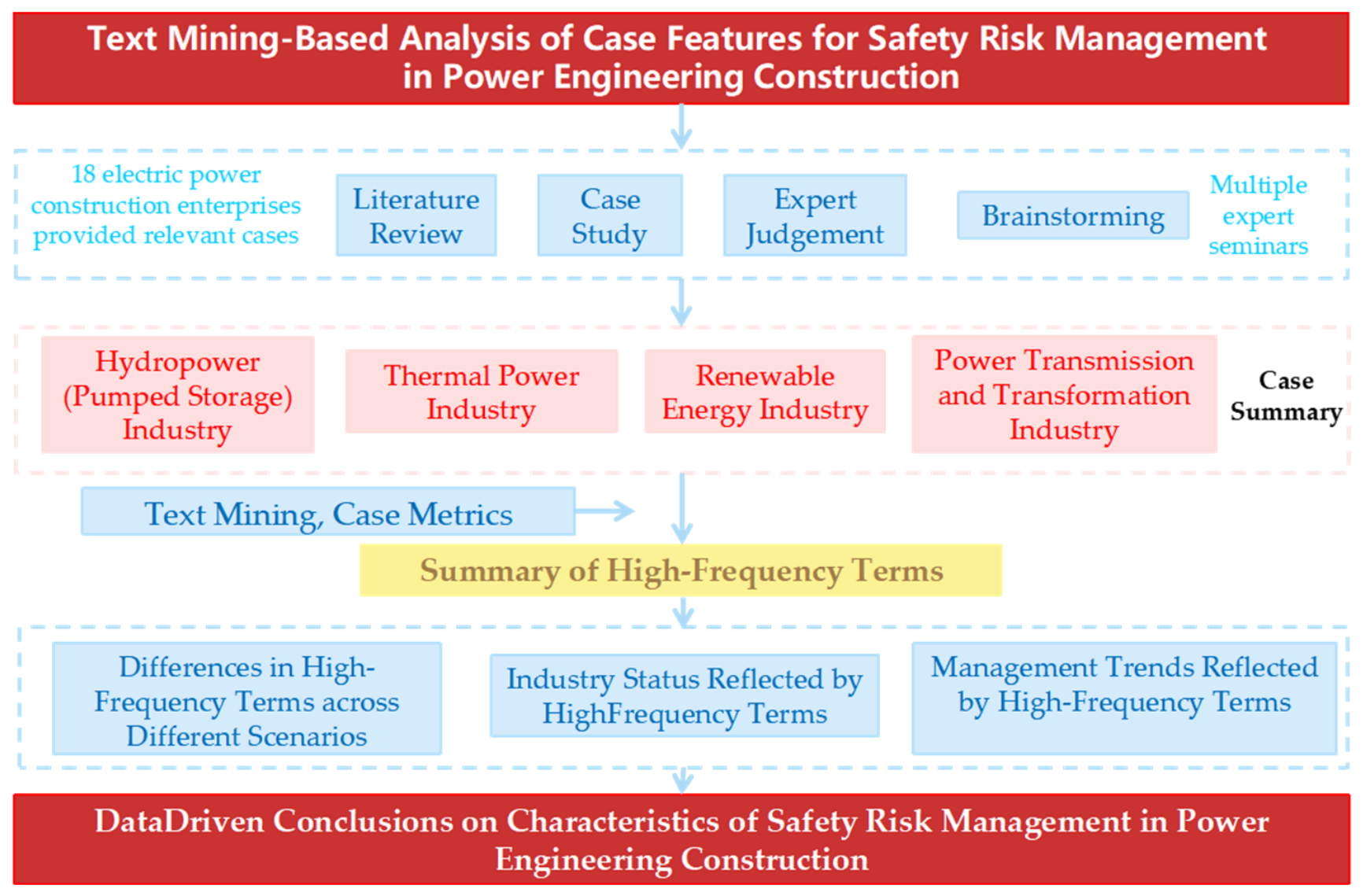
In summary, existing studies have increasingly applied text mining and other data-driven methods to extracting safety-related information in engineering, providing new approaches for identifying risk factors and safety-management characteristics from unstructured textual data. However, several limitations remain. First, existing studies have predominantly focused on individual power engineering sectors or specific risk categories, with limited cross-sector comparison among power engineering domains. Second, differences in domain-specific terminology and expressions may affect the consistency of text feature extraction across sectors. Third, systematic extraction and quantitative cross-sector comparison of high-frequency safety management and control elements in safety cases remain limited; moreover, differences in the number of cases across sectors may affect direct word-frequency comparisons. To address these gaps, this study, as illustrated in Figure 1, analyzes 36 safety management cases from power engineering projects. A domain-specific lexicon is constructed with the assistance of DeepSeek and subsequently validated manually for text mining. Both raw and normalized word frequencies are employed to comparatively analyze the characteristics of safety risk management and control reflected in cases from four sectors: hydropower, thermal power, renewable energy, and power transmission and transformation.
Figure 1.
Research flowchart.
2. Data Source and Research Methodology
2.1. Data Source
The case data utilized in this study are obtained from 18 representative power engineering construction enterprises in China. To ensure the authenticity and authoritativeness of the cases, as well as the reliability of the research data, all original cases are authentic records of safety risk management and control events that occurred during the actual construction processes of these enterprises. These cases are initially compiled, reviewed, and confirmed by internal experts and project management teams within the enterprises. The complete collection of the 36 cases used in this study is provided inSupplementary Material S1.
To ensure the objectivity and specificity of the subsequent sector-level feature analysis, the cases were systematically classified according to the four major sectors of power engineering construction. The specific distribution is as follows: 18 cases from hydropower industry, 7 cases from thermal power industry, 7 cases from renewable energy industry, and 4 cases from power transmission and transformation industry. Although the number of cases varies across the four sectors (18, 7, 7, and 4, respectively), this imbalance may affect direct comparisons based on raw word frequencies. Sectors with more cases may have a greater opportunity for certain terms to occur, whereas the smaller transmission and transformation sample may result in relatively unstable frequency estimates. Therefore, the raw frequencies are used primarily to describe the occurrence of terms within the collected cases, rather than to directly represent sector-level prevalence. To reduce the influence of differences in sample size, case-normalized word frequencies are additionally calculated for cross-sector comparison.
2.2. Research Methodology
Currently, based on historical data and artificial intelligence technologies, artificial intelligence technologies have shown promising performance in engineering project risk identification [22]; meanwhile, text mining methods have also been widely adopted in textual analysis for safety management [23,24]. Given the study’s focus on cross-sector frequency-based comparison, the Systems-Theoretic Accident Model and Processes (STAMP) [9] and the Functional Resonance Analysis Method (FRAM) [25] are outside the analytical scope of this paper. These frameworks are discussed only as possible extensions when system-level interaction data are available.
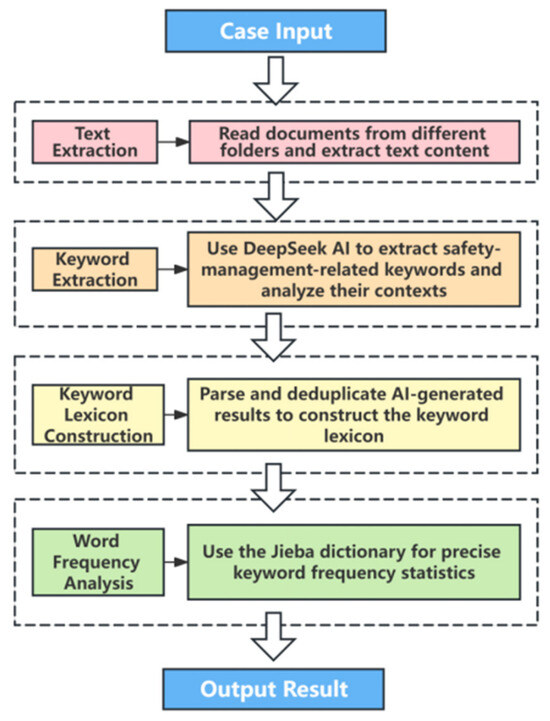
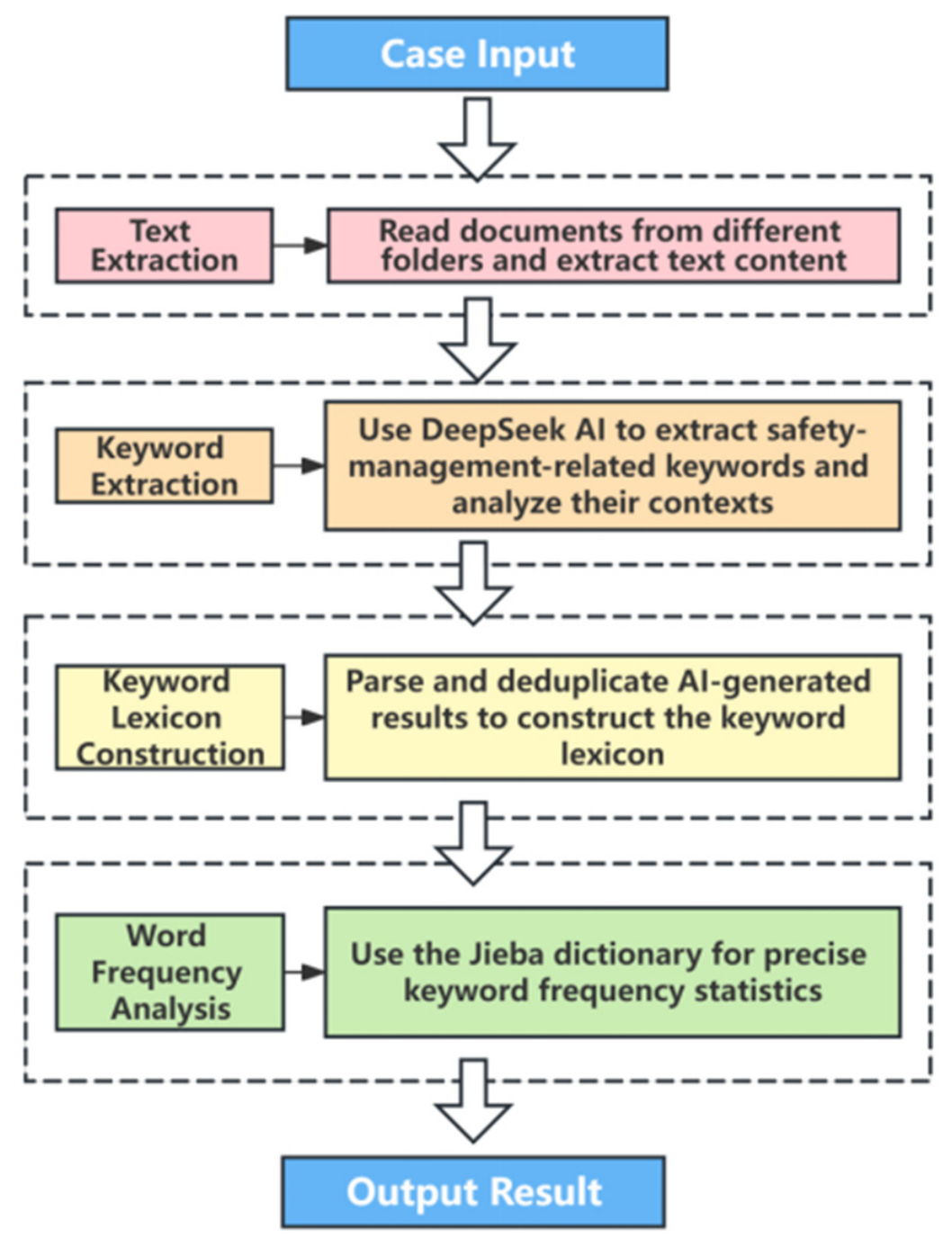
Building on these studies, this study develops an automated text-mining workflow to enable quantitative comparison of safety characteristics across multiple power engineering sectors. Its technical route sequentially encompasses four core stages: “case reading and data preprocessing, LLM-driven professional lexicon construction, precise tokenization and word frequency statistics, and structured output”. The specific workflow is shown in Figure 2, and the code is provided in Supplementary Material S2.
Figure 2.
Safety Case Text Mining and Keyword Frequency Analysis Workflow.
During the data preprocessing stage, the algorithm automatically identifies classification labels based on the directory structure. It not only parses standard paragraphs but also traverses all table cells, introducing a memory address deduplication mechanism to resolve the issue of duplicate extraction caused by merged cells. Considering that power safety management involves professional contexts, simple co-occurrence word extraction cannot adequately meet the needs of feature analysis. This study constructs a specialized prompt engineering framework, leveraging the text comprehension capabilities of the DeepSeek-V4-pro [26] large language model to generate candidate professional keywords for constructing a domain-specific lexicon. Zhang et al. [27] have already utilized DeepSeek to achieve safety risk identification. The prompt strictly constrains the model output to the format of “classification-keyword-context and stage”, requiring the model to directly extract content words from the original text while explicitly prohibiting semantic summarization.
The generated candidate keywords were subsequently validated before being incorporated into the final lexicon. Each candidate keyword was checked against the corresponding original case text to verify its textual traceability and relevance to safety risk management and control. Keywords that could not be in the original text, were overly general, irrelevant to the research topic, semantically duplicated, or expressed inconsistently were removed or adjusted through manual review. The validated keyword set was then used as the domain-specific lexicon for subsequent Jieba tokenization and word-frequency analysis. Thus, DeepSeek served primarily as an auxiliary tool for candidate keyword generation and preliminary classification, while the final keyword selection was determined through original-text verification and manual screening.
During the tokenization and word frequency statistics stage, the validated domain-specific lexicon is dynamically loaded into the Jieba custom dictionary in descending order by length. High-weight matching is employed to resolve truncation issues for long specialized terms, and the Counter is utilized to quantify the feature word frequencies across the four scenarios: hydropower, thermal power, renewable energy, and power transmission and transformation. Considering the unequal number of cases across the four sectors, case-normalized word frequency (CNWF) is further calculated to facilitate cross-sector comparison, as follows:
where denotes the raw number of occurrences of keyword in sector , and denotes the number of cases in sector s. The CNWF represents the average number of occurrences of a given keyword per case within the corresponding sector.
3. Overall Analysis of High-Frequency Words in Safety Risk Control for Power Engineering Construction
Drawing on 36 real-world safety cases provided by 18 power engineering construction enterprises, this chapter employs Python 3.14.0 text mining techniques to perform tokenization and word frequency statistics on all case texts. After filtering out stop words and irrelevant terms, the most frequent and representative high-frequency words are extracted. The systematic organization and analysis of these core vocabularies intuitively reflect the overall characteristics, focal points, and management trends of current safety risk control in power engineering construction. Table 1 presents the top eight high-frequency words along with their occurrence frequencies and contextual backgrounds.
Table 1.
High-frequency terms and application analysis of safety risk management and control in power engineering.
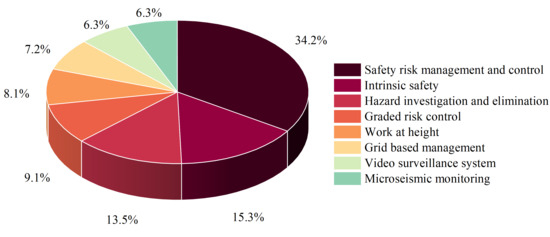
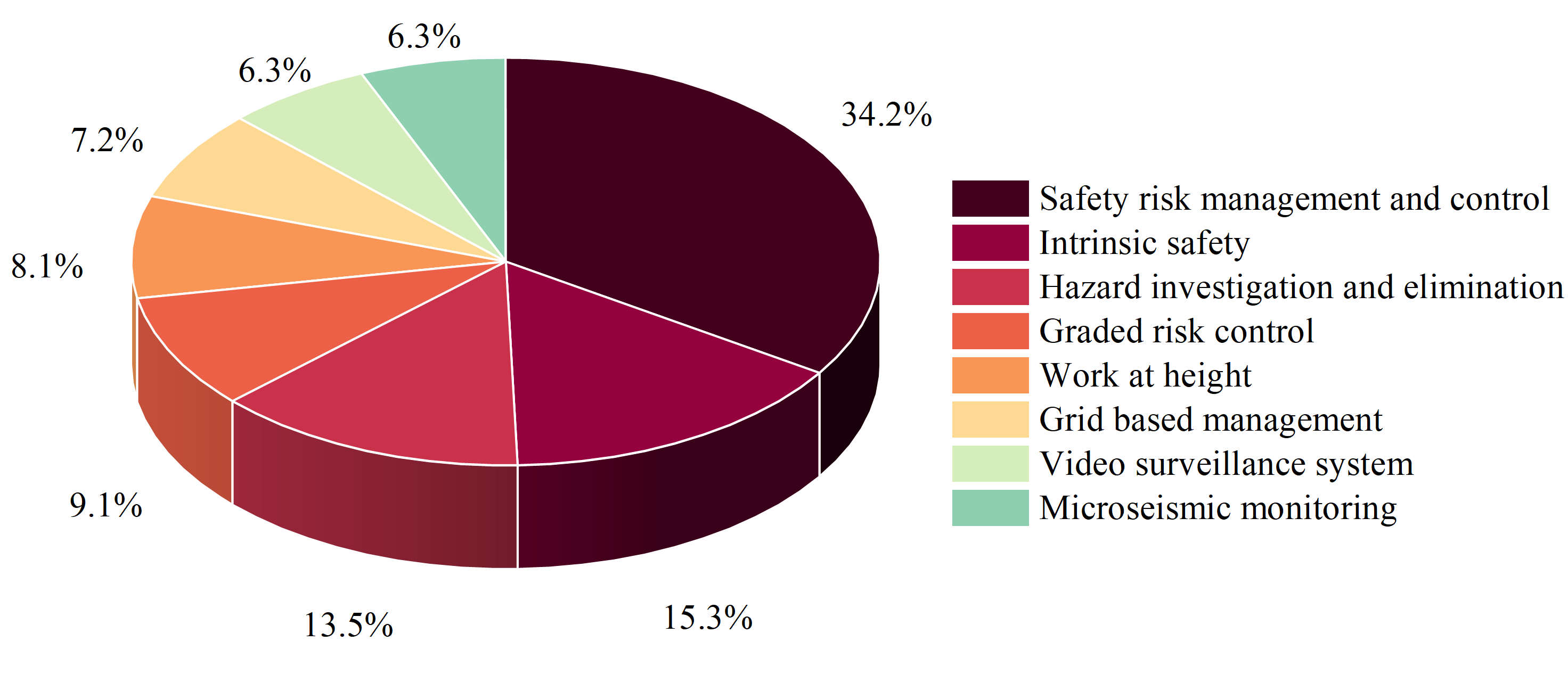
As shown in Figure 3, the term “safety risk management and control” (38 occurrences) dominates with the highest frequency, establishing both the research theme and the core of practical management. On this basis, “intrinsic safety” (17 occurrences) serves as the overarching objective, aiming to prevent accidents at the source through improved equipment reliability and personnel competence. “Hazard investigation and elimination” (15 occurrences) and “graded risk control” (10 occurrences) together constitute the “dual prevention” system for safety management in power engineering. Meanwhile, “grid-based management” (8 occurrences) acts as an organizational innovation that addresses the blind spots of traditional management responsibilities by reinforcing the full responsibility guarantee system for all personnel.
Figure 3.
Proportional analysis of high-frequency words in power engineering safety risk management.
In terms of specific operational tasks, “work at height” (9 occurrences) is the only high-frequency term referring to a specific on-site activity. Its frequent occurrence may be attributed to the widespread presence of work-at-height activities across different power engineering sectors, such as wind turbine installation, steel tower erection, and dam concreting, making it an important focus of accident prevention. Regarding technological applications, “video surveillance system” (7 occurrences) and “microseismic monitoring” (7 occurrences) appear frequently. The former compensates for gaps in manual inspections through digital supervision, while the latter focuses on specific risks such as rockburst in underground hydropower projects. Together, they demonstrate a clear transition in safety control from an “experience-oriented” approach towards a “data and technology-driven” paradigm.
3.1. Analysis of High-Frequency Terms in Safety Risk Management and Control Cases for Hydropower Engineering
The hydropower industry has the largest number of cases and faces unique challenges from complex geological conditions and large-scale underground cavern group construction. Its high-frequency safety risk terms (see Table 2) exhibit the characteristics of “general risk management and control as the foundation, specialized prevention of geological risks, and deep application of intelligent means”.
Table 2.
High-frequency terms and their CNWF weight analysis for safety risk management and control in hydropower engineering.
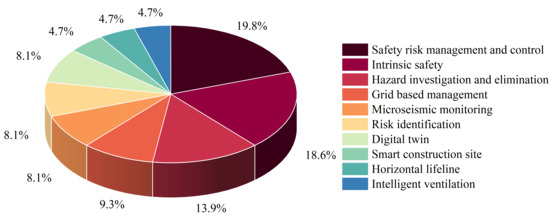
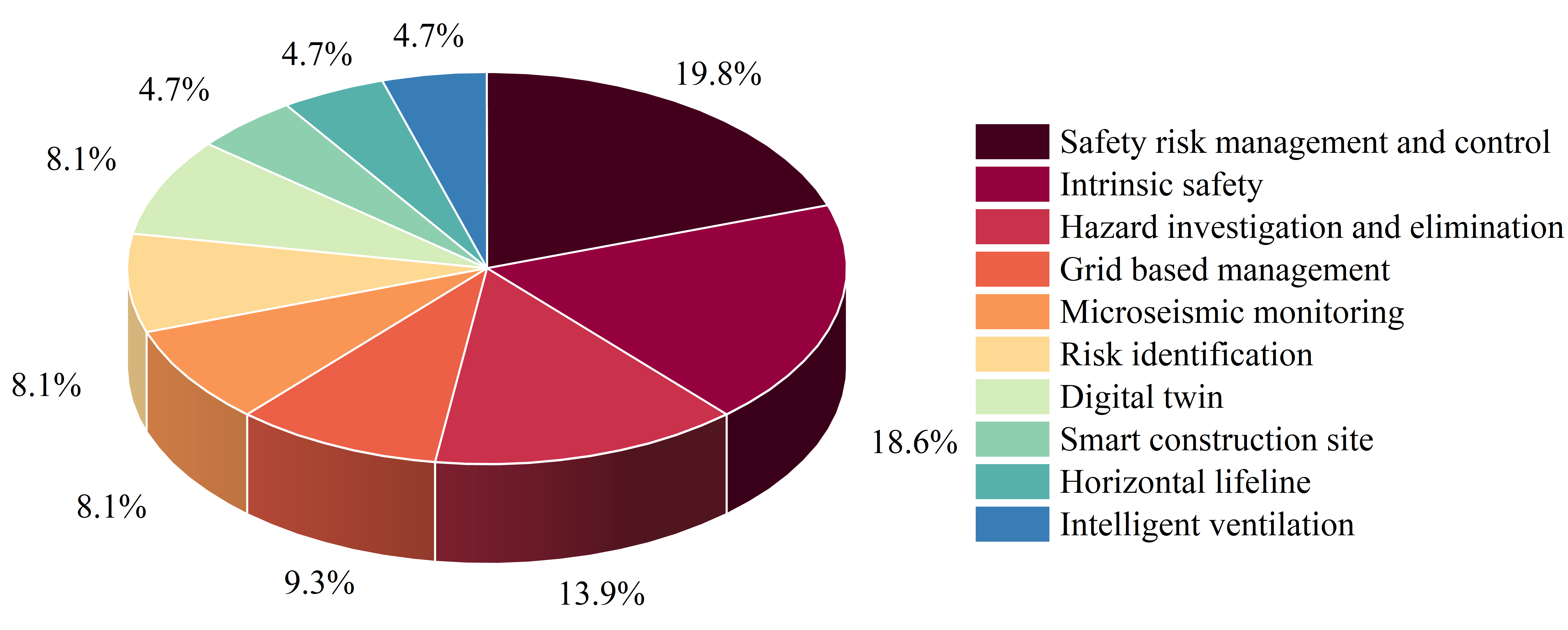
As shown in Figure 4, in terms of overall prevention and control, “safety risk management and control” (17 occurrences), “intrinsic safety” (16 occurrences), “hazard investigation and elimination” (12 occurrences), and “grid-based management” (8 occurrences) constitute a solid institutional foundation, ensuring clear responsibilities and effective control during cross-operation construction across multiple working faces in underground caverns.
Figure 4.
Proportional analysis of high-frequency terms for safety risk management and control in hydropower engineering.
In terms of specific risk prevention, unlike other industries, hydropower projects face high in-situ stress and complex geological structures, and are highly vigilant against rockburst and water inrush risks in underground powerhouse caverns. Consequently, “microseismic monitoring” (7 occurrences) and “risk identification” (7 occurrences) emerge as high-frequency terms in this field, reflecting reliance on scientific early warning and dynamic support to ensure operational safety.
In terms of technology and construction support, “digital twin” (7 occurrences) and “smart construction site” (4 occurrences) reflect an emphasis on high-precision installation and intelligent on-site management. Meanwhile, “horizontal lifeline” (4 occurrences) and “intelligent ventilation” (4 occurrences) address the specific challenges associated with work at height on high and steep slopes and confined-space conditions in deeply buried tunnels, respectively, providing targeted technical support for risk control.
3.2. Analysis of High-Frequency Terms in Safety Risk Management and Control Cases for Thermal Power Engineering
Thermal power engineering is characterized by dense equipment, numerous high-temperature and high-pressure operations, complex installation and commissioning procedures, and frequent work at height. Based on the high-frequency term statistics (see Table 3), the characteristics of safety risk management and control in the thermal power industry can be summarized as: “relying on graded prevention, emphasizing frontline safety briefings, and focusing on work at height”.
Table 3.
High-frequency terms and their CNWF weight analysis for safety risk management and control in thermal power engineering.
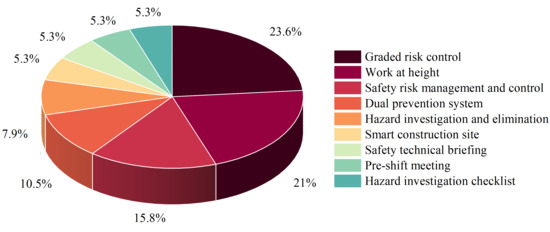
As shown in Figure 5, in terms of institutional prevention and control, “graded risk control” (9 occurrences) ranks the highest, supplemented by “dual prevention system” (4 occurrences), “hazard investigation and elimination” (3 occurrences), and “hazard investigation checklist” (2 occurrences), highlighting the great emphasis placed by the thermal power industry on the stratified control of four-level risks.
Figure 5.
Proportional analysis of high-frequency terms for safety risk management and control in thermal power engineering.
In terms of operational scenarios and frontline implementation, the very high frequency of “work at height” (8 occurrences) represents a major challenge in thermal power safety management, especially in conditions such as large boiler installation and chimney construction, where work at height is widespread across multiple locations and involves complex risk factors. To address this characteristic, the thermal power industry has strengthened frontline safety management, as reflected by the frequent appearance of “safety technical briefing” (2 occurrences) and “pre-shift meeting” (2 occurrences), indicating that management focus is shifted down to the work teams, ensuring frontline operational compliance through daily pre-shift hazard pre-analysis and three-level technical briefings.
In terms of technological support, the industry also shows “smart construction site” (2 occurrences), reflecting that it is gradually introducing technological means such as AI video surveillance to compensate for the limitations of traditional manual protection.
3.3. Analysis of High-Frequency Terms in Safety Risk Management and Control Cases for Renewable Energy Engineering
Renewable energy projects (especially wind power) are mostly located in remote areas with variable meteorological conditions and are characterized by significant features such as large-equipment lifting at height and high environmental sensitivity. The high-frequency term statistics (see Table 4) show that risk management and control in this industry exhibit the characteristics of “emphasis on weather warning, precision construction operations, and technology-enabled remote monitoring”.
Table 4.
High-frequency terms and their CNWF weight analysis for safety risk management and control in renewable energy engineering.
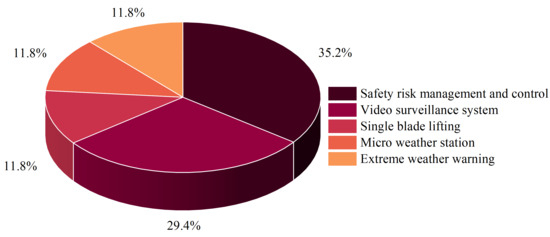
As shown in Figure 6, in terms of overall management objectives, “safety risk management and control” (6 occurrences) appears as a fundamental high-frequency term, indicating that renewable energy projects also embed safety management and control throughout the entire construction cycle.
Figure 6.
Proportional analysis of high-frequency terms for safety risk management and control in renewable energy engineering.
In terms of core characteristics, the renewable energy industry exhibits two distinctive high-frequency terms that differ significantly from other industries. One is high meteorological dependency: the presence of “micro-weather station” (2 occurrences) and “extreme weather warning” (2 occurrences) reflects that wind power construction is strongly constrained by natural meteorological conditions. To cope with sudden strong winds and severe convective weather, it is essential to deploy on-site wind-measuring radar and establish an extreme weather warning mechanism—these are prerequisites for the safe progress of renewable energy construction. The other is high-risk precision lifting: the frequent occurrence of “single-blade lifting” (2 occurrences) reflects the unique process risk of this industry. Given the extremely long and heavy wind turbine blades, conventional integral lifting is highly challenging and involves substantial operational risks; therefore, single-blade lifting technology is preferred to effectively reduce wind load effects. This process demands extremely strict operational precision and safety control.
In terms of intelligent supervision means, since renewable energy project sites are usually vast and dispersed, the high frequency of “video surveillance system” (5 occurrences) is particularly significant. Through real-time remote monitoring covering all work fronts, the system effectively addresses the challenges of large management radius and the difficulty of extending supervision reach to remote sites.
3.4. Analysis of High-Frequency Terms in Safety Risk Management and Control Cases for Transmission and Transformation Engineering
Transmission and transformation engineering is characterized by numerous construction sites, long extensive linear distribution, and dispersed work fronts, and involves extensive work at height for tower assembly and live-line operations. The high-frequency term statistics (see Table 5) reflect that risk management in this industry emphasizes “traditional process control, frontline personnel education, and full-process supervision with documented records”.
Table 5.
High-frequency terms and their CNWF weight analysis for safety risk management and control in transmission and transformation engineering.
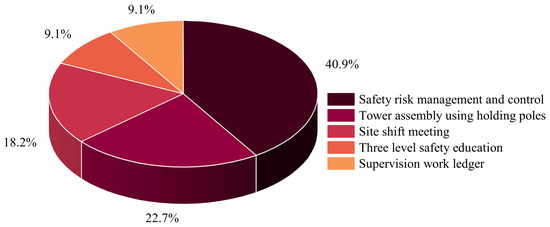
As shown in Figure 7, in terms of core construction operations, “tower assembly using holding poles” (5 occurrences) is the most representative high-frequency term for high-risk procedures in this industry, indicating that tower assembly, as the core link of transmission and transformation construction, is subject to whole-process safety control over its construction techniques, which is a top priority for supervision.
Figure 7.
Proportional analysis of high-frequency terms for safety risk management and control in transmission and transformation engineering.
In terms of personnel organization and technological application, the presence of “site shift meeting” (4 occurrences) and “three-level safety education” (2 occurrences) highlights the importance that the transmission and transformation industry places on frontline team management. It is noteworthy that the site shift meeting is organized and recorded using BeiDou Navigation Satellite System (BDS) positioning technology, reflecting that the industry is integrating precise positioning technology into daily pre-shift risk briefings to achieve digital recording of personnel management.
In terms of external supervision and process documentation, the appearance of “supervision work ledger” (2 occurrences) indicates that transmission and transformation engineering rely particularly on daily follow-up inspections by supervision units, using institutionalized ledger records to ensure that construction progress and safety standards at dispersed work sites can be effectively monitored.
4. Industry Status and Management Trends Reflected by High-Frequency Terms
4.1. Differential Analysis of High-Frequency Terms Across Different Scenarios
Because sample sizes differ substantially across the four sectors, raw frequencies cannot be directly interpreted as indicators of the relative importance of terms across sectors. A larger sample provides more opportunities for a term to occur, whereas frequencies calculated from a small number of cases may be disproportionately affected by individual cases. Therefore, this study reports both raw frequencies and CNWF values. Raw frequencies preserve the actual occurrence information, whereas CNWF provides the average number occurrence of a term per case and thereby improves comparability across sectors. However, CNWF does not eliminate the uncertainty associated with small samples. Results for the transmission and transformation sector, which contains only four cases, are considered exploratory and should not be interpreted as statistically representative of the entire sector.
- (1)
- Common safety management core
“Safety risk management and control” is a common core term throughout the entire industry, ranking among the top in the statistical tables of all four subsectors (17 occurrences in hydropower, 6 in thermal power, 6 in renewable energy, and 9 in transmission and transformation). This indicates that, regardless of the business area, risk prevention is the fundamental bottom line of power engineering construction. Meanwhile, “work at height”, as a common high-risk scenario faced by all sectors [28,29], is frequently emphasized in both thermal power (8 occurrences) and hydropower (as mentioned in the context of horizontal lifelines), reflecting the industry-wide fundamental challenge of fall prevention.
- (2)
- Differentiated sector-specific management characteristics
Despite the common emphasis on safety risk management and control, the distribution of other high-frequency terms reveals distinct sector-specific characteristics. These differences are closely related to the construction environments, operational conditions, and risk profiles of the respective sectors.
Hydropower sector: Characterized by “high geological risks + advanced technological prevention”. The characteristic terms include “microseismic monitoring” and “digital twin”, both with a CNWF of 0.39, while “intelligent ventilation” has a CNWF of 0.22. These terms are mainly associated with rockburst warning, underground construction conditions, and digitalized construction control. The results indicate that hydropower safety management places greater emphasis on dynamic monitoring and intelligent technological prevention, reflecting the management requirements imposed by complex geological conditions and underground construction environments.
Thermal power sector: Characterized by “institutional checklists + frontline execution capability”. “Graded risk control” has a CNWF of 1.29, followed by “work at height” (1.14) and “dual prevention system” (0.57). In addition, “safety technical briefing” and “pre-shift meeting” both have a CNWF of 0.29. The combination of these terms indicates that thermal power safety management emphasizes risk stratification, systematic hazard investigation, and frontline implementation, with institutional requirements being translated into daily work-team activities through standardized briefings and pre-shift management.
Renewable energy sector: Characterized by “prioritized meteorological risk management + remote multi-terminal monitoring”. “Video surveillance system” has a CNWF of 0.71, while “single-blade lifting”, “micro-weather station”, and “extreme weather warning” each have a CNWF of 0.29. These terms reflect the influence of distributed construction sites, changing meteorological conditions, and specialized lifting operations. Accordingly, renewable energy safety management places greater emphasis on remote monitoring, meteorological early warning, and specialized process control, particularly for reducing risks associated with weather-sensitive construction activities.
Transmission and transformation sector: Characterized by “strict control of traditional processes + external supervision with documented records”. “Safety risk management and control” has a CNWF of 2.25, the highest among the four subsectors, while “tower assembly using holding poles” and “site shift meeting” have CNWF values of 1.25 and 1.00, respectively. “Supervision work ledger” and “three-level safety education” both have a CNWF of 0.50. These terms collectively indicate stronger emphasis on high-risk process control, on-site supervision, personnel training, and documented traceability in the sampled transmission and transformation cases.
Taken together, the CNWF-based comparison provides additional evidence for distinguishing common and sector-specific safety management characteristics. The four subsectors share the common foundation of safety risk management and control, but differ in their relative prominence and practical expression: hydropower emphasizes geological hazard monitoring and intelligent technological prevention (microseismic monitoring and digital twin, both 0.39); thermal power prioritizes graded risk control and frontline execution (graded risk control, 1.29; work at height, 1.14); renewable energy highlights remote monitoring and meteorological risk management (video surveillance, 0.71; micro-weather station and extreme weather warning, both 0.29); and transmission and transformation concentrates on risk management, high-risk process control, and documented supervision (safety risk management and control, 2.25; tower assembly using holding poles, 1.25).
These findings suggest that the dual prevention framework in power engineering should adopt a “common framework + sector-specific measures” approach. Common requirements should provide a unified basis for risk identification, grading, hazard investigation, and control verification, while sector-specific measures should be tailored to the dominant hazards, construction environments, and operational characteristics of each scenario.
It should be noted that CNWF improves comparability by accounting for differences in case numbers but does not eliminate all limitations. The transmission and transformation sector contains only four cases, which may amplify CNWF values for terms occurring repeatedly in a small sample. Therefore, CNWF values should be interpreted as indicators of relative prominence within the sampled cases rather than as direct measures of sector-wide safety importance or performance. The identified patterns should be regarded as case-based evidence. Future research should expand and balance case numbers across subsectors and combine normalized text-mining results with expert assessment and quantitative safety-performance indicators to further verify robustness and generalizability.
4.2. Industry Status Reflected by High-Frequency Terms
Based on the patterns reflected in the four groups of high-frequency terms, the sampled cases reveal the following three prominent characteristics of safety risk management and control in power engineering construction:
- (1)
- The role of technology-enabled safety management has significantly increased
From “video surveillance system” (7 occurrences in renewable energy, high frequency), “microseismic monitoring” (7 occurrences in hydropower), to “digital twin” (7 occurrences in hydropower) and “smart construction site” (involved in both hydropower and thermal power), the data indicate that the era of relying solely on traditional systems and manual supervision is undergoing a transformation. The power construction industry is now introducing technological means on a large scale, such as AI video [30], IoT sensors [31], and building information model (BIM) [32] digital twins, to compensate for blind spots in manual protection, provide early warning of complex geological risks, and improve installation accuracy.
- (2)
- The required granularity of process management is becoming increasingly refined
The recurring presence of terms such as “grid-based management” (hydropower), “hazard investigation checklist” (thermal power), “supervision work ledger” (transmission and transformation), and “safety technical briefing” (thermal power) reflects that current safety management has shifted from macro-level “advocacy-based management” to micro-level “checklist-based, grid-based, and documented management” [33,34]. Enterprises strive to assign safety responsibilities to every grid, every work team, and every process step.
- (3)
- Traditional high-risk procedures remain a major challenge in safety management and control
Despite significant advancements in technology, the frequent appearance of specific high-risk operational scenarios such as “work at height” (8 occurrences in thermal power) and “tower assembly using holding poles” (5 occurrences in transmission and transformation) indicates that the physical risks inherent in power construction (e.g., falls from height, mechanical injury) have not disappeared with technological progress. They remain the greatest challenge in on-site management and must be kept under constant, high-level vigilance.
4.3. Management Trends Reflected by High-Frequency Terms
Based on the characteristic distribution of the current high-frequency terms, the following development trends in safety risk management and control for power engineering construction can be identified as follows:
- (1)
- A comprehensive shift from “post-event rectification” to “pre-event prevention”
The frequent occurrence of “graded risk control” and “dual prevention system” signifies a gradual shift in the management logic of power engineering construction from responding to incidents and rectifying identified hazards toward identifying and controlling risks in advance [35]. Enterprises are no longer satisfied with emergency response and hazard rectification after safety incidents occur; instead, they are shifting the management focus forward, using four-level risk stratification and hazard identification during pre-shift meetings to integrate risk identification and control into routine construction processes, thereby enabling safety management to move forward from hazard correction to risk prevention. This trend indicates that the dual prevention mechanism is gradually becoming an important organizational approach for transforming safety management from reactive control to proactive prevention.
- (2)
- Transition from “sole reliance on manual protection” to “deep integration of technological and manual protection”
The emergence of numerous technology-related terms (microseismic monitoring, video surveillance, BDS positioning, and intelligent ventilation) indicates that future safety management will rely heavily on digital and intelligent infrastructure [36]. However, this does not imply a weakening of the human role; on the contrary, high-frequency terms such as “site shift meeting”, “three-level safety education”, and “safety technical briefing” suggest that frontline personnel, organizational management, and technical measures will continue to constitute essential elements of safety control. Technological tools will primarily enhance the ability of personnel to perceive risks, obtain information, and make timely decisions, rather than replace human judgment and management responsibilities. The future development of safety management is therefore more likely to be characterized by human–technology collaboration, in which digital technologies provide continuous monitoring and information support while personnel remain responsible for risk assessment, intervention, and decision-making.
- (3)
- Differentiated and customized control based on scenarios is becoming increasingly mature
The divergence of high-frequency terms across sectors indicates that the industry is gradually moving away from a uniform safety management model toward risk control that considers the characteristics of specific construction scenarios. The differences in high-frequency terms correspond to the distinctive risk profiles of different sectors, such as complex geological and underground construction conditions in hydropower, weather and environmental exposure in renewable energy, and tower erection and lifting operations in transmission and transformation projects. Accordingly, future safety management is expected to place greater emphasis on matching risk identification, monitoring technologies, control measures, and emergency arrangements to specific construction scenarios. Rather than simply applying standardized measures across all projects, specialized risk databases, scenario-specific early-warning methods, and targeted safety control technologies may provide more effective support for differentiated risk prevention and control.
Overall, the high-frequency terms indicate that safety risk management in power engineering construction is developing toward a more proactive, technology-enabled, and scenario-oriented model. This transition is reflected not only in the increasing emphasis on risk prevention before incidents occur, but also in the integration of digital technologies with human-based management and the refinement of control measures according to sector-specific risk characteristics. These trends suggest that future safety management will increasingly focus on the combination of “risk prevention + technological support + human decision-making + scenario-based control,” thereby improving the adaptability and effectiveness of safety risk management across various power engineering construction contexts.
5. Conclusions
5.1. Main Findings
This study, grounded in the practical needs of safety risk management and control in power engineering construction, addresses the limitation that current text-mining research mostly focuses on a single engineering type and lacks cross-scenario comparative analysis. To this end, a cross-industry analytical framework for safety characteristics is constructed, integrating the semantic understanding of large language models with Python-based automated text mining. Drawing on systematic high-frequency term extraction and quantitative analysis of 36 real-world safety cases collected from 18 power construction enterprises—covering four power engineering sectors, namely hydropower, thermal power, renewable energy, and power transmission and transformation—this study conducts an exploratory cross-sector analysis and draws the following core conclusions:
- (1)
- The industry-wide safety management and control practices observed in the examined cases exhibit an overall pattern of “equal emphasis on dual prevention and technological empowerment”. The overall high-frequency terms indicate that “safety risk management and control” and “intrinsic safety” serve as the overarching objectives, while “hazard investigation and elimination” and “graded risk control” constitute a solid dual-prevention barrier; “work at height” remains a major safety concern across the examined sectors; and the high-frequency of organizational innovations such as “grid-based management”, along with technological measures like video surveillance and microseismic monitoring, reveals that safety management is increasingly incorporating technology-supported, data-informed approaches while retaining conventional organizational and frontline controls.
- (2)
- The risk management and control characteristics differ significantly across power engineering sectors. The hydropower sector is characterized by “high geological risks driving advanced technological prevention”, relying on microseismic monitoring, digital twins, and intelligent ventilation to address geological and underground risks. The thermal power sector emphasizes “institutional checklists and rigid frontline execution”, focusing on the dual prevention system, safety technical briefings, and pre-shift meetings. The renewable energy sector is heavily constrained by meteorological conditions and is highly dependent on micro-weather stations, extreme weather warnings, and single-blade lifting techniques. The transmission and transformation sector concentrates on “strict control of traditional high-risk procedures and documented supervision”, with tower assembly using holding poles and BDS-positioned site shift meetings as its core measures. These differences suggest that safety risk management needs to be adapted to the specific risk characteristics and construction scenarios of different sectors rather than relying solely on uniform control measures.
- (3)
- The large-language-model-assisted text-mining workflow provides a practical approach for organizing and comparing heterogeneous safety case information. This method uses the DeepSeek large language model with prompt engineering to assist in identifying and organizing domain-specific safety terms and constructing a specialized lexicon with contextual classifications, while Python-based processing supports automated extraction, normalization, and statistical analysis. It dynamically incorporates Jieba to resolve long-word truncation issues and introduces cell memory address deduplication to ensure precise extraction from complex tables. The two-level structured Excel output ensures both process traceability and statistical usability. Furthermore, case-normalized word frequency (CNWF) is introduced to reduce the influence of unequal case numbers across sectors and provide a more appropriate basis for cross-sector comparison than raw frequency alone. However, the present study remains primarily a frequency-based and interpretive analysis, and the LLM-assisted workflow should therefore be regarded as a tool for improving term extraction and organization rather than as a substitute for deeper semantic or causal analysis.
5.2. Limitations and Future Work
- (1)
- The dataset is relatively small and unevenly distributed across the four sectors, comprising 18 hydropower cases, 7 thermal power cases, 7 renewable energy cases, and 4 power transmission and transformation cases. Such an imbalance may affect the stability of frequency-based results, particularly in sectors with fewer cases, where individual cases may exert a greater influence on keyword frequencies. Although CNWF reduces the direct influence of differences in case numbers, it cannot eliminate the uncertainty associated with small and unevenly distributed samples. Therefore, the findings should be interpreted as exploratory evidence from the collected cases rather than as statistically representative conclusions about the entire power engineering construction industry.
- (2)
- The LLM-assisted keyword extraction process may be affected by model randomness, semantic drift, and domain noise. Structured prompting, original-text traceability checks, and manual screening were adopted to reduce these potential effects. However, an independently annotated ground-truth corpus was not established in the present study; therefore, precision, recall, and F1-score were not used to quantitatively evaluate the performance of the LLM-assisted extraction process. Future research should establish an expert-annotated dataset and conduct quantitative validation of LLM-assisted keyword extraction.
- (3)
- The present analysis is primarily frequency-based and interpretive. This methodological choice is deliberate and aligned with the study’s aim: to provide a cross-industry quantitative comparison of safety management characteristics in power engineering construction. While frameworks such as STAMP [9] or FRAM [25] can provide deeper insights into system-level control structures, functional interactions, and dynamic couplings, they require detailed system descriptions, component-level interactions, and process tracing that are not available in the collected case dataset. Applying them to the current data would therefore not be methodologically justified. The frequency-based approach allows systematic comparison of safety management characteristics across sectors, which is the primary contribution of this study. It does not, however, establish causal relationships, risk coupling, or interaction mechanisms among the identified terms. Future research should expand the case database, particularly for underrepresented sectors, and conduct sensitivity analyses with respect to sample size and composition where sufficient data are available. When richer system-level data become available, more systematic approaches such as STAMP or FRAM can be introduced to further examine system-level relationships, functional interactions, and potential control deficiencies underlying the identified safety management characteristics.
Overall, the proposed framework provides an exploratory and traceable approach for identifying and comparing safety management characteristics across power engineering scenarios, while its findings and methodological applicability should be further validated using larger, more balanced, and independently annotated datasets.
Supplementary Materials
The following supporting information can be downloaded at: https://www.mdpi.com/article/10.3390/pr14182974/s1.
Author Contributions
Conceptualization, C.G. and X.Z.; methodology, C.G. and X.Z.; validation, J.Z. and F.H.; formal analysis, C.G. and X.Z.; investigation, C.G., X.Z. and X.W.; resources, C.G. and F.H.; data curation, J.Z. and X.W.; writing—original draft preparation, C.G., X.W. and F.H.; supervision, F.H.; project administration, C.G. and F.H. All authors have read and agreed to the published version of the manuscript.
Funding
This research received no external funding.
Data Availability Statement
All analysis code for this study is available in the main text and Supplementary Materials, ensuring complete reproducibility of our results. Further inquiries can be directed to the corresponding author.
Acknowledgments
We also extend our thanks to the members of our research group. Their lively discussions, hard-working attitudes, and willingness to share knowledge have created a positive and productive research environment.
Conflicts of Interest
Authors Changren Gao, Xiang Zhou and Jingyi Zhao are employed by the company Hubei Anyuan Safety & Environmental Protection Technology Co., Ltd. Author Xinying Wu and Fan Hu are employed by China University of Geosciences (Wuhan). The authors declare that the research was conducted in the absence of any commercial or financial relationships that could be construed as a potential conflict of interest.
Nomenclature
| Abbreviation | Definition |
| AHP | analytic hierarchy process |
| AI | artificial intelligence |
| BDS | BeiDou Navigation Satellite System |
| BIM | building information model |
| CNWF | case-normalized word frequencies |
| FTA | fault tree analysis |
| FMEA | failure mode and effects analysis |
| FRAM | Functional Resonance Analysis Method |
| LLM | large language model |
| STAMP | Systems-Theoretic Accident Model and Processes |
| Symbol | Definition |
| the raw number of occurrences of keyword i in sector s | |
| the number of cases in sector s |
References
- Vesely, B. Fault Tree Analysis (FTA): Concepts and Applications; NASA HQ: Washington, DC, USA, 2002.
- Sharma, K.D.; Srivastava, S. Failure mode and effect analysis (FMEA) implementation: A literature review. J. Adv. Res. Aeronaut. Space Sci. 2018, 5, 1–17. [Google Scholar]
- Guo, S.; Li, J.; Liang, K.; Tang, B. Improved safety checklist analysis approach using intelligent video surveillance in the construction industry: A case study. Int. J. Occup. Saf. Ergon. 2021, 27, 1064–1075. [Google Scholar] [CrossRef] [Scilit]
- Zhu, X.; Zhao, J.; Xiang, Y.; Li, C.; Hu, F. Safety Risk Management in China’s Power Engineering Construction: Insights and Countermeasures from the 14th Five-Year Plan. Processes 2025, 13, 2789. [Google Scholar] [CrossRef] [Scilit]
- Ting, S.N.; Buma, T.C.; Lee, Y.Y.; Kuan, N.H.T. Development of a Centralized Risk Register Framework for Enhancing Risk Management in Electric Power Transmission Projects in Developing Countries: The Case of Malaysia. ASCE-ASME J. Risk Uncertain. Eng. Syst. Part A Civ. Eng. 2026, 12, 04026015. [Google Scholar] [CrossRef] [Scilit]
- Vaidya, O.S.; Kumar, S. Analytic hierarchy process: An overview of applications. Eur. J. Oper. Res. 2006, 169, 1–29. [Google Scholar] [CrossRef] [Scilit]
- Wu, X.; Hu, F. Analysis of ecological carrying capacity using a fuzzy comprehensive evaluation method. Ecol. Indic. 2020, 113, 106243. [Google Scholar] [CrossRef] [Scilit]
- Harrison, R.L. Introduction to monte carlo simulation. In Proceedings of the AIP Conference Proceedings; AIP Publishing: Melville, NY, USA, 2010; p. 17. [Google Scholar]
- Leveson, N.G. Engineering a Safer World: Systems Thinking Applied to Safety; MIT Press: Cambridge, MA, USA, 2016. [Google Scholar]
- Yang, Y.; Tu, X.; Wang, W.; Liu, X.; Zhao, X. Identification of hierarchical causation networks for power system security incidents: A feedback-driven multi-agent framework. Saf. Sci. 2026, 202, 107279. [Google Scholar] [CrossRef] [Scilit]
- Wang, H.; Zhang, Z. A mechanism for efficiently controlling the safety risks of pumped storage power station construction. J. Phys. Conf. Ser. 2024, 2752, 012154. [Google Scholar] [CrossRef] [Scilit]
- Ding, Y.; Teng, F.; Zhang, P.; Huo, X.; Sun, Q.; Qi, Y. Research on text information mining technology of substation inspection based on improved Jieba. In Proceedings of the 2021 International Conference on Wireless Communications and Smart Grid (ICWCSG); IEEE: New York, NY, USA, 2021; pp. 561–564. [Google Scholar]
- Hegde, J.; Rokseth, B. Applications of machine learning methods for engineering risk assessment—A review. Saf. Sci. 2020, 122, 104492. [Google Scholar] [CrossRef] [Scilit]
- Guang, W.; Yuan, Y.; Huang, S.; Zhang, F.; Zhao, J.; Hu, F. Application of Large AI Models in Safety and Emergency Management of the Power Industry in China. Processes 2025, 13, 2569. [Google Scholar] [CrossRef] [Scilit]
- Xie, Y.; Huang, Z.; Wei, Y.; Huang, B.; Huang, C.; Xia, M. Research and Application of a Full Process Control Platform for Power New Energy Engineering Construction Based on AI and Big Data. In Proceedings of the 2024 IEEE First International Conference on Data Intelligence and Innovative Application (DIIA); IEEE: New York, NY, USA, 2024; pp. 1–5. [Google Scholar]
- Zeng, Q. Power Grid Engineering Safety Management Application Based on Big Data Technology. In Proceedings of the 2024 3rd International Conference on Artificial Intelligence and Autonomous Robot Systems (AIARS); IEEE: New York, NY, USA, 2024; pp. 202–206. [Google Scholar]
- Lee, D.; Lim, D.; Lee, J. Safety Autonomous Platform for Data-Driven Risk Management Based on an On-Site AI Engine in the Electric Power Industry. Appl. Sci. 2025, 15, 630. [Google Scholar] [CrossRef] [Scilit]
- Yang, Y.; Xiang, P.; Wang, D. Knowledge graph and mitigation measures recommendation for safety hazards in large-scale hydropower projects using diverse heterogeneous inspection data. Autom. Constr. 2025, 178, 106419. [Google Scholar] [CrossRef] [Scilit]
- Cao, K.; Chen, S.; Yang, C.; Li, Z.; Luo, L.; Ren, Z. Revealing the coupled evolution process of construction risks in mega hydropower engineering through textual semantics. Adv. Eng. Inform. 2024, 62, 102713. [Google Scholar] [CrossRef] [Scilit]
- Wang, H.; Cao, J.; Lin, D. Deep analysis of power equipment defects based on semantic framework text mining technology. CSEE J. Power Energy Syst. 2019, 8, 1157–1164. [Google Scholar] [CrossRef] [Scilit]
- Liu, Y.; Xia, Y.; Miao, W.; Xing, F.; Tu, H. A Causal Relation Extraction Model for Power Fault Texts Integrating Causal Prompt Vectors. In Proceedings of the 2025 3rd International Conference on Power, Grid and Energy Storage; IEEE: New York, NY, USA, 2025; pp. 431–435. [Google Scholar]
- Erfani, A.; Cui, Q. Predictive risk modeling for major transportation projects using historical data. Autom. Constr. 2022, 139, 104301. [Google Scholar] [CrossRef] [Scilit]
- Jallan, Y.; Ashuri, B. Text mining of the securities and exchange commission financial filings of publicly traded construction firms using deep learning to identify and assess risk. J. Constr. Eng. Manag. 2020, 146, 04020137. [Google Scholar] [CrossRef] [Scilit]
- Hu, K.; Wang, J.; Hu, X.; Cheng, Z. Identification of Safety Risk Factors for Shield Construction in Urban Drainage Deep Tunnel Based on Text Mining. Processes 2025, 13, 2782. [Google Scholar] [CrossRef] [Scilit]
- Patriarca, R.; Di Gravio, G.; Woltjer, R.; Costantino, F.; Praetorius, G.; Ferreira, P.; Hollnagel, E. Framing the FRAM: A literature review on the functional resonance analysis method. Saf. Sci. 2020, 129, 104827. [Google Scholar] [CrossRef] [Scilit]
- Xu, A.; Lin, B.; Xue, B.; Wang, B.; Xu, B.; Wu, B.; Zhang, B.; Lin, C.; Dong, C.; Ling, C. Deepseek-v4: Towards highly efficient million-token context intelligence. arXiv 2026, arXiv:2606.19348. [Google Scholar]
- Zhang, G.; Yang, D.; Sun, Y. Construction Safety Risk Identification and Coupling Analysis Based on Data Mining. Buildings 2026, 16, 1917. [Google Scholar] [CrossRef] [Scilit]
- Chan, A.P.; Wong, F.K.; Chan, D.W.; Yam, M.C.; Kwok, A.W.; Lam, E.W.; Cheung, E. Work at height fatalities in the repair, maintenance, alteration, and addition works. J. Constr. Eng. Manag. 2008, 134, 527–535. [Google Scholar] [CrossRef] [Scilit]
- Li, X.; Guo, Y.; Ge, F.-l.; Yang, F.-q. Human reliability assessment on building construction work at height: The case of scaffolding work. Saf. Sci. 2023, 159, 106021. [Google Scholar] [CrossRef] [Scilit]
- Zhang, F.; He, H.; Fan, Y.; Dong, X. Technology and implementation of safety monitoring system for power grid construction site based on intelligent video analysis. J. Comput. Methods Sci. Eng. 2026. [Google Scholar] [CrossRef] [Scilit]
- Mansour, D.E.A.; Numair, M.; Zalhaf, A.S.; Ramadan, R.; Darwish, M.M.; Huang, Q.; Hussien, M.G.; Abdel-Rahim, O. Applications of IoT and digital twin in electrical power systems: A comprehensive survey. IET Gener. Transm. Distrib. 2023, 17, 4457–4479. [Google Scholar] [CrossRef] [Scilit]
- Sai, Y.; Zhang, T.; Huang, X.; Ding, C. Analysis of digital twins and application value of power engineering based on BIM. In Proceedings of the International conference on Big Data Analytics for Cyber-Physical-Systems; Springer: Singapore, 2019; pp. 550–558. [Google Scholar]
- Lu, W.; Wang, H.; Zhang, T.; Wu, M. Practice and exploration of implementing safety production responsibility system through security grid management. Water Resour. Hydropower Eng. 2025, 56, 6. [Google Scholar]
- Morteza, A.; Ilbeigi, M.; Schwed, J. A blockchain information management framework for construction safety. In Computing in Civil Engineering 2021; American Society of Civil Engineers: Reston, VA, USA, 2021; pp. 342–349. [Google Scholar]
- Golabchi, H.; Pereira, E.; Lefsrud, L.; Mohamed, Y. Proposal of a safety maturity framework in construction: Implementing leading indicators for proactive safety management. J. Saf. Sustain. 2025, 2, 207–221. [Google Scholar] [CrossRef] [Scilit]
- Chi, S.; Caldas, C.H. Automated object identification using optical video cameras on construction sites. Comput.-Aided Civ. Infrastruct. Eng. 2011, 26, 368–380. [Google Scholar] [CrossRef] [Scilit]

Disclaimer/Publisher’s Note: The statements, opinions and data contained in all publications are solely those of the individual author(s) and contributor(s) and not of MDPI and/or the editor(s). MDPI and/or the editor(s) disclaim responsibility for any injury to people or property resulting from any ideas, methods, instructions or products referred to in the content. |
© 2026 by the authors. Licensee MDPI, Basel, Switzerland. This article is an open access article distributed under the terms and conditions of the Creative Commons Attribution (CC BY) license.