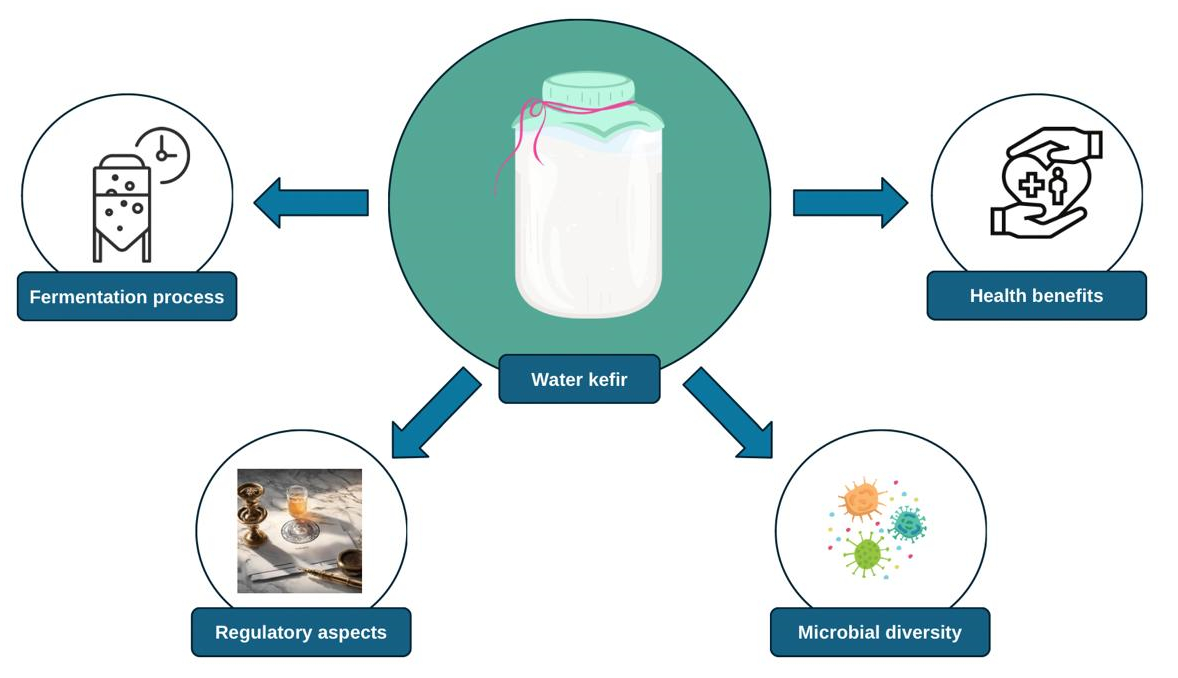
Water Kefir: Review of Microbial Diversity, Potential Health Benefits, and Fermentation Process

 , , ,
, , ,  and
and
Abstract
1. Introduction
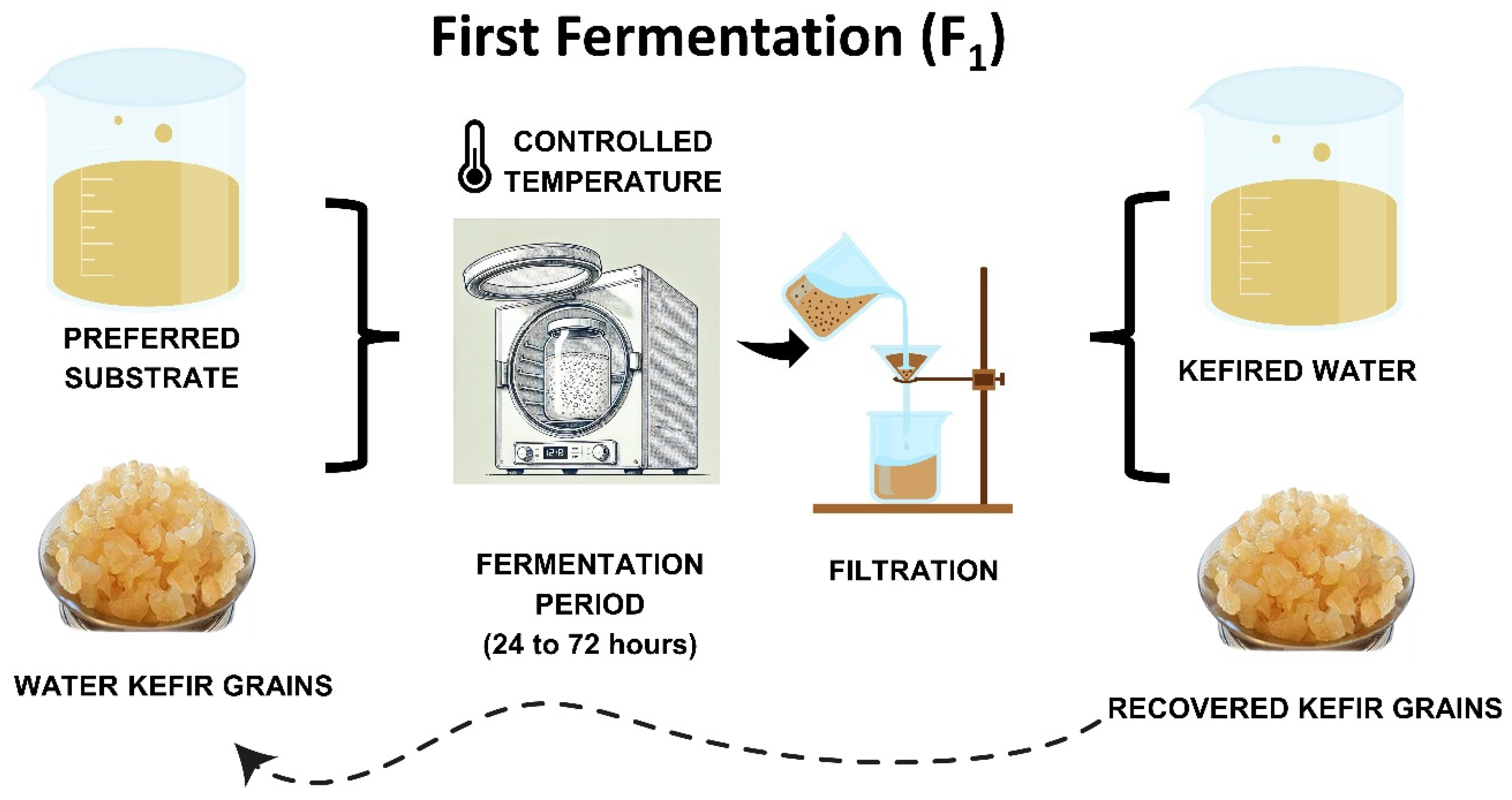
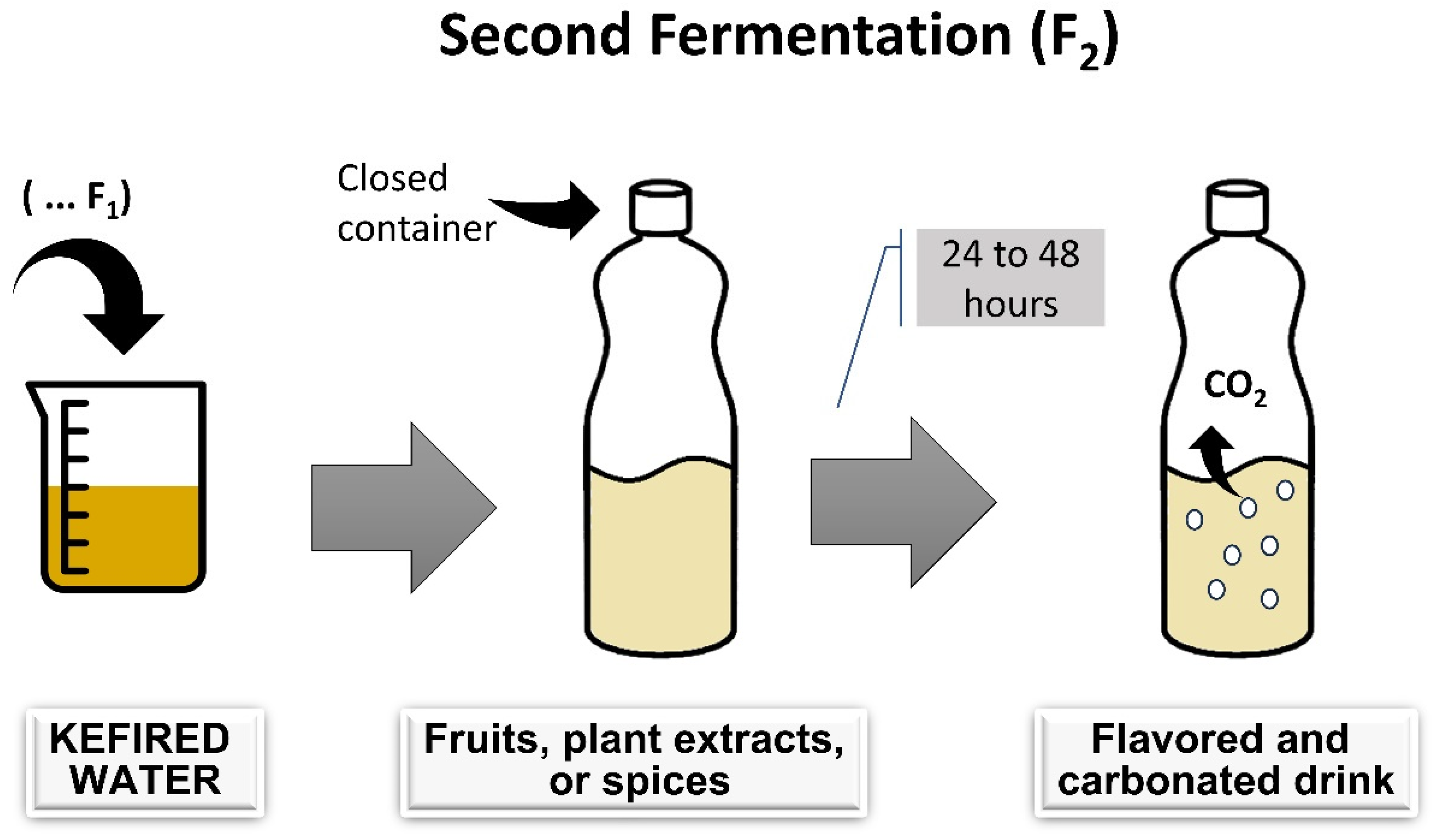
2. Origin, Composition, and Production Process
3. Regulatory Aspects
4. Fermentation Dynamics of Water Kefir
5. Microbial Diversity of Water Kefir
6. Potential Health Benefits of Water Kefir
7. Final Considerations and Future Perspectives
Author Contributions
Funding
Data Availability Statement
Acknowledgments
Conflicts of Interest
References
- Manoj, P.M.; Mohan, J.R.; Khasherao, B.Y.; Shams, R.; Dash, K.K. Fruit based probiotic functional beverages: A review. J. Agric. Food Res. 2023, 14, 100729. [Google Scholar] [CrossRef] [Scilit]
- Mojikon, F.D.; Kasimin, M.E.; Molujin, A.M.; Gansau, J.A.; Jawan, R. Probiotication of Nutritious Fruit and Vegetable Juices: An Alternative to Dairy-Based Probiotic Functional Products. Nutrients 2022, 14, 3457. [Google Scholar] [CrossRef] [Scilit]
- Hasan, M.; Arpitha, S.; Das, C.; Laishram, R.; Sasi, M.; Kumar, S.; Maheshwari, C.; Krishnan, V.; Kumari, S.; Lorenzo, J.M.; et al. Research trends and approaches for the nutritional and bio-functionality enhancement of fermented soymilk. J. Funct. Foods 2023, 107, 105698. [Google Scholar] [CrossRef] [Scilit]
- Egea, M.B.; dos Santos, D.C.; de Oliveira Filho, J.G.; Ores, J.d.C.; Takeuchi, K.P.; Lemes, A.C. A review of nondairy kefir products’ characteristics and potential human health benefits. Crit. Rev. Food Sci. Nutr. 2022, 62, 1536–1552. [Google Scholar] [CrossRef] [Scilit] [PubMed]
- Fiorda, F.A.; Pereira, G.V.d.M.; Thomaz-Soccol, V.; Rakshit, S.K.; Pagnoncelli, M.G.B.; Vandenberghe, L.P.d.S.; Soccol, C.R. Microbiological, biochemical, and functional aspects of sugary kefir fermentation—A review. Food Microbiol. 2017, 66, 86–95. [Google Scholar] [CrossRef] [Scilit]
- Gulitz, A.; Stadie, J.; Wenning, M.; Ehrmann, M.A.; Vogel, R.F. The microbial diversity of water kefir. Int. J. Food Microbiol. 2011, 151, 284–288. [Google Scholar] [CrossRef] [Scilit]
- Bozkir, E.; Yilmaz, B.; Sharma, H.; Esatbeyoglu, T.; Ozogul, F. Challenges in water kefir production and limitations in human consumption: A comprehensive review of current knowledge. Heliyon 2024, 10, e33501. [Google Scholar] [CrossRef] [Scilit]
- Moretti, A.F.; Moure, M.C.; Quiñoy, F.; Esposito, F.; Simonelli, N.; Medrano, M.; León-Peláez, Á. Water Kefir, a Fermented Beverage Containing Probiotic Microorganisms: From Ancient and Artisanal Manufacture to Industrialized and Regulated Commercialization. Futur. Foods 2022, 5, 100123. [Google Scholar] [CrossRef] [Scilit]
- Mukherjee, A.; Gómez-Sala, B.; O’Connor, E.M.; Kenny, J.G.; Cotter, P.D. Global regulatory frameworks for fermented foods: A review. Front. Nutr. 2022, 9, 902642. [Google Scholar] [CrossRef] [Scilit]
- Spizzirri, U.G.; Loizzo, M.R.; Aiello, F.; Prencipe, S.A.; Restuccia, D. Non-dairy kefir beverages: Formulation, composition, and main features. J. Food Compos. Anal. 2023, 117, 105130. [Google Scholar] [CrossRef] [Scilit]
- Lynch, K.M.; Wilkinson, S.; Daenen, L.; Arendt, E.K. An update on water kefir: Microbiology, composition and production. Int. J. Food Microbiol. 2021, 345, 109128. [Google Scholar] [CrossRef] [Scilit] [PubMed]
- Pidoux, M.; Brillouet, M.; Quemener, B. Characterization of the polysaccharides from a Lactobacillus brevis and from sugary kefir grains. Biotechnol. Lett. 1988, 10, 415–420. [Google Scholar] [CrossRef] [Scilit]
- Guzel-Seydim, Z.B.; Gökırmaklı, Ç.; Greene, A.K. A comparison of milk kefir and water kefir: Physical, chemical, microbiological and functional properties. Trends Food Sci. Technol. 2021, 113, 42–53. [Google Scholar] [CrossRef] [Scilit]
- Laureys, D.; De Vuyst, L. Microbial Species Diversity, Community Dynamics, and Metabolite Kinetics of Water Kefir Fermentation. Appl. Environ. Microbiol. 2014, 80, 2564–2572. [Google Scholar] [CrossRef] [Scilit]
- Moinas, M.; Horisberger, M.; Bauer, H. The structural organization of the Tibi grain as revealed by light, scanning and transmission microscopy. Arch. Microbiol. 1980, 128, 157–161. [Google Scholar] [CrossRef] [Scilit]
- Waldherr, F.W.; Doll, V.M.; Meißner, D.; Vogel, R.F. Identification and characterization of a glucan-producing enzyme from Lentilactobacillus hilgardii TMW 1.828 involved in granule formation of water kefir. Food Microbiol. 2010, 27, 672–678. [Google Scholar] [CrossRef] [Scilit]
- Corona, O.; Randazzo, W.; Miceli, A.; Guarcello, R.; Francesca, N.; Erten, H.; Moschetti, G.; Settanni, L. Characterization of kefir-like beverages produced from vegetable juices. LWT 2016, 66, 572–581. [Google Scholar] [CrossRef] [Scilit]
- da Silva Fernandes, M.; Lima, F.S.; Rodrigues, D.; Handa, C.; Guelfi, M.; Garcia, S.; Ida, E.I. Evaluation of the isoflavone and total phenolic contents of kefir-fermented soymilk storage and after the in vitro digestive system simulation. Food Chem. 2017, 229, 373–380. [Google Scholar] [CrossRef] [Scilit]
- Randazzo, W.; Corona, O.; Guarcello, R.; Francesca, N.; Germanà, M.A.; Erten, H.; Moschetti, G.; Settanni, L. Development of new non-dairy beverages from Mediterranean fruit juices fermented with water kefir microorganisms. Food Microbiol. 2016, 54, 40–51. [Google Scholar] [CrossRef] [Scilit]
- Calatayud, M.; Börner, R.A.; Ghyselinck, J.; Verstrepen, L.; De Medts, J.; Van den Abbeele, P.; Boulangé, C.L.; Priour, S.; Marzorati, M.; Damak, S. Water kefir and derived pasteurized beverages modulate gut microbiota, intestinal permeability and cytokine production in vitro. Nutrients 2021, 13, 3897. [Google Scholar] [CrossRef] [Scilit]
- Pendón, M.D.; Bengoa, A.A.; Iraporda, C.; Medrano, M.; Garrote, G.L.; Abraham, A.G. Water kefir: Factors affecting grain growth and health-promoting properties of the fermented beverage. J. Appl. Microbiol. 2022, 133, 162–180. [Google Scholar] [CrossRef] [Scilit] [PubMed]
- Bueno, R.S.; Ressutte, J.B.; Hata, N.N.; Henrique-Bana, F.C.; Guergoletto, K.B.; de Oliveira, A.G.; Spinosa, W.A. Quality and shelf life assessment of a new beverage produced from water kefir grains and red pitaya. LWT 2021, 140, 110770. [Google Scholar] [CrossRef] [Scilit]
- de Almeida, K.V.; Zanetti, V.C.; Camelo-Silva, C.; Alexandre, L.A.; da Silva, A.C.; Verruck, S.; Teixeira, L.J.Q. Powdered water kefir: Effect of spray drying and lyophilization on physical, physicochemical, and microbiological properties. Food Chem. Adv. 2024, 5, 100759. [Google Scholar] [CrossRef] [Scilit]
- Manjunatha, V.; Bhattacharjee, D.; Flores, C. Unlocking Innovations: Exploring the Role of Kefir in Product Development. Curr. Food Sci. Technol. Rep. 2024, 2, 221–230. [Google Scholar] [CrossRef] [Scilit]
- Hill, C.; Guarner, F.; Reid, G.; Gibson, G.R.; Merenstein, D.J.; Pot, B.; Morelli, L.; Canani, R.B.; Flint, H.J.; Salminen, S.; et al. Expert consensus document: The international scientific association for probiotics and prebiotics consensus statement on the scope and appropriate use of the term probiotic. Nat. Rev. Gastroenterol. Hepatol. 2014, 11, 506–514. [Google Scholar] [CrossRef] [Scilit]
- Instrução Normativa Nº 46, de 23 de Outubro de 2007. Available online: https://www.cidasc.sc.gov.br/inspecao/files/2019/09/INSTRUÇÃO-NORMATIVA-N-46-de-23-de-outubro-de-2007-Leites-Fermentados.pdf (accessed on 7 January 2025).
- Gur, J.; Mawuntu, M.; Martirosyan, D. FFC’s Advancement of Functional Food Definition. Funct. Foods Heal. Dis. 2018, 8, 385–397. [Google Scholar] [CrossRef] [Scilit]
- Cufaoglu, G.; Erdinc, A.N. An alternative source of probiotics: Water kefir. Food Front. 2023, 4, 21–31. [Google Scholar] [CrossRef] [Scilit]
- Laureys, D.; Aerts, M.; Vandamme, P.; De Vuyst, L. Oxygen and diverse nutrients influence the water kefir fermentation process. Food Microbiol. 2018, 73, 351–361. [Google Scholar] [CrossRef] [Scilit]
- Martínez-Torres, A.; Gutiérrez-Ambrocio, S.; Heredia-Del-Orbe, P.; Villa-Tanaca, L.; Hernández-Rodríguez, C. Inferring the role of microorganisms in water kefir fermentations. Int. J. Food Sci. Technol. 2017, 52, 559–571. [Google Scholar] [CrossRef] [Scilit]
- Xu, D.; Bechtner, J.; Behr, J.; Eisenbach, L.; Geißler, A.J.; Vogel, R.F. Lifestyle of Lactobacillus hordei isolated from water kefir based on genomic, proteomic and physiological characterization. Int. J. Food Microbiol. 2019, 290, 141–149. [Google Scholar] [CrossRef] [Scilit]
- Hsieh, H.-H.; Wang, S.-Y.; Chen, T.-L.; Huang, Y.-L.; Chen, M.-J. Effects of cow’s and goat’s milk as fermentation media on the microbial ecology of sugary kefir grains. Int. J. Food Microbiol. 2012, 157, 73–81. [Google Scholar] [CrossRef] [Scilit]
- Gamba, R.R.; Koyanagi, T.; Peláez, A.L.; De Antoni, G.; Enomoto, T. Changes in Microbiota During Multiple Fermentation of Kefir in Different Sugar Solutions Revealed by High-Throughput Sequencing. Curr. Microbiol. 2021, 78, 2406–2413. [Google Scholar] [CrossRef] [Scilit] [PubMed]
- Tavares, P.P.L.G.; Silva, M.R.; Santos, L.F.P.; Nunes, I.L.; Magalhães-Guedes, K.T. Production of quinoa (Chenopodium quinoa) kefir fermented beverage flavored with cocoa (Theobroma cacao) powder. Braz. J. Agric. Sci. 2018, 13, e5593. [Google Scholar] [CrossRef] [Scilit]
- Cao, C.; Hou, Q.; Hui, W.; Kwok, L.; Zhang, H.; Zhang, W. Assessment of the microbial diversity of Chinese Tianshan tibicos by single molecule, real-time sequencing technology. Food Sci. Biotechnol. 2019, 28, 139–145. [Google Scholar] [CrossRef] [Scilit] [PubMed]
- Gamba, R.R.; Yamamoto, S.; Sasaki, T.; Michihata, T.; Mahmoud, A.-H.; Koyanagi, T.; Enomoto, T. Microbiological and functional characterization of kefir grown in different sugar solutions. Food Sci. Technol. Res. 2019, 25, 303–312. [Google Scholar] [CrossRef] [Scilit]
- Verce, M.; De Vuyst, L.; Weckx, S. Shotgun metagenomics of a water kefir fermentation ecosystem reveals a novel oenococcus species. Front. Microbiol. 2019, 10, 479. [Google Scholar] [CrossRef] [Scilit] [PubMed]
- Tu, C.; Azi, F.; Huang, J.; Xu, X.; Xing, G.; Dong, M. Quality and metagenomic evaluation of a novel functional beverage produced from soy whey using water kefir grains. LWT 2019, 113, 108258. [Google Scholar] [CrossRef] [Scilit]
- Azi, F.; Tu, C.; Rasheed, H.A.; Dong, M. Comparative study of the phenolics, antioxidant and metagenomic composition of novel soy whey-based beverages produced using three different water kefir microbiota. Int. J. Food Sci. Technol. 2020, 55, 1689–1697. [Google Scholar] [CrossRef] [Scilit]
- Eckel, V.P.L.; Ziegler, L.-M.; Vogel, R.F.; Ehrmann, M. Bifidobacterium tibiigranuli sp. nov. isolated from homemade water kefir. Int. J. Syst. Evol. Microbiol. 2020, 70, 1562–1570. [Google Scholar] [CrossRef] [Scilit]
- Alves, V.; Scapini, T.; Camargo, A.F.; Bonatto, C.; Stefanski, F.S.; de Jesus, E.P.; Diniz, L.G.T.; Bertan, L.C.; Maldonado, R.R.; Treichel, H. Development of fermented beverage with water kefir in water-soluble coconut extract (Cocos nucifera L.) with inulin addition. LWT 2021, 145, 111364. [Google Scholar] [CrossRef] [Scilit]
- Patel, S.; Tan, J.; Börner, R.; Zhang, S.; Priour, S.; Lima, A.; Ngom-Bru, C.; Cotter, P.; Duboux, S. A temporal view of the water kefir microbiota and flavour attributes. Innov. Food Sci. Emerg. Technol. 2022, 80, 103084. [Google Scholar] [CrossRef] [Scilit]
- Yerlikaya, O.; Akan, E.; Kinik, Ö. The metagenomic composition of water kefir microbiota. Int. J. Gastron. Food Sci. 2022, 30, 100621. [Google Scholar] [CrossRef] [Scilit]
- Rodríguez, M.A.; Fernández, L.A.; Díaz, M.L.; Pérez, M.; Corona, M.; Reynaldi, F.J. Microbiological and chemical characterization of water kefir: An innovative source of potential probiotics for bee nutrition. Rev. Argent. Microbiol. 2023, 55, 176–180. [Google Scholar] [CrossRef] [Scilit]
- Koh, W.Y.; Utra, U.; Ahmad, R.; Rather, I.A.; Park, Y.-H. Evaluation of probiotic potential and anti-hyperglycemic properties of a novel Lactobacillus strain isolated from water kefir grains. Food Sci. Biotechnol. 2018, 27, 1369–1376. [Google Scholar] [CrossRef] [Scilit]
- Talib, N.; Mohamad, N.E.; Yeap, S.K.; Ho, C.L.; Masarudin, M.J.; Abd-Aziz, S.; Izham, M.N.M.; Kumar, M.R.; Hussin, Y.; Alitheen, N.B. Anti-Diabetic Effect of Lacticaseibacillus paracasei Isolated from Malaysian Water Kefir Grains. Probiotics Antimicrob. Proteins 2023, 16, 2161–2180. [Google Scholar] [CrossRef] [Scilit]
- Alsayadi, M.; Al Jawfi, Y.; Belarbi, M.; Soualem-Mami, Z.; Merzouk, H.; Sari, D.C.; Sabri, F.; Ghalim, M. Evaluation of Anti-Hyperglycemic and Anti-Hyperlipidemic Activities of Water Kefir as Probiotic on Streptozotocin-Induced Diabetic Wistar Rats. J. Diabetes Mellit. 2014, 4, 85–95. [Google Scholar] [CrossRef]
- Falsoni, R.M.P.; Moraes, F.d.S.A.; de Rezende, M.S.; da Silva, C.L.; de Andrade, T.U.; Brasil, G.A.; de Lima, E.M. Pretreatment with water kefir reduces the development of acidified ethanol-induced gastric ulcers. Braz. J. Pharm. Sci. 2022, 58, e191046. [Google Scholar] [CrossRef] [Scilit]
- Rekha, K.; Venkidasamy, B.; Samynathan, R.; Nagella, P.; Rebezov, M.; Khayrullin, M.; Ponomarev, E.; Bouyahya, A.; Sarkar, T.; Shariati, M.A.; et al. Short-chain fatty acid: An updated review on signaling, metabolism, and therapeutic effects. Crit. Rev. Food Sci. Nutr. 2024, 64, 2461–2489. [Google Scholar] [CrossRef] [Scilit]
- Chen, Y.; Lin, Y.; Lin, J.; Yang, N.; Chen, M. Sugary Kefir Strain Lactobacillus mali APS1 Ameliorated Hepatic Steatosis by Regulation of SIRT-1/Nrf-2 and Gut Microbiota in Rats. Mol. Nutr. Food Res. 2018, 62, e1700903. [Google Scholar] [CrossRef] [Scilit]
- Jeong, D.; Kim, D.-H.; Kang, I.-B.; Kim, H.; Song, K.-Y.; Kim, H.-S.; Seo, K.-H. Modulation of gut microbiota and increase in fecal water content in mice induced by administration of Lactobacillus kefiranofaciens DN1. Food Funct. 2017, 8, 680–686. [Google Scholar] [CrossRef] [Scilit]
- Hong, W.; Chen, Y.; Chen, M. The Antiallergic Effect of Kefir Lactobacilli. J. Food Sci. 2010, 75, H244–H253. [Google Scholar] [CrossRef] [Scilit] [PubMed]

| Origin of Grains | Region Analyzed | Primers | Bacteria Species | Yeast Species | Reference |
|---|---|---|---|---|---|
| Brazil | 16S rRNA | 338fgc and 518r/NS3 and YM951r | Lentilactobacillus parabuchneri, Lentilactobacillus kefiri, Lactobacillus lactis, Lacticaseibacillus casei, Leuconostoc citreum, Lacticaseibacillus paracasei subsp. paracasei subsp. tolerans, Lentilactobacillus buchneri, Acetobacter lovaniensis. | Saccharomyces cerevisiae, Kluyveromyces lactis, Lachancea meyersii, Kazachstania aerobia. | [34] |
| China | 16S rRNA/18S rDNA and ITS | 27F and 1492R/NS1F and ITS4R | Leuconostoc pseudomesenteroides, Serratia liquefaciens, Pseudomonas fragi, Ochrobactrum lupini, Zymomonas mobilis, Lentilactobacillus hilgardii, Lactococcus raffinolactis, Leuconostoc mesenteroides. | Saccharomyces cerevisiae, Guehomyces pullulans. | [35] |
| Argentina | 16/26S rDNA | 7F and 1510R/LSU-D2F and LSU-D2R | Acetobacter indonesiensis, Acetobacter lovaniensis, Acetobacter tropicalis, Gluconobacter oxydans, Lacticaseibacillus casei/paracasei, Lentilactobacillus diolivorans, Lentilactobacillus farraginis, Lactobacillus harbinensis, Lentilactobacillus hilgardii, Lactobacillus nagelii, Liquorilactobacillus satsumensis, Oenococcus kitaharae. | Pichia membranifaciens, Pichia occidentalis, Saccharomyces cerevisiae. | [36] |
| Belgium | 16S rRNA/ITS1 and ITS2 | ND | Lactobacillus harbinensis, Lentilactobacillus hilgardii, Lactobacillus nagelii, Lacticaseibacillus paracasei subsp. paracasei, Liquorilactobacillus hordei, Bifidobacterium aquikefiri, Candidatus Oenococcus aquikefiri. | Saccharomyces cerevisiae, Dekkera bruxellensis. | [37] |
| China | 16S rRNA/ITS | ND | Genus: Acetobacter, Lactobacillus, Ameyamaea, Nguyenibacter, Corynebacterium, Tanticharoenia, Acidomonas, Tetragenococcus, Ruminococcus, Bifidobacterium, Neokomagataea. | Saccharomyces cerevisiae, Candida kruisii, Candida ethanolica, Kazachstania humilis, Candida sake, Mortierella alpina, Candida elateridarum, Mortierella sarnyensis, Plectosphaerella cucumerina, Scytalidium cuboideum, Metarhizium anisopliae. | [38] |
| China | 16S rRNA/ITS | PRK341F and PRK806R/ITS1 | Genus: Acetobacter, Lactobacillus, Gluconobacter, Ameyamaea, Luteimonas, Atopobacter, Tanticharoenia, Swaminathania, Bifidobacteria, Nguyenibacter, Asticcacaulis, Swingsia. | Saccharomyces cerevisiae, Candida kruisii, Candida ethanolica, Dekkera bruxellensis, Kazachstania barnettii, Kazachstania humilis, Mortierella alpina, Rhizopus arrhizus, Saitozyma podzolica, Candida tetrigidarum, Dipodascus geotrichum, Clonostachys miodochialis, Ramularia pratensis, Bullera alba, Zopfiella marina, Chaetospermum chaetosporum. | [39] |
| Germany | 16S rRNA | M13V and BOXA1R | Bifidobacterium tibiigranuli sp. nov. | ND | [40] |
| Brazil | 16S rRNA/ITS | 341F and 806R | Gluconobacter morbifer, Gluconobacter frateurii, Gluconobacter cerinus, Gluconobacter albidus, Gluconacetobacter liquefaciens, Leuconostoc mesenteroides, Leuconostoc carnosum, Liquorilactobacillus uvarum, Lactobacillus sakei, Liquorilactobacillus oeni, Liquorilactobacillus mali, Latilactobacillus curvatus, Acetobacter persici, Acetobacter peroxydans, Acetobacter pasteurianus, Acetobacter orientalis, Acetobacter lambici, Acetobacter indonesiensis. | Lasiodiplodia brasiliensis, Debaryomyces hansenii, Cladosporium herbarum, Cladosporium delicatulum, Lachancea fermentati, Pichia fermentans, Saccharomyces cerevisiae, Candida etchellsii. | [41] |
| Brazil | 16S rRNA/ITS | ND | Liquorilactobacillus satsumensis, Oenococcus kitaharae, Oenococcus oeni, Gluconobacter oxydans, Acetobacter sp., Lactobacillus sp., Liquorilactobacillus oenit, Liquorilactobacillus nagelii, Komagataeibacter intermediust, Komagataeibacter saccharivorans, Gluconobacter cerinus. | Brettanomyces bruxellensis, Saccharomyces cerevisiae, Lachancea fermentati. | [22] |
| Argentina | 16S rRNA | 341F and 806R | Rothia mucilaginosa, Lawsonella clevelandensis, Gluconobacter oxydans, Enterobacteriaceae, Rahnella aquatilis, Staphylococcus gallinarum, Ligilactobacillus pobuzihii, Schleiferilactobacillus harbinensis, Liquorilactobacillus nagelii, Lactobacillus kefiranofaciens, Latilactobacillus sakei, Corynebacterium pyruviciproducens, Propionibacterium acnes, Pseudomonas migulae, Acetobacter lovaniensis, Fenollaria massiliensis, Liquorilactobacillus satsumensis, Oenococcus kitaharae, Lentilactobacillus hilgardii, Lacticaseibacillus casei/paracasei, Lactiplantibacillus plantarum, Lactococcus lactis. | ND | [33] |
| Switzerland | 16S rDNA | ND | Zymomonas mobilis, Bifidobacterium aquikefiri, Liquorilactobacillus hordei, Liquorilactobacillus satsumensis, Liquorilactobacillus nagelii, Leuconostoc suionicum. | Brettanomyces bruxellensis, Saccharomyces cerevisiae, Saccharomyces eubayanus, Torulaspora delbrueckii. | [42] |
| Türkiye | 16S rRNA | 341F805R | Ligilactobacillus ruminis, Bacillus methanolicus, Acetobacter percisi, Amylolactobacillus amylophilus, Lactococcus sp., Achromobacterx ylosoxidans, Lentilactobacillus buchneri, Pediococcus pentosaceus, Melissococcus plutonio, Komagataeibacters accharivorans, Staphylococcus aureus, Marinilactibacillus sp., Lactobacillus sakei, Pseudomonas synxantha, Enterococcus faecium, Bacillus thuringiensis, Loigolactobacillus backii, Streptococcus sobrinus, Acetobacter persici, Bacillus amyloliquefaciens, Limosilactobacillus reuteri, LimosiLimosilactobacillus fermentum. | Pichia kudriavzevii, Saccharomyces cerevisiae, Eremothecium cymbalariae, Candida glabrata, Ogataea parapolymorpha, Thermothielavioides terrestris, Tetrapisispora phaffii, Fusarium oxysporum, Sugiyamaella lignohabitans, Aspergillus oryzae. | [43] |
| Türkiye | 16S rRNA and 18S rRNA | 341F and 806R/2024F and 2409R/528F and 706R | Lactobacillus nagelii, Lactobacillus harbinensis, Liquorilactobacillus ghanensis, Pseudomonas geniculate. | Geotrichum silvicola, Dekkera bruxellensis, Dekkera anomala, Lachancea fermentati. | [28] |
| Argentina | 16S rRNA and 18S | P0 and P6/ITS1F and ITS4 | Lentilactobacillus hilgardii, Lentilactobacillus buchneri. | Saccharomyces cerevisiae. | [44] |
| Brazil | 16S rRNA | ITS1 and ITS2 | Zymomonas mobilis, Sporolactobacillus spathodeae, Liquorilactobacillus satsumensis, Lactobacillus sp., Lentilactobacillus hilgardii, Oenococcus kitaharae, Acetobacter peroxydans, Gluconobacter frateurii, Leuconostoc mesenteroides. | Lachancea fermentati, Wickerhmomyces anomalus, Saccharomycetes sp., Saccharomyces cerevisiae, Torulaspora delbrueckii, Candida californica. | [23] |
Disclaimer/Publisher’s Note: The statements, opinions and data contained in all publications are solely those of the individual author(s) and contributor(s) and not of MDPI and/or the editor(s). MDPI and/or the editor(s) disclaim responsibility for any injury to people or property resulting from any ideas, methods, instructions or products referred to in the content. |
© 2025 by the authors. Licensee MDPI, Basel, Switzerland. This article is an open access article distributed under the terms and conditions of the Creative Commons Attribution (CC BY) license (https://creativecommons.org/licenses/by/4.0/).
Share and Cite
de Almeida, K.V.; Sant’ Ana, C.T.; Wichello, S.P.; Louzada, G.E.; Verruck, S.; Teixeira, L.J.Q. Water Kefir: Review of Microbial Diversity, Potential Health Benefits, and Fermentation Process. Processes 2025, 13, 885. https://doi.org/10.3390/pr13030885
de Almeida KV, Sant’ Ana CT, Wichello SP, Louzada GE, Verruck S, Teixeira LJQ. Water Kefir: Review of Microbial Diversity, Potential Health Benefits, and Fermentation Process. Processes. 2025; 13(3):885. https://doi.org/10.3390/pr13030885
Chicago/Turabian Stylede Almeida, Klinger Vinícius, Cíntia Tomaz Sant’ Ana, Samarha Pacheco Wichello, Gabriele Estofeles Louzada, Silvani Verruck, and Luciano José Quintão Teixeira. 2025. "Water Kefir: Review of Microbial Diversity, Potential Health Benefits, and Fermentation Process" Processes 13, no. 3: 885. https://doi.org/10.3390/pr13030885
APA Stylede Almeida, K. V., Sant’ Ana, C. T., Wichello, S. P., Louzada, G. E., Verruck, S., & Teixeira, L. J. Q. (2025). Water Kefir: Review of Microbial Diversity, Potential Health Benefits, and Fermentation Process. Processes, 13(3), 885. https://doi.org/10.3390/pr13030885