


Abstract
Background: Familial hemiplegic migraine (FHM) is a rare and severe form of migraine disorder featuring aura symptoms that include hemiplegia during attacks. While pathogenic missense variants in CACNA1A, ATP1A2, and SCN1A can cause FHM or its sporadic form, they explain less than 20% of suspected hemiplegic migraine cases, suggesting the involvement of other genes or genetic variations, potentially including copy number variations (CNVs). PPRT2 gene variants including CNVs have also been implicated in hemiplegic migraine. Methods: Multiplex ligation-dependent probe amplification (MLPA) assays were used to investigate the presence of CNVs in the CACNA1A, SCN1A, ATP1A2, and PRRT2 genes in a cohort of 170 unrelated probands suspected to have FHM who had tested negative for pathogenic missense or small indel variants within these genes. Potential CNVs were subsequently confirmed using quantitative PCR. Results: In 15 patients referred for FHM genetic testing, various CNVs in the target genes were detected by MLPA and subsequently validated by quantitative PCR. CACNA1A exon duplications were identified in six patients and deletions found in two. Two patients had ATP1A2 exon deletions, while one had a duplication. For SCN1A, exon deletions were found in three patients and a duplication in one. PRRT2 exon deletions were detected in five patients, with a single nucleotide polymorphism (SNP) array confirming a deletion spanning PRRT2 and neighbouring loci including 26 genes in one of those. Three patients had CNVs in more than one FHM gene. Conclusions: Our study demonstrates the presence of CNVs in FHM genes in a subset of hemiplegic migraine cases (~9%), suggesting a likely role in the disorder and highlighting the need to explore structural variation in addition to the commonly interrogated genetic mutation points. These findings contribute to further understanding of genetic mechanisms that underlie hemiplegic migraine and may inform improved diagnostic and therapeutic strategies.
1. Introduction
Hemiplegic migraine is a rare subtype of migraine with aura in which individuals experience hemiplegia or unilateral weakness during a migraine attack, as well as other symptoms that commonly present in migraine [1]. When hemiplegic migraine is inherited—usually in an autosomal dominant manner—it is characterised as familial hemiplegic migraine (FHM); however, it may also occur in the absence of a family history (sporadic hemiplegic migraine—SHM) [2].
Three main causal genes have been identified for FHM—CACNA1A, ATP1A2, and SCN1A—which all encode ion channels or ion transport proteins [3]. Notably, pathogenic variants (e.g., missense, nonsense, splicing, small indels) in the FHM genes were detected in less than 20% of patients that were referred for testing to our diagnostic facility [4,5], and other researchers have similarly found a low diagnostic rate [6,7]. This suggests that other genes and/or other types of variants, such as copy number variants (CNVs) might be involved in disease aetiology [5,6,8].
Some studies have implicated other genes as potentially involved in hemiplegic migraine, including PRRT2, PNKD, SLC1A3, and SLC4A4 [5,9]. In particular, PRRT2, encoding proline-rich transmembrane protein 2 (PRRT2), has been described as a fourth FHM gene, although clinical heterogeneity of individuals with PRRT2 variants makes it difficult to assign causality [10,11,12,13]. As well as FHM, PRRT2 has been implicated in other paroxysmal disorders, including paroxysmal kinesigenic dyskinesia, epilepsy, and episodic ataxia [12,14]. PRRT2 is a type-II transmembrane protein with important functions in various neurological processes during development, including neuronal migration, spinogenesis, formation and maintenance of synapses, and it moderates the presynaptic vesicle docking/priming process to regulate neurotransmitter release [15,16].
The genes associated with FHM play important roles in the excitatory and inhibitory ion balance within the central nervous system, and, critically, one of the main components thought to underlie migraine with aura is cortical spreading depression, an electrophysiological phenomenon characterised by a wave of excitation followed by depolarisation across the cortical neurons [17,18]. In a mouse model, Prrt2 deficiency was found to reduce prolonged inactivation of voltage-gated sodium channels, leading to increased excitability and facilitated spreading depression generation in the cerebellar cortex [19].
Many hereditary disorders, including FHM, are caused by single nucleotide variants (SNVs) or small indels in the sequence of specific genes. However, copy number variants (CNVs) comprising duplications or deletions of large DNA segments are causal for some human Mendelian pathologies, as well as being implicated in complex genotypic and phenotypic traits [20,21,22]. The joint impact of chromosomal imbalances (25%) and CNVs (10%) accounts for as much as 35% of congenital disabilities [22,23]. Pathogenic CNVs have been found to be involved in a range of neurodevelopmental disorders such as intellectual disability, developmental delay, autism spectrum disorder, epilepsy, and other neurological phenotypes, as well as psychiatric disorders [22,24,25,26]. For movement disorders, muscle disorders and neuropathies, analysis of 4800 exomes found that CNVs contributed to ~7% of genetic diagnoses [27], and in some conditions CNVs are the most frequent cause of a genetic disease [28]. Only a handful of studies have screened for CNVs in hemiplegic migraine with CACNA1A, ATP1A2, and PRRT2 CNVs identified in some patients [6,8,13,29,30].
Short-read sequencing technologies have been applied to CNV detection. However, the complex nature of variant content and, in particular, larger structural variants, makes CNV calling challenging and CNV callers consequently exhibit variable performance when handling short-read data [31]. Long-read sequencing technologies can provide better resolution for CNVs [31], but are associated with higher cost and may require specific sample preparation requirements. Multiplex ligation-dependent probe amplification (MLPA) is a non-sequencing-based multiplex PCR method of detecting CNVs, commonly used diagnostically due to accuracy, cost-effectiveness, and the availability of clinically relevant probe sets from MRC Holland [28].
In this study, we report a comprehensive CNV analysis targeting the key causative genes implicated in hemiplegic migraine (CACNA1A, ATP1A2, SCN1A, and PRRT2) within an Australian/New Zealand cohort of 170 patients referred for FHM gene testing who were negative for missense, splice site, or nonsense mutations within these genes. MLPA was used in this study as the primary methodology for detecting CNVs. Validated CNVs were detected in ~9% of patients, with some cases having more than one. Our results suggest that CNVs in FHM genes contribute to disease pathogenesis and that including their analysis in genetic testing may lead to improved diagnostic rates for the disorder.
2. Materials and Methods
This article presents findings derived from the PhD thesis of Thais Zielke, “Investigating the role of rare and common genetic variants in migraine subtypes” (2024), submitted to Queensland University of Technology [32].
2.1. Population Cohort
Patients from Australia and New Zealand exhibiting symptoms consistent with hemiplegic migraine, clinically diagnosed by a neurologist, provided blood samples for diagnostic testing of the main FHM genes (CACNA1A, ATP1A2, and SCN1A) at our Genomics Research Centre Diagnostic Testing Laboratory, Queensland University of Technology (QUT). Consent for genetic testing was obtained by their doctors and ethical approval for this study was provided by the QUT Human Research Ethics Committee (Project ID: 7416). Family history was reported for 25% of the cases, while 5% were reported as SHM, and family information was not provided for the remaining cases. Detailed clinical information aside from a suspected hemiplegic migraine diagnosis was not available for some patients if the clinician simply requested specific FHM gene testing.
2.2. Sequencing Analysis
For each of the patients referred for FHM gene testing comprehensive sequencing of the coding exons of CACNA1A, ATP1A2 and SCN1A using a targeted 5-gene panel (which also includes NOTCH3 and KCNK18) on the Ion Torrent next-generation sequencing (NGS) platform had previously been performed in our diagnostic facility [4]. Pathogenic variants within the three main FHM genes were identified in less than 25% of those patients. A total of 170 probands who were negative for pathogenic missense variants within CACNA1A, ATP1A2 and SCN1A, and had sufficient DNA, were selected for this research.
2.3. MLPA Analysis
DNA samples from the probands were screened for potential CNVs using MLPA with three different available probe sets from MRC Holland that target the FHM-related genes of interest: P348-C1 (CACNA1A—13 exons; ATP1A2—21/23 exons; PRRT2—4 exons); P279 (CACNA1A—34 exons; KCN1A—2 exons); and P137 (SCN1A—26/29 exons). As noted by MRC-Holland these probe sets do not include ATP1A2 exons 18 and 23 or SCN1A exons 27 to 29.
MLPA was performed according to the manufacturer’s instructions. The amplification products were then examined by capillary electrophoresis, on an Applied Biosystems® 3500 genetic analyser (Thermo Fisher Scientific, Waltham, MA, USA). Relative quantification of the signal peaks from fragments of unique size generated by individual probes in the assay provided information about the template DNA copy number. Coffalyser.Net software v.240129.1959 (MRC Holland, Amsterdam, The Netherlands) was used to normalise the raw data and quantify the fragment peaks and determine the occurrence of CNVs.
2.4. Real Time Quantitative PCR
Suspected deletions and duplications identified through MLPA analysis were further validated via real time quantitative PCR (qPCR). Primer sequences to assay specific exons are shown in Supplementary Table S1. PCR cycle conditions were optimised for the primer sets and PCR efficiencies were calculated from standard curves and verified with linear regression to have R2 values above 0.99. Each reaction was performed with 15 ng of DNA, 5 pmol forward and reverse primers, GoTaq® qPCR Master mix, CXR Reference Dye (Promega, Madison, WI, USA), and deionised water, totalling 10 µLs per well in 384-well optical plates. Thermal cycling was conducted on a QuantStudio Flex 7 (Thermo Fisher Scientific, Waltham, MA, USA) using a PCR cycling programme consisting of a pre-run activation step of 2 min at 95 °C, followed by 40 cycles of denaturation at 94 °C for 30 s, annealing at 60 °C for 30 s, and extension at 72 °C for 30 s, followed by a dissociation stage. All qPCR experiments were performed in triplicate.
Analysis of qPCR was performed using the 2−ΔΔCT method [33,34]. Copy numbers for the exons with suspected CNVs in samples were determined by comparison with the known copy number of a control sample using GAPDH (Glyceraldehyde 3-phosphate dehydrogenase) as the reference gene.
2.5. SNP Array Analysis
For selected samples where large deletions were suspected, part of the validation method utilised SNP data obtained from the Illumina Infinium Global Screening Array chips with multi-disease content (GSAv3 + MD). The minimum sample input per reaction was 200 ng and all samples were normalised prior to submission, with the array hybridization and visualisation performed using manufacturer protocols by the Australian Translational Genomics Centre, QUT. Analysis was performed using CNVPartition, a plug-in for Genome Studio (Illumina, Inc., San Diego, CA, USA), in which calculations of CNVs were made through Log R Ratio and B Allele frequency.
3. Results
3.1. MLPA and qPCR Results
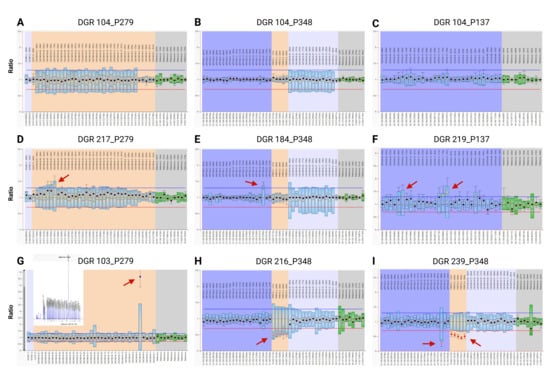
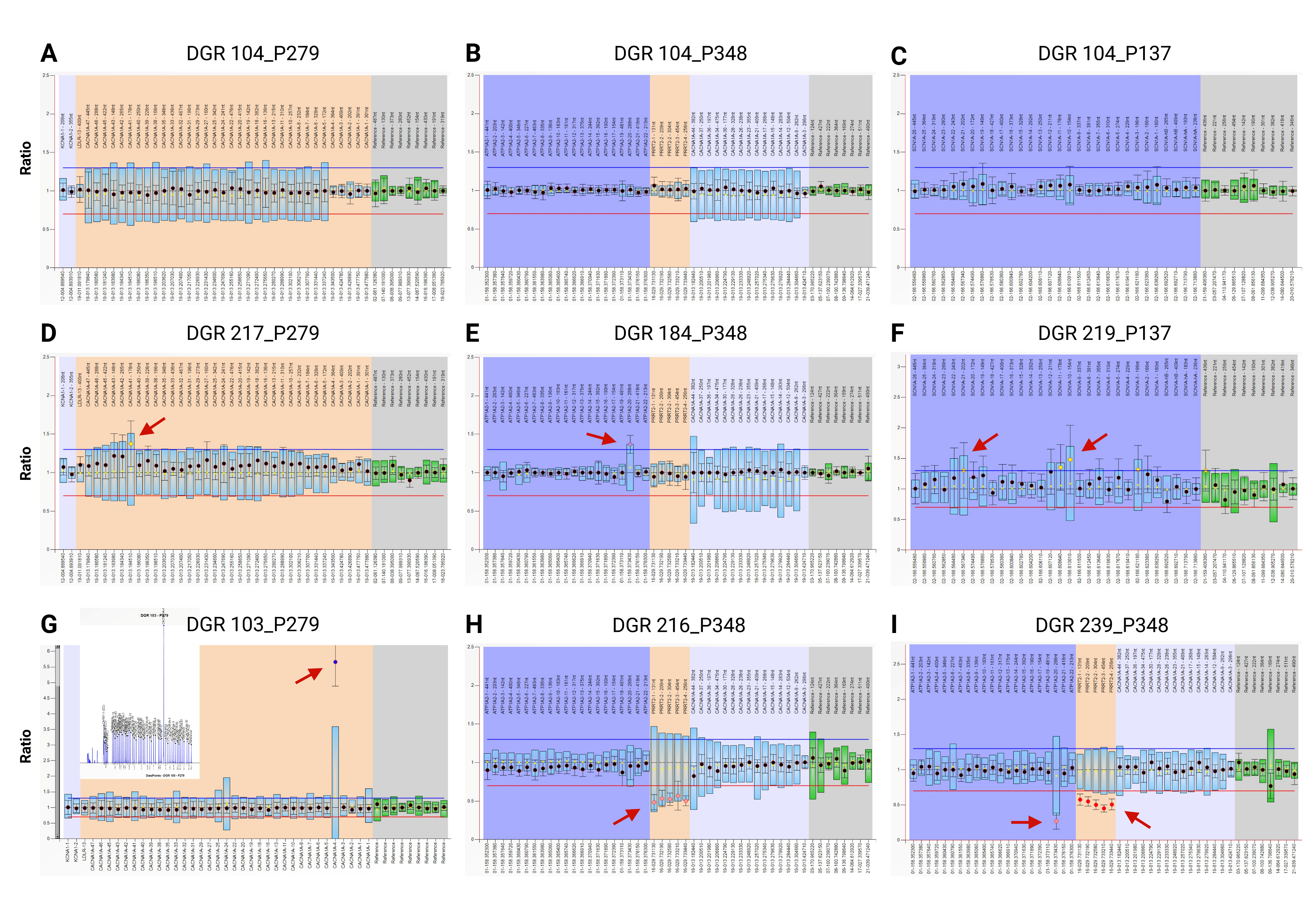
A total of 170 DNA samples were available from patients diagnosed with symptoms of hemiplegic migraine and referred for FHM gene testing, but negative for pathogenic mutations via NGS panel [4]. These were screened for CNVs in CACNA1A, ATP1A2, SCN1A, and PRRT2 using MLPA assays with the P137, P279 and P348 probe sets from MRC Holland. Examples of the ratio plots obtained from the electropherograms for selected samples using Coffalyser.Net software are shown in Figure 1A–I). For the majority of DNA samples CNVs were not detected with the FHM gene MLPA probe sets (e.g., DGR 104, Figure 1A–C). However, following initial evaluation of MLPA results, suspected CNVs in 31 patient DNAs were identified as annotated in Supplementary Table S2.
Figure 1.
MLPA results showing CNVs in FHM genes in hemiplegic migraine patients. Examples of Coffalyser ratio plots of MLPA analysis with MRC Holland P279 (CACNA1A exons), P348 (ATP1A2, PRRT2, and CACNA1A exons) and P137 (SCN1A exons) probe sets. Colour of dots indicates significance information: black—no significant difference; yellow—ambiguous; purple—increased by 1–2 Standard Deviations (SDs); blue—increased by ≥2 SDs; orange—decreased by 1–2 SDs; red—decreased by ≥2 SDs. (A–C) Analysis of DGR 104 showing no CNVs across the four genes. Red arrows indicate CNVs detected in samples: (D) duplication of CANCA1A exon 41 in DGR 217; (E) duplication of ATP1A2 exon 20 in DGR 184; (F) duplications of SCN1A exons 10, 11, and 21 in DGR 219; (G) five-fold amplification of CACNA1A exon 4 in DGR 103 with inset showing electropherogram from this sample; (H) deletion of all exons (1–4) of PRRT2 in DGR 216; (I) deletion of all exons (1–4) of PRRT2 as well as deletion of ATP1A2 exon 20 in DGR 239. Figure created in BioRender. Sutherland, H. (2026) https://BioRender.com/8pk5r2x (accessed on 24 December 2025).
As MPLA assays can be sensitive to the quality or salt concentrations of DNA, qPCR was subsequently used to further validate all the suspected CNVs. Not all CNVs identified using the MLPA were confirmed through qPCR, and some of the results obtained from both MLPA and qPCR analyses were inconclusive (Supplementary Table S2). Nevertheless, among the hemiplegic migraine samples analysed, a total of 15 cases exhibited confirmed CNVs involving the four targeted genes, as seen in Table 1. Interestingly, within this subset, three samples (DGR 112, DGR 146, and DGR 239) displayed multiple CNVs affecting more than one of the investigated genes.
Table 1.
Summary of confirmed CNVs in FHM genes identified in hemiplegic patients.
Six hemiplegic patients exhibited amplifications in CACNA1A, while two had deletions within this gene. Notably, four individuals had duplications of exon 41—DGR 92, DGR 114, DGR 217 (Figure 1D), and DGR 112 (which also had a SCN1A exon 24 deletion). A five-fold amplification of CACNA1A exon 4 was observed in DGR 103 by MLPA (Figure 1G), which was confirmed by qPCR (Supplementary Table S2). With respect to CACNA1A deletions, a heterozygous exon 8 deletion was observed in DGR 204, and DGR 146 had a complex array of CNVs which included deletion of CACNA1A exon 1, as well as exons 41 to 44.
A number of confirmed CNVs featuring exon 20 of ATP1A2 were detected in the hemiplegic migraine cohort. One sample (DGR 184) exhibited a heterozygous duplication of exon 20 (Figure 1E), while DGR 227 and DGR 239 had deletions of ATP1A2 exon 20. Notably, the latter patient also had a large deletion which included all four PRRT2 exons (Figure 1I and see below).
SCN1A variants can cause FHM or epilepsy (usually Dravet Syndrome), depending on their effect on channel function [35]. Two probands exhibited heterozygous deletions in SCN1A: DGR 123 had a heterozygous deletion of exons 18 to 21, while DGR 112 had a deletion of SCN1A exon 24 in addition to a CACNA1A exon 41 duplication. Heterozygous duplications of SCN1A exons 10, 11 and 21 were detected in DGR 219 (Figure 1F).
Heterozygous deletions of PRRT2, the most recently implicated FHM gene, were identified in five hemiplegic migraine patients. All exons of the gene were deleted in DGR 146, DGR 216 (Figure 1H), and DGR 239 (Figure 1I), while deletions encompassing exon 1 were confirmed in two other two probands (DGR 145 and DGR 189).
3.2. SNP Array Results
SNP arrays were performed for all samples and the FHM genes were examined for evidence of the CNVs identified via MLPA and qPCR. Only one deletion encompassing the entire PRRT2 gene in DGR 239 was validated through this method. In fact, the SNP array for DGR 239 showed that this deletion affected a large genomic region spanning approximately 610.5 kilobase pairs (kbp) at chromosome 16p11.2. As listed in Table 2, the region includes approximately 26 genes including PRRT2 and is a known recurrent microdeletion (16p11.2) [36]. The other validated CNVs in Table 1 were not detectable in the microarray data, suggesting that SNP array analysis is not particularly useful for detection of smaller CNVs.
Table 2.
CNV findings in SNP array for DGR 239 confirming deletion of genes including PRRT2.
4. Discussion
In this study, we conducted a comprehensive analysis of CNVs in the primary causal genes associated with hemiplegic migraine—CACNA1A, SCN1A, ATP1A2, and PRRT2—in a cohort comprising 170 patients clinically diagnosed with the disorder, but negative for pathogenic missense variants or small indels within these genes. MLPA analysis revealed the presence of both deletions and duplications within the FHM genes which were confirmed by qPCR in 15 probands as summarised in Table 1 and Supplementary Table S2. Notably, CNVs involving more than one FHM gene were found in three patients, which may interact through shared pathways.
CACNA1A encodes Voltage-Gated Calcium Channel Subunit Alpha1 A, the pore-forming subunit of Cav2.1, a major calcium channel in the brain. Duplications in CACNA1A were observed in six samples, while two samples exhibited deletions within the same gene. One notable finding was a five-fold amplification in exon 4 of CACNA1A in DGR 103, which would be likely to have functional implications in hemiplegic migraine pathogenesis for this patient. Interestingly, most of the observed duplications in CACNA1A included exon 41 (five out of six probands), suggesting that this genomic region may serve as a mutational hotspot for CNVs within the CACNA1A gene. Grieco et al. (2018), investigating CNVs in CACNA1A in hemiplegic migraine and episodic ataxia patients, also found deletions that included exon 41 in some hemiplegic migraine patients [6], further supporting the premise that this region is prone to genetic alteration and may play a significant role in hemiplegic migraine pathophysiology. A high frequency of deletions of CACNA1A exon 47 (with or without other exons) was also found in their cohort [6]. Copy number changes in CACNA1A are frequently associated with episodic ataxia; breakpoints often located in Alu repeats which may be involved in generating amplifications and deletions [29,37,38,39]. There is considerable overlap in symptoms between hemiplegic migraine patients and episodic ataxia patients, and the conditions may co-occur. Further investigation of copy number and other potential modifying susceptibility variants (including other CNVs) may lead to a better understanding of their impact on patients and more accurate diagnosis of these disorders.
One patient (DGR 184) exhibited an amplification specifically within exon 20 of ATP1A2. ATP1A2 encodes the α2 catalytic subunit of the ATPase Na+/K+ pump, which plays an important role in establishing and maintaining the electrochemical gradients which regulate neurotransmitter uptake and muscle contraction [40]. Gagliardi et al. (2017) suggest that ATP1A2 duplication might lead to elevated levels of extracellular potassium and intracellular sodium, resulting in increased intracellular calcium levels through the Na+/Ca2+ exchanger [8]. This would lead to increased synaptic glutamate, which can trigger cortical spreading depression, thought to underlie the aura that features in some migraine subtypes. Heterozygous deletions of exon 20 were found in DGR 227 and DGR 239. These findings highlight the potential involvement of different types of CNVs in this gene. Epilepsy may arise through ATP1A2 loss of function potentially including via deletions [41]. Although typically distinct, some studies have documented cases where FHM2 and epilepsy coexist within the same individual [42,43], suggesting similar pathogenic mechanisms affecting ion channels and pump function, although with other factors that may modify expression to manifest the different conditions [44]. Interestingly, DGR 239 was another example of a patient with a complex landscape of FHM gene-related CNVs, as additional to the ATP1A2 exon 20 deletion they had the 16p11.2 microdeletion which includes PRRT2.
Investigation of PRRT2 identified five samples with heterozygous deletions, further supporting a role for this gene in hemiplegic migraine. Riant et al. (2022) detected eight of 860 hemiplegic migraine probands with deletions of the whole PRRT2 gene [13]. Four of these had a deletion of ~546 kb at the 16p11.2 locus, similar to that the recurrent CNV of 16p11.2 deletion syndrome [36], and the deletion found in DGR 239 in this study. Among our cohort, another two individuals had heterozygous deletions spanning all four exons of PRRT2, but not large enough to be detected by microarray, and two other probands exhibited partial PRRT2 deletions. Chromosome 16 harbours highly homologous low-copy repeats, which facilitate genetic rearrangements through nonallelic homologous recombination events during meiosis [45]. Our findings underscore the presence of various types of deletions in this gene and the significance of PRRT2 in hemiplegic migraine pathogenesis.
PRRT2 is known to exert crucial roles in brain development, neurogenesis, synapse formation, and calcium-dependent neurotransmitter release [46]. PRRT2 deletions, particularly in the context of the larger 16p11.2 deletion, may also be associated with developmental delay phenotypes, as observed in the study conducted by Riant et al. (2022) [13]. Developmental delay was also a clinical feature of patient DGR 216 in this study, who had a heterozygous deletion of all exons of PRRT2 (and possibly other genes not detected by the MLPA assay). The clinical spectrum of neurocognitive phenotypes associated with 16p11.2 deletions is variable. Patients may present with intellectual disability, morbid obesity, large head circumference, epilepsy and other symptoms, each displaying varying degrees of penetrance [45]. This clinical heterogeneity and incomplete penetrance poses challenges for accurate clinical interpretation and diagnosis of 16p11.2 deletion patients as genotype–phenotype correlations are complex [45]. Multiple genes within the region may influence phenotypic expression, either singly, or through interaction with other genetic factors; detailed molecular investigations are needed to understand the underlying mechanisms of the diverse clinical presentations observed in patients with 16p11.2 deletions [47].
Analysis of SCN1A, which encodes the pore-forming subunit of the Nav1.1 sodium channel, revealed heterozygous deletions in two hemiplegic patients (DGR 112 and DGR 123) and amplifications across three distinct exons in another (DGR 219). Previous studies have shown that Nav1.1 channels regulate the excitability of neurons via mediating the depolarizing phase of action potentials in excitable membranes, and that deletions in SCN1A can cause Dravet syndrome and epilepsy [48,49]. Deletions in SCN1A have not been previously reported in hemiplegic migraine; rather, gain-of-function SCN1A variants are typically linked to FHM3 [50]. Therefore, together with studies identifying SCN1A point mutations in FHM, our findings suggest that CNVs in SCN1A may also be causal in some patients.
Limitations in our investigation included the availability of comprehensive clinical data for all enrolled patients which may impede clear understanding of genotype–phenotype relationships, and that the cohort comprised probands referred for diagnostic testing and other family members were unavailable for segregation analysis. Nevertheless, comparing available clinical information with patients with classical pathogenic variants in FHM genes showed a similar range of phenotypes as those with CNVs, such as hemiplegic migraine episodes, family history of migraine/FHM, and some cases with onset of symptoms from an early age and developmental delay [4]. On the other hand, in patients in which no pathogenic variant has yet been identified, additional varied symptoms were reported in some patients, such as vertigo and brain stem aura features, stroke-like episodes, pyramidal signs, and late onset of symptoms. This suggests that this group may represent a more genetically and phenotypically diverse cohort, and possible confounding factors could include non-motor complex auras [51,52], migraine with unilateral motor symptoms (MUMS) [53], or cerebral small vessel disease [54] (although with respect to the latter, patients had been excluded for pathogenic NOTCH3 variants).
Validating some of the CNVs detected by MLPA via qPCR was challenging, as the estimated copy number was inconclusive in some cases and they could not be confirmed as true CNVs. Further, SNP array analysis was only able to confirm one large deletion in a single patient, underlining that SNP arrays are more useful for larger CNV detection. We also acknowledge that due to cost constraints we did not perform MLPA assays on non-migraine controls in this study to determine whether any of these specific CNVs are present in the general population.
To extend understanding of such CNVs in FHM, other approaches may be undertaken in the future. For instance, long-read sequencing techniques could offer more precise identification of the breakpoints, boundaries, and arrangements of these structural genomic alterations. Additionally, gene expression studies utilising RNA sequencing would be beneficial to understand the impact of the CNVs on transcript structure and gene expression at each loci [55,56]. Future studies incorporating functional analyses, using derived patient-specific cell lines or CRISPR-Cas9-based gene-editing techniques to introduce CNVs into cell lines could contribute to elucidating the consequences of these specific CNVs when compared with controls [57,58,59,60].
5. Conclusions
We report the presence of CNVs in known FHM causal genes in a subset of hemiplegic migraine cases in the absence of pathogenic SNV or small indels in these genes, expanding our understanding of the genetic factors that underly this condition. The identification of CNVs in CACNA1A, ATP1A2, SCN1A, and PRRT2, as well as the co-occurrence of CNVs in multiple genes, underscores the complexity of the genetic landscape in hemiplegic migraine. With classical pathogenic variants (missense, nonsense, splicing, small indels) identified in only ~20% of referred patients with symptoms of hemiplegic migraine, finding a molecular diagnosis in an additional ~9% of individuals represents a substantial uplift in diagnostic rate. Furthermore, this knowledge may be translated into clinical practise by treating the patient with drugs that target, or are effective for, the affected ion channel or ATPase, similar to what occurs for cases with classical pathogenic variants [61,62]. Thus, this comprehensive analysis of CNVs, particularly the confirmation of PRRT2 deletions and duplications found in exon 41 of CACNA1A, provides valuable insights and a broader understanding of the underlying molecular basis of hemiplegic migraine and may inform improved diagnostic strategies and targeted therapeutic approaches for affected individuals.
Supplementary Materials
The following supporting information can be downloaded at: https://www.mdpi.com/article/10.3390/biomedicines14050954/s1, Table S1: Sequences of qPCR primers and amplicons for CNV validations, Table S2: Summary of qPCR analysis.
Author Contributions
H.G.S. and L.R.G. conceptualised and supervised this study; the process of participant recruitment, DNA acquisition, and clinical information collection was carried out by N.M., R.A.S. and L.R.G.; T.Z. and N.M. performed the DNA extractions; T.Z. performed the molecular genetic studies statistical analyses; T.Z. and H.G.S. composed the tables and figures; T.Z. wrote the first draft of the manuscript. All authors have read and agreed to the published version of the manuscript.
Funding
This work was supported by the following funding sources awarded to L.R.G.: the Australian National Health and Medical Research Council (NHMRC-APP1122387); a US Migraine Research Foundation grant (2019); an Australian International Science Linkages grant; and by infrastructure purchased with Australian Government EIF Super Science Funds as part of the Therapeutic Innovation Australia–Queensland Node project. T.Z. was supported by a QUT South American Scholarship and accompanying QUT HDR Tuition Fee Sponsorship. H.G.S., N.M., R.A.S. and L.R.G. received salary support from QUT.
Institutional Review Board Statement
This study was conducted in accordance with the Declaration of Helsinki and approved by the Queensland University of Technology Human Research Ethics Committee (Project ID: 7416, date of approval 14 May 2024).
Informed Consent Statement
Informed consent was obtained from all subjects involved in the study via their treating doctor.
Data Availability Statement
All data supporting the findings of this study are available within the paper and Supplementary Tables.
Acknowledgments
We thank the patients and their referring doctors for their participation in this study. We would like to acknowledge initial work by Ellie Maas on the MLPA protocol and the Australian Translational Genomics Centre (QUT) for performing the SNP arrays.
Conflicts of Interest
L.R.G. reports recent consultancy support from Teva, participates on the Aust Novartis migraine Advisory Board, and has received research support from VariantBio. She also serves as chair for the Board of Censors, Diagnostic Genomics, Human Genetics Society Australasia. The other authors declare no conflicts of interest. The funders had no role in the design of the study; in the collection, analyses, or interpretation of data; in the writing of the manuscript; or in the decision to publish the results.
Abbreviations
The following abbreviations are used in this manuscript:
| CNV | Copy number variation |
| FHM | Familial hemiplegic migraine |
| MLPA | Multiplex ligation-dependent probe amplification |
| NGS | Next generation sequencing |
| PCR | Polymerase chain reaction |
| qPCR | Quantitative PCR |
| QUT | Queensland University of Technology |
| SHM | Sporadic hemiplegic migraine |
| SNP | Single nucleotide polymorphism |
| SNV | Single nucleotide variants |
References
- Headache Classification Committee of the International Headache Society (IHS). The International Classification of Headache Disorders, 3rd Edition. Cephalalgia 2018, 38, 1–211. [Google Scholar] [CrossRef] [Scilit]
- Russell, M.B.; Ducros, A. Sporadic and familial hemiplegic migraine: Pathophysiological mechanisms, clinical characteristics, diagnosis, and management. Lancet Neurol. 2011, 10, 457–470. [Google Scholar] [CrossRef] [Scilit]
- Eising, E.; van den Maagdenberg, A.M.J.M. Hemiplegic Migraine and Channel Disorders. In Reference Module in Neuroscience and Biobehavioral Psychology; Elsevier: Amsterdam, The Netherlands, 2017. [Google Scholar] [CrossRef] [Scilit]
- Maksemous, N.; Smith, R.A.; Sutherland, H.G.; Maher, B.H.; Ibrahim, O.; Nicholson, G.A.; Carpenter, E.P.; Lea, R.A.; Cader, M.Z.; Griffiths, L.R. Targeted next generation sequencing identifies a genetic spectrum of DNA variants in patients with hemiplegic migraine. Cephalalgia Rep. 2019, 2, 1–9. [Google Scholar] [CrossRef] [Scilit]
- Sutherland, H.G.; Maksemous, N.; Albury, C.L.; Ibrahim, O.; Smith, R.A.; Lea, R.A.; Haupt, L.M.; Jenkins, B.; Tsang, B.; Griffiths, L.R. Comprehensive Exonic Sequencing of Hemiplegic Migraine-Related Genes in a Cohort of Suspected Probands Identifies Known and Potential Pathogenic Variants. Cells 2020, 9, 2368. [Google Scholar] [CrossRef] [Scilit]
- Grieco, G.S.; Gagliardi, S.; Ricca, I.; Pansarasa, O.; Neri, M.; Gualandi, F.; Nappi, G.; Ferlini, A.; Cereda, C. New CACNA1A deletions are associated to migraine phenotypes. J. Headache Pain 2018, 19, 75. [Google Scholar] [CrossRef] [Scilit]
- Hiekkala, M.E.; Vuola, P.; Artto, V.; Happola, P.; Happola, E.; Vepsalainen, S.; Cuenca-Leon, E.; Lal, D.; Gormley, P.; Hamalainen, E.; et al. The contribution of CACNA1A, ATP1A2 and SCN1A mutations in hemiplegic migraine: A clinical and genetic study in Finnish migraine families. Cephalalgia 2018, 38, 1849–1863. [Google Scholar] [CrossRef] [Scilit] [PubMed]
- Gagliardi, S.; Grieco, G.S.; Gualandi, F.; Caniatti, L.M.; Groppo, E.; Valente, M.; Nappi, G.; Neri, M.; Cereda, C. De novo exonic duplication of ATP1A2 in Italian patient with hemiplegic migraine: A case report. J. Headache Pain 2017, 18, 63. [Google Scholar] [CrossRef] [Scilit] [PubMed]
- De Boer, I.; Terwindt, G.M.; van den Maagdenberg, A.M.J.M. Genetics of migraine aura: An update. J. Headache Pain 2020, 21, 64. [Google Scholar] [CrossRef] [Scilit] [PubMed]
- Riant, F.; Roze, E.; Barbance, C.; Méneret, A.; Guyant-Maréchal, L.; Lucas, C.; Sabouraud, P.; Trébuchon, A.; Depienne, C.; Tournier-Lasserve, E. PRRT2 mutations cause hemiplegic migraine. Neurology 2012, 79, 2122–2124. [Google Scholar] [CrossRef] [Scilit]
- Dale, R.C.; Gardiner, A.; Antony, J.; Houlden, H. Familial PRRT2 mutation with heterogeneous paroxysmal disorders including paroxysmal torticollis and hemiplegic migraine. Dev. Med. Child Neurol. 2012, 54, 958–960. [Google Scholar] [CrossRef] [Scilit]
- Ebrahimi-Fakhari, D.; Saffari, A.; Westenberger, A.; Klein, C. The evolving spectrum of PRRT2-associated paroxysmal diseases. Brain 2015, 138, 3476–3495. [Google Scholar] [CrossRef] [Scilit] [PubMed]
- Riant, F.; Roos, C.; Roubertie, A.; Barbance, C.; Hadjadj, J.; Auvin, S.; Baille, G.; Beltramone, M.; Boulanger, C.; Cahn, A.; et al. Hemiplegic Migraine Associated with PRRT2 Variations: A Clinical and Genetic Study. Neurology 2022, 98, e51–e61. [Google Scholar] [CrossRef] [Scilit]
- Gardiner, A.R.; Bhatia, K.P.; Stamelou, M.; Dale, R.C.; Kurian, M.A.; Schneider, S.A.; Wali, G.M.; Counihan, T.; Schapira, A.H.; Spacey, S.D.; et al. PRRT2 gene mutations: From paroxysmal dyskinesia to episodic ataxia and hemiplegic migraine. Neurology 2012, 79, 2115–2121. [Google Scholar] [CrossRef] [Scilit]
- Valente, P.; Castroflorio, E.; Rossi, P.; Fadda, M.; Sterlini, B.; Cervigni, R.I.; Prestigio, C.; Giovedi, S.; Onofri, F.; Mura, E.; et al. PRRT2 Is a Key Component of the Ca2+-Dependent Neurotransmitter Release Machinery. Cell Rep. 2016, 15, 117–131. [Google Scholar] [CrossRef] [Scilit]
- Coleman, J.; Jouannot, O.; Ramakrishnan, S.K.; Zanetti, M.N.; Wang, J.; Salpietro, V.; Houlden, H.; Rothman, J.E.; Krishnakumar, S.S. PRRT2 Regulates Synaptic Fusion by Directly Modulating SNARE Complex Assembly. Cell Rep. 2018, 22, 820–831. [Google Scholar] [CrossRef] [Scilit]
- Kramer, D.R.; Fujii, T.; Ohiorhenuan, I.; Liu, C.Y. Cortical spreading depolarization: Pathophysiology, implications, and future directions. J. Clin. Neurosci. 2016, 24, 22–27. [Google Scholar] [CrossRef] [Scilit] [PubMed]
- Pietrobon, D.; Moskowitz, M.A. Chaos and commotion in the wake of cortical spreading depression and spreading depolarizations. Nat. Rev. Neurosci. 2014, 15, 379–393. [Google Scholar] [CrossRef] [Scilit] [PubMed]
- Lu, B.; Lou, S.S.; Xu, R.S.; Kong, D.L.; Wu, R.J.; Zhang, J.; Zhuang, L.; Wu, X.M.; He, J.Y.; Wu, Z.Y.; et al. Cerebellar spreading depolarization mediates paroxysmal movement disorder. Cell Rep. 2021, 36, 109743. [Google Scholar] [CrossRef] [Scilit]
- Sagoo, G.S.; Butterworth, A.S.; Sanderson, S.; Shaw-Smith, C.; Higgins, J.P.; Burton, H. Array CGH in patients with learning disability (mental retardation) and congenital anomalies: Updated systematic review and meta-analysis of 19 studies and 13,926 subjects. Genet. Med. 2009, 11, 139–146. [Google Scholar] [CrossRef] [Scilit]
- Pfundt, R.; Del Rosario, M.; Vissers, L.; Kwint, M.P.; Janssen, I.M.; de Leeuw, N.; Yntema, H.G.; Nelen, M.R.; Lugtenberg, D.; Kamsteeg, E.J.; et al. Detection of clinically relevant copy-number variants by exome sequencing in a large cohort of genetic disorders. Genet. Med. 2017, 19, 667–675. [Google Scholar] [CrossRef] [Scilit]
- Truty, R.; Paul, J.; Kennemer, M.; Lincoln, S.E.; Olivares, E.; Nussbaum, R.L.; Aradhya, S. Prevalence and properties of intragenic copy-number variation in Mendelian disease genes. Genet. Med. 2019, 21, 114–123. [Google Scholar] [CrossRef] [Scilit] [PubMed]
- Commission-on-Novel-Technologies-for-Neurodevelopmental-Copy-Number-Variants. Neurodevelopmental copy-number variants: A roadmap to improving outcomes by uniting patient advocates, researchers, and clinicians for collective impact. Am. J. Hum. Genet. 2022, 109, 1353–1365. [CrossRef] [Scilit]
- Cooper, G.M.; Coe, B.P.; Girirajan, S.; Rosenfeld, J.A.; Vu, T.H.; Baker, C.; Williams, C.; Stalker, H.; Hamid, R.; Hannig, V.; et al. A copy number variation morbidity map of developmental delay. Nat. Genet. 2011, 43, 838–846. [Google Scholar] [CrossRef] [Scilit]
- Mullen, S.A.; Berkovic, S.F.; ILAE Genetics Commission. Genetic generalized epilepsies. Epilepsia 2018, 59, 1148–1153. [Google Scholar] [CrossRef] [Scilit]
- Girirajan, S.; Rosenfeld, J.A.; Coe, B.P.; Parikh, S.; Friedman, N.; Goldstein, A.; Filipink, R.A.; McConnell, J.S.; Angle, B.; Meschino, W.S.; et al. Phenotypic Heterogeneity of Genomic Disorders and Rare Copy-Number Variants. N. Engl. J. Med. 2012, 367, 1321–1331. [Google Scholar] [CrossRef] [Scilit] [PubMed]
- Pennings, M.; Meijer, R.P.P.; Gerrits, M.; Janssen, J.; Pfundt, R.; de Leeuw, N.; Gilissen, C.; Gardeitchik, T.; Schouten, M.; Voermans, N.; et al. Copy number variants from 4800 exomes contribute to ~7% of genetic diagnoses in movement disorders, muscle disorders and neuropathies. Eur. J. Hum. Genet. 2023, 31, 654–662. [Google Scholar] [CrossRef] [Scilit]
- Stuppia, L.; Antonucci, I.; Palka, G.; Gatta, V. Use of the MLPA assay in the molecular diagnosis of gene copy number alterations in human genetic diseases. Int. J. Mol. Sci. 2012, 13, 3245–3276. [Google Scholar] [CrossRef] [Scilit]
- Labrum, R.W.; Rajakulendran, S.; Graves, T.D.; Eunson, L.H.; Bevan, R.; Sweeney, M.G.; Hammans, S.R.; Tubridy, N.; Britton, T.; Carr, L.J.; et al. Large scale calcium channel gene rearrangements in episodic ataxia and hemiplegic migraine: Implications for diagnostic testing. J. Med. Genet. 2009, 46, 786–791. [Google Scholar] [CrossRef] [Scilit]
- Carreño, O.; Corominas, R.; Angèlica Serra, S.; Sintas, C.; Fernández-Castillo, N.; Vila-Pueyo, M.; Toma, C.; Gené, G.G.; Pons, R.; Llaneza, M.; et al. Screening of CACNA1A and ATP1A2 genes in hemiplegic migraine: Clinical, genetic, and functional studies. Mol. Genet. Genom. Med. 2013, 1, 206–222. [Google Scholar] [CrossRef] [Scilit] [PubMed]
- Lavrichenko, K.; Johansson, S.; Jonassen, I. Comprehensive characterization of copy number variation (CNV) called from array, long- and short-read data. BMC Genom. 2021, 22, 826. [Google Scholar] [CrossRef] [Scilit]
- Zielke, T. Investigating the Role of Rare and Common Genetic Variants in Migraine Subtypes. Ph.D. Thesis, Queensland University of Technology, Brisbane, Australia, 2024. [Google Scholar]
- Maren, N.A.; Duduit, J.R.; Huang, D.; Zhao, F.; Ranney, T.G.; Liu, W. Stepwise Optimization of Real-Time RT-PCR Analysis. Methods Mol. Biol. 2023, 2653, 317–332. [Google Scholar] [CrossRef] [Scilit]
- Damgaard, M.V.; Treebak, J.T. Protocol for qPCR analysis that corrects for cDNA amplification efficiency. STAR Protoc. 2022, 3, 101515. [Google Scholar] [CrossRef] [Scilit]
- Heyne, H.O.; Baez-Nieto, D.; Iqbal, S.; Palmer, D.S.; Brunklaus, A.; May, P.; Epi25 Collaborative; Johannesen, K.M.; Lauxmann, S.; Lemke, J.R.; et al. Predicting functional effects of missense variants in voltage-gated sodium and calcium channels. Sci. Transl. Med. 2020, 12, eaay6848. [Google Scholar] [CrossRef] [Scilit]
- Chung, W.K.; Roberts, T.P.; Sherr, E.H.; Snyder, L.G.; Spiro, J.E. 16p11.2 deletion syndrome. Curr. Opin. Genet. Dev. 2021, 68, 49–56. [Google Scholar] [CrossRef] [Scilit]
- Riant, F.; Lescoat, C.; Vahedi, K.; Kaphan, E.; Toutain, A.; Soisson, T.; Wiener-Vacher, S.R.; Tournier-Lasserve, E. Identification of CACNA1A large deletions in four patients with episodic ataxia. Neurogenetics 2010, 11, 101–106. [Google Scholar] [CrossRef] [Scilit]
- Wan, J.; Mamsa, H.; Johnston, J.L.; Spriggs, E.L.; Singer, H.S.; Zee, D.S.; Al-Bayati, A.R.; Baloh, R.W.; Jen, J.C.; CINCH Investigators. Large Genomic Deletions in CACNA1A Cause Episodic Ataxia Type 2. Front. Neurol. 2011, 2, 51. [Google Scholar] [CrossRef] [Scilit] [PubMed]
- Sintas, C.; Carreno, O.; Fernandez-Castillo, N.; Corominas, R.; Vila-Pueyo, M.; Toma, C.; Cuenca-Leon, E.; Barroeta, I.; Roig, C.; Volpini, V.; et al. Mutation Spectrum in the CACNA1A Gene in 49 Patients with Episodic Ataxia. Sci. Rep. 2017, 7, 2514. [Google Scholar] [CrossRef] [Scilit] [PubMed]
- Kinoshita, P.F.; Leite, J.A.; Orellana, A.M.M.; Vasconcelos, A.R.; Quintas, L.E.M.; Kawamoto, E.M.; Scavone, C. The Influence of Na+, K+-ATPase on Glutamate Signaling in Neurodegenerative Diseases and Senescence. Front. Physiol. 2016, 7, 195. [Google Scholar] [CrossRef] [Scilit]
- García-Hernández, J.L.; Corchete, L.A.; Marcos-Alcalde, Í.; Gómez-Puertas, P.; Fons, C.; Lazo, P.A. Pathogenic convergence of CNVs in genes functionally associated to a severe neuromotor developmental delay syndrome. Hum. Genet. 2021, 15, 11. [Google Scholar] [CrossRef] [Scilit]
- Wilbur, C.; Buerki, S.E.; Guella, I.; Toyota, E.B.; Evans, D.M.; McKenzie, M.B.; Datta, A.; Michoulas, A.; Adam, S.; Van Allen, M.I.; et al. An Infant with Epilepsy and Recurrent Hemiplegia due to Compound Heterozygous Variants in ATP1A2. Pediatr. Neurol. 2017, 75, 87–90. [Google Scholar] [CrossRef] [Scilit]
- Prontera, P.; Sarchielli, P.; Caproni, S.; Bedetti, C.; Cupini, L.; Calabresi, P.; Costa, C. Epilepsy in hemiplegic migraine: Genetic mutations and clinical implications. Cephalalgia 2018, 38, 361–373. [Google Scholar] [CrossRef] [Scilit] [PubMed]
- Pisano, T.; Spiller, S.; Mei, D.; Guerrini, R.; Cianchetti, C.; Friedrich, T.; Pruna, D. Functional characterization of a novel C-terminal ATP1A2 mutation causing hemiplegic migraine and epilepsy. Cephalalgia 2013, 33, 1302–1310. [Google Scholar] [CrossRef] [Scilit] [PubMed]
- Fetit, R.; Price, D.J.; Lawrie, S.M.; Johnstone, M. Understanding the clinical manifestations of 16p11.2 deletion syndrome: A series of developmental case reports in children. Psychiatr. Genet. 2020, 30, 136–140. [Google Scholar] [CrossRef] [Scilit]
- Landolfi, A.; Barone, P.; Erro, R. The Spectrum of PRRT2-Associated Disorders: Update on Clinical Features and Pathophysiology. Front. Neurol. 2021, 12, 629747. [Google Scholar] [CrossRef] [Scilit]
- Szelest, M.; Stefaniak, M.; Ręka, G.; Jaszczuk, I.; Lejman, M. Three case reports of patients indicating the diversity of molecular and clinical features of 16p11.2 microdeletion anomaly. BMC Med. Genom. 2021, 14, 76. [Google Scholar] [CrossRef] [Scilit]
- Wang, J.-Y.; Tang, B.; Sheng, W.-X.; Hua, L.-D.; Zeng, Y.; Fan, C.-X.; Deng, W.-Y.; Gao, M.-M.; Zhu, W.-W.; He, N.; et al. Clinical and Functional Features of Epilepsy-Associated In-Frame Deletion Variants in SCN1A. Front. Mol. Neurosci. 2022, 15, 828846. [Google Scholar] [CrossRef] [Scilit]
- Depienne, C.; Trouillard, O.; Saint-Martin, C.; Gourfinkel-An, I.; Bouteiller, D.; Carpentier, W.; Keren, B.; Abert, B.; Gautier, A.; Baulac, S.; et al. Spectrum of SCN1A gene mutations associated with Dravet syndrome: Analysis of 333 patients. J. Med. Genet. 2009, 46, 183–191. [Google Scholar] [CrossRef] [Scilit]
- Brunklaus, A.; Brünger, T.; Feng, T.; Fons, C.; Lehikoinen, A.; Panagiotakaki, E.; Vintan, M.-A.; Symonds, J.; Andrew, J.; Arzimanoglou, A.; et al. The gain of function SCN1A disorder spectrum: Novel epilepsy phenotypes and therapeutic implications. Brain 2022, 145, 3816–3831. [Google Scholar] [CrossRef] [Scilit]
- de Tommaso, M.; Ambrosini, A.; Brighina, F.; Coppola, G.; Perrotta, A.; Pierelli, F.; Sandrini, G.; Valeriani, M.; Marinazzo, D.; Stramaglia, S.; et al. Altered processing of sensory stimuli in patients with migraine. Nat. Rev. Neurol. 2014, 10, 144–155. [Google Scholar] [CrossRef] [Scilit] [PubMed]
- Fitzek, M.P.; Mecklenburg, J.; Overeem, L.H.; Lange, K.S.; Siebert, A.; Triller, P.; Neeb, L.; Dreier, J.P.; Kondziella, D.; Reuter, U.; et al. Alice in Wonderland Syndrome (AIWS): Prevalence and characteristics in adults with migraine. J. Neurol. 2024, 271, 5146–5155. [Google Scholar] [CrossRef] [Scilit]
- Young, W.B.; Gangal, K.S.; Aponte, R.J.; Kaiser, R.S. Migraine with unilateral motor symptoms: A case-control study. J. Neurol. Neurosurg. Psychiatry 2007, 78, 600–604. [Google Scholar] [CrossRef] [Scilit]
- Sutherland, H.G.; Jenkins, B.; Griffiths, L.R. Genetics of migraine: Complexity, implications, and potential clinical applications. Lancet Neurol. 2024, 23, 429–446. [Google Scholar] [CrossRef] [Scilit]
- Gamazon, E.R.; Stranger, B.E. The impact of human copy number variation on gene expression. Brief. Funct. Genom. 2015, 14, 352–357. [Google Scholar] [CrossRef] [Scilit]
- Henrichsen, C.N.; Chaignat, E.; Reymond, A. Copy number variants, diseases and gene expression. Hum. Mol. Genet. 2009, 18, R1–R8. [Google Scholar] [CrossRef] [Scilit] [PubMed]
- Aguirre, A.J.; Meyers, R.M.; Weir, B.A.; Vazquez, F.; Zhang, C.-Z.; Ben-David, U.; Cook, A.; Ha, G.; Harrington, W.F.; Doshi, M.B.; et al. Genomic copy number dictates a gene-independent cell response to CRISPR/Cas9 targeting. Cancer Discov. 2016, 6, 914–929. [Google Scholar] [CrossRef] [Scilit] [PubMed]
- Bassett, A.R. Editing the genome of hiPSC with CRISPR/Cas9: Disease models. Mamm. Genome 2017, 28, 348–364. [Google Scholar] [CrossRef] [Scilit]
- Canver, M.C.; Bauer, D.E.; Dass, A.; Yien, Y.Y.; Chung, J.; Masuda, T.; Maeda, T.; Paw, B.H.; Orkin, S.H. Characterization of genomic deletion efficiency mediated by clustered regularly interspaced short palindromic repeats (CRISPR)/Cas9 nuclease system in mammalian cells. J. Biol. Chem. 2014, 289, 21312–21324. [Google Scholar] [CrossRef] [Scilit]
- Tai, D.J.C.; Ragavendran, A.; Manavalan, P.; Stortchevoi, A.; Seabra, C.M.; Erdin, S.; Collins, R.L.; Blumenthal, I.; Chen, X.; Shen, Y.; et al. Engineering microdeletions and microduplications by targeting segmental duplications with CRISPR. Nat. Neurosci. 2016, 19, 517–522. [Google Scholar] [CrossRef] [Scilit]
- Pelzer, N.; Stam, A.H.; Haan, J.; Ferrari, M.D.; Terwindt, G.M. Familial and sporadic hemiplegic migraine: Diagnosis and treatment. Curr. Treat. Options Neurol. 2013, 15, 13–27. [Google Scholar] [CrossRef] [Scilit] [PubMed]
- Di Stefano, V.; Rispoli, M.G.; Pellegrino, N.; Graziosi, A.; Rotondo, E.; Napoli, C.; Pietrobon, D.; Brighina, F.; Parisi, P. Diagnostic and therapeutic aspects of hemiplegic migraine. J. Neurol. Neurosurg. Psychiatry 2020, 91, 764–771. [Google Scholar] [CrossRef] [Scilit]

Disclaimer/Publisher’s Note: The statements, opinions and data contained in all publications are solely those of the individual author(s) and contributor(s) and not of MDPI and/or the editor(s). MDPI and/or the editor(s) disclaim responsibility for any injury to people or property resulting from any ideas, methods, instructions or products referred to in the content. |
© 2026 by the authors. Licensee MDPI, Basel, Switzerland. This article is an open access article distributed under the terms and conditions of the Creative Commons Attribution (CC BY) license.