


Abstract
Background: Trigger finger (TF) is increasingly linked to metabolic dysregulation, yet its relationship with cardiovascular disease (CVD) remains poorly characterized. We evaluated whether TF is independently associated with incident cardiovascular events. Methods: Using the TriNetX Global Collaborative Network, we identified adults with new-onset TF (2005–2023) and 1:1 propensity score-matched them to controls without TF, excluding those with pre-existing CVD. The hazard ratio and 95% confidence interval of CVD risks, stratified by age, sex, and race, were reported. Rheumatoid arthritis (RA) and ankylosing spondylitis (AS) cohorts served as active comparators to contextualize risk magnitude. Results: The matched cohorts (n = 194,532 per group; mean age 56.2 years) were well-balanced. TF was independently associated with increased risks of composite cardiovascular events (CCEs), including myocardial infarction, ischemic stroke, and heart failure. Elevated CCE risk persisted across age groups and was stronger in women (HR: 1.29; 95% CI: 1.24–1.34) than men (HR: 1.18; 95% CI: 1.12–1.23). Asian patients exhibited the highest relative risk (HR: 1.59; 95% CI: 1.37–1.84), including specific elevations in heart failure and hemorrhagic stroke. Notably, cardiovascular risks in patients with TF were comparable to, and in some instances exceeded, those observed in the RA and AS active comparator cohorts. Conclusions: Trigger finger is associated with subsequent CCE and structural heart disease. These findings suggest that TF may be associated with broader cardiovascular vulnerability. Further studies are needed to determine whether selected high-risk patients with TF may benefit from additional cardiovascular assessment.
1. Introduction
Trigger finger (TF), also known as stenosing flexor tenosynovitis, is a common hand disorder characterized by impaired flexion and extension of the affected digit, often causing pain, locking, and functional limitation. The condition results from a mismatch between the flexor tendon and its sheath, leading to mechanical obstruction during tendon gliding [1]. TF affects approximately 2% of the general population and up to 20% of individuals with diabetes, with higher prevalence in women and adults aged 40–59 years [1,2]. While traditionally considered an overuse syndrome, emerging evidence implicates metabolic and cardiovascular factors in its development.
Epidemiological studies have consistently identified diabetes mellitus, rheumatoid arthritis, and female sex as key risk factors for TF, with diabetes associated not only with higher incidence but also greater disease severity [3,4]. Poor glycemic control, reflected by elevated HbA1c, further increases TF risk in both type 1 and type 2 diabetes, highlighting the importance of metabolic regulation in disease prevention [5]. Beyond glucose dysregulation, hyperlipidemia has emerged as an independent risk factor: large-scale cohort studies demonstrate a fourfold higher incidence of TF among individuals with elevated lipid levels, even after adjusting for comorbidities [6]. These findings suggest that vascular and inflammatory mechanisms contribute to tendon pathology in the context of metabolic dysfunction. Taken together, the strong associations with diabetes and dyslipidemia raise the possibility that TF is not merely a localized hand disorder but may serve as a clinical marker of systemic metabolic and vascular abnormalities.
Despite these mechanistic insights, the relationship between TF and cardiovascular disease (CVD) remains poorly characterized. Few studies have directly examined cardiovascular outcomes. For example, Sood and Lipira analyzed a nationwide cohort of Veterans Health Administration patients undergoing trigger finger release and reported a nearly twofold increased risk of heart failure compared with controls [7]. However, their study was limited to predominantly male surgical patients and did not assess non-surgical TF cases or a broader range of cardiovascular outcomes.
To address these gaps, the present study examines a large, diverse, population-based cohort using rigorous propensity score matching, stratified analyses by age, sex, and race, and active comparator groups with established inflammatory rheumatic diseases, including rheumatoid arthritis and ankylosing spondylitis. This comprehensive approach enables a robust evaluation of whether TF is independently associated with incident cardiovascular events, while accounting for confounding factors and capturing a wide spectrum of outcomes.
2. Materials and Methods
2.1. Data Origin and Study Framework
This investigation was designed as a retrospective cohort analysis based on data retrieved from the TriNetX research platform (TriNetX LLC, MA, United States), a federated network that curates continuously refreshed, de-identified electronic health records from healthcare institutions worldwide. The dataset was drawn from the TriNetX Global Collaborative Network, which consolidates clinical information from over 150 medical organizations across North America, Europe, and Asia, collectively representing a population exceeding 150 million individuals. Data from TriNetX platform was analyzed in epidemiological and public health studies in various fields [8,9,10].
2.2. Ethical Approval and Data Governance
The study protocol adhered to the principles outlined in the Declaration of Helsinki. Approval was granted by the Institutional Review Board of Chung Shan Medical University Hospital (CS1-25002), Chi Mei Medical Center (11502-E02), and Ditmanson Medical Foundation Chia-Yi Christian Hospital (No. IRB2025121), which waived the requirement for informed consent due to the use of anonymized data. All study data were accessed through the TriNetX Research Network, where data handling and governance are managed centrally by the TriNetX system. Additional details regarding data stewardship can be found on the network’s official website.
2.3. Cohort Selection
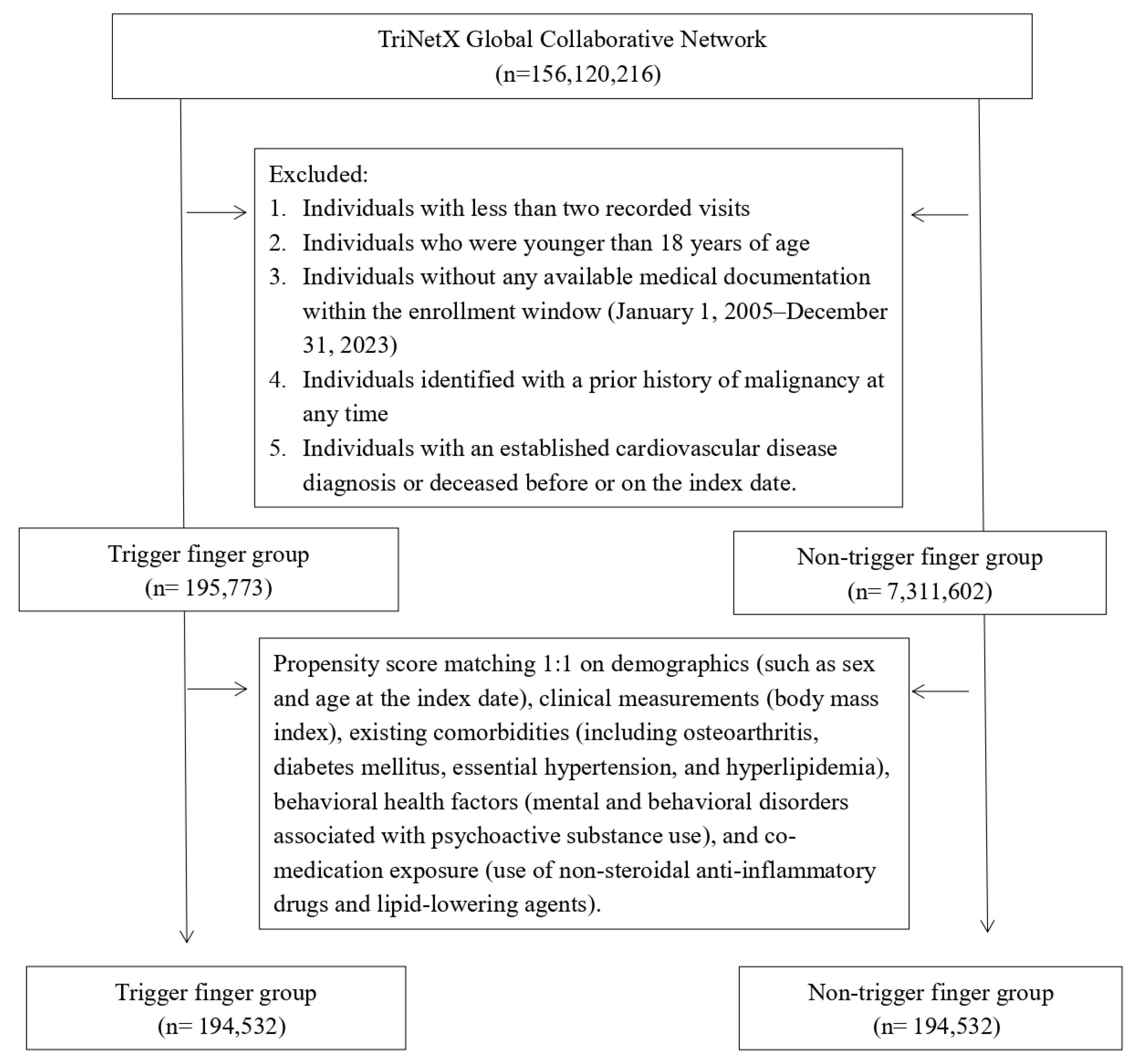
Participants were identified using diagnostic, procedural, and prescription coding systems recorded between 2005 and 2023 (complete code definitions provided in Table S1). Individuals assigned to the TF cohort were required to have a documented TF diagnosis and a minimum of two recorded clinical encounters. The comparison group consisted of individuals who underwent adult health evaluations and had no prior record of TF (Figure 1). Patients were excluded if they were younger than 18 years, had a documented history of malignancy, or had died on or before the index date. Patients with any previously documented cardiovascular diagnosis included in the predefined exclusion criteria were also excluded. These criteria encompassed both components of the primary composite cardiovascular outcome and the broader cardiovascular conditions assessed as secondary outcomes. All qualifying diagnoses were combined using an OR operator, and the presence of any such diagnosis on or before the index date resulted in exclusion. The complete diagnostic codes are provided in Supplementary Table S1. To minimize baseline imbalances, a 1:1 propensity score-matching approach was applied. Matching variables included demographic factors (age at index date and sex), anthropometric measures (body mass index), comorbid conditions (such as diabetes mellitus, osteoarthritis, essential hypertension, and hyperlipidemia), behavioral and substance-related psychiatric disorders, and concomitant medication use (including nonsteroidal anti-inflammatory drugs and lipid-lowering therapies). Behavioral health covariates included mental and behavioral disorders due to psychoactive substance use (ICD-10-CM: F10–F19), which encompasses nicotine dependence (F17). These diagnoses were included in the propensity score-matching strategy as documented behavioral health conditions but were not considered equivalent to directly measured smoking status.
Figure 1.
Patient selection process.
2.4. Outcome Definition
The primary outcome was composite cardiovascular events (CCEs), defined as the first documented occurrence of acute myocardial infarction, heart failure, cardiac arrest, ischemic stroke, or nontraumatic intracranial hemorrhage. The corresponding ICD-10-CM codes were I21, I22, I46, I50, I61, I62, I63, and R57.0. This study-specific composite differs from the conventional three-point MACE definition. Secondary outcomes included the individual cardiovascular events and other cardiovascular diagnoses listed in Supplementary Table S1. Follow-up for each outcome was censored at the first documented event.
2.5. Subgroup and Sensitivity Assessments
Multiple sensitivity analyses were conducted to evaluate the stability of the findings. These included alternative operational definitions of TF, the use of active comparator cohorts with known cardiovascular risk (patients with ankylosing spondylitis and rheumatoid arthritis), varied matching methodologies, and the implementation of washout intervals to reduce potential reverse causation (summarized in Table S2). Subgroup analyses were additionally performed across age groups, sex, and racial categories.
2.6. Statistical Procedures
All statistical computations were executed within the TriNetX analytic interface and supplemented by Python version 3.12.7. Comparative risk estimates were expressed as hazard ratios accompanied by 95% confidence intervals. Covariate balance following matching was evaluated using standardized mean differences, with values below 0.1 indicating acceptable equilibrium between cohorts.
3. Results
3.1. Baseline Characteristics
Table 1 summarizes the baseline characteristics of study participants before and after propensity score matching. Prior to matching, the TF cohort (n = 195,773) was older (mean ± SD, 56.2 ± 14.3 years) than the control group (40.1 ± 17.1 years) and had higher prevalences of comorbidities, including essential hypertension (24.5% vs. 9.4%), hyperlipidemia (16.2% vs. 5.1%), diabetes mellitus (13.7% vs. 3.6%), and osteoarthritis (19.6% vs. 3.0%). After 1:1 propensity score matching, 194,532 individuals remained in each group, with well-balanced baseline characteristics (all standardized mean differences <0.1), indicating successful adjustment for potential confounders.
Table 1.
Baseline characteristics.
3.2. Cardiovascular Events
3.2.1. Age Stratification
Patients with TF demonstrated significantly elevated risks of composite cardiovascular events (CCEs) across age groups, with older adults showing higher absolute risk. During follow-up, the hazard ratios for CCEs were 1.26 (95% CI 1.19–1.33) in younger adults (18–64 years) and 1.22 (95% CI 1.18–1.27) in older adults (≥65 years) compared with matched controls (Table 2).
Table 2.
Age-based stratification analysis.
Among individual CCE components, TF was associated with increased risks of acute myocardial infarction (AMI) (HR 1.46, 95% CI 1.33–1.60 in younger adults; HR 1.50, 95% CI 1.41–1.59 in older adults), ischemic stroke (HR 1.30, 95% CI 1.18–1.45; HR 1.21, 95% CI 1.14–1.28), and heart failure (HR 1.24, 95% CI 1.14–1.35; HR 1.25, 95% CI 1.20–1.31). Hemorrhagic stroke risk was elevated in younger adults (HR 1.37, 95% CI 1.12–1.67) but not significant in older adults. Pulmonary embolism showed a modest increase in younger adults (HR 1.23, 95% CI 1.05–1.43), but this increase was not significant in older adults. No significant associations were observed for cardiac arrest in either age group.
Beyond CCEs, TF was linked to higher risks of cardiovascular disease, including chronic ischemic heart disease (HR 1.50, 95% CI 1.42–1.58; HR 1.54, 95% CI 1.49–1.60), peripheral arterial disease (HR 1.42, 95% CI 1.34–1.51; HR 1.44, 95% CI 1.39–1.50), cerebrovascular disease (HR 1.53, 95% CI 1.40–1.69; HR 1.58, 95% CI 1.50–1.66), and thrombotic venous disease (HR 1.28, 95% CI 1.17–1.41; HR 1.23, 95% CI 1.14–1.32). Structural heart disease risks were also elevated in patients with TF, including valve disorders (HR 1.32, 95% CI 1.22–1.43; HR 1.48, 95% CI 1.41–1.55), rheumatic heart disease (HR 1.63, 95% CI 1.45–1.83; HR 1.71, 95% CI 1.60–1.84), carditis (HR 1.30, 95% CI 1.08–1.57; HR 1.33, 95% CI 1.15–1.54), and conduction disorders (HR 1.32, 95% CI 1.26–1.38; HR 1.39, 95% CI 1.34–1.43).
3.2.2. Sex Stratification
When stratified by sex, TF was associated with increased cardiovascular risk in both men and women, with slightly stronger effects in women. Female patients had a higher CCE risk (HR 1.29, 95% CI 1.24–1.34) than male patients (HR 1.18, 95% CI 1.12–1.23). Both sexes showed elevated risks across multiple outcomes, including heart failure, AMI, cerebrovascular disease, peripheral arterial disease, chronic ischemic heart disease, thrombotic venous disease, valve disorders, rheumatic heart disease, carditis, and conduction disorders (Table 3).
Table 3.
Sex-based stratification analysis.
3.2.3. Race Stratification
Stratification by race revealed a consistent positive association between TF and CCE across all racial groups, with the highest relative risk observed in Asian patients (HR 1.59, 95% CI 1.37–1.84), followed by White (HR 1.27, 95% CI 1.23–1.32) and Black individuals (HR 1.23, 95% CI 1.15–1.32) (Table 4). Asian patients also demonstrated higher risks of heart failure (HR 1.72, 95% CI 1.37–2.17) and hemorrhagic stroke (HR 1.73, 95% CI 1.17–2.54). Nearly all cardiovascular outcomes were significantly elevated across racial groups, except for cardiac arrest in all races, and pulmonary embolism and carditis in Asians.
Table 4.
Race-based stratification analysis.
3.3. Active Comparator Analysis
To further validate these findings, an active comparator analysis was performed using cohorts of rheumatoid arthritis (RA) and ankylosing spondylitis (AS) cohorts (Table 5). TF patients consistently exhibited higher risks of CCEs and most cardiovascular outcomes, supporting the robustness of the observed associations.
Table 5.
Active comparator analysis.
3.4. Sensitivity Analyses
The association between TF and CCEs remained consistent across sensitivity analyses using alternative TF definitions, follow-up durations, and washout periods (Tables S3–S5). When TF was defined using additional treatment-related criteria, the HRs for CCEs ranged from 1.21 to 1.61 across the three algorithms. Analyses restricted to 5- and 10-year follow-up periods resulted in HRs of 1.20 (95% CI 1.16–1.24) and 1.26 (95% CI 1.22–1.30), respectively. Extending the washout period to 12, 24, and 36 months resulted in HRs of 1.31 (95% CI 1.27–1.35), 1.33 (95% CI 1.29–1.37), and 1.39 (95% CI 1.35–1.44), respectively. The findings were also consistent across different propensity score-matching models (Tables S6 and S7). Compared with the crude model (HR 2.80, 95% CI 2.74–2.85), the association with CCEs was attenuated after matching for demographic characteristics, BMI, and medication use (Model 1: HR 1.30, 95% CI 1.26–1.34), and remained elevated after further adjustment for comorbidities (Model 2: HR 1.22, 95% CI 1.19–1.26). In the additional model incorporating a broader range of medication exposures, the association persisted (Model 3: HR 1.26, 95% CI 1.22–1.29).
4. Discussion
Trigger finger (TF) is well recognized to occur more frequently in individuals with metabolic disorders, including diabetes mellitus, dyslipidemia, and metabolic syndrome [3,4,6]. These associations suggest that TF may arise within the context of systemic metabolic dysfunction rather than as an isolated, localized condition, raising the possibility that TF could serve as a clinical marker of underlying cardiometabolic and vascular abnormalities. Despite this, the relationship between TF and cardiovascular disease (CVD) remains incompletely characterized.
4.1. Principal Findings
In this large-scale, propensity score-matched cohort study, TF was associated with an increased risk of cardiovascular events compared with matched controls. The association was observed across age and sex subgroups, with higher relative risk estimates among women and Asian patients. Although TF has previously been linked to metabolic dysfunction, our findings extend these observations to subsequent cardiovascular outcomes. Shared cardiometabolic risk factors may partly contribute to these associations, but the underlying mechanisms remain uncertain. Our findings are also consistent with our previously published conference abstract reporting an association between TF and ischemic heart disease [11]. However, the earlier analysis was restricted to adults aged ≥50 years in the TriNetX US Collaborative Network, whereas the present study included a broader adult population from the Global Collaborative Network. Differences in study periods, cardiovascular exclusion criteria, sensitivity analyses and matching strategies may have contributed to the variation in effect estimates. Although the two study populations may partially overlap, the present analysis extends the earlier findings by examining a broader range of cardiovascular outcomes and conducting additional subgroup and sensitivity analyses.
4.2. Contextualization via Active Comparator
To contextualize the clinical magnitude of our findings, we utilized rheumatoid arthritis (RA) and ankylosing spondylitis (AS) as active comparators. These conditions serve as established clinical benchmarks for cardiovascular risk driven by systemic inflammation and immune dysregulation [12,13,14,15,16]. Notably, the cardiovascular hazard profiles observed in patients with TF were comparable to, and in some instances exceeded, those of the active comparator cohorts. This parity is clinically revealing: while the excess cardiovascular risk in RA and AS is primarily attributed to chronic systemic inflammation and immune-mediated vascular injury, idiopathic TF generally lacks such overt systemic inflammatory features [17]. The comparable cardiovascular risk estimates observed across these populations may reflect shared cardiometabolic risk factors, although differences in treatment exposure and underlying disease characteristics should be considered when interpreting these findings. Patients with TF may receive local corticosteroid injections, whereas those with RA or AS may be exposed to systemic corticosteroids or disease-modifying antirheumatic drugs. Although systemic corticosteroids were incorporated into an additional matching model, differences in local treatment exposure and disease-specific therapies may still influence cardiovascular outcomes. Therefore, the observed associations should not be interpreted as evidence of differences in underlying biological mechanisms between these conditions.
Cardiometabolic multimorbidity may further complicate the interpretation of cardiovascular risk in inflammatory rheumatic diseases. Previous real-world evidence has shown that patients with RA and cardiometabolic multimorbidity tend to have more severe clinical manifestations and poorer treatment outcome [18]. These findings suggest that cardiometabolic conditions may influence the clinical characteristics of active-comparator populations beyond their underlying inflammatory diagnoses. Emerging evidence also highlights potential interactions between metabolic dysfunction and immune-mediated inflammation in rheumatic diseases, although direct evidence linking these pathways to TF remains limited [19]. Therefore, the cardiovascular associations observed in the active-comparator analyses should be interpreted in the context of both metabolic comorbidity and disease-specific inflammatory characteristics, rather than attributed to distinct biological mechanisms.
4.3. Mechanisms: Fibrosis and Metabolic Toxicity
Several biological processes may potentially contribute to the observed association between TF and cardiovascular disease. Metabolic dysfunction has been implicated in tendon pathology, while non-enzymatic glycation and microvascular abnormalities may affect both musculoskeletal and cardiovascular tissues [1,6,20]. Fibroblast activation and extracellular matrix remodeling have also been described in the pathogenesis of tendon disorders and atherosclerosis [17,21,22]. However, whether these processes represent a shared pathway linking TF to subsequent cardiovascular events remains uncertain. The present findings cannot establish that localized tendon changes reflect corresponding fibrotic alterations in the cardiovascular system.
Cardiometabolic risk factors may partly account for the observed association between TF and cardiovascular outcomes. Diabetes and dyslipidemia have previously been associated with TF, while obesity and hypertension may contribute to a broader metabolic environment associated with cardiovascular disease [6,23,24]. Although these conditions were considered in propensity score matching, their severity and duration may not have been adequately captured. Systemic inflammation may also contribute to the relationship between metabolic dysfunction and cardiovascular disease [25]. However, the present study did not directly assess inflammatory activity or relevant biological pathways. Therefore, the possible involvement of inflammation and fibrosis should be regarded as hypothesis-generating rather than evidence of an established mechanism linking TF to cardiovascular events.
4.4. Mechanisms: The Amyloid Connection
A distinct and critical mechanism potentially underlying the association with heart failure is systemic amyloidosis. Recent data indicate that tenosynovial tissue from patients undergoing TF release frequently harbors amyloid deposits years prior to the onset of cardiac symptoms [7,26,27]. The presence of amyloid in these tissues is associated with a profound increase in the risk of subsequent heart failure and systemic amyloidosis [7]. These observations raise the possibility that TF may precede the clinical recognition of systemic amyloidosis in selected patients. However, the present study did not directly assess amyloid deposition or establish the clinical utility of amyloidosis screening following TF diagnosis. Future studies may investigate whether targeted evaluation is beneficial in older patients with recurrent or multiple trigger fingers, especially when accompanied by other musculoskeletal features associated with amyloidosis, such as carpal tunnel syndrome.
4.5. Demographic Phenotypes: Race, Sex, and Age
Our stratified analyses revealed demographic nuances. First, the association between TF and CCEs was strongest among Asian patients. This likely reflects the “lean diabetic” phenotype common in Asian populations, characterized by visceral adiposity and insulin resistance at lower BMIs, creating a potent pro-inflammatory and pro-fibrotic milieu even when traditional metrics appear normal [28,29,30,31]. Beyond racial differences, biological sex also played a distinct role in risk modification. We observed stronger effect estimates in women. This amplification may result from the interplay of female-specific risk factors (e.g., pregnancy complications, menopause) and the observation that traditional risk factors, such as diabetes, confer a greater relative risk of cardiovascular mortality in women than in men [32,33,34,35,36].
Regarding age, while relative risk elevations were consistent, the specific disease phenotypes diverged. Notably, the associations with hemorrhagic stroke and pulmonary embolism reached statistical significance only among adults aged 18–64 years. However, these findings should be interpreted cautiously, as vascular aging and related physiological changes were not directly assessed in this study.
4.6. Strengths and Limitations
This study has several strengths. The large, multicenter cohort allowed us to examine long-term cardiovascular outcomes across different demographic subgroups. In addition, the use of active comparators and multiple sensitivity analyses provided further context for interpreting the observed associations.
Nevertheless, several limitations should be acknowledged. First, the retrospective observational design precludes causal inference. Although propensity score matching was performed to account for measured cardiovascular risk factors, residual confounding remains possible. Obesity, diabetes, hypertension, and dyslipidemia are closely associated with cardiovascular disease and may also contribute to the development of TF. Differences in disease severity or metabolic control may not have been fully captured by diagnostic codes. Furthermore, detailed smoking status was unavailable, although substance use-related diagnoses, including nicotine dependence, were incorporated into propensity score matching. BMI measurements were unavailable for approximately 59% of patients in both matched cohorts. Renal disease was assessed using documented CKD diagnoses rather than longitudinal eGFR measurements, potentially overlooking early or undiagnosed renal impairment. These limitations may have affected the extent of confounding control. Second, the selection of individuals undergoing general adult health examinations as controls may have introduced selection bias due to differences in healthcare-seeking behavior and clinical contact. Although active-comparator analyses using RA and AS populations yielded consistent associations, these groups differ in their underlying disease characteristics and treatment patterns. Differences in local corticosteroid injections, systemic corticosteroid exposure, and disease-modifying therapies may have influenced the observed cardiovascular outcomes. Moreover, the use of retrospective electronic health records introduces potential misclassification, as cardiovascular outcomes were identified using diagnostic codes without independent clinical adjudication. Differences in follow-up intensity may also have affected outcome detection. Therefore, selection bias and surveillance bias cannot be excluded. Third, the absence of detailed information on TF severity, recurrence, and the number of affected digits prevented further assessment of disease-specific risk patterns. Inflammatory biomarkers and direct measures of tissue fibrosis were also unavailable, limiting our ability to investigate the biological mechanisms underlying the observed associations. Finally, although TF was associated with cardiovascular events after propensity score matching, its incremental predictive value beyond established cardiovascular risk factors remains uncertain. The present study did not evaluate whether incorporating TF into existing cardiovascular risk models would improve discrimination or calibration. Further prospective studies are needed to clarify the clinical relevance of these associations and determine whether TF provides additional value in cardiovascular risk assessment.
5. Conclusions
In conclusion, this study identified an association between TF and subsequent cardiovascular events across multiple patient subgroups. These findings suggest that TF may be associated with broader cardiovascular vulnerability, although its incremental value beyond established cardiovascular risk factors remains uncertain. Further studies are needed to determine whether TF contributes to cardiovascular risk prediction and whether targeted evaluation may be beneficial in selected high-risk populations.
Supplementary Materials
The following supporting information can be downloaded at: https://www.mdpi.com/article/10.3390/biomedicines14122776/s1, Table S1. Utilized proxy codes. Table S2. Description of all applied sensitivity analysis models. Table S3. Sensitivity analysis of applying different definitions in TF patients. Table S4. Sensitivity analysis of applying different follow-up times after index date. Table S5. Sensitivity analysis of applying different wash-out periods after index date. Table S6. Sensitivity analysis of crude matching covariates. Table S7. Sensitivity analysis of applying different matching covariates.
Author Contributions
All the authors were involved in drafting or revising the article and approved of the submitted version. Study conception and design: H.-C.C., H.-Y.L., S.-W.L., Y.-F.T., C.H., Y.-J.S., C.-H.H., S.-Y.G. Data acquisition: Y.-J.S. and S.-Y.G. Data analysis and demonstration: Y.-J.S. and S.-Y.G. Original draft preparation: H.-C.C., H.-Y.L., S.-W.L., Y.-F.T., C.H., Y.-J.S., C.-H.H., S.-Y.G. All authors have read and agreed to the published version of the manuscript.
Funding
This research received no external funding.
Institutional Review Board Statement
This study was approved by the Institutional Review Board of Chi Mei Medical Center (approval number: 11502-E02; approval date: 25 February 2026), Chung Shan Medical University Hospital (approval number: CS1-25002, approved on 25 February 2025) and Ditmanson Medical Foundation Chia-Yi Christian Hospital (approval number: No. IRB2025121, approved on 08 December 2025) and the study adhered to the tenets of the Declaration of Helsinki.
Informed Consent Statement
This study waived the requirement for informed consent due to the use of anonymized data.
Data Availability Statement
Data in this study were retrieved from TriNetX Research Network. All data available in the database were administrated by the TriNetX platform. Detailed information can be retrieved at the official website of the research network (https://trinetx.com, accessed on 22 October 2026).
Acknowledgments
ChatGPT 5.6 was used for grammar improvement and paragraph editing in the manuscript.
Conflicts of Interest
The authors declare no conflict of interest.
References
- Currie, K.B.; Tadisina, K.K.; Mackinnon, S.E. Common Hand Conditions: A Review. JAMA 2022, 327, 2434–2445. [Google Scholar] [CrossRef] [Scilit]
- Williams, A.L.; Leggit, J.C. Trigger Finger: Safety and Effectiveness of NSAID vs. Steroid Injection Therapy. Am. Fam. Physician 2021, 104, 577–578. [Google Scholar]
- Shen, P.C.; Chang, P.C.; Jou, I.M.; Chen, C.H.; Lee, F.H.; Hsieh, J.L. Hand tendinopathy risk factors in Taiwan: A population-based cohort study. Medicine 2019, 98, e13795. [Google Scholar]
- Weaver, D.J.; Lewis, J.; Abdelfadeel, W.; Strelzow, J.A.; Wolf, J.M. Revision A1 Pulley Release: An Analysis of Risk Factors Using a National Database. J. Hand Surg. Am. 2025, 50, 1033–1042. [Google Scholar] [CrossRef] [Scilit]
- Rydberg, M.; Zimmerman, M.; Gottsäter, A.; Eeg-Olofsson, K.; Dahlin, L.B. High HbA1c Levels Are Associated with Development of Trigger Finger in Type 1 and Type 2 Diabetes: An Observational Register-Based Study from Sweden. Diabetes Care 2022, 45, 2669–2674. [Google Scholar] [CrossRef] [Scilit]
- Chen, P.T.; Zhang, H.W.; Tsai, Z.R.; Peng, H.C.; Lin, Y.S.; Tsai, J.J.P.; Lin, C.W. Association between hyperlipidemia and trigger finger: A nationwide population-based cohort study. PLoS ONE 2023, 18, e0288426. [Google Scholar] [CrossRef] [Scilit]
- Sood, R.F.; Lipira, A.B. Risk of Amyloidosis and Heart Failure Among Patients Undergoing Surgery for Trigger Digit or Carpal Tunnel Syndrome: A Nationwide Cohort Study with Implications for Screening. J. Hand Surg. Am. 2022, 47, 517–525.e514. [Google Scholar] [CrossRef] [Scilit]
- Gau, S.Y.; Lo, S.W.; Hsu, C.; Chen, S.J.; Zuberbier, T.; Chang, H.C. Human papillomavirus infection is associated with increased risk of new-onset hidradenitis suppurativa: A population-based cohort study. J. Am. Acad. Dermatol. 2025, 92, 444–451. [Google Scholar] [CrossRef] [Scilit]
- Gau, S.Y.; Lo, S.W.; Tu, Y.F.; Liao, W.C.; Su, Y.J.; Chang, H.C.; Zuberbier, T.; Metz, M.; Chen, S.J. Human papillomavirus infection increases risk of new-onset prurigo nodularis: A multicenter retrospective cohort study using global and US electronic medical records of TriNetX network. J. Am. Acad. Dermatol. 2025, 93, 1092–1095. [Google Scholar] [CrossRef] [Scilit]
- Yang, S.C.; Liao, W.C.; Jhang, Y.S.; Chang, H.C.; Su, Y.J.; Chen, S.J.; Gau, S.Y. Sodium-glucose cotransporter-2 inhibitors use and risk of dementia in different ethnoracial groups with type 2 diabetes. Alzheimer’s Dement. J. Alzheimer’s Assoc. 2025, 21, e14353. [Google Scholar] [CrossRef] [Scilit]
- Lo, S.-W.; Tu, Y.-F.; Chang, H.-C.; Gau, S.-Y. 26-A-12734-ACC trigger finger increases risk of ischemic heart disease: A multi-center, retrospective cohort study. JACC J. 2026, 87, A866. [Google Scholar] [CrossRef] [Scilit]
- Sen, R.; Caplan, L.; Danila, M.I. Cardiovascular disease in spondyloarthritis: A narrative review of risk factors and the effect of treatments. Curr. Opin. Rheumatol. 2024, 36, 95–107. [Google Scholar] [CrossRef] [Scilit]
- Papagoras, C.; Voulgari, P.V.; Drosos, A.A. Cardiovascular Disease in Spondyloarthritides. Curr. Vasc. Pharmacol. 2020, 18, 473–487. [Google Scholar] [CrossRef] [Scilit]
- Hansildaar, R.; Vedder, D.; Baniaamam, M.; Tausche, A.K.; Gerritsen, M.; Nurmohamed, M.T. Cardiovascular risk in inflammatory arthritis: Rheumatoid arthritis and gout. Lancet Rheumatol. 2021, 3, e58–e70. [Google Scholar] [CrossRef] [Scilit]
- Markov, M.; Georgiev, T.; Angelov, A.K.; Dimova, M. Adhesion molecules and atherosclerosis in ankylosing spondylitis: Implications for cardiovascular risk. Rheumatol. Int. 2024, 44, 1837–1848. [Google Scholar] [CrossRef] [Scilit]
- Oiegar, R.; Pop, D. Cardiovascular Risk Assessment in Patients with Rheumatoid Arthritis. J. Clin. Med. 2025, 14, 6461. [Google Scholar] [CrossRef] [Scilit]
- Wiberg, A.; Ring, D.; Furniss, D. A Review of Common Hand Conditions. JAMA J. Am. Med. Assoc. 2022, 328, 1771. [Google Scholar] [CrossRef] [Scilit]
- Ruscitti, P.; Di Muzio, C.; Conforti, A.; Di Cola, I.; Pavlych, V.; Navarini, L.; Currado, D.; Biaggi, A.; Di Donato, S.; Marino, A.; et al. Cardiometabolic multimorbidity may identify a more severe subset of rheumatoid arthritis, results from a “real-life” study. Medicine 2023, 102, e33362. [Google Scholar] [CrossRef] [Scilit]
- Conforti, A.; Russo, V.; Lucchetti, L.; Fiorino, E.; Messina, F.; Francomano, D.; Merendino, N.; Marchetti, M. Ketogenic diet in rheumatoid arthritis, psoriatic arthritis and psoriasis: A scoping review of clinical and mechanistic evidence. Autoimmun. Rev. 2026, 25, 104137. [Google Scholar] [CrossRef] [Scilit]
- Green, H.D.; Burden, E.; Chen, J.; Evans, J.; Patel, K.; Wood, A.R.; Beaumont, R.N.; Tyrrell, J.; Frayling, T.M.; Hattersley, A.T.; et al. Hyperglycaemia is a causal risk factor for upper limb pathologies. Int. J. Epidemiol. 2024, 53, dyad187. [Google Scholar] [CrossRef] [Scilit]
- Singh, S.; Torzewski, M. Fibroblasts and Their Pathological Functions in the Fibrosis of Aortic Valve Sclerosis and Atherosclerosis. Biomolecules 2019, 9, 472. [Google Scholar] [CrossRef] [Scilit]
- Tillie, R.; van Kuijk, K.; Sluimer, J.C. Fibroblasts in atherosclerosis: Heterogeneous and plastic participants. Curr. Opin. Lipidol. 2020, 31, 273–278. [Google Scholar] [CrossRef] [Scilit]
- Löfgren, J.P.; Zimmerman, M.; Dahlin, L.B.; Nilsson, P.M.; Rydberg, M. Diabetes Mellitus as a Risk Factor for Trigger Finger -a Longitudinal Cohort Study over More Than 20 Years. Front. Clin. Diabetes Healthc. 2021, 2, 708721. [Google Scholar] [CrossRef] [Scilit]
- Guggenheim, L.; Kang, Y.; Furniss, D.; Wiberg, A. Identifying non-genetic factors associated with trigger finger. J. Plast. Reconstr. Aesthetic Surg. 2024, 94, 91–97. [Google Scholar] [CrossRef] [Scilit]
- Rohm, T.V.; Meier, D.T.; Olefsky, J.M.; Donath, M.Y. Inflammation in obesity, diabetes, and related disorders. Immunity 2022, 55, 31–55. [Google Scholar] [CrossRef] [Scilit]
- Wininger, A.E.; Phelps, B.M.; Le, J.T.; Harris, J.D.; Trachtenberg, B.H.; Liberman, S.R. Musculoskeletal pathology as an early warning sign of systemic amyloidosis: A systematic review of amyloid deposition and orthopedic surgery. BMC Musculoskelet. Disord. 2021, 22, 51. [Google Scholar] [CrossRef] [Scilit]
- Navarro-Saez, M.D.C.; Feijoo-Massó, C.; Berenguer Sánchez, A.; Parra Parente, T.; Guillamon Toran, L.; Marcano-Fernández, F.; Camara-Cabrera, J.; Bravo Ferrer, Z.D.C.; Comet Monte, R.; Calvet Calvo, X. Early Diagnosis of Amyloidosis and Cardiac Involvement through Carpal Tunnel Surgery and Predictive Factors. J. Clin. Med. 2024, 13, 4328. [Google Scholar] [CrossRef] [Scilit]
- Patel, A.P.; Wang, M.; Kartoun, U.; Ng, K.; Khera, A.V. Quantifying and Understanding the Higher Risk of Atherosclerotic Cardiovascular Disease Among South Asian Individuals: Results from the UK Biobank Prospective Cohort Study. Circulation 2021, 144, 410–422. [Google Scholar] [CrossRef] [Scilit]
- Volgman, A.S.; Palaniappan, L.S.; Aggarwal, N.T.; Gupta, M.; Khandelwal, A.; Krishnan, A.V.; Lichtman, J.H.; Mehta, L.S.; Patel, H.N.; Shah, K.S.; et al. Atherosclerotic Cardiovascular Disease in South Asians in the United States: Epidemiology, Risk Factors, and Treatments: A Scientific Statement from the American Heart Association. Circulation 2018, 138, e1–e34, Erratum in Circulation 2018, 138, e76. [Google Scholar] [CrossRef] [Scilit]
- Ho, F.K.; Gray, S.R.; Welsh, P.; Gill, J.M.R.; Sattar, N.; Pell, J.P.; Celis-Morales, C. Ethnic differences in cardiovascular risk: Examining differential exposure and susceptibility to risk factors. BMC Med. 2022, 20, 149. [Google Scholar] [CrossRef] [Scilit]
- Lim, A.; Elias, S.; Benjasirisan, C.; Byiringiro, S.; Chen, Y.; Turkson-Ocran, R.A.; Dennison Himmelfarb, C.R.; Commodore-Mensah, Y.; Koirala, B. Heterogeneity in the Prevalence of Cardiovascular Risk Factors by Ethnicity and Birthplace Among Asian Subgroups: Evidence from the 2010 to 2018 National Health Interview Survey. J. Am. Heart Assoc. 2024, 13, e031886. [Google Scholar] [CrossRef] [Scilit]
- Bartz, D.; Chitnis, T.; Kaiser, U.B.; Rich-Edwards, J.W.; Rexrode, K.M.; Pennell, P.B.; Goldstein, J.M.; O’Neal, M.A.; LeBoff, M.; Behn, M.; et al. Clinical Advances in Sex- and Gender-Informed Medicine to Improve the Health of All: A Review. JAMA Intern. Med. 2020, 180, 574–583. [Google Scholar] [CrossRef] [Scilit]
- Mehta, L.S.; Velarde, G.P.; Lewey, J.; Sharma, G.; Bond, R.M.; Navas-Acien, A.; Fretts, A.M.; Magwood, G.S.; Yang, E.; Blumenthal, R.S.; et al. Cardiovascular Disease Risk Factors in Women: The Impact of Race and Ethnicity: A Scientific Statement from the American Heart Association. Circulation 2023, 147, 1471–1487. [Google Scholar] [CrossRef] [Scilit]
- Freaney, P.M.; Khan, S.S.; Lloyd-Jones, D.M.; Stone, N.J. The Role of Sex-Specific Risk Factors in the Risk Assessment of Atherosclerotic Cardiovascular Disease for Primary Prevention in Women. Curr. Atheroscler. Rep. 2020, 22, 46. [Google Scholar] [CrossRef] [Scilit]
- Millett, E.R.C.; Peters, S.A.E.; Woodward, M. Sex differences in risk factors for myocardial infarction: Cohort study of UK Biobank participants. BMJ 2018, 363, k4247. [Google Scholar] [CrossRef] [Scilit]
- Rajendran, A.; Minhas, A.S.; Kazzi, B.; Varma, B.; Choi, E.; Thakkar, A.; Michos, E.D. Sex-specific differences in cardiovascular risk factors and implications for cardiovascular disease prevention in women. Atherosclerosis 2023, 384, 117269. [Google Scholar] [CrossRef] [Scilit]

Disclaimer/Publisher’s Note: The statements, opinions and data contained in all publications are solely those of the individual author(s) and contributor(s) and not of MDPI and/or the editor(s). MDPI and/or the editor(s) disclaim responsibility for any injury to people or property resulting from any ideas, methods, instructions or products referred to in the content. |
© 2026 by the authors. Licensee MDPI, Basel, Switzerland. This article is an open access article distributed under the terms and conditions of the Creative Commons Attribution (CC BY) license.