


Abstract
Objectives: This study aimed to determine whether patients with inflammatory bowel disease (IBD) meet the criteria for probable sarcopenia. Methods: A total of 112 participants (69 females and 43 males) were enrolled, including 45 patients with Crohn’s disease (CD; 26 females, 19 males), 38 patients with ulcerative colitis (UC; 23 females, 15 males), and 29 healthy persons in the control group (CG; 20 females and nine males) aged 25 to 43 years. All participants underwent densitometric and handgrip strength assessment and completed the SARC-F (sarcopenia risk assessment form) to assess the risk of sarcopenia. Results: A low relative skeletal muscle index (RSMI), indicating low muscle mass that may predict sarcopenia, was observed in 42.22% of patients with CD, 34.21% of patients with UC, and 20.69% of controls. The differences between groups were not statistically significant (p = 0.16). Muscle strength measurements also suggested possible sarcopenia in 8.89% of patients with CD, 2.63% of patients with UC, and 3.45% of controls, with no statistically significant differences between groups (p = 0.39). SARC-F scores differed significantly between groups (p < 0.05), with probable sarcopenia identified in 26.67% of patients with CD, 18.42% of patients with UC, and none of the controls. Conclusions: Given the nature of the underlying disease, sarcopenia is highly likely to occur in patients with either CD or UC. Early detection may significantly improve patients’ quality of life and overall condition, which may, in turn, positively affect their general health and even prognosis of disease remission.
1. Introduction
Sarcopenia refers to a state of reduced muscle strength resulting from a decrease in the number and quality of muscle fibres. Initially, sarcopenia was associated with ageing. However, it has also been observed throughout life, including childhood and adolescence [1,2,3]. The latest definition treats sarcopenia as a progressive and systemic skeletal muscle disorder leading to an increased probability of adverse outcomes such as falls, fractures, physical disability and mortality [4].
There are different categories of sarcopenia by cause. Primary sarcopenia is directly linked to ageing, without any other discernible cause. Secondary sarcopenia may be divided into activity-related sarcopenia (e.g., sedentary lifestyle, deconditioning, zero-gravity conditions) [5], disease-related sarcopenia (advanced organ failure, inflammatory disease, malignancy or endocrine disease) [6,7,8], nutrition-related sarcopenia (inadequate dietary intake of energy and/or protein, malabsorption, gastrointestinal disorders or use of medications that cause anorexia) [6] and drug-related sarcopenia [9].
Apart from ageing, many factors may influence the development of sarcopenia: physiological, genetic, nutritional, and behavioural [2,5].
Even though primary sarcopenia is diagnosed on the basis of low muscle strength, the diagnosis has to be confirmed by documented low muscle quantity or quality. When, additionally, low physical performance is ascertained, sarcopenia may be considered severe [4].
However, due to the lack of a specific algorithm for diagnosing secondary sarcopenia (and even significant shortcomings in the standardisation of the algorithm for primary sarcopenia), we simply sought to assess whether sarcopenia could be suspected in the patients included in the study (without making a diagnosis or classifying the severity of the condition). This is also why we treated and presented our measurements as separate categories that could serve as predictors of secondary sarcopenia [4,10].
Inflammatory bowel disease (IBD) is a chronic inflammatory condition of the gastrointestinal tract characterised by an intensified immune response, bloody diarrhoea, and abdominal pain. IBD is divided into Crohn’s disease (CD) and ulcerative colitis (UC). The prevalence of sarcopenia in IBD is difficult to estimate; it is thought to affect 37–52% of IBD patients, including patients in remission. Sarcopenia may serve as a predictor of prognosis and treatment requirements in IBD (including the need for surgical intervention or initiation of immunomodulatory or biologic therapy) [11,12].
The aetiology of sarcopenia in IBD is multifactorial, including chronic inflammation, reduced energy and protein intake with increased requirements, and impaired nutrient absorption. Although sarcopenia is often linked to malnutrition and low body mass, it may also affect patients with overweight and obesity [13]. Additionally, low physical activity among IBD patients also increases the risk of low muscle mass. Inflammatory bowel disease is also associated with chronic inflammation and elevated systemic levels of proinflammatory cytokines, such as interleukins 1, 6, 12, and 18, which exert a catabolic effect on protein metabolism [11]. The role of genetic factors remains poorly understood, but an increasing number of studies focus on this subject [4]. An important parameter for sarcopenia seems to be the albumin level. The meta-analysis showed that elderly people without sarcopenia had higher albumin levels than patients with sarcopenia [14]. In fact, sarcopenia is a serious problem in IBD patients, increasing morbidity and mortality. Additionally, sarcopenia is associated with frailty, a higher frequency of hospitalisation, an increased risk of postoperative complications, and lower mobility [15,16].
This study aims to assess the relative skeletal muscle index (RSMI), grip strength, and SARC-F questionnaire results in IBD patients, which may inform future diagnosis of sarcopenia. Knowledge about the frequency of sarcopenia may prompt research into risk factors for sarcopenia in IBD patients. It may improve the quality of care for IBD patients. Additionally, awareness of the frequency of probable sarcopenia in IBD may lead to the development of new therapeutic standards, including oral diet preparation and surgical treatment.
2. Materials and Methods
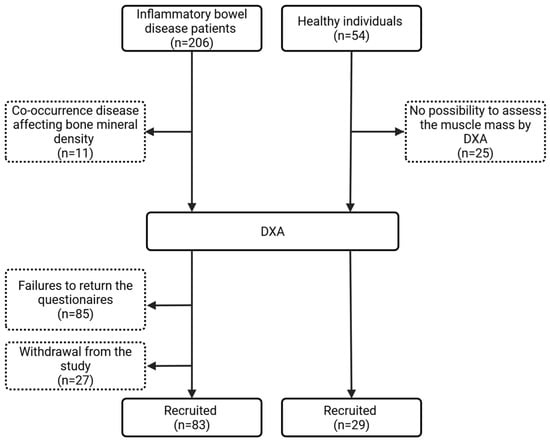
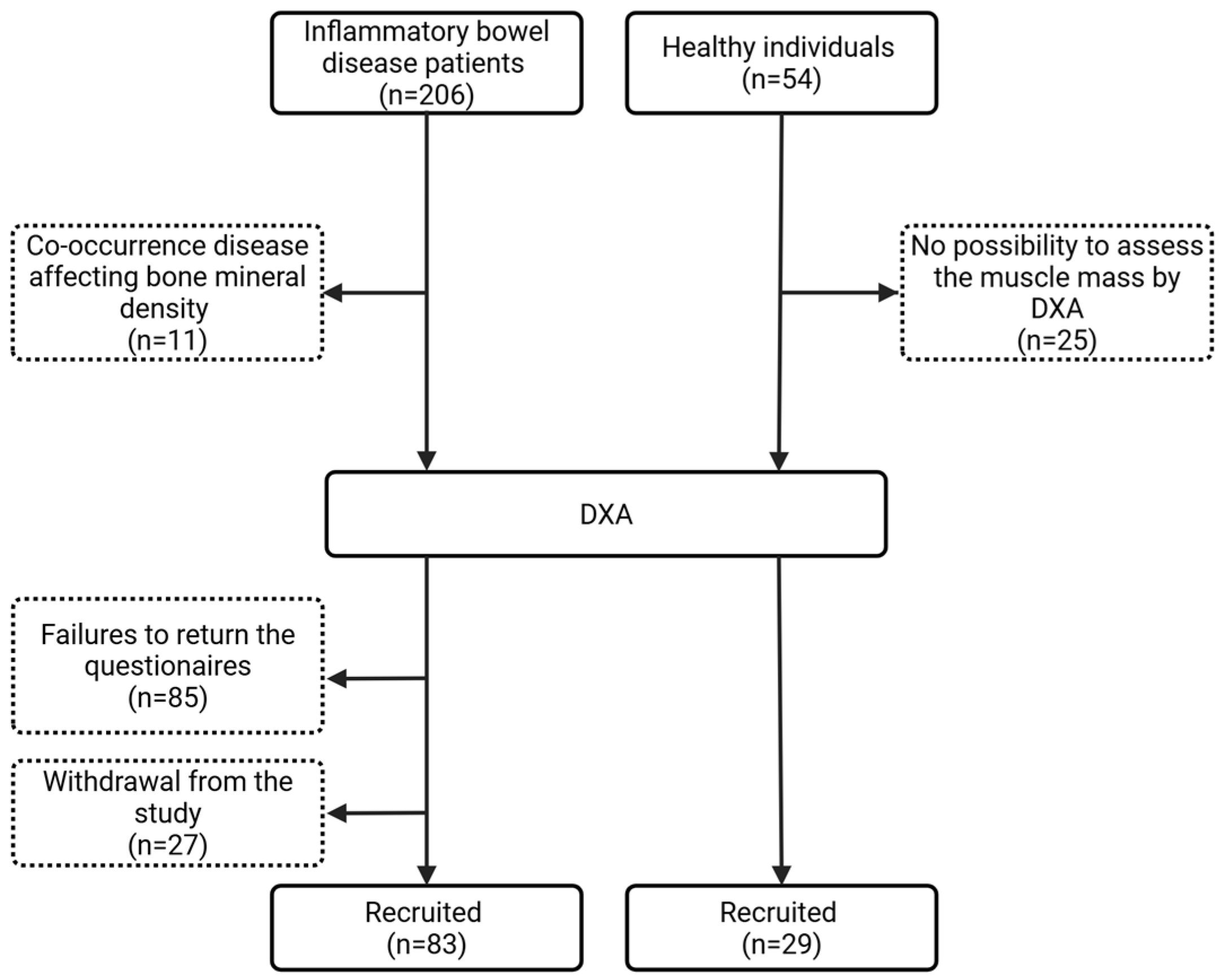
A total of 112 participants (69 females and 43 males) took part in the study, including 45 CD patients (26 females, 19 males), 38 UC patients (23 females, 15 males) aged 25 to 43 years, and 29 healthy individuals (control group—20 females and nine males), recruited at the Department of Gastroenterology, Dietetics and Internal Medicine, Poznan University of Medical Sciences between 2021 and 2024. Initially, 206 IBD patients and 54 control subjects were selected for the study. Inclusion criteria were age over 18 years, a diagnosis of IBD, and informed consent. Some subjects were excluded for various reasons (comorbidities, osteopenia, pregnancy, chronic diseases other than IBD). The control group included healthy adults (aged 18–50 years). Health was defined, according to the World Health Organization, as “a state of complete physical, mental and social well-being and not merely the absence of disease or infirmity” [17]. A participant flow chart is presented in Figure 1.
Figure 1.
Participant flow chart.
Patients with IBD were examined during hospitalisation or outpatient visits using endoscopic, histopathological, and radiological criteria. All IBD patients were treated in accordance with the standards of the European Crohn’s and Colitis Organisation and the Polish Society of Gastroenterology. All subjects in the study provided their written informed consent. The study protocol was approved by the local bioethics committee of the Poznan University of Medical Studies (Resolution no. 501/21).
All patients completed the SARC-F to assess muscle strength subjectively. We assumed that meeting even one of the criteria in the SARC-F could constitute grounds for suspecting sarcopenia, as the original questionnaire contains questions designed for people over the age of 65, whilst our study participants were considerably younger.
In all study participants, handgrip strength was measured using a Baseline Hydraulic Hand Dynamometer. Of the three measurements performed with the dominant hand, the highest value was recorded in accordance with the manufacturer’s recommendations [18].
All participants underwent dual-energy X-ray absorptiometry (DXA) to assess the relative skeletal muscle index (RSMI) using the Lunar DPX-Plus device (Lunar Inc., Madison, WI, USA). The device was calibrated every day. All examinations were performed by the same experienced operator using the same device and a standardised measurement protocol. Concentrations of C-reactive protein (CRP), total protein, albumin and 25-hydroxyvitamin D [25(OH)D] were measured [19].
No a priori sample size calculation was performed, as the study included all eligible participants recruited during the predefined study period. Because the study had already been completed, a post hoc power analysis based on the observed effect estimates was not performed. Instead, a sensitivity analysis was conducted to assess the magnitude of the effect detectable with the available sample size. With a total sample size of 112 participants, a two-sided significance level of 0.05, and 80% statistical power, the study was able to detect an effect size of approximately Cohen’s w = 0.29 for comparisons of categorical outcomes across the three study groups, corresponding to a moderate effect.
The statistical analysis was conducted using nonparametric methods because the distributions of the continuous variables deviated from normality, as assessed by the Shapiro–Wilk test. Continuous variables were compared across the three groups (CD, UC, and the control group) using the Kruskal–Wallis test. Post hoc pairwise comparisons were performed using Dunn’s test with Bonferroni correction. Categorical variables were analysed using the chi-square test when its assumptions were satisfied. For analyses involving sparse contingency tables, particularly subgroup analyses based on the Montreal classification, the Fisher–Freeman–Halton exact test was used. When the overall exact test was statistically significant, pairwise comparisons between Montreal classification categories were performed using two-sided Fisher’s exact tests with Holm adjustment for multiple comparisons. These subgroup analyses were considered exploratory.
Spearman’s rank correlation was used to assess relationships between continuous parameters. All statistical analyses were performed using Statistica 14 Cloud Software Group, Inc. (2023). Data Science Workbench, version 14. Fort Lauderdale, FL, USA. http://tibco.com (accessed on 18 September 2026). Results were considered statistically significant at p < 0.05.
3. Results
The study included 112 participants (69 women and 43 men) aged 25–43 years. Forty-five patients had Crohn’s disease, 38 had ulcerative colitis, and 29 individuals were in the control group. The groups had similar age and sex distributions. Statistically significant differences were found between the groups in body mass, BMI (body mass index), SARC-F score, CRP, and albumin levels. However, we did not find significant differences in handgrip strength, 25(OH)D level, or total protein level. Table 1 presents characteristics of the study group.
Table 1.
Characteristics of the study group.
There were no statistically significant differences between CD and UC patients in the use of steroids, biologics, mesalazine, or azathioprine (Table A1—Appendix A).
Table A2 (Appendix A) presents characteristics of patients with CD and UC, classified according to the Montreal classification.
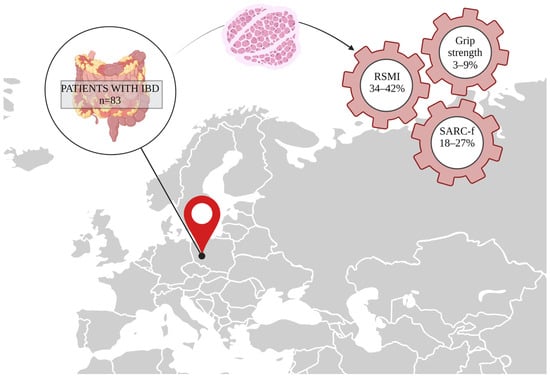
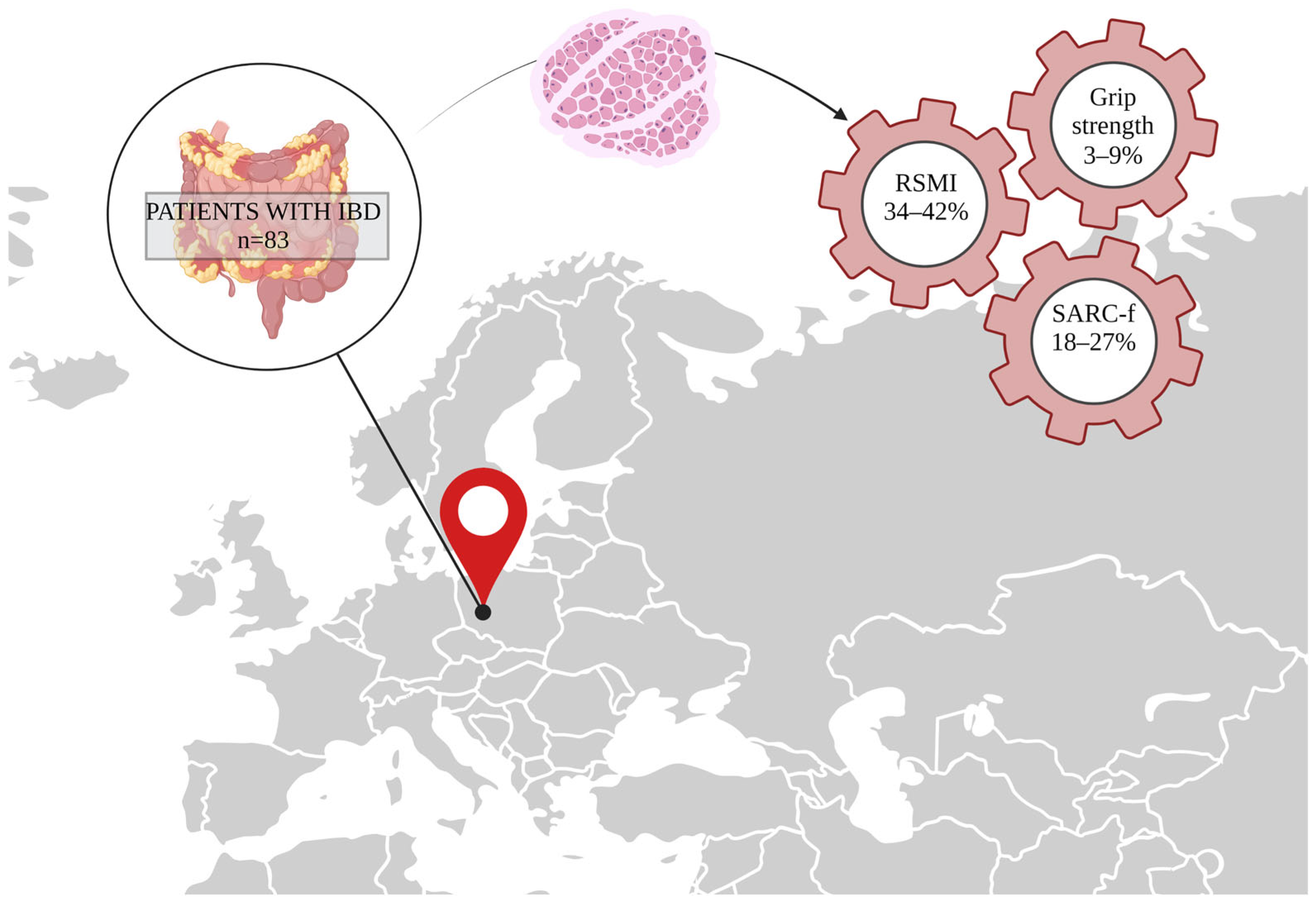
Table 2 presents the prevalence of probable sarcopenia in IBD patients based on three criteria: RSMI determined by densitometry (cut-off values [kg/m2]: 7.26 for males, 5.45 for females [19], handgrip strength (cut-off points [kg]: 27 for males, 16 for females) [20] and the SARC-F questionnaire score (Figure 2).
Table 2.
Prevalence of probable sarcopenia in IBD (CD and UC) and control groups based on RSMI, grip strength, and SARC-F value.
Figure 2.
Frequency of probable sarcopenia in IBD patients defined by various methods.
Table 3 shows the prevalence of probable sarcopenia as determined by three different criteria: RSMI, handgrip strength, and the SARC-F score in relation to the Montreal classification in patients with Crohn’s disease (considering disease localisation, age at onset, and behaviour), while Table 4 presents the prevalence of probable sarcopenia as determined by the same three criteria in relation to the Montreal classification in UC patients (considering disease severity and extent). There was a statistically significant difference in the prevalence of probable sarcopenia between patient groups when assessed using the SARC-F criterion (p < 0.05).
Table 3.
Characteristics and clinical parameters of patients with Crohn’s disease are presented according to the Montreal classification.
Table 4.
Characteristics and clinical parameters of patients with ulcerative colitis are presented according to the Montreal classification, based on the disease extent and the severity of exacerbation.
Positive correlations were found between RSMI and serum albumin (R = 0.27, p < 0.05) and total protein (R = 0.24, p < 0.05), and a negative correlation was found between RSMI and CRP levels (R = −0.25, p < 0.05) in IBD (CD and UC) patients. In CD patients, positive correlations were observed between RSMI and handgrip strength (R = 0.30, p < 0.05) and serum albumin levels (R = 0.36, p < 0.05).
Positive correlations were also observed between RSMI and albumin (R = 0.23, p <0.05) and total protein levels (R = 0.27, p < 0.05) between the CD and UC patient groups.
Exploratory subgroup analyses were performed to assess associations between sarcopenia-related criteria and the Montreal classification. Due to small cell counts, including zero and single observations in some categories, exact tests were used.
In patients with Crohn’s disease, a significant overall association was observed between disease localisation and probable sarcopenia defined by RSMI (Fisher–Freeman–Halton exact test, p = 0.011). In pairwise comparisons, the difference between L2 and L3 remained statistically significant after Holm correction (adjusted p = 0.014), whereas the remaining pairwise comparisons were not significant. A significant overall association was also observed between disease behaviour and RSMI-defined probable sarcopenia (p = 0.018). After Holm correction, only the comparison between B2 and B3 remained statistically significant (adjusted p = 0.031). No significant associations were observed for age at disease onset or for sarcopenia defined by handgrip strength or SARC-F score.
In patients with ulcerative colitis, a significant overall association was observed between disease severity and SARC-F positivity (Fisher–Freeman–Halton exact test, p = 0.011). However, none of the pairwise comparisons between severity categories remained statistically significant after Holm correction. No significant associations were observed between disease extent and any of the assessed sarcopenia-related criteria, or between disease severity and RSMI or hand grip strength.
4. Discussion
The prevalence of probable secondary sarcopenia varies depending on the criteria used. Considering RSMI alone, sarcopenia would be suspected in about 42% and 34% of CD and UC patients, respectively. Grip strength was decreased in about 9% of CD patients and 2% of UC patients. Finally, the SARC-F score may indicate probable secondary sarcopenia in about 27% and 18% of CD and UC patients, respectively.
The previous Polish study showed that probable sarcopenia affects about 17–24% of patients with IBD [13]. However, this study did not include RSMI data. In comparison, sarcopenia and probable sarcopenia affected 10% and 18% of French patients with IBD [12], whereas in the Chinese study, 14.6% of patients with IBD had probable sarcopenia and 0.7% of patients had sarcopenia [21].
The lower body weight and BMI in patients with IBD found in our study are consistent with current knowledge of IBD. The course of inflammatory diseases involving the gastrointestinal tract is associated with malnutrition due to insufficient nutrient absorption in inflamed tissues, diarrhoea, abdominal pain, and decreased appetite [22].
The SARC-F questionnaire is a simple screening tool recommended for rapid assessment of sarcopenia. It contains five questions on physical fitness [23,24].
None of the patients in our study met the cut-off criterion recommended in the questionnaire (≥4); the highest observed score was three. The SARC-F therefore appears to have limited utility in this relatively young IBD population. The conventional SARC-F cut-off of ≥4 may have limited applicability in younger patients with IBD, and development of age- and disease-specific thresholds requires dedicated studies with an independent reference standard and external validation. The questionnaire was designed primarily for the geriatric population, whereas the mean age in all study groups in the present study was below 40 years. Therefore, the performance of the conventional SARC-F threshold in younger patients with IBD remains uncertain and requires further validation. Nevertheless, the distribution of SARC-F scores differed significantly between the study groups. When the presence of any SARC-F symptom was considered (SARC-F score > 0), such symptoms were most frequent in patients with Crohn’s disease and were not observed in the control group. This finding should be interpreted as a difference in symptom burden rather than as a diagnosis of sarcopenia based on SARC-F. This finding is consistent with expectations, as Crohn’s disease involving a larger part of the gastrointestinal tract can be more debilitating. Sarcopenia is more frequently diagnosed in the CD patient population [10,19]. This may be due to malnutrition resulting from reduced nutrient absorption and lower protein and albumin levels, which translate into lower muscle mass, or to steroid therapy. The authors of the cited study also report that 96% of IBD patients surveyed restrict their diet without consulting a dietitian [20].
The patients with IBD in this study had lower handgrip strength compared to controls, which is consistent with the fact that chronically ill patients are at risk of developing secondary sarcopenia. In their publication, Stafie et al. highlight the alarmingly low levels of physical activity among patients with IBD. In contrast, regular physical activity is crucial to the course of the disease, can alleviate some symptoms, and even prolong periods of remission. Engaging in moderate but regular physical activity can help reduce inflammation by lowering pro-inflammatory cytokine levels and simultaneously enhancing the secretion of anti-inflammatory mediators [25,26]. Additionally, corticosteroid treatment is considered to reduce muscle strength [27]. Although the difference in handgrip strength was not statistically significant in our study, grip strength testing is believed to be a good predictor of the presence of sarcopenia [28,29]. An age-associated loss of muscle mass and strength begins in the fifth decade of life. The decrease in muscle mass is about 0.5–1.2% per year, and the decline in muscle strength is about 3% per year [30]. It appears that the young age of the participants in our study (mean age less than 40 years) and their remission status contribute to relatively high muscle performance despite chronic disease. In addition, muscle strength may be higher as a result of undertaking physical activity.
Secondary sarcopenia results from three pathological mechanisms: chronic inflammation, nutritional deficiencies, and insufficient physical activity [31].
The use of anti-inflammatory medications recommended by IBD treatment algorithms (glucocorticosteroids, mesalazine, biologic therapy) is intended to suppress inflammation.
Nutritional support for sarcopenia involves supplementation with amino acids (leucine), whey proteins, 25(OH)D, omega-3 fatty acids, and β-hydroxy-β-methylbutyrate (HMB) [32,33,34,35,36,37].
Since no pharmacological treatments are available, physical activity, alongside dietary intervention, remains the first-line treatment, based on the principle that any physical activity is better than none [32,38]. Resistance training is the most effective, as it leads to improvements in muscle strength, muscle mass, and physical function [32,39,40]. According to Supriya et al., it is important to develop exercise programmes tailored to comorbidities rather than to sarcopenia itself [39].
CRP is a protein whose level rises sharply in the event of an acute infection. However, its level increases with any inflammatory process and tissue damage. An increase in CRP levels indicates an active inflammatory process, with levels falling to normal values (below 5 mg/L) during remission [41]. Elevated CRP levels, as a marker of inflammation, are consistent with the chronic inflammatory nature of IBD, whose aetiology remains incompletely understood [42]. The current study recorded the highest CRP levels in the CD group, slightly lower levels in the UC patients, and normal levels (less than 1 mg/L) in the control group. The differences were statistically significant.
Paradoxically, the highest serum 25(OH)D levels were recorded in the UC group—this may be related to the fact that patients in this group receive vitamin supplementation under regular medical supervision. Ratajczak et al. suggest that patients with IBD should receive higher doses of 25(OH)D than healthy adults. The research revealed no differences in 25(OH)D levels according to disease extent and severity among patients with UC (according to the Montreal classification). No differences were observed in terms of disease localisation, behaviour, or age at diagnosis in patients with Crohn’s disease [43]. Other authors suggest that IBD treatment may be associated with 25(OH)D levels. No effect of azathioprine on 25(OH)D levels has been demonstrated. However, treatment with tumour necrosis factor alpha (TNF-alpha) inhibitors (infliximab, adalimumab) significantly increases 25(OH)D levels in patients with CD. In addition, 25(OH)D levels may be negatively affected by disease localisation (small bowel), small bowel resection, or acute disease flare [44].
In our study, reduced levels of total protein (not statistically significant) and albumin (statistically significant) in our IBD patients indicate a risk of malnutrition in this group. Diet is of great importance in the course of chronic diseases. Adequate nutrient intake in IBD favourably influences body composition and improves patients’ nutritional status. Albumin levels decline in IBD due to the presence of a chronic inflammatory process and impaired absorption. Malnutrition is a common condition among patients with IBD [22,45,46].
Patients with both CD and UC were treated according to the recommendations of ECCO and the Polish Society of Gastroenterology. The vast majority of patients were treated with corticosteroids, 55-aminosalicylic acid (5-ASA), azathioprine, and biologic drugs.
Based on the different diagnostic criteria (RSMI, SARC-F score, and muscle strength measurement) used in this study, the prevalence of probable sarcopenia differed between patients with CD and UC. The estimate based on RSMI appears to be the closest to previously reported estimates worldwide. Although the RSMI is an indicator of low muscle mass rather than sarcopenia itself, this index appears to be potentially useful in the diagnostic process.
The phenomenon of secondary sarcopenia in patients with IBD is relatively well documented, although it has only recently been studied. The lack of diagnostic guidelines for secondary sarcopenia, together with the gaps in diagnostic algorithms highlighted by the authors of existing consensus documents on primary sarcopenia—a condition that has been documented and studied in far greater depth—makes it difficult to design and carry out an appropriate study.
We hope that our study may contribute, even if only to a small extent, to our understanding of the phenomenon of secondary sarcopenia in the extremely complex conditions that constitute IBD.
Furthermore, due to the lack of clear guidelines, we did not classify the task of classifying sarcopenia according to severity (from probable to severe), as this was beyond the scope of our study.
Data on the prevalence of sarcopenia indicate that approximately 42% of IBD patients, 52% of CD patients, and 37% of UC patients have sarcopenia [11,47,48].
The handgrip strength test and the results estimated from the SARC-F showed lower predictive values in our study. This may be due to both the relatively small study group and the fact that the diagnostic criteria for sarcopenia developed by the European Working Group on Sarcopenia in Older People (EWGSOP) pertain to primary sarcopenia, which mainly affects older people [4,10].
Interestingly, cases of probable sarcopenia were also identified in the control group despite the participants’ relatively young age (most cases identified based on RSMI). This may be related to the sedentary lifestyle characteristic of Western societies, insufficient physical activity, and a poorly balanced diet (inadequate intake of protein and 25(OH)D) [43,49].
In this study, RSMI correlated positively with albumin levels in both the IBD group (CD and UC combined) and each study group individually, indicating greater skeletal muscle mass in better-nourished patients. There was also a negative correlation between RSMI and CRP levels [42,45].
A positive correlation between RSMI and handgrip strength was observed in the CD patient group. In the study by Bryant et al., sarcopenia was identified in 12% of patients with IBD based on low muscle mass assessed using DXA-derived RSMI [28].
Exploratory analyses based on the Montreal classification suggested an association between RSMI-defined probable sarcopenia and selected clinical characteristics of Crohn’s disease. Significant overall associations were observed for disease localisation and disease behaviour; however, after adjustment for multiple pairwise comparisons, significance was retained only for the L2 versus L3 localisation categories and the B2 versus B3 behaviour categories. These findings may be biologically plausible, as more extensive or complicated disease can be associated with impaired nutrient absorption and poorer nutritional status [37]. However, given the small number of patients in several subgroups, these results should be interpreted cautiously and considered hypothesis-generating. Larger studies are required to determine whether disease localisation and behaviour are independently associated with reduced skeletal muscle mass.
In patients with ulcerative colitis, an overall association was observed between disease severity and SARC-F positivity. However, none of the pairwise comparisons between severity categories remained statistically significant after adjustment for multiple comparisons. Therefore, this finding should be interpreted cautiously, particularly given the small numbers of patients within individual severity categories. No significant associations were observed for disease extent.
5. Conclusions
The disease’s pathophysiology and course affect both the body’s general condition and the condition of muscle tissue, which can lead to sarcopenia. In the absence of internationally agreed diagnostic criteria, secondary sarcopenia requires further research to establish its potential role as an important prognostic factor for IBD in the future.
Low muscle mass is common among patients with IBD. However, due to the limitations in the diagnosis of secondary sarcopenia, estimating the prevalence of sarcopenia in IBD patients is difficult.
The SARC-F does not seem to be the best screening tool for patients with IBD at risk of sarcopenia. It is important to note that SARC-F includes questions about activities that are not problematic for young people even with low muscle mass. A new questionnaire may therefore be needed to screen for secondary sarcopenia in younger populations.
Exploratory analyses suggested that RSMI-defined sarcopenia may be associated with selected Montreal classification categories in patients with Crohn’s disease; however, these findings require confirmation in larger cohorts.
Further studies involving larger patient groups are needed to enable the development of tools for assessing secondary sarcopenia. RSMI, the SARC-F, and grip strength seem to be useful, but further research is needed to establish, among other things, appropriate cut-off values for these parameters.
Several limitations of the present study should be acknowledged. First, the relatively modest sample size, particularly within some clinical subgroups, limited the statistical precision of the estimates and the power to detect small between-group differences. Therefore, all findings should be interpreted with appropriate caution, particularly non-significant results, which may reflect limited statistical power rather than the absence of a true effect. Second, the study was conducted at a single centre, which may limit the generalizability of the findings and may introduce selection bias. Finally, the study was not designed to develop or validate a clinical prediction model or a risk stratification score. Given the modest sample size, development of such a tool using the present dataset would carry a substantial risk of overfitting and would require validation in a larger, preferably multicenter, independent cohort.
Additionally, IBD encompasses complex, multifactorial chronic conditions which, by their very nature, have a significant impact on patients’ nutritional status and levels of physical activity. Nutritional status, long-term medication use and previous surgical procedures all have an impact on the condition of muscle tissue and the closely related bone tissue (osteopenia, osteoporosis). Secondary sarcopenia in this group of patients is influenced by a wide range of biological and environmental factors. We therefore recognise both the need for further large-scale research and the need for great caution when drawing conclusions regarding sarcopenia in this group of patients.
Author Contributions
Conceptualisation: K.-K.I.; methodology: D.S. and K.-K.I.; formal analysis: M.M.; investigation: D.S. and K.-K.I.; data curation: D.S., A.E.R.-P. and K.-K.I.; writing—original draft preparation: D.S., A.E.R.-P. and K.-K.I.; writing—review and editing: K.-K.I. and A.D.; supervision: K.-K.I. and A.D. All authors have read and agreed to the published version of the manuscript.
Funding
This research received no external funding.
Institutional Review Board Statement
The study was conducted in accordance with the Declaration of Helsinki, the study’s assumptions were approved by the local bioethics committee of the Poznan University of Medical Studies (Resolution no. 501/21). Date of approval: 24 June 2021.
Informed Consent Statement
Informed consent was obtained from all subjects involved in the study.
Data Availability Statement
The data presented in this study are available on request from the corresponding author.
Acknowledgments
The authors have reviewed and edited the output and take full responsibility for the content of this publication.
Conflicts of Interest
The authors declare no conflicts of interest.
Abbreviations
The following abbreviations are used in this manuscript:
| CD | Crohn’s disease |
| UC | ulcerative colitis |
| CG | control group |
| RSMI | relative skeletal muscle index |
| SARC-F | strength, assistance with walking, rising from a chair, climbing stairs, and falls |
| IBD | inflammatory bowel disease |
| CRP | c-reactive protein |
| DXA | dual-energy X-ray absorptiometry |
| 5-ASA | 5-aminosalicylic acid |
Appendix A
Table A1.
Frequency of using the medications in the CD and UC groups.
Table A2.
Characteristics of patients with CD presented according to the Montreal classification.
References
- Altowati, M.M.A.; Shepherd, S.; McMillan, M.; McGrogan, P.; Russell, R.; Ahmed, S.F.; Wong, S.C. Persistence of Muscle-Bone Deficits Following Anti-Tumour Necrosis Factor Therapy in Adolescents with Crohn Disease. J. Pediatr. Gastroenterol. Nutr. 2018, 67, 738–744. [Google Scholar] [CrossRef] [Scilit] [PubMed]
- Bowser, M.; Herberg, S.; Arounleut, P.; Shi, X.; Fulzele, S.; Hill, W.D.; Isales, C.M.; Hamrick, M.W. Effects of the Activin A-Myostatin-Follistatin System on Aging Bone and Muscle Progenitor Cells. Exp. Gerontol. 2013, 48, 290–297. [Google Scholar] [CrossRef] [Scilit] [PubMed]
- Ooi, P.H.; Thompson-Hodgetts, S.; Pritchard-Wiart, L.; Gilmour, S.M.; Mager, D.R. Pediatric Sarcopenia: A Paradigm in the Overall Definition of Malnutrition in Children? JPEN J. Parenter. Enter. Nutr. 2020, 44, 407–418. [Google Scholar] [CrossRef] [Scilit] [PubMed]
- Cruz-Jentoft, A.J.; Bahat, G.; Bauer, J.; Boirie, Y.; Bruyère, O.; Cederholm, T.; Cooper, C.; Landi, F.; Rolland, Y.; Sayer, A.A.; et al. Sarcopenia: Revised European Consensus on Definition and Diagnosis. Age Ageing 2019, 48, 16–31, Correction in Age Ageing 2019, 48, 601. https://doi.org/10.1093/ageing/afz046. [Google Scholar] [CrossRef] [Scilit] [PubMed]
- Shaw, S.C.; Dennison, E.M.; Cooper, C. Epidemiology of Sarcopenia: Determinants Throughout the Lifecourse. Calcif. Tissue Int. 2017, 101, 229–247. [Google Scholar] [CrossRef] [Scilit] [PubMed]
- Scaldaferri, F.; Pizzoferrato, M.; Lopetuso, L.R.; Musca, T.; Ingravalle, F.; Sicignano, L.L.; Mentella, M.; Miggiano, G.; Mele, M.C.; Gaetani, E.; et al. Nutrition and IBD: Malnutrition and/or Sarcopenia? A Practical Guide. Gastroenterol. Res. Pract. 2017, 2017, 8646495. [Google Scholar] [CrossRef] [Scilit] [PubMed]
- Watanabe, H.; Enoki, Y.; Maruyama, T. Sarcopenia in Chronic Kidney Disease: Factors, Mechanisms, and Therapeutic Interventions. Biol. Pharm. Bull. 2019, 42, 1437–1445. [Google Scholar] [CrossRef] [Scilit] [PubMed]
- Bryant, R.V.; Schultz, C.G.; Ooi, S.; Goess, C.; Costello, S.P.; Vincent, A.D.; Schoeman, S.N.; Lim, A.; Bartholomeusz, F.D.; Travis, S.P.L.; et al. Obesity in Inflammatory Bowel Disease: Gains in Adiposity despite High Prevalence of Myopenia and Osteopenia. Nutrients 2018, 10, 1192. [Google Scholar] [CrossRef] [Scilit] [PubMed]
- Kuzuya, M. Drug-related Sarcopenia as a Secondary Sarcopenia. Geriatr. Gerontol. Int. 2024, 24, 195–203. [Google Scholar] [CrossRef] [Scilit] [PubMed]
- Cruz-Jentoft, A.J.; Baeyens, J.P.; Bauer, J.M.; Boirie, Y.; Cederholm, T.; Landi, F.; Martin, F.C.; Michel, J.-P.; Rolland, Y.; Schneider, S.M.; et al. Sarcopenia: European Consensus on Definition and Diagnosis: Report of the European Working Group on Sarcopenia in Older People. Age Ageing 2010, 39, 412–423. [Google Scholar] [CrossRef] [Scilit] [PubMed]
- Dhaliwal, A.; Quinlan, J.I.; Overthrow, K.; Greig, C.; Lord, J.M.; Armstrong, M.J.; Cooper, S.C. Sarcopenia in Inflammatory Bowel Disease: A Narrative Overview. Nutrients 2021, 13, 656. [Google Scholar] [CrossRef] [Scilit] [PubMed]
- Dermine, S.; Bazin, T.; Hassan, F.A.; Bettolo, J.; Billiauws, L.; Bourdillel, J.; Bresteau, C.; Corcos, O.; El Khatib, M.; Gouse, A.M.; et al. Prevalence and Impact of Sarcopenia in Patients with Inflammatory Bowel Diseases: A Prospective Cohort Study. Clin. Res. Hepatol. Gastroenterol. 2025, 49, 102555. [Google Scholar] [CrossRef] [Scilit] [PubMed]
- Olczyk-Wieczorkowska, M.; Kaczmarczyk, O.; Dąbek, A.; Zagrodzki, P.T.; Piątek-Guziewicz, A.B.; Zwolińska-Wcisło, M.M. Prevalence of Sarcopenia, Myopenia, and Malnutrition in Polish Patients with Inflammatory Bowel Disease. Pol. Arch. Intern. Med. 2026, 136, 17194. [Google Scholar] [CrossRef] [Scilit] [PubMed]
- Silva-Fhon, J.R.; Rojas-Huayta, V.M.; Aparco-Balboa, J.P.; Céspedes-Panduro, B.; Partezani-Rodrigues, R.A. Sarcopenia and Blood Albumin: A Systematic Review with Meta-Analysis. Biomedica 2021, 41, 590–603. [Google Scholar] [CrossRef] [Scilit] [PubMed]
- Dharap, V.; Desai, D.; Abraham, P.; Gupta, T.; Dhoble, P.; Mehta, N.; Modhe, J. Prevalence and Outcome of Sarcopenia in Patients with Inflammatory Bowel Disease: A Follow-up Study. Intest. Res. 2026, 24, 141–150. [Google Scholar] [CrossRef] [Scilit] [PubMed]
- Le Cosquer, G.; Gilletta, C.; Kochar, B.; Ananthakrishnan, A.N.; Buisson, A. Frailty in Inflammatory Bowel Disease: A Missing Link in Personalized Care for the Aging IBD Population. Inflamm. Bowel Dis. 2026, 32, izag031. [Google Scholar] [CrossRef] [Scilit] [PubMed]
- Constitution of the World Health Organization. Available online: https://www.who.int/about/governance/constitution (accessed on 2 September 2026).
- Roberts, H.C.; Denison, H.J.; Martin, H.J.; Patel, H.P.; Syddall, H.; Cooper, C.; Sayer, A.A. A Review of the Measurement of Grip Strength in Clinical and Epidemiological Studies: Towards a Standardised Approach. Age Ageing 2011, 40, 423–429. [Google Scholar] [CrossRef] [Scilit] [PubMed]
- Baumgartner, R.N.; Koehler, K.M.; Gallagher, D.; Romero, L.; Heymsfield, S.B.; Ross, R.R.; Garry, P.J.; Lindeman, R.D. Epidemiology of Sarcopenia among the Elderly in New Mexico. Am. J. Epidemiol. 1998, 147, 755–763. [Google Scholar] [CrossRef] [Scilit] [PubMed]
- Steiber, N. Strong or Weak Handgrip? Normative Reference Values for the German Population across the Life Course Stratified by Sex, Age, and Body Height. PLoS ONE 2016, 11, e0163917. [Google Scholar] [CrossRef] [Scilit] [PubMed]
- Zhang, Q.; Liu, H.; Liu, S.; Zhu, S.; Zhang, S.; Yang, Z.; Wu, S. Increased Mortality Associated with Sarcopenia in Inflammatory Bowel Disease: A Long-Term Prospective Cohort Study. Am. J. Gastroenterol. 2026, 121, 1679–1689. [Google Scholar] [CrossRef] [Scilit] [PubMed]
- Godala, M.; Gaszyńska, E.; Walczak, K.; Małecka-Wojciesko, E. An Evaluation of the Usefulness of Selected Screening Methods in Assessing the Risk of Malnutrition in Patients with Inflammatory Bowel Disease. Nutrients 2024, 16, 814. [Google Scholar] [CrossRef] [Scilit] [PubMed]
- Malmstrom, T.K.; Miller, D.K.; Simonsick, E.M.; Ferrucci, L.; Morley, J.E. SARC-F: A Symptom Score to Predict Persons with Sarcopenia at Risk for Poor Functional Outcomes. J. Cachexia Sarcopenia Muscle 2016, 7, 28–36. [Google Scholar] [CrossRef] [Scilit] [PubMed]
- Nishikawa, H.; Asai, A.; Fukunishi, S.; Takeuchi, T.; Goto, M.; Ogura, T.; Nakamura, S.; Kakimoto, K.; Miyazaki, T.; Nishiguchi, S.; et al. Screening Tools for Sarcopenia. In Vivo 2021, 35, 3001–3009. [Google Scholar] [CrossRef] [Scilit] [PubMed]
- Davis, S.P.; Crane, P.B.; Bolin, L.P.; Johnson, L.A. An Integrative Review of Physical Activity in Adults with Inflammatory Bowel Disease. Intest. Res. 2022, 20, 43–52. [Google Scholar] [CrossRef] [Scilit] [PubMed]
- Stafie, R.; Singeap, A.-M.; Rotaru, A.; Stanciu, C.; Trifan, A. Bridging the Gap: Unveiling the Crisis of Physical Inactivity in Inflammatory Bowel Diseases. World J. Gastroenterol. 2024, 30, 1261–1265. [Google Scholar] [CrossRef] [Scilit] [PubMed]
- Ergenc, I.; Ismail Basa, C.; Uzum, A.; Sahin, S.; Kani, H.T.; Aslan, R.; Tufan, A.; Kasımay, Ö.; Atuğ, Ö.; Alahdab, Y.Ö. High Prevalence of Muscle Weakness and Probable Sarcopenia in Patients with Inflammatory Bowel Disease. Nutr. Clin. Pract. 2024, 39, 557–567. [Google Scholar] [CrossRef] [Scilit] [PubMed]
- Bryant, R.V.; Ooi, S.; Schultz, C.G.; Goess, C.; Grafton, R.; Hughes, J.; Lim, A.; Bartholomeusz, F.D.; Andrews, J.M. Low Muscle Mass and Sarcopenia: Common and Predictive of Osteopenia in Inflammatory Bowel Disease. Aliment. Pharmacol. Ther. 2015, 41, 895–906. [Google Scholar] [CrossRef] [Scilit] [PubMed]
- Lee, S.Y. Handgrip Strength: An Irreplaceable Indicator of Muscle Function. Ann. Rehabil. Med. 2021, 45, 167–169. [Google Scholar] [CrossRef] [Scilit] [PubMed]
- Bell, K.E.; von Allmen, M.T.; Devries, M.C.; Phillips, S.M. Muscle Disuse as a Pivotal Problem in Sarcopenia-Related Muscle Loss and Dysfunction. J. Frailty Aging 2016, 5, 33–41. [Google Scholar] [CrossRef] [Scilit] [PubMed]
- Barone, M.; Baccaro, P.; Molfino, A. An Overview of Sarcopenia: Focusing on Nutritional Treatment Approaches. Nutrients 2025, 17, 1237. [Google Scholar] [CrossRef] [Scilit] [PubMed]
- Kim, H.; Kim, J.; Lee, C.; Kim, S. Nutrition and Exercise for Sarcopenia Treatment. Osteoporos. Sarcopenia 2025, 11, 54–64. [Google Scholar] [CrossRef] [Scilit] [PubMed]
- Walrand, S.; Le Bacquer, O. Dietary Leucine Intake and Sarcopenia: From Isolated Supplementation to Combined Strategies. Curr. Opin. Clin. Nutr. Metab. Care 2026, 29, 75–80. [Google Scholar] [CrossRef] [Scilit] [PubMed]
- Nasimi, N.; Sohrabi, Z.; Nunes, E.A.; Sadeghi, E.; Jamshidi, S.; Gholami, Z.; Akbarzadeh, M.; Faghih, S.; Akhlaghi, M.; Phillips, S.M. Whey Protein Supplementation with or without Vitamin D on Sarcopenia-Related Measures: A Systematic Review and Meta-Analysis. Adv. Nutr. 2023, 14, 762–773. [Google Scholar] [CrossRef] [Scilit] [PubMed]
- Fuentes-Barría, H.; Aguilera-Eguía, R.; Angarita-Davila, L.; Rojas-Gómez, D.; Alarcón-Rivera, M.; López-Soto, O.; Maureira-Sánchez, J.; Bermúdez, V.; Rivera-Porras, D.; Contreras-Velázquez, J.C. Vitamin D and Sarcopenia: Implications for Muscle Health. Biomedicines 2025, 13, 1863. [Google Scholar] [CrossRef] [Scilit] [PubMed]
- Courel-Ibáñez, J.; Vetrovsky, T.; Dadova, K.; Pallarés, J.G.; Steffl, M. Health Benefits of β-Hydroxy-β-Methylbutyrate (HMB) Supplementation in Addition to Physical Exercise in Older Adults: A Systematic Review with Meta-Analysis. Nutrients 2019, 11, 2082. [Google Scholar] [CrossRef] [Scilit] [PubMed]
- Varamini, B.; Yang, J.O.; Merry, B.J.; Dau, D.J. The Role of Omega-3 Polyunsaturated Fatty Acids on Sarcopenia and Aging Muscle. Int. J. Environ. Res. Public Health 2026, 23, 355. [Google Scholar] [CrossRef] [Scilit] [PubMed]
- Bull, F.C.; Al-Ansari, S.S.; Biddle, S.; Borodulin, K.; Buman, M.P.; Cardon, G.; Carty, C.; Chaput, J.-P.; Chastin, S.; Chou, R.; et al. World Health Organization 2020 Guidelines on Physical Activity and Sedentary Behaviour. Br. J. Sports Med. 2020, 54, 1451–1462. [Google Scholar] [CrossRef] [Scilit] [PubMed]
- Supriya, R.; Singh, K.P.; Gao, Y.; Gu, Y.; Baker, J.S. Effect of Exercise on Secondary Sarcopenia: A Comprehensive Literature Review. Biology 2021, 11, 51. [Google Scholar] [CrossRef] [Scilit] [PubMed]
- Cheng, F.; Li, N.; Yang, J.; Yang, J.; Yang, W.; Ran, J.; Sun, P.; Liao, Y. The Effect of Resistance Training on Patients with Secondary Sarcopenia: A Systematic Review and Meta-Analysis. Sci. Rep. 2024, 14, 28784. [Google Scholar] [CrossRef] [Scilit] [PubMed]
- Liu, D.; Saikam, V.; Skrada, K.A.; Merlin, D.; Iyer, S.S. Inflammatory Bowel Disease Biomarkers. Med. Res. Rev. 2022, 42, 1856–1887. [Google Scholar] [CrossRef] [Scilit] [PubMed]
- Sakurai, T.; Saruta, M. Positioning and Usefulness of Biomarkers in Inflammatory Bowel Disease. Digestion 2023, 104, 30–41. [Google Scholar] [CrossRef] [Scilit] [PubMed]
- Ratajczak, A.E.; Rychter, A.M.; Zawada, A.; Dobrowolska, A.; Krela-Kaźmierczak, I. Nutrients in the Prevention of Osteoporosis in Patients with Inflammatory Bowel Diseases. Nutrients 2020, 12, 1702. [Google Scholar] [CrossRef] [Scilit] [PubMed]
- Schäffler, H.; Schmidt, M.; Huth, A.; Reiner, J.; Glass, Ä.; Lamprecht, G. Clinical Factors Are Associated with Vitamin D Levels in IBD Patients: A Retrospective Analysis. J. Dig. Dis. 2018, 19, 24–32. [Google Scholar] [CrossRef] [Scilit] [PubMed]
- Liu, S.; Tian, Z.; Jiang, Y.; Ding, X.; Jin, S.; Jing, X. Low Muscle Mass Is Associated with Readmission for Inflammatory Bowel Disease. Turk. J. Gastroenterol. 2023, 34, 108–117. [Google Scholar] [CrossRef] [Scilit] [PubMed]
- Singh, A.; Midha, V.; Mahajan, R.; Verma, S.; Kakkar, C.; Grover, J.; Singh, D.; Kaur, R.; Masih, A.; Bansal, N.; et al. Evaluation of Nutritional Characteristics Reveals Similar Prevalence of Malnutrition in Patients with Ulcerative Colitis and Crohn’s Disease. Dig. Dis. Sci. 2023, 68, 580–595. [Google Scholar] [CrossRef] [Scilit] [PubMed]
- Ryan, E.; McNicholas, D.; Creavin, B.; Kelly, M.E.; Walsh, T.; Beddy, D. Sarcopenia and Inflammatory Bowel Disease: A Systematic Review. Inflamm. Bowel Dis. 2019, 25, 67–73. [Google Scholar] [CrossRef] [Scilit] [PubMed]
- Potcovaru, C.-G.; Filip, P.V.; Neagu, O.-M.; Diaconu, L.S.; Salmen, T.; Cinteză, D.; Pantea Stoian, A.; Bobirca, F.; Berteanu, M.; Pop, C. Diagnostic Criteria and Prognostic Relevance of Sarcopenia in Patients with Inflammatory Bowel Disease-A Systematic Review. J. Clin. Med. 2023, 12, 4713. [Google Scholar] [CrossRef] [Scilit] [PubMed]
- Bo, Y.; Liu, C.; Ji, Z.; Yang, R.; An, Q.; Zhang, X.; You, J.; Duan, D.; Sun, Y.; Zhu, Y.; et al. A High Whey Protein, Vitamin D and E Supplement Preserves Muscle Mass, Strength, and Quality of Life in Sarcopenic Older Adults: A Double-Blind Randomized Controlled Trial. Clin. Nutr. 2019, 38, 159–164. [Google Scholar] [CrossRef] [Scilit] [PubMed]

Disclaimer/Publisher’s Note: The statements, opinions and data contained in all publications are solely those of the individual author(s) and contributor(s) and not of MDPI and/or the editor(s). MDPI and/or the editor(s) disclaim responsibility for any injury to people or property resulting from any ideas, methods, instructions or products referred to in the content. |
© 2026 by the authors. Licensee MDPI, Basel, Switzerland. This article is an open access article distributed under the terms and conditions of the Creative Commons Attribution (CC BY) license.