


Abstract
Background: Cellular senescence contributes to aging, chronic inflammation, and age-related diseases. Senolytics eliminate senescent cells, whereas senomorphics modulate their pathological activities, including the senescence-associated secretory phenotype (SASP). This review examines their mechanisms, preclinical and clinical evidence, safety, and translational challenges. Methods: Published mechanistic, preclinical, and clinical literature on senolytic and senomorphic therapies was reviewed, focusing on therapeutic targets, disease-specific findings, safety, and clinical translation. Results: Senolytics, including dasatinib plus quercetin, navitoclax, and fisetin, target senescent-cell survival pathways, whereas senomorphics, including rapamycin, metformin, and Janus kinase inhibitors, modulate inflammatory signaling and SASP-associated pathways. Preclinical studies suggest benefits across metabolic, cardiovascular, musculoskeletal, and neurodegenerative disease models. However, human evidence remains limited and heterogeneous. Early clinical studies demonstrate the feasibility of senescence targeting and changes in selected biomarkers, but consistent clinical benefit remains unestablished. Major challenges include senescent-cell heterogeneity, insufficiently validated biomarkers, treatment-related toxicity, and the physiological roles of senescence in tissue repair and tumor suppression. Conclusions: Senolytics and senomorphics are promising but investigational therapeutic strategies. Clinical translation requires validated biomarkers, disease-specific patient selection, improved therapeutic selectivity, adequately powered trials with clinically meaningful endpoints, and long-term safety assessment. Aligning therapeutic strategies with senescent-cell phenotypes, disease context, and treatment objectives may improve clinical relevance.
1. Introduction to Cellular Senescence
Cellular senescence has emerged as a complex biological state implicated in aging, tissue homeostasis, cancer, and chronic disease [1,2]. Initially described as the finite proliferative capacity of human fibroblasts, senescence is now recognized as a stress-responsive program triggered by telomere dysfunction, persistent DNA damage, oncogenic signaling, mitochondrial and metabolic stress, and other cellular insults [1,2]. Despite durable cell-cycle arrest, senescent cells remain metabolically active and undergo extensive alterations in morphology, metabolism, chromatin organization, organelle function, and intercellular signaling [1,3]. These changes are not uniform across senescent cells but vary according to the initiating stimulus, cell type, tissue environment, and duration of the senescent state, contributing to the heterogeneity of senescence phenotypes observed in vivo [4].
A defining feature of many senescent cells is the senescence-associated secretory phenotype (SASP), comprising cytokines, chemokines, growth factors, proteases, and other mediators that alter the tissue microenvironment [4]. Although SASP can facilitate immune clearance and tissue remodeling, persistent or dysregulated SASP activity promotes chronic inflammation, extracellular matrix remodeling, impaired regeneration, fibrosis, and tissue dysfunction [4,5]. The SASP is therefore not intrinsically detrimental; its biological effects depend on its composition, magnitude, duration, and cellular context. Transient SASP activity may promote tissue repair, recruit immune cells, reinforce growth arrest, and facilitate tissue remodeling, whereas sustained secretion of inflammatory and matrix-modifying mediators may contribute to chronic tissue injury and age-related pathology [4]. Senescence therefore has context-dependent effects: transient senescence contributes to tumor suppression, wound repair, and development, whereas persistent accumulation can drive age-related tissue deterioration [1,4,5]. This duality provides the rationale for therapeutic strategies that selectively target senescent cells or their harmful activities [6].
Senolytics and senomorphics represent two complementary approaches to senescence-targeted therapy [6,7]. Senolytics eliminate senescent cells by targeting their dependence on pro-survival mechanisms, including senescent cell anti-apoptotic pathways [7,8]. In contrast, senomorphics modify senescent-cell functions, particularly by suppressing or reshaping the SASP and associated inflammatory signaling [6,7]. Thus, senolytics target the cellular burden, whereas senomorphics primarily target the functional consequences. The therapeutic rationale for these approaches extends beyond cellular senescence itself to its contribution to age-related tissue dysfunction and disease. Senescence-targeting strategies are being investigated in metabolic, cardiovascular, musculoskeletal, pulmonary, and neurodegenerative disorders, in which senescent-cell accumulation or altered secretory activity may contribute to inflammation, impaired tissue regeneration, fibrosis, and functional decline. However, the relative contribution of senescence to individual disease processes, and the extent to which its targeted modulation can improve clinically meaningful outcomes, remain under investigation [5,9].
The therapeutic landscape has expanded from repurposed compounds to selective small molecules, targeted delivery systems, immune-based strategies, and combination regimens [7,8]. Emerging research has also broadened the scope of senotherapeutic investigation to organ-specific applications, including neurological disorders [10,11] and skin aging and dermatological diseases [12]. Preclinical findings suggest therapeutic potential across metabolic, cardiovascular, musculoskeletal, pulmonary, and neurodegenerative conditions, while oncology research is investigating the implications of senescence for treatment response and resistance [8,13]. However, clinical translation remains at an early stage; human studies have yet to establish consistent therapeutic benefit [8,13].
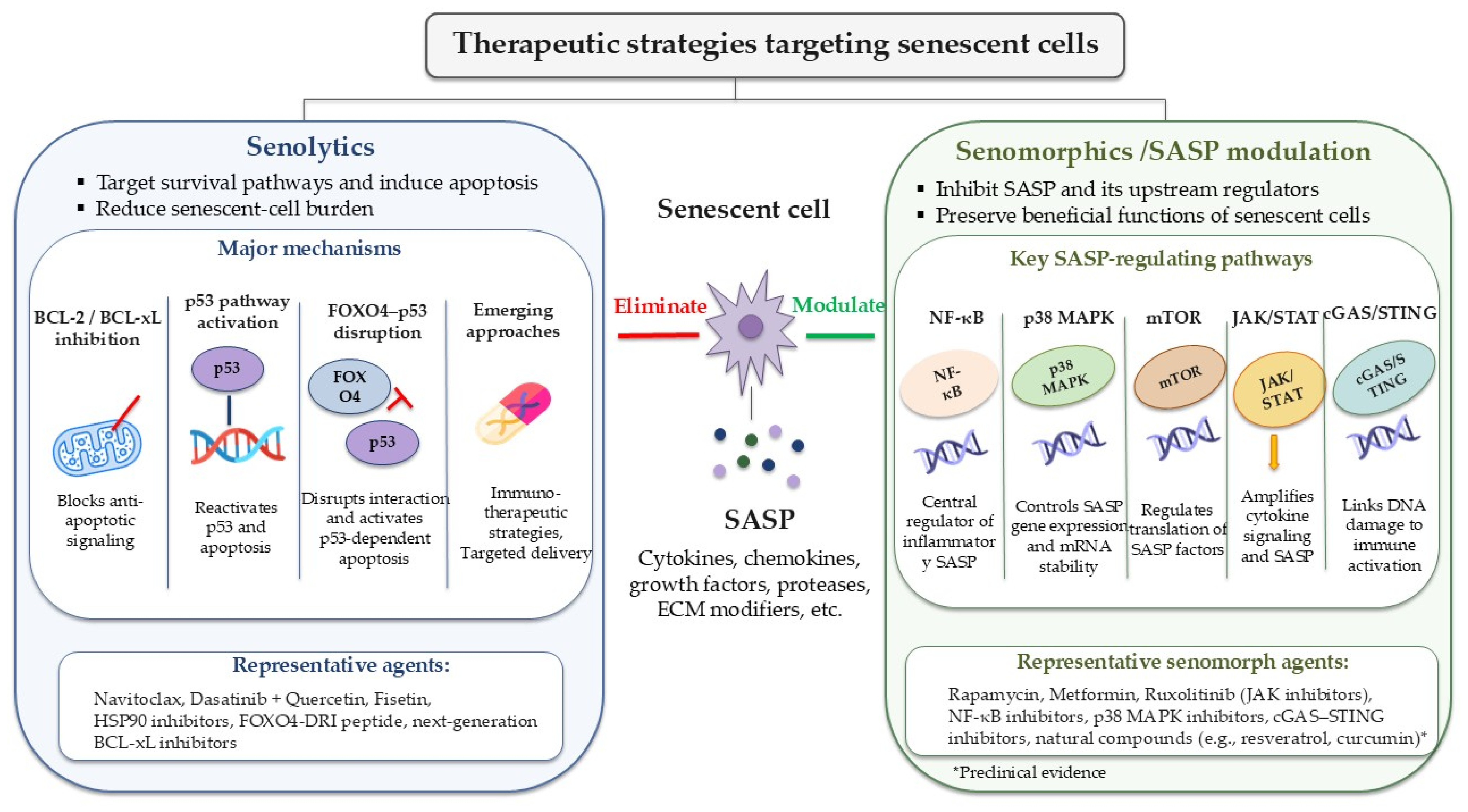
Several challenges limit progress, including senescent-cell heterogeneity across tissues and disease states, the lack of universally validated biomarkers for detecting senescence in vivo, and uncertainty regarding optimal patient selection, dosing, and treatment timing [3,5]. Moreover, indiscriminate senescent-cell elimination may disrupt physiological functions, while SASP modulation can produce context-dependent effects [4,8]. Therapeutic development therefore requires strategies that distinguish harmful from beneficial senescence and demonstrate meaningful clinical benefit alongside acceptable safety (Figure 1).
This review examines mechanisms, preclinical evidence, and clinical progress of senolytics and senomorphics, with particular emphasis on therapeutic selectivity, safety, biomarker development, and the translational priorities needed to advance senescence-targeting interventions toward clinical use.
Figure 1.
Overview of senolytic and senomorphic strategies. Senolytics eliminate senescent cells by targeting survival dependencies, whereas senomorphics attenuate deleterious senescent-cell functions, chiefly the SASP, through inhibition.
2. Literature Review
The literature reviewed for this article was identified through searches of PubMed/MEDLINE, Scopus, Web of Science, and Google Scholar, focusing on cellular senescence, senolytic and senomorphic interventions, their underlying mechanisms, and therapeutic applications. Search concepts included cellular senescence, senolytics, senomorphics, SASP, targeted senescent-cell elimination, and clinical translation, combined with disease-specific terms where relevant. Mechanistic studies, preclinical investigations, and clinical studies were considered to provide a comprehensive overview of the field. The literature was critically evaluated with emphasis on therapeutic targets, biological activity, disease-specific findings, safety, limitations of existing approaches, and clinical development. Particular attention was given to distinguishing preclinical evidence and biological target engagement from demonstrated clinical efficacy and to identifying emerging therapeutic strategies and unresolved translational challenges.
3. Senolytics: Mechanism and Drug Candidates
Senolytics are pharmacological agents designed to selectively eliminate senescent cells by exploiting their dependence on specific pro-survival pathways [8]. Senescent cells frequently upregulate multiple components of so-called senescent cell anti-apoptotic pathways (SCAPs), including BCL-2 family proteins, PI3K/AKT signaling, ephrin-dependent survival pathways, HSP90-mediated proteostasis, and other stress-response mechanisms [8,14]. Pharmacological disruption of these pathways can overcome apoptosis resistance toward programmed cell death [8].
Molecular Basis of Senolytic Activity
The identification of SCAPs established the foundation for first-generation senolytics, as senescent cells rely on redundant survival mechanisms to resist apoptosis despite persistent cellular damage [8,14]. Targeting these pathways can preferentially eliminate senescent cells, although selectivity varies with cell lineage, inducing stimulus, tissue context, and senescence duration [6,8]. Representative senolytic candidates, their principal molecular targets, mechanisms of action, translational status, and key limitations are summarized in Table 1.
The BCL-2 family of anti-apoptotic proteins, particularly BCL-2, BCL-xL, and BCL-w, represents one of the best-characterized senolytic targets. By restraining pro-apoptotic signaling, these proteins maintain mitochondrial integrity and contribute to senescent-cell survival [15]. Their inhibition promotes mitochondrial outer membrane permeabilization and caspase-dependent apoptosis [16]. Navitoclax (ABT-263), a BCL-2/BCL-xL/BCL-w inhibitor, demonstrated broad preclinical senolytic activity but is constrained by dose-limiting thrombocytopenia resulting from BCL-xL inhibition in platelets [15,16]. More selective BCL-xL inhibitors, including A1331852 and A1155463, have therefore been investigated to improve senolytic selectivity and therapeutic selectivity [16].
The PI3K/AKT pathway represents another important survival mechanism targeted by senolytic agents, remaining active in senescent cells despite irreversible cell-cycle arrest and promoting resistance to apoptosis [8,17]. Quercetin, a naturally occurring flavonoid, exhibits senolytic activity partly through inhibition of PI3K and other pro-survival pathways [14]. However, its pleiotropic targets and variable activity across cell types highlight the heterogeneity of senescent cells and support combining agents with complementary mechanisms [6,8].
The combination of dasatinib and quercetin (D+Q) is among the most extensively studied senolytic regimens. Dasatinib is a multikinase inhibitor, and quercetin, a flavonoid targeting multiple kinases and survival pathways, exhibit complementary senolytic activity in selected cell populations [14]. Preclinical studies showed that intermittent D+Q reduces senescent-cell burden and improves age-associated phenotypes [18]. Early clinical studies subsequently demonstrated reductions in selected senescence-associated markers, supporting the feasibility of senolytic treatment [19,20]. However, these studies were small and exploratory, and clinical evidence remains insufficient to establish disease-modifying efficacy [1,6].
Fisetin, a flavonoid structurally related to quercetin, is another extensively investigated senolytic. Comparative screening identified fisetin as capable of reducing senescence markers across multiple tissues in aged and progeroid mice, partly through modulation of BCL-2 family proteins, PI3K/AKT, and other survival pathways [8,21]. Its cell-type-selective activity further supports the concept that senolytic efficacy depends on the molecular phenotype of target cells [21]. Although fisetin has progressed to human clinical investigation, definitive evidence of disease-modifying efficacy remains limited [6].
Senolytic activity can also be achieved by disrupting HSP90-dependent proteostasis, as HSP90 stabilizes proteins involved in cellular survival, and its inhibition interferes with PI3K/AKT and related pathways [22]. HSP90 inhibitors such as 17-DMAG and 17-AAG have demonstrated senolytic activity in experimental models, including accelerated aging models [22]. However, their broader pharmacological effects and toxicity have limited development as systemic senolytics [8,22].
A mechanistically distinct strategy is represented by FOXO4-DRI, a peptide designed to disrupt FOXO4-p53 interaction and promote p53-dependent apoptosis in senescent cells [23]. Preclinical studies demonstrated reduced senescent-cell burden and improved age-associated phenotypes, supporting protein–protein interactions as potential senolytic targets [23]. However, peptide stability, tissue distribution, delivery, and clinical translation remain key challenges [8].
Beyond established candidates, the senolytic landscape is shifting toward more selective and tissue-directed approaches, including next-generation BCL-xL inhibitors, immunotherapies, targeted delivery systems, and protein-degradation technologies [8,24]. These strategies aim to overcome the off-target pharmacology of repurposed first-generation senolytics, with greater molecular and tissue selectivity potentially improving therapeutic index and reducing systemic toxicity, particularly in older populations [8,24].
Importantly, senolytic activity does not necessarily translate into clinical efficacy. Failure of the MDM2 inhibitor UBX0101 in a randomized phase II knee osteoarthritis study highlights the gap between preclinical senolysis and clinical benefit [25]. This underscores the need for appropriate patient selection, target-engagement assessment, disease-specific endpoints, and adequate drug exposure [8]. Conversely, the BCL-xL inhibitor foselutoclax (UBX1325) has advanced into ophthalmic clinical development, with encouraging findings in diabetic macular edema supporting locally targeted senolysis [25]. These experiences highlight a shift toward disease-specific, locally delivered, and molecularly targeted strategies.
Table 1.
Representative senolytic candidates, molecular targets, mechanisms, and translational status.
4. Senomorphics and SASP Modulation
While senolytics eliminate senescent cells, their heterogeneous distribution, context-dependent functions, and potential systemic toxicity have prompted complementary strategies that modify senescent-cell behavior without inducing cell death [5,6]. Senomorphics attenuate detrimental senescent-cell functions, particularly the SASP, while potentially preserving beneficial effects of senescence [4,5]. Unlike senolytics, which reduce senescent-cell burden, senomorphic interventions aim to modify the biological activity of senescent cells, although their effects may extend beyond senescence-associated processes depending on the molecular target. Major molecular pathways regulating the SASP and representative senomorphic approaches are presented in Table 2.
4.1. SASP as a Therapeutic Target
The SASP comprises cytokines, chemokines, growth factors, proteases, extracellular matrix-modifying enzymes, and other mediators, with its composition varying by cell type, senescence-inducing stimulus, tissue environment, and duration [4]. Its development involves interconnected pathways, including NF-κB, p38 MAPK, mTOR, JAK/STAT, and cGAS–STING signaling [4,27]. Persistent activation can sustain inflammation, promote tissue remodeling, and induce pathological effects in neighboring cells, making these pathways potential targets for senomorphic intervention [4,27]. However, SASP regulation is not governed by a single pathway, and these signaling networks also perform essential functions in normal cellular physiology, including innate immune responses, metabolic regulation, stress adaptation, cell survival, and tissue homeostasis. Consequently, their modulation may alter biological processes beyond SASP regulation, and therapeutic effects cannot necessarily be attributed exclusively to senomorphic activity [4].
NF-κB is a central regulator of the inflammatory SASP, integrating signals from DNA damage, oxidative stress, and cytokines to promote mediators such as IL-6 and IL-8 [4,28]. Beyond senescence, NF-κB is a critical regulator of innate and adaptive immune responses, inflammatory signaling, cellular stress responses, and survival. Its inhibition can attenuate SASP expression and paracrine effects [28]. Similarly, p38 MAPK regulates SASP development through NF-κB activity and SASP transcript stability, with its inhibition reducing inflammatory mediator production [29]. p38 MAPK also participates in stress sensing, inflammatory responses, differentiation, and cellular adaptation to environmental stimuli. Although modulation of these pathways may reduce pathological inflammatory signaling, sustained or systemic inhibition could interfere with normal immune responses and cellular stress adaptation. However, both pathways have essential physiological functions, limiting sustained systemic inhibition [27].
The mTOR pathway links cellular metabolism with SASP regulation. Physiologically, mTOR integrates nutrient availability, growth-factor signaling, energy status, and environmental cues to regulate protein synthesis, cellular growth, metabolism, and autophagy. Its role in senescence extends beyond SASP regulation, reflecting its broader involvement in cellular metabolic and stress responses. Rapamycin-mediated mTORC1 inhibition can suppress SASP development by reducing translation of membrane-bound IL-1α, an upstream activator of NF-κB [30]. Rapamycin has reduced inflammatory cytokine secretion and the pro-tumorigenic effects of senescent cells in experimental models, supporting mTOR inhibition as a senomorphic strategy [30]. However, its broad metabolic and immunological effects limit senescence-specific targeting [5]. Thus, the effects of mTOR inhibition may reflect a combination of SASP suppression, metabolic modulation, and changes in other cellular processes rather than selective modification of senescence alone.
JAK/STAT signaling can amplify cytokine-driven inflammatory responses and sustain SASP-associated signaling. Outside senescence, JAK/STAT pathways mediate cytokine and growth-factor responses and regulate immune-cell function, proliferation, differentiation, and hematopoietic activity. In senescent cells, cytokine-mediated activation of JAK/STAT may reinforce inflammatory signaling and contribute to the persistence of SASP-associated responses. JAK inhibition has reduced SASP-associated inflammation and improved physical function in aged mice, providing in vivo support for this pathway as a senomorphic target [31]. Nevertheless, because JAK/STAT signaling is integral to immune regulation and cytokine responses, its inhibition may produce broader immunomodulatory effects that complicate the attribution of therapeutic benefits to senomorphic activity.
The cGAS-STING pathway has also emerged as an important link between persistent DNA damage and innate immune activation during senescence, although its contribution varies across cell types and senescence-inducing stimuli [4,27]. Physiologically, cGAS–STING functions as a cytosolic DNA-sensing mechanism that activates innate immune signaling, including type I interferon responses, in response to aberrant intracellular DNA. In senescence, the accumulation of cytosolic DNA arising from genomic or mitochondrial damage may activate cGAS–STING and promote inflammatory SASP signaling. However, this pathway also contributes to antimicrobial defense and immune surveillance, and its effects may vary according to the cellular and disease context [32].
Metabolic and repurposed agents may provide additional approaches to SASP modulation. Metformin, for example, can suppress SASP-associated inflammatory signaling through mechanisms involving AMPK and IKK/NF-κB, with experimental studies demonstrating reduced inflammatory cytokine secretion in senescent cells [33,34]. Although these findings support its potential as a senomorphic agent, its pleiotropic metabolic and anti-inflammatory effects make it difficult to attribute observed benefits exclusively to SASP modulation [27].
Importantly, SASP suppression should not be equated with reversal of cellular senescence. Senomorphic interventions may reduce inflammatory and paracrine consequences while leaving cell-cycle arrest, persistent DNA damage, and other senescent features intact [4,5]. Their therapeutic objective is therefore to uncouple pathological secretory activity from the broader senescent phenotype rather than restore senescent cells to a proliferative state.
4.2. Translational Considerations
Several agents, including rapamycin, metformin, JAK inhibitors, and modulators of NF-κB, p38 MAPK, and cGAS–STING, demonstrate senomorphic or SASP-modulating effects in experimental models [5,6,27]. However, senomorphic efficacy is difficult to define because suppression of selected SASP factors does not necessarily indicate comprehensive modification of senescence [3,4]. Moreover, targeting pathways with essential physiological functions may cause immune, metabolic, or tissue-repair effects [4,27]. The pleiotropic nature of these pathways also complicates mechanistic attribution, as changes in inflammatory markers or disease outcomes may reflect broader pharmacological effects rather than selective modulation of senescent cells.
Accordingly, future strategies should prioritize selective, context-specific SASP modulation over indiscriminate pathway blockade. Combining senolytics with senomorphics may further improve therapeutic precision by reducing senescent-cell burden while suppressing residual or physiologically retained senescent-cell activity [5,27]. However, optimal combinations, sequencing, treatment duration, and response biomarkers remain to be established.
Table 2.
Major molecular pathways regulating the SASP and representative senomorphic approaches.
5. Preclinical Evidence
Preclinical studies provide proof of concept that targeting cellular senescence can modify disease phenotypes in vivo. Genetic and pharmacological approaches have shown that reducing senescent-cell burden or modulating their secretory activity can improve tissue function across diverse age-related and chronic disease models [15,18,21,23]. Summary of preclinical studies evaluating senolytic and senomorphic interventions is presented in Table 3.
5.1. Preclinical Evidence for Senolytic Strategies
Among senolytics, dasatinib plus quercetin (D+Q) has generated extensive in vivo evidence. In aged and progeroid mice, intermittent D+Q reduced senescent-cell burden, improved physical function, and extended lifespan [18]. D+Q also improved vascular function in aged and hypercholesterolemic mice, with senescent-cell clearance varying across vascular compartments [35]. In obesity models, D+Q and navitoclax reduced senescence markers and transiently improved glucose tolerance and insulin sensitivity, although these effects were not sustained with repeated treatment [36].
BCL-2 family inhibition provides evidence that directly targeting senescent-cell survival pathways can improve tissue function. Navitoclax reduced senescent-cell burden and rejuvenated hematopoietic stem-cell function in aged mice, with additional activity demonstrated in osteoarthritis models [15,16]. In post-traumatic osteoarthritis, intra-articular navitoclax reduced senescent chondrocytes, inflammatory cytokines, and cartilage and subchondral bone pathology [37].
Senolytic benefits have also been demonstrated across organ-specific models. D+Q improved vasomotor function in aged and atherosclerotic mice [35]. while preserving bone density, microarchitecture, and strength under chronic high-altitude hypoxia [38]. In SM/J mice, D+Q delayed early-onset intervertebral disk degeneration, reducing senescence markers and SASP expression while preserving disk-cell viability and tissue architecture [39]. Notably, navitoclax did not produce comparable structural benefits, highlighting the context-dependent efficacy of senolytic agents [39].
Evidence is also emerging in neurodegenerative disease. In the APP^NL-F/NL-F Alzheimer’s disease model, D+Q and fisetin modulated senescence-associated markers and improved selected metabolic and cognitive outcomes, with responses varying by sex and treatment [40]. These findings complement earlier evidence that fisetin extends healthspan and lifespan in aged and progeroid mice [21].
5.2. Preclinical Evidence for Senomorphic and SASP-Modulating Strategies
Preclinical evidence for senomorphics provides a complementary approach by modulating the SASP to reduce inflammatory and paracrine effects without eliminating senescent cells. Rapamycin suppressed SASP through mTOR-dependent regulation of IL-1α translation [30]. While JAK inhibition reduced SASP-associated inflammation and improved physical function and frailty in aged mice [31]. Metformin similarly attenuated inflammatory cytokine expression through IKK/NF-κB modulation [33,34].
More recent studies have expanded senomorphic strategies beyond conventional small molecules. The bifunctional immunotherapeutic HCW9218 reduced senescent-cell and SASP markers and improved metabolic and physical outcomes in diabetic and aged mice [41]. Similarly, standardized Salvia haenkei extract reduced senescence-associated inflammation and fibrosis and improved healthspan, with luteolin identified as a senomorphic constituent targeting the p16-CDK6 axis [42].
Table 3.
Preclinical studies evaluating senolytic and senomorphic interventions.
6. Clinical Trials and Human Studies
Clinical translation of senotherapeutic strategies remains at an early stage, with human studies ranging from small open-label pilot studies demonstrating biological target engagement to randomized controlled trials evaluating disease-specific clinical outcomes. The majority of published studies have investigated senolytic approaches, particularly dasatinib plus quercetin (D+Q), while more recent clinical development has expanded toward selective BCL-xL inhibition, fisetin, and tissue-directed administration. Importantly, evidence of biological target engagement, reflected by changes in senescence-associated biomarkers, should not be equated with clinical efficacy. To date, human studies have not consistently demonstrated that biomarker changes translate into meaningful improvements in disease-specific clinical outcomes, underscoring the need for appropriate patient selection and adequately powered trials with clinically relevant endpoints [5,19].
Table 4 illustrates an important progression in clinical development: initial studies established human target engagement and feasibility, whereas subsequent trials have increasingly incorporated randomized designs, disease-specific outcomes, and biomarker-based patient stratification. The D+Q bone study is particularly informative because the overall primary endpoint was not met, while exploratory analyses suggested that baseline senescent-cell burden may influence response [43].
Table 4.
Clinical studies evaluating senolytic interventions.
6.1. Clinical Evidence for Senolytic Strategies
The first clinical evidence supporting senolytic activity in humans came from an open-label phase 1 pilot study of D+Q in nine individuals with diabetic kidney disease. Participants received oral dasatinib and quercetin for 3 days, after which adipose tissue, skin, and blood were evaluated. Treatment was associated with reductions in multiple senescence-associated markers, including p16INK4A, p21CIP1, and senescence-associated β-galactosidase-positive cells in adipose tissue and skin. Circulating SASP-associated factors, including IL-1α, IL-6, and MMP-9 and MMP-12, were also reduced [19]. These findings provided initial direct evidence that a short, intermittent senolytic regimen could alter senescence-associated cellular and molecular markers in humans. However, the study was a small Phase 1 pilot designed to evaluate senolytic activity and did not establish clinical efficacy in diabetic kidney disease. Changes in senescence-associated biomarkers should therefore be interpreted as evidence of biological activity rather than therapeutic benefit.
A subsequent phase 1 randomized, placebo-controlled pilot study evaluated D+Q in 12 individuals with idiopathic pulmonary fibrosis (IPF). Participants received D+Q or placebo for 3 consecutive days per week over 3 weeks. All participants completed the scheduled dosing and assessments. Although the study was primarily designed to assess feasibility and tolerability rather than efficacy, no serious adverse events related to D+Q were observed. Non-serious adverse events were more frequent in the D+Q group, and sleep disturbances and anxiety occurred disproportionately among participants receiving active treatment [44]. These findings supported the feasibility of intermittent dosing while emphasizing the need for controlled safety evaluation in subsequent trials.
The clinical evidence subsequently progressed to randomized evaluation in age-related disease. In a phase 2 randomized controlled trial involving 60 postmenopausal women, intermittent D+Q was evaluated for effects on bone metabolism. The primary endpoint, percentage change in the bone-resorption marker C-terminal telopeptide at 20 weeks, did not differ significantly between the D+Q and control groups. The bone-formation marker procollagen type 1 N-terminal propeptide increased relative to control at 2 and 4 weeks but not at 20 weeks. No serious adverse events were observed [43].
Importantly, exploratory analyses demonstrated that skeletal responses appeared to be concentrated among women with higher baseline senescent-cell burden, defined by T-cell p16INK4a expression. In this subgroup, D+Q was associated with changes in both bone-formation and bone-resorption markers and an increase in radius bone mineral density at 20 weeks [43]. These findings do not establish efficacy of D+Q for postmenopausal bone loss but provide an important proof of concept for biomarker-enriched senolytic trials, in which baseline senescent-cell burden may influence treatment response.
6.2. Senolytics in Neurodegenerative Disease
Neurodegenerative disease has emerged as another area of clinical investigation because cellular senescence and SASP-associated inflammation may contribute to neuronal and glial dysfunction. An open-label phase 1 feasibility study evaluated intermittent D+Q in five older adults with early symptomatic Alzheimer disease. Dasatinib was detected in cerebrospinal fluid in four of five participants, providing evidence of central nervous system exposure, whereas quercetin was not detected in cerebrospinal fluid. The regimen was tolerated without early treatment discontinuation, although secondary cognitive and neuroimaging outcomes did not demonstrate significant pre- to post-treatment differences [48].
More recently, Millar et al. (2025) [45] evaluated intermittent D+Q in 12 older adults at risk for Alzheimer disease. Participants received dasatinib 100 mg and quercetin 1250 mg for 2 days every 2 weeks for 12 weeks. No serious adverse events related to the intervention were observed. Mean Montreal Cognitive Assessment scores increased by 1.0 point overall, although the confidence interval included no change; an increase of 2.0 points was observed in participants with the lowest baseline cognitive scores. Plasma TNF-α also showed a small, nonsignificant reduction, and its change correlated inversely with the change in MoCA score [45]. The investigators emphasized that the absence of a control group and the small sample size limit interpretation of these exploratory findings.
These studies demonstrate the feasibility of investigating senolytics in neurodegenerative disease but also illustrate the distinction between biological plausibility, target engagement, and clinical efficacy. Larger randomized trials incorporating validated biomarkers and disease-relevant clinical endpoints will be required before the therapeutic contribution of senolysis in neurodegenerative disease can be established.
6.3. Local and Tissue-Directed Senolytic Approaches
An alternative strategy is to restrict senolytic exposure to the tissue in which pathogenic senescent cells are believed to accumulate. Foselutoclax (UBX1325), a selective BCL-xL inhibitor, represents an example of this approach. In a randomized, sham-controlled phase 2 study involving 65 patients with diabetic macular edema, a single intravitreal injection was evaluated primarily for safety and tolerability, with efficacy assessed as a secondary objective. No treatment discontinuations due to adverse events were observed, and the study reported no apparent differences between groups in vital signs, electrocardiograms, or routine blood chemistry parameters [25]. The study provided further clinical evidence supporting feasibility of local senolytic treatment, while the efficacy signal remained exploratory and requires confirmation in larger trials.
This tissue-directed approach is conceptually important because many first-generation senolytics have systemic pharmacological effects unrelated to senolysis. Local administration may therefore increase the therapeutic index by concentrating exposure at the site of disease while limiting systemic exposure.
6.4. Emerging Clinical Investigation of Fisetin
Fisetin is another senolytic candidate progressing toward disease-specific clinical evaluation. Unlike D+Q, for which several small human studies have already been completed, current fisetin investigations include disease-specific trials designed to establish whether senolytic treatment can modify clinically relevant outcomes.
The STOP-Sepsis trial is a multicenter, randomized, double-blind, adaptive phase 2 clinical trial evaluating fisetin in adults older than 65 years with sepsis. The study protocol plans to enroll 220 participants and compare placebo with either a single oral dose of fisetin or two doses administered 1 day apart. The primary outcome is change in a composite cardiovascular, respiratory, and renal Sequential Organ Failure Assessment score at day 7, while secondary outcomes include senescent CD3+ cell quantification, organ-failure-free days, intensive care unit stay, and 28-day mortality [46]. STOP-Sepsis is a planned clinical trial, and the published protocol describes the proposed study design rather than clinical findings. Accordingly, no conclusions regarding the efficacy of fisetin in sepsis can currently be drawn from this study. The STOP-Sepsis design is nevertheless relevant to the broader development of senotherapeutics because it links a biological endpoint, senescent immune-cell burden, with clinically meaningful measures of organ dysfunction. Such trial designs may help determine whether changes in senescence-associated biomarkers are associated with tangible patient outcomes.
Another ongoing investigation, the TROFFi (Treatment Of Frailty with Fisetin) trial, is a multicenter, phase II, randomized, double-blind, placebo-controlled study evaluating fisetin in postmenopausal women with early-stage breast cancer who have experienced functional decline following neoadjuvant or adjuvant chemotherapy. The study plans to enroll 88 participants with impaired physical function, defined as a 6-min walk distance (6MWD) of <400 m, who will receive fisetin (20 mg/kg/day) or placebo on days 1–3 of each 14-day cycle for four cycles. The primary endpoint is change in 6MWD from baseline to the end of treatment, with additional assessments of physical function, quality of life, fatigue, cognition, neuropathy, safety, and senescence-associated biomarkers. As the published report describes the trial rationale and design rather than clinical outcomes, TROFFi currently represents an ongoing investigation of fisetin’s potential clinical benefit, and its efficacy remains to be established [47].
6.5. Biomarker-Guided Patient Selection
A major limitation of early senolytic trials has been the absence of a validated method for identifying patients with a sufficiently high burden of therapeutically relevant senescent cells. The 2024 D+Q bone trial provided evidence that baseline senescent-cell burden may influence treatment response, prompting further investigation of biomarkers suitable for clinical trial enrichment [43].
Farr et al. (2024) [43] subsequently characterized human senescent-cell biomarkers in relation to the D+Q bone trial. T-cell p16-variant 5 mRNA was more closely associated with skeletal response to D+Q than an assay measuring combined p16-variant 1 and 5 transcripts. A plasma SASP marker panel also demonstrated potential utility for identifying participants with a positive skeletal response. These findings support the concept that biomarker-defined patient selection may improve the ability of future trials to identify treatment-responsive populations [43].
However, interpretation of SASP-based biomarkers is complicated by their lack of specificity for cellular senescence. Cytokines such as interleukin-6 (IL-6) and tumor necrosis factor-α (TNF-α) are also elevated in chronic inflammatory conditions and age-related systemic inflammation, potentially confounding senescence-associated signals with generalized inflammation or inflammaging [49]. Moreover, circulating SASP profiles may reflect contributions from multiple cell types, with considerable variation in secretory composition across senescent cell populations and associations with age, frailty, and clinical risk [50].
These biomarkers should currently be regarded as investigational rather than established clinical tools. Senescence is heterogeneous across tissues and disease states, and no single biomarker reliably identifies all senescent cells in vivo. Future trials should consider accounting for baseline inflammatory status and relevant comorbidities, incorporating conventional inflammatory measures alongside senescence-associated biomarker panels, and evaluating longitudinal changes relative to baseline and control groups. Stratification according to baseline inflammatory burden and multiparametric biomarker assessment may help distinguish senescence-associated signals from nonspecific inflammation and improve interpretation of target engagement and treatment response.
6.6. Translational Challenges and Current Clinical Perspective
Taken together, available human studies support the feasibility of senescence-targeting interventions and provide evidence of biological activity, but the clinical evidence remains insufficient to establish broad disease-modifying efficacy. The current evidence base is characterized by small sample sizes, heterogeneous populations, variable treatment schedules, different definitions of senescence-related endpoints, and limited duration of follow-up.
An important distinction is therefore required between three levels of evidence:
1. Target engagement: evidence that senescent-cell markers or pathways are altered following treatment.
2. Biological response: changes in disease-relevant molecular, structural, or physiological measures.
3. Clinical benefit: improvement in patient-relevant symptoms, function, disease progression, or other validated clinical outcomes.
Several studies have demonstrated the first level, while evidence for the second level is emerging. Demonstration of reproducible clinical benefit remains the principal unmet requirement for establishing senotherapeutics as therapeutic interventions.
The clinical experience also suggests that future senolytic development is likely to move away from a generalized “anti-aging” strategy toward disease-specific, biomarker-guided, intermittent, and tissue-directed interventions. The phase 2 D+Q bone study illustrates the potential importance of baseline senescent-cell burden in determining response, while UBX1325 demonstrates the feasibility of restricting senolytic exposure to a disease-relevant tissue [25,43].
Finally, although the majority of human studies to date have focused on senolytics, comparable clinical evidence for senomorphic/SASP-modulating interventions specifically developed as senotherapeutics remains limited. Agents such as metformin, rapamycin, and JAK inhibitors have demonstrated SASP-modulating effects in experimental models, but their established pharmacological actions extend beyond senescence, making it difficult to attribute clinical effects specifically to senomorphic activity. Therefore, these approaches require separate evaluation using validated senescence-related biomarkers and disease-specific clinical endpoints.
Overall, clinical studies have established that senotherapeutic interventions can be administered to humans and can modify selected senescence-associated biological measures. However, the transition from biological target engagement to reproducible clinical benefit remains incomplete. Future trials should therefore prioritize biomarker-defined patient populations, adequately powered randomized designs, disease-specific endpoints, tissue-selective delivery where feasible, and sufficiently long follow-up to determine both durability of benefit and delayed safety outcomes.
7. Safety Concerns and Toxicological Challenges
This section examines the safety profile of senolytics and senomorphics, focusing on treatment selectivity, off-target and tissue-specific toxicities, and the potential risks of modulating physiologically relevant pathways. It also considers age-related pharmacological vulnerabilities, including altered drug handling, organ function, and polypharmacy, alongside long-term safety and strategies to mitigate treatment-related risks.
7.1. Selectivity and the Therapeutic Window
The principal safety concern with senolytics is the ability to selectively eliminate senescent cells without damaging healthy cells. Although senescent cells may exhibit increased dependence on anti-apoptotic pathways, these pathways are not exclusive to senescent cells. Their inhibition can therefore produce on-target toxicity in normal tissues, particularly when the targeted pathway has an essential physiological role [5].
The clinical experience with BCL-2/BCL-xL inhibition illustrates this challenge. Navitoclax has demonstrated senolytic activity in preclinical models, but its inhibition of BCL-xL is associated with thrombocytopenia, reflecting the dependence of circulating platelets on this survival pathway. Clinical studies in oncology have similarly demonstrated hematological toxicities, emphasizing the importance of separating senolytic activity from broader pharmacological effects [51]. More selective approaches, including BCL-xL-directed compounds and targeted protein degradation, are therefore being investigated to improve the therapeutic window [24]. The principal safety considerations associated with major senotherapeutic approaches are summarized in Table 5.
Table 5.
Major safety and toxicological considerations for senotherapeutic approaches.
7.2. Off-Target and Tissue-Specific Toxicity
The toxicity profile of senotherapeutics may vary substantially according to the target, tissue, and route of administration. Dasatinib plus quercetin (D+Q), one of the most extensively investigated senolytic combinations, has shown generally acceptable tolerability in early human studies; however, clinical trials remain too small to fully characterize uncommon or delayed adverse effects [43,44]. The intermittent administration used in several studies may help limit cumulative exposure, but the optimal dosing interval remains uncertain.
Tissue-directed administration represents another strategy for reducing systemic exposure. The development of UBX1325 (foselutoclax), a selective BCL-xL inhibitor administered intravitreally for diabetic macular edema, provides an example of localized senolytic treatment. Phase 1 and subsequent randomized clinical studies have provided clinical evidence of tolerability and biological activity, although longer follow-up and larger studies are required to establish its broader safety profile [25,26].
Systemic administration may increase exposure of healthy tissues, whereas local delivery may improve tissue selectivity. The development of UBX1325 for diabetic macular edema illustrates this approach, with intravitreal administration providing localized exposure and an acceptable safety profile in early clinical evaluation [25,26]. However, local administration is applicable only to selected anatomical and disease contexts.
Age-related pharmacological vulnerability represents an additional consideration in the clinical development of senotherapeutics, particularly given their anticipated use in older adults with multimorbidity. Declining renal function, changes in hepatic metabolism, altered body composition, and increased pharmacodynamic sensitivity may affect drug exposure, tolerability, and toxicity, although these effects vary substantially between individuals and agents [52]. Polypharmacy may further increase the risk of adverse drug reactions through drug–drug interactions and overlapping toxicities. This is particularly relevant to dasatinib-containing regimens, as dasatinib is metabolized predominantly through CYP3A4 and its exposure can be altered by concomitant CYP3A4 inhibitors or inducers [53]. Similar considerations warrant attention during the development of other senotherapeutics, including HSP90 inhibitors, for which agent-specific pharmacokinetic, interaction, and tolerability profiles should inform clinical evaluation [54]. Accordingly, future trials should incorporate medication reconciliation, assessment of renal and hepatic function, interaction screening, and individualized dose or exposure monitoring where appropriate, rather than assuming uniform tolerability across older participants.
7.3. Safety Considerations for Senomorphics
Senomorphics may offer an alternative approach by modifying the pathological consequences of senescence without directly eliminating senescent cells. However, this does not eliminate safety concerns. Many pathways involved in SASP regulation, including NF-κB, p38 MAPK, mTOR, JAK/STAT, and cGAS-STING, also have important physiological functions in immune regulation, metabolism, tissue repair, and cellular stress responses [27,38]. These pathway-specific safety considerations, together with those of senolytic approaches, are summarized in Table 5.
For example, systemic inhibition of NF-κB or JAK/STAT may alter inflammatory and immune responses, whereas mTOR inhibition can produce broader metabolic and immunological effects. Similarly, suppression of cGAS-STING signaling could influence normal innate immune responses. These considerations suggest that senomorphic strategies may require a balance between sufficient suppression of pathological SASP activity and preservation of physiological signaling. Importantly, reduction in selected SASP factors should not be interpreted as reversal of the underlying senescent state, as senescent cells may remain metabolically active and capable of producing other mediators.
7.4. Long-Term Safety and Repeated-Dose Safety
Most clinical studies of senotherapeutics have involved relatively small populations and short treatment periods. Consequently, important questions remain regarding repeated treatment, cumulative toxicity, and the biological consequences of sustained senescent-cell depletion or SASP suppression. This is particularly relevant because senescence can have beneficial roles in tumor suppression, wound healing, tissue remodeling, and other physiological processes [5].
Long-term safety assessment should therefore extend beyond conventional adverse-event monitoring. Changes in tissue function, immune parameters, organ-specific toxicity, and senescence-associated biomarkers may be relevant during prolonged follow-up. Standardized and multiparametric approaches to senescence detection will be important because individual markers such as p16, p21, or SA-β-gal do not independently define senescence across tissues [3]. Biomarker development is consequently important not only for demonstrating efficacy but also for monitoring the biological effects of treatment.
7.5. Risk Mitigation and Translational Considerations
Several strategies may help improve the safety of future senotherapeutics. These include disease- and tissue-specific identification of target senescent-cell populations, biomarker-guided patient selection, intermittent rather than continuous dosing where appropriate, and development of more selective molecular or delivery approaches. Local administration may be particularly useful where the pathological senescent-cell population is anatomically restricted, whereas systemic treatment may require greater attention to dose and off-target exposure.
Patient selection may also become increasingly important because senescent-cell burden and phenotype can differ substantially between individuals. Biomarker-guided approaches could potentially identify patients with a relevant senescent-cell phenotype and provide pharmacodynamic evidence of target engagement [55]. Such strategies may also help distinguish biological activity from nonspecific effects of drugs that have established pharmacological actions beyond senescence.
Overall, the safety of senotherapeutics will depend on achieving an appropriate balance between senescent-cell targeting and preservation of normal cellular functions. Current evidence supports the feasibility of senescence-targeting interventions but remains insufficient to define their long-term safety across different diseases and populations. Continued development should therefore integrate selective drug design, tissue-directed delivery, biomarker-based monitoring, and appropriately long-term clinical follow-up.
8. Regulatory and Ethical Perspectives
The translation of senolytics and senomorphics into clinical practice presents regulatory and ethical challenges that extend beyond conventional drug development. Unlike therapies directed against a defined molecular target or disease pathway, senotherapeutics aim to modify a heterogeneous cellular state that can have both beneficial and pathological functions. Regulatory development must therefore establish not only pharmacological activity but also evidence that modulation of senescence produces clinically meaningful benefit while preserving physiological functions of senescent cells [5].
8.1. Regulatory Classification and Development Pathways
A major regulatory consideration is that cellular senescence is unlikely to constitute a standalone therapeutic indication. Senotherapeutics will instead need to be evaluated within specific disease contexts, with the intended clinical benefit clearly defined. For example, the development of senolytics in diabetic macular edema has focused on retinal functional outcomes rather than senescent-cell clearance itself [25,26]. Similarly, trials of systemic senolytics have evaluated disease- or function-specific outcomes rather than relying solely on changes in senescence-associated biomarkers.
This disease-specific approach is important because the biological significance of senescence varies according to tissue, disease stage, and underlying pathology. Regulatory assessment should therefore consider mechanism of action, target tissue, patient population, treatment duration, and clinically relevant outcomes rather than assuming that a common regulatory pathway will apply to all senotherapeutic agents.
8.2. Biomarkers and Clinical Endpoints
Reliable identification of senescent cells remains an important requirement for clinical development. No single biomarker currently provides a universal measure of senescence across tissues, and commonly used markers such as p16, p21, and SA-β-gal can vary according to cell type and biological context [3]. Consequently, regulatory studies should ideally incorporate multiple complementary measures to establish senescent-cell burden and demonstrate pharmacodynamic target engagement.
Importantly, reduction in senescence-associated biomarkers should not be considered sufficient evidence of therapeutic efficacy. Clinical trials should link evidence of senescence modulation with validated measures of organ function, disease progression, physical function, or patient-reported outcomes. This distinction is particularly relevant because senolytic treatment may alter senescence-associated markers without producing a corresponding functional benefit. Biomarker-guided approaches may nevertheless improve patient selection and enable more precise assessment of treatment response [55].
8.3. Clinical Trial Design and Risk-Benefit Assessment
The heterogeneity of senescence also has implications for trial design. Patients may differ substantially in the abundance, phenotype, and tissue distribution of senescent cells, potentially contributing to variable responses to the same intervention. Enrichment strategies based on disease characteristics or senescence-associated biomarkers may therefore become increasingly relevant as validated biomarkers become available [55].
Early-phase studies should establish appropriate dose, treatment interval, pharmacodynamic effects, and short-term safety before progression to larger efficacy trials. Because many senotherapeutics are being investigated in older populations with multiple comorbidities, trial design should also account for concomitant medications and underlying organ dysfunction. Longer follow-up will be important because the consequences of repeated senescent-cell elimination or prolonged SASP suppression may not be apparent during short treatment periods.
8.4. Ethical Considerations
Ethical considerations arise from the dual biological role of senescence. Senescent cells can contribute to pathological inflammation and tissue dysfunction, but transient senescence also participates in processes such as tissue remodeling, wound repair, and tumor suppression [5,38]. Broad or prolonged elimination could therefore have consequences that are not predictable from short-term reductions in senescence-associated markers.
This uncertainty is particularly relevant when senotherapeutics are investigated for age-related conditions or broader health span applications. Participants should be informed that many such interventions remain investigational and that the long-term consequences of modifying senescent-cell populations are not fully established. Ethical trial conduct should therefore include transparent communication regarding potential benefits, known risks, and uncertainties surrounding long-term outcomes.
8.5. Access, Equity, and Future Regulatory Priorities
If senotherapeutics demonstrate clinical benefit, questions of access and equity will become increasingly relevant. Some future approaches may require specialized biomarker testing, tissue-specific drug delivery, or individualized treatment selection, potentially increasing the complexity and cost of implementation. Regulatory and healthcare frameworks will need to consider how such approaches can be integrated into routine practice without creating unnecessary barriers to appropriate treatment.
Future regulatory development should therefore emphasize standardized biomarkers, disease-specific clinical endpoints, appropriate patient selection, long-term safety monitoring, and reproducible evidence of clinical benefit. Furthermore, improved molecular characterization and proteomic profiling may help identify senescent cell populations and advance biomarker development for clinical translation [56]. International harmonization of approaches to defining and measuring senescence may further facilitate comparison across clinical studies and accelerate development of validated senotherapeutic strategies [3]. Nevertheless, regulatory evaluation will need to remain disease- and context-specific, given the heterogeneity of senescent cells and the distinct mechanisms of action and safety considerations associated with senolytics and senomorphics [5].
Overall, the regulatory pathway for senotherapeutics will likely remain disease-, mechanism-, and context-specific. Progress will depend on demonstrating that modulation of senescence translates into meaningful clinical benefit while maintaining an acceptable safety profile. Establishing standardized biomarkers and clinically relevant endpoints will be particularly important for moving senolytics and senomorphics from exploratory clinical studies toward evidence-based therapeutic use [5,57].
9. Future Directions and Personalized Senotherapeutics
Selective, tissue-targeted, and potentially safer approaches represent key priorities in senotherapeutic development. The limitations of first-generation senolytics, including off-target effects, toxicity arising from inhibition of survival pathways in non-senescent cells, and the narrow therapeutic window of certain agents, highlight the need for more selective strategies. The limitations of first-generation senolytics, including off-target effects, toxicity arising from inhibition of survival pathways in non-senescent cells, and the narrow therapeutic window of certain agents, highlight the need for more selective strategies.
A personalized framework involving the selection of senomorphics based on the patient’s senescence profile is gaining momentum. A recent report has postulated three novel strategies: immune-mediated clearance via senescent cells, tissue-specific protein degradation using proteolytic-targeting chimeras (PROTACs), and modulating the gut microbiome–epigenetic axis to offer a microenvironment supporting senolysis [58]. Immune-mediated clearance seeks to harness the immune system to identify and remove senescent cells, potentially improving selectivity. This is particularly relevant because senescent-cell phenotypes vary across tissues; senescent endothelial cells in vascular aging and senescent adipocytes in metabolic disease may exhibit distinct biological and functional characteristics and require different therapeutic approaches. Characterization of these tissue- and disease-specific features may therefore inform the development of personalized senotherapeutic strategies.
Approaches such as antibody–drug conjugates, senescence-associated enzyme-activated prodrugs, and engineered immune cells are being explored to enhance recognition, selectivity, and targeting of senescent-cell populations. Targeted protein degradation through PROTAC technology offers a complementary strategy by inducing degradation of specific proteins through recruitment of the ubiquitin–proteasome system, rather than relying solely on conventional pharmacological inhibition. This distinction may be particularly relevant to senolytic targets involved in cell-survival pathways, where systemic inhibition can affect non-senescent cells and contribute to dose-limiting toxicity. For example, the thrombocytopenia associated with BCL-xL inhibition by first-generation agents such as navitoclax illustrates the challenges of targeting survival proteins that are also required for normal cellular function. PROTAC-based approaches may offer opportunities to refine target modulation through selective protein degradation; however, whether this translates into improved senescent-cell selectivity, therapeutic window, or safety remains to be established. Targeted protein degradation has also been proposed to address limitations associated with conventional inhibition of proteins considered difficult to target pharmacologically, including regulators within the BCL-2 family and p53-associated pathways [59].
In contrast to senolytics, senomorphics aim to modulate senescence-associated processes, particularly the SASP and associated inflammatory signaling, without necessarily eliminating senescent cells [60,61]. Although this approach may offer advantages where senescent cells contribute to tissue repair or other physiological processes, its therapeutic potential remains challenging to establish [60,62]. The biological effects of senomorphic agents may be context-dependent, and modulation of pathways such as mTOR, JAK/STAT, or NF-κB may affect multiple cellular processes beyond senescence [60,61]. Consequently, observed anti-inflammatory or disease-modifying effects cannot always be attributed specifically to senomorphic activity. Further studies are needed to establish the extent to which selective SASP modulation translates into meaningful clinical benefits, while preserving beneficial functions of senescent cells. The limited clinical evidence and challenges in identifying senescence-specific biomarkers further underscore the need for mechanistically informed studies and longer-term evaluation of senomorphic interventions [60,62].
The bidirectional interaction network between the gut microbiota and cellular senescence may also be explored to identify emerging pathogenic mechanisms and disease-specific regulatory features [63]. Microbiome composition may play a significant role in an individual’s response to senescence-inflammatory pathways and to drug therapy. Further investigation of microbiome–senescence interactions may therefore support the development of strategies that complement direct senescent-cell targeting, although their therapeutic relevance remains to be established.
An interesting and emerging approach reported recently is to utilize senescent tumor cell membrane-coated nanoparticles to target endoplasmic reticulum (ER) in tumor cells. A two-step targeting approach includes encapsulating ribociclib into nanoparticles to induce tumor cell senescence; then, they are loaded with brefeldin A used to target ER stress. Following a sequential therapy, it has been reported that the nanosystem complex accomplished significant ER accumulation and antimetastatic efficacy in 4T1 tumor-bearing mice, providing an advanced perspective for subcellular delivery and tumor-targeting therapy targeting senescence [64]. Similarly, a flexible bioengineered technique to expand immunogenic potential and diminish adverse effects of senescent cancer cell-based nano-vaccination has been proposed [65]. Although these approaches illustrate the potential of combining senescence induction with targeted delivery and immune modulation, their findings remain preclinical and require further validation before clinical translation.
10. Conclusions
The status and clinical translation of these proposed therapies based on mitigating cellular senescence depend on a detailed and accurate understanding of their association with the disease. Both senolytic strategies, aimed at eliminating senescent cells, and senomorphic approaches, aimed at modulating their detrimental biological effects, offer distinct therapeutic opportunities but remain subject to important translational challenges. Research should focus on combining detailed molecular characterization, biomarker-guided drug selection and targeted delivery, and scientifically rigorous clinical trials. Establishing cell- and tissue-specific therapeutic targets, defining clinically meaningful endpoints, and determining long-term safety will be essential to translating mechanistic findings into clinical benefit. Such an approach is promising and possesses the potential to reform the healthcare model completely, provided the right therapeutic strategy for the right senescent cell population at the right stage of disease is optimized.
Author Contributions
Conceptualization, R.K.; writing—original draft preparation, F.A. and P.M.; writing—review and editing, F.A. and P.M.; supervision, R.K. All authors have read and agreed to the published version of the manuscript.
Funding
This article did not receive any funding, and the APC was funded by Gulf Medical University, Ajman, United Arab Emirates.
Institutional Review Board Statement
Not applicable.
Informed Consent Statement
Not applicable.
Data Availability Statement
No new data were created or analyzed in this study. Data sharing is not applicable to this article.
Acknowledgments
The authors are grateful to the College of Medicine, Gulf Medical University, Ajman, United Arab Emirates, for the support and encouragement.
Conflicts of Interest
The authors declare no conflicts of interest.
Abbreviations
| AE | Adverse event |
| AMPK | AMP-activated protein kinase |
| BCL-2 | B-cell lymphoma 2 |
| BCL-xL | B-cell lymphoma-extra large |
| BCVA | Best-corrected visual acuity |
| CAR-T | Chimeric antigen receptor T cell |
| cGAS | Cyclic GMP–AMP synthase |
| CDK6 | Cyclin-dependent kinase 6 |
| CTX | C-terminal telopeptide of type I collagen |
| D+Q | Dasatinib plus quercetin |
| DNA | Deoxyribonucleic acid |
| DME | Diabetic macular edema |
| FOXO4 | Forkhead box O4 |
| FOXO4-DRI | FOXO4-disrupting retro-inverso peptide |
| FOXO4–p53 | Forkhead box O4–tumor protein p53 interaction |
| HSP90 | Heat shock protein 90 |
| IKK | IκB kinase |
| IPF | Idiopathic pulmonary fibrosis |
| JAK | Janus kinase |
| JAK/STAT | Janus kinase/signal transducer and activator of transcription |
| LPS | Lipopolysaccharide |
| MAPK | Mitogen-activated protein kinase |
| MDM2 | Mouse double minute 2 homolog |
| MoCA | Montreal Cognitive Assessment |
| mTOR | Mechanistic target of rapamycin |
| mTORC1 | Mechanistic target of rapamycin complex 1 |
| NF-κB | Nuclear factor kappa B |
| p16 | Cyclin-dependent kinase inhibitor 2A |
| p16–CDK6 | Cyclin-dependent kinase inhibitor 2A–cyclin-dependent kinase 6 interaction |
| p38 MAPK | p38 mitogen-activated protein kinase |
| p53 | Tumor protein p53 |
| P1NP | Procollagen type I N-terminal propeptide |
| PI3K/AKT | Phosphoinositide 3-kinase/protein kinase B |
| SA-β-gal | Senescence-associated β-galactosidase |
| SASP | Senescence-associated secretory phenotype |
| SCAPs | Senescent cell anti-apoptotic pathways |
| STAT | Signal transducer and activator of transcription |
| STING | Stimulator of interferon genes |
| TNF-α | Tumor necrosis factor alpha |
References
- Gorgoulis, V.; Adams, P.D.; Alimonti, A.; Bennett, D.C.; Bischof, O.; Bishop, C.; Campisi, J.; Collado, M.; Evangelou, K.; Ferbeyre, G.; et al. Cellular Senescence: Defining a Path Forward. Cell 2019, 179, 813–827. [Google Scholar] [CrossRef] [Scilit]
- Di Micco, R.; Krizhanovsky, V.; Baker, D.; d’Adda di Fagagna, F. Cellular Senescence in Ageing: From Mechanisms to Therapeutic Opportunities. Nat. Rev. Mol. Cell Biol. 2021, 22, 75–95. [Google Scholar] [CrossRef] [Scilit]
- Suryadevara, V.; Hudgins, A.D.; Rajesh, A.; Pappalardo, A.; Karpova, A.; Dey, A.K.; Hertzel, A.; Agudelo, A.; Rocha, A.; Soygur, B.; et al. SenNet Recommendations for Detecting Senescent Cells in Different Tissues. Nat. Rev. Mol. Cell Biol. 2024, 25, 1001–1023. [Google Scholar] [CrossRef] [Scilit]
- Wang, B.; Han, J.; Elisseeff, J.H.; Demaria, M. The Senescence-Associated Secretory Phenotype and Its Physiological and Pathological Implications. Nat. Rev. Mol. Cell Biol. 2024, 25, 958–978. [Google Scholar] [CrossRef] [Scilit]
- McHugh, D.; Durán, I.; Gil, J. Senescence as a Therapeutic Target in Cancer and Age-Related Diseases. Nat. Rev. Drug Discov. 2025, 24, 57–71. [Google Scholar] [CrossRef] [Scilit]
- Gasek, N.S.; Kuchel, G.A.; Kirkland, J.L.; Xu, M. Strategies for Targeting Senescent Cells in Human Disease. Nat. Aging 2021, 1, 870–879. [Google Scholar] [CrossRef] [Scilit]
- González-Gualda, E.; Baker, A.G.; Fruk, L.; Muñoz-Espín, D. A Guide to Assessing Cellular Senescence in Vitro and in Vivo. FEBS J. 2021, 288, 56–80. [Google Scholar] [CrossRef] [Scilit]
- Lelarge, V.; Capelle, R.; Oger, F.; Mathieu, T.; Le Calvé, B. Senolytics: From Pharmacological Inhibitors to Immunotherapies, a Promising Future for Patients’ Treatment. npj Aging 2024, 10, 12. [Google Scholar] [CrossRef] [Scilit]
- Zheng, L.; He, S.; Wang, H.; Li, J.; Liu, Y.; Liu, S. Targeting Cellular Senescence in Aging and Age-Related Diseases: Challenges, Considerations, and the Emerging Role of Senolytic and Senomorphic Therapies. Aging Dis. 2024, 15, 2554–2594. [Google Scholar] [CrossRef] [Scilit]
- Ahmed, F.; Khanam, R. Senolytics in Brain Disorders: A Novel Pharmacological Approach to Control Cellular Senescence and Oxidative Stress. In Adaptation under Stressful Environments through Biological Adjustments and Interventions; Tulsawani, R., Vohora, D., Eds.; Springer Nature: Singapore, 2023; pp. 327–342. ISBN 978-981-99-7652-2. [Google Scholar]
- Ahmed, F.; Khanam, R. Senotherapeutics in Neurological Disorders. In Senotherapeutics; CRC Press: Boca Raton, FL, USA, 2026. [Google Scholar]
- Ahmad, S.S.; Ahmed, F. Senolytics in Skin Care and Skin Diseases. In Senotherapeutics; CRC Press: Boca Raton, FL, USA, 2026. [Google Scholar]
- Czajkowski, K.; Herbet, M.; Murias, M.; Piątkowska-Chmiel, I. Senolytics: Charting a New Course or Enhancing Existing Anti-Tumor Therapies? Cell. Oncol. 2025, 48, 351–371. [Google Scholar] [CrossRef] [Scilit]
- Zhu, Y.; Tchkonia, T.; Pirtskhalava, T.; Gower, A.C.; Ding, H.; Giorgadze, N.; Palmer, A.K.; Ikeno, Y.; Hubbard, G.B.; Lenburg, M.; et al. The Achilles’ Heel of Senescent Cells: From Transcriptome to Senolytic Drugs. Aging Cell 2015, 14, 644–658. [Google Scholar] [CrossRef] [Scilit]
- Chang, J.; Wang, Y.; Shao, L.; Laberge, R.-M.; Demaria, M.; Campisi, J.; Janakiraman, K.; Sharpless, N.E.; Ding, S.; Feng, W.; et al. Clearance of Senescent Cells by ABT263 Rejuvenates Aged Hematopoietic Stem Cells in Mice. Nat. Med. 2016, 22, 78–83. [Google Scholar] [CrossRef] [Scilit]
- Zhu, Y.; Doornebal, E.J.; Pirtskhalava, T.; Giorgadze, N.; Wentworth, M.; Fuhrmann-Stroissnigg, H.; Niedernhofer, L.J.; Robbins, P.D.; Tchkonia, T.; Kirkland, J.L. New Agents That Target Senescent Cells: The Flavone, Fisetin, and the BCL-XL Inhibitors, A1331852 and A1155463. Aging 2017, 9, 955–963. [Google Scholar] [CrossRef] [Scilit]
- Zhu, Y.; Tchkonia, T.; Fuhrmann-Stroissnigg, H.; Dai, H.M.; Ling, Y.Y.; Stout, M.B.; Pirtskhalava, T.; Giorgadze, N.; Johnson, K.O.; Giles, C.B.; et al. Identification of a Novel Senolytic Agent, Navitoclax, Targeting the Bcl-2 Family of Anti-Apoptotic Factors. Aging Cell 2016, 15, 428–435. [Google Scholar] [CrossRef] [Scilit]
- Xu, M.; Pirtskhalava, T.; Farr, J.N.; Weigand, B.M.; Palmer, A.K.; Weivoda, M.M.; Inman, C.L.; Ogrodnik, M.B.; Hachfeld, C.M.; Fraser, D.G.; et al. Senolytics Improve Physical Function and Increase Lifespan in Old Age. Nat. Med. 2018, 24, 1246–1256. [Google Scholar] [CrossRef] [Scilit]
- Hickson, L.J.; Langhi Prata, L.G.P.; Bobart, S.A.; Evans, T.K.; Giorgadze, N.; Hashmi, S.K.; Herrmann, S.M.; Jensen, M.D.; Jia, Q.; Jordan, K.L.; et al. Senolytics Decrease Senescent Cells in Humans: Preliminary Report from a Clinical Trial of Dasatinib plus Quercetin in Individuals with Diabetic Kidney Disease. eBioMedicine 2019, 47, 446–456. [Google Scholar] [CrossRef] [Scilit]
- Justice, J.N.; Nambiar, A.M.; Tchkonia, T.; LeBrasseur, N.K.; Pascual, R.; Hashmi, S.K.; Prata, L.; Masternak, M.M.; Kritchevsky, S.B.; Musi, N.; et al. Senolytics in Idiopathic Pulmonary Fibrosis: Results from a First-in-Human, Open-Label, Pilot Study. eBioMedicine 2019, 40, 554–563. [Google Scholar] [CrossRef] [Scilit]
- Yousefzadeh, M.J.; Zhu, Y.; McGowan, S.J.; Angelini, L.; Fuhrmann-Stroissnigg, H.; Xu, M.; Ling, Y.Y.; Melos, K.I.; Pirtskhalava, T.; Inman, C.L.; et al. Fisetin Is a Senotherapeutic That Extends Health and Lifespan. eBioMedicine 2018, 36, 18–28. [Google Scholar] [CrossRef] [Scilit]
- Fuhrmann-Stroissnigg, H.; Ling, Y.Y.; Zhao, J.; McGowan, S.J.; Zhu, Y.; Brooks, R.W.; Grassi, D.; Gregg, S.Q.; Stripay, J.L.; Dorronsoro, A.; et al. Identification of HSP90 Inhibitors as a Novel Class of Senolytics. Nat. Commun. 2017, 8, 422. [Google Scholar] [CrossRef] [Scilit]
- Baar, M.P.; Brandt, R.M.C.; Putavet, D.A.; Klein, J.D.D.; Derks, K.W.J.; Bourgeois, B.R.M.; Stryeck, S.; Rijksen, Y.; van Willigenburg, H.; Feijtel, D.A.; et al. Targeted Apoptosis of Senescent Cells Restores Tissue Homeostasis in Response to Chemotoxicity and Aging. Cell 2017, 169, 132–147.e16. [Google Scholar] [CrossRef] [Scilit]
- Cruickshank-Taylor, A.B.; Kozora, J.S.; Carew, J.S.; Nawrocki, S.T.; Wang, W. Proteolysis Targeting Chimeras as Senolytics: An Emerging Senotherapy for Combating Aging. J. Pharmacol. Exp. Ther. 2025, 392, 103752. [Google Scholar] [CrossRef] [Scilit]
- Klier, S.; Dananberg, J.; Masaki, L.; Bhisitkul, R.B.; Khanani, A.M.; Maturi, R.; Salehi-Had, H.; Mallinckrodt, C.H.; Rathmell, J.M.; Ghosh, A.; et al. Safety and Efficacy of Senolytic UBX1325 in Diabetic Macular Edema. NEJM Evid. 2025, 4, EVIDoa2400009. [Google Scholar] [CrossRef] [Scilit]
- Crespo-Garcia, S.; Fournier, F.; Diaz-Marin, R.; Klier, S.; Ragusa, D.; Masaki, L.; Cagnone, G.; Blot, G.; Hafiane, I.; Dejda, A.; et al. Therapeutic Targeting of Cellular Senescence in Diabetic Macular Edema: Preclinical and Phase 1 Trial Results. Nat. Med. 2024, 30, 443–454. [Google Scholar] [CrossRef] [Scilit]
- Klepacki, H.; Kowalczuk, K.; Łepkowska, N.; Hermanowicz, J.M. Molecular Regulation of SASP in Cellular Senescence: Therapeutic Implications and Translational Challenges. Cells 2025, 14, 942. [Google Scholar] [CrossRef] [Scilit]
- Kang, C.; Xu, Q.; Martin, T.D.; Li, M.Z.; Demaria, M.; Aron, L.; Lu, T.; Yankner, B.A.; Campisi, J.; Elledge, S.J. The DNA Damage Response Induces Inflammation and Senescence by Inhibiting Autophagy of GATA4. Science 2015, 349, aaa5612. [Google Scholar] [CrossRef] [Scilit]
- Freund, A.; Patil, C.K.; Campisi, J. p38MAPK Is a Novel DNA Damage Response-Independent Regulator of the Senescence-Associated Secretory Phenotype. EMBO J. 2011, 30, 1536–1548. [Google Scholar] [CrossRef] [Scilit]
- Laberge, R.-M.; Sun, Y.; Orjalo, A.V.; Patil, C.K.; Freund, A.; Zhou, L.; Curran, S.C.; Davalos, A.R.; Wilson-Edell, K.A.; Liu, S.; et al. MTOR Regulates the Pro-Tumorigenic Senescence-Associated Secretory Phenotype by Promoting IL1A Translation. Nat. Cell Biol. 2015, 17, 1049–1061. [Google Scholar] [CrossRef] [Scilit]
- Xu, M.; Tchkonia, T.; Ding, H.; Ogrodnik, M.; Lubbers, E.R.; Pirtskhalava, T.; White, T.A.; Johnson, K.O.; Stout, M.B.; Mezera, V.; et al. JAK Inhibition Alleviates the Cellular Senescence-Associated Secretory Phenotype and Frailty in Old Age. Proc. Natl. Acad. Sci. USA 2015, 112, E6301–E6310. [Google Scholar] [CrossRef] [Scilit]
- Yu, L.; Liu, P. cGAS/STING Signalling Pathway in Senescence and Oncogenesis. Semin. Cancer Biol. 2024, 106–107, 87–102. [Google Scholar] [CrossRef] [Scilit]
- Abdelgawad, I.Y.; Agostinucci, K.; Sadaf, B.; Grant, M.K.O.; Zordoky, B.N. Metformin Mitigates SASP Secretion and LPS-Triggered Hyper-Inflammation in Doxorubicin-Induced Senescent Endothelial Cells. Front. Aging 2023, 4, 1170434. [Google Scholar] [CrossRef] [Scilit]
- Moiseeva, O.; Deschênes-Simard, X.; St-Germain, E.; Igelmann, S.; Huot, G.; Cadar, A.E.; Bourdeau, V.; Pollak, M.N.; Ferbeyre, G. Metformin Inhibits the Senescence-Associated Secretory Phenotype by Interfering with IKK/NF-κB Activation. Aging Cell 2013, 12, 489–498. [Google Scholar] [CrossRef] [Scilit]
- Roos, C.M.; Zhang, B.; Palmer, A.K.; Ogrodnik, M.B.; Pirtskhalava, T.; Thalji, N.M.; Hagler, M.; Jurk, D.; Smith, L.A.; Casaclang-Verzosa, G.; et al. Chronic Senolytic Treatment Alleviates Established Vasomotor Dysfunction in Aged or Atherosclerotic Mice. Aging Cell 2016, 15, 973–977. [Google Scholar] [CrossRef] [Scilit]
- Sierra-Ramirez, A.; López-Aceituno, J.L.; Costa-Machado, L.F.; Plaza, A.; Barradas, M.; Fernandez-Marcos, P.J. Transient Metabolic Improvement in Obese Mice Treated with Navitoclax or Dasatinib/Quercetin. Aging 2020, 12, 11337–11348. [Google Scholar] [CrossRef] [Scilit]
- Yang, H.; Chen, C.; Chen, H.; Duan, X.; Li, J.; Zhou, Y.; Zeng, W.; Yang, L. Navitoclax (ABT263) Reduces Inflammation and Promotes Chondrogenic Phenotype by Clearing Senescent Osteoarthritic Chondrocytes in Osteoarthritis. Aging 2020, 12, 12750–12770. [Google Scholar] [CrossRef] [Scilit]
- Wang, S.; Zhai, J.; Heng, K.; Sha, L.; Song, X.; Zhai, H.; Dai, C.; Li, J.; Teng, F.; Huang, J.; et al. Senolytic Cocktail Dasatinib and Quercetin Attenuates Chronic High Altitude Hypoxia Associated Bone Loss in Mice. Sci. Rep. 2024, 14, 30417. [Google Scholar] [CrossRef] [Scilit]
- Novais, E.J.; Ottone, O.K.; Jagannath, S.; Akande, E.J.; Barve, R.A.; Risbud, M.V. Dasatinib and Quercetin Senolytic Treatment Delays Early Onset Intervertebral Disc Degeneration in SM/J Mice. Bone Res. 2026, 14, 42. [Google Scholar] [CrossRef] [Scilit]
- Fang, Y.; Peck, M.R.; Quinn, K.; Chapman, J.E.; Medina, D.; McFadden, S.A.; Bartke, A.; Hascup, K.N.; Hascup, E.R. Senolytic Intervention Improves Cognition, Metabolism, and Adiposity in Female APP NL-F/NL-F Mice. bioRxiv 2024. [Google Scholar] [CrossRef] [Scilit]
- Shrestha, N.; Chaturvedi, P.; Zhu, X.; Dee, M.J.; George, V.; Janney, C.; Egan, J.O.; Liu, B.; Foster, M.; Marsala, L.; et al. Immunotherapeutic Approach to Reduce Senescent Cells and Alleviate Senescence-Associated Secretory Phenotype in Mice. Aging Cell 2023, 22, e13806. [Google Scholar] [CrossRef] [Scilit]
- Zumerle, S.; Sarill, M.; Saponaro, M.; Colucci, M.; Contu, L.; Lazzarini, E.; Sartori, R.; Pezzini, C.; Rinaldi, A.; Scanu, A.; et al. Targeting Senescence Induced by Age or Chemotherapy with a Polyphenol-Rich Natural Extract Improves Longevity and Healthspan in Mice. Nat. Aging 2024, 4, 1231–1248. [Google Scholar] [CrossRef] [Scilit]
- Farr, J.N.; Atkinson, E.J.; Achenbach, S.J.; Volkman, T.L.; Tweed, A.J.; Vos, S.J.; Ruan, M.; Sfeir, J.; Drake, M.T.; Saul, D.; et al. Effects of Intermittent Senolytic Therapy on Bone Metabolism in Postmenopausal Women: A Phase 2 Randomized Controlled Trial. Nat. Med. 2024, 30, 2605–2612. [Google Scholar] [CrossRef] [Scilit]
- Nambiar, A.; Kellogg, D.; Justice, J.; Goros, M.; Gelfond, J.; Pascual, R.; Hashmi, S.; Masternak, M.; Prata, L.; LeBrasseur, N.; et al. Senolytics Dasatinib and Quercetin in Idiopathic Pulmonary Fibrosis: Results of a Phase I, Single-Blind, Single-Center, Randomized, Placebo-Controlled Pilot Trial on Feasibility and Tolerability. eBioMedicine 2023, 90, 104481. [Google Scholar] [CrossRef] [Scilit]
- Millar, C.L.; Iloputaife, I.; Baldyga, K.; Norling, A.M.; Boulougoura, A.; Vichos, T.; Tchkonia, T.; Deisinger, A.; Pirtskhalava, T.; Kirkland, J.L.; et al. A Pilot Study of Senolytics to Improve Cognition and Mobility in Older Adults at Risk for Alzheimer’s Disease. eBioMedicine 2025, 113, 105612. [Google Scholar] [CrossRef] [Scilit]
- Silva, M.; Wacker, D.A.; Driver, B.E.; Staugaitis, A.; Niedernhofer, L.J.; Schmidt, E.L.; Kirkland, J.L.; Tchkonia, T.; Evans, T.; Serrano, C.H.; et al. Senolytics To slOw Progression of Sepsis (STOP-Sepsis) in Elderly Patients: Study Protocol for a Multicenter, Randomized, Adaptive Allocation Clinical Trial. Trials 2024, 25, 698. [Google Scholar] [CrossRef] [Scilit]
- Ji, J.; Crespi, C.M.; Yee, L.; Zekster, Y.A.; Al-Saleem, A.; Petersen, L.; Lee, C.; Son, N.; Smith, C.; Evans, T.; et al. A Phase II Randomized Placebo-Controlled Study of Fisetin to Improve Physical Function in Breast Cancer Survivors: The TROFFi Study Rationale and Trial Design. Ther. Adv. Med. Oncol. 2026, 18, 17588359261424668. [Google Scholar] [CrossRef] [Scilit]
- Gonzales, M.M.; Garbarino, V.R.; Kautz, T.F.; Palavicini, J.P.; Lopez-Cruzan, M.; Dehkordi, S.K.; Mathews, J.J.; Zare, H.; Xu, P.; Zhang, B.; et al. Senolytic Therapy in Mild Alzheimer’s Disease: A Phase 1 Feasibility Trial. Nat. Med. 2023, 29, 2481–2488. [Google Scholar] [CrossRef] [Scilit]
- Walker, K.A.; Basisty, N.; Wilson, D.M.; Ferrucci, L. Connecting Aging Biology and Inflammation in the Omics Era. J. Clin. Investig. 2022, 132, e158448. [Google Scholar] [CrossRef] [Scilit]
- Schafer, M.J.; Zhang, X.; Kumar, A.; Atkinson, E.J.; Zhu, Y.; Jachim, S.; Mazula, D.L.; Brown, A.K.; Berning, M.; Aversa, Z.; et al. The Senescence-Associated Secretome as an Indicator of Age and Medical Risk. JCI Insight 2020, 5, e133668. [Google Scholar] [CrossRef] [Scilit]
- De Vos, S.; Leonard, J.P.; Friedberg, J.W.; Zain, J.; Dunleavy, K.; Humerickhouse, R.; Hayslip, J.; Pesko, J.; Wilson, W.H. Safety and Efficacy of Navitoclax, a BCL-2 and BCL-XL Inhibitor, in Patients with Relapsed or Refractory Lymphoid Malignancies: Results from a Phase 2a Study. Leuk. Lymphoma 2021, 62, 810–818. [Google Scholar] [CrossRef] [Scilit]
- Ngcobo, N.N. Influence of Ageing on the Pharmacodynamics and Pharmacokinetics of Chronically Administered Medicines in Geriatric Patients: A Review. Clin. Pharmacokinet. 2025, 64, 335–367. [Google Scholar] [CrossRef] [Scilit]
- FDA. FDA Prescribing Information for Dasatinib. 2023. Available online: https://www.accessdata.fda.gov/drugsatfda_docs/label/2010/021986s7s8lbl.pdf (accessed on 21 November 2026).
- Rastogi, S.; Joshi, A.; Sato, N.; Lee, S.; Lee, M.-J.; Trepel, J.B.; Neckers, L. An Update on the Status of HSP90 Inhibitors in Cancer Clinical Trials. Cell Stress Chaperones 2024, 29, 519–539. [Google Scholar] [CrossRef] [Scilit]
- Khosla, S.; Monroe, D.G.; Farr, J.N. Towards a Personalized Approach in Senolytic Trials. Nat. Aging 2025, 5, 1926–1929. [Google Scholar] [CrossRef] [Scilit]
- Dey, A.K.; Banarjee, R.; Boroumand, M.; Rutherford, D.V.; Strassheim, Q.; Nyunt, T.; Olinger, B.; Basisty, N. Translating Senotherapeutic Interventions into the Clinic with Emerging Proteomic Technologies. Biology 2023, 12, 1301. [Google Scholar] [CrossRef] [Scilit]
- Robbins, P.D.; Jurk, D.; Khosla, S.; Kirkland, J.L.; LeBrasseur, N.K.; Miller, J.D.; Passos, J.F.; Pignolo, R.J.; Tchkonia, T.; Niedernhofer, L.J. Senolytic Drugs: Reducing Senescent Cell Viability to Extend Health Span. Annu. Rev. Pharmacol. Toxicol. 2021, 61, 779–803. [Google Scholar] [CrossRef] [Scilit]
- Zhang, W.; Song, S.; Zhang, Y.; Pan, Y.; Hu, D.; Wang, Y. Emerging Strategies in Senotherapeutics: From Broad-Spectrum Senolysis to Precision Reprogramming. npj Aging 2026, 12, 92. [Google Scholar] [CrossRef] [Scilit]
- Fan, G.; Zhang, Q.; Guo, W.; Liu, M.; Tan, D.; Tang, Z.; Yang, J. Proteolysis-Targeting Chimera (PROTAC): A Promising Senolytic Strategy. Ageing Res. Rev. 2026, 115, 103027. [Google Scholar] [CrossRef] [Scilit]
- Suda, M.; Paul, K.H.; Tripathi, U.; Minamino, T.; Tchkonia, T.; Kirkland, J.L. Targeting Cell Senescence and Senolytics: Novel Interventions for Age-Related Endocrine Dysfunction. Endocr. Rev. 2024, 45, 655–675. [Google Scholar] [CrossRef] [Scilit]
- Saliev, T.; Singh, P.B. Targeting Senescence: A Review of Senolytics and Senomorphics in Anti-Aging Interventions. Biomolecules 2025, 15, 860. [Google Scholar] [CrossRef] [Scilit]
- Ozdemir, S.A.; Faizan, M.I.; Kaur, G.; Shaikh, S.B.; Ul Islam, K.; Rahman, I. Heterogeneity of Cellular Senescence, Senotyping, and Targeting by Senolytics and Senomorphics in Lung Diseases. Int. J. Mol. Sci. 2025, 26, 9687. [Google Scholar] [CrossRef] [Scilit]
- Sun, P.; Chen, G.; Guo, Y. Regulatory Mechanisms of Age-Related Degenerative Diseases: Insights from the Gut Microbiota-Cellular Senescence Interaction Network. Ageing Res. Rev. 2026, 119, 103152. [Google Scholar] [CrossRef] [Scilit]
- Tao, J.; Guo, Y.; Zhang, F.; Wu, J.; Xing, L.; Kong, J.; Li, L.; Zhou, Z.; Huang, Y. Senescent Tumor Cell Membrane-Based “Time Engine” Nanosystem Amplifies Endoplasmic Reticulum Targeting for Metastasis Blockade. Sci. Adv. 2026, 12, eaeh0494. [Google Scholar] [CrossRef] [Scilit]
- Yang, C.; Chen, Y.; Liu, J.; Zhang, W.; He, Y.; Chen, F.; Xie, X.; Tang, J.; Guan, S.; Shao, D.; et al. Leveraging Senescent Cancer Cell Membrane to Potentiate Cancer Immunotherapy Through Biomimetic Nanovaccine. Adv. Sci. 2024, 11, e2400630. [Google Scholar] [CrossRef] [Scilit]

Disclaimer/Publisher’s Note: The statements, opinions and data contained in all publications are solely those of the individual author(s) and contributor(s) and not of MDPI and/or the editor(s). MDPI and/or the editor(s) disclaim responsibility for any injury to people or property resulting from any ideas, methods, instructions or products referred to in the content. |
© 2026 by the authors. Licensee MDPI, Basel, Switzerland. This article is an open access article distributed under the terms and conditions of the Creative Commons Attribution (CC BY) license.