


Abstract
Background: The prognostic values of preoperative pan-immune-inflammation value (PIV) and delta neutrophil index (DNI) after the open repair of ruptured abdominal aortic aneurysm (RAAA) remains uncertain. We compared their associations with in-hospital mortality and postoperative major adverse events (MAEs). Methods: This single-center retrospective cohort included 230 adults undergoing emergency open RAAA repair between January 2009 and April 2026. Multivariable logistic regression adjusted for age, preoperative shock, lactate, and creatinine. Incremental discrimination was evaluated using the area under the receiver operating characteristic curve (AUROC) and bootstrap internal validation. Results: The study population had a mean age of 71.5 ± 9.7 years and included 186 men (80.9%) and 44 women (19.1%; male-to-female ratio, 4.23:1). In-hospital mortality occurred in 79 patients (34.3%), and MAEs in 93 (40.4%). For mortality, adjusted odds ratios were 1.77 (95% CI, 1.34–2.33) per PIV doubling and 2.76 (95% CI, 1.78–4.27) per one-percentage-point DNI increase (both p < 0.001). Optimism-corrected AUROC increased from 0.714 for the clinical model to 0.770 with PIV and 0.788 with DNI. For MAEs, DNI remained associated with the outcome (OR, 1.80; 95% CI, 1.27–2.55; p < 0.001), whereas PIV did not (OR, 1.22; 95% CI, 0.97–1.54; p = 0.095). Corresponding corrected AUROCs were 0.614, 0.630, and 0.674. Direct comparisons did not establish a statistically significant superiority of DNI over PIV. Conclusions: Both markers provided additional mortality-related prognostic information beyond clinical variables; only DNI was significantly associated with MAEs. External validation is needed before clinical use.
1. Introduction
Ruptured abdominal aortic aneurysm (RAAA) is a vascular emergency requiring urgent surgical intervention and is associated with a high risk of mortality despite advances in treatment. Although the increasing availability of endovascular treatment options and improvements in perioperative care have led to substantial progress in patient management, early outcomes remain a major clinical concern, particularly in patients undergoing open surgical repair [1]. Prognosis in these patients depends not only on hemorrhage control but also on the severity of hemorrhagic shock, tissue hypoperfusion, ischemia-reperfusion injury, and the resulting systemic inflammatory response. In particular, the pathophysiological changes associated with aortic cross-clamping and reperfusion may play an important role in the development of postoperative organ dysfunction and multiple organ failure [2]. Therefore, assessing the risk of mortality and serious complications using data available before surgery remains an important yet challenging aspect of RAAA management.
Several clinical risk scoring systems, particularly the Glasgow Aneurysm Score (GAS), have been developed to predict early mortality in patients with RAAA [3]. However, the predictive performance of these systems has been inconsistent across different patient populations. In a multicenter external validation study published in 2025, Li et al. demonstrated that the discriminative performance of eight different mortality prediction models was generally limited [4]. Similarly, Warren et al. reported that existing risk scores provided only moderate discrimination for mortality prediction across two large vascular surgery databases [5]. These findings support the investigation of additional biomarkers that may reflect patients’ acute physiological and inflammatory responses beyond conventional clinical variables.
In recent years, inflammatory indices derived from complete blood counts have become a focus of prognostic research in cardiovascular diseases because of their ready availability. However, the prognostic value of these markers in patients with RAAA remains insufficiently established. In a recent study, Jovanovic et al. reported that the neutrophil-to-lymphocyte ratio, platelet-to-lymphocyte ratio, and systemic inflammatory response index demonstrated limited predictive performance for early morbidity and mortality in patients undergoing open RAAA repair [6]. The Pan-Immune-Inflammation Value (PIV), a more comprehensive hematological index, integrates neutrophil, monocyte, platelet, and lymphocyte counts into a single parameter, enabling the simultaneous assessment of different cellular components of the systemic immune–inflammatory state. The prognostic significance of PIV was initially demonstrated in oncology [7], and subsequent studies have reported associations with major cardiovascular and cerebrovascular events following coronary artery bypass grafting [8] and with in-hospital mortality in acute type A aortic dissection [9]. Nevertheless, these findings cannot be directly generalized to a distinct patient population such as RAAA, which is characterized by severe hemorrhagic and hemodynamic disturbances.
Unlike PIV, the Delta Neutrophil Index (DNI) is a parameter obtained from automated hematology analyzers that is associated with the circulating immature granulocyte population. DNI has been reported to provide prognostic information, particularly in assessing the severity of systemic inflammatory responses and infection-related clinical conditions [10]. A systematic review and meta-analysis involving adult patients with sepsis also identified a significant association between elevated DNI values and mortality [11]. However, whether this evidence derived from sepsis populations is applicable to the conditions of hemorrhagic shock and surgical stress associated with acute aneurysm rupture remains uncertain. Whereas PIV provides a broader assessment of peripheral immune cell distribution, DNI offers distinct hematological information regarding the immature granulocyte response. The different biological characteristics of these two markers provide a rationale for their comparative evaluation within the same patient population.
Currently, data directly comparing the prognostic performance of PIV and DNI in patients undergoing open RAAA repair are limited. Furthermore, whether these markers provide additional prognostic information beyond conventional clinical risk factors and their associations with serious postoperative complications other than mortality remain insufficiently clarified. This study aimed to evaluate the associations of preoperative PIV and DNI values with in-hospital mortality and to compare their prognostic performance in patients undergoing open RAAA repair. As a secondary objective, the associations of both markers with major postoperative adverse events were investigated. The primary hypothesis was that PIV and DNI may provide additional prognostic information beyond conventional clinical variables and that their incremental contributions may differ according to the clinical endpoint evaluated.
2. Materials and Methods
- Data Collection
Study Design:
This study was conducted as a single-center, retrospective, observational cohort study involving adult patients who underwent emergency open surgical repair for ruptured abdominal aortic aneurysm (RAAA) at Mersin City Training and Research Hospital between January 2009 and April 2026. The study was led by the Department of Emergency Medicine in collaboration with the Department of Cardiovascular Surgery. The primary objective was to investigate the associations of preoperative Pan-Immune-Inflammation Value (PIV) and Delta Neutrophil Index (DNI), obtained during the initial evaluation in the emergency department, with in-hospital mortality and major postoperative adverse events, and to compare the incremental prognostic contributions of these markers beyond conventional clinical variables.
During the study period, the records of 307 patients evaluated for RAAA were screened for eligibility.
The inclusion criteria were as follows:
- •
- Age ≥ 18 years.
- •
- Confirmation of abdominal aortic aneurysm rupture by computed tomography angiography and/or intraoperative findings.
- •
- Emergency open surgical repair during the index hospital admission.
- •
- Availability of assessable in-hospital outcome data.
The exclusion criteria were as follows:
- •
- Primary endovascular aneurysm repair (EVAR; n = 24).
- •
- No surgical intervention (n = 16).
- •
- Previous abdominal aortic aneurysm repair (n = 9).
- •
- Unavailable or invalid preoperative PIV or DNI measurements (n = 21).
- •
- Essential clinical records unsuitable for analysis (n = 7).
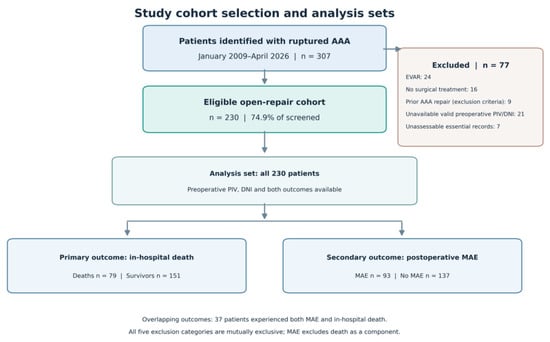
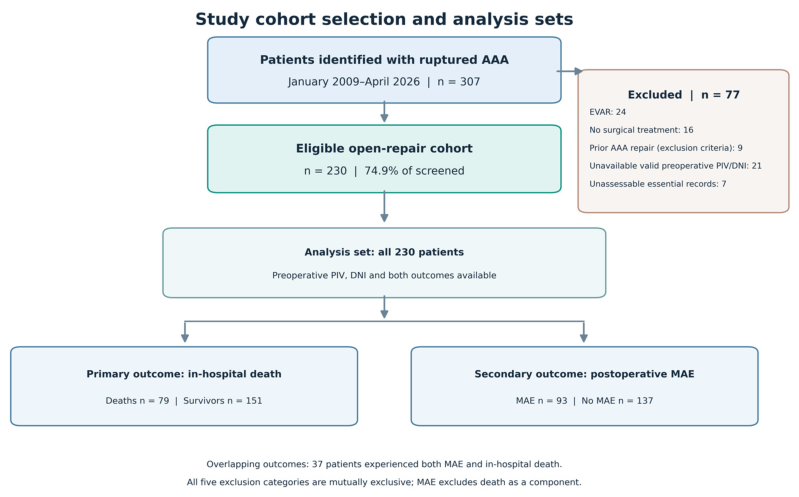
The reasons for exclusion were classified into mutually exclusive categories. After the exclusion of 77 patients, the final study cohort comprised 230 patients. The patient selection process is illustrated in Figure 1.
Figure 1.
Flow diagram of patient selection and analysis sets. A total of 307 patients evaluated for ruptured abdominal aortic aneurysm (RAAA) between January 2009 and April 2026 were screened for eligibility. Seventy-seven patients were excluded due to primary endovascular aneurysm repair (EVAR; n = 24), absence of surgical intervention (n = 16), previous abdominal aortic aneurysm repair (n = 9), unavailable or invalid preoperative PIV or DNI measurements (n = 21), or unsuitable clinical records (n = 7). The final cohort comprised 230 patients undergoing emergency open RAAA repair. In-hospital mortality occurred in 79 patients (34.3%), while 151 (65.7%) survived. Major postoperative adverse events (MAEs) occurred in 93 patients (40.4%), including 37 who also experienced in-hospital mortality. Mortality was not included as a component of the composite MAE endpoint. Abbreviations: DNI, delta neutrophil index; EVAR, endovascular aneurysm repair; MAE, major adverse event; PIV, pan-immune-inflammation value; RAAA, ruptured abdominal aortic aneurysm.
Presentation to the emergency department was considered the starting point of clinical evaluation and treatment. For prognostic analyses, baseline measurements were defined using the first eligible blood sample obtained before open surgical repair. Preoperative biomarkers were evaluated exclusively in conjunction with clinical information available before surgery. Patients were followed throughout the index hospitalization. Follow-up for mortality ended at in-hospital death or discharge, whereas follow-up for postoperative complications ended at the occurrence of the respective event, death, or discharge. Because the study population consisted exclusively of patients who underwent open surgical repair, the findings represent this selected treatment group rather than all patients with RAAA presenting to the emergency department (Figure 1).
In the emergency management of RAAA, the selection between open surgical repair and EVAR is influenced by aneurysm anatomy, hemodynamic condition, patient-specific clinical characteristics, and institutional endovascular capabilities. Open repair remains an important treatment option, particularly when endovascular intervention is anatomically unsuitable or clinically impractical. In the present study, 24 patients undergoing primary EVAR were excluded to maintain a homogeneous cohort of patients treated with open repair. Therefore, the findings specifically reflect this surgical population and should not be interpreted as a comparison between open and endovascular treatment strategies. Potential changes in treatment preferences over the extended study period should also be considered when assessing the generalizability of the results.
Clinical and Laboratory Data Collection:
Demographic, clinical, laboratory, imaging, operative, and postoperative follow-up data were retrospectively collected from the hospital information management system, electronic medical records, laboratory records, radiological assessments, surgical and anesthesia records, intensive care unit monitoring charts, and discharge documents. No directly identifiable patient information was included in the analytical dataset. Data consistency was assessed by examining the concordance among available clinical variables, laboratory results, calculated indices, and outcome codes.
Baseline characteristics, including age, sex, diabetes mellitus, hypertension, coronary artery disease, chronic kidney disease, and chronic obstructive pulmonary disease, were recorded. To assess clinical severity at emergency department presentation, systolic blood pressure, preoperative shock status, Glasgow Coma Scale (GCS) score, presence of preoperative cardiac arrest, and left ventricular ejection fraction were evaluated. Preoperative shock was defined as clinically documented circulatory shock accompanied by a systolic blood pressure below 90 mmHg before surgery. The lowest recorded preoperative systolic blood pressure was used to verify this classification. Vasopressor requirement, duration of hypotension, and serum lactate levels were considered additional indicators of hemodynamic compromise rather than mandatory diagnostic criteria. Shock status was coded as a binary variable (present or absent). Laboratory parameters included hemoglobin, creatinine, lactate, leukocyte, neutrophil, lymphocyte, monocyte, and platelet counts, as well as PIV and DNI values. In addition, the Glasgow Aneurysm Score (GAS) was recorded for conventional prognostic assessment [3].
Laboratory results from venous blood samples obtained preoperatively and at 24 h postoperatively were evaluated. For preoperative measurements, the first eligible sample obtained between the patient’s emergency department evaluation and surgical intervention was used. The precise timing of preoperative blood sampling relative to initial resuscitation, intravenous fluid administration, and blood transfusion was not available in the analytical dataset. Therefore, whether blood samples were collected before or after these interventions could not be consistently determined. Postoperative 24-h measurements were included in the dataset to document hematological and biochemical changes following surgery. However, because the primary objective was to evaluate prognostic markers available before surgery, only preoperative PIV and DNI values were used in the main regression models for the primary and secondary endpoints. Postoperative measurements were not substituted for preoperative values and were not included in the main prediction models. Although postoperative 24-h laboratory measurements were unavailable for seven patients who died within the first 24 h, these patients were not excluded from the preoperative analyses.
PIV was calculated using absolute neutrophil, monocyte, platelet, and lymphocyte counts obtained from the same preoperative blood sample, according to the following formula:
PIV = (Neutrophils × Monocytes × Platelets)/Lymphocytes
Hematological cell counts were expressed in consistent concentration units for these calculations. Because of the right-skewed distribution of PIV, a log2 transformation was applied in the regression analyses, and effect sizes were expressed per doubling of PIV.
DNI measurement was based on the leukocyte differential analysis principle of the ADVIA 2120i Hematology System (Siemens Healthcare Diagnostics, Tarrytown, NY, USA), which uses myeloperoxidase activity and nuclear lobularity. In this method, DNI reflects the difference between the sum of the neutrophil and eosinophil fractions determined in the myeloperoxidase channel and the polymorphonuclear leukocyte fraction identified in the nuclear lobularity channel [12]. DNI was recorded as a percentage (%) and analyzed as a continuous variable. DNI values were not considered equivalent to the immature granulocyte percentage (IG%) and were not retrospectively derived from other hematological parameters.
The anatomical and morphological characteristics of the aneurysm included maximum diameter, infrarenal, juxtarenal, or pararenal neck location, rupture pattern classified as retroperitoneal, intraperitoneal, combined, or aortocaval fistula, and iliac artery involvement. To assess surgical complexity and perioperative physiological burden, aortic cross-clamp level and duration, total operative time, estimated intraoperative blood loss, intraoperative packed red blood cell, fresh frozen plasma, and platelet transfusion volumes, lowest intraoperative mean arterial pressure, intraoperative cardiac arrest, and the type of graft used (tube or bifurcated) were evaluated. In addition, red blood cell transfusions administered during the first 24 postoperative hours and the total transfusion burden were recorded separately.
The primary endpoint was defined as all-cause in-hospital mortality during the index hospitalization. Deaths occurring intraoperatively or postoperatively were included in this endpoint. In-hospital mortality was not considered equivalent to 30-day mortality.
The secondary endpoint was the occurrence of at least one major adverse event (MAE) during the index hospitalization following surgery. The composite endpoint comprised eight components: invasive mechanical ventilation lasting more than 48 h, pneumonia, sepsis, new requirement for renal replacement therapy, bowel ischemia, postoperative myocardial infarction, postoperative stroke, and reoperation for bleeding. Each component was assessed based on the documented occurrence of the corresponding postoperative event in the available clinical records. Patients who developed multiple complications were counted only once in the composite endpoint, while individual components were reported separately. Because in-hospital death was not included in the MAE definition, mortality and MAE were not treated as mutually exclusive endpoints. It was recognized that early death could shorten the observation period required for the development of complications, particularly pneumonia and prolonged mechanical ventilation.
Standard clinical and diagnostic criteria were used to define major postoperative adverse events. Postoperative pneumonia was defined according to the Centers for Disease Control and Prevention/National Healthcare Safety Network (CDC/NHSN) criteria as the presence of a new or progressive pulmonary infiltrate accompanied by clinical and laboratory findings supporting infection [13]. Sepsis was defined in accordance with the Sepsis-3 consensus as life-threatening organ dysfunction caused by infection, with an increase of at least two points from baseline in the Sequential Organ Failure Assessment (SOFA) score [14]. A new requirement for renal replacement therapy was defined as the initiation of intermittent hemodialysis or continuous renal replacement therapy during the postoperative period in patients who were not receiving dialysis before surgery. Bowel ischemia was defined as intestinal ischemia confirmed by imaging, endoscopic, or surgical findings supporting clinical suspicion. Postoperative myocardial infarction was defined in accordance with the Fourth Universal Definition of Myocardial Infarction as an acute rise and/or fall in cardiac troponin levels accompanied by clinical, electrocardiographic, or imaging findings supporting myocardial ischemia [15]. Postoperative stroke was defined as a new-onset focal neurological deficit and/or an acute cerebrovascular event confirmed by appropriate neuroimaging [16]. Reoperation for bleeding was defined as repeat surgical intervention to control postoperative hemorrhage, whereas prolonged mechanical ventilation was defined as invasive mechanical ventilation lasting more than 48 h after surgery. Only complications occurring during the postoperative period were considered, and patients experiencing multiple complications were counted as a single event in the composite MAE endpoint.
- b.
- Data Analysis
Statistical Analysis:
Statistical analyses were performed with in-hospital mortality as the primary endpoint and major postoperative adverse events as the secondary endpoint. Continuous variables were presented as mean ± standard deviation or median [25th–75th percentile], according to their distribution, whereas categorical variables were expressed as counts and percentages. Patients were categorized as survivors and non-survivors according to their in-hospital survival status. Absolute standardized mean differences (SMDs) were used to assess the magnitude of differences in baseline characteristics between groups. For continuous variables, SMDs were calculated by dividing the difference in group means by the square root of the average within-group variances; for binary variables, a standardization approach based on Bernoulli variances was applied. No hypothesis testing was performed in the descriptive tables of baseline characteristics and intraoperative variables, and no p values were reported for these comparisons.
The associations of PIV and DNI with the endpoints were examined using univariable and multivariable binomial logistic regression models. Models were fitted using maximum likelihood estimation. The effects of variables were expressed as odds ratios (ORs) with 95% confidence intervals (CIs). Two-sided Wald z tests were used for statistical evaluation of the regression coefficients. PIV was analyzed after log2 transformation, with ORs calculated per doubling of PIV, whereas ORs for DNI represented an absolute increase of one percentage point. Age was evaluated per 1-year increase, lactate per 1 mmol/L increase, and creatinine per 1 mg/dL increase, while preoperative shock was assessed as present versus absent.
A common baseline clinical model (M0) was developed for both endpoints. This model included age, preoperative shock, preoperative lactate, and preoperative creatinine. Variables were not selected according to their p values in univariable analyses. To assess the incremental prognostic contribution of PIV, M1 was constructed by adding log2(PIV) to M0, whereas M2 was constructed by adding DNI to M0 to evaluate the contribution of DNI. The M3 model, incorporating both markers, was specified as M0 + log2(PIV) + DNI and evaluated on an exploratory basis. The same model structure was applied separately to the primary and secondary endpoints.
In the final analytical population, all 230 patients had available data for the clinical variables included in the main models, preoperative PIV, DNI, and outcome status. Therefore, the primary analyses were conducted using complete data, and multiple imputation was not performed. Given the 79 deaths for the primary endpoint and 93 MAEs for the secondary endpoint, model complexity was restricted. The most comprehensive model, M3, included six explanatory variables. The hematological cell counts used to calculate PIV and PIV itself were not entered simultaneously as independent predictors in the same multivariable model. Similarly, GAS was not added to the M0–M3 models because of potential overlap between its components and the clinical covariates; instead, it was evaluated separately as a reference prognostic score for mortality.
Sample Size and Statistical Power:
A retrospective sample size adequacy assessment was conducted using the Demidenko logistic regression power approximation implemented in G*Power 3.1. Assuming a two-sided significance level of 0.05, 80% statistical power, an event probability of 34.3%, and expected odds ratios of 1.50 for PIV and 2.00 for DNI, the estimated minimum sample sizes were 203 and 136 patients, respectively. The actual cohort of 230 patients exceeded both estimates, yielding calculated statistical powers of 84.9% and 96.2%, respectively, under these assumptions.
Model discrimination was assessed using the area under the receiver operating characteristic curve (AUROC). First, the discriminative performance of single-marker logistic regression models containing only PIV or DNI was examined. GAS was evaluated for mortality using a separate single-score logistic regression model. Subsequently, the performance of M0, M1, M2, and the exploratory M3 model was compared. Changes in AUROC (ΔAUROC) associated with adding markers to the clinical model were calculated through M1–M0, M2–M0, and M3–M0 comparisons.
The 95% confidence intervals for AUROC values were obtained using 1000 repetitions of non-stratified bootstrap resampling, in which the same patients were resampled in a paired manner. Percentile confidence intervals were calculated using the fixed predicted probabilities from models fitted to the original dataset. Confidence intervals for apparent AUROC differences between models were also derived from paired differences within the same bootstrap samples. These confidence intervals were not interpreted as confidence intervals for optimism-corrected AUROC differences following internal validation. A two-sided paired DeLong test was used to directly compare the apparent AUROC values of the PIV-only and DNI-only models. Comparisons between models extended with clinical covariates were evaluated using paired bootstrap differences.
To reduce the impact of overfitting in the model development cohort, bootstrap internal validation with 1000 repetitions was performed. In each bootstrap sample, the models were refitted, and the difference between performance in the bootstrap sample and test performance in the original dataset was calculated. The mean optimism was subtracted from the apparent AUROC to obtain the optimism-corrected AUROC. The accuracy of predicted probabilities was assessed using the Brier score, whereas calibration was evaluated using the calibration slope and intercept. Bootstrap-based optimism correction was also applied to Brier scores and calibration parameters. The ideal calibration slope was considered to be 1, and the ideal intercept was 0. Calibration plots displayed corrected logistic calibration relationships, while observed event rates across quintiles of predicted risk were used for descriptive visual assessment.
Additional sensitivity analyses were performed to assess the robustness of the findings. First, L2/ridge-penalized logistic regression with standardized explanatory variables was applied to examine the sensitivity of regression coefficients to penalization. The regularization parameter was fixed at C = 1, and 95% confidence intervals were obtained using percentiles from 500 patient-level bootstrap resamples. Second, to evaluate the potential influence of perioperative factors, aortic cross-clamp duration, intraoperative red blood cell transfusion volume, and estimated blood loss were added to the baseline clinical model. These extended models were not used as substitutes for the preoperative risk prediction models. Finally, a conditional sensitivity analysis was performed in a subgroup of 223 patients after excluding seven patients who died within the first 24 postoperative hours. This approach was used to assess the influence of early death on the observation period for complications and was not considered an analysis that eliminated the competing-event nature of death.
Analyses other than the primary endpoint and marker comparisons were interpreted as exploratory. A two-sided p < 0.05 was considered the threshold for nominal statistical significance, and no adjustment for multiple comparisons was applied. Because no prespecified clinical decision thresholds were available, optimal cutoff values were not derived from the ROC curves. The Hosmer–Lemeshow goodness-of-fit test, net reclassification improvement (NRI), integrated discrimination improvement (IDI), and decision curve analysis were not performed.
Software:
Statistical analyses were performed in a Python-based statistical computing environment (version 3.15.0). Logistic regression, receiver operating characteristic (ROC) curve analysis, bootstrap resampling, Brier score calculations, and calibration assessments were performed. For ridge-penalized logistic regression analyses, the L2 regularization method implemented in the scikit-learn library (version 1.9.1) was used.
3. Results
The study cohort included 230 patients who underwent open repair for ruptured abdominal aortic aneurysm, of whom 151 (65.7%) survived and 79 (34.3%) died during hospitalization. The mean age was 71.5 ± 9.7 years, and 186 patients (80.9%) were male. Hypertension was present in 166 patients (72.2%), diabetes mellitus in 76 (33.0%), coronary artery disease in 67 (29.1%), chronic kidney disease in 68 (29.6%), and chronic obstructive pulmonary disease in 44 (19.1%). Non-survivors were older than survivors (75.7 ± 9.8 vs. 69.3 ± 8.9 years; absolute standardized mean difference [SMD] = 0.68). Preoperative shock was documented in 144 patients (62.6%) and was more frequent among non-survivors than survivors (74.7% vs. 56.3%; SMD = 0.39). The mean left ventricular ejection fraction was 51.4 ± 6.7% in non-survivors and 54.4 ± 6.7% in survivors (SMD = 0.43). Non-survivors had lower mean hemoglobin levels (9.9 ± 1.7 vs. 10.6 ± 1.8 g/dL; SMD = 0.38) and higher median lactate levels (3.72 [2.92–4.36] vs. 3.18 [2.35–4.09] mmol/L; SMD = 0.31). The median preoperative pan-immune-inflammation value (PIV) was 1465.08 [700.00–2709.36] in non-survivors and 683.72 [380.45–1154.61] in survivors (SMD = 0.67). Corresponding delta neutrophil index (DNI) values were 1.90 [1.35–2.92]% and 1.24 [0.88–1.62]%, respectively (SMD = 0.88). The mean Glasgow Aneurysm Score was 96.8 ± 15.0 in non-survivors and 86.6 ± 15.3 in survivors (SMD = 0.67) (Table 1).
Table 1.
Preoperative demographic, clinical, and laboratory characteristics (n = 230).
The mean maximum aneurysm diameter was 77.7 ± 17.0 mm. Infrarenal aneurysms accounted for 172 cases (74.8%), followed by juxtarenal aneurysms in 43 (18.7%) and pararenal aneurysms in 15 (6.5%). Contained retroperitoneal rupture was identified in 150 patients (65.2%), free intraperitoneal rupture in 44 (19.1%), mixed retroperitoneal/intraperitoneal rupture in 25 (10.9%), and aortocaval fistula in 11 (4.8%). Contained retroperitoneal rupture was recorded in 71.5% of survivors and 53.2% of non-survivors (SMD = 0.38), whereas mixed rupture was recorded in 7.9% and 16.5%, respectively (SMD = 0.26). Infrarenal aortic clamping was performed in 165 patients (71.7%), suprarenal clamping in 51 (22.2%), and supraceliac clamping in 14 (6.1%). Suprarenal clamping was recorded in 31.6% of non-survivors compared with 17.2% of survivors (SMD = 0.34). Median cross-clamp duration was 51.00 [39.00–66.00] minutes in non-survivors and 46.00 [34.00–57.50] minutes in survivors. Estimated blood loss was 3050 [2225–4275] mL. in non-survivors and 2600 [1875–3800] mL in survivors. The median total red blood cell transfusion requirement, including intraoperative administration and the first postoperative 24 h, was 6 [4,5,6,7,8] units in non-survivors and 4 [2,3,4,5,6,7] units in survivors. Intraoperative cardiac arrest occurred in 11 patients (4.8%), including 7 non-survivors (8.9%) and 4 survivors (2.6%). Tube grafts were used in 133 patients (57.8%), and bifurcated grafts in 97 (42.2%) (Table 2).
Table 2.
Aneurysm characteristics and intraoperative variables (n = 230).
Major postoperative adverse events (MAEs), excluding death as a component, were recorded in 93 patients (40.4%), including 56 survivors (37.1%) and 37 non-survivors (46.8%). Prolonged mechanical ventilation exceeding 48 h was the most frequently recorded component, occurring in 43 patients (18.7%), followed by pneumonia in 23 (10.0%), reoperation for bleeding in 17 (7.4%), bowel ischemia in 15 (6.5%), postoperative myocardial infarction in 15 (6.5%), sepsis in 12 (5.2%), new renal replacement therapy in 8 (3.5%), and postoperative stroke in 6 (2.6%). Pneumonia was documented in 15.2% of non-survivors and 7.3% of survivors, while bowel ischemia occurred in 10.1% and 4.6%, respectively. Postoperative stroke occurred in 5.1% of non-survivors and 1.3% of survivors. The median intensive care unit stay was 3.27 [2.34–4.96] days in the overall cohort. Median hospital stay was 8.88 [5.62–12.30] days overall, 10.67 [8.50–13.15] days among survivors, and 3.64 [2.15–6.29] days among non-survivors (Table 3).
Table 3.
Postoperative outcomes and components of the composite endpoint (n = 230).
In univariable logistic regression analysis, age (OR: 1.08, 95% CI: 1.04–1.11; p < 0.001), preoperative shock (OR: 2.29, 95% CI: 1.26–4.18; p = 0.007), lactate (OR: 1.29, 95% CI: 1.03–1.62; p = 0.025), and creatinine (OR: 1.77, 95% CI: 1.05–3.01; p = 0.033) were associated with in-hospital mortality. Both PIV (OR: 1.88, 95% CI: 1.47–2.41; p < 0.001) and DNI (OR: 2.92, 95% CI: 1.99–4.28; p < 0.001) were also associated with mortality in univariable analyses. In the multivariable clinical model (M0), age remained associated with mortality (adjusted OR: 1.08, 95% CI: 1.04–1.12; p < 0.001). Following adjustment for age, preoperative shock, lactate, and creatinine, PIV remained associated with mortality in M1 (adjusted OR per doubling: 1.77, 95% CI: 1.34–2.33; p < 0.001), while DNI remained associated with mortality in M2 (adjusted OR per percentage-point increase: 2.76, 95% CI: 1.78–4.27; p < 0.001). In the exploratory model including both biomarkers (M3), PIV (adjusted OR: 1.69, 95% CI: 1.26–2.27; p < 0.001) and DNI (adjusted OR: 2.63, 95% CI: 1.67–4.13; p < 0.001) remained associated with mortality. For postoperative MAEs, univariable analysis identified preoperative shock (OR: 2.01, 95% CI: 1.14–3.53; p = 0.016), lactate (OR: 1.49, 95% CI: 1.19–1.88; p < 0.001), PIV (OR: 1.35, 95% CI: 1.10–1.67; p = 0.005), and DNI (OR: 2.02, 95% CI: 1.46–2.80; p < 0.001) as associated variables. In the adjusted clinical model, lactate remained associated with MAEs (adjusted OR: 1.48, 95% CI: 1.10–1.98; p = 0.009). Following adjustment, PIV was not significantly associated with MAEs in M1 (adjusted OR: 1.22, 95% CI: 0.97–1.54; p = 0.095), whereas DNI remained associated with MAEs in M2 (adjusted OR: 1.80, 95% CI: 1.27–2.55; p < 0.001). In the exploratory combined model, DNI remained associated with MAEs (adjusted OR: 1.75, 95% CI: 1.23–2.49; p = 0.002), while PIV did not (adjusted OR: 1.15, 95% CI: 0.91–1.47; p = 0.245) (Table 4).
Table 4.
Univariable and complete multivariable logistic regression results for mortality and postoperative major adverse events (n = 230).
For in-hospital mortality, the apparent area under the receiver operating characteristic curve (AUROC) was 0.710 (95% CI: 0.638–0.777) for PIV alone and 0.749 (95% CI: 0.679–0.816) for DNI alone. The Glasgow Aneurysm Score had an AUROC of 0.676 (95% CI: 0.604–0.747). The clinical reference model (M0) yielded an apparent AUROC of 0.733 (95% CI: 0.668–0.795), which increased to 0.789 (95% CI: 0.726–0.848) after adding PIV (M1) and 0.806 (95% CI: 0.746–0.864) after adding DNI (M2). The exploratory combined model (M3) yielded an apparent AUROC of 0.838 (95% CI: 0.782–0.890). After bootstrap optimism correction, AUROC values were 0.714 for M0, 0.770 for M1, 0.788 for M2, and 0.820 for M3. Compared with M0, the apparent paired AUROC differences were +0.056 (95% CI: 0.009–0.100) for M1, +0.073 (95% CI: 0.022–0.121) for M2, and +0.105 (95% CI: 0.049–0.162) for M3. The direct apparent AUROC difference between M2 and M1 was +0.017 (95% bootstrap CI: −0.039–0.070). The paired DeLong comparison between DNI alone and PIV alone yielded an AUROC difference of +0.040 (95% CI: −0.050–0.129; p = 0.385). Bootstrap-corrected Brier scores were 0.201 for M0, 0.186 for M1, 0.179 for M2, and 0.167 for M3. The corresponding optimism-corrected calibration slopes were 0.90 for all four models, with intercepts of +0.01, +0.01, +0.00, and +0.01, respectively (Table 5).
Table 5.
Discrimination and calibration for in-hospital mortality (n = 230).
For postoperative MAEs, PIV alone yielded an apparent AUROC of 0.616 (95% CI: 0.536–0.692), whereas DNI alone yielded an AUROC of 0.680 (95% CI: 0.611–0.749). The apparent AUROC of the clinical reference model (M0) was 0.639 (95% CI: 0.563–0.708), compared with 0.660 (95% CI: 0.583–0.734) for M1, 0.699 (95% CI: 0.627–0.764) for M2, and 0.709 (95% CI: 0.637–0.776) for M3. Following bootstrap optimism correction, the corresponding AUROC values were 0.614, 0.630, 0.674, and 0.678, respectively. Compared with M0, the apparent paired AUROC difference was +0.021 (95% CI: −0.012–0.054) for M1, +0.061 (95% CI: 0.009–0.108) for M2, and +0.070 (95% CI: 0.014–0.119) for M3. The direct apparent AUROC difference between M2 and M1 was +0.039 (95% bootstrap CI: −0.011–0.090). The paired DeLong comparison of DNI alone versus PIV alone yielded an AUROC difference of +0.064 (95% CI: −0.023–0.152; p = 0.149). Bootstrap-corrected Brier scores were 0.235 for M0, 0.235 for M1, 0.225 for M2, and 0.226 for M3. The corresponding optimism-corrected calibration slopes were 0.82, 0.80, 0.83, and 0.81, respectively, with intercepts of +0.01 for all four models (Table 6).
Table 6.
Discrimination and calibration for postoperative major adverse events (n = 230).
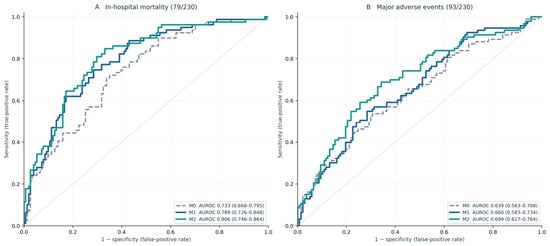
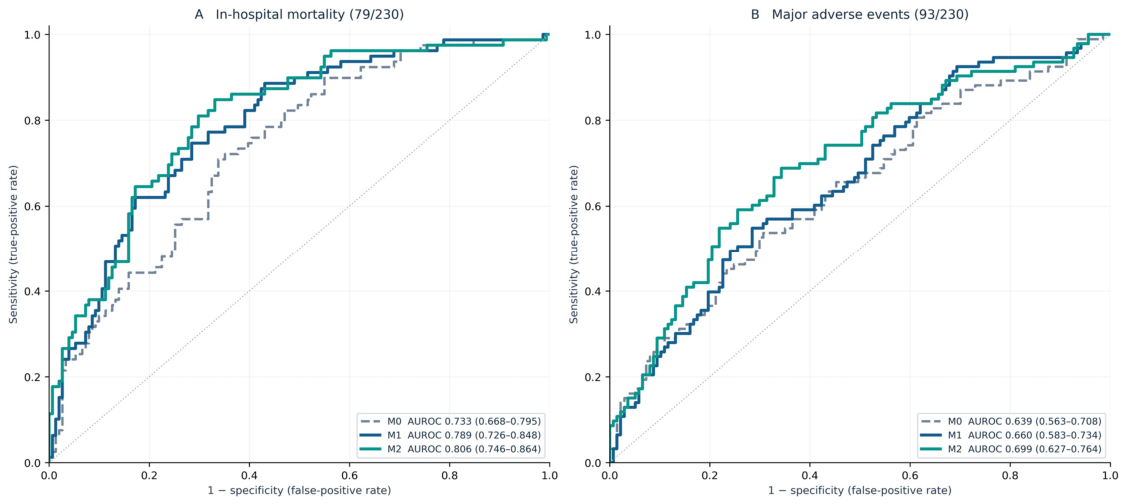
The paired receiver operating characteristic curves for in-hospital mortality and postoperative MAEs are presented in Figure 2A,B, respectively. For mortality, the apparent AUROC values were 0.733 for M0, 0.789 for M1, and 0.806 for M2. For postoperative MAEs, the corresponding AUROC values were 0.639, 0.660, and 0.699. The ROC curves and their associated 95% confidence intervals correspond to the apparent discrimination estimates reported in Table 5 and Table 6 (Figure 2).
Figure 2.
Paired receiver operating characteristic (ROC) curves. Panel (A): in-hospital mortality; Panel (B): MAE. The curves represent apparent predictions of M0 (age, shock, lactate and creatinine), M1 (M0 + log2 PIV) and M2 (M0 + DNI) in the same 230 patients; the AUROC and fixed-risk paired bootstrap 95% confidence intervals shown in the legend match Table 5 and Table 6 exactly. These curves do not depict optimism-corrected discrimination; corrected estimates are reported in Table 5 and Table 6. GAS and M3 are omitted from the figure for legibility.
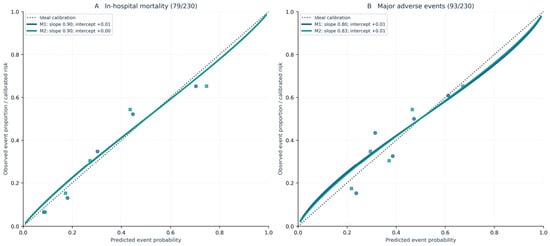
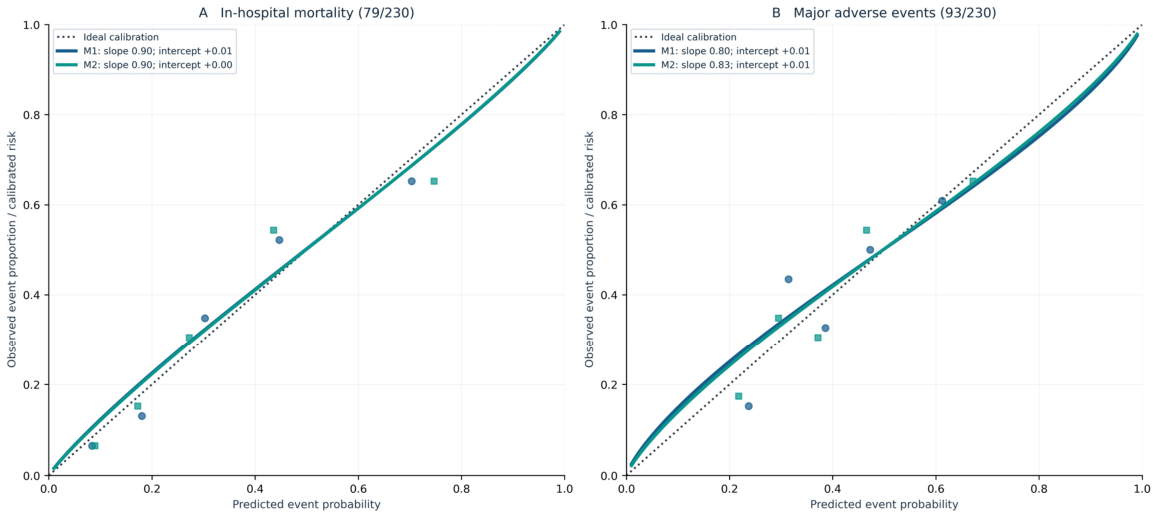
Bootstrap optimism-corrected calibration results for the PIV- and DNI-extended clinical models are presented in Figure 3. For in-hospital mortality, the corrected calibration slopes were 0.90 for both M1 and M2, with intercepts of +0.01 and +0.00, respectively. For postoperative MAEs, the corresponding calibration slopes were 0.80 and 0.83, with intercepts of +0.01 for both models. Observed event proportions across predicted-risk quintiles are displayed alongside the corrected calibration functions (Figure 3).
Figure 3.
Panel (A): in-hospital mortality; Panel (B): MAE. The M1 and M2 lines are logistic calibration functions calculated from the same 1000-resample bootstrap optimism-corrected calibration intercepts and slopes reported in Table 5 and Table 6; the dotted 45° line represents perfect calibration. Filled circles (M1) and squares (M2) show descriptive, non-corrected observed proportions by predicted-risk quintile (n ≈ 46 each) as visual diagnostics; they are not used to derive corrected calibration curves. Since the calibration lines are based on corrected logistic intercept/slope, they should not be misinterpreted as nonparametric externally validated smooths. The model estimates and panel numerators agree with Table 5 and Table 6.
Sensitivity analyses were performed using ridge-penalized logistic regression, additional perioperative covariate adjustment, and exclusion of patients who died within the first postoperative 24 h. In the ridge-penalized models, the mortality-related ORs were 1.74 (95% CI: 1.36–2.23) for PIV and 2.63 (95% CI: 1.86–4.45) for DNI. The corresponding ORs for postoperative MAEs were 1.21 (95% CI: 0.97–1.56) and 1.77 (95% CI: 1.32–2.64), respectively. After additional adjustment for cross-clamp duration, intraoperative red blood cell transfusion, and estimated blood loss, the mortality-related ORs were 1.75 (95% CI: 1.32–2.32) for PIV and 2.68 (95% CI: 1.71–4.19) for DNI. For postoperative MAEs, the corresponding ORs were 1.21 (95% CI: 0.95–1.54) and 1.77 (95% CI: 1.23–2.54). Following exclusion of seven patients who died within the first postoperative 24 h, the analysis included 223 patients. In this subgroup, the mortality-related ORs were 1.70 (95% CI: 1.29–2.25) for PIV and 2.92 (95% CI: 1.87–4.57) for DNI. The corresponding MAE-related ORs were 1.29 (95% CI: 1.02–1.64) for PIV and 1.86 (95% CI: 1.30–2.66) for DNI (Table 7).
Table 7.
Prespecified sensitivity and robustness analyses (n = 230).
4. Discussion
In this study of 230 patients who underwent open surgical repair for ruptured abdominal aortic aneurysm (RAAA), preoperative Pan-Immune-Inflammation Value (PIV) and Delta Neutrophil Index (DNI) were associated with in-hospital mortality, and their addition to conventional clinical variables improved prognostic performance. After adjustment for age, preoperative shock, lactate, and creatinine levels, both PIV and DNI remained significantly associated with mortality, whereas only DNI showed a statistically significant association with major postoperative adverse events (MAE). A doubling of PIV was associated with increased odds of in-hospital mortality (OR: 1.77; 95% CI: 1.34–2.33), while a one-percentage-point increase in DNI was associated with a higher OR (OR: 2.76; 95% CI: 1.78–4.27). However, because of differences in measurement scales, these effect sizes do not represent directly comparable prognostic strengths of the two markers. Although models incorporating DNI demonstrated numerically higher discrimination for both endpoints, no statistically significant superiority over PIV was established in direct comparisons. These findings suggest that the hematological response at presentation may provide information related to early prognosis in patients with RAAA, although the prognostic value of this information may vary according to the marker used and the clinical endpoint evaluated.
The systemic inflammatory response in RAAA reflects the combined effects of acute blood loss, hemorrhagic shock, tissue hypoxia, and ischemia-reperfusion injury. In particular, tissue hypoperfusion and subsequent reperfusion may trigger mechanisms of organ injury associated with neutrophil activation, endothelial dysfunction, and the release of inflammatory mediators [2]. By integrating neutrophil, monocyte, platelet, and lymphocyte counts, PIV enables different cellular components of the acute inflammatory response to be assessed within a single parameter [7]. In this setting, elevated PIV may reflect both inflammatory activation and systemic physiological stress rather than inflammation alone. Furthermore, resuscitation, transfusion, and hemodilution may alter circulating cell counts, limiting a direct mechanistic interpretation of PIV.
Unlike PIV, DNI reflects the circulating immature granulocyte response, which may accompany severe systemic physiological stress. The prognostic significance of DNI has previously been demonstrated, particularly in sepsis and clinical conditions associated with systemic inflammatory responses [10,11]. However, elevated DNI in RAAA may reflect not only inflammatory activation but also tissue hypoperfusion, adrenergic stress, and the physiological consequences of acute hemorrhage. Its associations with mortality and MAE in our study suggest that DNI may provide distinct information regarding clinical severity, although a causal contribution to organ injury cannot be established from these observational findings.
Evidence from other cardiovascular surgical populations provides context for the prognostic role of PIV, although its applicability to RAAA remains limited. In their study of 527 patients undergoing elective coronary artery bypass grafting (CABG), Dolapoglu and Avci reported that elevated PIVs were associated with long-term major cardiovascular and cerebrovascular events, with an AUROC of 0.726 for PIV [8]. Similarly, Yu et al. demonstrated an independent association between PIVs at presentation and in-hospital mortality in 308 patients who underwent surgical treatment for acute type A aortic dissection, reporting an AUROC of 0.732 for PIV alone [9]. However, elective CABG and acute aortic dissection differ substantially from RAAA in terms of hemorrhagic burden, hemodynamic instability, and physiological stress. Therefore, these findings cannot be directly extrapolated to patients undergoing emergency open RAAA repair.
In a more recent study focusing specifically on patients with RAAA, Jovanovic et al. reported that the preoperative neutrophil-to-lymphocyte ratio, platelet-to-lymphocyte ratio, and systemic inflammatory response index demonstrated limited discriminative performance for short-term morbidity and mortality in 74 patients [6]. Furthermore, the observation that certain inflammatory indices were lower among non-survivors indicates that the relationship between hematological responses and clinical outcomes may not always be linear or consistent in direction. In contrast, the studies by Dolapoglu and Avci and Yu et al. identified associations between elevated PIV, a more comprehensive hematological index, and adverse clinical outcomes [8,9]. These differences may arise not only from the cellular composition of the indices used but also from differences in patient population characteristics, sampling time, endpoint definitions, and statistical adjustment approaches. In our study, PIV alone yielded an AUROC of 0.710 for in-hospital mortality, which increased to an optimism-corrected AUROC of 0.770 when combined with clinical variables. This finding supports the potential of PIV to provide mortality-related prognostic information in patients undergoing open RAAA repair. However, the adjusted association between PIV and MAE did not reach statistical significance (OR: 1.22; 95% CI: 0.97–1.54), and its addition to the clinical model provided only a limited improvement in discrimination. Therefore, the association of PIV with mortality does not necessarily imply that it can predict all postoperative complications arising through different mechanisms with comparable accuracy. Additional evidence from studies involving patients with RAAA supports the potential prognostic relevance of inflammation-related hematological markers. Ko et al. evaluated 334 patients undergoing open abdominal aortic aneurysm repair, including 98 patients with rupture, and reported that preoperative neutrophil-to-lymphocyte ratio (NLR) was independently associated with 1-year mortality in the ruptured subgroup (OR: 1.144; 95% CI: 1.031–1.271; p = 0.012) [17]. In a retrospective study of 40 patients undergoing emergency EVAR for RAAA, Badem et al. found that the multi-inflammatory index (MII) was independently associated with early mortality, further supporting the potential prognostic role of composite inflammatory markers in this high-risk population [18]. More recently, Wang et al. investigated 121 patients undergoing emergency RAAA repair and reported that the admission neutrophil percentage-to-albumin ratio (NPAR) demonstrated an AUROC of 0.811 (95% CI: 0.726–0.896) for predicting in-hospital mortality [19]. Although these findings support further investigation of hematological biomarkers in RAAA, differences in treatment modalities, biomarker composition, and outcome definitions limit direct comparisons with the present study, which exclusively included patients undergoing open surgical repair.
Evidence from other clinical populations also supports investigating the prognostic role of DNI. In their systematic review and meta-analysis, Ahn et al. demonstrated that elevated DNI was associated with mortality in adult patients with sepsis [11]. In the field of cardiovascular surgery, Kim et al., in a study involving 843 patients, reported that DNI measurements obtained at 24, 48, and 72 h postoperatively yielded AUROC values of 0.729, 0.711, and 0.755, respectively, for predicting 30-day mortality [20]. Similarly, in a study involving 446 patients undergoing CABG, Bilgiç et al. demonstrated that both preoperative and postoperative DNI values were associated with mortality, with each one-unit increase in preoperative DNI associated with 2.61-fold higher odds of death [21]. In our RAAA cohort, preoperative DNI demonstrated an AUROC of 0.749 as a single marker. However, differences in hemorrhagic shock, surgical conditions, biomarker sampling time, and clinical endpoints limit direct comparisons with these studies.
When evaluating the prognostic contribution of any laboratory biomarker in patients with RAAA, comparison with existing clinical risk models is particularly important. Li et al. externally validated eight different mortality prediction models in 315 patients undergoing RAAA repair and reported that the models generally provided limited to moderate discrimination. In that study, the highest AUROC was 0.740 for the Glasgow Aneurysm Score (GAS) [4]. Similarly, Warren et al., in a comparative analysis using two large vascular surgery databases, reported AUROC values of 0.687 for GAS and 0.688 for the Dutch Aneurysm Score [5]. Both studies demonstrate that conventional risk scores may contribute to clinical assessment, although their discriminative ability and calibration performance may vary across populations. In our study, GAS alone yielded an AUROC of 0.676, whereas the baseline clinical model (M0), comprising age, shock, lactate, and creatinine, achieved an apparent AUROC of 0.733. However, because GAS and M0 differ in their development and calculation methods, these findings should not be interpreted as evidence of the established superiority of our clinical model over the existing score. The use of GAS solely as a comparator for mortality and the absence of direct analyses of other clinical risk scores further limit the scope of this comparison.
The principal prognostic finding of this study lies not so much in the standalone performance of the hematological markers as in their incremental contribution to the baseline clinical model. For in-hospital mortality, the bootstrap optimism-corrected AUROC of M0 was 0.714, increasing to 0.770 with the addition of PIV (M1) and to 0.788 with the addition of DNI (M2). The apparent AUROC differences were +0.056 (95% CI: 0.009–0.100) for M1 and +0.073 (95% CI: 0.022–0.121) for M2. However, the direct apparent AUROC difference between the clinical models incorporating DNI and PIV was only +0.017, with a confidence interval that included zero (95% CI: −0.039–0.070). Similarly, the paired DeLong comparison of the single-marker models revealed no significant difference (p = 0.385). Therefore, the numerically higher discrimination observed with DNI does not constitute evidence of its statistical or clinical superiority over PIV. Although the exploratory M3 model incorporating both markers yielded a higher corrected AUROC (0.820) for mortality, the persistence of this improvement in independent patient populations has not been demonstrated.
In addition to discrimination, evaluating calibration and prediction error is essential for understanding the potential clinical value of the models. In the mortality models, the optimism-corrected Brier scores of 0.201 for M0, 0.186 for M1, and 0.179 for M2 indicate a numerical improvement in the overall accuracy of predicted probabilities following the addition of the markers. However, the corrected calibration slopes of 0.90 for M0, M1, and M2 suggest a degree of overfitting at the extremes of predicted risk. These findings indicate that model performance in a new patient population cannot be guaranteed even after bootstrap internal validation. Particularly considering the variable calibration performance of existing risk scores across different cohorts, a recommendation for clinical use based solely on AUROC values would be insufficient [4,5]. Therefore, although the observed performance improvements represent a meaningful starting point for prognostic model development, they should not be regarded as definitive risk estimates that can be directly incorporated into clinical decision-making.
The findings for the secondary endpoint showed a somewhat different pattern. In our study, MAE was defined as a composite of eight serious postoperative complications, excluding in-hospital death, and at least one event was recorded in 40.4% of patients. Preoperative DNI remained significantly associated with MAE after adjustment for clinical variables (OR: 1.80; 95% CI: 1.27–2.55), whereas a similar independent association could not be demonstrated for PIV. Furthermore, the optimism-corrected AUROC values for MAE were 0.614, 0.630, and 0.674 for M0, M1, and M2, respectively, with a numerically greater improvement following the addition of DNI than PIV. Nevertheless, because the confidence interval for the direct AUROC difference between the two marker-augmented clinical models included zero (95% CI: −0.011–0.090), the statistical superiority of DNI over PIV could not be demonstrated for this endpoint either. Moreover, the corrected AUROC of 0.674 for M2 indicates that substantial uncertainty remains in predicting serious postoperative complications at the individual patient level. The eight components of the composite MAE endpoint were selected to capture clinically important postoperative complications reflecting respiratory, infectious, renal, gastrointestinal, cardiovascular, neurological, and bleeding-related morbidity after emergency open RAAA repair. However, these complications differ substantially in clinical severity, frequency, and underlying pathophysiological mechanisms. Consequently, the composite outcome may be disproportionately influenced by more frequently occurring events, while associations with individual complications may differ from those observed for the overall endpoint. Furthermore, early postoperative death may prevent the occurrence or documentation of complications requiring longer observation periods, particularly pneumonia and prolonged mechanical ventilation. Therefore, the observed associations of PIV and DNI with composite MAEs should be interpreted as exploratory indicators of overall postoperative morbidity rather than evidence of uniform predictive performance across individual complications or risk estimates independent of the competing influence of death.
Surgical characteristics and perioperative physiological derangements also play important roles in determining prognosis in patients with RAAA. In our study, preoperative shock, suprarenal aortic cross-clamping, free or combined rupture morphology, and greater blood loss were numerically more frequent or more pronounced among non-survivors. These variables are important because they indicate that mortality cannot be explained solely by the baseline hematological status. However, incorporating variables arising during surgery into a preoperative prediction model is temporally inconsistent with risk assessment at presentation. Therefore, cross-clamp duration, intraoperative red blood cell transfusion, and estimated blood loss were evaluated in a separate sensitivity analysis. In this extended model, the associations of PIV and DNI with mortality were largely preserved, with adjusted ORs of 1.75 and 2.68, respectively. The consistency of the ridge-penalized regression results with the main analyses further supports a degree of robustness of the findings to the modeling approach used. Nevertheless, adjustment for intraoperative variables does not eliminate unmeasured confounding. Because blood loss, transfusion requirements, and cross-clamp duration are related to both baseline disease severity and surgical management, incorporating these variables into the model may introduce additional sources of bias. Furthermore, the persistence of the associations in the analysis excluding seven patients who died within the first 24 h does not imply that survival and observation-time biases associated with early death were completely eliminated.
From an emergency medicine perspective, the significance of this study lies in providing evidence regarding the interpretation of hematological parameters available during the initial patient assessment alongside existing clinical information. The fundamental components of early clinical management in RAAA include assessment of hemodynamic status, rapid diagnosis, resuscitation, and timely provision of appropriate surgical treatment [1]. During this process, parameters such as PIV and DNI may provide complementary information about the patient’s physiological response without requiring additional invasive measurements. However, our findings do not support the use of these markers alone to determine surgical eligibility, treatment priority, or resuscitation strategy. Moreover, the limited number of variables included in the baseline clinical model, the absence of direct comparisons with more comprehensive risk scores reported in the literature, and the lack of validation in an independent patient population are important considerations for clinical implementation. The 30-day mortality rate of 37.4% reported for the open repair strategy in the randomized IMPROVE trial highlights the substantial burden of early mortality associated with RAAA treatment [22]. Although the 34.3% in-hospital mortality rate observed in our study appears consistent with this clinical context, the two rates cannot be directly compared because of differences in endpoint time frames, treatment strategies, and patient selection criteria.
In conclusion, preoperative PIV and DNI values were associated with in-hospital mortality in patients undergoing open RAAA repair, and their addition to conventional clinical variables improved prognostic model performance. Notably, DNI also remained significantly associated with major postoperative adverse events and demonstrated numerically higher discrimination for both endpoints. However, direct comparisons did not establish the statistical superiority of DNI over PIV. These findings suggest that hematological markers may provide prognostic information complementary to the initial clinical assessment of patients with RAAA. Nevertheless, these findings should be considered exploratory and hypothesis-generating rather than definitive evidence supporting clinical implementation. Prospective external validation in independent, multicenter cohorts is essential to establish the reproducibility, generalizability, and clinical utility of PIV- and DNI-based prognostic models before their integration into routine clinical practice. Particular attention should be given to evaluating model discrimination and calibration across different patient populations, healthcare settings, and laboratory platforms to establish their generalizability and reproducibility. Additionally, standardized biomarker measurement protocols and clinically meaningful risk thresholds should be investigated. Finally, prospective studies incorporating decision curve analysis and clinical impact assessments are needed to determine whether biomarker-based risk stratification provides meaningful improvements in clinical decision-making and patient outcomes beyond conventional clinical assessment.
Limitations of the Study
The findings of this study should be interpreted in light of several limitations. First, the retrospective, single-center design and restriction to patients undergoing open surgical repair introduce potential selection bias and limit generalizability to the overall RAAA population. Treatment selection between open repair and EVAR may vary according to anatomical suitability, hemodynamic condition, patient characteristics, and institutional resources. Furthermore, the extended study period from 2009 to 2026 introduces potential temporal bias, as evolving surgical techniques, perioperative management strategies, resuscitation protocols, and transfusion practices may have influenced clinical outcomes. Changes in hematology analyzer technology, measurement procedures, or calibration practices over time could also have affected the comparability of PIV and DNI measurements. The consistency of laboratory instrumentation and calibration throughout the entire study period was not independently verified. Consequently, potential temporal and measurement-related variability should be considered when interpreting the prognostic associations observed in this cohort.
Second, the inability to determine the precise timing of preoperative blood sampling relative to resuscitation and transfusion procedures complicates the assessment of variability in hematological parameters during acute hemorrhage. The multivariable models accounted for key clinical indicators, including age, shock, lactate, and creatinine, and additional sensitivity analyses incorporating cross-clamp duration, blood loss, and transfusion volumes were performed. Although the associations were generally preserved in these analyses, the possibility of residual confounding related to detailed hemodynamic changes and unmeasured indicators of clinical severity remains. Additionally, the retrospective classification of preoperative shock may have been influenced by variations in clinical documentation and the frequency and timing of blood pressure measurements, particularly over the extended study period. Therefore, some degree of misclassification cannot be completely excluded.
The secondary MAE endpoint comprised eight clinically heterogeneous complications differing in severity, frequency, underlying mechanisms, and timing of occurrence. Early postoperative death may preclude the development or observation of certain complications, particularly pneumonia and prolonged mechanical ventilation, thereby introducing a competing-event problem. Although the sensitivity analysis excluding seven patients who died within the first 24 postoperative hours (n = 223) was performed to assess the robustness of the findings, this survivor-selected analysis does not eliminate the competing influence of death and may introduce selection bias. Furthermore, conventional logistic regression does not account for differences in the time available for complications to occur before death or discharge. Therefore, the associations between PIV, DNI, and composite MAEs should be interpreted cautiously and should not be considered estimates of complication risk adjusted for the competing event of death.
Finally, the possibility of overfitting cannot be completely excluded in models developed using 79 mortality events and 93 major adverse events. Although restricting model complexity, performing bootstrap internal validation, and conducting ridge-penalized regression analyses contributed to assessing the robustness of the findings, these approaches do not replace independent external validation. Furthermore, although the incremental prognostic contributions of the markers to the clinical model were evaluated, direct comparisons with all established RAAA risk models were not performed. Therefore, while these findings support the prognostic potential of PIV and DNI, validation across different centers is required before their incorporation into clinical decision-making.
5. Conclusions
In patients undergoing open repair for ruptured abdominal aortic aneurysm, higher preoperative PIV and DNI values were independently associated with in-hospital mortality, and both markers provided additional prognostic information beyond conventional clinical variables. These findings suggest that PIV and DNI may complement preoperative risk assessment, although neither marker demonstrated statistically significant superiority over the other. Given the exploratory nature of these findings, prospective external validation in independent patient populations is required before PIV and DNI can be reliably incorporated into clinical risk assessment and decision-making.
Author Contributions
Conceptualization, M.E. and B.T.; methodology, M.E., B.T., S.O., Ö.K. and A.B.; validation, E.O.K. and İ.G.; formal analysis, B.T.; investigation, M.E., Ö.E.D.V., A.B., E.O.K., İ.G. and H.C.; data curation, M.E., Ö.E.D.V. and İ.G.; writing—original draft preparation, B.T.; writing—review and editing, M.E., B.T., Ö.E.D.V., A.T.K., S.O., Ö.K., A.B., E.O.K., M.B., İ.G. and H.C.; supervision, M.E., B.T., A.T.K. and M.B. All authors have read and agreed to the published version of the manuscript.
Funding
This research received no external funding.
Institutional Review Board Statement
The study was conducted in accordance with the Declaration of Helsinki and approved by the Non-Interventional Clinical Research Ethics Committee of Mersin City Training and Research Hospital (protocol code: 2026/233; date of approval: 29 April 2026). All patient data were anonymized prior to analysis, and patient confidentiality was maintained throughout the study.
Informed Consent Statement
Written informed consent for surgical treatment was obtained as part of routine clinical care. Given the retrospective observational design and the use of anonymized clinical data, additional informed consent for research participation was not required. No individually identifiable patient information is presented in this manuscript.
Data Availability Statement
The data supporting the findings of this study are available from the corresponding author upon reasonable request. Due to patient confidentiality, ethical considerations, and institutional regulations, the individual-level clinical data are not publicly available. Access to anonymized data may be considered for legitimate academic and research purposes, subject to appropriate institutional approval and applicable data protection requirements.
Conflicts of Interest
The authors declare no conflicts of interest.
Abbreviations
| AAA | Abdominal aortic aneurysm |
| AUROC | Area under the receiver operating characteristic curve |
| CABG | Coronary artery bypass grafting |
| CDC/NHSN | Centers for Disease Control and Prevention/National Healthcare Safety Network |
| CI | Confidence interval |
| DNI | Delta neutrophil index |
| EVAR | Endovascular aneurysm repair |
| GAS | Glasgow Aneurysm Score |
| GCS | Glasgow Coma Scale |
| ICU | Intensive care unit |
| IDI | Integrated discrimination improvement |
| IG% | Immature granulocyte percentage |
| MAE | Major adverse event |
| NRI | Net reclassification improvement |
| OR | Odds ratio |
| PIV | Pan-immune-inflammation value |
| RAAA | Ruptured abdominal aortic aneurysm |
| ROC | Receiver operating characteristic |
| SMD | Standardized mean difference |
| SOFA | Sequential Organ Failure Assessment |
References
- Wanhainen, A.; Van Herzeele, I.; Bastos Goncalves, F.; Montoya, S.B.; Berard, X.; Boyle, J.R.; D’Oria, M.; Prendes, C.F.; Karkos, C.D.; Kazimierczak, A.; et al. Editor’s Choice—European Society for Vascular Surgery (ESVS) 2024 clinical practice guidelines on the management of abdominal aorto-iliac artery aneurysms. Eur. J. Vasc. Endovasc. Surg. 2024, 67, 192–331. [Google Scholar] [CrossRef] [Scilit]
- Katseni, K.; Chalkias, A.; Kotsis, T.; Dafnios, N.; Arapoglou, V.; Kaparos, G.; Logothetis, E.; Iacovidou, N.; Karvouni, E.; Katsenis, K. The effect of perioperative ischemia and reperfusion on multiorgan dysfunction following abdominal aortic aneurysm repair. BioMed Res. Int. 2015, 2015, 598980. [Google Scholar] [CrossRef] [Scilit]
- Samy, A.K.; Murray, G.; MacBain, G. Glasgow aneurysm score. Cardiovasc. Surg. 1994, 2, 41–44. [Google Scholar] [CrossRef] [Scilit]
- Li, S.R.; Mazroua, M.S.; Reitz, K.M.; Phillips, A.R.; Tzeng, E.; Liang, N.L. External validation of eight ruptured abdominal aortic aneurysm mortality prediction models demonstrates limited predictive accuracy. Eur. J. Vasc. Endovasc. Surg. 2025, 69, 824–834. [Google Scholar] [CrossRef] [Scilit]
- Warren, A.S.; Hemingway, J.F.; Quiroga, E.; O’Donnell, T.F.X.; Schermerhorn, M.L.; Zettervall, S.L.; Dansey, K. Comparative assessment of risk score performance in ruptured abdominal aortic aneurysm repair risk stratification. Eur. J. Vasc. Endovasc. Surg. 2025, 70, 604–613. [Google Scholar] [CrossRef] [Scilit]
- Jovanovic, K.; Jovanovic, N.; Dabovic, L.; Radovanovic, N.; Savic, M.; Koncar, I.; Ilic, N.; Dragas, M.; Cvetkovic, S. Preoperative inflammatory indices have limited predictive value in patients with ruptured abdominal aortic aneurysm. Ann. Vasc. Surg. 2026, 132, 71–80. [Google Scholar] [CrossRef] [Scilit]
- Fucà, G.; Guarini, V.; Antoniotti, C.; Morano, F.; Moretto, R.; Corallo, S.; Marmorino, F.; Lonardi, S.; Rimassa, L.; Sartore-Bianchi, A.; et al. The pan-immune-inflammation value is a new prognostic biomarker in metastatic colorectal cancer: Results from a pooled-analysis of the Valentino and TRIBE first-line trials. Br. J. Cancer 2020, 123, 403–409. [Google Scholar] [CrossRef] [Scilit]
- Dolapoglu, A.; Avci, E. Relationship between pan-immune-inflammation value and in major cardiovascular and cerebrovascular events in stable coronary artery disease patients undergoing on-pump coronary artery bypass graft surgery. J. Cardiothorac. Surg. 2024, 19, 241. [Google Scholar] [CrossRef] [Scilit]
- Yu, X.; Chen, Y.; Peng, Y.; Chen, L.; Lin, Y. The pan-immune inflammation value at admission predicts postoperative in-hospital mortality in patients with acute type A aortic dissection. J. Inflamm. Res. 2024, 17, 5223–5234. [Google Scholar] [CrossRef] [Scilit]
- Peneva, P.; Nikolova, S.; Bocheva, Y. Delta neutrophil index: In search of an early indicator of sepsis. Folia Med. 2021, 63, 496–501. [Google Scholar] [CrossRef] [Scilit]
- Ahn, C.; Kim, W.; Lim, T.H.; Cho, Y.; Choi, K.S.; Jang, B.H. The delta neutrophil index (DNI) as a prognostic marker for mortality in adults with sepsis: A systematic review and meta-analysis. Sci. Rep. 2018, 8, 6621. [Google Scholar] [CrossRef] [Scilit]
- Bilgiç, A.; Toprak, B.; Akın, R. The relationship between delta neutrophil index (DNI) and mortality during cardiopulmonary bypass: An observational study. Eur. J. Inflamm. 2025, 23, 1721727X251405637. [Google Scholar] [CrossRef] [Scilit]
- Centers for Disease Control and Prevention. Chapter 6: Pneumonia (PNEU) Event. In National Healthcare Safety Network (NHSN) Patient Safety Component Manual; Centers for Disease Control and Prevention: Atlanta, GA, USA, 2026. [Google Scholar]
- Singer, M.; Deutschman, C.S.; Seymour, C.W.; Shankar-Hari, M.; Annane, D.; Bauer, M.; Bellomo, R.; Bernard, G.R.; Chiche, J.D.; Coopersmith, C.M.; et al. The third international consensus definitions for sepsis and septic shock (Sepsis-3). JAMA 2016, 315, 801–810. [Google Scholar] [CrossRef] [Scilit]
- Thygesen, K.; Alpert, J.S.; Jaffe, A.S.; Chaitman, B.R.; Bax, J.J.; Morrow, D.A.; White, H.D.; Executive Group on behalf of the Joint European Society of Cardiology (ESC)/American College of Cardiology (ACC)/American Heart Association (AHA)/World Heart Federation (WHF) Task Force for the Universal Definition of Myocardial Infarction. Fourth universal definition of myocardial infarction (2018). Circulation 2018, 138, e618–e651. [Google Scholar] [CrossRef]
- Sacco, R.L.; Kasner, S.E.; Broderick, J.P.; Caplan, L.R.; Connors, J.J.; Culebras, A.; Elkind, M.S.; George, M.G.; Hamdan, A.D.; Higashida, R.T.; et al. An updated definition of stroke for the 21st century: A statement for healthcare professionals from the American Heart Association/American Stroke Association. Stroke 2013, 44, 2064–2089. [Google Scholar] [CrossRef] [Scilit]
- Ko, D.E.; Yoon, H.J.; Nam, S.B.; Song, S.W.; Lee, G.; Ham, S.Y. Preoperative neutrophil to lymphocyte ratio, platelet to lymphocyte ratio, and mean platelet volume as predictors of 1-year mortality in patients undergoing an open repair of abdominal aortic aneurysms: A retrospective study. J. Clin. Med. 2021, 10, 5410. [Google Scholar] [CrossRef] [Scilit]
- Badem, S.; Atasoy, M.S.; Yüksel, A.; Müdüroğlu, A.; Güven, H.; Kılıç, A.Ö.; Çetintaş, D.; Velioğlu, Y. Multi-Inflamatuar Index is a new predictive parameter for early-term mortality in patients undergoing endovascular aortic repair for ruptured abdominal aortic aneurysm. Eurasian J. Med. 2025, 57, 1–6. [Google Scholar] [CrossRef] [Scilit]
- Wang, J.; Li, R.; Wu, X. Neutrophil percentage-to-albumin ratio and in-hospital mortality after emergency repair of ruptured abdominal aortic aneurysm: A retrospective cohort study. BMC Cardiovasc. Disord. 2026. [Google Scholar] [CrossRef] [Scilit]
- Kim, S.; Park, J.H.; Lim, H.; Lee, H.; Song, S.W. Association of delta neutrophil index with the 30-day mortality in adult cardiac surgical patients. Int. J. Med. Sci. 2024, 21, 1730–1737. [Google Scholar] [CrossRef] [Scilit]
- Bilgiç, A.; Toprak, B.; Kaya, H. Delta neutrophil index in coronary artery bypass surgery: An innovation in postoperative mortality assessment. J. Inflamm. Res. 2025, 18, 1497–1508. [Google Scholar] [CrossRef] [Scilit]
- IMPROVE Trial Investigators. Endovascular or open repair strategy for ruptured abdominal aortic aneurysm: 30 day outcomes from IMPROVE randomised trial. BMJ 2014, 348, f7661. [Google Scholar] [CrossRef] [Scilit]

Disclaimer/Publisher’s Note: The statements, opinions and data contained in all publications are solely those of the individual author(s) and contributor(s) and not of MDPI and/or the editor(s). MDPI and/or the editor(s) disclaim responsibility for any injury to people or property resulting from any ideas, methods, instructions or products referred to in the content. |
© 2026 by the authors. Licensee MDPI, Basel, Switzerland. This article is an open access article distributed under the terms and conditions of the Creative Commons Attribution (CC BY) license.