


Abstract
Background/Objectives: Culture-negative results are common in surgically treated suspected native knee septic arthritis, but the absence of a uniform reference standard can complicate interpretation. We evaluated whether comorbidity burden and routinely available preoperative inflammatory markers were associated with intraoperative culture positivity. Methods: This retrospective cohort included 104 adults who underwent open or arthroscopic irrigation and debridement for clinically suspected native knee septic arthritis between May 2020 and December 2025. The primary analysis used age-adjusted Firth bias-reduced logistic regression with the Charlson Comorbidity Index (CCI), C-reactive protein (CRP), peripheral white blood cell count (WBC), and age. A sensitivity analysis was restricted to patients with an observed synovial WBC of at least 50,000 cells/mm3. Results: Intraoperative cultures were positive in 29/104 patients (27.9%). In the age-adjusted Firth model, lower CCI (odds ratio [OR] 0.63 per point, 95% confidence interval [CI] 0.46–0.86), higher CRP (OR 1.39 per 50 mg/L, 95% CI 1.07–1.82), and higher WBC (OR 2.37 per 5 × 10⁹/L, 95% CI 1.32–4.26) were associated with culture positivity; age was not independently associated. In the restricted sensitivity analysis (n = 44; 17 positive cultures), effect directions were preserved, although estimates were less precise. Conclusions: Within this selected surgical cohort, lower comorbidity burden and stronger preoperative CRP and peripheral leukocyte responses were associated with culture positivity. These exploratory associations require external validation and do not establish infection in individual culture-negative cases or replace standardized diagnostic sampling.
1. Introduction
Native-joint septic arthritis is an orthopaedic emergency because delayed diagnosis or inadequate treatment can cause rapid cartilage destruction, permanent functional impairment, sepsis, and death. The knee is the most frequently affected large joint in adults. Current guidance emphasizes prompt aspiration, appropriate microbiological sampling, and timely surgical management when clinical suspicion is high [1,2]. No single serum or synovial biomarker can reliably confirm or exclude infection across all presentations [2,3].
Identification of the causative organism supports pathogen-directed treatment, but cultures remain negative in a substantial proportion of surgically treated patients. Culture-negative and culture-positive cohorts may differ in inflammatory severity and clinical course [4,5], and antimicrobial exposure before sampling may reduce culture yield [6]. A negative culture therefore does not exclude infection, but neither does operative treatment alone provide a uniform reference standard for every culture-negative case. Diagnostic uncertainty in culture-negative cases is clinically important because alternative inflammatory diagnoses may emerge during follow-up [7].
Serum CRP, peripheral WBC, synovial WBC, and NLR have previously been evaluated in native-joint infection [8,9,10,11]. A recent study also identified age, CRP, and synovial WBC as markers of culture positivity [12]. The more distinctive question in the present cohort was whether disease-weighted comorbidity burden remained associated with culture positivity after accounting for age and routinely available peripheral inflammatory markers. Clinically, such an association could indicate that host characteristics influence the probability of microbiological recovery or the inflammatory phenotype observed at presentation.
Recent tertiary-centre cohorts and contemporary diagnostic studies continue to demonstrate substantial heterogeneity in culture recovery, microbiological spectrum, biomarker performance, and clinical outcomes, underscoring the need for standardized diagnostic adjudication and cautious interpretation of isolated laboratory markers [13,14].
The primary objective was to evaluate the associations of CCI, preoperative CRP, and peripheral WBC with intraoperative culture positivity after adjustment for age in surgically treated patients with clinically suspected native knee septic arthritis. Secondary objectives were to describe NLR and clinical outcomes by culture status and to assess whether the direction of the primary associations was preserved in a more restrictive subgroup with an observed synovial WBC of at least 50,000 cells/mm3. The analyses were considered exploratory rather than a clinical prediction model.
2. Materials and Methods
2.1. Study Design and Setting
We conducted a retrospective observational cohort study at Başakşehir Çam and Sakura City Hospital, a tertiary referral centre in Istanbul, Türkiye. Consecutive adults treated surgically for suspected native knee septic arthritis between May 2020 and December 2025 were assessed. This study is reported in accordance with the Strengthening the Reporting of Observational Studies in Epidemiology (STROBE) guidelines for observational studies. The completed STROBE checklist is provided as Supplementary File S1. The study was approved by the Institutional Review Board of Başakşehir Çam and Sakura City Hospital (Approval No. 2026.09.414; 23 September 2026). Preliminary analyses were performed in August 2026 using a dataset provided to the study team with direct patient identifiers removed. Final statistical analyses were completed after ethics approval. The study was conducted in accordance with the Declaration of Helsinki.
2.2. Study Population and Diagnostic Framework
The predefined inclusion criteria were: (1) age 18 years or older; (2) a native knee joint; (3) a new or rapidly worsening clinical presentation characterized by knee pain, swelling, restricted motion, and/or systemic inflammatory features prompting urgent hospital assessment; (4) operative irrigation and debridement performed by the treating orthopaedic team for clinically suspected infection; (5) five intraoperative specimens submitted for microbiological assessment; and (6) availability of the required preoperative variables and a final intraoperative culture report. This operational definition of an acute presentation did not impose a fixed symptom-duration threshold because symptom onset and duration were not documented uniformly in the retrospective records.
The predefined exclusion criteria were: (1) previous surgery involving the affected knee; (2) a rheumatological disease that could produce a sterile inflammatory flare; (3) specimens reported by the microbiology laboratory as insufficient for culture assessment; and (4) incomplete laboratory data required for the primary analysis. Culture positivity was not required for inclusion, and no single numerical laboratory threshold was mandatory. Patients were classified by culture status only after the final intraoperative microbiology report became available. Standardized crystal analysis and a uniform record of macroscopic purulence were not available; therefore, a sterile inflammatory or crystal-associated process cannot be excluded in every culture-negative case.
2.3. Microbiological Assessment and Treatment
In accordance with institutional clinical practice, five separate intraoperative specimens were collected from each patient, comprising synovial fluid and synovial tissue obtained from macroscopically inflamed regions. Consistent with published recommendations for microbiological sampling in osteoarticular infection, each specimen was collected using a separate sterile instrument and submitted to the microbiology laboratory in a separate sterile container [1,15]. Antibiotics were not administered before specimen collection. Empirical antimicrobial therapy was initiated after all five intraoperative specimens had been obtained and was subsequently tailored according to culture and antimicrobial susceptibility results together with the clinical assessment. Specimens were processed for aerobic and anaerobic bacterial cultures according to the institutional laboratory protocol. Cultures were initially incubated for 5–7 days; when cultures remained negative after 7 days despite a high clinical suspicion of infection, incubation was extended to 10–14 days in accordance with the SANJO recommendations [1]. Organism identification and antimicrobial susceptibility testing were performed using routine laboratory methods. Culture positivity was defined as growth of a clinically relevant organism in the final intraoperative microbiology report; no clinically relevant growth was classified as culture negative. Blood cultures, molecular diagnostic tests, and synovial crystal analyses were not routinely performed and were therefore unavailable for analysis. Owing to the retrospective design, specific antibiotic agents, doses, and treatment durations were not available in a sufficiently standardized form for patient-level comparison between culture groups.
2.4. Variables and Outcomes
Clinical variables included age, sex, the original disease-weighted CCI without age adjustment, surgical approach, revision surgery, intensive care admission, in-hospital mortality, and length of stay. Laboratory variables included CRP, erythrocyte sedimentation rate, WBC, neutrophil percentage, NLR, synovial WBC, and synovial polymorphonuclear leukocyte percentage. NLR was calculated as the absolute neutrophil count divided by the absolute lymphocyte count. Body mass index was not sufficiently complete in the retrospective records and could not be evaluated.
Exact symptom duration and the intervals from symptom onset to hospital presentation, presentation to aspiration, and aspiration to surgery were not available in a sufficiently complete and standardized form for patient-level analysis.
2.5. Data Completeness
Age, sex, CCI, CRP, WBC, culture status, and surgical approach were available for all 104 patients; no imputation was used for the primary model. Secondary descriptive analyses used observed values only. Therefore, denominators differ for ESR, synovial WBC, synovial PMN percentage, and length of stay, as shown in Table 1. The restricted sensitivity analysis excluded patients whose synovial WBC was unavailable.
Table 1.
Characteristics according to culture status.
2.6. Statistical Analysis
Continuous variables were summarized as median and interquartile range and compared with the Mann–Whitney U test. Categorical variables were reported as n/N (%) and compared with Fisher’s exact test. Tests were two-sided, with p < 0.05 considered statistically significant.
The primary analysis used Firth bias-reduced logistic regression because only 29 culture-positive events were available and conventional maximum-likelihood estimates may be unstable in small or sparse samples [16]. The model included four prespecified terms: CCI per point, CRP per 50 mg/L, WBC per 5 × 10⁹/L, and age per ten years. This corresponds to approximately 7.3 events per predictor parameter and remains below contemporary recommendations for developing a stable clinical prediction model [17]. The analysis was therefore interpreted as exploratory association modeling. Sex distribution was compared between culture groups with Fisher’s exact test. Although aggregate sex counts were recoverable from the source records, patient-level sex was not linked in the de-identified analytical dataset used for regression; consequently, sex could not be added to the multivariable model and residual confounding remains possible.
A post hoc sensitivity analysis applied the same Firth model to patients with an observed synovial WBC of at least 50,000 cells/mm3, a finding that supports an inflammatory process compatible with septic arthritis but is not diagnostic by itself [1]. Data-derived cut-offs, ROC comparisons, and incremental NLR models from the original submission were removed to reduce multiplicity and avoid overstating predictive performance. The association between surgical approach and revision was examined separately with Fisher’s exact test. Analyses were performed using reproducible Python code (Python Software Foundation; https://www.python.org/; accessed on 7 October 2026).
3. Results
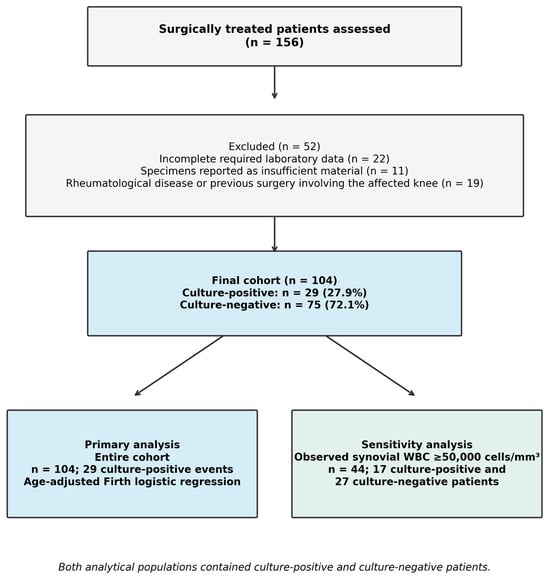
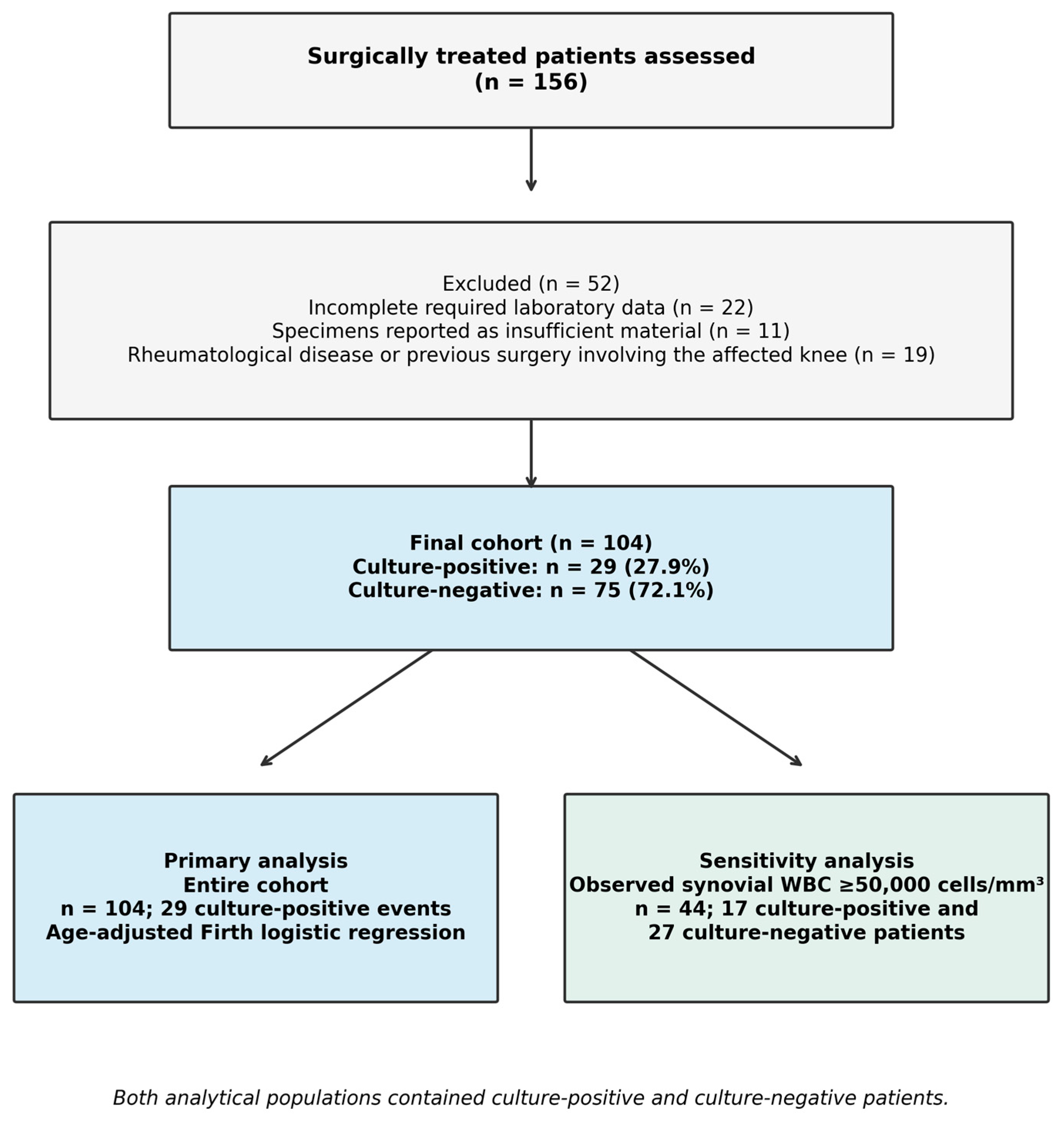
The initial surgically treated population comprised 156 patients. We excluded 22 patients with incomplete laboratory data required for the primary analysis, 11 whose specimens reached the microbiology laboratory but were reported as insufficient for culture assessment, and 19 with rheumatological disease or previous surgery involving the affected knee. These mutually exclusive exclusions left 104 patients for analysis; 29 (27.9%) had a positive intraoperative culture and 75 (72.1%) had no clinically relevant growth (Figure 1).
Figure 1.
Flow of patient screening, exclusions, and analytical populations. The primary analysis included the entire cohort (n = 104; 29 culture-positive and 75 culture-negative patients). The sensitivity analysis included patients with an observed synovial WBC ≥ 50,000 cells/mm3 (n = 44; 17 culture-positive and 27 culture-negative patients).
Culture-positive patients had lower CCI and higher CRP, WBC, neutrophil percentage, NLR, and observed synovial WBC values (Table 1). Age and ESR did not differ significantly. Sex distribution was similar between culture groups. Observed synovial PMN percentage was slightly lower in the culture-positive group, although denominators were limited and this secondary comparison should be interpreted cautiously. BMI could not be reported because sufficiently complete retrospective data were unavailable.
In the age-adjusted Firth model, lower CCI, higher CRP, and higher WBC were associated with culture positivity, whereas age was not independently associated (Table 2). The sensitivity analysis restricted to 44 patients with observed synovial WBC ≥ 50,000 cells/mm3 retained the same direction for all estimates. WBC remained associated with culture positivity, while the confidence intervals for CCI and CRP widened and crossed unity.
Table 2.
Age-adjusted Firth logistic regression analyses of culture positivity.
Arthroscopy did not imply revision surgery. Revision occurred in 2/16 (12.5%) arthroscopically treated patients and 14/88 (15.9%) patients treated with an open approach (Fisher’s exact p = 1.000). Culture status was not associated with surgical approach, revision, intensive care admission, or in-hospital mortality (Table 1).
Among culture-positive cases, 15 (51.7%) grew Staphylococcus aureus, 10 (34.5%) grew Streptococcus species, three (10.3%) grew Gram-negative bacilli, and one (3.4%) grew Neisseria meningitidis (Table 3).
Table 3.
Pathogens isolated in culture-positive cases.
4. Discussion
The main finding was that lower disease-weighted comorbidity burden and stronger preoperative CRP and peripheral leukocyte responses were associated with intraoperative culture positivity after adjustment for age using a small-sample bias-reduced method. NLR was higher in culture-positive patients but was retained only as a descriptive marker because it overlaps biologically and mathematically with the leukocyte response. The revised analysis does not propose a clinical prediction score or diagnostic threshold.
The diagnostic status of culture-negative cases requires careful qualification. Every patient had an acutely symptomatic native knee that the treating team considered sufficiently suspicious for infection to warrant operative irrigation and debridement. Nevertheless, crystal analysis and a uniform record of purulence were not available, and a negative culture does not prove either infection or sterility. Misclassification is therefore possible. The restricted analysis among patients with an observed synovial WBC ≥ 50,000 cells/mm3 preserved the direction of the estimates, but this threshold is compatible with an inflammatory process and is not itself a definitive reference standard [1].
The inverse CCI association is the most distinctive observation. Previous work has primarily emphasized inflammatory markers and age [4,5,12]. In our age-adjusted model, CCI retained an inverse association while chronological age did not. This finding may indicate that disease burden, immune response, or healthcare exposure influences the phenotype associated with microbiological recovery. The study did not measure those mechanisms, so the association should not be interpreted causally or used to reduce diagnostic vigilance in patients with high comorbidity.
CRP, WBC, and NLR are broad inflammatory markers and cannot distinguish bacterial infection from crystal-associated or other sterile inflammatory arthritis [8,9,10,11]. Their higher values in culture-positive patients therefore describe the intensity of the observed host response rather than establish a bacterial diagnosis. This distinction is especially important in a cohort selected after a clinical decision to operate.
Only two of 16 arthroscopically treated patients underwent revision, compared with 14 of 88 patients treated with an open approach. Thus, the identical culture-stratified counts for surgical approach and revision in the original Table 1 were coincidental and did not mean that all arthroscopically treated patients required revision. Surgical approach was selected by the treating surgeon and cannot be compared causally in this retrospective cohort.
The study adds a focused analysis of disease-weighted comorbidity to earlier culture-positivity research, but its contribution is exploratory. The 29 positive cultures limited the number of parameters and the precision of subgroup analyses. We therefore used Firth regression, adjusted for age, removed data-derived thresholds and ROC comparisons, and avoided claims of predictive utility. Larger multicentre cohorts with standardized diagnostic adjudication and microbiological protocols are required before any model can support clinical decisions. Contemporary cohorts similarly emphasize heterogeneity in microbiology, treatment pathways, and outcomes, supporting multicentre validation rather than direct clinical implementation of single-centre estimates [13,14].
Several limitations remain. The retrospective single-centre design is susceptible to selection, information, and diagnostic misclassification bias. Culture-negative disease was not confirmed against a uniform reference standard, and crystal analysis was not consistently available. BMI, blood-culture results, molecular testing, exact symptom duration, clinically relevant diagnostic and treatment intervals, and sufficiently standardized details of postoperative antibiotic agents, doses, and treatment durations were unavailable. Although sex distribution was reported by culture group, patient-level sex was not linked in the de-identified regression dataset and residual confounding by sex cannot be excluded. Only 29 culture-positive events were available, and the restricted analysis contained 17 events. The analyses cannot establish causality, diagnostic accuracy, calibration, clinical utility, or transportability. External validation is required.
5. Conclusions
Among adults who underwent surgery for clinically suspected native knee septic arthritis, lower CCI, higher preoperative CRP, and peripheral WBC were associated with intraoperative culture positivity after adjustment for age using Firth regression. These exploratory findings suggest that comorbidity burden may contribute information beyond inflammatory intensity, but they do not confirm infection in culture-negative cases and should not guide treatment or replace standardized microbiological sampling.
Supplementary Materials
The following supporting information can be downloaded at: https://www.mdpi.com/article/10.3390/biomedicines14112492/s1, File S1: STROBE Checklist for Cohort Studies.
Author Contributions
Conceptualization, M.Ö. (Mehmet Önüt); methodology, Ö.Ö. and M.A.T.; software, Ö.Ö.; validation, M.Ö. (Mehmet Önüt), Ö.Ö. and M.A.T.; formal analysis, M.Ö. (Mehmet Önüt); investigation, M.Ö. (Mete Özer), B.D. and E.A.; resources, M.A.T.; data curation, M.Ö. (Mehmet Önüt), Ö.Ö., M.Ö. (Mete Özer) and B.D.; writing—original draft preparation, M.Ö. (Mehmet Önüt); writing—review and editing, M.Ö. (Mehmet Önüt) and M.A.T.; visualization, M.Ö. (Mehmet Önüt) and M.Ö. (Mete Özer); supervision, M.Ö. (Mehmet Önüt) and M.A.T.; project administration, M.Ö. (Mehmet Önüt). All authors have read and agreed to the published version of the manuscript.
Funding
This research received no external funding.
Institutional Review Board Statement
The study was conducted in accordance with the Declaration of Helsinki and approved by the Institutional Review Board of Başakşehir Çam and Sakura City Hospital (Approval No. 2026.09.414; 9 September 2026).
Informed Consent Statement
The requirement for individual informed consent was waived by the Institutional Review Board because of the retrospective study design and the use of de-identified data.
Data Availability Statement
The de-identified dataset analyzed in this study is available from the corresponding author upon reasonable request, subject to institutional and ethics-committee approval and applicable data-protection requirements.
Conflicts of Interest
The authors declare no conflicts of interest.
Abbreviations
CCI, Charlson Comorbidity Index; CI, confidence interval; CRP, C-reactive protein; ESR, erythrocyte sedimentation rate; IQR, interquartile range; NLR, neutrophil-to-lymphocyte ratio; OR, odds ratio; PMN, polymorphonuclear leukocyte; STROBE, Strengthening the Reporting of Observational Studies in Epidemiology; WBC, white blood cell count.
References
- Ravn, C.; Neyt, J.; Benito, N.; Abreu, M.A.; Achermann, Y.; Bozhkova, S.; Coorevits, L.; Ferrari, M.C.; Gammelsrud, K.W.; Gerlach, U.-J.; et al. Guideline for management of septic arthritis in native joints (SANJO). J. Bone Jt. Infect. 2023, 8, 29–37. [Google Scholar] [CrossRef] [Scilit] [PubMed]
- Wu, K.A.; Kugelman, D.N.; Seidelman, J.L.; Seyler, T.M. Native joint septic arthritis. Antibiotics 2024, 13, 596. [Google Scholar] [CrossRef] [Scilit] [PubMed]
- McBride, S.; Mowbray, J.; Caughey, W.; Wong, E.; Luey, C.; Siddiqui, A.; Alexander, Z.; Playle, V.; Askelund, T.; Hopkins, C.; et al. Epidemiology, management, and outcomes of large and small native joint septic arthritis in adults. Clin. Infect. Dis. 2020, 70, 271–279. [Google Scholar] [CrossRef] [Scilit] [PubMed]
- Paz, Z.; Fowler, M.L.; Zhu, C.; Lieber, S.B.; Moore, A.; Shmerling, R.H. Patients with surgically treated culture-negative native joint septic arthritis have less severe disease and better outcomes. Infect. Dis. 2020, 52, 713–720. [Google Scholar] [CrossRef] [Scilit] [PubMed]
- Hançerli, C.Ö.; Doğan, N. Comparison of culture-negative adult knee septic arthritis patients with culture-positive patients. Compr. Med. 2024, 16, 118–122. [Google Scholar] [CrossRef] [Scilit]
- Khodadadi, R.B.; Damronglerd, P.; McHugh, J.W.; El Zein, S.; Lahr, B.D.; Yuan, B.J.; Abu Saleh, O.M.; A Suh, G.; Tande, A.J. Effect of preoperative antibiotic therapy on operative culture yield for diagnosis of native joint septic arthritis. Clin. Infect. Dis. 2024, 79, 1062–1070. [Google Scholar] [CrossRef] [Scilit] [PubMed]
- Eberst-Ledoux, J.; Tournadre, A.; Mathieu, S.; Mrozek, N.; Soubrier, M.; Dubost, J.-J. Septic arthritis with negative bacteriological findings in adult native joints: A retrospective study of 74 cases. Jt. Bone Spine 2012, 79, 156–159. [Google Scholar] [CrossRef] [Scilit] [PubMed]
- Eren, T.K.; Aktekin, C.N. How reliable are synovial cell count and blood parameters in the diagnosis of septic arthritis? Jt. Dis. Relat. Surg. 2023, 34, 724–730. [Google Scholar] [CrossRef] [Scilit] [PubMed]
- Holzmeister, A.; Frazzetta, J.; Yuan, F.F.; Cherones, A.; Summers, H.; Cohen, J.; Lack, W.D. Evaluation for septic arthritis of the native adult knee is aided by multivariable assessment. Am. J. Emerg. Med. 2021, 46, 614–618. [Google Scholar] [CrossRef] [Scilit] [PubMed]
- Massey, P.A.; Clark, M.D.; Walt, J.S.; Feibel, B.M.; Robichaux-Edwards, L.R.; Barton, R.S. Optimal synovial fluid leukocyte count cutoff for diagnosing native joint septic arthritis after antibiotics. J. Am. Acad. Orthop. Surg. 2021, 29, e1246–e1253. [Google Scholar] [CrossRef] [Scilit] [PubMed]
- Varady, N.H.; Schwab, P.E.; Kwee, D.S.; Dilley, J.E.; Bedair, H.; Chen, A.F. Synovial fluid and serum neutrophil-to-lymphocyte ratio: Novel biomarkers for the diagnosis and prognosis of native septic arthritis in adults. J. Bone Jt. Surg. Am. 2022, 104, 1516–1522. [Google Scholar] [CrossRef] [Scilit] [PubMed]
- İpek, E.; Çakar, A.; Altuntaş, Y.; Balkanlı, B.; Bozca, M.A.; Şahin, H.U.; Eren, O.T. Markers of culture positivity and a novel scoring system in native knee septic arthritis. Infection 2026. [Google Scholar] [CrossRef] [Scilit] [PubMed]
- Cimatti, P.; Ciaffi, J.; Dallari, B.; Amicucci, F.; Trisolino, G.; Storni, E.; Maso, A.; Ursini, F.; Dallari, D. Ten-year experience with native joint septic arthritis: A retrospective cohort study from a tertiary center. J. Clin. Med. 2025, 14, 6403. [Google Scholar] [CrossRef] [Scilit] [PubMed]
- Huber, L.; Aguicenoglu, H.S.; Baertl, S.; Lenz, J.E.; Gerhardinger, K.; Hanses, F.; Zeman, F.; Walter, N.; Alt, V.; Rupp, M. Diagnostic parameters in native joint septic arthritis and development of a new evaluation score. J. Bone Jt. Infect. 2026, 11, 175–183. [Google Scholar] [CrossRef] [Scilit] [PubMed]
- Sousa, R.; Carvalho, A.; Santos, A.C.; Abreu, M.A. Optimal microbiological sampling for the diagnosis of osteoarticular infection. EFORT Open Rev. 2021, 6, 390–398. [Google Scholar] [CrossRef] [Scilit] [PubMed]
- Firth, D. Bias reduction of maximum likelihood estimates. Biometrika 1993, 80, 27–38. [Google Scholar] [CrossRef]
- Riley, R.D.; Snell, K.I.E.; Ensor, J.; Burke, D.L.; Harrell, F.E., Jr.; Moons, K.G.; Collins, G.S. Minimum sample size for developing a multivariable prediction model: Part II—Binary and time-to-event outcomes. Stat. Med. 2019, 38, 1276–1296, Correction in Stat. Med. 2019, 38, 5672. [Google Scholar] [CrossRef] [Scilit] [PubMed]

Disclaimer/Publisher’s Note: The statements, opinions and data contained in all publications are solely those of the individual author(s) and contributor(s) and not of MDPI and/or the editor(s). MDPI and/or the editor(s) disclaim responsibility for any injury to people or property resulting from any ideas, methods, instructions or products referred to in the content. |
© 2026 by the authors. Licensee MDPI, Basel, Switzerland. This article is an open access article distributed under the terms and conditions of the Creative Commons Attribution (CC BY) license.