


Highlights
What are the main findings?
- Early dapagliflozin initiation significantly reduced all-cause mortality but not heart failure hospitalization in the all-population analysis.
- Initiation of dapagliflozin was associated with a significant reduction in urinary tract infections (UTIs), without an increase in any adverse events.
What are the implications of the main findings?
- The available randomized evidence supports short-term safety with a clear all-population mortality.
- Adequately powered AHF-specific trials with prespecified timing strata are needed before definitive clinical recommendations can be made.
Abstract
Background/Objectives: Dapagliflozin is a foundational chronic heart failure therapy, but whether it retains benefit when initiated early during hospitalization for acute heart failure (AHF) remains uncertain. Methods: We searched MEDLINE, Embase, Scopus, and CENTRAL from inception to 26 January 2026 for randomized trials comparing early initiation of dapagliflozin 10 mg once daily with standard therapy in adults hospitalized for AHF (PROSPERO CRD420261364466). Two reviewers independently performed screening, extraction, and risk-of-bias assessment. Outcomes were pooled under random-effects models with Knapp–Hartung adjustment. Results: Ten trials enrolling 3507 participants (1769 in the dapagliflozin group and 1738 in the control group) were eligible. Dapagliflozin significantly reduced all-cause mortality (RR 0.67, 95% CI 0.52–0.86) and urinary tract infections (RR 0.52, 95% CI 0.35–0.76), while no significant differences were observed in cardiovascular death, MACEs, heart failure hospitalization, all-cause readmission, length of hospital stay, or body weight. Dapagliflozin was not associated with a significant increase in acute kidney injury, hypotension, or hypoglycemia, supporting a favorable safety profile. Conclusions: In adults hospitalized with acute heart failure (AHF), dapagliflozin significantly reduced all-cause mortality but not heart failure hospitalization during follow-up. Larger, adequately powered trials in patients with AHF, with prespecified analyses according to the timing of dapagliflozin initiation, are warranted.
1. Introduction
Acute heart failure (AHF) is a life-threatening clinical syndrome characterized by new-onset or worsening signs and symptoms of heart failure that are severe enough to prompt urgent evaluation and commonly lead to unplanned hospital admission. It remains a leading driver of hospitalization among older adults and carries a heavy burden of morbidity, mortality, and healthcare utilization, with vulnerability to adverse events persisting through admission and well beyond discharge [1].
Current in-hospital AHF management prioritizes the rapid identification and treatment of congestion and precipitating factors, most often using intravenous loop diuretics, while maintaining balance in perfusion, renal function, and hemodynamic stability. However, AHF has long been therapeutically frustrating: multiple randomized trials of in-hospital pharmacologic interventions have not consistently translated into improved post-discharge outcomes. This underscores the need for therapies that are both feasible to start during admission and able to modify early and longer-term risk [1,2]. Hospitalization provides a time-limited opportunity to initiate or intensify evidence-based, disease-modifying heart failure therapies and to structure early post-discharge follow-up, which contemporary guidelines emphasize as a strategy to reduce re-hospitalization and death [3,4].
Sodium–glucose cotransporter-2 (SGLT2) inhibitors, especially dapagliflozin, have emerged as foundational disease-modifying therapies across the heart failure spectrum, expanding well beyond their original glucose-lowering indications. In the DAPA-HF trial, dapagliflozin reduced the risk of the primary composite outcome of worsening heart failure or cardiovascular death in patients with symptomatic heart failure with reduced ejection fraction (HFrEF), with consistent benefits irrespective of the diabetes status [5]. In the DELIVER trial, dapagliflozin reduced the combined risk of worsening heart failure or cardiovascular death in patients with heart failure and mildly reduced or preserved ejection fraction (HFmrEF/HFpEF) [6]. A prespecified patient-level pooled meta-analysis of DAPA-HF and DELIVER further demonstrated reductions in cardiovascular death, all-cause mortality, and total heart failure hospitalizations across a broad range of ejection fractions, supporting a clinically meaningful and mechanistically plausible role for dapagliflozin in heart failure risk reduction as SGLT2 inhibitors promote osmotic diuresis and natriuresis, reduce cardiac preload and afterload, along with improving cardiorenal function independent of glucose lowering [7,8]. These data have informed guideline recommendations specifically supporting dapagliflozin and other SGLT2 inhibitors as a core component of contemporary heart failure pharmacotherapy, including HFmrEF and HFpEF [3,4].
Whether the clinical benefits of dapagliflozin can be preserved or even amplified when initiated early during hospitalization for AHF is a clinically important question. Early initiation could theoretically address two pressing problems in AHF care: (a) congestion and diuretic responsiveness during admission and (b) the heightened early post-discharge risk period, when therapeutic inertia, suboptimal initiation of guideline-directed medical therapy, and limited follow-up may contribute to recurrent adverse events [3,4]. Simultaneously, clinicians have legitimate safety concerns regarding the initiation of SGLT2 inhibition during acute illness, including risks associated with fluctuating volume status, blood pressure, renal function, and the rare but serious complication of ketoacidosis in susceptible patients [4]. These concerns underscore the need for trial-level evidence, particularly randomized comparisons with meticulous adverse event ascertainment, to inform decision-making.
Evidence supporting early in-hospital SGLT2 inhibitor initiation has expanded in recent years, providing proof-of-concept for the feasibility in stabilized AHF. In the EMPULSE study, initiation of empagliflozin in clinically stabilized patients hospitalized for acute de novo or decompensated chronic heart failure improved a hierarchical 90-day clinical benefit outcome and was well tolerated, suggesting that SGLT2 inhibition can be safely started during AHF hospitalization under appropriate stability criteria [2]. In the SOLOIST-WHF trial, sotagliflozin initiated before discharge or shortly after discharge in patients with diabetes and recent worsening heart failure reduced total cardiovascular deaths and heart failure events compared with placebo, reinforcing the concept that early post-acute initiation may yield clinically relevant benefits [9]. However, when considering dapagliflozin specifically in the AHF setting, available evidence is comparatively limited and heterogeneous, often focusing on short-term decongestion and safety rather than mortality.
Several randomized trials have directly informed the early use of dapagliflozin in AHF-relevant inpatient scenarios. DICTATE-AHF evaluated dapagliflozin initiated during hospitalization among patients with acute heart failure receiving intravenous loop diuretics and provided important randomized evidence regarding its physiological effects and safety in this setting [10]. DAPA-RESIST compared dapagliflozin with metolazone as an add-on strategy in hospitalized patients with heart failure and loop diuretic resistance; dapagliflozin was not more effective at relieving congestion than metolazone but was associated with less biochemical disturbance, a potentially meaningful safety/tolerability advantage in a high-risk inpatient population [11]. More recently, DAPA ACT HF–TIMI 68 tested in-hospital initiation of dapagliflozin in stabilized acute heart failure hospitalization and, based on publicly reported primary results, did not demonstrate a statistically significant reduction in cardiovascular death or worsening heart failure through short-term follow-up, although the evolving totality of randomized evidence continues to inform the magnitude and certainty of benefit for early in-hospital SGLT2 initiation [12,13].
Given the rapid emergence of randomized trials with differing eligibility criteria (e.g., stabilization requirements and diuretic resistance), timing of initiation, follow-up duration, and outcome definitions, the net clinical effect and safety profile of early dapagliflozin initiation in AHF remain uncertain when considering single trials in isolation. Therefore, a focused synthesis of randomized evidence is needed to quantify the potential benefits and harms, improve the precision of mortality and safety outcomes, and clarify the consistency across trial designs and patient subgroups. This systematic review and meta-analysis aimed to evaluate whether early initiation of dapagliflozin compared with control or conventional therapy improves clinically relevant outcomes, including all-cause mortality, heart failure rehospitalization, composite heart failure events, and cardiovascular and non-cardiovascular adverse events in adult patients hospitalized with acute heart failure.
2. Methods
This systematic review and meta-analysis were performed in line with the PRISMA guidelines and the Cochrane Handbook for Systematic Reviews of Interventions [14,15]. PRISMA 2020 checklist is included in Supplementary Table S1. The protocol was registered with PROSPERO (CRD420261364466). As the study relied on previously published data, ethical approval was not required.
2.1. Search Strategy and Data Sources
A comprehensive literature search was carried out across multiple electronic databases to identify studies assessing the efficacy and safety of dapagliflozin in patients with acute heart failure. The databases included MEDLINE (via PubMed), Embase (via Ovid), Scopus, and the Cochrane Central Register of Controlled Trials. A combination of MeSH terms and free-text keywords related to “SGLT2 inhibitors,” “dapagliflozin,” “acute heart failure,” and “randomized controlled trials” was applied. Reference lists of relevant articles and review papers were also screened to capture any additional studies. The search covered all records published from inception up to 26 January 2026. Detailed search strategies for each database are presented in Supplementary Table S2.
2.2. Selection Process
Two reviewers (Miad Ali Alhamrani and Lina Fahad Bahitham) independently screened the titles and abstracts of all retrieved records. Studies that met the eligibility criteria, or that could not be confidently judged from the title and abstract alone, were advanced to full-text review. Disagreements were resolved by discussion, with a third senior reviewer (Ahmed Alsaif) consulted where consensus could not be reached.
2.3. Inclusion and Exclusion Criteria
Studies were eligible for inclusion if they met the following criteria: (1) randomized controlled trials; (2) comparison of dapagliflozin (10 mg once daily) with standard or conventional therapy; (3) evaluation of dapagliflozin initiated on hospitalization or within days after admission for acute heart failure (4) reporting of at least one predefined outcome of interest; and (5) publication in any language. No minimum sample size was required for inclusion. We excluded non-randomized studies, retrospective cohort studies, case reports, editorials, non-human studies, and meeting abstracts.
2.4. Data Collection
A standardized data extraction form was developed to ensure consistent capture of key variables across all included studies. Two authors independently extracted the data using the standardized form, with discrepancies resolved through discussion. The form included essential study characteristics such as study design, year, country, trial identifier, sample size, and duration of follow-up. Participant-level data included mean age, sex distribution, baseline comorbidities such as type 2 diabetes, hypertension, and ischemic heart disease, along with key clinical measures including left ventricular ejection fraction and estimated glomerular filtration rate. Information on the timing of dapagliflozin initiation was also recorded. When data were incomplete or unclear, study authors were contacted for clarification. If no response was received, data were extracted from graphs using PlotDigitizer [16].
2.5. Outcome and Subgroups
All-cause mortality was considered the primary outcome of interest. Secondary outcomes included major adverse cardiovascular events (MACEs; a composite of cardiovascular death, myocardial infarction, and stroke), individual cardiovascular outcomes (cardiovascular death and stroke), length of hospital stay, readmission, and heart failure-related hospitalization. Functional outcomes included changes in body weight in kg from admission to final follow-up, serum creatinine, estimated glomerular filtration rate (eGFR). Safety outcomes comprised acute kidney injury or worsening renal function, hypotension, urinary tract infections, and hypoglycemia. A prespecified subgroup analysis examined the effect of the timing of dapagliflozin initiation, where data permitted, comparing initiation within 12 h of hospital presentation with initiation after 12 h but within 24 h.
2.6. Quality Assessment
Two reviewers independently assessed the methodological quality of the included randomized trials using the Cochrane Risk of Bias tool version 2 (RoB 2), with any disagreements resolved through discussion with a third reviewer. The RoB 2 framework evaluates five domains to determine the overall risk of bias, including bias arising from the randomization process, deviations from intended interventions, missing outcome data, outcome measurement, and selective reporting of results.
2.7. Statistical Analysis
All analyses were performed using RC MetaStudio v0.2.3, an open-source desktop application for conducting meta-analyses through a graphical interface [17]. For continuous outcomes, mean differences (MDs) with 95% confidence intervals (CIs) were calculated. When available, data reported as means and standard deviations (SDs) were directly extracted. For studies reporting medians and interquartile ranges (IQRs), medians were converted to means and IQRs were transformed into SDs using the methods described by Luo et al. [18] and Wan et al. [19], respectively. For dichotomous outcomes, risk ratios (RRs) with 95% CIs were computed and pooled using the Mantel–Haenszel method [20] under a random-effects model. Continuous outcomes were pooled using the inverse variance method. The Knapp–Hartung adjustment was applied to the confidence intervals to account for uncertainty in the between-study variance estimate [21]. Between-study variance was estimated using the Paule–Mandel estimator [22] for dichotomous outcomes and the restricted maximum likelihood (REML) method [23] for continuous outcomes. Heterogeneity was assessed using the Higgins I2 statistic and interpreted according to the Cochrane Handbook guidelines, alongside the Chi2 test, as follows: 0–40% indicating low heterogeneity, 30–60% moderate heterogeneity, 50–75% substantial heterogeneity, and 75–100% considerable heterogeneity [24]. Publication bias was not assessed because none of the outcomes included 10 or more studies [25]. When more than two studies were available, sensitivity analyses were conducted by sequentially omitting one study at a time. A p-value < 0.05 was considered statistically significant for all analyses.
2.8. Certainty of Evidence
Grading of Recommendations Development, Assessment, and Evaluation (GRADE) approach was used to grade the certainty of evidence. The summary of the effects was generated via the GRADEpro Guideline Development Tool (Supplementary Table S3).
3. Results
3.1. Search Results
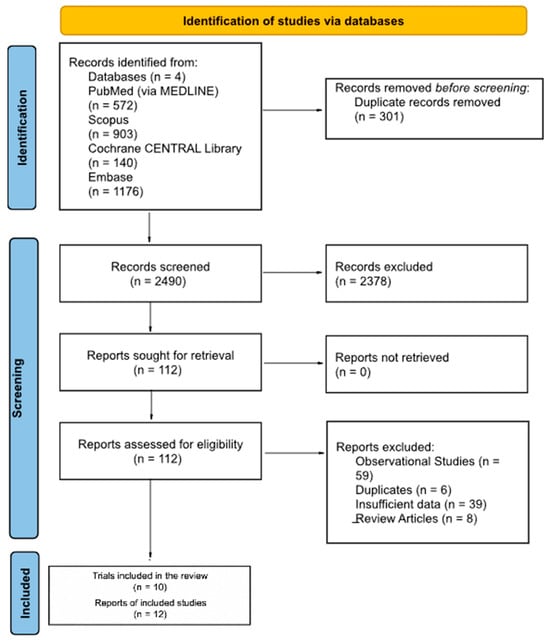
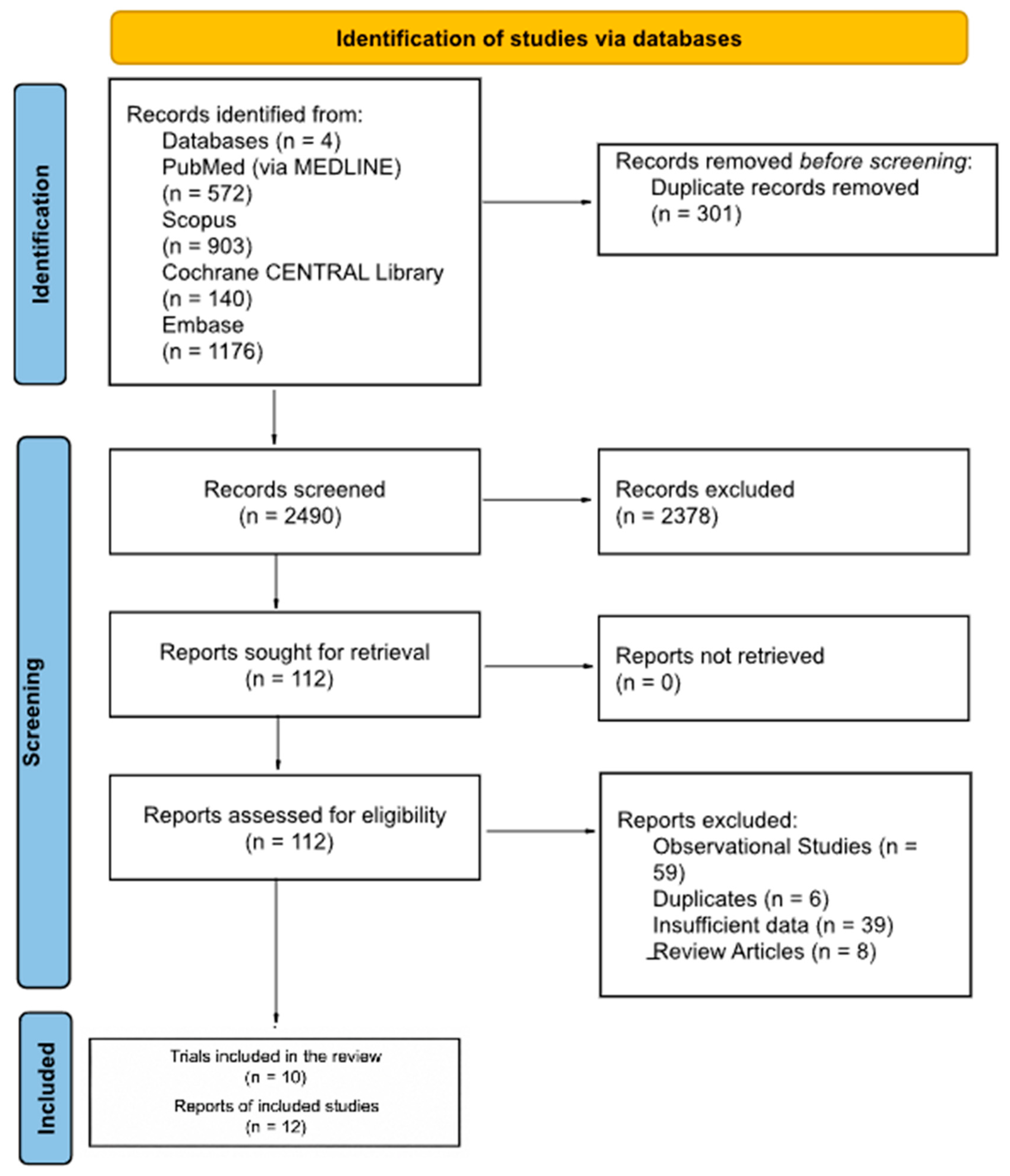
The systematic search identified 2791 articles (Figure 1). A total of 301 duplicates were removed, leaving 2490 articles for screening. Titles and abstracts were reviewed, resulting in the exclusion of 2378 records. The full texts of the remaining 112 reports were reviewed and assessed for eligibility. Ultimately, 10 RCTs reported in 12 publications, comprising 3507 participants, were eligible, while studies involving acute myocardial infarction or late initiation of dapagliflozin during or after hospitalization were excluded [10,11,12,26,27,28,29,30,31,32,33,34,35,36,37]. A total of 1769 participants were included in the dapagliflozin group, while 1738 participants were included in the control group. The trials were conducted across several countries, with two conducted in Egypt, two in the United States, and one in Russia. Single trials were conducted in Romania, Japan, Thailand, China, and the United Kingdom. Participants’ mean age ranged from 60 to 79 years. All studies administered 10 mg of dapagliflozin once daily to the patients. Baseline characteristics of studies and participants are provided in Table 1 and Table 2.
Figure 1.
PRISMA flow diagram of study selection.
Table 1.
Baseline characteristics of included Randomized Controlled Trials.
Table 2.
Baseline characteristics of included participants.
3.2. Quality Assessment Results
Risk of bias was evaluated in five domains: randomization process (D1), deviations from intended interventions (D2), missing outcome data (D3), outcome measurement (D4), and selective reporting of results (D5). Among the 15 included trials, 9 were judged to have “some concerns” of bias, most notably in Domain 2 and Domain 4, and 6 studies were assessed as having a “low risk” of bias. A visual summary is presented in Supplementary Figures S1 and S2.
3.3. Efficacy Outcomes
3.3.1. Major Adverse Cardiovascular Events (MACEs)
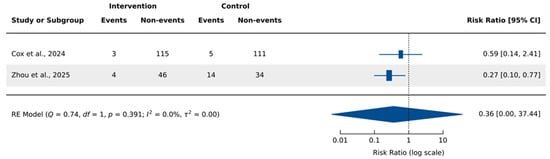
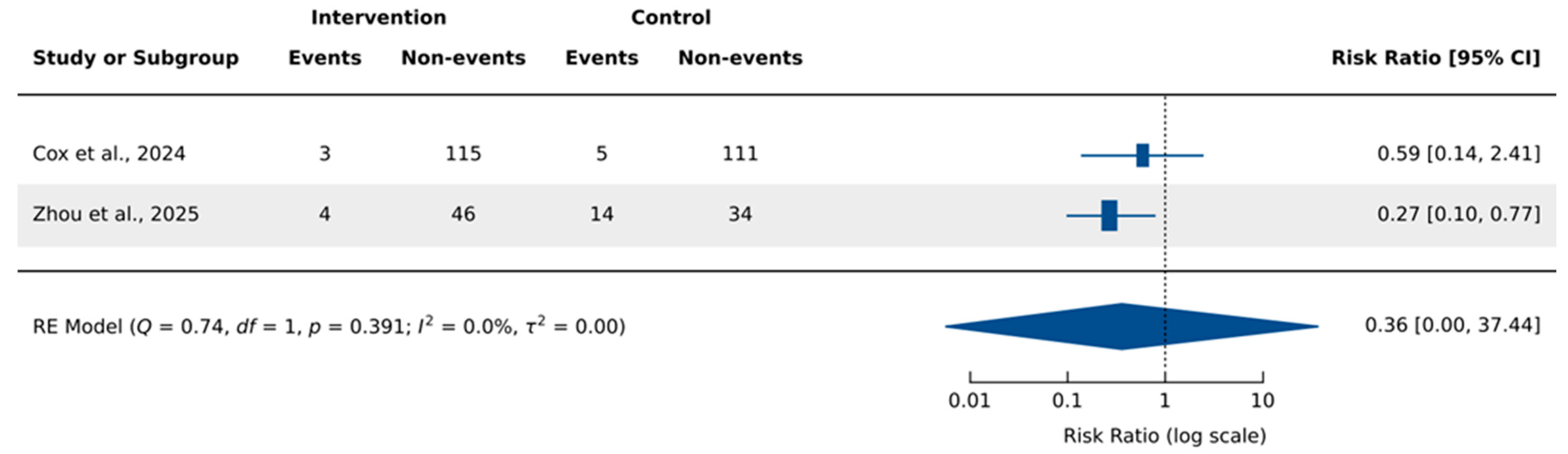
In the pooled analysis of 2 studies [10,37], dapagliflozin did not confer a statistically significant reduction in MACEs compared with control (RR = 0.36 [0.00, 37.44]; p = 0.41; I2 = 0%) (Figure 2).
Figure 2.
Forest plot for major adverse cardiovascular events (MACEs) [10,37].
3.3.2. Cardiovascular Death
In the pooled analysis of 2 studies [10,12], dapagliflozin was not associated with a significantly lower risk of cardiovascular death compared with control (RR = 0.73 [0.02, 29.49]; p = 0.67; I2 = 4.8%) (Supplementary Figure S3).
3.3.3. All-Cause Mortality
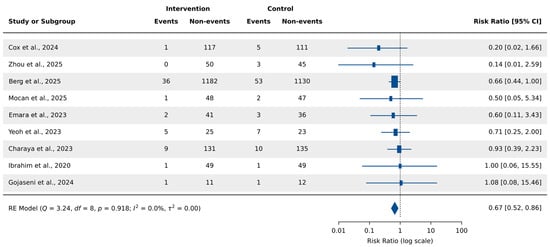
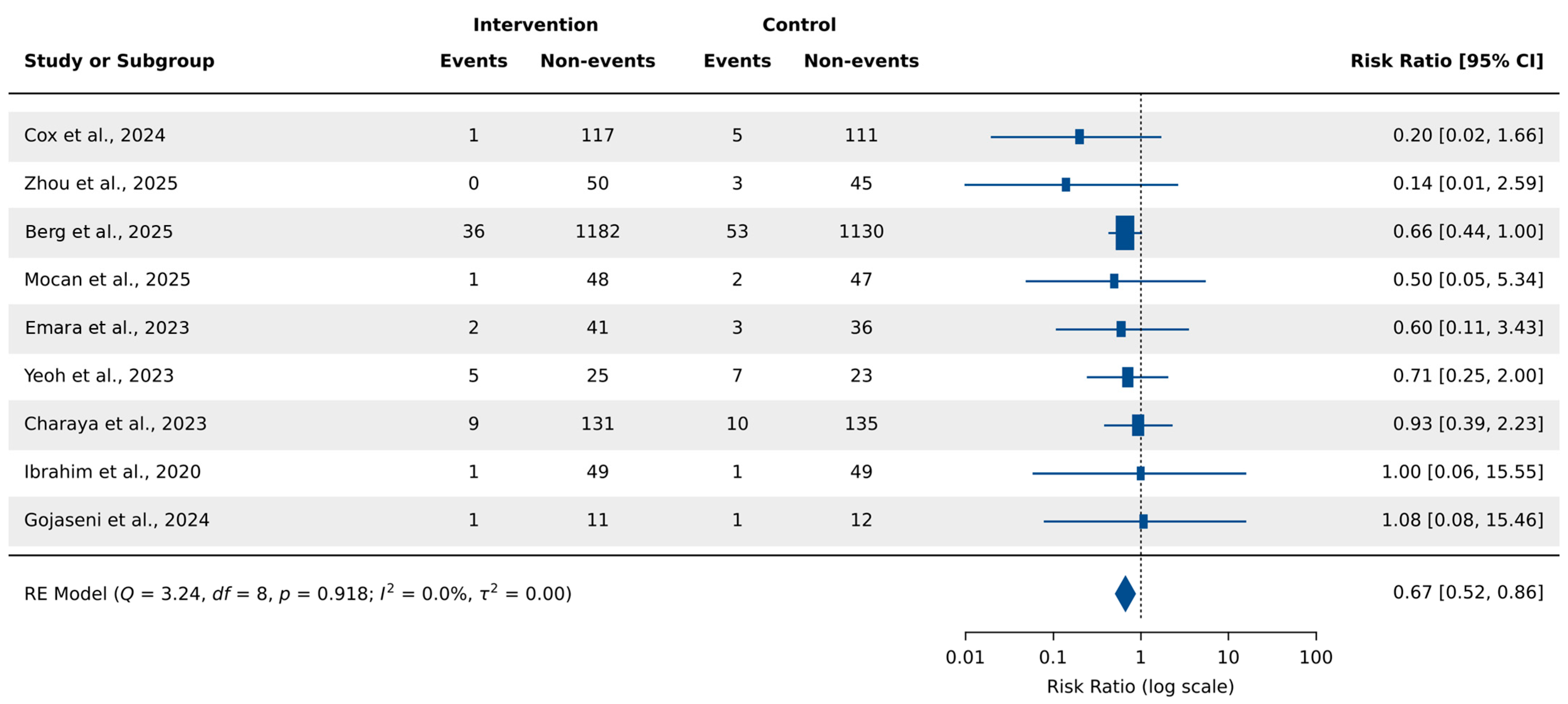
Across 9 studies [10,11,12,26,28,31,34,36,37], dapagliflozin significantly reduced all-cause mortality relative to control (RR = 0.67 [0.52, 0.86]; p = 0.006; I2 = 0.0%) (Figure 3). Sensitivity analysis showed that this finding remained consistent after exclusion of Yeoh et al. (Supplementary Figure S4).
Figure 3.
Forest plot for all-cause mortality [10,11,12,26,28,31,34,36,37].
3.3.4. Stroke
Across 2 studies [10,37], dapagliflozin was not associated with a statistically significant reduction in stroke compared with control (RR = 0.61 [0.00, 703.30]; p = 0.42; I2 = 0.0%) (Supplementary Figure S5).
3.3.5. Heart Failure Hospitalization
In the pooled analysis of 4 studies [10,11,12,37], dapagliflozin was associated with a numerically lower risk of heart failure hospitalization; however, the difference did not reach statistical significance (RR = 0.87 [0.59, 1.29]; p = 0.3; I2 = 0.0%) (Supplementary Figure S6). Leave-one-out sensitivity analysis confirmed that this non-significant result was consistent across all study exclusions (Supplementary Figure S7).
3.3.6. Readmission (All-Cause)
Across 7 studies [10,11,12,28,31,34,37], dapagliflozin did not significantly reduce all-cause readmission compared with control (RR = 0.78 [0.49, 1.22]; p = 0.217; I2 = 59.0%) (Supplementary Figure S8). Sensitivity analysis demonstrated that omission of Zhou et al., 2025 markedly reduced heterogeneity (I2 = 0%), while the results remained non-significant (RR = 0.88 [0.73, 1.06]). (Supplementary Figure S9).
3.3.7. Length of Hospital Stay
In the pooled analysis of 8 studies [10,11,26,28,31,34,35,36], dapagliflozin did not significantly shorten the length of hospital stay compared with control (MD = −0.45 days [−0.96, 0.06]; p = 0.07; I2 = 14.4%) (Supplementary Figure S10). Leave-one-out sensitivity analysis showed that this finding remained non-significant across all study exclusions (Supplementary Figure S11).
3.4. Functional Outcomes
3.4.1. Weight Change
Across 6 studies [10,11,26,31,34,35], dapagliflozin was not associated with a significantly greater reduction in body weight compared with control (MD = −0.59 kg [−1.43, −0.26]; p = 0.134; I2 = 97.2%) (Supplementary Figure S12). Although between-study heterogeneity was substantial, leave-one-out sensitivity analysis did not alter the statistical significance of the pooled estimate (Supplementary Figure S13).
3.4.2. eGFR Change
The pooled analysis of 4 studies [11,32,34,35] showed no statistically significant difference in eGFR change between dapagliflozin and control (MD = −1.93 mL/min [−11.19, 7.34]; p = 0.32; I2 = 97.6%) (Supplementary Figure S14). Removal of K. Charaya et al. [31,32,33] 2023 yielded a significant result with low heterogeneity (MD = +2.55 mL/min [0.72, 4.38]; p = 0.027; I2 = 0.0%) (Supplementary Figure S15).
3.4.3. Serum Creatinine
Across 2 studies [26,34], dapagliflozin did not significantly affect serum creatinine compared with control (MD = −1.71 µmol/L [−24.96, 21.54]; p = 0.3499; I2 = 97.8%) (Supplementary Figure S16).
3.5. Safety Outcomes
3.5.1. Acute Kidney Injury (AKI)
In the pooled analysis of 8 studies [10,12,26,28,33,34,35,36], dapagliflozin was not associated with a statistically significant increase in AKI risk compared with control (RR = 1.19 [0.87, 1.64]; p = 0.236; I2 = 4.4%) (Supplementary Figure S17). Leave-one-out sensitivity analysis confirmed the robustness of this finding (Supplementary Figure S18).
3.5.2. Urinary Tract Infection (UTI)
Across 5 studies [10,11,35,36,37], dapagliflozin significantly reduced the risk of urinary tract infection compared with control (RR = 0.52 [0.35, 0.76]; p = 0.009; I2 = 0.0%) (Supplementary Figure S19). This finding remained unchanged in leave-one-out sensitivity analysis (Supplementary Figure S20).
3.5.3. Hypoglycemia
Across 4 studies [10,12,28,35], no statistically significant difference in hypoglycemia was observed between dapagliflozin and control (RR = 0.73 [0.41, 1.29]; p = 0.179; I2 = 0.0%) (Supplementary Figure S21). Leave-one-out sensitivity analysis showed that this finding remained stable (Supplementary Figure S22).
3.5.4. Hypotension
In the pooled analysis of 7 studies [10,11,12,28,33,36,37], dapagliflozin was not associated with a statistically significant increase in hypotension risk (RR = 1.15 [0.58, 2.24]; p = 0.639; I2 = 13.9%) (Supplementary Figure S23). Leave-one-out sensitivity analysis showed that this finding remained stable (Supplementary Figure S24).
3.6. Subgroup Analyses Based on Timing of Dapagliflozin Introduction
Twelve-Hour Threshold
Subgroup analysis according to a 12 h initiation threshold was performed for length of hospital stay and weight change (Supplementary Figures S25 and S26). For length of hospital stay, no significant subgroup (p = 0.600) difference was observed between initiation at ≤12 h (MD = −0.20 days [−1.82, 1.42]) and initiation after 12 h but within 24 h (MD = −0.49 days [−1.43, 0.45]; p = 0.06). A non-significant subgroup difference was observed for weight change (p = 0.139), with greater weight reduction in the ≤12 h subgroup (MD = −1.38 kg [−3.60, −0.84]) than in the >12 h subgroup (MD = −0.41 kg [−1.38, −0.56]).
4. Discussion
This review extends the existing literature by providing the first meta-analysis focused specifically on dapagliflozin, rather than SGLT2 inhibitors as a class, in acute heart failure. It also prespecified treatment initiation timing as a potential effect modifier, incorporated smaller trials evaluating early dapagliflozin initiation that were underrepresented in previous pooled analyses and evaluated the robustness of findings through leave-one-out sensitivity analyses for all outcomes.
4.1. Main Findings
In this systematic review and meta-analysis of 10 randomized controlled trials enrolling 3507 participants, dapagliflozin 10 mg once daily, initiated during hospitalization significantly reduced all-cause mortality, the prespecified primary outcome.
Across the all-population analyses, no significant differences were observed for cardiovascular death, MACEs, all-cause readmission, or length of hospital stay. Heart failure hospitalization showed a directionally favourable but non-significant point estimate (RR 0.87, 95% CI 0.59–1.29) consistent with both a null effect and a clinically meaningful reduction of approximately one third, and the included trials were collectively underpowered for this endpoint. Dapagliflozin did not produce a significant reduction in body weight that, in the acute setting, is best interpreted as a surrogate marker of enhanced decongestion rather than adipose loss. No statistically significant excess was observed for acute kidney injury, hypotension, or hypoglycemia, although several of these analyses are precision-limited. The diabetic ketoacidosis analysis, based on only two trials, is uninformative (see Section 4.4). Dapagliflozin significantly reduced the risk of urinary tract infection compared with control.
This synthesis is conceptually distinct from the meta-analysis reported alongside the DAPA ACT HF–TIMI 68 primary results [12], which pooled SGLT2 inhibitors as a class in patients hospitalized for heart failure. The present analysis (i) is restricted to dapagliflozin specifically, allowing molecule-specific inference; (ii) prespecifies timing of initiation as an effect modifier; and (iii) reports leave-one-out sensitivity analyses for every outcome. The certainty of evidence was formally graded using the GRADE framework.
4.2. Comparison with Previous Literature
In DAPA-HF, dapagliflozin reduced the composite of worsening heart failure or cardiovascular death in patients with heart failure and reduced ejection fraction [5], and in DELIVER, analogous benefits extended into the mildly reduced and preserved ejection fraction range [6], with a patient-level pooled analysis demonstrating reductions in cardiovascular and all-cause mortality across the ejection fraction spectrum [7]. The discrepancy between those chronic trials and the present synthesis likely reflects factors intrinsic to the acute setting: shorter follow-up windows, the dominance of competing risks during hospitalization, hemodynamic and neurohormonal instability that may attenuate measurable disease-modifying effects, and heterogeneous stabilization criteria across trials.
Within the acute setting, our findings are broadly consistent with the individual contributing trials. The DAPA ACT HF–TIMI 68 trial, the largest study, did not demonstrate a significant reduction in cardiovascular death or worsening heart failure with in-hospital initiation [12]. DICTATE-AHF supported the feasibility and tolerability of dapagliflozin co-administered with intravenous loop diuretic therapy in patients hospitalized with acute heart failure [10], and DAPA-RESIST, in patients with established loop diuretic resistance, found dapagliflozin no more effective than metolazone for decongestion but associated with less biochemical disturbance [11]. Set against trials of other agents, EMPULSE demonstrated improvement in a hierarchical clinical benefit composite at 90 days with empagliflozin in stabilized acute heart failure [2], and SOLOIST-WHF showed reductions in cardiovascular events with sotagliflozin initiated before or shortly after discharge in patients with diabetes and recent worsening heart failure [9]. Differences in eligibility criteria—most importantly stabilization requirements and diabetes status—comparator design, endpoint definitions, and event ascertainment likely contribute to the variation across these programs. Background guideline-directed therapy also varied across the included trials, which spanned an era encompassing increasing uptake of angiotensin receptor–neprilysin inhibitors, and completeness of foundational therapy is a plausible effect modifier.
Diabetes prevalence varied across trials and consistent quantitative reporting at the cohort level was limited; this should be borne in mind when interpreting the metabolic and DKA signals discussed below.
4.3. Potential Mechanisms and Clinical Implications
The reduction (non-significant) in body weight observed with dapagliflozin is best interpreted in this context as a predominant marker of enhanced decongestion. Over the short follow-up windows of acute heart failure trials, the dominant contributor to weight change is fluid balance rather than adiposity, and the magnitude observed is consistent with augmented natriuresis and osmotic diuresis when SGLT2 inhibition is added to intravenous loop diuretic therapy [8]. In trials with longer follow-up, however, a contribution from sustained glucosuric caloric loss and modest adipose change cannot be excluded, and the pooled estimate likely reflects a mixed contribution rather than fluid balance alone. Direct decongestion endpoints—including NT-proBNP and BNP trajectories, KCCQ scores, dyspnea visual analogue scales, and hemoconcentration markers—were not synthesized, either because they were not consistently reported across trials or were not prespecified outcomes of this analysis; the decongestion interpretation should therefore be regarded as inferential rather than directly demonstrated. Heart failure hospitalization, the most clinically meaningful post-discharge endpoint is compatible with both a null effect and a clinically meaningful reduction of approximately one third; the included trials were collectively underpowered for this endpoint. A directional but imprecise reduction in length of hospital stay was also observed, which, although non-significant, would be operationally relevant at scale if confirmed in adequately powered trials.
Glucose-independent mechanisms proposed for SGLT2 inhibitors, including reductions in cardiac preload and afterload, attenuation of inflammation and adverse cardiac remodeling, and a postulated shift in myocardial substrate utilization, may operate less efficiently against a background of acute decompensation, neurohormonal activation, and renal stress [8]. SGLT2 inhibitor initiation is also recognized to produce a small, reversible reduction in eGFR within the first weeks of therapy that is hemodynamic in origin and distinct from acute kidney injury [8]; the absence of a significant AKI signal in this synthesis is consistent with that distinction.
For the practising clinician, the practical message is twofold. Starting dapagliflozin during hospitalization for acute heart failure appears to introduce detectable safety across the available randomized evidence, but it is not associated with greater weight reduction. Hypoglycemia events were infrequent and not increased with dapagliflozin, consistent with the established mechanism of SGLT2 inhibition, which does not directly cause hypoglycemia in the absence of concomitant insulin or insulin secretagogue (e.g., sulfonylurea) therapy [8].
4.4. Strengths and Limitations
This synthesis has several strengths. It is restricted to randomized evidence on dapagliflozin specifically, incorporates the most recently reported acute heart failure trials, and prespecifies timing of initiation as a subgroup variable. Leave-one-out sensitivity analyses are reported for all outcomes, increasing transparency around the stability of pooled estimates. The protocol was prospectively registered with PROSPERO and the conduct adhered to PRISMA reporting guidelines [14].
Several limitations require explicit acknowledgement. First, ejection fraction inclusion criteria varied across trials and patient-level stratification by ejection fraction was not feasible. Second, follow-up period was generally short, leaving open the possibility that benefits accruing beyond the index hospitalization are not captured.
4.5. Conclusions
In this systematic review and meta-analysis of 10 randomized controlled trials, initiation of dapagliflozin during hospitalization in adults with acute heart failure significantly reduced all-cause mortality, but not cardiovascular death, heart failure hospitalization, or length of stay in the all-population analysis. Heart failure hospitalization in the all-population analysis was directionally consistent with the chronic-phase evidence base. The available randomized evidence did not detect a statistically significant safety signal for acute kidney injury, hypotension, or hypoglycemia, although it did for the urinary tract infections; clinical decisions should weigh these uncertainties alongside the absence of demonstrated rehospitalization benefit in the all-population analysis. Adequately powered trials with prospectively prespecified, AHF-specific and timing-stratified analyses are required to determine whether early in-hospital initiation of dapagliflozin offers benefit on hard clinical endpoints in patients hospitalized with acute heart failure.
Supplementary Materials
The following supporting information can be downloaded at https://www.mdpi.com/article/10.3390/biomedicines14102319/s1, Table S1: PRISMA 2020 checklist; Table S2: search strategy and databases used for literature selection; Table S3: GRADE certainty of evidence assessment; Table S4: trial publication linkage table for Charaya et al. (NCT04778787) [31,32,33]; Figure S1: risk-of-bias summary plot for the included randomized controlled trials; Figure S2: risk-of-bias traffic light plot for the included randomized controlled trials; Figures S3–S24: supplementary forest plots and sensitivity analyses; Figures S25 and S26: subgroup analyses according to the 12 h dapagliflozin initiation threshold.
Author Contributions
Conceptualization, A.K.A.; methodology, and L.F.B. and A.K.A.; formal analysis, H.A. and A.T.A.; investigation, S.H.S.H. and L.K.A.; data curation, N.K.A. and L.F.B.; writing—original draft preparation, A.K.A., M.A.A. and A.T.A.; writing—review and editing, A.A., J.S.A. and A.A.K.A.; visualization, L.K.A. and L.F.B.; supervision, A.A. All authors have read and agreed to the published version of the manuscript.
Funding
This work was supported by the Deanship of Scientific Research, Vice Presidency for Graduate Studies and Scientific Research, King Faisal University, Saudi Arabia (KFU263425).
Institutional Review Board Statement
Not applicable. This systematic review and meta-analysis used previously published data and did not involve new human participant recruitment or the collection of identifiable patient-level data.
Informed Consent Statement
Not applicable.
Data Availability Statement
Data available from corresponding author on request.
Conflicts of Interest
The authors declare no conflicts of interest.
References
- Masip, J.; Peacock, W.F.; Arrigo, M.; Rossello, X.; Platz, E.; Cullen, L.; Mebazaa, A.; Price, S.; Bueno, H.; Di Somma, S.; et al. Acute Heart Failure in the 2021 ESC Heart Failure Guidelines: A scientific statement from the Association for Acute CardioVascular Care (ACVC). Eur. Heart J. Acute Cardiovasc. Care 2022, 11, 173–185. [Google Scholar] [CrossRef] [Scilit] [PubMed]
- Voors, A.A.; Angermann, C.E.; Teerlink, J.R.; Collins, S.P.; Kosiborod, M.; Biegus, J.; Ferreira, J.P.; Nassif, M.E.; Psotka, M.A.; Tromp, J.; et al. The SGLT2 inhibitor empagliflozin in patients hospitalized for acute heart failure: A multinational randomized trial. Nat. Med. 2022, 28, 568–574. [Google Scholar] [CrossRef] [Scilit] [PubMed]
- Heidenreich, P.A.; Bozkurt, B.; Aguilar, D.; Allen, L.A.; Byun, J.J.; Colvin, M.M.; Deswal, A.; Drazner, M.H.; Dunlay, S.M.; Evers, L.R.; et al. 2022 AHA/ACC/HFSA Guideline for the Management of Heart Failure. Circulation 2022, 145, e895–e1032. [Google Scholar] [CrossRef] [Scilit] [PubMed]
- McDonagh, T.A.; Metra, M.; Adamo, M.; Gardner, R.S.; Baumbach, A.; Böhm, M.; Burri, H.; Butler, J.; Čelutkienė, J.; Chioncel, O.; et al. 2023 Focused Update of the 2021 Guidelines for the diagnosis and treatment of acute and chronic heart failure. Eur. Heart J. 2023, 44, 3627–3639. [Google Scholar] [CrossRef] [Scilit] [PubMed]
- McMurray, J.J.V.; Solomon, S.D.; Inzucchi, S.E.; Köber, L.; Kosiborod, M.N.; Martinez, F.A.; Ponikowski, P.; Sabatine, M.S.; Anand, I.S.; Bělohlávek, J.; et al. Dapagliflozin in Patients with Heart Failure and Reduced Ejection Fraction. N. Engl. J. Med. 2019, 381, 1995–2008. [Google Scholar] [CrossRef] [Scilit] [PubMed]
- Solomon, S.D.; McMurray, J.J.V.; Claggett, B.; de Boer, R.A.; DeMets, D.; Hernandez, A.F.; Inzucchi, S.E.; Kosiborod, M.N.; Lam, C.S.; Martinez, F.; et al. Dapagliflozin in Heart Failure with Mildly Reduced or Preserved Ejection Fraction. N. Engl. J. Med. 2022, 387, 1089–1098. [Google Scholar] [CrossRef] [Scilit] [PubMed]
- Jhund, P.S.; Kondo, T.; Butt, J.H.; Docherty, K.F.; Claggett, B.L.; Desai, A.S.; Vaduganathan, M.; Gasparyan, S.B.; Bengtsson, O.; Lindholm, D.; et al. Dapagliflozin across the range of ejection fraction in patients with heart failure: A patient-level, pooled meta-analysis of DAPA-HF and DELIVER. Nat. Med. 2022, 28, 1956–1964. [Google Scholar] [CrossRef] [Scilit] [PubMed]
- Verma, S.; McMurray, J.J.V. SGLT2 inhibitors and mechanisms of cardiovascular benefit: A state-of-the-art review. Diabetologia 2018, 61, 2108–2117. [Google Scholar] [CrossRef] [Scilit] [PubMed]
- Bhatt, D.L.; Szarek, M.; Steg, P.G.; Cannon, C.P.; Leiter, L.A.; McGuire, D.K.; Lewis, J.B.; Riddle, M.C.; Voors, A.A.; Metra, M.; et al. Sotagliflozin in Patients with Diabetes and Recent Worsening Heart Failure. N. Engl. J. Med. 2021, 384, 117–128. [Google Scholar] [CrossRef] [Scilit] [PubMed]
- Cox, Z.L.; Collins, S.P.; Hernandez, G.A.; McRae, A.T., III; Davidson, B.T.; Adams, K.; Aaron, M.; Cunningham, L.; Jenkins, C.A.; Lindsell, C.J.; et al. Efficacy and Safety of Dapagliflozin in Patients With Acute Heart Failure. J. Am. Coll. Cardiol. 2024, 83, 1295–1306. [Google Scholar] [CrossRef] [Scilit] [PubMed]
- Yeoh, S.E.; Osmanska, J.; Petrie, M.C.; Brooksbank, K.J.M.; Clark, A.L.; Docherty, K.F.; Foley, P.W.; Guha, K.; Halliday, C.A.; Jhund, P.S.; et al. Dapagliflozin vs metolazone in heart failure resistant to loop diuretics. Eur. Heart J. 2023, 44, 2966–2977. [Google Scholar] [CrossRef] [Scilit] [PubMed]
- Berg, D.D.; Patel, S.M.; Haller, P.M.; Cange, A.L.; Palazzolo, M.G.; Bellavia, A.; Kuder, J.F.; Desai, A.S.; Inzucchi, S.E.; McMurray, J.J.; et al. Dapagliflozin in Patients Hospitalized for Heart Failure: Primary Results of the DAPA ACT HF–TIMI 68 Randomized Clinical Trial and Meta-Analysis of Sodium-Glucose Cotransporter-2 Inhibitors in Patients Hospitalized for Heart Failure. Circulation 2025, 152, 1411–1422. [Google Scholar] [CrossRef] [Scilit] [PubMed]
- AstraZeneca. FARXIGA (Dapagliflozin) Tablets [Prescribing Information]; Revised 06/2024; AstraZeneca Pharmaceuticals LP: Wilmington, DE, USA, 2024. [Google Scholar]
- Page, M.J.; McKenzie, J.E.; Bossuyt, P.M.; Boutron, I.; Hoffmann, T.C.; Mulrow, C.D.; Shamseer, L.; Tetzlaff, J.M.; Akl, E.A.; Brennan, S.E.; et al. The PRISMA 2020 statement: An updated guideline for reporting systematic reviews. BMJ 2021, 372, n71. [Google Scholar] [CrossRef] [Scilit] [PubMed]
- Higgins, J.P.T.; Thomas, J.; Chandler, J.; Cumpston, M.; Li, T.; Page, M.J.; Welch, V.; Flemyng, E. Cochrane Handbook for Systematic Reviews of Interventions, Version 6.5; Cochrane: Chichester, UK, 2024; Available online: www.cochrane.org/handbook/ (accessed on 5 October 2026).
- PlotDigitizer Online App. PlotDigitizer. Available online: https://plotdigitizer.com/app (accessed on 5 October 2026).
- Salman, A.; Fatima, K.; Khan, M.S.; Siddiqi, T.J.; Usman, M.S. RC MetaStudio: An Open-Source Software for Advanced Meta-Analysis; Figshare: London, UK, 2026. [Google Scholar] [CrossRef]
- Luo, D.; Wan, X.; Liu, J.; Tong, T. Optimally estimating the sample mean from the sample size, median, mid-range, and/or mid-quartile range. Stat. Methods Med. Res. 2018, 27, 1785–1805. [Google Scholar] [CrossRef] [Scilit] [PubMed]
- Wan, X.; Wang, W.; Liu, J.; Tong, T. Estimating the sample mean and standard deviation from the sample size, median, range and/or interquartile range. BMC Med. Res. Methodol. 2014, 14, 135. [Google Scholar] [CrossRef] [Scilit] [PubMed]
- Mantel, N.; Haenszel, W. Statistical aspects of the analysis of data from retrospective studies of disease. J. Natl. Cancer Inst. 1959, 22, 719–748. [Google Scholar] [CrossRef] [Scilit]
- Knapp, G.; Hartung, J. Improved tests for a random effects meta-regression with a single covariate. Stat. Med. 2003, 22, 2693–2710. [Google Scholar] [CrossRef] [Scilit] [PubMed]
- Paule, R.C.; Mandel, J. Consensus values and weighting factors. J. Res. Natl. Bur. Stand. 1982, 87, 377–385. [Google Scholar] [CrossRef] [Scilit] [PubMed]
- Viechtbauer, W. Bias and efficiency of meta-analytic variance estimators in the random-effects model. J. Educ. Behav. Stat. 2005, 30, 261–293. [Google Scholar] [CrossRef] [Scilit]
- Deeks, J.J.; Higgins, J.P.T.; Altman, D.G.; on behalf of the Cochrane Statistical Methods Group. Analysing data and undertaking meta-analyses. In Cochrane Handbook for Systematic Reviews of Interventions; Cochrane: Chichester, UK, 2019; pp. 241–284. [Google Scholar] [CrossRef] [Scilit]
- Egger, M.; Davey Smith, G.; Schneider, M.; Minder, C. Bias in meta-analysis detected by a simple, graphical test. BMJ 1997, 315, 629–634. [Google Scholar] [CrossRef] [Scilit] [PubMed]
- Ibrahim, A.; Ghaleb, R.; Mansour, H.; Hanafy, A.; Mahmoud, N.M.; Abdelfatah Elsharef, M.; Kamal Salama, M.; Elsaughier, S.M.; Abdel-Wahid, L.; Embarek Mohamed, M.; et al. Safety and efficacy of adding dapagliflozin to furosemide in type 2 diabetic patients with decompensated heart failure and reduced ejection fraction. Front. Cardiovasc. Med. 2020, 7, 602251. [Google Scholar] [CrossRef] [Scilit] [PubMed]
- James, S.; Erlinge, D.; Storey, R.F.; McGuire, D.K.; de Belder, M.; Eriksson, N.; Andersen, K.; Austin, D.; Arefalk, G.; Carrick, D.; et al. Dapagliflozin in myocardial infarction without diabetes or heart failure. NEJM Evid. 2024, 3, EVIDoa2300286. [Google Scholar] [CrossRef] [Scilit] [PubMed]
- Emara, A.N.; Wadie, M.; Mansour, N.O.; Shams, M.E.E. The clinical outcomes of dapagliflozin in patients with acute heart failure: A randomized controlled trial (DAPA-RESPONSE-AHF). Eur. J. Pharmacol. 2023, 961, 176179. [Google Scholar] [CrossRef] [Scilit] [PubMed]
- Cunningham, J.W.; Vaduganathan, M.; Claggett, B.L.; Kulac, I.J.; Desai, A.S.; Jhund, P.S.; de Boer, R.A.; DeMets, D.; Hernandez, A.F.; Inzucchi, S.E.; et al. Dapagliflozin in patients recently hospitalized with heart failure and mildly reduced or preserved ejection fraction. J. Am. Coll. Cardiol. 2022, 80, 1302–1310. [Google Scholar] [CrossRef] [Scilit] [PubMed]
- Dayem, K.A.; Younis, O.; Zarif, B.; Attia, S.; AbdelSalam, A. Impact of dapagliflozin on cardiac function following anterior myocardial infarction in non-diabetic patients—DACAMI (a randomized controlled clinical trial). Int. J. Cardiol. 2023, 379, 9–14. [Google Scholar] [CrossRef] [Scilit] [PubMed]
- Charaya, K.; Shchekochikhin, D.; Agadzhanyan, A.; Vashkevich, M.; Chashkina, M.; Kulikov, V.; Andreev, D. Impact of dapagliflozin treatment on serum sodium concentrations in acute heart failure. Cardiorenal Med. 2023, 13, 101–108. [Google Scholar] [CrossRef] [Scilit] [PubMed]
- Charaya, K.V.; Schekochikhin, D.Y.; Nikiforova, T.V.; Dimchishina, A.S.; Soboleva, T.V.; Shkliarov, A.M.; Kusova, Z.R.; Mesitskaya, D.F.; Novikova, N.A.; Andreev, D.A. The use of dapagliflozin in acute decompensated heart failure: Results of the randomized study. Kardiologiia 2023, 63, 11–18. [Google Scholar] [CrossRef] [Scilit] [PubMed]
- Charaya, K.; Shchekochikhin, D.; Andreev, D.; Dyachuk, I.; Tarasenko, S.; Poltavskaya, M.; Mesitskaya, D.; Bogdanova, A.; Ananicheva, N.; Kuzub, A. Impact of dapagliflozin treatment on renal function and diuretics use in acute heart failure: A pilot study. Open Heart 2022, 9, e001936. [Google Scholar] [CrossRef] [Scilit] [PubMed]
- Mocan, D.; Puschita, M.; Lungeanu, D.; Pop-Moldovan, A.; Pilat, L.; Darabantiu, D.; Jipa, R.; Lala, R.I. Pulmonary congestion relief by adding dapagliflozin to intravenous loop diuretic in acute heart failure patients. ESC Heart Fail. 2025, 12, 3320–3332. [Google Scholar] [CrossRef] [Scilit] [PubMed]
- Kawanami, S.; Egami, Y.; Abe, M.; Osuga, M.; Nohara, H.; Ukita, K.; Kawamura, A.; Yasumoto, K.; Okamoto, N.; Matsunaga-Lee, Y.; et al. Randomized trial to assess worsening renal function by adding dapagliflozin for acute decompensated heart failure. ESC Heart Fail. 2025, 12, 2023–2033. [Google Scholar] [CrossRef] [Scilit] [PubMed]
- Gojaseni, P.; Wattanakul, J.; Chuasuwan, A.; Chittinandana, A. SGLT2 inhibitor dapagliflozin reduces proximal tubular cell damage biomarkers in patients with acute heart failure. Ren. Fail. 2024, 46, 2373275. [Google Scholar] [CrossRef] [Scilit] [PubMed]
- Zhou, L.; Niu, M.; Chen, W.; Hu, Q.; Chen, Y.; Geng, X.; Gu, J. Effects of dapagliflozin on heart rate variability, cardiac function, and short-term prognosis in early-onset post-myocardial infarction heart failure. Front. Cardiovasc. Med. 2025, 11, 1490316. [Google Scholar] [CrossRef] [Scilit] [PubMed]

Disclaimer/Publisher’s Note: The statements, opinions and data contained in all publications are solely those of the individual author(s) and contributor(s) and not of MDPI and/or the editor(s). MDPI and/or the editor(s) disclaim responsibility for any injury to people or property resulting from any ideas, methods, instructions or products referred to in the content. |
© 2026 by the authors. Licensee MDPI, Basel, Switzerland. This article is an open access article distributed under the terms and conditions of the Creative Commons Attribution (CC BY) license.