


Abstract
Interstitial cystitis/bladder pain syndrome (IC/BPS) is biologically heterogeneous. No single bladder-directed therapy addresses every relevant mechanism. Recent reviews have covered pathophysiology, multimodal care, and biomaterial-based mucosal repair in detail. This review takes a different route and uses therapeutic migration as a translational lens. The concept refers to moving a treatment idea from another specialty into IC/BPS when the same biological problem appears to be active in a bladder endotype. Representative migrations include platelet-rich plasma and cell-based repair strategies, along with neural, immune-directed, and microbiome approaches. We also discuss one unsuccessful migration. The central question is whether the biological rationale still holds in the bladder. We therefore propose a migration filter that considers mechanism conservation, endotype enrichment, feasibility in the urinary environment, safety, and objective target engagement. Urothelial healing is discussed as a tissue-recovery construct for bladder-centered phenotypes, while treat-to-target principles are adapted for mechanism-informed research. Therapeutic migration remains the overarching framework, but symptom control and biological recovery are treated as separate outcomes.
1. Introduction
IC/BPS remains difficult to classify and treat because it is not a single biological entity. Recent guideline and consensus work increasingly separates Hunner lesion disease from non-Hunner presentations [1,2,3,4]. The former is typically more bladder-centered and inflammatory. The latter can include subtler urothelial abnormalities, but pain may also be shaped by pelvic-floor dysfunction, widespread pain, autonomic features, or central sensitization. This heterogeneity helps explain why symptom-based treatment often produces variable and modest effects [2,5,6].
Urothelial barrier dysfunction provides a useful disease model, but it does not explain every case. Surface protection depends on the glycosaminoglycan (GAG)/glycocalyx layer and differentiated umbrella cells. Junctional complexes and regenerative capacity help maintain integrity, while an underlying immune, neural, and vascular compartment shapes how injury is sensed and amplified. When this system is disturbed, urinary solutes and danger signals can gain greater access to the lamina propria and intensify inflammatory or nociceptive signaling [7,8,9,10]. In some patients, barrier injury may be secondary rather than initiating. It can still become an important amplifier.
Several recent reviews already summarize IC/BPS pathophysiology, multimodal treatment, and current bladder therapies [6,10]. A 2026 review also focuses on biomaterials, nanomedicine, mucosal repair, and drug-delivery strategies [11]. Our question is different. We ask how treatment concepts move across organ systems, why a migration may succeed in one IC/BPS endotype and fail in another, and how mechanism-specific outcomes can be used to judge that transfer. Urothelial-healing measures are included when they are biologically appropriate. Drug-delivery engineering is discussed only when exposure changes interpretation of the target.
Therapeutic migration, as used here, transfers a treatment principle between diseases or organs when its biological premise can be tested in the bladder. It is one route within translational medicine. Drug repurposing may be part of that route, but the examples in this review also include procedures, cells, biologics, and microbial interventions. The key questions are whether the proposed target exists in a defined IC/BPS group and what outcomes would support or refute the transfer. The framework has not been validated for choosing treatment in current practice.
2. Review Approach and Scope
This is a narrative, hypothesis-generating review rather than a systematic review or clinical guideline. Candidate publications were identified through targeted searches of PubMed/MEDLINE and publisher full-text sites, citation tracking from relevant guidelines and primary studies, and review of regulatory safety documents where applicable. The final targeted update was performed on 1 October 2026. Principal search concepts included “interstitial cystitis” OR “bladder pain syndrome”, combined with “Hunner lesion”, “urothelial barrier”, “endotype” OR “phenotype”, “mucosal healing”, “platelet-rich plasma”, “mesenchymal stem cell”, “neuromodulation”, “botulinum toxin”, “microbiota transplantation”, and “bacillus Calmette–Guérin”. Cross-organ searches paired “inflammatory bowel disease”, “oral mucositis”, “chronic wound”, “eosinophilic esophagitis”, “chronic rhinosinusitis”, “vasculitis”, “radiation cystitis”, or “recurrent urinary tract infection” with barrier, immune, repair, or treat-to-target concepts. English- and Chinese-language publications were considered; other languages were not systematically searched.
Comparator diseases were chosen because they pose a biological or practical question relevant to IC/BPS. We traced interventions to other specialties, examined shared processes such as barrier injury, inflammation, neural sensitization, and impaired repair, and considered the constraints of local treatment in luminal tissues. Clinical associations with systemic disease were treated as a prompt for inquiry only when a common process was plausible. IBD informs mucosal assessment and treat-to-target design; oral mucositis and chronic wounds illuminate injury and restitution; eosinophilic esophagitis and chronic rhinosinusitis offer examples of pathway-defined therapy. Vasculitis provides an immune–vascular comparison, while radiation cystitis and recurrent UTI test assumptions about treatment in the urinary environment. We favored guidelines, controlled or prospective studies, and primary human or mechanistic work, while retaining pivotal older trials and negative findings. Selection was purposive, not exhaustive. We did not duplicate screening, register a protocol, formally grade risk of bias, pool effects, or apply GRADE. Cross-organ findings remain hypotheses unless the relevant process is shown in bladder tissue or a defined IC/BPS population.
3. Urothelial Barrier Dysfunction in IC/BPS: Established Biology and Heterogeneity
3.1. Barrier Architecture, Sensory Signaling, and Repair
The urothelium is not an inert lining. Its GAG/glycocalyx layer limits direct contact between urine and the cell surface, while umbrella-cell uroplakin plaques create a highly impermeable but mechanically adaptable membrane. Tight-junction and adherens-junction proteins restrict paracellular flux. Urothelial cells also respond to stretch and chemical changes. Through released mediators, they communicate with immune cells, afferent nerves, stromal cells, and detrusor muscle [7,8,10].
A clinically useful barrier model should not be reduced to one defect. Surface protection and intercellular sealing are only part of the problem. Sensory signaling may remain abnormal even when the luminal surface is partly restored, and defective repair can persist after inflammation has fallen. A therapy that coats the bladder may therefore improve one layer of dysfunction while leaving another largely unchanged.
3.2. The Barrier–Amplification Loop
Barrier failure increases contact between the suburothelium and urinary irritants. Resident immune pathways may then become activated, and afferent excitability can rise. Oxidative stress can intensify the process. Reactive oxygen species (ROS) can disrupt membranes, mitochondria, and junctional localization [9]. Inflammatory recruitment and tissue hypoxia add further oxidative burden. Adenosine triphosphate (ATP), nerve growth factor (NGF), and transient receptor potential (TRP) signaling can then lower sensory thresholds and contribute to pain, urgency, and frequency.
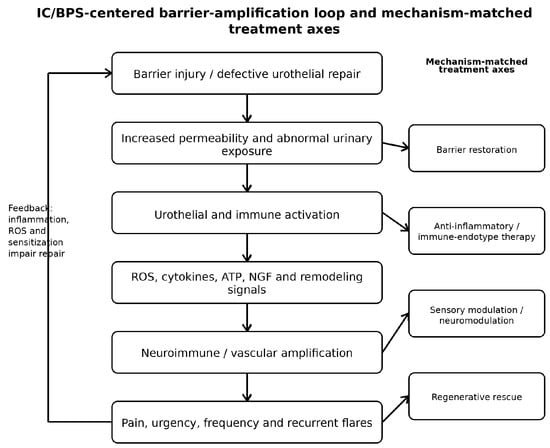
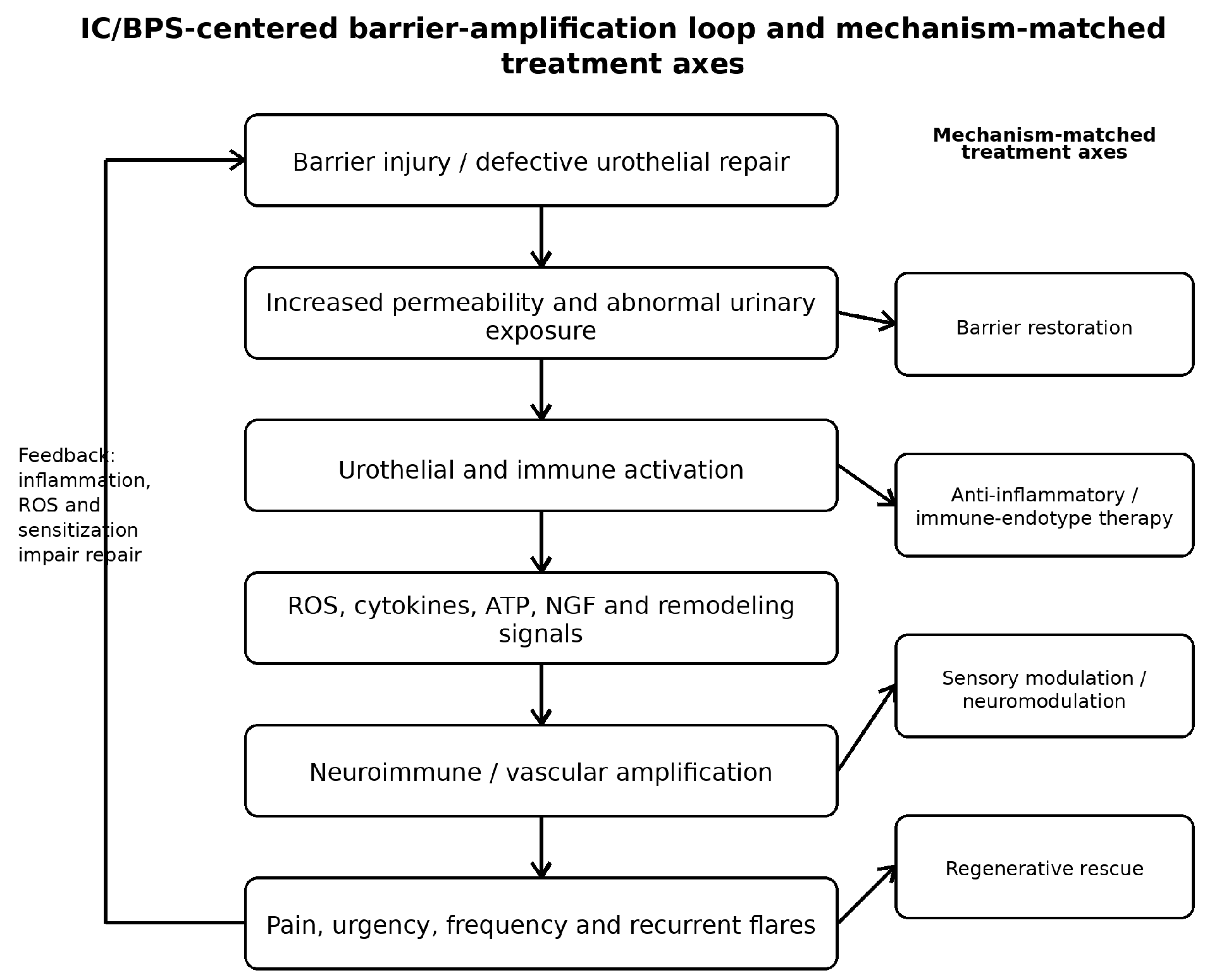
Once this loop is established, it may become partly self-sustaining. Abnormal afferent activity can persist. So can microvascular dysfunction or incomplete epithelial repair. These processes may keep the barrier vulnerable after the initiating trigger has faded. The model is compatible with recurrent flares, but it should not be treated as a universal causal sequence. Figure 1 summarizes the proposed amplification loop and the corresponding treatment axes.
Figure 1.
IC/BPS-centered barrier–amplification loop and mechanism-matched treatment axes. Barrier dysfunction can interact with immune activation, oxidative stress, neurogenic amplification, microvascular change, and defective repair. The relative importance and directionality of these components may differ among phenotypes; the figure does not imply that barrier injury initiates all IC/BPS.
3.3. Hunner Lesion Disease and Non-Hunner Phenotypes
Recent histopathological and genomic studies further separate Hunner lesion disease from non-Hunner IC/BPS. Hunner lesions are associated with urothelial denudation and chronic subepithelial inflammation; lymphoplasmacytic infiltration, vascular change, and fibrosis are also described [4,12]. Immunogenomic profiling has implicated clonally expanded B cells and signaling through B-cell activating factor (BAFF) and a proliferation-inducing ligand (APRIL) [4,12]. Non-Hunner disease often preserves the urothelial layers and shows subtler or more heterogeneous inflammatory changes [4]. These differences argue against merging bladder-centered inflammatory disease with systemic or myofascial pain phenotypes.
The 2025 global consensus phenotyping effort recommends, at minimum, separating bladder-centric from systemic presentations [3]. That distinction matters in a barrier-oriented model. Objective urothelial injury is more likely to be a primary treatment target in bladder-centric disease. In a systemic-pain phenotype, it may be only one part of a wider pain network.
3.4. Biomarkers, Microbiota, and the Limits of Single-Marker Diagnosis
Urinary and serum biomarker studies have identified signals related to inflammation, oxidative stress, neurotrophins, and extracellular-matrix remodeling [13,14,15]. Some differ between IC/BPS and controls; others vary across clinical phenotypes. Matched serum-urine analyses and machine-learning studies suggest that multianalyte panels may outperform individual markers for phenotype or response prediction [13,16,17]. Recent reviews have therefore shifted attention away from a single diagnostic molecule and toward biomarker clusters [14,15,17].
Microbiome studies add another source of heterogeneity [18]. Their results are sensitive to specimen collection and contamination control, and they are also influenced by antibiotic exposure, hormonal status, and phenotyping. The microbiota are therefore better viewed as a possible modifier than as evidence of chronic occult infection.
Mechanistic work is beginning to move beyond association. A recent multi-omics study of Hunner-type IC/BPS combined metagenomics, bile-acid metabolomics, and single-cell profiling. It identified an axis linking Enterococcus avium, taurochenodeoxycholic acid (TCDCA), and TLR3 to urothelial injury. Transfer and metabolite experiments reproduced barrier disruption, whereas TLR3 inhibition attenuated injury [19]. These findings do not show that microbiota transplantation is effective in IC/BPS. They do, however, provide a mechanistic route by which dysbiosis could influence the bladder through defined metabolites and urothelial signaling.
4. Cross-Organ Mechanistic Convergence: What Is Actually Transferable?
Cross-organ comparison is useful when it identifies a biological problem that can also be measured in the bladder. The comparator diseases in this review are not treated as equivalents of IC/BPS. Instead, they provide models for asking whether barrier failure, immune activation, neural sensitization, defective repair, or another relevant process is conserved enough to justify a bladder-specific hypothesis. A shared pathway, clinical association, or delivery problem is therefore a reason to test transfer, not evidence that the transfer will succeed.
4.1. Barrier Failure, Repair Failure, and Recurrence
Inflammatory bowel disease (IBD) is the strongest structural comparator because both the intestine and bladder face a complex luminal environment. In the intestine, epithelial differentiation and junctional regulation work together with mucus and antimicrobial defenses to maintain barrier function. When that barrier fails, antigen access increases and immune activation follows. Inflammation, in turn, impairs junctional regulation and epithelial repair [20,21].
The oral mucosa offers a different kind of comparison. It is a high-turnover barrier exposed to repeated mechanical and chemical stress. Therapy-associated oral mucositis is useful because injury can be followed from epithelial damage through inflammation and pain into repair [22,23,24]. IC/BPS is not oral mucositis, but this sequence provides a tractable model for studying how tissue injury and nociception interact.
Chronic wounds make repair failure experimentally visible. Many remain in a prolonged inflammatory state, with oxidative stress and impaired cellular migration limiting re-epithelialization. Randomized wound-healing studies provide direct evidence that autologous PRP can accelerate closure of selected chronic diabetic foot ulcers [25]. For a repair-deficient IC/BPS phenotype, the question is more specific: can platelet-derived repair signals be delivered to the bladder in a way that helps epithelial recovery without adding fibrosis, inflammation, or procedural injury?
Same-organ comparators help prevent overinterpretation of distant analogies. Radiation cystitis combines urothelial injury with inflammation, vascular damage, and fibrosis [26]. In IC/BPS itself, a randomized multicenter comparison of intravesical hyaluronic acid/chondroitin sulfate with dimethyl sulfoxide shows that locally acting bladder therapies can be tested head-to-head rather than treated as interchangeable instillations [27]. Recurrent UTI provides another example of localized intravesical therapy and its practical scheduling constraints [28]. The causes differ, but the urinary tract repeatedly exposes the same practical issues of surface protection, local exposure, and recurrence.
Epithelial inflammatory memory offers another hypothesis for recurrence. Recent oral-barrier research suggests that epithelial stem or progenitor cells may retain transcriptional or epigenetic effects of prior inflammation [29,30]. Comparable urothelial memory has not been demonstrated in IC/BPS. For now, it remains a testable possibility: previous inflammation may leave the urothelium primed or slow to repair even after symptoms improve.
4.2. Innate Inflammation, Oxidative Stress, and the Immune–Vascular Interface
Barrier disruption and inflammation reinforce one another. Urinary solutes can activate urothelial and resident immune pathways, while reactive oxygen species further destabilize junctions, mitochondria, and regenerative programs [9,10]. ATP and neurotrophin signaling provide additional links between epithelial damage and pain amplification.
Comparable feedback is well described in IBD and oral mucositis [20,21,22,23,24,31]. IBD has connected these processes to objective mucosal-healing targets [32,33,34], while oral mucositis provides repair-oriented models [35,36]. Vascular inflammatory disease contributes a different perspective through endothelial dysfunction and immune–endothelial injury [37,38,39,40,41,42]. For IC/BPS, these comparisons argue for separating visible lesion inflammation from diffuse inflammatory activity, redox injury, and later neural amplification rather than treating all of them as one category.
Vasculitis is mainly an endothelial disorder, so the analogy has limits. It is still informative at the level of selective-barrier biology and mechanism-based classification. Studies of complement activation, autoantibody-mediated injury, and genetically defined vascular inflammation show how tissue patterns can support mechanistic stratification [37,38,39,40,41]. Behcet disease adds a multisystem example in which recurrent mucosal lesions coexist with vascular inflammation [42,43].
For IC/BPS, the useful extension is to study the urothelium together with its immune, neural, and vascular environment. This may be especially relevant in Hunner lesion disease. Vascular permeability or complement-related signals could eventually help identify a strongly inflammatory bladder phenotype [4,12]. The transferable principle is endotyping, not direct repurposing of vasculitis drugs.
4.3. Adaptive Immune Endotypes
IBD has moved from broad immunosuppression toward pathway-directed therapy. Current targets include TNF, IL-23-related pathways, integrins, JAK signaling, and S1P signaling [31,44]. IC/BPS should not copy that list. The relevant lesson is that a targeted immune therapy becomes more credible when the matching biological endotype can be identified before treatment.
Hunner lesion disease currently provides the clearest rationale for immune endotyping. Histopathology and B-cell findings support a distinct inflammatory phenotype [4,12]. Cyclosporine A has shown greater apparent utility in inflammatory or Hunner phenotypes than in unselected IC/BPS, although toxicity and limited evidence constrain routine use [2,6]. Intravesical interferon-alpha2b also produced a clinical signal compared with hyaluronic acid in a randomized trial [45]. These observations support immune-pathway testing in selected patients, but they do not define a universally responsive population.
IBD, eosinophilic esophagitis, and chronic rhinosinusitis show what pathway-directed treatment looks like when biological classification is more mature [31,44,46,47]. In eosinophilic esophagitis, a phase 3 trial of dupilumab improved histologic remission as well as dysphagia outcomes [47]. The connection between a defined pathway and an objective tissue response is the important point.
IC/BPS would benefit from the same discipline. Anti-NGF, interferon, B-cell-related targets, or future cytokine-directed agents should be linked to a pre-specified biological signature rather than grouped as interchangeable advanced therapies. This also makes a negative trial more informative because failure of the target can be separated from failure of patient selection.
4.4. Neuroimmune Sensitization and Dissociation Between Symptoms and Tissue Change
IC/BPS pain can persist after a mucosal insult has partly resolved [6,9]. Urothelial signaling and pelvic-floor nociception may continue to drive peripheral afferents, while central amplification becomes increasingly independent of the original tissue injury. Neural dysfunction therefore forms a therapeutic axis that overlaps with urothelial inflammation but is not identical to it. Botulinum toxin A and neuromodulation primarily aim to reduce abnormal signaling. Tanezumab offers a more pathway-specific example, although broader efficacy, safety, and responder selection remain unresolved [2,6,48].
Prospective work in refractory interstitial cystitis has shown that sacral neuromodulation can improve pain and voiding outcomes [49]. That improvement does not prove epithelial repair. This distinction matters in trial design. A patient with neurogenic-pain-dominant disease may improve markedly despite little change in mucosal biomarkers. Conversely, a regenerative treatment may improve barrier biology without fully reversing established central sensitization. These should be recognized as different forms of response rather than forced into one composite outcome.
4.5. Shared Architecture, Not Shared Etiology
Across chronic barrier diseases, the recurring similarity is architectural rather than cytokine-specific. Barrier failure can increase abnormal exposure [7,8,20,21]. Innate inflammation and oxidative stress may then amplify injury [9,20,21], while adaptive immunity can sustain disease in susceptible phenotypes [12]. Incomplete regeneration may leave tissue vulnerable to recurrence [29,30,50].
Other processes modify that core architecture. Broader epithelial-barrier literature describes similar cross-organ patterns [51,52,53,54,55]. Neural sensitization can maintain symptoms even when visible tissue injury improves [49]. Microvascular inflammation may sustain selected phenotypes [37,38,39,40], and dysbiosis can alter local or systemic exposure. These factors are better viewed as possible amplifiers than as universal initiating events.
Applied to IC/BPS, this logic favors mechanism-based sequencing. The dominant phenotype should be defined first. Tissue or barrier activity can then be assessed when it is likely to change interpretation. Noninvasive biomarkers may support that assessment, but they should not stand alone. Treatment selection and follow-up should return to the same biological hypothesis. Comparator diseases help organize this process without proving that their organ-specific therapies will work in IC/BPS. The shared mechanistic axes are summarized in Table 1.
Table 1.
Shared mechanistic axes across barrier diseases and their relevance to IC/BPS.
6. Why Rational Therapies Produce Inconsistent Results: Testing Endotype Mismatch
6.1. The Current Gap Between Diagnosis and Biology
IC/BPS diagnosis remains clinical and exclusionary. Treatment response is also judged largely through symptoms and voiding outcomes. Those measures matter because they capture the lived disease, but they do not show whether urothelial injury has resolved or whether the intended biological pathway has changed. Similar symptom scores can therefore arise from different disease states.
Therapeutic selection remains largely empirical. Guidelines and broad syntheses do not identify one intervention that improves every outcome in every patient [2,5,6]. DMSO and PRP studies illustrate how uneven protocols and comparators complicate interpretation [62,66,67]. Endotype mismatch is a plausible explanation for some inconsistent results, but inadequate exposure, small samples, measurement error, and genuine lack of efficacy must also be considered. No current biomarker panel has prospectively validated these proposed categories for choosing IC/BPS treatment.
There is also no validated objective recovery target for IC/BPS. Cystoscopy remains essential for identifying Hunner lesions and for selected diagnostic questions, but the field lacks a standardized measure that links symptoms to tissue activity and barrier recovery. IBD has mucosal-healing targets; IC/BPS has no accepted equivalent. This gap motivates the translational framework proposed here.
6.2. From Phenotype to Endotype
A barrier-oriented research strategy should refine the clinical diagnosis rather than replace it. Current consensus supports separating Hunner lesion disease and distinguishing bladder-centric from systemic presentations [1,2,3]. Biomarker work suggests that composite signatures may add information beyond single analytes [14,15,16,17]. A future work-up could therefore combine clinical phenotype with a limited set of examination and biomarker measures chosen for a specific treatment question.
For research purposes, six overlapping candidate patterns may help organize trials. A barrier-dominant hypothesis concerns currently demonstrable surface or permeability dysfunction, with symptom timing linked to bladder filling; a repair-deficient hypothesis would require evidence of delayed restitution or persistent epithelial injury on serial assessment after active inflammation has diminished. Neither has an accepted assay or threshold. Hunner lesions provide an observable inflammatory feature, but proposed cytokine and BAFF/APRIL cutoffs are unvalidated. Pelvic-floor tenderness is an examination finding and does not demonstrate afferent sensitization or a central neural mechanism. Neural sensitization remains a separate hypothesis requiring direct evidence. Widespread pain and comorbid symptoms describe clinical distribution rather than a proven molecular endotype. These patterns can overlap and should not be treated as diagnostic labels.
Chronic rhinosinusitis shows how a field can move beyond descriptive phenotypes. Histology and biomarker-based approaches are increasingly used to define inflammatory endotypes, with the longer-term aim of improving selection for targeted biologics [46]. IC/BPS need not copy those immune labels. A useful bladder endotype should be reproducible, clinically measurable, linked to disease biology, and capable of changing a treatment decision or interpretation. Depending on the question, Hunner status could be combined with a urinary panel or a tissue feature rather than with an exhaustive battery of tests.
The corresponding study hypotheses differ by putative mechanism: surface protection in patients with a reproducible barrier measure, repair interventions where serial injury and restitution can be documented, lesion-directed approaches in verified Hunner disease, and pain-focused care when pelvic-floor or widespread symptoms predominate [2,6,66,67]. These are candidates for stratified trials, not rules for selecting or withholding an intervention in current practice. Table 3 makes the proposed measurements and gaps explicit.
Table 3.
Candidate IC/BPS patterns and trial hypotheses. These categories and indicators are unvalidated for treatment selection.
6.3. Mechanism-Matched Sequencing Instead of an Empiric Treatment Ladder
These mechanisms suggest several testable treatment sequences rather than a universal ladder. A trial might stratify by Hunner status and prespecified bladder or pain features before evaluating whether a mechanism-matched intervention improves outcomes. Combinations need a clear rationale and a comparator able to isolate any added benefit. Current evidence does not justify assigning every patient a dominant molecular axis or using the proposed sequence as a clinical algorithm.
A 122-patient observational analysis reported within-group symptom changes after PRP and BoNT-A and different urinary-marker trajectories after four therapies [81]. The fact that some within-group tests reached significance while others did not does not establish that PRP or BoNT-A outperformed hyaluronic acid or LESW. That requires a prespecified between-group contrast with appropriate adjustment for baseline differences. A retrospective multimodal-therapy study is likewise susceptible to selection and confounding [82]. Such findings can generate candidate stratification variables, but prospective controlled comparisons are needed before inferring comparative efficacy or a successful endotype match.
7. Urothelial Healing as a Multidimensional Treatment Target
The most transferable lesson from IBD is a treatment architecture rather than a specific drug. Treat-to-target programs separate symptom improvement from objective disease control. STRIDE-II formalized this by linking early clinical response to later reassessment of biological activity and healing [61]. Prospective IBD studies likewise show that deeper endoscopic or histologic healing can carry prognostic information [58,59].
IC/BPS has no validated counterpart. A reasonable adaptation is to measure symptoms and urothelial recovery as related but distinct outcomes. That approach is most relevant to bladder-centered disease with active barrier injury, inflammation, or impaired repair. It should not be imposed on predominantly neurogenic or systemic-pain phenotypes.
We use “urothelial healing” as a research construct, not a validated IC/BPS endpoint. Clinical response denotes meaningful change in symptoms and quality of life; it does not imply tissue restoration. An endoscopic response describes visible mucosal change, most clearly when a Hunner lesion is reassessed with consistent methods. Neither measure alone demonstrates restored urothelial function.
Molecular target engagement asks whether a prespecified pathway changed in the expected direction. A functional barrier response requires evidence of improved urothelial integrity or permeability. “Healing” should be reserved for a validated tissue-recovery measure. Disease modification is a stronger claim and would additionally require durable clinical outcomes together with credible evidence that the disease process has been altered. No IC/BPS assay or threshold currently satisfies all these conditions.
The methodological value of this construct is simple: symptomatic relief and biological repair are not the same event. Pain can improve while barrier abnormalities persist. Epithelial repair can occur while a systemic pain phenotype remains active. Inflammation may also fall without correcting a regenerative defect. Multidomain assessment makes those discordant responses visible.
Validation should start with prognosis. A candidate urothelial-healing measure must be reproducible and responsive to treatment. More importantly, it should add information that matters clinically, such as prediction of durable remission or fewer flares. A measure that does not improve decisions beyond standard symptom assessment is unlikely to justify routine use. Candidate domains and measures are summarized in Table 4.
Table 4.
Proposed research domains for urothelial healing.
8. A Proposed Treat-to-Target Framework for IC/BPS
8.1. Define the Dominant Biology and a Pre-Specified Target
Treat-to-target is a borrowed research architecture rather than current IC/BPS standard care. STRIDE-II in IBD links symptom response with repeated objective assessment of bowel activity [61]. In IC/BPS, a trial could prespecify a clinical outcome and, where appropriate, a separately analyzed lesion or barrier endpoint. The direction, time point, reproducibility, and prognostic value of any proposed tissue endpoint need validation before it can serve as a target. Improvement in an IBD endpoint does not validate a urothelial-healing endpoint.
Prospective trials should stratify patients before randomization. Hunner status and the distinction between bladder-centric and systemic presentations should be recorded at minimum [3]. Additional measures can be added when they are relevant to the mechanism under study. The aim is not to create a maximal testing panel. It is to distinguish a biologically ineffective treatment from a potentially useful treatment tested in the wrong population.
8.2. Reassess Symptoms and Biological Activity Separately
Objective barrier assays need technical and clinical validation. Exfoliated urothelial cells, organoids, urinary proteins, and permeability surrogates could be tested for reproducibility, change over time, and added prognostic value [14,15]. Proposed panels lack accepted thresholds and cannot currently determine whether a patient should continue, switch, or stop treatment. In Hunner disease, repeat cystoscopy can document lesion status when clinically indicated or prospectively justified, but lesion change still should not be equated automatically with regenerated epithelium [4,12].
8.3. Treat Recurrence as a Mechanistic Outcome
Recurrence is a clinically meaningful outcome, but fewer flares alone cannot show tissue repair or disease modification. The inflammatory-memory literature suggests a straightforward experimental design [30]. Urothelial cells could be sampled during active disease and again after the response. A third sample at relapse would then allow investigators to ask whether prior inflammation left a stable transcriptional or epigenetic imprint. This is an untested bladder hypothesis; sampling burden and prognostic value must be justified before it becomes a trial target.
8.4. Treat Local Exposure as a Modifier, Not the Disease Model
For intravesical therapy, delivery performance matters when it can confound biological interpretation. A drug may fail because urinary dilution prevents adequate exposure, not because the target is irrelevant. The reverse is also true: prolonged residence time does not establish efficacy. Exposure and procedural burden are therefore useful secondary variables, while mechanism-specific target engagement should remain central [83,84,85]. Table 5 summarizes the proposed sequence.
Table 5.
Prospective questions for testing a treat-to-target model in IC/BPS. These are hypotheses for prospective evaluation, not validated clinical continuation or switching rules.
9. Research Priorities and Limits of Cross-Organ Extrapolation
9.1. Priority Research Directions
Several research priorities follow from this framework. IC/BPS endotypes need to become reproducible and treatment-predictive rather than merely descriptive. A biomarker panel or tissue assay is useful only if it changes selection, prognosis, or interpretation. Trials of regenerative, immune, neural, and microbiome therapies should also enrich for the biological state that the intervention is designed to modify.
Early uncontrolled work can establish feasibility and generate hypotheses. Adequately controlled trials can establish symptomatic efficacy without proving a biological mechanism. Target engagement requires reliable, prespecified biological measures; urothelial regeneration requires direct and validated structural or functional evidence. A disease-modification claim would additionally need durable, clinically meaningful benefit supported by coherent tissue-level evidence. Safety monitoring must match the intervention, including retinal surveillance with long-term PPS and infectious-disease safeguards for living microbial products [57,80].
9.2. Limits of Extrapolation
Cross-organ comparison is useful only when biological differences remain explicit. The intestinal mucosa cannot be mapped directly onto the bladder because its microbial ecosystem and mucus architecture are different. Oral mucositis and chronic wounds are primarily injury-repair models, not idiopathic chronic pain disorders. Delivery platforms developed for the eye, esophagus, or vagina also face physiological constraints that differ from urine-exposed urothelium.
Other analogies have different limitations. Chronic rhinosinusitis has clinically actionable inflammatory endotypes that IC/BPS does not yet possess. Radiation cystitis and recurrent UTI share the organ but not the initiating cause. Vasculitis centers on endothelium rather than epithelium. The comparisons made here therefore concern mechanisms and study design, not common etiology or direct drug interchangeability.
The comparator diseases do not contribute equally. IBD offers the closest structural analogy for the relation among barrier injury, inflammation, and tissue healing. Eosinophilic esophagitis and chronic rhinosinusitis are more useful for thinking about endotype-guided treatment. Oral mucositis and chronic wounds mainly inform injury and repair. Same-organ conditions such as radiation cystitis or recurrent UTI are valuable for testing whether a proposed principle still makes sense in the urinary environment.
What transfers most reliably is a way to frame falsifiable studies. Objective biological measures can complement symptoms when they are reliable and linked to a prespecified mechanism. Neither a failed migration such as BCG nor an early positive signal can be attributed automatically to endotype selection without prospective evidence [75]. Reassessment may improve treatment decisions, but the proposed rules must first be compared with usual care.
10. Conclusions
Urothelial barrier dysfunction remains useful for a substantial subset of IC/BPS, but it is more informative as part of a network than as a single-cause theory. Barrier failure can interact with inflammation, altered sensory signaling, microvascular change, and defective regeneration. The balance among these processes is likely to differ across phenotypes.
Comparator diseases clarify different parts of that network. IBD shows how tissue healing can be linked to objective monitoring, while other fields contribute models of endotyping, repair, or neural modulation. Their main contribution is methodological. They help define better questions for IC/BPS rather than supplying a ready-made treatment list.
Therapeutic migration offers a way to choose and test bladder-relevant hypotheses. Its proposed filter, candidate endotypes, and urothelial-healing domains remain investigational. Controlled trials can demonstrate clinical response or symptomatic efficacy even if the biological mechanism is unresolved. A marker change may support target engagement but does not establish regeneration; fewer flares may indicate durable benefit but do not independently prove disease modification. Structural recovery requires a reliable, prespecified tissue measure, and any disease-modification claim needs durable clinical outcomes alongside credible biological evidence. Safety and negative trials, including intravesical BCG, should inform which migrations proceed. Until these measures and selection strategies are validated, clinical decisions should continue to rely on established evidence and patient-centered assessment [2,75].
Author Contributions
Conceptualization, J.W. and W.C.; investigation, J.W., N.Z. and S.Y.; data curation, J.W., N.Z. and S.Y.; writing (original draft preparation), J.W.; writing (review and editing), N.Z., S.Y. and W.C.; visualization, J.W.; supervision, W.C.; project administration, W.C. All authors have read and agreed to the published version of the manuscript.
Funding
This research received no external funding.
Institutional Review Board Statement
Not applicable.
Informed Consent Statement
Not applicable.
Data Availability Statement
No new data were created or analyzed in this study. Data sharing is not applicable to this article.
Acknowledgments
During the preparation of this manuscript, the authors used ChatGPT (OpenAI; GPT-5.6 and GPT-6.0) for language refinement and editorial assistance. The authors reviewed and edited all output and take full responsibility for the content of this publication.
Conflicts of Interest
The authors declare no conflicts of interest.
References
- Homma, Y.; Akiyama, Y.; Kim, J.H.; Chuang, Y.C.; Jeong, S.J.; Meng, E.; Kitta, T.; Jhang, J.F.; Furuta, A.; Lee, K.S.; et al. Definition change and update of clinical guidelines for interstitial cystitis and bladder pain syndrome. Low. Urin. Tract. Symptoms 2024, 16, e12532. [Google Scholar] [CrossRef] [Scilit] [PubMed]
- Doiron, R.C.; Tadayon, B.; Violette, P.D.; Locke, J.; Andrews, M.; Nadeau, G.; Gray, G.; Cox, A. 2025 Canadian Urological Association guideline: Selected treatment recommendations for interstitial cystitis/bladder pain syndrome. Can. Urol. Assoc. J. 2025, 19, 90–103. [Google Scholar] [CrossRef] [Scilit] [PubMed]
- Wolff, D.T.; Tranchina, S.; Schrepf, A.; Doiron, R.C.; Chai, T.C.; Walker, S.J. Interstitial cystitis/bladder pain syndrome patient phenotyping. Neurourol. Urodyn. 2026, 45, 19–25. [Google Scholar] [CrossRef] [Scilit] [PubMed]
- Ruetten, H.; Crawford, L.K.; De, E.J.B.; Li, W.; Akiyama, Y. Genomics and histopathology in interstitial cystitis/bladder pain syndrome. Neurourol. Urodyn. 2026, 45, 54–59. [Google Scholar] [CrossRef] [Scilit] [PubMed]
- Park, J.J.; Kim, K.T.; Lee, E.J.; Chun, J.; Lee, S.; Shim, S.R.; Kim, J.H. Current updates relating to treatment for interstitial cystitis/bladder pain syndrome: Systematic review and network meta-analysis. BMC Urol. 2024, 24, 95. [Google Scholar] [CrossRef] [Scilit] [PubMed]
- Jhang, J.F.; Yu, W.R.; Jiang, Y.H.; Kuo, H.C. Pathophysiology and potential multimodal therapeutic strategies for IC/BPS. Nat. Rev. Urol. 2025, 22, 672–686. [Google Scholar] [CrossRef] [Scilit] [PubMed]
- van Ginkel, C.; Hurst, R.E.; Janssen, D. The urothelial barrier in interstitial cystitis/bladder pain syndrome: Its form and function, an overview of preclinical models. Curr. Opin. Urol. 2024, 34, 77–83. [Google Scholar] [CrossRef] [Scilit] [PubMed]
- Jafari, N.V.; Rohn, J.L. The urothelium: A multi-faceted barrier against a harsh environment. Mucosal. Immunol. 2022, 15, 1127–1142. [Google Scholar] [CrossRef] [Scilit] [PubMed]
- Mohammad, A.; Laboulaye, M.A.; Shenhar, C.; Dobberfuhl, A.D. Mechanisms of oxidative stress in interstitial cystitis/bladder pain syndrome. Nat. Rev. Urol. 2024, 21, 433–449. [Google Scholar] [CrossRef] [Scilit] [PubMed]
- Yu, W.R.; Jhang, J.F.; Jiang, Y.H.; Kuo, H.C. The Pathomechanism and Current Treatments for Chronic Interstitial Cystitis and Bladder Pain Syndrome. Biomedicines 2024, 12, 2051. [Google Scholar] [CrossRef] [Scilit] [PubMed]
- Yang, X.; Pan, Y.; Tian, W.; Li, R.; Wang, Y.; Wang, M.; Yin, Z.; Zhang, Y. Biomaterials and Nanomedicine for Mucosal Repair and Inflammation Control in Interstitial Cystitis/Bladder Pain Syndrome: An Extensive Review. Int. J. Nanomed. 2026, 21, 617670. [Google Scholar] [CrossRef] [Scilit] [PubMed]
- Horie, M.; Akiyama, Y.; Katoh, H.; Taguchi, S.; Nakamura, M.; Mizuguchi, K.; Ito, Y.; Matsushita, T.; Ushiku, T.; Ishikawa, S.; et al. APRIL/BAFF upregulation is associated with clonal B-cell expansion in Hunner-type interstitial cystitis. J. Pathol. 2024, 264, 383–395. [Google Scholar] [CrossRef] [Scilit] [PubMed]
- Kuret, T.; Sterle, I.; Romih, R.; Veranic, P. Matched serum- and urine-derived biomarkers of interstitial cystitis/bladder pain syndrome. PLoS ONE 2024, 19, e0309815. [Google Scholar] [CrossRef] [Scilit] [PubMed]
- Chen, Y.C.; Tyagi, P.; Alperin, M.; Stern, J.N.H.; Ackerman, A.L.; Kuo, H.C. The role of biomarkers in the diagnosis and treatment of interstitial cystitis/bladder pain syndrome: What does current evidence reveal? Neurourol. Urodyn. 2026, 45, 60–70. [Google Scholar] [CrossRef] [Scilit] [PubMed]
- Xin, K.; Wu, S.; Li, R.; Tan, C.; Jiang, Y.; Yu, J.; Liu, X.; Li, S.; Li, Z.; Chen, X. Exploring promising biomarkers based on pathogenic mechanisms in interstitial cystitis/bladder pain syndrome. Nat. Rev. Urol. 2026, 23, 217–235. [Google Scholar] [CrossRef] [Scilit] [PubMed]
- Jhang, J.F.; Yu, W.R.; Huang, W.T.; Kuo, H.C. Combination of urinary biomarkers and machine-learning models provided a higher predictive accuracy to predict long-term treatment outcomes of patients with interstitial cystitis/bladder pain syndrome. World J. Urol. 2024, 42, 173. [Google Scholar] [CrossRef] [Scilit] [PubMed]
- Chen, Y.C.; Kuo, H.C. Integrating biomarker clustering for improved diagnosis of interstitial cystitis/bladder pain syndrome: A review. Int. Urol. Nephrol. 2025, 57, 2725–2734. [Google Scholar] [CrossRef] [Scilit] [PubMed]
- Fu, C.; Zhang, Y.; Liang, L.; Lin, H.; Shan, K.; Liu, F.; Feng, N. The microbiota in patients with interstitial cystitis/bladder pain syndrome: A systematic review. BJU Int. 2024, 134, 869–880. [Google Scholar] [CrossRef] [Scilit] [PubMed]
- Peng, L.; Chen, J.W.; Chen, Y.Z.; Di, X.P.; Lin, L.D.; Li, B.Y.; Zhang, C.; Wang, W.; Gao, X.S.; Ma, Y.C.; et al. Multi-omics analysis identifies a microbiota-bile acid-TLR signaling axis driving bladder injury in interstitial cystitis. Nat. Commun. 2026, 17, 1299. [Google Scholar] [CrossRef] [Scilit] [PubMed]
- Okumura, R.; Takeda, K. The role of the mucosal barrier system in maintaining gut symbiosis to prevent intestinal inflammation. Semin. Immunopathol. 2025, 47, 2. [Google Scholar] [CrossRef] [Scilit] [PubMed]
- Saha, K.; Zhou, Y.; Turner, J.R. Tight junction regulation, intestinal permeability, and mucosal immunity in gastrointestinal health and disease. Curr. Opin. Gastroenterol. 2025, 41, 46–53. [Google Scholar] [CrossRef] [Scilit] [PubMed]
- Ono, K.; Ueno, T.; Kido, M.A.; Hitomi, S.; Naniwa, M.; Nakatomi, C.; Yoshimoto, R.U.; Sawada, T.; Kato, T. Recent advances in the treatment of oral ulcerative mucositis from clinical and basic perspectives. J. Oral Biosci. 2024, 66, 504–510. [Google Scholar] [CrossRef] [Scilit] [PubMed]
- Abdalla-Aslan, R.; Keegan, R.; Zadik, Y.; Yarom, N.; Elad, S. Recent advances in cancer therapy-associated oral mucositis. Oral Dis. 2025, 31, 2695–2710. [Google Scholar] [CrossRef] [Scilit] [PubMed]
- Choudhury, M.; Brunton, P.; Dias, G.; Schwass, D.; Meledandri, C.; Ratnayake, J.; Pletzer, D.; Tompkins, G. Gold nanoparticles as innovative therapeutics for oral mucositis: A review of current evidence. Drug Deliv. Transl. Res. 2025, 15, 2323–2353. [Google Scholar] [CrossRef] [Scilit] [PubMed]
- Elsaid, A.; El-Said, M.; Emile, S.; Youssef, M.; Khafagy, W.; Elshobaky, A. Randomized Controlled Trial on Autologous Platelet-Rich Plasma Versus Saline Dressing in Treatment of Non-healing Diabetic Foot Ulcers. World J. Surg. 2020, 44, 1294–1301. [Google Scholar] [CrossRef] [Scilit] [PubMed]
- Neckonoff, E.; Anderson, C.B. Advancements in understanding and managing radiation cystitis: A comprehensive review. Curr. Urol. Rep. 2024, 26, 1. [Google Scholar] [CrossRef] [Scilit] [PubMed]
- Cervigni, M.; Sommariva, M.; Tenaglia, R.; Porru, D.; Ostardo, E.; Giammò, A.; Trevisan, S.; Frangione, V.; Ciani, O.; Tarricone, R.; et al. A randomized, open-label, multicenter study of the efficacy and safety of intravesical hyaluronic acid and chondroitin sulfate versus dimethyl sulfoxide in women with bladder pain syndrome/interstitial cystitis. Neurourol. Urodyn. 2017, 36, 1178–1186. [Google Scholar] [CrossRef] [Scilit] [PubMed]
- Patel, D. Intravesical therapies for recurrent urinary tract infections: A systematic review. Cureus 2024, 16, e72175. [Google Scholar] [CrossRef] [Scilit] [PubMed]
- Xin, Y.; Lei, H. The oral mucosal barrier: A dynamic gateway in oral and systemic health. Tissue Barriers 2026, 14, 2610035. [Google Scholar] [CrossRef] [Scilit] [PubMed]
- Wang, Q.; Li, X.; Xue, F.; Zhao, P.; Mu, Y. Oral epithelial barrier: Gatekeeper of mucosal immunity and driver of disease. Microbiol. Res. 2026, 310, 128568. [Google Scholar] [CrossRef] [Scilit] [PubMed]
- Mansouri, P.; Mansouri, P.; Behmard, E.; Najafipour, S.; Kouhpayeh, A.; Farjadfar, A. Novel targets for mucosal healing in inflammatory bowel disease therapy. Int. Immunopharmacol. 2025, 144, 113544. [Google Scholar] [CrossRef] [Scilit] [PubMed]
- Sands, B.E.; Danese, S.; Chapman, J.C.; Gurjar, K.; Grieve, S.; Thakur, D.; Griffith, J.; Joshi, N.; Kligys, K.; Dignass, A. Mucosal and transmural healing and long-term outcomes in Crohn’s disease. Inflamm. Bowel Dis. 2025, 31, 857–877. [Google Scholar] [CrossRef] [Scilit] [PubMed]
- Buda, A.; Pessarelli, T.; Aldinio, G.; De Bona, M.; Iacucci, M.; Tontini, G.E. Endoscopic healing in IBD: Still the target to achieve? Dig. Liver Dis. 2025, 57, 969–976. [Google Scholar] [CrossRef] [Scilit] [PubMed]
- Uchiyama, K.; Takagi, T.; Murakami, E.; Naito, Y. Mucosal healing of ulcerative colitis based on endoscopic diagnosis, histopathology, and mucosal inflammatory mediators. Inflamm. Intest. Dis. 2025, 10, 233–245. [Google Scholar] [CrossRef] [Scilit] [PubMed]
- Lv, K.; Gao, B.; Ye, W.; Shen, C.; Chen, T.; Wang, C.; Yao, H. Promotion of epithelial healing in oral mucositis by hESC-derived mesenchymal stem cells via the PI3K/AKT pathway. Curr. Stem Cell Res. Ther. 2025, 20, 810–823. [Google Scholar] [CrossRef] [Scilit] [PubMed]
- Joseph, B.; Mauramo, M.; Sorsa, T.; Anil, S.; Waltimo, T. LED-based low-level light therapy for oral mucositis in cancer patients: A systematic review and GRADE analysis. Oral Surg. Oral Med. Oral Pathol. Oral Radiol. 2025, 140, 300–311. [Google Scholar] [CrossRef] [Scilit] [PubMed]
- Dolgyras, P.; Anyfanti, P.; Lazaridis, A.; Gavriilaki, E.; Koletsos, N.; Triantafyllou, A.; Nikolaidou, B.; Mastrogiannis, K.; Yiannaki, E.; Papakonstantinou, A.; et al. Endothelial dysfunction and complement activation are independently associated with disease duration in patients with systemic vasculitis. Microvasc. Res. 2024, 154, 104692. [Google Scholar] [CrossRef] [Scilit] [PubMed]
- Kumrah, R.; Goyal, T.; Rawat, A.; Singh, S. Markers of endothelial dysfunction in Kawasaki disease: An update. Clin. Rev. Allergy Immunol. 2024, 66, 99–111. [Google Scholar] [CrossRef] [Scilit] [PubMed]
- Paolini, L.; Guida, F.; Calvaruso, A.; Andreozzi, L.; Pierantoni, L.; Lanari, M.; Fabi, M. Endothelial dysfunction: Molecular mechanisms and therapeutic strategies in Kawasaki disease. Int. J. Mol. Sci. 2024, 25, 13322. [Google Scholar] [CrossRef] [Scilit] [PubMed]
- Zhang, T.; Li, L.; Huang, S.; Starodubtseva, M.N.; Liu, J. Anti-endothelial cell antibodies in pathogenesis of vasculitis. Front. Immunol. 2025, 16, 1567293. [Google Scholar] [CrossRef] [Scilit] [PubMed]
- Gul, A.; Aksentijevich, I.; Brogan, P.; Gattorno, M.; Grayson, P.C.; Ozen, S. The pathogenesis, clinical presentations and treatment of monogenic systemic vasculitis. Nat. Rev. Rheumatol. 2025, 21, 414–425. [Google Scholar] [CrossRef] [Scilit] [PubMed]
- Bello, F.; Fagni, F.; Bagni, G.; Hill, C.L.; Mohammad, A.J.; Moiseev, S.; Olivotto, I.; Seyahi, E.; Emmi, G. Arterial and venous thrombosis in systemic and monogenic vasculitis. Nat. Rev. Rheumatol. 2025, 21, 355–369. [Google Scholar] [CrossRef] [Scilit] [PubMed]
- Lavalle, S.; Caruso, S.; Foti, R.; Gagliano, C.; Cocuzza, S.; La Via, L.; Parisi, F.M.; Calvo-Henriquez, C.; Maniaci, A. Behcet’s disease, pathogenesis, clinical features, and treatment approaches: A comprehensive review. Medicina 2024, 60, 562. [Google Scholar] [CrossRef] [Scilit] [PubMed]
- Centanni, L.; Bencardino, S.; D’Amico, F.; Zilli, A.; Parigi, T.L.; Allocca, M.; Danese, S.; Furfaro, F. Targeting mucosal healing in Crohn’s disease: Efficacy of novel pathways and therapeutic targets. Expert. Opin. Ther. Targets 2024, 28, 963–978. [Google Scholar] [CrossRef] [Scilit] [PubMed]
- Shen, S.H.; Peng, L.; Zeng, X.; Zhang, J.; Shen, H.; Luo, D.Y. Intravesical Interferon Therapy vs Hyaluronic Acid for Pain Among Female Individuals with Interstitial Cystitis: A Randomized Clinical Trial. JAMA Netw. Open. 2024, 7, e244880. [Google Scholar] [CrossRef] [Scilit] [PubMed]
- Toppila-Salmi, S.; Reitsma, S.; Hox, V.; Gane, S.; Eguiluz-Gracia, I.; Shamji, M.; Maza-Solano, J.; Jääskeläinen, B.; Väärä, R.; Escribese, M.M.; et al. Endotyping in chronic rhinosinusitis—An EAACI Task Force report. Allergy 2025, 80, 132–147. [Google Scholar] [CrossRef] [Scilit] [PubMed]
- Dellon, E.S.; Rothenberg, M.E.; Collins, M.H.; Hirano, I.; Chehade, M.; Bredenoord, A.J.; Lucendo, A.J.; Spergel, J.M.; Aceves, S.; Sun, X.; et al. Dupilumab in Adults and Adolescents with Eosinophilic Esophagitis. N. Engl. J. Med. 2022, 387, 2317–2330. [Google Scholar] [CrossRef] [Scilit] [PubMed]
- Evans, R.J.; Moldwin, R.M.; Cossons, N.; Darekar, A.; Mills, I.W.; Scholfield, D. Proof of concept trial of tanezumab for the treatment of symptoms associated with interstitial cystitis. J. Urol. 2011, 185, 1716–1721. [Google Scholar] [CrossRef] [Scilit] [PubMed]
- Comiter, C.V. Sacral neuromodulation for the symptomatic treatment of refractory interstitial cystitis: A prospective study. J. Urol. 2003, 169, 1369–1373. [Google Scholar] [CrossRef] [Scilit] [PubMed]
- Wang, Z.; Guo, Y.; Fan, Y.; Li, X.; Shen, W. Remodeling mechanisms and intervention strategies of the oral mucosal immune barrier. Front. Immunol. 2026, 17, 1815513. [Google Scholar] [CrossRef] [Scilit] [PubMed]
- Sun, N.; Ogulur, I.; Mitamura, Y.; Yazici, D.; Pat, Y.; Bu, X.; Li, M.; Zhu, X.; Babayev, H.; Ardicli, S.; et al. The epithelial barrier theory and its associated diseases. Allergy 2024, 79, 3192–3237. [Google Scholar] [CrossRef] [Scilit] [PubMed]
- Pat, Y.; Yazici, D.; D’Avino, P.; Li, M.; Ardicli, S.; Ardicli, O.; Mitamura, Y.; Akdis, M.; Dhir, R.; Nadeau, K.; et al. Recent advances in the epithelial barrier theory. Int. Immunol. 2024, 36, 211–222. [Google Scholar] [CrossRef] [Scilit] [PubMed]
- Meng, J.; Xiao, H.; Xu, F.; She, X.; Liu, C.; Canonica, G.W. Systemic barrier dysfunction in type 2 inflammation diseases: Perspective in the skin, airways, and gastrointestinal tract. Immunol. Res. 2025, 73, 60. [Google Scholar] [CrossRef] [Scilit] [PubMed]
- Berni Canani, R.; Caminati, M.; Carucci, L.; Eguiluz-Gracia, I. Skin, gut, and lung barrier: Physiological interface and target of intervention for preventing and treating allergic diseases. Allergy 2024, 79, 1485–1500. [Google Scholar] [CrossRef] [Scilit] [PubMed]
- Schreiber, F.; Balas, I.; Robinson, M.J.; Bakdash, G. Border Control: The Role of the Microbiome in Regulating Epithelial Barrier Function. Cells 2024, 13, 477. [Google Scholar] [CrossRef] [Scilit] [PubMed]
- Buford, K.; Peters, K.M.; Riedl, C.; Mishra, N.N.; Wyndaele, J.J.; Lovász, S.; Pinto, R.A.; Birder, L. Global Consensus on Interstitial Cystitis/Bladder Pain Syndrome: An Update on Therapeutic Treatments. Neurourol. Urodyn. 2026, 45, 46–53. [Google Scholar] [CrossRef] [Scilit] [PubMed]
- Janssen Pharmaceuticals; Inc. ELMIRON (Pentosan Polysulfate Sodium) Capsules: Prescribing Information. DailyMed. Available online: https://dailymed.nlm.nih.gov/dailymed/drugInfo.cfm?setid=f0ba651e-3d8a-11df-8fbe-119855d89593 (accessed on 29 September 2026).
- Yzet, C.; Robert, C.; Brazier, F.; Meudjo, E.; Moreau, C.; Chatelain, D.; Fumery, M. Impact of histological healing on ulcerative colitis disease course among patients with endoscopic healing: Results of a prospective study. Clin. Res. Hepatol. Gastroenterol. 2025, 49, 102700. [Google Scholar] [CrossRef] [Scilit] [PubMed]
- Yzet, C.; Brazier, F.; Derval, E.; Vanelslander, P.; Dejour, V.; Pricope, D.; Diouf, M.; Fumery, M. Impact of complete vs partial endoscopic healing on long-term outcomes in Crohn’s disease: A prospective multicenter study. J. Crohn’s Colitis 2025, 19, jjaf104. [Google Scholar] [CrossRef] [Scilit] [PubMed]
- Srinivasan, A.R. Treat to target in Crohn’s disease: A practical guide for clinicians. World J. Gastroenterol. 2024, 30, 50–69. [Google Scholar] [CrossRef] [Scilit] [PubMed]
- Turner, D.; Ricciuto, A.; Lewis, A.; D’Amico, F.; Dhaliwal, J.; Griffiths, A.M.; Bettenworth, D.; Sandborn, W.J.; Sands, B.E.; Reinisch, W.; et al. STRIDE-II: An Update on the Selecting Therapeutic Targets in Inflammatory Bowel Disease (STRIDE) Initiative of the International Organization for the Study of IBD (IOIBD): Determining Therapeutic Goals for Treat-to-Target Strategies in IBD. Gastroenterology 2021, 160, 1570–1583. [Google Scholar] [CrossRef] [Scilit] [PubMed]
- Li, H.R.; Shen, S.H.; Gao, X.S.; Peng, L.; Luo, D.Y. The efficacy and safety of dimethyl sulfoxide into the bladder for the treatment of interstitial cystitis/bladder pain syndrome: A systematic review and meta-analysis. Neurourol. Urodyn. 2025, 44, 1036–1046. [Google Scholar] [CrossRef] [Scilit] [PubMed]
- Lucendo, A.J.; Miehlke, S.; Schlag, C.; Vieth, M.; von Arnim, U.; Molina-Infante, J.; Hartmann, D.; Bredenoord, A.J.; Ciriza de Los Rios, C.; Schubert, S.; et al. Efficacy of Budesonide Orodispersible Tablets as Induction Therapy for Eosinophilic Esophagitis in a Randomized Placebo-Controlled Trial. Gastroenterology 2019, 157, 74–86.e15. [Google Scholar] [CrossRef] [Scilit] [PubMed]
- Lin, K.Y.; Yang, C.C.; Hsu, C.J.; Yeh, M.L.; Renn, J.H. Intra-articular Injection of Platelet-Rich Plasma Is Superior to Hyaluronic Acid or Saline Solution in the Treatment of Mild to Moderate Knee Osteoarthritis: A Randomized, Double-Blind, Triple-Parallel, Placebo-Controlled Clinical Trial. Arthroscopy 2019, 35, 106–117. [Google Scholar] [CrossRef] [Scilit] [PubMed]
- Hossam, E.M.; Alserr, A.H.K.; Antonopoulos, C.N.; Zaki, A.; Eldaly, W. Autologous Platelet Rich Plasma Promotes the Healing of Non-Ischemic Diabetic Foot Ulcers. A Randomized Controlled Trial. Ann. Vasc. Surg. 2022, 82, 165–171. [Google Scholar] [CrossRef] [Scilit] [PubMed]
- Jiang, Y.H.; Kuo, Y.C.; Jhang, J.F.; Lee, C.L.; Hsu, Y.H.; Ho, H.C.; Kuo, H.C. Repeated intravesical injections of platelet-rich plasma improve symptoms and alter urinary functional proteins in patients with refractory interstitial cystitis. Sci. Rep. 2020, 10, 15218. [Google Scholar] [CrossRef] [Scilit] [PubMed]
- Yu, W.R.; Jiang, Y.H.; Jhang, J.F.; Kuo, H.C. Repeated intravesical injections of platelet-rich plasma are safe and effective in the treatment of interstitial cystitis/bladder pain syndrome. Tzu Chi Med. J. 2025, 37, 72–79. [Google Scholar] [CrossRef] [Scilit] [PubMed]
- Li, Z.; Sun, Y.; Wu, J.; Zhang, W.; Li, T.; Tang, S.; Ding, G. Mesenchymal Stem Cells Derived Extracellular Vesicles in Inflammatory Bowel Disease: Therapeutic Efficacy and Bioengineering Applications. Int. J. Nanomed. 2026, 21, 584494. [Google Scholar] [CrossRef] [Scilit] [PubMed]
- Kyung, Y.S.; Hong, K.S.; Chung, H.M.; Shin, J.H.; Choo, M.S.; Kim, E.Y.; Shin, J.M.; Kang, A.R.; Seo, J.W.; Park, J.; et al. A single-center, phase 1/2a trial of hESC-derived mesenchymal stem cells (MR-MC-01) for safety and efficacy in interstitial cystitis patients. Stem Cells Transl. Med. 2025, 14, szaf018. [Google Scholar] [CrossRef] [Scilit] [PubMed]
- Sanders, F.W.B.; Huang, J.; Alio Del Barrio, J.L.; Hamada, S.; McAlinden, C. Amniotic membrane transplantation: Structural and biological properties, tissue preparation, application and clinical indications. Eye 2024, 38, 668–679. [Google Scholar] [CrossRef] [Scilit] [PubMed]
- Madan, R.; Radoiu, C.; Liaw, A.; Lucas, S.; Hamada, A.; Dhar, N. Early three-month report of amniotic bladder therapy in patients with interstitial cystitis/bladder pain syndrome. Int. Urol. Nephrol. 2023, 55, 1937–1942. [Google Scholar] [CrossRef] [Scilit] [PubMed]
- Considine, J.; O’Hollaren, K.; Radoiu, C.; Madan, R.; Liaw, A.; Dhar, N. Amniotic bladder therapy: Six-month follow up treating interstitial cystitis/bladder pain syndrome. Can. J. Urol. 2024, 31, 11898–11903. [Google Scholar] [PubMed]
- De la Corte-Rodriguez, H.; Roman-Belmonte, J.M.; Rodriguez-Damiani, B.A.; Vazquez-Sasot, A.; Rodriguez-Merchan, E.C. Extracorporeal Shock Wave Therapy for the Treatment of Musculoskeletal Pain: A Narrative Review. Healthcare 2023, 11, 2830. [Google Scholar] [CrossRef] [Scilit] [PubMed]
- Jhang, J.F.; Kuo, H.C. Low-energy extracorporeal shock-wave therapy with or without intravesical botulinum toxin A instillations for refractory interstitial cystitis/bladder pain syndrome: A randomized double-blind trial of clinical and biomarker outcomes. Int. Urol. Nephrol. 2026, 58, 2055–2063. [Google Scholar] [CrossRef] [Scilit] [PubMed]
- Mayer, R.; Propert, K.J.; Peters, K.M.; Payne, C.K.; Zhang, Y.; Burks, D.; Culkin, D.J.; Diokno, A.; Hanno, P.; Landis, J.R.; et al. A randomized controlled trial of intravesical bacillus Calmette-Guérin for treatment refractory interstitial cystitis. J. Urol. 2005, 173, 1186–1191. [Google Scholar] [CrossRef] [Scilit] [PubMed]
- Rico-Caballero, V.; Romero-Rivera, M.; Moreno-Blanco, A.; Aira, A.; Casals-Pascual, C.; Rodríguez-Jiménez, C.; Quereda, C.; Soriano, A.; Del Campo, R. Fecal microbiota transplant as treatment for recurrent urinary tract infections: A proof-of-concept study. Eur. J. Clin. Microbiol. Infect. Dis. 2025, 44, 2549–2554. [Google Scholar] [CrossRef] [Scilit] [PubMed]
- Reasoner, S.A.; Francis, J.; Gidney, M.; Amponsah, A.; Frainey, B.; Schrepf, A.; Kelly, A.G.; Ryden, A.M.; Crofford, L.J.; Dmochowski, R.R.; et al. Urobiome Analysis in Interstitial Cystitis/Bladder Pain Syndrome Reveals Nuanced Differences Associated with Localized Pain. Int. Urogynecol. J. 2026, ahead of print. [Google Scholar] [CrossRef] [Scilit] [PubMed]
- Liu, B.; Zhang, Y.W.; Zhang, L.L.; Xu, X.; Wang, Y.; Lin, H.; Gu, C.; Jiang, P.; Sun, Y.; Feng, N. Safety and efficacy of urinary microbiota transplantation for interstitial cystitis. Chin. J. Urol. 2025, 46, 421–429. (In Chinese) [Google Scholar] [CrossRef]
- Expert Group on Prevention and Treatment of Urinary Dysfunction. Expert consensus on the application standards of urine microbiome transplantation in partial female urological diseases. Chin. J. Endourol. (Electron. Ed.) 2026, 20, 127–133. (In Chinese) [Google Scholar] [CrossRef]
- US Food and Drug Administration. Fecal Microbiota for Transplantation: Safety Communication—Risk of Serious Adverse Reactions Due to Transmission of Multi-Drug Resistant Organisms. Posted 13 June 2019; updated 18 June 2019. Available online: https://www.fda.gov/safety/medical-product-safety-information/fecal-microbiota-transplantation-safety-communication-risk-serious-adverse-reactions-due (accessed on 29 September 2026).
- Chiu, Y.C.; Tsai, P.C.; Jhang, J.F.; Kuo, H.C. Revealing distinct treatment mechanisms and outcome correlations in patients with interstitial cystitis/bladder pain syndrome after different bladder therapies through urinary biomarker analysis. Int. Urol. Nephrol. 2025, 57, 2073–2080. [Google Scholar] [CrossRef] [Scilit] [PubMed]
- Yu, W.R.; Jhang, J.F.; Jiang, Y.H.; Kuo, H.C. Therapeutic Efficacy of Different Bladder Monotherapies Versus Multimodal Therapy in Patients with Interstitial Cystitis/Bladder Pain Syndrome. Biomedicines 2026, 14, 834. [Google Scholar] [CrossRef] [Scilit] [PubMed]
- Banerjee, A.; Lee, D.; Jiang, C.; Wang, R.; Kutulakos, Z.B.; Lee, S.; Gao, J.; Joshi, N. Progress and challenges in intravesical drug delivery. Expert. Opin. Drug Deliv. 2024, 21, 111–129. [Google Scholar] [CrossRef] [Scilit] [PubMed]
- Li, Z.A.; Wen, K.C.; Liu, J.H.; Zhang, C.; Zhang, F.; Li, F.Q. Strategies for intravesical drug delivery: From bladder physiological barriers and potential transport mechanisms. Acta Pharm. Sin. B 2024, 14, 4738–4755. [Google Scholar] [CrossRef] [Scilit] [PubMed]
- Hu, K.; Xiao, M.; Chen, S.; Huang, Y.; Hou, Z.; Li, X.; Yang, L. Innovative applications of natural polysaccharide polymers in intravesical therapy of bladder diseases. Carbohydr. Polym. 2025, 354, 123307. [Google Scholar] [CrossRef] [Scilit] [PubMed]

Disclaimer/Publisher’s Note: The statements, opinions and data contained in all publications are solely those of the individual author(s) and contributor(s) and not of MDPI and/or the editor(s). MDPI and/or the editor(s) disclaim responsibility for any injury to people or property resulting from any ideas, methods, instructions or products referred to in the content. |
© 2026 by the authors. Licensee MDPI, Basel, Switzerland. This article is an open access article distributed under the terms and conditions of the Creative Commons Attribution (CC BY) license.